



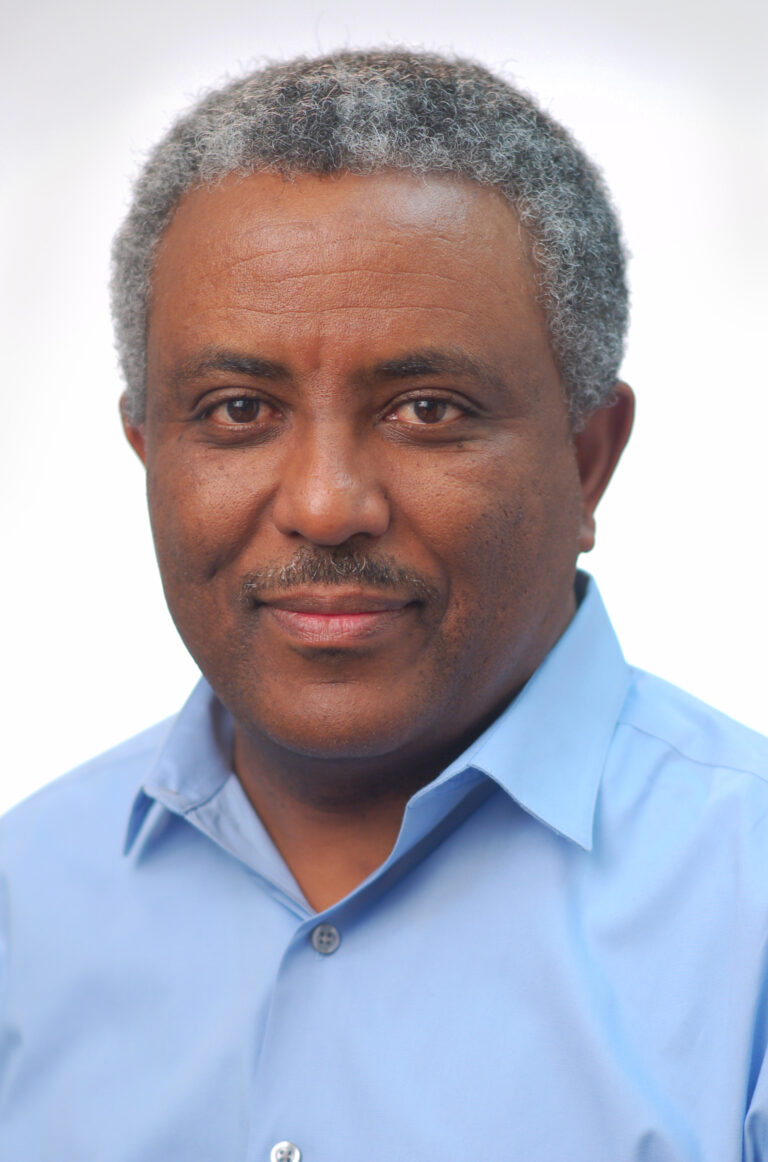
Professor Belay B. Demoz
Principal Special (Full Prof) · Tenured
Department of Physics Jnt Ctr Earth Sys Technology
College of Natural and Mathematical Sciences
JCET
He/Him/His/Himself
About
Dr. Demoz has several years of research and management experience in private industry, government, and Academia. He has Chaired national and international Committees and editorial boards including the Atmospheric LIDAR Application Studies (CLAS) for the American Meteorological Society; the observing sites subgroup of the the Atmospheric Observation Panel for Climate (AOPC) Working Group on GRUAN (WG-GRUAN); Advisory Boards at UCAR/NCAR and Charity and Community Organizations. He has organized national and international conferences, experiments, and workshops. He is a Professor in Physics, Foundational PI and Director of the NASA-UMBC Cooperative Centers (Joint Center for Earth Systems Technology (JCET) and GESTAR II), where he still serves as Advisor.
Research interests
Dr. Demoz's research interest covers the broad area of atmospheric observations with a particular emphasis in lidar, radar and Microwave radiometer and their applications in mesoscale observations, climate observation and network design. His is mainly interested in integrating the multiple instruments and their physics in understanding atmospheric dynamics to improve now casting and climate.
Teaching interests
Dr. Demoz's teaching interests are in the areas of atmospheric instrumentation - including lidars, microwave radiometery, and radars, classical mechanics and aerosol and cloud micro-physics. He has lectured in general mechanics and analytical mechanics for several years. He is trained in cloud microphysics and aerosol physics and enjoys teaching these courses.
Education
- Postdoc — University of Illinois-Urbana (UIUC) (1994)
-
Ph D, Atmospheric Physics
— University of Nevada-Reno;, Desert Research Institute (DRI) (1992) Sierra Nevada Winter Storms: A Study Using Microwave Radiometry, Ice crystal and Isotopic Technique
-
MS, Atmospheric Physics
— University of Nevada-Reno (1989) A Study of the Ratio of 18O/16O in Relation to Physical Cloud Characteristics in Precipitation from Ice-Phase Winter Storms over the Sierra Nevada
- BS, Physics — Asmara University (1984)
Publications
- A case study of Mid-Atlantic nocturnal boundary layer events during WAVES 2006 2014
- The relationship between El Niño Southern Oscillations and cereal production in Sahel 2014
- Double Bright Band Observations with High-Resolution Vertically Pointing Radar, Lidar, and Radiometer 2014
- Identifying anthropogenic 'hotspots' and management of water resources in Lake Chad Basin. 2014
- Review of Multiple-payload Radiosonde Sounding Configurations for Determining Best-Practice Guidance for GRUAN
- Characterization of West African jet streams and its association to ENSO events and rainfall in ERA- Interim 1979 - 2011
Presentations
- EPAMS Profiler and Ceilometer Network 2020
- Using Lidar and Machine Learning to Identify Planetary Boundary Layer Heights 2019
- EPAMS Profiler and Ceilometer Network 2019
- Evaluation of Lidars/Ceilometers, and Determination of Mixing Layer Heights for PAMS 2018
- Lidar Profiling the lower Troposphere: experience from PECAN 2017
- Summary and highlights of PECAN FP2 measurements 2016
- The National Weather Service Ceilometer Planetary Boundary Layer Project Update 2016
- Determining Planetary Boundary Layer Heights with Ground-Based Lidar and Wind Profiler on Short Spatial and Temporal Scales 2015
- CREST Lidar Network Observations for Air Quality and Wind Energy Research 2014
Grants and Contracts
- NOAA Cooperative Science Center in Atmospheric Science and meteorology (NCAS-M) 2016
- NOAA Cooperative Science Center in Atmospheric Science and meteorology (NCAS-M) 2016
- Support of NOAA commitment to Climate Observing System (GCOS) reference Upper Air Network (GRUAN) 2014
- Investigate and Validate the effectiveness of the CL31 as a lidar network 2014
- Investigate and Validate the effectiveness of the CL31 as a lidar network 2014
- PECAN: Ground based Lidar and 2014
Courses Taught
- Special Topics
- Atmospheric Physics II