



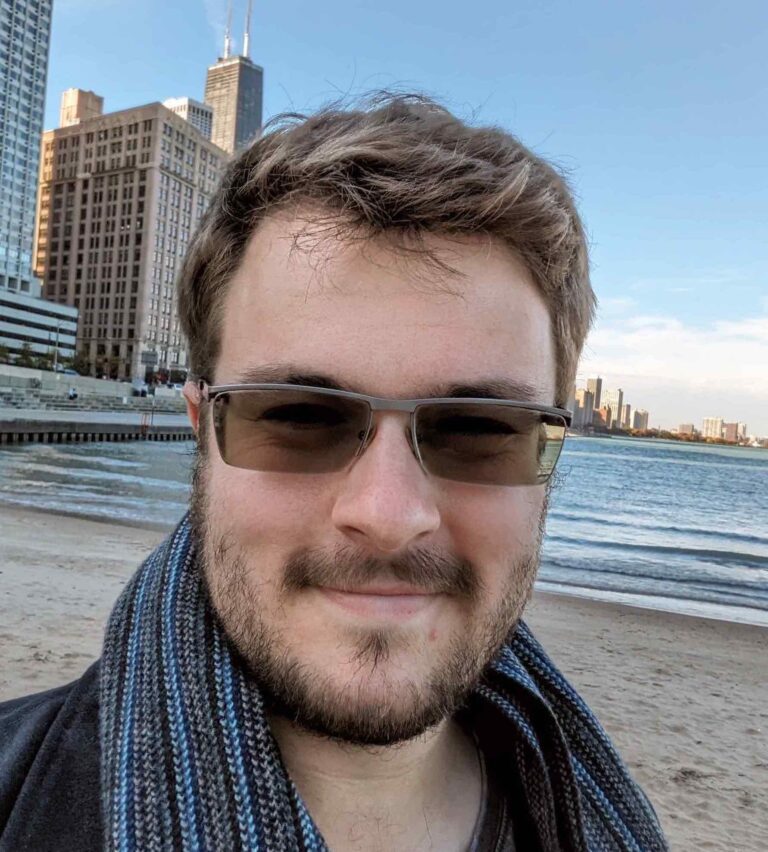
Dr. David James Turner
Assistant Research Scientist · Non-Tenure Track
Center for Space Science and Technology
College of Engineering and Information Technology
He/Him/His/Himself
About
I am originally from the United Kingdom, and earned both my Astrophysics MPhys (integrated masters) and Astronomy PhD from the University of Sussex, working with Professor Kathy Romer on X-ray emissions from galaxy clusters. During that time I became very focused on
Research interests
I am originally from the United Kingdom, and was born in Winchester, in the south of England. I was always very interested in anything technical or scientific, even when I was a younger child. During primary and secondary school, I was much more interested in the idea of building robots than I was astrophysics, but when I got to my A-levels I was won over by Physics and Astrophysics. It helped that they let me do fun experiments like building my own induction coils to measure the efficiency of wireless energy transmission, and that I got to build a piece of software to simulate and teach Kepler’s laws of motion.
I earned both my Astrophysics MPhys (integrated masters) and Astronomy PhD from the University of Sussex, working with Professor Kathy Romer on X-ray emissions from galaxy clusters. Specifically I directly measured large sets of galaxy cluster masses from X-ray data, in order to support the galaxy cluster cosmology efforts of large galaxy and galaxy cluster surveys such as the Dark Energy Survey (DES).
During my PhD I became very focused on the idea of open-source scientific practice and software, believing that it was the best way to make any result truly replicable by others. The field of astrophysics in particular benefits enormously from the countless openly available sets of observation and catalogs of results. I endeavored to lower the barriers to entry for using X-ray data, to allow the full exploitation of the large archives of high-energy observations available to the astrophysics community.
I moved to the US in late 2022 for a postdoctoral position at Michigan State University, working with Professor Megan Donahue on the X-ray analysis of a sample of local galaxy clusters, though we also branched out into galaxy groups. During this time I created more open-source X-ray software, this time to make it easier to manage and process large sets of multi-mission X-ray data, and gained experience in many other areas of astrophysics thanks to Megan’s mentorship and depth of knowledge. This postdoc was instrumental in starting to turn me into a more focused and complete scientist (though that is still very much a work in progress).
Finally, I started my research faculty (assistant research scientist) position at the University of Maryland, Baltimore County in the summer of 2025, as part of CRESST II, and the new staff scientist at NASA’s High Energy Astrophysics Science Archive Research Center (HEASARC).
Teaching interests
- Extragalactic astrophysics
- Observational astronomy
- Python programming
- Proper software development practices for astrophysics
Education
-
Ph D, Astronomy
— University of Sussex (2022) Exploiting the XMM science archive; for X-ray galaxy cluster mass calibration and other astrophysical applications
-
Other, Astrophysics
— University of Sussex (2018) FCtrlA: Model independent X-ray mass measurements for the XMM Cluster Survey
Publications
- Are HI and OVI absorbers beyond the virial radius of groups and clusters of galaxies showing us the grandest large scale structures in warm gas?