



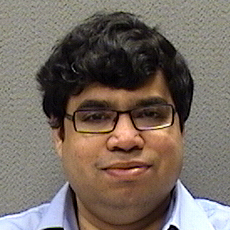
Dr. Nirmalya Roy
Professor · Tenured
Department of Computer Science and Electrical Engineering Department of Information Systems
College of Engineering and Information Technology
He/Him/His/Himself
About
Dr. Nirmalya Roy is a Professor in the Information Systems department and the director of the Mobile, Pervasive and Sensor Computing (MPSC) Lab at the University of Maryland, Baltimore County (UMBC). He is also the associate director of the Center for Real-time Distributed Sensing and Autonomy (CARDS) at UMBC. He is a co-PI on ArtIAMAS (AI and Autonomy for Multi-Agent Systems) cooperative research agreement of approximately $20 million from Army Research Lab (ARL), 2021-26 in collaboration with the University of Maryland, College Park. He has been awarded ARL, NSF EAGER, NSF US-India Collaborative Research, NSF REU Site, NSF CAREER, Alzheimer’s Association, NSF CPS (Cyber-Physical Systems), NSF GCTC (Global City Team Challenge), Office of Naval Research, Constellation E2: Energy to Educate, and UMB-UMBC Research and Innovation Partnership grants, totaling ~$25 million. His current research interests include use-inspired AI/ML and human-centric data science with applications to smart health, cyber-physical systems, IoT, robotics and autonomy. He is a recipient of best paper awards in IEEE/ACM DCOSS 2023, SmartComp 2023 & 2022, SPIE 2022, CHASE 2021, IGSC 2020, Elsevier PMC 2020, QShine 2009, PerCom 2006; best paper award nominations in SmartComp 2018 & PerCom 2011; and Institute for Infocomm 2011 best research paper award. Prior to joining UMBC, he was a Clinical Assistant Professor in the School of Electrical Engineering and Computer Science department at the Washington State University. He worked as a Research Staff Member in the Institute for Infocomm Research (I2R) in Singapore from 2010 to 2011 and as a postdoctoral fellow in the Electrical and Computer Engineering department at the University of Texas at Austin from 2008 to 2009. He received his M.S. and Ph.D. degrees in Computer Science and Engineering from the University of Texas at Arlington in 2004 and 2008, respectively. He received his B.E. degree in Computer Science and Engineering in 2001 from Jadavpur University, India. More information about him, his students and research can be found at his lab homepage https://mpsc.umbc.edu/
Research interests
IoT, Pervasive Computing, Middleware and Sensor Networks, Intelligent Systems, Smart Environments (Pervasive Healthcare and Smart Buildings), Cyber-Physical Systems, Robotics
Teaching interests
Computer Networks, Machine Learning, Mobile, Pervasive and Ubiquitous Computing, Computational Methods, Data Structure and Algorithms
Education
- Other, EECS/Software Engineering — University of Texas at Austin (2010)
-
Ph D, Computer Science and Engineering
— University of Texas at Arlington (2008) A Context-aware Learning, Prediction and Mediation Framework for Resource Management in Smart Pervasive Environments
-
MS, Computer Science & Engineering
— University of Texas at Arlington (2004) Providing Better QoS Assurance to Next Generation Ubiquitous Grid Users
- BS, Computer Science & Engineering — Jadavpur University (2001)
Publications
- mitation-Inspired Semantic-Guided Distillation for User-Conditioned Memorability Prediction 2025
- CALM: Multimodal Cognitive Load Assessment Framework via Engineered and Explainable Features 2025
- QuasiNav: Asymmetric Cost-Aware Navigation Planning with Constrained Quasimetric Reinforcement Learning 2025
- TAVIC-DAS: Task and Channel-Aware Variable-Rate Image Compression for Distributed Autonomous System 2025
- EEGAmp+: Investigating the Efficacy of Functional Connectivity for Detecting Events in Low-Resolution EEG 2024
- Unsupervised Domain Adaptation for Action Recognition via Self-Ensembling and Conditional Embedding Alignment 2024
- AcouDL: Context-Aware Daily Activity Recognition from Natural Acoustic Signals 2024
- ARSFineTune: On-the-Fly Tuning of Vision Models for Unmanned Ground Vehicles 2024
- EnCoMP: Enhanced Covert Maneuver Planning with Adaptive Target-Aware Visibility Estimation using Offline Reinforcement Learning 2024
- Is Edge Computing Always Suitable for Image Analysis? An Experimental Analysis 2024
- TopoNav: Topological Navigation for Efficient Exploration in Sparse Reward Environments 2024
- VIVAR: Learning View-Invariant Embedding for Video Action Recognition 2024
- β-Decode: Attention-based Decoding Temporal Artifacts via Unsupervised β-Variational Autoencoder 2024
- A Novel ROS2 QoS Policy-enabled Synchronizing Middleware for Co-simulation of Heterogeneous Multi-Robot Systems 2023
- A Systematic Study on Object Recognition Using Millimeter-wave Radar 2023
- An Online Continuous Semantic Segmentation Framework with Minimal Labeling Efforts 2023
- CoverNav: Cover Following Navigation Planning in Unstructured Outdoor Environment with Deep Reinforcement Learning 2023
- HeteroEdge: Addressing Asymmetry in Heterogeneous Collaborative Autonomous Systems 2023
- SrPPG: Semi-Supervised Adversarial Learning for Remote Photoplethysmography with Noisy Data, 2023
- Unsupervised spatio-temporal anomalous thermal behavior monitoring of inside-built environments 2023
- Flood Detection using Semantic Segmentation and Multimodal Data Fusion 2021
- Monitoring Thermal Condition inside Built Environment with Longitudinal Thermal Images 2021
- Trending Machine Learning Models in Cyber-Physical Building Environment: A survey 2021
- Temporal Clustering Based Thermal Condition Monitoring in Building 2021
- OMAD: On-device Mental Anomaly Detection for Substance and Non-Substance Users 2020
- Localized Flood Detection With Minimal Labeled Social Media Data Using Transfer Learning 2019
- Tracking and Behavior Augmented Activity Recognition for Multiple Inhabitants 2019
- Active Deep Learning for Activity Recognition with Context Aware Annotator Selection 2019
- Event Characterization and Separation using Wavelet Signatures 2019
- Detecting Common Insulation Problems in Built Environments using Thermal Images 2019
- Developing Machine Learning based Predictive Models for Smart Policing 2019
- A Bayesian Data Analytics Approach to Buildings' Thermal Parameter Estimation 2019
- Analyzing The Emotions of Crowd For Improving The Emergency Response Services. 2019
- SocialAnnotator: Annotator Selection by Exploiting Social Relationships in Activity Recognition 2018
- HappyFeet: Challenges in Building an Automated Dance Recognition and Assessment Tool 2018
- DeActive: Scaling Activity Recognition with Active Deep Learning 2018
- A Flash Flood Categorization System using Scene-Text Recognition 2018
- Analyzing the Sentiment of Crowd for Improving the Emergency Response Services 2018
- Forecasting Gas Usage in Large Buildings using Generalized Additive Models and Deep Learning 2018
- Tracking Disaster Response from Social Media with Wavelet Analysis 2018
- Sleep Well: A Sound Sleep Monitoring Framework for Community Scaling 2018
- UnTran: Recognizing Unseen Activities with Unlabeled data using Transfer Learning 2018
- Scaling Human Activity Recognition via Deep Learning-based Domain Adaptation 2018
- Recent Machine Learning Trends in Human Activity Recognition - A Survey 2018
- Firearm Detection Using Wrist Worn Tri-Axis Accelerometer Signals 2018
- HappyFeet: Recognizing and Assessing Dance on the Floor 2018
- Non-Intrusive Air Leakage Detection from Residential Homes 2018
- Wearable Sensor-based Location-specific Occupancy Detection in Smart Environments 2018
- Longitudinal Energy Waste Detection with Visualization 2017
- Active Learning Enabled Activity Recognition 2017
- Unseen Activity Recognition: A Hierarchical Active Transfer Learning Approach 2017
- COAR: Collaborative and Opportunistic Human Activity Recognition 2017
- Demo: SenseBox: A Low-Cost Smart Home System 2017
- SoccerMate: A Personal Soccer Attribute Profiler using Wearables 2017
- TransAct: Transfer learning Enabled Activity Recognition 2017
- Smartphone-based Mobile Gunshot Detection 2017
- Infrequent Non-Speech Gestural Activity Recognition using Smart Jewelery: Challenges and Opportunities for Large Scale Adaptation 2016
- A Smart Segmentation Technique Towards Improved Infrequent Non-Speech Gestural Activity Recognition Model 2016
- CACE: Exploiting Behavioral Interactions for Improved Activity Recognition in Multi-Inhabitant Smart Homes 2016
- Automated Functional and Behavioral Health Assessment of Older Adults with Dementia 2016
- Active Learning Enabled Activity Recognition 2016
- Quality and Context Aware Smart Healthcare 2016
- Quality- and Energy-Sensitive Determination of Multiple Contexts in 2016
- Mobeacon: An iBeacon-Assisted Smartphone-based Real Time Activity Recognition Framework 2015
- Infrastructure-less Occupancy Detection and Semantic Localization in Smart Environments 2015
- Mobeacon: An iBeacon-Assisted Smartphone-based Real Time Activity Recognition Framework 2015
- SensePresence: Infrastructure-less Occupancy Detection for Opportunistic Sensing Applications 2015
- Sleep Well: A Sound Sleep Monitoring Framework for Community Scaling 2015
- Infrastructure-less Occupancy Detection and Semantic Localization in Smart Environments 2015
- AARPA: Combining Mobile and Power-line Sensing for Fine-grained Appliance Usage and Energy Monitoring 2015
- Acoustic Based Appliance State Identifications for Fine Grained Energy Analytics 2015
- Demo Abstract: A Microphone Sensor based System for Green Building Applications" 2015
- GeSmart: A Gestural Activity Recognition Model for Predicting Behavioral Health 2014
- High-Order Moments Conditional Domain Adaptation Networks for Wearable Human Activity Recognition
- RespFormer: A Motion-Guided Temporal-Frequency Multimodal Fusion Transformer for Contactless Respiratory Monitoring
- CAM-Seg: A Continuous-valued Embedding Approach for Semantic Image Generation
Presentations
- Building Robust Deep Learning Models for Multi-domain Interactions of Autonomous Cyber-Physical Systems 2025
- MemGaze: Imitation-Inspired Semantic-Guided Distillation for User-Conditioned Memorability Prediction 2025
- Scalable and Adaptable Cross-Domain Autonomous Health Assessment 2025
- E2RespUNet: End-to-End Respiratory Signal Reconstruction and Rate Prediction Using a Unified Attention-Enhanced U-Net 2025
- Contactless Physiological Health Sensing: Challenges and Opportunities 2025
- CoOpTex: Multimodal Cooperative Perception and Task Execution in Time-critical Distributed Autonomous system 2025
- Sensors, Cameras & Robots for Smart Health, Green Building & Complex Environments: CPS Challenges, Solutions & Opportunities 2025
- Sensors, Cameras & Robots for Smart Health, Green Building & Complex Environments: CPS Challenges, Solutions & Opportunities 2025
- Designing Camera-based Physiological Health Parameter Sensing on the Edge 2025
- Sensors, Cameras & Robots for Smart Health, Green Building & Complex Environments: CPS Challenges, Solutions & Opportunities 2025
- RobSenCom: A Middleware to Improve the Connectivity between Heterogeneous Robots and IoT 2023
- Unsupervised spatio-temporal anomalous thermal behavior monitoring of inside-built environments 2023
- Multi-modal Sensing, Cross-Domain Modeling and Community Deployments in Smart Environments”, 2020
- Keynote Talk: “A Cross-Domain Machine Learning Framework for Pervasive Sensing” 2020
- A Cross-Domain Machine Learning Framework for Scalable Human Activity and Behavior Recognition, 2020
- AI + IoT + ML for Innovative Smart Computing Applications 2018
- Automated Functional and Behavioral Health Assessment of Older Adults 2018
- Automated Functional and Behavioral Health Assessment of Older Adults: Challenges in the Field/Deployment 2018
- A Cross-Domain IoT Framework for Human Activity and Behavior Recognition 2018
- IoT for Longitudinal Health Monitoring and Assessment, 2018
- Journey of my CAREER Award 2018
- A Cross-Domain IoT Framework for Human Activity and Behavior Recognition 2018
- Physiological Health Assessment 2017
- COAR: Collaborative and Opportunistic Human Activity Recognition 2017
- Distributed Data Analytics for Real-Time Monitoring and Detection of Flash Floods in Smart City”, 2017
- Scaling Human Activity Recognition Via Deep Transfer Learning 2017
- TransAct: Transfer learning enabled activity recognition 2017
- Wearable & IoT for Cognitive Health Assessment: Significance and Challenges 2017
- Wearable & IoT for Cognitive Health Assessment 2016
- CACE: Exploiting Behavioral Interactions for Improved Activity Recognition in Multi-Inhabitant Smart Homes 2016
- Automated Functional and Behavioral Health Assessment of Older Adults with Dementia 2016
- UMB-UMBC Partnership 2016
- Quantum Machine Learning for Big Data Cyber Security Analytics 2016
- May I live Independently with IoT and Machine learning? 2016
- May I live Independently with IoT and Machine learning? 2016
- May I live Independently with IoT and Machine learning? 2016
- Deep Data Analytics for Detecting Abnormal Human Behavior in Public Spaces 2015
- Scalable Smart Home Activity Recognition Technologies 2015
- Green Building Energy Analytics: Opportunities & Challenges 2015
- Green Building Energy Analytics 2014
- Immersive physiotherapy: Challenges for smart living environments and inclusive communities 2014
- Monitoring patient recovery using wireless physiotherapy devices 2014
Grants and Contracts
- SBIR Phase I: AI Powered Invisible Fence to Foster Human-Wildlife Harmony, 2025
- Planning: AI-Ready: TRACE: Testbed for Disaster Resilience Auditing and Crisis Evaluation 2025
- I-Corps: Translation Potential of an Artificial Intelligence System for Wildlife Detection and Deterrence for Protecting Plants and Wildlife 2025
- Student Travel Grant for 2024 IEEE International Conference on Pervasive Computing and Communications (PerCom) 2023
- Collaborative Research: Conference: NSF/TIH PI Meeting and Workshop for Indo-US Research Collaboration 2023
- Building Robust Deep Learning Models for Securing the Multi-domain Interactions of Autonomous Cyber-Physical Systems 2023
- US-India Collaborative: Research Supplement CNS: Detecting Behavioral Health Disorders of Older Adults using Self-supervised Learning and Causal Reasoning 2022
- III: Small: SocialAnnotator: Selecting Efficient Data Annotators by Exploiting Social Relationships and Contexts 2019
- FW-HTF Theme 2: Automated Dance Assessment and its Ramification on the Future Work of Dancers 2018
- UMBC-USNA Cyber Innovation Grants: Optically networked semiconductor spin qubits via liquid crystal mediated ordering, Office of Naval Research, 2018
- CAREER: Scalable and Adaptable Cross-Domain Autonomous Health Assessment 2018
- Distributed Data Analytics for Real-Time Monitoring and Detection of Flash Floods in Smart City 2016
- Energy Education through Green Buildings 2015
- CPS: Breakthrough: Low-cost Continuous Virtual Energy Audits in Cyber-Physical Building Envelope 2015
- QHealth: Quality-Adaptive Models and Middleware for Situation Recognition in Pervasive Healthcare 2015
- CSR: Small: An Energy-Efficient Multi-Modal Context Inference Framework for Continuous Health Monitoring 2015
- Sensor Technology Box for Smart Health 2015
- Automated Functional and Behavioral Health Assessment of Older Adults with Dementia 2015
- A hybrid semiconductor-soft matter device as a route to a scalable, self-assembled spin register for optical quantum error correction 2015
- UMBC-USNA Cyber Innovation Grants: A hybrid semiconductor-soft matter device as a route to a scalable, self-assembled spin register for optical quantum error correction 2015
- Energy Education through Green Buildings 2014
- QACM: Quality-adaptive Ambiguous Context Mediation Framework for Pervasive Computing 2014
- Powerline Controlled Appliance Usage-based Fine-Grained Energy Analytics in Green Buildings 2014
- SURF: A Sensor-based Context Uncertainty Reasoning Framework for Pervasive Computing at 2014
- Energy Education through Green Buildings 2013
- SCC-CIVIC-PG Track B: FloodNet: Community-driven Cyber-Physical Network for Resilient Flood Monitoring and Alerting in Urban Environment
- SCC-CIVIC-PG Track B: FloodNet: Community-driven Cyber-Physical Network for Resilient Flood Monitoring and Alerting in Urban Environment
- SCH: GDRSense: Robust Sensing and Fair Predictive Models for Psychotropic Medication Management
- CPS: Small: An Automated Dance Assessment System for Enhancing the Student-Teacher Interactions
Research in Progress
- Infrastructure-Assisted Smartphone-based ADL Recognition in Multi-Inhabitant Smart Environments 2013
Patents and Intellectual Property
- Scalable Activity Recognition for Independent Living Applications 2015
Courses Taught
- Computational Methods for IS R
- Spec Topics In IS