All posts by: Bobby Lubaszewski '10, M.P.S. '23


“The Meyerhoff Effect”—Alycia Marshall ’95 multiplies opportunities for underrepresented students and faculty

They say a rising tide lifts all ships—the idea that when an ecosystem prospers, everyone within it is propelled upward by the same powerful current. The same can be said for UMBC’s Meyerhoff Scholars Program. At least that was the experience of Alycia Marshall ’95, mathematics. The Meyerhoff tide eventually lifted her higher than she imagined: president of the Community College of Philadelphia

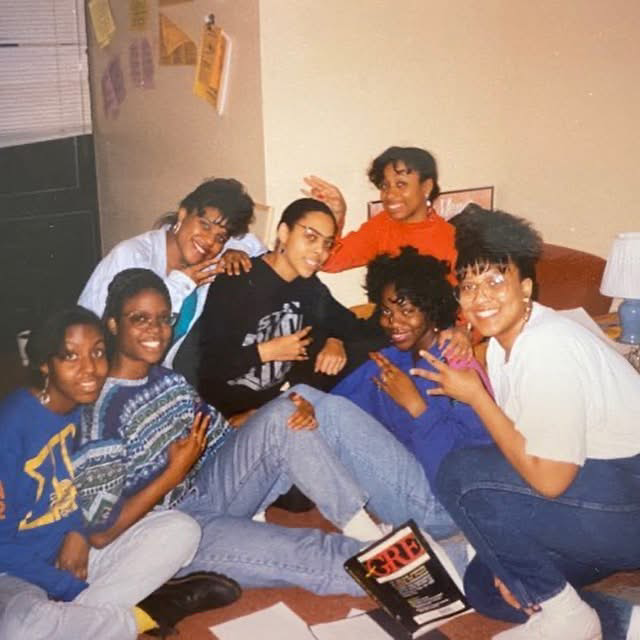
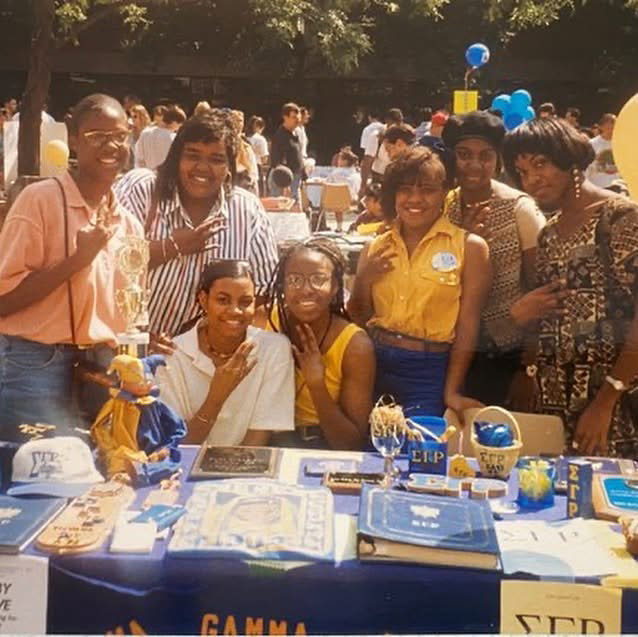
As an undergraduate student at UMBC, Marshall wasn’t a Meyerhoff Scholar by title, but she felt like one by proximity. Many of her friends were Meyerhoff Scholars. Her peers were Meyerhoff Scholars. Her line sisters Sigma Gamma Rho Sorority Incorporated were Meyerhoff Scholars. Everywhere she turned, she was surrounded by Meyerhoff Scholars.

“Even though I wasn’t a Meyerhoff, I was sucked into this culture of high achievement,” says Marshall. “I call it ‘the Meyerhoff Effect.’”

Pictured above: Marshall and members of Sigma Gamma Rho Sorority Incorporated on campus.

Brilliance was the baseline, and everyone strived to do their absolute best. It became a friendly peer-to-peer competition. But more than that, for Marshall, it was inspiring to see so many high-achieving Black students in one place, pushing each other to be the best versions of themselves.

“I had been in talented and gifted classes my entire school career,” says Marshall. “I was used to being around high-achieving students, but I was always the one person of color in the room. I was just floored to actually see so many people that looked like me who were high achieving at one time, in one place.”

For Marshall, that “Meyerhoff Effect” caused a fundamental shift in her internal barometer for success. She began to see her own potential through a wider lens—one that would eventually take her from a shy undergraduate student at UMBC to the President’s Office at CCP.

The teaching bug

Marshall started her UMBC journey as a biology major. Math and teaching were not even on her radar as potential careers—but that all changed pretty quickly during Marshall’s first year. Her “aha moment” occurred during a Calculus 1 lecture. Marshall was doing well in the course, but she knew she could do even better. She wanted that “A.” So, when the professor offered extra credit to anyone who could go to the board and explain the solution to a problem, Marshall couldn’t help herself. While other students were intimidated by the hundreds of students in that lecture hall class, and the difficulty of the material, Marshall regularly volunteered. She found that she wasn’t just good at solving the equations—she was good at communicating the logic behind them. “I got something out of that,” she says. Before she knew it, her classmates were asking to study with her, and Marshall started tutoring a few of her peers.

“That experience encouraged me to think about mathematics and teaching as a profession,” says Marshall. 

After graduating from UMBC in 1995 with a B.S. in mathematics, Marshall began her teaching career at Bishop McNamara High School, a private school in Forestville, Maryland, before moving to Frederick Douglass High School, a public school in Prince George’s County. Around the same time, she began a master’s program at Bowie State University, eventually earning her masters of arts in teaching in 1998. Then, she got the higher education itch.

Education that changes lives

“I was very intrigued by the idea of teaching at the college level,” says Marshall, who quickly found an adjunct role at Anne Arundel Community College (AACC), teaching developmental math part-time. She was teaching high school students during the day and non-traditional college students twice a week in the evenings for AACC at Fort George G. Meade, a United States Army installation in Maryland.

“That was a whole different experience for me,” says Marshall, “understanding how important education was and how people were seeking that to change their lives.”

She was hooked. So, when a full-time position opened up, Marshall jumped at the opportunity and for the next 23 years she built an impressive career at AACC. During this time, Marshall also earned a Ph.D. in mathematics education from the University of Maryland, College Park in 2007. Her career saw her move from a professor of mathematics to the first African American woman to chair the department. Eventually, she worked her way up to associate vice president of learning and academic affairs. However, the work Marshall says she is most proud of is what she’s done throughout her career to support underrepresented students in STEM and leadership—an effort to replicate aspects of the Meyerhoff Scholars Program at the community college level.

When the idea initially occurred to Marshall, the first thing she did was reach out to her mentor, Freeman Hrabowski, III, UMBC president emeritus. He invited Marshall and AACC leaders to UMBC to meet with him and LaMont Toliver, then the director of the Meyerhoff Scholars Program and assistant dean of undergraduate education.

“It was great,” says Marshall. “That never would have happened had it not been for my connection to UMBC, my relationship with Dr. Hrabowski, and his continued interest in supporting me well beyond my graduation.”

The UMBC field trip and a National Science Foundation grant helped Marshall start the Engineering Scholars Program at AACC, connecting underrepresented students with scholarships, mentoring, and support services. Marshall also created the African American Leadership Institute to develop highly qualified, diverse leaders through targeted leadership development to improve the retention rates for this population and increase the diversity of college leadership.

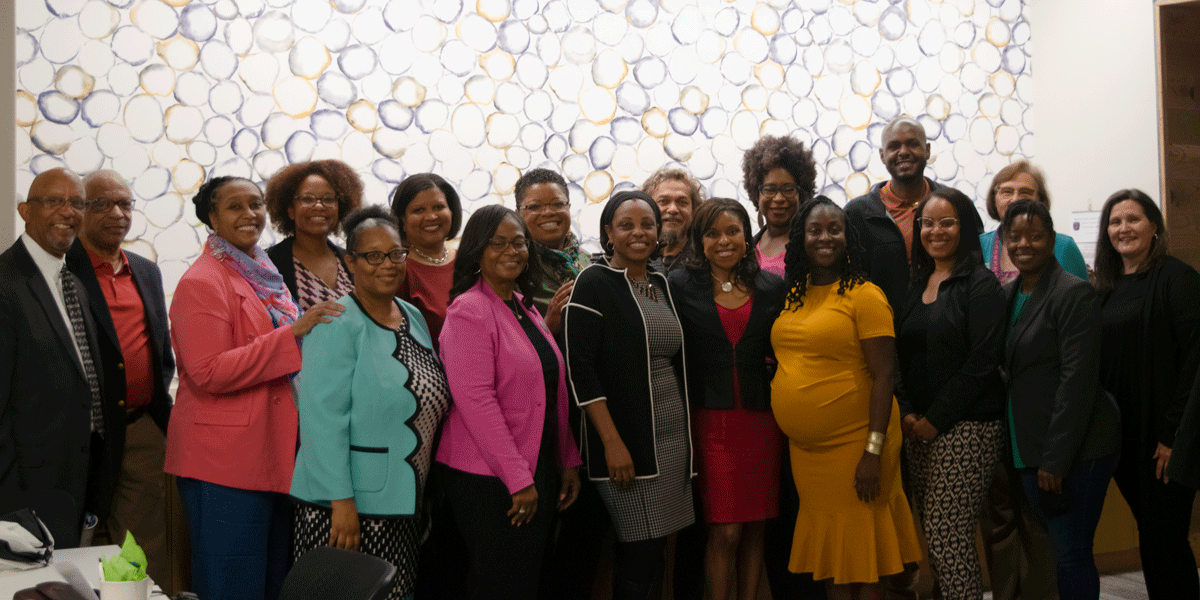
Alycia Marshall and members of The African American Leadership Institute (AALI) at Anne Arundel Community College (AACC).
Marshall (center) at the African American Leadership Institute (AALI) closing session at Anne Arundel Community College (AACC).

For years after that, whenever Hrabowski was in a room with Marshall, he would introduce her with a bold proclamation: “This is Dr. Marshall. She’s a UMBC graduate, and she’s going to be a president one day.” 

“When Doc pours into people that way, he has a way of speaking their future into them,” says Marshall. “I leaned on that. Knowing that he knew I could do it helped me know I could do it, too.” 

Marshall left AACC in 2022 to become the provost and vice president for academic and student success at the Community College of Philadelphia (CCP). And it didn’t take long for her to make an impact. Soon after joining CCP, Marshall started the Aspiring Leaders Fellowship Program for employees interested in moving into higher education leadership roles. The program, now in its third cohort, matches participants with senior leaders from different institutions who serve as mentors.

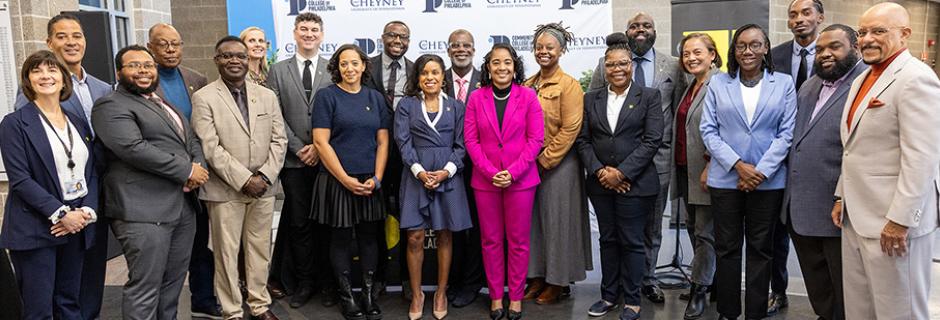
Marshall and members of the Aspiring Leaders Fellowship Program at the Community College of Philadelphia.
Marshall (center) and members of the Aspiring Leaders Fellowship Program at the Community College of Philadelphia.

Marshall also started a new faculty onboarding program to provide newly hired faculty the tools they need to succeed—time to learn ways to enhance their pedagogical practices and build on their teaching skills in their first year at CCP—as well as a new department head onboarding program.

“There’s a similar theme with all this about professional development, continuous improvement, and making sure folks have the tools that they need,” says Marshall.

In 2025, Hrabowski’s prophecy came true. Marshall was named CCP president, the first Black woman to serve in the role in a permanent capacity.

Upon receiving the news, one of Marshall’s first calls was to the man who believed in her future before she believed it herself.

“When I told Doc I got the job…he was emotional,” says Marshall. “He was so very proud of me. It was a wonderful day.”

Marshall at at graduation with the Mayor of Philadelphia and the Community College of Philadelphia's student graduation speaker.
Marshall (center) at graduation with Cherelle Parker, the Mayor of Philadelphia, and the Community College of Philadelphia’s student graduation speaker.

Plot twist— Michelle Corpora ’03 took a nonlinear path to becoming NYT bestselling author

It was around five o’clock on a Wednesday in May, and Michelle Jabès Corpora ’03, English and theatre, was on her sofa watching her favorite British murder mystery on TV. It had been a long shot to think her newest book, His Face Is the Sun, would hit the New York Times (NYT) bestsellers list, and since she hadn’t heard anything and it was getting late, she figured it wasn’t meant to be. 

Buzz! Buzz! Buzz! Suddenly, she looked down at her phone to see a FaceTime call from five different numbers—most of which she didn’t recognize. She quickly answered and saw her agent, editor, assistant editor, and publicists in the group of smiling faces before hearing the four words every author dreams of hearing: “You’re on the list!”

“I just started crying,” recalls Corpora. “I couldn’t believe it.” 

His Face Is the Sun stayed on the NYT Bestsellers Young Adult Hardcover list for five weeks, which the author says was “absolutely unbelievable.”

Where it all began

Corpora’s journey to becoming a NYT bestselling author was not a straight line—far from it. Corpora initially came to UMBC as a Linehan Artist Scholar to study theatre. Because she’d always been passionate about writing and literature, however, she added English as a second major to supplement her studies.

Corpora as ‘Cleo’ AKA Fraulein Kost in a 2001 UMBC Theatre production of Cabaret.

“Learning about drama helped significantly with my approach to character, plot, and pacing,” says Corpora. After UMBC, Corpora earned a master’s degree in Children’s Literature from Hollins University. Then, a few more twists and turns. Among other jobs, Corpora worked as a wedding singer, as a technician in a veterinarian’s office, and volunteered at a wildlife rehabilitation center before taking a big career leap and moving to New York City to try and get a job in children’s publishing.

Pictured left: Corpora as ‘Cleo’ AKA Fraulein Kost in a 2001 UMBC Theatre production of Cabaret.

New York state of mind

One catch: Corpora didn’t have a full-time job lined up. All she had were two unpaid summer internships at children’s publishing houses. 

“It was a real gamble,” says Corpora, “but I feel like my entire career has been a series of gambles, and they always seem to work out well.”

Corpora landed an editorial assistant position at Greenwillow Books, an imprint of HarperCollins Children’s Books, where she had the opportunity to work on books by legendary authors like Kevin Henkes and Sid Fleischman, among many others. Then came her own children and another career pivot. With the birth of her daughter, Corpora moved into book packaging services.

“Book packaging is an interesting, mostly unknown side of the publishing industry where groups of writers work as a team to create concepts for series fiction,” says Corpora. “The transition was challenging because you really have to let go of ownership over your ideas, and you have to be creative in a collaborative way, which doesn’t come naturally to most people at first.”

Despite the learning curve, Corpora admits that her work as a concept creator really helped her grow as a writer, as she was coming up with ideas, developing them, and also editing manuscripts. “It made me into a jack of all trades,” she says.  

From ghostwriting to ghosts

In 2015, Corpora got her first publishing opportunity after winning an audition to be a ghostwriter for a long-running middle-grade mystery series, eventually writing five books in the series. It wasn’t until 2021, however, that Corpora would see her name on one of her creations. Her next four books, all bearing the name Michelle Jabes Corpora on the cover, were what are known as work-for-hire projects.

“These are usually projects that you audition for,” explains Corpora. “It’s not ghostwriting because your name goes on the books, but usually the publisher has a concept for a book or series they want on their list, and they hire a writer to develop and write that project for them.”

This was the process for her two middle-grade historical fiction novels, The Fog of War and The Dust Bowl, as well as her young adult horror duology, Holly Horror, which was created in partnership with the owners of the classic character, Holly Hobbie.

“Because of my job, I’d become a kind of chameleon,” says Corpora. “I was happy to write whatever book the client wanted. But it also taught me to identify the essence of every story. What makes it good? What makes it human? What’s the heart of this story?”

Michelle Jabès Corpora '03

English

Each step in Corpora’s journey built her foundation as a writer. But at that point, her agent knew she was ready for more.

“She’d seen me grow through all of this, was basically like, ‘It’s time for you to stop auditioning and ghostwriting and start writing your story—something that’s meaningful to you and that’s yours,’” recalls Corpora.

Finding her story 

In 2023, Corpora took her next big gamble: creating not only her own original series, but writing something she’d never tried her hand at before. Epic fantasy. 

“It felt like a big leap of faith at the time. I still had two young daughters, a part-time job, and a very busy life,” says Corpora, “and I was planning to put a lot of hours into a project that might never sell. But once the idea was born, I knew there was no going back.”

The Throne of Khetara series, born from that fateful conversation with her editor, is an Ancient Egyptian-inspired trilogy about a kingdom in turmoil, a forgotten oracle, and four unlikely heroes: a princess, a priestess, a rebel, and a thief.

“My parents and three of my grandparents were immigrants born in Egypt,” says Corpora. “So I grew up hearing stories about Egypt, and became fascinated by Ancient Egyptian history from a very young age.” 

Corpora describes the series as “Ancient Egyptian Game of Thrones for young adults,” and is told from the perspectives of the four main characters.

“That seemed to really resonate strongly with people,” says Corpora, who wanted to showcase the different perspectives in ancient Egypt, including the non-royal population who were most affected by war and conquest.

The trilogy was picked up by Sourcebooks Fire and is currently being published in nine territories so far, including the UK, Italy, France, Germany, Spain, Brazil, Hungary, and Greece. It has also won numerous distinctions, including being on the list of YALSA Top Ten Best Fiction for Young Adults in 2026. 

“It’s been a long and winding road to get here,” says Corpora. “But I’ll always remember UMBC as a place that allows people to find their way in the world, even if your journey might take you off the beaten path.”

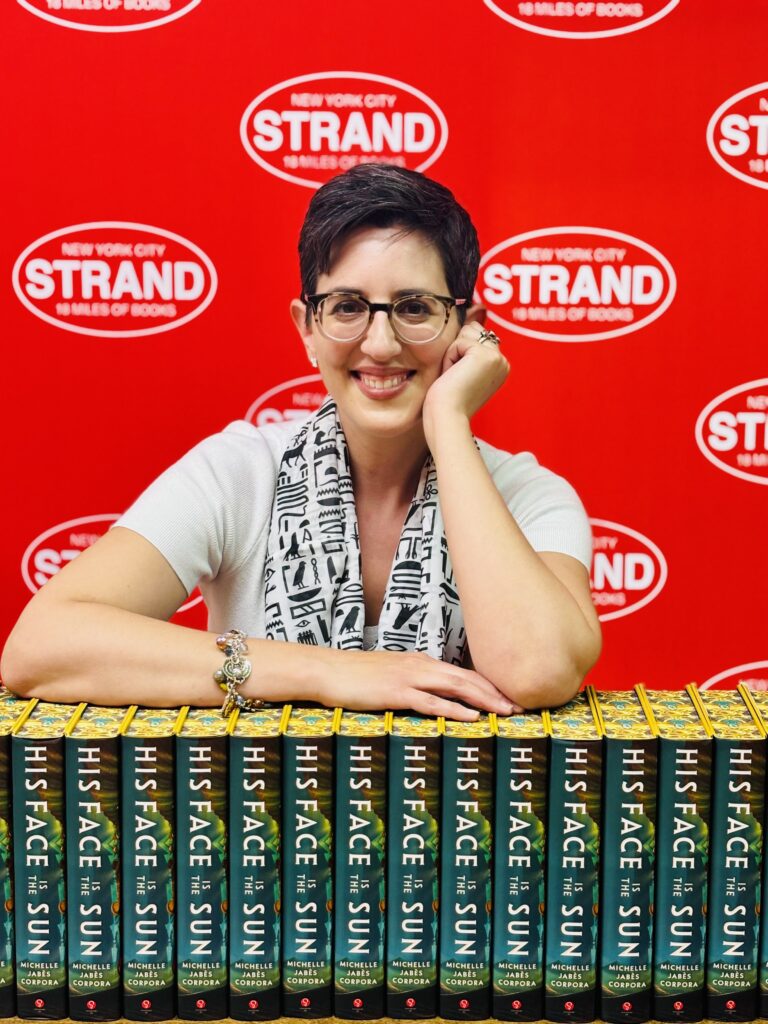
Pictured right: Corpora, a New York Times bestseller, at a book signing event at The Strand Book Store in New York City.

New York Times Bestseller, Corpora, at a book signing event at The Strand Bookstore in New York City. Her arms are leaning against a stack of her books with His face is the sun written across the spines

The molecular storyteller: How Cameron Slayden ’99 advances science through animation

Inside the dark, swirling chaos of a cell, drama unfolds. A viral molecule, rendered in electric blue and menacing curves, attempts its invasion. A therapeutic compound swoops in to intercept it like a fighter jet defending its home from alien forces. This is not science fiction; it is the meticulously crafted vision brought to life by Cameron Slayden ’99, interdisciplinary studies, founder, CEO, and creative director at Microverse Studios

Slayden’s team of animators specializes in creating detailed, stunning visuals for biotech, pharmaceutical, and medical device companies, illustrating how their technologies operate at the most granular level—on a cellular and molecular scale. “We never copy other people,” says Slayden. Instead, his team embraces metaphor—visualizing neurons as jellyfish tentacles or lightning bolts—and superimpose that artistic aesthetic onto the scientific imagery.

It’s not enough for Slayden to just be a 3D animator. He also needs to fully understand the science—satisfying practicing scientists with his two-minute animation while compelling venture capitalists to invest millions. “I have to balance clarity of message to reach multiple levels of audience with enough accuracy so that the underlying message is unimpeachable,” says Slayden. 

This is a video animation Microverse Studios recently completed for Excellergy, a biotechnology company developing a first-in-class portfolio of trifunctional effector cell response inhibitors (ECRIs) to combat severe allergic diseases and help improve patient quality of life.

This unique balance of artistic flair and scientific rigor is the direct result of a path galvanized over three decades ago. For his pioneering work in scientific visualization, combining the rigorous inquiry of science with the persuasive power of art, Slayden is being recognized with an Outstanding Alumni award at the 2025 UMBC Alumni Awards on Wednesday, October 29. His career exemplifies the interdisciplinary spirit UMBC fosters, proving that to truly understand the world, one must be able to both analyze it like a scientist and appreciate it like an artist.

Illustrations have more value than just beauty

Cameron Slayden holding a microscope.
Slayden holding a microscope.

Even as a 16-year-old student at Suitland High School in Prince George’s County, Maryland, Slayden was already balancing his passion for art with his love of science—but he had yet to discover how the two intertwined. At this time, Slayden had won multiple Gold Key awards, the highest regional prize in the Scholastic Art and Writing Awards, a competition for students in grades 7-12, which, he admits, had given him a “hugely inflated ego.” Then, during one biology class, inspiration struck while studying chloroplasts, the organelles in plant cells that are responsible for photosynthesis.

“The illustration in the textbook was awful, really ridiculous, extremely simplified,” says Slayden.

Next to the illustration, however, was a cross-section of the cell created from a tunneling electron microscope, which creates images at an extremely small scale, down to resolving individual molecules. Immediately, Slayden began to notice differences between the illustration and the tunneling electron micrograph. That’s when his pencil got to work. He began to sketch a more detailed illustration of the chloroplast that better represented the intricate details of the organelle. 

“When I was done with that drawing, I remember realizing that that illustration had more value than just being pretty,” says Slayden. “It carried real information about the world, and it was valuable to humanity in that way. And at that moment, I realized that was the kind of art that I wanted to do.”

The rest of Slayden’s life would be guided by that moment. From then on, he used every opportunity to hone his craft—to envision how each tiny detail would translate to paper.

“When you’re drawing something, you’re bringing it through your visual cortex and through all of the processing,” explains Slayden. “Your brain is creating a three-dimensional model of the object in your head, and then you’re bringing it out through your motor cortex onto the paper. You come away with a much deeper understanding of the thing that you were just drawing.” 

Fruitful friction

Around the same time Slayden was looking into colleges, something big was happening at UMBC. Earl and Darielle Linehan, with a deeply held belief in the importance of the arts in society, had recently made a generous gift to the university to establish the Linehan Artist Scholars Program. Slayden applied in the program’s inaugural year and was then offered a full ride to UMBC as one of the first cohort of  Linehan Artist Scholars.

Slayden seized the opportunity, working with his advisor, Stephen Bradley, to craft an interdisciplinary course load that seamlessly merged UMBC’s stellar biology program with the visual arts curriculum. While the science courses provided the foundational accuracy, it was the friction in the art program that proved transformative.

“There was an artistic journey that I had to go through,” says Slayden. “UMBC’s art program forced me to dig deep and crack open my inner reservoirs of creativity and start to actually explore producing an emotional response in my audience.”

Today, that emotional engagement is the key to the success of Microverse Studios, transforming dry scientific information into a memorable, persuasive story. However, the greatest impact UMBC had on Slayden and his career was not a class or a professor, but a fellow student—Olivia Rogers ’99, psychology—now Olivia Slayden, his wife.

Photos above: Slayden and Adam Mueller ’02, M.S. ’03, at the UMBC Jiu-Jitsu club, which he helped found in 1999. Slayden is a black belt in Brazilian Jiu-Jitsu and a second-degree black belt in Japanese Jiu-Jitsu (left). Slayden and Olivia Rogers, now Olivia Slayden, at Cameron’s graduation (right).

Following graduation, Slayden got a job doing medical illustrations for legal cases, but found the work to be “too dark and draining.” He eventually landed the role of scientific illustrator at Science Magazine, creating medical illustrations for the publication and designing a dozen magazine covers. However, after three years, he realized, “I wasn’t at the top of my game.” At the same time, Olivia was also unhappy with her job. It was time for a change.

After Slayden received his master’s degree in medical illustration from Augusta University in Georgia, he and Olivia founded Microverse Studios in 2005. Cameron serves as CEO and creative director, while Olivia serves as chief commercial officer.

When you’re drawing something, you’re bringing it through your visual cortex and through all of the processing. Your brain is creating a three-dimensional model of the object in your head.

Cameron Slayden '99

“I had no idea what I was doing running a business,” says Slayden. “And in the intervening 20 years, I think I’ve kind of finally figured it out, at least for the most part.”

Leaning into new tech

Today, Microverse Studios is a full-service scientific and medical animation studio serving high-profile clients like Pfizer, National Geographic, Bausch + Lomb, and the Howard Hughes Medical Institute (HHMI) as well as notable startups like Elon Musk’s Neuralink. Slayden and his team specialize in taking an idea and turning it into a deployment-ready video for a wide range of audiences, from research scientists to investors and venture capitalists, as well as healthcare providers. 

Slayden attributes the studio’s success to their commitment to staying on top of science and new animation technology. The shift to cloud rendering means complex, high-quality animation that once took a week to output can now be rendered in “literally an hour.” Slayden also believes artificial intelligence will continue to play a larger role in the studio’s work. Rather than viewing it as a threat, he sees AI as another tool at his disposal—the next evolution in how artists create their work.


Mark your calendars for the 2025 Alumni Awards on Wednesday, October 29, at 6 p.m., and consider joining the UMBC community at the Chesapeake Employers Insurance Arena to celebrate Cameron Slayden and the many remarkable individuals receiving awards. The event will be livestreamed for those unable to join in person. You can learn more at alumni.umbc.edu/alumniawards.

Jacqueline Smith ’06, cancer drug researcher and role model for Black chemists

At a young age, Jacqueline Smith ’06, chemistry, already knew what she wanted to study in college. What she wasn’t quite sure about was where that would take her. She interned at several different companies, including L’Oreal, McCormick, and Walgreens, but it wasn’t until she found herself in Katherine Seley-Radtke’s chemistry lab that she found her true passion—academic research. 

Today, Smith is an associate professor of chemistry at Howard University. 

Her research on drug discovery and delivery has been supported by prestigious national awards, including a National Science Foundation CAREER award, as well as the NSF Excellence in Research award. And in October, she will receive a 2025 UMBC Outstanding Alumni Award. 

She recently had an opportunity to reflect on her journey from UMBC to Howard, and everything in between.

Q: What initially brought you to UMBC?

A: I’m a native of the DMV area. I graduated from Eleanor Roosevelt High School in Prince George’s County. I came to UMBC as a Meyerhoff scholar, the M13 cohort, as a chemistry major in 2003. In high school, I didn’t really know much about UMBC, to be honest. It was my guidance counselor who told me to check it out. And then when I came to campus for Meyerhoff selection weekend, it was a different atmosphere than I had ever experienced. The idea of people getting their Ph.D. was kind of new to me. That was attractive and interesting to me as a high-achieving student from the Eleanor Roosevelt Science and Tech program. 

Jacqueline and some of her fellow Meyerhoff M13 cohort having fun.
Jacqueline, right, and some of her fellow Meyerhoff M13 cohort having fun.

Q: What do you love most about the Meyerhoff Scholars Program?

A: The Meyerhoff program really helped me because, even though I was a pretty strong student, I didn’t necessarily have the best study skills. The Meyerhoff Program helps you get organized and get focused, so that when you meet challenges, you have the tools to overcome them. And then personally, the Meyerhoff program has always been very supportive of me throughout my academic and professional career.

Q: You had your daughter while at UMBC. What was that experience like, and where did you find support?

A: It was challenging, of course. But I think that because of the strong foundation I had through the Meyerhoff program, I was able to continue on and eventually complete my degree. I remember vividly that sometimes I had to bring my daughter to class. The teachers were not like, “Oh, no, what are you doing here?” I didn’t get that vibe at UMBC. Even when I had to bring my daughter to the library with me for a study group, my colleagues were very welcoming. So, there was tons of support..

Q: If you could give one piece of advice to a current UMBC student, what would it be?

A: What I would say to current UMBC students is to take advantage of all the wonderful opportunities and support found on campus. Sometimes when you’re young, you think you don’t need to go to a study group or utilize the Writing Center, but they’re valuable. 

Pictured right: Jacqueline holding hands with her daughter and one of her Meyerhoff M13 cohort.

Jacqueline holding hands with her daughter and one of her Meyerhoff M13 cohort.

Q: How did your time at UMBC shape your career aspirations?

A: Coming into UMBC, I knew I wanted to study chemistry, but I really didn’t know what type of chemistry or, really, what different varieties were out there. I was able to explore that at UMBC. In addition to the whole Meyerhoff program experience, which was pivotal to my academic growth, I had a lot of wonderful internship experiences at UMBC, including L’Oreal, McCormick, and Walgreens.

I also worked in Katherine Seley-Radtke’s lab in the chemistry department. Faculty research was a new thing to me, and it intrigued me. And so I decided that I wanted to explore this idea of academic research further. When I graduated from UMBC, I continued on to the University of Maryland, College Park to do my Ph.D. in chemistry, specializing in organic synthesis, which is what Dr. Seley-Radtke had done. Then, I went to do my postdoc at Georgetown University in the Lombardi Comprehensive Cancer Center.

Q: Can you tell us more about your career in higher ed?

A: After my postdoc, I got a faculty position at Bowie State University, which is a primarily undergraduate institution. I think what really attracted me to Bowie is that it’s an HBCU (Historically Black College or University), but it also felt similar to UMBC in a lot of ways. It was a smaller school, and I felt like there was that whole family environment. 

However, when I got to Bowie in 2016, they did not have a chemistry department. I played a big role in developing the chemistry program at Bowie, developing the curriculum, developing the proposal for the Maryland Higher Education Committee, and, eventually, defending that proposal. And I am happy to say that we officially launched the chemistry department at Bowie in 2019.

While I was working on the chemistry program, I was also trying to develop a research program with undergraduates, similar to what I saw done at UMBC. Ultimately, I was able to secure National Science Foundation funding through the HBCU-UP program. Initially, I got a research initiation award, which allowed me to procure some high-tech equipment, like a microwave reactor and an automated column chromatography instrument.

These tools allowed students to do their research within the confines of their academic schedule. The microwave, for example, allowed students to do reactions very quickly—in about 20 minutes—and then they could purify the compounds very quickly using automated chromatography.

Jacqueline and the Bowie State Smith Research Lab 2023 summer research group.
Jacqueline, right, and the Bowie State Smith Research Lab 2023 summer research group.

In 2023, I became the first-ever Bowie professor to earn an NSF CAREER grant. This is an unusual achievement for an HBCU. When I was at College Park in my Ph.D. program, I remember seeing everybody working on their CAREER award applications. It was like a benchmark when they got it. So, being the rebel that I am, I decided that I was going to go for it at this primarily undergraduate HBCU institution. 

It just so happened that UMBC president Valerie Sheares Ashby (herself a chemist) was at Bowie shortly after I received the CAREER award. She was very happy for me, especially after learning I was a UMBC alum. She shared that information with UMBC president emeritus Freeman Hrabowski and the Meyerhoff program, who also reached out to congratulate me.

Receiving the CAREER award was really a game-changer for my research. I was able to hire a postdoc. And then, I received the NSF Excellence in Research award the next year.

Now, I felt like I had the tools I needed to take my work to the next level. So, that’s what brought me to Howard University in 2025. It was a hard decision to leave Bowie, but I really wanted to work with and support graduate students at the Ph.D. level.

Q: How have you given back to the community throughout your career?

A: I’ve had the opportunity throughout my career, really starting in my Ph.D. program, to work with the National Organization for the Professional Advancement of Black Chemists and Chemical Engineers (NOBCChE). I was the student chapter president at College Park, and that was a really supportive organization for me. Then, upon starting my career at Bowie, I joined the NOBCChE board. I am entering the last year of my term as the Northeast Regional chair for NOBCChE.

However, I still plan to assist with programming and outreach in the local areas and with Howard University’s chapter. So, I’ve been really fortunate to come full circle and now be in a position to offer the same support to graduate students that I received. I was also lucky enough to help approve the UMBC chapter of NOBCChE recently.

While at Bowie, I also worked with the science and technology program at Flowers High School to have students come into my lab and do their research practicum project, just like I did when I was a student at Eleanor Roosevelt. Then, several times a year I try to do some K-12 STEM activities with local elementary, middle, and high schools.

Q: What does winning a UMBC Alumni Award mean to you?

A: Winning this award means a lot to me because it validates that I have continued the Meyerhoff and the UMBC tradition of excellence. I know UMBC’s reputation is world-renowned, and I know the high standard that is there. So, it makes me feel proud to be selected. It makes me feel like the work I’m doing is good work, and it’s contributing to the scientific community, to the chemistry community in a tremendous way.


Mark your calendars for the 2025 Alumni Awards on Wednesday, October 29, at 6 p.m., and consider joining the UMBC community at the Chesapeake Employers Insurance Arena to celebrate Jacqueline Smith and the many remarkable individuals receiving awards. The event will be livestreamed for those unable to join in person. You can learn more at alumni.umbc.edu/alumniawards.

Homecoming 2025: Bonfires, carnivals, and puppies—oh my!

Retrievers of all ages (dogs included) know what it means when the sweltering summer heat and humidity begin to be replaced with the cool, crisp air of autumn. When the pumpkin spice lattes flow from the University Center and hoodies become the marquee clothing item on campus. Homecoming season is upon us.

“The energy of Homecoming and Family Weekend is what most excites me,” says Renique Kersh, vice president for student affairs. “Having an opportunity to see alumni come back and reconnect with this place that they loved so much and seeing the smiles on the faces of our parents, families, and current students is incredibly meaningful.”

Hyped for Homecoming

This year’s Homecoming promises a mix of cherished traditions and exciting new events, offering something for every member of the UMBC community. The festivities kick off on Sunday, October 5, with the student org kickball tournament and one of the university’s longest-standing Homecoming traditions, the Homecoming bonfire, which has been illuminating Erickson field since 2004. The next day, students can pick up their Homecoming 2025 shirts at Homecoming Hype from 12 – 1 p.m. in The Commons. 

The Homecoming excitement continues to build on Thursday, October 9, with two events that celebrate the heart of the UMBC experience: academic excellence and Retriever pride. Get ready to be inspired as we celebrate the passion and accomplishments of UMBC alumni, faculty, and staff in the areas of research and creative achievement at this year’s GRIT-X Talks and Reception. After the formal program, you’re invited to a special reception and showcase. Mix and mingle, learn something new, and enjoy delicious hors d’oeuvres. 

Aryya Gangopadhyay on the GRIT-X stage along with several four-legged robots.
Aryya Gangopadhyay, UMBC professor of information systems, took the GRIT-X stage during Homecoming 2024 for his talk, “Where Humans Can’t Go – Human Robot Teaming.”

“I am especially excited about opportunities to explore the intersection between the thought-provoking work of some of our faculty and the exciting impact of our alumni speakers,” says Karl Steiner, vice president for research and creative achievement. “I can’t wait to welcome them to present their work on stage.”

Following GRIT-X, head over to the Chesapeake Employers Insurance Arena for Retriever Madness, an old favorite making its Homecoming return to help kick off the 2025 – 2026 basketball season. Enjoy live entertainment, games and prizes, autograph sessions and meet-and-greets with student athletes, tasty snacks and beverages, and so much more. Wear your best black and gold as we celebrate what it means to be part of Retriever Nation.

“I love that our student-athletes get to play a part in the buzz and excitement of the week as we bring students, alumni, and families together in celebration of our university,” says Tiffany D. Tucker, director of athletics, physical education, and recreation. “Homecoming is a tremendous opportunity to pull the UMBC community together.”

Bring your pup!

Homecoming weekend has something for everyone, including your furry, four-legged friends (looking at you, Puppy Parade). On Friday night, October 10, students are invited to preview the carnival before the rest of the community joins the fun on Saturday, October 11. But, Homecoming is so much more than carnival rides and games. The day is packed with events from the Retriever 5K and Family Fun Run at 8:30 a.m., all the way to the men’s soccer game vs. New Hampshire at 7 p.m. 

There are plenty of Homecoming favorites returning, like the Greek Alumni and Friends Day Party, First Lego League Build, and Taste of Maryland Crab Feast. And there are a few new events sure to capture the hearts of Retrievers, like the re-imagined community breakfast.

Start your Homecoming Saturday off right with a warm and welcoming breakfast at True Grit’s, UMBC’s beloved dining hall. Also new this year, you can challenge a real chess champ outside the alumni and friends tent. Step right up and take on Gowtham Karaka, M.P.S. ’24, one of the UMBC Summer Enrichment Academy chess instructors, as he plays up to six games with six different players…at the same time! There are prizes if you win, but no shame if you lose! It’s all in the name of smart fun.

“This year, I’m excited to participate in the 5K run,” says Kersh, “and to join our families at the new wine and cheese reception!”

Two female runners stretching before the UMBC Homecoming 5k.
Two runners stretching before the Homecoming 5k.

Homecoming 2025 comes to an end on Sunday, October 12, with the women’s soccer senior day game vs. Bryant, which includes a t-shirt giveaway for the first 300 fans. It’s the perfect way to cap off a whirlwind week of Homecoming excitement.

“I love all the Retriever energy and excitement that comes with Homecoming,” says Nate Dissmeyer ’07, information systems, president of the UMBC Alumni Association Board of Directors. “There are so many amazing events and activities.”

View the full lineup of Homecoming 2025 events at homecoming.umbc.edu.

Meet a Retriever—Arabia Morgan ’12, financial recruiter, content creator, and author

Meet Arabia Morgan ’12, media and communication studies with a minor in theatre. Arabia currently resides in Los Angeles, California, where she works as a financial recruiter with Edward Jones and enjoys making a positive impact on the lives of others. She is also a content creator with a life goal of becoming a voice actor. In 2023, Arabia added another feather to her cap as an author after publishing her debut novel, But I’m Fine Tho: Khadija Parker—inspired by some writing she started at UMBC. Take it away, Arabia! 

Q: What initially brought you to UMBC?

A: I came to UMBC because a childhood friend, Victoria Sari ‘12, was attending the school. I was looking for a theatre program and decided to join her there. I hadn’t heard of the university prior to speaking with my friend. I immediately tried to embed myself in the campus culture to build community. I even started working in the dining hall to be able to provide for myself. Although I originally transferred to UMBC to major in theatre, I eventually changed my major to media and communication studies with a minor in theatre. 

Q: Who in the UMBC community has inspired you or supported you?

A: At UMBC, I found a place where I felt seen. I loved my professors and how they pushed me. I still use the skill sets that I learned from my leaders. People like Rebecca Adelman, professor and chair of MCS, Professor Bill Shewbridge, Professor Jason Loviglio, and so many other professors in MCS and theatre really helped shape my future. They gave me purpose.

Q: What is your favorite part of Retriever Nation?

A: UMBC has given me a community like no other. Even being an alum of so many years ago, I still feel connected within my MCS program. I constantly receive updates on jobs, professors’ retirement announcements, and more.

MCS was an amazing program, and the lessons I learned still ring true to this day. I also really enjoy being able to say I went to an honors university.

Arabia Morgan ’12

media and communication studies

I graduated from UMBC in December of 2012 and have not stopped using my degree since. I have been invested in social media and have continuously grown my platforms over the years. I began writing my first novel during the COVID-19 pandemic, in June of 2020. It was one of the best decisions I could have made.  

Arabia Morgan posing by the UMBC sign after graduation.
Morgan posing by the old UMBC sign after graduation.

Q: Can you tell us about your book?

A: I found a gray hair, which prompted me to write about my feelings regarding what I perceived as a midlife crisis. I not only wrote about things I’ve encountered, but things people close to me have gone through as well. Funnily enough, while I was at UMBC, I had started what I call a diary. I wrote in this diary from 2011 to about 2019 about different men I met. Not necessarily relationships, but if I met you at a club, store, gas station, or wherever, I  would write about it. I used some of the content as a muse to write about the main character of my book, Khadija Parker. 

But I’m Fine Tho: Khadija Parker is a romantic journey of self-love. It tells the story of Khadija Parker, a young woman from Charlotte, North Carolina. She has spent most of her life as a people pleaser and hopeless romantic. Turning 25 made no difference. She felt that there were still many unforeseen obstacles preventing her from finding her happily ever after. It wasn’t until 30 that a light bulb illuminated, making things appear a little clearer for her. Khadija learns to close the revolving door of broken promises and begins to seek her own destiny while dealing with sexual assault, failed relationships, and many tribulations. 

Pictured above: Morgan at a book signing from her book launch in February 2023.

Publishing this novel impacted me personally. I was afraid of the outcome. I often debated about putting this piece of work out into the world—would anyone even get it? Being an artist who creates real stories that the average person may go through is hard. A lot of people would rather read fairy tales and happy endings. I would rather write in truth.

Attending UMBC subconsciously started all of my accomplishments. For that, I thank you! 

* * * * *

UMBC’s greatest strength is its people. When people meet Retrievers and hear about the passion they bring, the relationships they create, the ways they support each other, and the commitment they have to inclusive excellence, they truly get a sense of our community. That’s what “Meet a Retriever” is all about.
Learn more about how UMBC can help you achieve your goals.

A lifetime of responding to disasters earns a lifetime professorship for John Ashworth, III 

Before 1960, the United States didn’t have a shock trauma center. That was until the construction of the R Adams Cowley Shock Trauma Center at the University of Maryland, which marked a turning point in emergency medical treatment—the first facility of its kind in the world to treat shock. 

Before 1980, the United States didn’t have a bachelor’s or master’s program in health services. That was until UMBC launched a revolutionary new program, Emergency Health Services, today known as Emergency and Disaster Health Systems (EDHS), awarding the world’s first bachelor’s degree in health services in 1984, and first master’s degrees in 1986.

John W. Ashworth, III, had a hand in shaping both.

Now, the man who helped build so many life-saving programs is being honored with the John W. Ashworth, III, Professorship in Emergency Health Services, another first. This time, the first named professorship in UMBC’s EDHS program.

“The University System of Maryland [USM] is known as a pioneer in emergency care and trauma care, and a great deal of that has to do with John Ashworth,” said USM Chancellor Jay A. Perman.

Ashworth was a vital leader in Maryland’s public health and emergency services community for more than four decades. Ashworth’s early career focused on emergency services and trauma. He was the director of the R Adams Cowley Shock Trauma Center, where he oversaw the construction of the Gudelsky Building and the Weinberg Building, helping bring the vision of the country’s first shock trauma unit to reality. 

There would be no shock trauma without John Ashworth.

Francis X. Kelly

Maryland State Senator

His career spanned critical leadership roles, including director of development and special projects for the Maryland Institute for Emergency Medical Services, COO and CEO of the University of Maryland Medical Center, senior vice president for network development at the University of Maryland Medical System, and associate dean of hospital networks at the University of Maryland School of Medicine. He also helped build and taught at UMBC’s program in EDHS.

“There is no one, no one in this state who has done more for shock trauma, more for the University of Maryland Medical System, and more for the University of Maryland Medical Center,” said Maryland State Senator Francis X. Kelly. “There is just nobody that can even come close to him.”

Ashworth’s leadership helped develop a statewide network of care that continues to serve Marylanders to this day. But perhaps his most enduring contributions are the ones that began in the classroom.

“I enjoyed so much being with the students,” said Ashworth. “I learned so much from the students. It was so rewarding.”

The world’s first bachelor’s degree in health services

The EDHS baccalaureate program launched in 1980 to educate practitioners, clinicians, scholars, and leaders to support community and emergency health and disaster management, eventually awarding the world’s first bachelor’s degree in health services in 1984. The graduate program, also the first in the nation, followed a year later and remains the largest such program in the United States. 

“From the start, the [EDHS] department has been a leader in EMS and related fields with a track record for innovation,” said Manfred H. M. van Dulmen, UMBC provost and senior vice president for academic affairs. “EDHS is a department grounded in excellence and built for the future.”

From 1989 to 2012, Ashworth taught undergraduate and graduate courses at UMBC, including EHS 400, the capstone management course for the undergraduate program. Today, Ashworth is an emeritus clinical assistant professor with the EDHS program, which serves more than 150 students across its undergraduate and graduate majors and minors with a robust curriculum that includes paramedic training, disaster health management, and emergency leadership.

Photo right: The faculty member, center, helps students practice emergency health techniques. (University Archives. Special Collections, UMBC)

	
Male faculty member helping students practice EHS techniques. (University Archives. Special Collections, University of Maryland, Baltimore County.)

“You have influenced and affected so many people in your career,” said Matthew Levy ’00, M.S. ‘08, EDHS medical director, of Ashworth, “and the impact you’ve had…goes further than you will ever know.”

In recognition of his tremendous work shaping the emergency health landscape, not just at UMBC, but throughout the state of Maryland, a group of Ashworth’s former colleagues and friends banded together to establish the John W. Ashworth, III, Professorship in Emergency Health Services. 

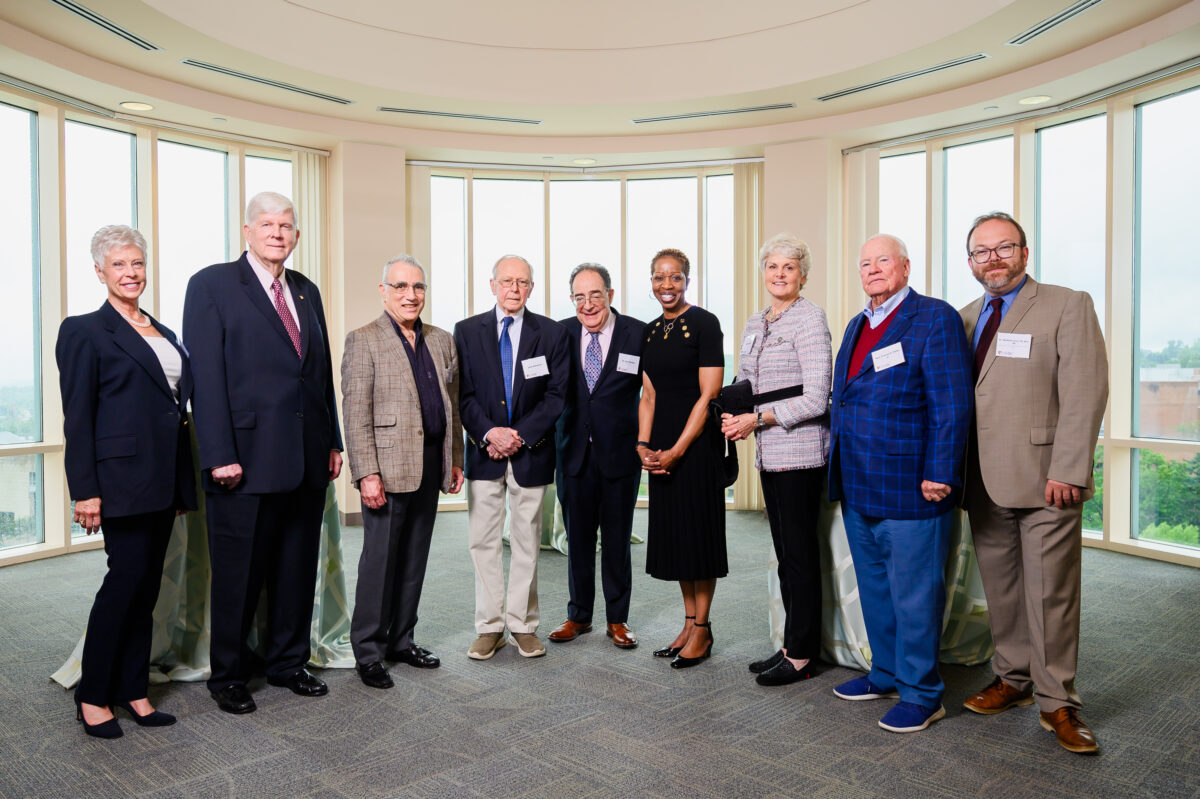
From left to right: Linda Doetsch; George Doetsch, Jr.; Thomas Scalea; John W. Ashworth, III; Jay A. Perman; Valerie Sheares Ashby; Alison Brown; Francis X. Kelly; Matthew Levy '00, M.S. ‘08
From left to right: Linda Doetsch; George Doetsch, Jr.; Thomas Scalea; John W. Ashworth, III; Jay A. Perman; Valerie Sheares Ashby; Alison Brown; Francis X. Kelly; Matthew Levy ’00, M.S. ‘08. Photo by Abnet Shiferaw ’11.

“This is a significant milestone that honors John’s enduring legacy and his tremendous contributions to the EDHS department,” said van Dulmen.

This investment will enhance faculty excellence, expand research in emergency health systems, and elevate the academic experience for students in one of UMBC’s most impactful programs.

“This is a big deal in terms of furthering emergency health in Maryland, the nation, and the world,” said Perman.

Friends, family, colleagues, and former students of Ashworth gathered together on Tuesday, May 13, to celebrate the tremendous legacy of Ashworth and the establishment of this new professorship—a tribute to a man whose career helped shape emergency care in Maryland and whose teaching left a lifelong impression on his students.

“Having an endowed professorship named for you is eternity,” said Thomas Scalea, physician-in-chief at the R Adams Cowley Shock Trauma Center, among other titles. “As long as there is a UMBC, there will be a John Ashworth Professor.”

Finding a lifetime of purpose in giving back

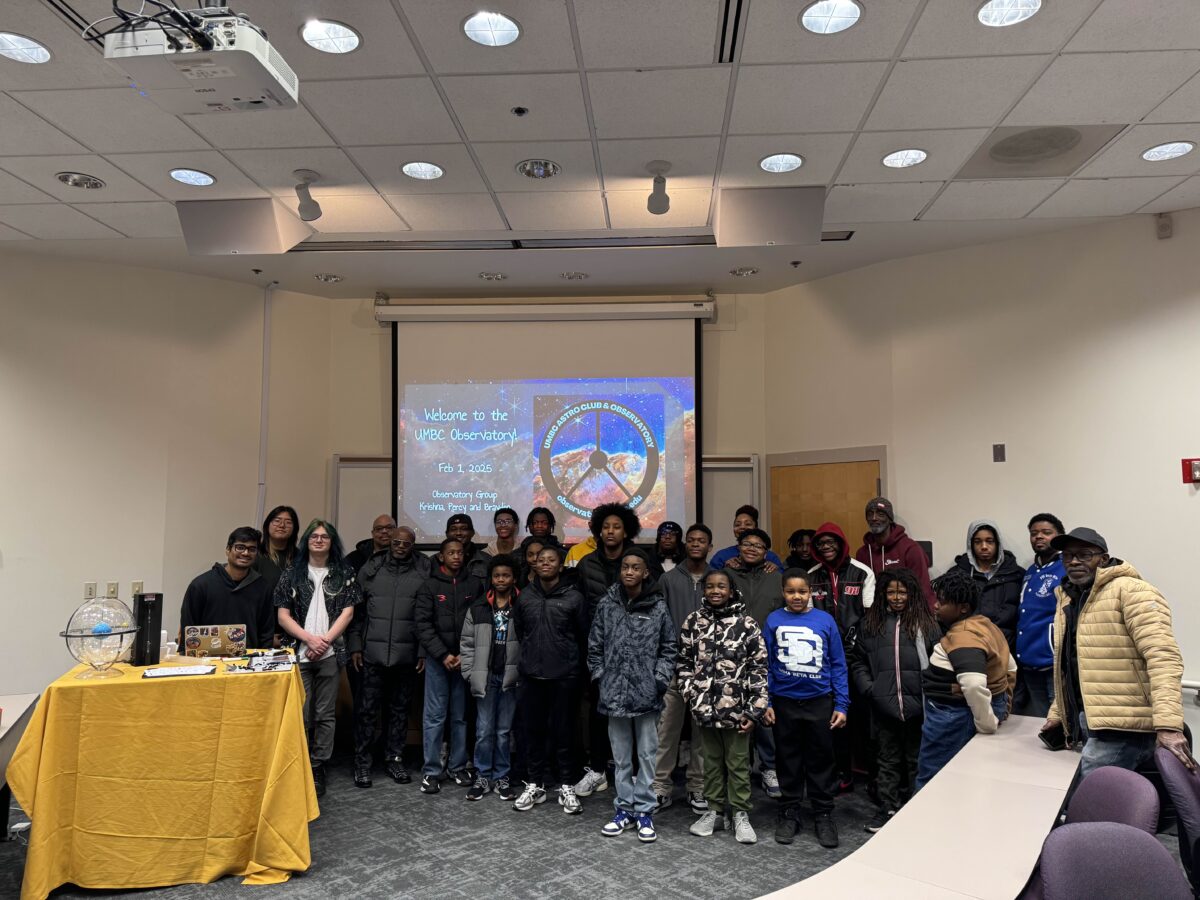
These students are part of their local Sigma Beta Club, a youth auxiliary of Phi Beta Sigma Fraternity, Inc., founded nationally in 1950 to help mentor young men and develop their leadership skills. “When we go out to UMBC, it’s always something special,” says Gary Brooks ’79, history, who played a large part in bringing these young people to Hilltop Circle. “UMBC does things second to none.”

The students came to campus in February with members of the Nu Sigma Sigma Alumni Chapter, which includes Phi Beta Sigma alumni—including Brooks—to tour the UMBC Observatory and attend a men’s basketball game.

Gary Brooks and members of the Sigma Beta Club touring the UMBC Observatory.
Gary Brooks ’79 and members of the Sigma Beta Club touring the UMBC Observatory with middle and high school students.

Nu Sigma Sigma partners with local universities like UMBC to offer Baltimore City youth interested in STEM the chance to experience college life. Most of these visits involve some sort of athletics event, and that’s about it—but not at UMBC. 

Another Sigma Beta Club visit to UMBC involved a FIRST LEGO League competition, and another saw the students observe a robotics event. Brooks also makes sure that each visit includes a member of UMBC senior leadership. Recently, the students had the chance to speak with UMBC President Valerie Sheares Ashby and Athletics Director Tiffany Tucker.

Brooks wants each visit to UMBC to be as meaningful as possible for these young men because he knows how UMBC can change lives.

Even though Brooks graduated 45 years ago, he never really left UMBC. He remains closely involved with Phi Beta Sigma at UMBC, helping mentor students, and he is an active member of Nu Sigma Sigma, working closely with the university to bring Sigma Beta Club members to campus. 

“The fraternity got me involved in community service,” says Brooks—a personal mission he carries on to this day.

Gary Brooks ‘79 and Larry Wiggins ‘75 with the 2024 Second Generation Scholarship recipients

“​Since I met Gary almost 20 years ago, he has been a dedicated champion of UMBC,” says Stanyell Bruce, director of alumni engagement at UMBC.

Brooks also serves on the UMBC Second Generation Scholarship Fund committee. The Second Generation Scholarship is awarded annually to outstanding undergraduate students who intend to pursue study at UMBC, are enrolled in or have completed a course in Africana studies, and demonstrate a commitment to improving the lives of racial/ethnic minorities through community service, extracurricular activities, or other community involvement. Brooks has served on the committee since 1986, when the scholarship was established.

Brooks is also the chairperson for the Historic St. James Episcopal Church Scholarship Fund—a position he has held since 2010—and helped establish the Dr. Lamont Smith, M.D. Scholarship through Sigma R.E.A.C.H., Inc. Brooks has served on that committee since its inception as well.

“Education is dear to my heart,” says Brooks, who went on to earn his M.P.A. from the University of Baltimore and his J.D. from the University of Maryland School of Law—an impressive resume for someone who initially struggled in college.

“My first semester at UMBC wasn’t the best,” admits Brooks. “I didn’t do well at all.”

Photo left: Gary Brooks ‘79 and Larry Wiggins ‘75 with the 2024 Second Generation Scholarship recipients.

Instead of giving up, Brooks decided to lean into his weaknesses—reading and writing—by taking courses in Africana studies, a subject that interested him a great deal. These courses involved a lot of reading and writing, but Brooks found himself more immersed in the work. It was still difficult, but he enjoyed the subject matter, and the faculty was incredibly supportive. As a result, his grades began to improve.

“I saw that success, and I got more and more serious about school,” says Brooks.

After graduation, Brooks remained close to the Africana studies department. He spearheaded a committee tasked with hosting the annual “Party with a Purpose,” whose proceeds supported Africana studies and the Second Generation Scholarship. Brooks also continued to correspond with several Africana studies faculty members who mentored Brooks throughout graduate school, law school, and his career.

Gary Brooks ‘79 and the Party with a Purpose planning committee during UMBC’s 50th anniversary.

After Brooks graduated from law school, one of those professors, Willie Lamousé-Smith, former chair of Africana studies, asked Brooks to step out of his comfort zone and step into the classroom to teach a course on the impact of the criminal justice system on the Black community. Despite some hesitancy—“I do estate planning and bankruptcy,” says Brooks. “I am not a criminal justice attorney.”—the young lawyer decided to take the leap into teaching after more than a little encouragement from Lamousé-Smith.

“Dr. Lamousé-Smith said, ‘Mr. Brooks, you are smart enough,’ and that was enough,” says Brooks. “He believed in me.”

Brooks taught this class for six years, connecting UMBC students with impactful, African American leaders, including the Baltimore City police commissioner and the Baltimore City state’s attorney. Brooks eventually handed the class over to his good friend and former law partner, Larry Wiggins ’75, political science, who played a large role in helping Brooks study for and pass the bar exam.

Brooks was honored at the 2001 UMBC Alumni Awards with an Alumni Community Leadership Award. He also received a special Visionary Leadership Award in 2006, recognizing members of the Reginald F. Lewis Museum of Maryland African American History and Culture Event Planning Committee for their outstanding contributions to advancing the mission of the UMBC Alumni Association. He’d like to thank his wife, Karen B. Brooks, their four children, Aja, Ashlea, Morgan, and Geron, and their three grandkids, Ryder, Ari, and Amari.

Over the years, Brooks has continued to give back to the UMBC community because of how much the UMBC community has given him.

“Gary’s commitment to UMBC never wavers,” says Bruce. “He’s someone I seek out for advice and guidance, and he embodies what it means to be Retriever Proud.”

Following the siren’s call to the food and beverage industry

When you walk into Kupcakes & Co. in Elkridge, Maryland, you are met with the welcoming aroma of fresh baked goods—cookies, cakes, cinnamon rolls, and, of course, cupcakes. Drawn in by the scents and scenes in front of you, you’ll soon meet the proprietor, Michelle Kupiec ’89, interdisciplinary studies. She wasn’t always an award-winning baker though. In 2007, Kupiec was a teacher and a mom, just trying to get her young son to eat food again after a series of difficult surgeries.

Without knowing it, Kupiec was traveling a well-trod path by other UMBC alumni who pivoted their careers to start their own food businesses. “The only thing stopping you is the belief that you can’t,” says Donta Henson ’13, M.P.S. ’17, Navy veteran and co-owner of Los Hermanos 1978 Tequila. This mentality led Henson out of the healthcare industry to start a tequila company with his brother in the middle of the COVID-19 pandemic. Likewise, John Williams ’04, financial economics, owner of Good Karma Creamery, flipped his life upside down (like a good pineapple cupcake) to follow his passion.

When life gives you lemons… make cupcakes

a platter of sweet treats and tasty food
A platter of sweet treats made by the bakery. (Marlayna Demond ’11)

For seven years, Kupiec taught for Howard County Public Schools while raising her twins, Adam and Allison. Her husband, Bill Kupiec ’89, interdisciplinary studies, worked as an IT manager at the Carnegie Institution for Science. Then, Adam started getting sick. He was in and out of the hospital 15 times over three years with severe pneumonia. Doctors couldn’t figure out what was going on until they noticed that Adam’s spine was curving at a rapid rate, putting pressure on his lungs. In 2007, Adam underwent spinal fusion surgery that left him with two 20-inch rods and 18 screws in his back. Then came the painful recovery.

“Adam wasn’t eating. Nothing was appealing to him,” remembers Kupiec. “So, Adam’s doctors encouraged us to watch shows involving food.”

Kupiec and Adam started watching the Food Network and Adam quickly fell in love with the bakers. As soon as he was physically able, Adam was in the kitchen experimenting, which helped keep his mind off the pain. “He was able to get off his pain meds because of his newfound passion for baking,” says Kupiec.

Throughout his recovery, Kupiec homeschooled Adam and the two continued to bake, sharing their creations with friends and family. It wasn’t long before a food truck entrepreneur approached Kupiec about baking for Curbside Cupcakes.

“I was like, ‘Wow! This could become a small business,’” says Kupiec.

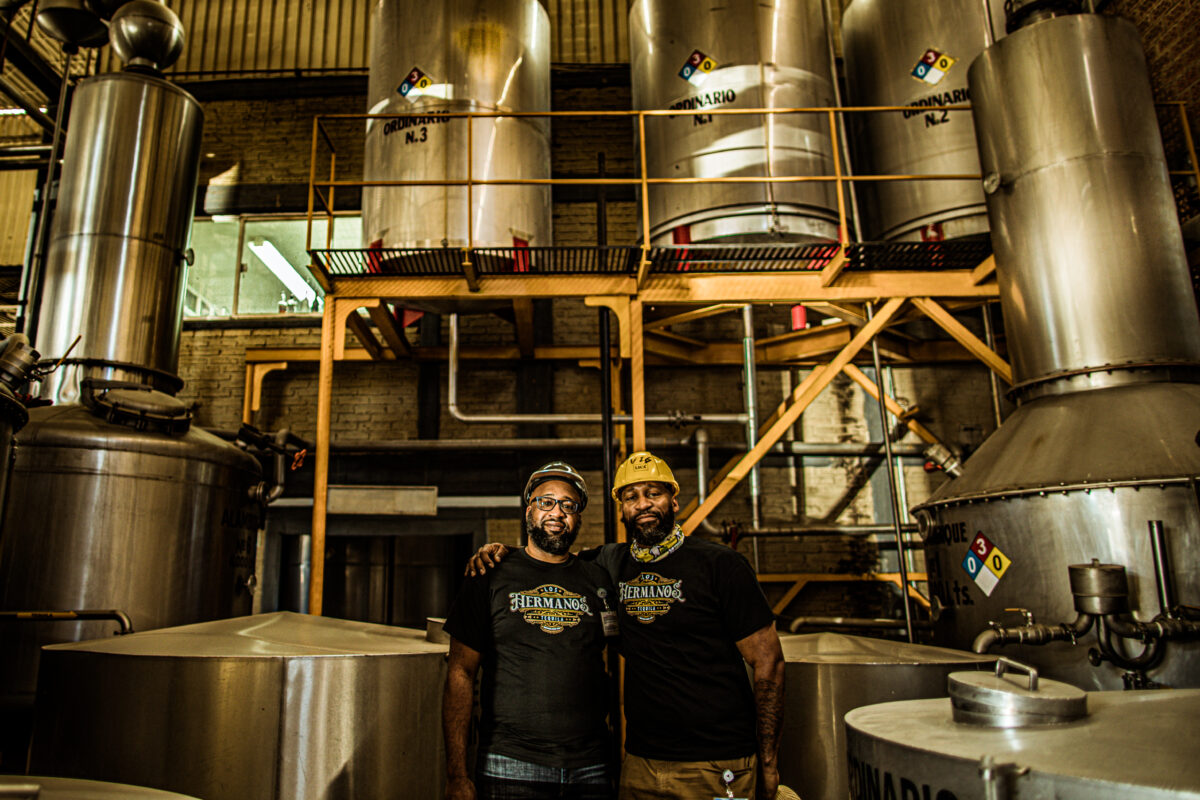
For Donta Henson, a health administration and policy major, the transition from a full-time health IT professional for the Centers for Medicare and Medicaid Services to tequila purveyor took a slightly different route. During the COVID-19 pandemic, in lieu of other activities, Henson’s brother William would regularly visit with a bottle of tequila. With nowhere else to go, the brothers started trying different tequila brands to pass the time. 

Donta and William Henson stand in Casa Maestri Brewery
Donta and William Henson on a tour of the Casa Maestri Brewery. Photo courtesy of the Hensons.

“We probably tried 20 different tequila brands,” recalls Henson. “We started feeling like we were tequila experts.” Henson noticed that when his brother posted tequila recommendations online, people would regularly respond positively. The brothers not only knew what they were talking about when it came to good tequila, but they had influence.

“I told my brother, ‘You know what? We could probably start our own brand,’” says Henson. “If other people are doing it, then we can figure it out too. We’re doing this!”

The pandemic offered many people the chance to pivot, but John Williams, a vice president at T. Rowe Price, already knew that he wanted more than an office job, especially with a young family.“It was a very good job in a lot of ways,” says Williams, who worked there for 10 years, “intellectually stimulating, financially rewarding, but it was a high-pressure type of job.” Fortunately, Williams learned an important lesson during his time at UMBC. “I figured out the value of saving while I was in college,” he recalls. So he put money away, lived below his means, and put himself in a position to control his future at a very young age.

“The question really became, ‘What do I want to do with my time?’” says Williams. “Buying my time and the freedom to do what I want was more valuable to me than continuing to work at T. Rowe.”

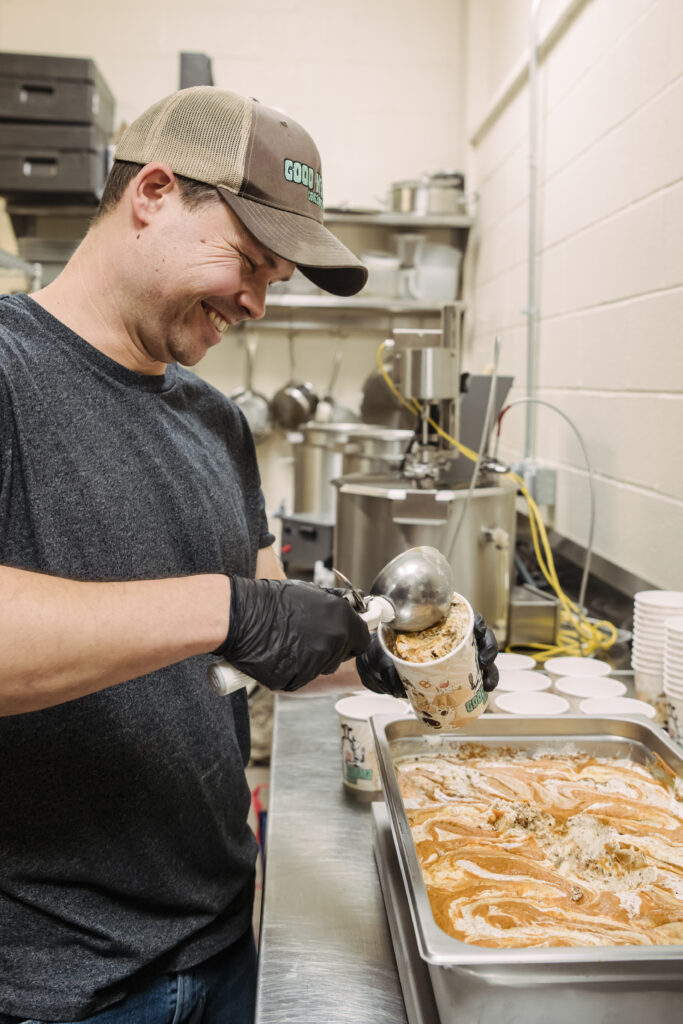
John Williams stands with a sweet treat
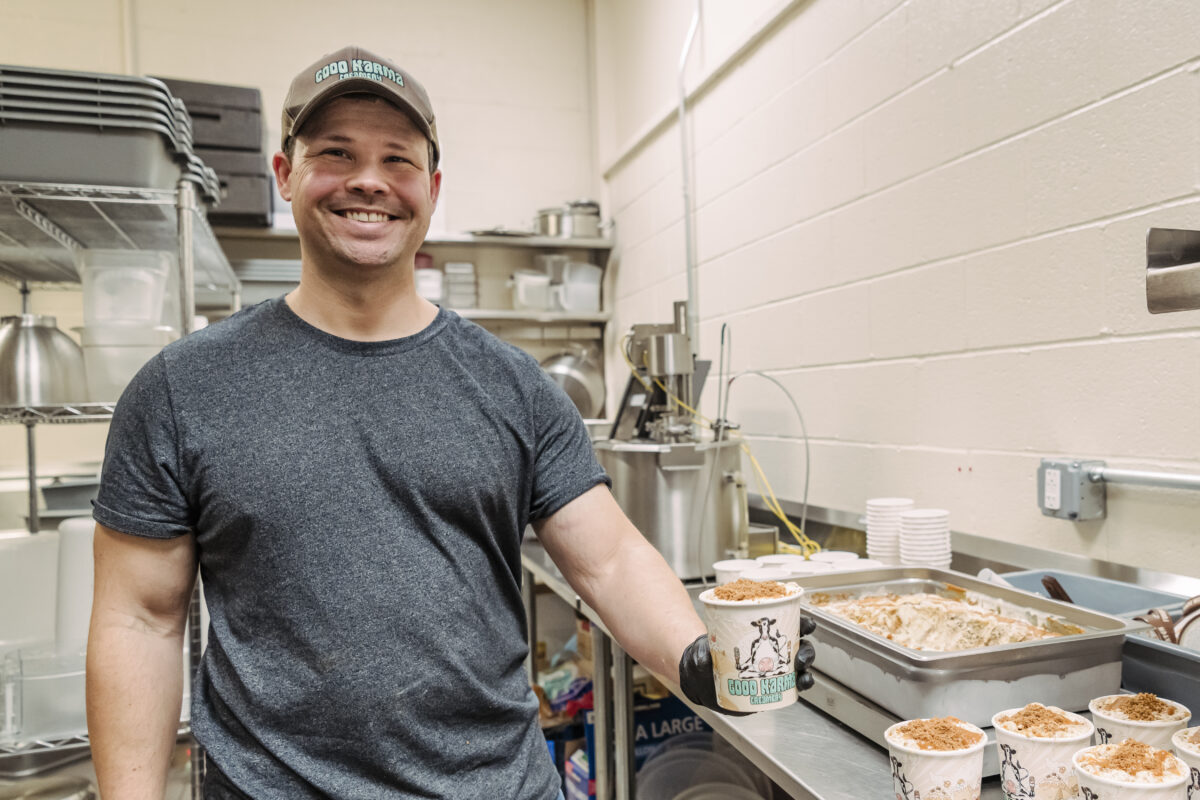
Williams packs pints of Good Karma ice cream in his business’s kitchen. (Marlayna Demond ’11/UMBC)

Williams left T. Rowe Price in 2020 to spend more time with his family and figure out his next step. “I stumbled on it a lot faster than I expected,” says Williams. “I was sitting in my driveway one day thinking about ice cream and realized I was kind of getting bored with what was at the grocery store when it just hit me. I should make ice cream.”

When the pivot pays off

To start baking for Curbside Cupcakes, Kupiec and Adam needed a commercial kitchen and to get licensed. That was the easy part. From there, the dynamic duo started baking 800 cupcakes a day, seven days a week—on top of homeschooling. Then, Curbside Cupcakes added a second truck and 800 cupcakes became 1,600. Kupiec quickly realized that she needed a kitchen of her own. In 2011, she hired additional help, and Kupcakes & Co. was born.

Eventually, with her own business growing, Kupiec cut ties with the food truck and focused her attention on Kupcakes & Co. After 14 years, business is strong and Kupiec offers a rotating assortment of 110 different flavors of cupcakes, along with other baked goods. “We turned our passion into a purpose,” says Kupiec.

To prove to his brother William that they too could turn their passion into a legitimate business, Henson started cold-calling other brands to learn more about their relationships with distilleries. That’s when Henson learned that tequila had to be made in Mexico. “I didn’t know that,” says Henson. 

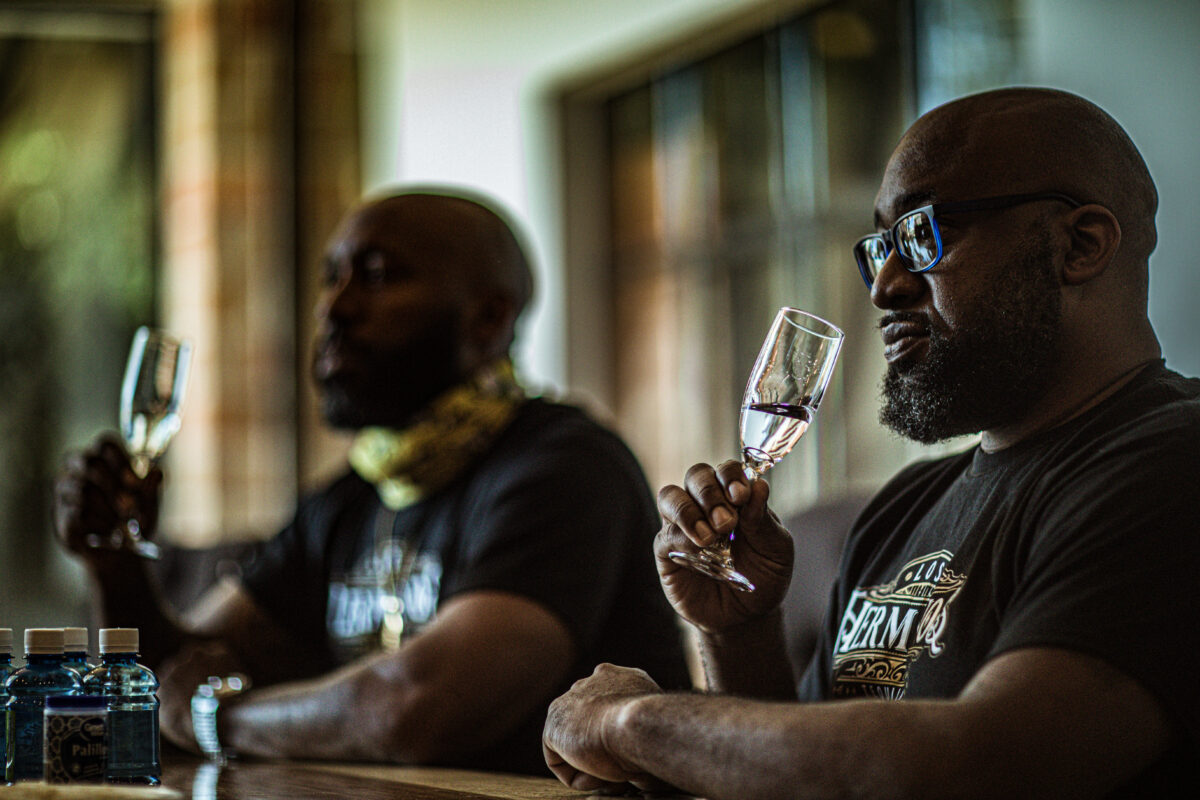
two men sit at a bar sipping clear liquid in glasses
Donta Henson, right, and his brother, William, taste tequila in Mexico. Photo courtesy of the Hensons.

The brothers eventually landed on Casa Maestri, a third-generation, family-owned, full-service distillery. In November 2020, Henson and his brother traveled to Guadalajara to tour the distillery, meet with farmers, and learn what it takes to make tequila. The brothers then began working with the distiller to choose the flavor profiles for their blanco and reposado tequilas, and then it was time to design the bottles and labels. What about a name?

“I wanted a name that captured the whole familial thing,” says Henson. “That’s the whole reason we even got into tequila.” After some research to see what was already taken, Henson and William agreed on “Los Hermanos,” which means “the brothers” in Spanish.

Three years later, Los Hermanos 1978 Tequila can be found in over 300 stores across six states and has won 24 awards. “Everything hinged on the mindset that we could do it,” says Henson. “We didn’t know anything.”

a man in a black shirt smiles while he scoops ice cream from a large tray into a pint container
Williams scoops out one his signature flavorful pints. (Marlayna Demond ’11/UMBC)

Williams can relate. “I had never made ice cream in my life,” he jokes. So, he ordered a tabletop ice cream maker from Amazon and began experimenting. “While I was watching my young daughter, I was probably spending 10 to 15 hours a week making ice cream,” says Williams. After a year of experimenting, Williams upgraded to a slightly more sophisticated machine and began sharing his ice cream creations with his neighbors, along with anonymous surveys.

“I was getting brutally honest feedback,” says Williams.

Once Williams had a better understanding of what people liked, and his daughter was off to kindergarten, he was ready to churn out his ice cream hobby into a full-fledged business. 

“I make my base from scratch,” says Williams, “which is a lot more work, but allows me to do more things with the flavors.” Williams also makes every chunk and swirl that goes into his ice cream—and there’s a lot. “I really load things up,” says Williams. 

Today, Good Karma Creamery sells ice cream by the pint online, with a drop every two weeks—the pints selling out within minutes. It’s not the grind of a financial job, and he gets to taste-test a lot of delicious flavors. From Williams’ seat, he thinks he made the right decision. “I decided to take my passion for finding the best premium ice cream into my own hands,” says Williams.

Chuck Peake—Pioneer of UMBC’s economics program

As Charles “Chuck” Peake celebrated his 90th birthday late one December evening in 2022, a contingent of middle-aged investors, bankers, and academics—Retriever alumni of various decades—were present to cheer on the founder of UMBC’s economics program. As their professor and mentor, Peake had built a tight-knit but inclusive community of economics students and, half a century later, those social bonds still held strong.

“I was honored on my 90th birthday to have several of my former students travel from around the country to celebrate our formative years together at UMBC,” says Peake. 

While sitting around the table, one of those students, Andrew Colyer ’89, economics, was inspired to ask his mentor about the early days of UMBC and the role Peake played in building the economics department.

The house that Chuck built

At UMBC, one of the benefits of being such a young university—just 57 years old—is that we are still so connected with our past and able to learn from the pioneers who helped found this university. Peake is one of those pioneers—here from the very beginning when campus consisted of just three academic buildings, plywood sidewalks, a lot of mud, and a whole lot more vision.

“Dr. Albin O. Kuhn, UMBC’s first chancellor, could be seen in his spare time using his tractor to carve out the route for the loop road that he envisioned,” recalls Peake.

“Chuck came to UMBC with the vision that the fledgling campus could become the ‘Swarthmore of Public Higher Education,’” says Marsha Goldfarb, professor emerita, economics, referring to the liberal arts college ranked No. 1 multiple times by U.S. News & World Report

Peake was hired as the university’s very first professor in economics and entrusted with a daunting task—building the economics department from the ground up. Peake was up for that challenge but, holding fast to his vision of what UMBC could become, he had two conditions.

Pictured right: Peake in his office in 1969.

Chuck Peake in his office in 1969.

“First, I would get a graduate assistant, and second, economics professors would not be required to give large lectures.” However, Peake, recalls, “For the first economics course offered in 1967, we expected 30 or 40 students and, to our surprise, 170 students enrolled and we were compelled to offer a large lecture.”

Peake prioritized getting to know his students and engaging them in the learning process, says Joseph Gallagher ’93, economics. “As a student, the first thing Dr. Peake did was give you agency,” recalls Gallagher. “‘Mr. Gallagher, what are your thoughts on this?’ He did this with all his students. By empowering his students, it conveyed a gravity to his classes and made you take stock of your opinions and your own retention of concepts. Dr. Peake wanted you to be engaged in his class and wanted it to be a conversation.”

Of course, this type of classroom model is not really possible in a large lecture format. So, the emphasis quickly became recruiting additional faculty members to meet demand and decrease class sizes to support greater interaction between student and teacher. Peake set his sights high and started his recruitment efforts by contacting the department chairs of the top 10 economics programs in the country.

“Our strategy was to start with young faculty members who studied at the highest quality institutions,” says Peake. “Amazingly, our first six core faculty members did their graduate study at a top 10 economics program.”

The foundation for the economics department was in place. The students were eager to learn. The faculty members were young and ready to prove themselves. There was just one thing missing—a sense of community. 

Chuck Peake and UMBC economics faculty from throughout the years return to the university to celebrate its 50th anniversary.
Peake and UMBC economics faculty from throughout the years return to the university to celebrate its 50th anniversary in 2016.

Building community beyond the classroom

“Dr. Peake was not only a great professor, role model, and mentor, but he was also very social and loved to have a good time,” says Donald Blair ’89, economics. “He definitely helped create a sense of strong culture within the economics department.”

Peake was instrumental in the formation of two student organizations: the Political Economy Club and the UMBC chapter of Omicron Delta Epsilon (ODE), an international economics honor society. He also sponsored the annual ODE banquet, when students were inducted into the honor society and awards were given out. 

“This banquet was a major social event in the life of the department,” says Goldfarb.

At the banquet, recipients were also presented with the Gerald Goldman Scholarship, established in honor of an early economics major tragically killed during a summer construction project, the Omicron Delta Scholarship, and the Charles F. Peake Fund, established in honor of Peake by the UMBC Economics and Administrative Sciences Alumni Association, Inc. (EASAA). 

Another endowment honoring Peake—the Charles F. Peake Endowment for Economics—was later started by Jack Mullen, III ’72, economics, the first UMBC alumnus to work on Wall Street, along with his wife, Carol Mullen ’70, American studies. This endowment helped establish the annual Mullen Lectures, which bring top economic minds from across the country to speak at UMBC. 

As part of his community-building project, Peake began hosting social gatherings for the Political Economy Club and ODE at his home. He would cook a ham and students would bring various dishes for what Peake called a “Tennessee-style dinner.” One summer, he held a crab feast at his home to help educate out-of-state students on the culinary benefits of the Maryland blue crab.

“He was trying very hard to make UMBC more than just a commuter school,” says Colyer who, like Blair and Gallagher, credits Peake with much of his career success. “I definitely benefited from his getting to know me,” he says.

Chuck Peake on his 90th birthday surrounded by family, friends, and former students.
Peake on his 90th birthday surrounded by family, friends, and former students.

Credit where credit is due

“My office used to be down the hall from his office, and I just recall a line of students and alumni stopping by to hang out,” says David Mitch, current UMBC economics department chair.

“Dr. Peake helped me straighten up my life,” says Colyer, who had nearly failed out of another institution before transferring to UMBC. Today, Colyer is the director of research at The Ithaka Group and still values Peake’s practical approach to advising and education. “You weren’t just going to get an econ degree,” says Colyer. “Dr. Peake took some personal responsibility in making sure you had a career after graduation.”

Blair, who is now an investment banker at Raymond James, had a similar experience at UMBC. “I give Dr. Peake tons of the credit for steering me in the direction that completely influenced my career,” he says. “I was late to the job recruitment cycle, and Dr. Peake made calls on my behalf to the big four accounting firms at the time and was able to get me an interview and eventually a job at KPMG in Baltimore.” 

“Dr. Peake’s influence went well beyond the classroom,” says Patricia Rudolph ’72, economics. “I believe that Dr. Peake’s help and guidance made my career possible. I had the vague idea that I wanted to be a college professor but I had no idea what I needed to do to achieve that goal. Dr. Peake took the time to help me through the entire process of applying for admission to a Ph.D. program.”

“He probably wrote more recommendations for grad school than any other professor,” says Colyer, who reconnected with Blair in the same MBA program at the University of Virginia.

Chuck Peake spending time with his great grandchildren, Charlie and Cabell.
Peake spending time with his great grandchildren, Charlie and Cabell.

Innovating after retirement 

Not even retirement can slow down a man like Peake. In fact, what he calls his “most important academic contribution to UMBC” didn’t even occur until 2001—two years after retiring—when the economics department launched its second major, the B.S. in financial economics, to go along with the traditional B.A. in economics.

“I spent about a decade preparing the proposed major,” says Peake. “With this credential, graduates found that it opened doors to Wall Street and other real-world pursuits well beyond academia.”

“Financial economics became extremely popular,” says Goldfarb. “And, before long, it attracted more students than the B.A.”

While Peake points to the B.S. as his most important academic contribution to UMBC, his former students know his kind nature and love for his students is his real legacy.

“He was always very supportive of his students and wanted the best for us,” says Blair.

“He always had time for everyone,” says Colyer, who was honored to have Dr. Peake attend his wedding.

“He is just a vessel of pure goodness,” adds Gallagher.

The man behind the camera

When LeBron James comes calling, you answer the phone. Philip Knowlton ’03, visual arts, knows this better than most.
The NBA legend doesn’t have the UMBC alum in his contacts because Knowlton is great at one-on-one (probably). Instead, Knowlton has collaborated with James’ media company Uninterrupted on several documentaries as a director, editor, producer, and director of photography. Uninterrupted was founded to empower athletes to tell their stories in their own words. This time, Knowlton was called upon to direct and co-executive produce Redefined: J.R. Smith, a four-part Prime Video documentary series released in April 2023 that follows J.R. Smith, a retired two-time NBA champion, as he navigates a new challenge—college.
“This is the story of him post-NBA as he decides to go to college at North Carolina A&T [State University] to pursue a degree but also to try out for the Aggies golf team,” explains Knowlton.

Student-athlete turned filmmaker

“It was just a really inspiring project to be a part of,” says Knowlton, who made his first sports documentary about UMBC track and field when he was a student-athlete on the team. Having played (and won championships) with James on both the Cleveland Cavaliers and Los Angeles Lakers, Smith became good friends with James. So, when Smith made the decision to pack his book bag, head to college, and try out for the golf team, his team connected with Uninterrupted to see about interest in a possible film project.

with a bag of golf clubs in the foreground, a man stands holding a high tech camera
Knowlton filming J.R. playing golf.

“Of course they were on board,” says Knowlton, who received the call from Uninterrupted soon after. “They asked me if I’d be interested in flying to Greensboro to film a sizzle.” In the film world, a sizzle is like a demo—a short trailer used to pitch the story to networks.

Knowlton jumped at the opportunity to once again work with Uninterrupted.

“I think what they really like about me is that I’m able to direct and shoot,” says Knowlton. “It keeps the team smaller and more intimate. So, you’re able to be in places that a big crew may not be able to get into. Or athletes may not want a whole big team following them around.” 

Knowlton worked with the team at Uninterrupted to put together a treatment and map out the story they wanted to tell. Then, he hopped on a plane to Greensboro and filmed the sizzle.

“Next, we took meetings with everyone like HBO Max, ESPN+, Amazon—all of them,” explains Knowlton. “There was interest from quite a few networks, but it ultimately landed on Prime Video.” 

By this point, Smith was just about two or three weeks out from starting school. So, Knowlton had to move quickly. “This production, specifically, was really dictated by Smith’s golf season and his school year,” says Knowlton. The team made it in time to film the first couple days of school and practice. Then, they returned every month or two for different milestones throughout Smith’s first year, like his first tournament and A&T’s homecoming celebration. 

“It was amazing to see J.R., who could have retired and moved to Miami to hang out by the pool, want to go to college for the first time and push himself,” says Knowlton.

Find a place that let’s you do both

Of course, this story starts way before Smith decided to trade basketballs for golf balls. This story starts at a still-burgeoning university in Baltimore County, Maryland.

“I was looking for a school where I could run cross country that also had a good video or digital art program,” explains Knowlton, who now owns and operates Opposit, a creative studio he founded in 2018 specializing in original documentary film content. “A lot of schools have one or the other but not both.” UMBC gave Knowlton the opportunity to explore both.

filming on a golf course
Knowlton filming in North Carolina.

“It was kind of a no-brainer,” admits Knowlton, who received an athletic scholarship to run on the cross country and track and field teams while pursuing his B.A. in imaging and digital arts. “That program was perfect in that it let me experiment in a lot of different art forms.”

Throughout college, Knowlton was still trying to find his passion. He knew he loved visual arts but was unsure where to focus his energy. He enjoyed photography, graphic design, and film. It wasn’t until Vin Grabill’s video art class that it all started to click.

“I taught students that video could be seen as a kind of ‘painting in time.’ Utilizing video edits as brushstrokes, students created short rhythmic works that brought impact to their source material,” explains Grabill, associate professor emeritus in UMBC’s Department of Visual Arts. “Phil’s exercises exemplified these goals, eventually leading to final projects where narrative content was successfully built around a solid rhythmic structure. I’m very happy to see Phil pushing his work forward 20 years later!”

“Today, when I do Q&As about my films, I like to quote [basketball coach] Jim Valvano, who said, ‘Every single day, in every walk of life, ordinary people do extraordinary things,’” says Knowlton. “When I work on documentaries, a lot of the time I am filming everyday people doing amazing things. But J.R.’s story almost feels like the reverse. He’s this extraordinary person doing something more ordinary—going to college. To have been a part of J.R.’s journey and help share with the world has been a great experience.”

Out of office—Developing underwater technologies to best support ocean life

Three weeks exploring the beautiful, pristine waters of Indonesia to study seagrasses—that was the plan. But before Terry Smith ’00, computer science, could get to work, he had another problem to solve. What do you do when half of your research equipment gets stuck in customs? For Smith, that just means it’s time to get creative. “I love finding the fun problems,” he says. So, he created a camera float using any materials he could get his hands on—PVC pipe, a life ring, and a bit of rope.

Smith is a solutions engineer on the Tidal project in Alphabet’s X division, a semi-secret research and development organization founded by Google in 2010. The Tidal project’s initial focus is on developing technologies that bring greater clarity to what’s going on below the ocean surface, with the goal of preserving ocean life and sustainably providing food for humanity. Recently, Smith worked with the governments of Indonesia and Australia to come up with technology to visualize, analyze, and track the growth of seagrasses, which are particularly effective at absorbing carbon dioxide from shallow waters.

Smith displays a prototype ocean mapping technology made from PVC pipes.
Smith working on a handmade prototype for ocean mapping technology made from PVC pipes. His well-used book of knots is nearby.

“Traditionally, if you wanted to make a map of all of the seagrasses, it would probably take 10 years and 1,000 grad students,” explains Smith. “We’re trying to come up with technology that’ll make that happen a lot faster. So, I go out into the water with some prototype technologies that my team built and run robots over seagrass and then do 3D visualization of the data we capture.”

Tidal is just the latest in a long line of exciting projects Smith has gotten to be part of throughout his career, which has seen him travel all over the world. And throughout it all, Smith follows a simple philosophy: “Go see what’s happening in your field and make early contact with the real world.”

A bird's-eye view of Smith and his team working on a boat at sea studying ocean life.
A bird’s-eye view of Smith and his team studying seagrass in the islands near Labuan Bajo, Indonesia. Smith is standing, guiding the umbilical cable between the cameras and the computers.

This core belief has guided Smith from UMBC all the way to X—the so-called moonshot factory in California. But this journey from coast to coast was not a linear adventure. Like many UMBC alumni, Smith’s story doesn’t even begin at UMBC. His story starts a little further south.

Hands-on industry experience

A man underwater with scuba gear inspects a piece of equipment
Smith inspecting an autonomous wave glider for Liquid Robotics around 2018.

For three years, Smith studied electrical engineering at the Florida Institute of Technology, but then he pressed pause. Eventually, he transferred to UMBC in 1997 to be closer to his parents. He decided to lean into the tech boom and major in computer science.

“I found a really amazing department,” said Smith. “There are so many opportunities at UMBC to work with outside companies. Being able to interact with industry gives you such an advantage.”

Smith parlayed all of this experience and his natural charisma into a part-time job while still in school, but not in the way you may think. As a bartender on Main Street, Ellicott City. Smith says one of his regulars asked about his summer plans. “Serving you drinks,” said Smith. The regular, a hiring manager at TRW Inc., a defense contractor since acquired by Northrop Grumman, ended up helping Smith find a summer job in the signals processing lab near Fort Meade.

That summer job eventually turned into a part-time job and then, “I left UMBC with a full-time job in hand and a lot of experience,” says Smith.

After working at TRW for a few years, Smith moved up to Boston, working at Draper Laboratory and eventually M.I.T. Lincoln Laboratory. But, like any good engineer, Smith continued to wonder what was next. So, he headed out west, eventually landing a job at NASA’s Ames Research Center, working on the next generation of air traffic control.

At that point, Smith says, “I had done a lot of work in simulation and I wanted to get back to the real world.” He moved on to Liquid Robotics, a Boeing company that works on wave-powered ocean robots to track whale migration using hydrophones or look for oil leaks around oil rigs using hydrocarbon sensors. After seven years there, X and the Tidal project came calling.

X marks the spot

Smith has been at X just shy of two years, working on Tidal to find ways to use Google technology to benefit ocean life.

“We’re using the experience we got doing salmon aquaculture to branch out into different areas, like the seagrass experiments in Indonesia” said Smith. “We’re looking for ways that AI, ocean robotics, and the other technologies we developed can be used to make human work on the ocean more efficient, sustainable, and better for both people and the ocean.”

Staying anchored to UMBC

No matter what he’s doing, or what far-flung location he finds himself, Smith has continued to find ways to stay connected with the UMBC community. He jumps at the opportunity to attend events whenever UMBC makes it out to the West Coast—most recently during the San Francisco stop on the 2022 RetriEVER Grateful Tour—and he remains close with his college roommate, Tim Craig ’02, computer science, who also relocated to California. “We see each other quite a lot,” says Smith. “His kids play with my kids.”

Smith and Tim Craig during their time as college roommates.
Smith and Tim Craig met as college roommates and still keep in touch. Pictured here circa 2002.

Smith is also working with the UMBC Alumni Engagement team to host an event at X for UMBC alumni working in Google-affiliated companies. “We all try to find each other,” says Smith of his fellow California-based Retrievers.

“Terry Smith’s example provides a road map for other alumni in how to stay engaged with UMBC,” says Stacey Sickels, UMBC Associate Vice President for Alumni Engagement and Development. “Terry has shared about job opportunities with the UMBC Career Services Office, his work could have potential research synergies with UMBC faculty, he wants to create a UMBC community within his company, he attends Bay Area alumni events, and Terry gives back with his time and giving.”

Up next for Smith, he will be investigating new areas to apply X’s machine learning and artificial intelligence technology, prototyping novel solutions, and helping commercialize Tidal’s aquaculture platform across the world. “It’s going to be a busy couple of years,” jokes Smith.