All posts by: Kait McCaffrey


UMBC named a “Best Value University” for 8th year in a row

UMBC has again been named a Best Value College for 2017 by Kiplinger’s Personal Finance, appearing on both the Best Value Public University list and “top 300” national Best Value University list.

Kiplinger has honored UMBC as a Best Value College for eight consecutive years. This ranking recognizes four-year schools with the essential combination of outstanding academics and affordability. It is based on a range of factors, including admission rates, student-faculty ratio, four-year graduation rates, and financial aid.

UMBC was also named as one of the nation’s top colleges “for students seeking a superb education with great career preparation and at an affordable price,” notes an announcement by The Princeton Review. The 2018 edition of Colleges That Pay You Back: The 200 Schools That Give You the Best Bang for Your Tuition Buck highlights universities across the United States that Princeton Review believes do a particularly good job of balancing excellent academics, affordability, and career services.

“For many years, UMBC has consistently provided our firm with hundreds of exceptionally talented students that we have hired across all areas of our business.  UMBC students are well rounded and diverse in their experiences and skills which make them strong assets to our firm year over year,” said Mindy Silverman, manager of talent acquisition at T. Rowe Price.

In addition to these university honors, U.S. News and World Report has just specifically recognized UMBC’s online master’s degree in information systems as one of the top 25 in such programs the nation. The degree program, through UMBC’s department of information systems, appears on the publication’s 2018 Best Online Information Technology Programs list, released January 9, 2018.

“UMBC’s online master’s offers a convenient way to learn from exceptional faculty working in the bold and innovative context that is UMBC. Our programs and faculty are consistently successful in delivering an education to our students that enable them to be just as successful in jobs with major companies and government, as with startup companies and non-profits,” said Keith Bowman, dean of the College of Engineering and Information Technology.

The online master’s program is designed for students who are advancing their education while balancing commitments to careers, family, and military service. Students and faculty in this field often complete research in areas such as health information technology, human-centered computing, data mining, artificial intelligence, and software engineering.

Learn more about applying to UMBC at the undergraduate and graduate admissions websites.

Photos by Marlayna Demond ’11 for UMBC.

Note- this story was updated on 1/23/18 to include The Princeton Review rankings.

UMBC welcomes over 1,200 new alumni during 2017 Winter Commencement Ceremonies

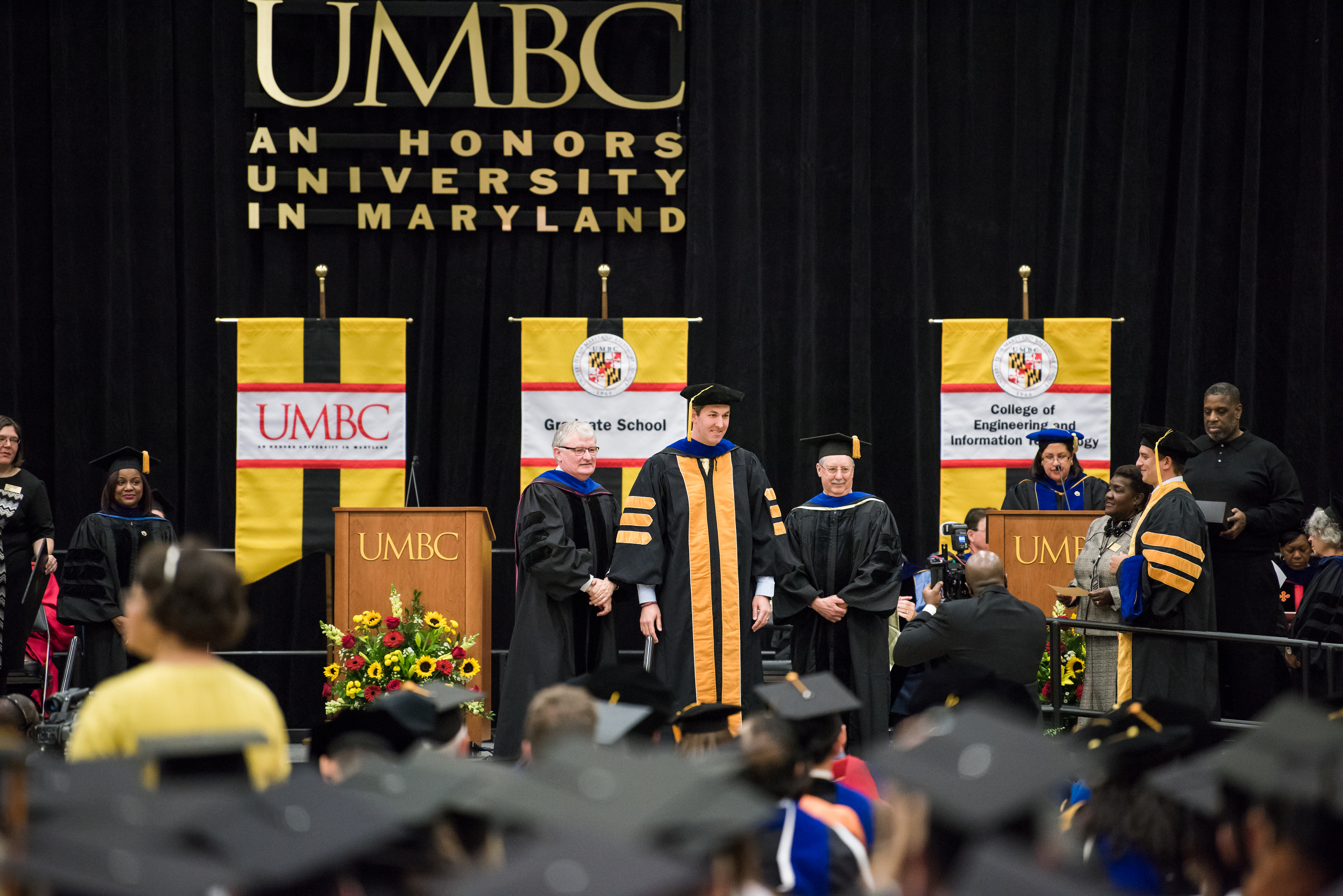
“Savor this moment.” That was the charge from President Freeman Hrabowski as he addressed more than 1,200 graduating students during the 2017 Winter Undergraduate and Graduate Commencement  Ceremonies on December 20 and 21, 2017. Family members, friends, faculty, and staff packed the Retriever Activity Center to celebrate the accomplishments of UMBC’s newest class of alumni.

President Hrabowski opened Undergraduate Commencement by emphasizing, “Life is about more than helping self. It is about using your talents to help the world,” setting the tone for students to live purposeful and impactful lives. He underlined this point by pointing to the many students who have served in the military, or who are planning to work as teachers and social workers.

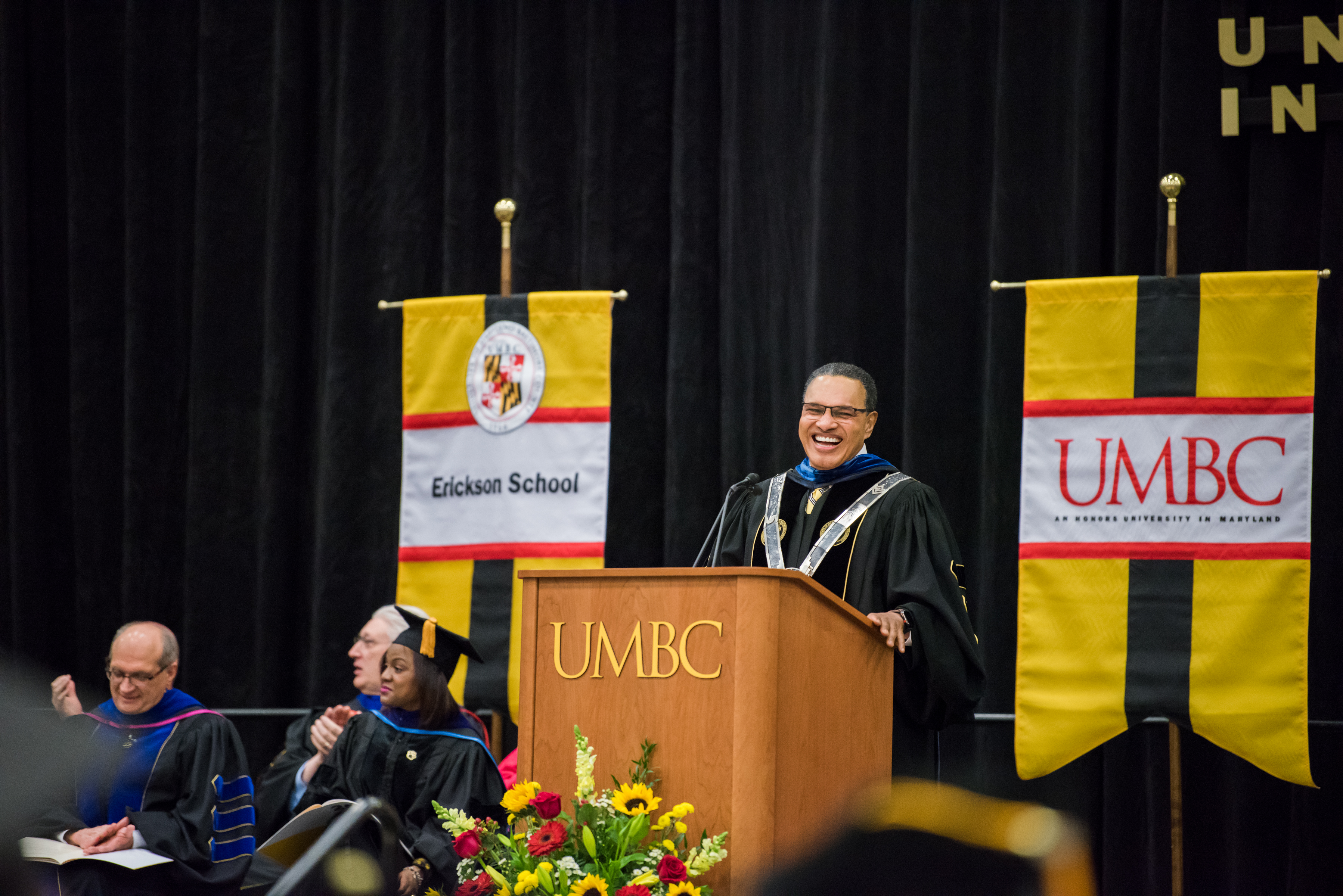
UMBC President Freeman Hrabowski addresses the audience during Winter Commencement Ceremonies 2017.

The December 20 graduate ceremony honored a combined 170 new master’s and Ph.D. recipients. The undergraduate ceremony recognized over 1,000 new bachelor’s degree recipients, including more than 800 earning their degrees in December and over 200 who completed their programs in the summer.

In addition to remarks by President Hrabowski, Provost Philip Rous and Graduate School Dean Janet Rutledge also shared their sentiments with the class of 2017. “Whatever career pathway you choose, you represent the very best of the future. You have embarked on one of the most important journeys of your lives and we are all very, very proud of you,” said Rutledge.

UMBC student and faculty exchanged hugs during Winter Commencement.

President of the Graduate Student Association, Roy Prouty M.S. ’16, atmospheric physics, recognized the accomplishments of his peers but acknowledged the work isn’t over yet.

“For all of you, today is a day where you can just sit back and breathe. But not for too long; there’s work to be done,” said Prouty. “I task you with this – communicate, advocate, and enrich. Do your best to convey the impact of your work. Spark interest in others. Advocate for your work and for your passions. And above all, and to the best of your ability, aim to enrich the lives and experiences of those around you.”

Along with UMBC faculty and staff, representatives from the University System of Maryland Board of Regents and the UMBC Alumni Association offered their support at both ceremonies.

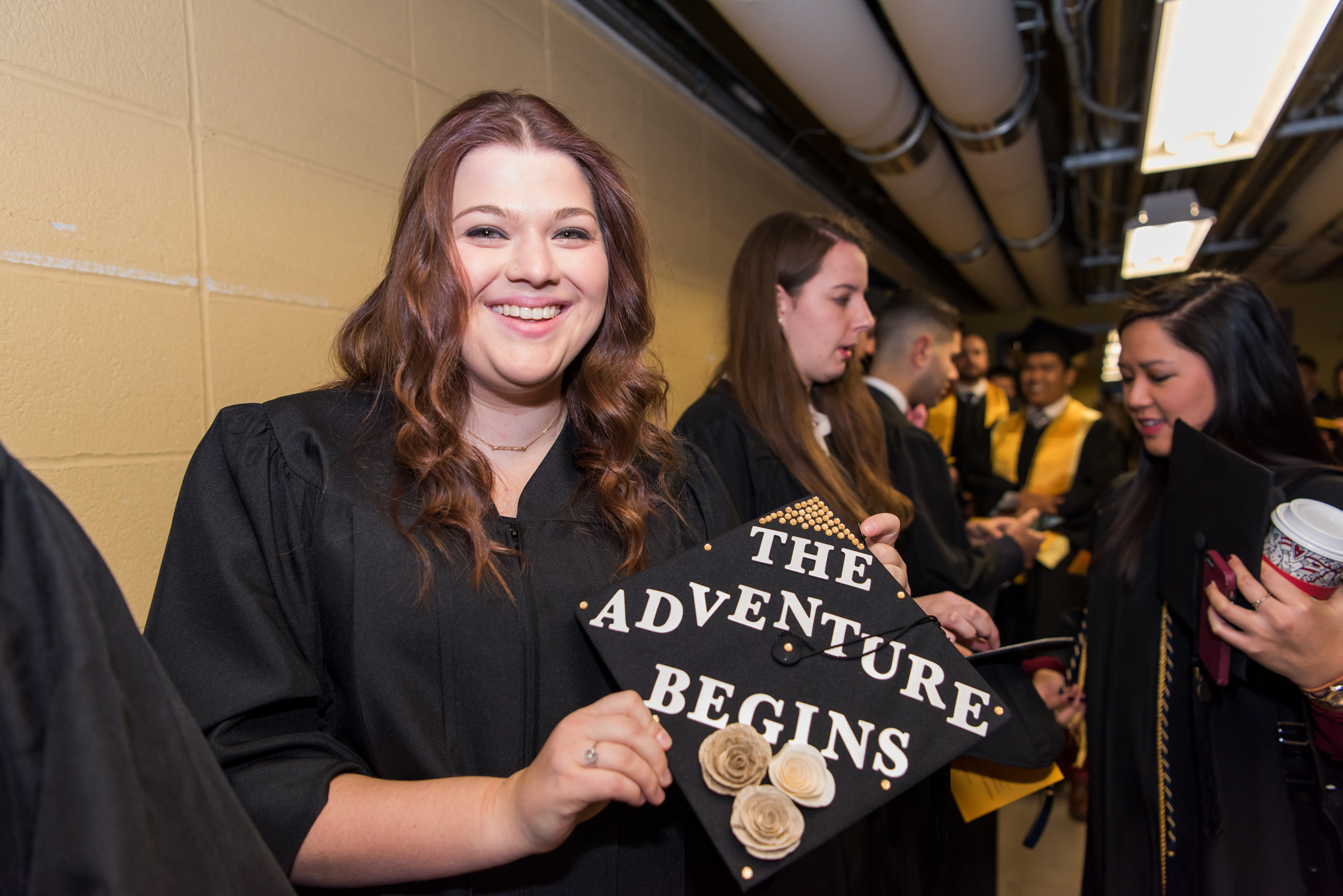
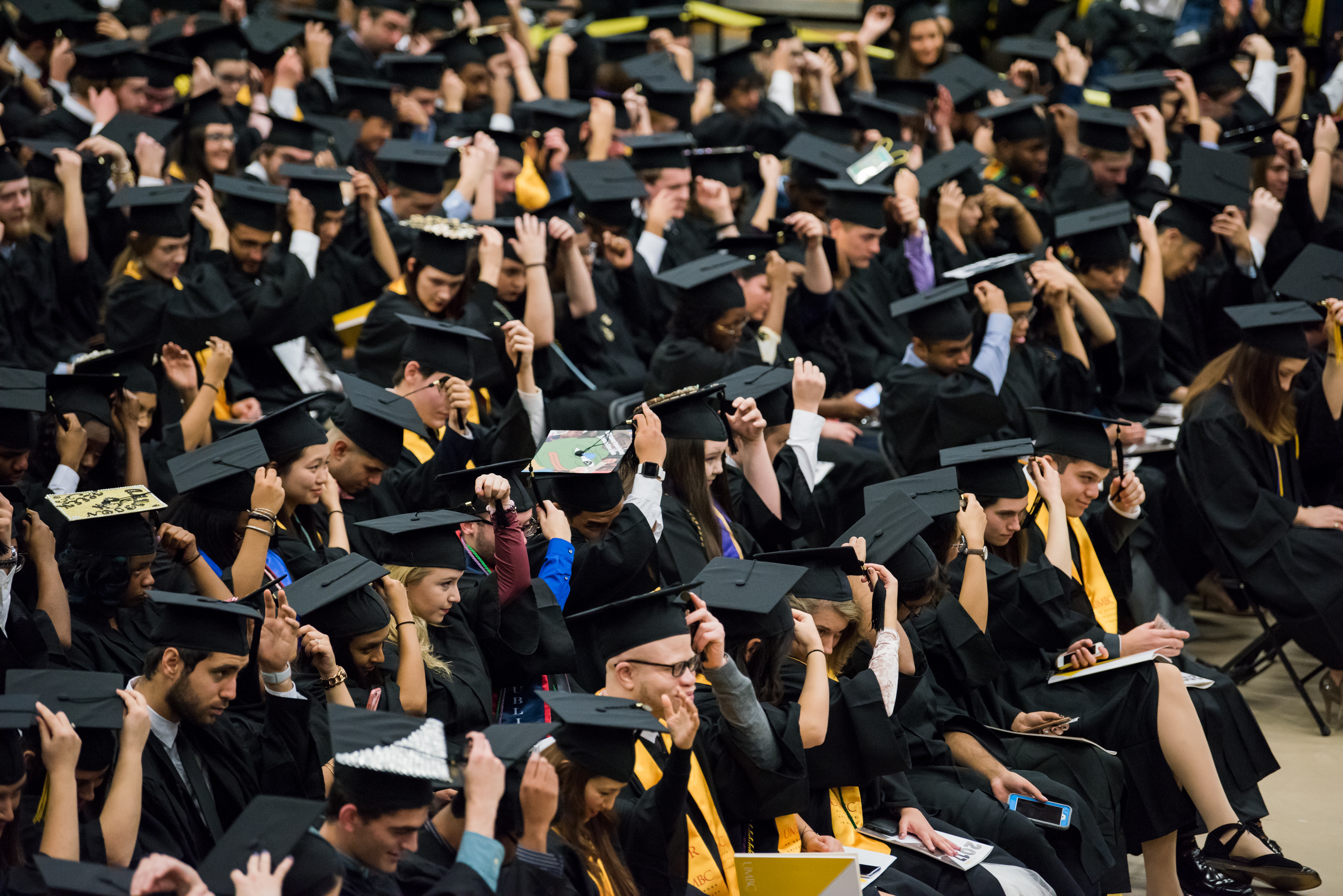
Students get creative with their caps during Winter Commencement.

December’s Commencement exercises were the last in the Retriever Activity Center. Beginning in 2018, spring and winter Commencement will move to UMBC’s new Event Center. This 172,000-square-foot multi-purpose facility will allow UMBC to move spring Commencement away from Royal Farms Arena and back to campus for the first time in two decades.

Baltimore County executive candidate John Olszewski, Jr receives his Ph.D. in public policy.

Much in the way that UMBC’s campus continues to grow, Provost Rous called on the class of 2017 to continue evolving to shape the future.

“You will join the tradition of UMBC alumni who through their life’s work continue to advance our understanding of our own humanity, our democracy, the natural world that surrounds us and, most importantly, make a difference in the lives of others,” said Rous.

Addressing the undergraduate students before turning their tassels for the first time, President Hrabowski encouraged students to “be true to yourselves, and be true in your relationships. Always work to elevate others even when times are challenging.”

The undergraduate class of 2017 turns their tassels during Winter Commencement.

As has been tradition, President Hrabowski closed both ceremonies echoing the words of UMBC’s first president, Albin O. Kuhn.

“If you bring to the future the same personal qualities and personal commitment you have brought to this campus as students, good and important things will happen to each of you, as well as to those around you … and the university community will be proud to have played a part in your life.”

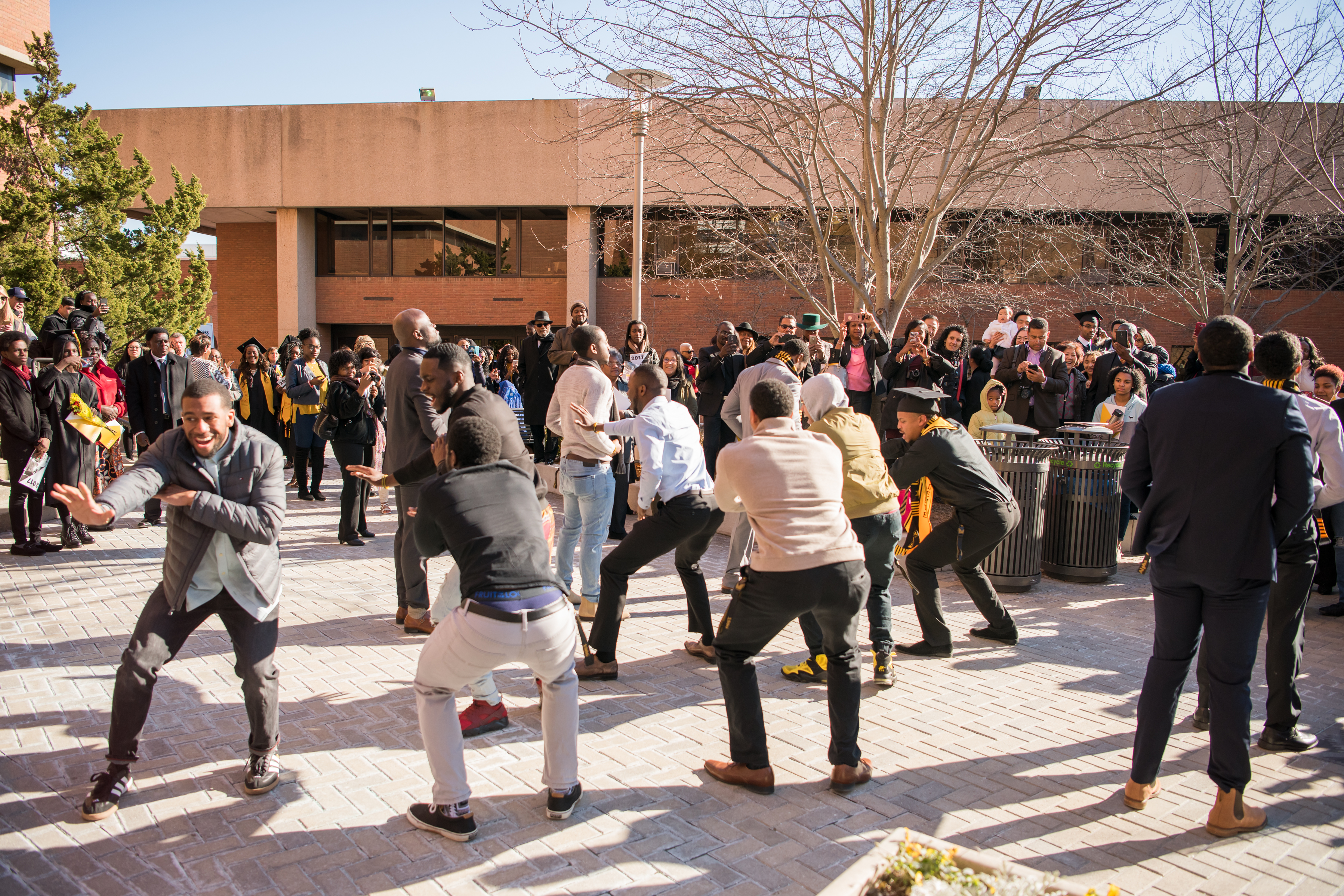
Celebrations continued after Undergraduate Commencement.

Videos of both ceremonies are available on the UMBC Commencement website. The ceremonies were also covered live via Twitter (@UMBC), Instagram (@UMBClife), and Snapchat (@UMBClife), with students and families sharing their own memories through #UMBC and #UMBCgrad. For additional photos, see our Commencement galleries on Facebook.

Photos by Marlayna Demond ’11 for UMBC.

Student-athlete represents UMBC and America East at NCAA Leadership Forum

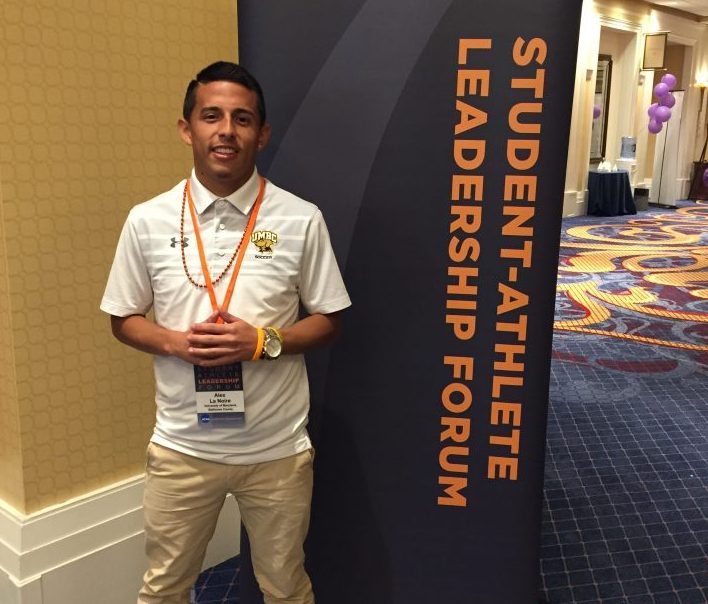
Alex La Noire ’19, financial economics, recently attended the annual NCAA Student-Athlete Leadership Forum in Washington, D.C. As a member of the soccer team and a student highly dedicated to service both to his campus and to his Latino community, the junior right-back was tapped to represent both the America East conference and UMBC in mid-November.

The NCAA Student-Athlete Leadership Forum’s annual event celebrates the diverse athletes who have made an impact on their campus and who strive to better themselves and their teams. Since its inception in 1997, the Leadership Forum has given over 5,000 student-athletes the opportunity to network and grow, both professionally and personally.  

Alex La Noire '19 at the NCAA Leadership Forum in Washington, D.C.

La Noire has amassed an impressive resume of both philanthropic and athletic accomplishments since arriving at UMBC. He was a recipient of the America East Helping Hands Award this past summer for his dedication to community service and commitment to academic rigor. As a walk-on member of the soccer team in his sophomore year, La Noire established himself as a campus and community leader.

“At a young age, I always took it upon myself to try and bring the teams I’ve played on closer together. I learned you can still be a leader even if you don’t have the captain title,” he said.  

In addition to traveling to Panama last spring with Global Brigades, an alternative spring break trip focused on service, La Noire was also part of the group that founded the branch project, Business Brigades. While service at UMBC is important to La Noire, he also focuses a large amount of his time on endeavors that hit closer to home. Since 2009, he has served as a Latino Student Fund Ambassador, a program that tutors underprivileged Latino students and a program that La Noire directly benefited from growing up. He attributes the program with “getting me to where I am today.”

Having parents who emigrated from Peru to the United States in the 1990s, La Noire feels especially strongly about giving back to the Latino community and honoring his roots. His connection to his heritage and his love of soccer collided recently after Peru’s 2-0 upset against New Zealand to qualify for the 2018 World Cup, their first appearance since 1982. “It was such a big deal to my family and friends for Peru to finally make it that we decided we had to do something crazy if they won. We all decided to dye our hair blond to commemorate the occasion.”

La Noire feels that his family values are directly responsible for his philanthropic ideals. “My parents were immigrants turned American citizens. We’ve lived through some struggle and even though we’re in a better position now, my parents never hesitate to help their family and friends. They instilled that in me. You can achieve so much but it doesn’t mean anything if you don’t pass it on. I can only do so much but hopefully, the person after me can do more.”

After attending the Leadership Forum, La Noire walked away with the confidence to grow his efforts as a member of the Student-Athlete Advisory Committee (SAAC), already putting plans into motion for how to implement some of the ideas sparked by the conference.

“We are very proud of Alex and his role with the NCAA leadership forum. His role as a leader on our team on and off the field continues to evolve and I am excited about working with him going forward,” said Pete Caringi, men’s soccer coach.

Banner image: Photo courtesy of UMBC men’s soccer team. Photo courtesy of Alex La Noire.

Idea competition serves as springboard for young entrepreneurs

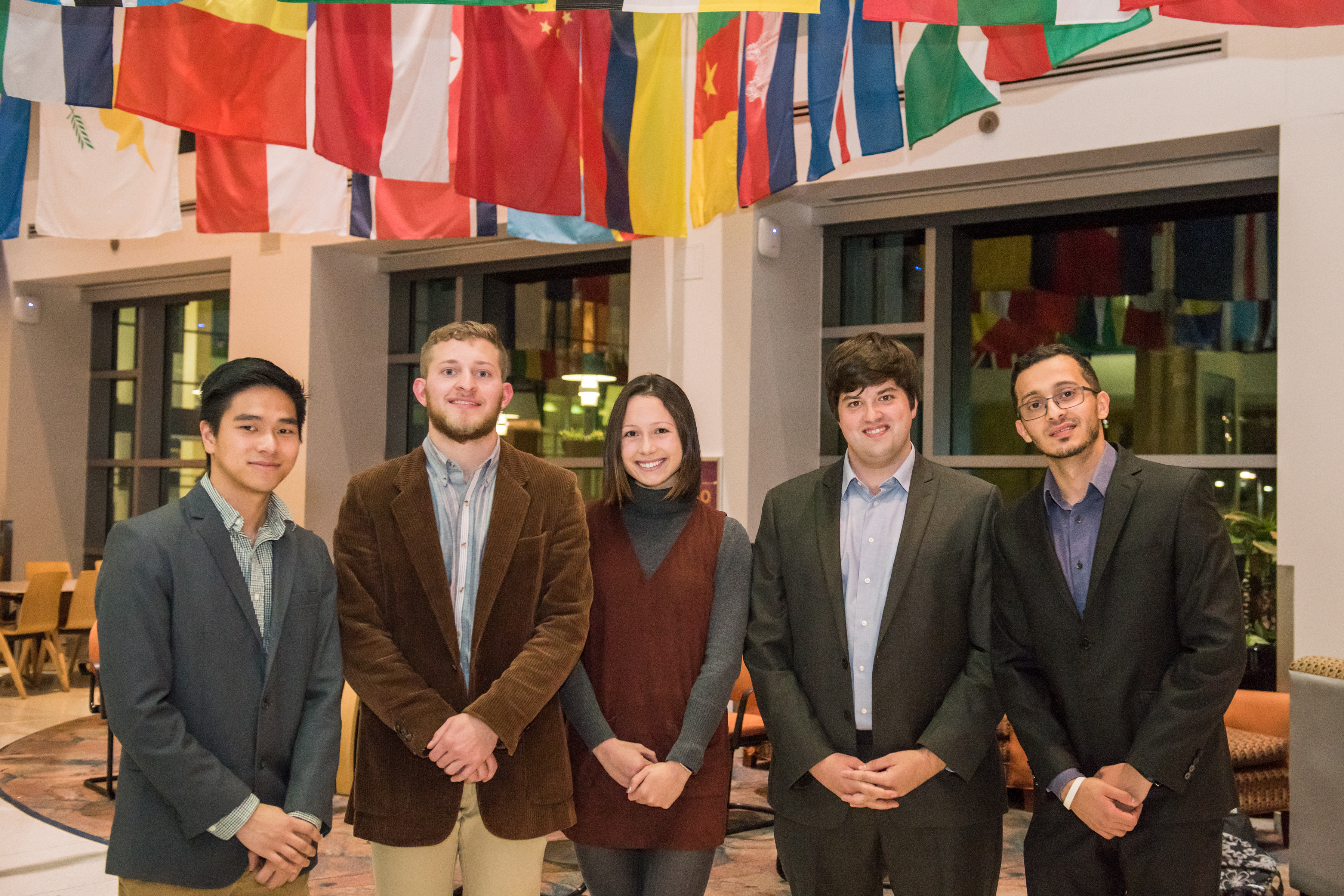
Each fall, student entrepreneurs at UMBC pitch their big ideas – Shark Tank-style, no less – for potential funding.  And each year, their ideas span disciplines, including everything from a comic book series featuring a new brand of hero, to hydro-powered water bottles designed to track water consumption.

Now in its eighth year, the Alex. Brown Center for Entrepreneurship Idea Competition is just one of several ways UMBC is helping to turn students’ ideas into reality, providing monetary prizes for startup funds, and advice from alums and others who can help them along the route to success.

“I think this competition is an amazing opportunity to help young adults have the confidence and ambition to go beyond just spitballing ideas,” said Karla Negrete ’19, mechanical engineering. Negrete and her partner Nathan Eschbach ’19, mechanical engineering, took home first place and a $750 prize for their Puncture Perfect concept, a patch that lights up veins to aid medical professionals in drawing blood.

“I think with the emergence of ultrasonic and infrared technology our idea was really overlooked. We intend for the venipuncture assistance patch to be a tool utilized in hospitals as large as Johns Hopkins to overseas military bases to third world developing countries. For a procedure as simple as the venipuncture, there should be a simple solution that is universally available,” explained Negrete.

Three UMBC alumni returned to campus to pose questions to the young entrepreneurs and act as judges for the competition –  Alexander Chizhik ’97, economics; Paul Mangus ’86, information systems management; and Angela Singleton ’95, interdisciplinary studies. When addressing the audience, all three focused on the importance of idea generation and perseverance. Singleton, inventor of footwear technology for women’s high heels, stressed the value of networking and relationship building, “so when you have your big idea, you know who to come to to make it happen.”

“Most people will tell you they have an idea but they don’t take steps to put it in action. If you don’t take that first step, there is no success,” said Chizhik, COO and general counsel for VIMRO, LLC. “It’s an incredible adventure to be part of something.”

Winners of the 2017 Alex. Brown Center for Entrepreneurship Idea Competition

Mustafa Al-Adhami M.S. ’15 and current Ph.D. student, mechanical engineering, and his partner Ben Pushon-Smith M.S. ’17, electrical engineering, were awarded second place for their Neuro-Stablyzer concept. Utilizing virtual reality technology, the Neuro-Stablyzer would combat the symptoms of PTSD through game play by directly targeting the areas of the brain most affected. Their goal is to offer an alternative solution to those suffering from PTSD that wouldn’t be as traumatic as traditional treatment or require medication.

Pushon-Smith elaborated, saying, “We believe that our idea could revolutionize how we treat mood disorders, and could be tailored to treat a broad range of mood disorders such as anxiety, ADHD, depression, and even enhanced learning. We plan to better research the localized effect of VR on specific networks of the brain, and to work with commercial partners to develop prototype games for the Neuro-Stablyzer program.”

Third place winner Vincent Celebrado-Royer ’18, business technology administration, brought his idea to the table with the Skanaroo app he developed. Skanaroo buttons are designed to be affixed to an easily visible accessory like a backpack. Each button is customized with a QR code that leads to a student organization’s landing page, with the idea that passersby will scan to learn more. Celebrado-Royer has already developed a fully functional product and website and has found success in marketing his invention to various clubs on the UMBC campus. In addition to his third place award, Celebrado-Royer also won best presentation.

In addition to this fall event, the Center for Entrepreneurship’s annual Cangialosi Business Innovation Competition (CBIC) is another opportunity for students to showcase their entrepreneurial prowess. This spring event awards $3,000 to the first place winner who devises the most effective startup business plan. Both of these events serve as a foundational stepping stone for students interested in making a career as an entrepreneur. Al-Adhami won third place in last year’s CBIC competition and has received confirmation for a provisional patent. He reflected on his experiences saying, “It was great to share our idea with a panel of entrepreneurs; hopefully one day we will be on the other side of the discussion.”

Banner image: Participants in the 2017 Alex. Brown Center for Entrepreneurship Idea Competition. All photos by Marlayna Demond ‘11 for UMBC.

New crowdfunding platform puts fundraising power in students’ hands

Since 2014, UMBC has used crowdfunding to support both philanthropic endeavors and entrepreneurial projects – everything from purchasing new instruments for the Down and Dirty Dawg Band, to creating educational opportunities for future Retrievers. The continued success of fundraising efforts like these has now led to the creation of Gritstarter, a custom-designed crowdfunding platform UMBC hopes will encourage student, faculty, and staff to serve as their own champions for fundraising.

“This is a tool that connects the UMBC community with donors and helps everyone on campus understand how philanthropy works and how they can be involved on both sides,” said Leanna Powell ’08, assistant director of Annual Giving.

Launched in August 2017, Gritstarter has already raised over $7,000 for student and campus-wide projects, with additional projects currently in the funding stage. One of the most successful campaigns came from UMBC’s mock trial team, who require funds to travel to the national championships in states as far reaching as California and Minnesota.

“We knew we had a number of people – family, friends, alumni, local attorneys –  who were interested in supporting us financially, but we didn’t have an easy way to collect that money and encourage others to give. That’s where Gritstarter came in,” said Ben Garmoe ’13, mock trial head coach, who worked with Powell to build a crowdfunding page that highlighted the work and personal sacrifices the students made to get to nationals.

“We tried to emphasize how even a small donation can make a significant difference, and how our organization works hard to make every dollar we receive go as far as possible,” he said.

The Gritstarter platform comes equipped with a wealth of information for novice fundraisers, with everything from suggestions on how to promote to potential funders, to ideas and guidelines for video creation. By giving students control of their own fundraising efforts – and supporting them with training from the Annual Giving office –  they’re afforded the ability to gain vital skills such as business management and strategic outreach, said Powell. This platform will also be an integral fundraising aid for UMBC’s inaugural Giving Day in February 2018.

In addition to traditional goal and deadline-driven fundraising efforts, Gritstarter also serves as a home for continued goodwill efforts like the Stay Black and Gold Student Emergency Fund. All donations to this fund serve to directly offset unexpected financial burdens for UMBC students.

Collaboration has been the driving force throughout the process of creating Gritstarter. On-campus departments and students were consulted to determine what the aesthetic of the platform would be and how it would fit into the established brand of UMBC.

Screenshot of UMBC's Gritstarter homepage.

“We wanted it to look like something for students and that’s why we worked with [student designers at] commonvision to design it because we wanted students to immediately see themselves in it and know it was for them,” said Powell.

Melissa Prather ’18, environmental science and design, and Samual Buettner ’18, design, were initially tapped for their design input as commonvision employees but eventually became the duo responsible for designing Gritstarter’s look and feel.

“Everyone ended up agreeing that it did make sense to have such a student centric thing also made by students,” explained Prather. The pair took inspiration from the landscape of UMBC to create dynamic imagery and logos, dedicating nearly five months to collaborating on the finished product.

Several academic departments, athletic teams, and student organizations are already taking advantage of the new crowdfunding platform but Powell has high hopes that interest will continue to grow. “I want every student organization to meet their fundraising goal and I want every student organization to fundraise with us,” she said.

Photo by Marlayna Demond ‘11 for UMBC.

Annual Critical Social Justice events focus on themes of resilience and resistance

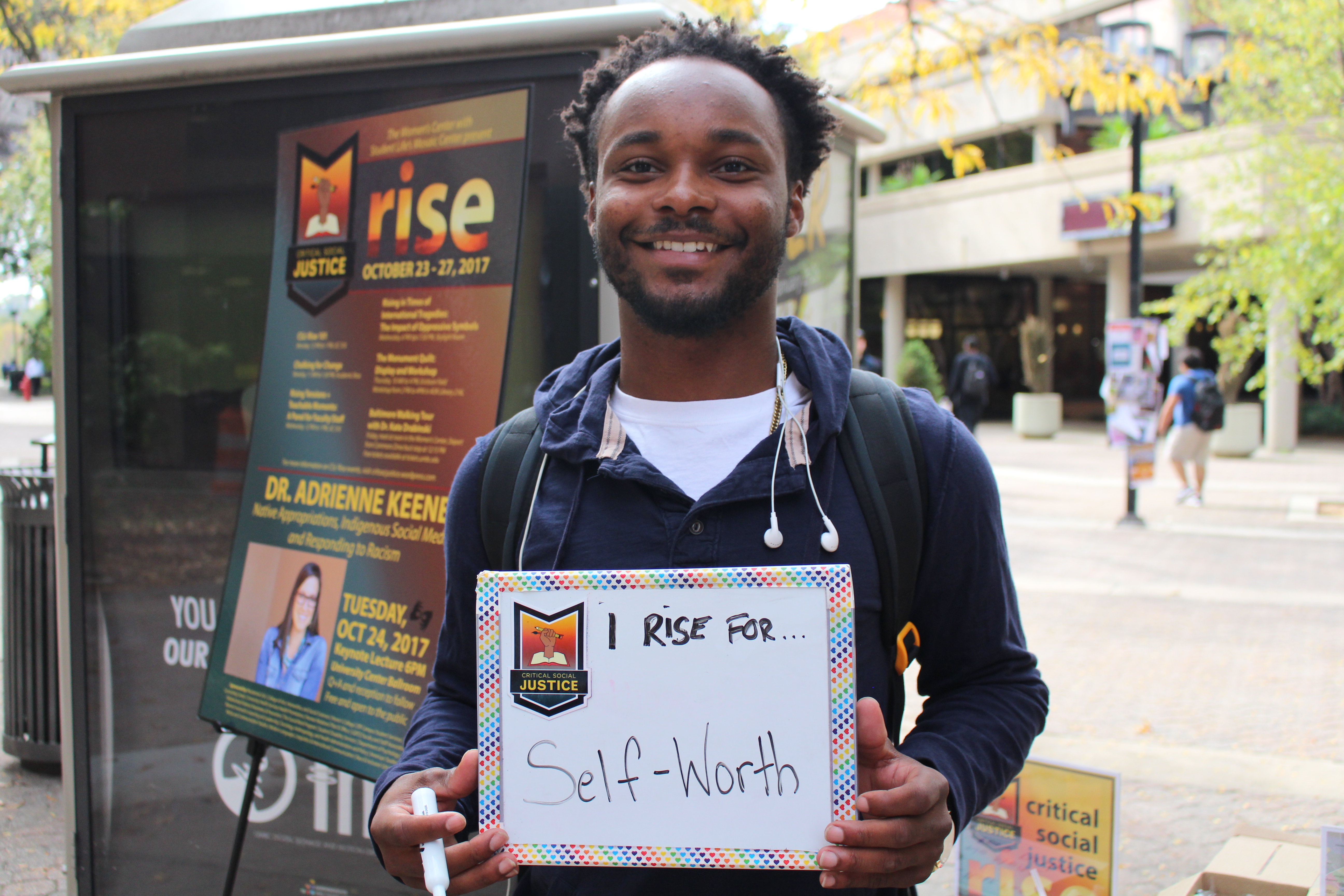
Critical Social Justice (CSJ): Rise began outside the confines of a lecture hall last week, bringing the mission directly to the streets of UMBC. During the kickoff event, Chalking for Change, students answered the question “What do you rise for?” with familiar wordsequality, inclusion, respect, tolerance, and other personal credos – that told a visual story of empowerment spanning Academic Row.

Now in its fifth year, CSJ is designed to encourage the public to think more closely about Critical Social Justice. Sponsored by the Women’s Center, The Mosaic Center for Culture and Diversity, and 18 additional co-sponsors, the week-long series offers a range of opportunities to explore individual and collaborative instances of resistance and resilience.

“Our attempt was to flip the script since these types of events are usually panels of speakers telling you what to think,” explains Jess Myers, director of The Women’s Center. “We wanted to use Chalking for Change as a way to allow for more dialogue and to break down the hierarchy of who gets to talk about what they care about and what they’re rising for.”

One of the most compelling events of the week was speaker Adrienne Keene’s keynote lecture, “Native Appropriations, Indigenous Social Media, and Responding to Racism.”  Keene opened her dynamic speech by displaying the results of a web image search for the term “Native American.” The search yielded repetitive images of historic photos or paintings that predominantly featured men bedecked in war regalia.

“There are 567 different federally recognized tribes and hundreds more state-recognized and non-federally recognized tribes, and each of those tribes has their own culture, their own regalia, their own language, their own history, their own government and that vast diversity and complexity is nowhere in this set of images,” Keene said in reference to the largely uniform results.

The Native scholar and activist addressed a standing-room-only audience about the ramifications of appropriating Native culture for entertainment purposes, in everything from runway fashion to athletic mascots. As a citizen of the Cherokee Nation, Keene stressed, “If I’m standing up here saying these are the things that make me a Cherokee woman, and you can go and buy all of those things at Target and Urban Outfitters, it starts to erode that ability for me to say those cultural markers make me who I am.”

In closing, Keene left the audience with a charge, saying, “UMBC really prides itself on being one of the most diverse campuses in the country and that’s amazing, but I want you to really think about what that means if it doesn’t include the original inhabitants of this land.”

During CSJ, The Women’s Center also invited survivors and secondary survivors to a quilt making workshop to create pieces for addition to the Monument Quilt, a public demonstration of stories from sexual violence survivors and their loved ones and supporters. The ultimate goal of the Monument Quilt is to blanket the National Mall with 6,000 squares that will spell out “Not Alone.” Moderators also used this time to address the #MeToo movement on social media, and gave many individuals the opportunity to speak about it in person for the first time.

The week culminated in the annual Baltimore Walking Tour with Kate Drabinski, senior lecturer in gender and women’s studies. Participants started their walk at the corner of Martin Luther King Boulevard and Pratt Street and continued to the Inner Harbor, stopping at various sites of resistance and resilience along the way. The tour focused heavily on transit and the effects it has on shaping communities.

“It’s really important for CSJ to not just be these ivory tower conversations. We have to be thinking about the ways that we do social justice as an institution and as a community within Baltimore,” Myers explained. “What’s important to remember about Critical Social Justice is that it’s not just supposed to be five days. What we really hope is that it can create springboards or open doors for people to think about Critical Social Justice all the time.”

To learn more about Critical Social Justice, visit the Critical Social Justice blog.

Banner image: Members of the UMBC community share their input during a workshop facilitated by Adrienne Keene. Photo by Marlayna Demond ’11 for UMBC. Additional photos provided by UMBC Women’s Center.

Center for World University Rankings names UMBC as one of the world’s top universities

The Center for World University Rankings (CWUR) named UMBC as one of the top universities in the world according to their 2017 report released last week. UMBC lands in the top 1.9% of higher education institutions worldwide and joins only four other institutions in Maryland on the list. More than 27,000 organizations were evaluated, making the CWUR the largest ranking of global universities.

CWUR takes eight indicators into account when compiling their rankings, including quality of education (alumni who have won major international awards); alumni employment (as CEOs in companies worldwide); quality of faculty (faculty who have won major international awards); research publications, influence and citations; broad impact; and international patent filings.

UMBC is one of only five institutions in the state of Maryland to make an appearance on the list, along with University of Maryland, College Park; University of Maryland, Baltimore; Johns Hopkins University; and Uniformed Services University of the Health Sciences. In addition to the global recognition UMBC has attained, the Wall Street Journal/Times Higher Education list of nationally ranked institutions recently named UMBC as one of the top universities in the United States.

Photo: UMBC student works outside in 2017.
Photo by Marlayna Demond ’11 for UMBC.