All posts by: UMBC News Staff


At Play – Summer 2014

ESTONIAN EXCELLENCE

There isn’t an NCAA in Estonia. No college recruiters or flashy promoters. So back in 2011, rising UMBC senior Lauri Kaei had to get onto the radar of UMBC men’s and women’s swimming and diving coach Chad Cradock ’97, psychology, the old fashioned way: grit, determination, and some timely word of mouth from other Estonians – including Herol Marjak ’13, history, and Johan Rohtla ’14, biochemistry – who have swum competitively at UMBC.

Flash forward three years. Kaei is one of the top performers on UMBC’s successful swimming and diving teams, chalking up individual achievements and helping the university’s 200- and 400-yard medley relay teams finish at the top of the America East Conference.

And like many UMBC student-athletes, Kaei has been just as successful in the classroom, double majoring in political science and philosophy with minors in international affairs and legal policy.

UMBC was a very different experience from higher education in Estonia. “It seemed really big!” Kaei observes. “Universities back home are just buildings that are spread out around the city, but there’s no actual campus.”

Kaei hopes to attend law school in the United States after graduation and plans to enjoy his last year of competitive swimming for UMBC.

Cradock observes that “it has been great to watch [Kaei] grow as a person. He’s someone that supports his teammates, cares a lot for the sport, and is invested in the betterment of himself. I know when he gets into the real world, whatever he does, he’s going to be extremely successful.”

— Katharine Scrivener

LEGO LEGEND
s14-ATPLAY-lego

For children, a tub of Legos isn’t just a collection of brightly colored building blocks. It’s a means of self-expression and a tool for learning.

But while many of us drift away from Legos, Jason Burik ’00, psychology, hasn’t stopped exploring their potential.

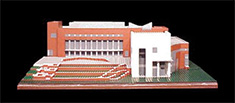
Burik’s parents and grandparents gave him Lego sets as a child, and his ambitions grew with each set. In seventh grade, he built a scale model of his parents’ house using the blueprints. And by the time he was at UMBC and the Baltimore Ravens were building a new stadium, Burik made a model of that as well.

“I still remember my roommates laughing when I told them I was going to build a Lego stadium on our apartment kitchen table,” he recalls.

Burik sent a photo of that stadium model to the Pittsburgh Pirates, who were in the process of building PNC Park. The photo landed him the first of many commissions. To date, Burik has constructed more than 100 Lego projects for clients around the world – including Yankee Stadium, Stanford University, and the U.S. Capitol. Among his favorites? A model of The Commons at UMBC.

His love for both education and Legos is contagious. When he’s not building with colorful blocks, Burik works as assistant to the superintendent in the Montour School District, west of Pittsburgh. Burik has managed to combine his passion for teaching and Lego modeling as well, conducting Lego building camps for children who may someday go on to build great things of their own.

— Meredith Purvis

PRIDE PROVEN

s14-ATPLAY-retriever-A

s14-ATPLAY-retriever-B

s14-ATPLAY-retriever-C

UMBC’s Prove It! Campaign has added greatly to the quality of campus life during its six years of existence, including the creation of a green space outside the Fine Arts Building and a system for tracking campus shuttle buses via GPS technology.

Last year’s winners have finally made their mark at UMBC – three new and vibrantly decorated Chesapeake Bay Retriever statues placed in prominent areas around campus.

The Retriever Project was the brainchild of UMBC students: Kelsey Krach’ 14, cultural anthropology and Spanish, Travis Bell ’14, psychology and political science, and Cami Sotela ’13, psychology.

With funding provided by UMBC’s Student Government Association, Prove It! gives undergraduates with a vision for ways to improve the campus a chance to compete to have their plan realized. Winners of the competition can receive up to $10,000 to implement a winning plan and cash prizes of up to $2,000.

The idea for the Retriever Project was based on a number of colorful “animals on parade” public art projects around the world – most notably two large projects in nearby Washington, D.C., which featured pandas and then donkeys and elephants.

Krach, Bell, and Sotela spent more than two years planning their Retriever Project entry. The first three statues were placed in front of the Albin O. Kuhn Library, The Commons, and the Performing Arts and Humanities Building. Each statue is painted to reflect a core UMBC value: diversity, academic and social exploration and the breadth and depth of UMBC’s academic program.

— Jessie Orsburn ’14

Learn more at umbcretrieverproject.blogspot.com.

FABULOUS FROSH

s14-ATPLAY-rookieoftheyear

In 2008, the UMBC men’s basketball team finally made the leap to the biggest event in college hoops: the NCAA Championship.

Retriever Nation has renewed hope of a return to the Big Dance thanks to rising sophomore Rodney Elliott, who was named as the America East Conference Men’s Rookie of the Year for the 2013-14 season. Elliott was also named to the conference’s Third Team – the only freshman to earn a spot amongst the conference’s elite players.

Elliott is the first UMBC’s men’s basketball player to earn Rookie-of-the-Year honors. The 6’0” point guard – the son of former College Park standout Rodney Elliott, Sr. – became UMBC’s second NCAA Division I player to record 400 points (451), 100 rebounds (118) and 100 assists (108) in a season. Elliott’s 451 points scored is the most by a freshman in UMBC’s 27 years of NCAA Division I competition.

Elliott was also selected as the America East Fans’ Choice Player of the Year.

“I am really honored to receive this award. It’s a humbling experience,” Elliott said. “I want to thank my family, my parents and my coaching staff – who knows where I would be without their support.”

Fellow rising sophomores Will Darley, David Kadiri and Charles Taylor, Jr., all played substantial minutes in 2013-14 and will form the nucleus of a men’s team with terrific potential.

“Rodney was thrust into a major role as a first-year college player and did a tremendous job,” said head coach Aki Thomas. “He has definitely served as a catalyst in the maturation process of our program.”

— Steve Levy ’85

Robert Deluty, Graduate School, Publishes His 45th Book

Robert Deluty, associate dean of the graduate school, has published a new volume of poetry, “Gifts in Disguise.” In his review, Joseph DeVitis writes: “Robert Deluty’s poems give us quick, yet profound, glimpses into the old adage that ‘things aren’t usually what they seem.’ He incorporates and transcends that theme because he wants us to look at
things as if they could be otherwise. Deluty urges us to become wider awake, to feel and reflect upon everyday experiences so that we might repair the damages in our lives. He is a remarkably hopeful poet who pulls us up when we stumble–and then claps his hands for us to dance.”

“Gifts in Disguise,” as well as all of Dr. Deluty’s other books, may be purchased at the UMBC Bookstore.

Advancing Excellence: The Foundations Work Group

While UMBC’s strategic planning will chart the future, the Strategic Planning Steering Committee is beginning its process with a realistic look at the foundations needed to support campus development.
StrategicPlanning-4949The Foundations Work Group is led by Lynne Schaefer, vice president of administration and finance. “As we were developing the four strategic focus areas, ideas about infrastructure and the current state of the university came up,” Schaefer explains. “We realized that, in order to talk about how we need to grow, we have to make sure that we understand where we are now. That discussion evolved into a plan to review five key foundational areas in order to determine how we continue to build a successful future for UMBC.”

The Foundations Work Group’s key areas include people, resources, facilities, technology/business practices and environmental sustainability. A review of the current status of each area will help assess history, strengths, “pain points” and opportunities. For example, the group will look at how the University invests in people by examining the current state of professional development and training, wellness, faculty and staffing ratio comparisons, and faculty mix, as well as qualities that make UMBC a great place to work, and future trends. Additional information about the data being assembled in the five key areas is available here.

“Providing a broad view of where we are now will allow us to look at ourselves realistically and build from where we are,” says Schaefer.

The group will create a data gallery that will be on view at the University Retreat in August, and the gallery will be accessible online for the entire campus by the start of the fall 2014 semester.

Bruce Walz, Strategic Planning Steering Committee co-chair and Foundations Work Group member, describes, “Rather than have each of the strategy groups attempt to find out such information relative to their area on their own, we decided to make this information available in a central data gallery that each group could access and interact with.”

“This approach ensures that all groups will be accessing the same data set, and reduces the potential for overlapping and multiple requests to various campus constituencies,” Walz explains. “Because the Foundations Working Group will continue to be a functioning group during the planning process, the available data will be dynamic and we will be able to effectively address specific requests from the strategy groups.”

The Foundations Work Group members are subject matter experts, as well as other campus leaders who can provide context and input into the five key foundational areas. They include Dorothy Caplan, president, Non-Exempt Staff Senate, and executive administrative assistant, College of Natural and Mathematical Sciences; Philip Farabaugh, professor of biological sciences; Tanvi Gadhia, environmental sustainability coordinator; Julianne Simpson, assistant director, facilities planning; Jack Suess, vice president, information technology; Valerie Thomas, associate vice president, human resources; Charlene Uhl, director of budget/resource analysis; and Bruce Walz, chair, Academic Planning Committee, and professor and chair, emergency health services.

Members also will serve as consultants to the Strategic Planning Steering Committee and four strategic planning strategy groups as questions or needs for analysis arise, and will contribute to the overall strategic planning process. The group plans to meet periodically with UMBC’s faculty and staff senates, as well as the Student Government Association and the Graduate Student Association.

Schaefer says that the inclusiveness of the strategic planning process, as well as the thoughtful planning that has gone into it, have helped to establish an important road map for the future.

“The UMBC community has many shared values and aspirations, and it’s great to see us all coalesce around what I think are really significant aspirational focus areas, while at the same time looking at the status of our foundational areas so that we can move forward from strength,” says Schaefer.

Six UMBC Graduates Among Inaugural America East Presidential Scholar-Athletes

Six UMBC student-athletes were among the 48 America East student-athletes named to the conference’s inaugural Presidential Scholar-Athlete class for their outstanding academic achievements throughout their collegiate careers. Approved by the America East Board of Presidents last June and implemented for 2013-14 academic year, the Presidential Scholar-Athlete award recognizes graduating student-athletes who compiled a cumulative grade-point-average (GPA) of 3.75 or higher as an undergraduate student.

The Retriever honorees were tennis’ Kim Berghaus, swimming and diving’s Patty Hallberg, volleyball’s Robbin Lee, men’s soccer’s Corbin McCarron, cross country/track athlete Kirsten McGovern and baseball’s Luke Seppi.

In addition to registering a 3.75 GPA for their college career, honored student-athletes must have received their undergraduate degree in the academic year they are honored and have attended their institution for a minimum of two years. All six Retriever student-athletes graduated Magna Cum Laude.

Dennis Coates, Economics, on WAMU’s Metro Connection

Does it make sense to host the 2024 Summer Olympics in Washington, D.C.? Economics Professor Dennis Coates recently shared his thoughts on this question on WAMU’s Metro Connection. The U.S. Olympic Committee has confirmed Washington, D.C. as a finalist to host the Olympics along with San Francisco, Los Angeles and Boston.

Coates shared insight on whether the financial investment in hosting the Olympics in D.C. would be worth the return. “By and large most of the cities that hosted saw a decline relative to what would have happened had they not hosted the event,” he said. And the primary reason, he believes, is the crowds.

“People respond to the possibility of crowds, if they’re locals, by saying one of two things. One is ‘I’m getting out of Dodge,’ which means there is a lot of flight so normal expenditures don’t occur. The other is ‘I am not leaving my house,’” Coates said.

Coates also addressed the argument that hosting the Olympics can lead to investment and improvements in infrastructure. “If you need the infrastructure, build the infrastructure,” he said. “You don’t need to throw a party for the world to justify spending the money to redo highways, pave some roads, work on the subway system or whatever. It’s well justified if it’s worth doing; it doesn’t need a party to justify it.”

To listen to the full, six-minute interview with Coates that aired on Metro Connection, click here.

Center for Aging Studies Research Featured in McKnight’s

A recently published study involving researchers from UMBC’s Center for Aging Studies found that assisted living facilities and nursing homes should evaluate certain processes and features that can often lead residents to feel stigmatized.

Center for Aging Studies researchers Erin Roth, Susan Goldman, Amanda Peeples and Brandy Wallace conducted the study along with researchers at the University of North Carolina at Chapel Hill and the University of South Florida, Tampa. Their findings were recently published in The Gerontologist.

A June 27th article published in McKnight’s, a news magazine for long-term care providers, highlighted the research findings and their impact on decision making at nursing homes and assisted living facilities. Below is an excerpt from the article:

“The findings were based on a total of about 250 interviews with residents, staff and family members of five senior living communities. Four had both assisted living and skilled nursing settings, and transitions between these settings is another trouble area identified by the investigators.”

“Whether individuals are drawn to a multilevel setting because it allows for transitional care without moving to a new campus, or in response to the less intense level of care (without giving thought to the other levels), the reality is that transitions within multilevel settings are more challenging than most anticipate,” the authors wrote.

To read the article in McKnight’s, click here. You can read the study published in The Gerontologist by clicking here.

Kate Drabinski, Gender and Women’s Studies, on The Marc Steiner Show

On Monday, June 30, WEAA’s The Marc Steiner Show hosted a segment focusing on LGBTQ politics after the Stonewall riots in 1969. Forty-five years after New York City police  conducted a raid against the gay and lesbian community at the Stonewall Inn in Greenwich Village which sparked a riot, the panelists reflected on how the political landscape has changed.

Kate Drabinski

Kate Drabinski, lecturer of gender and women’s studies and director of the Women Involved in Learning and Leadership (WILL) program participated in the discussion and said it’s also important to remember the influence events before Stonewall had on LGBTQ politics.

“Stonewall has been memorialized as the beginning of a movement, but in a lot of ways that movement has lost some of the original politics of the people who were there,” Drabinski said. “I think it’s important to mark were we’ve come, but also what we lose when we isolate Stonewall as the moment when everything happened.”

Other panelists in the discussion included Vann Michael, Black Transmen Inc. Maryland/DC Chapter representative, Imara Jones, economic justice contributor for Colorlines.com and Sharon Brackett, Board Chair of Gender Rights Maryland. You can listen to the full segment here.

Donald Norris, Public Policy, Provides Maryland Primary Election Analysis

Donald NorrisThroughout Maryland’s primary election night on June 24, Public Policy Professor and Chair Donald Norris provided analysis on WJZ 13 for several key races, including the race for governor and attorney general. After the governor’s race was set, Norris offered his take on how Democrat Anthony Brown and Republican Larry Hogan will proceed in the months ahead before Election Day in November.

“I think these guys are going to go after each other tooth and toenail, quite frankly. It’s a Republican establishment candidate who has positioned himself as a moderate to draw off Democratic votes,” Norris said. ”Brown is, of course, the Democrat established candidate. I think it’s going to be all odds favoring the Democrat because the state is so Democratic, so deep blue.”

Norris was quoted in The Daily Record and The Baltimore Sun providing post-election analysis, and also was quoted in a Baltimore Sun article on July 1 about Governor O’Malley’s intervention in the Johns Hopkins Hospital labor dispute. The article can be found here.

President Hrabowski Discusses College Access in Trusteeship Magazine

UMBC President Freeman Hrabowski recently wrote an essay on the importance of education to the promise of the American Dream in Trusteeship, a magazine published by the Association of Governing Boards of Colleges and Universities.

In his essay, Dr. Hrabowski recounts the history of access to higher education, from the G.I. bill that enabled veterans to attend college to present-day legislation further extending access. He encourages college and university leaders to continue making education accessible to under-served populations, saying, “We must invest in our children and young people, in education, and in research if we’re to continue to grow and thrive as a nation.”

Click to read Dr. Hrabowski’s essay, “Diversity, Access, and the American Dream.”

Meet the Staff: Lexi Coon

headshotName: Lexi Coon
Job Title: A&D Communications Intern
Focus Area: Writing for the UMBC Giving and Alumni Blogs
Years at UMBC: 3
Grad year (if alum): hopefully fall of 2015!

Q: Where are you from originally?

I was born in Manhattan, KS, and lived there for about 2 years (not that I remember any of it). As far as I’m concerned, I’m a born and raised Delawarean.

Q: What do you love most about UMBC?

I really enjoy how many people are willing to help you succeed in whatever it is you want to do. Everyone here really does want to know how you are doing and if there is a way they can help you. Also the squirrels are really entertaining.

Q: What’s your favorite thing about your job?

I’d have to say my favorite thing about working for Alumni Relations is the people I work with. I can come in really tired and grumpy, but by the end of the day they have me laughing and smiling. There’s a lot of camaraderie and energy around here.

Q: Have you ever done anything crazy or out of the ordinary?

Well since I’m a swimmer, I have a thing for water. My dad and I both became certified scuba divers when I was ten, and a few years later we got to dive in the Epcot Aquarium in Disney! It was unbelievable. Also, this past year when I went home for Christmas, two of my friends and I went surfing on the Eve of Christmas Eve just because we could. The water temperature was about 44 degrees, but it was totally worth it.

Q: If you could visit any place in the world, where would you go?

I can’t pick just one. I have a running list of where I want to go, from all over Europe to the Galapagos Islands. I’m very much a beach girl, so any place that has sunshine, sand, and cool animals and culture always appeals to me.

Round-Up: UMBC In the News 6/27

One of the things that makes UMBC great is how wonderful our alumni, students, faculty, and staff are. Because of these amazing people, UMBC often finds itself “in the news,” so each week, we’ll be sharing with you a round-up of the most newsworthy achievements from our community.

Read more great news about the UMBC community here!

Tamara Peters, IRC, on CBS Baltimore

CBS Baltimore featured a news story on “Bearings of Baltimore Circa 1815”, a 3D representation of Baltimore during the War of 1812. Tamara Peters, from UMBC’s Imaging Research Center, led a team of researchers to study historical documents and create the 3D map.

Peters discussed the use of technology in the cutting-edge representation. “We are so used to today living through our smart phones and our iPads,” she said. “I think this is just a natural way for people of this generation to learn and to be exposed to things.”

“Bearings of Baltimore Circe 1815” is on display at the Maryland Historical Society. Click here to watch the video on the CBS Baltimore website.