All posts by: UMBC News Staff


Alumni to perform at Bruun Studios

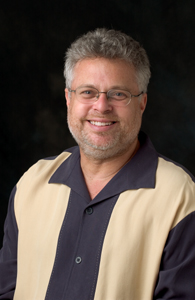
The percussion quartet Umbilicus, featuring Tom Goldstein, music, Shelly Purdy ’10, music, Will Redman ’98, visual & performing arts, and Rob Wolk ’11, music, performs Friday, October 4 in the program Feeling Different — an event that “explores what it means to feel different.”

“When is [feeling different] a good thing, or a bad thing? Empowering, or marginalizing? When does difference generate harmony, and when chaos?”

Attendance is free, but registration is required for attendance. Please email Peter Bruun at peter@bruunstudios.com, to reserve your space. Bruun Studios is located at:
302 E. Federal Street
4th Floor
Baltimore, MD

Reposted from Insights

UMBC: Ready for Liftoff

Ready for Liftoff

Cync Program Launches First Three Companies

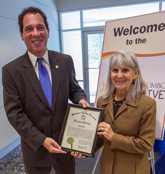
Cync Ribbon CuttingUMBC’s Research Park Corporation, known as bwtech@UMBC, and Northrop Grumman Corporation hosted a ceremony on September 27th for the first graduating class of the Northrop Grumman Cync Program: AccelerEyes, Five Directions and Oculis Labs. The event also marked the expansion of bwtech@UMBC’s Cyber Incubator program, a sign of the program’s success and the positive economic impact both initiatives are making on the region.

The celebration, held at bwtech@UMBC, featured remarks by Northrop Grumman Corporate Vice President and President of Northrop Grumman Information Systems Kathy Warden, UMBC President Freeman Hrabowski, Baltimore County Executive Kevin Kamenetz, Speaker Pro Tem Delegate Adrienne Jones ’76 and Maryland Secretary of Business and Economic Development Dominick Murray.

“We’re proud to be a part of this endeavor and congratulate the Cync companies,” said Warden. “When seeking the most innovative approaches to mitigating the cyber threat, academia and small business bring unique insights to a cyber leader like Northrop Grumman. This partnership with UMBC and the Cync companies is generating the type of game-changing technologies that keep us ahead in the cyber battle, while helping us to cultivate tomorrow’s cyber workforce.”

“The graduation of the first three companies from this program demonstrates the potential of university and corporate partnerships to grow Maryland’s economy and support young businesses,” President Hrabowski said. “UMBC’s research park is playing an increasing role in developing the cybersecurity sector in Maryland, and we couldn’t have a better partner in that work than Northrop Grumman.”

The Cync program, founded in March 2011, is an innovative partnership that focuses on commercializing technology to protect the nation from a growing range of cyber threats. It builds on bwtech@UMBC’s successful business-incubation framework by offering a “scholarship program” for small businesses with the most promising cybersecurity ideas. Participants in the program draw on UMBC’s research expertise and Northrop Grumman resources to develop tools that will secure and protect our nation’s networks.

Participants also cut the ribbon on a 3,353 square-foot expansion of the bwtech@UMBC Cyber Incubator. The new space, called the CyberHive, will include five incubator labs, two shared offices, a conference room, coffee bar, kitchen and coworking space.

In total, there are 48 cybersecurity companies in the bwtech@UMBC community, including Light Point Security, also a Cync company and recently named a top-five Startup of the Year by the Wall Street Journal. bwtech@UMBC has the largest cluster of early-stage cybersecurity companies at a university-affiliated research park in the nation.

Sen. Barbara Mikulski and Rep. Elijah E. Cummings, made the following comments regarding the joint bwtech@UMBC/Northrop Grumman event:

“Maryland is the global epicenter of cyber security, leading the way in finding cyber tech solutions that make our country safer and preparing our cyber warriors for jobs that make our economy stronger,” said Mikulski. “Because of Maryland’s incredible federal assets, dynamic private sector and academic institutions, America’s cyber defense starts in Maryland. The partnership between institutions like UMBC and Northrop Grumman for the Cyber Cync Program is so important for Maryland and the country. It builds the cyber workforce and makes sure that our students are ready to fill the jobs of today and the jobs of tomorrow.”

“I am thrilled to see the success of the Cyber Cync Program, demonstrated by the first round of graduates celebrated today, and the expansion of UMBC’s Cyber Incubator,” said Cummings. “As technology’s role in society continues to grow, the cybersecurity problems we face will only become more difficult. Innovative partnerships like Cync play a critical role in ensuring we are able to find solutions to those problems now, and in the future.”

(10/02/13)

A Big UMBC Thank You – FY13 Donor Roll

Every year, as fall begins to roll in, and the leaves start turning brilliant colors all across campus, we’re reminded that Thanksgiving is just around the corner.

Fortunately for us, we don’t have to wait for November to get that warm gracious feeling (although the pie, alas, will have to wait). Today, we’re releasing the FY13 Donor Roll, a list of all of the wonderful people who supported UMBC during the last fiscal year.

This list is full of Retriever Believers. Thank you for all you do to keep UMBC strong!

Pete Caringi UMBC Soccer Show to Air Thursday Evenings on Q1370 throughout October

The Pete Caringi UMBC Soccer Show returns for another season on Thursday, Oct. 3, 2013. The show will run for five consecutive Thursdays in the month of October as the Retrievers work their way through the treacherous America East Conference and attempt reach the NCAA Championships for the third time in the past four years. Each Thursday, show host Paul Mittermeier will discuss the week’s action with Coach Caringi and player guests. The program airs on the home of the Retrievers, Q1370 AM, the station’s new frequency at 99.9 FM and streams live from 7:00-8:00 p.m. on www.q1370.com.

Fans are welcome to call the show and speak to the guests. The studio line is 410-481-1370.

Tom Beck Selected Chair of the Maryland State Historical Records Advisory Board

Tom Beck, Chief Curator, has been selected chair of the Maryland State Historical Records Advisory Board, the group that connects historical groups in Maryland and reviews Maryland grants submitted to the National Historical Publications and Records Commission of the National Archives. He succeeds Edward Papenfuse, retiring Maryland State Archivist and Commissioner of Land Patents.

Tom Goldstein, Music, and Alumni Perform at Bruun Studios

goldstein01-sThe percussion quartet Umbilicus, featuring Tom Goldstein, music, Shelly Purdy ’10, Will Redman ’98, and Rob Wolk ’11, performs Friday, October 4 in the program Feeling Different — an event that “explores what it means to feel different.”

“When is [feeling different] a good thing, or a bad thing? Empowering, or marginalizing? When does difference generate harmony, and when chaos?”

Attendance is free, but registration is required for attendance. Please email Peter Bruun at peter@bruunstudios.com, to reserve your space. Bruun Studios is located at:
302 E. Federal Street
4th Floor
Baltimore, MD

Photo Gallery: UMBC Hosts Third Annual 1966 Society Dinner

Dr. Freeman Hrabowski hosted the third annual 1966 Society dinner on September 19 in the Imaging Research Center (IRC) at UMBC.  The 1966 Society (link to planned giving page) celebrates those individual members who have identified the UMBC Foundation in their estate plans.

Guests had a wonderful time exploring the IRC during the evening. During dinner, Dan Bailey, Director of the Imaging Research Center, welcomed the group and showcased some of the exciting research being worked on in the Center.  Check out the new IRC documentary, The Work of the Imaging Research Center http://www.irc.umbc.edu/blog/.

Please contact Kim Robinson at kim.robinson@umbc.edu if you would like information about estate planning.


Photo Gallery: Sherman Hall Dedication

UMBC honored and thanked George and Betsy Sherman for their commitment to education and their generous support of the University at the dedication of Sherman Hall, formerly Academic IV, on Thursday, September 19.

Over nearly 20 years, the Shermans have committed more than $10 million to help strengthen our efforts to increase the number of well-prepared, highly qualified teachers in science, technology, engineering, and mathematics (STEM) committed to teaching in high-needs schools in the Greater Baltimore area. Their support enabled UMBC to launch the Sherman STEM Teacher Scholars Program in 2006.

To You – Fall 2013

Richard ByrneI ride UMBC Transit to work every day.

Yes, I’m likely helping reduce UMBC’s carbon footprint by doing so. But what I have found over the five years that I’ve been a rider is that the feeling of virtuousness is outweighed by the camaraderie I’ve found with my fellow riders.

For a little over four years, I battled the commute by DC Metro and MARC train with the hardy group of souls who ride the Halethorpe Line and the BWI/MARC Line. Students, faculty and staff together – braving the blustery winds at the Halethorpe MARC station, or the crowded trains and inevitable commuting delays.

When I moved closer to UMBC late in 2012, I switched over to the Catonsville Line and the Arbutus Line. These lines primarily serve the off-campus housing near the university – and the eager chatter of students in multiple languages reminds me not only how diverse our campus is, but just how far many people travel to get a UMBC education.

This issue of UMBC Magazine takes sustainability as its theme. One thing that has surprised me as we have assembled this issue is how hard the university is working to overcome the history and geography that made UMBC a primarily commuter campus through much of its existence. The campus is becoming more of a community as its residential student population grows. There are more ways than ever to get to campus without being one person in one car. And the university is also coordinating efforts to become more ecologically friendly in how we dispose of our waste, heat our classrooms and offices, and construct new buildings to more exacting environmental standards.

Another surprise has been the scope of research on campus devoted to sustainability. We’ve tackled some of this research in previous issues of UMBC Magazine, but had no problem filling more than half of the space we normally allot to features with stories about the ways that UMBC faculty are pondering just how to make our city and our planet a greener place.

The magazine that you hold in your hand is also playing its part in UMBC’s sustainability efforts. Before the first issue of UMBC Magazine was published, the university decided that it would be printed on paper that was at least 50 percent postconsumer recycled (Roland Cascades Opaque). According to our suppliers, the use of this paper preserves trees (139), cuts down on the creation of solid waste (6,542 pounds worth) and prevents the release of 12, 882 pounds of net greenhouse gases.

We hope you enjoy this issue of UMBC Magazine! And perhaps enjoy it more knowing the efforts we are making to harmonize its production with UMBC’s goals to be a greener university.

— Richard Byrne ’86

The News – Fall 2013

PAST AND FUTURE

The torch has been passed at the College of Arts, Humanities and Social Sciences (CAHSS) – and it has been passed from one historian to another.

Scott E. Casper arrived on campus as the new dean of the CAHSS and professor of history in July, following John Jeffries, who retired and is now a professor emeritus of history and dean emeritus of the college.

Casper was the interim dean of the College of Liberal Arts at the University of Nevada, Reno and a professor of history at that university, serving as chair of the department and director of graduate studies.  He was also chair of the university’s faculty senate.

UMBC’s new dean of CAHSS brings with him a distinguished record in teaching and research. Casper is the author of Sarah Johnson’s Mount Vernon: The Forgotten History of an American Shrine (Hill and Wang) and Constructing American Lives: Biography and Culture in Nineteenth-Century America (The University of North Carolina Press). He was named the University of Nevada, Reno Foundation Professor in 2010 and the Carnegie Endowment for the Advancement of Teaching/Council for Advancement and Support of Education Nevada Professor of the Year in 2008.

Casper received his A.B. in history from Princeton University in 1986; his M.A. and M. Phil. in American studies from Yale University in 1990; and his Ph.D. in American studies from Yale University in 1992.

– Richard Byrne ’86

ASTONISHING ALUMS

Each year, the UMBC Alumni Association presents Outstanding Alumni of the Year Awards to honor alumni for their professional and personal achievements and service to the university.

The annual awards presentation ceremony – which will be held this year on Thursday, October 10 at the Albin O. Kuhn Library – is one of the highlights of UMBC Homecoming 2013.

This year’s awardees are:

Jeehye Yun ’97, computer science as Outstanding Alumnus of the Year in Engineering and Information Technology. Yun is CEO of Secured Sciences Group LLC – a successful information technology company headquartered in the bwtech@UMBC research park.

Ricardo Zwaig ’77, Spanish as Outstanding Alumnus of the Year in the Humanities. Zwaig was appointed as a district court judge in Howard County in 2010 by Governor Martin O’Malley. He was the first male Hispanic district court judge in Maryland.

Dr. Mary Loeken, M.S. ’80, biological sciences as Outstanding Alumna in the Natural and Mathematical Sciences. Loeken is a research investigator at Joslin Diabetes Center and an associate professor at Harvard Medical School whose research on diabetic pregnancy was featured in the Summer 2012 issue of UMBC Magazine.

Sherece West-Scantlebury, P.h.D. ’07, public policy as Outstanding Alumna in the Social and Behavioral Sciences. West-Scantlebury is president and CEO of the Winthrop Rockefeller Foundation – a dynamic Midwestern philanthropic organization.

Brigitte Pribnow Moore ’05, acting as Outstanding Alumna in the Visual and Performing Arts. Moore is executive director of the Young Playwrights’ Theater in Washington, DC.

For more information about the awards and UMBC Homecoming 2013, visit our website: http://homecoming.umbc.edu/

– Jenny O’Grady and Richard Byrne ’86

PLUGGED IN

Karl Steiner

Over the past two decades, UMBC has grown by leaps and bounds as a research institution – in size, in capacity for interdisciplinary collaboration, and in its continuing efforts to integrate undergraduates into the process of discovery. The task of the university’s new vice president for research, Karl V. Steiner, will be to continue and intensify that growth.

Steiner was hired to take the reins from Geoffrey Summers, a professor of physics at UMBC, who has retired after serving as vice president since 2008. Summers was also the founding dean of UMBC’s College of Natural and Mathematical Sciences in 2005.

In his previous position as senior associate provost for research development at the University of Delaware, Steiner fostered notable interdisciplinary collaborations among engineers, life scientists, social scientists, health scientists and other researchers. He was a professor in the electrical and computer engineering department and the biomedical engineering program, and served in a variety of other positions, including founding associate director of the Delaware Biotechnology Institute, executive director of the Center for Composite Materials, founding executive director of the Fraunhofer Research Center – Delaware, and president and founder of Lightweight Solutions, Inc.

Steiner received his Engineering Diploma in electrical engineering from the University of Applied Sciences in Braunschweig Wolfenbüttel, Germany, in 1983; his master’s degree in electrical engineering from the University of Delaware in 1989; and his Doktor Ingenieur in mechanical engineering from the Institute for Composite Materials (IVW) at the University of Kaiserslautern, Germany, in 1995. He is a co-holder of two patents, and has authored over 80 publications in prominent science, technology and engineering journals.

– Richard Byrne ’86

THE GOOD WORDS

Retriever Word Cloud
For the fourth year running, The Chronicle of Higher Education has named UMBC one of the best colleges in the nation for which to work. It was also the second year in a row that UMBC made the Chronicle’s “Honor Roll” for ranking highly across all categories in which faculty and staff across the country were asked to rate their workplaces.

The Chronicle results are based on responses from nearly 45,000 people at 300 institutions nationwide. UMBC received high ratings in seven categories, including collaborative governance, teaching environment and diversity.

But how do UMBC faculty and staff view UMBC in their own words? A recent survey conducted to prepare for the creation of the university’s new strategic plan (Our UMBC: A Strategic Plan for Advancing Excellence) is one place to look.

The survey of faculty, staff and students was conducted earlier this year as part of a year-long preparation to commence work on the new plan. A word cloud derived from responses of faculty and staff was presented at the university’s annual retreat in August (in the shape of a retriever, of course), revealing that among the words that came up most often were “engaged,” “diverse,” “collaborative,” “innovative,” “supportive,” “inclusive,” community” and “entrepreneurial.”

UMBC Provost Philip Rous also formally unveiled the strategic planning process at this year’s university retreat. The creation of the plan will unfold over the next two years and its implementation will coincide with UMBC’s 50th anniversary in 2016.  You can find out more about Our UMBC: A Strategic Plan for Advancing Excellence by visiting www.umbc.edu/planning.

– Richard Byrne ’86

Postcards From Pyongyang – Brian Souders ’09, Ph.D., LLC

Postcards from North KoreaBrian Souders ’09, Ph.D.,  language, literacy and culture, has directed UMBC’s Study Abroad program since 2000. His own travels and study have taken him to (among many locations) Finland and Russia, but Souders spent a week this past spring in one of the most secretive and closed-off nations in the world: North Korea.

Officially known as the Democratic People’s Republic of Korea (or DPRK), North Korea hosts only a few thousand tourists annually – and only a fraction of that number are Americans.

A week spent in North Korea in March is not a spring break trip to Cancún by any stretch of the imagination. Most group tours do not start with a two-hour orientation that involves each individual signing a statement that they are not a journalist trying to sneak into the country. Nor do most group tours elsewhere in the world have a long list of rules and regulations – no photographs of soldiers, scenes of poverty, strategic buildings or anything that could remotely be construed as a military target or a source of embarrassment to the North Korean government.

In exchange for our agreement to these conditions? We were to be accompanied at all times by guides from the North Korean state travel agency. No long strolls on your own across Kim Il Sung Square in the capital city of Pyongyang. In fact, there was no time scheduled for any individual activity. Our assigned guides could get into serious trouble were we to wander off.

Time Traveling to North Korea

The best way to describe the week I spent in North Korea is “time travel.” A journey back to my very first visit to the then-Soviet Union in 1982. At the time, I was a high school exchange student spending my junior year in Finland – and our program included a weekend trip to Leningrad (now St. Petersburg).

As was the case in Leningrad in the latter days of the Cold War, Pyongyang is devoid of any commercial advertising. The city is full of propaganda in support of the Korean Workers’ Party (North Korea’s Communist Party) and the Korean People’s Army. The same lantern-jawed proletarians depicted in Soviet propaganda posters also appeared in Pyongyang with Asian – instead of European – features.

Even more ubiquitous were images of the three men who have ruled North Korea since its founding in 1948: the Great Leader and Eternal President, Kim Il Sung (1948-1994); his son, the Dear Leader Kim Jong Il (1994-2012); and his grandson, current leader, Kim Jong Un.

In the 1980s, the cult of personality among Soviet leaders had largely vanished, with only founder Vladimir Lenin’s portrait still widely displayed. The cult of the Kim family, however, is inescapable – disseminated via posters and portraits in libraries, schools, public squares, and in every single car of the Pyongyang metro.

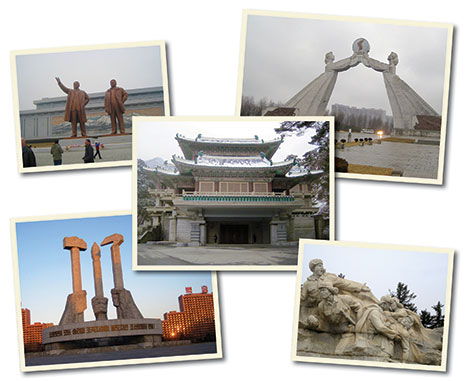
Our itinerary for the week also included visits to Mansu Hill (where statues of Kim Il Sung and Kim Jong Il tower over the square) and Kumsusan Palace of the Sun (where both men are buried). We also paid a five-hour visit to the International Friendship Exhibition Hall, a museum with an endless maze of corridors connecting rooms filled with the more than 90,000 gifts given to the Great Leader and the Dear Leader by a long list of dead dictators – including the late presidents of Iraq, Libya, Romania, the Soviet Union.

“If you were to spend one minute looking at each gift in this museum to the Eternal President and his son, the Dear Leader,” our guide told us as the tour commenced, “you could spend a year here.”

We exchanged silent glances of panic.

A Chill in the Air

In March, the Korean Peninsula is swept by chilly winds from Siberia. But the contrast between South and North Korea in March is revealing.

When I visited South Korea in March 2012 to run the Seoul Marathon, I regularly had to open the windows in my overheated hotel room. But I rarely did so in North Korea – where hot water was sporadic, electricity intermittent (even in the capital) and indoor heating was not universal.

As our group headed into the Light Industry section of the Museum of the Three Revolutions during our trip, I had a bad feeling.

“Bundle up,” I told one of my fellow travelers. “We’re going inside.” We could see our own breath as we wandered from exhibition to exhibition.

I did catch a few memorable and unscripted glimpses of the country seen through the windows of our comfortable tour bus. The public face of Pyongyang glistened in comparison with empty, pothole-filled highways that wound past high-rise apartment rows marked by extreme poverty.

And I saw life beyond the city, too – glimpses of a stunning countryside where peasant farmers hacked through the snow-covered fields, following ox-powered plows in the bitter cold as they prepared for spring planting.

But was I able to experience the “real” North Korea? Our group never entered a regular shop or interacted with anyone other than roller-blading children at Kim Il Sung Stadium.  We never touched (or even saw) North Korean currency.

The answer, sadly, is no.