All posts by: UMBC News Staff


Ferrera ’10, MFA, IMDA, Headlines Show in Rockville

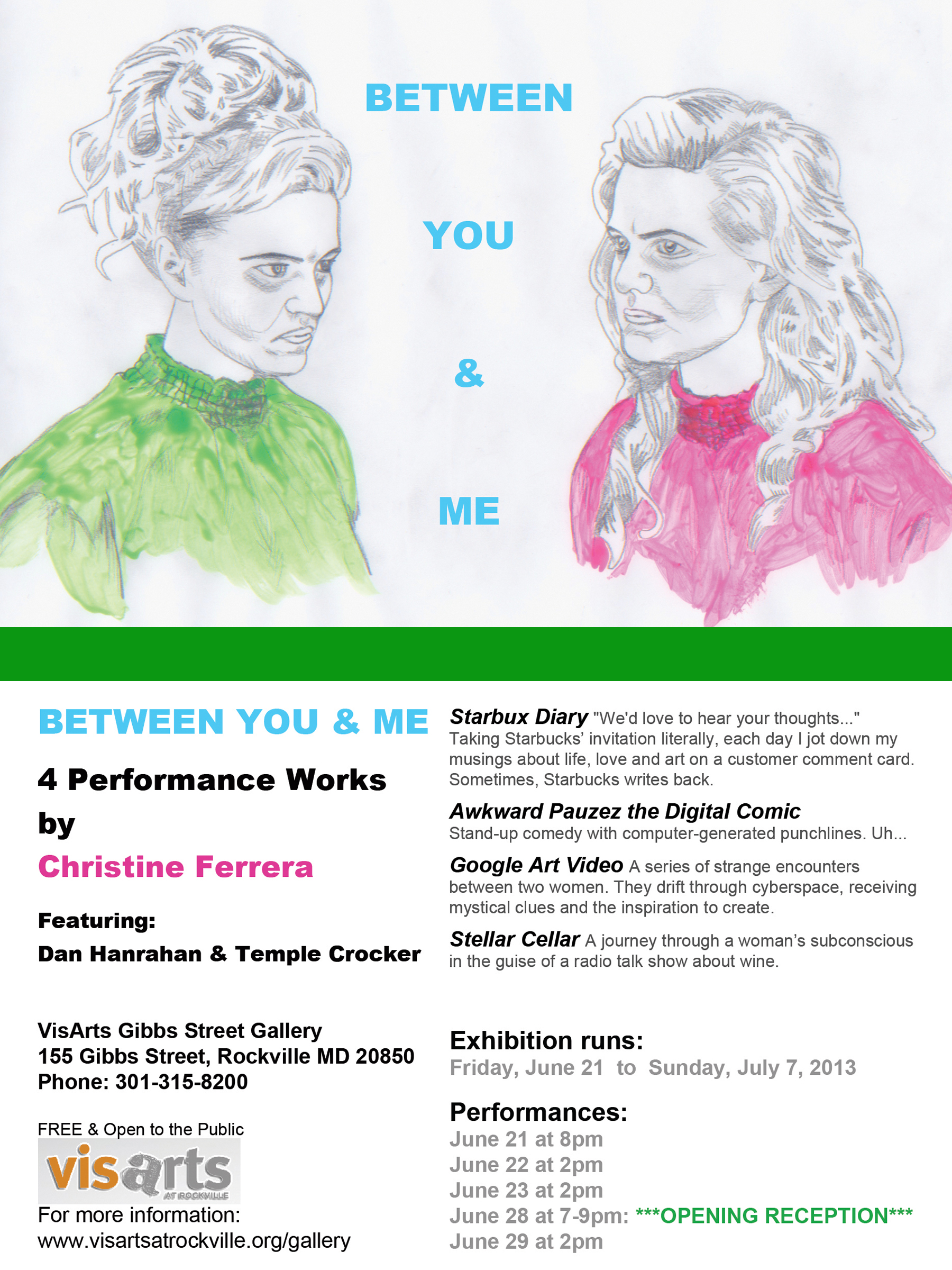
ferrera_imageBetween You and Me, an exhibition by Coordinator/Producer of the New Media Studio, Christine Ferrera ’10 M.F.A., Imaging and Digital Arts, opens Friday, June 21, at 8 p.m. at the Gibbs Street Gallery in Rockville, Maryland.

According to Rockville’s VisArts website, Between You and Me is a collection of performance pieces “that circuitously contemplate art, humor and feminism. Each piece uses personal monologue as a vehicle to explore longing, insecurity, narcissism and enlightenment. By counter-posing live and recorded performance, satire and sincerity, the artist either transcends her angst or winds up in a self-reflexive tangle.”

The works include Starbux Diary; Awkward Pauzez the Digital Comic, a stand-up comedy act with computer generated punchlines; Google Art Video, a performance featuring the strange encounters of two women drifting through cyberspace receiving mystical clues and the inspiration to create, and Stellar Cellar, a journey through a woman’s subconsciousness under the guise of a radio show discussion about wine. Read the complete descriptions of the works on the event poster.

This event is free and open to the public, and continues through July 7. Performances of the works are scheduled through June on the 22nd, 23rd, 28th and 29th. A free opening reception will be held on the 28th from 7:00 to 9:00 p.m.

Catonsville Club Establishes Scholarship

In a final goodwill gesture to the Catonsville community, the recently disbanded Woman’s Club of Catonsville has donated $25,000 to establish a new endowment at the University of Maryland, Baltimore County (UMBC).

In memory of 80 years of service to the Catonsville community, The Women’s Club of Catonsville Memorial Scholarship rewards UMBC students returning for their sophomore year and having maintained a 3.5 GPA, or higher. Preference will be given to candidates who have attended a public or private high school in the Catonsville area.

“The club has a strong history of putting money back into the Catonsville community,” said Paula Ray, former treasurer for the club. “UMBC has a very good reputation, and we are fortunate to have to such a fine institution in our back yard.”

Besides following the tradition of the Women’s Club, Ms. Ray says the donation was also a great way to memorialize the legacy of the club. “We really wanted a lasting endowment that the club would be remembered for.”

Most scholarships focus on the newly enrolled, but the members of the club wanted to highlight those students returning to campus to continue their studies. “The club wanted to see the money go to someone who had finished their first year, and done well,” said Ray.

UMBC plans to offer the scholarship to students beginning in fall 2014.

Up On the Roof – Summer 2013

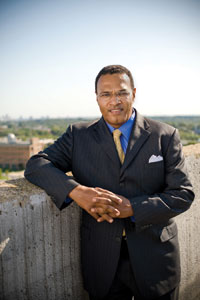
President HrabowskiUMBC President Freeman A. Hrabowski, III, takes your questions.

Q:  I want to thank you for making me proud to have a degree from UMBC. The legacy you are building not only enriches students’ experiences, but adds value to their postgraduate lives. How will you continue the momentum you’ve built – and specifically where will additional capital be directed in the coming years?

– John Becker ’01, information systems

A:  Wherever I go in the country, people talk about UMBC as a university that is setting a standard for inclusive excellence. So how do we keep the momentum?

First, I think of academic innovation. We need to think about how we use technology and how we prepare students to solve problems in groups. Interdisciplinarity is also a focus for us in increasingly important ways.

We are involved in a number of experiments at UMBC to pursue those questions. We are working with the Howard Hughes Medical Institute on how we prepare students for medical school. We’re exploring the digital humanities and how we teach writing at UMBC. We are working with the Gates Foundation on how we connect to community colleges, and also with the National Science Foundation to determine which strategies help students succeed.

As a result, we have created a culture that focuses on trying different approaches. We use analytics to assess the effectiveness of different strategies, and then set our direction based on that analysis. We’re going to continue those efforts as we also continue to find resources to attract the best faculty across disciplines to UMBC.

There have also been significant investments in the physical infrastructure of the university. People who have not been to campus in the past few years are always amazed at how much the place has been transformed. We recently opened the first phase of the Performing Arts and Humanities Building. It is the most expensive building in the history of UMBC.

And over the next several years the university will be transformed even more. We hope to have a new Events Center that will not only be supportive of academically-sound athletics, but will also give the entire campus a greater opportunity to be physically fit. And we are also delighted that our governor, Martin O’Malley, has moved a new Interdisciplinary Life Sciences Building forward in the queue for state funding.

It is the investments we are making in academic innovation and in people – coupled with our investments in the physical infrastructure on campus – that will shape UMBC in the future.

Q:  Given the injustices you’ve had to overcome to reach your level of success, what are a few guiding principles you’ve used to maintain a positive and productive attitude?

— John Garnet ’06, financial economics

A:  I continue to recommend David Brooks’ book The Social Animal. We think that we determine our actions and attitudes based on logic and a rational approach, yet research shows us that much of what we decide to do can be attributed to things that happened to us as children – many of them which we have forgotten.

For me, growing up in such a loving family, with very hard-working and positive parents who emphasized the importance of love and respect for each other, made all the difference in the world. I saw them in different ways being insulted and challenged by a rigid and prejudiced society – but they never became bitter or cynical. And they always believed that every human being had the potential to be a good person. And when they witnessed people being mean-spirited they believed that they were the product of their childhood experiences; that these people clearly hadn’t had the benefit of love.

I didn’t believe them at first. But as I have gotten older, I appreciate their approach much more. They told me that the people who tend to be happiest have to be realistic – on the one hand – but also to have as much optimism as possible. To find the good in whatever the situation is. Even in tragedy, to ask the question: What can I learn from this?

To You – Summer 2013

Richard ByrneI am on UMBC’s campus almost every working day. As the editor of UMBC Magazine, that’s not unexpected. It’s my job.

But before I became editor, I came back to UMBC a number of times after graduating in 1986. Sometimes I returned to see a former professor. Other times, I was invited to speak to young journalists, or a new generation of Bartleby editors. I also attended alumni events.

The staff of our alumni relations department work hard to come up with events that will entice you to reconnect with the university and your fellow alumni. These events include talks given by UMBC professors on the cutting edge of research in various disciplines, wine tastings and gallery openings, and even a chance to take in ball games at Orioles Park at Camden Yards or Nationals Stadium.

Over the past few years, it’s been a delight to watch many of my fellow alumni make the trek home to UMBC. What they see when they get here isn’t just a campus filled with memories – but also a university that’s growing and thriving across disciplines.

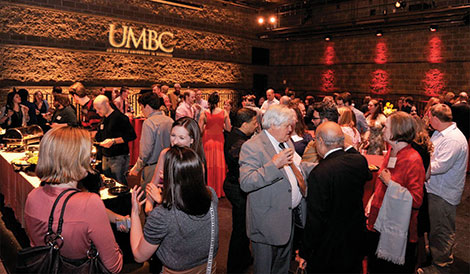
Just this past April, UMBC alumni gathered on campus for a number of events. Over 60 ancient studies alumni came back to celebrate their program’s remarkable history and honor a number of the founding faculty of the department. And 70 alumni from UMBC’s award-winning theatre program came back to celebrate the opening of the new Performing Arts and Humanities Building with their department’s faculty (below) and to see William Shakespeare’s The Two Gentlemen of Verona –  the first production in a the new building’s proscenium theatre.

TOYOU_theatreHave a look at our calendar on the back page of this issue – or, better yet, sign up and get information about all of our upcoming events – including Homecoming 2013 – via our online alumni portal Retriever Net.

I’m sure you’ll find something that will bring you back to visit us here at UMBC.

– Richard Byrne ’86

The News – Summer 2013

CALL TO HISTORY

The proscenium theatre of UMBC’s recently-opened Performing Arts and Humanities Building was perhaps the most appropriate venue for this year’s W. Augustus Low Lecture in History.

The lecturer was John Jeffries, dean of UMBC’s College of Arts, Humanities and Social Sciences (CAHSS) and professor of history, who will retire from the university on June 30. Among the greatest legacies of his 40 years of scholarship and service to UMBC – much of it as leader of the Faculty Senate and the college – was his guiding hand in making the new building a reality, and literally cementing the university’s continuing commitment to the arts and humanities.

The capacity crowd gave Jeffries two standing ovations – both before and after his lecture, which was entitled “A Life in History: Reflections on Studying Politics and Policy in Twentieth Century America.”

The lecture took the audience through Jeffries’ journey from majoring in history as an undergraduate on a Navy ROTC scholarship at Harvard University in the late 1950s and early 1960s and a five year career in the U.S. Navy to graduate studies at Yale University and a career in academe that took hold at UMBC in 1973.

Yet Jeffries’ lecture was as much a tale of the shifting currents in the study of his chosen subject – 20th century electoral politics and policy in the United States – as it was a personal reminiscence.  Jeffries recalled the excitement of entering the discipline when the “new political history” was in the ascendance. It was a moment when historians were reshaping the field with “systematic, quantitative and social-science approaches to the study of American politics” and seeking to uncover larger currents and patterns in the nation’s political history.

Though the “new political history” itself was subject to critiques and corrections in subsequent decades, Jeffries made a compelling case for its emphasis on the centrality of “ethnocultural attachments and antagonisms in voting” by pointing to the persistence of its influence in recent elections.

Jeffries also explained his own shift as a historian away from studies of voting to the wider seas of how election results played out in the policies enacted by elected officials – with special attention to the era of the New Deal. “I have tried to root my study of policymaking in the matrices of politics and public opinion,” he said, “not just the documents found in archives.”

Asked in the question-and-answer session after the lecture what his advice would be to future students of history, Jeffries had a simple and straightforward reply: “Work hard and have fun. I’ve really enjoyed my life in history…. Enjoy what you’re doing.”

At the end of the lecture, UMBC president Freeman A. Hrabowski, III capped off the event by announcing that Jeffries had been named by the university as both a professor emeritus of history and a dean emeritus of the college.

Members of the CAHSS faculty also announced that a new John Jeffries International Fellowship was being established to provide UMBC faculty with resources to create, or redesign, and teach a course in their fields with an explicit international or transnational focus.

– Richard Byrne ’86

– Watch Dean Jeffries’ lecture here.

Interested in helping to endow the John Jeffries International Fellowship? Point your browser to UMBC’s online giving site to select an amount and type “John Jeffries Fellowship” in the “Other Designation” line provided in the web form.

TIME PASSAGES
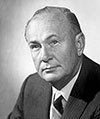
James PineAs UMBC prepares to celebrate its 50th anniversary in 2016, the university will mark a number of landmark dates in its founding. The first of them, in fact, fell in late April of this year, with the 50th anniversary of the passage of the legislation that authorized UMBC’s founding.

The legislation implemented some of the recommendations made by a 1962 state commission on expanding higher education in Maryland. The bill itself was sponsored by longtime Baltimore County Senator James A. Pine, Sr., who was also chair of the Maryland Senate’s Economic Affairs Committee. Pine died in 1988 at the age of 85.

While the 1963 legislation authorized the building of four new branches of the University of Maryland (including locations in the state’s western and southern regions and on the Eastern Shore), UMBC was the only university actually founded as a result of the legislation.

The bill also specifically mentions that the university would not only alleviate overcrowding at other state universities, but also serve as a “nucleus for scientific research and development” in Baltimore County – a definition of its mission which has been amply fulfilled over more than four decades.

UMBC was also the first public university founded in Maryland after the state fully desegregated its higher education system in 1954.

“This university was founded at a time when people of all races could come here and study,” says UMBC president Freeman A. Hrabowski, III. “We are a part of an experiment in which America has been engaged, providing public higher education in an atmosphere of excellence and diversity.”

– Richard Byrne ’86

Image provided by the Maryland Archives

KICK IN

Engineers without bordersStroll near the Commons on most weekdays and you’ll see tables piled high with tasty baked goods, or featuring games of chance. The students at these tables are asking for help – spare change, really – to fund their clubs’ latest and greatest pursuits in a way that hasn’t changed much since the university opened in 1966.

But now these passionate student appeals are now getting a boost from the power of the Internet via GiveCorps, UMBC’s newest fundraising tool. The UMBC pilot of GiveCorps – which focuses on university needs as well as student causes – has just launched online, harnessing social media’s power to publicize, track and aggregate philanthropic campaigns.

“We are incredibly excited to work with student groups to help them understand the ins and outs of philanthropy through GiveCorps,” says Dayna Carpenter, UMBC’s associate director of annual giving. “Our students are very motivated to do good in this world, and this is an important element of their education.”

The GiveCorps site already boasts colorful channels to help student causes. Visitors can help the SAE Mini Baja team get to their next competition, for instance, or send students from Engineers Without Borders to Kenya to dig wells. Donors can also support university giving that directly benefits current students, including the Stay Black and Gold Fund for those who have emergency financial needs.

“The best part is that this lets the students take the lead in promoting their own projects using social media,” says Carpenter. “They’re really good at that, already, so this should feel like a natural fit.”

— Jenny O’Grady

Visit UMBC’s GiveCorps site here.

Team Player – Stephanie Hill ’86, CompSci and Economics

When Stephanie Hill ’86, computer science and economics, signed up for her first computer programming class at UMBC, it was almost as an afterthought – an elective to fill out the semester.

That class in the programming language COBOL led Hill to become (in her words) an “accidental engineer.” And however serendipitous her start in engineering may have been, she’s been quite a success. At Lockheed Martin’s Information Systems & Global Solutions-Civil division, Hill oversees some of the largest government computer systems in operation today. She’s also been honored by the university as one of its 2012 Alumni of the Year.

At UMBC, Hill says she learned that she “loved the problem-solving aspect” of programming and software engineering. “You could make things happen. It took me to a new level of satisfaction, figuring out a problem and being able to see the answer,” Hill says. She also cites a three-year professional practice co-op that UMBC had set up with the Department of Labor during her time at the university as instrumental in setting the stage for her success.

The problems that Hill tackles now at Lockheed Martin involve immense complexity. Her division is responsible for the company’s work with U.S. civil federal agencies and other government agencies worldwide – tasks that demand the smooth operation of many large computer systems that Hill’s group oversees.

If you’ve been on an airplane, you likely have flown through airspace managed by an air traffic control system that Hill’s division at Lockheed Martin runs on behalf of the Federal Aviation Administration. Those who served in the armed forces may use a disability system Hill oversees for the Department of Veterans Affairs, and anyone who has drawn on the resources provided by Medicare or Medicaid also depends on the work in Hill’s division.

“We literally impact the lives of American citizens every day,” Hill says.

Soon after graduating from UMBC, Hill took a job with defense contractor Martin Marietta. The only open position was in software testing, but she let the company know she was eager to be in software engineering.

Hill proved her mettle and was promoted to software engineer within a few years. Ever since, she has tirelessly worked up through the ranks of the company (which in 1995 merged with Lockheed Corporation to become Lockheed Martin) in roles of increasing responsibility that included positions as the company’s Director of Quality and Mission Success and as its Director of Technical Operations.

As she has risen to greater prominence, Hill has also been visible as a leader in efforts to help more women and minorities follow her into careers in engineering.

As Hill pointed out in an op-ed she wrote for The Washington Post in May 2012, only 14 percent of engineers today are women, and only 6 percent of those working in the fields of science, technology, engineering, and mathematics (STEM) are black or Hispanic.

One problem in boosting those dismal numbers is that many women and minorities don’t see role models in their neighborhoods and schools – a reason why Hill has served as a mentor to many UMBC students.

“We have a real responsibility to share what we do,” she says. She is also a member of the state of Maryland’s STEM Task Force, which seeks ways to encourage more learning in the sciences.

“I never imagined I’d have the opportunities that I have had. I want other people to experience it,” Hill says. “Seeing people blossom and become leaders is very motivating and satisfying.”

Hill says one of the biggest misconceptions people have about engineering is that it is a job for introverts. In fact, she says, much of her time at Lockheed Martin is spent working with others – meeting employees for first-hand accounts of what’s happening in the field, or checking in with customers to make sure their expectations are met.

Pursuing a career in engineering doesn’t mean that “you are sitting behind the desk with your head down, not talking to anybody,” Hill says. “There is some of that individual work, but most of the work we do we do in a team. And we do some of the most exciting things any career could offer.”

– Joab Jackson ’90

Read more about Hill’s piece in the Washington Post here.

How To Make a Great Cupcake

Michelle KupiecWith Michelle Kupiec ’89, interdisciplinary studies, Owner of Kupcakes & Co.

by Meredith Purvis

America’s craze for cupcakes is still going strong – and why not? The best bakers have pushed the boundaries of the cupcake to concoct dozens of colorful confections with new twists (bouffant icings and inventive garnishes) that can dazzle the eyes and delight the taste buds.

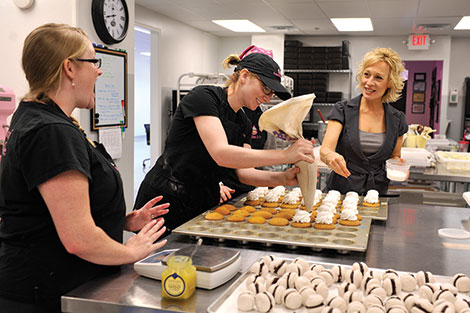
It’s not as easy as it looks to make a truly amazing cupcake, however, and even for the most polished pastry chefs wrestle with perfecting this single serving of scrumptiousness. So we headed into the kitchen with Michelle Kupiec ’89, interdisciplinary studies, owner of the Elkridge boutique bakery Kupcakes & Co. – whose cupcake offerings includes such gems as French Toast and Mint Oreo –  to find out the secret to making a great cupcake.

Tools of the Trade

  • An organized kitchen
  • The basic baking arsenal, including  spatulas, mixing bowls, and measuring cups and spoons
  • A sweet tooth and some creativity to help you dream up great new flavors

STEP 1: Scour the grocery store

A great cupcake needs the right ingredients to make it truly special. Seems like a no brainer, right? But Kupiec says it pays to give even the most basic ingredients extra attention. Kupcakes & Co. uses specialty garnishes such as gourmet lemon curd and homemade brownies, and even orders gourmet cocoa from Belgium. Those things may be out of reach for the average baker, but Kupiec says that even basic upgrades can make a huge difference. “The most crucial thing you need are the freshest eggs you can get,” she observes. Substituting sea salt for regular salt can also boost flavor, as will opting for fresh fruit and spices instead of dried alternatives. (Those who want to kick it up even higher can look for Madagascar vanilla and gourmet chocolate chips at upscale grocery stores.) Kupiec adds that you should set aside your calorie counter apps: Using whole milk and real butter is rewarded with a better tasting cupcake.

STEP 2:  Practice, practice, practice

Cupcake glamour shotDon’t expect your first cupcakes to be your best cupcakes, Kupiec warns. She and her team of bakers are experts, but that’s because they’ve spent decades (collectively) learning these skills. “You have to have patience with baking; it’s so important that you don’t rush it,” says Kupiec. The best way to do that, she says, is to build an environment that will allow you to succeed: Get your kitchen cleaned before you begin, and organize all your ingredients before you even begin to bake. And, of course, look for an excuse to bake! Whether it’s a bake sale at school or someone’s birthday party, you will get a chance to perfect your skills, with the added bonus of sweet treats for you and your friends to enjoy.

STEP 3: Unleash your mad scientist

One of the best ways to make your cupcakes stand out is to develop a unique taste or look. For many bakers, the thought of deviating from a recipe is slightly terrifying: what if something goes wrong? Will my cupcakes self-destruct? Baking is a science, says Kupiec, and there are plenty of ways to experiment. “Think about what you can do to enhance the cupcake without really changing the recipe,” she advises. The best place to start? The icing: “You can easily add in some zest or dried fruit to boost a cupcake’s flavor,” says Kupiec. A key part of her cupcake creation process is coming up with the signature topping for a cupcake, which doesn’t change the recipe at all, but really gives the cupcake some added panache. “Consider adding elements that add texture, like crushed cookies or tiny marshmallows,” she suggests. Even simple touches can make a cupcake seem extra special.

STEP 4: Share the (baked) goodness

Cutaway view cupcakesFew things in life are quite so wonderful as enjoying good food in good company. So when you do come up with a fancy new cupcake, make sure you share it. “To me, baking is love, and I like to share that with my friends and co-workers as a gift,” says Kupiec. “I take care with the presentation, and personalize it so that people will know I did this just for them.” That way, she adds, every step that you’ve taken – from the using best ingredients and choosing the most unique toppings to finding the perfect packaging – adds up to a wonderful gift.

Sidebar: Cupcakes By the Numbers

Sidebar images making cupcakesIt’s no surprise that the folks at Kupcakes & Co. make tons of cupcakes. But just how many? On average, they work about 84 hours per week to make about 10,000 cupcakes, and that takes:

  • 400 pounds of flour
  • 700 pounds of powdered sugar
  • 1,620 eggs
  • 400 pounds of chocolate chips
  • 16 full- and part-time staff members
  • 350 different kinds of sprinkles
  • 95 cupcake pans
  • 2,400 square feet of kitchen and storefront space

Read more about Michelle and Kupcakes & Co. on the UMBC Alumni Blog at umbcalumni.wordpress.com

UMBC: World-class students

World-Class Students

Five UMBC students have been awarded Fulbright grants, and two additional students have been named alternates for the prestigious program that takes students around the world to teach English or conduct original research. This ties last year’s number, which set a record for the most UMBC students to receive the award in one year.

Four students were awarded English teaching assistantships: Yasmin Radbod ’13, Asian studies, for Nepal; Alexandra Mills ’13, gender and women’s studies, for Malaysia; Hannah Kurlansky ’13, English and media and communication studies, for Slovakia; and Andrew Holter ’12, English and history, for the Czech Republic. In addition, Madeline Hall ’12, environmental studies, received a grant to conduct research in New Zealand.

The Fulbright Program is the flagship international educational exchange program sponsored by the U.S. government and is designed to increase mutual understanding between the people of the United States and the people of other countries. The Program operates in over 155 countries worldwide.

Holter said that when he learned he had received the award, he was both thrilled and humbled by the offer. “It was excitement paired with a really unexpected and satisfying sense of responsibility, since the Department of State doesn’t just hand these out so that 23-year-olds can take vacations,” he said.

Two additional students were named alternates for the awards, Abigail Bratcher ’13, history and Russian, for research in Russia and Nathan Rehr ’13, political science, for an English Teaching Assistantship in Turkey.

“I could not be happier for or more proud of our Fulbright recipients and alternates, and am thrilled that UMBC’s talented students are being recognized by the U.S. Student Fulbright Program,” said Brian Souders, the associate director of international education services. “It is rewarding to see that our students are recognized internationally for the work they do.”

“I have always been interested in exploring and learning from other cultures. I believe that no one person, nation, or group of people has a monopoly on knowledge,” said Mills, who plans to attend graduate school in public policy after she returns from abroad.

Recipients of Fulbright grants are selected on the basis of academic or professional achievement, as well as demonstrated leadership potential in their fields. At UMBC, the process of applying for a Fulbright starts six to eight months prior to the October application deadline. Students develop ideas for a research or service project, write essays and gather letters of support from UMBC faculty members and research mentors overseas. They receive advice from academic mentors and Souders along the way. Applicants also have an on-campus interview that is geared to help strengthen their final proposals prior to submission.

“This year’s cohort of applicants brought a unique set of academic interests, creativity and endurance to get through the Fulbright application process,” said Souders. “Almost all had participated in a semester-length study abroad program, and many wanted to continue research they started overseas, or give back as a teacher of English and cultural ambassador.”

Radbod, for example, has worked extensively with refugee populations in Baltimore, some of which are Nepalese immigrants. She also spent a year studying abroad in China.

Students’ courses of studies and extracurricular activities on campus also contribute to the strength of their Fulbright applications.

“At UMBC I’ve been able to study language and communication in depth, which should help me in teaching English abroad. I’ve learned what can be accomplished when students work together and I’m excited to see how this translates for me with this experience,” said Kurlanski.

If Bratcher and Rher do not receive grants this year, they will be encouraged to reapply. One of this year’s awardees, Madeline Hall, was selected as an alternate last year but awarded a grant this year after tweaking her research proposal.

“I will be researching how sheep and cattle farmers in New Zealand decide whether or not to take part in carbon capture programs,” said Hall. “Carbon capture is still a very new field. Since New Zealand is ahead of the curve, it’s a really great place to get experience that I could potentially use elsewhere.”

(5/30/13)

UMBC: Pumping Up Their Math Muscles

Pumping Up Their Math Muscles

Coach Sory Kante, moves quickly across the gym. One of his students working out needs help. But what’s stumped the student isn’t a 220 pound bench press or a complicated yoga move. It’s a calculus problem.

Kante is a coach in UMBC’s newest type of gym: The Math Gym. One recent evening, dozens of students lined up for the gym, knowing that rather than hitting the treadmill, they’d be tackling a regimen of worksheets and quizzes specifically designed for them. The gym provides students with training in foundational skills, skills they’ve supposedly already learned, but have now faded into distant memory. And, on this particular night, more than 40 students, working with as many as 7 coaches, spill out of the seminar room and into the corridors of the math department.

Math Gym is the first of the projects funded by the inaugural Hrabowski Fund for Innovation grants to get off the ground. The fund invests in creative faculty initiatives that reimagine our students’ learning experiences.

Nagaraj Neerchal, professor and chairman of the department of mathematics and statistics, came up with the idea for Math Gym. “It’s something Freeman Hrabowski inspired,” he says.

Math Gym is a departure from traditional tutoring in focusing on crucial, yet basic skills—rather than a specific topic that’s stumping a student in a current class. “Tutoring is like going to the clinic when you’re sick,” says Neerchal. “Working in Math Gym is like working out to stay fit so you won’t get sick. We need both.”

The custom workout begins with QuizZero, a quiz Neerchal and his colleagues designed to test students’ understanding of prerequisite material before classes start. It’s administered through Blackboard and evaluates students’ preparation in the foundational classes, such as algebra, pre-calculus, calculus I and calculus II. Students who score below the median of the class are notified they should brush up on their skills. About 1800 students every semester take the test.

More than half of the freshman entering UMBC each year don’t place into pre-calculus. Those that do may be lacking in foundational skills. “Almost all of them have taken algebra in high school,” says Neerchal, “they just forget.”

The solution, he says: come to Math Gym and get fitted for a “custom workout.” Last semester, nearly 800 students whose QuizZero performance indicated they could use a refresher were invited to participate. Of those, over 500 came to Math Gym.

“If students are taking a class, any class,” says Neerchal, “and if they are unable to do well in class, it’s because they’ve lost their foundational math skills.”

Once a student completes QuizZero, they can come to the Math Gym and have their “workout” customized. The Math Gym coaches and manager have a spreadsheet that they can check to find out what students have to work on. They pass out worksheets and the students are ready for their “workout.”

As the semester progresses the gym rats develop their foundational skills and they can begin to move on to working on their current class, says Chris Harris, Math Gym manager.

And Math Gym appears to be working. “This semester, I saw a dramatic increase in student exam grades in applied calculus as compared to last year of approximately twenty points,” says instructor Elizabeth Stanwyck. “We are tracking the progress of those students who have come to Math Gym versus those who have not,” says Neerchal.

And students say that Math Gym is helping them in their classes. Take Aaron Good, a junior, majoring in physical therapy. Good is taking trigonometry and pre-calculus. “I noticed that my test scores and everything significantly improved,” since the opening of Math Gym, he says. Good says that he hopes to make around a B in his class.

Other gym rats, Nnamdi Onyioofor, a senior, and Caleb Zhou, a freshman, are at Math Gym one evening to work on Calculus I. “I’ve been here for the past week every day,” Zhou says.

Professors also offer extra credit for students who regularly go to Math Gym. But Nicole Lentz, a freshman, says it’s not just the extra credit that keeps her coming back.

“The people here are really helpful too,” she says. “Whenever I have a question they just sit down and help you work it through. They don’t just tell you how to get it so it really makes me understand everything a lot better.”

What’s next for Math Gym? Neerchal and Harris are looking to target a wider range of courses, including those in disciplines beyond mathematics and statistics. They would like to build relationships with other departments and colleges so that students could come to work on math skills relevant for their subjects, such as chemistry, physics and economics. No matter the subject, the underlying math skills are the same.

And the key to mastering them, Neerchal says, “is doing reps. It’s all about repetition just like at the gym.”

(6/17/13)

Appointment of Professor Tim Nohe as Director of the Center for Innovation, Research, and Creativity in the Arts

To: The UMBC Community

From: John Jeffries, Dean of Arts, Humanities, and Social Sciences

Date: June 13, 2013

Re: Appointment of Professor Tim Nohe as Director of the Center for Innovation, Research, and Creativity in the Arts

I am pleased to announce the appointment of Professor Tim Nohe of the Department of Visual Arts as the founding Director of the new UMBC arts research center—the Center for Innovation, Research, and Creativity in the Arts [CIRCA]. Professor Nohe has achieved a remarkable record at UMBC as a multi-talented and interdisciplinary artist who has exhibited and performed widely, as a fine teacher and mentor, and as a leader in shared governance, most recently as President of the Faculty Senate for two years. His work has included collaborations with all of the arts departments at UMBC and with numerous local, regional, national, and international artists, arts organizations, and universities. He is currently Adjunct Professor at La Trobe University, Melbourne, Australia, and his many distinctions include two Fulbright awards and four Maryland State Arts Council Individual Artist Awards. Professor Nohe will bring his wide-ranging skills, experience, and connections to his new position of Director of CIRCA. I look forward to his working with others, at UMBC and elsewhere, to facilitate innovation, research, and creativity in the arts and to raise the visibility and enhance the already strong reputation of the arts at UMBC.

Dr. Kate Drabinski, Gender and Women’s Studies, headlines Baltimore City Paper Queer Issue

You May Now Kiss the Brides
Even as other battles loom, the LGBT community stops to celebrate marriage equality at Pride 2013

On a warm spring evening, Carrie Hiers and Tonya Cook sit on overstuffed couches in their cozy Northeast Baltimore living room and plan their wedding. There will a rainbow balloon arch, bubbles, and a giant spread of rainbow cupcakes.

Technically, it’ll be the second wedding for Hiers and Cook but their first legal one. And they won’t be alone.

On Sunday, June 16, they will join couples from all over the state and beyond—some coming from as far away as Georgia—in Druid Hill Park for a mass same-sex wedding ceremony called “WeDo Baltimore,” officiated by Mayor Stephanie Rawlings-Blake, as part of the Baltimore Pride 2013 festivities.

Read the full article »