All posts by: UMBC News Staff


Ellen Handler Spitz, Honors College, Travels to Appalachia

Ellen Handler Spitz, honors college professor of visual arts, recently spent several days in southern Appalachia as part of a program at the University of the South sponsored by the Yale University School of Medicine and Scholastic Books.

During her visit, Spitz spoke on “Reflections on Children’s Cultural Lives.” Spitz’s lecture was the third event in the annual Easter semester lecture series presented by Community Engaged Learning, the University of the South’s academic community engagement program. This annual series features a range of speakers from all over the world. Speakers address a variety of topics of concern for people living on the Cumberland Plateau and in surrounding communities.

Spiz was also a guest lecturer in “Child, Family, and Community Development in Rural Appalachia,” a psychology course developed out of a partnership between Sewanee’s Psychology Department and Yale School of Medicine’s Child Study Center. The purpose of the program is to help children and families in poverty-stricken Appalachia and to build community and foster a rich cultural life.

In addition to lectures, meetings, classes, Spitz also read aloud to four groups of small children in Grundy County. She read “Trumpet,” “A Birthday for Frances,” and “Miss Agatha’s Lark.”

Ellen reading to Grundy Co. children 2013

Ellen Handler Spitz, Honors College, to Participate in Panel

On Saturday, March 16, Ellen Handler Spitz, honors college professor of visual arts, will participate in a panel discussion in New York City about what we can learn from the perennial controversies about children’s books that are “too dark.”

Spitz will be joined on the panel by author Lois Lowry and former New York Times children’s books editor Julie Just.  The event will take place at 2:00 p.m. at the New School’s Arnold Hall, 55 West 13th St., New York, NY.

Robert Provine, Psychology, to Give Goddard Scientific Colloquium (4/5)

At 3:30 p.m. on Friday, April 5, Robert Provine, professor of psychology, will discuss “Curious Behavior” and his concept of “small science” at the Goddard Space Flight Center. This talk, part of the Goddard Scientific Colloquium series, will be Provine’s 4th colloquium at Goddard.

The talk will be held in the Building 3 (Goett) auditorium. Access to the Goddard Space Flight Center is limited to those holding Goddard badges or official visitors; if you would like to attend, contact Scientific Colloquium at (301) 286-0660 or by e-mail more than 48 hours beforehand.

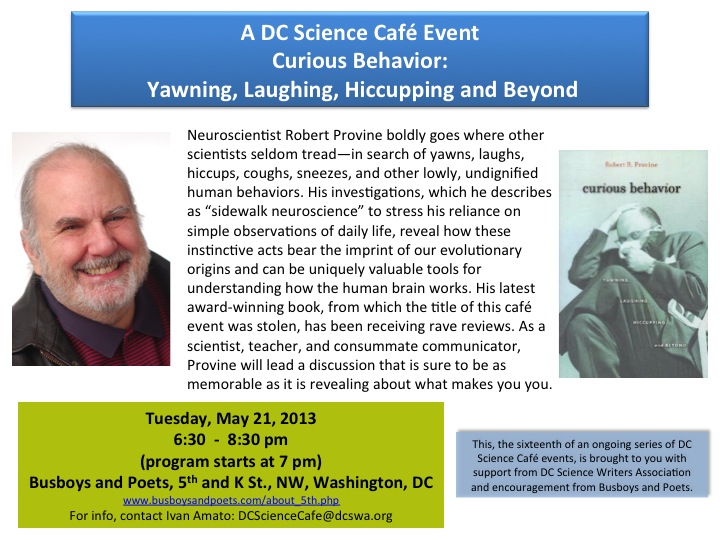
Robert Provine, Psychology, to Speak at “Science Cafe”

Robert Provine, professor of psychology, will lead a discussion at the DC Science Café on May 21.  The DC Science Café, which is sponsored by the DC Science Writers Association, aims to give the general public an opportunity to participate in lively and important discussions about the consequential scientific discoveries and issues of our times.

The discussion will be held from 6:30-8:30 p.m. at Busboys and Poets 5th and K St., NW location. Provine’s discussion will focus on “Curious Behavior,” the subject of his book “Curious Behavior: Yawning, Laughing, Hiccupping, and Beyond.”

A flyer for the event is below.

Slide1

Robert Provine, Psychology, Judges “Brain Bee”

Robert Provine, professor of psychology, was a keynote speaker and judge at the U.S. finals of the Fifth Annual International Brain Bee on March 2 and 3.  This is the second time that Provine has spoken at and judged this event. The topic of his talk was “Curious Behavior,” and was based on his book “Curious Behavior: Yawning, Laughing, Hiccupping, and Beyond.”

The International Brain Bee is an annual competition about knowledge of neuroscience for high school students sponsored by the Society for Neuroscience. Thousands of students from around the world participate. Forty-seven US regional finalists, from as far as California and Alaska competed; one regional finalist will be attending UMBC.

The U.S. finalist won a $3,000 and the opportunity to compete at the international championship in Vienna, Austria.


Graduate Student Charlotte Keniston, IMDA, Selected for MAP’s ‘THIRTY’

Charlotte Keniston, an imaging and digital arts (IMDA) graduate student, has been selected as a featured artist in Maryland Art Place’s upcoming project, THIRTY: 30 Creative Minds Under 30.

Find out more at Maryland Art Place’s website.

“THIRTY is a series of monthly talks featuring thirty emerging Baltimore artists under the age of thirty. All of the participants use a diverse range of creative practices, from visual art to performance, curatorial, community art, design, film, photography and technology to create visual experiences.”

For All the World to See’ in Arbutus Patch

A recent visit by students of Mount Hebron High to the Center for Art, Design and Visual Culture’s current exhibition, For All the World to See: Visual Culture and the Struggle for Civil Rights, was featured in an article in the Arbutus Patch.

Read “Local High Schools to Visit UMBC Exhibition Thursday” at Patch.com.

The high school group, is one of several to visit the exhibition, in a project in which visiting students are encouraged to create their own “social justice-inspired artwork” following the visit. A collection of the student artwork is currently scheduled to be displayed in April 2013.

Back from the Edge

Back from the Edge

Could our global ecosystem be careening towards a cliff? That’s what some scientists think. Erle Ellis, an associate professor of geography and environmental systems at UMBC, and a group of scientists from Australia and the United Kingdom are trying to talk their colleagues back from the edge in a new paper published this week in Trends in Ecology and Evolution.

There is growing agreement among scientists that we now live in an epoch called the Anthropocene – an age where humanity has transformed the world’s ecosystems, atmosphere and even its rocks. The question is whether humans are causing changes in Earth’s ecosystems that might soon trigger a global tipping point. Is the Anthropocene biosphere accelerating towards a point of no return?

While the idea of global tipping points is controversial, ecological tipping points at the local level are well studied. For example, “if you add nutrients to a lake it will continue on as before until you surpass a certain level of nutrients.  Then the lake’s ecosystem will suddenly shift to a new state — it will have reached its tipping point,” says Ellis. “The lake will go from having very clear water to very turbid water, the kinds of fish will change and the chemistry and the ecology of the lake will change almost completely. It is then very hard to get that lake back into its previous state.”

A planetary tipping point in Earth’s ecosystems could occur, say Ellis and his colleagues, if ecosystems across the planet responded to uniform human pressures in similar ways, or if there were strong connections across continents and ecosystems that enabled the rapid transmission of ecological impacts across the planet. 

Fortunately, Ellis and his colleagues are convinced that a planetary tipping point in ecology isn’t likely to occur on Earth. To begin with, organisms and ecosystems on different continents aren’t strongly connected. Animals, plants and microbes are greatly limited in their interactions by distance and barriers such as oceans and mountain ranges. Accordingly, responses to human pressures depend largely on local conditions.  Even global climate change is unlikely to produce a coherent global shift in ecology because local ecosystems respond so differently to changes in climate.

“Essentially, local changes aren’t acting to push each other over the edge, as is the case with tipping points,” Ellis says. “They are simply adding up to cause long-term global changes in ecology.”

While we still need to think about global impacts, Ellis’ research puts the emphasis back on managing ecosystems at the local and regional level. That assertion has significant policy implications and could help us avoid misguided conservation efforts. “The disadvantage of thinking in terms of global tipping points,”says Ellis,“is that if you think you are far from the brink, no need to act, and if you think you’ve passed the tipping point you might as well give up.”

(3/1/13)


Robert Deluty, Graduate School, Publishes His 40th Book

Robert Deluty, associate dean of the graduate school, has published a new volume of poetry, The Knife and the Pumpkin.  In his review, Ronald Pies writes:

“Robert Deluty’s latest collection of poems takes its title from an intriguing comment by the novelist, Simone Schwarz-Bart: ‘Only the knife knows what goes on in the heart of a pumpkin.’ Physicians and therapists might be put in mind of a kindred statement by Sophocles: ‘A wise doctor does not mutter incantations over a sore that needs the knife.’ Both sayings teach us that, sometimes, there is no avoiding pain in getting to the heart of the matter. Deluty’s wonderful new collection understands this well. And yet, as always with Deluty’s poems, there is the saving grace of the poet’s ironic humor and deep human sympathy — deflecting the knife blade when it would do more harm than good.”

The Knife and the Pumpkin, as well as all of Dr. Deluty’s books, may be purchased at the UMBC Bookstore.

James Grubb, History, Receives USM Regents’ Faculty Award for Teaching

James Grubb, professor of history, is the recipient of a 2013 USM Regents’ Faculty Award for Teaching.

Regents’ Faculty Awards publicly recognize distinguished performance on the part of faculty members. This award is the highest honor presented by the Board of Regents to exemplary faculty members. The awardees are selected by the Council of University System Faculty and submitted to the Board of Regents for approval.

Teaching awards are given to faculty who have have demonstrated accomplishments in areas such as course development and pedagogy, faculty development, mentorship of faculty, direction of student research projects, and leadership in teaching improvement.

Previously, Grubb was selected as the Lipitz Professor of the Arts, Humanities and Social Sciences for the 2010-2011 academic year. Watch Grubb give the annual Lipitz Lecture below.

[youtube http://www.youtube.com/watch?v=RH1EpucL1_0]

Jessica Pfeifer, Philosophy, Selected for Leadership Role in PSA

pfeiferJessica Pfeifer, associate professor of philosophy, has been selected as the Executive Secretary and Treasurer of the Philosophy of Science Association (PSA).

The mission of the PSA is to promote research, teaching, and discussion of issues within the philosophy of science from diverse viewpoints. Pfeifer is interested particularly in improving the PSA’s institutional memory, facilitating the mentoring of philosophers of science at the start of their careers, and making the scientific community and the general public aware of the philosophy of science and its value in public discourse.

Pfeifer has published papers in a range of topics in philosophy of science, and co-edited, with Sahotra Sarkar, The Philosophy of Science: An Encyclopedia, Vols. 1 & 2 (Routledge, 2006). She has already assumed several of the jobs of the PSA Executive Secretary and Treasurer, and will soon assume all the duties of the position.

This appointment was made possible by generous financial support and co-sponsorship by UMBC and CAHSS.

Robert Provine, Psychology, in the Globe and Mail

Robert Provine, professor of psychology, is featured in a Globe and Mail story entitled “Why do Oscar Winners Cry Tears of Joy?”

Provine pointed out that it is important to distinguish between two kinds of crying – vocal crying, typical of a newborn demanding to be fed, which is an ancient behaviour shared with other animals, and emotional crying, the tears of happiness or sadness, which is a recent evolutionary development exclusive to humans.

“Only humans shed emotional tears,” he said.

The story appeared online on February 22.