All posts by: UMBC News Staff


UMBC celebrates the career of Bimal Sinha at 10th annual Probability and Statistics Day

The highly anticipated 2016 Probability and Statistics Day at UMBC on May 20 and 21 featured numerous compelling talks from leading statisticians. Previous years included workshops and student presentations on innovative work, while this year included a poignant celebration. In addition to marking the event’s 10th anniversary, participants also honored event founder Bimal Sinha, longtime professor of mathematics and statistics at UMBC, on his 70th birthday.

Sinha founded the graduate program in applied statistics at UMBC and has made substantial contributions to the UMBC community over three decades. “What stands out for me,” said Bill LaCourse, dean of the College of Natural and Mathematical Sciences, “is that he is a kind, thoughtful, and generous person.” Reflecting on Sinha’s work to expand statistics at UMBC is like watching “an acorn…growing into a mighty oak,” said LaCourse.

Many of Sinha’s former students returned to UMBC to attend the event, which is “a testament to his mentorship and involvement,” said Liz Stanwyck Ph.D. ’11. Stanwyck recalled that Sinha helped arrange for her to give invited talks in Bangladesh and India during her graduate studies, an opportunity that proved to be transformative. Stanwyck currently serves as a lecturer in the UMBC math department and as the statistics program advisor.

Barry Nussbaum, president-elect of the American Statistical Association (ASA), lauded the UMBC math and statistics department—and by extension, Sinha, who helped shape it—for “embracing all the traits the ASA suggests departments have” to be recognized as standard bearers. These include an emphasis on data science and external communications, real applications of theoretical work, and interdisciplinary initiatives. Nussbaum was particularly impressed by what he called UMBC’s “innovative extras,” such as the strength of undergraduate research and the “math gym” tutoring program.

Colleagues also reflected on Sinha’s pivotal role in developing strong relationships with local agencies where his theoretical work is applied. In addition to furthering research, relationships with groups like the Environmental Protection Agency and U.S. Census Bureau create important opportunities for students and alumni.

“It’s fascinating to see what our alumni have done with their careers,” said Rouben Rostamian, who joined the UMBC faculty the same year as Sinha and is now chair of UMBC’s math department. He shared, “It gives meaning to what we do here.”

In addition to his contributions to UMBC, Sinha has founded an annual mathematics and statistics conference in Africa, hosted over the first three years in Ethiopia, Cameroon, and Senegal, and planned to take place next in South Africa. “We can actually see the impact it is having,” said Thomas Mathew, professor of mathematics and statistics at UMBC.

Throughout his long career, still going strong, Bimal Sinha has cultivated a global research network, mentored dozens of graduate students to their Ph.D. and M.S. degrees, contributed new knowledge to the field of statistics, and founded a graduate program and two successful conference series, among other accomplishments. The secret to his success, he says, is simply, “Do good work and be nice to everybody”—a message his students and colleague have taken to heart.
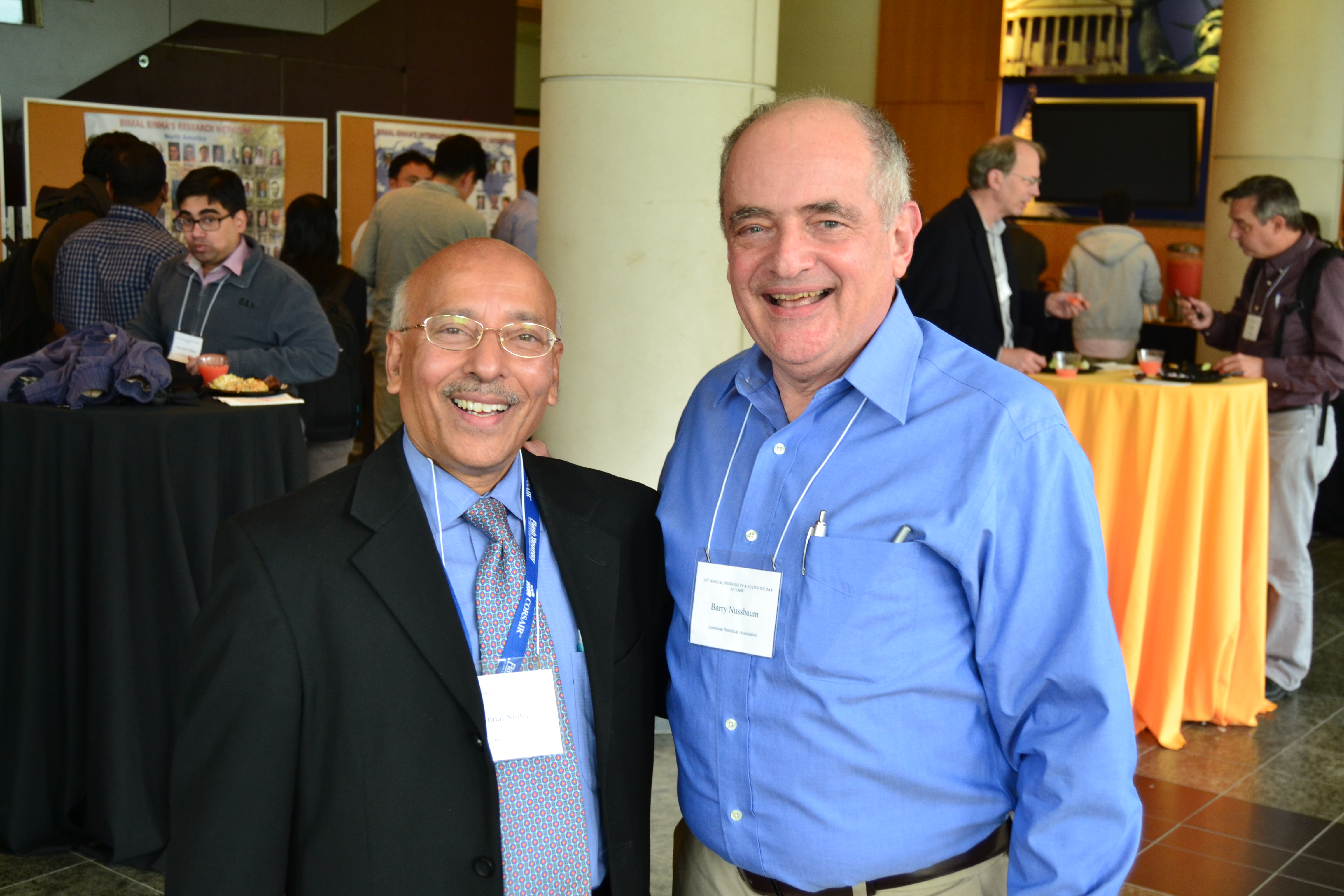
DSC_0033

Images: Attendees (header image) and Bimal Sinha (l) and Barry Nussbaum (r) at UMBC Probability and Statistics Day 2016. Photos by Ricardo Moura.
 

Fan Yang’s “Faked in China” tackles competing visions of the Chinese economy in a globalized world

The opening ceremony of the 2008 Summer Olympics in Beijing lasted several hours, showcased thousands of performers, and featured an elaborate fireworks ceremony, wowing the many spectators who viewed it in person and on high-definition television. But what the viewers saw was not entirely real.

The song that accompanied the entrance of the Chinese national flag was lip-synced. The impressive fireworks display was pre-recorded. But for one emerging cultural and media studies scholar watching on television, the event sparked provocative research questions. Fan Yang saw the opening ceremony incidents as emblematic of a larger struggle taking place within China’s economy.

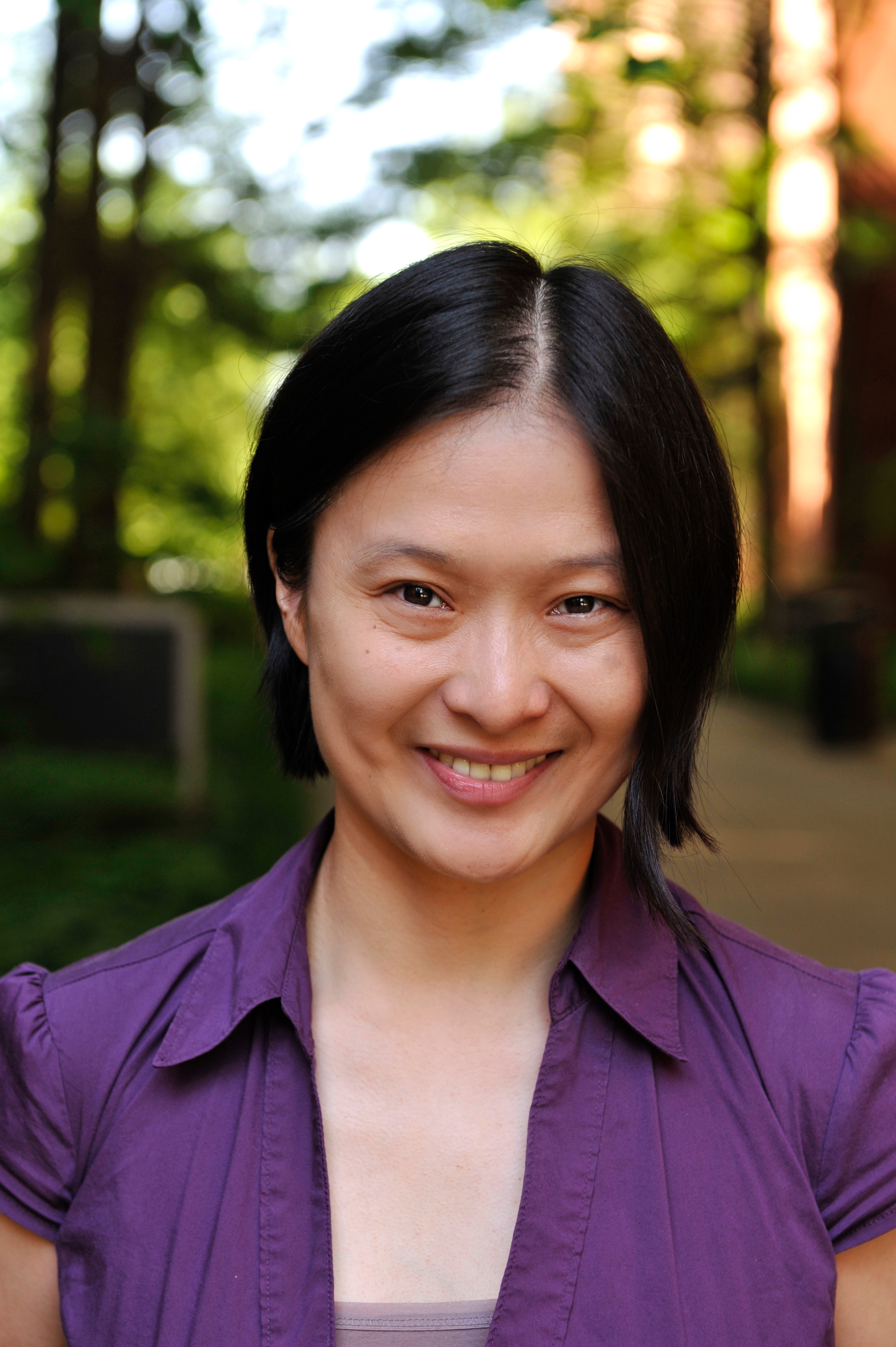
Fan Yang

Yang, an assistant professor of media and communication studies, wrestles with this in her new book Faked in China: Nation Branding, Counterfeit Culture, and Globalization (Indiana University Press 2015). The thought-provoking work closely examines China’s cultural dilemma as it deals with competing visions for the nation’s economy since it joined the World Trade Organization (WTO) in 2001.

The book traces interactions between Chinese government policies to enforce its nation branding—the idea that China should make its own products to comply with the intellectual property rights regime, and the “counterfeit culture” of making, buying, and selling unauthorized products.

After living in several regions of the country and experiencing its vastly diverse landscape, Yang first became interested in this analysis when she began to think critically about the idea of national culture as a unified notion and started to push back against dominant Western perceptions that Chinese culture has an inherent propensity for faking.

“That kind of discussion of culture to me is not the most helpful,” explains Yang. “Not only because it understands culture as a fixed idea that never changes, but also that it doesn’t take into account the fact that many other places in the world have had this reputation of faking.”

Throughout the book, Yang weaves in examples like Beijing’s Silk Street Market (a popular tourist destination), the cultural formation of the term shanzhai (imitation and counterfeit brands and goods), and the concept of the Chinese Dream to illustrate the complex cultural dilemma that China is experiencing.

“There is a need to think about what China really means not just for China, but for the world. Looking at the interactions between culture and economy in China is a way for us to broaden the scope of cultural studies in the West,” Yang says.

In an increasingly globalized world, Yang is hopeful her book will make an important contribution to generating discussions about how a “rising” China is viewed by people in the West.

“The imagined contention between superpowers of China and America is overly simplistic and doesn’t account for a lot of complexities,” she says. “The kind of analysis that I performed I hope will reorient our thinking of China as at once aspiring to join the First World while still encountering ‘faking’ as a ‘Third-World problem.’”

For news media interviews related to Yang’s book, see below:

Fan Yang on fakes, pirates, and shanzhai culture (Sinica Podcast) 

Images: (1) Silk Street Markets by Tim Riley, CC by-NC-ND 2.0. (2) Fan Yang, photo by Marlayna Demond ’11 for UMBC.   

George Derek Musgrove reflects on the surprisingly brief history of D.C.’s presidential primary

Washington D.C.’s presidential primary on June 14 marked the 60th anniversary of the District’s first-ever presidential primary. George Derek Musgrove ’97, history, associate professor of history, joined WAMU Radio to discuss why it took so long for the nation’s capital to have a say in presidential politics.

“Because it looks bad internationally,” Musgrove told WAMU. “We can’t be the capital of the free world, if in fact no one votes here.”

Musgrove is an expert in post-WWII United States history with an emphasis on African American politics. He is currently working on a book project about the history of race and democracy in Washington, D.C.

In the WAMU radio and print story “On D.C. primary day, celebrating 60 years of having a voice,” Musgrove explained that the history of the lack of a vote in presidential primaries extends all the way back to the nineteenth century.

“Remember that the excuse for stripping the city of the vote entirely in the 1870s was that black folks had the vote and would dominate the city with their vote,” he said. “And over the years, since the 1870s, segregationists in Congress had brought that back up repeatedly.”

Musgrove said that the city’s shifting demographics from majority white to majority black in the 1950s also played a role in D.C.’s push for voting rights, especially with Congress being heavily involved in the process.

“Black leaders in the city are very clear on who their enemies are in Congress and how those people will respond to their being involved in the effort to gain self-determination for the city.”

Listen to the full story on WAMU’s website.

Community Law in Action honors LaMar Davis, director of The Choice Program, as a 2016 Baltimore Inspiring Voice

Each year, Community Law in Action (CLIA), an organization dedicated to cultivating the leadership skills of Baltimore youth, honors a select group of individuals who create positive social change and transform the city. LaMar Davis, director of The Choice Program at UMBC, was one of just eight people honored by CLIA during this year’s “Inspiring Voices” award ceremony, held May 10 at the University of Maryland, Baltimore.

During the event, CLIA Executive Director Corryne Deliberto recognized the awardees for dedicating their skills and expertise to serving as positive leaders, role models, and mentors to Baltimore youth who are devoted to making Baltimore a better city.

As a 2016 CLIA Inspiring Voice award winner, Davis was featured in a compelling video produced by CLIA about The Choice Program, a nationally recognized model for community-based intervention that has served more than 25,000 youth and their families from Maryland’s highest risk communities.

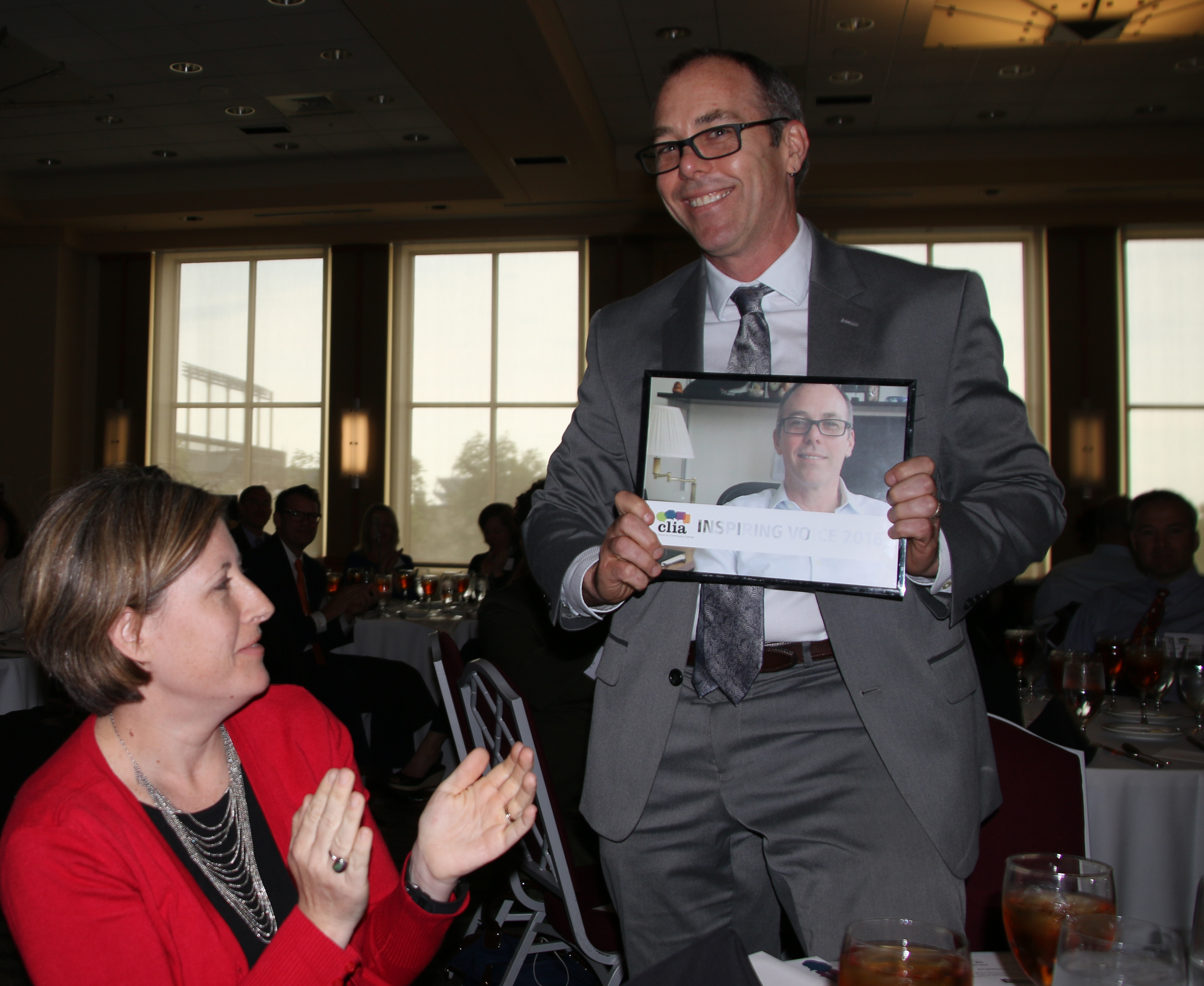
LaMar Davis at the 2016 Inspiring Voices Award luncheon.

“The Choice Program is UMBC’s response to addressing pressing social issues within Maryland and Baltimore City,” Davis explains in the video, which was screened at the award ceremony. “What we know is that when youth enter into detention facilities, the likelihood that they will enter as an adult goes up exponentially.”

For more than 28 years, The Choice Program has partnered with the Maryland Department of Juvenile Services (DJS) to focus on four areas of intervention: education, employment, family involvement, and community supervision. The program works within high poverty communities in Baltimore City and in Baltimore, Prince George’s, and Montgomery Counties to reduce obstacles impacting youth and family success. Last year, 92% of participating court-involved youth completed the program and were not adjudicated with new charges.

During the CLIA Inspiring Voice award ceremony, Davis shared that the tremendous success of the program over the years has been largely due to an approach that focuses on youth, their families, and the community, supported by 50 AmeriCorps community service-learning fellows. Those fellows provide critical contact, mentoring, and advocacy to young people and their families involved in the juvenile justice and social services systems.

“We bring an approach that says, ‘What are your strengths?’ Youth and families already know what their problems are, but it’s much more difficult for them and for others to really identify what they do well,” said Davis in the video. “We are also looking at how to give young people in Baltimore and Baltimore County an opportunity to get that first job experience, to build a resume, and get some on-the-job experience though our Choice Flying Fruit Café, kiosk, and stand.”

The Choice Jobs Program, which serves 200 local youth each year, expanded earlier this year with the grand opening of Baltimore’s first Flying Fruit Café, located at the University of Baltimore (UB) John and Frances Angelos Law Center.

As UMBC is in the midst of its 50th anniversary celebration year, Davis is optimistic that the program will continue to build on its success, serving even larger numbers of Baltimore youth in the future.

“UMBC and our president, Dr. Freeman Hrabowski, continue to lead the way on how a public university should support its community and commit to being part of the solution,” says Davis. “I am honored to have received this award on behalf of the university, The Choice Program at UMBC, our amazing staff, and AmeriCorps Community Service-Learning Fellows who do the work every day. This award speaks to our program and institution’s inspired commitment.”

Images: (1) LaMar Davis speaks at the 2015 University Retreat. Photo by Marlayna Demond ’11 for UMBC. (2) LaMar Davis receives 2016 Inspiring Voice Award. Photo courtesy of Community Law in Action.  

Psychology Home Visiting Training Center graduates first cohort of home visitors

Nearly 30 home visiting health professionals from across Maryland are now better equipped to address the multidimensional needs of the families they serve as part of the state’s home visiting program. On June 2, the psychology department and Division of Professional Studies held a graduation ceremony for its inaugural cohort of the Maternal, Infant Early Childhood Home Visiting (MIECHV) Training and Certificate Program.

The program is a collaboration among UMBC psychology faculty and staff, the Maryland Department of Health and Mental Hygiene, and local Maryland Home Visiting Programs across the state and provides enhanced training and curricula to empower home visitors with current knowledge and empirically supported practices to meet the challenges of families they serve.

The group serves pregnant women and families with children from birth to age 5, with a focus on families at risk because the parents are younger than 21, low income, live in at-risk communities, have a history of child abuse or neglect, or have other factors that can put healthy child development in jeopardy.

The UMBC program uses training modules for home visitors and supervisors to address critical problems such as communication and motivation, infant and child care and behavior management, domestic violence, substance use, mental health, parenting, and culture. The ultimate goal of the program is to help home visitors in promoting the health and well-being of children and their families.

“Home visiting is a valuable service to enhance the health and development of young at-risk families,” says Carlo DiClemente, a professor of psychology and Home Visiting Training Center team member. “This academic community partnership extends psychology faculty research and expertise into the community and offers training and support to this impressive group of home visitors and supervisors across Maryland.”

The training program is part of the UMBC Psychology Training, Research, and Services Center (PTRSC). The UMBC program trained a pilot group of nearly 115 health professionals who will also receive certificates. To learn more about the program, visit MIECHV training website.

Image: Psychology Home Visiting Training Center graduates first cohort of home visitors during its Spring 2016 graduation. Photo by Carol Bateman.

First year of UMBC Volunteer Income Tax Assistance program serves more than 100 local community members

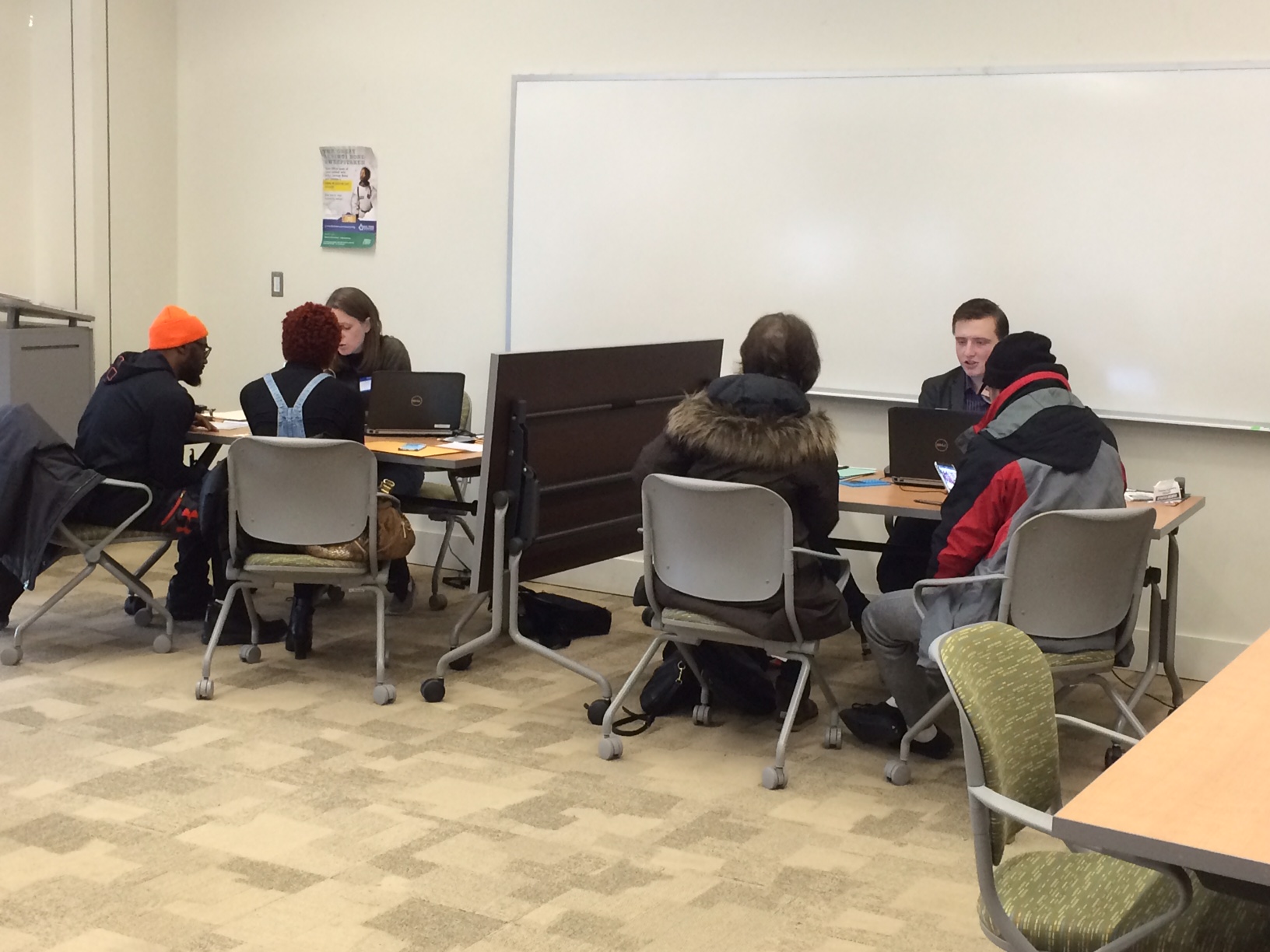
Tax season can be a stressful time for just about everyone. But a group of UMBC students and staff members worked tirelessly for six Saturdays during the spring semester to ensure that 106 clients, mainly from Baltimore County and Baltimore City, had an opportunity to receive free tax preparation to file their taxes before the April deadline.

The Volunteer Income Tax Assistance Program (VITA) is facilitated by the IRS and is offered at locations throughout the country. It offers free tax preparation to people earning $54,000 or less, people with disabilities, and limited English speaking taxpayers who need assistance in preparing their own tax returns. The program came to UMBC for the first time this year when several people at the university who had worked as VITA volunteers in the past came together and identified a need for the service in the local community.

“We could have quadrupled the number of clients we saw and still not served everybody that wanted it,” says Trisha Wells, director of student affairs administrative and business services and organizer of the UMBC VITA program.

UMBC VITA Program

Wells worked with Meghann Schutt, deputy director of the Shriver Peaceworker Program, the UMBC Financial Literacy Team, the Career Center, the Department of Economics, and many other groups on campus to bring the VITA program to UMBC. Volunteer recruitment started last fall, and a group of dedicated students went through a tax certification class to help serve community members in need.

“I think most people don’t understand that taxes can be used for social justice,” shares Ethan Griffin ’18, a Sondheim Public Affairs Scholar majoring in interdisciplinary studies and UMBC VITA student volunteer. “Everyone has to do it and most may not understand the inequity…it’s really uplifting to be able to step in during the process and offer help to as many people as we can.”

Wells says that the first year of the program was a tremendous success, with 83 percent of clients served receiving a refund and almost $126,000 in total refunds for the program. Almost two-thirds of the clients who received refunds said they planned to use it to pay off debt, pay past due bills, or save and invest the money.

Wells notes that the enthusiastic student involvement in the program was what really drove its success in its first year at UMBC.

“Their energy is what made it happen,” explains Wells. “There is no way that we would ever get enough preparers if we weren’t leveraging students. The clients loved working with students. The person getting their taxes done feels like they are making a difference in the student’s life and it’s a give and take and they get to know each other. The students being a part of this is crucial.”

The UMBC VITA program partnered with the Baltimore CASH Campaign to get the word out in the local community that this service was available at the university. Because there is such a significant need for the VITA service in the local community, Wells is hopeful that even more volunteers will sign up for training next year to be able to serve a larger number of clients.

Griffin also has advice for fellow students, faculty, and staff who might be interested in getting involved next year.

“VITA can be for anyone, not just those interested in the tax process or financial economics,” he says. “I think the dynamics and assets of the [UMBC VITA] site make the service, your service, connected to those across Maryland and even the country.”

Anyone who might be interested in getting involved in the program next year is encouraged to contact Trisha Wells at twells@umbc.edu.

Top image: IRS 1040 Tax Form. Photo by Ken Teegardin, CC by -SA 2.0. Bottom image: UMBC student volunteers assist community members with tax preparation as part of the VITA program. Photo courtesy Trisha Wells. 

Goddard Planetary Heliophysics Institute to receive up to $20 million from NASA over next five years

NASA has renewed its support for the Goddard Planetary Heliophysics Institute (GPHI), granting permission for a maximum of $20 million to be spent over the next five years. The institute is a joint venture of UMBC; the University of Maryland, College Park; and American University, and it was initially funded for $10 million over five years beginning in 2011. GPHI faculty focus on heliophysics research, which seeks to understand physical processes related to the Sun and interplanetary spaces in our solar system, such as how the magnetic field surrounding Earth (the “magnetosphere”) protects us from the solar wind.

The boost in funding is a sign that NASA “is happy with the way we have been managing the research projects,” says Jan Merka, GPHI director.

GPHI has grown significantly since its inception, especially in the last 18 months. The renewal will support further growth and allow the institute’s 20 research faculty to continue work on their ongoing projects.

In addition to supporting the work of research faculty, the new funding could also allow faculty to consider bringing graduate students on board. Beyond physics students, Merka says some projects might be a good fit for students in mathematics or information systems.

GPHI focuses on fundamental research, but “there are all kinds of applications we can’t even predict right now,” Merka explains. For example, there is potential for solar wind to become so strong that it damages our power grid. After solar eruptions, the solar wind, composed of high-energy particles, can travel from the Sun to Earth in only about 1.5 days. This window could translate to early warning of impending damage, but scientists aren’t yet good at predicting the path of a solar storm. It’s no easy decision to shut down international power grids in expectation of a solar wind surge, so being able to make accurate predictions is key.

The new funding will support research to improve space weather forecasting and other projects related to NASA science missions, such as the Magnetospheric Multiscale (MMS) mission, launched in 2015. MMS consists of four satellites orbiting Earth in tight formation and collecting data from more than 30 instruments about magnetospheric processes. The mission will improve understanding of solar flares, eruptions of solar material (“coronal mass ejections”), and how similar processes play out elsewhere in the universe.

The work is made easier because “we have great staff and administrative support here,” Merka notes, which allows researchers at GPHI to focus their energy on science.

“We are very proud of our successful partnership with NASA Goddard under the GPHI program to pursue collaborative research in solar-planetary sciences,” says Karl V. Steiner, vice president for research.  “I want to thank Dr. Merka for his outstanding leadership on this program, which is the foundation for this five-year renewal to synergistically foster new directions in research and technology in heliophysics.”

Image: Jan Merka at GPHI; photo by Marlayna Demond ’11 for UMBC.

UMBC prepares next generation of leading K-12 educators with commitment to community

It has been a banner year for UMBC community members committed to improving the quality of K-12 education. This spring The Washington Post and Baltimore County Public Schools honored two UMBC alumni as teachers of the year. Earlier in 2016 UMBC collaboratively launched a major initiative to boost student support, community engagement, and STEM and arts education in local schools—K-12 schools where UMBC alumni have already had a significant impact as educators.
These high profile announcements are emblematic of the UMBC alumni who demonstrate outstanding leadership as teachers, mentors, and role models for children every day. They also are the result of UMBC’s long-term investments in innovative teacher education programs and effective community collaborations, a level of national leadership recognized in recent years by the White House and former U.S. Secretary of Education Arne Duncan.
Setting a high bar
“As the Baltimore County Teacher of the Year, Carter is noted for his enthusiasm, his authenticity, and his work to be a champion for students inside and outside of the classroom,” writes Education Postin a new story highlighting Corey Carter ’08, biological sciences, ’10 M.A.T. Carter, who teaches science and co-founded the My Brother’s Keeper mentoring program at Old Court Middle School in Pikesville, was named 2016 Baltimore County Public Schools Teacher of the Year earlier this year.

Corey Carter
Corey Carter at a Sherman STEM Teacher Scholars event at UMBC

“His ultimate goal is for his students to love science as much as he does,” the article notes. “He wants his students to rush home to their parents and caretakers to talk about what they did in science class that day. He believes that being a teacher was a profession that chose him because his parents encouraged him to read, to ask more questions, and always look for answers, which is what he now hopes to instill in his students in the classroom.”
Carter explains in the article the importance of teaching the whole child, and the need to champion students both in and out of the classroom. He also calls attention to the need to support teachers and their ongoing growth. “As teachers, we always do what needs to get done, but we don’t always reach out for help, even if we do need it,” he says. “One of the most important ways to support educators is by simply asking them what they need to be successful.”
Shalonda Holt ’07, biological sciences, teaching certificate in education, shares this core value of supporting students and teachers as whole people with vast potential. Holt was named the 2016 Washington Post Teacher of the Year after previously being selected as Howard County Teacher of the Year. As a biology teacher at Centennial High School in Ellicott City, Holt has been a leader in innovative teaching methods and encouraging students to follow their passion.

Shalonda Holt '07
Shalonda Holt, photo courtesy of the Howard County Public School System

“Shalonda has such a powerful impact on her students and fellow teachers,” said HCPSS Superintendent Renee A. Foose in a Howard County Public School System press release announcing her recognition earlier this year. “She is a dedicated educator who truly cares about her students and strives to improve the education experience.”
Supporting local communities 
While Holt teaches in Howard County and Carter in Baltimore County, many UMBC alumni teach in Baltimore City, where UMBC has numerous K-12 educational and student support partnerships, some dating back decades.
Three years ago, UMBC President Freeman Hrabowski and Lakeland Elementary/Middle School Principal Najib Jammal met to lay the groundwork for collaboration inspired by the vision and philanthropy of George and Betsy Sherman. The partnership that emerged brought UMBC’s Sherman STEM Teacher Scholars Program, Shriver Center Peaceworker Program, and The Choice Program to Lakeland, and it has already had a major impact.
This work reached a significant milestone at the start of 2016 when UMBC, Baltimore City Public Schools, and the Northrop Grumman Foundation partnered to launch a $1.6 million partnership to boost science, technology, engineering, arts, and math (STEAM) education. Among those working every day to make this project a reality are educators like Caryn Horrigan ’09, M.A., TESOL, a Lakeland teacher who has offered steadfast support for students as they actively work through the issues underlying the 2015 Baltimore Uprising.

Lakeland_Northrop_UMBC-1048
Caryn Horrigan (left) at educational partnership launch event

Others are working on these same issues, but in different contexts. Kevin Maxwell ’02, Ph.D., language, literacy, and culture, CEO of Prince George’s County Public Schools, and Margaret Weber ’12, M.A.T., art education, a New York City Public Schools visual arts teacher, recently joined colleagues at UMBC’s 10th Annual Arts Integration Conference, which focused on social justice. Throughout the conference they shared best practices to build cultural awareness, enhance community engagement, and provide opportunities for students to become advocates for social justice both in and out of the classroom.
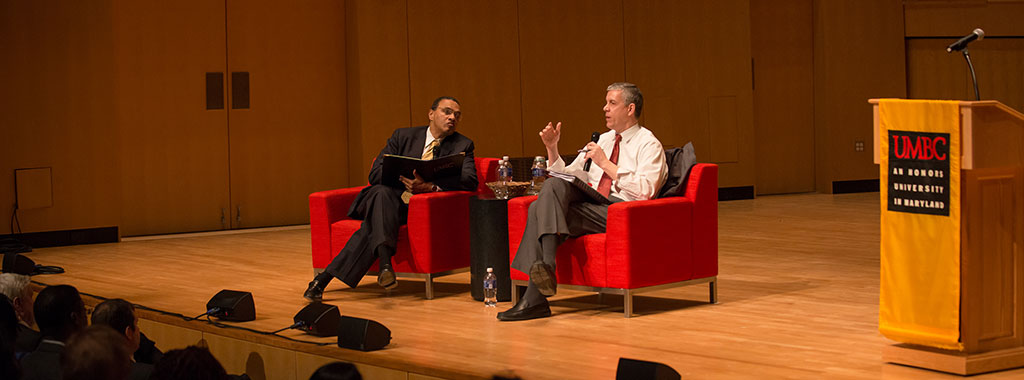
As Secretary Duncan said in a 2015 event on campus, highlighting UMBC’s strength in preparing the next generation of teachers, “You’re not just talking about this, you’re living it. You’re walking the walk.”

UMBC President Freeman Hrabowski and former U.S. Secretary of Education Arne Duncan, sitting on a stage speaking
UMBC President Freeman Hrabowski and former U.S. Secretary of Education Arne Duncan

Header image: Caitie Fleming, early childhood education program, teacher in Freedom School at Lakeland, pictured with a student. All photos by Marlayna Demond ’11 for UMBC unless otherwise noted. 

Developers and designers team up in new UMBC mobile app course

Effective mobile apps require solid visual and technical design. A new course launched in spring 2016 brought together UMBC arts and computer science students to create new apps from scratch, working on collaborative teams throughout the development process.

The professors behind “Designing and Developing Effective Mobile Applications” created the course specifically to prepare students for careers requiring interdisciplinary, team-based approaches to creative projects. Viviana Cordova, assistant professor of visual arts, and Nilanjan Banerjee, associate professor of computer science and electrical engineering, jointly developed and taught the course with support from the Hrabowski Fund for Innovation.

“Cross-disciplinary collaboration is a very important part of education,” says Cordova, “because not only do students learn to collaborate, but also to compromise.”

“We saw that most mobile applications either lacked good implementation or slick user interfaces,” says Banerjee. “Students in fine arts were able to develop usable, aesthetically pleasing interfaces while students in computer science were able to build functional apps.”

Most coders think in terms of “function first, user later,” says Michael Leung ’17, computer science, whose Team Huebotics represented UMBC in the final four of the Microsoft Imagine Cup last spring. This course reinforced for Leung that collaborating with a designer from the beginning actually makes coding faster and easier, in addition to improving the final product.

Computer science majors on almost every team echo Leung’s sentiments. Jessica Rolfe ’16 says “starting with a unified look made merging our work easy later on,” and Michael Bishoff ‘16 summed his feelings up saying, “It’s been awesome. Life with a designer is so much better.”

Visual arts students valued the opportunity to see their work in an end-product that could be accessed and enjoyed by users. Cordova previously offered a more conceptual graphic design course focused on mobile apps, but, she says, “My students wished they could actually have a fully developed app at the end of the project.” Collaborating with computer scientists made that possible.

Students presented their final work at a demo day on May 10, inviting guests from UMBC and the industry. Some of their games are now available in the Google Play store and, Cordova shares, “students had internship and job offers during our event from companies that came to visit the demo presentation.”


Apps produced through the class:

Flee helps users find something to do in their area. It pulls in events from meetup.com and displays all events in selected categories, like arts and sports, within a specified geographic area. Then it links to the event website or Google maps for directions. (Creators: Aletena Sahlu, Amanda Pyryt, Siddharth Utgikar, Lloyd Prudente, Carmella Pombuena)

Soundless syncs with Google Calendar and turns a phone’s sound off when the user has an appointment, then turns it back on after the appointment. It prevents a favorite song from blaring during a staff meeting and helps users avoid missed calls that can result when a user forgets to turn the ringer back on after a meeting ends. (Creators: Joseph Daniels, Kshipra Kode, Oladipupo Eke, Mark Pileggi, Monica William-Henein) Ringtriever is similar to Soundless, except it syncs with UMBC’s PeopleSoft program, which includes a student’s class schedule. (Creators: Benjamin Lelonek, Frank Zastawnik, Sophia Haire, Jenna Conn, Johnson Tien)

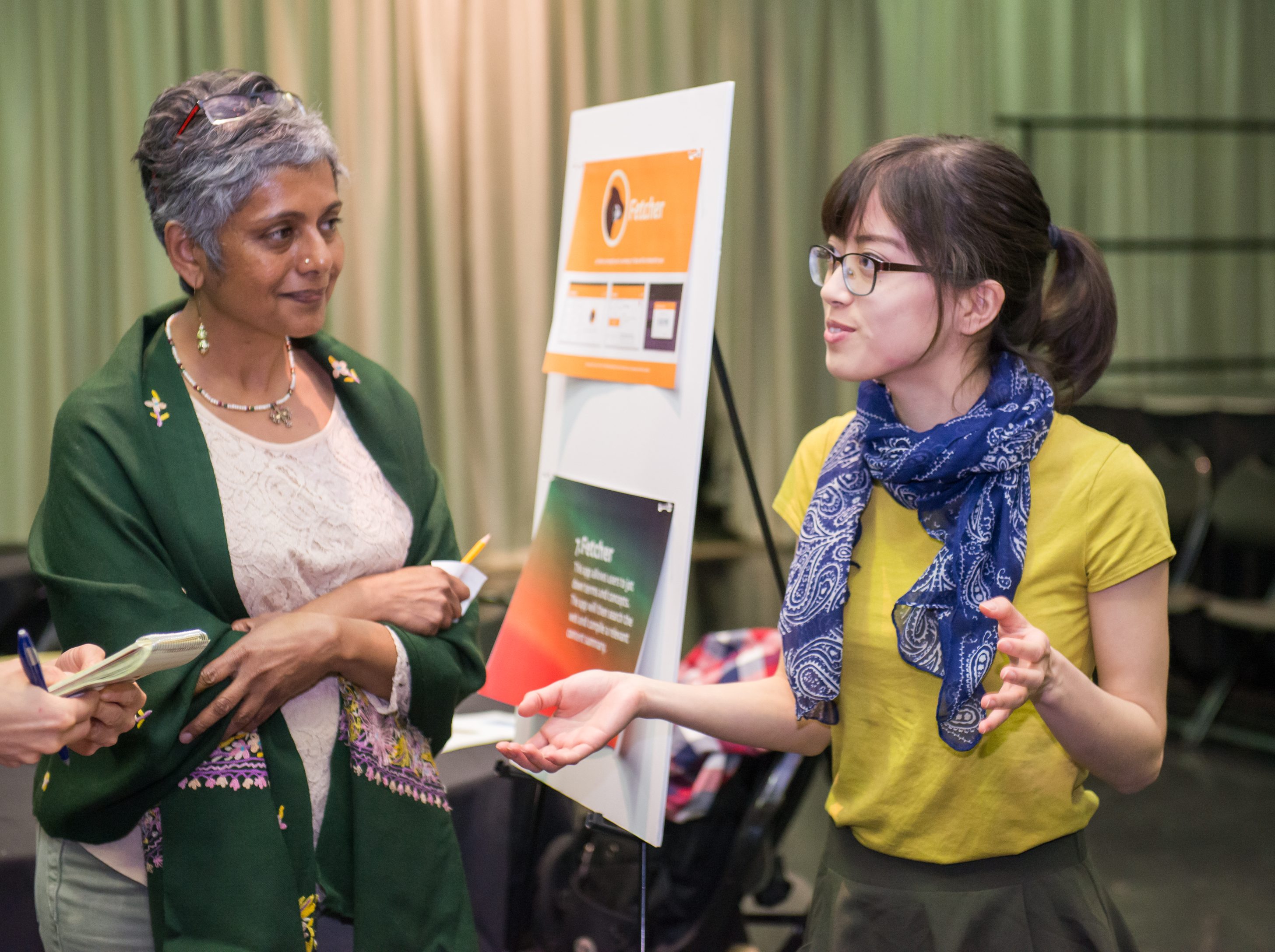
Smartphone-app_demo-fair-2383Fetcher allows users to flag terms they want to learn more about—ideas that come up in a class, book or conversation— and then emails the user a list of related search results in a bundle at a selected day and time. (Creators: Lemuel Sun, Michael Leung, Prutha Date, Rakshit Verma, Mariko Sakemi)

Intelliwake delivers everything a user needs first thing in the morning in one app: an alarm, weather forecast, traffic information and directions to your first appointment, and top news. (Creators: David Wiedel, Taylor Nycum, Nayan Sharma, Sola Awojoodu)

Doggone-It tracks the location of a pet wearing a GPS tracking device and alerts the user if the pet strays beyond a predefined perimeter. It tracks how far a pet travels during the day (indicating activity level) and can point a pet owner in the right direction if their pet strays. (Creators: Anudeep Nallamothu, Devendra Dahiphale, Sujata Devi, Dan Kostov)

UMBC Grit targets current UMBC community members and campus visitors. It allows users to pin photos and videos to the campus map. Users can scroll through tagged images within their current map view. UMBC Grit imports campus events, which users can add to their Google Calendar, and also includes floor maps for campus buildings. (Creators: Robert Ginsburg, Sazedul Alam, Leslie McAdoo, Kim Trinh, Hope Berger)

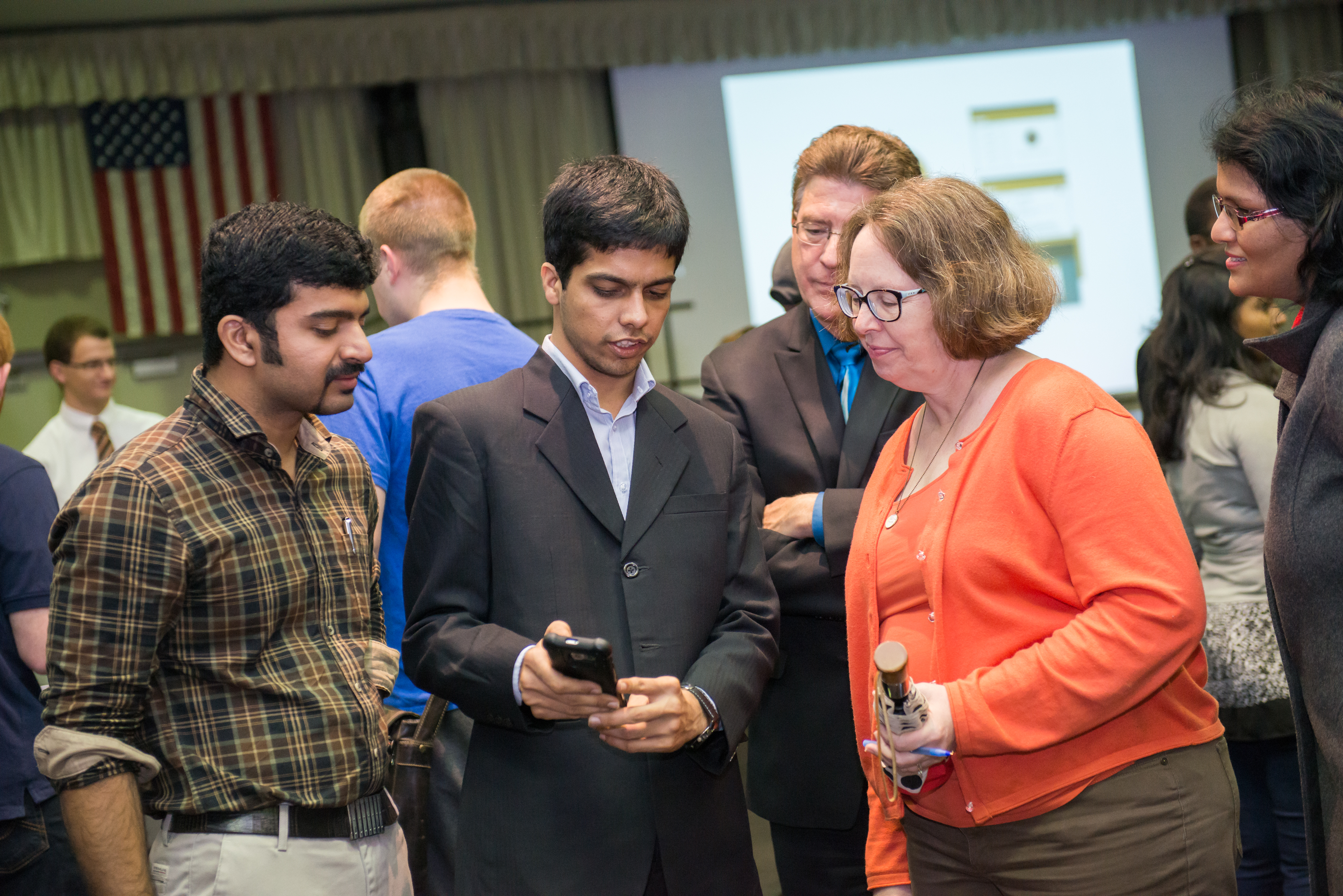
Spotswap and Photodrop are also campus-focused apps, but could potentially be implemented elsewhere. Spotswap helps students find available seating in study areas around campus, which could come in handy at peak study times. (Creators: Jessica Rolfe, Randall Brunecz, Rujuta Palande, Venkata Bujunuru, Sandy Nguyen, Nicholas Desaulniers) Photodrop allows users to take a photo and “drop” it at a location on a map to entice people to check out areas on campus where exciting activities are taking place. (Creators: Lun-Chung Yuan, Michael Bishoff, Siqi Lin, Xiaoxia Zheng, Tim Shattuck, Jimena DelCastillo)

Smartphone-app_demo-fair-2336Hex is a fun puzzle game with a beehive theme. (Creators: Brooke Washington, Tiantian Xie, John Swank, Kevin Jones)

ULock is a surveillance tool that allows users to lock and unlock their doors remotely. (Creators: Persephone Della, Sandep Narayanan, Siraj Memon, William Morgan, Andrea Cervantes-Medin)

SoWifi allows users to share wifi networks without giving out a password, and to set a time limit on access, providing more options for coffee shops and other businesses that offer their customers wifi access. (Creators: Robert Grossman, Nasif Sikder, Suraksha Shukla, Matia Wills, Matt Walker)


Header image: Michael Bishoff explains the PhotoDrop app to visitors at a demo presentation of the projects from the interdisciplinary course “Designing and Developing Effective Mobile Applications.”

Other images from top to bottom: Mariko Sakemi explains Fetcher and ULock creators explain their app. 

All images by Marlayna Demond ’11 for UMBC. 

Sarah Shin selected for American Association of State Colleges and Universities leadership program

The American Association of State Colleges and Universities (AASCU) has announced the inaugural class of its emerging leaders program, and Sarah Shin, a professor of education and president of UMBC’s Faculty Senate, is one of just 25 candidates nationwide selected for the program.

The program is designed for mid-career professionals and faculty leaders in higher education and it provides an opportunity for participants to strengthen and enhance their leadership skills while developing a network of experienced leaders and experts in higher education from around the country.

We need a robust pipeline of talented professionals interested in advancing their careers in higher education,” said AASCU President Muriel A. Howard in a news release announcing the program. “AASCU has a long history of providing successful leadership development programs at every professional level of higher education administration.”

“I feel privileged to be selected to participate in the inaugural class of AASCU’s Emerging Leaders Program,” said Shin. “This is a great honor for our university and a fantastic opportunity for me to engage with experienced leaders and experts in higher education. The program includes opportunities for hands-on practical exercises, a leadership self-assessment, and the development of individualized leadership plans. I hope to bring back lessons learned from this experience to contribute to advancing the mission of UMBC.”

Presidents, chancellors, and cabinet-level administrators nominated each emerging leader. As part of the requirements for the program, each participant had to demonstrate the potential for advancement at their campus and upon completion of the program, nominators will identify a project, initiative or assignment that will expand the participant’s knowledge of the university and facilitate his or her growth as leader by using the skills learned during the program.

The three-day seminar will be held June 11-14 in Washington, D.C. Visit the AASCU website to learn more about the program and members of the inaugural class.

Image: Sarah Shin. Photo by Marlayna Demond ’11 for UMBC. 

“What An Unbelievable Place This Is:” Linehan Reception Celebrates UMBC’s Commitment to the Arts

When we think of art, we tend to think of finished pieces: paintings in galleries, dances and plays performed to a sold-out crowd, freshly pressed full-length records and live symphonies. But the reality is that art is so much more than final product. It’s what we can’t see — the equipment, the time, the relentless pursuit of creativity, and donors like you — that makes it possible.

At the end of each academic year, we celebrate the hard work and creative achievements of some of UMBC’s most talented student artists at the Linehan Artist Scholars Reception. This year, guests at the reception were able to take in a student showcase in the Performing Arts and Humanities Building’s Dance Cube, a massive glass structure overlooking Hilltop Circle.

Since 1999, the Linehan program, established with a generous gift from Earl and Darielle Linehan and currently headed by Doug Hamby, associate professor of dance, has been advancing UMBC’s reputation as a center for the arts as well as STEM, and the PAHB is a centerpiece of that effort. Much like any fine work of art, the building took several years of planning and multiple phases of construction before the finished product could be shown, inhabited, and practiced in. The past several Linehan receptions have been held here: achievement within achievement.

According to Scott Casper, dean of the College of Arts, Humanities, and Social Sciences, the Linehan program prides itself on being not just a scholarship, but a community. Students live together on the Visual and Performing Arts floor in Harbor Hall, and have several opportunities a year to visit museums and performances in Baltimore, New York, and Philadelphia. Students at the reception related their experiences within the Linehan program (among them: seeing the Paris Opera Ballet perform Jonathan Safran Foer’s Tree of Codes and visiting the Museum of Modern Art).

This year’s showcase featured a variety of student art from across disciplines. On the visual arts side, Adan Rodriguez ’17 assembled a short video presentation, compiling various works from design, animation, and film students, as well as their commentary on their work, their influences, and what art means to them.

Art, says animation major Justyna Kurbiel ’18, is “a sharing of ideas,” but it also takes a lot more work than people realize.

“They never really know what’s just outside the frame,” she says plainly, before the camera pans back from her face, revealing microphones, monitors, and the screen behind her.

Ryan Bailey ’16, dance, choreographed and performed a piece set, intermittently, to Earth, Wind, and Fire’s “September” and long periods of frenetic, movement-filled silence. Chanel Whitehead ’17 performed Romani Lachrymose, an original and deeply melancholy composition by Samuel Winnie ’16, music, on cello, with Winnie accompanying her on a laptop and synthesizer.

Ally Kocerhan ’16, theatre and gender and women’s studies, who, at the time of the reception, was facing a choice between the California Institute of the Arts and New York University for graduate school, directed Jessie Gilson ’17 in a scene from Christopher Durang’s Sister Mary Ignatius Explains It All For You. Gilson’s character, Diane, an ex-Catholic, tells the story of the loss and trauma that destroyed her faith to one of the nuns who taught her in school.

The performance moved Earl Linehan, who told Gilson, “I’m a Catholic [and I get it]…I could hear Sister Madeline talking to me.”

“What an unbelievable place this is,” Linehan told the crowd. “I choke up every time.”

Julia Celtnieks ’13; photos by Marlayna Demond ’11


NASA and UMBC scientists gather to celebrate LAGEOS on its 40th anniversary in orbit

On May 4, 2016 LAGEOS turned 40. For a satellite that is expected to stay in Earth orbit for 8.4 million years it’s the blink of an eye, but for the team involved in the project this birthday marks an exciting milestone. On May 11, scientists who worked on the LAGEOS mission gathered at the NASA Goddard Space Flight Center (GSFC) in Greenbelt, MD to pay homage to its considerable contributions to science over the last 40 years.

The LAGEOS (Laser Geodynamic Satellite) orbits in a “medium Earth trajectory,” the sweet spot where lasers can still detect it from Earth, but it isn’t subject to the atmosphere’s drag. It is passive, carrying no complex instrumentation. The satellite is an extremely dense ball (60 centimeters in diameter, but 407 kilograms) uniformly covered with 426 reflectors for pinging laser beams back to Earth. The original concept was to use a depleted uranium core and name it “Cannonball.”

“You can imagine the PR we got,” says Mike Pearlman, director of the Central Bureau of the International Laser Ranging Service (ILRS) of the Harvard-Smithsonian Center for Astrophysics. The launched version was much smaller and simpler. It used a brass core and took the name LAGEOS (pronounced lay-jee-ose).

LAGEOS was the first North American satellite dedicated exclusively to laser ranging,” says Erricos Pavlis, research scientist at the Joint Center for Earth Systems Technology (JCET), a collaboration between UMBC and NASA. The French launched a similar satellite, Starlette, just a year earlier in 1975. Initially, there were only 12 stations on Earth that ranged to the satellite. Today there are more than 35 that track it daily; over the satellite’s lifespan 120 different stations have tracked LAGEOS.

LAGEOS has provided critical data for a variety of research projects during the last four decades. Pavlis, who earned his Ph.D. from research on LAGEOS, says “laser was the method that first showed the way” for measuring tectonic plate movements. Its data is also used to measure polar motion, changes in Earth’s rotational axis relative to its crust.

LAGEOS has also provided information about Earth’s interior, useful in developing models to explain earthquakes, measure sea-level rise, and monitor change in station heights on the Earth’s crust. “It has proven an unfathomable tool,” says Pavlis. “It has produced much higher-quality results than were originally expected.”

David Smith, the first lead project scientist on the LAGEOS mission, shares Pavlis’ positive feelings. “I was fortunate to be in the right place at the right time,” he says. “LAGEOS was the beginning of many things—a great beginning.”

The existence of LAGEOS made many projects, including international collaborations, possible, such as the Crustal Dynamics Project, Goddard Earth Models (GEM), and the TOPEX/Poseidon missions. LAGEOS helped “create an international community focused on solving geodesic problems,” says Pavlis.

The quality of data produced by the satellite has drastically improved since its launch. Pearlman pointed out that the original laser pulse duration was 20 nanoseconds, and his team was proud when they reduced that to six nanoseconds. Today, the pulse duration is on the order of picoseconds, 1000 times shorter. Similar gains have occurred in the rate of the transmitted pulses.

These improvements in laser technology have increased the accuracy of the data produced by LAGEOS. Its measurements were initially accurate on the order of meters; today they are accurate to a few millimeters.

Many laser ranging satellites have been launched since LAGEOS, including LAGEOS-2 in 1992 and the Laser Relativity Satellite (LARES) in 2012. Pavlis is the U.S. principal investigator for LARES, an Italian Space Agency mission launched by the European Space Agency. “There have been a whole fleet over the last 25 years,” says Frank Lemoine, geodesist at NASA GSFC.

Perhaps that speaks to the utility of such satellites for providing a relatively low-cost means to collect data that can be used to answer so many different scientific questions. In fact, “If you look up, what you see is there’s still more room for LAGEOS satellites,” says Pearlman, noting, “They’re a neat investment with a big payoff.”

For more on LAGEOS, read “NASA Put a Big Disco Ball in Space 40 Years Ago, and It’s Still There” from Space.com.

Image: Steve Merkowitz introduces Erricos Pavlis; photo: Jay Friedlander.