All posts by: UMBC News Staff


Matthew Kelly to pursue interest in German language and culture through Fulbright teaching assistantship in Bavaria

Matthew Kelly
B.A., Modern Languages, Linguistics, and Intercultural Communication
Cum Laude
Hometown: Conway, New Hampshire
Plans: Fulbright Teaching Assistantship, Germany

UMBC has not only helped me achieve my goals, it has helped me become the person that I am today… The past four years at UMBC have been the best four years of my life.

Matthew Kelly’s passion for German language and culture has shaped his UMBC experience and the next steps in his academic career. As a standout student in modern languages, linguistics, and intercultural communication, Kelly has received numerous awards, including the Plogman Language Award and his department’s Palomares Award for Excellence in Service and Academic Achievement.

Matthew Kelly completes a pass in a UMBC ice hockey team game

Kelly has been very involved with the UMBC ice hockey team, as a player, team vice president, and a recruiter, and enjoys connecting his love of hockey with his interest in German. He was a student teacher and assistant ice hockey coach at Mt. Hebron High School in Howard County, and led a group of Mt. Hebron German language students on a campus visit of UMBC. He also served as a German tour guide for area high schools at the German Christmas Market in Baltimore’s Inner Harbor.

Kelly is a recipient of the 2016 J. William Fulbright Grant and will teach English in Bavaria, Germany, following graduation.

Images: Matthew Kelly completes a pass in a UMBC ice hockey team game; photo courtesy of Matthew Kelly. Portrait by Marlayna Demond ‘11 for UMBC.

Mark Fisher’s UMBC experience prepares him for leadership role in U.S. Army Corps of Engineers

Mark Fisher
B.S., Mechanical Engineering
Hometown: North East, Maryland
Plans: Second Lieutenant, U.S. Army Corps of Engineers

Teaching freshmen students in their first engineering course has taught me the power of making an impression on young students in the STEM field, while at the same time teaching me organization and how to work with faculty.

Mark Fisher has enjoyed taking on new challenges and responsibilities as an emerging leader throughout his time as a mechanical engineering student at UMBC, from ROTC to the classroom to the res hall.

Fisher has served as battalion commander of the Johns Hopkins ROTC program, of which UMBC is an affiliate university. In the ROTC program, he explored leadership styles to prepare him to serve as a commissioned officer in the U.S. Army Corps of Engineers after graduation.

Mark Fisher and his wife Skylar on their first date at the ROTC ball

Fisher has worked as a teaching assistant introductory engineering over the past three years, assisting first-year engineering students and, most recently, serving as lead teaching assistant. He has also served as lead resident assistant in UMBC housing.

Beyond providing experiences that have helped Fisher define a path for his future career, UMBC has also played an important role in his personal life. Fisher met his wife, Skylar Dewees Fisher ‘16, biological sciences, on the first day of classes in their freshman year, and they married this January. They will graduate together this spring.

Images: Mark Fisher and his wife Skylar on their first date at the ROTC ball; photo courtesy of Mark Fisher. Portrait by Marlayna Demond ‘11 for UMBC.

John Fritz, AVP of information technology, examines how data can help students improve their academic success

John Fritz
Ph.D., Language, Literacy, and Culture
Summa Cum Laude
Hometown: Elkridge, Maryland
Plans: Continuing as UMBC’s Assistant VP of Information Technology

UMBC has allowed me to reinvent myself multiple times… I couldn’t be more appreciative or thankful for the opportunities to study my work and wear so many hats in my 21 years at UMBC.

John Fritz has worn several hats at UMBC over the last 21 years, and he credits the university with enabling him to reinvent himself and to grow through multiple careers. After Fritz began working at UMBC in 1995, he transitioned from working in public relations to information technology. His curiosity and thirst for knowledge led him to pursue his Ph.D. to study if technology, particularly the Learning Management System he was overseeing, could inform students through data analytics that help improve their academic success.

Fritz’s daughter Zoe is currently a sophomore at UMBC, and his wife Dawn earned her master’s degree in teaching at UMBC in 2008. John shares that earning his Ph.D. has been one of the most rewarding things he has ever accomplished and is proud to begin UMBC’s 50th anniversary year as both a leader in UMBC’s administration and an alumnus.

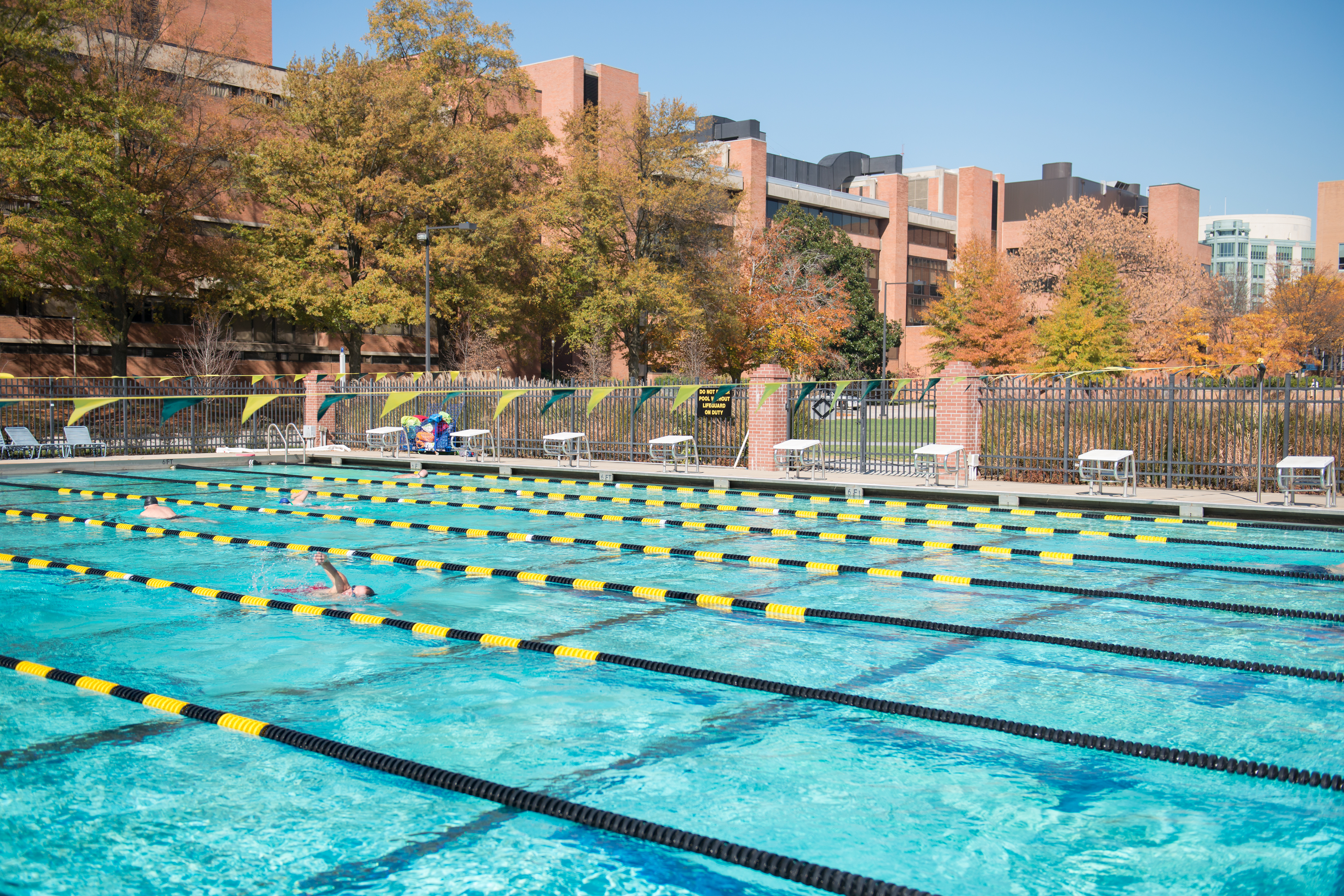
John Fritz pool photo

Images: UMBC’s outdoor pool, where throughout his time as a student, employee, and even now as a parent, Fritz spends time swimming laps, which he says has been a great stress reliever and think tank to sort through issues and opportunities. Photos by Marlayna Demond ‘11 for UMBC.

Essence Fredericks, standout scholar-athlete, heads to multinational PricewaterhouseCoopers

Essence Fredericks
B.S., Financial Economics
Hometown: Baltimore, Maryland
Plans: Audit position at PricewaterhouseCoopers, LLC

[UMBC] has provided all the tools to help better equip me for my future and has also allowed me access to numerous internship and service opportunities to help me prepare for my future.

Essence Fredericks has taken full advantage of her time at UMBC by pairing her two passions: excelling in the classroom and on the track. Fredericks’ academic honors include Honors College membership, a Dean’s Scholarship, T. Rowe Price Scholarship, and multiple dean’s list honors.

Essence Fredericks submittedAs a member of the Women’s Track and Field Team, she competed in several America East Championships in the 500m, 800m, and the 400m hurdles. She was also a standout at other events including the ECAC Championships, George Mason Invitational, and Sykes & Sabock Challenge.

Through internship and service opportunities, Fredericks developed a strong skill set to become highly prepared for a career in financial economics. After graduation, she will begin a full-time audit position at PricewaterhouseCoopers, LLC, a leading multinational professional services network.

Images: The track at UMBC, where Essence says she was able to pursue her dreams each day and develop memories and friendships that will last a lifetime; photo courtesy Essence Fredericks. Portrait by Marlayna Demond ’11 for UMBC.

Cheyenne Smith follows her passion to serve Baltimore communities

Cheyenne Smith
B.A., Psychology; B.S., Biological Sciences
Magna Cum Laude
Hometown: Ellerslie, Maryland
Plans: AmeriCorps Community Service Learning Fellow, The Choice Program at UMBC

I firmly believe that the experiences I have had as an undergraduate are unique to UMBC due to the commitment to diversity, involvement, and community engagement.

Cheyenne Smith is committed to addressing the education gap in urban communities, a passion she developed through UMBC leadership positions and internship experiences. Smith worked as a program assistant for the Baltimore RISE Fellowship Program and a service learning intern for The Shriver Center at UMBC. She credits the center for exposing her to a career path that she hadn’t considered before by helping her forge deep ties to Baltimore communities.

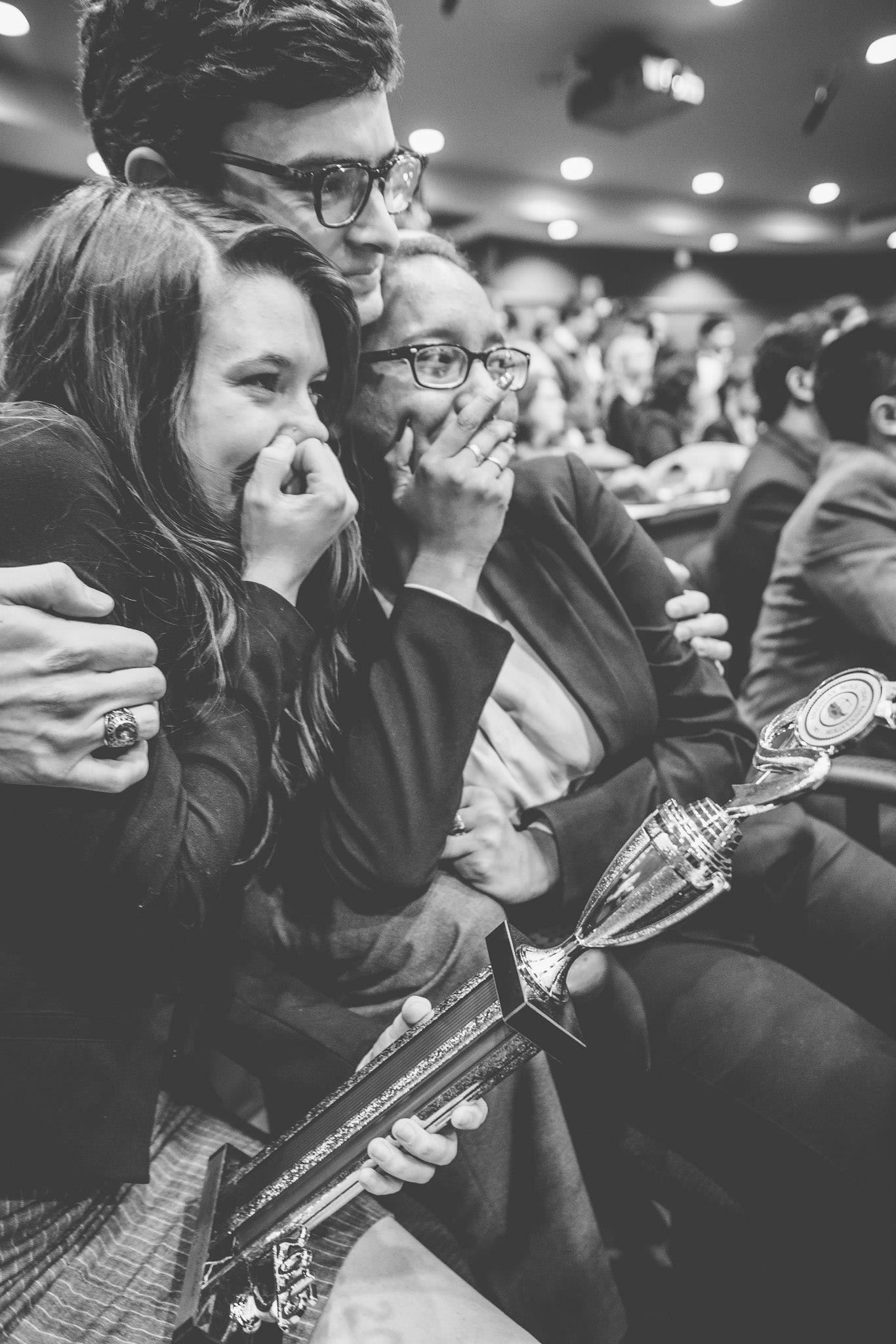
Cheyenne Smith submitted Smith also served as president of UMBC Mock Trial and led the team in two consecutive bids to the American Mock Trial Opening Round Championships and first prize in the inaugural Charm City Classic Mock Trial Invitational. She is active in numerous campus organizations and has been recognized through the Samuel I. Rosenberg Fund Award, President’s Fellow Award, and France-Merrick Service Scholarship.

Following her passion to serve the Baltimore community, Smith plans to join The Choice Program at UMBC as an AmeriCorps Community Service Learning Fellow.

Video: Cheyenne Smith describes her experience competing in Opening Round Championships with her UMBC Mock Trial teammates. 

Images: Cheyenne Smith with teammates after winning a bid to the Mock Trial Opening Round Championships for the first time in school history; photo courtesy of Cheyenne Smith. Portrait by Marlayna Demond ’11 for UMBC.

Kevin Heffner aims to make the Erickson School a world leader in the growing field of aging services

Kevin Heffner
M.A., Management of Aging Services
Summa Cum Laude
Hometown: Reisterstown, Maryland
Plans: Continuing as Erickson School Director of External Relations

The Erickson School’s interdisciplinary approach to leadership in aging services is unique. The school has helped me to address challenges in an integrated fashion, examining them from a variety of viewpoints in order to determine the best solutions to complex problems.

Kevin Heffner joined the Erickson School at UMBC in 2006 and in the past decade has built numerous partnerships, created new scholarship opportunities, and led the undergraduate, graduate, and executive education recruitment team. Currently the school’s director of external relations, he is graduating in the newest cohort of the management of aging services master’s program.
Heffner is a member of the Phi Kappa Phi Honors Society and earned a 4.0 GPA. The M.A. program in management of aging services has taught him to approach complex problems in an integrated and interdisciplinary fashion by studying them from a variety of viewpoints. With his graduate degree, Heffner would like to make the Erickson School at UMBC “the most significant agent for leadership development and change, anywhere in the word, in the growing field of aging services.”

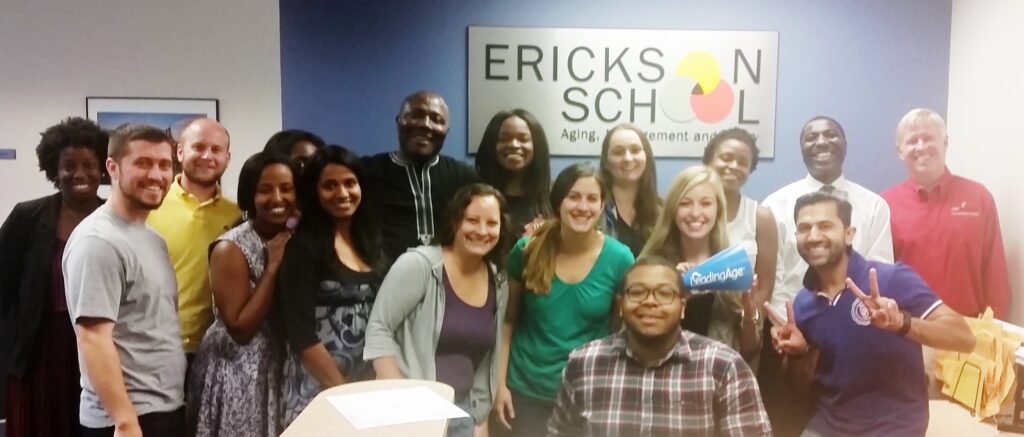
Kevin Heffner pictured with the most internationally diverse cohort in the Erickson School’s history, with students from India, Pakistan, Honduras, Ghana, Nigeria, and the U.S.; photo courtesy of Kevin Heffner. Portrait by Marlayna Demond ’11 for UMBC.
Images: Kevin Heffner pictured with the most internationally diverse cohort in the Erickson School’s history, with students from India, Pakistan, Honduras, Ghana, Nigeria, and the U.S.; photo courtesy of Kevin Heffner. Portrait by Marlayna Demond ’11 for UMBC.

Anthony Jankoski to pursue interest in criminal justice at Northwestern University’s School of Law

Anthony Jankoski
B.A., English
Magna Cum Laude
Hometown: Silver Spring, Maryland
Plans: J.D., Northwestern University’s Pritzker School of Law

My professors and faculty mentors have helped me to become a critical thinker and an active voice on campus. These skills have proved invaluable during my tenure as president of student government and will assist me greatly in law school.

Anthony Jankoski has made the most of opportunities to excel academically and take on important leadership positions while at UMBC. He was president of the Student Government Association (SGA) during the 2015-16 academic year and previously served as SGA treasurer. He has learned to provide support and guidance to fellow students who are interested in becoming involved in student government and making a positive impact in the UMBC community.

Jankoski’s academic pursuits have led him to develop an interest in criminal law and he has plans to attend Northwestern University’s Pritzker School of Law. He is inspired by helping people who may be faced with legal challenges and using his knowledge of the criminal justice system and services available to assist those in need of support.

Image: Anthony Jankosi. Photo by Marlayna Demond ’11 for UMBC. 

“A Look Ahead” offers glimpse into the twists and turns of scientific research careers

UMBC faculty, students, alumni, and community partners gathered in the University Ballroom April 20, 2016 for “A Look Ahead XIX: Explorations in Transformative Research,” a day of research talks, presentations, and networking opportunities focusing on the life sciences and hosted by UMBC’s College of Natural and Mathematical Sciences (CNMS).

Dean Bill LaCourse opened the event by commenting on the dedication of UMBC partners and alumni, reflected in the two plenary speakers, saying, “This year’s ‘A Look Ahead’ shows the UMBC greatness we have today has its roots in greatness.”

“A Look Ahead” appealed to scientists at all stages of research. In his plenary, Isiah Warner, decorated analytical and environmental chemistry professor at the Louisiana State University and a UMBC parent, addressed the challenges of changing one’s research focus after developing a reputation in a particular field. As an investigator with an established lab and students relying on him, his decision to switch directions would ripple beyond himself, he realized. But ultimately, he said, “It was worth taking that leap of faith.”

Warner leaped from expertise in fluorescence spectroscopy, a technique that uses emitted light to analyze compounds, to ionic liquids. Ionic liquids are comprised of charged particles (ions) and are liquid at room temperature. The ions in ionic liquids don’t “pack nicely” together, instead flowing around each other, Warner said. However, ionic compounds that do pack well form solids at room temperature. Warner dubbed these “GUMBOS,” for “group of uniform materials based on organic salts,” as a nod to the dish popular in his Louisiana home.

GUMBOS are “tunable,” meaning scientists can change their properties with precision. And because they are solids, GUMBOS can be produced as nanoparticles, or “nanoGUMBOS.” Warner’s lab discovered one nanoGUMBO that killed cancer cells, but not healthy cells, in both petri dishes and mice. While nanoparticles have been developed for drug delivery before, the challenge has been getting the drug “loaded” into the particle. In this case, “The drug is the material,” said Warner. Besides its application to possible new cancer treatments, Warner’s team sees potential for applications in life sciences, solar cells, and engineering.

Taking the stage after Warner, Paula Grabowski ’76, chemistry, professor of biological sciences at the University of Pittsburgh, focused on her “journey through science,” including her time at UMBC and pioneering graduate work in Thomas Cech’s lab at the University of Colorado at Boulder.

Grabowski’s research has focused on RNA. For many years, RNA was believed to be nothing more than a transient, string-like molecule in the cell, delivering its message to build a protein and then rapidly breaking down. But “there’s so much more to [RNA],” Grabowski said. She was part of the project in Cech’s lab that discovered an essential role that RNA plays, that of enzyme catalyzing chemical reactions.

Grabowski’s passion for her work is palpable. “I was chomping at the bit to get onto that project,” she said.

Suggesting a radically different view of RNA to the scientific community came with its challenges. For a long time, even the lab didn’t believe what they were seeing. How could a simple RNA molecule be a catalyst? “[The result] smelled like an artefact,” Grabowski said. But after developing some new experimental techniques and running countless repeat trials, the evidence was overwhelming: RNA can serve as an enzyme.

Since Grabowski’s original discovery, RNA researchers have uncovered more surprises. For example, “RNA is a molecular contortionist,” explained Grabowski, describing the ways that it folds into remarkably complex three-dimensional structures—no longer just a simple string. Scientists now believe that RNA catalyzes a broader array of reactions, and they’ve developed techniques to create RNA molecules called “aptamers” that could have broad applications for disease treatment. This promising line of research “takes RNA from bench to bedside,” Grabowski said.

Grabowski also spoke of her time at UMBC as an undergraduate during the university’s first decade, recalling professors who “made chemistry come alive” and helped her realize she “wanted to have a passion.”

Reflecting on how UMBC has changed and remained  the same over the decades, Grabowski shared that as a student, “UMBC faculty cared about my success as a student and my future,” and she sees that “UMBC is a treasure” today. Looking across at the audience of student researchers and successful alumni, she shared, “I couldn’t be more impressed with what has happened here.”

Image: Dr. Isiah Warner, Dean Bill LaCourse and Paula Grabowski ’76 at the A Look Ahead event. Photo by Marlayna Demond ’11 for UMBC. 

UMBC has strong presence at the 2016 TESOL International Convention and 50th anniversary celebration

More than 1,000 speakers representing 50 countries gathered in Baltimore for the TESOL 2016 International Convention from April 5-8, 2016. The gathering celebrated the 50th anniversary of the TESOL International Association and covered a range of topics including language testing and assessment, technology in language learning, bilingual education, and refugee and immigration concerns. UMBC’s English for Speakers of Other Languages (ESOL) programs had many major roles at the event, demonstrating UMBC’s impact around the globe in TESOL.

Heidi Faust, associate director of TESOL Professional Training Programs in the education department, received a grant to research English teacher professional development through professional learning communities (PLCs). She presented her work at the convention and discussed how the global demand for access to English is increasing and more teachers are transitioning from teaching English to adults to younger learners. Faust is using her grant to gather data, surveys, and analysis of teacher reflective journals to test sustainable models for teacher professional development.

“There’s opportunity for empowerment,” Faust explained during her presentation. “My hope is that this will be transformative for teachers at the professional level and communities will continue to sustain their growth.”

Faust also organized an academic session at the convention in her position as chair of the Intercultural Communication Interest Section, and she presented as part of the newly formed TESOL Diversity Forum.

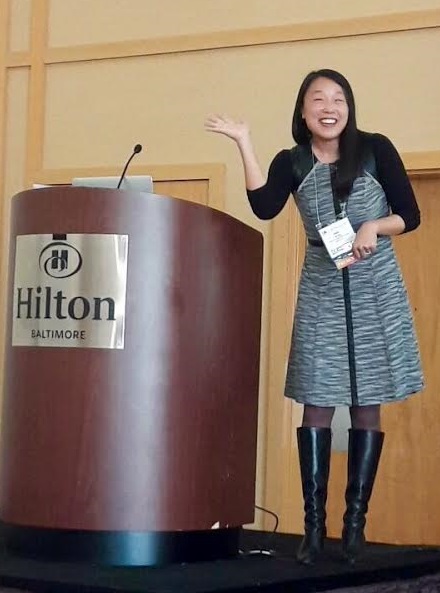
Joan Shin

Joan Shin ’08, Ph.D., language, literacy, and culture, and professor of the practice in the education department, was an invited speaker at the convention and presented her work using song to teach young learners English and also hosted a “Tea with Distinguished TESOLers.”

Before the convention, Shin was named a “30 Up and Coming” TESOL professional for her work as an international leader in teaching English to young learners. Her work has taken her to Brazil, Turkey, Vietnam, Saudi Arabia and ten other countries to train English as a foreign language (EFL) teachers to meet the needs of elementary-aged students. She has received praise and recognition for a National Geographic Learning book series that she co-edited with Jodi Crandall, founding director of the language, literacy, and culture program and professor emerita of education, designed to give learners the skills and knowledge they need to learn English and understand the world around them.

“With this honor, I feel inspired to work even harder to make a positive difference in the education of English learners through my work with teachers here in Maryland and worldwide,” Shin said after receiving the award.

The TESOL convention local committee included UMBC education department faculty members Laura Hook, Doaa Rasheed, and Yeji Yoon, and many alumni and partners connected with UMBC’s TESOL programs attended an anniversary reception at the convention. This included colleagues from the U.S. Department of State, U.S. Department of Education, National Geographic Learning, and several other organizations.

The ESOL program began at UMBC in 1979, and hundreds of alumni are currently practicing ESOL teachers locally, throughout the country, and around the world. Read more about UMBC’s ESOL programs on the education department website.

Header Image: Heidi Faust presents at the 2016 TESOL International Convention. 

Teri Rueb: Listening to Baltimore

Teri Rueb, assistant professor of visual arts, is creating an interactive Baltimore City tour.

“Teri Rueb: Listening to Baltimore”

“If these walls could speak, what tales they could tell” isn’t just a saying to Teri Rueb, it’s an artistic challenge. The assistant professor of visual arts creates interactive sound installations which allow visitors to explore a terrain on several different levels – listening to its stories, songs, and history – while walking and looking.

“I approach sound from a sculptor’s point of view,” says Rueb, “exploring its spatial aspects,” while also probing themes of time, memory, identity—and technology. In her “Trace” environmental sound installation, Rueb enabled hikers in British Columbia to hear site-specific poems, songs, and musings while carrying a backpack loaded with a Global Positioning Satellite device and small computer. She took the concept to an urban landscape in her Open City installation in Washington, D.C., exploring the idea of public space and civic identity.

Now, with the support of a Faculty Research Fellowship, Rueb will spend the fall 2001 semester creating “Invisible Cities/Sounding Baltimore,” which will collect oral histories from residents of Baltimore neighborhoods and combine them with sound compositions to create a kind of multi-layered, interactive, city tour. “I’ll go to parts of the city that I find sonically interesting, take samplings of the soundscape, and manipulate them, taking artistic license,” she explains. Using a wireless, handheld device combining palm pilot, GPS, and MP3 technologies, listeners will wander through the city and listen to the tales the streets, and walls, can tell.


School of Public Policy hosts forum on cybersecurity concerns in local governments

Cybersecurity concerns continue to make headlines, including the recent attacks at MedStar Health and fraudulent tax returns being filed for Baltimore City employees. In response to this, many local governments, like their counterparts in the private sector, are taking steps to protect their websites and information.  

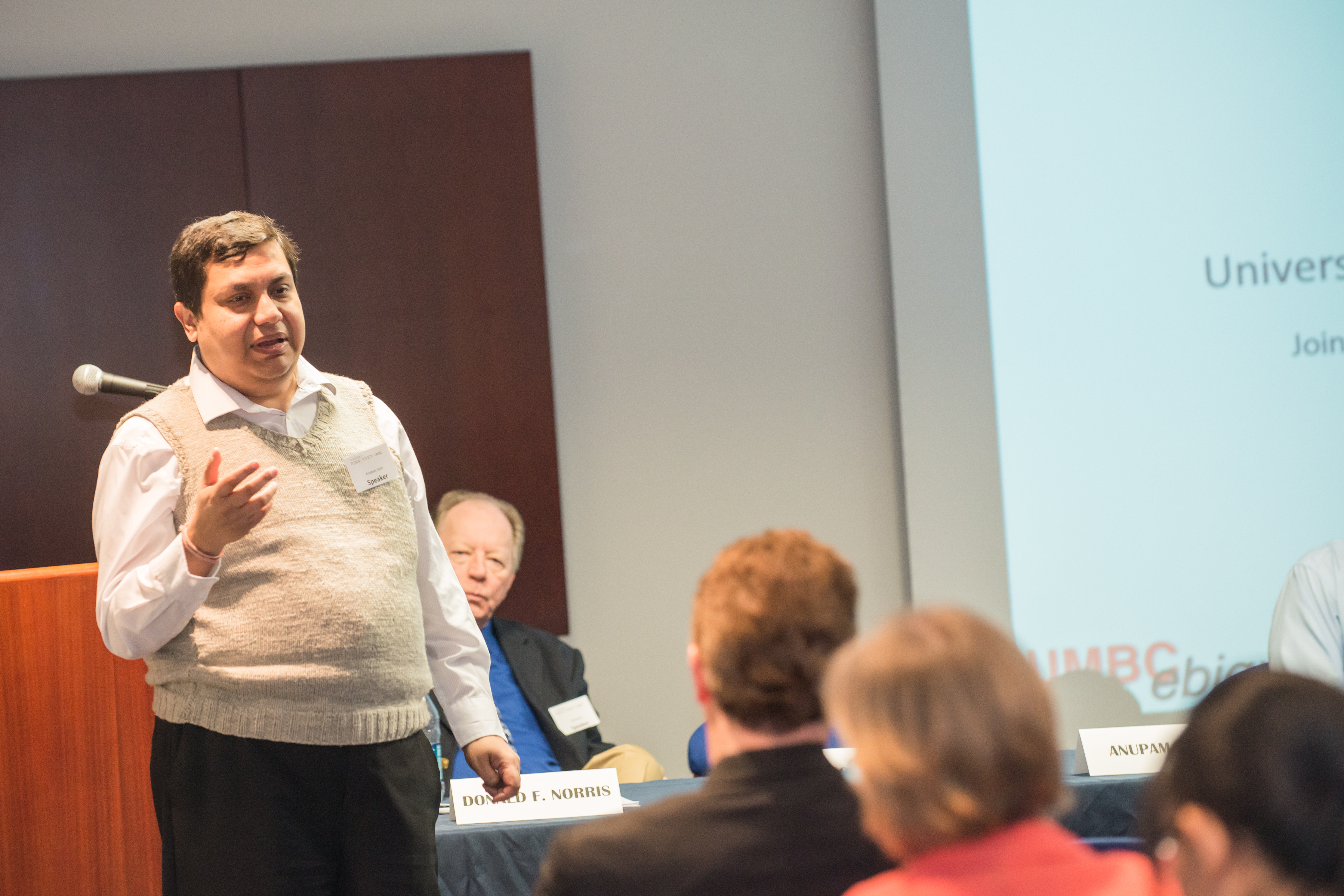
UMBC’s School of Public Policy hosted a forum on “Cybersecurity Concerns in Local Governments” on Friday, April 15 to present research on cybersecurity initiatives in local governments in Maryland and to highlight the policy implications of these initiatives. The event was sponsored by the UMBC School of Public Policy, bwtech@UMBC Cyber Incubator, and the UMBC Center for Cybersecurity. 

Public_Policy-Cyber-Forum16-7256Speakers included School of Public Policy Professor and Director Donald Norris, Anupam Joshi, professor and chair of computer science and electrical engineering (CSEE) and director of UMBC’s Center for Cybersecurity, Rob O’Connor, chief technology officer for Baltimore County, and Gayle Guilford, chief information security officer for Baltimore City.

Norris discussed cybersecurity challenges in local governments across the country based on his research. In 2013, along with Joshi, he convened a focus group of technology officers from around Maryland to identify challenges and what governments are doing to help prevent cyber attacks.

“It was fascinating, because in part, we went in thinking cybersecurity is a technology problem and that the technology would fix itself,” Norris explained. “But people, policy, and process in government and large organizations are almost always the problem.”

Norris found that technology professionals in government identified people as the weakest link in cybersecurity threats because of phishing emails, lack of user training, under enforced and inefficient policies, and lack of funding to deal with cybersecurity threats.

To further research constantly evolving cybersecurity challenges in local government, Norris and his colleagues developed a questionnaire which will be conducted through the International City and County Management Association (ICMA) for city and county governments with populations greater than 50,000 around the country. They anticipate receiving the results this summer.

“We want to find out what local governments across the nation say are their biggest cybersecurity problems and the barriers that they face in addressing cybersecurity,” Norris said.

Joshi discussed various policies that are needed to keep computer and data systems secure, and said that policies should ideally be written in terms that both people and computers can easily interpret. “We need shared ontology that many systems can understand,” he explained. Computer systems can use policies to better understand the computer system’s actions and behaviors and identify issues and cybersecurity threats as they arise.

To regulate access to information, Joshi recommends having adjustable responses and a “need to know versus need to share” framework that can determine who has access to what levels of information. For example, he said that a general question, such as a person’s location, can be answered generally or very specifically. Sharing the state where the a person is located is less helpful than knowing what city they are in, and sharing GPS coordinates is the most helpful information. This method can be applied to providing access to information and data that needs to be kept secure and confidential.

He says that it is increasingly difficult to walk away from a cyber attack, especially if the cyber attack is in progress. “Technology evolves so quickly that hacks also have to evolve rapidly,” Joshi said.

Gayle B. Guilford, chief information security officer for the City of Baltimore, pointed out that the “new ransomware does not require human interaction,” so education about maintaining security on computers needs to change. “It used to be ‘don’t click,’ now you don’t even have to click,” she said, adding that the users should be the biggest group identifying oddities and suspicions.

“End users are the biggest vulnerability, but need to be the biggest defense,” said Rob O’Connor, chief technology officer for Baltimore County.

Note: On the same day as the forum, Norris and Richard Forno, assistant director of UMBC’s Center for Cybersecurity, were quoted in a Baltimore Sun article about fraudulent tax returns being filed for Baltimore City employees. Read “Federal, state authorities investigating source of data used to steal city employees’ tax returns” on the Baltimore Sun website, and “Investigation into Baltimore City Employees’ Stolen Tax Returns Underway” in Government Technology.

Forno also was quoted in “Maryland National Guard steps up role in cyberspace” on the Baltimore Sun website, and Why haven’t hackers taken down the power grid?”in Parallax.

Image: Cybersecurity Forum Speakers (from left to right): Donald Norris, Gayle Guilford, Anupam Joshi, and Rob O’Connor. Photo by Marlayna Demond ’11 for UMBC. 

Undergraduate researchers win support for international fieldwork on endangered bird species

Four UMBC undergraduates in Kevin Omland’s biological sciences lab have won Youth Activity Fund Grants from the Explorers Club to support team-based field research on the critically endangered, and largely unstudied, Bahama oriole (Icterus northropi). This species only lives on the remote Andros Island in the Bahamas.

The Omland lab is internationally known for expertise on oriole genetics and evolution. A major goal of this new research project is to increase awareness of the rare Bahama oriole and promote conservation of endangered wildlife in the Caribbean broadly. Omland’s hope is to not only help the bird population, but also to support sustainable economic development for the island’s residents.

The project is multifaceted, and the four grant winners reflect the interdisciplinary nature of the research. They include Alexis Scarselletta ’16 and Michael Rowley ’18, biological sciences; Jennifer Christhilf ’18, geography and environmental systems; and Daniel Stonko ’16, chemistry and biochemistry.Omland grant winners 1“Having such a broad range of expertise…will allow us to collect and analyze data from a wider range of resources,” says Rowley. “We all will…learn from each other’s perspectives,” he notes, reflecting that the diverse team-based approach “will really add to the value we take away from the experience as people and as researchers.”

Rowley also shares that having this opportunity for an intensive undergraduate research experience will have many benefits for his science career. “This experience will make me more desirable to graduate programs,” he says, “but more so, it will allow me to narrow down my understanding of what I want to do with my life.”

Explorer Club grants support international fieldwork for students from across the United States in a variety of scientific fields. Previously, students in Omland’s lab have won Explorer Club grants for research in Puerto Rico and Mexico. The Omland lab also has a $12,500 grant from the MBZ Species Conservation Fund dedicated to Bahama oriole research.

Learn more about activities in the Omland lab at its Facebook page and lab page.

Photo: Bahama oriole, by Lisa McGuire (header image), and Michael Rowley ’18 and Alexis Scarselletta ’16 with a Baltimore oriole at Patapsco Valley State Park in Maryland, by Kevin Omland (second image)