

All posts by: UMBC News Staff


Alumni Perk: Telehealth Available via Alumni Insurance Program

Editor’s Note: The UMBC Alumni Association has partnered a several organizations to offer you special perks and benefits. This month, we wanted to share this announcement from our partner organization, Meyers and Associates*, about health care plan available to our newest graduates and their families:

How many times have you been sick, wishing you didn’t have to drag yourself (or a loved one) to the doctor? Why spend money going to the doctor when you can access quality care by phone or video chat from your home or while on the road? The University of Maryland, Baltimore County Alumni Insurance Program now offers telehealth— a simple, affordable way to meet your everyday healthcare needs. Physicians are available 24/7 with no limit on the time of consultation or frequency of calls. And there are no co-pays or deductibles.

Telehealth provides treatment for non-emergency ailments such as cold and flu, allergies, bronchitis, sprains and strains, pink eye, and more. Using electronic health records, telephone, email, and video consultations, doctors provide treatment and write short-term prescriptions, providing you with quality care at your convenience.  Individual and family memberships are available with special pricing for University of Maryland, Baltimore County alumni.

Telehealth doctors are practicing U.S. board-certified primary care physicians, pediatricians, and family physicians who average 15 years of experience and are credentialed every three years.

Telehealth does not replace your primary doctor, but it’s a convenient, affordable alternative that can help your family stay healthy in between regular doctor’s office visits.

View telehealth details and enrollment options to learn more or call our program partner at 888-252-2242.

*posted on behalf of Meyers and Associates

Dave Marcotte, School of Public Policy, in The Conversation

As many states across the country have dealt with significant snowfall over the last two months, school districts have been forced to shut down for several days. School of Public Policy professor Dave Marcotte has conducted extensive research on the impact of snow days on student learning, and published an article in The Conversation about the work he has done with his colleagues.

Dave Marcotte“Research shows that fewer school days do reduce student performance, especially for the more disadvantaged students. Evidence from previous winters also shows that more days in school do, in fact, improve achievement for American students overall, something that has been hard to accomplish in recent times,” Marcotte wrote.

In his article, Marcotte referenced studies in Minnesota, Maryland, Colorado, and Massachusetts that have found in years with especially bad winters, there is a significant impact on scores and pass rates.

Marcotte also discussed why it’s possible decisions haven’t been made in states to increase the length of the school year: “…the most substantial obstacle to extending the school year is money. Re-constituting the school year means re-negotiating teacher and staff contracts, paying for extended use of buses and buildings, and in many cases retrofitting schools to include air conditioning to operate into the hot months of summer. Indeed, these costs led Oregon to repeal the provision to extend the school year of the 1991 Education Act for the 21st Century.”

To read Marcotte’s full article titled “Schools close and kids lose,” click here.

Rebecca Adelman, Media and Communication Studies, in The Conversation

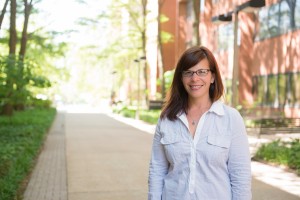
Portrait of Rebecca Adelman standing outside on academic row.

In the wake of Brian Williams’ six-month suspension from NBC News, Rebecca Adelman offered a fresh perspective on the story and argued that Williams’ actions were more complex than their first appearance on the surface.
Adelman, an assistant professor of media and communication studies, wrote an article for The Conversation in which she examined public reactions to Williams’ false claims about his experience reporting in Iraq and how they spoke to the way military service is valued in American culture: “…I’d suggest instead that Williams inadvertently revealed something about the profoundly contradictory place military service occupies in American culture,” Adelman wrote.
In her article, Adelman discussed how the automatic nature of public gratitude for military service in the United States makes it easy to mistake its origins.
“The Williams story revealed how readily, and convincingly, such attachments can be fabricated. Indeed, he explained his wrongdoings in terms of bewildered appreciation. It all started, he said in his apology, ‘in an effort to honor and thank’ the man who had protected him. This turned, he admitted, into a ‘bungled attempt … to thank one special veteran’ of the many who have his ‘greatest respect.'”
She added: “The public anger at Williams, in other words, may be rooted in something more than his deceitfulness. What may be upsetting us is his very visible failure to perform what many see as the purest expression of good citizenship – thanking the military.”
To read the full article titled “Brian Williams, the military and American culture, click here.

Policy Pioneer

Renato “Renny” DiPentima, Ph.D. ’84,  policy sciences, had a distinguished career in the Social Security Administration, where he rose to the rank of deputy commissioner and served on numerous governmental task forces and advisory boards. He was also selected by Government Computer News as the Government Executive of the Year in 1993. After leaving Social Security, DiPentima was president and CEO of SRA International, a company he helped build into a leading provider of information technology services and solutions throughout the federal government. DiPentima was also the recipient of UMBC’s Alumni of the Year Award in 2004.

UMBC Magazine asked DiPentima – the first recipient of a Ph.D. in the program – to reminisce about his experiences in one of UMBC’s signature fields of advanced study.

cn_renny-aI remember well that day over 30 years ago when I made the pilgrimage from UMBC’s Administration Building to the Albin O. Kuhn Library and then back to Administration Building to register as one of UMBC’s first public policy Ph.D. students. It was the beginning of a truly rewarding experience that significantly influenced my career and life going forward.

At the time I entered the program, I was a senior manager at the Social Security Administration (SSA) in Woodlawn, and had responsibility for the agency’s advanced systems.

Five years earlier, SSA had inherited the welfare programs for the aged, blind, and disabled across the United States. This implementation and transition from 50 states and four territories had been fraught with problems and major policy and systems failures. Having witnessed it firsthand as a participant in its planning and implementation, I became increasingly more interested in the interplay between policy and technology and why large programs failed.
Continue reading “Policy Pioneer” →

Tanguy Ringoir Wins Grandmaster Title

Tanguy Ringoir ’18 financial economics, recently won the Grandmaster Norm Invitational held at the Chinggis Chess Club, Burlingame, Calif.

The Grandmaster (GM) title is the highest title a chess player can earn, is difficult to achieve and can take quite some time to accomplish.

IMG_1378_2To win the title, a player must achieve a certain score (number of wins) in a tournament with a certain number of highly rated titled players (Grandmasters) present and at least three of them must be from a foreign country.

“It is not so easy to locate tournaments–or host ones–that meet this criteria in the U.S.,” says Joel DeWyer, business manager of UMBC’s chess team. “A player has to do this at three separate tournaments that meet this criteria.”

DeWyer says that, “In Tanguy’s case, he [Ringoir] knew that he needed at least one win and a draw in his final two games at the tournament in order to earn his final norm. One loss and it would have all escaped him.”

For Ringoir, earning the GM title will also open the door to several elite tournaments around the world.

Hilltop Researchers in the Journal of Pediatrics

Hilltop Senior Research Analyst Michael T. Abrams, MPH, and Policy Analyst Carl H. Mueller, MS, are co-authors of a new study published in the Journal of Pediatrics titled “Transcranial Doppler screening of Medicaid-insured children with sickle cell disease.”

The work was conducted in collaboration with researchers at Johns Hopkins and University of South Carolina medical schools, under the direction of Dr. David Bundy. The study found that letters to parents and doctors of children with sickle cell disease (SCD) did not succeed in increasing their use of a simple screening technique (transcranial Doppler imaging: TDI) for stroke risk, even as children with SCD are known to be at markedly heightened risk for stroke.

The research, conducted largely at The Hilltop Institute, used Medicaid administrative data to identify a calendar year 2010-11 cohort of youth aged 2-16 years with SCD, and measured 6 month post-letter TDI use in a group of 117 subje cts whose parents and doctors were sent letters, and a comparison group of 433 subjects who were not targeted by that mailing. Pre-intervention, annualized screening in the full SCD cohort identified (n=829) was just over 23 percent. Six month follow-up on those who did not receive screening in the pre-intervention period was 7.2 percent in the group receiving the mailing, and 8.6 percent in the comparison group. This group difference was non-significant after adjusting for numerous covariates. Accordingly, this work reveals that a single mailing to parents and providers is not sufficient to increase TDI use in youth with SCD. One important correlate which did emerge from this work is that specialist visits (e.g., to a hematologist), did significantly increase the use of TCD irrespective of the mailing. This incidental finding suggests that referral to a sickle cell specialist is more impactful than referral for a specific procedure to address this serious illness, at least in terms of receiving important preventative screening. For more information contact Hilltop team lead Michael Abrams (mabrams@hilltop.umbc.edu).
The full reference for this work is: Bundy DG, Abrams MT, Strouse JJ, Mueller CH, Miller MR, Casella JF (2015): “Transcranial Doppler screening of Medicaid-insured children with sickle cell disease”, Journal of Pediatrics, 166(1):188-90. doi: 10.1016/j.jpeds.2014.09.018. The pubmed citation and abstract can be accessed here: http://www.ncbi.nlm.nih.gov/pubmed/25444529

Biology and Batteries

In the quest to make a better battery Evgenia Barannikova, a graduate student at UMBC in the department of chemistry and biochemistry, has isolated a peptide, a small sequence of amino acids, which binds to lithium manganese nickel oxide (LMNO), a material that can be used to make high performance batteries.

DSC_7334

“Biology provides several tools for us to solve important problems,” said Evgenia Barannikova, a graduate student at UMBC. Barannikova works in the lab of Mark Allen and studies how biological molecules in general can improve the properties of inorganic materials in batteries. “By mimicking biological processes we can find the better solution,” she told phys.org

Read more at:

Phys.org 
Newelectronics
Scientific American

Call for Class Notes

Happy belated New Year, alumni!

We know that you are all out in the world making profound and positive differences, and as the new year rolls along, we would love to hear about what you’ve been up to.

If you have any updates, announcements, or news, please click here to submit your note.
And please, have a wonderful 2015!

Online Comment Period for Mid-Year Interim Reports Ends Feb. 28

TO: UMBC Campus Community

FROM: Provost Philip Rous, Co-Chair, Strategic Planning Steering Committee
Bruce Walz, Chair, Academic Planning and Budget Committee, Co-Chair, Strategic Planning Steering Committee

RE: Online Comment Period for Mid-Year Interim Reports Ends Feb. 28

The strategy groups and Foundations Work Group mid-year interim reports describing work to date, key findings, and emerging themes are now available online to the campus community. We encourage you to take a moment to review them and share your thoughts and comments. The reports will be available for comment through Saturday, February 28, 2015.

This is an important opportunity for campus engagement with the strategy and foundations groups as each continues to work on analysis of the collected data and begins to develop recommendations that will include goals, objectives and measures of success. Feedback collected through your comments online and from the fall campus survey will inform development of final recommendations due to the Strategic Planning Steering Committee in mid-April.

We would also like to thank all those who participated in the strategic planning interactive gallery last week. Your experiences and perspective shared throughout the afternoon sparked insightful and informative discussions with the strategy and foundations group members.

Pres. Hrabowski Inspires at Maryland Arts Day 2015

hrabowskiPresident Hrabowski gave the keynote address at Maryland Arts Day last week. Maryland Arts Day is an annual event hosted by Maryland Citizens for the Arts, a statewide arts advocacy organization.

In his address, Dr. Hrabowski examined the role of the arts in finding our value as human beings. “The way we think about ourselves as a society, the language that we use in discussing who we are, the values that we hold will shape who we are,” he said. “I posit to you that the arts intersect with our very souls.”

Dr. Hrabowski also spoke about the importance of the arts, drawing on his childhood experiences of balancing his love of mathematics with piano lessons. He said, “I didn’t understand that one could love math and love music. Because too often still today, we teach kids that they’re one thing or the other and the whole point of the arts is that it is to create whole citizens who understand you can do many things. I want every child to know and feel and embrace the artist within herself.”

Click here to find our more information about Maryland Arts Day and to watch a video of Dr. Hrabowski’s remarks.

It’s Good to Be Happy: The Life of Albin O. Kuhn

Editor’s Note: UMBC has a long and storied history, and it all began in 1966 with Albin O. Kuhn, UMBC’s first chancellor. So we sat down with Albin’s granddaughter, Julie Kuhn Sanchez ’10, to learn more about this founding father.

Most of you know that UMBC’s library is called the Albin O. Kuhn library, but fewer of you probably know that it was named after UMBC’s first chancellor, Albin Owings Kuhn, who mapped out the present Hilltop Circle by riding around in circles on a tractor. If you want to know more about how UMBC came to be what it is today, just ask Julie Kuhn Sanchez ‘10, Media & Communication Studies and Visual Arts, Albin’s granddaughter. She lives to tell the legacy her beloved grandfather left behind.

We had the chance to sit down with Julie and hear about Albin’s novel-like life. She told a story from the ’60s when a student came into Albin’s office and addresses a man he thinks is the chancellor. This man, however, tells the student he is mistaken and points outside to another man on a lawnmower. Albin was the only chancellor to mow his own lawn, Julie shares with a smile. Stories like these make a person memorable – and Albin had many of them.

Remembered for more than just his memorable stories, Albin was admired by many for his work ethic, gentle demeanor, and humble spirit. He has had a lasting impact on all who knew him and even those who did not. Julie says her grandfather had a rule that he stuck to: Always hire someone who is better than you. People often find themselves intimidated by those who are better at certain tasks; but not Albin. He made sure to hire those more adept than him in different areas so as to build a strong, diverse team. Albin knew that if he was unable to solve a problem, there was someone on his team who could.

Julie as a young girl with grandfather, Albin

Always connected to and surrounded by good people, Albin’s influence has carried into UMBC today. He made sure that his staff members were good, down-to-earth, and hard-working people. And UMBC is still filled with these sorts of people.

Julie commented that she admires the values Albin instilled in UMBC. “It’s like a family,” says Julie. “It always has been.” She shares a story of when UMBC was opening for the first-ever freshmen class. Always looking to get his hands dirty, no job was too small for Albin. The bathrooms still needed to be cleaned before the new students came and so Albin, his wife, teachers, and other staff scrubbed the bathrooms until they were pristine.  The family-like mentality of UMBC is part of what makes this campus special.

With an education from and several years spent working as Admissions Counselor at UMBC, Julie has experienced the family-like mentality that is a part of this university. Though she no longer studies or works at UMBC, she still feels a connection. After her grandfather passed away, she enjoyed walking around campus and seeing her grandfather’s handiwork. She would see the library all lit up at night and immediately think, Grandpa. Reminiscent of those times, she remembers his presence always being there. There’s a sense of pride attached to being the granddaughter of someone so great, she explains.

Toward the end of Albin’s life, he went completely blind. Even without vision, Albin lived a full and joyous life, always thinking of others and ways he could help. He would ask his granddaughter often, “Julie, are you happy?” She would reply, “Yes, Grandpa, I am,” and he would always say,  “Good. It’s good to be happy.”

–By Jessie Orsburn ’14

John Rennie Short, Public Policy, in The Conversation

In light of the recent significant snowfall across parts of the Northeast, School of Public Policy professor John Rennie Short wrote an article for The Conversation in which he analyzed the impact of climate change on extreme weather events.

John Rennie ShortIn referencing the 60 inches of snow that fell in 30 days on Boston and parts of the wider region, Short wrote: “This is the new normal for weather in the US. Global climate change increases the chances that the once-a-century event is now a once-every-twenty-years occurrence. The country is now experiencing more severe weather events: long droughts in the Southwest, destructive wildfires in the West, and more intense hurricanes along the Atlantic and Gulf coasts.”

In his article, Short discussed urban planning and climate adaptation and the value of publicly funded services, among other topics.

“Immediately after a storm, there is public outcry for more and better emergency responses, but these priorities quickly move to the back of the line of government priorities as the event passes from memory. We are not good at using public monies for extreme, irregular events,” Short wrote. “Major weather events also expose the recurring dilemma of balancing public concerns with private interest. The shift of the past forty years towards private interests is embodied in the desire for small government, reducing taxation and shrinking the public sector.”

To read the full article titled “Extreme weather exposes the vulnerability of our cities to climate change,” click here.