All posts by: UMBC News Staff


To You – Fall 2014

Richard ByrneI’m happy to admit it. I’m a big Retriever sports fan.

There have been times when I have gone to extreme lengths to take in a UMBC men’s basketball game. I remember sitting in a Washington, D.C. hotel room back in March 2001, listening to online radio broadcasts of Northeast Conference tournament games involving the Retrievers.

That 2000-2001 men’s team was the first Retrievers men’s squad in a while that had come close the navigating the madness of pressure-packed early March basketball and snatching a bid to the men’s NCAA basketball tournament.

Sadly, the 2000-2001 team won only one game in the conference tournament before bowing out of contention. But the fire was lit. The 2001-2002 men’s hoops team came even closer to snatching a bid to the Big Dance, forging a 20-9 record and losing a 75-72 heartbreaker to Quinnipiac in that year’s Northeast Conference tournament.

It would take another six years and a switch to the America East Conference before the UMBC men’s hoops team threatened again to win their way onto one of the biggest stages in American sports.

The 2007-08 team fought to a 23-8 record on their way to the America East conference title. They had been forged in the heat of battles and growing pains to become a fiercely competitive squad. And when they beat Stony Brook and Vermont to earn a home game on ESPN for the conference title and a trip to the NCAA tournament, I knew that I had to make my way to the Retriever Activities Center and watch history in the making.

The crowd packed into the RAC that afternoon to watch UMBC play Hartford was as enthusiastic a crowd as has ever assembled on campus. And as the team broke away from Hartford midway through the second half, I was so proud to watch a generation of UMBC students finally get their chance to storm the court and dance at its center and celebrate a victory in front of the whole country.

This issue of UMBC Magazine focuses on UMBC’s impressive athletics program – both the glories of its past and an interview about the program’s present and future with athletics director Tim Hall.

Our look at the past of UMBC athletics reveals a university that’s always had successes. (And even a Division II national championship!) The university’s women’s teams have been equal partners in the program’s successes and strengths. And UMBC’s athletes have accomplished it all at a school that emphasizes the “scholar” part of “scholar-athlete.”

The notion that UMBC athletics is woven inextricably into the inclusive excellence of the university makes its successes even sweeter – and worth celebrating.

– Richard Byrne ’86

The Virtue of Small – Michael Tully ’97

Michael Tully ’97, cinematic arts, is a professional screenwriter. Or at least he was – until last month.

Tully’s paychecks for writing his next feature, Don’t Leave Home, ran out on October 1. And if things go according to plan, he will fly to Ireland in April to start drawing a salary as director of that film – a spooky psychological thriller in the vein of David Lynch’s Lost Highway or Nicholas Roeg’s Don’t Look Now – for a full year.

Which still leaves Tully with a half-year gap in employment. He had a steady gig for several years as the chief writer/editor of the arthouse film website Hammer to Nail, but he’s given that up to devote himself full time to making movies.

“That’s the scary/fun part of filmmaking,” he says by phone from his home in Austin, Texas, where he moved from New York City in 2012 when his wife, Holly Herrick, landed a job with the Austin Film Society. “It’s always a hustle. You’ve never really arrived.”

An observer could be forgiven for believing that he has. Septien, Tully’s genre-defying feature about three troubled brothers living together on a farm, was an official selection of the Sundance Film Festival in 2011. IFC bought it for $80,000, allowing Tully to pay off the $15,000 in production costs he’d put on his own credit card ­– and also pay back his parents and the friends who’d kicked in – within six months of shooting.

It was a happy ending for a movie Tully made “as a sort of lark middle finger to the film industry.” Septien broke every one of the dispiriting rules Tully was hearing at film festival panel discussions: Pick an easy-to-identify genre, don’t cast yourself, don’t spend your own money, and choose a title starting with A or B so video-on-demand viewers won’t have to scroll too far down their menu.

Tully’s much warmer, yet still idiosyncratic follow-up, the semi-autobiographical ’80s-set comedy Ping Pong Summer, also played at Sundance this year. Shot on location in Ocean City for a thrifty $1 million, Tully nonetheless managed to snag an honest-to-god movie star, Susan Sarandon, for a pivotal role, one he’d written with the legendary German filmmaker Werner Herzog in mind.

Tully’s pal Jay Duplass, who directed the Oscar-winning actress in Jeff Who Lives at Home, passed the script to Sarandon and vouched for Tully’s worthiness. It helped that the character, Randi Jammer, is a retired champion of pingpong, a sport close to Sarandon’s heart: She’s a partner in SPiN, a chain of pingpong clubs in New York, Los Angeles, Toronto, and Dubai.

Tully’s first feature as director, 2006’s Cocaine Angel, didn’t come until almost a decade after he’d graduated from UMBC’s film department. His UMBC education had given him a grounding in the physical details of film production, but when it came to getting an internship or learning to navigate the financial subtleties of filmmaking, he was largely on his own. “And I liked that,” he says.

But even small movies still cost a lot of money in the late ’90s. “It wasn’t as easy as saying, ‘I’m going to get a Panasonic DVX and get my buddies and make a movie,’” Tully recalls. “Which is finally what I did when I turned 30, with Cocaine Angel. It was a lot of being insecure and not having the confidence to take the plunge.”

Learning to believe in yourself is a big theme of Ping Pong Summer, a picture Tully sums up as “an experiment in combining my own life with the movies I loved in the ’80s” – teen comedies like Better Off Dead and National Lampoon’s Vacation – “and really trying to make an artifact film that feels like a lost movie from 1985.”

Thanks to his father, Tully has an Irish passport – which makes him a native filmmaker in the eyes of the Irish Film Board (IFB), eligible not just for tax rebates but for potentially several hundred thousand dollars in production funds too.

Tully was initially wary of claiming to be an Irish artist, but a talk with a gentleman from the IFB straightened him out. “He said, ‘People have come in here with accents stranger than yours,’” Tully laughs.

Don’t Leave Home will be another step on the progression that Ping Pong Summer began, stirring Tully’s idiosyncrasies into the tropes of a beloved genre.

“More and more,” Tully says, “I’m like: ‘Can you make something that feels soulful and earnest out of a premise that is just absolute movie hokum!’” Fingers crossed, he’ll have at least a year to figure that out. And get paid for it, too.

– Chris Klimek

The News – Fall 2014

STRONGER STEM

UMBC’s leadership in fostering the success of students seeking degrees in the sciences, technology, engineering and math (STEM) was highlighted in October when the National Institutes of Health (NIH) announced a groundbreaking series of awards totaling more than $18 million for the university.

The awards were part of a $240 million, five-year NIH investment to enhance diversity in the biomedical research workforce called Building Infrastructure Leading to Diversity (or, BUILD). Bill LaCourse, dean of the College of Natural and Mathematical Sciences, and UMBC Provost Philip Rous, together serve as the award’s principal investigators and will direct the STEM BUILD@UMBC initiative.

Unlike programs that focus on supporting students at extreme ends of the achievement curve, STEM BUILD@UMBC will focus on high-potential students who are at risk for not completing their STEM degrees but who, with extra support, are likely to succeed. The university will collaborate with five community colleges, Gallaudet University, and the University of Maryland School of Medicine in this initiative, which will combine innovation with the leveraging of effective components of existing UMBC programs to create a multifaceted new student support model.

A White House College Opportunity Initiative workshop held in September at UMBC revealed a demand for well-evaluated approaches to improving STEM education nationwide, as many U.S. universities struggle with lagging retention rates and achievement gaps.

– Dinah Winnick

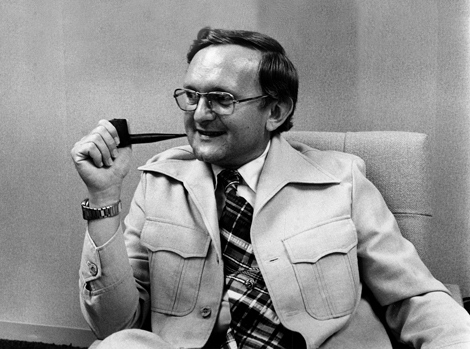
Chancellor John W. Dorsey (1936 – 2014)

NEWS-John-Dorsey

John W. Dorsey, the third Chancellor of the University of Maryland, Baltimore County, passed away in July at the age of 78. Dorsey died at his home in Laurel of respiratory failure.

Dorsey was named as UMBC Chancellor in 1977. He came to UMBC from the University of Maryland, College Park, where he had held a number of academic leadership positions in the 1970s, including Vice Chancellor of Administrative Affairs and Acting Chancellor (1974-1975). Dorsey served as Chancellor at UMBC until 1986, overseeing nine years in which the university boosted its enrollment and significantly raised its academic profile.

A key element in Dorsey’s legacy was the stability he brought to a university whose development after its founding in 1966 had not been without growing pains, including the resignation of the university’s second Chancellor Calvin B. T. Lee under acrimonious circumstances in 1976.

Dorsey arrived at a moment when UMBC was under the constant threat of a significant revision or even termination of its mission as a public research institution. One of Dorsey’s most notable moments as Chancellor came in 1981, when local media reported that Sheldon Knorr, the executive director of the Maryland Higher Education Commission, was preparing a proposal that UMBC be shut down and converted into an industrial park.

The reports created a firestorm on campus, and Chancellor Dorsey rallied the university community at a large public meeting held in the UMBC dining hall with a stinging rejection of the scheme – which never reached formal consideration

UMBC President Freeman A. Hrabowski, III, observes that Dorsey “was the protector and supporter of UMBC. When the university found itself and its future being questioned, he was the one who said we must protect this great institution because the people of the state need UMBC.”

Dorsey came to the job with an intimate knowledge of Maryland’s university system and its politics and tensions, and he usually preferred taking a quieter approach to building his lasting achievements on campus. Dorsey’s “wonderful, understated approach” was a key to his success, says Hrabowski, who adds that “it’s easy to see why the university went to the next level under his strong leadership.”

Shortly after his appointment as Chancellor, Dorsey commenced a sweeping internal reorganization of the university’s administrative and political governance which simplified and clarified UMBC’s structure and paved the way for sustainable growth. And far from shutting down or altering its core mission, UMBC’s enrollment grew steadily over Dorsey’s nine-year tenure and surged past the 6,000 mark in his last year as Chancellor.

Upon his departure from UMBC in 1986, Dorsey returned to College Park as a special assistant to President John S. Toll. He also returned to teaching economics and retired from College Park in 2001.

An alumnus of College Park with a B.S. in economics (1958), Dorsey also had a master’s degree and a doctorate in economics from Harvard University.

– Richard Byrne

HONOR ROLL

Each year at Homecoming, UMBC’s Alumni Association bestows its Alumni of the Year awards to notable graduates of the university, and the select group of this year’s honorees was among the most impressive yet.

This year’s ceremony was held in the recently-opened second phase of the university’s Performing Arts and Humanities Building, and the 2014 award winners included:

Claudia Pearce ’89 M.S. and ’94 Ph.D., computer science (Engineering and Information Technology), a senior computer science authority at the NSA.

Donna Lewis ’86, English (Humanities), a cartoonist with the Washington Post News Service and Syndicate and the unit chief of the Office of Professional Responsibility, Transportation Security Administration in the Department of Homeland Security.

Michael Adelstein ’96, biochemistry and molecular biology (Natural and Mathematical Sciences), CEO of Potomac Photonics, Inc.

Kaliope Parthemos ’93, psychology (Social and Behavioral Sciences), chief of staff in the office of Baltimore Mayor Stephanie Rawlings-Blake.

Hadieh Shafie ’04 M.F.A., imaging and digital arts (Visual and Performing Arts), independent artist.

Gib Mason ’95, economics (Distinguished Service) chief operating officer and director of the Center for Leadership and Innovation, UMBC Training Centers.

Isaac Kinde ’05, biological sciences (Rising Star), M.D./Ph.D. candidate, The Johns Hopkins University School of Medicine.

The Alumni Association also honored Anne Spence, professor of the practice in mechanical engineering, with the association’s inaugural Outstanding Faculty Award.

– Richard Byrne ‘86

How To – Fall 2014

Train a Dog to Perform Search and Rescue

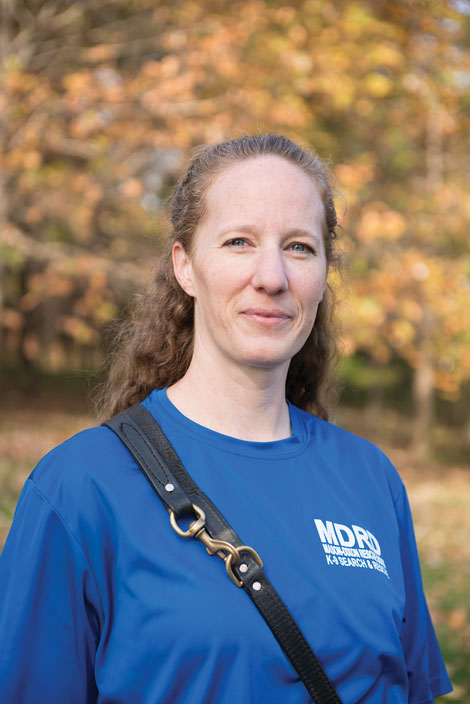
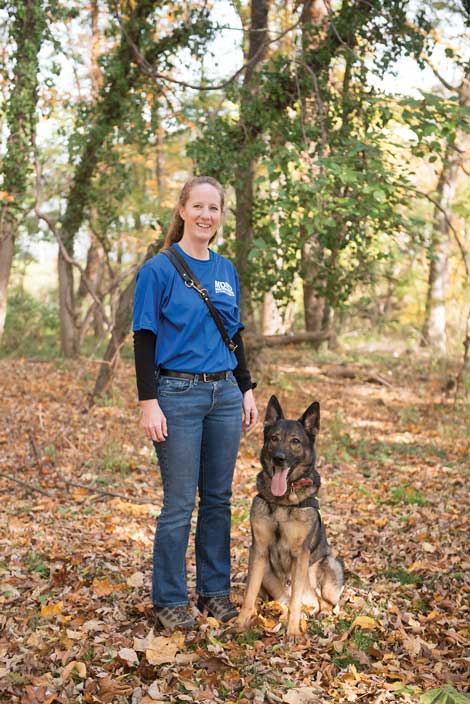
f14-HOWTO-SearchRescue-4519Lisa Kakavas ’94, psychology, spends her days working as textbook manager in the UMBC Bookstore. At night and on weekends, however, you’ll find her out in the field with her sable German shepherd, Zildjian (or “Z” for short), working with Mason-Dixon Rescue Dogs. Kakavas is president of the all-volunteer group, which trains dogs – and their owners – to seek and find missing people, both alive and dead.

How do you transform a dog from lovable companion to hard-working rescue/recovery K9?


Step 1: FIND A TEAM TO TRAIN WITH

“There are numerous search and rescue groups around Maryland, and they are generally very open to helping newbies get started,” says Kakavas. She advises starting with a web search to identify groups that are close to where you live. You’ll likely be invited to a field day – most groups hold regular weekly sessions – and meet everyone involved in the group to see if you’re a good fit for that team. Training a rescue dog is a rigorous, long-term project, and it’s important that both the group’s location and overall zeitgeist work for you. “You’ll be spending a lot of pretty intense time with these folks,” Kakavas observes.

Step 2: LEARN FIELD SKILLS

Interestingly, the first step in training a search and rescue dog does not involve an actual canine. “You need to solidify certain skills yourself, as a handler, before you can start teaching your dog,” says Kakavas. On the learning curve: navigation with map, compass and GPS. You’ll also study search strategy – i.e., how to evaluate an area of land to devise the most effective and efficient search approach, since “when you’re looking for a live individual, time is of the essence” – and “scent theory,” or understanding how terrain, weather patterns and even vegetation affect how a search target’s scent disperses in the landscape.

This initial human training period varies, depending upon the individual’s previous outdoors experience and how much time they can devote to what is ultimately a volunteer gig. “The ballpark is about one year,” Kakavas says.

Step 3: CHOOSE YOUR DOG

f14-HOWTO-SearchRescue-4480aIdeally, those interested in learning to do search and rescue acquire the dog after they’ve established their own skills. “This way you get to see a multitude of working dogs and start to understand what breed you’d like to work with, what makes a good search dog,” she says. Although many rescue canines come from certain working breeds like German shepherds, border collies, and Labrador retrievers, Kakavas says that any pup – so long as it is less than two years old – has potential. A dog’s particular characteristics are more important than its breed. “Look for a dog that is independent yet sociable, tractable, eager to learn, agile, and fearless,” she says. “And has a good nose!”

Step 4: EARN “THE PAYCHECK”

While a handler’s motivation is abstract – help the community, save lives, bring a loved one home to their family – dogs are motivated by food and play. Search and rescue training is built around the “paycheck” of a treat or some tug of war as a reward for performing tasks. Training a dog to certification level typically requires one to two years, when working at it part time, and involves activities like “runaways” which use the handler and a volunteer “subject” for the dog to find. “The subject runs away maybe 30 feet, which kicks in the dog’s natural prey drive even as they can still see the person,” Kakavas explains. Every time the dog goes to a subject, it is rewarded with a very vigorous playtime.  The distance gets longer and longer, until eventually the subject is out of the dog’s sight. The dog by this time understands the need to find a person in order to get their reward, thus naturally transitioning from sight to scent in order to go collect that paycheck.

“Training is essentially coupling the dog’s natural drives with a reward, over and over again until it’s deeply automatic,” says Kakavas. “Our dogs are searching for any human scent. No matter who is out there in the field, the dogs will find them, which we want: even if it’s not the missing person, it is someone who is a potential witness.”

Step 5: DON’T FORGET TO HAVE FUN

f14-HOWTO-SearchRescue-4532Doing searches, which can be long and grueling, must also be fun for both dog and handler. Especially the dogs: if it’s not fun, they simply won’t do it. Fortunately, says Kakavas, search and rescue is the canine equivalent of a big game of hide and seek. And the handler? “Just watching that dog do a job it is born to do, just the way you’ve trained them to do it – that is the human paycheck.”

TOOLS OF THE TRADE

  1. Dog treat or toy, depending upon your dog’s preference
  2. A GPS, compass, and map
  3. Working knowledge of search strategy
  4. Spirit of fun and adventure

By The Numbers

f14-HOWTO-SearchRescue-4496Amount of area searched: Anywhere from a few hundred square feet to 80 acres.

Number of years Kakavas has been training dogs and doing rescue and recovery: 14.

Furthest Kakavas has ever traveled to do a search: 3,500 miles, searching for a lost hiker in Peru.

Number of searches Kakavas and Z have done in their five years of working together: more than 50.

– Michelle Gienow

History Rooted in the Community

UMBC alumni work to preserve and present history for broad audiences in Maryland and beyond.

By Max Cole

UMBC’s history department is the only one in Maryland that offers a graduate track in public history. Students who take courses in public history learn that it is a unique profession that requires a unique approach to research and interpretation. Each course creates opportunities for students to engage in work on real projects with real partners, which in turn helps prepare them to enter the workforce upon graduation.

“Public history is a form of public service,” says Denise Meringolo, an associate professor of history at UMBC and director of the public history program. “Public historians help create historical understanding by sharing authority and inquiry with a variety of partners.”

“At UMBC, graduate students in public history develop a portfolio of work, produced in class and in internships that demonstrates they have a marketable set of skills, most importantly including experience in community-based public history practice.”

UMBC students who go into public history careers understand the importance of rooting their work and research in the communities they serve. They preserve and present history for broad, non-academic audiences, and they strive to relate historic objects, materials, sites and places to everyday people to make them understand their significance and value. Above all, they have an appreciation for what they do and a passion for history that often starts at a young age.

Smelling the Campfire

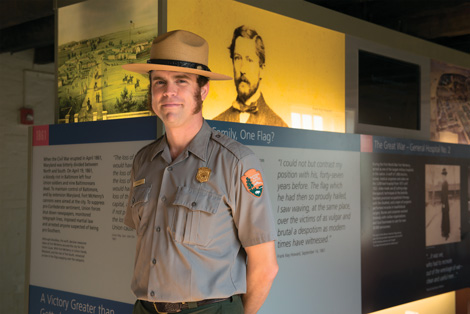
Jim Bailey, Park Ranger, Fort McHenryWhen Jim Bailey was seven years old, he witnessed his first historical re-enactment at New Market Battlefield in Virginia. He remembers it as the moment he decided he wanted to work in public history.

“A living historian let me try on his coat and hold his musket. I could see the camps and I could smell the campfires,” remembers Bailey. “I remember as a child just being enthralled by everything I was hearing, seeing and smelling.”

Bailey ’03, history, and ’08 M.A., historical studies, now works as a park ranger and volunteer coordinator at Fort McHenry in Baltimore. As park ranger, Bailey presents interpretive programs, serves as historic weapons supervisor, and coordinates the living history volunteer program with the Fort McHenry Guard.

Fort McHenry CannonAs a student of history and having grown up in nearby Catonsville, Bailey understands the significance of Fort McHenry to Baltimore and American history, and each day on the job he interacts with visitors from across the globe.

“In an age when we are addicted to our smartphones and everything moves so quickly, we have visitors here that don’t necessarily understand the War of 1812, let alone the Battle of Baltimore,” Bailey observes.

“Two hundred years ago is incredibly remote,” he continues, “so how do you engage people in a meaningful way and make a connection? That’s what interpretation is all about.”

Bailey says if visitors can think of the War of 1812 and its impact on American history, he has done his job.

“When you’re walking up on the fort walls and you begin to contemplate what happened there, it’s powerful. When you start to hear fifes and drums on the parade ground, and see soldiers marching and sergeants shouting out commands and can see them drilling just as they did 200 years ago…the fort becomes alive like it wasn’t 20 minutes ago. Those are things that stay with you for the rest of your life.”

Family Ties

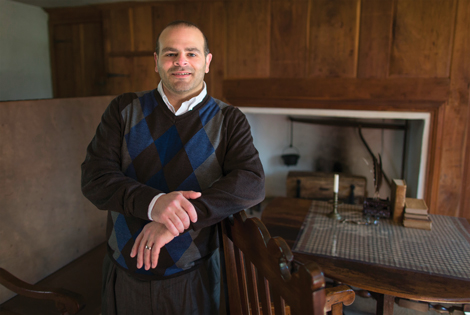
Robert Bennett, Executive Director, William Brinton 1704 Historic House

Many UMBC history alumni have their own personal story — something they can point back to as being a stepping-stone for where they are now.

For Robert Bennett, it started with a research paper about a historical aspect of his family he produced as a student at UMBC.

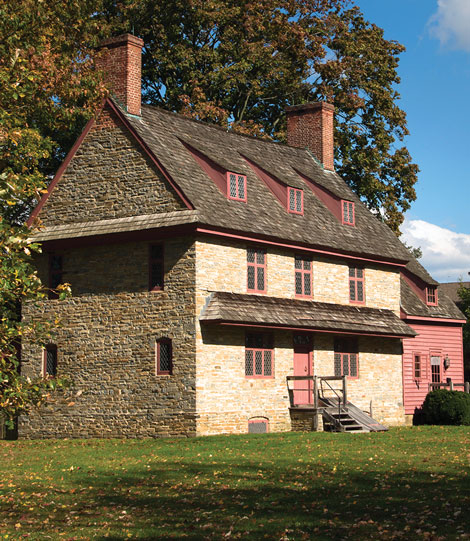
Bennett ’12, history and ancient studies, is executive director of the William Brinton 1704 Historic House in West Chester, Pa. He landed the job through his research paper on the Bennett family, in which he discovered he was descended from English Quakers who helped colonize Pennsylvania in the mid-1680s. In the course of his research, he discovered that the descendants of this family owned and operated a historic house and museum dating back to 1704 in West Chester.

William Brinton 1704 Historic House

Eventually, Bennett found that his seven times great grandfather built the housewith his brother-in-law in 1704.

“Whenever I come here to the house, it makes me think about my seven times great grandfather and grandmother,” says Bennett. “It’s very personal for me. When I come here, it’s like coming home.”

As executive director, Bennett cleans and maintains historic objects at the home, maintains records, organizes volunteers, presents tours and coordinates events throughout the year. In all his work, he tries to make visitors understand his strong, personal connection to the historic home with the goal of having it resonate in their own lives.

“UMBC taught me that if you can find the personal connection or the human touch in a historical document, object or artifact, then you can relate to it better,” says Bennett. “If you can relate to it, you can relate it to others in that way.”

Bringing History to Life

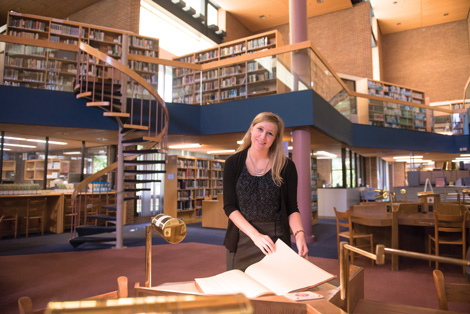
Allison Seyler, Research Archivist, Maryland State ArchivesUMBC’s history department teaches students research, interpretation, communication and writing skills, all of which are necessary to be a successful public historian.

Allison Seyler combines all of those skills in the day-to-day work she does as a research archivist at the Maryland State Archives.

Seyler describes her job as having three tiers: data mining, research and education. Seyler ’10, history and French, and ’12 M.A., historical studies, works on the grant-funded Legacy of Slavery in Maryland project. Focusing on five counties on Maryland’s Eastern Shore, Seyler researchers newspapers, advertisements and government records from the 19th century to create biographical sketches or case studies on slaves, slave owners and fugitives living on the Eastern Shore.

“It’s all about these individual stories we are rediscovering,” says Seyler. “They didn’t go anywhere. These stories are there. We just have to bring light to them. We illuminate these people’s struggles and their experiences because they’re worthwhile. They have value. They’re important to the American story and the Maryland story.”

In addition to using her research and writing skills to produce case studies, Seyler presents her findings to a variety of audiences: teachers, students at all levels, and even descendants of Eastern Shore families who have lived there for centuries.

“This is the human experience,” explains Seyler. “Who is to say that’s not important?”

When the Light Bulb Goes Off

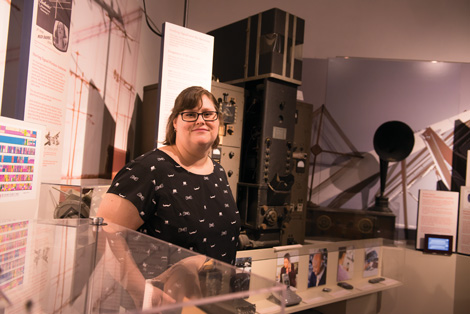
Alice Donahue, Assistant Director, National Electronics MuseumWhile many alumni who are now working as public historians thoroughly enjoy their jobs, it is important to understand how much of the work can be a time-consuming challenge, especially in a managerial role at a national museum.

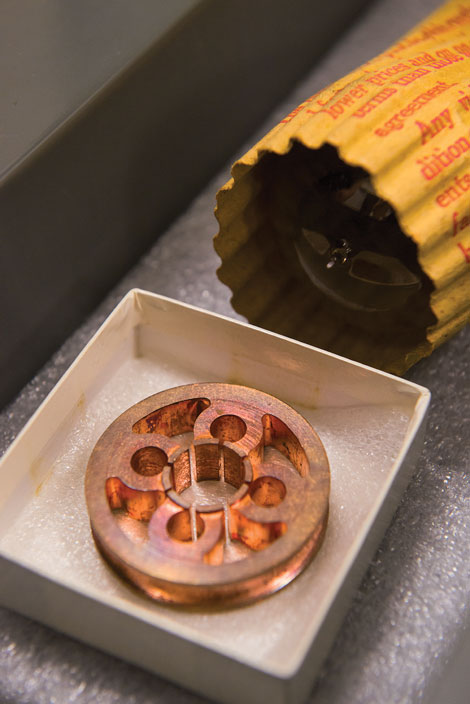
When Alice Donahue first started working at the National ElectronicsMuseum in Linthicum, her first job was to project manage the opening of a new gallery about the introduction to concepts and principals of electronics.

National Electronics Museum Piece“When I came in, I had to literally cut half the words [for interpretive displays],” says Donahue ’05, history, and ’08 M.A., historical studies. “When you take historiography at UMBC, you need to be able to reduce the argument of a 400-page book to one page. That skill definitely translated to exhibit writing.”

As the museum’s assistant director, Donahue manages the museum’s collection and volunteer program. She brings in new objects, organizes and cleans objects on display, and maintains mountains of paperwork on them noting where they came from and why they are important.

The museum helps people understand how electronics and communications have evolved, which makes the job worthwhile for Donahue.

“Public history is about making history that people care about. How do I pick which words people are going to care about and what about this history makes them understand themselves and their experience better?” says Donahue, describing the challenges of her job.

“When the light bulb goes off and people realize they knew more than they thought they did and the world is suddenly bigger and their role in it is bigger…it cements their place in history and that is what I really enjoy.”

It’s Not Just About the History

International Mapping Company Group Picture

As demonstrated by several UMBC alumni working at International Mapping Company in Ellicott City, one doesn’t necessarily need to major in history to pursue a career in the public history field.

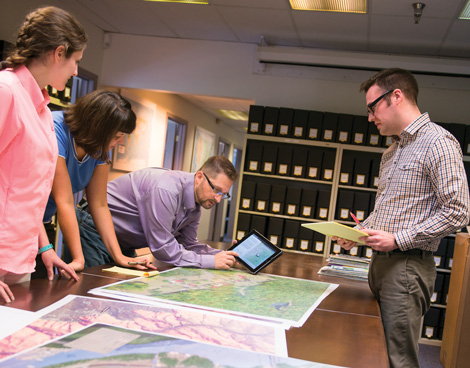
International Mapping creates interactive maps, applications, signage, videos andother materials to enhance the user’s experience while visiting historic sites, national parks or even studying history in the classroom.

“We specialize in displaying geographic information for people so they can better understand it,” explains Dan Przywara ’94, geography, and director of sales and marketing at the company. “It’s one thing to read a word and try to visualize what happened. It’s another thing to actually see something and be able to comprehend it from that image.”

International Mapping has worked on projects from Maine’s Acadia National Park to Harpers Ferry National Historic Park and beyond. Twelve employees of the company are UMBC alumni representing majors from geography and visual arts to computer science. While much of the work involves advanced technical skills, employees still need to have strong research, writing and analytical skills, all of which are the foundation of what goes into producing compelling public history.

“With a historical map video, I have to research historical events in order to map them properly, so it combines a lot of other skills – both technology and general research knowledge,” says Kevin Lear ’85, geography, who is senior project manager at International Mapping and recently completed a video history project on the Korean War.

“We know the skills that UMBC alumni have when they get here can transfer to our company,” explains Przywara. “With the range of skills that we require, UMBC provides that.”

People and Community

Graduates of UMBC’s public history program and other related majors are prepared to enter the workforce with a full complement of skills that will enable them to contribute to preserving and presenting history for decades to come.

Whether it’s creating digital maps, presenting re-enactments or leading tours, alumni are prepared for a variety of jobs in public history. However, there is one common thread that is taught at UMBC that carries over into the everyday work: it’s all about people and community.

“It is truly crucial for public historians to understand that the questions guiding their research and the interpretive products they produce must be rooted in the communities they serve,” says Denise Meringolo. “Otherwise, they will be insignificant and unimportant.”

The desire to serve the community is evident with public history alumni, and perhaps more powerful is the fact that many of them wish to continue giving back.

“As a graduate of the program, I thought it was so enriching and well put together, I want to stay involved in that community,” says Alice Donahue. “We want to keep giving back. We got so much from the program, and we want to continue to help the next generation to keep getting that.”

Hire Calling – Elliot Lasson ’87

Rubin Rakovsky was an in-house auditor for a multinational accounting firm, but wasn’t happy with his job. “I was just a number there,” he says. “I wanted to feel like I was part of something.”

Rakovsky’s search for a more satisfying position led him to Elliot Lasson ’87, psychology. Lasson, the executive director of Joblink of Maryland, helped match him with a small real estate investment fund in Laurel that satisfied the young accountant’s desire to meet new people and participate in multiple aspects of the business.

“Employment is so central to who people are,” says Lasson, who moved into the leadership role at the Baltimore-based nonprofit six years ago. “[Rakovsky] was at a place in his life where he needed a change, and I was in a place I could help.”

Lasson traces his own interest in a career in human resources to his father, who was a clinical psychologist. He wanted to follow in his father’s footsteps, but sought to apply that curiosity about human behavior to a business environment.

As an undergraduate at UMBC, Lasson was able to meld his dual interests by concentrating his course work on organizational psychology – the scientific study of human behavior in the workplace.

“I tend to be a very focused person. I determine where I want to go and I find a path to get there. I didn’t feel I needed to turn back or second guess. I knew what I wanted,” says Lasson, who lives in Baltimore’s Mount Washington neighborhood with his wife, Sheryl.

Lasson also received a master’s degree and a doctorate in organizational psychology at Wayne State University in Detroit. He worked for private firms in Michigan and Maryland, and eventually for the state of Maryland, where he heard through some friends that Joblink was looking for a new leader.

He recalls liking how the organization – which works primarily works with members of the state’s Jewish community but is open to all – was still young and growing.

“I saw an opportunity to build something there,” says Lasson, who also earned a second bachelor’s degree in Talmudic Studies from Ner Israel College in Pikesville while attending UMBC.

Joblink has helped more than 400 people find new jobs since he took over – and has provided assistance to another 2,400 people seeking work. All of Joblink’s services are free to job applicants, employers and search firms. Lasson says that one key is to look beyond resumes and minimum job requirements, and take into account an applicant’s personality and goals, as well as the business’ culture, when matching job seekers with prospective employers.

Lasson identifies a few key elements for a successful job search. He urges job seekers to develop new skills by volunteering in a preferred field or helping with projects outside their current department. They should focus on “portable skills,” especially in computers.

“That is really critical,” says Lasson, who also serves as a member of the Governor’s Workforce Investment Board, a panel that advises the state’s executive branch on how to best address Maryland’s workforce needs. “Tech skills are a prerequisite for most jobs these days,” he says.

Lasson has also extended his vision to higher education, and has returned to UMBC to teach graduate-level psychology courses as an adjunct professor.

“He’s got a soft spot for this school it seems,” says Ted Rosen, director of UMBC’s industrial/organizational psychology master’s program. “He is really dedicated to his students and they really appreciate him.”

Lasson says it’s been especially hard to find people good jobs the past few years, “but with a little luck I can usually help. I find it very gratifying.”

There is hope that comes along with the hard work, he adds. “People should never give up,” he says. “Keep looking.”

– Scott Daugherty ’02

Grit to Greatness

UMBC Athletics Director Tim Hall Lays Out His Program for the Future of Retriever Fever

Interview by Richard Byrne ’86

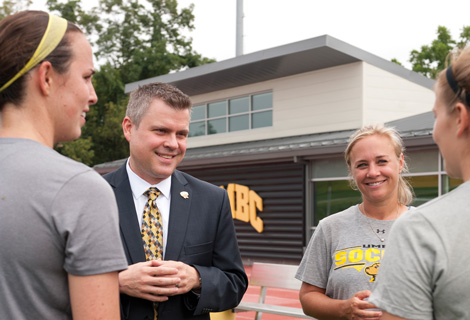
When Tim Hall was appointed director of athletics, physical education and recreation in July 2013, he had some big shoes to fill. Longtime director Charles Brown had led UMBC’s program for 24 years, solidifying and growing the program’s Division I successes while keeping the department true to UMBC’s mission of emphasizing both sides of the student-athlete experience.

Yet in Hall’s first semester, he had the chance to oversee the ascent of UMBC men’s and women’s soccer to simultaneous 2013 America East conference championships and (in the case of the men’s team), lofty national rankings that have been rare for past UMBC teams.

Before coming to UMBC, Hall was director of athletics at the University of Missouri-Kansas City (UMKC) for six years, and he helped propel UMKC to new heights at the NCAA Division I level in athletic competitiveness, academic success, fund-raising and community service efforts.  He has also worked at Kent State University, Eastern Kentucky University, St. Xavier College and Youngstown State University.

f14-FT-cc_communitypicnic-truegrits-5943

Interviewed recently in his office in the Retriever Activities Center, Hall radiated a quiet intensity of purpose – both in embracing the priority to balance academic and athletic success articulated by UMBC President Freeman A. Hrabowski, III, and making plans to take UMBC athletics to even greater success by involving its alumni and the wider community.

What have you learned about UMBC athletics and the school spirit of the university in your first year on campus?

Tim Hall: Certainly our mascot, “True Grit,” is appropriate. The word “grit” is associated with UMBC as an institution, and it’s synonymous with our athletics department, too. We’re a relatively young institution, and there’s a growing amount of school spirit. Our colors – black and gold – resonate with alumni. We have pockets of very strong support and spirit.

We are working to engender a stronger sense of pride in the university through our athletics programs: primarily men’s and women’s basketball, men’s and women’s soccer, men’s and women’s lacrosse. And a stronger sense of pride in the success of our athletics program I think will bode well for having a stronger sense of overall school spirit.

How do you assess where our athletics program is at the present moment? What challenges do we face as a university?

The landscape of college athletics is changing a great deal. We’ve gone through a massive overhaul of the legislative process and NCAA governance structure. The big five conferences – about 65 institutions – really are going to control, by and large, the governance structure and process. The word used a lot in anticipation of these changes is “permissive” – which means if you have the resources to do it, you can do it. There is going to be a lot of deregulation.

What it’s going to mean for UMBC as a smaller, mid-major division one program is that we’re going to have to prioritize our expenditures. We need to talk about return on investment – and, as I always say, return on objective. What are our major objectives? Our funding will have to be in line with those objectives if we’re going to realize success.

We love all of our sports at UMBC, but as an NCAA Division I-AAA school – which means we don’t sponsor football – our best opportunities for revenues are in soccer, lacrosse and basketball – primarily basketball, though. And for us to realize revenues from those sports, we have to put teams on the field that are competitive and can win more than they lose. You have to make sure that you have the coaches and the student-athletes and the tools that they need to be successful: scholarships, equipment, and appropriate facilities, etc.

That doesn’t mean we don’t want baseball or tennis or track and field to be successful. We want all of our programs to be successful.

You mentioned pockets of spirit and support. How does UMBC athletics build on that?

One of my initiatives as we put our strategic plan for UMBC athletics together is to grow and to engender more of a sense of pride from all constituencies, but specifically from our former student athletes.

When I got to UMBC last year, I was able to discern fairly quickly that our former student-athletes are very active within their own particular sports. For example, former lacrosse players come back to Homecoming and interact just with former teammates at lacrosse-specific functions. Soccer, the same. Tennis, the same. The phrase “siloed” would probably be accurate.

What we want to do is tear down some of the silos. We want to say: “Yes, your sport is important, but there’s strength in numbers. A rising tide raises all ships. We want you to come to events that are athletic department-wide and institution-wide.”

What opportunities are presented for UMBC athletics by the new facilities in the works right now – especially the new Events Center that is planned for 2017?

From an organizational perspective, having the new Events Center will allow us to move nearly all of our varsity programs to that facility. All of our coaches’ offices and all of our support units for intercollegiate athletics will be housed there. This move will allow us to then have the RAC refurbished to become specifically a facility for recreation and wellness and club sports, which would be more consistent with other similar universities. That’s a big growth step in our maturation process in the areas of athletics, recreation and physical education.

And, again, our basketball program has to be successful for us to be successful as a department, so having a venue that’s going to be one of the finest of its kind in the mid-Atlantic region will give us a recruiting advantage from as far north as Boston to as far south as Florida. Having this new state-of-the-art venue will put us in a different conversation in terms of prospective student athletes that we could recruit to UMBC.

You can’t be successful in getting new facilities and growing an intercollegiate athletic program without the support of the university’s leadership. President Hrabowski and Dr. Nancy Young, vice president of student affairs, want to see a very strong and vibrant athletics program, and we have aligned our activities based on the success of the student first, and the athlete second – but a real close second – to prepare them for graduation and to be future leaders of our society. I think that that’s really where we keep our focus.

What does UMBC offer to recruits by that strong emphasis on both elements of the term “student-athlete”? In an economy where recent graduates continue to struggle, is there an advantage in taking in the whole person, and being able to say: “This is a place where you’re going to compete and where you’re going to excel and be prepared to do almost anything?”

I believe that success in athletics and success in academics are not mutually exclusive. You can be successful and balanced in both.

We talk to our coaches all the time about finding student who fit in at UMBC academically, athletically and socially. If any one of those three is not present, then it probably won’t be the right fit for a young person. I think the three of them really go together. You spend a lot of time with your teammates as an athlete, you spend a lot of time with them pursuing academics, and then there’s some of that time that’s also social. You want to make sure that you’re maximizing each one of those facets of the university experience.

It’s rigorous to be a division one athlete. There are the maximum mandated hours that the NCAA allows you to practice and compete, but then there’s also the training that you do during the off season to keep yourself in peak physical shape.

If you put in the student piece, and then the athlete piece, and also put in the social “enjoy your college experience” piece, it doesn’t leave you a lot of time to prepare to enter the working world. We must find creative ways for internships, externships, shadowing opportunities, summer jobs, so that our young people are tangibly prepared to enter the workforce.

We partner with our Career Services Center to ensure that our student-athletes have all of the appropriate preparation that they need to be successful when they have graduated so that they are prepared to enter into the working world. I think that’s something we do very well here.

f14-FT-cc_NewAD-1217

Where do alumni fit in to where you see UMBC athletics headed?

Alumni play a very integral role. They are crucial to our future success. You have to have alumni – that group of individuals that have come before – to really show that sense of unity, that sense of family, that sense of school spirit and pride to (and for) current and future student-athletes.

Over the coming three to five years, we’re implementing an aggressive strategic plan that has a strong external component to it. One of our highest priorities is further connecting and reconnecting athletic alumni to really be involved with our athletic department and our university at a level that’s commensurate with their personal and professional situation. If we’re successful, it will be through the support of those alums – their time, talent and treasure – that will give us the margin of excellence.

And when I say time, talent and treasure, we really need all three. For example, we need alums to give of their time to volunteer as part of an alumni mentoring program, where they can also manifest their talent. But we’re also going to need treasure. We’re going to need alums to step up and give – to say yes to our funding initiatives – whether they are facility-related or scholarship-related initiatives. There’s a direct correlation between alumni involvement and alumni investment and successful athletic programs.

And as the university looks to celebrate its 50th where does athletics fit in? And finding those special moments in the history of our athletic department and really celebrating those and using those as a launching pad for the next 20 to 30 to 50 years, I think is going to be really important.

Hopefully our success comes in terms of being able to recruit the right young men and women here to win championships, and graduate many fantastic, well-prepared young people who go on to be leaders of our society and contribute to the betterment of our world.

As an athletics department we don’t determine what our brand is: our constituencies determine what our brand is. And from an athletics perspective, I don’t think, in the past, we’ve been as consistent with our messaging as we need to be. What our alumni and our various constituencies will see going forward is, number one, more consistency in our messaging, and then, number two, that our messaging will be very closely aligned with that of the broader university.

Discovery – Fall 2014

INSPIRED CHOICE

Julia M. Ross’ path to becoming the new dean of UMBC’s College of Engineering and Information Technology (COEIT) was paved by numerous achievements as a scholar and an academic leader. But it is a deep commitment to breaking down disciplinary boundaries, ensuring graduate student success, and increasing diversity in the fields encompassed by her college that have characterized her time at UMBC.

Ross arrived at the university in 1995, rising eventually to become Constellation Professor of Information Technology and Engineering at UMBC. In 2011, under her leadership as chair, UMBC’s chemical and biochemical engineering department merged with the civil and environmental engineering department to create a single entity. (Ross remains a professor in the new chemical, biochemical, and environmental engineering department.)

The new dean has a stellar record of scholarship in bioengineering and engineering education, and is the author or co-author of more than 50 peer-reviewed publications. In 2013, Ross received a prestigious American Council on Education fellowship, which is the nation’s premier higher education leadership development program. During that year, Ross worked with Jay Perman, president of the University of Maryland, Baltimore.

At UMBC, Ross also served as special assistant to the provost for inter-institutional research initiatives and was instrumental in enhancing research relationships and collaborations between UMBC and the University of Maryland, Baltimore, including the development of the universities’ joint seed grant program.

Another initiative that Ross has helped spearhead is the INSPIRES Curriculum – a program for high school students supported by the National Science Foundation and designed to promote interdisciplinary research in science and engineering education. The program’s acronym stands for “INcreasing Student Participation, Interest and Recruitment in Engineering and Science,” and the research team led by Ross began its work by building a curriculum that could be used in high school classrooms to teach engineering.

“We were trying to put something together that could be used by all students,” says Ross. “We’ve developed an engineering curriculum that is well suited for putting into science and technology classes. There are very few curricula for either that incorporate engineering. We were trying to develop something that was low cost and modular but still had real engineering in it.”

Ross and her colleagues recently received $3 million from the NSF to continue their work, and she believes the timing couldn’t be better. “Science standards have changed,” Ross observes, “and they now place engineering as part of the Next Generation Science Standards.”

“UMBC is very fortunate to have someone of Ross’s impressive experience and talent to serve as our next dean of the College of Engineering and Information Technology,” says Provost Philip Rous.

In her new role, Ross is seeking to attract top graduate students to the college. Yet she adds that her college also must focus on attracting and retaining just the sort of undergraduate students who may be inspired by the curriculum she has helped develop in high schools.

“We have to work to diversify the undergraduate population,” says Ross. “I’d love to see us exceeding the national average regarding minorities and women. And we also need to make sure that as students move through the college that they are progressing equally regardless of their backgrounds.”

– Nicole Ruediger

SAFER AND STRONGERf14-DISCOVERY-mitre

UMBC’s increasingly central role in strengthening our nation’s cybersecurity infrastructure – and its growing ability to collaborate with private industry in that effort – were highlighted in October by the announcement of the university’s participation in a new Federally Funded Research and Development Center (FFRDC).

The U.S. Commerce Department’s National Institute of Standards and Technology (NIST) – which promotes U.S. innovation and industrial competitiveness by advancing measurement science, standards and technology in ways that enhance economic security and improve national quality of life – awarded a contract to operate the new center to the MITRE Corporation.

The center is the first to be dedicated solely to enhancing cybersecurity and protecting national information systems. MITRE will partner with the University System of Maryland (USM) to carry out the center’s goals, with UMBC and the University of Maryland, College Park as the essential collaborators in that effort. The contract to operate the center has maximum funding of $5 billion over 25 years.

“Securing our cyber infrastructure requires government, industry, and higher education to work closely together, and this center makes that powerful collaboration possible,” says UMBC President Freeman A. Hrabowski, III. “Further, it solidifies Maryland’s role as the hub of cybersecurity in our nation.”

Anupam Joshi (photo, left), director of the UMBC Center for Cybersecurity, will serve in a leadership role for UMBC in the new project. Joshi says that “while national security interests are usually central to the security conversation, this center will also work to meet the cybersecurity needs of individuals and businesses in a variety of sectors, such as health care and energy. Individuals and small and medium-size businesses constitute a major part of the nation’s cyber-infrastructure, but can lack the resources and technical expertise to respond effectively to cyber threats.”

Geography – and the proximity of the USM and UMBC to a growing hub of activity in cybersecurity – also played a role in the award. The federal government sponsors fewer than 50 FFRDCs across the country, and all are designed to tackle complex, long-term problems of significant national interest. Maryland hosts a large number of federal agencies and companies on the cutting edge of cybersecurity, and the USM is nationally recognized for its research and education programs in the field.

U.S. Senator Barbara A. Mikulski lauds the public-private collaboration created by the new project. “This new center unites the knowledge of the government with the know-how of the private sector,” she observes, “to develop cyber technology solutions needed to protect dot-com entities and make our cyber-infrastructure more resilient.”

This new center will support the National Cybersecurity Center of Excellence (NCCoE), established in 2012 by NIST, the state of Maryland, and Montgomery County to help businesses secure their data and digital infrastructure by bringing together information security experts from industry, government, and academia. The collaboration between the USM and MITRE will further the NCCoE’s goal to foster public-private collaborations to identify and solve today’s most pressing cybersecurity challenges.

“I am delighted about this new strategic collaboration with our colleagues at College Park and at MITRE,” says Karl Steiner, Vice President for Research at UMBC. “It will provide opportunities to further expand and apply our scientific capabilities in an area of such critical importance.”

– Dinah Winnick

CONTEMPLATING COMMUNITY

DISCOVERY-brodsky-2

When Anne E. Brodsky won a national award in February 2014 for contributions to the field of community psychology, it came as no surprise to her students and colleagues at UMBC. Brodsky is a tireless scholar who has nurtured dozens of graduate and undergraduate researchers – all while working in collaboration with a range of social-service organizations in Baltimore and beyond.

Over the last 20 years, Brodsky has made creative use of narrative and other qualitative methods in her field. She also conducted extraordinary field work in Pakistan and Afghanistan from 2001 through 2007, including the study of an underground feminist organization there at a pivotal moment in the region’s history.

Brodsky, a professor of psychology, joined UMBC’s faculty in 1997. Her research initially focused on resilience and community-building among East Baltimore women affected by welfare reform. In 2000, however, Brodsky’s work took an unexpected turn when she met members of the Revolutionary Association of the Women of Afghanistan (RAWA) – a feminist organization that has resisted the Soviet, Taliban, and post-Taliban regimes since 1977 – at a conference in Baltimore.

“This was an organization that had never been able to come to the West, never been able to share its stories,” Brodsky recalls. “We put together an informal national tour, and for four months, they were in and out of my house.”

One morning not long after the tour, Brodsky says, “I woke up and thought, wait: Risk. Resilience. Women’s communities. I do this for a living.” She sent her RAWA contacts an e-mail message and, to her surprise, they were willing to have an American academic visit their clandestine sites in Pakistan and Afghanistan.

Brodsky made her first visit in July and August of 2001, just weeks before the September 11 attacks, and returned for several more months in 2002. The resulting book, With All Our Strength: The Revolutionary Association of the Women of Afghanistan, was published by Routledge in 2003 and received strong reviews.

One major concept that Brodsky has attempted to formalize throughout her work is resilience – that is, the strengths that allow women to endure in contexts of risk and adversity. In both Afghanistan and East Baltimore, she and her colleagues have found, having children can serve as a protective factor, providing hope and motivation to persist even in extremely challenging climates.

Gitika Talwar, who is completing a doctorate in psychology at UMBC, is one of 13 past and present UMBC graduate students who have co-authored papers with Brodsky. “She has an amazing range of scholarly interests,” Talwar says. “I’m on the West Coast now studying Afghan immigrant communities, but we still make time every two or three weeks to talk about my research. She’s been very supportive the entire way.”

Brodsky is a former director of UMBC’s Gender and Women’s Studies program and is an associate dean of the College of Arts, Humanities and Social Sciences.

“Anne’s just top-notch,” says Kenneth Maton, a professor of psychology. “She asks really difficult and appropriate questions, and she brings to bear important theoretical perspectives. When she went to Afghanistan, that was an intellectual stretch and also a personal risk. But she’s always been determined to follow her intellectual passions.”

– David Glenn

STEPS TO THE FUTURE

DISCOVERY-Dance_Cube-2314

Dance has been an integral part of the artistic and academic environment at UMBC since the university’s earliest days, and the completion of the second and final phase of university’s Performing Arts and Humanities Building (PAHB) is an opportunity for the entire community to reflect on the importance of the centrality of the arts in the UMBC experience.

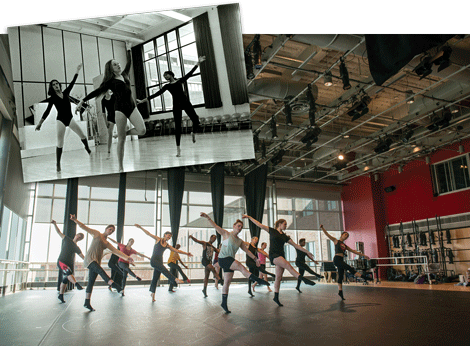
The dance department at UMBC has long occupied a large and well-lit studio in the university’s Fine Arts Building. Over the years, thousands of UMBC students – be they dance majors or students who have woven the art into their academic life – have taken flight in that space.

The studio in Fine Arts that saw so much motion and energy over the last four decades is now in the process of an extensive remodeling and repurposing for other uses, but the new home for the dance department in the PAHB features a 120-seat dance studio and a separate dance technology studio.

The opening of the second phase of the PAHB – which was formally commemorated at a ceremony in October – concluded a transition that encompassed not only UMBC’s dance department, but also its music, philosophy and ancient studies departments. The new phase of the building also includes a 350-seat concert hall, a new rehearsal hall, a recording studio for the music department, and an archaeology lab that is central to the continuing teaching mission of UMBC’s ancient studies department.

– Richard Byrne

Back Story – Fall 2014

UMBC’s growing status as a hub for cybersecurity was highlighted in October by the university’s central role in an award by the U.S. Department of Commerce – National Institute of Standards and Technology (NIST) to the MITRE Corporation for a new Federally Funded Research and Development Center (FFRDC). Where does this activity weave into UMBC’s profile as a research institution? UMBC Magazine talked with Karl V. Steiner, Vice President for Research at UMBC, about the award and the university’s burgeoning research program.

* * * * *

UMBC Magazine: You’ve been at UMBC for a little more than a year now. What attracted you to UMBC, and what are its strengths as a research university?

Karl Steiner: The first thing I heard about UMBC was about its remarkable undergraduate success. The story has been told many times, about its STEM pathways for students and reaching out to underrepresented populations in those fields, and really providing a remarkable overall undergraduate experience. And obviously I knew about President Freeman A. Hrabowski, III, who has positioned the entire institution such that UMBC is now a recognized national leader in this area. The other part that struck me when I first came on campus were the people – the faculty members, the academic leadership and many of the outstanding students I had a chance to meet with. UMBC is an exciting place to come to every morning and the chance to work with the campus community makes this a very exciting opportunity for me and my family.

Once I looked at UMBC in more detail, I realized: “Here’s an institution that has come a long way over the past 20 years but I know it’s ready for another major jump over the next decade or so.

Many great pieces are already in place at UMBC – and I’m calling them “pieces” because I think many of them were not connected quite yet the way I know we can combine them. We are now creating a structure that benefits from our existing strengths in research and scholarship, our national reputation for undergraduate education and our status as a U.S News & World Report number one “up and coming” university for six years in a row. We will continue building UMBC as an institution with a very vibrant, collaborative research and scholarship culture.

What advantages accrue to UMBC from our proximity to Washington, DC, and to the major research hub that has developed between that city and Baltimore?

It is vital for our future plans to have this very rich environment around UMBC – including the proximity of numerous federal laboratories, and to federal and state agencies. Within an hour’s drive of campus we have NASA Goddard, the National Security Agency (NSA), NIST, the Army Research Lab, the Naval Research Lab, the National Institutes of Health (NIH), the National Science Foundation (NSF), the Social Security Administration and the US Department of Education.

Did you know that Maryland as a state has the second highest amount of federal R&D obligations in the Nation? It is a remarkable positioning for our faculty to build meaningful collaborations and partnerships – and provides future employment opportunities for our students.

UMBC’s current research strengths are well aligned with key national priorities such as healthcare, the environment and national security. These topics are not only in the forefront of today’s discussions, but they are long-term issues that won’t be solved over the next five years.

Collaboration seems to be another key strength in UMBC’s research profile

UMBC is a highly collaborative campus. As I like to say: “We play well with others” – both within our campus and with external partners. And as a university, we have always been proactively looking for collaborations. These can be collaborations with federal agencies, with local industry, or with other academic institutions in Maryland and across the country.

It’s a major strength for us as a mid-sized research institution to have so many faculty who go back and forth between departments across colleges. These faculty members actually encourage our academic leadership – including myself, our deans and all the way to Provost Philip Rous and President Hrabowski – to think not only within the academic structure but also within the solution space that we need to find to address major research issues.

It creates an environment where faculty from the social sciences and the humanities can collaborate and provide key solutions. For example, there are ethical questions and social science approaches needed for all of these research segments – especially in the life sciences, but also in climate change, and in cyber-security. None of these challenges can be addressed properly without thinking about the societal context.

Our location close to two major urban centers provides us with many opportunities to pursue our research mission in partnership with our communities, such as our scholarship and creative activity in the arts at Station North in Baltimore or research studies of the urban environment and its impact on underserved neighborhoods.

We have the chance to offer a comprehensive approach to solve some of society’s largest challenges together, which positions UMBC in many ways better than other institutions.

You mentioned some of the key strengths in UMBC’s research profile. What are some of the ways that we’re using those strengths?

One example is the close relationship we’re creating between UMBC and our partner institution, the University of Maryland, Baltimore (UMB), especially in health sciences. UMB has outstanding expertise in such areas as medicine, pharmacy, dentistry and nursing, and in turn our faculty members in such areas as engineering, IT, biology, biochemistry or statistics have unique skills that provide a fertile ground for successful collaborations with our colleagues.

A key to our success in this is that our senior leaders – including President Hrabowski and UMB President Jay Perman – are committed to establishing meaningful and sustainable relationships between our two campuses.

The Partnership Pilot Grants for five collaborations between researchers at UMBC and UMB that we launched last fall set the stage for even deeper relationships, and we’ll announce a second round of Partnership Pilot Grants recipients early next year. I have been impressed by the level of interest expressed by faculty on both campuses as we shared and discussed these opportunities with them.

As an example of the promise of this partnership, there is Mike Summers, a professor of chemistry and biochemistry at UMBC – one of only two Howard Hughes Medical Institute (HHMI) investigators at a public institution in Maryland – who is leading a large research group that is using nuclear magnetic resonance (NMR) techniques to study the structure and function of proteins, such as the AIDS virus. Just a few years ago, Dr. Summers joined with colleagues at UMB and at College Park and together they successfully competed for a major instrumentation grant from NIH for a state-of-the-art 950 Megahertz superconducting NMR instrument. This is what research excellence combined with strategic collaborations can do for us.

In the end, this relationship has to lead to multi-faceted interactions where individual researchers – perhaps a surgeon or a materials researcher for dental implants at UMB – know they can find partners in UMBC’s mechanical engineering or computer sciences departments for a particular orthopedic device, a new test method for materials, or an innovative computer simulation. It might be a partner in our mathematics and statistics department working with so-called Big Data containing 3-D MRI or CT scans or the rapidly growing amount of electronic health records. What we are trying to build is a natural synergy between our two institutions, where research collaborations flourish easily and on multiple levels.

I call this “weaving the fabric” -rather than just building individual bridges.

In what other research areas is UMBC pushing forward into new vistas?

The environmental sciences, clearly. UMBC has a multi-decade history of working closely with NASA Goddard, with over 100 researchers working within three joint centers between UMBC and Goddard. And there’s a significant benefit for our campus by having these very active links between us.

I just returned from a tour over in our Physics Building and saw our LIDAR (Light Detection and Ranging) facility in action, where we conduct research measuring pollution, rainfall, and other environmental factors. So much of that work – and the other work we do with NASA – has a direct impact on our understanding of climate change.

UMBC’s research in this area also extends to the Center for Urban Environmental Research and Education (CUERE), which provides not only a global perspective to the issue of climate change but a true local and regional perspective as well. The director of CUERE, Claire Welty, and her team are looking into environmental, social and economic consequences of the transformation of the urban landscape in and around Baltimore.

Upal Ghosh in UMBC’s chemical and biochemical engineering and Kevin Sowers at our Institute of Marine and Environmental Technology (IMET), located at Baltimore’s Inner Harbor, are successfully working on research in microbial bioremediation to understand the effects and fate of heavy metals and organic pollutants in bays and oceans.

So we have actually a very unique footprint here in research on the environment. Our challenge and our opportunity – I always like combined those two words – are to take that footprint and grow it by working with other institutions, agencies, foundations or the private sector.

While we are talking about the environment and climate change, I should also mention that we’re conducting relevant research into the broader life sciences at a unique facility – the Aquaculture Research Center that we have downtown at the Columbus Center with IMET, led by Russell Hill and Yonathan Zohar.

To my knowledge, there is no other site like this in the world that is able to create sustainable aqua farming from the egg all the way to a harvestable fish. And just like UMBC’s connection to NASA, IMET provides our institution with a way to open the door and create even more collaborative research efforts that actually build communities of excellence.

We have faculty like Govind Rao, director of the Center for Advanced Sensor Technologies (CAST), who is currently working under a major grant from the Defense Advanced Research Projects Agency (DARPA) on ways of literally disrupting the current pharmaceutical manufacturing paradigm by producing drugs in small, portable devices, either at the bedside of the patient – or in the battle field. This is path-breaking research with direct impact on life sciences and beyond.

And then we have Don Norris, director of the Maryland Institute for Policy Analysis and Research (MIPAR), a highly respected leader for scholarly research on policy and policy-related issues in the social sciences and related disciplines. Their work connects the analytic capability of UMBC scholars to the policy issues facing public sector decision makers in the region, state and nation.

Along the same line, our Shriver Center serves as a national leader in applied learning, civic engagement and community-based service delivery programs.

We’ve also developed a considerable reputation in information sciences – especially in what is called “Big Data.” That’s a buzzword that’s been around for some time now, but what it means is that we are working today in Terabytes, Petabytes and even Exabytes – on scales that even just a decade ago were unfathomable. And between Yelena Yesha in computer science and electrical engineering and the Center for Hybrid Multicore Productivity and Research (CHMPR) and Mathias Gobbert’s High Performance Computing Facility (HPCF) in mathematics and statistics, UMBC is well positioned to work with experts in a variety of scientific fields. We’re using our high-performance, big data computing capability to get answers to some of the key research questions out there.

Speaking of information sciences, what does the recent award made by the National Institute of Standards and Technology (NIST) to the MITRE Corporation and the University System of Maryland for a new Federally Funded Research and Development Center (FFRDC) mean for UMBC’s status as a growing hub for cybersecurity research?

I like to say “we were cyber before cyber was cool.” UMBC outstanding professors, including Anupam Joshi, Tim Finin, Charles Nicholas, Alan Sherman, and many others, who work in this field, have positioned UMBC in a very prominent spot within this rapidly growing field of cybersecurity. And we’re also one of the top producers of cybersecurity talent for the NSA, located just 15 miles south of our campus.

It is vital that this new FFRDC is positioned in Maryland. Five or six of the major federal cyber security labs are located in Maryland. We have the NSA obviously. We have the US Cyber Command. We have the Intelligence Advanced Research Projects Agency (IARPA) and the Defense Information Systems Agency Headquarters (DISA). And last year, NIST created the National Cybersecurity Center of Excellence (NCCoE), with a focus on cybersecurity issues in the private sector, which now coordinates our joint efforts on the FFRDC.

This new FFRDC is even more vital for UMBC. As I said earlier, all of these centers are within less than an hour’s drive from our campus. It literally positions us in the middle of everything. So – we are in a perfect location and we have outstanding faculty and remarkable students. And more than half of the companies in bwtech@UMBC – our research park – are cyber related. We have an incredibly strong cyber footprint as an institution within a state that itself has a national reputation as a leader in cybersecurity.

As a campus, I think we will benefit tremendously from this form of collaboration with NIST, with MITRE and with our colleagues at College Park. We will be at the table when many of the key questions are being discussed. And this is vital, because unless you are in the room, and you’re at the table, you will not even be aware of many of the challenges and opportunities that are facing us.

NIST is, by its national mandate, a measurement standard laboratory focused on working with the private sector and developing buy-in and adaptation from the community into agreed-upon practices. It’s a way of working together that lends itself to building a strong partnership between NIST, the private sector and academic leaders, all of whom provide advanced thinking on these issues.

As one of the two leading academic partners – together with College Park – we will be coordinating the interactions with our affiliate academic partners, including George Mason University, the Massachusetts Institute of Technology, Purdue University, the University of Alabama Birmingham, the University of California Berkeley, the University of Delaware, the University of Illinois at Urbana-Champaign and the University of Texas campuses in Dallas and in San Antonio.

Where do you see UMBC as a research institution in the next five years?

I expect that UMBC will continue to be known as an institutional leader providing outstanding opportunities for our undergraduates. But we also want to be known as an institution that has remarkable and talented faculty members who are engaged in world-class research, scholarship and creative activity. By growing this pool of talent, we will attract a very strong group of both graduate students and post-doctoral researchers. These growing research and graduate programs will have a direct and positive impact on the experience of our undergraduates.

Increased funding will be one outcome of this direction, but even more important is to grow and recognize the strong research culture embedded in our institutional fabric. But so is UMBC being at the head of the table when possible solutions to the challenges of today and tomorrow are being discussed. That will bring in an increasing number of talented researchers from across the country and even across the globe to participate in these very exciting endeavors. And in the long term, it will create opportunities that will lead to more collaboratively funded research efforts, new spin-offs and, therefore, new economic growth for our state.

– Richard Byrne ’86

At Play – Fall 2014

OUTRACING STEREOTYPES

Amanda Knapp, assistant vice provost for academic standards and policy administration, is revved up about higher education. But she’s also making tracks – and noise – as a motorcycle aficionado.

Yes, that’s Knapp on the cover of the September issue of American Motorcyclist magazine, posing with her KTM 300 XCW in a shot taken by UMBC Magazine photographer Marlayna Demond ’11. (Another shot inside the magazine showed Knapp in her full racing gear near the UMBC sign at the entrance to campus.)

The cover photo and the accompanying article tackle the public perceptions of motorcyclists, and Knapp is a proud and accomplished rider who has been an enthusiast for 30 years, since she rode her first motorcycle – a Honda 70.

Knapp developed her love for motorcycles at a young age, thanks in big part to her dad. “Some of my happiest childhood memories were spent on two wheels chasing my dad through the woods. My dad always challenged me to ride hard, go faster than the guys, and face fear head on – even if it meant taking a few risks along the way.”

The sport is such an important part of Knapp’s life at present that she even taught her husband to ride. She told American Motorcycle that “there’s nothing more rewarding or stress-relieving than hitting the trail and/or a track.”

She says that some lessons she’s learned as a motorcyclist have been useful in her professional life. As an assistant vice provost, Knapp works with a diverse UMBC student body that she says is brimming with potential.

“I serve as a student advocate,” Knapp says, “cheering loud when they are succeeding and cheering even louder when they may need some extra encouragement. Like racing a motorcycle, I am passionate about my position, and I am committed to keeping students ‘on track’ and ‘in the race.’”

Asked why she chose a career in higher education, Knapp quips that she loved college so much, she wanted to find a way to stay there forever. On a more serious note, however, she observes that her 15-year career in higher education has been motivated by the fact that college changed her own life. As a first-generation college student, Knapp chose the field as a way of giving back to a process that gave so much to her.

Knapp says working at UMBC has been the highlight of her higher education career: “Never have I been part of an academic community quite like UMBC. This is a place where people care deeply for one another, work collaboratively, think beyond the impossible, and center all efforts on a common goal – student success.”

And the fact that UMBC gives her the path to excel as an academic leader and get her motorcycle out on the track is an added bonus. “I feel so grateful to UMBC for creating a community where the concept of work-life balance is not only a reality, but something that is strongly encouraged.”

– Katherine Scrivener

PAGE TURNER

f14-ATPLAYadamjkurtz2

Many people share thoughts, ideas and emotions in a handwritten journal or an online blog. The entire business model of Pinterest is based on such sharing of ideas and images that spark creativity.

But how do you spin that sort of activity into a more creative life? Adam Kurtz ’09, visual arts, says you can do it 1 Page At A Time – the title of a new “daily companion book” that he published in October with Perigee Trade, a division of Penguin Books.

“I think this [book] could be really great for anyone who needs a little help moving along,” Kurtz says. “Someone who has maybe abandoned journals in the past. This is a fun, weird, silly book, but it’s not a coincidence that the title sounds a little bit like a recovery slogan.”

Kurtz says the process of taking creative exploration in small steps – literally one thing each day – offers an unintimidating entry point into constant creativity.

“My book is for human beings, for anyone with a pulse,” he insists. “We’re all creative in some way, that’s maybe what makes us human at all.”

And in a society that increasingly revolves around the Internet, adds Kurtz, a book like his new work can be an impetus to slow down and pace your creativity by exploring a bit of it each day and recording it.

“I put feelings into words and words onto objects,” Kurtz says, “and then I hold them and never let them go.”

– Shannon Williams ’14

REVISING THE LIST

f14-ATPLAY_kaylaHow much influence can a blog post have in reshaping public perceptions about race, gender and even what’s “sexy” in science? In June, Kyla McMullen ’05, computer science, decided to find out.

McMullen – an assistant professor of computer science at the University of Florida – was perusing a 2013 Business Insider feature on “The Sexiest Scientists Alive” and noticed something strange: Not one of the 50 scientists named to the list was a black woman.

So McMullen created her own list of “Sexiest Black Female Scientists” and posted it on her own website. The story went viral, and was such a success that she created a similar list of black male scientists (“Brilliant Is the New Black”) in October.

“The reach of the article has surprised me the most,” says McMullen.“I have had people tell me that they have landed speaking engagements, or been called for faculty interviews, and all sorts of wonderful things from being on the list. I was even contacted by the head of the search committee of a very prestigious school to help identify candidates to diversify their faculty search.”

McMullen also organizes seminars and speeches, and works with middle and high school students to help address the issues raised by her list about minority participation in STEM fields.

“It’s my job to get out there,” she says, “and let young people know that they have options far better than what the media would have them think.”

– Richard Byrne ‘86
Photo: Michael Oliver

This #GivingTuesday, UMBC Students Need Your Help

Giving Tuesday 2014_asb pic

The Thanksgiving leftovers have dwindled away and many of us have put a significant dent in our holiday shopping lists, having bustled through Black Friday, Small Business Saturday, and Cyber Monday. Three years ago, Giving Tuesday was established to encourage us to to break away from the consumerism and chaos that has swallowed up our holiday season and return to a spirit of giving.

This year, there are a number of great causes to consider at UMBC for Giving Tuesday.

While many students will enjoy much-needed time off from classes with family and friends over their spring break this March, four different groups of students will be giving back to the community on service trips through Alternative Spring Break.

They need our help.

Each of these trips requires resources. It’s gas for vans or a plane ticket on trips that are further afield. It’s food and accommodations where they’ll be staying. Sometimes, there are even fees associated with the opportunity of participating in the projects. The more we can help them raise now, the less money each student participant will have to pay out of pocket in March. Even a modest gift of $10 or $20 will make a difference.

These students are making an impact in the world beyond UMBC, and they need your support. Please consider donating to one of the Alternative Spring Break projects, or to any of the other worthwhile student-led projects that are affecting change both on and off campus.

Your commitment truly is a gift that will keep on giving, and our communities will benefit from the great work of the students this spring.

Thank you!

Support UMBC Students on #GivingTuesday

UMBC Hosts Inaugural Research Forum on The Nexus of Social Sciences and Human Health

Research_Forum-8740

On Friday, November 21, UMBC hosted its inaugural Research Forum, the first event in a new, semi-annual series to bring together researchers and scientists from across UMBC and partner institutions to establish collaborations around common research themes. The first event was titled, “The Nexus of Social Sciences and Human Health Research,” and it was sponsored by the Office of the Provost and the Office of the Vice President for Research. The forum aimed to advance intra-campus and inter-campus collaborations in the social and health sciences and to initiate conversations about the role of social sciences in basic and translational research.

Research_Forum-8786

Dr. William Riley, the Acting Director of the NIH Office of Behavioral and Social Sciences Research (OBSSR), presented the event’s keynote address. Dr. Riley discussed how researchers are now faced with a data-rich environment to enhance their work when conducting investigations, including advances with item response theory, computer adaptive testing, and other sensor technologies which generate reports in real-time.

Researchers from UMBC and UMB participated in a panel discussion that focused on developing meaningful links across disciplines. John Schumacher, an associate professor of sociology, discussed strategies for seeking research partners and establishing leaders and milestones to advance interdisciplinary research projects. Fadia Shaya, a professor of pharmaceutical health services research at UMB, discussed how developing peer support and establishing social networks can lead to improved outcomes. UMBC professors Shari Waldstein (psychology) and Brian Cullum (chemistry and biochemistry), shared their insights on strategies for collaboration across disciplines, including building on pilot data and prior research to advance projects. Lee Boot, associate director of UMBC’s Imaging Research Center, discussed how discipline silos no longer exist and how collaboration is needed to solve problems.

Future Research Forums will focus on high-performance computation and environmental sciences and remote sensing. For more information, click here.