All posts by: Scott Cech


Putting the principles of education to work

There are some people who you meet, and it’s obvious: They’re natural leaders—seemingly born to the role. Derek Anderson ’03, interdisciplinary studies, is one of those people.

He went right from UMBC to the front of the classroom as a teacher in the highly regarded Howard County Public School System, earning a master’s degree in school administration and supervision from Johns Hopkins University at the same time.

But in talking with Anderson, it becomes apparent that he wasn’t born a leader—he became one. And he says UMBC was a big reason why he did.     

After nearly a decade of classroom leadership, Anderson became an assistant principal, then principal at Longfellow Elementary School in Columbia, Maryland, winning recognition as Howard County’s 2023 Principal of the Year.

And now he’s been tapped by Maryland’s state superintendent of schools to be the state’s new executive director of community schools, overseeing more than 450 schools with the goal of better connecting schools with the families they serve. 

From imposter syndrome to educator

As improbable as it sounds, this rising star in education leadership remembers that as a first-year student, he wasn’t sure at first that he even belonged in college.

“I struggled mightily in my first semester,” he remembers—in large part because his secondary school hadn’t fully prepared him for college-level academics. “There was a point where I said to myself, ‘Am I cut out for this? This is a lot.’”

A man in a green button down shirt leans against a brick wall

Anderson says UMBC’s academic advising and his own inner determination to persevere helped, but what set him firmly on the path to his future was The Shriver Center, an organization at UMBC that connects students with applied learning, civic engagement, and community-based service opportunities. He began volunteering weekly at a local elementary school not too far from campus.

“I really realized how excited the kids were when we came to visit,” Anderson says. “And it was mutual—I would start looking forward to that particular day of the week. That was the first time I really started to consider a career in education.”

Building a major to match his passion

That realization, he says, galvanized him: It not only gave him a career goal to help shape his studies, it motivated him to work toward the day when he could help students prepare better than he had been for postsecondary academics.

“I thought about my own experience, and I questioned: Could I have been better prepared?” Anderson says. “What would have better prepared me so that I did not struggle the way I did in college? So that really reinforced the idea of, ‘I want to go into education so that I can help and support [students] so that they don’t have some of those experiences.’”
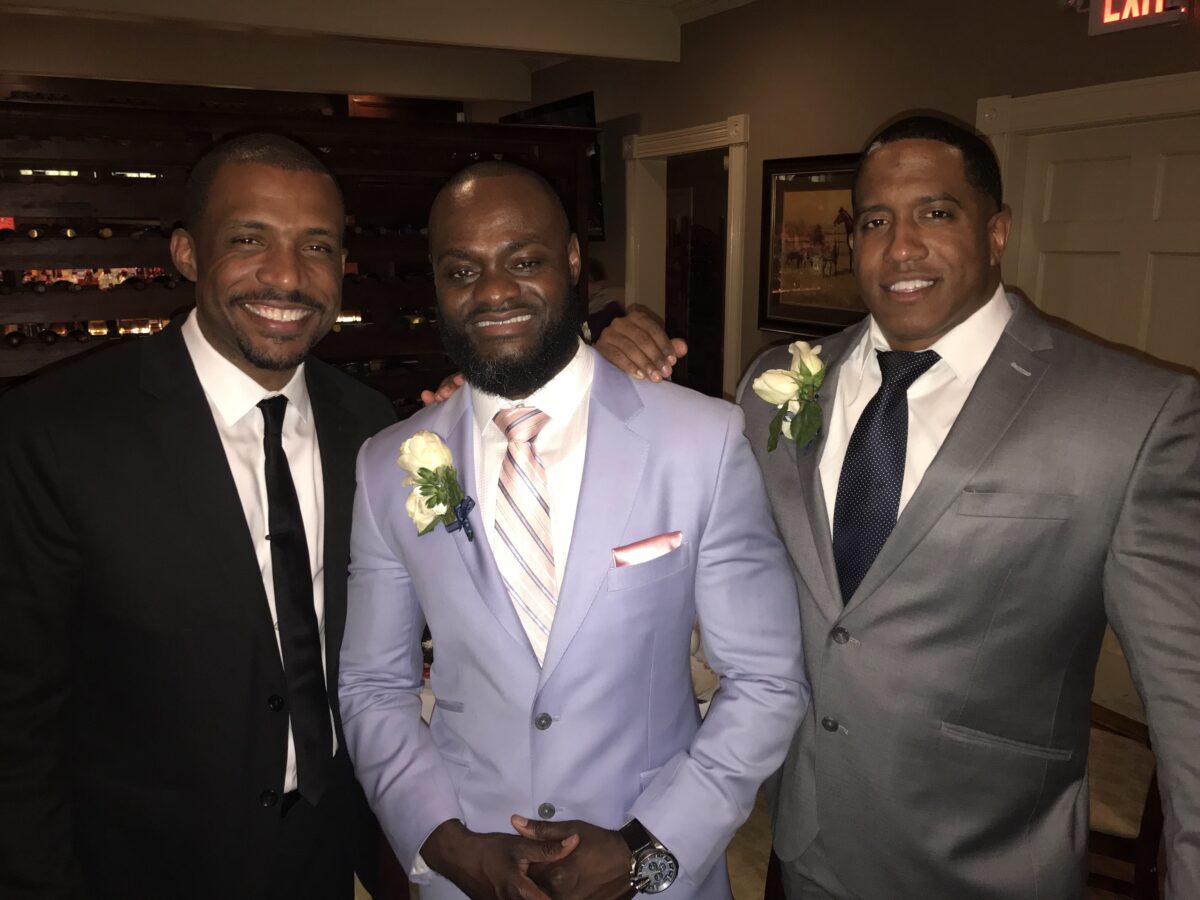
Three men in suits smile at a wedding
Anderson, on the left, with two of his closest UMBC friends, Eddie Freeman ’03, M.S. ’06, and Marc Haskins ’01 at Freeman’s wedding.

UMBC didn’t offer an education major at the time, but Anderson followed his inspiration, juggling a steady load of challenging coursework with his athletic obligations as captain of the track and field team, responsibilities as a dorm resident advisor, and eventually student teaching in Baltimore City schools as he pursued his teaching certificate.

Along with his teacher-certification track, Anderson’s interdisciplinary studies focused on psychology and Africana studies, and one of his professors in the latter field gave him first-hand insight into the power of effective teaching.

He remembers vividly the classes he took with Christel N. Temple, then an assistant professor of Africana studies at UMBC.

“She’s an African American woman, and I believe at the time she was relatively new to the position, but she was very good—not just in disseminating the content, but in the passion she showed for it. That was a big motivator for me,” Anderson says.

Because of that passion for teaching, he remembers: “I really enjoyed her class. I wanted to learn. I wanted to grow. I wanted to enhance my knowledge for no other reason than to become brighter and better.”

Temple, now a full professor of Africana studies at the University of Pittsburgh, isn’t surprised that her former student’s leadership qualities have attracted attention.

“I am so proud of his career,” she says. “His success is a reminder of the contribution that Africana studies makes—not just our field’s orientation to subjects such as culture, communication and sociology, but also to education studies.”

Understanding the personal dimensions of education

Anderson landed a job in Howard County Public Schools soon after graduation by way of his teaching certification and graduation from UMBC. He taught at an elementary school for seven years, then served as an elementary school instructional team leader before becoming an assistant principal. He served in that role for four years before becoming principal at Longfellow Elementary School in 2017.

Kathy Nuemann ’06, American studies, remembers meeting Anderson the year before he became principal. Neumann, a math specialist at Longfellow, was excited to meet another Retriever at her school and struck by his genuine personality. For the next six years, as they worked together, she says, “Derek was always available. Whether I was seeking advice, sharing an idea, or just needed someone to lend an ear. His sincerity extended to students as well.”

She recounts a recent story where her students wrote a proposal to Anderson as part of a social studies project. After identifying a problem (trash on the recess field), the students brainstormed a solution by requesting a recycling bin out on the playground. Neumann invited Anderson to visit her class and the students read the proposal to him. “Not only did Derek listen to the proposal, but he fulfilled the request within a week. My students were thrilled!” 

All told, Anderson served nearly 20 years in Howard County’s elementary schools—long enough to see two of his three his own children pass through Longfellow Elementary while he was principal there. (He met his wife of 16 years, Jonae Anderson ’02, psychology, M.P.P. ’05, at UMBC.) 
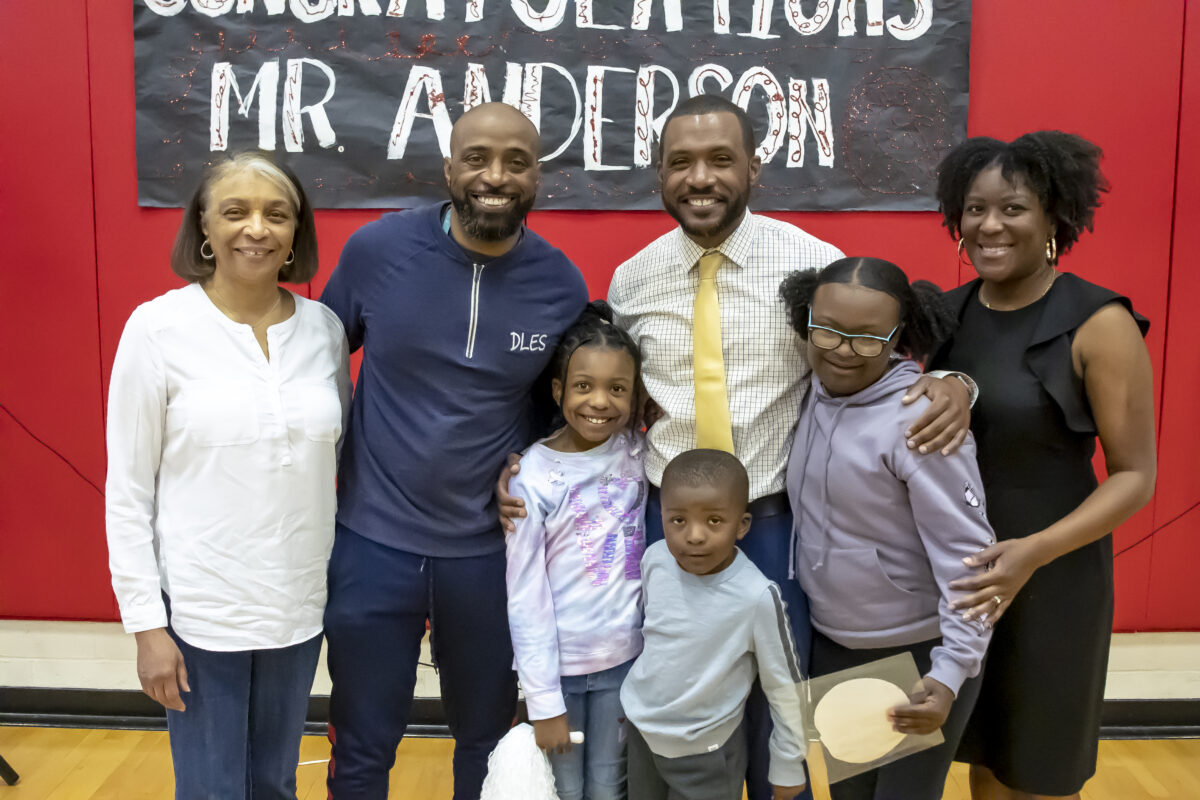
a man in a white dress shirt and a yellow tie stands with his family and a sign behind them that reads Congratulations Mr. Anderson
Anderson was named 2023 Principal of the Year for Howard County Public Schools. He’s pictured here with his wife and children, and mother and brother.

Indeed, Anderson says, parenthood helped underline the personal dimension of education, and not just for the obvious reasons.

“It makes me that much more passionate about the work” of education, he says. “Parents send us their kids—they send us the best they have, Monday through Friday, with the expectation that they’re going to come back safely, happy and enjoying that [school] experience. That is a responsibility I carry with me every day.”

Bringing energy to the executive position 

In fact, it turned out that that sense of greater responsibility made him the perfect candidate for his new role as executive director of Maryland’s growing portfolio of community schools.

The expansion is part of the state’s 2019 Blueprint for Maryland’s Future legislation, which dedicates almost $4 billion per year in state and local funding over the next decade to a set of reforms aimed at improving public schools in the state.

The intent of community schools is to better connect schools with the families they serve. Particulars of that connection can include addressing daycare deficiencies in schools that educate a disproportionate proportion of teenage mothers, or creating a weekend food pantry with fresh groceries at a school situated in a food desert.

“Leadership has always been something that I’ve aspired to,” Anderson says. “For a long time, I never thought past the principalship,” and he admits that there’s a special energy to being in a school building that he may well miss in his new job as executive director.

But when he weighed the one school he was leaving against the difference he could make in overseeing more than 450 schools, he says he found himself thinking about his own educational journey. 

“I went from, ‘I’m not confident about being a student in college’ to ‘This is something I want to pursue,’ because along the way people were providing opportunities, providing guidance, providing insight, and it’s led to a very fulfilling career for me,” Anderson says.

And with his new role’s wider scope, he has the opportunity to be just such a helping hand in the lives and education of many more students.

“I still get up excited about coming to work [in education] because I know it’s meaningful work,” Anderson says. “What better way to serve kids?”


See where a degree in education from UMBC might take you.

Music Man

Devin Walker ’89, political science, is a man with a plan. And a cause and a vision and a passion.

Oh, and a Grammy nomination.

“Uncle Devin, the Children’s Drumcussionist,” as he’s known professionally, was nominated for a Grammy for Best Children’s Music Album in 2022 as a member of the 1 Tribe Collective, one of his many top-level endeavors that center around education, music, and young people.

He’s the musical muscle and co-owner of The Uncle Devin Show, an interactive musical experience for children that uses percussion instruments to inspire both fun and critical thinking.

Walker also runs a training course, “Racism in Children’s Music: Liberating Music for the Black Child,” and he has created an online music radio program for children called WEE Nation Radio, streaming R&B, funk, hip-hop, jazz, go-go, reggae, calypso, and world music, all created for children and families.

But the roots of many such accomplishments, says Walker, can be traced back to his years at UMBC.

Behind the Music 

Although music has always been a passion, Walker saw majoring in political science as an opportunity to probe systemic inequities and effect meaningful change.

“I was very active in the student movement back in the 80s,” he said. “Understanding the politics of everything really gave me the keen awareness to start to look for those things inside of whatever I was involved in.”

Those sharpened critical-thinking skills came in handy when he found himself researching a film called Ethnic Notions through UMBC’s Albin O. Kuhn Library.

The Emmy-winning 1987 documentary peels back the anodyne veneer of familiar songs, books, cartoons, and movies meant for children to reveal their poisonously racist stereotypes, themes, and origins.

Even the sing-song silliness “Eeny, Meeny, Miny, Moe,” the film notes, originally alludes to the capture of African Americans fleeing enslavement.

“I was blown away,” Walker said. “I had no idea that there was a dark history” to so many songs, along with all the many stereotype-perpetuating movies and other media. 

Taking a New Tack

“So the seed was planted,” he said. “But even then, I didn’t think about coming in and really making a contribution to changing [the direction of children’s music] until around 2007.”

It was at this point, Walker said, that he truly began to understand firsthand the unique influence that music can have—for good or ill—on children. He and his wife Lolita Johnson Walker, whom he met at UMBC, don’t have children, but his sister had four, and he spent time with them every week. 

“Every Wednesday, it was Uncle Devin’s time,” Walker said, and that time included lots of music. But he remembered all too well the veiled racism of traditional songs he had researched as a UMBC student. 

Neither did he want his nieces and nephews to soak up too much of the wrong adult pop music.   

“I couldn’t let them listen to all that music, because it just wasn’t appropriate,” Walker said. “And so I said, I’ll create my own music for them. And as they got older, I said, let me record it so they can have a memory of it.”

Things snowballed from there, according to Walker. His nieces and nephews started playing the music for their friends, and the friends started asking Walker to record more songs, and people started asking him to perform for children and families.

Music with New Meaning

During Walker’s college days, he said, “I used to always participate in all of the [UMBC] talent shows. But it was all just us having fun. I never thought of it as a profession or anything like that.”

In fact, Cynthia M. Hill, a retired UMBC associate provost, remembers Walker primarily as a driven student.

“I met Devin when he participated in the Learning Resources Center’s academic support program for incoming UMBC freshmen,” Hill said. “He was impressive because he was anxious to learn and worked hard.”

But because they were both members of the UMBC gospel choir, she also knew firsthand that he had a professional-level musical talent. He even got to play with Dizzy Gillespie: The jazz giant visited UMBC in 1985, when Walker was a first-year student. 

And although he worked full-time after graduation, helping to investigate and resolve workplace issues covered by the Equal Employment Opportunity Commission on behalf of both public- and private-sector employers, he continued to play with local bands.

And as Walker’s deep love of music—with the training and talent to match—continued to grow, he focused more and more of his prodigious energy into the journey that became The Uncle Devin Show, creating positive songs set to infectious beats such as “No Such Thing as Good or Bad Hair.” 

“I try to find a way to help—not to tell children what to think, but to teach them how to think,” Walker said; he sees music as the key. 

“We have a perfect tool here to help our children navigate these very difficult waters of life right now, and in a fun, entertaining, and engaging way,” he said “That’s really what my goal is.”

From the Soil to the Stars, Internships Take Students’ Futures to the Next Level 

UMBC students are known for the strength of their diversity: not just in their personal backgrounds, but in the breadth of their academic interests and professional goals. 

Accordingly, Retrievers’ summer 2022 internships spanned a vast array of subjects and disciplines, from history to mechanical engineering, and working in fields ranging from groundwater all the way up to outer space.

The four UMBC students profiled below vividly embody this wide spectrum, but they all have two things in common. Each completed their internship before starting their junior year, and each has the same advice to new students: Visit the Career Center sooner rather than later.

“It is never too early to start,” agreed Christine Routzahn, the Career Center’s director. “Internships offer students an opportunity to gain experience, build their career readiness skills, and develop professional connections that can help them succeed in competitive career paths and graduate programs.”

Up and Away

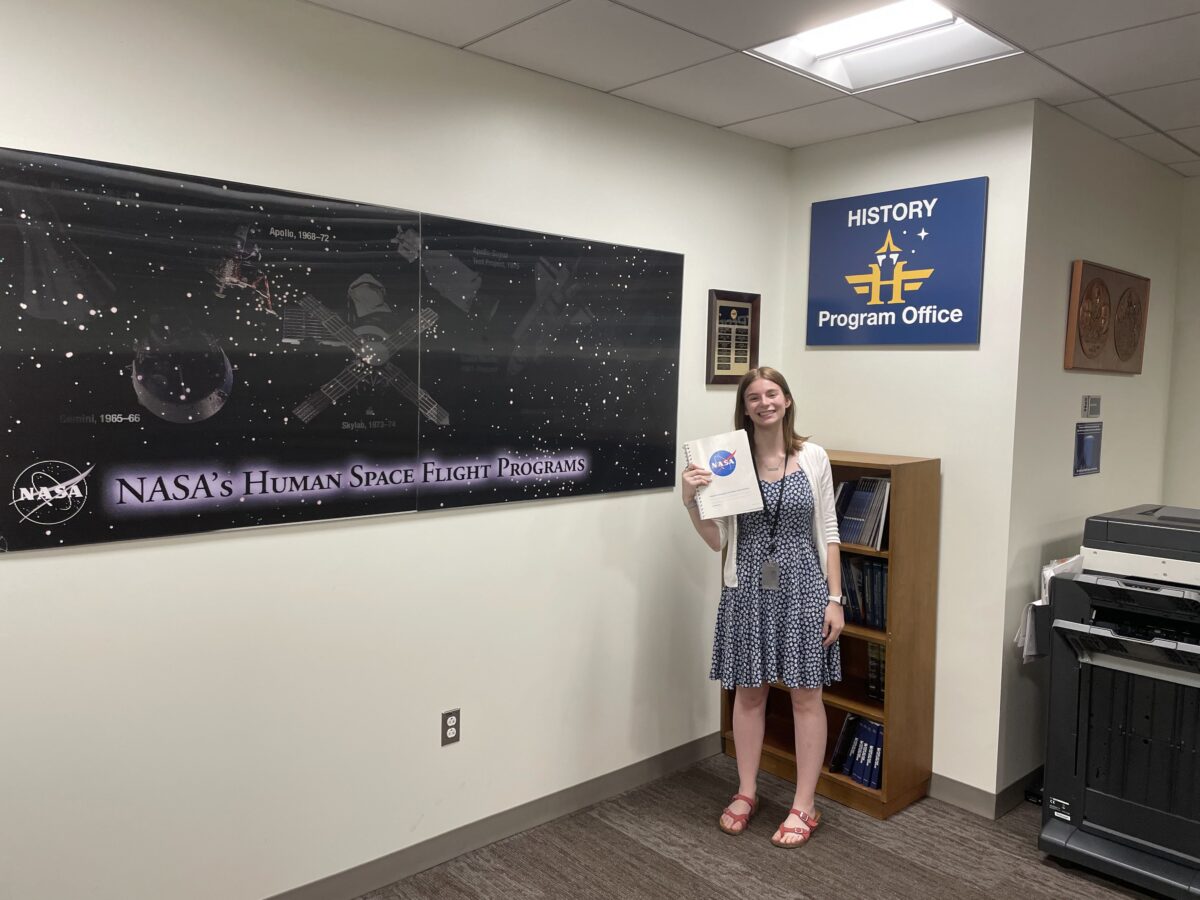
“I found the Career Center’s resources really helpful in crafting and perfecting my resume,” said Madelyn Pollack ’24, a history major with public history and Judaic studies minors in the Honors College and Humanities Scholars programs whose internship was at—of all places—NASA

Intern Madelyn Pollack stands next to a NASA poster and holds a NASA binder
Madelyn Pollack. (Photo courtesy of Pollack)

“I had an interest in space,” Pollack explained, “But when I applied, I wasn’t expecting a call back—I wasn’t expecting to get to do this.”

It turned out that her internship’s responsibilities included a rich variety of opportunities to apply her passion for history: Pollack had a seat at the table in publishing meetings, she got to research and publish key moments of aerospace-related history on the space agency’s official social media outlets, and she was even able to create a research-based presentation on orbital debris and public opinion.

Headshot of Madelyn Pollack in a white shirt and black jacket.
Madelyn Pollack. (Photo courtesy of Pollack)

Pollack said that taking an internship early in her college career helped her further focus her academic interests and refine her idea of what kind of historian she wants to be. 

“As a history major, I didn’t have an idea of a specific focus I wanted to take” within the field, she said. But, “if you ask me now what my dream job is, I would say if a job opens up [at NASA] in the next three years or so, it would be really nice to be a historian over there.”

Pollack already has a start on that goal: Based on her success as a summer intern, NASA recently hired her as a continuing intern part-time starting this fall.

First Things First

Ian Nana ’24, mechanical engineering, said one of the biggest misconceptions his fellow students seem to have is that there’s no point in doing an internship until you know exactly what your academic and professional goals are.

“I definitely recommend to any new student: Even if you’re not sure exactly what you want to do, go to the Career Center your freshman year,” said Nana. “You might try one internship and be like, ‘Okay, I like this—I might do this.’ Or, ‘I don’t like this.’”

Even if it’s the latter, Nana said, just having that first experience on your resume makes you a much better candidate for the next internship or job opportunity.

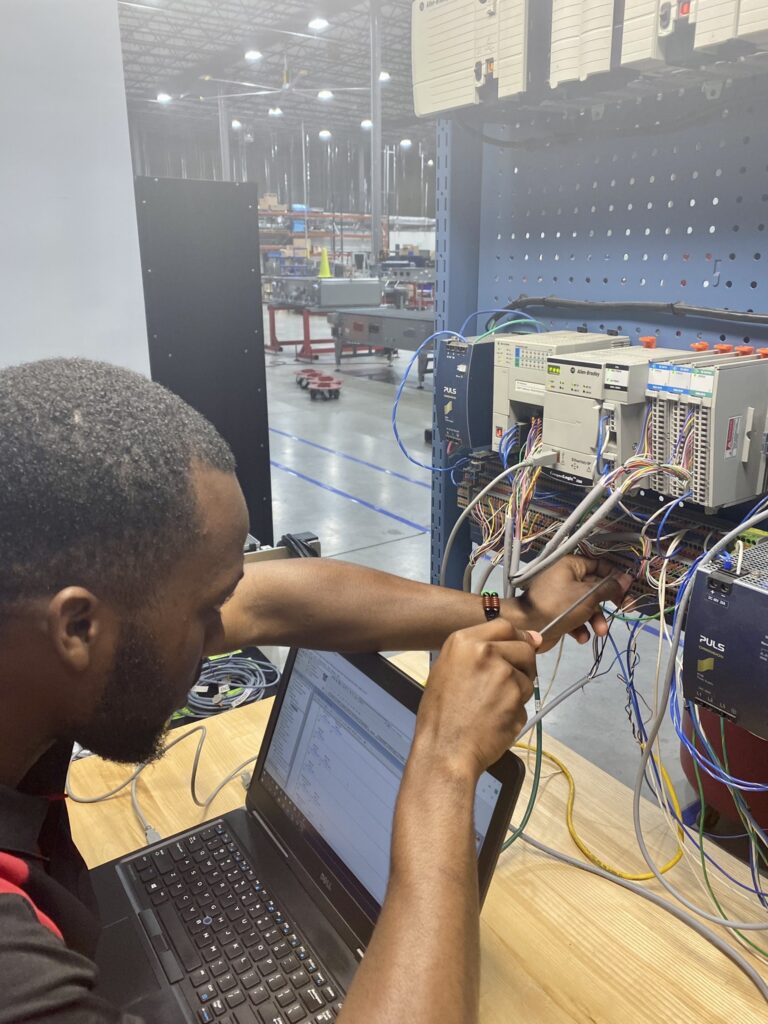
A man works with wires at a desk
Ian Nana. (Photo courtesy of Nana)

“When I came [to UMBC] for my first semester, I went to the Career Center,” Nana said. And although he didn’t immediately see exactly what he was looking for, he reminded himself that an internship that strengthens general work skills can be just as valuable as field-specific experience, so he applied for a broad spectrum of internships.

“When I applied to other ones, even though they weren’t related to engineering, they showed teamwork. They showed collaboration—how I deal with people,” Nana said. “College is great, but what [employers also] want is experience, because that’s really what is going to make you valuable.”

Nana also encourages students to start looking for opportunities where he did: at UMBC’s Fall Career and Internship Fair. This year, the fair—held on Sept. 21—will host 140 organizations, many of whom are seeking a wide spectrum of summer 2023 interns, from first-year undergraduates to advanced graduate students.

Routzahn highly recommends that all students participate in upcoming Career Center events and activate and upload their resumes to Handshake, UMBC’s new job and internship platform. Top employers are posting incredible internships, part-time, and full-time jobs daily. 

Nana, who worked this summer as an engineering intern at Intralox—a global firm that specializes in designing and creating computer-controlled conveyor-belt systems—should know: Though he had to overcome steep technical challenges, including learning a whole new programming language, his success speaks for itself.

a man stands in a large warehouse with conveyor belts
Ian Nana. (Photo courtesy of Nana)

“My manager told me to definitely come back,” he said. “When you see your skills actually being applied and you do something and it works, that’s the best feeling.”

All in the Details

Alexander Bauserman ’24, history, echoed his fellow 2022 interns’ recommendation to visit the Career Center early, often, and with an open mind.

Headshot of Alexander Bauserman, a brown haired man wearing glasses
Alexander Bauserman. (Photo courtesy of Bauserman)

“I would say go as soon as you have the opportunity,” Bauserman said. Even if there’s not an obviously perfect alignment between a given internship opening and your major, he added, “The value of these internships is that sometimes they offer unexpected skills.”

Bauserman spoke from recent experience: He was able to tap into a longstanding personal interest, strengthen his core skills, and develop new ones in his virtual internship at the Maryland Pesticide Education Network, which gathers and disseminates information on the harmful effects of various pesticides and advocates for organic and other alternative agricultural land uses.

“I’m actually a history major, and even though this [internship was] environmental, I actually had an interest in environmental science in my high school years,” he said.

That passion served him well as he dove into the highly detail-intensive work of reformatting environmental science abstracts, checking links on the organization’s website, and learning how to leverage search engine optimization.

“They’ve all been new skills that I’ve gained, because I didn’t really work in any of these areas directly before, but they’re very useful, and I’ve been able to add them to my resume, so I’m very pleased with that,” Bauserman said.

Learning While Doing

Terra Miley ’25, chemical engineering, definitely didn’t waste any time looking for internships: She started as a first-year student. “I’d definitely heard from upperclassmen about how helpful the Career Center is,” she said. “Once you make your first appointment, you realize how helpful it is.”

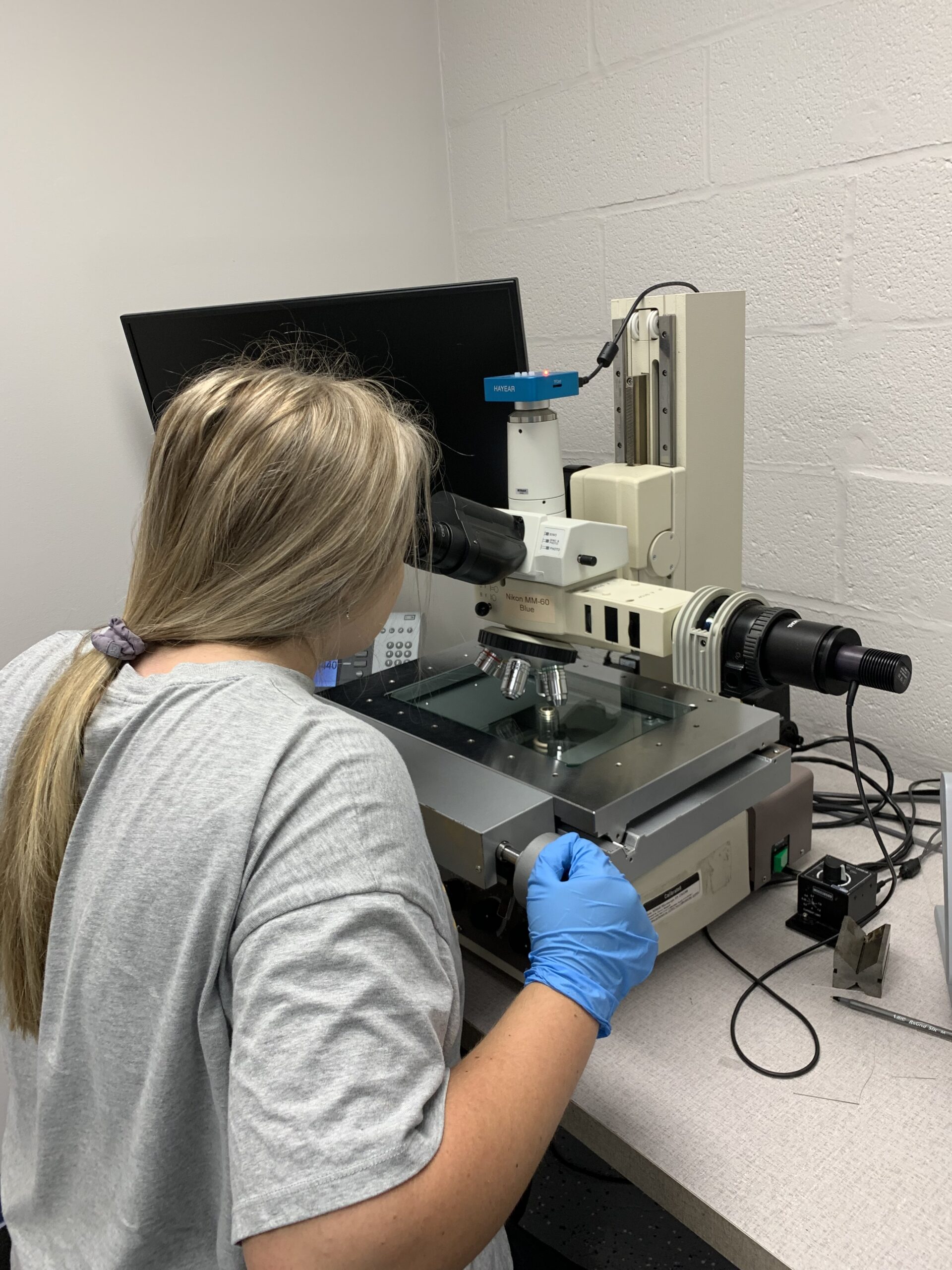
Miley interned at Potomac Photonics, Inc., a digital and micro-manufacturing firm based at the UMBC Technology Center, “basically learning how to do everything.”

“I was doing a digital workspace for the company, so I was able to get exposed to a lot of different projects and machines and pretty much all of the work they do,” she said.

Miley added that the internship also boosted her confidence that her academic journey—she’s on a bio-technology/bio-engineering track—is the right one for her.

“A lot of the parts that [Potomac Photonics] made were for medical companies, which is kind of what I want to get into. And it made me realize: I am definitely interested in that.”

So interested, in fact, that she’s already made an appointment with the Career Center to get set up with an internship for next summer. “I wanted to try to get an actual research opportunity for next summer and they gave me a giant list of opportunities … that I can look at,” Miley said.

Such resources, Miley said, make the Career Center ”super helpful.”

Routzahn said student success stories such as Miley’s, Bauserman’s, Nana’s, and Pollack’s are happily the norm at UMBC. 

“Most employers use internships as a recruiting tool to find their future full-time employees,” she noted, adding that “55 percent of our recent graduates who were employed at graduation indicated that they accepted full-time offers with an organization that they interned or worked for while at UMBC.”