All posts by: Magazine Editor


Photo Essay: Celebrating Campus Sustainers

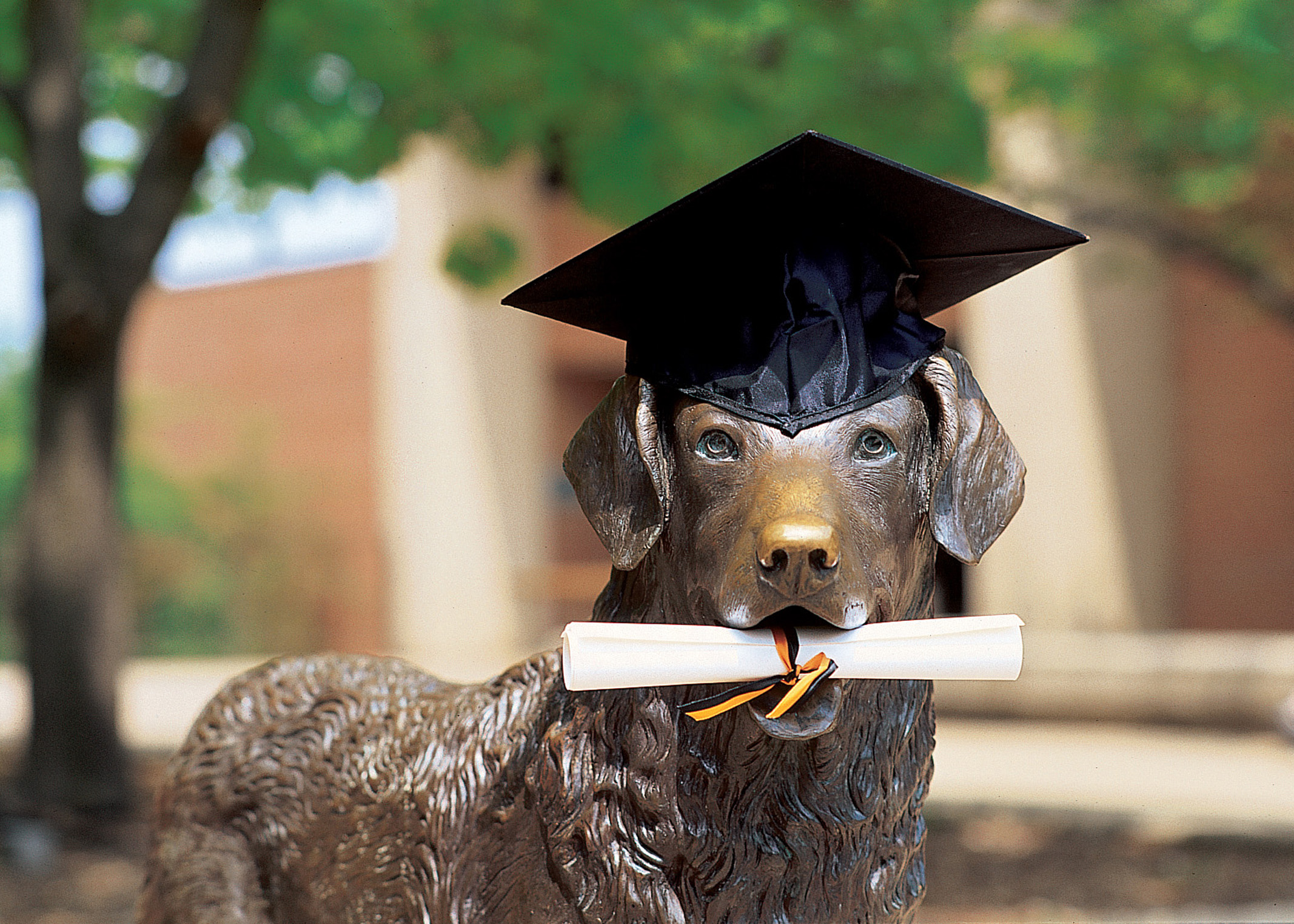
While the pandemic required most of our community to adjust to virtual life constrained at home, other Retrievers worked tirelessly on campus to keep UMBC running. For those operating in-person, enduring the heavy silence that blanketed campus, adhering to intense health precautions, and yearning for the people that would once again make UMBC a home characterized their experiences. As many of us now return to the office, we recognize the folks who kept our campus clean, safe, and beautiful—especially those who supported our students along the way. Call them behind-the-scenes allstars, vital resources, boots-on-the-ground—the sustainers—and you’d be right to do so. Here are some of their stories. 

Creating Safe Spaces

Name: Tyler Fultz
Title: Acting Manager for Residential Conduct and Community Wellbeing
Location: Residential Life

Tyler Fultz, acting manager for residential conduct and community wellbeing at UMBC, remembers looking out of their on-campus apartment window in spring 2020 and being struck by how silent and empty the campus was. “People just left everything and went home,” Fultz says, still processing how quickly their job changed.
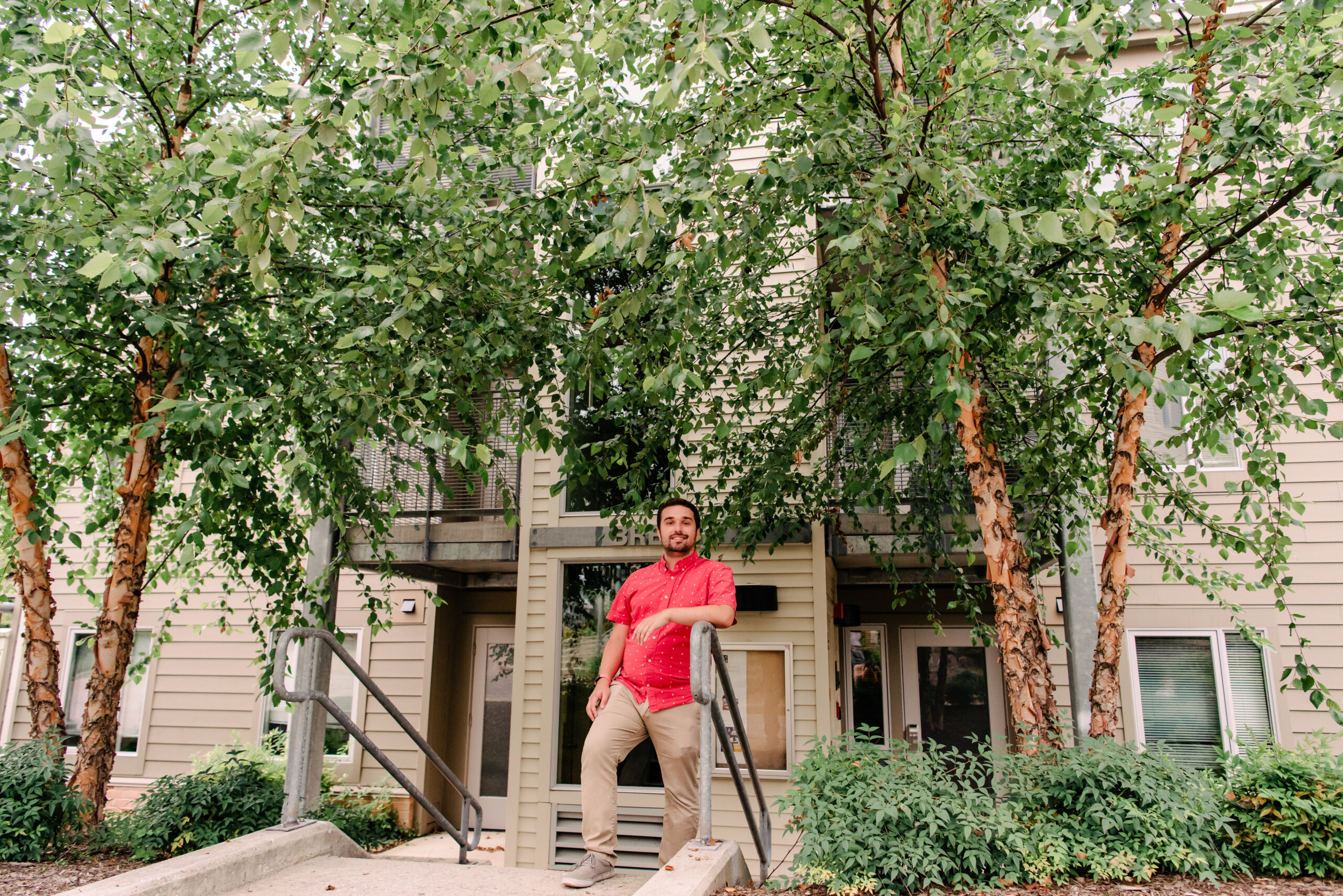
Before March 2020, Fultz supervised a bustling staff of 12 resident assistants, providing support to their team as well as the nearly 800 students living in the West Hill, Terrace, and Hillside apartments on campus. Fultz had a full schedule that also included meeting with students for alleged policy violations, attending student conduct hearings, and serving on a duty rotation to provide support to students 24 hours a day.

During the pandemic, the numbers of residential students in Fultz’s area fell to nearly 200, with only approximately 1,200 residential students total. Fultz shifted to a role overseeing quarantine and isolation housing set up to support students who had tested positive for COVID-19 or were awaiting test results. The landscape felt completely different.


“On one hand, it could feel lonely, but on the other hand it felt like the safest place I could possibly be,” Fultz says about their life on campus during COVID-19. “There were seven community directors who were around campus, but you didn’t run into them.”

Fultz found that building relationships with students became more challenging in the virtual environment because students were burnt out from being on their computers so much. Fultz often first connected with students, who needed housing and support, via phone to talk about the details and answer any questions. From there, they helped facilitate students’ moves into empty on-campus apartments that had university-provided furniture.

Once a student was in quarantine and isolation housing, Fultz says they let students know they were available in case they needed assistance, or just someone to chat with. “It was a team of people providing support,” Fultz emphasizes, noting no one could have taken on this task alone.

– Megan Hanks Mastrola

Cooking from Scratch in a Pandemic 

Name: Rachel Faulkner
Title: True Grit’s Executive Chef
Location: True Grit’s 

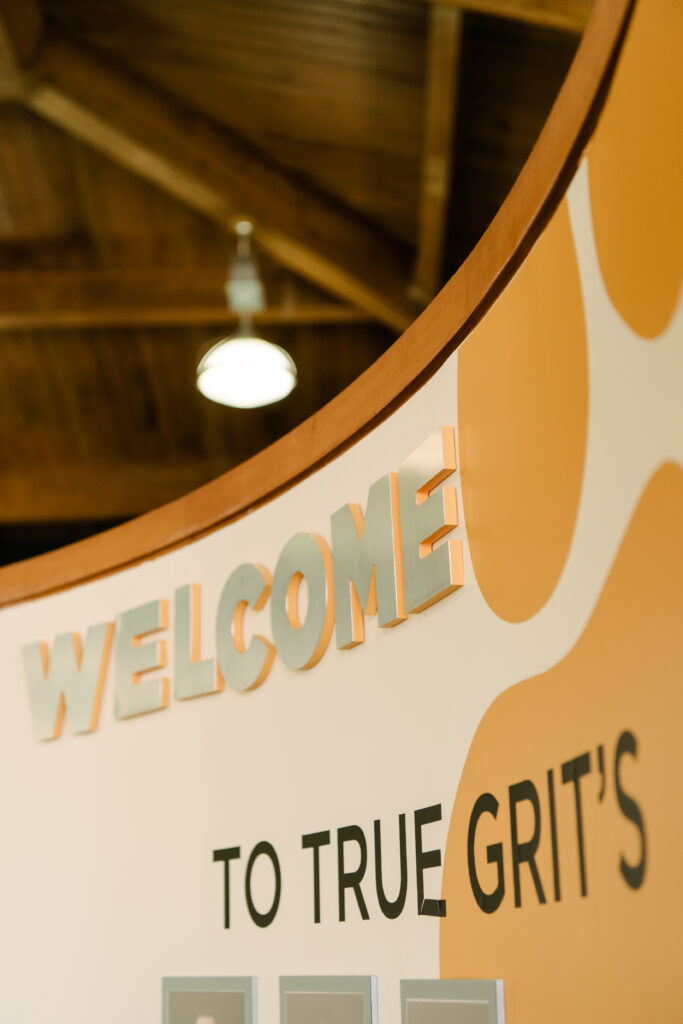
Rachel Faulkner is used to preparing food for about 2,500 people a day, in addition to managing a staff of nearly 40 people. She oversees the daily menus that are offered at True Grit’s—all made from scratch, including the tomato and alfredo sauces at the pasta station. During the pandemic, however, Faulkner and her limited staff were only feeding about 300 – 600 people each day. She says that even though they were preparing fewer meals, it was still the same amount of work for about one third of the staff. “Everyone who showed up really came in full force,” says True Grit’s executive chef, who came to campus every day during the pandemic. 
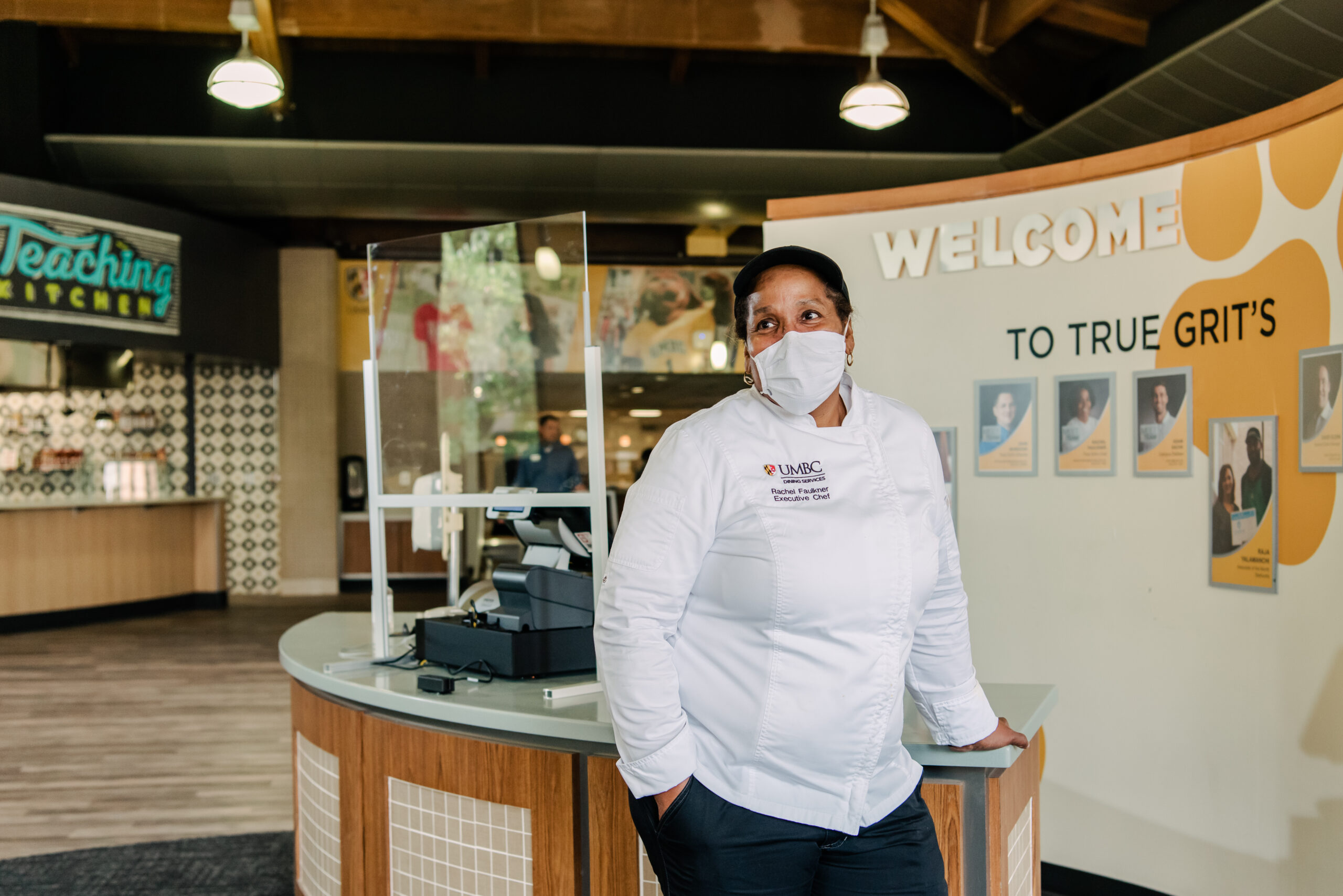
During this time, Faulkner says her job felt more intense and hectic because she was constantly adapting to new needs or requirements. Overnight, she and her team began offering to-go boxes, and the dining staff started serving food to people to reduce the number of hands touching utensils self serve involved. She also had to make sure that her staff was following the ever-changing health and safety guidelines, which made the job overwhelming at times. “We hardly saw anybody,” Faulkner says about what she saw looking out the windows of True Grit’s. “There were people who were afraid to come into the dining hall to eat. They said they’d rather order out.” 

Faulkner, who has worked at UMBC for 23 years and for Chartwells since 2008, says that her primary job responsibilities largely stayed the same throughout the pandemic, except she had to step in to fill in roles that were empty due to a limited staff. It was an all-hands-on-deck situation, Faulkner recalls. At one point, she even worked the register. 

Looking back, she says that she could not have done her job without her teammates, including John Burgoon ’99, psychology, director of resident dining at UMBC. “The whole team made sure students were fed, and that we had the tools we needed to get through the day,” Faulkner says. “I couldn’t have done it alone. I needed my team.” 

True Grit’s is now open for dining, and Faulkner is excited to welcome students back. “I am excited to see all the new faces,” she says. “I’m hoping that things are somewhat back to normal. I hope we have a big turnout at the dining hall and people feel safe coming to eat here.” 

– Megan Hanks Mastrola

Creating Future-Forward Classrooms 

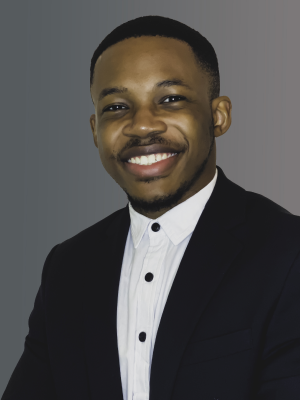
Name: Victor Adebanjo ’23
Title: Student AV Installation Worker
Location: Math and Psych

In January 2021, Victor Adebanjo ’23, mechanical engineering, gratefully found himself back on campus, helping to ready classrooms for the eventual return of more students. As a student worker in the Department of Instructional Technology (DoIT), Adebanjo was tasked with helping usher UMBC’s learning spaces into the future. 
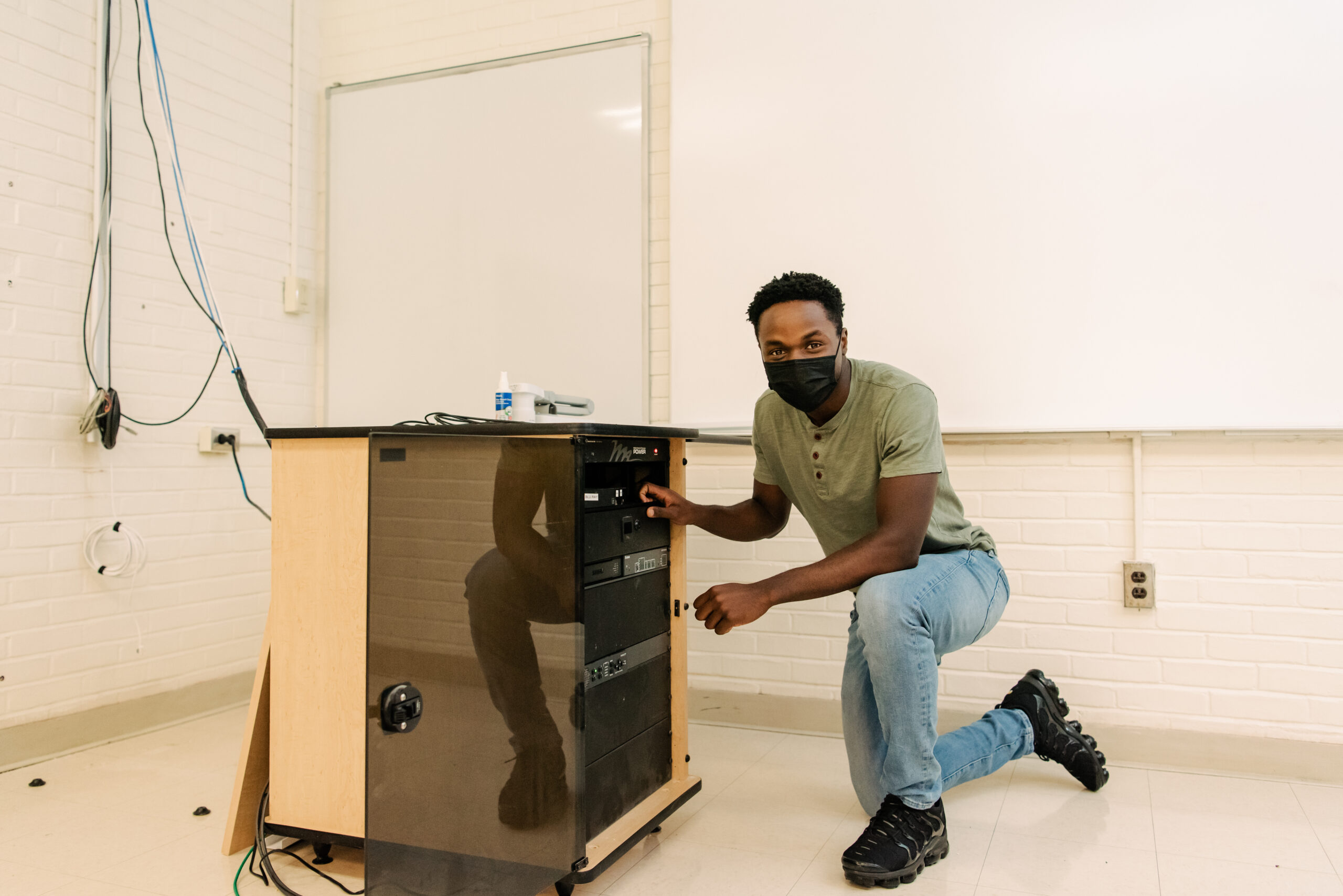
On campus, there were a million things to do and not enough hands—far from when the pandemic first hit, and Adebanjo wasn’t even sure he had a job. 

In March 2020, Adebanjo didn’t have time to process when his boss said he could no longer come into work. His school work was the first thing he had to deal with and keeping up with the academic changes was more than enough of a fulltime job. 

After making it through that spring semester, Adebanjo asked David Souder, coordinator of AV services in DoIT, if there was any work and was immediately put on a rotation of Webex meetings so he could virtually assist professors with their classes. After that, he assisted with transitioning the Meyerhoff Summer Bridge program to a virtual environment.  

Then came the call to return to campus to modify learning spaces. Part of this included arranging high flex spaces—classrooms with cameras and microphones so that a student attending the class can virtually see the classroom and the professor, and vice versa. 
While it was rough to adhere to the strict COVID-19 regulations and endure the eerie quiet of campus, says Adebanjo, he and his coworkers found a way to make it bearable. As they worked in empty buildings, they’d talk about the ghosts in the halls and the walls. One day, while walking in the dim halls of Math/Psych, Adebanjo says, “as I came down the hall, the door was shaking… since it’s so quiet you can just hear everything.”  

Adebanjo would like his fellow returning students to know that a lot of collaboration and hard work has been invested to make sure campus is the way everyone remembers it. “Everything is still here for you when you return,” he shares.

— Charis Lawson ’20

Getting Student-Athletes to the Finish Line

Name: Stacy Carone
Title: Associate Athletic Director for Sports Medicine and Performance, UMBC Athletics
Location: Chesapeake Employers Insurance Arena

Stacy Carone still gets goosebumps when she thinks back to that day.

“March 12, 2020, is the day that college athletics stopped,” says Carone, associate athletic director for sports medicine and performance, who prior to that day spent her campus hours helping student-athletes succeed in their sports.
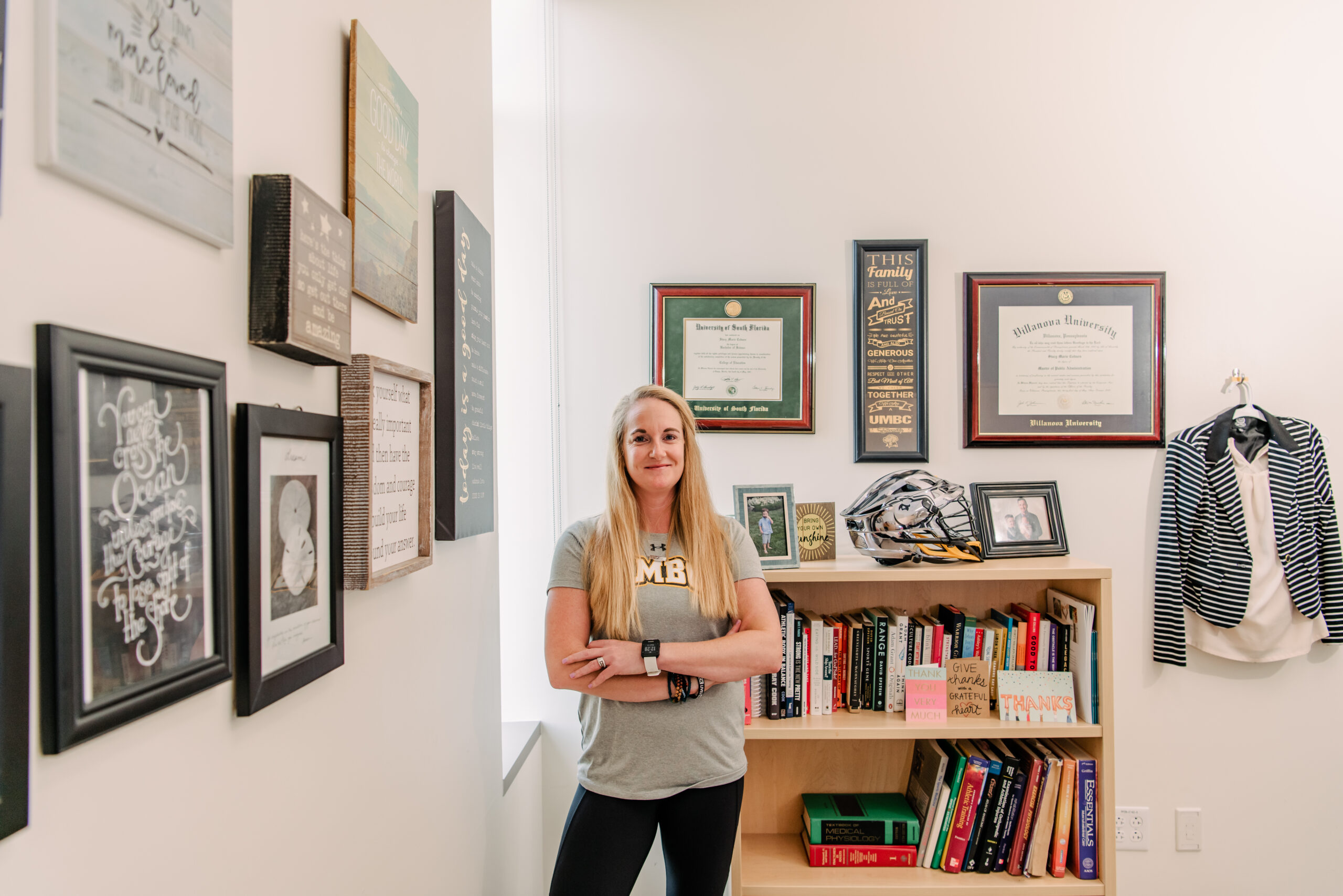
“Even then, we couldn’t have predicted the magnitude of the pandemic in any way. What it was going to do to the world or what it was going to do to our mental wellness or physical wellness. I am not exaggerating that our work in sports performance and sports medicine to safely return the student athletes to campus happened on March 13, 2020.” 

As she retells it now, sitting in her office right off the arena’s sports medicine facility, Carone quickly realized that the work that her team does to closely monitor the wellbeing of UMBC’s almost 400 student-athletes had to pivot to work during the pandemic—a time when although games and practices were cancelled, student-athletes still checked in with their teammates, coaches, athletic trainers, and training continued on with adjustments made due to students being in different places. UMBC Athletics launched virtual monitoring that focused on athletes’ mental health and coping during the pandemic. “It gave us that open door to check in like we would every day,” she explains. 

Eventually the virtual would turn to in-person again. Carone and the sports medicine and sports performance team returned to campus in July 2020 to accompany her athletes as they navigated policies from UMBC and America East Conference in order to compete in an unusual Fall 2020 season. Since the pandemic began, Carone and her colleagues developed a 200-page document that outlined everything from cleaning practices to testing requirements and occupancy limitations. Carone also managed COVID-19 testing for student-athletes—she says that when most people were still at home wiping down their mail, her team was in the office, dressed in multiple layers of PPE to test student-athletes. 

“We do what we do because we like interacting with our student athletes,” says Carone. “We do this for the gift of playing a role in a student athlete’s life. Everything we do, we approach as a team. So we were just happy to be back. It felt different. It looked different. But we’re back.”

– Megan Hanks Mastrola

Maintenance Continues Above Ground and Below

Name: John Zahor
Title: Director of Operations and Maintenance 
Location: Campus tunnel system

Name: Craig Goodwin
Title: Director of Design and Construction

Location: Campus tunnel system
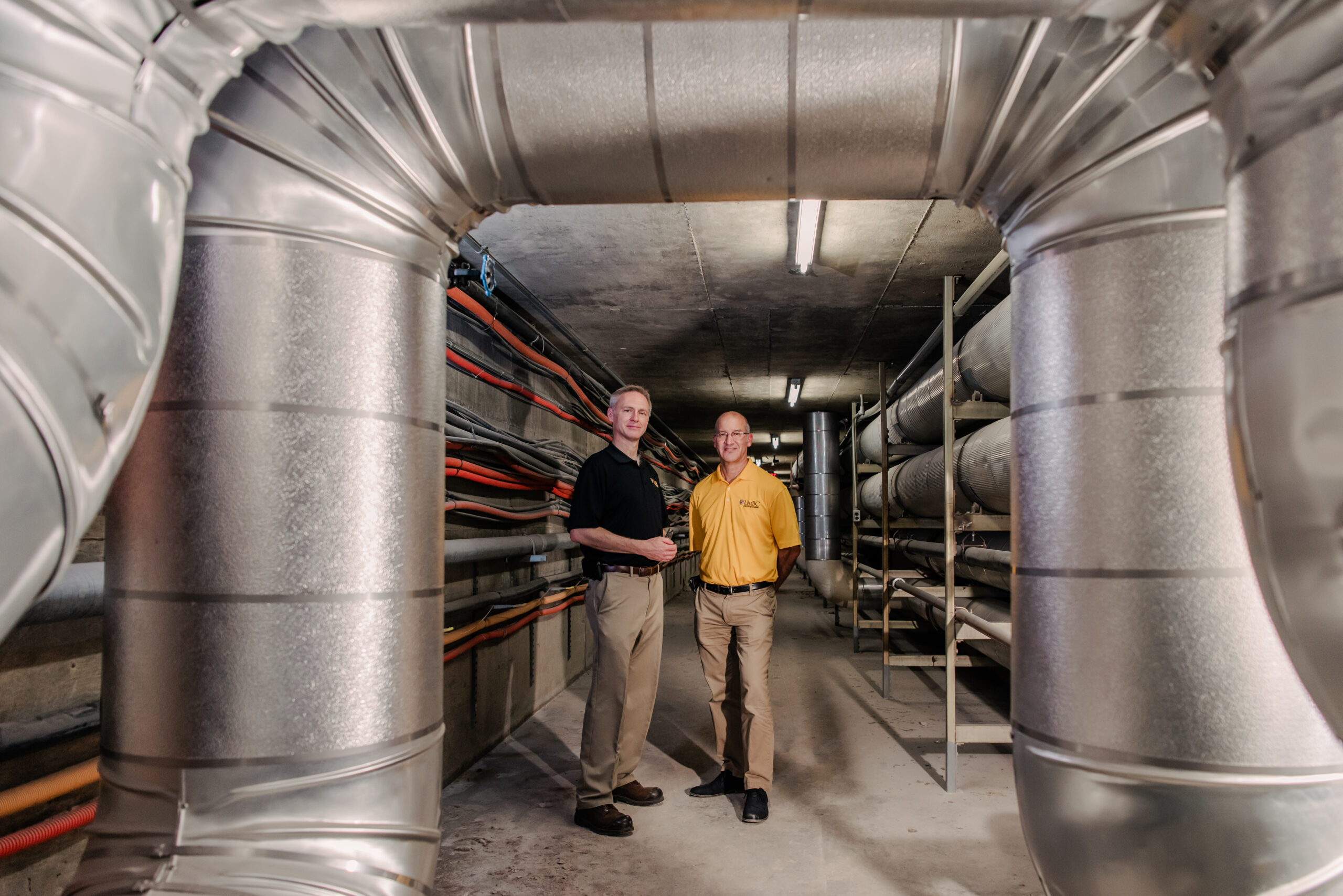
The campus tunnel system may be the basis for Retriever lore, but in reality the underground structures are so much more important. Meet two of the people who help keep the fresh air circulating throughout each classroom and office as they navigate the underground paths with intimate knowledge of their history and function: John Zahor—director of operations and maintenance, who oversees the plumbing, electrical, painting, and architecture shops at UMBC—and Craig Goodwin, director of design and construction.

Not all offices had the option for remote work, and Facilities Management kept up their important tasks of maintaining the buildings, construction, grounds, and related operations while so many community members were absent.

Zahor realized that his first big challenge was to figure out a schedule for his staff to follow that allowed them to complete projects while abiding by social distancing and campus guidelines. The Facilities Management team regularly checked on buildings, oversaw construction, and responded to any issues that arose including water leaks and dripping faucets. Zahor’s team usually receives many work orders from people across UMBC when folks are on campus. This often helps determine their projects, but with fewer people on campus during the pandemic, his team relied on stepped up surveys and their observations to guide their work. 

“Without many people on campus, we have less service requests and less eyes seeing what is going on,” he explains, noting that typically there are 14,000 people on campus who see things before they do. “We had to do a lot of surveys and get people walking around, asking them to tell us what they saw.” 

The distribution of resources also shifted during the pandemic as campus needs changed, explains Zahor. With fewer people on campus each day to maintain the grounds. Facilities Management scaled back its planting, opting for plants that required less maintenance, he says.
Eventually, Zahor developed a schedule where each member of his team would come to campus two or three days each week, so that projects could be continued while maintaining social distancing. That schedule stayed in place until the end of June 2021, when Zahor’s team returned to campus five days a week.

Goodwin’s team works with Zahor’s team to manage on-campus construction projects that are underway at UMBC, including the work being done outside Sherman Hall and the construction of the new Center for Wellbeing. For these projects, Goodwin sees a silver lining to an otherwise undesirable situation—with fewer people on campus during COVID, fewer people were inconvenienced by these large-scale projects. 

Despite the upside of completing projects more efficiently, Goodwin says he missed seeing the folks who call these buildings home. “This place is a community. Not having students, faculty, and staff here was sad. I really missed that, and I’m really looking forward to seeing people.” 

– Megan Hanks Mastrola

Educating the Youngest Retrievers

Name: Michelle Gross
Title: Director
Location: Y Preschool at UMBC

Name: Myeisha Jones
Title: Preschool instructor, 2 year olds
Location: Y Preschool at UMBC

When the Y Preschool at UMBC reopened just days after the March 12 shutdown of campus, Myeisha Jones knew she had to be there. Jones is one of the longest-serving instructors at the preschools—in charge of the 2-year-olds—and she knew a familiar face, even just her eyes above a mask, would be a welcome sight. “When they sent the email to see who might be willing to come back,” says Jones, “I wanted to help. I didn’t want to leave the kids out and not help the parents who had to go back to work.”

The preschool, nestled between Harbor Hall and Hillside Apartments, is usually home to 64 kids, ages 2 to 5. When so much of campus closed, Jones and others fielded phone calls from anxious parents, who understandably had a lot of questions about new COVID-19 protocols. Michelle Gross, who was hired as the director of the preschool in June 2021, says that childcare facilities are actually uniquely prepared for moments like the pandemic. “We have the proper training for different things like asthma or allergies and we already had strict cleaning and handwashing protocols. So we had a good head start for implementing new strategies, checking temperatures, and increasing sanitization.”

When the preschool reopened, they had about 20 kids show up, and were able to operate with reduced class sizes to abide by new space regulations. Jones says that they built health protection measures into their activities, singing songs about washing your hands or games about how to wear your mask correctly. But for the most part, she and Gross agree, the kids adapted quickly to the new way of life, even occasionally reminding teachers to pull up a slipping mask.

Jones says the hardest part of working on a mostly closed campus was not being able to walk the kids around to different destinations, like the library, or getting to stop by Starbucks on her break. But the parents really showed up, she emphasizes, even the ones who kept their kids at home. “They would call and text and check in on us, send supplies, even have lunch delivered sometimes,” Jones says. “Because even though they’re not here, they know I’m here.”
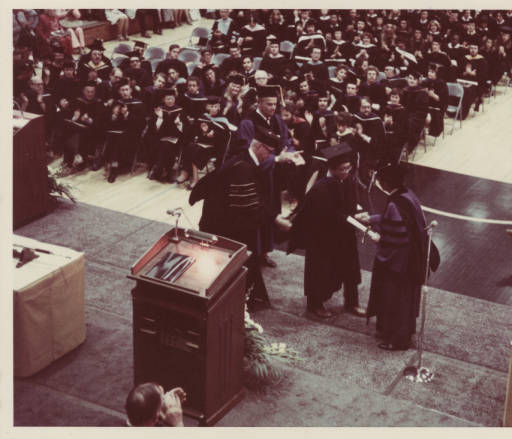
Gross wants parents to know that the preschool is ready for their kids to return in full capacity. “We’re doing our best here to make sure all of the kids can stay safe, get educated, and be ready for kindergarten,” says Gross. “So that is our ultimate goal and it’s never changed. I want them to know that it’s safe and that we’re ready. We miss not having a full building of kids.”

— Randianne Leyshon ’09

Patrolling the Silence

Name: Bruce Perry ’97 
Title: Deputy Chief of Police
Location: UMBC Police Station 

Bruce Perry ’97, psychology, has spent his life preparing for the range of situations that might arise due to being a police officer. But he hadn’t prepared for the silence on campus for the past 18 months. 
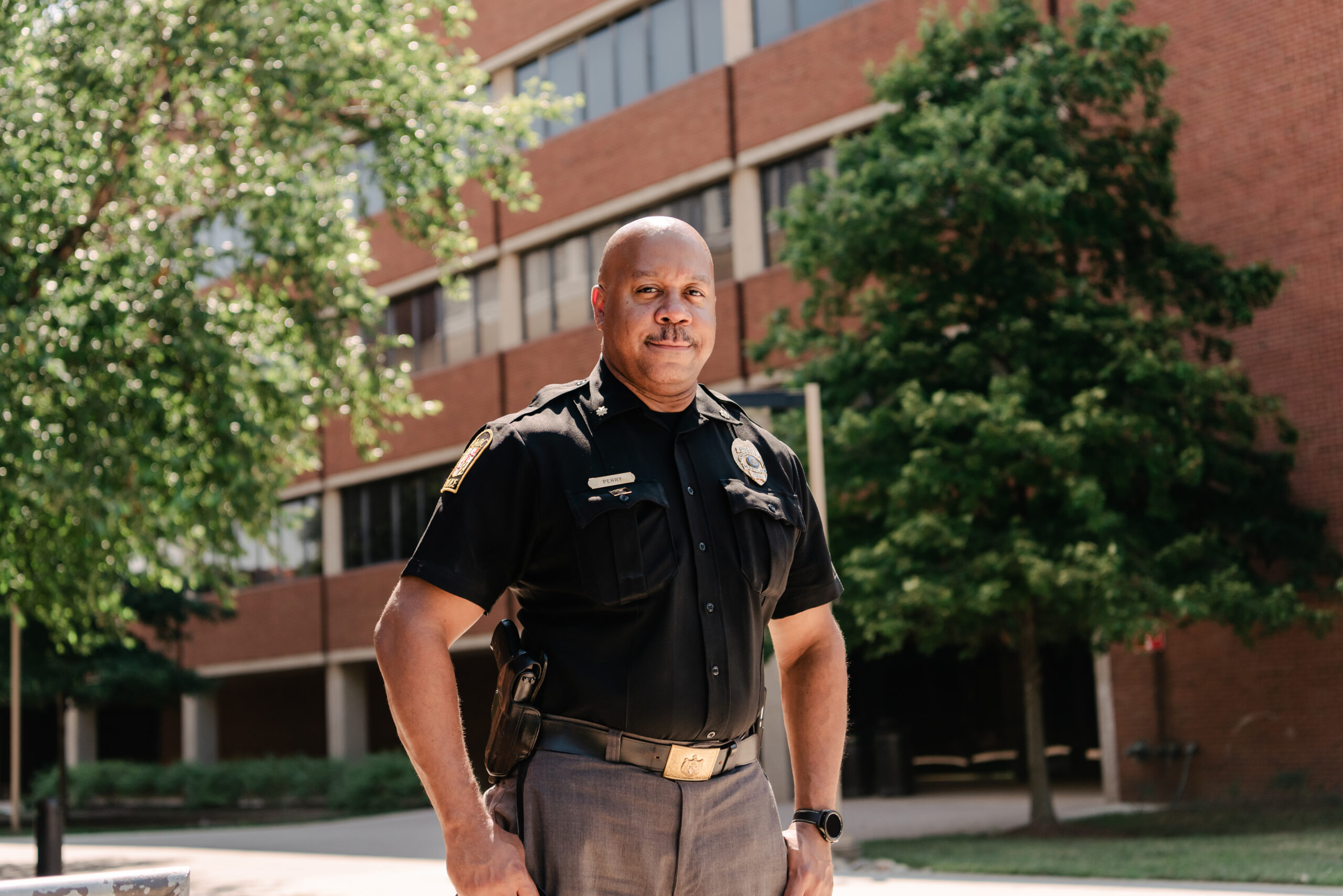
Since high school, Perry trained for this career by taking practicals, directing traffic, and enrolling in law enforcement classes as a police explorer in his young adult years. While attending UMBC, he worked as a police aide, where he confirmed his aspirations. After graduating, Perry worked his way up through the ranks of UMBC’s Police, from patrolling campus to overseeing all operations and support services. During the pandemic, the police station continued its 24/7 operations, so Perry jumped into the rotation of officers. 

“It was so weird,” says Perry, who continued to work on campus the past year and a half. “Since I’ve been here for so long I have never seen campus so bare or empty.”

But while the pandemic made most of campus quiet, Perry had to deal with a roster of new concerns. Approved visitors had to follow protocols to get into locked buildings—which included contacting the police to request permission—and alarms went off in other buildings when people tried to access them. These day-to-day tasks replaced most of his customary activities. 
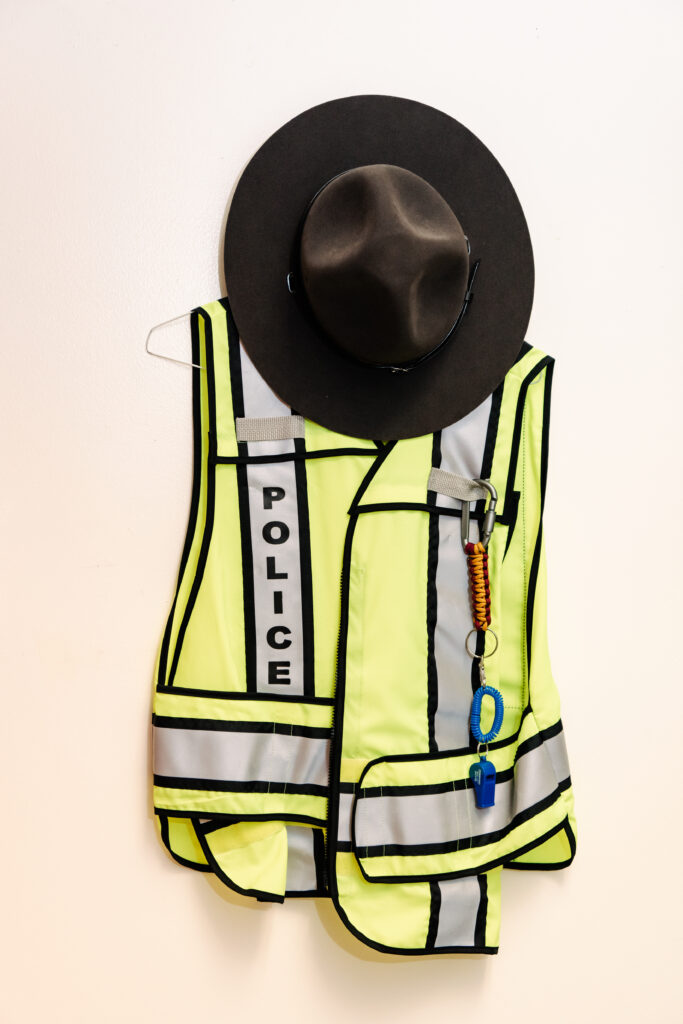
Most of his job is administrative now, says Perry, so some things didn’t change, like monitoring what was happening around campus and holding his regular meetings, even if they were now virtual. Since there were fewer incidents, Perry volunteered for campus committees that dealt with the university’s response to the pandemic. 

Perry feels like the pandemic has taught him an important lesson. ”If we are given direction from those who know what they are talking about… we can all make it through this,” he commented, excited for life to return to campus. “I’m so happy that things are going back to normal, or somewhat normal. We came out of a trying time.”

— Charis Lawson ’20

Coffee and Art to Support the Community

Name: Deep Patel ’19
Title: Co-founder of OCA Mocha
Location: OCA Mocha

Name: Michael Berardi ’19
Title: Co-founder and General manager of OCA Mocha
Location: OCA Mocha
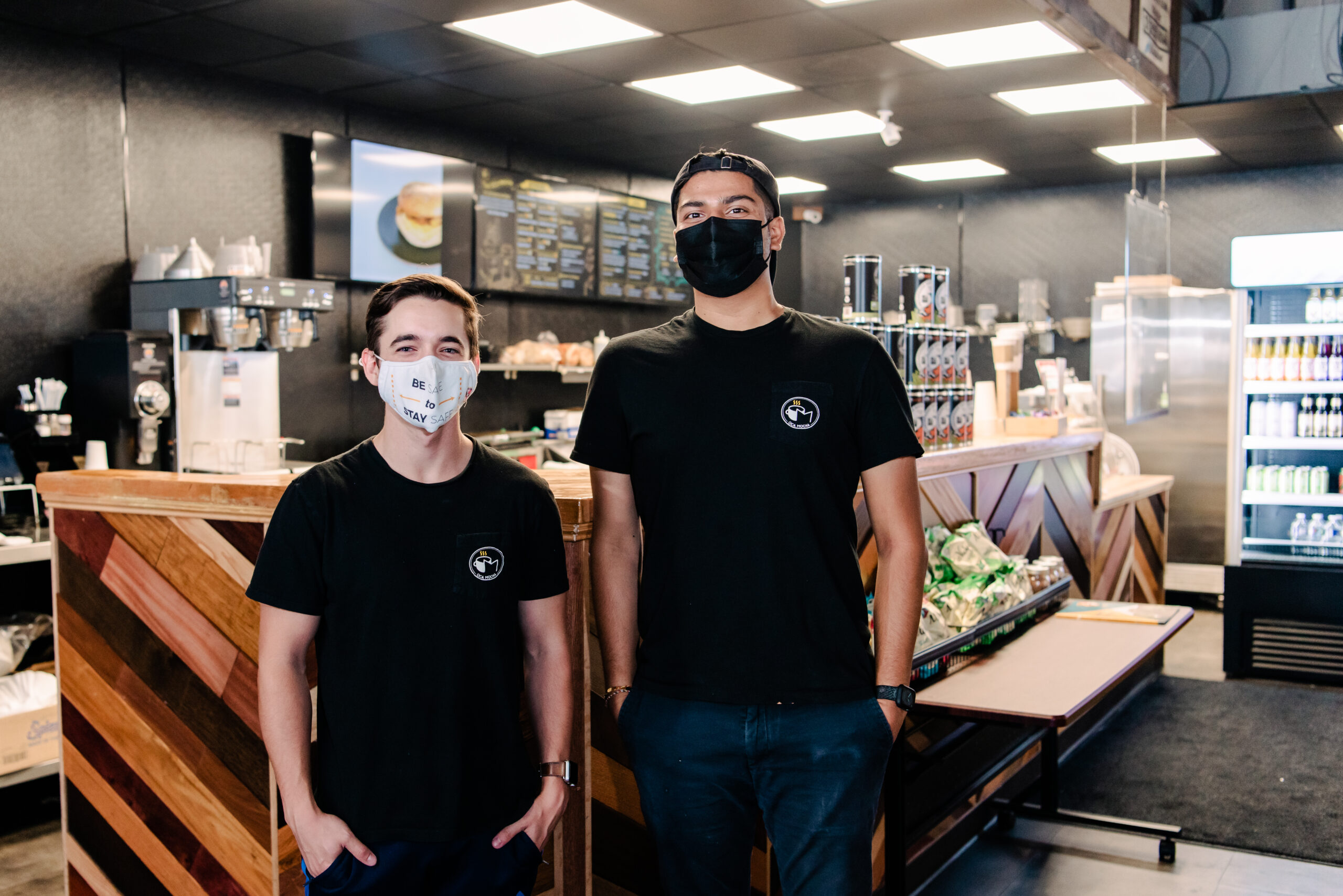
When OCA Mocha, a UMBC-affiliated coffee shop and community gathering space in downtown Arbutus, opened its doors in 2019, co-founders Deep Patel ’19 and Michael Berardi ’19 could never have imagined how much a global pandemic would drastically change the way they ran their business. Before COVID-19, the pair worked to bring people into the space, not only for coffee but to connect with members of the community through events. When the pandemic began, Patel, biological sciences and financial economics, says they had to make a sharp pivot. OCA Mocha shut down from March 2020 to June 2020. “Public safety always came first,” Patel explains. 

To keep their dream of a coffee shop viable, Patel and Berardi quickly developed a system for online ordering and curbside pickup. To stay true to their mission of serving the Arbutus community, the shops began giving out free meals and activity kits to children in Arbutus, and Patel and Berardi drove around town to make the deliveries. “It was born out of a need in the community,” says Berardi, media and communication studies. 

Prior to COVID, the OCA Mocha team had started a kids club that allowed children in the community to come to the coffee shop and work on crafts, so they came up with a pick-up option. “It was essentially a condensed summer camp,” Berardi explains, adding that in collaboration with UMBC student orgs and local activists, OCA Mocha also hosted virtual events to talk about topics including social and racial issues. 

Patel says that one of the good things that came from the pandemic was spending a lot of time getting to know Berardi better, noting that oftentimes they were the only staff members at OCA Mocha. Throughout COVID, the OCA Mocha team received regular support from Mike Pound, director of environmental safety and health at UMBC, Gib Mason ’95, economics, professor of practice in entrepreneurship, as well as Office of Institutional Advancement staff, and the OCA Mocha management committee, who made themselves available at any point to provide guidance.
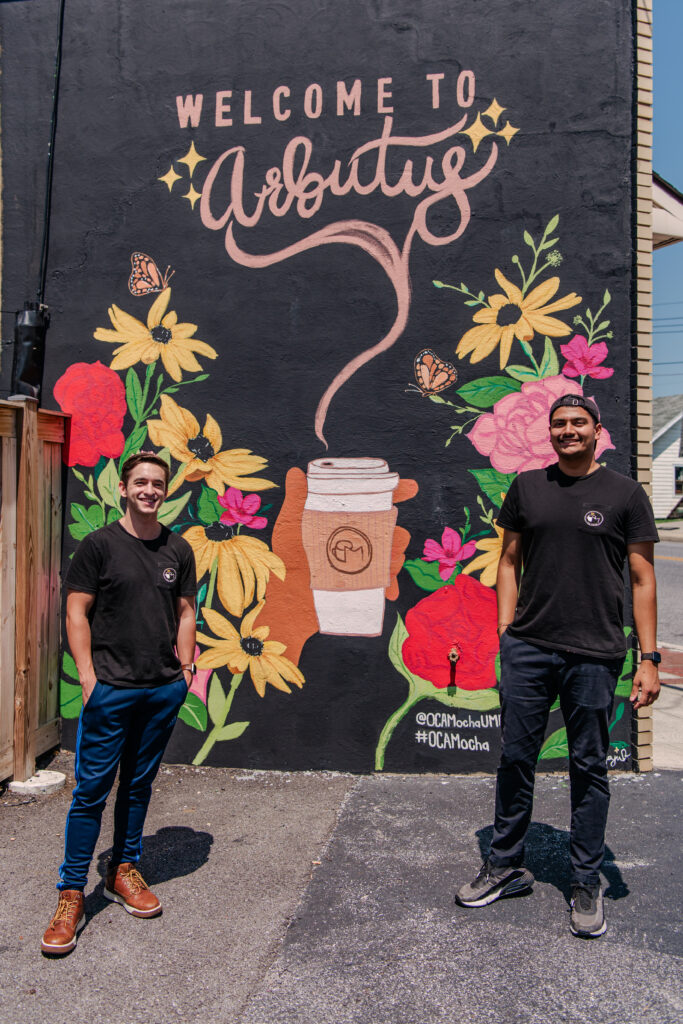
“I think we learned a lot of valuable lessons,” says Berardi. “It’s important to take a step back and focus on what really matters. I personally learned the power of community to lift each other up and get through challenging times together.” 

– Megan Hanks Mastrola

*****
All photos by Marlayna Demond ’11.


Nursing home residents and staff are traumatized from the pandemic⁠—collaborative care can help with recovery

By Nancy Kusmaul, associate professor, Social Work UMBC

For older adults, social isolation may have dredged up past traumas that are difficult to come back from. And for those living in nursing homes that have been the center of outbreaks throughout the COVID-19 pandemic, these new traumas can make resuming care as usual even more difficult.

Older adults more vulnerable to COVID-19 stayed home out of fear. People in nursing homes were further isolated when the Centers for Medicare & Medicaid Services required nursing homes to stop outside visitation and group activities in the interest of public safety. Full closure lasted six months, with gradual reopening. Some states chose to keep more restrictive measures in place for much longer.

Not only did residents lose their right to visitors and contact with the rest of the world, but nursing home staff were covered in personal protective equipment that made it harder to connect because of communication challenges. In addition, staff were busier than ever because of staff shortages and greater care demands, leaving little time to provide social support.

Isolation, emotional neglect and fear of life-threatening disease can be traumatic in their own right. Furthermore, they can exacerbate past traumas that caregivers may not be aware of.

I am an associate professor of social work at the University of Maryland, Baltimore County, and my research focuses on quality of life and care in nursing homes. As nursing homes begin recovering from COVID-19, it will be important to address both the trauma residents and staff endured during the pandemic, as well as past traumas they may have endured.

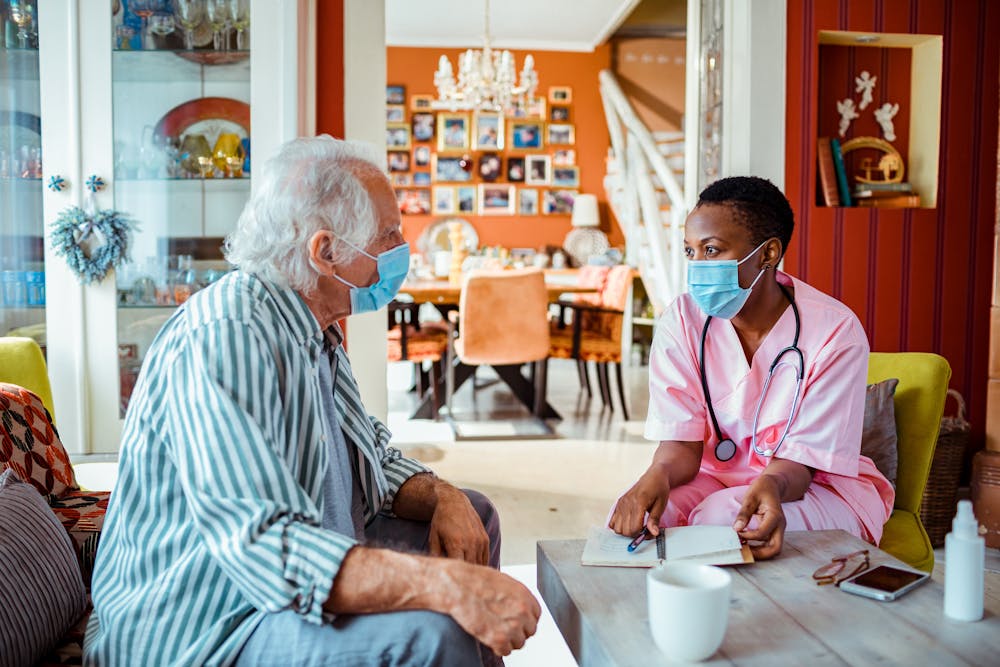
Health care worker talking to an older patient.
Older adults are more likely to have experienced a traumatic event that may affect how they respond to care. Marko Geber/DigitalVision via Getty Images

What is trauma?

Psychological trauma results from exposure to abuse, disasters, violence and other harmful or life-threatening events that are often out of one’s control. These events can have lasting adverse effects on mental, physical, social, emotional or spiritual well-being. People with a history of trauma report more distress and pain in medical settings, and are more likely to be anxious, depressed and distrustful when receiving medical care. These factors make it more difficult for them to engage with providers and respond to care.

Trauma-informed care is especially relevant to older adults. They have a greater risk of having experienced something traumatic by virtue of the fact that they have been around longer. Older adults are also likely to have experienced potentially traumatic loss of their loved ones or physical abilities. Furthermore, many older people grew up during a time when trauma and other mental health challenges were often not addressed due to heavy stigma. These unresolved issues may resurface when faced with the additional challenges of aging, including end of life.

What is trauma-informed care?

Trauma-informed care is an approach that takes a person’s past traumatic experiences into consideration when providing care and creates services that minimize re-traumatization. It’s currently used in a variety of settings, such as education, mental health, health care and criminal justice. https://www.youtube.com/embed/fWken5DsJcw?wmode=transparent&start=0 Trauma-informed care recognizes that life experiences play a role in an individual’s health and well-being.

It’s particularly useful when there are power differentials between clients and providers. These include situations where the provider can control which programs or services a client can access, or by the type of report they provide on the client’s progress. Organizations that are trauma-informed work to flatten their power structure, meaning that hospitals, social service agencies and nursing homes give their patients and clients the ability to choose how they receive services.

Organizations also work to make their clients and staff feel safer in a variety of ways:

  • Ensuring the safety of their care settings. This is not always easy or one size fits all. For example, locked doors will make some people feel safer and others less safe.
  • Fostering trust through transparency. Organizations will hold high expectations for care, but also give their staff the tools to work independently and make decisions without micromanaging.
  • Offering opportunities to connect with people in similar situations. This may include social events, mentoring and group therapy or self-help.
  • Collaborating in service provision. This involves a “doing with,” rather than serving or “doing for” mentality. For example, instead of scheduling an appointment on a client’s behalf, staff may provide contacts at local agencies and help the client to call and set up services on their own.
  • Empowering clients and staff. Clients and staff have a voice in deciding how they want to work with each other. This could include having a variety of times that services are available, virtual or in-person meetings and the ability to choose their provider.
  • Respectful of identity. Organizations take into account cultural, historical and gender issues that may have affected how someone has previously been treated. This is particularly important when working with older adults, who may have had a lifetime of discrimination and past trauma.

Trauma-informed care is still in its early stages when it comes to older adults. End-of-life and hospice care settings are in the process of implementing it, and it is required but not yet fully integrated in nursing homes.

Caregiver holding the hands of an older adult.
Trauma-informed care for older adults requires caring for the caregiver as well. Morsa Images/DigitalVision via Getty Images

Trauma-informed care starts with staff

The COVID-19 pandemic has had significant psychosocial effects on older adults in nursing homes and in the community. Residents and families need to trust nursing homes again. Care that incorporates the principles of trauma-informed care and takes each individual’s unique life experiences into account is essential for older adults with potentially traumatic life experiences, especially in light of the potential trauma caused by a global pandemic.

For older adults in long-term care settings, organizations can take steps to ensure that residents feel safe both from the threat of disease and isolation. This starts with supporting their staff.

Trauma-informed nursing homes need to ensure their that workers have access to personal protective equipment and health care to mitigate disparities. Racial and ethnic minorities are over-represented among direct care workers and may need trauma-informed care themselves to be able to provide trauma-informed care to residents. Without trauma-informed care at all levels, staff will burn out and shortages will worsen.

Nursing home staff that feel supported in their efforts are essential to collaborative, quality care. Trauma-informed care goes both ways.

*****

Header image: Trauma-informed care ensures that both patients and staff feel supported in their care decisions. Owen Franken/Corbis Documentary via Getty Images

Nancy Kusmaul, Associate Professor of Social Work, University of Maryland, Baltimore County

This article is republished from The Conversation under a Creative Commons license. Read the original article.

The Rocky Yet Rewarding Road of Graduate Research

One Halloween evening, a young Amanda Belunis watched her dad arrange dry ice in the kitchen sink. Belunis and her brother thought the chilling fog spilling from the countertop was awesome. Now a third-year chemistry graduate student on her way to a Ph.D. at UMBC, Belunis is conducting her own experiments in a research group under William LaCourse, professor of chemistry and dean of the College of Natural and Mathematical Sciences.

In her latest project, Belunis is investigating chemicals called per- and polyfluorinated alkyl substances (PFAS) in water from sinks, drinking fountains, and outdoor sources. While PFAS, often found in household surfaces like nonstick cookware, might not be as noticeable as dry ice, they are much more prevalent in our environment and can cause toxicity such as liver damage and hormonal effects in humans and animals.

“Some people call PFAS ‘forever chemicals’ because they are not easily degraded and persist for long times in the environment,” says Lee Blaney, associate professor of chemical, biochemical, and environmental engineering, who oversees other PFAS research projects in his own lab at UMBC. Because “PFAS can contaminate the water supplies used by towns and cities,” Blaney and his team are also focused on developing new techniques to measure and treat PFAS in water to safeguard public health.

In her daily life in the lab Belunis works steadily on, knowing her research can have real life applications that will protect people. Even when challenges arise, she has a team of mentors and fellow students to help guide her and celebrate her wins.

Starting the climb

While tackling PFAS projects and working towards a Ph.D. in chemistry are new steps for Belunis, seeing science in the world around her is already familiar.

Raised in Branchburg, New Jersey, Belunis was surrounded by family with science backgrounds—her father has a Ph.D. in food science and both her father and brother have degrees in chemistry. But, scientific or otherwise, Belunis’s parents were always ready to support her goals.

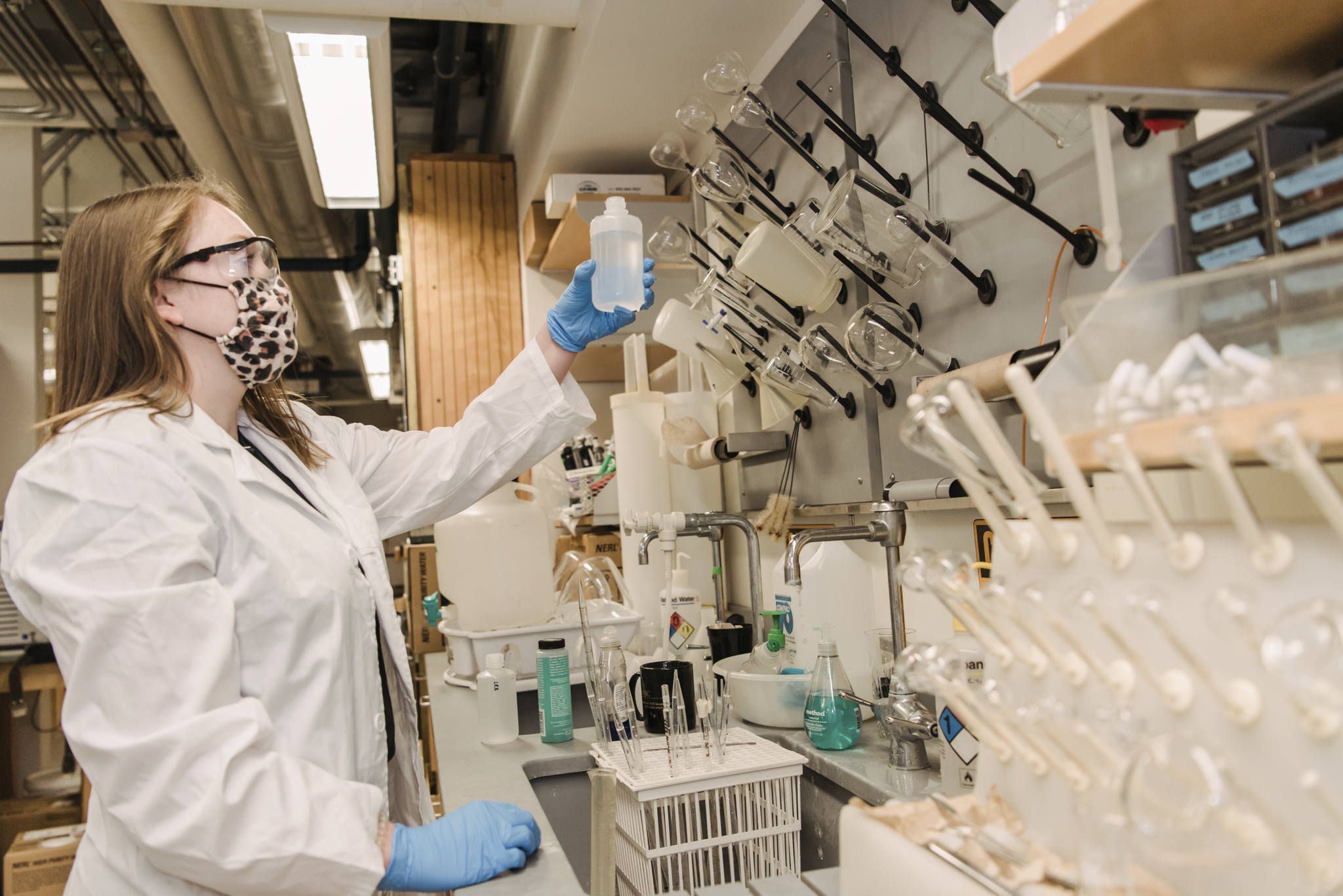
Woman in lab coat and mask looking at liquid in bottle
Belunis analyzing sample collection from the sink in the LaCourse lab.

“They never told me I can’t accomplish a dream,” she remembers. “They don’t understand everything, but always listen, and not all parents do that.”

Belunis’s interest in higher education soared after taking chemistry herself in high school. “My teacher made me fall in love with chemistry and realize all the possibilities that are out there.” 

This led her to a degree in forensic chemistry at Towson University. While there, she learned about the LaCourse research group at UMBC whose projects utilized science for outside applications, from detecting counterfeit currency to assessing the authenticity of vanilla.

Learning the ropes

Belunis knew graduate school would be difficult, but she was surprised at the intensity of the challenge. “I don’t want to make it seem like it’s all fine and dandy; it’s a lot of hard work,” she maintains. “You’re basically working on a project from scratch.” 

Belunis works through most of her challenges in the LaCourse lab, located in the left wing of the Robert and Jane Meyerhoff Chemistry Building. Right at the corner of the second floor, the lab is filled with countertops and fume hoods for prepping solutions and lined with drawers stocked with glassware and scientific instrument parts.

But Belunis doesn’t always don a lab coat. Her time is split between “hands-on” work, like preparing samples and using instruments, and “sit-down” work like data analysis. Before starting any experiment at the bench, she reviews research papers and discusses background information with LaCourse. “A lot of analytical chemistry is sitting at your desk with your laptop looking through the literature and making sure your experiments are sound,” she says.

Starting her PFAS project took extra background work as Belunis evaluated the reliability of an Environmental Protection Agency (EPA) instrument method for determining PFAS in drinking water. “EPA methods are very meticulous; there’s a lot of tiny details that go into everything and that was a learning curve for me,” she recalls.

After dedicated desk work in her corner of the LaCourse lab, Belunis collected local water samples (including from the laboratory’s sink) and added PFAS standards for reference. Adding a known amount of the chemical in question is called “spiking” in analytical chemistry and helps calculate the original, unknown amount of the PFAS. Then she poured the samples through large syringes conditioned with reagents, special chemicals used for separating the PFAS from water and other components of the sample. This process, called solid phase extraction, concentrates PFAS to make them easier to detect.

Tackling additional challenges

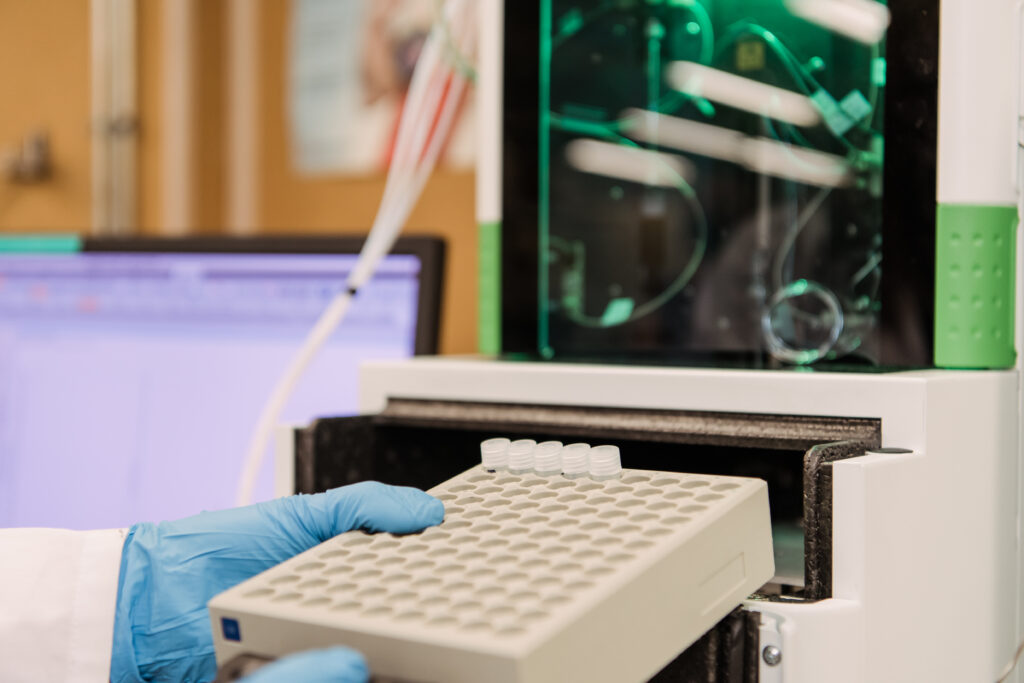
Another crucial side of analytical chemistry is troubleshooting instruments that analyze chemicals. For this, Belunis walked downstairs to the Molecular Characterization and Analysis Complex (MCAC) to use ultra-high performance liquid chromatography-tandem mass spectrometry, a two-part instrument that can separate PFAS from water and detect PFAS by mass. But Belunis realized the autosampler, the part that sends the PFAS sample into the instrument, needed to be free from plastics to avoid interference with the PFAS. She worked with the MCAC and laboratory company PerkinElmer, and received custom-made autosampler tubing.

“It was my first time connecting with outside instrument professionals—that was a skill to build,” Belunis recalls.

When the instrument finished processing each sample, Belunis worked with a computer program to examine graphical results with peaks, called chromatograms, and translated the peaks into numbers to report the method’s reliability.

Belunis’s current method is EPA-acceptable; she found that different PFAS were separated and detected with accuracy and precision in each of the water samples. This showed the EPA method is sufficient for detecting PFAS levels—toxic and non-toxic—in drinking water.

Navigating steep slopes

Achieving accomplishments during a research trek is fulfilling, but relief is hard to embrace when there’s another hill to climb, Belunis says. “I try my best to remember why I started grad school and why I want to be here to stay motivated.”

Just as a hiker might climb with a partner on a mountain expedition, Belunis is not alone in her graduate school journey. She’s often supported and encouraged by fellow LaCourse graduate students Ciara Pitman and Kayry Segarra. They focus on helping each other become better rather than competing against each other, a skill that Pitman attributes to the lab’s group meetings.

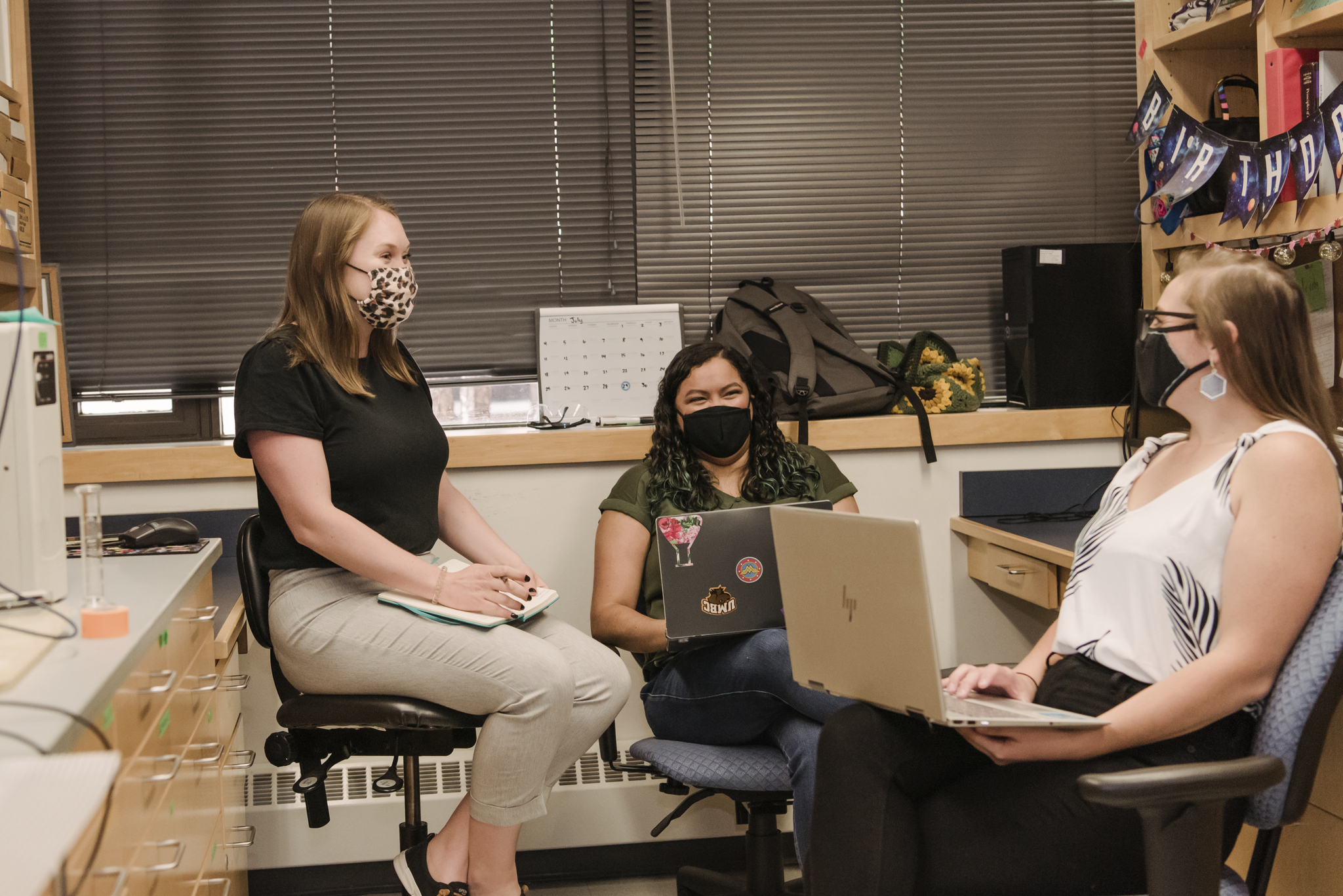
From left to right: Belunis, Segarra, and Pitman meet for a group collaboration meeting, a weekly occurrence in the LaCourse lab.

“I think our group meetings are probably much different from other labs,” she explains. “Not only do we discuss our updates, but we bring problems to the group. I like that there’s many different perspectives on solving the problems, so we’re prepared to answer whatever questions come our way later.”

LaCourse supports this environment as he values working together with students rather than students only working for him. “I’m only a guide for this research—I want students to learn lessons,” he says.

Belunis says LaCourse’s mentorship has helped her think carefully about her projects before taking action. “Be willing to be an independent thinker and be willing to be wrong,” she says about being a successful “LaCoursian” researcher. Pitman agrees, adding, “[LaCourse] wants to help us think through the problem because analytical chemistry is about problem solving.”

Reaching the summit

While not as dramatic as watching dry ice float out of a sink, the work Belunis has invested in studying harmful chemicals in everyday life has been worthwhile despite the obstacles. 

“This topic is relevant because PFAS are everywhere,” she says. “I like the environmental side of analytical chemistry, so it’s been a great project to work on.” Belunis will continue problem solving in her thesis by developing a method for detecting PFAS in aquaculture. This will help explore if humans are exposed to PFAS through seafood.

Belunis concludes that mental strength is key for continuing graduate education. “You’re not going to know everything, but as long as you have a mindset of ‘Things are hard now, but I’m going to make it,’ you’ll be okay.”

— Karis Barnett ’21, M29, chemistry

*****

Header image: Belunis using liquid chromatography-tandem mass spectrometry (LC-MS/MS) for sample analysis. All photos by Marlayna Demond ’11.
Taxing bachelors and proposing marriage lotteries – how superpowers addressed declining birthrates in the past

By Amy Froide, professor of history, UMBC

There’s growing awareness – and concern – about declining birthrates in the U.S. and other countries around the world.

Falling birth rates are usually seen as a sign of societal decline, a nation’s diminishing power, and the eclipse of marriage and family values. Rarely are they put into any kind of historical context. But birthrates are cyclical and have gone up and down throughout history.

While some people might assume that the decision to have a child is a personal or private one, individuals and couples also respond to external forces. Economic, social and cultural factors heavily influence birth rates. As a historian who has researched the uptick of single people in the 17th and 18th centuries, I’m familiar with how governments and societies have traditionally responded to low marriage and birthrates with various persuasion techniques.

In the 1690s, England and France entered into a 120-year period of continuous hot and cold warfare. The two nations were also superpowers that engaged in trade, established colonies and fought wars on multiple continents.

Maintaining healthy population numbers was a top concern, seen as a crucial element for ensuring economic and military might. So each country advanced a number of pronatalist strategies to encourage marriage and births.

Marriage loses its luster

In the 17th century – a period when marriage and fertility were more closely connected than they are today – the English were primarily concerned about low marriage rates.

Demographic historians E.A. Wrigley and R.S. Schofield reconstructed England’s population trends from 1541 to 1871 to show how, thanks to a relatively late age at first marriage and high rates of people who never married, birthrates in England declined. From 1600 to 1750 the average Englishwoman did not marry until age 26 and the average man at age 28. This age at first marriage began to fall only after 1750 with the advent of the Industrial Revolution.

Perhaps more importantly, anywhere from 13% to 27% of those English people born between 1575 and 1700 never married. This was highest in the last decades of the 17th century.

Various factors account for the high percentage of people never marrying: war, colonization and outbreaks of illnesses, such as the plague. Literature from England’s Restoration also reveals a negative attitude toward marriage among elite men.

So when the English government passed the Marriage Duty Act in 1695 to raise money to fight the French, it simultaneously addressed revenue needs and fertility concerns.

The marriage duty tax levied fees on births, marriages and deaths. But it also gave people an incentive to get married by taxing bachelors over the age of 25 and childless widowers. Women weren’t usually taxed because the government assumed men were largely behind the decline in marriage.

Pushing spinsters into motherhood

Cultural pressure also served to persuade or encourage women to marry.

Emerging at the same time as the marriage duty tax were the first literary and visual depictions of the “old maid” archetype, a portrayal of never-married women that was always disparaging.

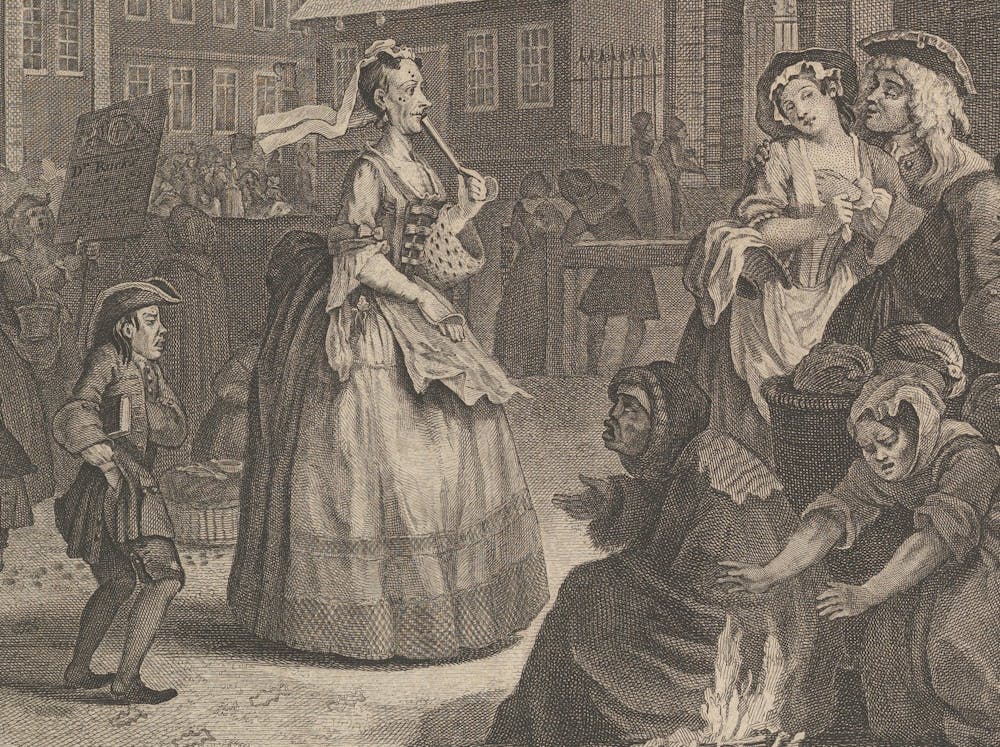
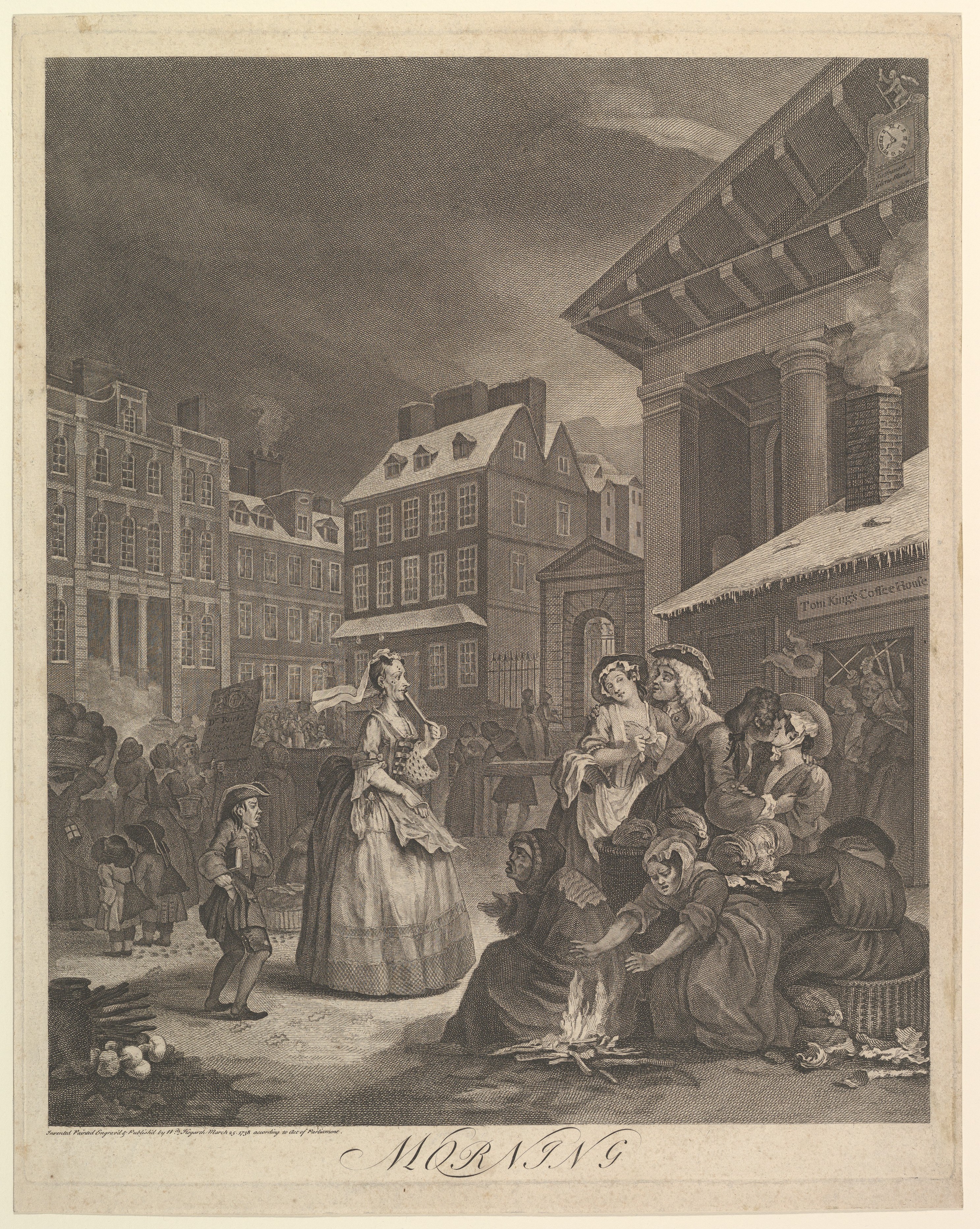
A classic example is William Hogarth’s print “Morning” from his “Four Times of the Day” series. It features a censorious, unpartnered, unattractive woman who is deemed to be past her prime.

A haggard woman with a pockmarked face observes attractive couples.
William Hogarth’s ‘Morning’ depicts an unmarried woman in an unflattering light. The Metropolitan Museum of Art

Literary satirists also suggested marital lotteries to partner off undesirable spinsters. A 1710 proposal for “The Love Lottery: Or, a Woman the Prize” responded directly to the marriage duty tax. The author proclaimed that instead of taxing marriages “they shou’d have propos’d to help’d ‘em to Matches.” He suggested a lottery in which “maids and widows” could venture 10 shillings and the prize would be a husband or a dowry.

This proposal was one of many that appeared between the 1690s and 1730s. For example, 1734’s “A Bill for a Charitable Lottery for the Relief of the Distressed Virgins in Great Britain” stated that “for the necessary encouragement of propagation, which we ought particularly to attend to upon the prospect of an approaching war, that all the Virgins in Great Britain from 15 to 40 should be disposed of [gotten rid of] by lottery.”

Although framed as prospective legislation, the proposed bill appeared in print only.

Saving babies for France

France differed from England by focusing more directly on increasing births. Although French writers contemplated various reasons for what they perceived to be low birthrates, high infant mortality was seen as a major issue.

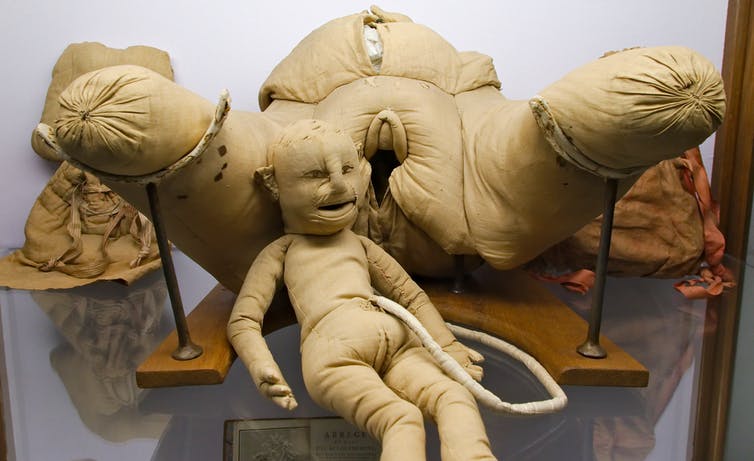
In the 1750s Parisian midwife Madame du Coudray capitalized on the French government’s pronatal stance and offered her services to Louis XV to train the country’s midwives in order to improve France’s live birth rates.

Du Coudray, herself unmarried and biologically childless, reproduced something else for France: what she called her machine – and what we might call a mannequin – on which midwives could practice different techniques used during difficult or dangerous births. Historian Nina Gelbart estimates that du Coudray and her disciples trained tens of thousands of midwives in successful delivery techniques.

A dummy child attached to a model woman via an umbilical cord.
France’s ‘national midwife,’ Madame du Coudray, invented an instructional mannequin to improve birthrates. Frédéric Bisson/flickr, CC BY

Pronatalism today

Substitute 21st-century U.S. and China for 18th-century England and France and you’ll see the same sort of handwringing over birthrates in these two nations today.

In both countries, a resurgence of policies aimed at getting people to have more babies has already begun. China ended its one-child policy in 2016. After a disappointingly low jump in birthrates, it has recently begun to encourage three-child families.

It’s unlikely the U.S. will see the equivalent of a national midwife like du Coudray – or, to use today’s parlance, a “reproduction czar.” But the U.S. Congress is finally talking seriously about increasing funding for child care. And beginning in July 2021, the IRS started issuing monthly child tax credit checks to most parents in the U.S.

Today’s policies are more of a carrot than the stick approach pursued by England with its marriage duty tax; instead of taxing bachelors to encourage marriage, the U.S. is providing a credit to existing parents.

It’s less likely that we’ll see single women openly derided as contemporary spinsters for choosing not to have children – although, as I’ve written, Americans still tend to stigmatize women who choose to stay single and childless.

But if the past is any guide, 21st-century superpowers will continue to engage in pronatalist strategies, because marriage, family and reproduction are still seen as the cornerstones of societal and political power.

*****

Header image: In England, children were seen as a way to replenish the military and sustain the economy. Universal Images Group via Getty Images

Amy Froide, Professor of History, University of Maryland, Baltimore County

This article is republished from The Conversation under a Creative Commons license. Read the original article.

There’s a long history of dances being pilfered for profit – and TikTok is the latest battleground

Jill Vasbinder, Senior Lecturer in Dance, UMBC

In January 2020, 14-year-old Jalaiah Harmon created what would become one of the biggest viral dance sensations on TikTok.

But few users knew that Harmon, who is Black, invented the dance, which she dubbed the Renegade – at least not until a month later, when The New York Times drew attention to her case. That’s because a TikTok user had copied the dance, and it was that TikToker’s rendition that went viral.

Because Harmon didn’t get credit, she wasn’t able to reap the benefits of more views and followers, which, in turn, could have led to collaborations and sponsorships.

Harmon is only the latest in a long list of women and people of color whose choreography and dance work have been pilfered for profit – a story that dates back to the origins of jazz dance in the 19th and early 20th centuries.

But these days, TikTok is the battleground – and it isn’t just Harmon who’s had her work lifted. In June 2021 several popular Black creators were so fed up with having their dances stolen or not credited that they decided to join forces and go on strike, refusing to post new dance content to bring attention to the issue.

Choreographers fight for royalties

Laying claim to a dance isn’t as straightforward as, say, a poet saying they have exclusive rights to a poem they’ve written.

Designed to protect “intangible cultural goods,” copyright, according to the U.S. Copyright Office, gives “Authors and Inventors the exclusive right to their respective Writings and Discoveries.”

Established in the hopes of rewarding innovation and promoting progress, the first U.S. copyright laws, which were established in 1787 and 1790 and based on statutes from Britain, didn’t grant rights to artists and dancers. Only writers were protected.

In fact, the very concept of owning choreography didn’t exist until the 20th century when dancers started to lay claim to their work in court.

In 1909, an Indian dancer named Mohammed Ismail tried to sue white dancer Ruth St. Denis, claiming he was the originator of one of St. Denis’ “Oriental” dances. In 1926, African-American blues singer Alberta Hunter claimed she held the copyright to the popular dance the Black Bottom, an African American social dance. https://www.youtube.com/embed/rQ9qapVmWi4?wmode=transparent&start=0 George White’s Black Bottom became a national sensation.

Hunter performed the Black Bottom in front a white audience in 1925. A year later, the dance appeared in George White’s revue “Scandals,” which ignited the Black Bottom dance craze.

However, little came of Ismail and Hunter’s efforts. More attempts would follow. In 1963, performer Faith Dane sued M&H Company for royalties for her choreography in “Gypsy” and lost. In the 1950s and 1960s, choreographer Agnes de Mille advocated for copyrights specific to choreography because she got very limited royalties for her work on the hit musical “Oklahoma!”

It wasn’t until 1976 that copyright protection was updated to specifically include choreographic works.

A delicate dance with copyright

But this hasn’t exactly led to a windfall of royalties for choreographers.

Congress has established four guidelines to determine whether a work can be granted copyright protection: originality, fixation, idea versus expression and functionality.

In choreography, it’s the fixed “expression” that’s being protected, not the “idea” behind it. This is why New York City Ballet can copyright their choreographed version of “The Nutcracker,” but other artists can create their own versions or expressions of the story as plays, storybooks or choreographed dance.

Artists and scholars still debate what, exactly, it is that a dancer or choreographer is trying to claim as their own. Is it the dance as a work of art, the choreography or the specific performance?

So while creators can apply to register the recorded expression of their idea with the government, many choreographers – perhaps due to so many gray areas in what is eligible for copyright – still don’t realize that they they have something of value that can or should be protected.

George Balanchine, the founding artistic director of New York City Ballet, had a heart attack in 1978. But he did didn’t draw up a will until he was told the dozens of dances he created would generate licensing income that would go to next of kin unless he directed otherwise.

When pop culture pulls from avant-garde

Avant-garde artist Anna Teresa De Keersmaeker’s brief spat with Beyoncé illustrates the tricky nature of determining what constitutes copyright infringement or plagiarism.

In 2011, De Keersmaeker claimed that Beyoncé, in her music video “Countdown,” had plagiarized De Keersmaeker’s dances from two different works – “Rosas danst Rosas” and “Achterland” – without giving her credit. https://www.youtube.com/embed/vlLZExpgBOY?wmode=transparent&start=0 Anna De Keersmaeker’s ‘Rosas danst Rosas.’

Both artists made public statements acknowledging what happened. It seems that though a substantial amount of De Keermaeker’s movement was transposed into “Countdown,” it was also transformed – from a white, elite avant-garde setting to a Black pop culture setting. A case could be made for fair use, the doctrine that permits the unlicensed use of copyright-protected works in certain circumstances. https://www.youtube.com/embed/2XY3AvVgDns?wmode=transparent&start=0 Beyoncé’s ‘Countdown.’

Nonetheless, this episode illustrates the gray areas of what is protected by copyright. Does performing someone else’s dance movements in a new setting – for an audience who may not have any connection or knowledge of its origins – make it OK? Does this make it a new work?

Copyright protection was devised primarily to promote progress. The thinking went that if authors and artist were given control of their work they would create more original work, earn a living from it and continue creating.

But the incentive for progress can also exist outside of copyright protection. This is what dancer-turned-lawyer Jessica Goudreault argued in a 2018 article for the Cardozo Law Review.

She writes that for some dance styles “the field might never evolve without the opportunity to copy,” which “sustains and encourages innovation.”

I would argue that this applies to the dances on TikTok. Without the ability for users to freely imitate the dances, those moves wouldn’t go viral. The creators of the dances would not get their moment in the Sun – however brief it is in social media – and other creators might be less inspired to innovate if they didn’t have the examples of those who came before them.

[Over 106,000 readers rely on The Conversation’s newsletter to understand the world. Sign up today.]

Can copyright protection even work for TikTok?

If TikTokers and choreographers are looking to license a new dance, should they rely solely on the copyright system and all its restrictions? Or is there another way to get credit and promote innovation in dance?

When dance videos are posted to the web, they are, by default, protected under copyright. In theory, this should prevent dancers from having their work used by others without permission.

In reality, it is often difficult to know who made it first and what constitutes fair use. When does doing some dance steps turn them into a new dance piece? Furthermore, discovering the original author or authors of a dance isn’t easy.

That’s because unlike posts on Facebook, Twitter and Instagram, TikTok posts aren’t time-stamped. Posts appear in a user’s feed in order of popularity, not chronologically. Identifying who posted the content first is tricky.

I would suggest that common law copyright is not the right solution here – and that the principles of Open Source might better serve creators.

Open Source, a social movement by computer programmers, is underpinned by licensing criteria that ensures integrity of authorship, among other principles. Open-source licensing could resolve the issue of the correct people receiving credit for their works. This could take the form of an Open-source license – which has yet to be clearly laid out for dance works – or a Creative Commons license with a “CC-BY” designation that requires attribution, but leaves space for copying, adjusting, remixing and innovation. For this to happen, TikTok would need to add a time and date stamp, in addition to a license preference feature.

Perhaps honoring legacies and influences by naming where something came from can begin to heal the damage that’s taken place over the years to people of color and other choreographers who’ve had their work cribbed with nary an acknowledgment or thanks.

* * * * * *

Jill Vasbinder, Senior Lecturer in Dance, University of Maryland, Baltimore County

Header Image: Laying claim to a dance isn’t as straightforward as doing the same for a poem. Tara Moore via Getty Images

This article is republished from The Conversation under a Creative Commons license. Read the original article.

Forward Progress Begins with Mentorship

Olumide Fagboyegun ’21, M29, biochemistry, is a recent UMBC graduate and a Meyerhoff Scholar. He will soon begin his Ph.D. in neuroscience at Harvard. Since graduating, he’s reflected on the mentors who have made these steps possible. What, exactly, made them great mentors, he asks. And how can he pass that gift along to future students, particularly other students from underrepresented groups?

Picture this: You’re sitting in a well-lit hotel ballroom at a table draped with a white tablecloth, nervously perspiring. Immediately in front of you is a podium on a stage, and encircling the ballroom are dozens of academics at various stages in their careers, from predoctoral trainees to full professors. One thing that stands out to you—even more imposing than their sheer presence—is the fact that almost all of them are Black. These academics are not only a testament to the fact that if we hold fast to the dream of equity in academia, it’s only a matter of time until it is realized. But for Black students in particular, this kind of experience is incredibly important.

Headshot of Olumide Fagboyegun
Headshot courtesy of Fagboyegun.

My experience as a member of the Meyerhoff Family at UMBC prepared me as a scientist and a scholar through the invaluable mentoring relationships where I was able to see a road to success forged by underrepresented students who went before me.

What makes a good mentor?

All my effective mentoring relationships have begun with one thing: reciprocated belief. My mentors have believed in me and I, in turn, have believed in their abilities to be good mentors for me. Both elements are necessary for an effective mentoring relationship. As a result, they have pushed me to believe in myself—to be better and more confident, in every regard. And I believed in their guidance and their affirmation of my potential. 

One close mentor pushed me to improve my networking skills while believing that I would represent my program and my university well wherever I went and with whomever I met. Another mentor believed in my capacity to do good science, and pushed me to reflect on the impact my scientific endeavors can have on society. 

It is worth reiterating that mentorship styles are remarkably diverse. One of the characteristics of a good mentor is the ability to see when one’s mentoring style may not be effective for a particular mentee, and to either modify their style, or to identify another mentor who would better meet the mentee’s needs. One of the strengths of the Meyerhoff Scholars Program is its ability to provide a wide range of mentoring styles to make sure that every student can find the support they need and achieve success on their chosen path, be it medical school, industry, or graduate school.

The mentee’s role

We often emphasize the role of the mentor, but the mentee’s role is no less important. New Meyerhoff Scholars start by going through a Summer Bridge program, which emphasizes the concept of the Meyerhoff Family—our scholar and alumni community, focused on mutual support. Through Summer Bridge, students learn to be open-minded to advice from their peers and mentors and to be comfortable proactively asking for help. Importantly, students learn to identify potential areas of self-improvement.

My own path, as a transfer student from Anne Arundel Community College, is less common for a Meyerhoff Scholar. While I did not go through Summer Bridge, I was embraced wholeheartedly by the Meyerhoff Family, and I believed that the mentorship provided in the Meyerhoff Scholars Program would be invaluable.

Fagboyegun with his fellow M29 cohort members, photo courtesy of the Meyerhoff Program.

The ripple effects of mentoring 

For underrepresented students, mentorship can play a particularly significant role in success.

In a recent piece published in Nature Medicine, Kizzmekia Corbett, ’08, M16, biological sciences and sociology, the leading scientist behind the Moderna COVID-19 vaccine, wrote about her first experience conducting scientific research as a high school student, and the impact, as a young Black woman, of having a Black scientist as her mentor. “This left me with an understanding of the necessity of visible representation in underserved communities, and the realization that one’s approach to mentorship is equally as important as (or arguably more important than) their approach to scientific discovery,” Corbett wrote.

Early in my college career, I was clued into the disparities that are characteristic of science and academia, which persist despite efforts to address them. In academia, these manifest, in part, as resource stratification and disparity in opportunities, including access to networks and mentors. 

On a personal level, as a Queer Black student in STEM, not seeing people who share my identity represented can make it feel as though there is no place for me in academia. Underrepresented minority (URM) students are acutely aware that most of the difficulty in forging that place in academia falls on the early URM individuals who attempt it. These individuals then face increasing pressure both internally and externally to succeed and be a model or a trailblazer. After all, insufficient diversity can have far-reaching effects, such as in healthcare disparities, and URM scientists have a strong motivation to address these problems. These pressures, coupled with the already high demands of academia, wear away uniquely on URM scholars.

Fagboyegun presents his research at Undergraduate Research and Creative Achievement Day in 2019. Photo by Marlayna Demond ’11.

Here, again, the  Meyerhoff Scholars Program shines. The Meyerhoff alumni network is remarkably connected, and ensures that graduates will always have peer mentors they are able to rely on, even if they are based in institutions with few other URM scientists, doctors, scholars, or other professionals. The strength of the Meyerhoff Family creates a ripple effect in those new institutions, providing Meyerhoff-style mentoring to URM students and more junior colleagues, which results in a cultural change. As a recent Meyerhoff alumnus, I intend to carry forward this culture change as well.

A vital perspective

The scene I set at the beginning of this essay is my memory from the annual University System of Maryland Summer Bridging Conference, hosted by the Louis Stokes Alliance for Minority Participation (LSAMP) my sophomore year. Such a scene is rare in academia, but it doesn’t have to be. The well-documented outcomes of the Meyerhoff Scholars Program so far suggest that it is entirely possible to permanently change the landscape of science to be much more inclusive of scholars of all identities.

It is worth noting that although a shared identity between a mentor and mentee isn’t necessary for all mentoring relationships, it often results in remarkably positive outcomes, as highlighted by Dr. Corbett in the quote above. 

Like many others, I have struggled with the idea that I might not be good enough to pursue a career in academia. However, the mentorship I’ve received through the Meyerhoff Scholars Program, LSAMP, and other initiatives has helped dissuade me of that notion. To achieve this, my mentors often help to place everything “in view” for me: my goals, weaknesses, strengths, accomplishments, and my place in the scientific and non-scientific world. This opportunity to zoom out and see the broader perspective has been vital to my success so far. 

We must recognize that mentorship is an essential part of the larger movement to diversify science in pursuit of an equitable society—a scaffold that ensures progress moves ever forward.

— Olumide Fagboyegun ’21, M29, biochemistry

*****

Header image: Fagboyegun presents his research at Undergraduate Research and Creative Achievement Day in 2019. Photo by Marlayna Demond ’11.

Building an Inclusive Workforce—Rising Together

Since 2009, as part of its Alumni Awards celebration, the UMBC Alumni Association names one “Rising Star” recipient each year who exemplifies early career and professional achievement. Prior to our October 2021 award ceremony, we’re spending some time with awardees from the past decade to see where they are now—and how they’ve grown in their fields while maintaining ties to UMBC. In this installment, UMBC Rising Stars Alicia Wilson ’04, political science, Nicole DeBlase ’06, financial economics, and Lauren Mazzoli Zavala ’15, computer science and mathematics, M.S. ’17, computer science, discuss their leadership roles in economic development, finance, and engineering and their concerted efforts to make these career paths more available to women and other underrepresented communities.

“If a woman sets the table, everyone wants to pull up a seat,” says Alicia Wilson ’04, political science. “It’s important for women to set the table—to be in positions of leadership—so they can build a strong team.”

Indeed, the following Rising Star Alumni Award recipients have not just set the table, they’ve helped build it.

UMBC Magazine sat down virtually with three powerhouse women to discuss how their time as UMBC students and scholars impacted their professional trajectories, and how they’re paving the way for the next generation of leaders.

Training up leaders

Economic development, finance, and engineering aren’t career paths traditionally associated with women (yes, even in 2021), however with concerted efforts to recruit, train, and retain young, female graduates—especially those coming out of smaller or lesser-known schools—the tides have been turning. UMBC’s constellation of programs that lift up underrepresented populations in tech or community development have well-situated Retrievers who want to make an impact on the world as well as closer to home. 

It’s no accident that a determining factor in who receives the Rising Star Award is someone who demonstrates ongoing involvement and support of UMBC, its students, and alumni.

Wilson, DeBlase, and Zavala are just three of the many success stories coming out of Hilltop Circle and their professional expertise, personal commitment to being viewed as leaders, and overall drive are more than evident, even over a Zoom call.

Opening doors

While their professional successes are evident, the personal successes of these Rising Stars are, in part, intertwined. Seeing firsthand the importance of strong leadership and being a part of a student body where academics are celebrated (“At UMBC, it’s cool to be smart,” says Wilson with a laugh), all three women have made it a point to open doors for other students who may not have taken the traditional route to careers in economics or engineering.

“I feel like I had to work a little harder to make it happen for myself on Wall Street,” says Nicole DeBlase ’06, financial economics, a managing director and lead analyst for Deutsche Bank, focusing specifically on U.S. multi-industry and electrical equipment. “Coming from a non-Ivy League school, I had to exercise my muscles to get my foot in the door. Because of that, I make it a point to help recruit people from state schools, knowing that talent and skill can come from anywhere. I feel like I’ve had a bit of an impact in that way.”

DeBlase visiting Oshkosh, a company she covers that makes defense vehicles, among other things. Photo courtesy of DeBlase.

The act of paying it forward is not a new concept for UMBC alumni, and each of these Retrievers emphasizes that “community” isn’t just a word splashed across the university’s homepage, but rather a way of life for students and alumni, and something university President Freeman Hrabowski actively nurtures.

“I had never eaten lunch with a university president before Dr. Hrabowski,” remembers Wilson, who was a Sondheim Public Affairs scholar and is now the vice president of economic development at the Johns Hopkins University and Health Systems. “I thought to myself how this must be a special place, because that’s far beyond what I would imagine someone in that position caring about—what some 17-year-old kid from the city thinks.”

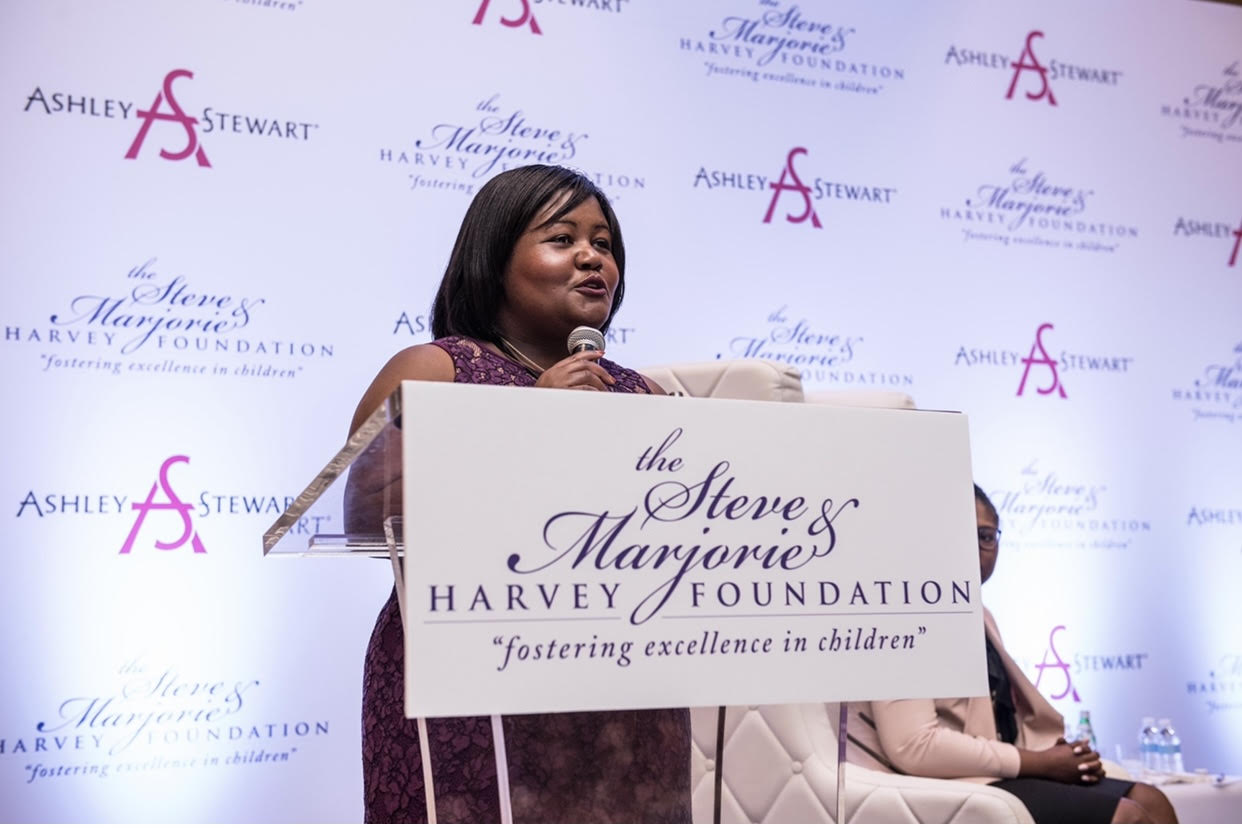
In 2018, Wilson was the keynote speaker at the Steve and Marjorie Harvey Foundation’s Girls Who Rule the World summit. Photo courtesy of Wilson.

Wilson’s Baltimore roots are serving her well. In her current role, she leads the development and implementation of Hopkins’ institution-wide strategies and initiatives both within the United States and abroad through investments in real estate, economic and neighborhood development, healthcare, and education.

A school that invests in its students to ensure their personal successes is something worth celebrating, says Wilson, 2009 Rising Star recipient—and it’s perhaps what UMBC most prides itself on.

Lauren Mazzoli Zavala agrees.

Zavala, right, with her mentee Priyanka Ranade '18, M.S. '19, information systems, at Northrop Grumman. Photo by Marlayna Demond '11.
Zavala, right, with her mentee Priyanka Ranade ’18, M.S. ’19, information systems, at Northrop Grumman. Photo by Marlayna Demond ’11.

“The time I spent in UMBC’s Cyber Scholars Program prepped me for the reality that teamwork and collaboration are essential in this industry,” says Zavala, ’15, computer science and mathematics, M.A. ’17, computer science. “You can never go into a room with an ego because you can always expect to learn from other people around you. That’s something I quickly picked up as a UMBC scholar and it’s been critical to how I approach my work at Northrop.”

Zavala, who received the Rising Star award in 2017, is now a software engineering manager at Northrop Grumman where she and her team oversee cyber missions as they relate to American troops in different parts of the world.

Showing up

Zavala, far left, at Northrop’s Cyber Security Raspberry Pi Competition hosted by Northrop Grumman for UMBC Students. Photo courtesy of Zavala.

The Center for Women in Technology (CWIT) is a primary example of the investment made in UMBC’s students’ future, in this case, the future of women in technological careers. Established in July 1998 to catapult women’s full participation in all aspects of information technology, CWIT expanded its scope in 2006 to include engineering majors as well. Zavala knows firsthand the importance a scholarship program like CWIT has on an entire student body.

“The Cyber Scholars Program was invaluable to me as a junior,” she adds. “Its partnership with CWIT, as well as Northrop Grumman and other leading companies in cybersecurity, provided students with the network and resources needed to build important connections.”

In a space typically dominated by white men, Zavala remembers joining a group of women to participate in a cyber competition. Though they didn’t end up winning, the lasting memory of being present and bringing some much-needed diversity to the space stayed with her.

“The worst we can do is fail,” she says, emphasizing the importance of showing up and trying. “In my career today, I’m constantly learning from other people, and that includes interns. We’ll lean on them for their creative solutions to very real deadlines and challenges we have to meet at Northrop every day.”

Talented trailblazing

Modeling good leadership results in good leadership, and ultimately, it’s what drives DeBlase, Zavala, and Wilson within their respective jobs—excellence recognizing excellence.

DeBlase on her first CNBC appearance. Photo courtesy of DeBlase.

“I run a team of four associates, and we have a 50/50 ratio of women versus men,” says DeBlase, who is heavily involved with Deutsche Bank’s recruitment process and is keen on creating opportunities for individuals who have taken a less traditional approach to reaching Wall Street. “Looking for the most talented person to fill a seat is critical, which is why it’s important to seek out those women applicants.”

Programs like Women on Wall Street—perhaps not coincidentally run by Deutsche Bank—allows DeBlase, the 2015 Rising Star awardee, to be up front and center in the recruiting process, ensuring that equal opportunity is given across the board. 

In her previous position, recruitment of talented women started early. “When I was at Morgan Stanley, there was a whole initiative around recruiting women,” DeBlase adds. We’d start at the sophomore level and actually do campus outreach.”

Despite the personal successes each woman has experienced in the workforce, there is still larger work to be done, particularly in light of the numerous challenges women have faced during the COVID-19 pandemic.

“There needs to be an evolution with work-life balance and work flexibility to allow women to feel like a career on Wall Street is more sustainable,” says DeBlase. “It’s still challenging for women who enter more senior roles. In a way, COVID has helped my workplace realize that there are opportunities for employees to work from home and strike a healthier work-life balance.”

In a perfect world, a trailblazer won’t be categorized by their gender, but rather by their innovation, talent, and dedication to creating a more inclusive society. Until then, however, it’s programs like CWIT, the Sondheim Program, and Women on Wall Street that will drive change that is both tangible and significant, as seen through the work of these three Rising Stars

With women like Zavala, Wilson, and DeBlase at the helm, change might come sooner than anticipated.

 — Nikoletta Gjoni ’09

Read more about other Retrievers rising together and stay tuned for more information about UMBC’s 32nd annual Alumni Awards in October.

As Urban Life Resumes, Can US Cities Avert Gridlock?

By John Rennie Short, professor, School of Public Policy, UMBC

Traffic is so ubiquitous in U.S. cities that until recently, imagining urban life without it meant looking to other nations for examples. Then, in 2020, COVID-19 closures and lockdowns took drivers off the roads. The thought experiment became real.

The main impacts are clear. First, public transit ridership plummeted by 80%, leaving mainly lower-income workers in jobs declared essential riding buses, subways and commuter trains.

Second, private vehicular traffic declined by more than 50% in most metro areas, and by more than 75% in some tech-oriented cities such as San Francisco, where more people could work from home. With less traffic, cities became quieter, less polluted. People could hear birdsong for the first time. Air quality improved. Skies were clearer.

Surprisingly, however, traffic accidents did not lessen. Though fewer people were driving, average speed levels increased with emptier roads. Distracted driving also increased, with more drivers texting, emailing and shopping while behind the wheel. Overconfidence, speed and distraction led to an increase in accidents.

Third, quiet roads provided an opportunity to reimagine and create less car-centric cities. From Boston to Los Angeles, street eateries blossomed. Diners, pedestrians and cyclists reclaimed outdoor spaces.

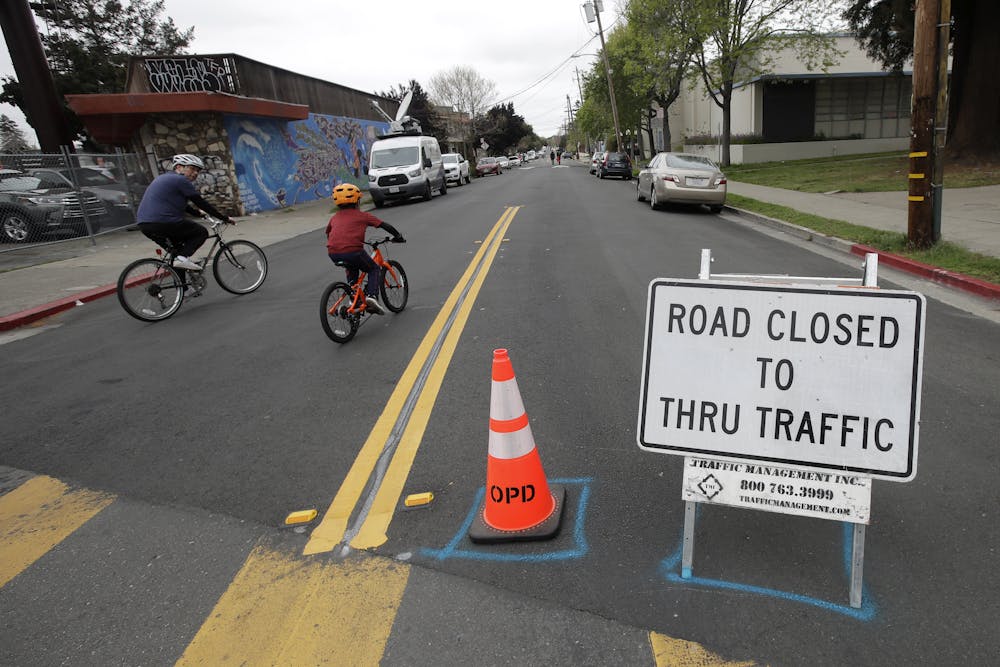
A man and child ride bikes past a street closure sign.
Oakland, California, closed 74 miles of streets in the spring of 2020 to give people safe spaces to get outdoors and exercise. AP Photo/Jeff Chiu

As states lift pandemic restrictions and workers debate whether to return to office settings, will these trends continue? As a scholar who researches cities, I expect the following key factors to shape what post-pandemic traffic looks like.

Public transit in crisis

Public transportation finances took a big hit during the pandemic as ridership shrank. Many cities responded by reducing bus and train service, eliminating routes and laying off employees. Whether urban public transportation can recover over the longer term is a critical question.

So far, surveys suggest that more affluent riders are less willing to return, especially if they can work productively from home. There is still a lingering sense that public transportation, and indeed all ride-sharing, is riskier than walking, cycling or personal auto travel.

Any longer-term declines in the quality of public transportation will be disproportionately shouldered by lower-income workers, who have less choice and will be forced to navigate more expensive, less reliable services. The ripple effects on access to employment opportunities, commuting times and general quality of life could be severe, adding yet another layer to mounting inequality in U.S. society.

Public transportation already was chronically underfunded in the U.S. before 2020, and the pandemic only added to these fiscal woes. However, the scale of the current crisis may be changing attitudes, especially at the federal level.

Subway car with two riders.
Passengers on a Metro train in Washington, D.C., on April 23, 2021. AP Photo/Patrick Semansky

Public transportation received a fiscal boost from the Coronavirus Aid, Relief, and Economic Security Act, known as the CARES Act, that Congress passed in March 2020. And President Joe Biden has proposed US$85 billion for capital investments in public transit in his infrastructure plan.

The details of potential investments are still taking shape, and much depends on congressional negotiations. But although the traditional American road and car mentality remains strong, the pandemic may have finally made clear that urban public transportation has a vital social and economic role in making cities fairer, as well as more efficient.

Traffic is rebounding

The increase in walking and bicycling during the pandemic was good news for many reasons. With less surface traffic, cities became quieter and less polluted. People could hear birds singing in many places for the first time and walk on streets free from busy traffic.

Cities traditionally plagued with gridlock, such as Boston, Dallas, Houston, Los Angeles and Washington, D.C., all saw less congested roads. But it’s not clear whether this will be a lasting change or a short-term response.

By mid-June 2020, while many states and cities were still under COVID-19 restrictions, traffic had rebounded across the country to almost 90% of pre-pandemic levels. Washington, D.C., was at 70% of its normal level, New York City was at 82%, and Los Angeles was at 85%. Now, as vaccines and the end of pandemic controls make people freer to move around, many cities are quickly returning to prior traffic levels.

Somewhat counterintuitively, having more cars on the road could actually improve safety. With more traffic, average speed may decline to safer levels.

However, distracted driving could offset this trend. We live in an age of distraction, where many people feel it is OK to drive while texting and tweeting. As traffic returns to pre-pandemic levels, cities and states will need to refocus attention on measures such as restricting cellphone use in cars.

Making city streets more people-friendly

Perhaps the most encouraging traffic-related news is that many cities are forging ahead with plans to reduce car travel and make streets safer for pedestrians and cyclists.

The pandemic offered a unique opportunity to reimagine the city as a place where drivers had to share space with others. This also was a trend that predated COVID-19 but accelerated in 2020 when streets were relatively empty.

Many cities are now implementing initiatives like free public transportation, protected bike lanes, bike-sharing initiatives, congestion pricing, regular street closures, priority bus lanes, quiet streets and reduced traffic speeds. These cities include Boston, Chicago, Los Angeles, New York, Seattle, San Francisco and Washington, D.C.

But there are competing interests and political counterpressures. One survey of mayors found that many endorsed changes to street space, but relatively few were planning to make them permanent. City leaders realize that powerful economic interests want consumers and workers to have downtown access by private car.

The coming months could well be a key pivotal point. The pandemic gave Americans a tantalizing glimpse of what less car-oriented cities would look like. The pandemic saw the reclamation of urban streets for public use, the emergence of a less car-centric city and the reimagining of a safer, slower, quieter city with streets shared among a variety of users. But many interests want a quick return to the status quo.

The outcome will depend on how effectively urban dwellers and advocacy groups make their case for more people-centered city streets.

*****

Header image: Rush-hour traffic in Los Angeles on June 15, 2021. Carolyn Cole / Los Angeles Times via Getty Images

John Rennie Short, Professor, School of Public Policy, University of Maryland, Baltimore County

This article is republished from The Conversation under a Creative Commons license. Read the original article.

Up On the Roof—Spring 2021

Although we may still be limited in terms of opportunities to physically visit campus, there are still many ways UMBC alumni can engage with the community. In a recent chat with UMBC President Freeman Hrabowski, Alumni Association President Brian Frazee ’11, political science, and M.P.P. ’12, the vice president of government affairs for the Maryland Hospital Association, shares why it’s so important to stay connected. And no, you don’t have to live next door to do it.

Frazee: You know, from the very beginning, I was so fortunate to have a great experience at UMBC. When people talk about UMBC they say that you get individualized attention, that people care about you, it’s a community. I felt that way right away. I was a Sondheim Public Affairs Scholar, and I did the B.A./M.P.P. program and I went straight through, stayed for five years to finish my master’s in public policy. And then I actually bought a house right next to UMBC. I did, I lived right next to the campus. I thought, now there’s really no excuse for me not to give back to this university. So I participated in every opportunity I could—alumni events, Homecoming, mentoring students, and staying connected with my professors.  

A few years went by doing that, and then Dr. Art Johnson, the former provost and director of the Sondheim Public Affairs Scholars Program said, “You should think about joining the alumni association board of directors.” Long story short, I applied, he nominated me, and I got on the board and the rest is history, and now I feel that my role is really twofold. Number one is to keep my fellow alumni engaged with UMBC. And two, is encouraging my fellow alumni to give back to the university, whether that’s financially and or through their time of volunteering. 

Hrabowski:  That’s wonderful. UMBC is all about stories, and I love hearing about those experiences and the memories of connecting to UMBC and the Sondheim program. And Brian, you reflect the significance of that program as we think about producing leaders in our state…and thinking about the whole picture, who are we as a campus, as a university, and how do alumni connect to the rest of campus and to the larger society? Your story is a great example of alumni engagement and the reasons why giving back is so important. It’s inspiring to me.

Frazee:  The past year has been incredibly challenging for obvious reasons, but it has also presented us incredible opportunities to learn from what we have been through. I think one of the greatest ways we can do that is through the virtual opportunities that we now have learned work very well. Retrievers Connect is one example of that. It is a new platform where folks can make those virtual connections from alumni to alumni, to current students, to faculty, or to any member of the UMBC community. It’s been very active…and it’s been interesting to connect with old friends and old professors in this new way. 

Our alumni are busy like everyone else, and they are all over the world, which is a great thing. So the ability for us to really expand our network of alumni beyond just the folks that happen to live in this area has been huge. We now have alumni board members that live in Atlanta. We have another one coming from Chicago; before that just wouldn’t have been possible. It’s wonderful. Nothing replaces the in-person networking opportunities, but at same time, how can we leverage the virtual environment to connect more people? And how do we find that right balance when things go back to “normal.”  

There are other ways, too. There are so many alumni chapters that are very active, depending on your interest area. You can reach directly out to a board member as a first step to engagement. You can connect with any member of the alumni engagement staff. Many alumni may not know that there is an entire staff that is dedicated to alumni relations and they are incredible. And when we are able, be sure to come to events, or connect with your favorite professor or your old department. There are a multitude of ways to stay involved. You just have to figure out what’s right for you.

Hrabowski: And we’ll look forward to seeing you when you do. You know, we always remember how people make us feel, and how universities make us feel. We really do. And either the university tells students in so many ways that they’re special and they will be fine and to be their best selves or they don’t. We are determined to do that. Thank you, Brian, for all you do. We’re so proud of you.

Learn more about Retrievers Connect and other ways of engaging with Retriever alums at alumni.umbc.edu.

*****
Header image: President Hrabowski and Brian Frazee walk on campus in early spring 2021. Photos by Marlayna Demond ’11.

Supporting the Whole Student

Lewis on campus in 1992. Photo courtesy of Lewis.

“To me, UMBC opened up the world,” says Tamara L. Lewis ’92, psychology. As a student, that meant joining Alpha Kappa Alpha Sorority, Inc., for instance, holding multiple jobs all around campus, and ultimately re-envisioning her career path. 

Lewis began her studies focusing on industrial and organizational psychology. However, it was her many on-campus jobs—conference assistant, desk staffer, and student worker in the admissions office—that allowed her to realize that she was actually drawn to counseling. Working across campus let Lewis see how a university can support student success, so she began to explore how she could work with students.

Thirty years later, Lewis still feels a sense of real connection to the campus and actively works to help other alumni engage with students and the institution. And her career pathway has allowed her to continue to support students in the manner she first observed at UMBC.

The need to belong

Academic support has defined many aspects of  Lewis’s career and philanthropic life. After UMBC, Lewis received her master’s degree in counseling from Hampton University—UMBC President Freeman Hrabowski’s alma mater. She then began her career in the counseling center at Baltimore City Community College. 

“Being in the academic realm got me thinking more about college student experiences,” she shares, and she started thinking about what structures exist to help young people succeed. She drew on lessons learned at UMBC that helped her understand the value of community and support in educating the whole student. 

Lewis speaking at a CBLA event. Photo courtesy of the Alumni Association.

Lewis continued exploring the topic of academic success in her dissertation for her doctorate from Morgan University. After earning both her graduate degrees from Historically Black Colleges and Universities, Lewis understood the advantages of students feeling a sense of belonging while at school. Her own experience, along with research and alumni work, has shown her the importance of making students feel important and valuable within their community.  

Carving out space

Creating a space for Black and Latinx alumni to come together came organically through events and outreach supported by UMBC’s Office of Alumni Engagement, says Lewis. What started as a UMBC-hosted evening for Black and Latinx alumni at Baltimore’s Reginald F. Lewis Museum of African American History, would result in the creation of the Chapter of Black and Latino Alumni (CBLA) at UMBC in 2006.

“Tamara was instrumental in creating the CBLA and leading events and initiatives that would speak to and acknowledge the unique experiences of our Black and Latine/x graduates,” says Stanyell Odom, director of Alumni Engagement. “Her love for UMBC is evident in the way she gives back her time, talent, and resources through the CBLA, the Alumni Board and her beloved sorority.”

In 1991, Lewis became a member of Alpha Kappa Alpha Sorority (AKA), one of the first historically Black sororities on campus. She remembers how important it felt to build community within the “small community” of Black students on campus. Through her student work in AKA, as well as her residential life involvement, she saw the value of supporting Black students to do their very best at UMBC, a vision that was shared through the administration, she says. 

Now, nearly 30 years after joining her sorority, she continues to connect with members to support UMBC. In 2011, Lewis helped plan the first AKA Homecoming reunion. Anita Jackson ’80, health science and policy, then a member of the Alumni Association Board of Directors, and the Office of Alumni Engagement leveraged connections to the alumni community to make the event a success. AKA members have gathered at Homecoming every year since. The event also fundraises for the UMBC Second Generation Scholarship, which is dedicated to students who show a commitment to the advancement of minorities. In 2020, during the COVID-19 pandemic, the sorority sisters came together virtually in honor of the charter anniversary of their chapter.

“It’s important that people give what they can; even if it’s not money but time,”  Lewis says, emphasizing the value of expanding the ways alumni can support the UMBC community.

Integral part of the community

Now, as the state test security officer and the National Assessment of Educational Progress state coordinator for the Maryland State Department of Education (MSDE), Lewis continues to ensure students have everything they need to succeed on standardized testing. The Assessment Branch of MSDE works to create uniform and accessible testing standards so students, educators, and community members can best support students and address any gaps in education. Working in Baltimore City, Lewis understands the value of equitable testing practices so students can use every support available. Her continued curiosity about addressing gaps and building community has made her an integral part of the UMBC alumni community.

As a student, Lewis realized that being an active member of the UMBC community was the best way to get the most of her education. Now, she wants to help current students—who she sees as future alumni—realize how important it is to give back to UMBC when they do graduate. “When I tell people I went to UMBC, they’re impressed,” she says, which just inspires her to give back even more.


— Imani Spence ’16

*****

Header image: Lewis, right, at an AKA Homecoming reunion in 2014. Photo by Marlayna Demond ’11.
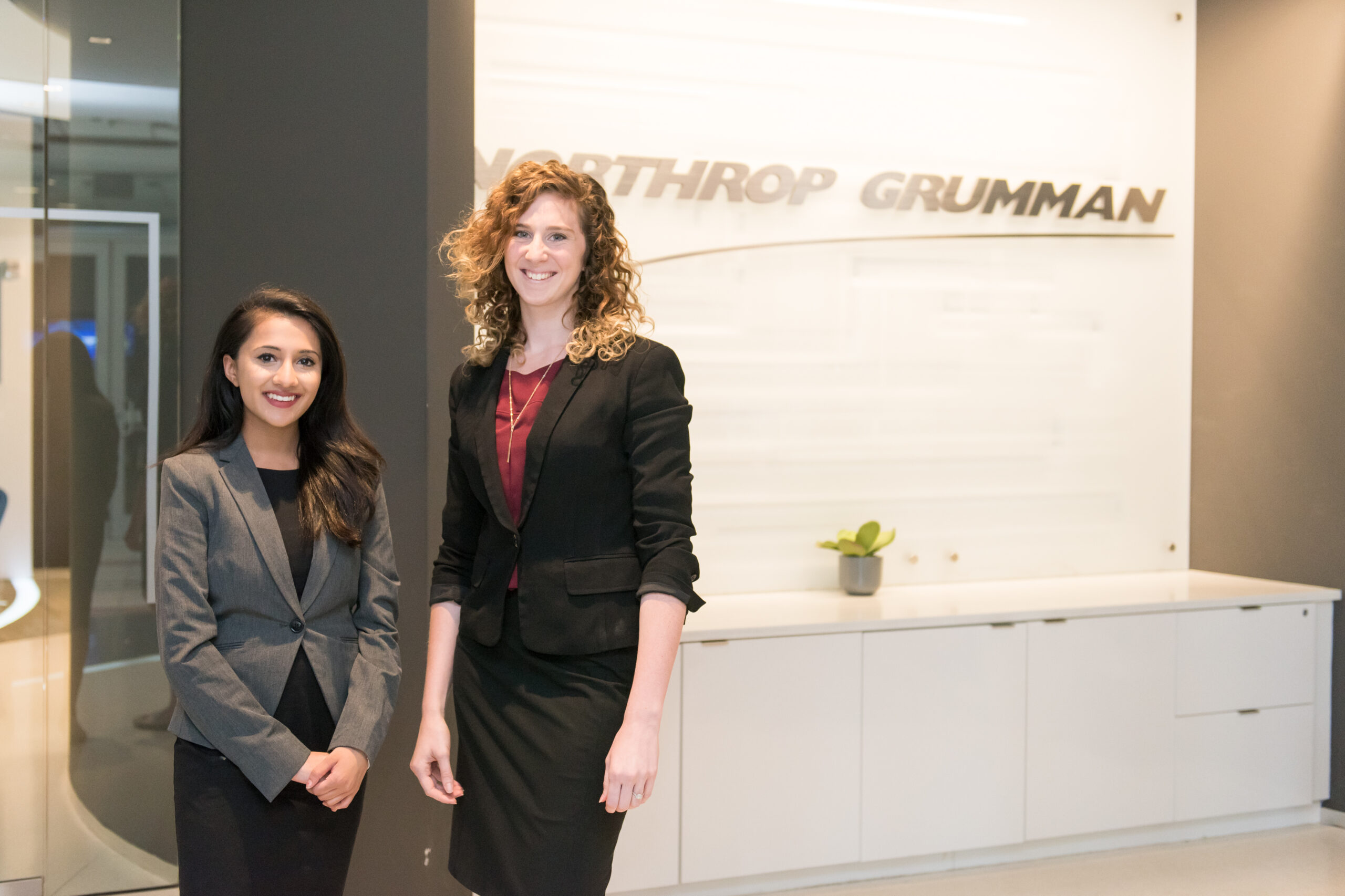
Vaccine Victories

UMBC students and staff have shown their resilience in myriad ways during the pandemic, but maybe nothing showcases the Retriever spirit more than the volunteer hours put in to assist in the region-wide vaccination challenge. 

Vaccine hunters Jen Dress, associate director of Campus Life, and Candace Martinez-Doane, assistant director of Leadership and Government, started their journeys by finding appointments for people within their immediate circles. As more people became eligible for vaccines, those circles widened to include more than 600 people they’ve helped register.

Part of their efforts focused on frontline UMBC community members, including over 30 ABM staff, who help maintain and clean UMBC facilities and residential buildings. Dress and Martinez-Doane partnered with UMBC Transit to organize UMBC coach buses to transport the ABM workers to and from their vaccine appointments. Next up on their list is helping 60 Chartwells dining staff members be successfully vaccinated to prepare for fall 2021 operations on campus.

UMBC students are also going above and beyond to volunteer their time. Of students in the University System of Maryland, Retrievers led the way attending 30 volunteer shifts at the M&T Bank Stadium mass vaccination site, giving approximately 175 hours of their time. According to Chris Bankert of the State of Maryland’s COVID-19 response team, “UMBC has been doing fantastic work at M&T Bank Stadium, and I have been hearing great feedback from the management staff on site.”

In mid-April, UMBC leveraged its long term partnership with the Lakeland community in south Baltimore to co-sponsor a pop-up vaccine event to serve 100 members of the community. “With deep community connections and strong partners like Casa de Maryland, we were ready to bring health resources to the community,” says Joshua Michael ’10, political science, director of the Baltimore School Partnerships and the Sherman Scholars Program,.

In other ways, Michael notes, Retrievers have adapted to meet the opportunity of the moment.  In summer 2020, 15 Sherman Scholars taught math online to 150 Lakeland students. And this fall, 30 UMBC students will provide additional support in mathematics through evening tutoring. “At UMBC,” says Michael, “our humanity has guided us to meet this moment.”

— Morgan Casey ’22 and Randianne Leyshon ’09

A version of this story was originally published by The Retriever.

Retrievers Behind the Scenes—Courtney C. Hobson, M.A. ’14

During the pandemic it has become even more important to find ways of engaging students in learning activities beyond the classroom. Fortunately, we have Courtney C. Hobson, M.A. ’14, historical studies, program coordinator for the Dresher Center for the Humanities, to help make these special moments happen.

What is your favorite thing about the work you do at UMBC and why?

As program coordinator, I do exactly what the title says—COORDINATE. This covers a multitude of things such as maintaining budgets, crafting social media posts, and other various administrative tasks. My favorite part of my job is helping to plan and coordinate the Humanities Forum, our free public lecture series. I essentially have a wish list of different artists, professors, writers, etc. who I would love to hear from and/or meet; through the Humanities Forum, sometimes that gets to happen! But mostly, I get to constantly learn new ideas and hear from different perspectives, which has been an enriching experience.

Tell us something people don’t really know or understand about your job.

Coordinating events or programs requires so much multitasking, juggling—any euphemism that you want to apply. It requires the ability to think about both the smaller and bigger picture and prepare for contingencies. You also have to be aware of the various people or groups that you interact with and anticipate their potential needs. Doing all of this and making the experience appear to be seamless is also a skill.

Is there someone in the campus community who has been particularly supportive? 

I can’t really pick out one person in particular because I have so many wonderful friends and colleagues at the university. As an alumna of the university, it’s a unique experience to transition from student-professor relationship to colleague or even friend with some of the professors in the History Department; they were my cheerleader when I was a student and continue to be so now.


Learn more about the Humanities Forum at https://dreshercenter.umbc.edu/humanities-forum/current/.

Header image: Hobson works with faculty members during an Humanities Teaching Lab. Both photos courtesy of Hobson.