



Every so often, we highlight the importance of student scholarships by introducing you to the very students they help to succeed. Today, we’re speaking with Nicole Shah, a senior social work major who is also a Charlotte W. Newcombe Foundation Scholarship recipient. This scholarship is given to returning female students over the age of 25. If you’re interested in learning more about the Returning Women’s meetings or scholarships, contact the Women’s Center at womens.center@umbc.edu.
Name: Nicole Shah, married mom of 4
Grad Year/Major: Social Work major, senior year
Affiliations: Mosaic Center DEI Fall 2012, Conversation Partner ELI Spring 2012
Q: What benefits have you experienced as a Newcombe Scholar?
A: Formal connection to the Women’s Center and all of the support the center offers. Monthly returning student’s meetings and having a network of students similar to me in my age and life situation(s) to lean on for support.
Q: What do you wish traditional students knew about being a non-traditional student?
A: That age ain’t nothing but a number. Younger students and mature students have a lot to offer one another, don’t be hesitant to reach out in class and on campus. The common denominator is that we are all students at UMBC so choose to focus on that. Once we graduate, we will be working with diverse groups of people so take advantage of learning how to do that now while in college.
Q: What do you wish the University and Professors knew about being a non-traditional student?
A: That returning students do not want special treatment, if we choose to tell you some of our extra responsibilities outside of campus it is because we need your support not your pity. There is a difference. No two people are alike therefore keep in mind no two students are alike; there is not a one-size-fits-all approach.
Q: What is one piece of advice you would offer to new non-traditional students at UMBC?
A: It is in your best interest to get involved on campus. With families and work responsibilities it does make it more challenging, but it is possible. Campus involvement definitely made my time at UMBC more rich and enjoyable.
Read more about the Charlotte W. Newcombe Scholarship here.
This interview originally appeared on the UMBC Women’s Center website.
All posts by: Magazine Editor
Scholarship Q&A: Nicole Shah, Newcombe Scholar
Every so often, we highlight the importance of student scholarships by introducing you to the very students they help to succeed. Today, we’re speaking with Nicole Shah, a senior social work major who is also a Charlotte W. Newcombe Foundation Scholarship recipient. This scholarship is given to returning female students over the age of 25. If you’re interested in learning more about the Returning Women’s meetings or scholarships, contact the Women’s Center at womens.center@umbc.edu.
Name: Nicole Shah, married mom of 4
Grad Year/Major: Social Work major, senior year
Affiliations: Mosaic Center DEI Fall 2012, Conversation Partner ELI Spring 2012
Q: What benefits have you experienced as a Newcombe Scholar?
A: Formal connection to the Women’s Center and all of the support the center offers. Monthly returning student’s meetings and having a network of students similar to me in my age and life situation(s) to lean on for support.
Q: What do you wish traditional students knew about being a non-traditional student?
A: That age ain’t nothing but a number. Younger students and mature students have a lot to offer one another, don’t be hesitant to reach out in class and on campus. The common denominator is that we are all students at UMBC so choose to focus on that. Once we graduate, we will be working with diverse groups of people so take advantage of learning how to do that now while in college.
Q: What do you wish the University and Professors knew about being a non-traditional student?
A: That returning students do not want special treatment, if we choose to tell you some of our extra responsibilities outside of campus it is because we need your support not your pity. There is a difference. No two people are alike therefore keep in mind no two students are alike; there is not a one-size-fits-all approach.
Q: What is one piece of advice you would offer to new non-traditional students at UMBC?
A: It is in your best interest to get involved on campus. With families and work responsibilities it does make it more challenging, but it is possible. Campus involvement definitely made my time at UMBC more rich and enjoyable.
Read more about the Charlotte W. Newcombe Scholarship here.
This interview originally appeared on the UMBC Women’s Center website.
Jones ’06, SocWk, Receives 2013 Walter Sondheim Public Service Award
UMBC alumnus Joseph T. Jones ’06, social work, CEO of The Center for Urban Families, was honored last week by the Greater Baltimore Committee as the recipient of the 2013 Walter Sondheim Public Service Award for his work connecting low-income men and women to job and family support.
According to a press release from the GBC:
Working from the non-profit organization’s center, located on Monroe Street in West Baltimore, Jones “is a beacon of hope to young men and women in Baltimore,” GBC President & CEO Donald C. Fry said in presenting Jones the award at GBC’s 2013 Annual Meeting on May 8 at the Hyatt Regency Baltimore.
The GBC’s Sondheim Award, created in 2007, recognizes individuals not elected to public office who demonstrate extraordinary commitment to community and to serving the public good. Read the GBC’s full press release about Jones here.
UMBC Magazine profiled Jones in its Fall 2011 issue. Read the story here.
Career Q&A: Mark DeNome ’07, ’10, Program Auditor
 Every so often, we’ll chat with an alum about what they do and how they got there. Today we’re talking with program auditor Mark DeNome ’07, emergency health services, ’10, master’s of public policy, about the path he took to UMBC and — ultimately — a career he truly loves.
Name: Mark DeNome
Job Title: Program Auditor
Employer: BNL Incorporated
Scholarships Received at UMBC: President’s Fellow Scholarship; Bill Hathaway Award
Q: Tell us a little about how you wound up at UMBC. What’s your background?
A: I was born and raised in Morgantown, West Virginia, by a single mother on a teacher’s salary. I was already well-acquainted with the primary in-state university most of my classmates selected; however, I knew for a true personal advancement, I would need to find an out-of-state school where I might get significant financial aid. I had a great experience on my campus tour, where I heard the inspiring Freeman Hrabowski speak and came across an exciting major in EHS that was new to me. The prospect of joining UMBC’s fine lacrosse team appealed to me, but what most influenced my decision was the nature of UMBC and the surrounding community to be both immersed yet intimate, a logical step between my rural upbringing and the hustle of the city. UMBC was an university, up-and-coming like I wanted to be.
Q: How important was it to you to receive scholarships?
A: Maybe I still would have come to UMBC, but I would have been in too much debt after undergrad to attend graduate school, at least right away. Or, maybe I would have stayed in my hometown and not have been exposed to such diverse demographics and ideas, nor have been able to re-invent myself with a new population which I think is very important for post-high school graduates. Also, I would have been working during semesters. Something so many people just do not understand is that focusing on coursework without having to work is a luxury, so I was fortunate UMBC tries to uphold that one does not have to be rich to be smart.
Q: What drove your decision to study EHS as an undergraduate, and then Public Policy as a graduate student?
A: I decided at age fourteen that I wanted to be a doctor, and recognized EHS as a program that would best prepare me and also set me apart from other applicants, which it succeeded in doing. However, once I was exposed to health care as a medical professional and started to understand some of the inefficiencies in the industry, I wanted to get involved in that right away. The Public Policy Department accepted me, and I maintained close ties with the EHS Department as I pursued my concentration in Health Politics.
Q: Tell us about your career. Were there any lessons you learned, in particular, at UMBC that you carried with you into your work?
A: After more than fifty applications and several jobs below my abilities (not requiring any degree), I was encouraged by a fellow classmate to take an entry level job as a government consultant in emergency management, where I collected the nickname Cupcake from my nature to do the less desirable tasks willingly. As I executed assignments with excellence for my colleagues, I was given more and more responsibility; what had carried over from UMBC was the sense of we “take care of each other.” Today, I lead a team of government auditors. I am glad to be in a position where I can hire and empower driven individuals of all demographics who demonstrate their character in overcoming challenges, and I take pride in the look of pleasant surprise I get from colleagues when they learn I attended UMBC, and they see me for the first time as not what they expected of a white male manager in Northern Virginia.
Q: Is there a particular class or professor who really inspired you?
A: No question, my undergraduate adviser and Paramedic Instructor, Dwight Polk, instilled professionalism and showed compassion to all EHS students and alumnis, as did all the EHS staff, from whom I still receive job announcements via email. I have to acknowledge Mark Perks, who would take attendance in organic chemistry by stating the name of every student so so he knew each one, and those were 200 tough names to remember. At the graduate level, my government budgeting course, taught by Roy Meyers, advanced my analytical abilities and introduced me to several tools I consider very useful to the government contractors in the region.
Q: What advice would you give to students considering UMBC?
A: Realize that the world wants you to succeed, and that each moment is an opportunity to demonstrate your character to someone who wants to help a person who shares passion for the same things. And there is a lot we share.
Mayhew ’10, IMDA, Talks Transmodern Festival in City Paper
 In a City Paper story examining the 10th anniversary of The Transmodern Festival, alum Jaimes Mayhew ’10, MFA imaging and digital arts, weighs in on the annual event’s impact on Baltimore. Mayhew participated in the festival for the first time in 2006 as part of the Boston-based Institute for Infinitely Small Things.
The story also mentions UMBC alumna Kristen Anchor ’02, ’13, visual arts and MFA, IMDA, respectively.
Tropea ’06, ’08, History, Premiers Catonsville Nine Film at MD Film Festival
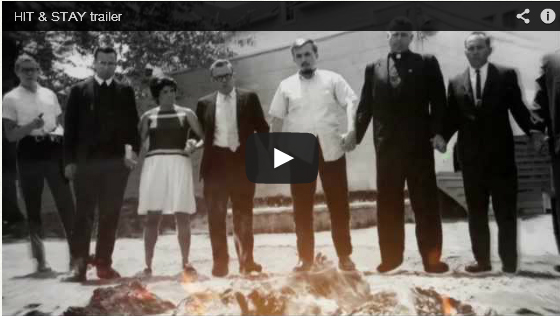
A film by Joe Tropea ’06, ’08, history, premiers locally at the Maryland Film Festival next week. The Baltimore Brew covered the film in a May 1 story entitled “A fiery act of civil disobedience in Catonsville still resonates, 45 years later.”
The Baltimore Sun also wrote about the film here.
“Hit & Stay’ tells the story of nine Catholic activists who protested the Vietnam War by burning draft files in Catonsville on May 17, 1968. Tropea and fellow filmmaker Skizz Cyzyk tell the story using old footage, recent interviews with surviving members of the group and their supporters, images of war horrors, and the reflections of eminences of the Left such as Howard Zinn, Noam Chomsky, Bill Ayers and Amy Goodman.
Tropea undertook the six-year process of making the documentary after writing on the subject for his masters thesis. “I had had no idea about the amount of strategy and coordination and about how all these things were connected,” he told Baltimore Brew.
“Hit & Stay” will have two screenings at The Maryland Film Festival. (Tickets available here.)
• Thursday, May 9, 7:30 p.m. at Charles Theatre, 1711 N Charles St.
• Saturday, May 11, 1:30 p.m. at MICA’s Brown Center, 1300 Mount Royal Ave.
The anniversary of the action will also be commemorated with a May 10 event at UMBC, “Looking Forward from the 45th Anniversary of the Catonsville Nine Actions.”
Pitcher Clark ’06, Psych, Picked Up By Orioles for Seattle Series
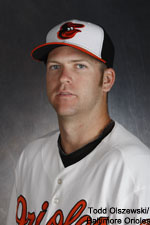 UMBC alumnus Zach Clark ’06, psychology, has been called up by the Baltimore Orioles to join the team for their series with the Seattle Mariners at Safeco Field in Seattle, the organization announced on yesterday afternoon.
A right-handed pitcher, Clark becomes the third Retriever to make a Major League squad, following in the footsteps of former UMBC students Jay Witasick and Wayne Franklin who combined to throw in the majors for 19 seasons.
Clark started the season with the Orioles’ Triple-A affiliate, the Norfolk Tides, after being signed to Baltimore’s 40-man roster back on October 31, 2012. He reported to the Birds’ Spring Training camp in Sarasota, Fla. in February before being assigned to Norfolk to start the regular season.
Clark has made five starts with the Tides so far this spring going 1-2 with a 4.56 ERA. In his last start, the 29-year old minor league veteran threw seven scoreless innings against Charlotte while scattering four hits. The right-hander struck out seven batters while walking just one.
Clark competed at UMBC from 2002 until 2006, when he signed as an undrafted free agent with the Orioles. While with the Retrievers, Clark made 41 starts, the third-highest total in school history, while also striking out 171 batters, the sixth-highest total for the Retrievers. In his senior year, the right-hander went 1-6 while posting a career-best 3.86 ERA. Following the season, Clark earned a bachelor’s degree in psychology from UMBC.
After signing with the Orioles in 2006, Clark was shuffled through the organization until he shored up a spot in the team’s plans last season. Following a year in which he went 10-9 with a 5.00 ERA at Double-A, the former Retriever turned around his fortunes in 2012 by winning ten of his 15 decisions and recording a 3.19 ERA for the Bowie Baysox while also making spot starts for Norfolk. He was rewarded with a spot at the Eastern League All-Star Game in early July and then earned a full promotion to the Tides in August. Ending the season with a three-hit, complete-game shutout of Gwinnett, Clark finished the season with a 5-2 mark and a 1.75 ERA in Norfolk.
The Orioles, who are in the midst of a season-long 11-game road trip, currently sit in third in the American League East with a 15-11 record, 3.5 games behind the Boston Red Sox. After Baltimore finishes this three-game series with the Mariners on Wednesday, the team heads to Los Angeles for a four-game set against the Angels before heading back to Camden Yards for a three-game home series against the Kansas City Royals on May 7-9.
A Tradition of Giving From UMBC’s Earliest Years
UMBC is a community that gives. Nearly each day in the breezeway next to The Commons, one might stroll by multiple tables occupied by students raising money for this charity or that. Our faculty and staff give annually in support of UMBC and organizations supported through the Maryland Charities Campaign. And, of course, alumni dedication to UMBC spans decades — starting with the first graduating class, in fact.
In a guest post on UMBC’s Breaking Ground blog, UMBC archivist Lindsey Loeper ’04, American studies, recently uncovered evidence of a truly momentous philanthropic action made by the Class of 1970:
The first senior project that I can locate in UMBC’s history is from 1970. The class of 1970 is often referred to as the Founding Class, because the graduates were the first group to complete all four years of their degree at UMBC. As in the origin stories of many of our campus traditions, UMBC students decided to forge their own path. During the Spring 1970 semester, a group of seniors organized to collect donations from the UMBC community as well as area businesses. Their goal was to establish a campus fund to assist students that were having trouble paying their full tuition bill.

According to the 1970 edition of Skipjack, the early UMBC student yearbook, the final total collected was $13,000, which is equivalent to more $75,000 today! For in-state students in 1970, a year of tuition at UMBC cost just $506, so a $13,000 emergency fund would have helped quite a few of them continue taking classes and working toward their degrees.
We’re so happy to see the celebration of student philanthropy on the Breaking Ground site not only because it was a truly generous moment shared by the Class of 1970, but because it signifies a spirit of giving that continues to live in our current students. And, it serves as an excellent segue to a new initiative that will be launched soon to help current students use the most modern online techniques to raise money for UMBC-based projects. Stay tuned for more on that!
Haines ’12, VisArts, to Show Paintings at Catonsville Gallery
 Alumna Kimberly Haines ’12, visual arts, will display a collection of paintings centered around the theme “New Skies” at the David Mikow Art Gallery in Catonsville starting later this week. An opening reception will be held at the gallery on Friday, May 3, from 5 to 7 p.m.
“New Skies, is full of new planets and surreal landscape paintings created with a variety of different mediums including watercolor, spray paint and acrylics,” said Haines, who was part of the gallery’s inaugural show with four other UMBC alumnae last fall. This is her first solo show.
“I am ecstatic to see so much of my own work line the walls of an art gallery,” she said.
The David Mikow Art Gallery is run by UMBC political science professor Carolyn Forestiere and her husband, Asher. For more information, including directions to the gallery, visit the gallery’s website here.
Read more about the gallery in this story featured in UMBC Magazine.
Black and Latino Senior Reception 2013
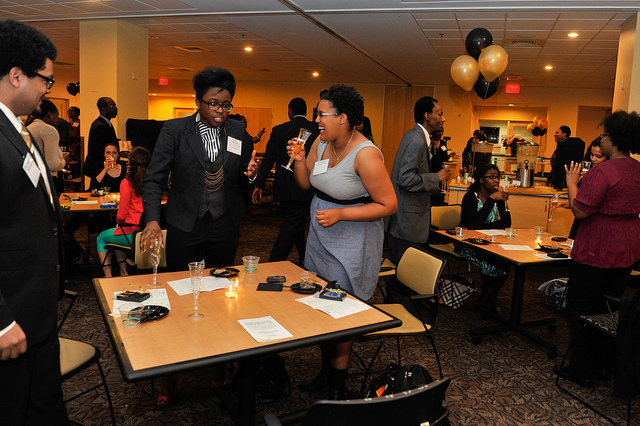 The Chapter of Black and Latino Alumni and the Office of Student Life’s Mosaic: Center for Culture and Diversity hosted the Black and Latino Senior Reception yesterday to celebrate the achievements of the Class of 2013. This annual dessert reception presents a great opportunity for black and Latino alumni to connect and network with some of our newly graduating seniors.
Congratulations to all! See a full slideshow of photos from the event here.
NYT Profiles College Sweethearts Hayes-Bohanans ’86 in “Making it Last” Column
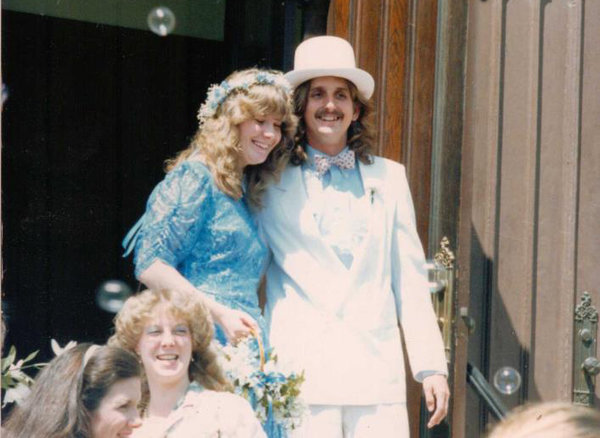 In an ongoing series on baby boomers who have been married for 25 years or more, the New York Times this week featured Retriever alumni sweethearts Pam and James Hayes-Bohanan ’86, who met and fell in love at good old UMBC. The pair, who now live and work in Bridgewater, MA, graduated with degrees in modern languages & linguistics and geography, respectively.
Read the full story in the New York Times here.
The interview recounts the early days of their relationship, when they met in a French class at UMBC; their travels together to attend grad school, and trials along the way; and their lives together as parents. They will celebrate their 26th wedding anniversary this May, the story said.
Asked what makes their relationship last, they told the Times:
Pam: Early on in our marriage we went to this couples communication workshop and we learned this very simple thing: you have to stop and thank your partner for whatever they did for you that day. Whoever took the garbage out, whoever changed the diaper; we always stop and remember that somebody did that so you didn’t have to.
James: But I would also say it was just picking the right person.
Q&A: Fleischer ’05, ’08, MechEng, To Compete on Discovery’s “Big Brain Theory”
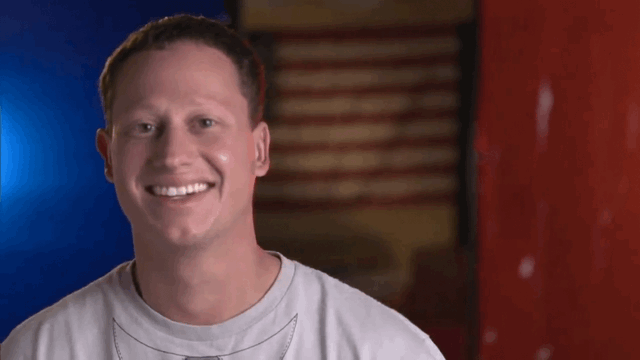 Corey Fleischer ’05, ’08 M.S. mechanical engineering, zooms a homemade Wii-controlled car around his driveway by day, and rules the demolition derby by night. He geeks out about nanotechnology, blows up light bulbs in his microwave in the name of fun and science, and always seems to be concocting plans for his next big idea.
So, when the opportunity to appear on the Discovery Channel’s new engineering-based reality show, “The Big Brain Theory: Pure Genius,” arose the senior mechanical engineer at Lockheed Martin jumped at the chance to show off his skills.
The series, hosted by actor Kal Penn, launches on Wednesday, May 1st, with Fleischer among the 10-person cast of extreme DIY-ers each trying to out-engineer the other to win a $50,000 prize and an engineering dream job.
We sat down with the father of two to find out more about what makes him tick…and what to expect from his appearance on the show.
[youtube http://www.youtube.com/watch?v=cgPzs6EBOsE]
Q: How did you hear about BBT? And how crazy was it when you found out you were chosen for the cast?
A: I first heard about BBT through a good friend at work. My buddy forwarded me the call-for-applicants webpage which was announcing a new TV show looking for the Top Engineer. They wanted hands-on engineers with outgoing personalities. My buddy thought I was a good fit, and he even helped me write my application and recorded and edited my audition video. See the audition here.
When I found out I was picked, I flipped out! It was crazy at first to know that I got picked!…but then it quickly set in that I was going to be on TV…which I’ve never been before.
Q: Your brain is clearly constantly formulating new ideas. What’s your dream invention?
A: My dream invention would be some type of engineering toy set for young kids. I have a 6-year-old son and a 2-year-old daughter and I’m always coming up with simple projects to show them engineering principles…they love it! I think all parents should introduce their kids to engineering at a really early age. Or, maybe I’d like to invent an laundry folding machine. Laundry folding and I don’t get along.

Q: I know you were a part of Mini-Baja (now SAE) at UMBC. How did that and other UMBC experiences help you get to where you are now?
A: Coming from UMBC, I feel like I hit corporate America with an unfair advantage. Participating in Mini-Baja had given me years of experience within/leading a technical team in a competition environment. Engineering is highly competitive, so that was huge. Additionally, my undergraduate and graduate studies under Dr. Mark Zupan gave me a strong background in material science that I apply toward all stages of engineering projects, from hardware selection to geometrical design to finish coatings.
Q: Tell us a little about your work at Lockheed Martin…and what you’d love to be doing in the future.
A: At Lockheed I get to work on several projects simultaneously. We have a large group here in Baltimore so there are always several projects going on that I’m able to support. I work under lots of smart guys…I love it here. As for the future, I just want to keep working on great projects with great people. As long as I continue to learn, I’ll be happy.
Q: You obviously can’t divulge the outcome of BBT, but what was one of your favorite parts of doing the show? How about challenges? Any nemeses we should look out for?
A: The design challenges were my favorite part of the experience. They were amazing! Every time they told us about a new challenge I thought, “I can’t believe someone’s going to pay me to build this!” Every challenge could be a paragraph on my resume…and I got to build eight!
The hardest part of the experience was being away from my kids. That was tough, but I knew they’d be proud, my son especially since he’s older. There was also a lot of drama that we all had to deal with, but I stayed out of it as much as I could. The whole experience was amazing! We pulled off some crazy accomplishments, and it’s going to be an amazing show. Nothing like this has ever been done.
– Read about Corey’s latest venture – a “makerspace” in Baltimore
Follow Corey on Twitter @coreyfleischer for updates and behind-the-scenes info about the show!