All posts by: Magazine Editor


Video: The Beats Go On

In Spring 2012, we wrote about Jerry Cimino ’76, history, founder of San Francisco’s Beat Museum, which he founded in 2003 at 540 Broadway to pay homage to a generation of writers and artists who continue to inspire him. In this video, watch Jerry recite from memory “Sometime During Eternity” from Lawrence Ferlinghetti’s A Coney Island of the Mind.

Read his full story, The Beats Go On, here.

Video by Jenny O’Grady.

Scholarship Success: Paige Khoury '12

Each year, the Alumni Association Scholarship program helps amazing students succeed at UMBC. Over the next few weeks, we’ll be sharing some of their stories with you. This week, meet scholarship recipient Paige Khoury ’12.
When you meet Paige Khoury ’12, dance, it’s easy to see why the new grad has trouble sitting still. Not only does she dance and choreograph, she’s also a dedicated volunteer – and even, recently, a budding filmmaker.
As one of four Alumni Association Scholarship winners for the 2011-2012 school year, Paige puts her passions to work wherever she goes, and UMBC is all the better for it.
“Dance helps my soul thrive,” said Khoury, whose choreographed piece, “Catalyst,” was performed by other students in the 2012 UMBC’s Undergraduate & Creative Achievement Day. “There really aren’t words to describe it. Dance is something that anyone can do…anybody is capable of it, and I love that.”

From “Catalyst.” Click to enlarge.

While dancing takes up a lot of her time, Khoury also truly enjoys giving back through volunteer work. She spent a month in Haiti during the summer of 2010 helping earthquake victims rebuild their lives. The volunteering – which she completed as a part of her church’s mission work – shaped her world outlook, she says.
“We helped out at an orphanage with 50 children in it that was run by one woman all by herself,” she says, showing off a bracelet given to her by a little boy named Albert, who latched onto her her first day in the torn country.
“I cherish this,” says Khoury, who has stayed in touch with Albert, and who is working from afar to raise money for the people in his village.  “He had nothing, and he gave this to me…he showed me that possessions aren’t important. Only people are important.”
Newly graduated, Khoury is taking some time to figure out what she wants to do long term. She knows she wants to help people. She wants to dance. Perhaps she could combine the two somehow, she says.
Ever grateful for the chances her scholarships gave her (she also earned a partial Linehan Artists Scholarship for dance), she also hopes to stay involved with UMBC.
“Every year, I’ve struggled to pay for school,” she says. “The scholarship allowed me to pursue dance and the things I love…it really helped make this year great. Thank you.”
* * * *
– As a sort of going away present to the Class of 2012, Paige orchestrated (and choreographed!) a video “lip dub” entitled “Study Rock Anthem” (to the tune of “Party Rock Anthem” by LMFAO). Watch it here

Scholarship Success: Paige Khoury ’12

Each year, the Alumni Association Scholarship program helps amazing students succeed at UMBC. Over the next few weeks, we’ll be sharing some of their stories with you. This week, meet scholarship recipient Paige Khoury ’12.

When you meet Paige Khoury ’12, dance, it’s easy to see why the new grad has trouble sitting still. Not only does she dance and choreograph, she’s also a dedicated volunteer – and even, recently, a budding filmmaker.

As one of four Alumni Association Scholarship winners for the 2011-2012 school year, Paige puts her passions to work wherever she goes, and UMBC is all the better for it.

“Dance helps my soul thrive,” said Khoury, whose choreographed piece, “Catalyst,” was performed by other students in the 2012 UMBC’s Undergraduate & Creative Achievement Day. “There really aren’t words to describe it. Dance is something that anyone can do…anybody is capable of it, and I love that.”

From “Catalyst.” Click to enlarge.

While dancing takes up a lot of her time, Khoury also truly enjoys giving back through volunteer work. She spent a month in Haiti during the summer of 2010 helping earthquake victims rebuild their lives. The volunteering – which she completed as a part of her church’s mission work – shaped her world outlook, she says.

“We helped out at an orphanage with 50 children in it that was run by one woman all by herself,” she says, showing off a bracelet given to her by a little boy named Albert, who latched onto her her first day in the torn country.

“I cherish this,” says Khoury, who has stayed in touch with Albert, and who is working from afar to raise money for the people in his village.  “He had nothing, and he gave this to me…he showed me that possessions aren’t important. Only people are important.”

Newly graduated, Khoury is taking some time to figure out what she wants to do long term. She knows she wants to help people. She wants to dance. Perhaps she could combine the two somehow, she says.

Ever grateful for the chances her scholarships gave her (she also earned a partial Linehan Artists Scholarship for dance), she also hopes to stay involved with UMBC.

“Every year, I’ve struggled to pay for school,” she says. “The scholarship allowed me to pursue dance and the things I love…it really helped make this year great. Thank you.”

* * * *

– As a sort of going away present to the Class of 2012, Paige orchestrated (and choreographed!) a video “lip dub” entitled “Study Rock Anthem” (to the tune of “Party Rock Anthem” by LMFAO). Watch it here

A SIRI-ous Mind

Siri-ous Mind

British writer and scientist Arthur C. Clarke once wrote that “any sufficiently advanced technology is indistinguishable from magic.”

And for many of us, that’s exactly how the beeps and pings and connecting dings that keep our schedules, steer our cars to the right destination, and even maintain our bonds with family and friends over great distances seem to work. Like magic.

But to the humans behind the technologies – including Silicon Valley-based UMBC alumni at Apple and Google – it’s anything but abracadabra. It’s a combination of hard work, entrepreneurial drive and visionary imagination at its geekish best.

Let’s meet some of the minds behind the magic of our technologies.

by Jenny O’Grady

Photos by Timothy Archibald. Illustrations by Meredith Nelson.

* * * *

Siri-ous Mind

How a UMBC alumnus found more than (voice) recognition for his work on the iPhone’s enigmatic Siri technology.

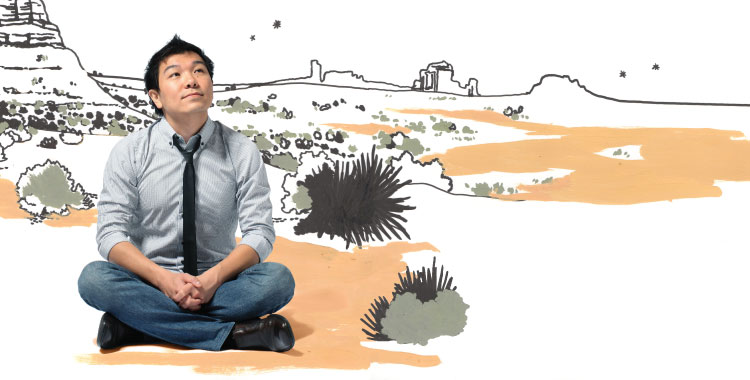
Sometimes, Harry Chen needs to get away. Far away.

When he’s surrounded by the sands of Death Valley, California, even the GPS can’t find him. He can’t check his email, or video chat with his parents in Hong Kong, or stream music from his favorite Pandora station. And he likes that solitude.

“Sometimes you’ve got to go to the desert,” says Chen, a UMBC computer science alumnus (B.A. ’98, M.S. ’00, Ph.D. ’04) who helped develop Siri, the voiceresponsive “personal assistant” found inside the latest Apple iPhones.

“You stay out there, and when you come back, you see such a big contrast of civilization,” he continues. “And it makes you appreciate life a lot more. Everything we created – one way or another – is kind of superficial, but also kind of essential.”

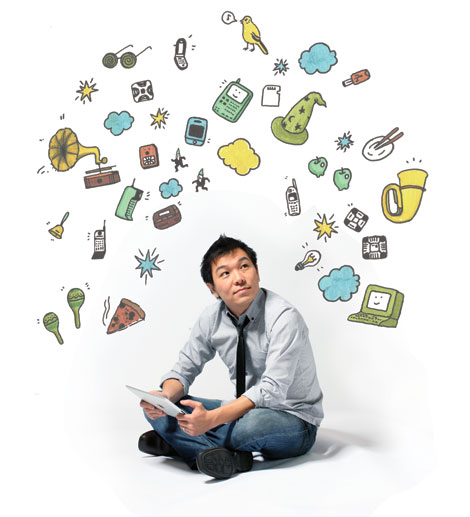
In a world where computing has left the desktop and lives in the clouds, Chen is a bit of a tech superstar. The work that he and his colleagues have done makes it easy for everyone from tweeners to grandfolks to whisper wishes into the palms of their hands to find the closest pizza, send an email or solve a math problem.

Reflecting on his short-yet-impressive career, the energetic 35-year-old software engineer is quick to note the importance of the nearly ten years he spent at UMBC. He says that the people and the environment of discovery at the university helped shaped him into the kind of thinker capable of seeing models and years ahead to the next cool thing.

Building The Basics

Like many blossoming tech geeks in the early 1990s, Chen first contemplated the inner workings of computers as a teenager, sitting at home in Hong Kong, his thumbs occupied by the bright red buttons of that era’s ubiquitous Nintendo controller.

“While I was playing, I’d get so curious. How did all those characters come about? I started thinking about how some games would make very predictable moves, and why some are not predictable at all,” he says. “Later on, my dad bought me a computer…and the games on that were sort of like the ones with a snake going in different directions. It made me very interested in understanding more about computer instructions.”

When Chen left home for Towson University in 1994, the world of web-based computing was just beginning to blossom. At the urging of his parents, he began a course of study in pharmacy, but a job opening at the campus library allowed Chen to help customers with computers. He started building simple websites with his friends. After taking a few classes, Chen discovered he had an aptitude for programming.

Suddenly, the future – including a transfer to UMBC – seemed obvious to him. It didn’t take Chen long to make himself at home in the university’s computer science department, where he turned artificial intelligence algorithms into Java code for computer science research projects, won highly-sought internships at Hewlett-Packard, and generally wowed his peers.

“One thing we always liked so much about Harry is that he liked to charge into things,” says Dr. Tim Finin, a professor of computer science and electrical engineering who specializes in artificial intelligence and who served as Chen’s Ph.D. advisor. “He was not afraid to just drop in and start working on something.”

At the time, many of UMBC’s computer science researchers focused on pervasive computing – which aims to unobtrusively connect and share data between the many devices in our lives. Chen took to it like a teen to texting, and reveled in collaborating with fellow students to test new ideas.

“Harry was, and probably still is, very good at that level. He could very effortlessly turn ideas into working prototypes,” says Finin. “It’s a really significant skill to be able to have an idea and then very quickly test it out…to be able to implement enough of it to get some feedback to know whether it’s a brilliant idea, whether it’s something that will pan out.”

The Smartest Room in the Building

Smart roomMany computer science students at UMBC take jobs right after they finish undergraduate studies. But an iffy job market in the late 1990s and then the dot.com bubble’s burst a few years later kept Chen in school.

Chen’s decision to wait to test the market turned out to be a good one. He used that time to develop a concept that helped shape his future research.

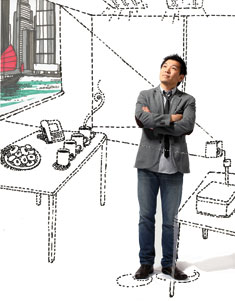
Imagine a room that answers your questions, or anticipates your needs and then fulfills them. Chen imagined that room – and then figured out how it might be brought to life.

“The graduate student’s life is really about exploration and to be free to identify your interests,” he says. “It’s almost like an accident when you find something you really like to work on and you just know it.”

Chen had spent some time interning at the Hewlett-Packard Labs, which were – at the time – at the forefront of mobile computing research and development. So when Chen returned to UMBC, he figured out what he wanted to design: a conference room broker. This system would retrieve and translate data from the devices within the room itself to solve problems for occupants while also considering user-privacy issues.

“So you walk into a meeting room,” Chen explains, “and the room understands how many people are in that room, what those people do…so the room says, ‘Oh, there’s a projector,’ and the projector would say, ‘I want to show a PowerPoint presentation. I can do that.’”

The smart room would also locate the presentation on Chen’s phone, download it, and show it – after automatically darkening the room. It might know that one of the meeting attendees wants a copy of the PowerPoint, and then simply download it to their phone. The room might even detect that an attendee’s hotel room is several miles away – and offer to call them a taxi.

“The idea is that people will use technology without thinking about it, which is just like you pick up chopsticks or a utensil and you just use it, you don’t think about it,” he says. “So that’s an idea, to try to encourage people to build technology for everyday people, to solve everyday problems.”

Imagining this room would help Chen shape his later work.

Taking Chances – and Detours

Following graduation from UMBC, both Chen and his wife Gigi Yim, who earned a bachelor’s and a master’s degree in information systems from UMBC in 2004 and 2007, pursued jobs in the Baltimore area. They even bought a house.

But the lure of Silicon Valley – and the fast-paced, creative life it offered – called to Chen.

“At one point, I thought: life is too short. I woke up one morning and I wrote my wife an essay and I said these are the reasons why we should just move to the West Coast,” he says, smiling. “Kind of like writing a paper: these are my reasons. I sent the email in the morning, and in the evening, I come home, and she says, ‘OK. Let’s do it.’”

Within days, they were looking for new jobs and making plans to move west. Yim took a job at Netflix, and Chen wound up at a vaguely-named startup working on a secret project involving voice recognition. (This startup – Siri – would later be bought by Apple.)

Right away, Chen felt confident they had made the right choice.“There’s a mentality here among a lot of people…a sort of hunger drive to make something” in Silicon Valley. “I always feel like you capture people’s smartness in thin air here,” he adds. “Somehow, you just breathe in people’s knowledge.”

“Harry, from day one, was pretty clear. Silicon Valley was where he wanted to end up,” says Dr. Anupam Joshi, a professor of computer science and another of Chen’s graduate school advisors. He observes that some students simply crave the risk and reward of the Silicon Valley environment.

“Some of it could be – for all we know – genetic hard wiring,” Joshi says. “That is why some people become race car drivers and others, like me, drive five miles below the posted speed limit.”

Valley Life: 101

Drive down Route 101 from San Francisco, and you see signs of our burgeoning tech civilization everywhere.

Billboards touting the latest cloud software. Silver-sided buildings in seemingly endless business parks that are home to startup upon startup. Even the street names themselves – like Apple’s famous Infinite Loop, or the punningly named Disk Drive in San Jose – conjure images of innovation and dreams.

Strolling around the manicured Apple campus in Cupertino, California, Chen speaks quickly. Excitedly. He says Silicon Valley is a place where ideas can be imagined without fear, where innovation is rewarded.

“People here have a passion for technology and innovation,” he says. “They want to change the world. They take risks. Most of the time they fail, but sometimes they succeed. So they step out, dream up some crazy idea and say ‘If I fail, fine. I’ll dream another one.’”

Even so, Chen acknowledges that nothing happens overnight. If you think about the gadgets that have occupied your pockets over the last 10 years, the technology required to power them crawled more than it leapt. The palm-held organizers of the mid-’90s, for example, were little more than tiny personal computers; today’s equivalent relies on web networking and interaction with other devices. Who knows what tomorrow’s devices will look like?

“Especially in the [artificial intelligence] research field, you can’t just jump to the dream right away,” Chen says. “You kind of have to think about yourself climbing a mountain. You have to do the work to get up there…you can’t just shoot straight up because that’s impossible. And once in a while you will have to make a detour, and because certain technology or culture has changed, you have to adapt to that.”

Back at UMBC, Joshi acknowledges that Chen’s metaphor is rooted in the reality of how creativity works. “That’s part of the fascination of this field, I think, going back to the creative process,” he says. “So much is yet not done. So much power is available through the computational process…we just have to channel it. We’ve barely scratched the surface.”

For Chen, it’s often enough just to see these products in use by the people he loves. When he was an undergraduate student, he communicated with his parents in Hong Kong by hand-written letter; today, he uses FaceTime to video chat with them whenever he wants.

Chen isn’t able to discuss what he’s working on now at Apple – a company known for keeping a tight leash on its ideas and products until they are introduced. But when you ask Siri a question on your new iPhone and get an answer, consider yourself at the doorway of Chen’s smart room, engaging with his work.

“It feels surreal,” Chen concludes, “because the things I talked about four or five years ago seem like a dream, and today, it doesn’t seem like a dream anymore.”

Read about UMBC alumni working at Google here.

Gray New World

Students in the Erickson School’s Project 2061 class have high expectations for technology and its power to meet human needs. Working across disciplines, they’ve created new possibilities for the future of senior care.

By Dinah Winnick
personas

It’s hard to imagine ourselves five years into the future, let alone 50. But one group of UMBC students has confronted this challenge head-on in search of inspiration for new designs to improve the lives of older adults.

Their course, “Project 2061” was spearheaded by the Erickson School, UMBC’s newest college. Founded in 2004, the school offers undergraduate and graduate curricula that combine the studies of aging, public policy and management.

The Erickson School created Project 2061 after being invited to showcase UMBC student research at a conference on the future of aging. The project quickly attracted faculty and students from engineering, information systems, design, management of aging services (MAgS) and interdisciplinary studies (INDS) to collaboratively develop new technologies for older adults living in the year 2061.

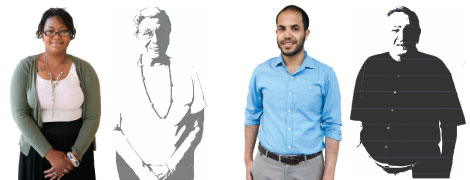
As it turns out, the endeavor’s success hinged on something simple and personal: students’ reflections on their own imagined future needs and desires. The class created three avatars based on students’ life experiences – “Abdulla,” “Ashley,” and “Spencer” – to help them explore both the problems aging can bring and how design can meet those challenges.

“Abdulla,” for instance, was based on Project 2061 participant Abdulla Aljneibi ’12, mechanical engineering. His avatar is 90 years old and recovering from a stroke that has left him struggling with memory, speech and motor impairments. Yet he is determined to live independently and enjoy activities such as cooking, daily prayer and going to the theater.

For Judah Ronch, dean of the Erickson School, creating personas like “Abdulla” proved the key to making Project 2061 click.

“This is always the challenge in teaching about aging,” says Ronch, “Until you make it about us it’s very removed. If it’s always about them, it’s highly abstract, it’s not very real, and there is not a sense of urgency about it because [typical students] are 25 or 20 and we’re talking about 60 years down the road.”

Everything changes, Ronch observes, “once you start talking about yourself and [asking], ‘How will this affect me?’”

BUILDING A TEAM

classroom

In May 2011, LeadingAge — a research and advocacy group focused on the lives of older adults — asked the Erickson School to create an exhibit on the future of aging.

LeadingAge planned a celebration of its 50th anniversary in October 2011 with a conference that would bring 8,000 participants to Washington, D.C. The group wanted to highlight dramatic changes in senior living from 1961 to the present, and also articulate a bold vision for the next 50 years.

Ronch says the exhibit “was an opportunity we couldn’t pass up.” So he recruited faculty and students from across UMBC to create the school’s presentation as part of a new, boundary-breaking course in the Erickson School.

To teach the class, Ronch enlisted Tim Topoleski, a professor of mechanical engineering who studies mobility and the mechanics of joint replacements. Catherine Neylan, assistant professor of design, and Amy Hurst, assistant professor of information systems, followed, attracted to the course by their shared interest in design for people with disabilities.

These faculty recruited students from a range of majors. Neylan observes that technology and social problems are now so complex that “we need collective intelligence to build the things that we build.”

Eventually, 19 UMBC students joined the effort. Early in the process, MAgS major Joe Yoon proposed that the class should create specific design personas based on students in the course and then craft flexible technologies to meet those avatars’ specific needs. His idea was a game-changer.

“In all of our scenarios of how this would be used,” recalls Hurst, “we never said, ‘How would grandma use this?’ We said, ‘How would I use it in 50 years.’ I think that fundamentally changed a lot of the designs [and] helped the students be more creative and engaged.”

Yoon’s proposal also forced students to ponder uncomfortable possibilities. As Steven Hall, a junior majoring in graphic design, observes: “I don’t think anybody’s going to want to think, ‘What’s my life going to be like in 50 years? I’m going to have cataracts and be overweight. I’m going to have my foot amputated from diabetes.’”

The students had to deal with uncertainties about their lives and the world in 50 years. “You can’t take the current older adult population and simply throw them 50 years into the future,” argues Colleen Bennett, a gerontology Ph.D. student and Project 2061 teaching assistant. The project depended on young people confronting their own fears and desires for later life.

“Every generation is different, and then they age,” says Hurst. “Traditionally, people are very bad at abstracting and predicting what they would want in the future, but they can tell you what they want now and how they feel about things.”

REALIZING A VISION

The three personas gave Project 2061 students a concrete foundation to build on.

“Once we had a starting point,” says Aljneibi, “the ideas started flowing.”

The class worked quickly to conceptualize, research, and render designs for technologies to meet functional needs: eating, sleeping, hygiene, and entertainment/social engagement. Living environments in the future might be quite different, they reasoned, but basic human needs will remain the same.

Occasionally, there were hiccups. The blurred lines of interdisciplinary work and the indefinite nature of the problems that the project aimed to address frustrated some of the students, especially early in the process.

“You would think design and engineering would be closer, but they both want to have a product and their process is so different,” observes Meyerhoff Scholar Jasmine Jones ’12, computer science and INDS. At times, she adds, students misinterpreted their failure to communicate across a disciplinary “language barrier” as actual disagreement over ideas.

“They are beginning to learn that the real world is not as clear-cut as their well-designed classes,” says Hurst.

In four weeks, however, a dozen designs took shape, all of them informed by contemporary technologies and targeted to meet users’ specific needs.

One group devised a “Smart Closet” that reminds users with memory and other cognitive impairments when and how garments need to be cleaned. It also lets users know when they last wore a favorite dress or tie, and even what clothing is appropriate for particular activities or occasions.

Another design team emerged with a “Lavish Lavatory”—which auto-adjusts toilet and rail height to account for changes in strength and balance over time. The design’s flexibility means it can help communal facilities better meet the needs of diverse individuals. It also discreetly and unobtrusively monitors waste and automatically sends relevant health data to each user’s physician.

Eating properly is important at any age, so another group designed a “FoodPro,” that monitors the refrigerator and pantry, keeping track of grocery inventory, expiration dates and nutritional content. It also helps users prepare meals that meet their particular dietary needs, taking into account health conditions, lifestyle choices and food preferences.

These projects formed the core of the Erickson School’s LeadingAge exhibit— “My Surroundings, My Well-Being”— which centered on personal experiences with technology.

The student designers took the exhibit opportunity as a chance to demonstrate how individuals would use their products in home environments. They acted as docents to the conference exhibit, explaining to visitors how each invention would serve “Ashley,” “Abdulla” and “Spencer” in their future lives.

Helping people connect with the exhibit in a personal way was a priority for Aljneibi—and not simply because he lent his identity to the design process. He also belongs to a close-knit multigenerational family with a grandmother facing mobility problems.

“When she goes into the shower,” he says, “it’s always in our heads: ‘What if she slips? What if she falls?’” For his family, respecting her boundaries means resisting the impulse to help her in the shower. In what ways could his team’s designs enable her, and people like her, to more safely bathe by themselves?

Though he approached the course from a neuroscience background, Talmo Pereira, an INDS major and Meyerhoff Scholar, took the tenets of user-centered design to heart.

“Considering that the environment should adapt to the user,” he suggests, “the mutability of the environment is one of the things that will most compensate for differences in culture and preferences, and certainly limitations.”

The exhibit received an enthusiastic response from vendors, senior care professionals, and LeadingAge organizers, who immediately invited the students back for 2012.

FULL SPEED AHEAD

Creating an exhibit with an October deadline left everyone involved in Project 2061 with the question of how to best make use of the rest of the semester. Focus on prototyping the exhibit designs or generate new concepts? Continue team projects or pursue independent research? The answer was different for each participant.

Aljneibi chose to continue his team project on bath designs. “When I came to the States I wasn’t fine with communal bathing, especially in the gym,” he reflects. “I used the handicapped one because I needed my privacy.” For him, this experience— uncomfortable though it felt—was an inspiration. After all, if the United States continues to grow increasingly diverse, certainly consumers would appreciate flexible bathing technologies.

Steven Hall ’11 and Pavlo Yankovetz ’11, both in graphic design, explored how visualizing health data in particular ways may offer older adults a sense of self-awareness and empowerment. They argue that information can motivate or stifle health-seeking behaviors, depending on how it is conveyed. “If you’re just giving someone numbers, that’s not helpful or useful. We want those numbers to mean something,” says Hall.

Meyerhoff Scholar Deanna Easley ’12, mechanical engineering, worked to develop safer flooring for older adults, who are often injured in falls. Having broken her own wrist in a fall, Easley understood the mental and physical traumas of injury and lengthy recovery.

“People told me, ‘At least you didn’t break the hand you write with,’” recalls Easley. “But I’m a pianist. I need both hands.” With a deep understanding of how injury can wreak havoc on one’s sense of self, plus input from MAgS students, Easley designed flooring that would not only enhance safety, but also offer aesthetic appeal and emotional comfort to potential consumers.

INNOVATION STARTS AT HOME

Academic leaders at UMBC applaud the new class, arguing that it breaks new ground at a university already known for its commitment to promoting undergraduate success through active learning.

“Project 2061 represents a striking example of UMBC’s ability to create innovative and multi-disciplinary approaches to teaching and learning that address significant future challenges,” says Provost Philip Rous.

“In the process of researching real problems, our students not only gain knowledge, they also co-create knowledge and contribute to the field,” says Diane Lee, Vice Provost and Dean of Undergraduate Education.

Connecting research to reality and realizing its potential for lasting impact isn’t simply a hypothetical draw to students. For Meyerhoff Scholar Jasmine Jones, Project 2061 is about “actually making a difference right now” rather than just “writing up a piece of code and turning it in.”

Ashley Johnson ’12, MAgS, who helped her classmates understand the needs of “Ashley,” a 111-year-old former psychologist who loves to garden and meditate in the year 2061 but struggles with dementia, diabetes and hearing loss, agrees: “I’m never asking, ‘Will I use this in the future?’ I know I will.”

Students aren’t the only beneficiaries of this work. As Don Engel, Assistant Vice President for Research, articulates: “Universities support research both to expand human knowledge and to engage students in the forefront of their disciplines. Project 2061 demonstrates how interdisciplinarity and a focus on real-world challenges produce compelling results and provide a valuable education to students and faculty alike.”

Part of Project 2061’s success, it turns out, was also rooted in participants’ refusal to play it safe. Not only did they take risks with ideas, but students and the faculty broke out of their intellectual comfort zones when they crossed disciplinary boundaries.

When you predict the future, says Ronch, “you have to be prepared to be wrong.” This kind of risk-taking requires what he calls “a special kind of iconoclasm: looking at a blank space and seeing what could fill it.”

Search Engineers

Search Engineers

British writer and scientist Arthur C. Clarke once wrote that “any sufficiently advanced technology is indistinguishable from magic.”

And for many of us, that’s exactly how the beeps and pings and connecting dings that keep our schedules, steer our cars to the right destination, and even maintain our bonds with family and friends over great distances seem to work. Like magic.

But to the humans behind the technologies – including Silicon Valley-based UMBC alumni at Apple and Google – it’s anything but abracadabra. It’s a combination of hard work, entrepreneurial drive and visionary imagination at its geekish best.

Let’s meet some of the minds behind the magic of our technologies.

by Jenny O’Grady
Photos by Gabriela Hasbun

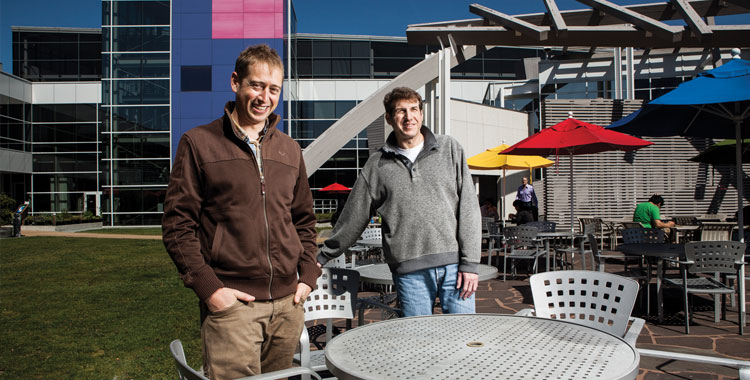
Stroll down the yellow brick walkway that leads to Building 43, and a trio of girls on colorful bikes rides by, dinging their handlebar bells and singing “Hello!”

Take a right, and you’re in a garden of busts that depict everyone from Lloyd Bridges to Jacques Cousteau. Beyond that, a T-Rex skeleton feasts on helpless plastic pink flamingos. There’s a delicious savory breeze – does it come from one of the free cafeterias or the employee-run herb garden? – and a burst of laughter from a group of young engineers playing beach volleyball nearby.

Oh, right: and today’s free haircut day. That’s life in the Googleplex for you.

Google’s headquarters in Mountain View, California, is often depicted as a Willy Wonka’s Chocolate Factory of high-tech geekdom. It’s frequently listed on Top 10 lists of amazing workplaces. But what’s it really like to work at a company with a product so popular that it’s become a verb?

“It is very good to foster a culture where people are engaged, want to be at work, and that allows you to concentrate your time on what you’re trying to do in the day,” says Jeffrey Burgan ’83, computer science, director of network engineering for Google Access, which delivers high speed internet. “People work very hard here, so if the place can take the burden off in other areas – like get an oil change or a haircut, or to have washers and driers so people can do their laundry – it definitely helps.”

Google is known as much for the sheer difficulty of its confounding job interviews as it is for the replica of SpaceShipOne in its lobby. The secret to the company’s success seems to lie in its careful balance of work and play, and other UMBC alumni at Google agree that its unique culture pushes them to be more creative and constructive.

Jeetendra M. Soneja M.S. ’04, computer science, is the tech lead for Google Analytics API. He works in an outlying office, but finds the company culture persists across Google’s many campuses.

“One thing that is common across all the Google offices all over the world is the friendly and helpful nature of the fellow Googlers,” he says. “This leads to a very healthy working environment and is one of the best things why I love working here. The work environment is also fun and relaxing, and yet focused and one that promotes and rewards innovation.”

Robert Banz ’95, computer science, has worked as a site reliability engineer at Google for four years. (“We make sure Google is ‘always on,’” he says.) Before that, he worked at UMBC, which gives him a bit of special perspective about what’s extra cool about working at the Mountain View campus.

“Everyone says it’s the free food options, so I’ll go with something else. I’d say I was surprised how much it felt like a university campus,” he said.

Banz also believes the atmosphere of Silicon Valley is a significant influence on the famed Google culture. “Silicon Valley and San Francisco, but really the entire Bay Area, has this amazing critical mass of passionate creative, scientific, and engineering talent,” he says. “These groups mix socially; mutual curiosity leads to unique ideas. I think that’s the secret to the creative engine, and the source of very engaging and entertaining conversation.”

Sandor Dornbush M.S. ’06, computer science, sometimes runs to work with his black lab, Coltrane. Other times, he takes the free Google shuttle. Today, he wheels his bike into a meeting room playfully covered in a soft padded material. Photos of the Burning Man festival hang nearby.

“Despite all the games, and the food and everything, I honestly don’t think I’ve played a single game of pool in my six years here,” says Dornbush, an engineer for Google Play, who knows his work ultimately comes first.

“People talk about the Google 15 (because of the free food), but I’ve actually found the opposite,” Dornbush says. “For the first time, many people have access to really good food, and they have access to the gym, and they see people around them taking care of themselves, and they start to drop pounds. So despite the fact that there’s all this free stuff, people work really hard. And it’s a culture that encourages that.”

The Beats Go On

Beats Main Image

At his San Francisco museum, UMBC alumnus Jerry Cimino ’76 makes sure the world is still hep to one of America’s greatest literary movements.

By Jenny O’Grady
Photos by Mirissa Neff and Brittany Powell

The Beat Generation was a uniquely American movement – producing pockets of poetry and art across the land. You could find them in 1950s New York City in their early days clustered around Columbia University – or down in the cafes and jazz clubs of Greenwich Village. Some of them found refuge at Black Mountain College in North Carolina. And they drank and declaimed in juke joints across the Midwest and the Southwest.

That restless urge to explore great spaces is at the heart of Beat verse and prose. But if you had to pick an epicenter of the movement, you’d likely choose San Francisco’s North Beach – and specifically the crossroads of Broadway and Columbus Avenue.

That’s where you’ll find one of America’s great literary meccas: the checkerboard-floored City Lights Books, which was founded by poet/ publisher Lawrence Ferlinghetti in 1953. Right next to it is the Vesuvio Café, a popular watering hole of poets like Allen Ginsberg and Jack Kerouac. And just up the street, at 1562 Grant Avenue, young writers spent hours smoking dope on a crooked stairwell called “Poet’s Corner” – and then headed to the press next door to check galleys of the latest chapbook.

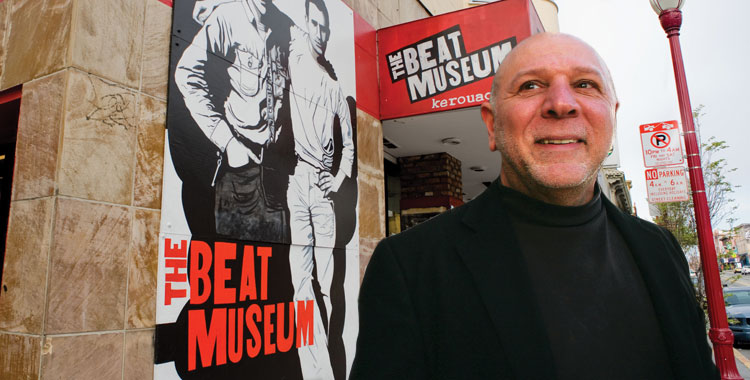
North Beach is also where you’ll find Jerry Cimino ’76, history. From the book-lined open air porch of the Beat Museum, which he founded in 2003 at 540 Broadway to pay homage to a generation of writers and artists who continue to inspire him, he takes in the rich history of this historic section of the city. He savors it. And he can’t help but share it with anyone who will listen.

“What we like to say is: ‘Welcome to the center of the universe,’” enthuses Cimino, with the flair of a modern day P.T. Barnum. “Because you’re at Broadway and Columbus right now – and everything that happened with the Beat Generation happened right here at this intersection.”

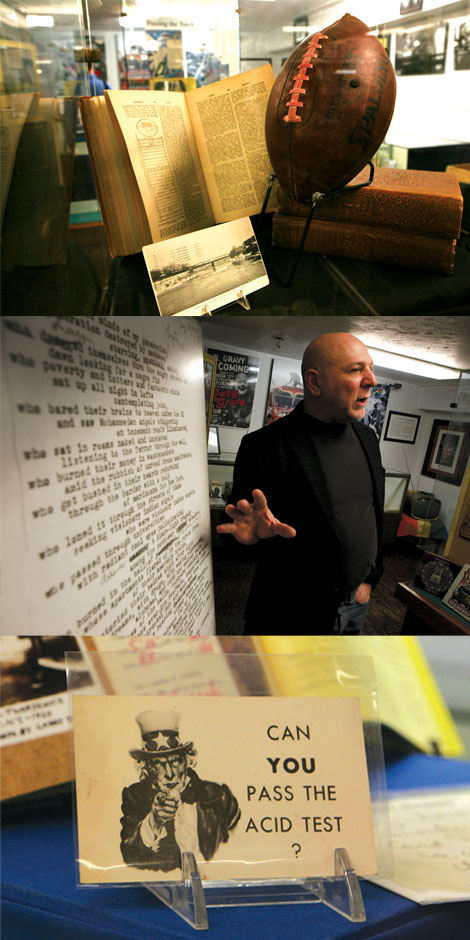
The museum’s walls reflect this, exploding with colorful posters, books, author photographs, drawings and videos covering every surface. One wall is devoted completely to editions of Kerouac’s On the Road from around the world. Another shows an early version of Ginsberg’s “Howl,” complete with scrawling edits by the author – enough to make even the biggest bookworm giddy.

More than 60 years after the Beats’ heyday, the culture has found a true evangelist in Cimino, a determined man driven by respect for the inclusive, nonconformist ideals the Beat authors represented. With a little elbow grease – and some recent attention from Hollywood – he’s on the road to making a lasting tribute to his heroes.

“IT KNOCKED ME OUT”

Beat Museum

Cimino grew up in the suburbs of Baltimore, the son of a WWII vet-turned-postal clerk. His first encounter with the music and movement of the Beat writers came when a teacher read poems from Lawrence Ferlinghetti’s classic collection A Coney Island of the Mind to his eighth-grade class.

“That whole book of poetry literally changed my life…it knocked me out,” says Cimino, who to this day can recite the book’s fifth poem, “Sometimes During Eternity,” from memory.

“You know, 1968 is when it all happened,” Cimino recalls. “Bobby Kennedy was shot and killed. Martin Luther King was shot and killed. The Vietnam War was raging, and all of us kids were looking at each other and saying, ‘What in the hell are we inheriting?’”

When Cimino arrived at UMBC in 1972, he was among the few students actually living on campus at the time, splitting time between what were then called “Dorms 1, 2, and 3.” He says that many of the bonds that he formed in that era at UMBC – including friendships with older students freshly scarred from serving in Vietnam, and with closeted gays who trusted him with their secret – would forever change his own way of thinking. He also enjoyed some time on stage with the theatre club, sharing the bill (but, sadly, never the stage) with one-time UMBC student Kathleen Turner in a 1975 campus production of Antigone.

“For the first time in my life, I was interacting with a lot of people who weren’t like me,” says Cimino. “And that’s what the Beats were all about – coming together and really celebrating your differences… they were about tolerance and compassion and having the courage to live the most authentic life you can.”

Jonathan M. Cooperman, who roomed with Cimino at UMBC before finishing a degree in physical therapy at the University of Maryland, Baltimore, recalls a thoughtful, passionate friend who also had more hair back then.

“He is very much the same guy to me now as he was then,” says Cooperman, who is now a member of the Beat Museum’s board. “If you walked into his room at three in the morning, the door would be cracked open with light pouring out into the hall. If you walked inside, Jer would be sipping tea and reading a book – usually Kerouac.”

Although he loved history and other subjects he’d studied at UMBC, Cimino graduated without a clear career path to follow. So he went with the flow in which he found himself, relocating to California and forging a successful career in sales for both IBM and American Express.

VOICES THAT SPAN GENERATIONS

Beat Museum

Over the years, however, Cimino and his wife, Estelle, started craving something more than a career in business. His continuing affection for the Beat literature he had read as a young man led him to befriend John Cassady – the son of Kerouac’s friend Neal Cassady, who is immortalized in the character of “Dean Moriarty” in On the Road.

Cimino also began building a collection of Beat generation memorabilia which eventually became “The Beat Museum on Wheels” in 2003. And just as Dean Moriarty took off across the country with Sal Paradise (the character representing Kerouac himself in On the Road), Cimino and Cassady drove “the mighty beatmobile” across America’s highways in October 2005 – even parking it overnight in Commons Circle at UMBC.

Cimino says he reveled in the chance to share his growing collection with UMBC students and see his old campus. And faculty members were happy to have a bit of the Beats in Catonsville.

“The students enjoyed visiting the museum on wheels, with all kinds of interesting, hard-to-get publications and memorabilia, and just hanging out with Jerry and John,” says UMBC associate professor of English Piotr Gwiazda, who helped organize the appearance.

The Beats cast a spell over today’s students now just as much as ever, Gwiazda says.

“Whenever I teach ‘Howl,’ students respond with interest,” he says. “There still seems to be something magnetic about the work of Beat Generation writers: the idea of community it embodied, its counter-cultural aspects, its philosophical dimensions, and of course its sheer verbal power and vitality.”

STAR POWER

Of course, interest in the Beats has never been limited to college students reading in circles on the grass. A new Hollywood treatment of Kerouac’s On the Road – which features Kristen Stewart of Twilight fame and Viggo Mortensen from the Lord of the Rings films – is traveling the festival circuit now and scheduled for general release later this year.

Cimino couldn’t be happier about what the new film means for the legacy of the Beats – and for the future of his own museum.

“It’s just great, have you seen it?” he says, cueing up the movie trailer on a screen above the museum’s entrance. Since filming began in 2010 under director Walter Salles, Cimino says members of the film’s cast have visited the museum and asked questions about their characters.

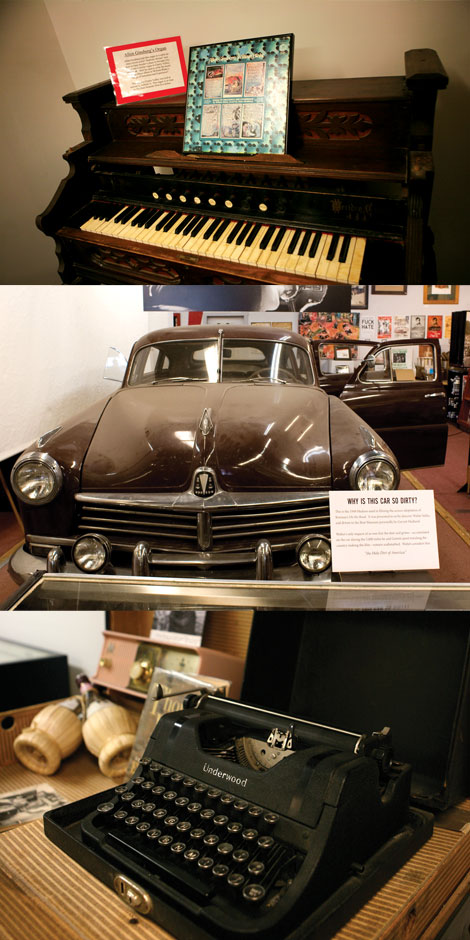
The cast and crew even dropped off a surprise prop from the film at the museum. Just to the right of the museum’s check-in desk sits a dusty maroon 1949 Hudson Hornet used during filming and driven to its resting spot in North Beach by none other than the movie’s star Garrett Hedlund (“a really delightful young man,” says Cimino), who portrays the everrestless Dean Moriarty.

Beside it stands a sign: “Walter’s only request of us was that the dust and grime – accumulated on the car during the 5,000 miles he and Garrett spent traveling the country making the film – remain undisturbed. Walter considers this ‘the Holy Dirt of America.’”

“You know, every fingerprint has a story,” says Cimino. “It’s important to keep that history intact.”

That’s a major part of Cimino’s job as curator: making the story of the Beats accessible and fun for anyone who might wander in. He loves every second of his evangelism for the movement and its great writers.

“The museum is successful because it represents a significant part of American culture and American literary history,” says Cooperman. “The opening of the movie On the Road demonstrates how this literature is still relevant.

“Of course, the fact that Jerry is probably as knowledgeable of the Beats as any academic doesn’t hurt either,” he adds. “He’ll ultimately be successful because he has a passion for what he does.”

NOW AND LATER

Passion is one thing. But, if you’re wondering how a start-up museum makes it in such difficult economic times, here’s your answer: It ain’t easy.

But the Beat Museum now survives and thrives thanks to Cimino’s magnetic business sense and a lot of hard work.

Just above Cimino’s desk hangs a complicated organizational chart showing a collage of boxes representing duties spanning everything from marketing to merchandising to fixing the guest toilet. One line connects them all.

“And every one of those boxes has my damn name on it,” he jokes. “That’s just how it is.”

The museum’s collection has grown as fans discover it. Cimino admits that “most people who love the Beats don’t have a lot of money,” but as fans of certain writers have discovered his museum, the memorabilia contributions have flowed in steadily. There’s a plaid jacket once worn by Kerouac, and a creaky pipe organ owned by Allen Ginsberg. There’s even an original “Can YOU pass the acid test?” card from the days when Neal Cassady drove Ken Kesey and the Merry Pranksters across the country in a psychedelic bus – a trip immortalized by author Tom Wolfe in his 1968 book, The Electric Kool-Aid Acid Test. (There’s also a film version of that book in works, to be directed by Gus Van Sant.)

Over the years, Cimino also found mentors to advise him as his plans for the museum have grown. He singles out the late Kim Greer, who was president of the National Steinbeck Center in Salinas, California, until his death in 2006.

“I have people come in every day telling me what I should be doing,” he says. “But I only take advice from people who have successfully done what they’re telling me I ought to do. It’s easy to guess…but that’s not going to get you anywhere.”

Right now, the Beat Museum is just as Cimino would like it to be: full, eclectic, engaging. Not too smooth, or too uniform: that wouldn’t fit well with the artists that it celebrates. Mismatched shelves offer hand assembled chapbooks by local poets. A claw-footed bathtub filled with dime store novels invites visitors to try something new. There’s a definite flavor to the place – a sort of San Francisco sourdough bite.

Cimino would enjoy having someone else fix the toilet from time to time. More important, however, is growing the Beat Museum so that it can stand strong for generations to come. That’s his next step.

“I started this place the only way I know how. I built it from nothing,” he says. “Now we’ve built a track record, we’ve made it succeed with the blood and sweat of a lot of people. If this thing’s going to outlive me…I’m going to have to think big.”

Scholarship Success: Q&A with Melanie Dell '12

Each year, the Alumni Association Scholarship program helps amazing students succeed at UMBC. Over the next few weeks, we’ll be sharing some of their stories with you. This week, meet Melanie Dell ’12, the recipient of this year’s Alumni Association Legacy Scholarship.
Name: Melanie Dell
Major: English
Grad Year: May 2012
Hometown: Catonsville, Maryland
What are you involved in on campus? I have been an editor of the UMBC Review: Journal of Undergraduate Research for the past two years.
Please share one of your favorite memories of your time at UMBC. There are two memories of my experience at UMBC that particularly stand out. The first one was reading the New Student Book Experience autobiography The Glass Castle for my English 100 class during my freshman year and attending a book talk at UMBC given by the author, Jeannette Walls. Reading and discussing the book in class, then hearing the author speak in person about her book was just one of the many interesting and unique learning experiences I had during my time at UMBC. My other fond memory was of a Shakespeare course (English 351) I took during my sophomore year. During the last class period of the semester, all of the students had to take part in performing an act from the play King Lear outside of the Fine Arts recital hall. We had to decide who played which parts, what act we were going to perform, and what costumes we were going to wear. Engaging this closely with the play allowed me to form a new appreciation for the Shakespeare plays that we had discussed and analyzed all semester.
What’s the most important lesson you’ve learned here? I’ve learned the value of diverse opinions and the importance of actively pursuing subjects that interest me. UMBC has cultivated my desires to increase my knowledge.
What are your plans for after graduation (if you know them)? Or, at least, what are you hoping to do? I will pursue a Master of Library Science degree at Clarion University in fall 2012. This is an entirely online program, which will allow me to concurrently work full-time at a public library.
What’s it like having a parent who is also an alum of UMBC? Did that factor into your decision to come here? When I was younger, my father would always tell me how invaluable his education was at UMBC. Although I applied to other universities, UMBC was my top choice because of the positive comments I heard from my dad about how this university provides the best resources, professors, and environment for its students.
How has the scholarship helped you? (And, do you have others?) I have funded my own education since I started at UMBC. I was awarded the President’s Fellows merit scholarship, but since that only covered a portion of UMBC’s tuition, I still had to make up the difference each semester. I would often work many hours during the week at a nearby public library to make sure that I did not have to take out loans or graduate with debts. Because of the Alumni Association Legacy scholarship, I was able to spend less time working in my senior year and more time focusing on school.
What would you say to the alumni who helped fund your scholarship? I want to express my sincerest gratitude and thanks to the alumni who helped fund my scholarship. It was an honor to receive this award.
Meet more members of the Class of 2012 here.

Scholarship Success: Q&A with Melanie Dell ’12

Each year, the Alumni Association Scholarship program helps amazing students succeed at UMBC. Over the next few weeks, we’ll be sharing some of their stories with you. This week, meet Melanie Dell ’12, the recipient of this year’s Alumni Association Legacy Scholarship.

Name: Melanie Dell
Major: English
Grad Year: May 2012
Hometown: Catonsville, Maryland

What are you involved in on campus? I have been an editor of the UMBC Review: Journal of Undergraduate Research for the past two years.

Please share one of your favorite memories of your time at UMBC. There are two memories of my experience at UMBC that particularly stand out. The first one was reading the New Student Book Experience autobiography The Glass Castle for my English 100 class during my freshman year and attending a book talk at UMBC given by the author, Jeannette Walls. Reading and discussing the book in class, then hearing the author speak in person about her book was just one of the many interesting and unique learning experiences I had during my time at UMBC. My other fond memory was of a Shakespeare course (English 351) I took during my sophomore year. During the last class period of the semester, all of the students had to take part in performing an act from the play King Lear outside of the Fine Arts recital hall. We had to decide who played which parts, what act we were going to perform, and what costumes we were going to wear. Engaging this closely with the play allowed me to form a new appreciation for the Shakespeare plays that we had discussed and analyzed all semester.

What’s the most important lesson you’ve learned here? I’ve learned the value of diverse opinions and the importance of actively pursuing subjects that interest me. UMBC has cultivated my desires to increase my knowledge.

What are your plans for after graduation (if you know them)? Or, at least, what are you hoping to do? I will pursue a Master of Library Science degree at Clarion University in fall 2012. This is an entirely online program, which will allow me to concurrently work full-time at a public library.

What’s it like having a parent who is also an alum of UMBC? Did that factor into your decision to come here? When I was younger, my father would always tell me how invaluable his education was at UMBC. Although I applied to other universities, UMBC was my top choice because of the positive comments I heard from my dad about how this university provides the best resources, professors, and environment for its students.

How has the scholarship helped you? (And, do you have others?) I have funded my own education since I started at UMBC. I was awarded the President’s Fellows merit scholarship, but since that only covered a portion of UMBC’s tuition, I still had to make up the difference each semester. I would often work many hours during the week at a nearby public library to make sure that I did not have to take out loans or graduate with debts. Because of the Alumni Association Legacy scholarship, I was able to spend less time working in my senior year and more time focusing on school.

What would you say to the alumni who helped fund your scholarship? I want to express my sincerest gratitude and thanks to the alumni who helped fund my scholarship. It was an honor to receive this award.

Meet more members of the Class of 2012 here.

Musgrove '97 Joins UMBC History Faculty

The Department of History is pleased to announce the addition of alumnus George Derek Musgrove to its faculty, beginning this fall.

Musgrove attended UMBC from 1993-1997, obtaining a B.A. in history. He then proceeded to obtain the 2003-2004 Anne E. Plato predoctoral fellowship at Trinity College in Hartford, Connecticut, the 2007-2008 postdoctoral fellowship in the Center for African American Urban Studies and the Economy at Carnegie Mellon University, and his Ph.D. in U.S. History at New York University in 2005. He is the author of Rumor, Repression, and Racial Politics: How Harassment of Black Elected Officials Shaped Post-Civil Rights America (University of George Press, 2012), and most recently was an assistant professor at the University of the District of Columbia (UDC).

“We are very excited to have… Musgrove joining our faculty because he is an especially promising historian of post-1945 US history, whose work combines political history, African-American history, the history of race relations, and urban history,” said Marjoleine Kars, chair of history.

Musgrove is equally excited at the opportunity to teach at his alma mater. “UMBC has a rich academic community,” he said.  “I hope both to contribute to and benefit from that community.  And in doing so, I hope to provide the same great learning experience that my professors gave me.”

Courses to be taught by the incoming professor include “American History: 1877-Present” (HIST102), and “The United States Since 1945″ (HIST347).

More on Musgrove and his work can be found on his website.

Originally posted in UMBC Insights.

“Super” Scholarship Success: Jeremy Brickey '12

Your support helps amazing students succeed at UMBC. Over the next few weeks, we’ll be sharing some of their stories with you. This week, meet Jeremy, a proud member of the Class of 2012.
Name: Jeremy Brickey
Major: English
Hometown: Lanham, Maryland
Plans: Marketing analyst for AKJ Books
Jeremy Brickey will be recognizable to this fall’s incoming freshmen: he was one of the faces of the “UMBC Superheroes” ad campaign. And Jeremy made his time at UMBC “super” by being involved in many facets of campus life. He is a member of the rugby team and on the rugby executive board; he was the president of the Sigma Alpha Epsilon fraternity, and won the UMBC Greek Man of the Year award in 2010. A Linehan scholar, Jeremy was published in Bartleby, UMBC’s literary magazine. In addition to being a “superhero,” Jeremy reached out to prospective students as a student ambassador and worked as a Woolie to help incoming students. As the 2012 Student Alumni Association founder and president, Jeremy will continue to make his mark on UMBC long after he graduates.
In a letter he wrote in the fall, he describes the impact scholarships have had on his life as a student:

“I can’t begin to tell you how thankful I am for what I have been given. Without my scholarships, I would not have fallen in love with the poetry of Marlowe or Donne, or taken acting classes, or had the chance to help launch a student alumni group at UMBC. Without the caring support of donors, I might have missed out on moments that truly shaped me as a thinker.
One of the most beautiful things about a place like UMBC is the way people help each other out, no matter what. You can’t always tell what a student is going through when you look at him or her, but I know many brilliant students who face struggles even greater than mine who are only able to study at UMBC because of the scholarships they receive. Sadly, not every student gets that chance.”

Brickey credits the people of UMBC with helping to open his eyes to many a new idea, and knows UMBC will remain a part of his life for years to come.

“I was a boy when I drove into campus in 2007. UMBC has been the most maturing experience of my life, both intellectually and socially. This campus has fostered a culture of “home” for me and for so many of the students walking the stage this May. There is a rich connection that Retrievers make with their unique campus, and that is something I will always cherish.”

Help support student scholarships and other great projects at UMBC.

“Super” Scholarship Success: Jeremy Brickey ’12

Your support helps amazing students succeed at UMBC. Over the next few weeks, we’ll be sharing some of their stories with you. This week, meet Jeremy, a proud member of the Class of 2012.

Name: Jeremy Brickey
Major: English
Hometown: Lanham, Maryland
Plans: Marketing analyst for AKJ Books

Jeremy Brickey will be recognizable to this fall’s incoming freshmen: he was one of the faces of the “UMBC Superheroes” ad campaign. And Jeremy made his time at UMBC “super” by being involved in many facets of campus life. He is a member of the rugby team and on the rugby executive board; he was the president of the Sigma Alpha Epsilon fraternity, and won the UMBC Greek Man of the Year award in 2010. A Linehan scholar, Jeremy was published in Bartleby, UMBC’s literary magazine. In addition to being a “superhero,” Jeremy reached out to prospective students as a student ambassador and worked as a Woolie to help incoming students. As the 2012 Student Alumni Association founder and president, Jeremy will continue to make his mark on UMBC long after he graduates.

In a letter he wrote in the fall, he describes the impact scholarships have had on his life as a student:

“I can’t begin to tell you how thankful I am for what I have been given. Without my scholarships, I would not have fallen in love with the poetry of Marlowe or Donne, or taken acting classes, or had the chance to help launch a student alumni group at UMBC. Without the caring support of donors, I might have missed out on moments that truly shaped me as a thinker.

One of the most beautiful things about a place like UMBC is the way people help each other out, no matter what. You can’t always tell what a student is going through when you look at him or her, but I know many brilliant students who face struggles even greater than mine who are only able to study at UMBC because of the scholarships they receive. Sadly, not every student gets that chance.”

Brickey credits the people of UMBC with helping to open his eyes to many a new idea, and knows UMBC will remain a part of his life for years to come.

“I was a boy when I drove into campus in 2007. UMBC has been the most maturing experience of my life, both intellectually and socially. This campus has fostered a culture of “home” for me and for so many of the students walking the stage this May. There is a rich connection that Retrievers make with their unique campus, and that is something I will always cherish.”

Help support student scholarships and other great projects at UMBC.