All posts by: Magazine Editor


President Hrabowski named one of TIME Magazine's 100 Most Influential People in the World

TIME named President Freeman Hrabowski to the 2012 TIME 100, the magazine’s annual list of the 100 most influential people in the world. The full list and related tributes appear in the April 30 issue of TIME, available on newsstands on Thursday, April 19, and now at time.com/time100.

The list, now in its ninth year, recognizes the activism, innovation and achievement of the world’s most influential individuals.

As TIME Managing Editor Richard Stengel has said of the list in the past, “The TIME 100 is not a list of the most powerful people in the world, it’s not a list of the smartest people in the world, it’s a list of the most influential people in the world. They’re scientists, they’re thinkers, they’re philosophers, they’re leaders, they’re icons, they’re artists, they’re visionaries. People who are using their ideas, their visions, their actions to transform the world and have an effect on a multitude of people.”

President Hrabowski told The Baltimore Sun that he accepts the recognition on behalf of the whole campus. “My success and the campus’ success are the same,” Hrabowski said. “People appreciate what we’ve done at the university, and I enjoy telling the story.”

Hrabowski also told The Sun that he considers the TIME honor a recognition for universities and their leaders nationwide.

“I think we often take for granted colleges and universities,” he said. “At UMBC, we don’t take it for granted, we celebrate it. That celebration gives people hope. People need to hope that we can educate all kinds of students, and those students will go on to lead our nation.”

This post originally appeared in UMBC Insights.

Sara Patenaude '11 M.A., Historical Studies, Wins History Writing Prize

Sara Patenaude ’11 M.A., historical studies, has won the Arnold Prize for Outstanding Writing on Baltimore’s History.

The Arnold Prize is named for Joseph L. Arnold, a professor of history at UMBC who died in 2004.  He was a vital and important member of the faculty for three and a half decades, as well as a leading historian of urban and planning history. He also played an active and often leading role with a variety of private and public historical institutions in the Baltimore area, and at his death was hailed as the “dean of Baltimore historians.” The Arnold Prize rewards outstanding research on Baltimore history.

Patenaude’s essay, entitled “Playing Fair: The Fight for Interracial Athletics in Baltimore,” is a chapter from her master’s thesis at UMBC.   The prize, which comes with a $500 award, is presented by the Baltimore City Historical Society.

Originally published in UMBC Insights.

Nominate a Great Graduate for an Outstanding Alumni of the Year Award

UMBC alumni are stars whose light extends well beyond their graduation. Past award winners include Duff Goldman, founder of Charm City Cakes, Maryland Delegate Jon Cardin, Johns Hopkins Medical Institutes medical researcher Crystal Watkins and Baltimore Sun reporter Jamie Smith Hopkins. The UMBC Alumni Association welcomes nominations for the 2012 Outstanding Alumni of the Year Awards.

The UMBC Alumni Association will present five awards to honor alumni for their professional and personal achievements, as well as their service to the community and to UMBC. In addition, the Association will present a “Rising Star” award to a graduate of the past decade. To nominate an alum for this prestigious award, please submit your nomination by May 30, 2012 at this link: http://alumni.umbc.edu/alumniawards.

Seth Sawyers '99, History, on Growing Up Baseball

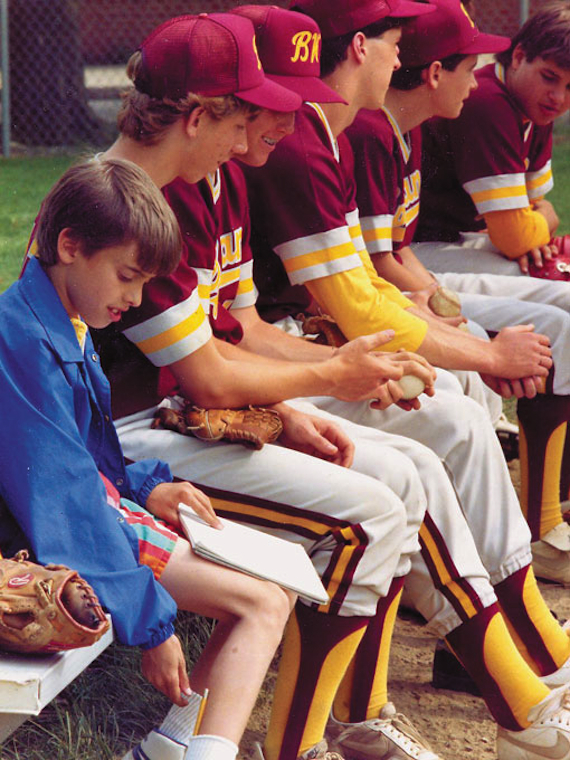
Seth Sawyers ’99, history, and adjunct faculty in English, has a new essay in the online literary magazine The Millions.

This essay, which is a chapter is from his recently completed memoir about growing up in the hills of western Maryland, is entitled “Baseball, Finally.”  It appeared on the journal’s website on April 4.

“….I can still feel the rhythm of the infield drill. I did thousands of them, the movements deep inside me like the steps of a dance, like the bass lines to certain Beatles’ songs.I loved turning double plays, taking the throw from third or from short, quickly hopping backward off the bag and, in the same motion, flinging a sidearm shot to first. It was the only dance I was ever any good at,” he writes.

“…we would never again, it turns out, be quite so free, quite as on the edge of something as beautiful and deep, and strange. Way out ahead of us was the unknowable everything, but just within reach was seven innings of baseball, a game we knew better than maybe anything else in the world.”

This post originally appeared in UMBC Insights.

Bill Shewbridge '80, New Media Studio, in Urbanite

Bill Shewbridge ’80, history, director of UMBC’s New Media Studio, spoke to Urbanite about the role technology plays on campus and in the lives of students.

“There is a tendency to think that students are digital natives,” says Bill Shewbridge, the director of the new media studio at the University of Maryland, Baltimore County (UMBC). “But uploading a picture to Facebook doesn’t make you a producer, much less an informed consumer.”

A television producer-turned-professor, Shewbridge discovered this after embarking on UMBC’s digital storytelling project eight years ago. To tell digital stories—short videos, usually for a particular class, that combine scriptwriting, interviewing, and research—students first needed to be taught video editing, audio recording, and image processing. Now, UMBC offers a multimedia literacy lab, a one-credit course taken concurrently with another class, where students learn those skills.

The article, “The Wired Campus,” appeared March 30 in Urbanite. Read the full story here.

Alums Make It Easier To Share A Cold One

Two information systems alumni are using their entrepreneurial spirit to make happy hour just a little bit happier.

As reported in the Arbutus Patch, alums Ryan Bricklemyer ’04, M.S. ’06, and Sean Kennedy ’06, have launched a website called BeerGivr that allows users to buy a beer — or an entire round — for friends at Baltimore bars without being present to pay the tab.

“There’s tons of different applications. I’m going to miss a party; I lost a bet. There’s tons of ways… beer is kind of like its own little currency,” said Bricklemyer, who noted that 16 Baltimore-area bars are participating so far, with more on the way.

“In consulting you constantly say ‘I owe you a beer.’ It is this thing that everybody says.  I think I owe cases of beer to people because I’ve said it so much.”

Read the full story in the Arbutus Patch.

Dog Tag: Taking the UMBC Logo to a New Level

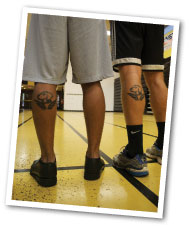
Many students broadcast their UMBC pride in traditional fashion – on a black and gold t-shirt, hoodie or ball cap. But UMBC seniors Chris Snyder ’12 and Chris Bowie ’12 have taken their case of Retriever Fever one very permanent step further.

“It was my last season of cross country, so I wanted to do something special,” says Snyder, a mechanical engineering major who along with Bowie had the new UMBC retriever logo tattooed on his left calf last spring.

Since its debut in summer 2010, the Retriever logo has spread quickly across the university’s walls and furniture, but never quite so indelibly as this. The inking process – including the addition of traditional cross country wings at the base of the dog – took about half an hour per runner, they said.

“You know, I like this school and I put all four years here into (a sport) I love,” says Bowie, a political science major. “It just made sense to want something permanent from a place that means something to me.”

So far, neither runner regrets the decision (or, at least, admits it). In fact, they both claim to get quite a few compliments. “You know, it might actually become a tradition,” says Bowie. “A lot of the freshmen runners want to get the dog… but they say they want to prove themselves first.”

— Jenny O’Grady

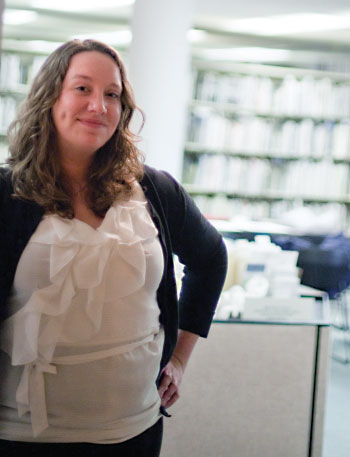
The Surveyor of the Stacks: Lindsey Loeper '04, AmSt

Lindsey Loeper ’04, American studies, acknowledges the futility of trying to keep pace with the hands of the watch and the rapidly turning pages of the calendar. No matter how quickly she and other members of the Special Collections team archive the stacks of UMBC documents they receive every day, there are always more coming. History never stops happening at a university that’s still building its story.

“We’re often asked when we’ll have everything digitized and we never will,” smiles Loeper, who earned her master’s of library sciences at College Park. “Instead, we try to create an online record that can lead you back [to the library], into the stacks.”

Already, the cool, darkened aisles contain 250 shelves stacked with nearly 750 linear feet of physical records, all neatly arranged in gray boxes. Add to that the online digital archives – launched in 2008 to make UMBC’s earliest documents, including many issues of The Retriever Weekly, easily available to the public – and you’re talking years and years of history waiting to be explored…

Read the full story, including features on other “Cool Jobs You Didn’t Know Existed at UMBC” in the Winter 2012 of UMBC Magazine.

Web Extra: Lindsey Loeper

Aqua Man: George Stover '73, INDS

George Stover ’73, interdisciplinary studies, answers the door at his production studio, Adventure Productions, looking like he’s on location in the wild. A tall man with a full head of silver hair and a boyish frame, Stover is clad in blue jeans, rugged boots, and a black canvas shirt emblazoned with his company’s emblem, a hammerhead shark.

Stover’s North Baltimore basement studio is far from the exotic underwater locations where he shoots his kid-friendly weekly television show, Aqua Kids. But the décor of his cavernous subterranean studio illustrates just how seamlessly Stover blends his dual passions for film and aquatics: fish tanks accessorize every room, a string of coral hangs from Stover’s office door, and replicas of manatees and starfish dangle from the ceiling.

Stover grew up in Perry Hall, but always was drawn to the water. His family spent summers on their 30-foot sailboat docked in Middle River. “I was always fishing or crabbing, always had an earache from swimming,” he chuckles.

So how did a middle-class kid end up swimming in the company of sharks and other aquatic animals in exotic locales such as the Bahamas and the Caribbean with a camera hoisted over his shoulder?

Stover developed his love of film at UMBC, where the would-be veterinarian found himself in a film animation class. “I got an A. I loved it,” he says. Even the fact that UMBC didn’t offer a film major didn’t deter Stover, who became one of the first students at the university to take what was then known as “Option II” and design his own film major.

Read the full story in the Winter 2012 issue of UMBC Magazine.

Tower Transformer: Kelley Bell '06, MFA

Picture this: It’s a cool, crisp night and you’re cruising north up Interstate 95, with the city of Baltimore rising up before you. The image of a metropolis can rise and fall with its skyline and its immense iconic representation of the city’s civic aspirations.

Much of Baltimore’s story is written in its skyline. There’s the urban renewal that spawned the National Aquarium and the twin stadiums of South Baltimore, for instance. The city’s history is also etched there in places such as the famous and distinctive Emerson Bromo-Seltzer Tower, which was built in 1911 at the corner of Eutaw and Lombard Streets.

Kelley Bell ’06, M.F.A., a graphic designer and professor at UMBC, was recently given an opportunity to transform the city’s skyline by creating art within the tower’s distinctive clock faces. Her exhibit is based on the renowned astronomical clock in Prague, and features the sun, the moon, and planets and stars circling in orbit around the tower. Bell even did careful calculations to ensure that her representations of heavenly bodies synched up with their celestial counterparts.

Bell moved to Baltimore in 2002, and quickly fell in love with the local art scene. “People are willing to share ideas and collaborate, and that’s an integral part of the work I do,” she explains.

Read the full story in the Winter 2012 issue of UMBC Magazine.

Leaving a Legacy: George Vitak '73, BioSci

“There are not that many of me left,” George Vitak, ’73, biological sciences, says jovially as we walk together from the Library Pond back to his office in the University Center on a blustery late November day.

The “me” in this case is a select group of faculty and staff who have witnessed UMBC’s rise to national prominence almost in its entirety. And at least as far as the University System of Maryland payroll is concerned, today is the day that another “me” bids UMBC farewell.

On December 1, Vitak retired from his position as director of campus card and mail services. He entered UMBC as a fresh-faced undergraduate from Archbishop Curley High School in 1968. Fate – and President Richard M. Nixon – kept him at the university for another 38 years, during which he helped supervise the campus’ physical growth and then shifted gears to become a key mover in UMBC’s early digital telecommunication services.

Read the full story in the Winter 2012 issue of UMBC Magazine.

Your Support Vital for Higher Education Budget

March 15, 2012
TO:  The UMBC Community
FR:  Freeman Hrabowski, President and Philip Rous, Provost
RE:   Your Support Vital for Higher Education Budget

As the Maryland General Assembly works to address a $1-billion State budget gap, legislators are considering a number of budget plans that would reduce Governor O’Malley’s proposed budget for the University System of Maryland (USM) and negatively impact USM campuses.  Budget cuts currently proposed for the System range from $5.3 million to nearly $20 million.

It is vital that faculty, staff, students, and alumni take time to urge legislators to continue the strong support they have shown higher education in the past.  Approving the Governor’s proposed budget for the USM would provide new resources enabling USM campuses to limit the FY-2013 tuition increase for in-state, undergraduate students to 3 percent.  At a time when budget cuts in many other states are forcing public campuses to raise tuition 10 to 15 percent, this support for higher education is exceptional.

Please email your legislators and urge their support for the Governor’s budget and access to high-quality, public higher education.  Go to: http://capwiz.com/usmd/home.  Click “Elected Officials” on the red tab at the top of the page to find your legislators.  Click “Take Action” in the middle of the page to compose a letter using the text provided by USM.

Thank you.