



 Teachers — for all they do — so often fly under the radar, inspiring students to succeed while taking little credit for themselves. The late UMBC biology faculty member, Carl Weber, was one of those teachers. His legacy, however, will ensure that excellence in teaching at UMBC will be recognized and nurtured—in part through a yearly award in his name that is given to outstanding faculty at UMBC. This year’s winner of the 2010 Carl Weber Excellence in Science and Mathematics Teaching Award was Dr. Jeff Leips, Associate Professor and Graduate Program Director in the Department of Biological Sciences. “It is an honor to be compared to someone who was so well respected as a teacher,” said Dr. Leips. The award was established in 2006 by his family in memory of Dr. Weber, Assistant Professor Emeritus and founding faculty member in the UMBC Department of Biological Sciences, as a tribute to his passion for classroom teaching. It honors a faculty member from the College of Natural Sciences and Mathematics for exceptional dedication to teaching as demonstrated by his or her enthusiasm, up-to-date teaching materials, effective mentoring, community service in the teaching area, approachability, rigorous learning requirements, coherent teaching philosophy and inspirational teaching style. At a recent lunch with members of the Weber family and a few colleagues of Dr Weber, Leips, inaugural award winner Bonny Tighe (senior lecturer in the Department of Mathematics and Statistics), Dr. Weber’s wife, Catherine, explained that the professor was not one to call attention to himself. In fact, the very thought of creating an award in his honor might have made him embarrassed. “He was the kind of person who shared who he was quite willingly,” said Mrs. Weber. “And if he saw everyone here at the table today, he’d probably be hugging them and laughing…and wanting to move on to something else.” Together, the group shared memories of Dr. Weber, from his love of classical and folk music, to his evolving passion for ecology, and to his many trips to streams in the Baltimore area doing insect larvae assays. “He had that kind of mind, in which something went in, and then everything just…stayed,” said Mrs. Weber. “If he was interested in something, he would just jump in.” “He was a pretty cool guy,” said Liesa Ann Weber-Frutchey, Dr. Weber’s daughter, a dance instructor, who spent many hours in the biology department as a child, often learning from her father and other professors as she played. “I used to catch butterflies and insects and then I learned how to preserve them…it was bonding time with my dad.” Dr. Leips seems to have followed in Dr. Weber’s footsteps, in a way, teaching the ecology section of UMBC’s Ecology and Evolution course. He has also worked with his colleagues to design a new advanced course in evolution (Evolution: From Genes to Genomes) and has developed a new course for graduate students, Mentoring in the Sciences. “It’s a beautiful thing to honor someone’s legacy through teaching,” said Dr. Leips, who has several of Dr. Weber’s old textbooks on his own shelves. “Plus, he was a wonderful guy, so this is really special.” Originally published in 2010.
All posts by: Magazine Editor
Leaving a Legacy: A Father’s Wisdom
 If Jo Anne Sabas ’77 could give you a piece of advice, she’d pass along something her father, Captain Samuel Joseph Sabas, once said to her: “You can lose your job, you can lose your home, you can even lose your health, but when you earn a college degree it can never be taken away from you.”
Jo Anne knows just how true those words are. From an early age, her father encouraged her pursuit of knowledge, and later on inspired her to make a lasting mark with a planned gift to UMBC.
Sam Sabas grew up in grinding poverty in south Chicago doing back-breaking work to support his mother, younger brother, and sister. His hard work also paid for his sister’s catholic high school tuition. He continued to support his family until he married. He then supported successfully a wife and two daughters. It wasn’t until much later in life that he had his chance at higher education. At 63 he retired as a sea captain to become a full-time college student. He graduated with honors from a two-year college.
So when Sam told Jo Anne she needed an education, she believed him. In fact, it was at his urging that she decided to return to school. At UMBC she was a non-traditional student—a decision that would leave its mark on her for the rest of her life. Thanks in part to her education, Jo Anne was able to strike out on her own as a writer.
“I got a sterling education from UMBC. I just think that UMBC is such a fine university,” Jo Anne says. “I am proud to be a graduate.” Several years ago, she decided to establish the Jo Anne Sabas Scholarship Endowment, an endowment that will benefit non-traditional students who are majoring in English or who include English with another (double) major. The endowment was inspired by her father.
“My father gave me that chance to return to school,” she says. “The credit really belongs to him.” So she decided to give someone else that opportunity.
Jo Anne knows what it’s like to try to squeeze getting an education into an already hectic life. While at UMBC, Jo Anne worked full-time for the then Dean of Social Sciences. “Because I was non-traditional, I couldn’t get involved in activities. I took courses during lunch time. I took courses at other colleges and transferred the credits to UMBC,” she says. “When I got down to the last 18 credits, I was bone tired. I took a four-month leave of absence from my job with the Dean’s permission and finished,” she adds. She would like to give another non-traditional student the support needed to make it through the tough moments.
Highways to Healing: Omolola Eniola-Adefeso '99, chem eng
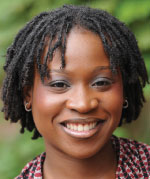 Once upon a time, Omolola Eniola-Adefeso ’99, chemical engineering, was on track to attend medical school. But she became a chemical engineer instead – so she could better attack problems such as her number one target: heart disease.
Eniola-Adefeso, an assistant professor of chemical engineering at the University of Michigan, investigates radical ways of delivering medicine that could prove efficient and effective than current practice. And she may succeed because she is thinks like an engineer – and not a doctor. Eniola-Adefeso came to Maryland from her native Nigeria the age of 16. She began her studies at Catonsville Community College, before transferring to UMBC, where she met the late Janice Lumpkin, an African-American chemical engineering professor. Lumpkin not only guided her student into a field where her passion for technology and medicine could intersect, but also helped her become a member of the first class of UMBC students in the Minority Access to Research Careers program.
After graduating from UMBC, she took a doctorate at the University of Pennsylvania in 2004. Her scholarship for graduate studies there was actually named after Lumpkin – who also attended Penn and died tragically after childbirth in 1997.
In 2006, Eniola-Adefeso (pronounced ah-DAY-feso and known to everyone as “Lola”) joined the faculty at Michigan where her lab seeks ways to create and use miniscule synthetic pellets to mimic white blood cells and deliver medicine more efficiently.
Read the full story in the Fall 2011 issue of UMBC Magazine.
Read more about UMBC alumni at Retriever Net, UMBC’s alumni online community.
Targeting Tastes: Maggie Lebherz '08, MLL
 Some students studying abroad fall in love with a place. Maggie Lebherz ’08, modern languages and linguistics, fell in love with some new tastes during her semester at the University of Salamanca.
“Tasting fresh olive oil added an entirely new dimension to it, and I also learned about the health benefits of olive oil,” she says. “I had never had true balsamic vinegar, and even the best ones on the market here could not compare to what I had in Spain.”
The love affair that Lebherz developed with balsamic vinegar and fresh olive oil while studying in Spain has translated into a most unusual business venture: Lebherz Oil & Vinegar Emporium (LOVE) in her hometown of Frederick.
After graduating from UMBC, Lebherz returned to Frederick, working as a translator for the local school system. However, when a redistricting left her with a job as a secretary, she began to consider opening her own store focused on the two products she loved: olive oil and vinegar. Many people thought she was nuts to build a business on two products. But, as Lebherz says, “I told people that Baskin-Robbins ‘just’ sells ice cream.”
Read the full story in the Fall 2011 issue of UMBC Magazine.
Read more about UMBC alumni on Retriever Net, UMBC’s alumni online community.
Formula for Success: Ronita Marple '05 Ph.D., chemistry
 As an analytical chemist and senior scientist for consumer goods giant Proctor & Gamble, Ronita Marple ’05 Ph.D., chemistry, observes that it’s not unusual for her to walk past a lab and catch a glimpse of a robot testing a product by performing a household chore over and over again, for hours on end, to identify a product’s weaknesses without stressing out human testers in the process.
Such grueling tests are part of how all of the nearly 125 products marketed by Proctor & Gamble end up in a consumer’s shopping cart. So is Marple’s own job mundane and robotic? “Never,” laughs the recipient of UMBC Alumna of the Year Award in the Sciences, who manages a team of chemists that unravel the technology behind each line of personal care at the corporation’s Cincinnati headquarters.
“Maybe there’s a new ingredient [in a product]: It’s my job to come up with a method to measure it,” she explains. Shampoo, for example. “There are just tons of ingredients in every bottle,” she says. Her team can scan a dollop of shampoo using a technique known as “whole product NMR” to determine the identity and concentration of each ingredient in the formula.
Marple and her team must also help ensure that most important ingredients of all – those responsible for cleaning and conditioning hair – remain stable and optimally concentrated between factory and shower. After all, that dollop of shampoo must trek cross country in a sweltering delivery truck before it becomes lather on a lustrous head of hair.
You don’t want to feel like you’re washing your hair with dish soap,” says Marple. “On the other hand, you want enough conditioning that it feels good.”
Read the full story in the Fall 2011 issue of UMBC Magazine.
Read more alumni stories at Retriever Net, UMBC’s alumni online community.
How To Grow Your Big Idea: Vivian Armor '73
With Vivian Armor ’73, director, Alex. Brown Center for Entrepreneurship
You wake up one morning with a big, bright light bulb bobbing above your head. You start your day, feed the dog, the light getting brighter by the minute. Pretty soon, it’s keeping you up at night. Well, congratulations. Your “big idea” has arrived – and with it, a world of possibility.
So, now what? Do you cash in your life savings for seed money? Get a fancy business degree? Buy the book by that guy in the suit covered in question marks?
Maybe you take some (absolutely) free advice from Vivian Armor ’73, American studies. She is director of UMBC’s Alex. Brown Center for Entrepreneurship and has some tips about how to move ahead safely and smartly so you can make all your wildest dreams come true.
Read the full “How To” story by Jenny O’Grady in the Fall 2011 issue of UMBC Magazine.
A Decade of Service: Shriver Living Learning Center
When Jason Woody ’04, sociology, received his acceptance letter to be part of the first class of the Shriver Living Learning Center (SLLC) ten years ago, he wanted to be a film major. And though he was interested in the social justice focus of the new center, he was also enticed by Erickson Hall, the sleek new dorm on campus that SLLC students would call home.
Woody found the SLLC’s service mentality contagious and it quickly came to define his worldview. In his sophomore year, he came across a poster asking students to dedicate service hours to honor those killed in the 9/11 attacks and took that call to heart. Back in his dorm room, he paged through biographies of the victims.
The story of Deora Bodley – a college student who died aboard United Flight 93, which crashed near Shanksville, Pennsylvania – gripped him most personally. Friends remembered Bodley for her own dedication to serving others. In her name, Woody launched a mentorship program for elementary-aged Baltimore youth to learn team-building skills: Project Team. The Shriver Center offered a van, help recruiting volunteers and credibility with partner organizations.
Shriver Center Director Michele Wolff remembers designing the SLLC to reflect “the true essence of service-learning.” Community members are required to complete both regular service throughout their residency and coursework that provides context and promotes reflection. As an affinity program, the SLLC also offers students a purposeful living experience with a built-in peer support network to help them confront the demands of service commitments.
Woody credits the support of fellow SLLC residents for his growth as a service leader. Kelly Subramanian ’08, biology and psychology, a former SLLC resident assistant, understands his perspective. “Personal relationships develop where you’re not only living together, you’re also serving together,” she says.
By the time Subramanian arrived a few years after Woody, the SLLC had already developed a reputation for its unique way of fostering students’ intellectual and personal growth. The program itself – more than the sleek new dorm – had become the attraction. “You’re helping other people and learning about what’s out there, but you’re also learning about yourself, what you value and what you want to do with your life,” Subramanian reflects.
Senior Benjamin Davis ’12, who hopes to teach in Baltimore City after graduation, calls the SLLC “a home for people just like me who expressed passion or interest in volunteering.” Davis tackled personal hardships and shyness, he says, by “working with other civically engaged individuals.”
Jason Woody never did take a single film class at UMBC. Instead, he pursued a career serving adults with mental illness. His organization, B’more Clubhouse, offers transitional employment and social and educational programs to help adults with mental illness develop confidence, skills and meaningful relationships, and reduce stigma against mental illness in the broader community. “I’ve seen people achieve milestones, big and small, that are life-changing,” he says.
Woody adds that he is still learning from others through service. His work has helped him develop patience and understanding. In this way, he says, the members of B’more Clubhouse are now his teachers.
— Dinah Winnick
This story originally appeared in the Fall 2011 issue of UMBC Magazine.
Climbing the Ladder: Zach Clark '06, psychology
In 2008, former UMBC Retriever pitcher Zach Clark ’06, psychology, was with the Frederick Keys – a Class A affiliate of the Baltimore Orioles – when he got the news that he was needed at Class AAA Norfolk Tides for a spot starting assignment.
The good news traveled fast, but Clark didn’t. It was only after a long bus trip with the Keys from Kinston, NC, to Myrtle Beach, SC, and an early morning flight to Syracuse, NY, that Clark finally joined his new club. He pitched for the Tides that same night.
“I slept at the hotel during the day, went to the field and pitched,” recalls Clark, who has played in the Orioles farm system since 2006. “That was pretty crazy. I didn’t know anybody. That was my first time at Triple A.”
Signed by Orioles’ scout Dean Albany as a non-drafted free agent after leaving UMBC in 2006, Clark started this season pitching for the Class AA Bowie Baysox. He began 2011 with a minor league record of 24-28 and an ERA of 3.61 in 119 games.
Clark knows life as a pitcher on-call is part of the path to the big leagues. He once battled heavy traffic from Bowie to Norfolk, VA to take the mound for Tides in a night game.
In games through Aug. 4 of this season Clark was 6-7 with an ERA of 5.14 in 18 games (with 17 starts) for Bowie in the Eastern League. Clark was named the Eastern League pitcher of the week on May 2 of this season.
— David Driver
This story originally ran in the Fall 2011 issue of UMBC Magazine.
Words and Music: Adam Trice '04, English
 Open the door to Annapolis’ Rams Head Tavern and the sounds of upbeat banjo and guitar
fly out into the warm night air, followed by closely by the gruff voice of Adam Trice ’04, English – who’s in the middle of a 45-minute set with his band, Red Sammy.
“It ain’t you, it ain’t her,” Trice growls tunefully in a song called “It Ain’t You (Carolina Road Anthem).” “I’m heading south, but I’m not sure. You got me high, it’s kind of funny. I’m playing bars for gas money.”
Trice dubs Red Sammy’s music as “graveyard country” because he likes the verbal interplay of the phrase. “I feel like it brings up a lot of different connotations that are associated with those two words,” explains Trice. The band has released a few records, including A Cheap Kind of Love Song and Dog Hang Low, both of which are available online or at the band’s shows.
Studying literature at UMBC had a hand in his musical direction. “My music’s more lyric driven, and I think it really banks off my English degree,” he explains. “A lot of electives in the creative writing track. They are the strong focus from which I draw.”
While Trice also pursues a day job as director of foundation relations and grant writing and development at Capitol College in Laurel, he enjoys playing for tips in a Jeremiah Weed bucket and is going to keep playing for the foreseeable future. “My plan is to continue pushing the art and seeing where that goes,” he says.
— Derek Roper ’11
Originally published in the Fall 2011 issue of UMBC Magazine.
Alumni Accolades – Outstanding Alumni of the Year 2011
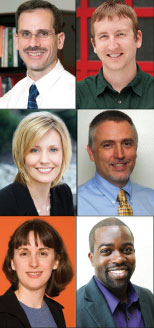 Among the highlights of UMBC’s Homecoming 2011 is a ceremony that honors university alumni who have achieved distinction in a wide range of disciplines and careers.
The UMBC Alumni Association – which selects recipients and presents the awards – moved the annual Outstanding Alumni of the Year ceremony back to campus in 2009, and it has since become a key element of the university’s celebration of school spirit.
This year’s recipients of the awards – which will be presented on Thursday, October 13 at 7:30 p.m. in the Albin O. Kuhn Library Gallery – include alumni who’ve reached prominence in the fields of technology, medicine, journalism and business. This year’s recipients are:
Ralph Semmel ’92, Ph.D., computer science, is the UMBC Alumnus of the Year in Engineering and Information Technology. In 2010, Semmel was named as the eighth director of The Johns Hopkins University Applied Physics Laboratory – one of the most prominent hubs of advanced technological research in the world.
Ronita Marple, ’05, Ph.D., chemistry, is the UMBC Alumna of the Year in the Natural and Mathematical Sciences. She is an analytical chemist and senior scientist for consumer goods giant Procter & Gamble. (Read a profile of Marple)
Jamie Smith Hopkins ’98, English, is the UMBC Alumna of the Year in the Humanities. She has been a reporter at The Baltimore Sun since 1999, and writes and blogs for the paper on the housing industry in the Baltimore metropolitan region. (UMBC Magazine profiled Hopkins in its Summer 2010 issue.)
Garrett Wright ’01, theatre, is the UMBC Alumnus of the Year in the Visual and Performing Arts. Wright is a Bridge Fellow at the Center for Constitutional Rights, where he puts his legal skills to work combating racial profiling in New York City’s Police Department. He is also a staff attorney at the Urban Justice Center’s Community Development Project, which provides legal advice to tenants and tenant organizations.
Dr. Jeffery Wilkinson ’89, interdisciplinary studies, is the UMBC Alumnus of the Year in the Social Sciences. He works at the University of North Carolina’s School of Medicine, and he has won renown as a global leader in combating obstetric fistula in some of the poorest regions of the world – including Asia and sub-Saharan Africa. (Wilkinson was profiled in the Summer 2009 issue of UMBC Magazine.)
Delali Dzirasa ’04, computer engineering, is UMBC’s Young Alumni Rising Star. He is the owner of Fearless Solutions, a cybersecurity company based in the bwtech@UMBC Research Park that focuses on secure software development, and already boasts several contracts with the federal government.
— Richard Byrne ’86
This article appeared in the Fall 2011 issue of UMBC Magazine.
Filmmakers at UMBC Homecoming
This year’s Arts and Humanities Afternoon at UMBC Homecoming on Saturday, October 15, 2011 will focus on alumni filmmakers. To whet your appetite for our afternoon discussion on the art of moving images, we’d like to introduce you to some of the filmmakers who’ll be coming to the event, which will be held in the Skylight Room of the UMBC Commons from 3 p.m. until 5 p.m. We’re also planning some screenings of the work of these filmmakers on campus in the week before the event. Please stay tuned!
Films by the alumni filmmakers will be shown at the Skylight Room in The Commons on the following dates:
Monday, October 10, 2011, at 7 p.m.: Saved! (Brian Dannelly ’97)
Tuesday, October 11, 2011, at 7 p.m.: Films by Richard Chisolm ’82, Steven Fischer ’98 and Daphne Gardner ’09
Read more about these alumni in the Fall 2011 issue of UMBC Magazine.
Striving to Make a Difference: Joseph T. Jones, Jr. '06
Once upon a time, Joseph T. Jones, Jr. thought he couldn’t escape the city’s mean streets. Now he’s leading efforts to help reclaim the families broken by urban ills.
By Elizabeth Heubeck ’91
Photos by Bruce Weller
Searing waves of heat already ripple through West Baltimore at 9 a.m. on a Friday in July. The streets around 2201 N. Monroe Street – headquarters of the Baltimore-based nonprofit Center for Urban Families (CFUF) – are all but deserted.
Inside the center’s air-conditioned conference room, 40 or so adults – men and women, black and white, some as young as 18 and others old enough to be grandparents – sit in neat lines of metal folding chairs, sweating a
bout their future. Some look anxious, others bleary-eyed. Most of the men wear ties, pressed pants and dress shoes; the women are in heels, panty hose and skirts. Some are ex-convicts. Many have been involved with the drug trade. Others have held jobs but haven’t been able to keep them.
If the room has the solemn air of a funeral, there’s a good reason. Everyone here is preparing to say goodbye to their old lives and start anew through the CFUF’s signature program, STRIVE, which is modeled after a prototype launched in New York City’s East Harlem.
When the center’s founder and CEO, Joseph T. Jones, Jr. ’06, social work, walks to the front of the room, everyone seems to sit up a little straighter. Standing more than six feet tall in a dark blue pin stripe suit, Jones’ imposing stature and deep, authoritative voice command the room. But his story also grabs attention with this audience: He’s walked a remarkably similar path.
“All the things I did suggest I should be dead, incarcerated, or debilitated,” Jones tells the group.
Jones’ path was particularly rocky: He was the product of a broken family. He shot heroin at 13, and was arrested for the first time at 14. He spent more time in Maryland’s juvenile justice system than he did in a high school classroom. And Jones’ career as a drug dealer saw him only narrowly escape a lengthy federal prison sentence.
But Jones is living proof that hard knocks don’t always knock you out. His West Baltimore center promotes stable career paths and rebuilds strong family units among urban residents, and Jones is sharing his successes with national audiences – including meetings with former Vice President Albert Gore, Jr. and a place on President Barack Obama’s Taskforce on Responsible Fatherhood and Healthy Families.
Healthy families are the building block for any American renaissance, argues Jones. “Twenty-five million children live in households where their fathers are not present. As a society, we can’t have that number of children not having a relationship with their fathers.”
 Rough Beginnings
Jones remembers the breakup of his own family at age nine with chilling clarity.
“My father, he was ex-military,” Jones recalls. “I remember him packing his [military] duffel bag one day.” Jones watched from the living room window, which overlooked the entrance to East Baltimore’s Lafayette Courts projects, as his father put his duffel bag in the car and drove away. Life with a single mother left Jones “crossing boundaries,” as he puts it. He became friends with a crowd that plunged him into heroin use and selling drugs. And his first drug-related arrest and sentence to 30 days in a juvenile detention facility didn’t exactly scare him straight. “One of my best friends from the street was there. He created a seamless pathway
for me to have no trouble in that system,” Jones recalls. As Jones cycled in and out of the juvenile justice system and grew ever-deeper roots to drugs and crime, a part of him remained open to a different path. Ironically, it was Jones’ father, barely present in his life since leaving with his duffel bag, who planted the seed on a visit to his son in juvenile detention.
Jones’ father brought him Manchild in the Promised Land, a book by Claude Brown which tells the story of the author’s coming of age (and escaping) poverty-stricken and drug-filled 1960s Harlem. The book led Jones to other influential autobiographies, including those of Martin Luther King, Jr. and John F. Kennedy.
“I was preparing myself for now, but not intentionally,” Jones says. “I was always attracted to stories about people who were making change in society.”
Almost Lost
Jones says he had a talent for masking problems under a façade of normality. He managed to earn his GED, attend community college, and was even admitted to a management training program with the Social Security Administration.
Under that surface, however, Jones remained unchanged. Indeed, he was brazen enough to sell drugs out of the Social Security Administration building.
He believed he was successfully evading police detection until one day he was asked to attend a meeting during work hours in the organization’s auditorium. When he arrived, he was greeted by members of the U.S. Drug Enforcement Agency.
Jones recalls the arrest was “a complete embarrassment.” His mother and grandmother also worked at Social Security Administration, and dealing in that building brought a federal drug charge. He was also suspended without pay and removed from the management training program.
Eventually Jones pled guilty to a misdemeanor and avoided jail time. But even that humiliating arrest did not create a final break with his addiction to heroin and cocaine and his drug crimes. For years, he observes, “faith and fate” allowed him to narrowly avoid lengthy jail sentences.
Jones started to weary of the game, however. On October 3, 1986, he knocked on the door of Spring Grove’s residential drug treatment program. “Part of me wanted to stop doing drugs,” Jones recalls. But the real motivation was to avoid a jail sentence for five new criminal charges. The choice was simple: drug treatment or jail.
A year in drug rehabilitation helped Jones finally make a break with his former life. For the first time since he could remember, he was sleeping and eating well and exercising regularly. At year’s end, Jones was ready to commit to the “phase out” stage of the treatment program, which required him to have a plan to continue his recovery. Jones decided on the community college degree he’d started but never finished.
Now in his thirties, his experience at Baltimore City Community College (BCCC) was decidedly different after rehab. Jones became the top student in the college’s accounting program. He also met his future wife, Debra Scovens, who was an assistant to BCCC’s dean of admissions.
They have now been married for 21 years and have three children. Armed with a new family and newfound confidence and stability, Jones was ready to pursue helping others change their lives as he had changed his own.
Making Waves in Public Policy
Jones took several part-time jobs to make ends meet during community college. One job involved working with a community-based organization that provided health and HIV/AIDS education, where his primary role was negotiating contracts with drug treatment centers and providing health and HIV education to their clients.
Jones parlayed that job into a grant-funded position with the Baltimore City Health Department to ensure that pregnant women in the city received prenatal care. As he worked with these women, he had an epiphany about the connections between their challenges and his own upbringing. “I’m dragging these women from crack houses to prenatal care,” he recalls, “then they’re going home to these guys who were saying, ‘We need help, too…. Public policy wasn’t addressing the issue of fatherhood.”
Health officials urged Jones to take up the cause on his own. And he did. Using the federal government’s Healthy Start Initiative, Jones developed and implemented a “Men’s Services” program within the city health department’s Healthy Start program.
His success with that initiative provided Jones with invitations to high-level conferences on urban families, including one hosted by Vice President Gore and his former wife, Tipper Gore. At that conference, Jones chose to make a splash when he was asked to comment.
“I went off on a tirade about the surface level of the conversation, and how it didn’t meet the needs of the people in the communities where I come from,” Jones recalls. And though he received a round of applause for his outburst, he felt compelled to apologize to Gore for his strong words. That day allowed Jones not only to establish a personal relationship with Gore, but it also garnered him more invitations to discuss the obstacles facing urban families.
Back to School
Jones’ persuasiveness about the importance of jobs and reconnecting families to create an urban renaissance also found an audience closer to home. UMBC president Freeman A. Hrabowski, III, attended one of Jones’ speeches and was impressed.
“It was clear he was a masterful communicator,” says Hrabowski. “He was analytical, used his own story and was able to talk about intervention strategies. Most importantly, he spoke with great authenticity.”
When Hrabowski queried Jones about his education and learned that he had an associate’s degree, he didn’t withhold his opinion. “My first reaction was that he had to go back,” Hrabowski recalls. “I knew it would open more doors for him.”
Jones demurred at first, telling UMBC’s president that he was too old, that he had a young family, and that he didn’t qualify for scholarships. But Hrabowski eventually won out, serving as Jones’ mentor as he took his degree at UMBC. In 2006, at the age of 50, Jones graduated cum laude from the university.
“His standard of excellence is so incredibly high,” Jones says of Hrabowski. “He uplifts you just being in his space.”
Success and Standards
Jones’ dynamic presence provides a similar uplift for the men and women he’s working hard to help at the Center for Urban Families.
Take STRIVE. On its surface, the program is a boot camp for coping with the challenges of the contemporary workplace: being on time, dressing appropriately and managing office hierarchies. But it’s also a “reboot” camp to help clients gain self-assurance and self-reliance in all areas of their lives.
“When you see people who come in here, and you look in their eyes,” Jones observes, “there’s almost no hope. You have to convince them that if they follow the structure we have established, they can be successful, regardless of their background,” he says.
At the first day of the STRIVE training on this July morning, most participants come dressed in their best clothing. But one young man, dressed in baggy black pants and untucked shirt, didn’t get the message. Jones summons him to the front of the room.
“Did they explain to you what you had to do to prepare for today, including the dress code?” Jones barks. “Do you want to go through this program?”
The young man’s response is barely audible.
“You’ve got ten minutes to get dressed like this guy,” says Jones, pointing to a man in the front row wearing a dress shirt and slacks, wing tips, and tie. The young man saunters to the back of the room and out the door.
Jones tells those who remain: “We’re going to raise the standard real high, and some of people are going to fall off…. Twenty percent of you won’t be back on Monday.”
When Jones worked for the Baltimore City Health Department, he designed and oversaw innovative programs like STRIVE. But the bureaucracy of working within a government agency frustrated him. “If I wanted to grow beyond now, I knew I couldn’t do it at the health department,” he says. With a nod from his then-boss and former Baltimore City Health Commissioner Peter Beilenson – and financial support from the Abell Foundation and its longtime president, Robert C. Embry, Jr. – Jones was able to strike out on his own.
In 1999, Jones opened the doors to the Center for Urban Families. In the attractive new building in which the nonprofit is housed today, Jones has also started a program to help fathers: Men’s Services Responsible Fatherhood program. The center also launched its first national initiative, Baltimore Building Strong Families, in 2005. The program aims to support new low-income parents with financial know-how and relationship skill building.
Tough Love
Jones attributes the success of the center’s initiatives to a tough-love approach that provides structure and demands discipline. It’s this approach that attracted longtime supporter David L. Warnock, CEO of a Baltimore-based investment firm. He’s been the chairman of the 12-year old nonprofit for more than eight years.
“I like the tough love approach to STRIVE,” says Warnock. “I also like how the model of STRIVE aims to create a sense of accomplishment among a group of people that doesn’t feel much in the way of accomplishment.”
The number of lives touched by STRIVE is also impressive. As of August 2011, more than 4,000 men and women in Baltimore have graduated from the program. And the center has been able to place more than 3,900 of its graduates in jobs with an average starting wage of $8.80 an hour.
Jones relishes telling personal success stories about STRIVE graduates, including La’Roy Charles Alston, Jr., a former gang member in Baltimore City. Two of Alston’s friends were shot within a week. Then Alston himself was shot twelve times and lost a leg. Though he thought about retaliating, Alston decided instead to give STRIVE a try.
“He was saying that he wanted to do something different. Now, he’s getting ready to graduate from Sojourner-Douglass College. He has one of the most infectious personalities, despite living with chronic pain,” says Jones.
Checking back in with Jones on a sunny Friday in August, he’s busily preparing new federal grants for the center and addressing a new class of STRIVE graduates, who enter to strains of “Pomp and Circumstance” decked out in blue caps and gowns.
Jones acknowledges that these graduates are facing some of the toughest economic times in recent memory, but he underscores that their commitment holds the key to success in surmounting it: “Remember when I told you on the first day that we were looking for a few good men and a few good women? You are the few good men and few good women.”
Jones also urges the new graduates not to get complacent. He wants to see them all back at the center bright and early on Monday morning, starting the job hunt.
“We’re going to have your back,” Jones says. “As long as you stay connected.”