All posts by: Magazine Editor


Christopher DiPompeo '04, econ, Clerking for Supreme Court Justice

The University of Pennsylvania Law School reports that Christopher DiPompeo ’04, economics, attained a highly-coveted clerkship in the U.S. Supreme Court for Chief Justice John G. Roberts, Jr. He started his clerkship in July.

DiPompeo earned his law degree from UPenn in 2009, having served nearly half of his law school career as editor-in-chief of the Law Review.

Read the full article here:  http://www.law.upenn.edu/blogs/news/archives/2011/05/christopher_dipompeo_supreme_court_clerk.html

Will Redman '98, VPA, sees music in a whole new way…

From the Baltimore Sun:

It takes a little time to unroll “Scroll,” a composition by Baltimore composer Will Redman, since it’s on paper that measures 8 feet long, 8 inches wide. It takes even longer to digest.

Although there are four distinct lines of music on the elongated page, indicating at least four players, there’s no specification of instruments.

So how do you perform such a piece? Ask Redman and he’ll just say: “That’s up to you.”

Read the full story.

Ronni Monaghan '97 appointed Director of Development at St. Joseph Medical Center Foundation

From the Daily Record:

“St. Joseph Medical Center Foundation has appointed two new directors: Ronni Monaghan is the director of development. She has more than a decade of service in Maryland nonprofits, including as director of the Maryland Association of Community Colleges and as a director of institutional research at Johns Hopkins University. Monaghan has a law degree from the University of Baltimore and a master’s degree in policy sciences from the University of Maryland, Baltimore County.”

See the original story.

Building A Tradition – Lafayette Gilchrist '92

The path to preserving Maryland’s traditional arts and culture sometimes begins when a jazz musician walks through an unlocked door in UMBC’s Fine Arts building.

One of Baltimore’s master jazz musicians, Lafayette Gilchrist ’92, Africana studies, was taking a summer class before his freshman year when he discovered that the building’s piano rooms were left open in the evening. One night, he finally gave in to temptation.

“The very first piano I played was this nine foot Steinway grand piano,” recalls Gilchrist, who had taken no formal lessons before coming to UMBC. “People think I’m lying when I tell them this, but the piano was in a concert hall, all the lights were off and there was a spotlight on it,” he said. “I fell in love. The music moved directly from my body to the instrument and into the air.”

Gilchrist audited composition classes during his time at UMBC and he was even hired to play at campus events. His musical passion and skill also eventually led him to Maryland Traditions – a statewide program that supports efforts to find, share, preserve and sustain traditional arts and culture.

Over the past academic year, Maryland Traditions has forged an exploratory partnership with UMBC that has not only brought Gilchrist back to campus for a March 30 event centered on introducing the program’s artists to the UMBC community, but created classes and events throughout the year.

The university installed Elaine Eff, the program’s co-director, as a folklorist-in-residence in the American studies department. In that role, Eff has connected UMBC students with internship opportunities, created a film series for campus and co-taught a humanities scholars class on Maryland’s traditions with Nicole King, an assistant professor of American studies.

“Elaine is such a force,” observes King. “She’s bringing the energy of the public programming realm here to the university.”

One of Maryland Traditions’ cornerstones is a Master-Apprentice program in which Gilchrist has been working. He first served as an apprentice to jazz saxophonist Carl Grubbs, and now Gilchrist is a mentor himself – advising pianist Ethan Simon (son of The Wire’s creator David Simon.)

Making strong connections is a key to the collaboration’s success. King says that Eff’s connections are invaluable to an American studies department, which has aspirations (especially with the recent establishment of its Orser Center for the Study of Place, Community & Culture at UMBC) to become a center for Baltimore area community studies.

“If we have these relationships with outside organizations and people,” King adds, “we don’t have to re-invent the wheel every time we go to work with the community.”

Eff says that the benefits of UMBC’s own pre-existing networks can’t be overstated. The university’s reach has allowed her to recruit interns for Maryland Traditions, inspire students to turn an analytic eye honed in campus classrooms to their own communities, and tap into the cultural knowledge of UMBC’s ethnic student organizations.

Who knows? Eff may find the next Lafayette Gilchrist practicing in the Fine Arts building after hours. “Every accomplishment we have here has tremendous value in building towards the future,” she concludes.

— Chelsea Haddaway

Gag Reels

Aspiring actors and videographers often yearn to be discovered. But three recent UMBC students and alumni aren’t waiting around for a big break. They’ve made their own success by collaborating on a comedy web series called Monday Wednesday Friday (www.facebookwastaken.com).

The skits are performed by former UMBC student Darrell Britt-Gibson (who also appeared as “O-Dogg” in HBO’s The Wire) and Joe King ’09, mechanical engineering, and produced by Tal Levitas ’08, political science and media and communications studies. Each episode is a freestanding story, but there are running themes to the sketches, with Britt-Gibson and King appearing as pilots, sportscasters, CIA agents and even wild animals.

“For the animal shoots, we had to be in make-up for twelve hours,” quips King.

The team for Monday Wednesday Friday is based largely in Los Angeles, the better to be close to the entertainment industry. The series started in January and recently wrapped up its third season of videos, but they are already drawing in other UMBC alumni to the process – including Adam Kurtz ’09, visual arts, who designed the show’s Tumblr website.

The Monday Wednesday Friday trio is also garnering kudos from even better-known UMBC alumni such as Ace of Cakes star Duff Goldman ’97, history, who gave the show a shout out in a recent appearance at Auburn University.

Levitas says that the Monday Wednesday Friday team wants “to create sharp, funny comedy that is written, acted and produced well. We don’t want to present slow, long performances and we’re really serious about tackling this in a new modern medium.”

— Monica Berron ’12

Mind Over Matter – Jay Witasick '93

The tough-minded attitude that pitcher Jay Witasick ’93, learned on the way to the major leagues served him well during a 12-year career there – and informs his work these days with TWC Sports Management in Timonium.

“I was mentally tough,” says Witasick. “No matter what happened in the game, I was ready the next day. When the game was over, the game was over. Even today in business, I never let any one game or one out define a whole career.”

As a transfer to UMBC as a rising sophomore, Witasick posted a 7-5 record for the Retrievers over two years. He was 4-1 with four complete games in 1993 and finished second in the nation with 12.3 strikeouts per game. He signed a professional contract with the St. Louis Cardinals, who picked him in the second round of the 1993 draft.

Witasick finally broke into the major leagues with the Oakland A’s in 1996 and pitched for seven teams over 12 years. A starter early in his pro career, he then shifted to the bullpen – from which he made 349 of his 405 appearances and retired with a 32-41 record and a 4.64 ERA.

Today, Witasick guides a new generation of players – both at TWC and as an assistant baseball coach at Harford Community College. Players under his tutelage benefit from the experiences of his battling baseball career, but his own memories center on the joys of that life in Major League Baseball.

“I enjoyed every day I played in the big leagues,” says Witasick, who played in two World Series. “I felt like a kid for 15 years straight. It’s fun. That’s the way it should be.”

— Jeff Seidel ’85

Tech Boomer: Kara Freeman ’91

Sometimes a small act of kindness can lead to big results.

One year into her undergraduate education, Kara Freeman ’91, engineering and information technology, was doing well at UMBC. Unbeknownst to her, however, her parents were fretting how to pay for the next semester. A grade school principal of Freeman’s contacted then-vice provost Freeman A. Hrabowski, III, to ask for help.

UMBC’s future president did not know Freeman or her family personally back in 1987, but found time to speak with her mother and offer useful financial assistance tips. The family secured the necessary aid for Freeman not only to finish but to excel as a scholar. Freeman has not forgotten Hrabowski’s intervention in her success – and it has had a big impact on her life. Freeman is now the vice president of administration and chief information officer for the American Council on Education (ACE). And part of her duties at the council are to help universities such as UMBC best use technologies to help their students.

A Washington, D.C. native, Freeman was the daughter of a firefighter father and a mother who worked as an equal opportunity specialist for the U.S. Department of Agriculture. She and her four siblings inherited their father’s strong work ethic and their mother’s never-say-die attitude and appreciation for helping others.
Both parents also emphasized the value of education. “They let us know how important school was and that we should stay on top of it,” she says.

Freeman started as a computer science major, but quickly migrated to information systems management, where she could focus on applying her people skills and avoid the long hours of solitude that programming often requires.

She also attributes much of her success to UMBC’s cooperative education program, which helped her land internships with IBM and General Electric: “When I graduated, I had work experience. That put me way ahead of anyone else.”

Her first job after graduation was as a systems analyst with AT&T, thanks to her tireless efforts in petitioning the company’s recruiters at job fairs. She followed this with stints working for WorldCom and MCI and, later, a consultant job for defense contractor Lockheed Martin.

In climbing the corporate ladder, however, Freeman has made a point of reaching back and helping others on the same climb. It’s a trait she picked up at UMBC, when she herself was seeking a mentor. As Freeman tells it, she and a friend never made it to a campus classroom where they were to be assigned a mentor, and instead wandered into a room filled with aspiring young mentors.

To this day, she remains in contact with her own protégée from that program, a then-nine-year-old inner-city student (who is now 30 and successful in the business world herself). And Freeman continues to participate in a variety of mentoring and education programs, including UMBC’s Center for Women and Information Technology (CWIT).

“I just have a strong need to make sure that others can learn from what I have learned,” Freeman says.

Freeman wasn’t looking for a new job when her sister pointed her to an information technology (IT) management position that had opened up at the American Council on Education. But she looked into the prospective job that offered, she observes, “a weird connection between what I love to do and what I do for a living.”
The council’s mission is to establish a national and international agenda for postsecondary education and training, and technology now plays an ever-increasing role in this effort. While part of Freeman’s job involves managing and making strategic decisions about the council’s technology, she sits on a board that advises ACE president Molly Corbett Broad on larger issues.

“When decisions are being made about any particular area, the technology needs to part of that discussion,” says Freeman. “In many cases, the [IT] folks are not at the table. Here, I can influence the decisions.”

Another part of her job involves understanding how colleges and universities use technology to help better prepare their students. Computers are becoming a core part of business and academia, yet higher education institutions can vary wildly in how they make full use of new technology. Her insights help ACE assist its members in the best use of these technologies.

Earlier this year, at ACE’s annual meeting, Freeman presented a panel about how universities can use technology. “For me, it is exciting,” she says. “Sometimes you think of IT as keeping the email on. But in this day and age, it is really much more strategic.”

— Joab Jackson ’90

Bridging the Distance

How does a student 1,500 miles from home cope when disaster strikes? How does he offer help and hope across an ocean?

Huguens Jean ’12, Ph.D., electrical engineering, flew to Haiti in March 2010 to find Port-au-Prince still reeling from a devastating earthquake. The streets surrounding his childhood home felt foreign and distorted – unusually silent, filled with unfamiliar smells and crumbling buildings.

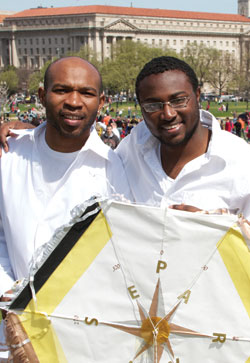
The earthquake struck in January, during the final days of his grandfather Andre Torchon’s battle with cancer. Travel to Port-au-Prince for the funeral became impossible. Two months later Jean was able to fly to Haiti with his brother, Clifford Muse ’11, information systems. Unable to fulfill their grandfather’s last request that they dress in white at his funeral to celebrate life’s joys, the brothers resolved to honor his memory in another way. They would capture on film the joys of life in Haiti, joys that endured even at a moment of profound national suffering.

The documentary Lift Up, co-directed by Jean and Phillip Knowlton ’03, visual arts, records their journey. It follows Jean and Muse as they build a kite in their grandfather’s honor, just like the kites they had flown with him as children in Haiti. A deeper look reveals Knowlton and Jean’s own journey as filmmakers, each traveling through uncharted territory to share stories of resilience in the face of profound loss with eloquence and compassion.

Jean and Knowlton met as undergraduates at UMBC when they co-captained the track and field team. They came from different worlds—the engineer from Port-au-Prince and the artist from Silver Spring, MD—but they stayed connected through their love of film, even as Jean moved on to graduate school at UMBC and Knowlton to edit music videos in New York. When the earthquake struck, their connection led to collaboration.

“We wanted to help the folks of Haiti in a way that was more meaningful than just texting money,” says Jean. “As a Haitian, it was very difficult for me to watch the devastation from a distance.” When the opportunity arose, they bridged that distance, flying to Haiti to film the post-quake recovery experience, checking their preconceptions at the gate.

The Port-au-Prince that Jean and Muse found was markedly different from the one they had left. The sense of disconnection was jarring in a different way for Knowlton, who had never before been to Haiti. Like Jean, he looked to Haitians for guidance to understand and document their experiences of survival, mourning, endurance and revival.

Jean recalls Knowlton speaking with the local residents, telling them how their strength of spirit amazed him. “To watch them sing, dance and continue with life in the midst of the devastation touched him profoundly,” says Jean, who was moved to tears as he filmed the conversations. “My friend from Maryland was in Haiti, in the middle of the rubble, helping us capture on film this very personal journey, and he did it just because he believed in our vision. I was grateful and humbled by his presence, and I cherished every bit of his collaboration and friendship.”

The result is a film that speaks to the universal importance of community in times of hardship. Lift Up contests negative representations of Haiti that the filmmakers argue have too often dominated media narratives. It also seeks to keep Haiti’s post-quake recovery in the public eye and promote longer-term humanitarian assistance there as news coverage wanes.

Lift Up reflects the vision and passion of the filmmakers as much as the experiences of its subjects. In film, Knowlton sa