
All posts by: Megan Hanks Mastrola


Three UMBC students receive Goldwater Scholarships, a national investment in future STEM leaders

Three UMBC students in the College of Engineering and Information Technology (COEIT) have been named Barry Goldwater Scholars for the 2016-2017 academic year. The Barry Goldwater Scholarship and Excellence in Education Program seeks to provide the United States with “a continuing source of highly qualified scientists, mathematicians, and engineers.”

As Goldwater Scholars, Daniel Ocasio ‘17, Naomi Mburu ‘18, and Andreas Seas ‘17, all chemical engineering majors, will receive substantial scholarship funding.

This highly competitive national scholarship has a major impact on each recipient’s educational path. Ocasio shares, “As a first generation college student, I feel extremely fortunate to be pursuing higher education, let alone a career in scientific research. To me, earning the Goldwater Scholarship is recognition of all those who made it possible for me to further my academic development.”

This year, a new initiative coordinated by Mitsue Wiggs, assistant director of the Meyerhoff Scholars Program, allowed UMBC students interested in applying for a Goldwater Scholarship to receive feedback on their applications before formally submitting the materials. Applicants shared early versions with alumni of the Meyerhoff Scholars Program, who reviewed the draft applications and provided advice before the students submitted their official applications to UMBC’s Goldwater Scholarship Selection Committee.

David Eisenmann, associate professor of biological sciences; Lee Blaney, assistant professor of chemical, biochemical and environmental engineering (CBEE) and Simon Stacey, director of UMBC’s Honors College, served on the UMBC Goldwater Scholarship Selection Committee this year. The committee reviewed applications, and provided advice and feedback to nominees on their essays.

At UMBC, Seas is involved with both the Meyerhoff Scholars Program and MARC U*STAR Program. He has also worked closely with faculty mentors at the University of Nebraska Medical Center’s Collaboration for Advanced Surgical and Engineering Applications. After pursuing a Ph.D. in biomedical engineering, he would like to become a professor and do vascular mechanobiology research. “I am honored that my contributions to science have been recognized by the Goldwater Committee,” he said. “My only hope is that I continue to learn from the world around me and contribute to the advancement of human knowledge.”

Ocasio has worked as a student researcher in Lee Blaney’s lab for over a year, and credits Blaney with helping to push him beyond his expectations for his undergraduate experience, and to pursue research as a career. Ocasio would like to pursue a Ph.D. in environmental engineering with the goal of conducting research related to water treatment and quality.

Mburu began research as a high school student with Lasse Lindahl, professor of biological sciences. She says that early exposure to research sparked her interest and encouraged her to join other labs and explore a variety of research areas. As an undergraduate at UMBC, she has worked with Gymama Slaughter, assistant professor of computer science and electrical engineering, who has inspired Mburu to pursue research on energy sources. Mburu also worked with mechanical engineering faculty at Vanderbilt University, producing research that formed the basis of her Goldwater Scholarship application. Mburu’s goal is to pursue a Ph.D. in nuclear engineering, and then teach physics and do nuclear energy development research.

“Being chosen for this prestigious scholarship as a sophomore is such an honor,” says Mburu. “I thank God for this amazing opportunity, and I am incredibly grateful for the wealth of opportunities UMBC had provided for me to make my goal of making an important contribution to the scientific world a reality.”

Image: Andreas Seas, Naomi Mburu and Daniel Ocasio (left-right) have been named Goldwater Scholars for 2016-2017. Photo by Marlayna Demond ’11 for UMBC.
UMBC hosts over 200 educators, industry leaders, legislators at Maryland Computing Education Summit

UMBC partnered with the Maryland State Department of Education to bring more than 200 educators, industry leaders, and legislators together for the Maryland Computing Education Summit, the state’s largest gathering focused on computing education. The event was held at UMBC on Tuesday, April 12, 2016.

The Maryland Computing Education Summit began as an annual event in 2013, with the goal of finding a way to offer at least one computer science course to students in every high school across the state, explained Marie desJardins, associate dean of UMBC’s College of Engineering and Information Technology (COEIT) and professor of computer science, one of the leaders behind the event.

Continuing the vision of the original summit, Jack Smith, Maryland interim state superintendent of schools, delivered opening remarks, emphasizing that computer science education needs to be integrated into all levels of K-12 education.

Throughout the summit, attendees participated in sessions on topics such as instructional resources, curriculum for students at different levels, teacher preparation, careers in computer science, and introducing students to computer science outside of the classroom. The session “Diversity and Equity: Why is CS Education Access So Important?” prompted participants to discuss unconscious and societal stereotypes within and about the field of computing.

Jan Plane, director of Maryland Center for Women in Computing and senior lecturer in the University of Maryland, College Park’s department of computer science, showed a graph illustrating the how fields such as biology, chemistry, math, and physics have become increasingly representative of the U.S. population, and how computer science still has significant work to do. “Without fixing the K-12 issues, we cannot fix the computer science pipeline,” Plane noted.

Both desJardins and Plane shared concerns that students often feel they aren’t “good at” or “cut of out for” computer science despite the fact that they haven’t tried it. They stressed that it is important for students to have exposure to computer science from an early age, before taking to heart stereotypes about who computer scientists are, and to have an understanding of the breadth of computing and the ways computing is used in society.

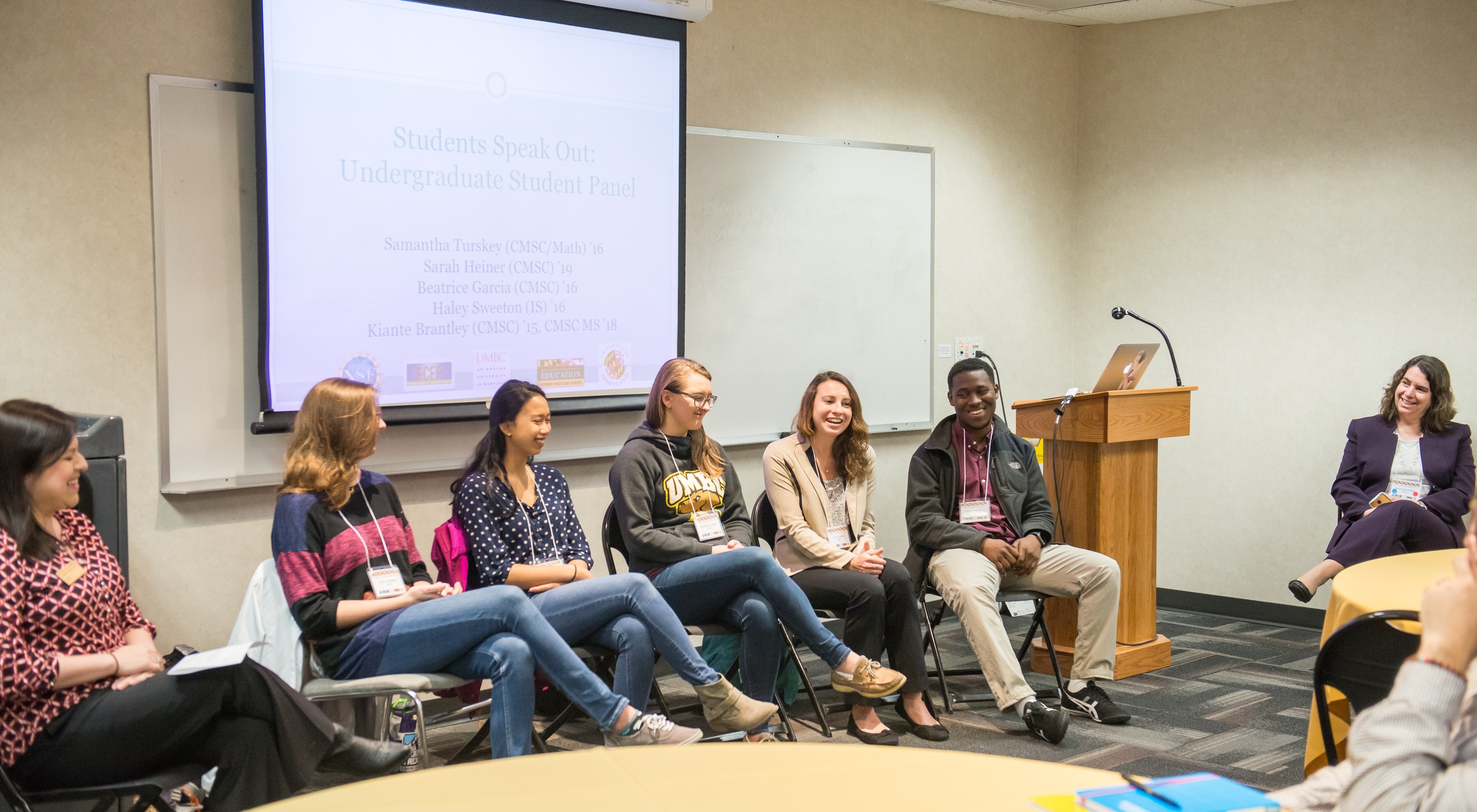
In one popular session, five UMBC students participated on a panel about their experiences in computing. Beatrice Garcia ‘16, computer science, recalled feeling troubled when she was one of a handful of women in her computer science courses. “Am I behind? Am I on par with the guys?” she would ask herself.

Several students mentioned that diversity is a huge issue in STEM fields. Sarah Heiner ‘19, computer science, said that she felt like an imposter during some of her classes, and wishes that one of her technology teachers in high school had been a woman. She did positively reflect on one high school STEM experience, recalling an exciting field trip to the Applied Physics Lab at Johns Hopkins University to learn about the broad ways math can be useful in careers.

Kiante Brantley ‘15, computer science, M.S. ‘16, computer science, emphasized that when educators present information about computer science and careers that use computer science, it is important to present the content in a way that young students find engaging, relatable, and memorable.

Other sessions highlighted resources that educators can use in their classrooms to introduce students to computer science, and gave attendees opportunities to brainstorm ways to integrate computer science principles into their courses.

Core to all these conversations was an understanding that computer science should not be siloed and accessible to only the small percentage of students who might discover it on their own. “We need to make coding a part of our culture,” said UMBC President Freeman Hrabowski, “in the same way that students need to know how to write and think.”

PBS documentary features neuroscientist Kafui Dzirasa’s new approach to treating bipolar disorder

More than five million Americans have been diagnosed with bipolar disorder, and Kafui Dzirasa ‘01, chemical engineering, is working to develop an electrical device that would stabilize a person’s mood without the side effects caused by medications. His work is featured in “Ride the Tiger: A Guide Through the Bipolar Brain,” a new PBS documentary that gives viewers a glimpse into the lives and stories of people with bipolar disorder.

Dzirasa, assistant professor of psychiatry and behavioral sciences at Duke University, describes how he is able to approach studying the brain from the perspective of an engineer.

Nearly one third of people with bipolar disorder are prescribed lithium as a way to help manage their symptoms. “These medications go everywhere in the brain. And when they go everywhere, the come along with some side effects that are pretty troubling,” explains Dzirasa.

When it comes to treatment, Dzirasa says, “We want to do the least necessary thing to get [a beneficial] outcome.”

The device that he is creating is able to specifically target a certain part of the brain where there is a “roadblock.” “Because the stimulation is only going where you need it, you don’t have to worry about any of the other side effects,” he notes.

The technology Dzirasa is developing is being tested on mice, which are injected with a human bipolar gene and over time begin to show behaviors that are similar to behaviors exhibited by people with bipolar disorder.

Watch the full documentary “Ride the Tiger: A Guide Through the Bipolar Brain” on PBS or in the window below. Learn more about Dzirasa’s research in a recent UMBC News article about his Presidential Early Career Award for Scientists and Engineers.

Image: Dr. Kafui Dzirasa. Photo by Les Todd, Duke Photography. 

UMBC’s 2016 NSF Graduate Research Fellows share gratitude for research experience, mentorship

Six members of the UMBC community, including one current undergraduate and five recent alumni, have received highly competitive National Science Foundation (NSF) Graduate Research Fellowship Awards for 2016.

“Through the NSF Graduate Research Fellowship Program, the nation invests in those individuals who have shown great potential to excel in STEM graduate programs and become the next generation of research leaders,” explains Janet Rutledge, vice provost and dean of the Graduate School at UMBC.

The high number of UMBC students and alumni who receive NSF Graduate Research Fellowship awards demonstrates national recognition of the quality of a UMBC education, which is particularly well regarded for providing robust research experiences for undergraduate and graduate students alike.

Gaurav Luthria ‘16, bioinformatics; Nicholas Rogers ‘15, chemical engineering; Akua Nimarko ‘15, biological sciences and psychology; Abraham Beyene ‘08, chemical engineering; Abigail Jackson ‘15, biochemistry and molecular biology; and Hythem Sidky ‘11, chemical engineering, all received fellowships for 2016. The three-year-long awards support students pursuing master’s and doctoral degrees in science, technology, engineering and mathematics (STEM) fields.

Luthria will use the fellowship funding to support a Ph.D. in bioinformatics and integrative genomics at Harvard Medical School, beginning in the fall. “Since coming to UMBC, I have received tremendous support and exposure to a wide array of research projects,” he says. “I am very excited for graduate school and hope to conduct significant research and develop computational tools to help doctors, scientists, and patients understand, diagnose, and treat human disease.”

Rogers received offers from ten Ph.D. programs, and is now deciding where he will pursue his degree.“The NSF GRF is a tremendous honor for me. It reflects my growth as a researcher and the mentorship that has guided me along this path,” he says. “Many others who have won this fellowship before me have emphasized that the impact of this award stretches beyond what I can see now, and I am very excited to see what opportunities it provides!”

Nimarko, pursuing a Ph.D. in neuroscience at Stanford University School of Medicine, shares, “I am grateful for the opportunities at UMBC that allowed me to successfully compete for this fellowship.”

Image: Akua Nimarko. Photo by Marlayna Demond ’11 for UMBC. 

Matt Pelton receives NSF CAREER Award for research on vibrating nanoparticles

Matt Pelton, assistant professor of physics, has received the prominent CAREER Award from the National Science Foundation (NSF) to advance his research on vibrating nanoparticles. His award totals approximately $650,000 over five years, and his research will focus on how nanoparticles act in various liquids, to understand the unique ways in which mechanical energy flows at the nanometer scale.

“We congratulate Dr. Pelton on his NSF CAREER Award, a recognition of his work and dedication to impacting other scientific fields through his research,” said Karl V. Steiner, vice president for research. “This recognition of Dr. Pelton adds to our growing list of outstanding young faculty who are receiving this high level of peer-based recognition from NSF and other sources.”

Scientists understand how conventional liquids, like water, behave on ordinary time and length scales, and how individual molecules make up liquids, but there is less understanding about liquids on intermediate scales. Pelton has developed a method based on ultrafast laser spectroscopy of vibrating metal nanoparticles suspended in liquids to understand the complex properties and molecular interactions of ordinary liquids.

“It’s like ringing a bell, but on a much smaller scale,” Pelton says of his work. When a bell is rung, it vibrates many times, and if the bell was rung and then submerged in water, it would ring fewer times than when it was not in water, he explains. And if the same bell was rung and then submerged in honey, a viscous liquid, the bell would only ring once or twice.

The nanoparticles in liquids that Pelton studies vibrate a few billion times per second, and can be manipulated with laser pulses. These pulses cause the nanoparticles to expand and vibrate, but like a bell, they react differently depending on the liquid that they are in. Pelton is working to understand how long the nanoparticles vibrate when hit with laser pulses, and where the energy goes as the particle moves.

It is known that particles on fast time scales and short length scales do not act the way that the particles on ordinary scales behave. Pelton explains that sometimes liquids act like a solid, giving the example of cornstarch mixed with water. The mixture acts like a liquid if somebody pushes slowly on it with their finger, but someone presses quickly enough, the particles in the mixture cannot move out of the way and the mixture appears to behave like a solid. Pelton’s research shows that this happens even for an ordinary liquid, such as water, if you push on it quickly enough — such as with a vibrating nanoparticle.

By contributing new knowledge about the complex properties of liquids, Pelton’s work will expand understanding of the function of biological molecules, which live in a liquid environment, and of potential new molecular sensors based on vibrating nanoparticles.

Beyond the research methodologies and findings, Pelton shares that UMBC has allowed him to create his own, independent research group and train the “next generation of scientists in an environment that emphasizes inclusive excellence.”

I’m particularly happy to receive the CAREER award because it recognizes both of these goals: effective teaching and innovative research,” Pelton says. “It allows me to pursue a research project that will form a cornerstone of my longer-term scientific program as a researcher and educator: to understand the unique ways in which energy flows at the nanometer scale.”

In the last two decades, UMBC faculty have received 30 NSF CAREER awards. Helena Mentis, assistant professor of information systems, is the most recent previous recipient of a CAREER award for over half a million dollars to advance her research on gesture-based tools that can be used by remote surgeons to share expert knowledge in the operating room.

Image: Matt Pelton works with a student in his lab. Photo by Marlayna Demond ’11 for UMBC. 

Society of Women Engineers hosts former Miss America for “Fight the Stereotype”

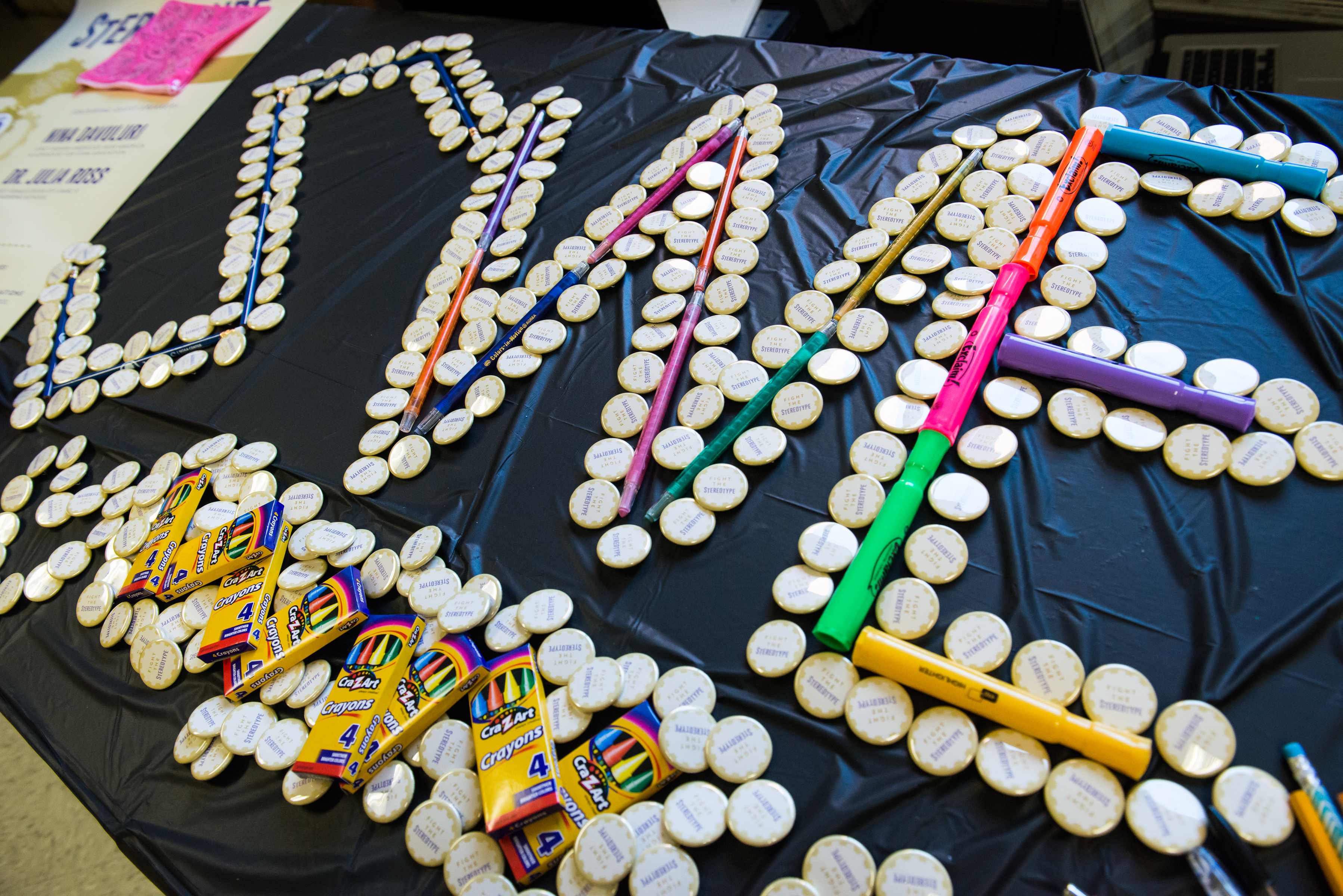
UMBC’s Society of Women Engineers (SWE) hosted “Fight the Stereotype,” an event focused on challenging gender and racial stereotypes related to STEM education and careers, on April 5, 2016.

Julie Ross, dean of UMBC’s College of Engineering and Information Technology, spoke about the importance of debunking stereotypes related to engineering fields, particularly pertaining to women and minorities. “People are well meaning,” she said, “but they have stereotypes in mind about what engineers look like, talk like, act like.”

“How will you fight the stereotype?” Ross asked the audience. “How do we dispel the stereotypes and respond?”

Before Nina Davuluri, an advocate for STEM education for girls and women and Miss America 2014, shared her story, she asked attendees to bring to mind any preconceptions or stereotypes they had about her as a former winner of the Miss America Pageant and an Indian-America. “I grew up feeling that I could never fit in this role of Miss America because of the stereotypes,” she shared.

Davuluri encouraged audience members to share stereotypes that they are facing, and to engage in an open conversation about misconceptions, to challenge societal assumptions and microaggressions that can dissuade women and minority students from pursuing their goals.

She says that when she won the Miss America Pageant in 2014, it showed that “it was time for the organization to have a winner that represented the U.S. population,” which is much more diverse than stereotypes suggest.   

Davuluri offered, based on her experience, that in addition to public statements, role modeling, and supporting anti-stereotype campaigns, it can also be effective to speak with people one-on-one in an effort to fight against broader societal stereotypes, saying, “that is how we need to learn.”

Mona Patel ‘18, chemical engineering, president of UMBC’s SWE chapter, said she hopes attendees continue to educate others moving forward. “My goal for this academic year was to encourage students to get involved in STEM outreach and to educate students on this campus about certain stereotypes,” she shared, adding “we hope you take away an important message and continue to educate others around you.”

SWE_event16-4835

Images: UMBC SWE members with Dean Julie Ross and Nina Davuluri (top) and SWE pins (bottom). Photo by Marlayna Demond ’11 for UMBC.

UMBC Chess to host Blindfold Chess Spectacular

On Sunday, April 24, Grandmaster Timur Gareyev, economics, a UMBC Chess Team alumnus, will return to campus to play a number of chess games while blindfolded and to lead a strategy session on how to play blindfold chess. This event comes in advance of an attempt, planned for later this year, to break a world record by playing 50 chess games simultaneously while blindfolded.

At UMBC, Gareyev will play chess games against 10 challengers, all while wearing a blindfold. After the games, Gareyev will talk about the art and strategy of playing chess without being able to see the boards.

Several members of the current UMBC Chess team will also have the opportunity to compete in knockout-style chess matches against Gareyev. All players participating will be blindfolded.

UMBC Chess also recently announced that in early March, eleven-year-old Pieter Heesters, a sixth grade student at the Calvert School in Baltimore, became the youngest winner of the Sweet 16 Maryland Scholastic Chess Championship, hosted by the Maryland Chess Association and held during the Alvin S. Mintzes UMBC Open. Heesters won a four-year scholarship to UMBC, which will be available to him when he graduates from high school in 2022, if he chooses to attend UMBC. Heesters is interested in math and music, and says that he wants to be a doctor. He will be one of the 10 challengers in the upcoming blindfolded chess event.

Grandmaster Tanguy Ringoir ‘19, economics, was the winner of the open division of the 2016 Alvin S. Mintzes UMBC Open competition.  

For more information about Gareyev’s upcoming chess event, please visit the UMBC Chess website

Photo by Gabriel Saldana, CC by-SA 2.0.

Cybersecurity experts share insights on MedStar Health cyber attack and cybersecurity safeguards

As ransomware reportedly held MedStar Health’s records system and data hostage, two UMBC cybersecurity experts offered insight on the situation and the possibilities for preventing future cyber attacks.

Anupam Joshi, director of UMBC’s Center for Cybersecurity and professor and chair of the department of computer science and electrical engineering (CSEE), spoke with CBS Baltimore (WJZ) about what MedStar Health or other organizations in similar situations can do to better understand and address the threats of ransomware.

He explained that ransomware takes over a computer system and holds it hostage until a demand is met, often a demand for bitcoins in exchange for returning access to the threatened data.

“Unbreakable. It’s simply unbreakable,” said Joshi, in describing how ransomware is highly challenging to crack.

Rick Forno, assistant director of the UMBC Center for Cybersecurity and director of UMBC’s graduate program in cybersecurity, spoke with The Daily Record about the MedStar Health system attack, specifically how ransomware attacks can be prevented.

Organizations like hospitals should back up their systems and data regularly, says Forno. However, he explains, malicious programs, like ransomware, can be hard to detect. This means that companies may not be able to guarantee that if encrypted backup files don’t contain  viruses or malware.

See “Cyber Attackers Who Broke Into MedStar Want Big Payout” on CBS Baltimore, and “MedStar cyberattack highlights health care IT challenges” in The Daily Record.

Photo by Yuri Samoilov, CC by 2.0.

UMBC-USNA teams share progress on cybersecurity research at symposium

UMBC and U.S. Naval Academy (USNA) faculty researchers presented updates on five collaborative cybersecurity projects funded by the Office of Naval Research (ONR) during the inaugural USNA-UMBC Partnership Symposium, hosted by UMBC’s Office the Vice President for Research on March 22, 2016.

The five projects presented are supported by three-year grants from the ONR, most of which are entering their second year of funding.

When the joint research initiative launched a year ago, Karl V. Steiner, vice president for research at UMBC, described it as “the start of a long-term partnership.” The recent symposium was the first formal opportunity for the research teams to formally present their progress on tackling major cybersecurity challenges outlined when the partnership began.

One team is developing a way to ensure that cloud-based storage services are secure, and that consumers can store their files with confidence. UMBC principal investigator (PI) Karuna Joshi, assistant research professor of computer science and electrical engineering (CSEE); Tim Finin, professor of CSEE; and USNA faculty are developing a cloud storage system that will make it impossible for deleted data to be restored or recovered.

Another group is developing a system that can continuously monitor itself and detect potential threats more quickly than human monitors. This technology has important safety as well as security implications. In cars, for example, hackers can gain control of a vehicle through Bluetooth or other existing systems, potentially having deadly effects. UMBC PI Ryan Robucci, assistant professor of CSEE; Chintan Patel, assistant professor of CSEE; Nilanjan Banerjee, associate professor of CSEE; Anupam Joshi, professor and chair of CSEE; and USNA faculty are now completing tests that involve working to detect anomalies in various systems.

Drawing on the finding that many online attacks follow predictable patterns, UMBC PI Tim Oates, professor of CSEE, and USNA PI Nate Chambers, assistant professor of computer science, presented their work on a tool to monitor social media networks, like Facebook and Twitter, in real-time to detect likely attacks. The team is analyzing language trends on social media platforms around the times that previous attacks took place. Regular social media users often notice attacks or threats of attacks first, and by analyzing and characterizing the content of their posts on “normal days” compared with “attack days” the team is developing a way to automatically generate an alert when real-time social media posts indicate a possible attack.

Understanding the strengths and limitations of the range of existing mobile authentication methods is important in protecting individuals’ devices from getting hacked. UMBC PI Ravi Kuber, associate professor of information systems, and USNA faculty are studying the strength of various authentication tools on Android devices to develop new methods that use tactile cues, like vibrations, to authenticate mobile devices. The team conducted research to understand authentication practices of people who are conscious of security issues, and the susceptibility of current authentication methods to over-the-shoulder breaches. Kuber and his team developed a secure authentication tool called H4Plock that prompts individuals to enter strokes in response to cues, where response patterns would be unique to an individual user.

The fifth group including UMBC PI Nirmalya Roy, assistant professor of information systems; Todd Pittman, associate professor of physics; James Franson, professor of physics; and several USNA faculty, is working to create quantum computers that can help identify abnormal behavior or patterns at much faster speeds than current computing technology. The team is extracting photons that will then be included in optical fibers to emit light. They are working to pull bundles of optical fibers thinner to create nanofiber cavities.

Don Engel, assistant vice president for research at UMBC, thanked the ONR for their close collaboration and shared his excitement that the research collaborations have already shown such “fruitful findings.”

Image: Karuna Joshi presents during the USNA-UMBC Partnership Symposium. Photo by Marlayna Demond ’11 for UMBC.

UMBC helps innovative faculty turn research into successful businesses

UMBC exemplifies a statewide trend of ramping up efforts to help faculty and students turn their research into commercial products and companies, supporting emerging entrepreneurs and boosting the state’s economy, The Baltimore Sun reports.

The article, which also appeared in The Washington Post, highlights new technologies developed by UMBC’s Nilanjan Banerjee and Ryan Robucci ‘02, computer engineering, both assistant professors of computer science and electrical engineering (CSEE). Banerjee and Robucci, as well as Chintan Patel ‘04 Ph.D., computer engineering, research assistant professor of CSEE, and their research students have worked with university and state officials to commercialize two wearable sensors that they developed in their ECLIPSE research cluster. The support the team received included guidance in obtaining grants, patenting the technology, and creating a viable business.

One sensor, RestEaze, non-intrusively monitors a person’s sleep quality in a home setting by tracking leg movements, and may help to diagnose restless leg syndrome, ADHD or cardiac issues. It is being developed in collaboration with the Johns Hopkins University School of Medicine, with funding from the TEDCO Innovation Commercialization Program as part of the Maryland Innovation Initiative.

The other sensor, Inviz, is a gesture recognition system that helps people with limited mobility complete everyday tasks, such as turning on the TV or a light, and be prepared for emergencies, with the ability to call 911. It uses low-cost flexible sensors that can be embedded in clothing or other fabric, and is supported by NSF and Microsoft.

UMBC is increasingly encouraging researchers to focus on commercializing their discoveries and research, Banerjee explained. “It’s one of our responsibilities to make sure we have a societal impact, and commercializing is one way of doing it,” he said in the article.

Read the full article “Maryland universities ramp up efforts to help students, faculty create companies” in The Washington Post and in The Baltimore Sun.

Image: Nilanjan Banerjee and Ryan Robucci in a lab. Photo by Marlayna Demond ’11 for UMBC.

START funding enables UMBC faculty to advance their research in new directions

UMBC’s Office of the Vice President for Research has named seven new recipients of Strategic Awards for Research Transitions (START). The awards are formerly known as Special Research Assistantship/Initiative Support (SRAIS). Reaching up to $20,000 each and beginning July 2016, the awards are intended to help faculty compete more effectively for external support and to pursue new areas of inquiry.

Rachel Brewster, associate professor of biological sciences, was awarded funding to study how zebrafish are able to survive extreme environmental conditions by entering hypometabolism.

Felipe A. Filomeno, assistant professor of political science, will receive START funding to study inclusionary policies on immigration settlement in Baltimore City. His case study will assess the outcomes of local immigration policies, examine how effective the policies have been in Baltimore, and advance understanding of local immigration policies.

Erin Green, assistant professor of biological sciences, will use the START funding to study the role of yeast genes in cellular stress response pathways. By understanding how yeast genes affect a cell’s response to stress, her work will expand the understanding of how environmental stimuli change the structure and function of DNA and proteins in chromosomes.

Marcella Mellinger, assistant professor of social work, was awarded START funding to study the evolution of anti-domestic violence advocacy efforts. She will gather qualitative data through focus groups and interviews, and identify themes that illuminate how advocacy work has shifted over time.

George Derek Musgrove, associate professor of history, will use START funding to conduct research and writing for the study “The Black Nationalist Resurgence and the Changing Nature of Black Protest in the Post-Civil Rights Period.” The study will focus on black political activism between 1980 and 1995, and will reframe this time period by displacing the popular teleological narratives in today’s discussions of race.

Hamed Pirsiavash, assistant professor of computer science and electrical engineering (CSEE), was awarded START funding to develop computer algorithms that can make computers “see” the world and “interact” with the world in ways similar to humans, accounting for a level of uncertainty. Utilizing these algorithms, computers watching large-scale unlabeled videos should be able to predict what will happen next.

Meilin Yu, assistant professor of mechanical engineering, was awarded START funding to develop a 3D computational fluid dynamics simulation tool that will be used to study the fin-body-flow interaction in fish locomotion. The findings of this research will help improve the design of autonomous underwater vehicles (AUVs).

Image: Associate professor Rachel Brewster. Photo by Marlayna Demond ’11 for UMBC. 

Three COEIT faculty honored for dedication to mentoring students  

Three faculty in UMBC’s College of Engineering and Information Technology (COEIT) have received distinguished awards from leading professional organizations for their commitment to mentoring students and advancing engineering education.

Amy Hurst, assistant professor of information systems, has been named a recipient of the National Center for Women and Information Technologys Undergraduate Research Mentoring Award 2016, which she will receive at the group’s Summit on Women and IT in May.

Hurst studies accessibility issues and develops assistive technologies and tools to empower others to build their own assistive technologies. During her five years at UMBC, Hurst has mentored more than 40 undergraduate students and nearly 25 graduate students. She engages students in her lab in various ways, and says that mentoring students is a huge part of why she is a professor.

“Students are embedded in my research lab by conducting independent research, supporting my PhD students’ research, and maintaining our lab equipment,” says Hurst. “Through working in my lab, undergraduate students have gained valuable experiences and been very successful.”

Over the past five summers, she has also hosted 11 undergraduates from other institutions in her lab through the Distributed Research Experiences for Undergraduates (DREU) program. The program allows students to work alongside UMBC students and complete meaningful research, while having access to a faculty mentor.

Hurst prioritizes meeting with all of her students at least once each week to discuss ongoing projects. “I have found that this topic [DIY assistive technology] is engaging for undergraduate researchers interested in having real-world impact and working with special populations,” she says.

Hurst’s award follows state and national recognition of Anne Spence, professor of practice in mechanical engineering, and Marie desJardins, associate dean of COEIT and professor of computer science, as mentors and advocates for engineering education.

Spence received the Engineering and Technology Education Advocacy Award from the Technology and Engineering Educators Association of Maryland (TEEAM) in February. The award recognized her substantial contributions to Project Lead the Way, a national organization focused on increasing the number, quality and diversity of engineers in the U.S. by effectively engaging more K-12 students in engineering through energetic, hands-on learning experiences.

In July, desJardins will be presented with the Undergraduate Research Faculty Mentoring Award from the Computing Research Association-Education (CRA-E). The award recognizes her work advancing computer science education in K-12 schools and preparing young women to pursue majors and careers in computer-related fields.

Since 2005, desJardins has mentored more than 70 undergraduate students, many of whom have gone on to pursue graduate programs in computing. She connects with undergraduate students during their first two years, and guides more senior students—particular those with research experience—in serving as peer mentors.

Hurst shares desJardins’s focus on engaging undergraduates in research through the support mentoring provides. “Mentoring has always been a priority to me, particularly helping students who are interested in research but have had little experience or exposure to it,” Hurst explains. “I feel that mentorship is one of the best ways to support students as they grow intellectually and make their career choices.”

Image: Amy Hurst talks with a student in her lab. Photo by Tim Ford, coordinator of illustrative services in the biological sciences department at UMBC.