All posts by: UMBC News Staff


Asian Studies Program and Longwood Apartments Begin Partnership

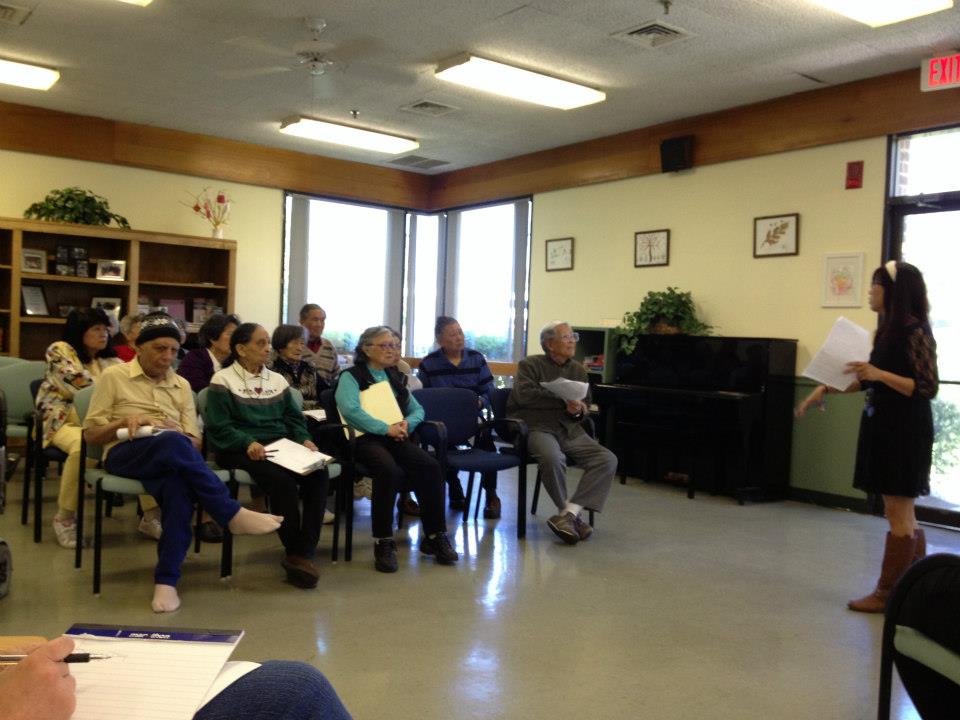
The Asian Studies Program and Longwood Apartments, located in Columbia, MD, have begun a partnership this spring. Asian Studies students will serve internships at this HUD Section 8 housing complex to facilitate communication between the largely Asian population and the non-Asian staff. They will also interact with the Chinese and Korean-speaking residents in a variety of ways, particularly through the Longwood Senior Center, which is located in Longwood Apartments and operated by Howard County

On April 26, two ASIA majors, Christine Au and Klara Kim, served as translators and facilitators at Longwood’s Spring Community meeting. Other internship duties will include: translating the monthly events calendar into Korean and Chinese; helping the Longwood staff to create bilingual work orders and other types of forms; assisting the Longwood Senior Center’s director with activities for residents (English language classes, recreational activities).

Christine Au speaks with residents

Asian Studies would also like to bring to Longwood Apartments “Food on the 15th,” a not-for-profit program that provides free groceries to low income senior citizens in Howard County. “Food on the 15th,” founded and directed by Julie Rosenthal, Program Management Specialist for ASIA, will begin collecting non-perishable food donations on campus in the fall.

To see more images, visit the Asian Studies Program Facebook Page.

Joe Tropea ’06 History B.A. and ’08 Historical Studies M.A, in the Baltimore Brew

A film by Joe Tropea ’06 History B.A. and ’08 Historical Studies premiers locally at the Maryland Film Festival next week.  The Baltimore Brew covered the film in a May 1 story entitled “A fiery act of civil disobedience in Catonsville still resonates, 45 years later.”

“Hit & Stay’ tells the story of nine Catholic activists who protested the Vietnam War by burning draft files in Catonsville on May 17, 1968.  Tropea and fellow filmmaker Skizz Cyzyk tell the story using old footage, recent interviews with surviving members of the group and their supporters, images of war horrors, and the reflections of eminences of the Left such as Howard Zinn, Noam Chomsky, Bill Ayers and Amy Goodman.

Tropea undertook the six-year process of making the documentary after writing on the subject for his masters thesis.  “I had had no idea about the amount of strategy and coordination and about how all these things were connected,” he said.

“Hit & Stay” will have two screenings at The Maryland Film Festival. (Tickets available here.)

Thursday, May 9, 7:30 p.m. at Charles Theatre, 1711 N Charles St.
• Saturday, May 11, 1:30 p.m. at MICA’s Brown Center, 1300 Mount Royal Ave.

The anniversary of the action will also be commemorated with a May 10 event at UMBC,Looking Forward from the 45th Anniversary of the Catonsville Nine Actions.”

UMBC: A Year of Questions, A Day of Answers

A Year of Questions, A Day of Answers

From the enduring popularity of Harry Potter to the intersection of open-source technology and the performing arts, the unique undergraduate research experience offered at UMBC comes to life this Spring.

The 17th annual Undergraduate Research and Creative Achievement Day (URCAD) held on Wednesday, April 24, gave UMBC undergraduates an opportunity to share their research with fellow students, faculty and staff members and alumni. The projects featured research, scholarship and creative work shared through oral presentations, posters, artistic exhibits, performances and film.

“URCAD brings together some of the most innovative and groundbreaking research projects and has defined UMBC’s commitment to a distinctive undergraduate experience,” said Diane M. Lee, Vice Provost and Dean of Undergraduate Education. “A major goal of the program is to give students the chance to share their knowledge through research and creative achievement and to gain valuable experience that will prepare them for graduate school or future careers.”

URCAD encourages undergraduates to explore inspirational topics and then creates a professional atmosphere where they can share their findings. Questions like “What drives people to create positive social change? How can we improve access to clean drinking water for communities in Africa? Is there a correlation between horror movies and mental disorders?”—as well as hundreds more— were answered by more than 200 different presentations displayed throughout the day. Some highlights included:

  • Mallory L. Brooks ’13 examined the popularity of the Harry Potter series by researching different fan groups and Potter-based organizations. Her findings revealed cultural themes that suggest the series appeals to our natural desire to be social.
  • Aneep S. Bindra ’14, Thomas A. Hervey ’14, and Zachary B. Hullihen ’13 have married the open-source technology of Microsoft’s Kinect motion sensing camera system with the performing arts to create intelligent stage lighting. The result was customizable, dynamic lighting effects that can be applied to virtually any live dance performance.
  • Social responsibility was certainly on the mind of Kathleen Algire-Fedarcyk ’13, but what about other college students? Ms. Algire-Fedarcyk’s research explored how to get students more involved in their communities by instituting a semester-long placement at local service-learning organizations as part of their Social Work 200 class.
  • A small community in Africa has a big problem: no access to clean drinking water. So, Dalton Hughes ’14 and Chris Mullen ’14, along with the UMBC chapter of Engineers Without Borders, decided to visit Isongo, Kenya and do something about it. What they found was high levels of chemical and bacterial contaminant in the water supply. Now, Hughes and Mullen are developing an inexpensive, low-tech water treatment system that will help improve the overall health of the Isongo population.
  • According to Brianna Garrett ’13, horror films are becoming increasingly popular and prevalent. Her study examined the emotions of disgust and fear that horror films prey on and how those emotions affect a person’s arousal, fear and revulsion. Data collected from this research will shed light on the effect of disgust and fear and how it may contribute to an etiology of mental disorders.
  • A full list of the undergraduate research projects presented at the 2013 URCAD event, including abstracts, is available on the URCAD website.

    (4/23/13)

UMBC: Living on a used planet

Living on a used planet

The Anthropocene, “the Age of Man,” has been presented as a story of new and accelerating human impact on Earth’s ecology — a threat to both humanity and the planet — due to industrial civilization.

But is this the true story of humankind and the biosphere?

Erle Ellis, a UMBC researcher, and his colleagues say, “not really,” in a new paper published in the Proceedings of the National Academy of Sciences (PNAS), “Used Planet: A Global History.”

Ellis, a professor of geography and environmental systems, and his colleagues say that the Anthropocene wasn’t born yesterday. “Human engineering of ecosystems, which changed the biosphere at globally significant levels in order to sustain human populations, likely began 3,000 years ago or earlier,” says Ellis. Most scientists talk about the Anthropocene beginning about 50 years ago,or at the most, 250 years ago.

Long before the emergence of agriculture, human populations had already begun adapting to denser populations by increasing the productivity of their land use systems, burning forests to attract game, consuming broader diets, and propagating favored species. The emergence of agriculture only continued the trend toward increasingly productive and intensive use of land.

“With the advent of fire,” says Ellis, “early humans started clearing land for hunting and gathering.” After the big game had been hunted out, which happened in many continents before the last ice age, Ellis says people turned their eyes towards smaller prey. In this way, people began to develop strategies to get more food out of the same amount of land. “We have been pushing past natural limits as long as we have been a species.”

Humans have been changing the plant for thousands of years. We live on a used planet and we shouldn’t think of people altering ecosystems as a recent disturbance.

Our ancestors adapted to the ecological changes made by their ancestors — all with the challenge of feeding growing populations from the same land. With advances in agriculture, we now use far less land per person. As our populations level off and concentrate within cities, more land can be returned to other species.

The, “reality is,” says Ellis, “is that rather than causing the sudden end of nature, industrial civilization lives in landscapes transformed by humans since prehistory.”

(5/1/13)

Lindsay DiCuirci, English, Awarded Fellowship

Lindsay DiCuirci, assistant professor of English, has been selected as the Stephen Botein Fellow in the History of the Book in American Culture at the American Antiquarian Society. She will be conducting research for a book based on her dissertation research, titled “History’s Imprint: The Colonial Book and the Writing of American History, 1790-1855,” this summer.

Botein Fellows are selected for the one-month fellowship on the basis of the applicant’s scholarly qualifications, the scholarly significance or importance of the project and the appropriateness of the proposed study to the Society’s collections.

Katie Morris of the Social Work Dept. Wins Program Director of the Year

UMBC’s Social Work Department, along with UMBC-Shady Grove, is pleased to announce Katie Morris as the Program Director of the Year at The Universities at Shady Grove. Ms. Morris received her award at the Student Achievement & Leadership Breakfast at The Universities at Shady Grove on Friday, April 12, 2013.

The Program Director of the Year Award is given to a program director from a participating USM institution who has served the students at the Universities at Shady Grove for at least two years. To be eligible the program director must have demonstrated a strong participation in creating a unique campus environment that is supportive of student success through activities such as community service and academic achievement, advanced the educational or career goals of students.

Ms. Morris serves as the Program Director for UMBC’s Social Work bachelor’s degree program and is in her tenth year as a faculty member at UMBC-Shady Grove. Her ability to connect and coordinate with her team of professors in the social work program has made the program among the best at The Universities at Shady Grove. She provides competent and professional leadership while also maintaining a collaborative atmosphere within the social work program. Recently, she presented at a national conference of baccalaureate social work programs and noted an article for the Chronicle of Higher Education on the use of technology in the social work curriculum. Ms. Morris has also been actively involved in inter-professional and interdisciplinary initiatives at The Universities at Shady Grove, including the very successful Poverty Simulation this past fall.

Ms. Morris is a motivator, educator, and a tireless advocate for students. She is totally dedicated to her job, always ready to intervene, to empower, and support students in finding solutions to problems. A student observed, “Katie wants us to take on challenges and do the best we can. She wants us to realize our full potential and is always there for us when we need her. She sees our strengths when we may not be able to see them, and she encourages us to be the best.”

Ms. Morris states, “I am truly honored to receive this award. I received this award because of my students. It is their curiosity, questions, experiences, hard work, passion and interest in social work that encourages me to be a better teacher, administrator, advisor, and go the extra mile to help them.”

Congratulations, Ms. Morris, for your accomplishment and proudly representing UMBC and the Social Work department.

First Works (5/3)

Join the Department of Dance, Friday, May 3 at 8:00 p.m. in Studio 317 of the Fine Arts Building, as Dance students debut their first ever choreographic pieces for this First Works concert.
Admission to First Works is free.

For All the World to Hear to Present at AAM Meeting

FATWTH in Afro-American 28 Feb 2013For All The World to Hear: Stories from the Struggle for Civil Rights, an oral history, outreach project of the CADVC, will present the session “Storytelling from Page to Stage: An Oral History Community Project” at the American Alliance of Museums’ (AAM) annual Meeting and Museum Expo.

The session, scheduled for Monday, May 20 from 1:45-3:00 p.m. in the Baltimore Convention Center, will tell the tale of the creation and production of For All the World to Hear. Harriet Lynn, director of the project, Sandra Abbott, CADVC, producer of For All the World to Hear, and Carrie Rennolds, graduate student, will present alongside participants in the project, who will share stories of their experience before and during the American civil rights movement.

Learn more about the session at the AAM article, “2013 AAM Annual Meeting Theme: The Power of Story,” or visit foralltheworldtohear.org.

Christine Mallinson, LLC, on “All Things Considered”

Christine Mallinson, associate professor of language, literacy, and culture, recently joined NPR’s “All Things Considered” for a discussion of the use of “yo” as a gender-neutral pronoun.

Mallinson said that kids in Baltimore have solved a very old problem in linguistics: English doesn’t have a gender-neutral pronoun. That makes it difficult to refer to people if you don’t know the person’s gender.  Youth in Baltimore often use “yo” instead of “he” or “she” when they don’t know a person’s gender. But they also use “yo” as a substitute even when they do know the gender.

Mallinson, and other linguists, are interested to see if the pronoun sticks around.  A number of other proposed gender-neutral pronouns – including ‘zee’ and ‘zeer’ – have failed to catch on.

“It’ll be interesting to see whether they keep that usage as they become adults. Do they keep that in the workplace? If that’s the case, it might persist,” said Mallinson. “But sometimes slang or linguistic innovations in middle or high school get dropped out as people become adult users of English.”

The segment, entitled “’Yo’ Said What?” aired on April 24.

UMBC: Texts, Technologies, and Literature

Texts, Technologies, and Literature

Beginning this fall, the English department will offer a new masters of arts in texts, technologies, and literature. The program is currently recruiting its first class of graduate students.

The M.A. in texts, technologies, and literature will give students the chance to further their understanding of literature and a broad array of other texts, including digital, academic and those that function in everyday use, in relation to both historical and contemporary culture.

When creating the new master’s, the English department decided that they wanted to develop a program that was different than anything else offered in the region. They also wanted to pull together the strengths in its two existing undergraduate tracks, literature and communications and technology. Finally, faculty wanted to look ahead to the future of the field and the future of the English department at UMBC.

“The discipline is changing, and it feels right in that way. We’re going with the way the discipline is moving,” said Orianne Smith, chair of English. She and Lucille McCarthy, the graduate program director, also feel that the balance between the two specialties of UMBC’s English department will make for a unique experience for students and faculty.

“It’s not just for literature folks, and it’s not just for technology folks. Everyone can get something out of it, and I’m really open to seeing how that evolves,” said Smith. She said that English faculty members are especially excited to teach master’s classes, since it will allow them to combine their teaching and research more deeply than they are able to do while teaching only undergraduate courses.

The department is currently recruiting students to begin graduate classes this fall. Smith and McCarthy expect that many members of this first class of students will be UMBC alumni. Smith said that in exit interviews with graduating students, the desire for a way to continue their studies at UMBC was often a topic of conversation. “There was pressure from below as well as endorsement from above,” she said.

She and McCarthy imagine students will come into the program with a variety of goals: some may be interested in pursuing a Ph.D. (students in this program can take classes in certain other UMBC departments, including the Language, Literacy, and Culture Ph.D. program); others might be teachers pursuing advanced training; and still more could be professionals entering or hoping to further their career in the communications, editorial, and digital media professions.

“We just don’t know what people will do with it. I think we’re going to learn together,” McCarthy said.

Another option for current students is the accelerated B.A./M.A., which allows undergraduates to take classes towards the master’s degree. MCCarthy said that she has a number of talented undergraduates in her classes pursuing projects that would be appropriate for graduate study.

Applications for the fall are due on May 1. Information, application requirements, a list of courses, and more can be found on the program’s website.

(4/1/13)

UMBC: The Two Gentlemen of Verona

The Two Gentlemen of Verona

UMBC celebrates a milestone this month as the Department of Theatre stages its first production in the new Performing Arts and Humanities Building Proscenium Theatre. Opening on April 18 and continuing through April 27, William Shakespeare’s The Two Gentlemen of Verona will be directed by assistant professor Eve Muson.

“It was a purposeful choice for the Department of Theatre to inaugurate the new PAHB Proscenium Theatre with William Shakespeare’s joyful comedy Two Gentlemen of Verona—a play about growing into maturity and defining one’s potential,” said Nyalls Hartman, chair and associate professor in the Department of Theatre. “It mirrors the Department’s own journey—moving into a dynamic new home, carrying our rich history forward and defining the direction of our future.”

Cultural leaders in the Baltimore region have applauded the new space. Vincent Lancisi, the artistic director of Everyman Theatre, remarked that for UMBC students and faculty to have “a toolkit like this, a place to tell stories, to create and to think and to engage audiences is extraordinary.” Fred Lazarus IV, president of the Maryland Institute College of Art, stated, “We talk about space as the envelope which allows really exciting creativity to happen, and that’s really what [UMBC has] created here.” Their comments were given during the opening celebration of the Performing Arts and Humanities Building in fall 2012.

The Two Gentlemen of Verona is one of Shakespeare’s earliest works and a perennial favorite among theatre audiences. When the two gentlemen, Valentine and Proteus, leave Verona to seek their fortunes in Milan, their boyhood friendship turns to rivalry as they both fall in love with the Duke’s daughter, Sylvia—even though she is promised to a rich suitor and Proteus is already engaged to his hometown sweetheart, Julia. Proteus sets out to betray both friend and fiancée, only to find that Julia and Sylvia have a thing or two to teach him about loyalty and love. One quick-witted (and one not-so-quick-witted) servant, some bawdy outlaws, and a faithful canine companion make this one of Shakespeare’s most lighthearted romantic comedies.

The play addresses timeless questions in Shakespeare’s works centered around love, friendship, adolescence and identity. What does it mean to be in a long distance relationship? How does one manage to live on one’s own for the first time? Set in imagined Renaissance Italy, UMBC’s production melds past and present, transcends time and blends music and dance. A visual mash-up of time periods, the play explores what happens when the bonds of friendship and fidelity are put to the test.

The production features scenery and costume design by Elena Zlotescu (associate professor); lighting and video design by Adam Mendelson (lecturer); musical direction by Anderson Wells (class of ’13); vocal direction by Lynn Watson (associate professor); choreography by Renee Brozic Barger (Dance, ’99); sound design by Patrick Calhoun; fight choreography by Cristian Bell; and dramaturgical support by Michele Osherow (associate professor of English and affiliate professor of Judaic Studies).

More information about the production, including performances dates and ticket information, is available on UMBC’s Arts and Culture Calendar.

(4/16/13)