All posts by: UMBC News Staff


Retriever Courage partners take stock of community work to prevent and respond to sexual assault

Sexual Assault Awareness Month is a national campaign focused on preventing sexual assault, harassment, and abuse, and it’s a month of great significance for the UMBC community. This year’s programming at UMBC is especially meaningful as the University responds to a call by students, faculty, and staff to do more to prevent sexual assault and other forms of sexual misconduct.

Retriever Courage: Speak, listen, learn, act

Retriever Courage was formed in fall 2018 in response to specific recommendations from students, faculty, and staff on how the university administration could improve community safety and wellbeing. The initiative outlined a shared governance process to better prevent and respond to sexual assault and other forms of sexual misconduct in ways that are inclusive, proactive, caring, and transparent.

This work involves dozens of partners across the university. They include the University Steering Committee, Retriever Courage Implementation Team, student and faculty/staff advisory committees, a prevention and response training implementation team, and procurement groups that assisted with the selection of an external consultant team now reviewing all related UMBC policies, practices, and resources.

“The thoughtful efforts of students, and the responsiveness of the University administration, faculty, and staff has been groundbreaking,” says University Steering Committee Chair Adam Harvey ’17, Ph.D. ’21, physics, who also serves as vice president of the Graduate Student Association. “Retriever Courage is beginning to transform the culture at UMBC and how people support each other in the campus community.”

At the same time, Retriever Courage partners say continuing to increase campus-wide involvement is critical to the long-term work of creating lasting change and growing a community where everyone feels safe and supported.

Preventing sexual violence and misconduct is a collective and ongoing responsibility,” says Susan McDonough, associate professor of history, and affiliate faculty of gender, women’s, and sexuality studies.

McDonough serves as faculty co-chair for the Retriever Courage Faculty/Staff Advisory Committee. She shares, “We have joined together to show up and do what we do best – to learn about the history of our own policies and practices, to research ways that other institutions have tackled these issues, and to educate for awareness and prevention.”

“Sexual violence is not a special interest issue, but rather a social justice issue that impacts us all,” says Student Advisory Committee Co-chair Aliya Weberman Ph.D. 21, clinical and community psychology. “Whether it is attending a Sexual Assault Awareness Month event, such as Take Back the Night; joining a group or committee working on these issues, such as We Believe You or Retriever Courage; or just telling someone impacted by sexual violence that you believe them and it’s not their fault; we can all make a difference.”
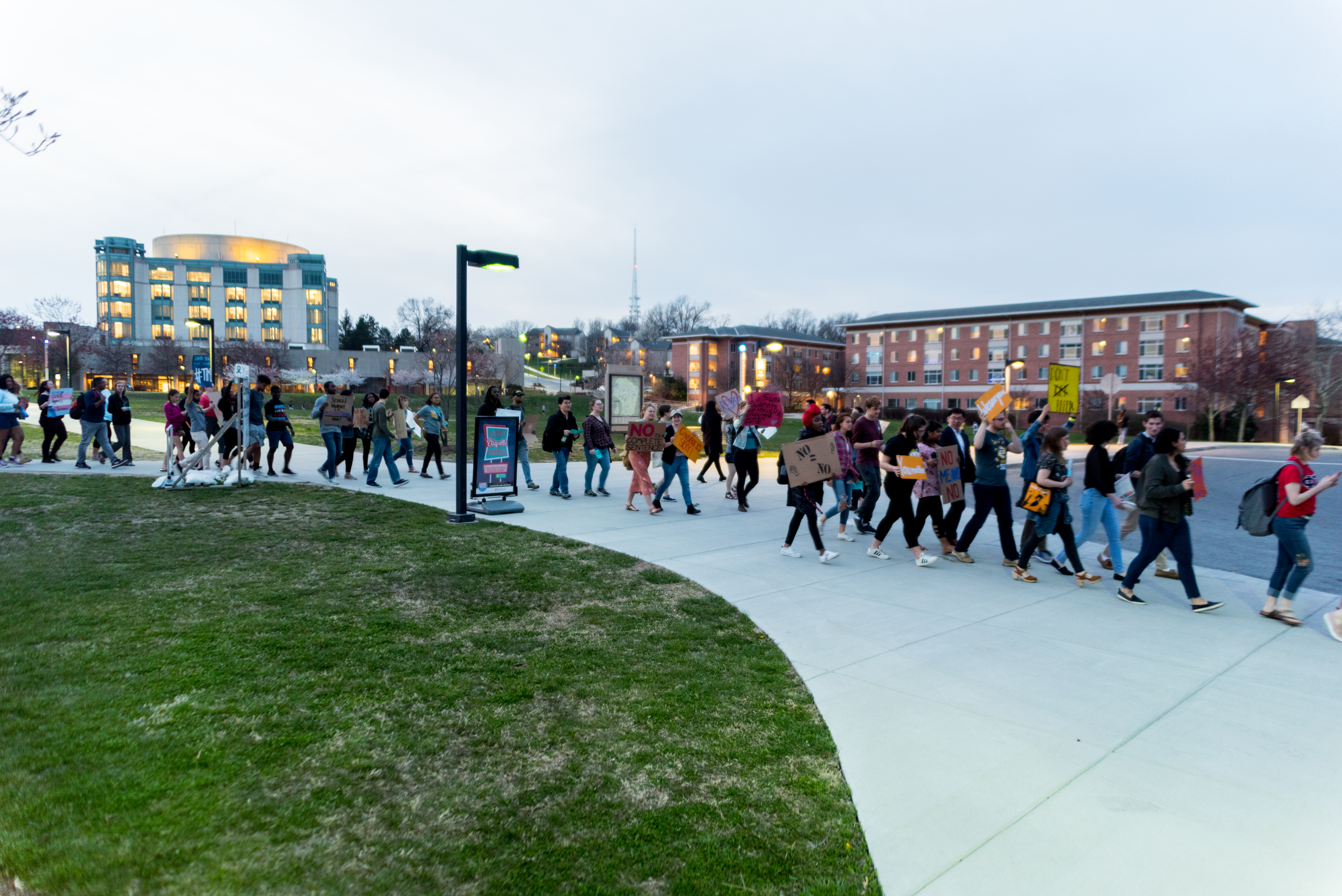
A group of students and other university community members walks through the university, carrying signs in support of women and survivors of sexual violence.

Commitment to action

Committee members share that several Retriever Courage projects directly responding to UMBC community input have been completed or are underway.

UMBC is currently distributing new campus ID cards that prominently display emergency resource information, and two Retriever Courage displays, including both on- and off-campus resources, were installed in The Commons. The displays are part of a pilot project proposed by the student activist/advocacy group We Believe You.
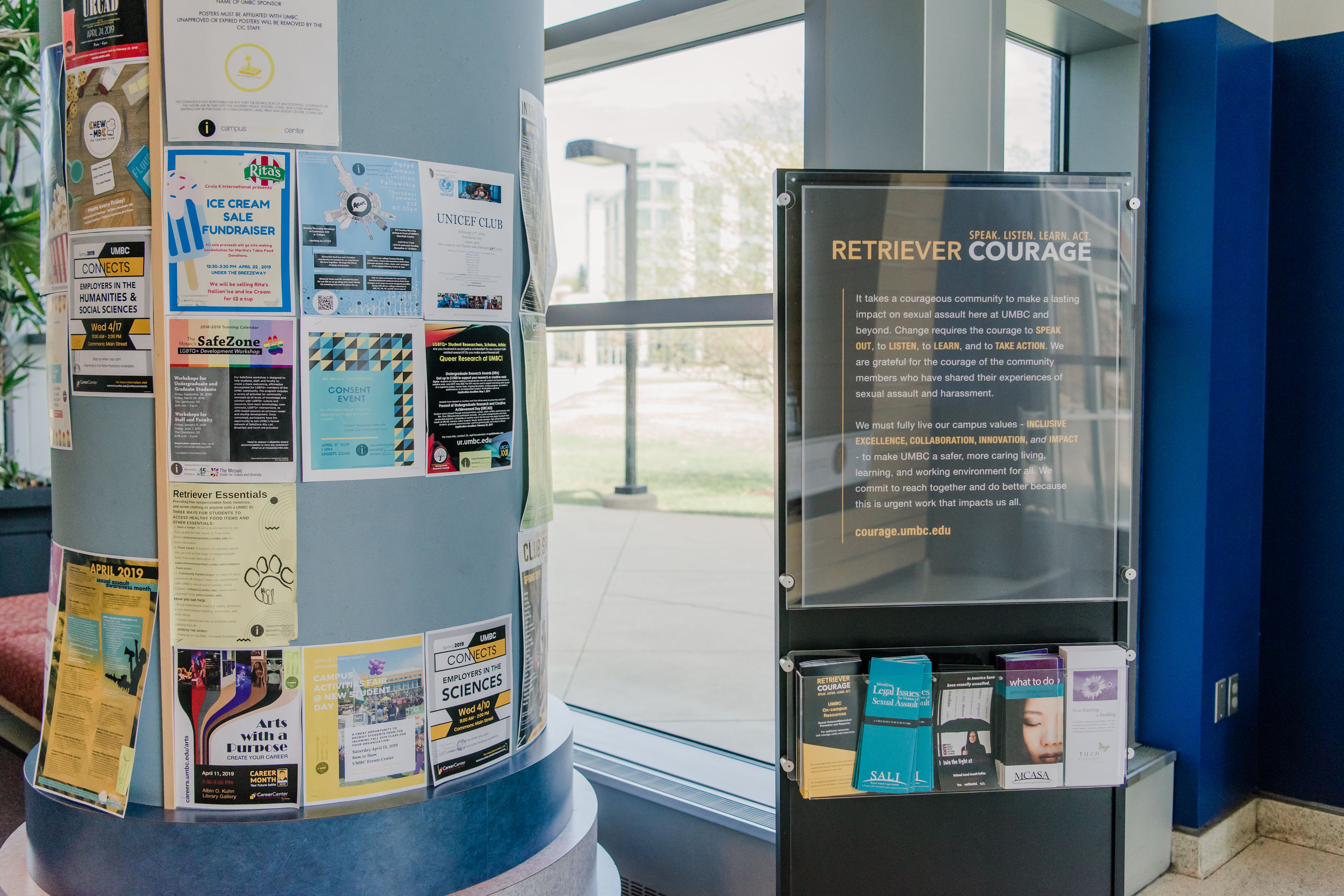
A display board in a university building shares information on Retriever Courage, with space for informational pamphlets below. Toward its left is a pillar with flyers promoting additional events and resources.

UMBC hired Jody Shipper, J.D., and Cherie Scricca, Ed.D. of Grand River Solutions, Inc. to work with Retriever Courage partners and the UMBC community during the spring semester. The consultants are reviewing UMBC policies, practices, and resources related to sexual assault prevention and response, and will share their recommendations in May.

Over 2,000 UMBC community members have participated in mandatory, in-person Title IX/sexual misconduct prevention and response training since December, and faculty and staff also completed a complementary online training. About 200 students are participating in an in-person pilot training project in April that will help determine a plan for training all students.

Facilities Management also continues to repair and add lighting in areas of concern to students.

Elle Everhart, staff co-chair of the Faculty-Staff Advisory Group and program management specialist in gender, women’s, and sexuality studies, says, “We are only just beginning to address the broader issues of toxic masculinity and rape culture on our campus, but the work done to date is a strong first step.”

“A 365-days-a-year undertaking”

As this work moves forward, the Retriever Courage partners are continually thinking about how the university can better support survivors of all identities and experiences. “We truly all know survivors whether we know them by name or not,” says Jess Myers, director of UMBC’s Women’s Center. “Our efforts to support survivors and cultivate a survivor-responsive campus need to be a 365-days-a-year undertaking,” Myers adds. “We all are responsible for this work.”

Implementation Team Co-Chair and Vice President for Student Affairs Nancy Young feels heartened by the work to date and committed to the work ahead. “We are encouraged by the engagement and collaborative spirit of our Retriever Courage partners and the UMBC community,” she shares. “The safety and wellbeing of our students and our entire community have been and must remain our priority in the long term.”

“The work of Retriever Courage is just the beginning,” says Young. “We encourage everyone to be involved as we make broader and far-reaching improvements in order to have a lasting impact.”

The UMBC community is invited to participate in Sexual Assault Awareness Month workshops and events organized by the Women’s Center and campus partners, including Take Back the Night on Thursday, April 18, 6 to 9 p.m.

UMBC community members can also get involved with Retriever Courage by contacting committee members and learning other ways to help prevent and respond to sexual violence/misconduct at UMBC.

Featured photo: A Take Back the Night survivor speak-out event. Photo courtesy of the Women’s Center at UMBC.
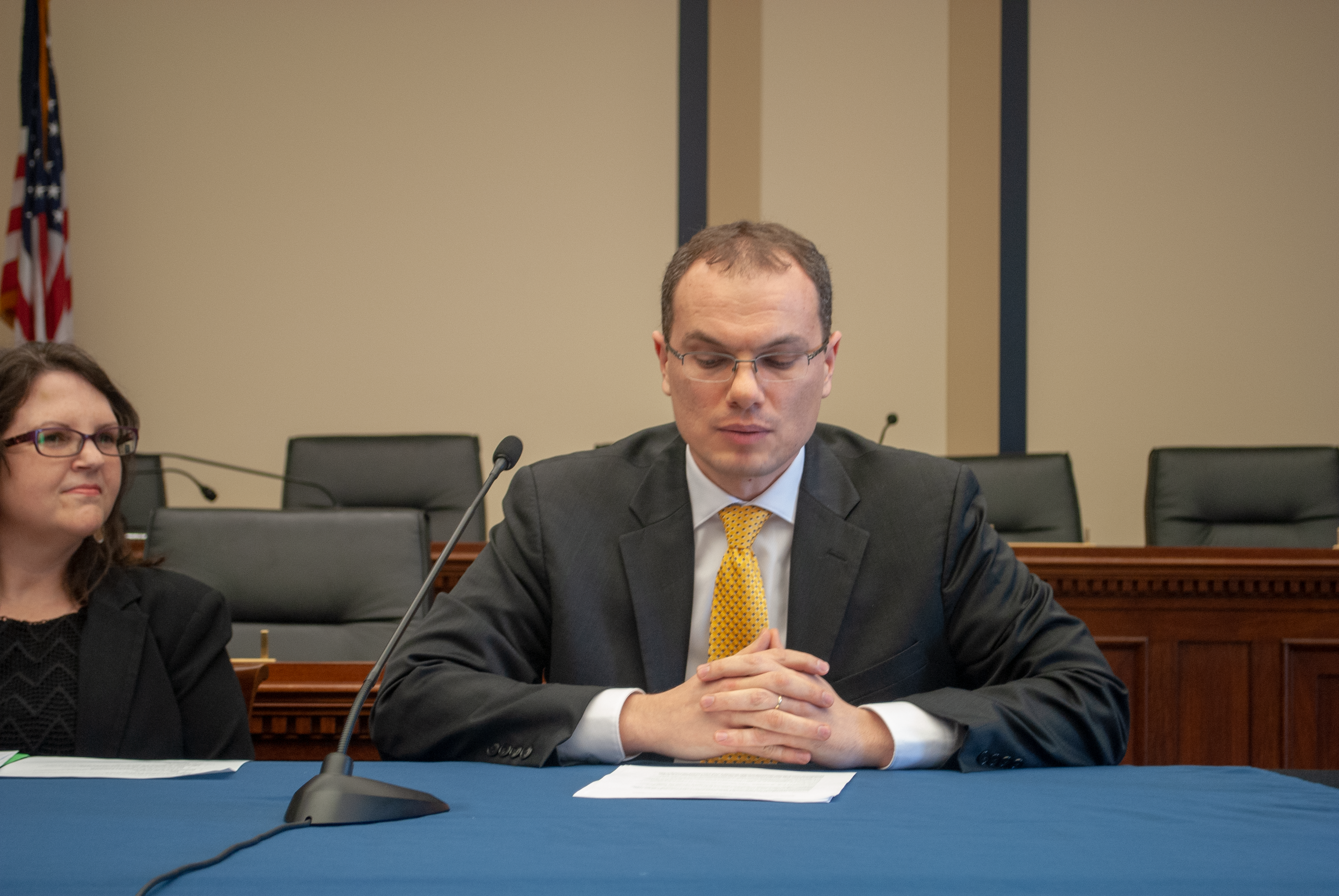
UMBC’s David Di Maria briefs Congressional staff on opportunities to support international students

UMBC’s David Di Maria recently visited Capitol Hill to brief Congressional staff on a key issue affecting higher education and the U.S. economy: opportunities for international students. To attend a U.S. university, international students must complete a student visa process, which can be both long and confusing for prospective students, their families, and the U.S. colleges and universities they hope to attend. With numerous immigration and education policy bills pending before Congress, Di Maria and colleagues in the higher education community offered their international education expertise to inform the debate.

Di Maria, associate vice provost for international education, spoke during the session “Student Visas, International Students, and the American Innovation Ecosystem.” He and other experts from the education and business communities provided perspectives on issues like visa processing and renewal procedures, the importance of international students to the U.S. economy, and ways to retain international students as members of the U.S. workforce after graduation.

Man in suit and tie, wearing glasses, speaks while seated at a table at an official event. Table includes a microphone and papers. A women sits next to him.

Economic impacts

Di Maria, who is known as a U.S. expert in the international education community, highlighted that international students “boost innovation, support 455,000 U.S. jobs, contribute nearly $40 billion to the U.S. economy, bring unique diversity to our campuses, and bolster U.S. foreign policy.” According to NAFSA: Association of International Educators, during the 2017-18 academic year, the nearly 20,000 international students enrolled at Maryland institutions of higher education contributed more than $700 million to the State’s economy, and supported more than 8,600 jobs.

UMBC has maintained strong international student enrollment, with more than 1,000 international students attending UMBC annually over the past several years. However, many other universities across the country have been challenged by declines in international student enrollments, which can, in turn, negatively affect the economies of individual states and the U.S. as a whole.

Opportunities for students and the nation

In addition to speaking about international student enrollments, Di Maria also discussed employment for these students after graduation.

Di Maria noted that visa caps and related policies result in U.S. schools producing “highly trained individuals and sending them somewhere else” for employment. He explained that in addition to affecting opportunities for the students, this prevents the U.S. from reaping the economic benefits that these recent graduates will provide when they enter the workforce, a point reiterated by panelist Jon Baselice from the U.S. Chamber of Commerce.

Kinu Harichandran, an international student from Pakistan, shared her experience as a graduate student at Georgetown University, where she earned a master’s and is working on a Ph.D. in vaccine research. She recounted the process for renewing her visa during her doctoral studies, and the toll it took on her research because she had to return to Pakistan for the renewal process.

During the several months Ms. Harichandran was in Pakistan, her professor monitored her research to keep it from being lost. She said her story is not unique, noting “professors are hesitant to take international Ph.D. students because of the possibility for gaps in research.”

When asked for one takeaway for the assembled Congressional staff, Di Maria recommended that the U.S. implement a national-level international education strategy, improve support for students, and adopt immigration policies that allow the U.S. to retain top graduates in our workforce. This, he suggested, could have a major impact by helping the U.S. attract international students, improving their experience, and encouraging them to contribute their skills and talents as members of the U.S. workforce.

This story was written by Mary Ann Richmond ’93, history. Featured image: David Di Maria, associate vice provost for international education, in the UMBC Commons. Photo by Marlayna Demond ’11 for UMBC.

Retriever basketball heads to America East playoffs

The month of March is a favorite for Retriever Nation, with America East playoffs on the horizon and memories of UMBC’s 2018 March Madness victory on everyone’s mind.

This year, both UMBC’s men’s and women’s basketball teams will compete in America East postseason play. The winners will then go on to compete in the 2019 NCAA Championships at the end of March.

Tyler Moore ‘20, psychology, and graduate student Joe Sherburne ‘18, financial economics, are leading their teams on and off the court. These team captains have both been standouts in 3-point field goals, and have each earned 2019 Academic All-District 2 First Team (CoSIDA) honors.

Women’s basketball ready for America East quarterfinals

Janee’a Summers ‘21, psychology, joins Moore as co-captain of the women’s team. Even as one of the youngest teams in the nation—with no seniors this year—the team has finished the regular season strong to earn the No. 7 seed in the America East tournament.

Among this season’s most exciting contests, the Retrievers upset UAlbany in a late season game. Later on, with their playoff fate on the line, they won at New Hampshire, 55-47, to earn a spot in the quarterfinals.

The Retrievers will take on second-seeded Hartford in West Hartford, Conn., on Wednesday, March 6 at 7 p.m. The game will be broadcast on ESPN+ (see game info). Students can enjoy the game with friends and popcorn at a watch party in the Sports Zone, also starting at 7 p.m.

Men’s basketball heads into postseason at No. 3

The 2018-19 season figured to be a challenging endeavor for the men’s team, led by head coach Ryan Odom. Standout guards Jairus Lyles ‘17, sociology; K. J. Maura ‘18, sociology; and Jourdan Grant ‘18, media and communication studies, completed their UMBC careers in 2018. The Retrievers’ phenomenal NCAA success in 2018 also assured they’d be considered a team to beat by this year’s opponents.

The Retrievers’ record stood at 9-9 and 1-2 in America East play in mid-January. Moreover, starting forwards Max Curran ’20, sociology, and Daniel Akin ’21 suffered season-ending injuries in December and January respectively. But the tide soon turned.

With a strong defense, the team earned ten wins in the final 13 games. UMBC defeated eventual regular season champion Vermont twice in that span, including a 65-56 win before a national television audience (ESPNU) at the UMBC Event Center on February 21.

To cap the regular season, UMBC rallied from an 18-point second half deficit to defeat New Hampshire, 56-53, on March 2. Freshman guard José Placer’s 3-point field goal with 2.4 seconds left on the clock punctuated the comeback.

As a result, UMBC earned the No. 3 seed in the America East Tournament and will host No. 6 UAlbany at the UMBC Event Center on Saturday, March 9. Students are invited to a pre-game social in the Sports Zone, starting 11:30 a.m. Tip-off time is scheduled for 1 p.m. Tickets are now available online for both students and the general public

Featured image: UMBC team captain Joe Sherburne during a game against Vermont. Photo by Gail Burton.

This article was written by Steve Levy, UMBC Athletics.

President Hrabowski shares an inclusive approach to difficult conversations in Bipartisan Policy Center interview

In a recent interview at the Bipartisan Policy Center’s Bob and Elizabeth Dole Series on Leadership, UMBC President Freeman Hrabowski shared his perspective on leading diverse and inclusive communities in today’s political environment.

Hrabowski grounded his talk in his own experience with the civil rights movement. He also drew listeners back to the founding of UMBC, noting, “It’s only been since the 1960s that we have said in the most clear manner that we need to bring more people into the mainstream.” He pointed out, “When the university was founded in the 1960s, we really were the only university in the state where kids of all races could come.”

More than 50 years later, UMBC still takes pride in its diverse community, which Hrabowski noted includes new immigrants and first-generation Americans with families from more than 100 countries, and first-generation college students, as well as students from military and intelligence families in the Washington, D.C. region. Hrabowski also pointed to UMBC’s socioeconomic diversity and the brain power of public research universities, saying, “You don’t have to be wealthy to succeed intellectually.”

How does this diverse group feel about the current heated political rhetoric? “People are angry, as you might imagine…people [at UMBC] believe in our country and they know we can be better than this,” said Hrabowski.

Reflecting on his conversations with students, Hrabowski told the audience, “young people will ask those of us of other generations ‘why haven’t you made it better than this?’…this is where the role of a teacher or mentor becomes most important.” He wants students to understand that “democracy is messy,” but change is possible, and we are empowered to make our communities and our country what we want them to become.

Hrabowski said he is “very proud” of how the UMBC community handles difficult conversations about policy and political issues, working across differences in perspective and opinion. He noted that “sometimes students need a chance to be upset with each other and have those conversations to find common ground.”

The key, Hrabowski suggested, is finding constructive ways to “help people not to give in to the anger of the moment.” He explained that educators have an important role in helping students learn how to effectively analyze complex issues, including ideas they disagree with, and to “understand the need to agree to disagree agreeably, with some civility.” By doing these things, Hrabowski said, students learn how to engage in respectful, productive public discourse.

Just as he views UMBC as a model for inclusive excellence in public higher education, Hrabowski sees Maryland as a model for bipartisanship and civility in state government. “[O]ur state is one of the few I see where you have more bipartisan agreement. We have a Republican governor who is supporting education, and a Democratic legislature, and they are working to make things happen… They are working together in a way that America needs to look at.”

The full interview is available through the Bipartisan Policy Center on SoundCloud.

This story was written by Mary Ann Richmond ’93, history. Featured image: President Hrabowski and UMBC students in a group discussion in the Dresher Center for the Humanities.

GRIT-X showcases groundbreaking UMBC research, scholarship, and creative achievement

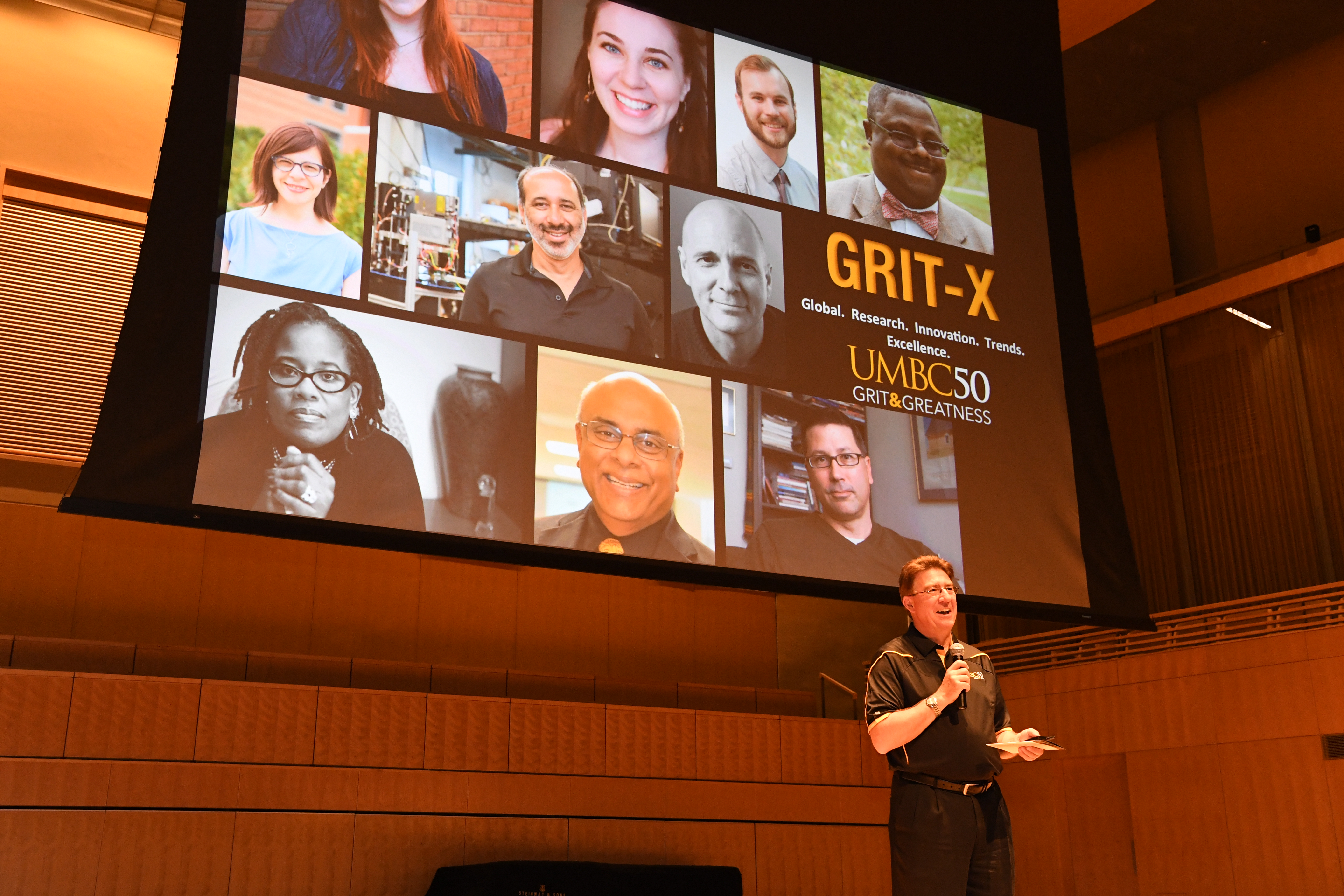
An inaugural GRIT-X event held during UMBC’s 50th anniversary weekend featured some of the university community’s most fascinating new research and creative work.

Faculty and alumni from across disciplines presented a series of engaging talks before an enthusiastic audience in Earl and Darielle Linehan Concert Hall. Hosted by Karl Steiner, vice president for research, GRIT-X featured three sets of 10-minute talks that covered topics from the process for creating a successful theatre company to dealing with contaminants of emerging concern in local watersheds.

Karl Steiner opens GRIT-X at UMBC.

“We really wanted to put a program together that…gives a glimpse at the diversity of programs and groundbreaking, impactful research and the many thought-provoking topics that many of our alumni and faculty are working on,” explained Steiner at the beginning of GRIT-X.

Several talks centered around what faculty and alumni are doing locally in and around Baltimore.

Kiirstin Pagan ’11, theatre, and Katie Hileman ’12, acting, shared how a dream that started when they were undergraduates at UMBC has led to the creation of the award-winning Interrobang Theatre Company, which is set to produce its seventh show later this year. Pagan and Hileman explained how they started the company and why they chose to remain in Baltimore after graduating.

“We love Baltimore,” shared Hileman. “We see it as a place of potential and growth, and it’s a place where artists are doing their work because they feel passionate about it…it’s also a place that’s really receptive to new and interesting work.”

Focusing on environmental impacts, Lee Blaney, an assistant professor of chemical, biochemical, and environmental engineering, explained how everyday items like antibiotics, sunscreens, and fragrances, once they are consumed, become contaminants that impact Baltimore streams.

Lee Boot, director of the Imaging Research Center (IRC), described how visual knowledge and information can reflect and influence how people think about the world. He described a current IRC project titled “The Art of Transformation,” where UMBC students, faculty, and staff are working with community organizations and residents in Baltimore to try to develop culture-based solutions and approaches to community development.

Lee Boot presents

“This entire enterprise where university people and community people are working hand-in-hand is a collaborative effort without a real hierarchy,” said Boot.

Many presentations focused on public policy, civic engagement, and social issues. Tyson King-Meadows, associate dean of the College of Arts, Humanities, and Social Sciences, discussed how voters react to what they hear and see depending on their own lens and who is delivering the message, and how they insulate themselves from information that they don’t agree with, resulting in what King-Meadows cautions is a less empowered citizenry.

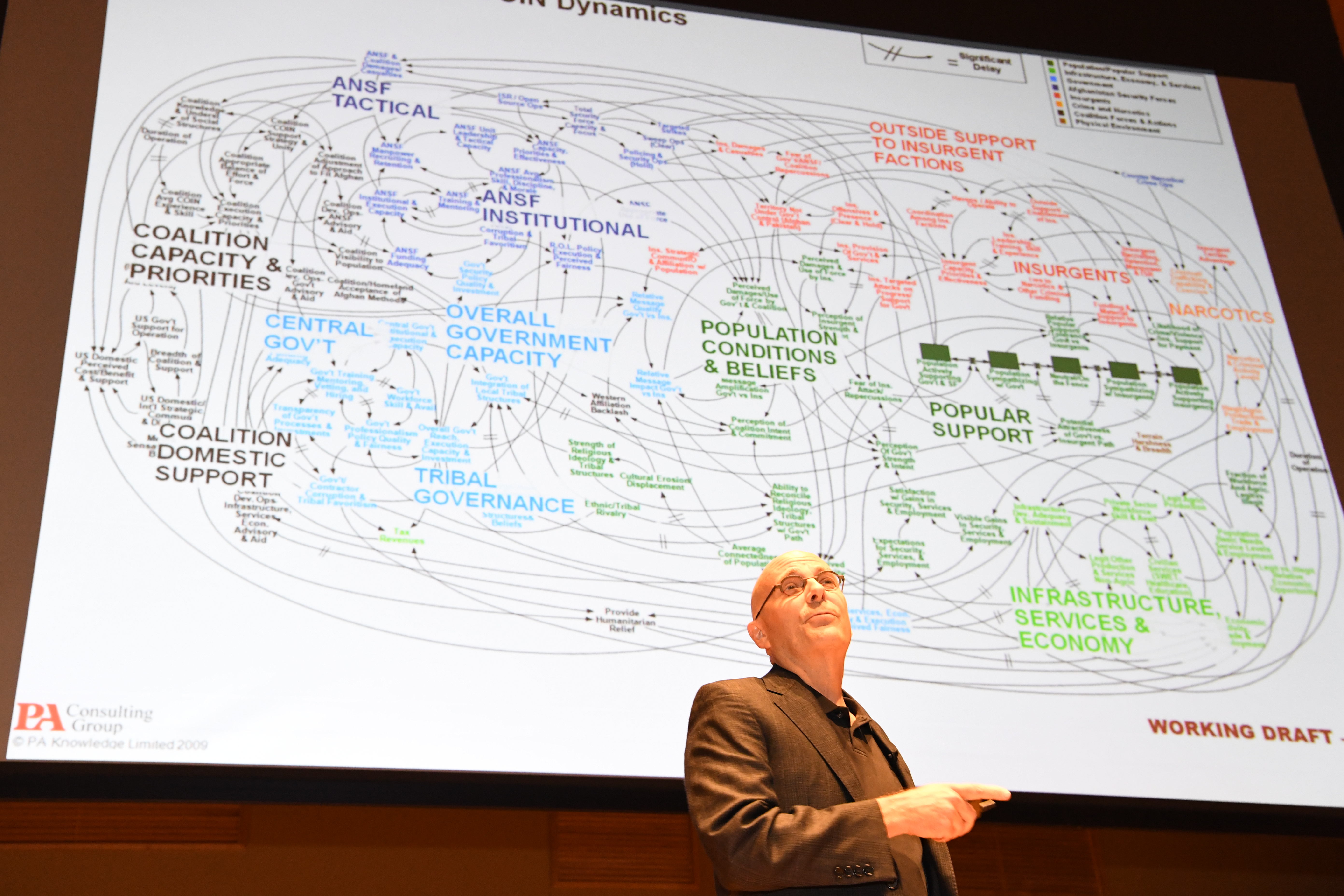
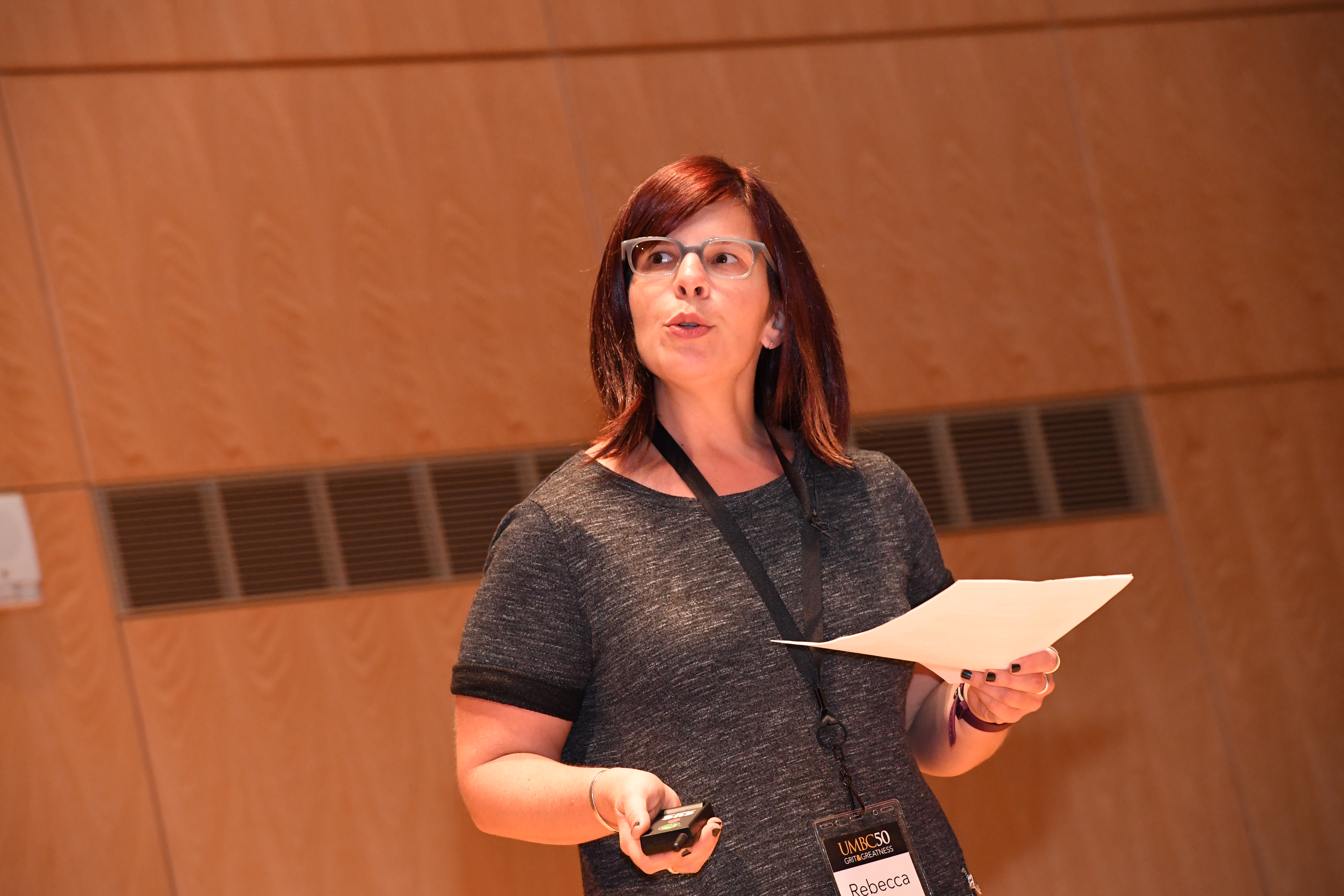
Drawing on her book Beyond the Checkpoint – Visual Practices in America’s Global War on Terror (University of Massachusetts Press 2014), Rebecca Adelman, associate professor of media and communication studies, shared how an experience she had at an airport security checkpoint helped sparked a research project where she investigated American visual culture of the Global War on Terror and its impact on society.

Rebecca Adelman presents at GRIT-X.

Thomas Schaller, professor and chair of political science, examined the decline in civics education in high schools and how it should influence teaching college students about politics and their significance in such a polarized and partisan climate.

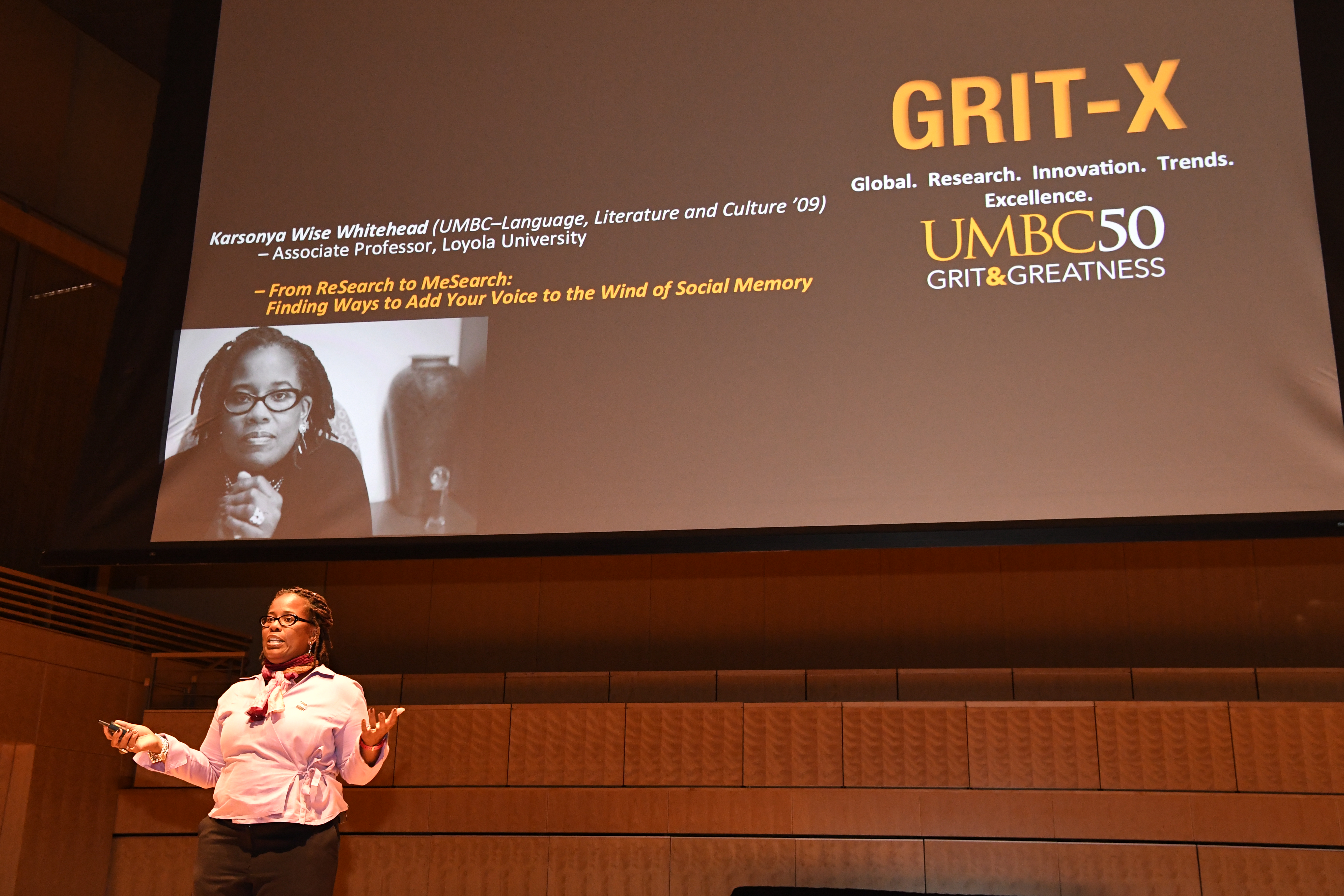
Karsonya Wise Whitehead ’09 Ph.D., language, literacy, and culture, reflected on the letters that she has written to her two sons as they have grown. She emphasized how the power of the written word can be a teaching tool and window into navigating parenthood.

Karsonya Wise Whitehead, Ph.D. '09, language literacy and culture, presents at GRIT-X.

“When people read letters to my black sons and they see my love for my sons poured out onto the page, it is a different experience. It’s a different way of connecting. It’s a way of taking the research off of the page and putting it into your lives,” said Whitehead.

Vanderlei Martins, professor of physics, highlighted UMBC’s efforts to research how pollution is influencing Earth’s energy balance and precipitation.

In a presentation about “disruptive innovation,” Govind Rao, professor of chemical, biochemical, and environmental engineering, talked about transformative UMBC inventions that have the potential to save millions of lives, such as a cardboard incubator for premature infants, currently being tested in India, and a suitcase-size device to manufacture medicines on-demand.

“I’m hoping that we continue to make positive change for the rest of the world,” said Rao.

Read more about UMBC’s 50th anniversary weekend, and watch the full video of the GRIT-X event below.

Photos: Header image: Vanderlei Martins. All images by Jim Burger. GRIT-X at UMBC, September 17, 2016. 

Founders Day celebrates 50 years of inclusive excellence at UMBC

On September 19, 1966, the first students began classes at UMBC. Fifty years later to the day, the UMBC community gathered for a special Founders Day celebration to reflect on the first generation of students, faculty, staff, and alumni who paved the way for university to become a national model of inclusive excellence.

Before a full crowd at the Retriever Activities Center (RAC), Robin Mayne ’69, American studies, UMBC’s first graduate, presented a letter she wrote to UMBC’s current freshman class and to future UMBC students over the next fifty years. It will be placed in a time capsule that will be opened in 2066.

Robin Mayne '69

Mayne described how her liberal arts education at UMBC inspired her to become a lifelong learner and provided her with the critical thinking skills needed to grapple with the complexities of today’s world.

“At [UMBC’s] core was engagement of both students and faculty in studies, creativity, community, political action, and social awareness and responsibility,” shared Mayne. “In the 50 years since those beginnings, these commitments have not diminished, but have only expanded and intensified.”

Vrinda Deshpande ’20, mathematics, formally thanked Mayne and accepted her letter on behalf of the freshman class. She reflected on her desire, and that of her fellow new Retrievers, to build on the foundation they are inheriting. “With these lessons, I know that my class’s next four years will reflect the same dedication that the first graduating class had to education and changing the world for the better,” Deshpande said.

The program also included top photos from the 50th anniversary celebration weekend and a living history that was presented by faculty, student, staff, and alumni leaders, documenting significant milestones over the university’s 50-year history.

President Freeman Hrabowski delivered the 2016 State of the University Address, reflecting on the university’s growth and achievements over the last 50 years. He highlighted rapid increases in UMBC’s research funding and partnerships, as well as the university’s economic impact. He also spoke to the impressive accomplishments of 70,000 UMBC alumni and the university’s commitment to issues of social justice and equality.

President Hrabowski also highlighted a New York Times story by columnist Frank Bruni, published during UMBC’s 50th anniversary weekend, that praised the university for serving as a national model of inclusive excellence—being a place where students of all backgrounds can achieve great things.

“From the ceiling of the student commons hang flags of countries from which students have come. There are more than 100,” wrote Bruni. “It’s a kind of kaleidoscope, and as I walked under it with Freeman Hrabowski, U.M.B.C.’s dynamic president, he stressed the school’s determination to ‘connect students to people different from themselves and lives different from their own.'”

“This has been a 50-year experiment in Catonsville,” Pres. Hrabowski explained in his remarks at Founders Day. “Can you bring people together from all races, backgrounds, and religions, and have them learning how to work together, to live together, and to listen to each other? That’s what we’re in the process of doing in our country, and it’s what we believe we are doing on this campus and will do even more of in the time to come.”

After commemorating UMBC’s first 50 years, President Hrabowski closed the Founders Day celebration by emphasizing that there is plenty of work still to be done in achieving sustained future success.

“We are forward-looking and responsive. We have a strong focus on inclusive excellence. We believe in high expectations and a passion for learning. But most important, we still believe in hard work.”

Read more about UMBC’s 50th anniversary celebration in The Baltimore Sun article “Over 50 years, UMBC has cultivated a research mission from former pastures” (with video).

UMBC50-Founders-day-6985

Images: UMBC 50th Anniversary Founders Day Celebration, September 19, 2016. Photos by Marlayna Demond ’11 for UMBC. Video by New Media Studio. 

Brewster lab to examine “pause button” on embryonic development, with eye on improving organ transplant

Embryos of zebrafish, a workhorse model organism in biology labs, routinely survive without oxygen for up to 50 hours by hitting the pause button on their development. Rachel Brewster, professor of biological sciences, and her team are working hard to learn how they do it. She hopes mechanisms that enable survival without oxygen could eventually be intentionally triggered in tissues like donated organs, to increase the length of time that can pass before they are transplanted.

That brief window of time is a major limiting factor in the availability of organs for transplant. Today, donated organs are cooled to slow metabolism and reduce oxygen consumption. Using that technique, hearts and lungs last only four to six hours, and kidneys up to 48. After that, tissues break down due to lack of cellular energy. This sliver of time to identify a recipient and deliver an organ means recipients are limited to a small geographic area in which to find a donor. Each day in the U.S., 79 people receive organ transplants and 22 die waiting for an organ.

Brewster’s research is supported by an Idea Discovery Grant from the U.S. Department of Defense (DoD). The DoD is interested in ways to improve transplant technology to increase the chances that injured soldiers would have timely access to donor organs and other tissues. If successful, the benefits would extend beyond the military.

The zebrafish Brewster work with “can arrest everything they’re doing as a mechanism to conserve cellular energy,” she says, so the goal is to “find the signaling mechanisms that shut down cellular activity.” Tissues survive by reducing energy consumption when energy production plummets in the absence of oxygen.

One of Brewster’s goals with the new project is to understand the timing of arrest—when development is paused—in zebrafish embryos. The research group has already learned that younger embryos arrest faster and more efficiently than older embryos. Also, older embryos are less likely to survive when oxygen is reintroduced.

Brewster would like to understand the sequence of arrest, as well. For example, does cell division in muscles arrest before it does in the digestive tract? Does tissue in an extremity like the tail succumb to a lack of oxygen before brain tissue? Are there essential systems that never arrest? “We can’t identify signaling mechanisms that cause arrest until we define arrest,” she says.

The team also hopes to identify small molecules whose concentrations in the cell change quickly upon oxygen deprivation, allowing them to mediate the rates of cellular processes on a short time scale. Brewster believes these molecules’ rapid effect on the cell makes them more likely to be involved in arrest than slower processes, such as the rate at which proteins are built from genetic instructions and then modified by cellular machinery.

Brewster hypothesizes that the involved small molecules activate or deactivate larger effector molecules, such as a class of proteins known as “kinases,” that carry out the arrest process. The team’s most ambitious goal is to identify those effector molecules. Rather than one “master regulator” molecule that controls the arrest process, Brewster explains, “It’s more likely every tissue fending for itself.” She adds, “My hunch is that the system is sloppier than we predicted.”

The experiments themselves are challenging and complex. The team will work with individual zebrafish embryos, and even using very young, fairly homogeneous embryos won’t make them all perfectly identical. Individual differences may show up as false positives in their results. “To figure out what is signal versus noise is not easy,” says Brewster.

One tack the team is taking to find molecules that trigger arrest is to knock out candidate molecules one by one. They’ll know they’ve got a winner if embryos without that molecule continue to develop in oxygen-deprived conditions.

“To actually identify a molecule that promotes arrest would be very exciting,” says Brewster. In addition to the organ transplant, another application of intentionally-triggered arrest might be during open heart surgery to prevent or slow tissue damage. Someday, NASA might use the technique to trigger a low-metabolic state in astronauts, similar to hibernation, to allow them to survive trips farther and farther from Earth.

Beyond practical applications, this project attracted Brewster on a more fundamental level. “Ninety-nine percent of developmental biologists study how development progresses,” she explains. “I was intrigued by the prospect of studying the exact opposite.”

Brewster is excited to share her passion for discovering how development can be paused with the many students who work in her lab, such as Ph.D. student Jong Park, who will focus on this project.  Undergraduates have also contributed significantly to the research. “I’m very proud that most of the preliminary data was produced by undergrads,” she says. “It’s really kudos to them that we got this thing funded.”

Image: Rachel Brewster at work in her lab; photo by Marlayna Demond ’11 for UMBC.


UMBC and Portuguese Naval Academy launch partnership to promote academic and cultural exchange

A delegation from Portugal visited UMBC earlier this month to sign a Memorandum of Understanding (MOU) outlining plans to develop collaborative exchange programs for teaching, learning, and research between the Portuguese Naval Academy (PNA) and UMBC. Initial projects will focus on cybersecurity, an area of strength for both schools.

Antonio Moreira, vice provost for academic affairs at UMBC, earlier named an “advisor of Portugal in the world” by that nation’s president, spearheaded the formal collaboration after meeting Admiral Torres Sobral from the Portuguese National Security Agency at a conference in Lisbon. Similarities emerged between the PNA and UMBC in their conversation, especially in cybersecurity and naval science. Moreira shared, “It became natural to focus on collaborations between the two institutions.”

High-level Portuguese officials have embraced the collaboration. “I think it is important to be here and be aware of what’s happening in our two countries,” said Navy Captain Afonso Galrito, Portugal naval and air attaché, at the signing event. “As soon as I heard we were taking this next step I asked, ‘Can I go?’”

The newly formalized relationship, which will initially last five years and is slated for automatic renewal, will support faculty exchanges for research and teaching, student exchanges at the undergraduate and graduate levels, joint seminars and conferences, and collaborative publication efforts.

UMBC is particularly excited to collaborate with the PNA this year, as the university’s Naval Reserve Officer Training Corps (NROTC) program kicks off. “It is fitting we are signing on the first day of classes and on the first day of our new NROTC program,” Moreira said. In addition, UMBC has strong ties with the U.S. Naval Academy, and the PNA signed an MOU with the Annapolis, MD institution in February 2016, providing opportunities for triangular collaboration.

UMBC President Freeman Hrabowski emphasized to the Portuguese dignitaries that an NROTC program within the University System of Maryland offers local students a compelling new path to military service and leadership development. “I am so proud of getting this program,” Hrabowski shared, having worked for many years to bring NROTC to UMBC.

While the initial collaborative focus is on cybersecurity, “What we sign here is just a start of the collaboration between these two institutions,” said Commodore Henriques Gomes, superintendent of the Portuguese Naval Academy, “We look forward to expanding it to other fields.”

Image: Antonio Moreira (r), UMBC’s vice provost for academic affairs, and Commodore Henriques Gomes (l),  superintendent of the Portuguese Naval Academy, shake hands after signing the MOU between their two institutions in the presence of other UMBC and PNA representatives. Marlayna Demond ’11 for UMBC.

New research by Curran and Kellogg points to inequities in science education from early age

In a new article published in The Conversation, School of Public Policy Assistant Professor F. Chris Curran shares his latest research that reveals significant achievement gaps in science for students as soon as kindergarten.

The study, which Curran worked on with Ann Kellogg, a public policy Ph.D. student, examined data from the Early Childhood Longitudinal Study (ECLS-K), a national study conducted by the federal government that uses data from science achievement tests that assessed concepts in physical, life and environmental science, and scientific inquiry.

Our study revealed large gaps in science achievement in kindergarten between white students and racial or ethnic minorities. And, where science gaps existed, we found that they were generally larger than the gaps in reading or mathematics achievement. However, we did not find significant gaps by gender,” Curran wrote in the article titled “Science achievement gaps start early – in kindergarten.”

Curran, whose research areas of focus include education policy and early childhood education, notes in the article that the results of the study point to the need for increased attention to inequities in science achievement.

“I believe, for example, that teachers and school leaders should look for opportunities to incorporate science concepts into reading and math lessons,” writes Curran. “Looking beyond the classroom setting, the findings of our work and that of others suggest the need to provide support to informal science learning opportunities. Visiting museums, interacting with nature and exploring novel tools all represent ways in which parents and caregivers can support early science inquiry.”

Read the full article in The Conversation, and view additional coverage below.

A new generation of all-girls schools (The Atlantic) 
In kindergarten, there is no STEM gender gap (Education Week) 
Science achievement gaps start early, in kindergarten (San Francisco Chronicle)
Why startling racial-based gaps in scientific achievement begin in kindergarten (Spare Min Podcast)
Science achievement gap  (Academic Minute)
Science achievement gap (Inside Higher Ed) 

Image: Chris Curran presents talk at UMBC about his research. Photo by Marlayna Demond ’11 for UMBC.

NSF funds Jason Kestner to tackle major obstacle to quantum computing

Predictions suggest that advances in quantum computing could lead to computers vastly faster than any that currently exist—computers that could efficiently crunch the more than 2.5 quintillion (that’s 2,500 million billion) bits of data created every day. But, despite this grand vision, the reality is that “nobody has a useful quantum computer right now,” says Jason Kestner, assistant professor of physics at UMBC. Kestner plans to help change that with a new three-year grant from the National Science Foundation.

Traditional computers use a binary system to store information in “bits.” At any given moment, a single bit can either be in a state that represents 1 or 0. Quantum bits, however, can be 1, 0 or exist in “a weird, spooky in-between state,” Kestner says.

To understand a quantum bit or “qubit,” Kestner suggests picturing it as a point on the surface of a sphere. The two poles represent 1 and 0, but the bit can be anywhere on the surface. This added complexity is what grants quantum computing its power to store huge amounts of information in small spaces, but complexity is also the source of one of its major challenges: noise. Kestner’s project will address the noise in quantum computers, which he describes as “the major obstacle to building a quantum computer.”

So what is noise? Say a qubit is at a point on the sphere halfway between the two poles, on the sphere’s equator. While the qubit is idle, it can slide along the equator. The distance it slides is the noise in the system—unwanted inaccuracy that slips in due to external influences. If enough noise builds up across all the computer’s bits, its output becomes unreliable.

Theorizing on ways to compensate for noise in quantum computers goes back to 1950, but no one has successfully achieved this in a many-bit system, which is Kestner’s goal. His research dives into a complex “spin echo” technique and asks, “How can we return the qubits to their rightful positions without disturbing anything else in the system?”

Kestner is a theoretical physicist, so the work that he and graduate student Fernando Calderon Vargas do is “a lot of math,” he explains. Calderon Vargas has published promising preliminary results. Now Kestner is starting to look into collaborations with experimental physicists who can test the new theories.

“It’s going to be a challenge to optimize this for particular experiments,” he says. Each experimental setup will be a little different and require tweaks to the equations.

As a quantum computing researcher, Kestner has long been fascinated by the fact “that something so counter-intuitive could be real,” but the incredible potential utility of advances in this field are what make it so exciting to him today. He shares, “The fact that we could use quantum weirdness to actually do something useful is pretty cool.”

In new book, Brian Grodsky argues recent revolutions are threatening the future of democracy

During the last two decades, Brian Grodsky has spent significant time talking to citizens who have been fighting for political change in countries like Poland, Uzbekistan, Serbia, Croatia, Russia, and South Africa. The result is a new book that is a thorough examination of how the most recent wave of democratic revolutions has actually threatened the future of democracy.

Grodsky, an associate professor of political science, is the author of The Democratization Disconnect: How Recent Democratic Revolutions Threaten the Future of Democracy (Rowman and Littlefield 2016), which closely looks at how recent democratic revolutions have played out over time. In countries that Grodsky spent time in as a researcher and professor, and also while working as a reporter and acting Foreign Service Officer at the U.S. Embassies in Poland and Uzbekistan, he discovered that leaders of these countries’ pro-democracy opposition movements often pushed for democratic reforms for vastly different reasons than the citizens wanted.

“These people, the masses, were struggling for change. They were struggling for greater human rights, for greater human dignity,” explains Grodsky. “The democratization disconnect comes in here where elites and non-elites, the people on the streets, sometimes have a very differing balance of economic and political understandings of what human dignity really is.”

Because democracy has become the internationally legitimate form of government, Grodsky says that many leaders promised democracy in their rise to power. After the revolutions, many of these same leaders found their publics bitter at being left with similar challenges, especially economic ones, to those they faced before.

“False promises and unmet expectations cheapen the idea of democracy and the whole idea of democratization, not just in these countries, but in many of the other countries where people are watching these democratization cases,” says Grodsky. “We’ve seen this all over the world.”

Grodsky notes that recent examples in the Middle East with the Arab Spring and past examples such as the color revolutions in Eurasia on the surface champion the idea that democracy has come of age, but at the same time threaten the idea of democratic legitimacy.

“I’m writing this book now because we are at this precarious period where I think we can still save democratic legitimacy and we can still move forward with democratization,” says Grodsky. “But in order to do this we need to stop and we need to think about what people are after.”

Grodsky, an expert in comparative politics, human rights, democratization, and Post-Communist issues is also author of Social Movements and the New State (Stanford University Press 2012) and The Costs of Justice (University of Notre Dame Press 2011). Read more about his most recent book, The Democratization Disconnect.

Read media coverage of Grodsky’s book below:

Trump, Clinton and the future of global democracy (The Conversation)
Democracy in the world of Donald Trump: The future of the global system (Salon) 
Trump, Clinton and the future of global democracy (SF Gate)
Democracy Lab Weekly Brief (Foreign Policy) 
Democratic Disneyland: Will Trump kill democracy as we all know it? (Biz News)
How will the 2016 election shape the future of democracy in the U.S. and throughout the globe? (Spare Min Podcast) 

Image: Brian Grodsky. Photo by Marlayna Demond ’11 for UMBC.

Governor’s Summer Interns present policy papers to state political leaders

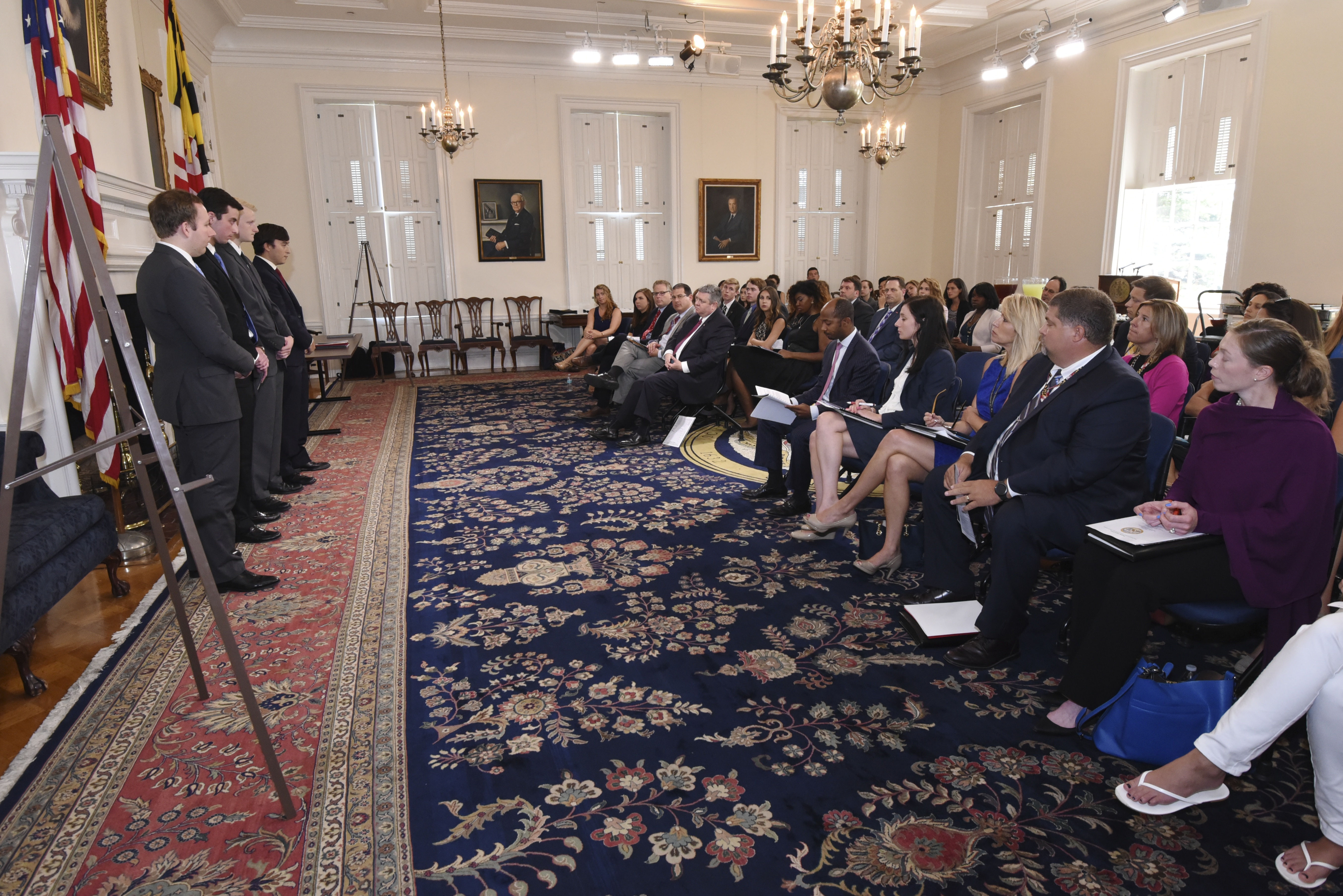
It’s not often that college students have the opportunity to present policy recommendations directly to senior level government officials, but students throughout Maryland recently shared research papers on significant issues impacting the state as part of The Shriver Center’s Governor’s Summer Internship Program (GSIP). The 2016 program ended with a celebration at the Maryland State House in Annapolis last month.

The Governor’s Summer Internship Program introduces Maryland college students to the unique challenges and rewards of working within state government. Interns work for ten weeks during the summer in state government agencies doing substantive tasks ranging from drafting speeches and correspondence to researching policy options and assisting with constituent case work. The program is led by the Shriver Center in partnership with the Office of the Governor.

Governor's Summer Interns 2016

During this year’s program, students studied topics such as addressing the achievement gap for English language learners, reducing recidivism, preventing opioid abuse, and affordable housing. Several UMBC students participated in the 2016 GSIP, including: Vanessa Barksdale ’17, social work; Nathan O’Toole ’17, economics; Aidan Delisle ’17, political science and philosophy; Patrick DuBoyce ’17, political science and history; and Manisha Vepa ’18, economics, global studies, and music.

At the closing ceremony, the GSIP interns presented their policy papers and fielded follow-up questions from senior cabinet officials in Maryland state government. The students offered thoughtful policy solutions including further development of transitional housing and continuing education for ex-offenders re-entering society, developing and passing a housing anti-discrimination law, and further development of local programs and magnet schools to address the achievement gap for non-English students.

UMBC Political Science Associate Professor Laura Hussey worked closely with the students throughout the summer to develop their policy papers, and Lieutenant Governor Boyd Rutherford opened the closing event by congratulating the students and thanking them for their service.

Other Shriver Center Public Service Scholars Programs came to a close at the beginning of August, including the Walter Sondheim Jr. Maryland Nonprofit Leadership Program, which offers summer internship opportunities in the nonprofit sector to college juniors, seniors and graduate students attending Maryland institutions, and the Maryland Department of Transportation Fellows Program. Read more about The Shriver Center’s Public Service Scholars Programs.

Images: The 2016 Governor’s Summer Internship Program closing ceremony at the Maryland State House, August 11, 2016. Photos courtesy Maryland Governor’s Office Photos.