Six UMBC faculty members have just received grants from the Maryland Industrial Partnerships (MIPS) program to develop new technologies with potential to grow the state’s economy. This is UMBC’s largest number of winning proposals within a single proposal round since MIPS began in 1987.
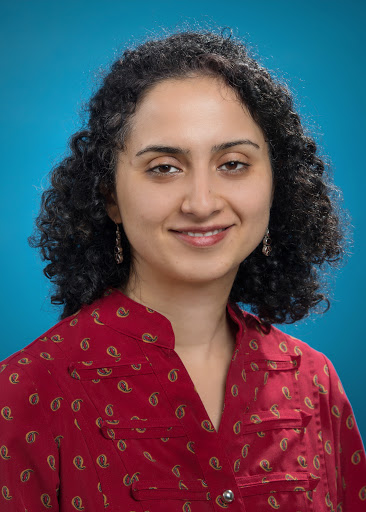
The program connects University System of Maryland (USM) faculty and students with Maryland businesses. UMBC’s latest MIPS grantees include computer science and electrical engineering faculty Tim Oates, Chein-I Chang, and Anupam Joshi;Soobum Lee, mechanical engineering; Dipanjan Pan, chemical, biochemical, and environmental engineering; and Vikram Vakharia, marine biotechnology. Among their industry partners are UMBC alumni entrepreneurs who are building businesses in Maryland.
Advances in aquaculture technology
Vakharia partnered with Mary Larkin, founder and CEO of Gaskiya Diagnostics, on a high-impact aquaculture project. The pair worked to develop a proposal for rapid, low-cost, easy-to-use diagnostic tests to protect and support aqua-farm production.
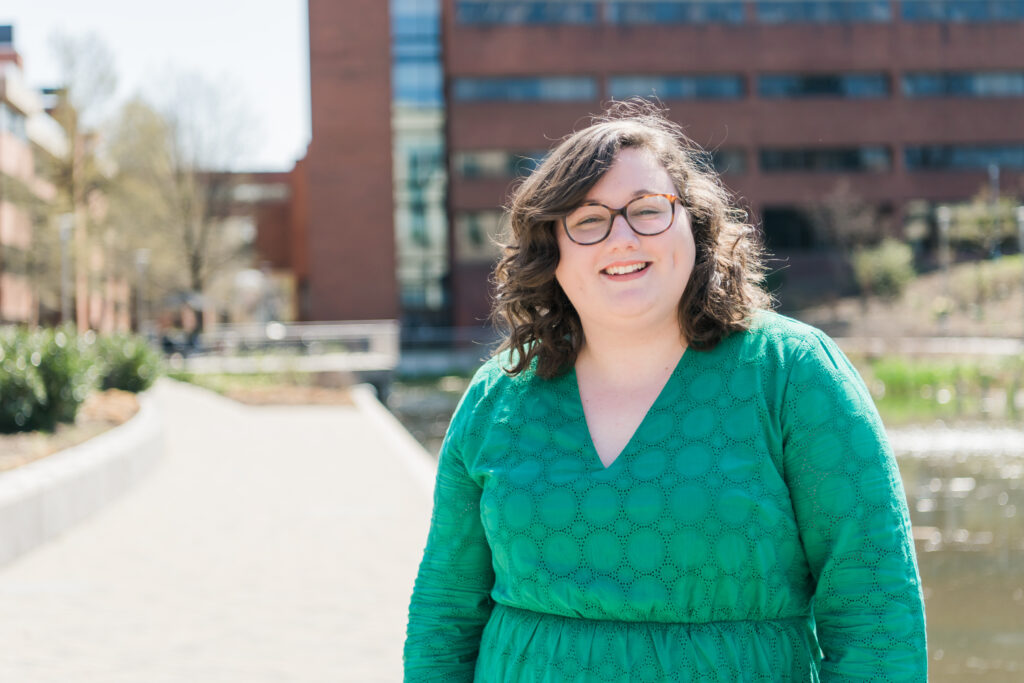
Larkin received her Ph.D. in marine biotechnology from UMBC in 2018. She was supported by research funding through MIPS as a graduate student at the Institute of Marine and Environmental Technology. She now serves as an industry partner through the program.
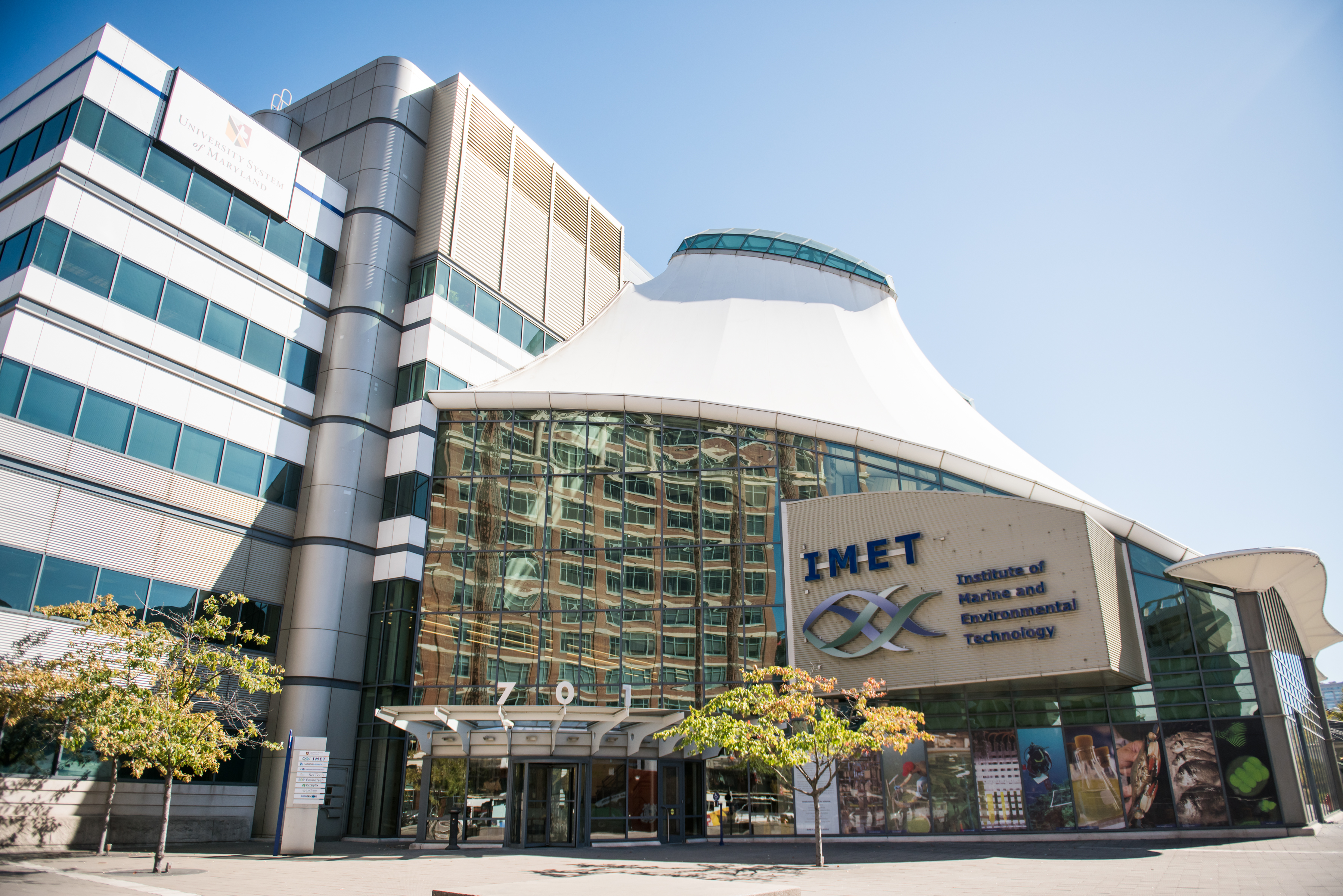
Institute of Marine and Environmental Technology
According to Larkin, “Low-cost, on-site tests enable aqua-farms to rapidly identify pathogens, allowing them to monitor disease and take actions to protect their crop.” Gaskiya’s initial focus for this testing is Whiteleg shrimp production facilities, which have an average of more than $4.5 billion in losses annually from disease.
“Farmers need to test their ponds and get instant information so that they can quickly take action and mitigate disease,” says Larkin.
What faster, simpler tests look like
Larkin describes Vakharia as a “perfect match” for her collaborator on this research. Vakharia’s background is in viruses that impact organisms important to aquaculture, including shrimp.
For this project, Vakharia notes, “I first had to identify the target. With the target, I can make a protein that Larkin can use to detect those pathogens in shrimp.” He explains, “This protein is a critical first step in making a non-animal-based binder that detects the pathogen.”
The team plans to incorporate the proteins and binders into a paper-based test. The test will provide results in minutes, similar to a pregnancy test.
Aqua-farms’ current tests for similar pathogens must be done through a lab. This results in an elongated turn-around time and average cost of $50 per sample. Gaskiya Diagnostics hopes to price the new diagnostic test at $5 to $10. The test results will be available in as quickly as 10 minutes. No expertise or additional equipment are required to perform or interpret the results.
Next generation cybersecurity
Joshi, professor and chair of computer science and electrical engineering, received a MIPS grant for a cybersecurity collaboration with the startup CyDeploy. They are developing a platform that automates the quality assurance process for cybersecurity updates made to IT and “internet of things” (IoT) devices like Amazon Alexa, Google Home, and health and medical devices.
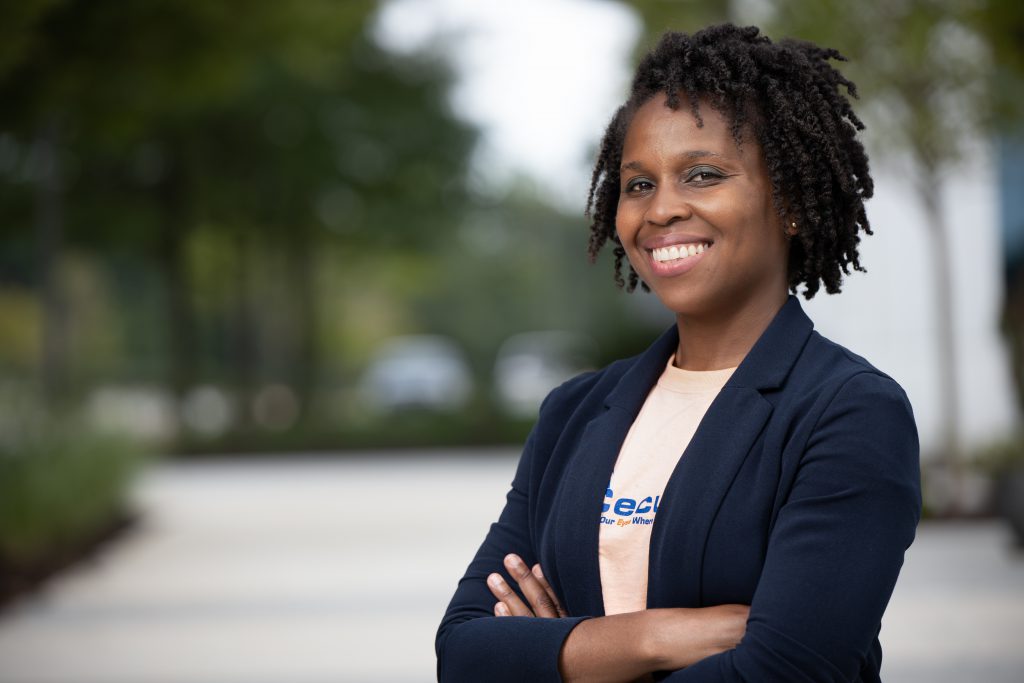
CyDeploy CEO Tina Williams-Koroma ‘02, computer science, presented Joshi with the idea to develop a “cybersecurity-driven change management system.” The technology is based in and leverages the use of artificial intelligence and machine learning to create a cloud-based replica of a company’s systems.
Tina Williams-Koroma. Photo courtesy of Williams-Koroma
From prototype to launch
Williams-Koroma and Joshi’s group at UMBC developed a conceptual prototype. It shows the infrastructure and technology that would make the system feasible, combining off-the-shelf tools with novel research.
“Increasingly, the government is now beginning to mandate security requirements around IoT devices. The longer-term vision that CyDeploy has is capturing the state of these systems, virtually recreating them and then running the security changes against virtual versions to see how the changes would affect those systems,” Joshi adds.
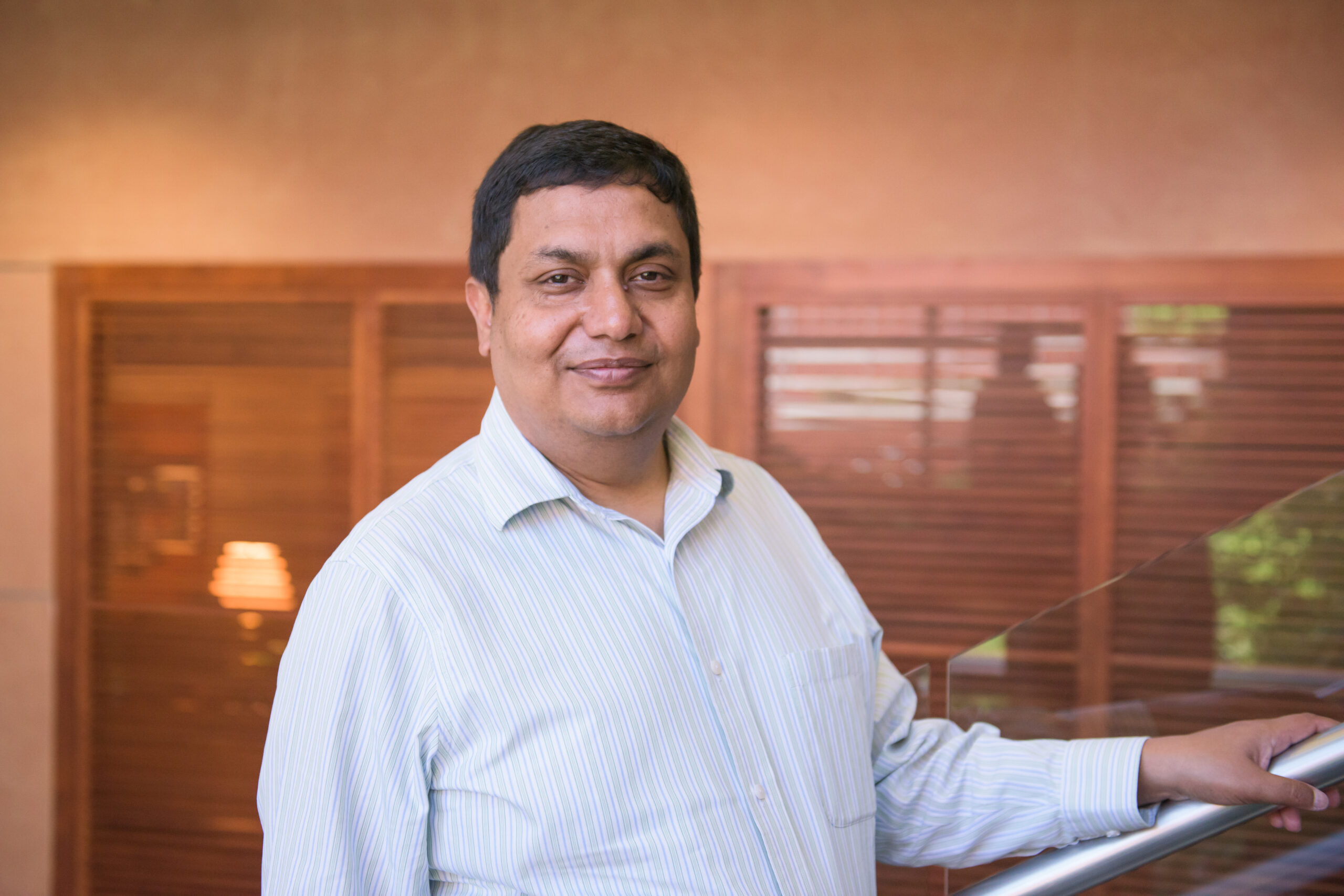
Anupam Joshi
Williams-Koroma, who is also an adjunct instructor at UMBC, projects that the initial development of the platform will be complete in late spring 2021. They anticipate launching a free pilot version for businesses to test their IT systems. IoT pilots will come in a later phase.
Funding that matters
Joseph Naft, director of the MIPS program, is excited about the tremendous potential of these projects. The long-term vision is creating additional high-quality jobs in Maryland. “We do this,” he says, “by bringing the expertise of faculty and students to bear on technology issues in product development for companies within the state.”
Since its inception, the MIPS grant program has had a $42 billion economic impact on the state of Maryland and has created nearly 22,000 jobs. UMBC’s incredibly strong results “speak well to the engagement of UMBC’s faculty with commercially viable products and technologies,” says Naft.
Dean Drake, associate vice president for research at UMBC, credits these results to the “expansive pool of talent” at UMBC and across all of the University System of Maryland.
“Helping our industry partners solve their challenges is a great strength of both UMBC and USM institutions more broadly,” says Drake. “Our talented faculty, students, staff, and alumni have expertise in every discipline that’s out there.”
These results also demonstrate UMBC’s “interest in working with companies in the state” for the benefit of all Marylanders, Naft notes, and UMBC’s robust potential for future growth.
Banner image: IMET entrance. All photos by Marlayna Demond’ 11 unless otherwise noted.
UMBC researchers have made strides in automated legal document analytics by creating a way to machine-process the Code of Federal Regulations (CFR). The CFR is a complex document containing policies related to doing business with the federal government. All business affiliates of the federal government must comply with it. For government contracts to be equitably open to a broad range of businesses, policies within the CFR must be accessible.
This document automation is just one part of a broader project to help contractors and other entities manage and monitor their legal documents. Directed by Karuna Joshi, associate professor of information systems, the team has successfully managed to do a complete analysis of the CFR. Digital Government: Research and Practice recently published their methodology.
Karuna Joshi (left) with Yelena Yesha, 2018.
Automating document review through AI
The team’s method for analyzing the CFR involves artificial intelligence (AI), which learns how to categorize information within the document, store it, and extract it when it is requested. Joshi and her team achieved this by creating a knowledge graph using Semantic Web technologies to illustrate all the key terms, rules, and regulations in the document. This basic framework enables users to ask an automated tool about a specific rule and be provided with the answer.
The semantic web language OWL, or Web Ontology Language, is used to represent concepts and to contextualize relationships. According to Joshi, the framework of the knowledge graph can be “adopted by federal agencies and businesses to automate their internal processes that reference the CFR rules and policies.” To facilitate this, they will make it available in the public domain.
Question and answer
General users can interact with the knowledge graph through a question-and-answer process, similar to how many people use Amazon’s Alexa or Apple’s Siri. For example, Joshi says, someone could ask a policy-related question like, “How many days at a minimum must a Request for Proposal (RFP) be posted open/available?” The system would query the CFR knowledge graph to find sections in the document that answer this question.
Karuna Joshi presents at the USNA-UMBC research symposium, 2016.
The researchers anticipate this will be a highly useful system for any business held to the CFR thanks to how it breaks down CFR’s legal complexity through the automated process with ease.
Access and accountability
This project to automate and support users’ understanding of legal documents has been an ongoing effort by the UMBC team. Beyond the CFR, they seek to assist people with understanding legally binding contracts that they encounter every day, such as terms of service for major companies.
Lavanya Elluri. Image courtesy of Elluri.
Lavanya Elluri, graduate student of information systems, adds, “Our research helps the organizations that use cloud services to understand the context from these textual documents quickly.”
Many users have found that companies are using their data without their knowledge. Often, this is due to the information buried within terms of service and privacy policies. Joshi predicts that the tools her team is developing to help users better understand these documents will be essential to hold companies accountable for their data use.
Featured image: UMBC’s Information Technology and Engineering Building. All photos by Marlayna Demond ’11 for UMBC unless otherwise noted.
UMBC researchers have developed a technique to more quickly analyze extensive data from Arctic ice sheets to gain insight and useful knowledge on patterns and trends.
Over the years, vast amounts of data have been collected about the Arctic and Antarctic ice. These data are essential for scientists and policymakers seeking to understand climate change and the current trend of melting. Masoud Yari, research assistant professor, and Maryam Rahnemoonfar, associate professor of information systems, have utilized new AI technology to develop a fully automatic technique to analyze ice data.
This public impact research is part of the National Science Foundation’s ongoing BigData project. Rahnemoonfar, Yari, and colleagues have published their findings in the Journal of Glaciology.
Rethinking manual techniques
For decades, researchers have kept close track of polar ice, snow, and soil measurements, but processing the large volume of available data has proven challenging. NASA’s processes for collecting, tracking, and labeling polar data involve significant manual work, and changes detected in the data can take months or even years to see. Even Arctic data collected via remote sensing technologies require manual processing.
Maryam Rahnemoonfar
According to Rahnemoonfar, “Radar big data is very difficult to mine and understand just by using manual techniques.”
The AI techniques the researchers are developing can be used to mine the data more quickly. They help scientists get useful information on trends related to the thickness of the ice sheets and the level of snow accumulation in a certain location.
Spotting patterns
The researchers developed an algorithm that learns how to identify objects and patterns within the Arctic and Antarctic data. An AI algorithm must be exposed to hundreds of thousands of examples to learn how to identify important elements and patterns. Rahnemoonfar and her team used existing incomplete and noisy labeled data from the Arctic to train the AI algorithm on how to categorize and understand new data.
The algorithm’s training is not yet complete. Researchers will need to scale it up over multiple sensors and locations to create a more accurate tool. However, it has already successfully begun to automate a process that was previously inefficient and labor-intensive.
The rapid expansion of using AI to understand ice and snow thickness in the Arctic will allow scientists and researchers to make faster and more accurate predictions to inform dialogue about climate change. The rate at which Arctic ice is melting impacts sea levels. If scientists are better able to predict the severity of the melting, society can better mitigate the harm caused by sea level rise.
Featured image: Team members from U.S. Coast Guard Cutter Healy on the NASA ICESCAPE mission, July 2011. Photo by NASA/Kathryn Hansen.
UMBC has placed ninth nationwide in the 2020 ALL IN Campus Democracy Challenge voting pledge competition. More than 600 colleges and universities participate in the ALL IN Campus Democracy Challenge, which encourages college students to pledge to vote based on evidence that when people make public pledges, they are more likely to follow through.
“These rankings speak to what people already know: UMBC is a national model for community engagement,” says President Freeman A. Hrabowski. “We’re proud of the work being done through our Center for Democracy and Civic Life, and we are grateful to all of our community members who took the pledge to vote in the 2020 election.”
Cast Your Whole Vote campaign
Launched in November 2018, UMBC’s Center for Democracy and Civic Life (CDCL) helps students develop the knowledge, skills, and approaches for deep and effective civic engagement and community work. The Center is led by Director David Hoffman, Ph.D. ’13, language, literacy, and culture (LLC), and Assistant Director Romy Hübler ‘09, modern languages and linguistics, M.A. ‘11, intercultural communication, Ph.D. ‘15, LLC.
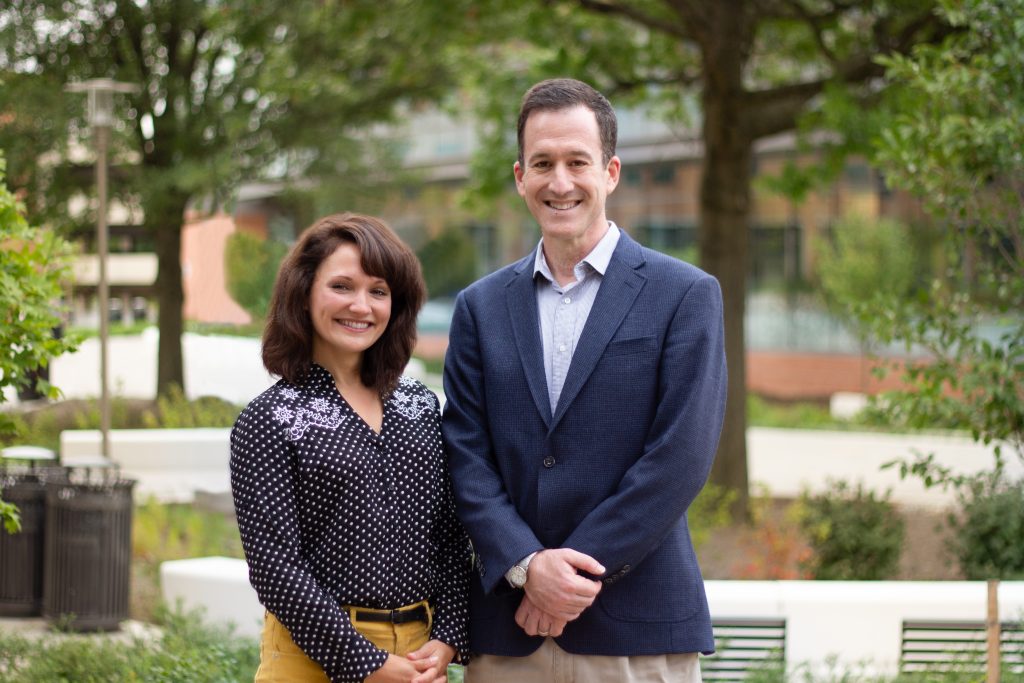
Romy Hübler and David Hoffman in 2019. Photo by Alexis Harris ’19 media and communication studies and visual arts.
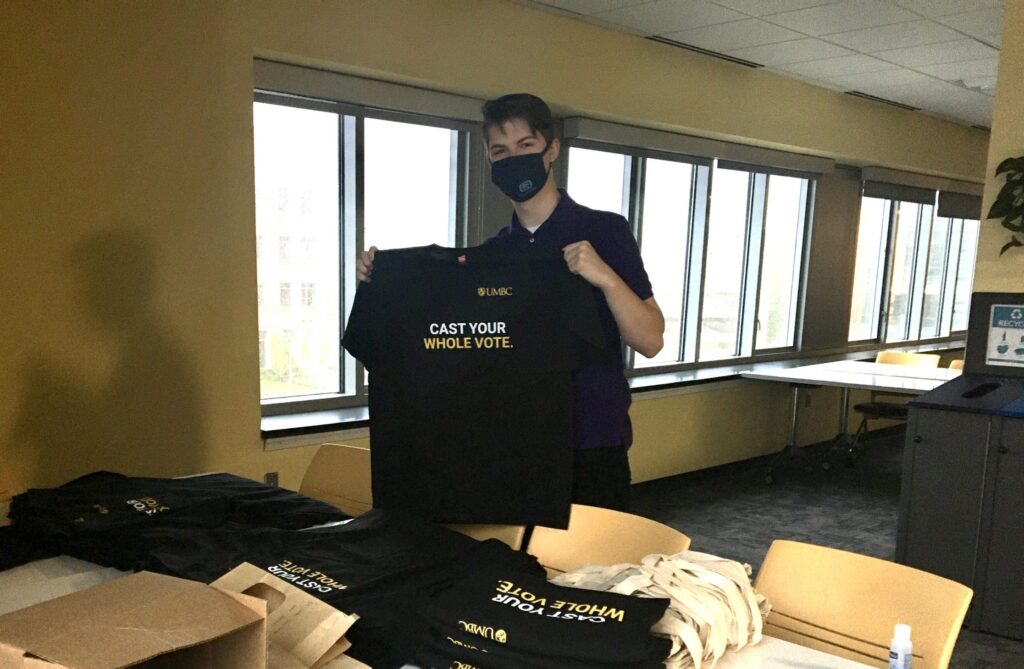
During the fall 2020 semester, Hoffman, Hübler, and the Center’s interns, along with University partners, organized a campus-wide Cast Your Whole Vote campaign, featuring voting and election events and resources. The events drew nearly 800 members of the UMBC community. As part of that programming, UMBC students, faculty, and staff members trained as facilitators to organize more than 20 additional post-election community discussions. Under the theme Together Beyond November, these conversations helped participants renew their connections and support each other in this challenging time.
“It’s important to vote, but also to recognize voting as just one way to make a difference in our communities and nation,” share Hoffman and Hübler. “UMBC’s Cast Your Whole Vote campaign encouraged members of the UMBC community to learn about issues, engage in civil conversations, and contribute their time and talent to building a better world on Election Day and every day. We are grateful to the many departments, student organizations, and campus leaders who worked with us.”
Charis Lawson ’21, English, CDCL political engagement intern, shares her motivation for voting in 2020.
The UMBC community will learn how many students actually voted in the 2020 national election in a 2021 report by the National Survey of Learning, Voting, and Engagement.
Interview with student leaders
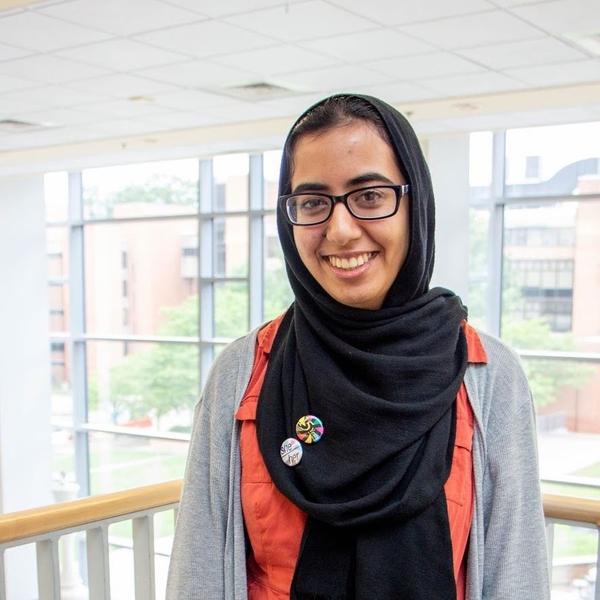
To learn more about student experiences in UMBC’s Cast Your Whole Vote campaign and election programming, UMBC News spoke with three student leaders: Tirzah Khan ‘21, information systems, is the connection corps intern with the Center for Democracy and Civic Life; Logan Lineburg ‘22, M30, biochemistry and molecular biology, is director of the Department of Executive Initiatives for the Student Government Association; and Meghan Lynch ‘18, political science, and M.P.P. ‘21, is the chair of legislative concerns for the Graduate Student Association.
UMBC News: Why is the ALL-IN pledge so important?
Khan: It’s important to be intentional about voting and hold each other accountable for participating in the voting process, especially on college campuses, where ideas about civic engagement are integral to the personal and professional development that students leave with. The knowledge that there is power in community is something that UMBC students learn pretty quickly because of the unique environment here, and I think it’s necessary to extend that knowledge to voting and social change.
Tirzah Khan in the UMBC Commons. Photo courtesy of Khan.
Lineburg: The ALL-IN pledge to me means that my involvement doesn’t end once I’ve cast my ballot. There are many important ways that one can engage with their community and politics, whether it is protesting, writing letters to legislators, or even simply having conversations with family and friends about the way we feel our nation is evolving, all of which are important for progress and growth.
Lynch: The ALL-IN pledge is a powerful reminder of how important it is to be an engaged and informed voter. The pledge reminds all of us of the importance of making a plan to vote. For Maryland residents, there were quite a few ways to cast your ballot this election, so this tool prompted voters to think about what would work best for them.
UMBC News: What does UMBC’s top 10 ALL IN ranking say to you about our community?
Khan: It says a lot to me about our campus’ values and needs—that our campus community is more important to us than ever, that we are dedicated to impacting the world outside our bubble, that we aim to ensure our voices are heard. I was still in high school during the last presidential election season so I’m not sure what that was like at UMBC, but the weeks leading up to this election illustrated just how much our community is willing to do for one another.
Lineburg: Knowing that our university has placed within the top two percent of colleges and universities really speaks to our campus’s commitment to excellence. We are passionate, educated, and empowered, and together, we all push for what is right.
Lynch: UMBC also shows up and gives that grit and greatness! I believe we have a thoughtful, intentional, and dedicated community who leads through action. In many spaces at UMBC, we talk about equity and justice, so it was reassuring to know that we put those principles into action such as through voting.
Tess McRae ’21, individualized studies, shared her first voting experience and how that impacted her perspective on civic engagement.
UMBC News: Why was participating in the Cast Your Whole Vote campaign or election-related events important to you?
Khan: One of the central ideas in the Cast Your Whole Vote campaign is that, while voting is incredibly valuable, there are so many other ways to affect social change besides voting. As someone who is not eligible to vote, that messaging felt really relevant to my experiences and passions.
I often feel excluded from election-related events and conversations because of my ineligibility. This is terrible because non-citizens, incarcerated people, and formerly incarcerated people are some of the most vulnerable members of our communities, especially during election years.
In turn, it felt amazing to be seen and included in this campus-wide campaign. The realization that my voice matters, my actions matter, and my story matters—especially during an election year—is what drove me to get involved in planning Election Night Extravaganza, and to participate in the Together Beyond November: (Re)building Community after Election 2020 facilitator training.
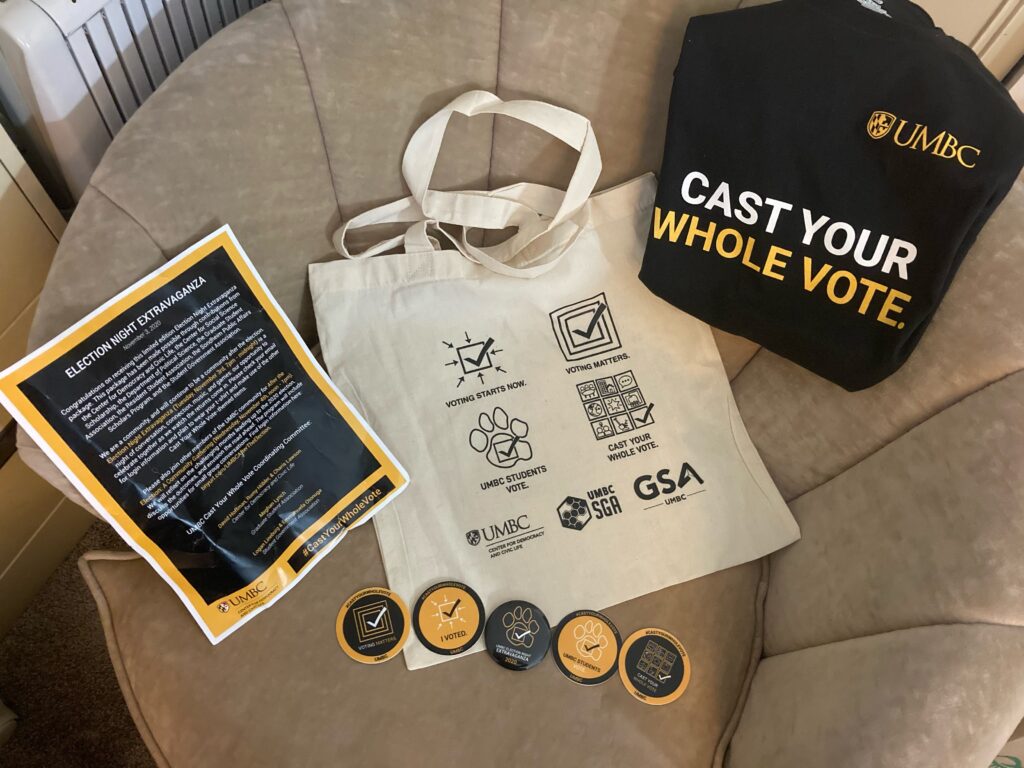
Cast Your Whole Vote campaign gear. Photo courtesy of the CDCL.
Lineburg: Being a part of the planning committee and speaking with other student leaders from different organizations and scholars programs was fantastic. Knowing that despite our vastly different backgrounds and future goals we are all able to unite to educate and inform our campus community about voting is thrilling.
As a third-year student, I can attest that UMBC’s efforts to educate and empower its students is supreme. At UMBC, every person has the capacity to make great change, and with incredibly supportive faculty, staff, and fellow students, I feel it would be nearly impossible to find a goal or dream that is unachievable here.
UMBC News: What were your favorite moments from the campaign and why?
Lynch: As someone who studies politics and policy, being involved with a community that encourages political participation is paramount. In these virtual times, I’ve been finding myself seeking out spaces to connect with others. The campaign has had a lot of wonderful events, like the Change Makers Dinners and debate watch parties that made these stressful, isolating times more manageable.
On Election Night in particular, we began our evening on Discord (a group-chatting platform) and then moved over to WebEx to hear from President Hrabowski and Vice President for Student Affairs Nancy Young. I could feel the energy and excitement from seeing everyone’s faces in the WebEx room. It was important to me to participate because we had to be creative about being in community, and the experience on WebEx on Election Night hopefully made the night more enjoyable for many.
UMBC News: How was the student response to the events?
Khan: This Election Day was more of an Election Week, I think students appreciated having non-judgmental, non-partisan spaces to process their feelings. Also, the idea that civic life and civic engagement extends far beyond voting and elections was something that I believe resonated with a lot of people and allowed them to feel comfortable in expressing their fears about the election.
Lynch: I could tell that students wanted to find spaces to talk and share their thoughts on the election. They were actively engaging with each other and seemed to be enjoying it. We had stressful and overwhelming moments to work through, but the students had such grace in taking time to understand and work through it all.
Meghan Lynch shares why she finds voting meaningful and other ways to be engaged.
UMBC News: What was it like to try to engage students virtually instead of in-person?
Khan: It was both more difficult and more rewarding than normal for me. Students have never been more in need of connection and community, but they’ve also never been more difficult to reach. There are so many layers of exhaustion and trauma that our community is facing right now, and it’s really hard to get through to people. Nobody wants to be in meetings and on camera more than they absolutely have to.
At the same time, though, we are all so incredibly lonely and scared right now. So despite how difficult it got as the election neared, I knew it was important to keep pushing and keep hosting spaces for students to build community around our shared election fears.
There’s something that the Center for Democracy and Civic Life says—“physical distance, civic proximity.” I’ve thought about this idea a lot since March, and it’s sort of become central to my work right now. We’ve never been further away from one another as a community, but the need for us to be closer has never been more important. I find that when we’re able to come together and help each other through sharing our fears and experiences and stories, we’re able to have an impact that is far beyond anything I experienced pre-pandemic.
Lineburg: Although engaging in the virtual world is challenging for many reasons, I believe that still having a space to connect with others is essential. The limitations of online engagement are not pleasurable, but from what I’ve heard from those I’ve spoken with, continuing to allow for interactions and conversations, especially during such stressful times, is and was greatly appreciated.
Logan Lineburg puts together Cast Your Whole Vote giveaway bags. Photo courtesy CDCL.
UMBC News: What was your experience as a facilitator for a post-election conversation group?
Lynch: I led a post-election conversation with graduate students which was incredibly fulfilling. Some of the general trends were being intentional about healing and renewing relationships, longing for being in physical space with others, the necessity of having “uncomfortable” conversations, and this being the only opportunity they’ve had to process the election results with their peers. Needless to say, the consensus afterwards was that we wanted more events.
Meghan Lynch at UMBC in 2018. Photo by Marlayna Demond ’11 for UMBC.
Khan: I’m pretty new to facilitation—especially in such stressful circumstances—so I was incredibly anxious going into both of the conversations that I facilitated. Through the Center for Democracy and Civic Life, I led one group of UMBC faculty and staff…and I led one group with some of my incredible peers at the Student Events Board. Both conversations were incredibly impactful and surprising, but in entirely different ways.
I was floored by the depth of thought that each participant brought. Some of the people were complete strangers to me, but almost immediately, they were willing to be so incredibly open, authentic and vulnerable about their election-related fears and hopes. It was a truly moving experience for me to be holding all of their emotions along with my own, and to know that I had given them my emotions to hold in return.
The 2021 U.S. News and World Report Best Colleges rankings affirm that UMBC remains one of the top universities in the nation, with a uniquely distinguished profile.
UMBC has advanced to #11 for undergraduate teaching and holds the #9 position on the list of most innovative schools in the nation, among other prominent rankings. UMBC is the only Maryland school represented in the top ten in innovation, standing alongside such universities as Stanford, Carnegie Mellon, MIT, and Caltech.
“We are delighted to again receive external recognition for creating a purposeful curriculum,” says Katharine H. Cole, vice provost and dean of Undergraduate Academic Affairs. “We are inclusive and innovative, and this drives our continuing ability to offer a distinctive educational experience to UMBC students.”
Student Government Association (SGA) President Mehrshad Devin ‘22, biology and physics, echoes Cole’s focus on inclusion and purpose. “The students of UMBC form a tightly-knit community,” he says. “We support each other and provide one another with the scaffolding needed to build something for the greater good, something greater than each of us individually.”
Members of the Race and Social Justice Interdisciplinary CoLab collaborate on a mapping project, summer 2018.
UMBC also placed within the top 80 public universities and ranked #160 on the overall list of top national universities.
A foundation of success
Karl Steiner, vice president for research, sees these rankings as reflecting UMBC’s commitment to inclusive excellence and collaboration. At some institutions, teaching and research are more separate endeavors. But at UMBC a foundational commitment to quality teaching drives collaborative research success, and research is a learning experience.
Minjoung Kyoung, assistant professor of chemistry and biochemistry, and students discuss a result.
“We are proud of our successful history of including undergraduate and graduate students in our diverse portfolio of research and creative achievement,” says Steiner. These students have unique opportunities to make a real impact through their UMBC research. Many alumni then advance to high-impact research careers serving the public good.
UMBC research across all disciplines has historically focused on addressing inequalities, and this continues during the time of COVID-19. “We are actively working on federally-funded projects to help in the fight against the COVID-19 pandemic and its broader impact on members of our communities,” says Steiner.
Students play an essential role in completing much of this research, from working in Seley-Radtke’s lab to interviewing families through Cheah’s study.
University growth
UMBC’s engineering programs performed strongly in the 2021 U.S. News rankings, tied with Villanova, Tulane, Howard, and University of Alabama. U.S. News just launched a new computer science program ranking this year as well, including UMBC in the nation’s top 100.
Karla Negrete, right, working in the lab along her mentor Deepa Madan, assistant professor of mechanical engineering, in 2019.
Keith J Bowman, dean of the College of Engineering and Information Technology (COEIT), attributes this recognition to a trend of healthy program growth across the college, such as the expansion of data science to UMBC at the Universities at Shady Grove. “UMBC’s unique set of engineering, computing, and business-related bachelor’s degree programs have undergone extraordinary student growth in recent years. That growth has enabled us to hire an outstanding cadre of new faculty,” says Bowman.
Nilanjan Banerjee (right), professor of computer science and electrical engineering, works with Christopher Boia ’19, mechanical engineering, in his lab.
A place for all students
UMBC jumped up seven places on the list of Best Colleges for Veterans, and is again one of the top schools in the nation for ethnic diversity. Yvette Mozie-Ross ’88, health science and policy, vice provost for enrollment management and planning, shares, “We take great pride in being a historically diverse institution that has welcomed and continues to welcome students of all backgrounds. And it is our unwavering commitment to inclusive excellence that makes UMBC such a unique and special place.”
Retrievers celebrate Convocation 2018.
Speaking to the work COEIT has done, Bowman shares, “Our student growth has been especially strong among African Americans and women,” both historically underrepresented groups in engineering and computing on a national level.
“The inclusive nature of UMBC is what makes the institution so exceptional,” says Devin. “From the moment a student commits to UMBC, the path towards success is laid out for them, with bold neon signs that push them to do more, even if they don’t yet know how.”
Banner image: Students gather at The Forum, a public artwork near UMBC’s Performing Arts and Humanities Building, 2016. All photos by Marlayna Demond ’11 unless otherwise noted.
Kait McCaffrey and Dinah Winnick contributed to this story.
For Nadia BenAissa ’20, gender, women’s, and sexuality studies (GWST), and Sam Hertl ’20, social work, UMBC has been a place to grow as leaders and advocates. Their college experiences have been defined by their work to educate, speak out, and create resources for survivors of sexual assault and LGBTQIA+ students at UMBC.
As the university community has responded to COVID-19 and transitioned to a virtual environment, BenAissa and Hertl have held steadfast in their commitments. They have continued working to create supportive spaces online and make sure that survivor and LGBTQIA+ voices are heard. At the same time, as seniors graduating during a pandemic, they have been managing their own sense of loss.
Centering the experience of survivors
BenAissa became involved with the Women’s Center as a sophomore after supporting her best friend through the Title IX process. “We needed to do something with our grief, and our sadness at the outcome of the process, but at the time there was no discussion group around the shared experience of trauma when we needed it most,” she explains.
BenAissa began researching Title IX, the federal law that proxihibits sex discrimination, sexual assault, and sexual harassment in education settings, for a class. “Nadia’s incredible focus and sharp intellect showed in her fine work in that course,” says her professor, GWST Chair Carole McCann.
Nadia BenAissa (c) and Haley Owens ’21 (l) speak with Pres. Hrabowski about We Believe You. Photo by Marlayna Demond ’11 for UMBC.
Then, in 2017, she and her friend founded We Believe You, an activist/advocacy and discussion group centered around survivors, with help from Women’s Center Director Jess Myers and Assistant Director Amelia Meman. BenAissa’s detailed research “prepared her to lead the We Believe You group through its subsequent challenges and successes,” says McCann.
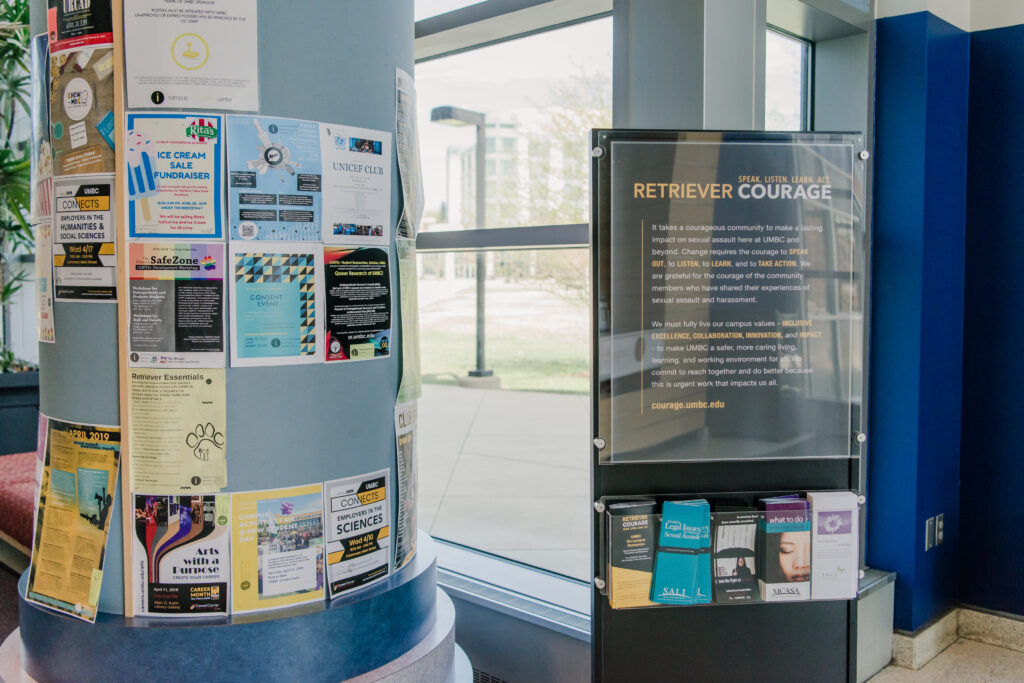
While We Believe You was getting ready to celebrate its one-year anniversary in 2018, UMBC launched Retriever Courage. UMBC created this campus-wide initiative in response to a call from students, faculty, and staff for the university to better prevent and respond to sexual assault and violence.
Seeing results
As president of We Believe You, BenAissa met with President Freeman Hrabowski and other campus leaders to discuss major challenges and possible steps forward. She then stepped into additional leadership roles as a member of the Retriever Courage implementation team and co-chair of the Student Advisory Committee.
Retriever Courage mission statement. Photo by Marlayna Demond ’11 for UMBC.
At the same time, BenAissa accepted an invitation from Baltimore County Executive John Olszewski, Ph.D. ’17, public policy, to join the County’s newly created sexual assault investigations task force.
BenAissa’s collaborative work with students, faculty, and staff led to UMBC launching mandatory Title IX training and an Office of Equity and Inclusion, and hiring more counseling staff. As part of We Believe You, BenAissa also worked with the implementation team to develop two resource stands in The Commons. They will eventually be replicated at other locations across campus.
Retriever Courage resource station in The Commons. Photo by Marlayna Demond ’11 for UMBC.
“Through her leadership of Retriever Courage, Nadia has already changed the campus for the better in how we confront sexual violence,” says Kate Drabinski, GWST senior lecturer and director of the Women Involved in Learning and Leadership program.
“Nadia is a fierce advocate who consistently speaks truth to power on behalf of survivors,” Myers adds. I believe she’s helped all of us be braver in this work.”
Building space for LGBTQIA+ students
Hertl became increasingly involved in advocacy for LGBTQIA+ students, particularly trans students, as a member of UMBC’s University Health Services (UHS) Student Health Advisory Council. They used their voice to help find ways for UHS and the Counseling Center to be more affirming of trans students. Some of their solutions were simple to implement, but powerful, such as placing pronoun buttons in the waiting rooms for students to wear.
In their junior year, they attended a Women’s Center program and quickly became involved in the Center’s work. Eventually, they became a Women’s Center intern for their social work field placement.
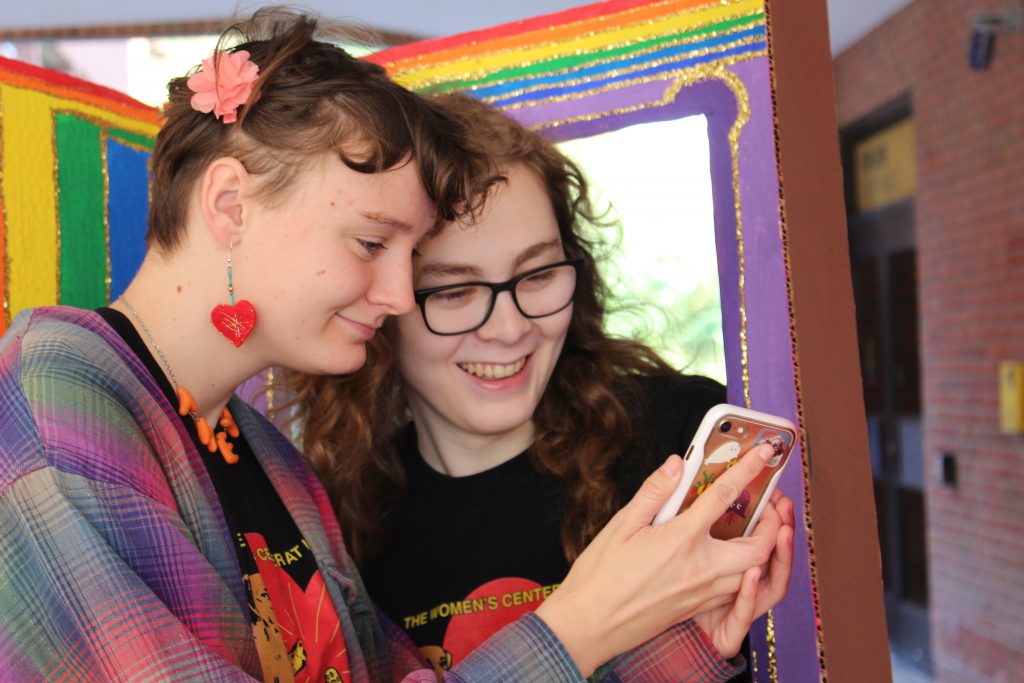
Sam Hertl (l) at a Women’s Center event in the breezeway. Photo courtesy of the Women’s Center.
In that role they served as a facilitator for Between Women. This discussion-based program centers the experience of women students who identify as LGBTQIA+. They also supported We Believe You, promoted Women’s Center events and resources, and began writing about LGBTQIA+ and accessibility issues.
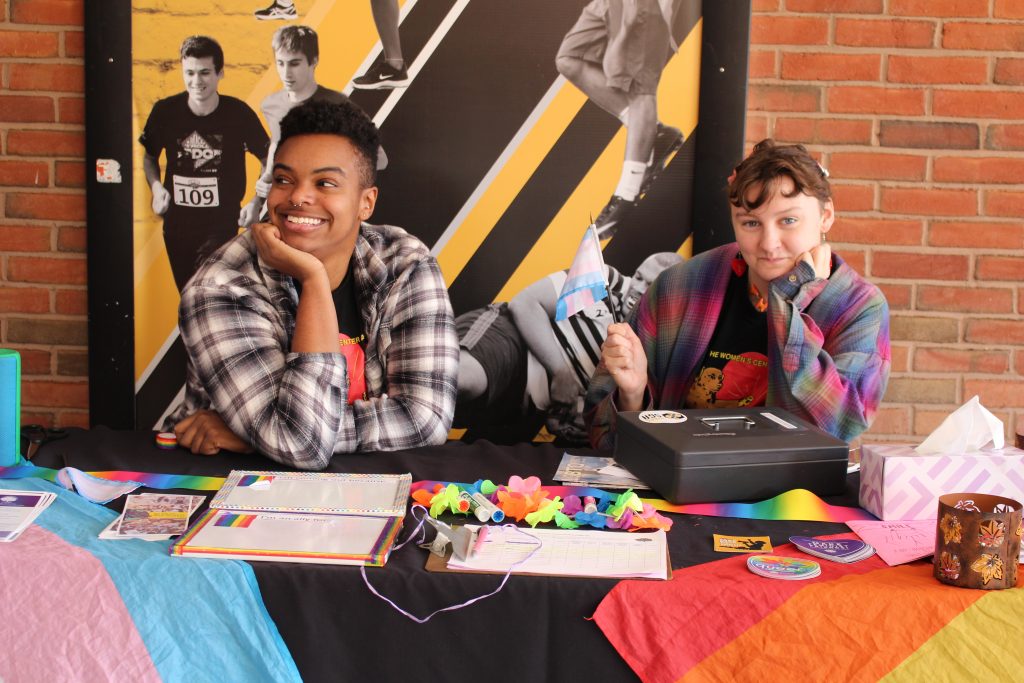
Hertl (r) tables for the Women’s Center in the breezeway. Photo courtesy of the Women’s Center.
This was all on top of the work supporting students as a residential assistant and social work courses, preparing for a public service career.
“In everything that they do, Sam strives to build an affirming, compassionate space for the LGBTQIA+ community,” says Meman. “Whether that’s in Residential Life, the classroom, or the Women’s Center, they are a truly rare person who is able to both bring people together and challenge them to be better human beings.”
Online community-building
The transition to online learning has been especially disruptive for the survivor and LGBTQIA+ communities, BenAissa and Hertl share. Both groups rely on communities of support, and have had to find new ways to connect online. BenAissa and Hertl have been determined to offer them continuity and community when they need it most.
Women’s Center groups like We Believe You’s discussion group continue to meet online. “I was especially impressed to see Sam easily replicate their skills of support once we moved online,” says Myers. “In virtual discussions they’ve modeled that care and compassion can be translated across distance and via our computer screens.”
Hertl, second from right, with other members of The Women’s Center, including Myers (l) and Meman (r). Photo courtesy of the Women’s Center.
Still, online group meetings don’t meet the needs of all students. Hertl explains, “It’s challenging because survivors and LGBTQIA+ students may be in an unsafe environment—home with perpetrators or with family members who aren’t aware of how they identify or who don’t approve of their choices.”
BenAissa and Hertl have also focused on using social media, which can be more anonymous, to connect students with resources. During Sexual Assault Awareness month, the Women’s Center created an online zine where survivors could tell their stories. They then hosted an Instagram Live event for contributors to read their submissions, or just tune in to hear others speak.
“It’s all new territory,” says BenAissa. “We look at what we as individuals can do, continue providing resources on social media, and keep speaking out about issues like consent and boundaries. We can hold space for one another and be kind.”
Coping with loss, strengthening connections
During the distance learning period, BenAissa and Hertl also missed seeing their own support communities in person. They grieved the loss of spring community activities and the graduation experiences they were expecting.
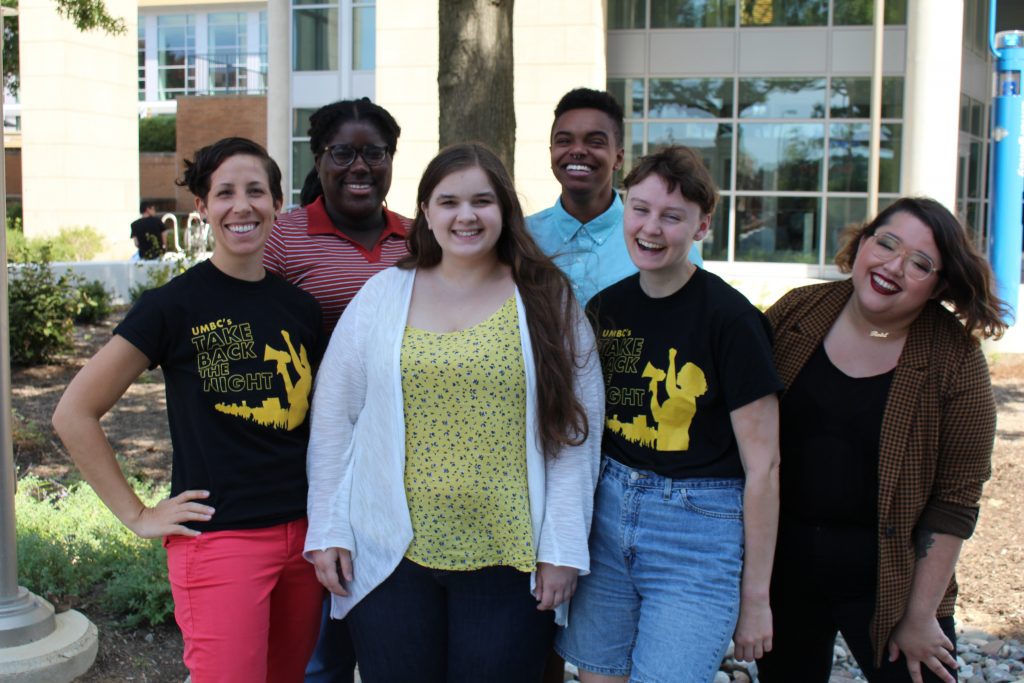
“I miss being on campus, leading the Take Back the Night march, and keeping people invested in what we’ve been building. There’s a lack of closure,” explains BenAissa.
Nadia BenAissa walks with Take Back the Night. This sexual assault awareness event works to expose rape culture and to enable survivors and allies to share personal stories. Photo by Ian Feldmann ’21.
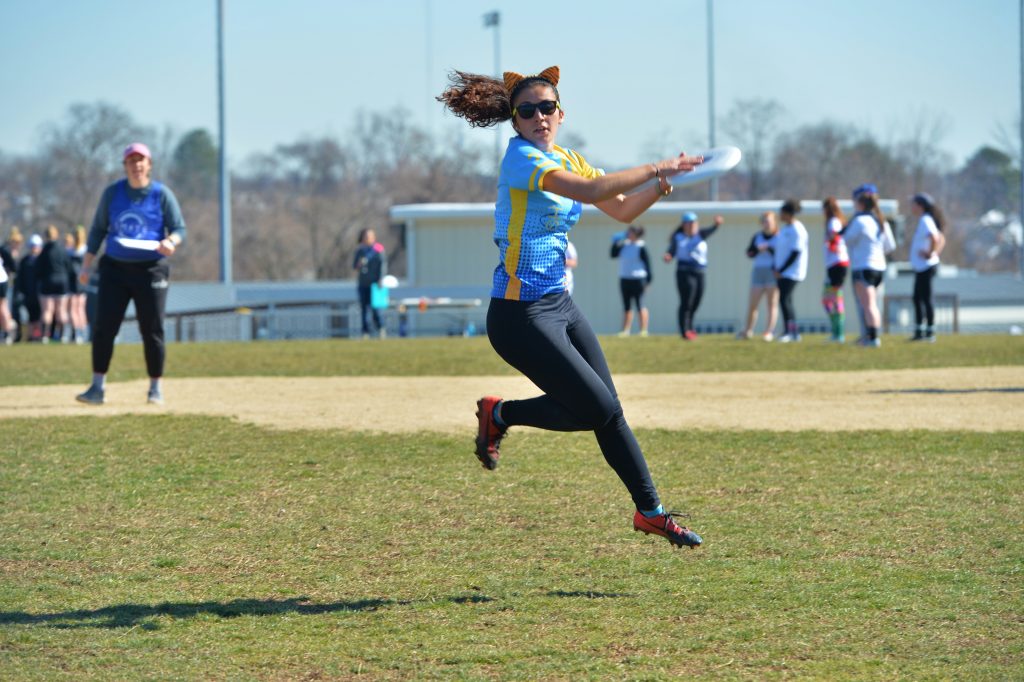
Still, she is doing her best. Over the last two months, BenAissa adapted her URCAD research on inequities in university Title IX processes into an online presentation. As captain of the Women’s Ultimate Frisbee team, she dealt with the disappointment of a canceled season. Still, she keeps in touch with teammates online, and she looks forward to joining the club’s active alumni community.
BenAissa at an ultimate frisbee tournament in February. Photo by Alexander Wright.
Hertl feels melancholy at times, and thinks about missing out on this year’s Quadmania and Take Back the Night. Continuing to support other students as a residential assistant and through work with the Women’s Center keeps them centered and engaged.
“There are so many unknowns right now,” says Hertl. “I just want to make sure people know what’s happening and where they can go for help.”
Continuing their commitment
Following graduation, Hertl will enter the University of Maryland, Baltimore’s accelerated master’s in social work program. There, they will focus on social policy and community action, particularly in working with trans and nonbinary people, as well as people with disabilities and people who are experiencing homelessness.
Hertl has also accepted a 2020 – 21 graduate assistantship at UMBC. This means the university will continue to benefit from their commitment to inclusivity.
Before leaving campus due to COVID-19, Hertl and fellow RA Julia Corns ’21, biological sciences, made “PAL”entine grams for residents. Photo courtesy of Hertl.
BenAissa plans to continue advocating for survivors in higher education. “I want to work to ensure survivors are centered in the policies that affect them and make sure they get the resources they need,” she says. “I’m not finished with this work, and I’m not finished being part of We Believe You, Retriever Courage, or UMBC.”
“The work we’ve done through Retriever Courage is a step in the right direction,” BenAissa continues. “We’re headed toward the standard we need to have here, and we will exceed that standard because we are UMBC. And UMBC has been great at giving me ways to be my best.”
Article written by Eleanor Lewis, communication specialist in the Division of Student Affairs.
Featured image: BenAissa speaks at Take Back the Night. Photo by Ian Feldmann.
Graduating during a pandemic means students won’t be able to celebrate in the ways they expected, with family and friends cheering in a packed UMBC Event Center. But earning their degrees will still be a joyful achievement that honors years of hard work and opens doors. For UMBC’s adult learners in particular, including Returning Women Student (RWS) Scholars, holding that diploma will mean the achievement of dreams long deferred.
“Once I made the first step, everything opened up”
This month Karla Gonzalez ‘20, social work, will become the first in her family to graduate from college, at age 34. For much of her life, college didn’t really seem like a possibility. She was proud to be one of the first in her family to finish high school, and to have a job that could support her three children. But as the years passed, Gonzalez realized something was missing—she had yet to reach her full potential.
Pursuing college involved significant change in Gonzalez’s life. She ended her marriage, left full-time work, and began to prioritize her dreams for the first time. She chose a career path that would build on the skills and talents she already had, and open up new possibilities. “Returning to college was the next stepping point that would allow me to stand on my own two feet,” she explains. “Once I made the first step, everything opened up.”
Jumina Ito (left) and Karla Gonzalez (center) at an RWS orientation event. Photo courtesy of the Women’s Center
Gonzalez was very conscious that as an adult learner her experience didn’t follow a traditional timeline. It was her son who reminded Karla that she would be the first in their entire extended family to graduate college. Then, other family members joined in on the refrain, “You’re the first. You’re the first!”
“I never saw myself as a leader, but at UMBC I learned that I was one”
Gonzalez now sees her achievement not just as a brave step for herself, but as clearing the path for her family members to move forward with their own college dreams. “Even though I’m in my 30s, it is special and it should be celebrated,” Gonzalez shares. ”I am that example that will tell them they can go for whatever goals they have.”
Karla Gonzalez celebrates her graduation with her children. Photo courtesy of Gonzalez.
She also celebrates the friendships she has built along the way, and how her peers and professors transformed the way she saw herself. “It isn’t just about getting a degree, but it’s also about those connections,” says Gonzalez. “I never saw myself as a leader, but at UMBC I learned that I was one.”
Gonzalez is this year’s Title IV-E Student of the Year, an honor recognizing a talented social work student who is dedicated to a career in public child welfare practice. She’ll next pursue a master’s in social work (MSW) through the advanced standing program at the University of Maryland, Baltimore.
Karla Gonzalez in front of a University of Maryland School of Social Work building. Photo courtesy of Gonzalez.
“It’s been almost a 30-year journey”
Like her classmate, Nia Latimer ‘20, social work, entered UMBC at the age of 42 as a single parent, no longer willing to defer her dreams. After graduating from high school, Latimer went right to college, but withdrew due to financial constraints. Over the years, she would re-enroll in college, but be forced to pause to focus on other life events. She shares, “It’s been almost a 30-year journey.”
Latimer has had a fulfilling job with Baltimore City Public Schools, but the dream of a college degree always remained in the back of her mind. After the death of her husband, she realized that now was the time to finish her degree, while continuing to work full-time. She began listening to the way others described her strengths and skills and decided to pursue a degree and career in social work.
When Latimer arrived at UMBC, she shared, she finally felt like she “was home.” She felt welcomed into a community with students of all ages and was impressed by how inclusive UMBC’s social work program was for adult learners.
Returning Women Student Scholars orientation, fall 2019, including Latimer (second row from the front, center) and Pres. Hrabowski (left, near front). Photo courtesy of the Women’s Center.
“It’s never too late to do this”
Latimer joined UMBC’s Returning Women Student Scholars + Affiliates program in her senior year. She found that other adult learners provided her with an additional layer of support that proved crucial to her success. The experience “validated that this is my time,” she says. “It’s never too late to do this.”
Nia Latimer (left) and Karla Gonzalez (center) at an RWS orientation event. Photo courtesy of the Women’s Center.
Graduating this May finally “feels like closure,” Latimer shares. She will become the first of her siblings to graduate with a college degree. And she has earned an award as Outstanding BSW Student Graduate, recognizing her academic achievements.
Latimer also knows this is just the beginning of a new chapter. She’ll soon begin an MSW through the advanced standing program at the University of Maryland, Baltimore.
Feeling “behind,” racing to catch up, and pausing to breathe
For Jumina Ito ‘20, biochemistry, “It was never a question as to whether I would return to school, only a question of when.”
Jumina Ito in front of the UMBC Library. Photo by Marlayna Demond ’11 for UMBC.
Between the time of graduating high school and enrolling at UMBC in the fall of 2016 at the age of 26, Ito traveled across the U.S. and internationally, working on farms. Taking this time to explore her interests helped her develop a better understanding of herself, she says, but it also left her feeling “behind” when she got to college.
Once at UMBC, she felt an urgency to blaze through, taking as many credits as possible while also working to support her family. Eventually, Ito realized this approach was not sustainable. If she was going to finish, she’d need to slow down and to find a community of support.
“The slow and steady climb is worth it”
Ito found her community in the Returning Women Student Scholars + Affiliates program, which also connected her with the Sherman STEM Teacher Scholars Program. These two programs provided her space to explore new possibilities for herself, including as an educator.
Jumina Ito (r) at an RWS orientation event. Photo courtesy of the Women’s Center.
Now, she’s excited to pursue a STEM teaching career that will help her serve as a model and mentor for girls interested in science. This fall, Ito will begin teaching chemistry and aquaponics full-time at Green Street Academy, where she completed her applied learning experience as a Sheman Scholar.
Ito will be the first of her four siblings to graduate. She hopes her graduation will be a helpful example for others, reflecting that we “inherently put limitations on ourselves, but you can rise above them.” Looking back at her life’s twists and turns over the past decade, she shares, “The slow and steady climb is worth it.”
“I could do this on my own”
When Lauren Hall graduated with her bachelor’s degree from UMBC at the age of 29, she kept right on going to pursue a master of arts in teaching (M.A.T.). But her college path wasn’t always so clear. “If you asked me ten years ago, I never would have thought I’d have a master’s degree,” she says.
Hall ‘18, English literature, M.A.T. ‘20, became a mother at age 18, and devoted her years after high school to raising her two young children and supporting her then-husband’s pursuit of higher education. After her marriage ended, she decided to return to college. Even while feeling afraid to leave the comfort of the life she knew, she also determined, “I could do this on my own.”
Lauren Hall (l) and Jess Myers (r) at the RSW Graduation Celebration, fall 2018. Photo courtesy of the Women’s Center.
Another new beginning
What began as small steps in returning to college quickly became a sprint. She took classes at the Community College of Baltimore County before transferring to UMBC. Once on campus, she focused on building a community where she could thrive even while juggling work and single parenthood.
Lauren Hall celebrates receiving her UMBC bachelor’s degree. Photo courtesy of Hall.
Hall enjoyed the chance to connect with students of all ages through shared values, interests, and a mutual commitment to each other. She shares that some of her younger classmates not only became friends, but also an integral part of her support system, helping with childcare and carpool duty.
Hall has been a rock for her family for years, but jokes that her master’s degree means, “Now, I’m a full grown-up!” It’s another step forward—another new beginning. She looks forward to working as an English teacher, in either Baltimore City or Howard County Public Schools, and is committed to helping students believe in their potential.
For information about the Women’s Center and the RWS Scholars + Affiliates program that supports adult learners seeking their first undergraduate degree, visit womenscenter.umbc.edu.
In addition to the students featured above, the Women’s Center’s RWS Scholars + Affiliates Program celebrates May 2020 graduates Shanice Bramwell, health administration and policy (HAPP); Josephine Gyasi-Baaye, social work; Samantha Homa, geography and environmental studies; Victoria Hughes, social work; Tatiana Pearson, information systems; Joanna Riley, social work; Aieda Solomon, HAPP and sociology; and Sheila Yeelon, social work. UMBC also honors the numerous other adult learners earning degrees this spring, from across the university.
Article written by Jess Myers, director of the Women’s Center at UMBC.
Featured image: RWS Scholars (including Jumina Ito and Lauren Hall) meet with President Freeman Hrabowski during fall 2018 orientation. Photo courtesy of the Women’s Center.
Kennedy Lamb and Jethro Ssengonzi are finishing their final semester with uncertainty about the world, but also a sense of hope. To cope with the challenges of graduating during the COVID-19 pandemic, they are drawing on resilience built through past challenges they’ve faced as UMBC scholar-athletes.
On the surface, Lamb ‘20, English, and Ssengonzi ‘20, mechanical engineering, didn’t have much in common when they arrived on campus. Lamb brought her academic and softball talents from the town of Mexico, New York, 35 miles north of Syracuse. Ssengonzi left Cary, North Carolina, to become a Meyerhoff Scholar and member of the Retriever swimming and diving team. Both connected early on with mentors who would support them in their most difficult moments.
Academics “kept me going”
In high school, Lamb was a Syracuse.com three-time First Team All-League softball player. She was also student council president and a student member of her local Board of Education. Her drive, leadership, and commitment to community fit with UMBC’s culture, but she struggled in her first year on campus. Lamb played in just nine games as a Retriever freshman and nearly did not return the next fall.
Lamb at NCAA Regionals, May 2019. Photo by Joshua R. Gateley, courtesy of UMBC Athletics.
“Coming from upstate New York to Maryland with no connections, no family or friends, or really any form of support, was extremely difficult,” said Lamb. “I suffered from anxiety and depression that wasn’t diagnosed until my junior year of college. I truly almost pulled the plug and dropped out on numerous occasions, but I couldn’t give up on my dream of playing DI softball.”
Lamb credits two mentors in particular for helping her over the hump during that tumultuous freshman year. Assistant Athletic Director Abbie Day served as her first athletics’ academic advisor. Science writer Sarah Hansen, M.S. ‘15, biological sciences, a communications manager in UMBC’s Office of Institutional Advancement, helped guide her toward new opportunities for her writing.
Kennedy Lamb enters a UMBC Transit bus for an assignment as a UMBC Magazine intern. Photo by Marlayna Demond ’11 for UMBC.
“In a way, my grades are what kept me going—I always knew I had that to fall back on,” says Lamb. “I loved all of my classes at UMBC and I knew the professors wanted me to succeed.”
“I took a great deal of pride in my GPA freshman year—and well, all of the years—because I knew if athletics was frustrating me, or something in my personal life wasn’t going quite right, I always had school to keep me motivated and focused,” she shares. That focus would pay off.
“I’ve had to adjust”
Ssengonzi came to UMBC after a distinguished swimming career at Green Hope High School. In addition to being a Meyerhoff Scholar, he quickly engaged with UMBC’s Grand Challenge Scholars Program. The program, which began just as he arrived at UMBC, gives students opportunities to work on multi-disciplinary teams to tackle some of the most pressing issues facing society today.
Ssengonzi during URCAD 2018 at UMBC. Photo by Leo Buoye ’19.
Ssengonzi’s sophomore year started off strong. Beyond swimming and coursework, he presented his summer research at the UMBC Undergraduate Research and Creative Achievement Day in 2018.
Ssengonzi presents his research at URCAD in April 2018. Photo by Marlayna Demond ’11 for UMBC.
But throughout that 2017-18 year, Ssengonzi struggled as his father, Robert, was diagnosed with cancer. Robert lost his battle with the disease in the fall of 2018. Dealing with day to day life at school while staying engaged with family was difficult.
“The last three years or so have been tough on my family,” Ssengonzi says. “I’ve had to adjust to many things. Fortunately, I’ve been able to forge ahead with the help of several people.”
He credits his massive swimming and diving family and his fellow Meyerhoff Scholars for their support throughout his UMBC journey. He also thanks mentors Maria Sanchez, professor of the practice in mechanical engineering and COEIT’s director of education and outreach, and adjunct professor Joseph Washington, Ph.D. ‘15, mechanical engineering.
“Most importantly, he cares about people”
Ssengonzi flourished over the past two years. The team selected him as one of their captains in 2019-20. And despite dealing with a troublesome quad injury, he posted lifetime bests in all of his swims. His last moments in the water as a Retriever were spent celebrating the team’s third consecutive America East championship.
“Jethro is driven and focused, sensitive and hard-working, and most importantly, he cares about people,” said head swimming and diving coach Chad Cradock ‘97, psychology.
Ssengonzi celebrates a strong swim on the path to UMBC winning the 2019 men’s and women’s swimming and diving America East championships. Photo by Colleen Humel, courtesy of Ssengonzi.
During spring break, Ssengonzi returned to North Carolina. He has not been back to campus since the COVID-19 pandemic struck. But he feels fortunate to stay connected with Retriever Nation remotely, and is already looking forward to his next steps.
Ssengonzi will pursue a Ph.D. in civil engineering at nearby North Carolina State University this fall. There, he will focus on the restoration and improvement of urban infrastructure. It’s a topic fueled by his involvement with UMBC’s Grand Challenge Scholars Program.
Path to the championship
Lamb has also enjoyed tremendous growth and success since connecting with mentors and building her community of support. She was one of nine students selected to participate in the first UMBC Interdisciplinary CoLab in summer 2018. Her three-member team worked closely with the UMBC Sustainability Office and Climate Action Steering Committee. They created four engaging informational videos on the importance of environmental sustainability at UMBC.
Under the direction of CoLab founder Carole McCann, professor and chair of gender, women’s and sexuality studies, Lamb also launched an independent project. She produced, directed, and filmed the video that UMBC now uses to publicize the CoLab program.
Lamb running near the Albin O. Kunh Library during a video shoot. Photo by Marlayna Demond ’11 for UMBC.
On the field, Lamb played in a career-high 27 games in 2019. But it was her steady, veteran leadership that helped the Retrievers to an improbable run to capture the 2019 America East Championship and compete in the NCAA Tournament.
There, she also received the America East Elite 18 award. This honor recognizes the student-athlete with the highest GPA in each America East championship game.
Lamb (center, in visor) celebrates the 2019 America East Championship win with her teammates. Photo by Stephen McLaughlin, America East.
“Kennedy Lamb is one of the hardest working, most caring, dedicated student-athletes I have had the privilege to work with over the years,” said head coach Chris Kuhlmeyer. “She is a prime example to all student-athletes at UMBC and across the nation of what it takes to live an exemplary life academically, athletically, and personally.”
Lamb receives America East Elite 18 award. Photo by Stephen McLaughlin, America East.
Like many seniors, the COVID-19 outbreak has delayed Kennedy’s post-graduation plans. She awaits news about graduate school and internship opportunities in science writing at leading institutes.
High achievement with strong support
Athletic Director Brian Barrio sees Lamb and Ssengonzi’s experiences as reflecting something essential about the values of UMBC and UMBC Athletics. “The magnificent performance of Retriever student-athletes in the classroom speaks volumes about the values of this department and of UMBC as a whole,” he says. “I could not be more proud of the young men and women who put the work in to achieve these GPAs while also competing for championships on the playing fields.”
This fall, UMBC’s seventeen teams combined for a school-record grade-point average of 3.19 and 46 student-athletes earned President’s List honors (4.00 GPA). In addition to Lamb and Ssengonzi, two other UMBC scholar-athletes were valedictorian candidates for the Class of 2020.
Abbey Farmer. Photo by UMBC Athletics.
Abigail “Abbey” Farmer, who hails from nearby Crofton, Maryland, is a dual major in health administration and policy and psychology. Before college, she swam with the Retriever Aquatics Club. Now, she is graduating in just three years with a 4.0 and as an active swimmer. She will begin a master’s degree in public policy at UMBC in the fall. And she’ll continue her swimming career.
Ilia Rattsev is completing his B.S. degree in bioinformatics and computational biology, along with a minor in computer science and a certificate of language studies in German. Rattsev came to UMBC from Moscow, Russia. He recently earned Eastern College Athletic Conference Swimmer of the Meet honors and the America East Elite 18 Award as the top student athlete at the championships, with a 3.97 GPA.
Rattsev has completed research in the lab of Maricel Kann, associate professor of biological sciences, where he developed a passion for cancer research. After graduation, he plans to continue his career in cancer research. He’s currently weighing graduate school and lab research options.
UMBC’s Ilia Rattsev, Jeremy Gates, Jack Carlisle, and Jethro Ssengonzi (l-r) accept the trophy for the 2020 America East Championship on behalf of UMBC men’s swimming and diving; Feb. 16, 2020. Photo by Brian Foley for America East.
Barrio’s mind is always on how to support UMBC’s student-athletes in reaching their goals, whether that’s in the lab, on the field, or in their communities. For now, that support reaches students from a distance, but he’s already thinking ahead to when competition resumes post-pandemic.
“The next time you come watch our teams compete,” Barrio says, “take a minute to reflect on how hard these Retrievers are working in all phases of their lives.”
Featured image: Jethro Ssengonzi (r)with fellow swimmer Diego Morales ’23 (l) at a home meet. Photo by Ian Feldmann ’20, courtesy of UMBC Athletics.
Article written by Steve Levy, associate athletic director for athletic communications.
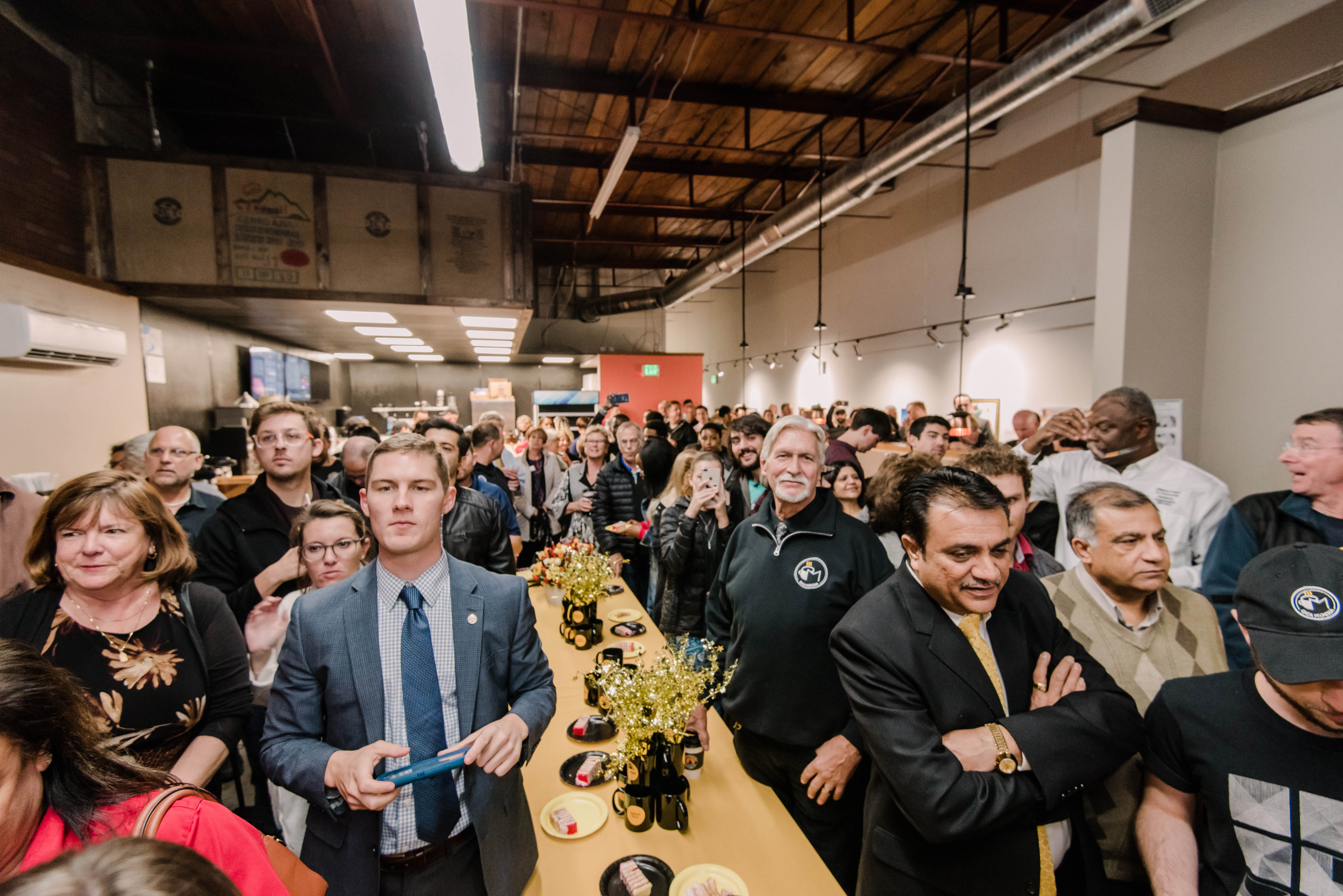
The plan began percolating in early 2017, when UMBC entrepreneurship professor Gib Mason ՚95, economics, presented a challenge to his Innovation, Creative Problem-Solving, and the Socialpreneur class. Local business and community groups had asked UMBC for ideas on how to better connect the University and its surrounding communities. That class assignment evolved into a student-led enterprise that could benefit UMBC and its neighbors for years to come. After more than two years of planning, construction, relationship-building, and first-hand experience with the ups and downs of starting a business from scratch, the project has become a reality. The doors of OCA Mocha—a coffee shop and community gathering space in downtown Arbutus—opened at 6 a.m. on November 4, 2019. More than 100 students, UMBC faculty and staff, and members of the community attended a grand opening celebration that afternoon.
A crowd of supporters gathers for OCA Mocha’s grand opening.
From class project to brick and mortar business
Student co-founder and recent UMBC alumna Krishna Gohel ՚18, biological sciences, called the grand opening “a dream come true.” When the project began in the spring of 2017, she and her classmates “knew UMBC needed something…and that the surrounding communities needed something…[and] we realized that [we] needed the same thing: unity.” Gohel called OCA Mocha “the missing piece of the puzzle,” a sentiment expressed repeatedly during the grand opening festivities.
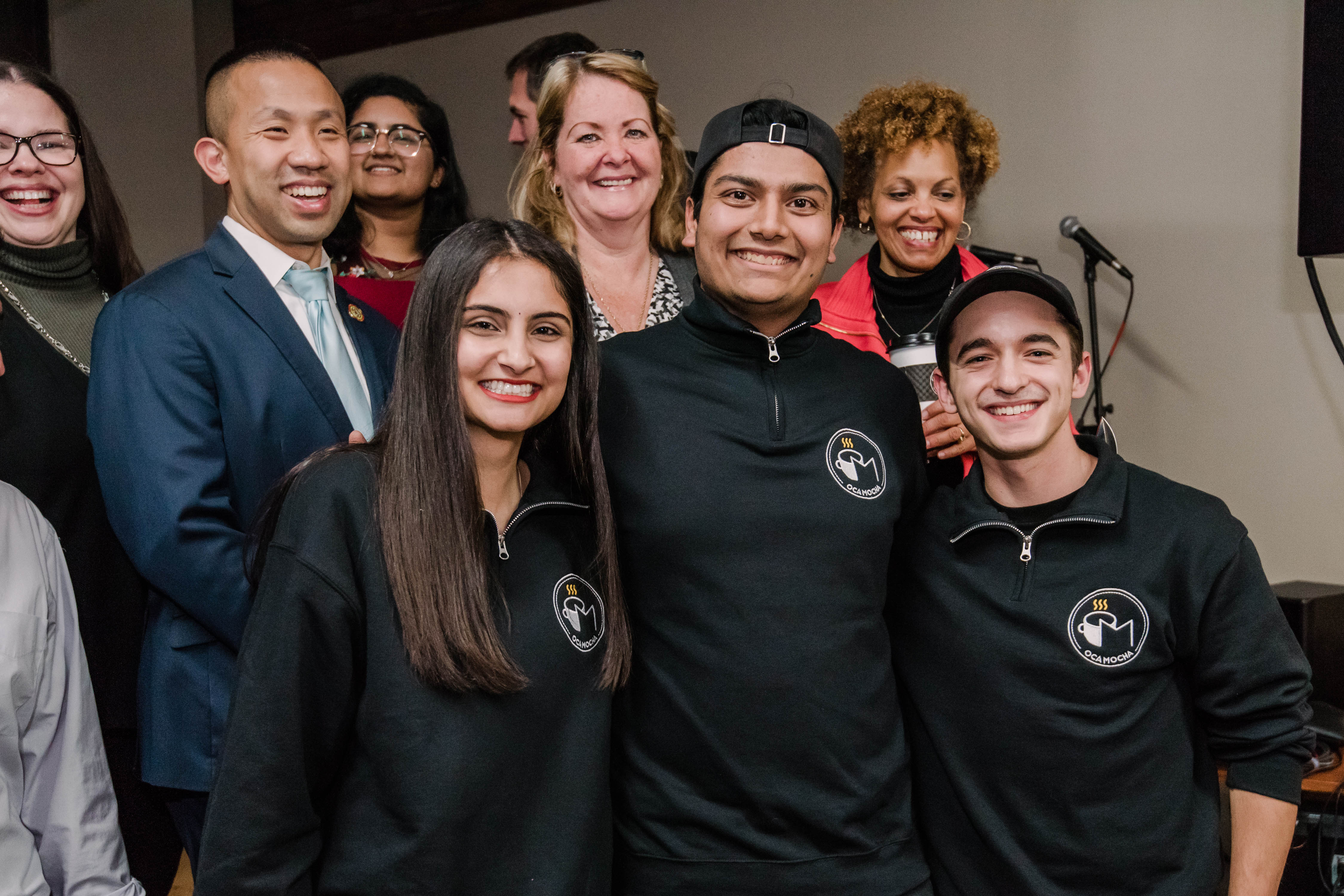
Co-founders (l-r): Krishna Gohel, Deep Patel, and Michael Berardi
Michael Berardi ՚19, media and communication studies, student co-founder and current OCA Mocha general manager, noted that “dozens of minds” helped conceive of OCA Mocha “and hundreds of hands have touched this project.” He reflected, “It’s truly been incredible.” Berardi and other speakers told the assembled crowd about OCA Mocha’s roots as a place where members of the UMBC and local communities could gather. This new space is now a hub for them to connect with and learn from each other, enjoy some coffee, and attend university- and community-sponsored events. It all centers around the unique core vision for OCA Mocha—creating a university-community relations effort located not on campus, but in the community.
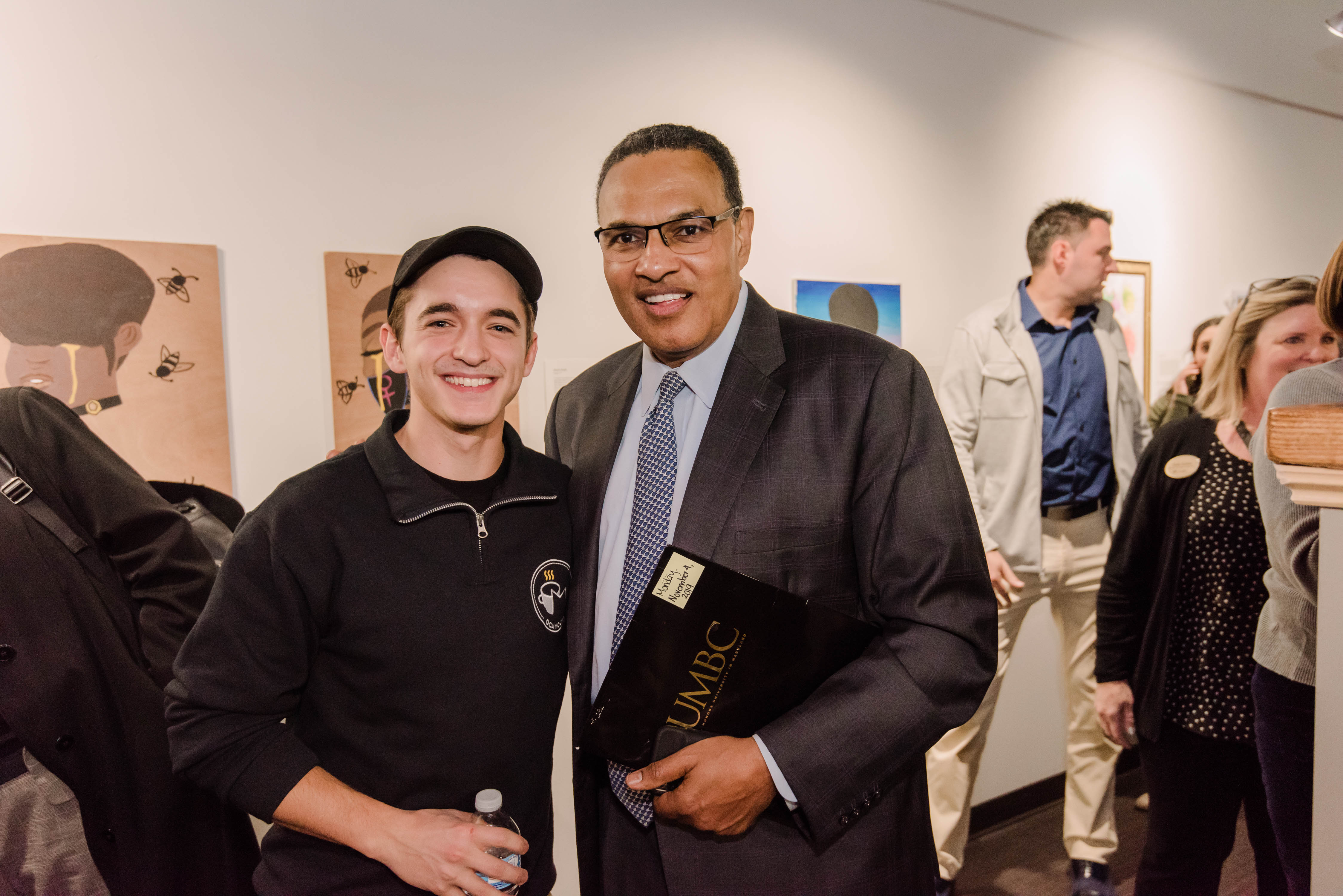
Michael Berardi and President Hrabowski at the OCA Mocha grand opening.
Locally made
The OCA Mocha team worked to refine its business plan and to transform commercial space that the University leased on East Drive in Arbutus. What began as an empty shell full of potential became a warm, welcoming space with a coffee bar, a community meeting room, and a stage for live music, open mic nights, and other entertainment. The space also includes a gallery for rotating art exhibits by members of the UMBC and local communities. Renovations began in March 2019, with Joe Regier, executive director of UMBC Transit and community connections, serving as UMBC’s on-site lead and liaison with the construction crew. The team sought to support the community by using local contractors and vendors whenever possible.
Joe Regier celebrates the OCA Mocha grand opening.
The wooden detailing on the coffee bar was created by craftsmen Michael McAuliffe and Bill Carter ՚98, interdisciplinary studies. Like so many others in the community, they donated their time and talents to the project. OCA Mocha partnered with Chesapeake Bay Roasting Company as its sole coffee supplier because of the company’s commitment to giving back to its local community and to supporting efforts to preserve the Chesapeake Bay.
Where coffee meets community
OCA Mocha’s tagline, “Where coffee meets community,” speaks volumes. Bettina Tebo, president of the Greater Arbutus Business Association, is one of the project’s earliest supporters. At the grand opening event, she called OCA Mocha “just the beginning of the amazing things that can happen from this relationship…and from the connections that we’re building.”
Celebrating the big day.
Vrinda Deshpande ՚20, biological sciences, UMBC Student Government Association (SGA) president, said OCA Mocha is “a very special place to be”—an example of the “power that [students] have to make change.” SGA has provided funding for the project and plans to use the community meeting room for meetings and programming. UMBC President Freeman Hrabowski told the crowd, “I don’t know when I’ve seen this kind of excitement.” He noted, “we believe in southwestern Baltimore County,” calling OCA Mocha “another step in building the partnership we’ve had for 50 years.”
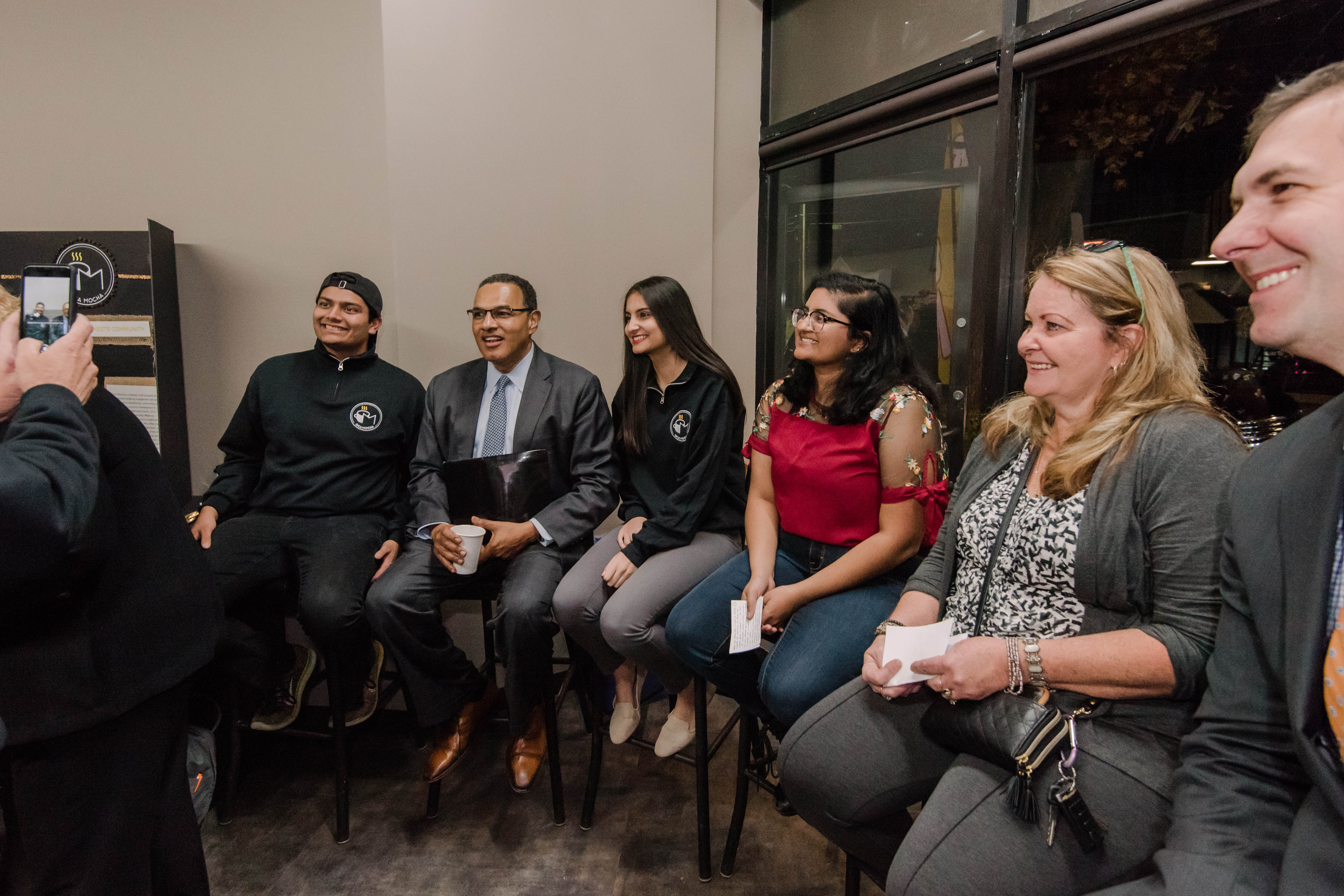
Event speakers (l-r) Deep Patel, Pres. Freeman Hrabowski, Krishna Gohel, Vrinda Deshpande, Bettina Tebo, and County Executive John Olszewski
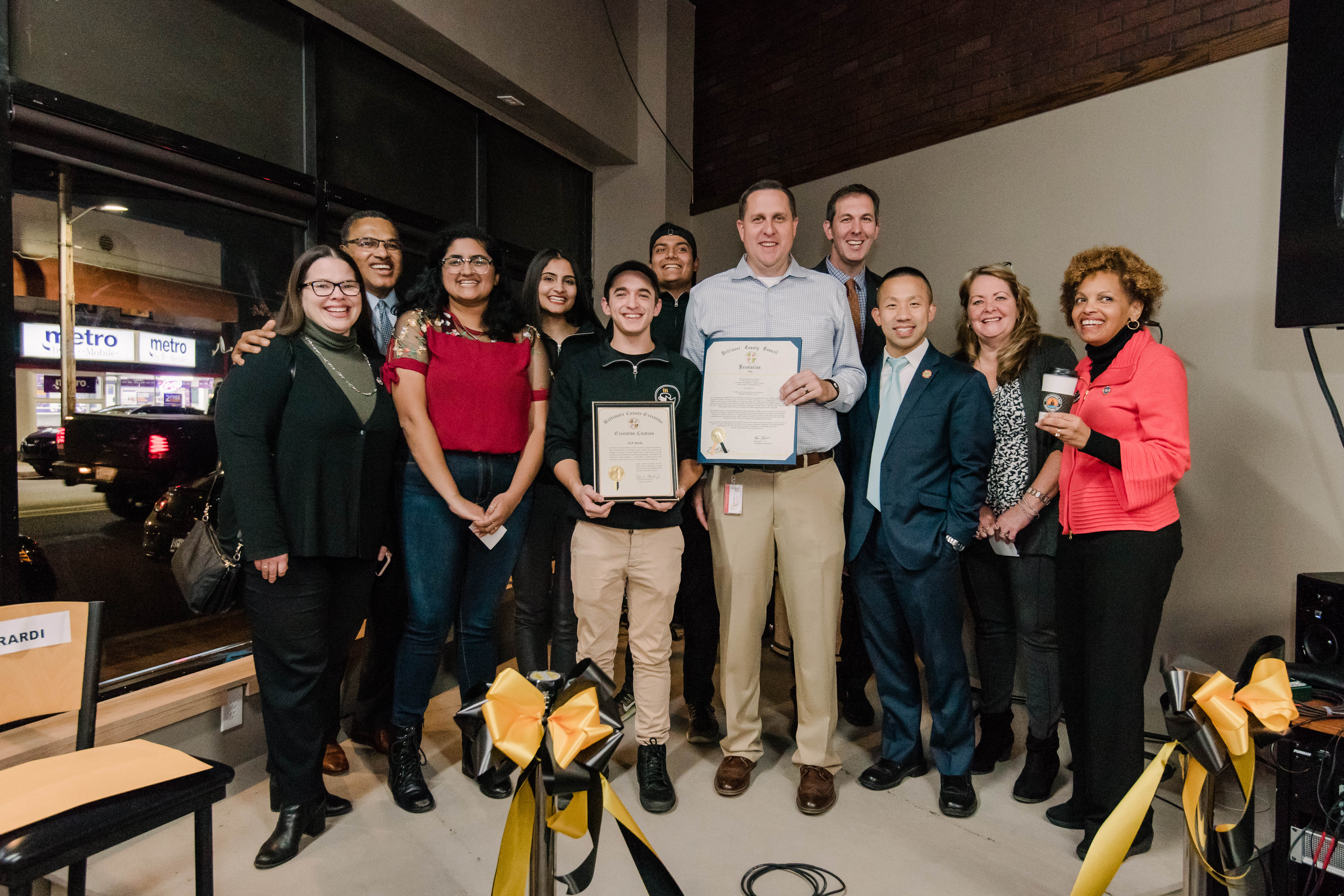
Baltimore County Executive John Olszewski, Ph.D. ՚17, public policy, presented the OCA Mocha team with a citation that reads, in part, “Your determination in creating a place where the community of Arbutus can repose and meet while further advancing the overall aesthetic of the community is greatly commendable.” The team also received a resolution from the Baltimore County Council, presented by staff for Councilman Tom Quirk, “extend[ing] its respect, admiration, and sincere congratulations to OCA Mocha upon their grand opening.” Maryland General Assembly District 12 Senator Clarence Lam and Delegates Terri Hill and Jessica Feldmark, and District 44B Delegate Pat Young, also attended the celebration.
OCA Mocha founders celebrate with local leaders.
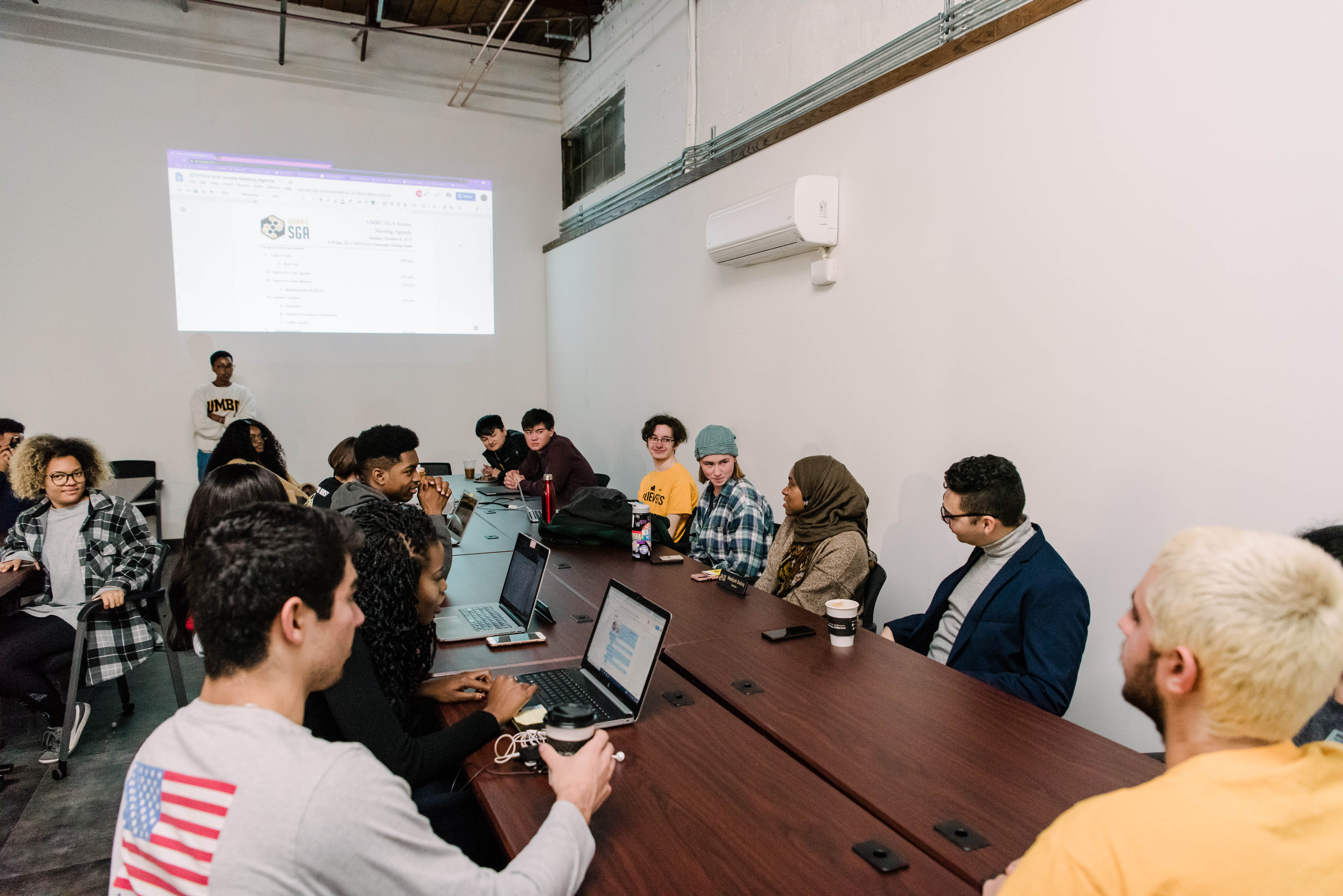
Wrapping up the formal program, student co-founder Deep Patel ՚19, biological sciences and financial economics, who is now a co-owner of the private investment group that runs the coffee shop, led a ceremonial ribbon-cutting featuring members of the OCA Mocha team, UMBC and community leaders, and public officials. The day of firsts continued into the evening as the SGA Senate convened its weekly meeting in the community meeting room.
SGA holds the inaugural gathering in OCA Mocha’s community meeting space.
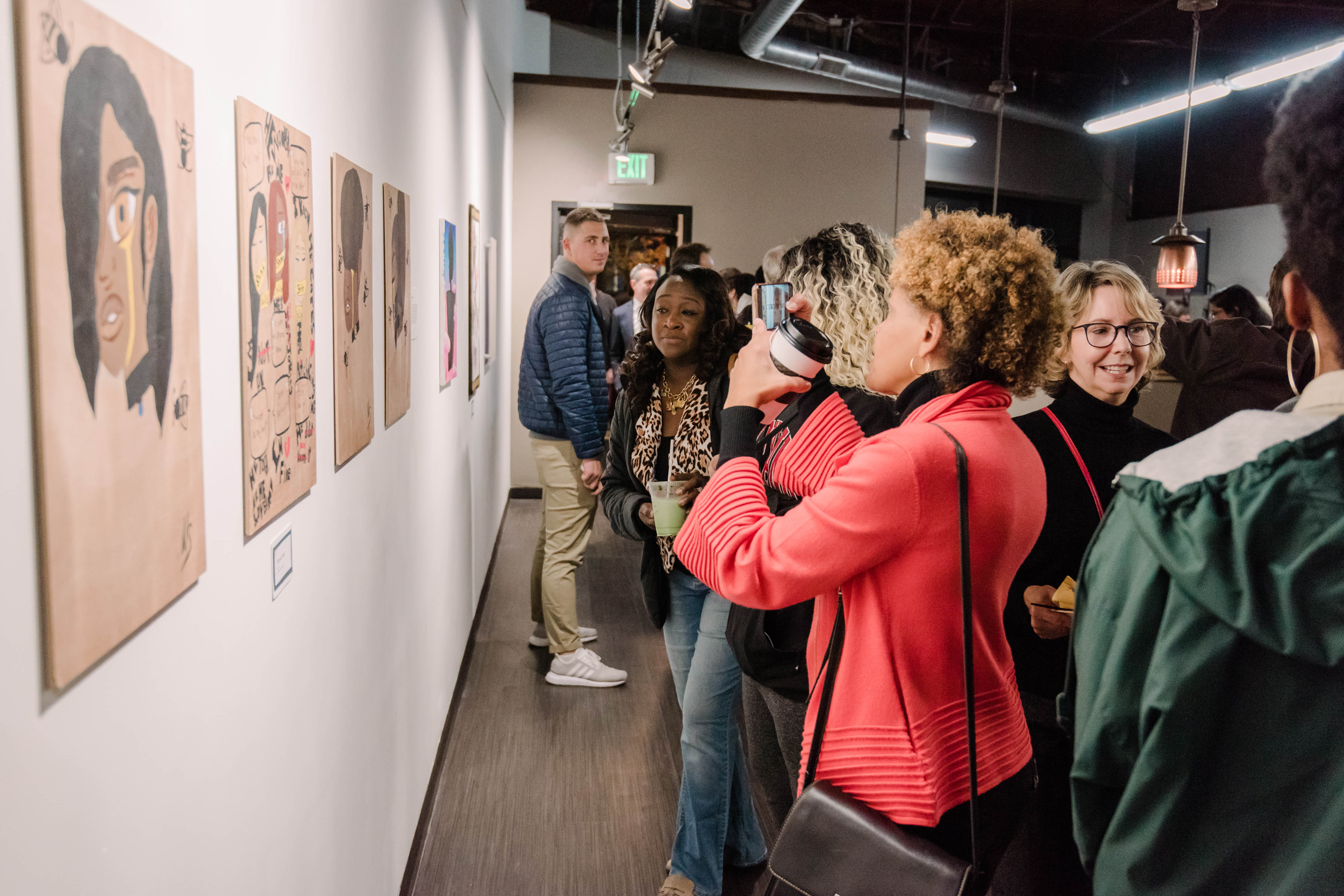
Patrons viewed the inaugural OCA Mocha gallery exhibit, featuring artwork by students from nearby Lansdowne High School and students who participated in the UMBC Choice Program’s “Youth in Action” event.
Delegate Terri Hill views the artwork on display.
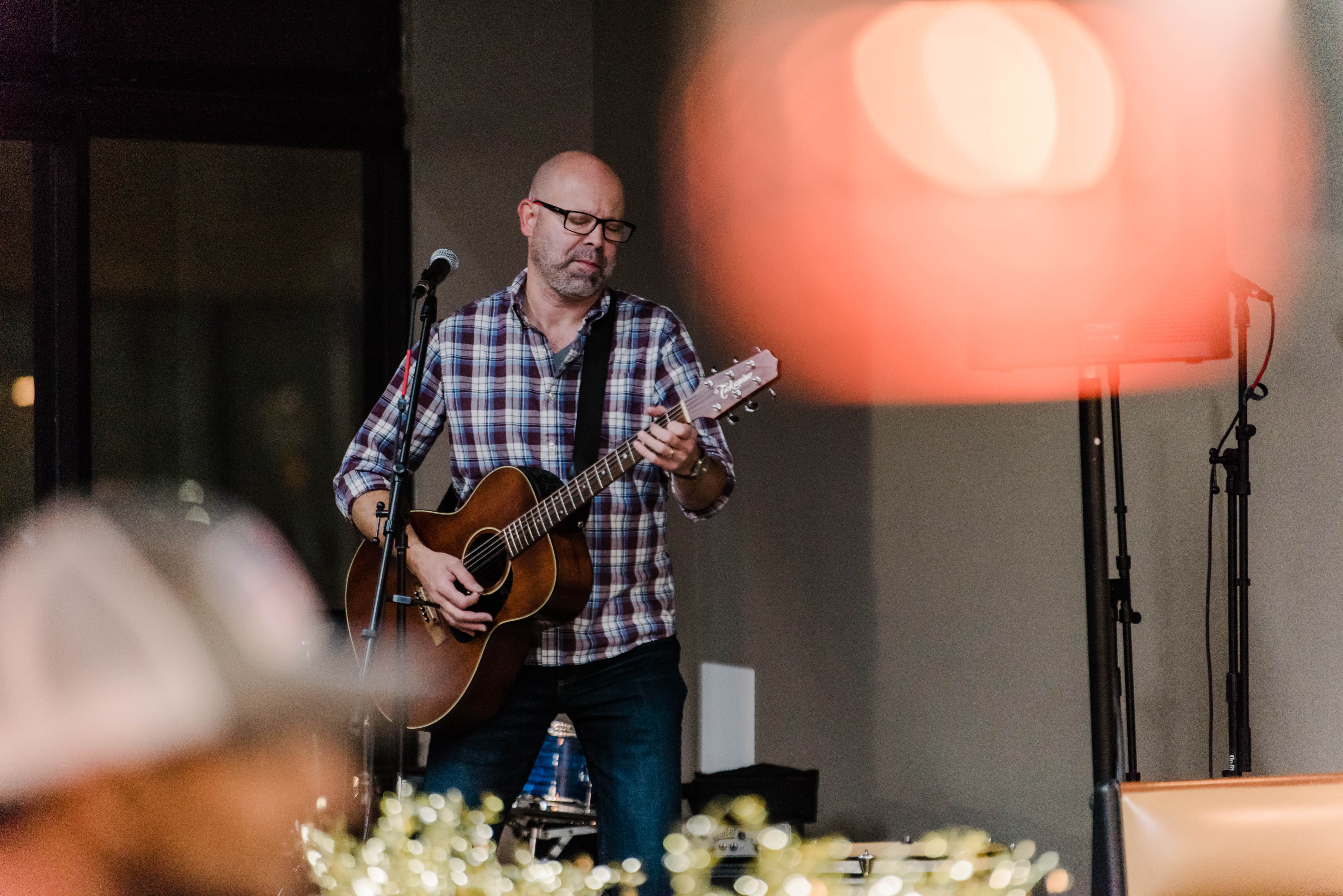
As the baristas, many of whom are UMBC students, continued to serve patrons, the OCA Mocha stage featured its first live act, local musician Jeremy Gilless. He was followed onto the stage by Matt Davenport ՚18, music technology; Tyler Moonlight; and Sushito, featuring Fayo Ojo ՚20, computer science, and led by OCA Mocha student co-founder Chris Roa ՚19, interdisciplinary studies.
Jeremy Gilless performs at the grand opening.
OCA Mocha is open daily. For information on hours, events, and how to reserve the community meeting room, visit OCA Mocha’s website.
Featured image: Adib Afnan ’19, biological sciences, prepares drinks at the OCA Mocha grand opening. All photos by Marlayna Demond ’11 for UMBC.
The start of the school year is invigorating for the whole university community, whether you’re starting your first year in college, transferring from a different institution, or gearing up to teach for the tenth year. And UMBC is channeling all that energy in classic Retriever ways.
Inflatable games in The Commons, a petting zoo on Erickson Field, food trucks everywhere—nothing says Welcome Week like a campus filled with activity. New students also have opportunities to reflect on what they hope to experience and achieve as college students, as well as learn about the foundational principles that are essential for our campus community to thrive.
Each student has a story
“We received a record number of applications this year, and the class of 2023 has all the strong academic credentials we’ve grown to expect at UMBC,” says Dale Bittinger ’16, M.P.P., assistant vice provost of undergraduate admissions, orientation, and school partnerships. “But even though you might start with the class’s numbers, it goes far beyond that. The students’ stories make the foundation of the class’s greatness.”
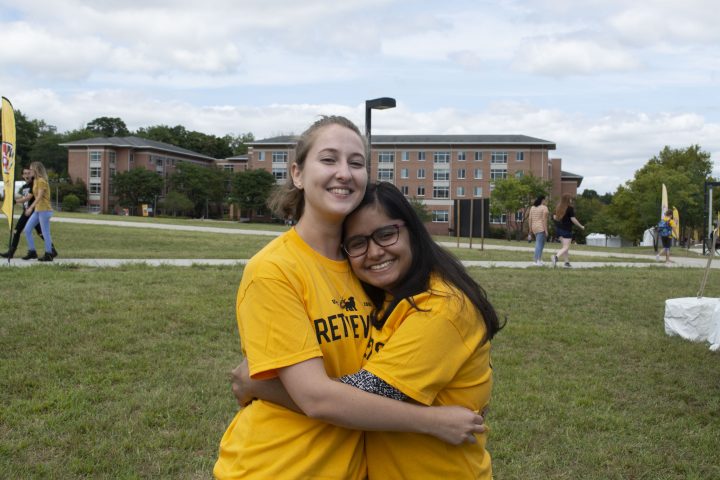
Hailing from 28 states and 31 countries, the incoming class of 2023 is eager to join in the unique community UMBC fosters among students. “UMBC has always been on my mind,” says Samiksha Paudel, biology. “I think it’s the best fit for me because of the size and the sense of community.”
Paudel hugs a newfound friend, Erica Doerrter, pre-nursing. Photo by Kennedy Lamb ’20.
“I chose UMBC because I heard that it’s cool to be a nerd here,” adds Natalie Davenport, psychology, “and so far, I haven’t been disappointed.”
Zinedine Partipilo Cornielles ’23, political science and financial economics. Photo by Arionna Gonsalves ’19.
Warm welcome from leaders
At Convocation (“a calling together” from Latin, as President Freeman Hrabowski pointed out), leaders of the campus community welcomed new students as fellow Retrievers. He encouraged them to take risks while also reminding them that they are in control of their destiny.
He also emphasized the principles that make Retriever Nation such a special place to grow and learn. He noted, “We value treating others with respect, standing against any kind of prejudice, and speaking out with courage about what is right and wrong.”
SGA President Vrinda Deshpande affirmed that failure happens—it’s trying new things that is so important.
“When things don’t go according to your plans- take a step back, breathe, forgive yourself, and make a new plan.” – Vrinda Deshpande, @umbcsga president (we heard an audible sigh of relief when she shared that no one expects your first year to be perfect) #UMBCwelcomepic.twitter.com/b7RwtJgyq5
At the annual Fall Opening Meeting for faculty and staff, students reminded them of their mission at UMBC. Incoming student and Honors College member Zinedine Partipilo Cornielles fled Venezuela with his family and settled in Howard County in pursuit of stability and access to education. He shared that during his time in high school, all he heard about was UMBC.
“When I first stepped on campus, I felt overwhelmed. Not just because of what college represents in everyone’s lives, but also because of how incredible the school was,” said Partipilo Cornielles. “I was able to see how there were so many opportunities for everyone.”
Zinedine Partipilo Cornielles at UMBC’s 2019 Fall Opening Program. Photo by Arionna Gonsalves ’19.
President Hrabowski ended the event with a brief version of his State of the University report and the familiar words attributed to Aristotle: “Choice, not chance, determines your destiny.” He then added an addendum, saying that recently a colleague had pressed him, asking, what if someone doesn’t have the chance to have a choice? “The nobility of what we do,” answered President Hrabowski, “is that we are creating opportunities for so many people to have that chance to make a choice.”
Campus is growing for students
Soon came the first day of classes. New and returning students walked through the doors of the Interdisciplinary Life Sciences Building (ILSB) for the first time, glimpsing bold colors and high tech classroom and lab spaces. With anticipation, they patiently stood in line to try the new line up of halal meals in The Commons and relaxed in True Grit’s updated dining hall, reconnecting with friends. Others enjoyed walking across the fresh green grass of the quad and spotting new pocket gardens with native plants.
UMBC’s Shady Grove campus is also expanding this year as construction continues on a building that will house the new translational life science technology major. Students in this major are eager to apply their skills and interest in the life sciences to creating innovative biotechnology solutions that will transform the health, agriculture, and environment sectors. They will find a welcoming home in the Biomedical Sciences and Engineering (BSE) Education Facility at Shady Grove this fall.
Discovering your place at UMBC
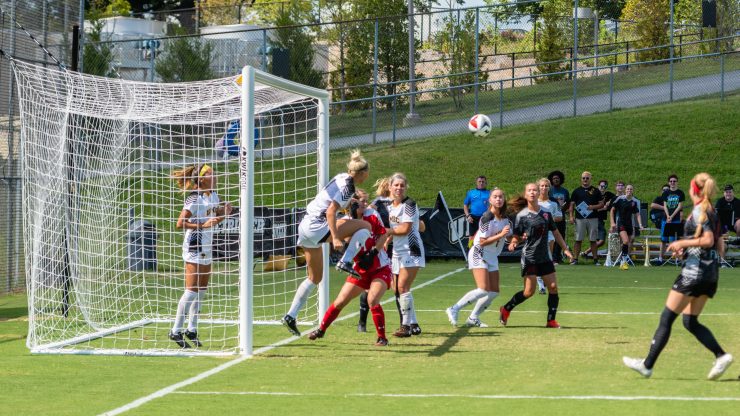
While not all of the first week of the fall semester is fun and games, there are also literal games, as the soccer teams kick off their new season. In an opening game against St. Francis, the women’s team kept the score tied 2-2 into overtime. The men’s soccer team is matched with Incarnate Word at 7 p.m. on August 30, giving new and returning Retrievers a chance to join their voices in a big WOOF WOOF as they cheer on the team.
Junior Kathryn Moormann deflects the ball from the goal. Photo by Ian Feldmann ’20.
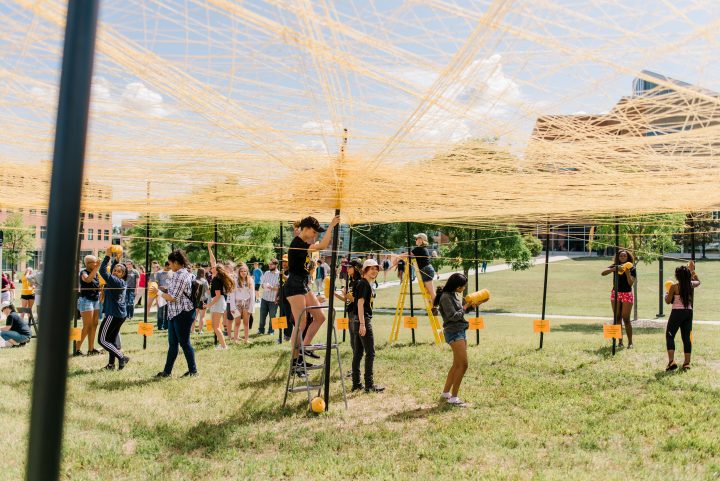
Though it’s a fast-paced introduction to campus, Welcome Week allows incoming students to bond with each other, and get an introduction to the UMBC experience from returning Retrievers. Whether they’re attending a pool party, morning yoga by the UMBC Library pond, or a “unity web” community activity, UMBC students use this week as a chance to start building relationships that will serve as the foundation for their years at UMBC.
Junior Kathryn Moormann deflects the ball from the goal. Photo by Ian Feldmann ’20.
“I’m excited to see what these students can do,” says Bittinger. “I don’t even know if they know what they’re capable of, but I hope they discover their place in the world here at UMBC. I’m as excited as they are to see them succeed.”
Happy first day of classes! Whether you're new to #RetrieverNation or you've called UMBC home for a while, start the year with our favorite mantra in mind: thoughts ➡️ words ➡️ actions ➡️ habits ➡️ character ➡️ destiny. #UMBCwelcomepic.twitter.com/f1dOJi48tg
At UMBC’s upcoming commencement ceremonies, students and their families and supporters will hear from three distinguished speakers, each honored as a leader in their field. They include a UMBC alumnus recently elected county executive, the first woman conductor of a major American orchestra, and one of the world’s top addiction researchers.
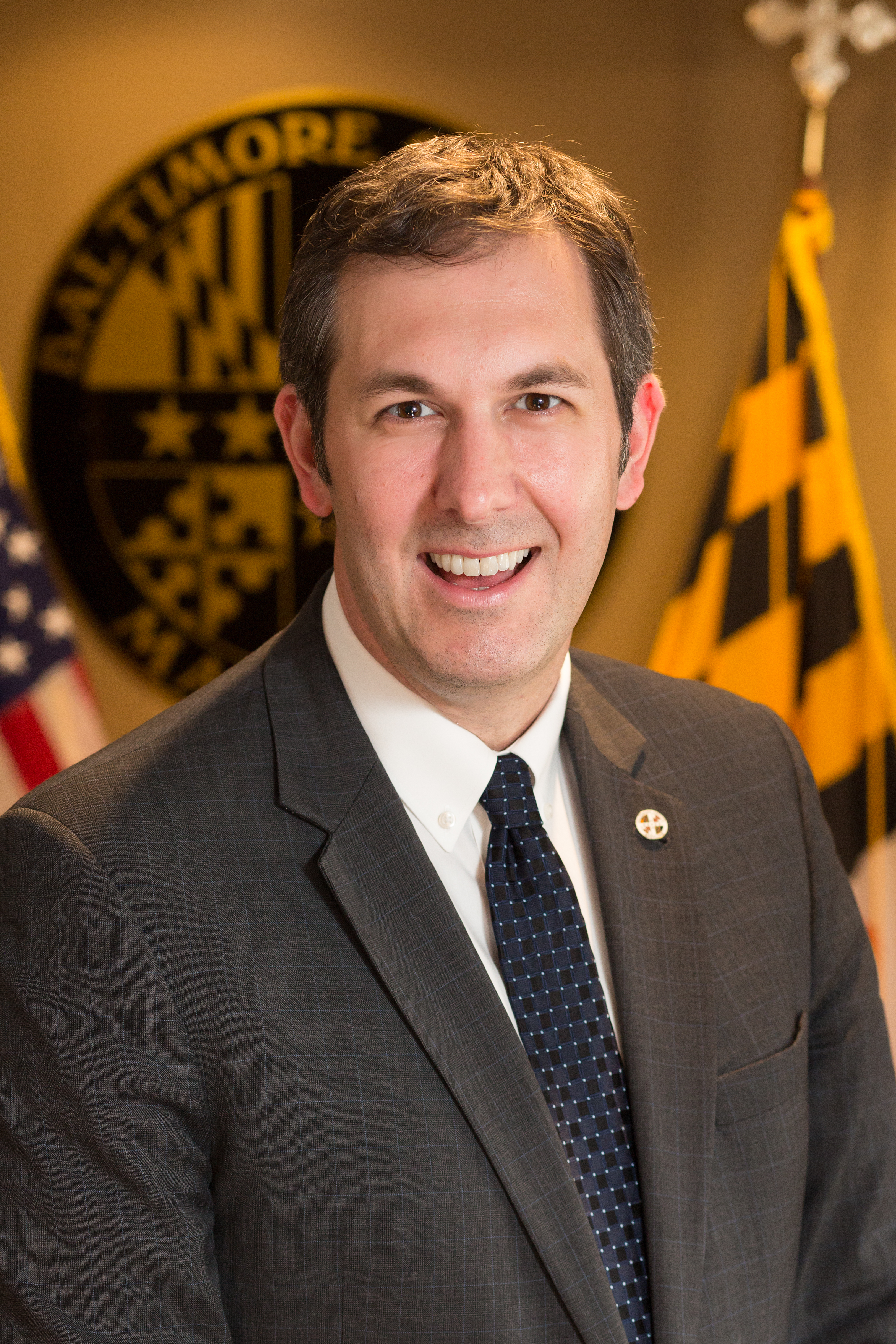
Baltimore County Executive Johnny Olszewski
On Wednesday, May 22, new Baltimore County Executive John “Johnny O” Olszewski, Jr. will speak at UMBC’s graduate commencement ceremony. Olszewski is a lifelong Baltimore County resident who frequently speaks of his strong belief in the power of public service. He earned his Ph.D. from UMBC in public policy in 2017. He also holds an undergraduate degree from Goucher College and master’s degree from George Washington University.
After college, Olszewski returned to his community to teach social studies and special education at Patapsco High School. The experience affected him in a profound way. As he recently wrote in the Baltimore Sun, “I am a teacher. I don’t work in a classroom anymore, but my days teaching at Patapsco High School have shaped me into the person I am today. They shape the kind of county executive I want to be.”
In 2006, Olszewski was elected to the Maryland House of Delegates at age 23. He served for nine years and was the youngest person ever elected as chair of the Baltimore County Delegation. During his time in the General Assembly, he championed numerous bills, including paid sick leave for all Maryland workers. His advocacy for Baltimore County focused on economic development and education reform, two issues he has continued to focus on as county executive.
Olszewski lives in Dundalk with his wife, Marisa, and their daughter, Daria.
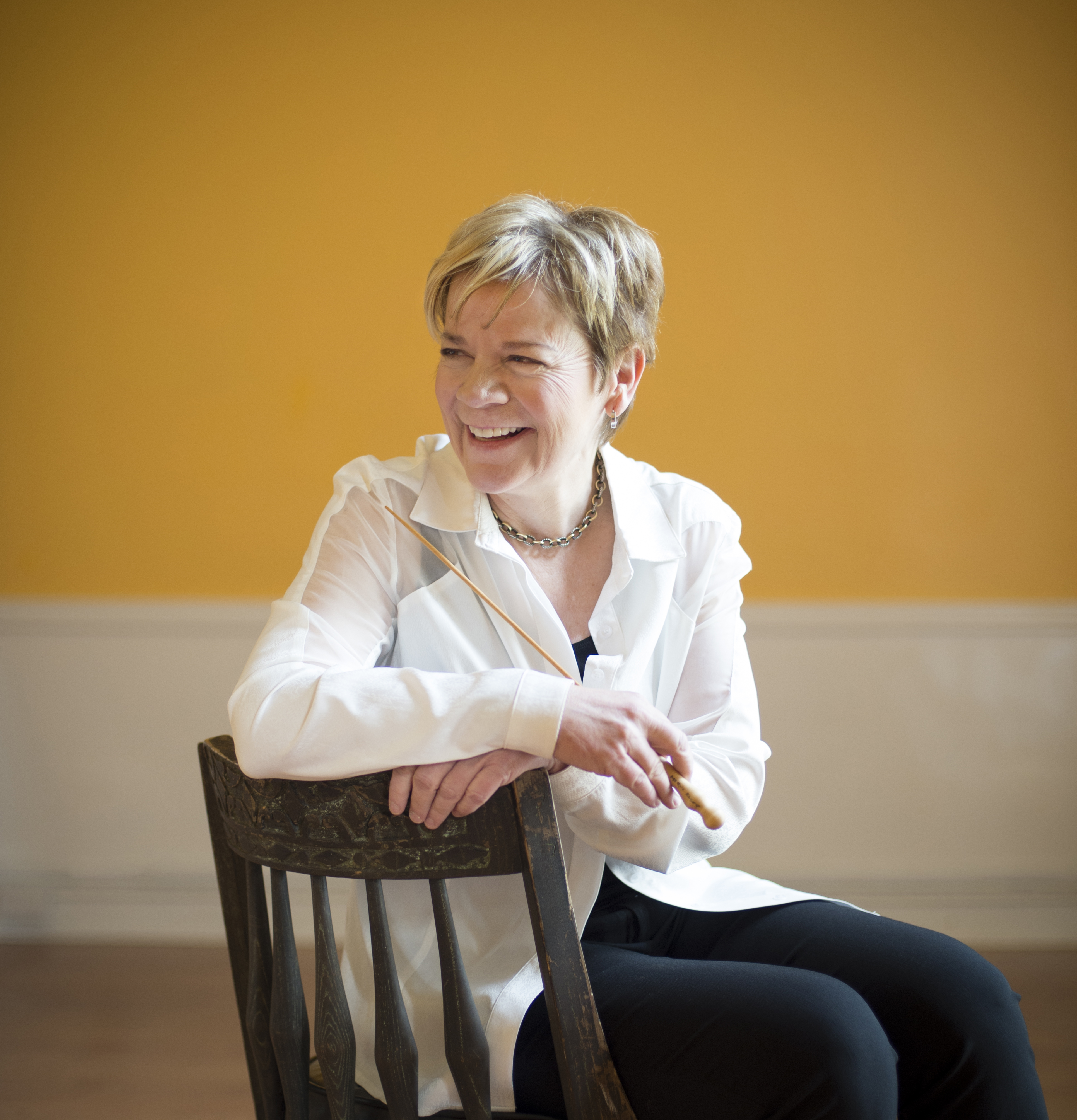
BSO Music Director Marin Alsop
UMBC will host two undergraduate commencement ceremonies on Thursday, May 23. Maestra Marin Alsop, music director for the Baltimore Symphony Orchestra (BSO), will speak in the first ceremony to graduates in UMBC’s College of Arts, Humanities, and Social Sciences; the School of Social Work; and the Erickson School. She will also receive an honorary doctor of fine arts degree.
Alsop has spent her career dedicated to showing how music really does have the power to change lives. As a conductor, educator, and leading advocate for the arts, she inspires musicians to give of their best in performing for all audiences. As a pioneer in a traditionally male-dominated field, she created a fellowship for women conductors in 2002. All 17 of the fellowship’s recipients remain involved in the field and five are now American music directors.
When she was named BSO music director in 2007, Alsop became the first woman conductor of a major American orchestra. She also holds roles as the principal conductor and music director of São Paulo Symphony Orchestra and chief conductor of the ORF Vienna Radio Symphony Orchestra. In September 2013, Alsop made history as the first female conductor of the BBC’s Last Night of the Proms in London and was immediately invited again for 2015.
As a student of the Leonard Bernstein’s, she was awarded the Koussevitzky Conducting Prize and is the only conductor to receive the prestigious MacArthur Fellowship. In 2008 she founded OrchKids, which brings together musicians and youth from some of Baltimore’s most challenged neighborhoods. The program works in partnership with six public schools and has served over 1,000 children.
“I believe the arts are an incredible opportunity, especially for young people, to gain self-esteem,” Alsop has said previously, in The Baltimore Sun. “When you start to see yourself mastering something so complicated [as a musical instrument], then you can see yourself mastering something else.”
“I wish we could reach thousands of kids,” she shared. “There are so many kids who deserve this.”
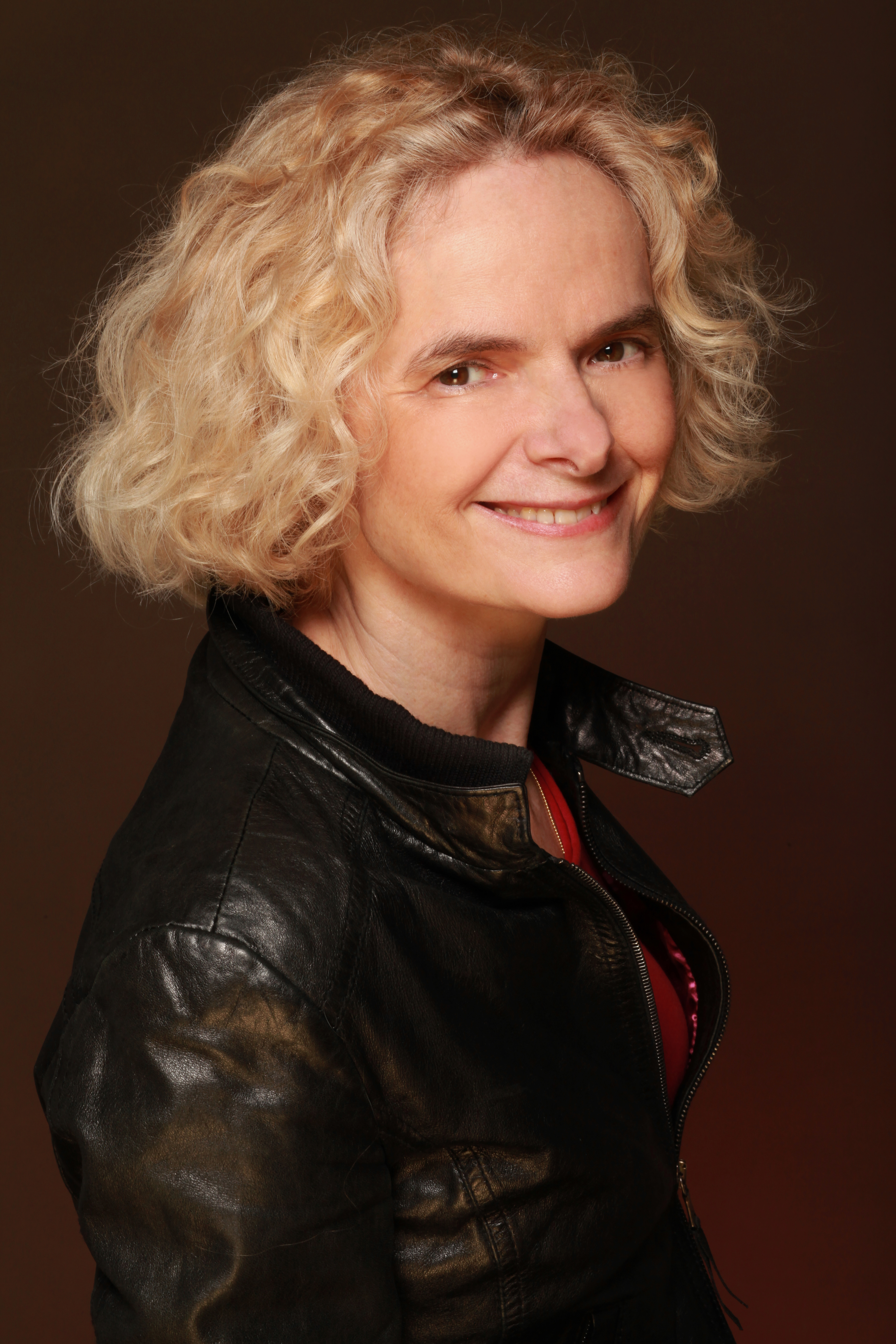
NIDA Director Nora Volkow, a leading addiction researcher
Physician Nora Volkow, director of the National Institute on Drug Abuse (NIDA), will address undergraduates from the College of Natural and Mathematical Sciences, College of Engineering and Information Technology, and interdisciplinary studies during UMBC’s second undergraduate commencement ceremony on May 23.
Volkow became director of NIDA, part of the National Institutes of Health, in May 2003. As the lead funder of world-wide research on the connections between health and drug abuse and addiction, NIDA brings together a wide diversity of scientists who develop and implement solutions for one of the world’s most pressing and urgent public health issues.
Volkow’s own research has been instrumental in demonstrating that drug addiction is a disease of the human brain. Her focus on neurobiology has helped make breakthroughs in other public health issues such as obesity, ADHD, and aging.
Volkow was born in Mexico, earned her medical degree from the National University of Mexico, and carried out her psychiatric residency at New York University. She has taught in the department of psychiatry and was associate dean of the Stony Brook University Renaissance School of Medicine. Prior to her tenure at NIDA she held leadership positions at the Department of Energy’s Brookhaven National Laboratory, including director of nuclear medicine, chairman of the medical department, and associate director for life sciences.
To date, Volkow has published more than 600 scientific articles and edited three books on neuroimaging for mental and addictive disorders. She was elected to the National Academy of Medicine in 2000 and twice has been named one of Time Magazine’s “Top 100 People Who Shape our World.” She will receive an honorary doctor of science degree at the ceremony.
Community members who are not able to attend the ceremonies in person can view them live through thecommencement webcast or follow them on Twitter@UMBC and through#UMBCgrad. Videos of the remarks will also be available online after the ceremonies.
This story was written by Marie Lilly, director of community engagement.
Featured image: BSO Music Director Marin Alsop. Photo by Margot Shulman.
When Angel Badewole ’19, chemical engineering, began as a first-year student at UMBC, it was her first time living apart from her family in Lagos, Nigeria. Early on, she knew her success attending college in another country would depend on finding multiple places to plug in and connect. She would need to find or build a home away from home make it through her four years abroad. Just looking at Badewole’s résumé tells a story of connection. She lists community-building and academic excellence as her two intentional goals. She built a self-made family through Residential Life—“It pulls together people that are so different”—and with the faith-based Bethel Campus Fellowship—“It’s a great place, it has the best connections.” Badewole also discovered a distant aunt who lives in Frederick, who would quickly become her “Maryland mom.”
Angel Badewole, left, and her chemical engineering capstone group project members at a UMBC men’s lacrosse game. Photo courtesy of Angel Badewole.
Badewole’s story resonates with many international students at UMBC. Maybe they heard about the institution through friends of the family, a lucky Google search, or UMBC’s reputation in their field of study. Then, often without having visited the United States, they arrived on campus, determined to make the most of their time here, both in the classroom and through connecting with people. For doctoral students, that time is often much longer than four years.
Finding support in a time of transition
Amrita Anam, Ph.D. ’19, information systems, began her seven years at UMBC in a spring semester, meaning she moved from Bangladesh to Baltimore in January. “What is happening? Is this how I die?” laughs Anam, remembering the chilly weather in those first few weeks of adjustment. She found her welcome in the information systems department, with professor and chair Aryya Gangopadhyay. “When I spoke to Dr. Gangopadhyay, I really liked how warm he was. There was no way I could do this without the support I got from my department.” Sitting now on the patio in front of the campus Starbucks, Anam explains the research interests that drew her to UMBC. “I use social media data, Twitter particularly, and I use it for disaster response, but the interesting thing is that instead of using text analytics, I use signal processing.”
Anam and her teammates made the finals of the 2017 UMBC Hackathon. Photo courtesy of Amrita Anam.
With her background in electrical engineering, Anam wanted to attend a school on the East Coast to be near her sister in New York. She also knew she’d need funding to see her through a Ph.D. program. She found that through her assistantship at UMBC. “If you come here directly to a very tough Ph.D. research scenario, it takes some time to even understand what’s happening,” says the cheerful data scientist. She appreciated that her department understood how to support her during her first months at UMBC. “School is not the same in my country, people are not the same, research is not the same, so I feel like those are the things that I needed some time to cope with,” says Anam.
Amrita Anam in a green space on UMBC’s campus. Photo courtesy of Amrita Anam.
While she was finding her feet in the information systems world, Anam connected with the Indian Student Association, as there was no formal group yet for Bangladeshi students. As the number of Bangladeshi students grew, she co-founded the Bangladesh Student Association to celebrate Bengali holidays, serving up delicious street food and showcasing regional dance styles.
Amrita Anam, right, participates in a dance with the Bangladesh Student Association. Photo courtesy of Amrita Anam.
Anam’s time at UMBC has been fruitful academically and socially, but a personal tragedy recently shook her to her core. Both her parents had always encouraged her to continue pursuing her education, pushing her out of her comfort zone when she needed it. But, as she came close to finishing her Ph.D., her father—“a film director, very artsy, very nerdy”—passed away suddenly.
Amrita Anam’s father, mother, and sister joined her on campus to celebrate her M.S. graduation.
Anam says she felt completely supported by her department during this upheaval and, with their encouragement, was able to finish the degree she had been working so hard to earn for so many years. On a warm spring morning, the day after defending her dissertation, Anam shared, “They’ve seen me grow in all these years, so they were also very proud and happy.” She is now looking forward to her upcoming position at Amazon as a business intelligence engineer.
Keep knocking on doors. It works.
Tobi Odunsi, M.S.’19, cybersecurity, first found himself in Maryland in 2017 for the wedding of his godbrother. He wasn’t originally looking at graduate schools in the United States, but decided to visit the UMBC campus since he was in the area. Interested in cybersecurity, Odunsi met with Toby Gouker, a faculty member in technical management, on a warm summer day. The Tobi-Toby meeting went well. “They didn’t have to do much convincing,” says Odunsi. After digging through the UMBC website, he already knew it would be a good fit. “As soon as I stepped into the school, I knew, ‘I like this.’”
Odunsi, right, troubleshooting a network issue with Tim Boyle, a network engineer in the Division of Information Technology. Photo courtesy of Tobi Odunsi.
Like Badewole, Odunsi is from Lagos, Nigeria, and also found comfort with a faith community near campus, attending Christ Apostolic Church and the International Friends Club. Those connections helped ease his transition, but another key component to his comfort was staying with his godmother until he found a job and a community of friends on campus. “She was my home away from home,” he says.
Odunsi and a group gathered to celebrate Easter with the International Friends Club. Photo courtesy of Tobi Odunsi.
Before coming to UMBC, Odunsi already had a strong interest in The Internet of Things—everyday devices that connect online with users and each other, like the smartphone app that pings your coffee maker to start brewing. Odunsi knew that for his graduate degree, he needed to find an unique niche in the broad field. He eventually decided on software defined networking, an approach to cloud computing. On campus, Odunsi was ready to hit the ground running, and to knock on a lot of doors to find the right opportunity. “It’s better to be prepared for an opportunity when you don’t have it, than for you to have an opportunity and not be prepared for it,” he says.
Tobi Odunsi setting up a next-generation firewall in one of the main data centers on campus. Photo courtesy of Tobi Odunsi.
Before long, Odunsi knocked on just the right door. When he reached Damian Doyle, assistant vice president of enterprise infrastructure in UMBC’s Division of Information Technology and told him about his research interests, Doyle responded, “Wow, we’ve been looking for someone to actually do something like that,” describes Odunsi. “So it’s like, the stars were aligned. And now UMBC is the first school in the University System of Maryland to implement that type of technology in their data center.”
Odunsi with Damian Doyle, right, and Ray Soellner, left, the associate director of telecommunications. Photo courtesy of Tobi Odunsi.
“Damian is a very great guy—his door is always open. There’s no time I’ve tried to schedule a meeting with him that he turned me down. He’s mentored me not just on work, but also given me guidance on how to proceed with my career, family, and likes of that sort,” says Odunsi, who will begin his position as a technology development program associate at Geico after graduation in May. When Odunsi’s mother visited campus and met Dr. Hrabowski, he told her that her son had “a good head on his shoulders,” and she began to tear up. “She was so appreciative of how far I’ve come and the support they’ve given me.”
The office that makes it possible
Odunsi attributes the ease of his academic experience to the team in UMBC’s office of International Education Services (IES). “For international students…you need to always make sure you’re in the right standing,” says Odunsi. “I don’t know if it’s just me, but whenever I go there, it feels like home.” Anam agrees wholeheartedly. “Studies are stressful,” she says, but thanks to IES, “I never have to stress about anything else.” She’s grateful to Michelle Massey, IES associate director, and other IES staff for their dedication to making sure international students can focus on their academic programs rather than spending all of their time worrying about visa paperwork. Haixu Leng, Ph.D. ’19, physics, remembers that Massey was one of the first people to greet him on campus, and to welcome him to the United States. Whenever he thinks about UMBC, he thinks about the helpful and patient team at IES.
A Google search can change everything
Leng owes his time at UMBC to an internet search for quantum optics programs. He was then drawn to UMBC from China because “the UMBC physics department is a relatively small department, in which you can get the attention that you may not get in a very large department. I really liked it.” As Leng settled into the physics department, he found a place in associate professor Matthew Pelton’s lab. There, using a home-built single-particle microscope, he studied the interaction between light and materials at the nanometer scale.
Haixu Leng works in the lab with his advisor Matthew Pelton. Photo by Marlayna Demond ’11 for UMBC.
Over his five years on campus, “the physics building became my favorite place,” says Leng. “It almost felt like home to me.” His other favorite place on campus is the library. There, he formed a friendship with Henan Zhao, a current Ph.D. student in computer science, over long study sessions. They have since married.
Haixu Leng at his PhD candidacy event with Henan Zhao. Photo courtesy of Haixu Leng.
Opening UMBC to the world International students who make their home at UMBC find many ways to continue celebrating their own cultures while taking part in the wealth of communities campus has to offer. It’s a two-way exchange that Badewole appreciates. “There are so many different people here,” says Badewole, “and that’s good in two ways. One, you will find people who are like you in many different respects: a community in your academic area, a community in whatever you believe in, a community in your interests; and two, you get to find a lot of people who are different than you and who you can then learn from.” Odunsi sees the campus’s welcoming atmosphere as a trickle-down effect from the values of UMBC leadership. “There’s this community of international students at UMBC—it keeps growing—and Dr. Hrabowski has been monumental in that effort to bring international students here,” says Odunsi. “He’s opening the school to not just a few set of people, but to the world at large.” Featured imaged: Angel Badewole, right, with friends from Bethel Christian Fellowship. Photo courtesy of Angel Badewole. This article was written by Randianne Leyshon ’09, assistant editor of UMBC Magazine.