Political science professor Tom Schaller’s latest column on Salon dealt with the run-up to the 2012 Republican National Convention in Tampa Bay.
“Republican National Convention: The heart of whiteness” was published on August 27th, and discussed what Schaller characterizes as the Republican Party’s efforts to present itself as a party of diversity to the American public while simultaneously having difficulty earning the votes of women and minorities.
Schaller described the approach as “window dressing,” and noted that such actions were unlikely to translate into a “winning coalition” this November. To Schaller, Mitt Romney’s choice of ultra-conservative Paul Ryan as a running mate and the party’s controversial support of voter ID initiatives which could adversely affect the voting rights of low-income and minority voters demonstrate the superficiality of the convention’s public face.
Schaller concluded the piece by writing that “[l]est a moving speech by Marco Rubio or Susana Martinez fool anyone, understand that Mitt Romney and the Republicans are not trying to unify America, broaden their coalition very much, move to the middle, or traffic in anything like the electoral kumbaya practiced by George W. Bush or Barack Obama in their first bids for the White House. Rather, in these anxious economic times, and despite a new cohort of female and minority politicians, Romney and the GOP hope to grind out a narrow win by building outward from their older, white male voter base. Any window dressing you see at this week’s truncated convention is just that.”
Based on his experiences studying and researching abroad in Morocco during the 2011-2012 academic year, Interdisciplinary Studies major Asif Majid ’13 published his first book at the end of the summer.
Written in two parts, This Moroccan Life pairs an original Brechtian play providing social commentary on Morocco with an extended analysis that connects the play to the academic research and personal experiences that influenced the writing of the play. Taken together, the two parts address issues related to Morocco including migration, transnational identity, human rights, gender, harassment, and the Arab Spring.
Supported by two Undergraduate Research Awards, Majid aims to produce the play on campus in concert with URCAD 2013. Paperback copies of the work can be purchased by clicking here while hardcover copies can be purchased by clicking here. Any inquiries should be addressed to publishers Bisaouraha Books at bisaourahabooks@gmail.com.
Four UMBC alums competed in Major League Lacrosse’s Championship Weekend, held at Harvard University Stadium in Boston, Mass on August 25 and 26, 2012.
Attackman Drew Westervelt is a member of the 2012 champion Chesapeake Bayhawks, while Brendan Mundorf, Peet Poillon and Terry Kimener competed for the runner-up Denver Outlaws. All four former Retrievers finished the 2012 season ranked in the top-20 in the MLL scoring race.
Westervelt played for the Denver squad in his first five years in the league. A Third Team All-American for UMBC in 2007, the Bel Air, Md. native tied for 20th in the league with 33 points and has 209 points (134-69-209) in his six years in MLL.
Mundorf was named 2012 Bud Light MLL Season Most Valuable Player just prior to the championship weekend. He also was named to his second All-MLL Team (2009, 2012) as the attackman finished second in the league with 59 points (32-27-59). Denver’s all-time leading scorer has 206 goals, 100 assists and 306 total points in seven league seasons.
The Mount St. Joseph graduate earned America East Player of the Year honors and All-America citations in 2005 and 2006. He suffered an ankle injury in practice on Friday, did not play in the semifinal victory over Long Island and scored a goal in limited action on Sunday vs. Denver.
Westervelt and Mundorf both represented the victorious United States squad in the 2010 FIL World Championships.
Poillon scored three goals in the Outlaws’ come-from-behind victory over the Lizards, including the game-tying goal early in the fourth quarter. The sharp-shooting midfielder tied for ninth in scoring in 2012 with 40 points (24-13-40) and surpassed the 100-point plateau (75-32-113) in his fifth MLL season in 2012.
The Cranberry Township, Pa. native was a Second Team All-American for UMBC in 2009.
Kimener just completed his most successful of six MLL campaigns, sparking Denver with 17 goals and 18 assists for 36 total points from his midfield position. The Oakton, Va. native earned three All-America citations at UMBC in 2006, 2007, and 2008.
A UMBC lacrosse alumnus has been named to the Federation of International Lacrosse (FIL) All-World team. Brendan Mundorf ’06, sociology, scored two goals against Canada in the FIL championship game, and scored a total of 17 goals in the six-game tournament. Team USA earned the World Lacrosse title.
Mundorf had the fourth most productive freshman season in the history of UMBC’s Division I lacrosse history. He also received All City-County honors from the Baltimore Sun during his senior season.
Drew Westervelt ’09, interdisciplinary studies, who is also a former member of the UMBC lacrosse team, scored 12 goals in six games with Team USA. Westervelt is a Baltimore Sun All Metro selection, and was co-player of the year in Harford County in 2003.
It’s absolutely fantastic, said Don Zimmerman, head coach of the men’s lacrosse program. It is one thing to have one player to represent UMBC on a national team, but have two is extraordinary. I couldn’t ask for two better alums to represent us. When they were here they were leaders. They had great attitudes and worked hard.
Mundorf and Westervelt, who currently play for the Denver Outlaws, will compete for a Major Lacrosse League title this month.
Missouri representative Todd Akin’s claims regarding “legitimate rape” served as the inspiration for political science professor Tom Schaller’s latest column inThe Baltimore Sun.
In “Todd Akin rape claim is just the tip of the GOP wacko iceberg,” published August 21st, Schaller noted that regardless of how offensive and strange the views of the embattled Missouri senatorial candidate are, they are not so atypical when compared with other views held by far right politicians regarding sex, contraception, abortion, feminism, economic policy, climate change and race.
Schaller concluded the column by making note of Akin’s support for repealing the 17th Amendement, which allows for the direct election of candidates to the United States Senate by popular vote:
“If we followed their reckless advice, imagine what cohort of crazy House Republicans might be appointed by their state legislatures to the Senate — the chamber our founders designed to serve as the saucer to cool the hot passions of the House. Or don’t. Just thinking about it may drive you crazy.”
UMBC embraces the potential of all students to become innovative problem solvers, resource creators and boundary busters in their fields. Matching students with opportunities to learn through practice is one key way the Shriver Center helps them realize that potential.
This summer, nearly 700 UMBC students enrolled in the Shriver Center’s internship, co-op and research practica at sites across the United States. These experiences go beyond on-the-job skills training. They enable our students to articulate their passions, envision their futures, and break ground on unique professional paths—all while making a visible impact, whether they are at the White House or a Baltimore hospital.
Research Program Coordinator Carly Hunt of Johns Hopkins Bayview Medical Center writes, “Over the past several years, UMBC interns have contributed immensely to our research on psychological and psychosocial recovery following severe burn injury.”
In a 2012 Shriver Center survey, approximately 90% of respondents said that their placement increased the clarity of their career goals, their self-confidence and their ability to make decisions—essential qualities for effective agents of change in any field. Further, 77% wrote that their leadership skills improved as a direct result of their internship, co-op, or research experience.
UMBC students have applied this leadership in an incredibly diverse range of ways. They have worked with non-profits to lead community service initiatives and spread their organizations’ reach through media campaigns. They have made companies more efficient and effective at serving clients and have offered fresh insight on scientific research. They have broken down preconceptions and cultivated new partnerships.
Timothy Potteiger ’14, computer engineering, writes that his White House internship program “really adopted an entrepreneurial mindset encouraging everyone on the team to be proactive.” He was thrilled to hit the ground running and meet the office’s high expectations.
This is gratifying news for Christine Routzahn, Director of Professional Practice at the Shriver Center. Routzahn says, “Our goal is that all UMBC students engage in applied learning and graduate with the knowledge and experience they need to find empowerment and success in their careers.”
Here we feature student interns from across UMBC who are making tangible impacts on their fields and the world.
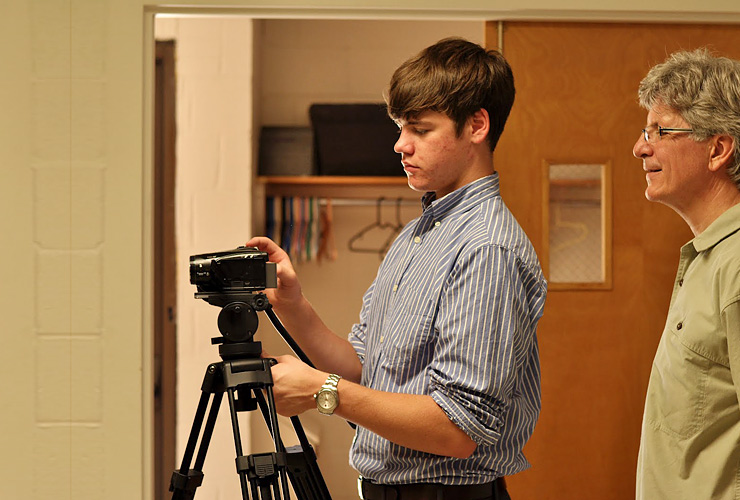
Michael Lofthus
Media and Multimedia Specialist Intern, American Friends Service Committee
Media and Communications Studies, Spring 2013
Lofthus worked as a media and multimedia specialist intern for AFSC, a non-profit committed to upholding principles of social justice, nonviolence and humanitarianism in the U.S. and abroad. He generated story ideas and developed and edited content for multimedia projects, outreach events, digital media and print materials, highlighting civil rights learning and youth empowerment programs in Baltimore and Washington D.C.
My experience has taught me never underestimate the power of the individual in a collective effort. With a little direction from the right people, any skill or talent can be harnessed to influence movements on a tremendous scale. In the presence of those who are passionate about their work, anything is possible.
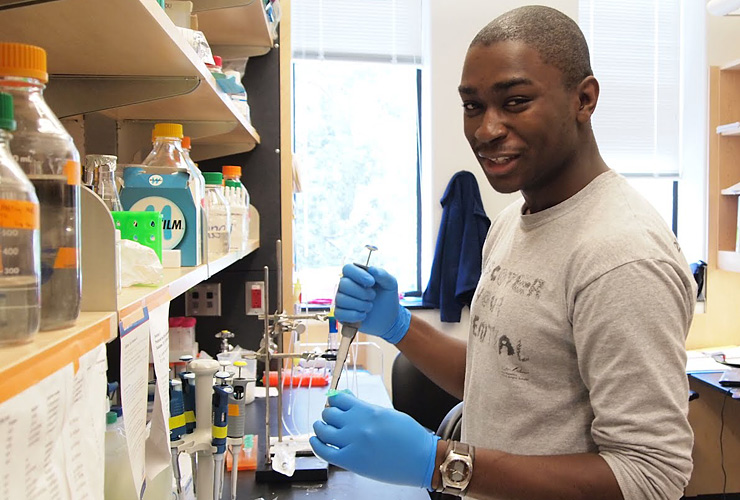
Felix O. Nwogbo, Jr.
Summer Research Intern, Duke University
Biochemistry and Molecular Biology, Spring 2013
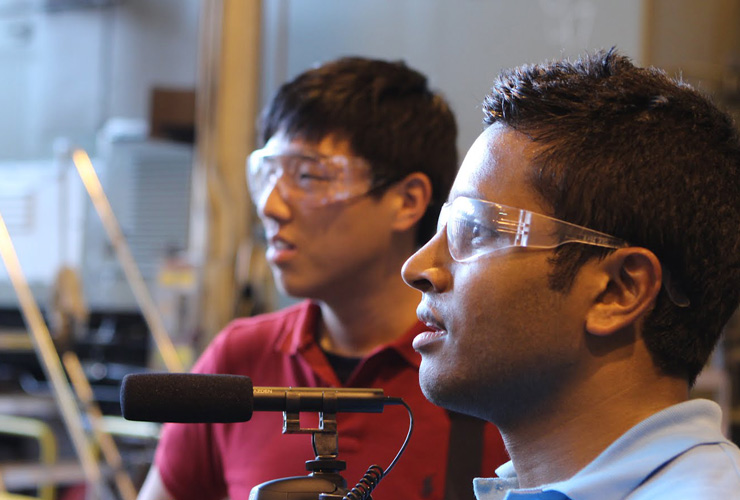
Nwogbo conducted basic science research in the biochemistry lab of Dr. Richard Brennan through Duke Universitys Summer Research Opportunity Program. In addition to learning about structural biology and research protocols, Nwogbo developed problem-solving strategies and new ways of thinking as a laboratory scientist.
Ive learned that experiments dont always go according to plan and you must be able to ask the right questions to figure out what is going on. The work Im doing is basic science, but in the long run it has great potential to become translational research and help millions deal with chronic infections.
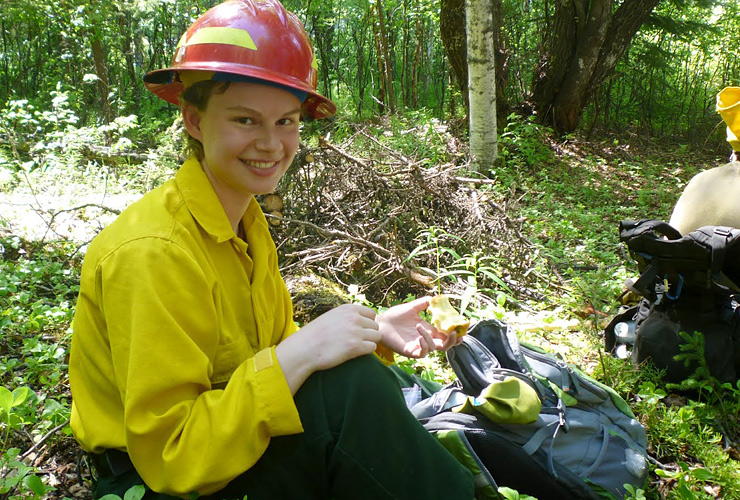
Molissa Udevitz
Squad Leader Intern, Alaska Department of Natural Resources Division of Forestry
Environmental Studies and Dance, Spring 2015
Based in Palmer, Alaska, Udevitz supervised a team of interns in the fieldsurveying and removing invasive plants, making a trail handicap accessible, and restoring stream banks to improve salmon access to spawning grounds. Udevitz also became wildland firefighter certified and collaborated with natural resource management professionals on other projects.
Before this summer, I knew I wanted to help solve the environmental challenges our world faces, but these problems often seem insurmountable. Ive realized that I dont need to come up with a grand solution; I can join this network of people working to protect the environment, and our individual projects combined will have a large, positive impact.
Samantha Hawkins
Intern, National Geographic Society
Anthropology and Interdisciplinary Studies, Spring 2014
As an intern with the Image Collection at National Geographic, Hawkins researched, labeled and catalogued images in preparation for online and print publication. She was challenged with the task of identifying people, locations and animal species from all regions of the world and all eras of history. Her detail-focused research has enabled National Geographic to share with the public powerful photographs that she hopes will inspire people to care more deeply for the world around them.
Ive always loved the idea of changing the world; Ive just never known how or really known anyone that has. My time at National Geographic has changed this perspective entirely. Every day I work with individuals whose mission is to inform others about our planet. Ive learned that every little bit of work helps and that making an impact doesnt come easily. It may take a lot of perseverance and a little luck, but it certainly is possible.
Joshua Kurikeshu
Project Lead Intern, General Electric
Information Systems and Visual Arts, Fall 2012
Kurikeshu interned at GE through the companys Information Technology Leadership Program, where he designed an automated self-service solution for GEs Active Directory group management. His work will help the company operate more efficiently and with greater security, and it will impact all seven GE divisions, from Aviation to Healthcare.
One of the greatest lessons Ive learned was how to take initiative. The ITLP internship has given me the ability to identify a problem and be the change to better the environment around me. It has also taught me how to use my most vital resourcepeople. I now know how networking can shape how much you can learn. The more you network, the more you learn, and the more you can impact the world.
Jennie Williams
Summer Serve Assistant Coordinator and Counselor, United Way of Frederick County
American Studies, Spring 2014
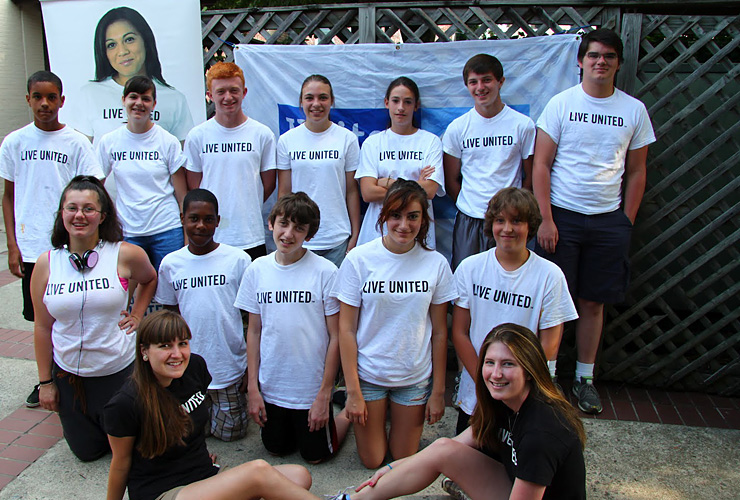
Williams served as an assistant coordinator and counselor for United Way of Frederick Countys new Summer Serve program. There she created opportunities for teen volunteers to do service work through non-profit partnerships and guided them through reflection on their service experiences.
I have contributed to projects that fight for issues I am passionate about: poverty, homelessness, womens health and hunger. Through this internship I have now also met the men and women who are responsible for creating organizations devoted to those causes.
Fahad Zafar
Software Engineer, Google
Computer Science (Ph.D.), Fall 2014
Working at the Googleplex in Mountain View, California was an eye-opening experience for Zafar, who assisted the YouTube editor team with developing new video effects and integrating an external code source into their platform. His tasks ranged from helping to solve large data problems to navigating the subtleties of visual presentation.
Understanding the development life-cycle of software used by millions of peoplewatching all the pieces that solve complex problems come togetherwas truly an unforgettable experience. Working at a company with such a large user base has changed my perspective on practical software development.
Paulette Mensah
Research Assistant, Hopkins Center for Health Disparity Solutions
Health Administration and Policy, Fall 2012
Mensahs work at the Johns Hopkins Bloomberg School of Public Health focused on inputting and analyzing data for the Cultural Quality Collaborative. Through surveys of staff and patients, the CQC assesses the cultural competency of participating hospitals with the goal of alleviating health disparities. Through this placement, Mensah also attended the International Conference on the Health of the African Diaspora.
I have always been interested in serving minority and limited English proficiency populations, and now I am. When hospitals improve their level of cultural competency, they improve healthcare delivery for their patients and the work environment for their employees. The analysis I have done is already making a difference.
Andres Camacho
Agent of Change, greeNEWit
Interdisciplinary Studies, Spring 2014
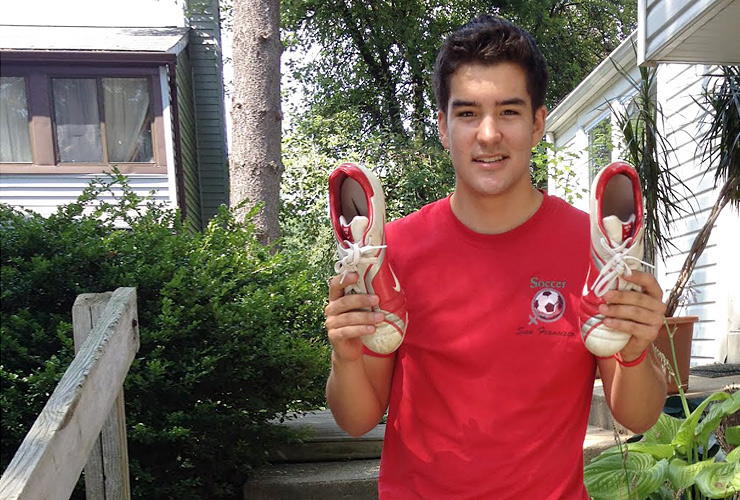
Camacho worked with greeNEWitan energy solutions firm that seeks to reduce energy consumption and promote sustainabilityto help launch the Cleats for Bare Feet and OUR Schools social initiatives. Cleats for Bare Feet collects second-hand athletic shoes and sporting equipment for distribution to children around the globe, from the U.S. to Haiti to Ethiopia. OUR Schools educates K-12 students about their power to influence environmental sustainability.
When you see the smile on the face of an orphaned boy from Ethiopia, when he tries on his new pair of soccer cleats, or you get a third grade class excited about sustainability, it really puts your work into context.
Kelly Pham
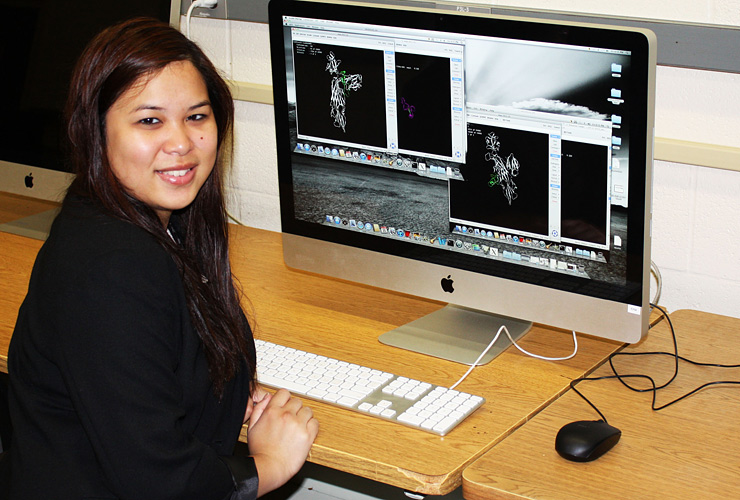
Undergraduate Researcher, Duquesne University Center for Computational Sciences
Biochemistry, Spring 2014
As a computational chemistry researcher, Pham spent her summer running computer simulations to study phenomena that cant be easily observed experimentally. Pham worked with Dr. Jeffry Madura, a pioneer in developing computational chemistry software to study the structure and function of proteins interacting with surfaces, among other topics. Her work has applications in cholera treatment.
I have enjoyed working with my mentor, Dr. Madura. He is not only a leader in computational chemistry, but he also plays an innovative role in developing programs to further his research. Ive learned from him that research is a long, arduous process but its also enjoyable when we take pride in our small, daily accomplishments.
Collin Wojciechowski
Project Manager, Baltimore Partnership for College Access and Success
Political Science and Media and Communication Studies, Spring 2013
The Baltimore Partnership for College Access and Success is a new non-profit, sponsored by the Greater Baltimore Urban League, that places college students as paid mentors in Baltimore City Middle Schools. As project manager, Wojciechowski was responsible for drafting the organizations Strategic Plan, outlining its current operations and its funding and outreach goals for the next decade.
This opportunity to do long-term planning for an organization with the potential to have a positive statewide impact has been exhilarating. Because this plan is in place, the BPCAS will now have a stronger, more concrete structure that will help them to bring in more funding and expand their reach. When that happens, more students will be mentored, meaning college attendance will go up, crime will go down, and Maryland will be that much stronger.
Megan Pejsa
Research Assistant, Johns Hopkins Bayview Medical Center
Psychology, Spring 2013
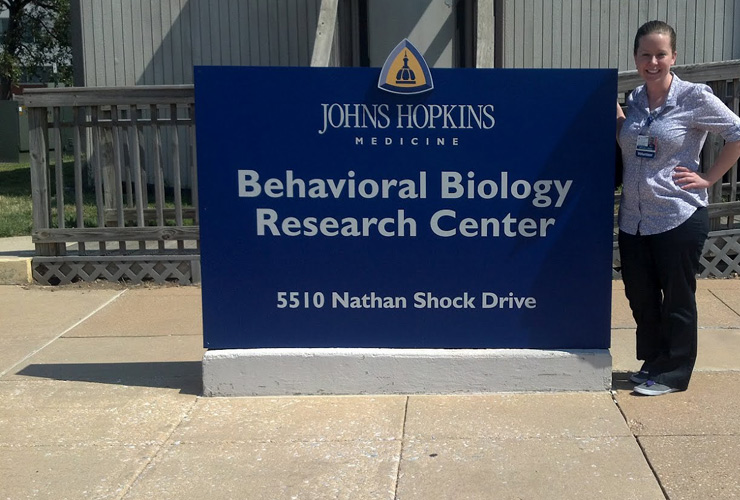
As a research assistant in the burn unit at Johns Hopkins Bayview, Pejsa completed clinical interviews with patients to assess how they were coping in the months following their hospital treatment and discharge. She assessed anxiety-related symptoms at one, six, twelve and 24 months following their burn injury.
The general public may only recognize PTSD in conjunction with veterans of war, but others also experience this anxiety disorder. The raw data I collected will be used to improve interventions for people at-risk of developing PTSD following a severe burn injury so that they have an overall better quality of life.
At the Annual Meeting of the National Association of Emergency Medical Services (EMS) Educators (NAEMSE), held on August 8, 2012, at the Walt Disney World Coronado Springs Resort in Orland, Florida, Bruce J. Walz, PhD, received the Lifetime Achievement Award. Dr. Walz is professor and chair of the Department of Emergency Health Services.
The Lifetime Achievement Award is a special award selected and approved by the NAEMSE Board of Directors to recognize a member who has made a significant long-term contribution to NAEMSE and the larger EMS community.
Dr. Walz is a charter member of NAEMSE and a past president. He has served on various committees and with numerous association projects. Most notably, he represented NAEMSE and EMS educators in general as legislative liaison and as president and a board member of Advocates for EMS. He was involved with the development of the National EMS Education Standards and currently serves on the NAEMSE Governance Committee. He is a contributing author to the association’s principle publication, Foundations of Education: An EMS Approach. He is frequently called upon to represent NAEMSE at federal and national association meetings in the Washington, DC area.
On August 15, The Baltimore Sun‘s free weekly B published a “Baltimore College Guide”, in which students from area universities provided insights into their schools. UMBC student Kate Godwin ’13, media and communications studies, discussed a number of on-campus and off-campus highlights and offered some advice to incoming students to help them navigate the school year successfully.
Godwin recommended Atwater’s for off-campus wi-fi and quality chai tea; Patapsco Valley State Park for a chance to get outside for a weekend or day trip for some hiking and any other physical activity; the annual QuadMania event for students; and the upper floors of the Albin O. Kuhn Library & Gallery for some quiet study time, along with “the best hot chocolate on campus” from the ground-floor cafe.
Godwin recommended that incoling students “[d]evelop a good dialogue with your adviser” and to use on-campus resources like the Shriver Center to obtain rewarding internships. The senior also said that classes she would recommend included those in communications, gender and womens studies and American studies, which she felt had a large degree of personal relevance to her own life.
What’s largely unknown to many Americans is who is left out of the safety net, said Cheryl Camillo, a senior researcher at Mathematica Policy Research. “A huge chunk of the populace is not covered, even by Medicaid,” she said.
Cheryl is a senior researcher at Mathematica Policy Research.
If youre new to UMBC, we hope our new homepage will show you what our university is all about. If, on the other hand, www.umbc.edu is one of your old favorites the new homepage preserves the features our research showed you loved, like easy access to myUMBC and the directory.
The new homepage also adds enhanced features to better help you find campus resources, stay informed about news and events and, generally, make the most of your time at UMBC.
You can take a brief, guided tour of the new homepage below. Here are a few of the principles youll see at work:
1. Homepages are no longer gatekeepers, but storytellers. People increasingly navigate the web by search. So, while its still important that information be clearly laid out, something thats more than a click or two away isnt necessarily hidden. And a homepage, rather than just serving as a map to information, should tell the story of a place. We hope ours does.
2. You matter. The new homepage provides content tailored for certain audiences, recognizing that not everybody is looking for the same thing. Personalized is the way of the web. So, weve introduced content tabs that let you see whats most relevant to you, whether youre a prospective student, current student, parent or family member, faculty or staff member, alum or supporter, business or employer.
3. We needed a friendlier site. Mobile-friendly that is. The new homepage is designed to play nice with just about any device from a desktop or laptop to a tablet or smart phone. This recognizes what we have heard repeatedly from experts on and off campus: mobile is the new normal.
We hope youll love the new homepage, but you might still be wondering, Why now?
First, you should know that the new homepage is one step in a broad, multi-year process to overhaul UMBCs web presence, thinking critically and strategically about how and what we do. Faculty, staff, students and alumni have been involved in a number of discussions about how to improve our web experience, and those conversations will continue.
However, members of the UMBC community and, especially, campus experts advised us of a number of improvements important to make now. Our marketing and recruitment efforts demand a cutting edge homepage, and the innovation and expertise of our faculty in the computer science, information technology and visual design fields further raise the bar. In the constantly evolving environment of the web, we simply cant stand still.
Of course, this is a work in progress. So, if theres something different youd like to see, let us know at homepage@umbc.edu. Likewise, if you love something, let us know too. We hope that the guided tour below will answer most of the questions you have about how to navigate the new homepage, but well keep an eye out for frequently asked questions and provide updates as needed. And we will be paying attention to your broader feedback, although we may not be able to respond personally to every note.
Again, this is just the first step in what will be a multi-year process, and your feedback is not only valued, but crucial.
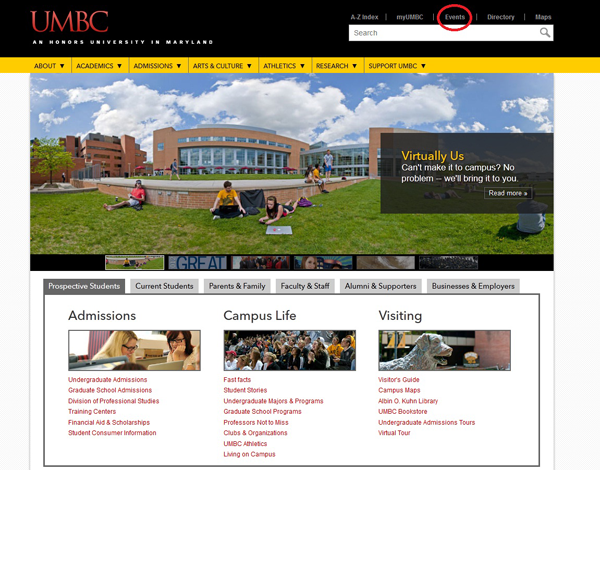
There are three primary ways to navigate from the new homepage into the rest of the UMBC website (see red arrows): The search function and directory bar The top level navigation, with dropdown menus The new audience-specific sections, with content for prospective students, current students, parents & family, faculty & staff, alumni & supporters, and businesses & employers
Looking for myUMBC? Youll find it in a number of places (see red circles): Above the search function, in the directory bar In the Current Student and Faculty & Staff audience sections, under Top Tools
Looking for news & events? Youll find them just below the new audience section.
Events can also be found above the search bar, in the directory bar (see red circle).
Amy Froide, Associate Professor of History and Director of UMBC’s Entrepreneurship & Innovation Minor, was invited to give two talks on her current book project, “The Silent Partners of Britain’s Financial Revolution: Women as Investors in Public Stocks, c. 1690-1750,” over the summer.
She presented her research to the History Department at Princeton University in May and the European Women’s History Seminar at the University of London in June.
Republican presidential nominee Mitt Romney’s pick of controversial Wisconsin Congressman Paul Ryan as his running mate is the subject of Tom Schaller’s latest Salon column, “Ryan pick in 5 easy steps.”
The political science professor explores what Romney’s VP selection means for the election and the GOP’s feature, starting with the arguments that Romney is playing it safe with the nomination and “the Romney camp clearly believes that a base-mobilizing strategy, rather than a swing voter-conversion strategy, is its best chance to win the White House.”
Schaller also argues that Ryan’s selection is further evidence the national GOP has become a “House-dominated party” as opposed to a presidential-oriented one. This “congressionalization of the Republican Party” is the topic of his forthcoming book from Yale University Press.







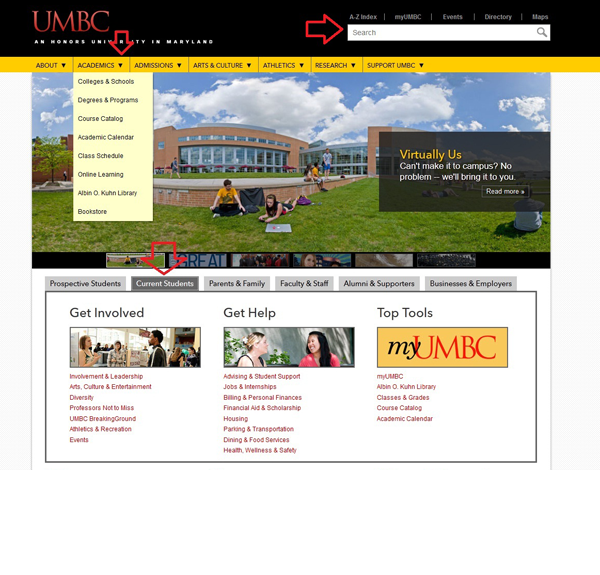 There are three primary ways to navigate from the new homepage into the rest of the UMBC website (see red arrows):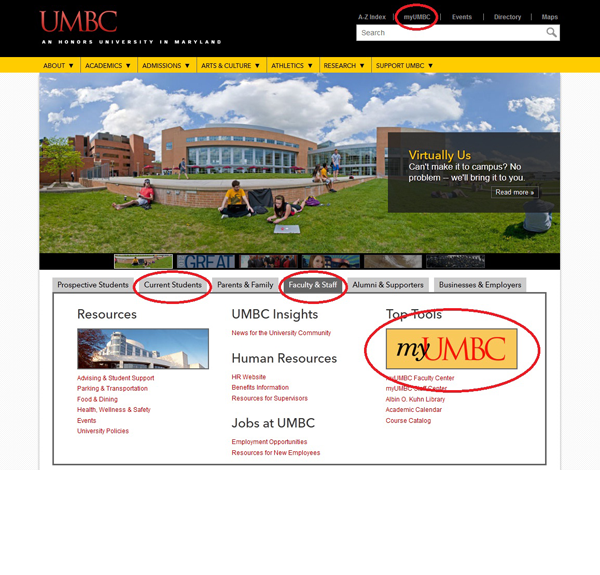
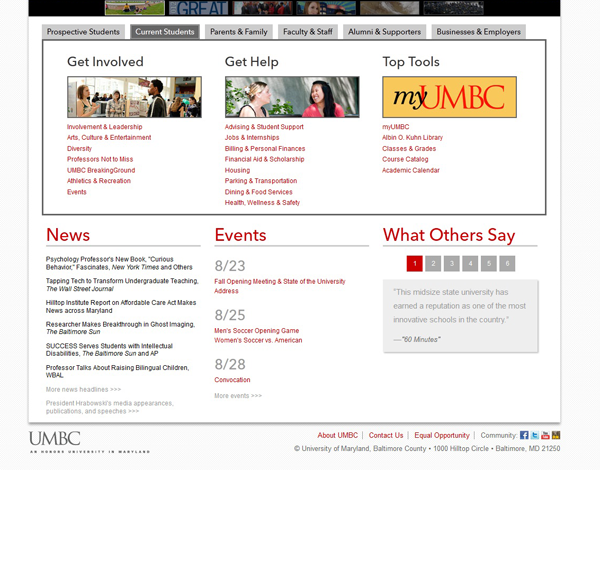 Looking for news & events? Youll find them just below the new audience section.