



Public Policy Ph.D. student John Olszewski has been named one of the Daily Record’s “20 in their twenties.” The list honors Maryland’s up-and–comers who are successful by or before the age of 30 based on their professional accomplishments, civic involvement and impact of achievement. John is a member of the Maryland House of Delegates, representing District 6 in Baltimore County. He also leads the 21-member Baltimore County Delegation in the House of Delegates as its Chairman—the youngest ever to be elected to that position.
All posts by: UMBC News Staff
John Winder ’12, on NPR’s “This I Believe” Website
John Winder ’12, computer science, has an essay posted on NPR’s “This I Believe” website. Winder’s essay details how an embarrassing experience led him to the belief that “we can either take command of our mistakes, or let them command us.”
“I realized I had already screwed up as bad as anyone could, undermining an easy victory, looking like a fool to the world. If I tried again, how could I do any worse? Knowing that, I relinquished my fears,” he writes.
His full essay can be read here.
Anne Rubin, History, and Tom Beck, Library Gallery, to Discuss Civil War Photographs (4/17)
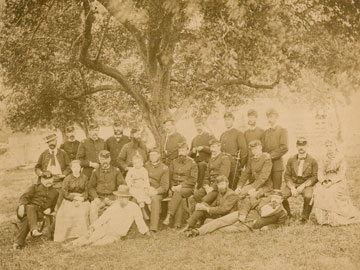 On April 17, Anne Rubin, associate professor of history, and Tom Beck, chief curator of the Albin O. Kuhn Library & Gallery and affiliate associate professor, visual arts, will discuss the gallery’s current exhibition, “The Photographer’s Eye: Civil War Photographs Selected from the UMBC Photography Collections.”
Rubin will discuss “Myth, Memory, and the American Civil War,” while Beck will speak about “Civil War Photography as Art and Historical Evidence.” Their talk will take place at 4 p.m. in the Library Gallery.
The American Civil War coincided with the early years of photography, and the images captured by the early practitioners of this art have helped to shape the memories of this central historical event. Technological limitations, artistic aspirations and societal expectations strongly impacted the images produced by photographers “documenting” the events of the Civil War. This exhibition explores the art and artifice of Civil War photography, while revealing something about why each of the selected 81 images was produced. The exhibit runs through May 31.
The discussion is sponsored by the Library Gallery and the Department of History
URCAD: Behind the Research
URCAD: Behind the Research
Diane Lee, Dean of Undergraduate Research, on URCAD:
Madeline Hall ’12, Geography and Environmental Systems, on Concept Maps
Charles Mason ’12, Graphic Design and Philosophy, on Education
Charles Mason ’12, Graphic Design and Philosophy, on Inspiration
Catherine Pasqualoni ’12, Ancient Studies, on Setbacks
Catherine Pasqualoni ’12, Ancient Studies, on URCAD
Macy Bokhari ’13, Political Science, on Grad School
Macy Bokhari ’13, Political Science, on Women’s Rights in Saudi Arabia
Macy Bokhari ’13, Political Science, on Media
(4/13/12)
Craig Saper, LLC, to Discuss “Digital Legacies”
Craig Saper, associate professor of language, literacy and culture, will participate in “Digital Legacies of the Avant-Garde,” a two-day international conference that examines the continuing influence of avant-garde concepts and practices on contemporary digital culture. The conference will be held in the New School in New York on April 20.
Saper will participate in a panel entitled “The Legacy of the AvantGarde between Generative Art and Networked Art.”
CWIT Springs Into Leadership
Last week the Center for Women in Information Technology (CWIT) held their second annual “Spring into Leadership,” event.
The event which is designed to provide networking opportunities to women majoring in engineering or information technology had 120 registrants up 23 registrants from last year. Registrants included students as well as 25 Industry professionals from Northrop Grumman, Lockheed Martin, Harris Corporation, NSA, BAE Systems, UserWorks, JHU/APL, CyberPoint International, General Electric’s Middle River Aircraft Systems, and AAI.
Wendy Martin, a vice president at Harris Corporation, gave the keynote address focusing on her story and the importance of diversity for organizational success. “The fact that you are different from your peers should not be something you shy away from or something that you shield from others. It’s a gift, especially in the workplace,” she emphasized to the women majoring in engineering and IT at the event.
Following the keynote the participants were split into networking pairs and then groups.
“By all accounts the event this year was a tremendous success because of the teamwork of the student planning committee,” says Susan Martin, Associate Director of CWIT. “This event really contributes to the sense of community among women in the College of Engineering and Information Technology.”
Spring into Leadership was made possible with support from Lockheed Martin Corporation, the 2011-2012 sponsor of the CWIT Affiliates Program, the UMBC Student Government Association, and the UMBC Graduate Student Association. The program was implemented by student leaders from the CWIT Student Council, the Information Systems Council of Majors (ISCOM) the student chapters of the Society of Women Engineers (SWE) and the American Society of Mechanical Engineers (ASME), and the Women in Science and Engineering (WISE) graduate student organization.
Sara Patenaude ’11 Wins Arnold Prize
Sara Patenaude ’11 M.A., historical studies, has won the Arnold Prize for Outstanding Writing on Baltimore’s History.
The Arnold Prize is named for Joseph L. Arnold, a professor of history at UMBC who died in 2004. He was a vital and important member of the faculty for three and a half decades, as well as a leading historian of urban and planning history. He also played an active and often leading role with a variety of private and public historical institutions in the Baltimore area, and at his death was hailed as the “dean of Baltimore historians.” The Arnold Prize rewards outstanding research on Baltimore history.
Patenaude’s essay, entitled “Playing Fair: The Fight for Interracial Athletics in Baltimore,” is a chapter from her master’s thesis at UMBC. The prize, which comes with a $500 award, is presented by the Baltimore City Historical Society.
President Hrabowski and COEIT in PRISM
In the March 2012 issue of PRISM, the flagship publication for the American Society for Engineering Education profiled UMBC’s President, Freeman Hrabowski.
“He just knows the path so many of the students have taken,” PRISM quoted Warren DeVries, dean of UMBC’s College of Engineering and Information Technology. “He seems to have everybody’s curriculum and progress in the back of his mind.”
PRISM interviewed a former COEIT student too:
“He’s always pushing us to be able to talk about what we did,” says Malcolm Taylor, who graduated in 2008 with a bachelor’s in computer engineering and is now in his third year pursuing a Ph.D. in electrical and computer engineering at Carnegie Mellon.”
“Taylor, a recent National Science Foundation Graduate Research Fellowship winner who is working with GM on safe and secure hardware systems for cars,” writes PRISM, “says he chose UMBC over other universities because of the community and support system it offered. Taylor was a member of the Meyerhoff Scholars Program, a signature UMBC initiative focused on helping high-achieving students, especially minorities, become leaders in science and engineering by preparing them to earn Ph.D.’s in the STEM
fields.”
Jen Dress and Lee Calizo, Student Life, Honored by ACPA
Jen Dress, assistant director of Student Life was honored at the national convention of ACPA College Educators International with the Commission for Student Involvement’s Outstanding Mid-Level Professional Award.
Dr. Lee Calizo, director of Student Life was honored at the national convention of ACPA College Educators International, with the Standing Committee for Women’s Research and Scholarship Award.
Christopher Corbett, English, to Speak at City Lit Festival
Christopher Corbett, professor of the practice of English, will give a talk at Baltimore’s City Lit festival on Saturday, April 14.
Corbett will join author Arthur Magida to discuss “Literary Necromancy: The Art of Writing Biography.” The two authors, and moderator Evan Balkan, will explore the art of writing biography, how subjects are chosen, and why writers delve into the lives of often not-so-well known figures.
Their talk will take place at 11 a.m. in the Central Library’s fine arts department. The Central Library is located at 400 Cathedral Street, Baltimore. For more information, visit the City Lit Project.
Ellen Handler Spitz, Honors College, in the New Republic
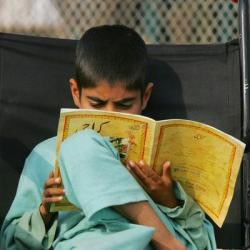 This month, Ellen Handler Spitz’s children’s literature column in The New Republic discusses two books from India as the honors college professor of visual arts examines The Enigma of Karma by Raja Mohanty and Folk Tales of Uttarakhand by Deepa Agarwal.
“As twenty-first century juggernauts of globalization and technology ride roughshod over regional cultures, there is a risk that precious legacies—oral, visual, and dramatic—are being lost. How will we preserve local customs, idiosyncratic habits of speech and dialect, humor, folklore, imagery, symbols, and artistic techniques—all with their concomitant wisdom? Sensitive editors of children’s books are grappling with these questions,” Spitz writes. “India may serve as an instructive guide.”
Spitz discusses these issues as they relate to these two very different but equally impressive children’s books in her essay “For Midnight’s Children.” The piece appeared in The New Republic on April 4.
Seth Sawyers ’99 in The Millions
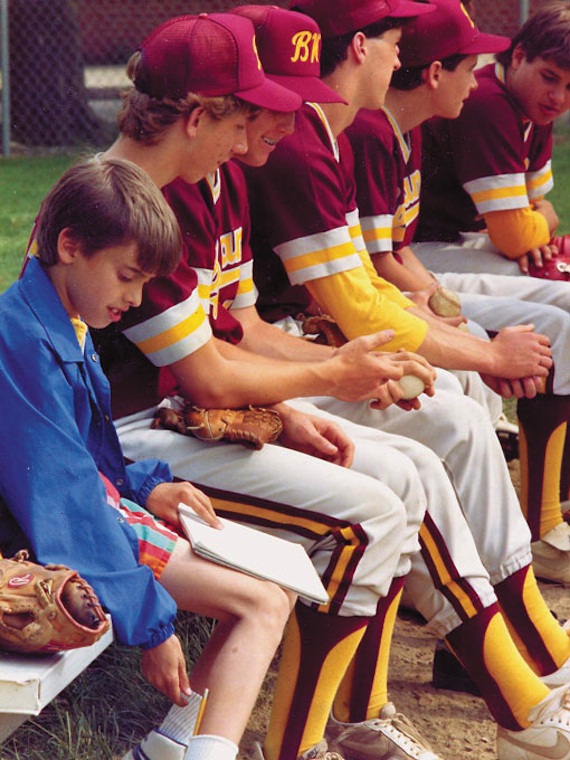 Seth Sawyers ’99, history, and adjunct faculty in English, has a new essay in the online literary magazine The Millions.
This essay, which is a chapter is from his recently completed memoir about growing up in the hills of western Maryland, is entitled “Baseball, Finally.” It appeared on the website on April 4.
“….I can still feel the rhythm of the infield drill. I did thousands of them, the movements deep inside me like the steps of a dance, like the bass lines to certain Beatles’ songs.I loved turning double plays, taking the throw from third or from short, quickly hopping backward off the bag and, in the same motion, flinging a sidearm shot to first. It was the only dance I was ever any good at,” he writes.
“…we would never again, it turns out, be quite so free, quite as on the edge of something as beautiful and deep, and strange. Way out ahead of us was the unknowable everything, but just within reach was seven innings of baseball, a game we knew better than maybe anything else in the world.”