All posts by: UMBC News Staff


New mentoring program connects refugee youth in Baltimore with opportunities to pursue a college education

A new college access mentoring program for refugees in Baltimore has demonstrated tremendous success in its first year, with all of the graduating seniors in the program accepted into college.

College JUMP (Journey Upward Mentoring Program) started last year through the Baltimore City Community College (BCCC) Refugee Youth Project (RYP) in partnership with The Shriver Center at UMBC. RYP operates a series of programs that work with refugee youth in Baltimore City and County.

Christina Smith ’15, global studies, Sondheim Public Affairs Scholar and Honors College member, serves as the coordinator for the program as UMBC’s Maryland-DC Campus Compact (MDCCC) AmeriCorps VISTA. She says the goal is to work with 11th and 12th grade refugee students to provide a near-peer college access mentoring program.

College JUMP has three areas of focus: college exploration, applying to college, and college preparation. Each refugee student in the program is paired with an undergraduate college student who works closely with them to provide resources and assistance throughout the college application process. College JUMP has a team of four undergraduate students who serve as mentor leaders.

“We want to make sure students start that first day of college feeling prepared for success,” explains Smith.

Francine Mukobwajana graduated from Western High School earlier this year and is starting at UMBC in the fall as a biochemistry major. She participated in the program last year and was mentored by Asma Qaiyumi ’17, biology and psychology.

“UMBC was my first choice,” shares Mukobwajana. “Asma helped me a lot. I moved here in 2014, so everything was new to me, but I really appreciated working with Asma.”

Mukobwajana says Qaiyumi helped her by identifying scholarships, senior year activities, and navigating the college application process. Part of College JUMP also included a campus visit to UMBC.

“A big part of the preparation is seeing a campus and seeing students going to class, events, and leading tours,” says Qaiyumi. “All of that is important for students like Francine to know.”

The origins of College JUMP are traced back to when Jodi Kelber-Kaye, associate director of the Honors College, received a BreakingGround grant to partner with community organizations for her race, poverty, and gender in Baltimore seminar. In 2013, her class worked with the International Rescue Committee (IRC) to create a proposal for encouraging refugee families to remain residents of Baltimore City past their initial resettlement period. After the director of the IRC asked about creating a college mentoring program for refugee youth, her 2014 seminar students partnered with Brittany DeNovellis at RYP to design such a program.

Eloise Grose, Shriver Center program coordinator for service-learning, partnered with Kelber-Kaye and others on campus to get the College JUMP funded and started through a MDCCC AmeriCorps VISTA grant.

DeNovellis, RYP volunteer specialist, was instrumental in the creation and implementation of the project and worked closely with Grose to create the grant proposal to receive funding and also serves as a co-supervisor for the program. Kursten Pickup, RYP coordinator, also assisted in the grant writing process.

Three years later, College JUMP was a tremendous success in its first year and has provided opportunities for refugees to continue their education and remain in the Baltimore region.

“If you think about what a refugee family endures, they leave their home country for reasons that are traumatizing for them, and are eventually relocated to the U.S.,” says Kelber-Kaye. “So it’s important for UMBC students to provide welcoming and supportive environments for refugee youth and families as they navigate this complicated aspect of US culture.”

Building off of incredible results this year including a 100 percent college acceptance rate and FAFSA completion rate, Christina Smith says there are plans to expand the number of students served and add more activities to the program for next year. Thirteen students completed a full year of programming, and an additional 31 students attended events and workshops focused on college access.

“UMBC values diversity among students and open mindedness and acceptance of a wide range of cultures and backgrounds,” says Smith. “The refugee community in Baltimore can be such an asset not just to the university but to the city and the state of Maryland.”

Any UMBC student who is interested in serving as a mentor for the program should contact Christina Smith at csmith24@umbc.edu.

For more information about service-learning at UMBC, contact The Shriver Center.

For more information about the Refugee Youth Project, visit www.refugeeyouthproject.org.

Image: Photo by Brittany DeNovellis. A group of mentors, students, and a Chesapeake Hall resident pose at the College JUMP kickoff event. 

Why are fairy tales so fascinating, and what can we learn from them?

Why are fairy tales so irresistible? Honors College Professor Ellen Handler Spitz recently joined the Jesse Mulligan program on Radio New Zealand to explore the topic.

During the segment, Spitz, who has conducted extensive research on children, psychology, and the arts, explained that fairy tales are powerful because “they give us access to a world of imagination throughout our culture.”

“They are such marvelous connectors. They take us back historically, and everybody knows these tales,” Spitz explained. “What’s so curious is nobody has to learn them.”

Spitz also described why scary fairy tales can be good for children to read and experience at a young age. She explained how it can be healthy to learn from them by discussing them with an adult throughout the process.

“The fears that children have don’t only come from the outside world and they don’t only come from the stories that they are told,” she said.”There are fears that come just simply from the process of maturation and you cannot sanitize the world,” adding, “…fairy tales in stories and all forms of art are kind of like a safe space, especially when you as the adult are there and think the child might be afraid of something, you can stop and talk to the child and discuss it. ”

Listen to the full segment “Why scary fairy tales are good for kids” on the Radio New Zealand website.

Image: Crane, Beauty and the Beast (London: George Routledge and Sons, 1875) 

Kimberly Moffitt reflects on community responses and reactions to recent violence across the country

Kimberly Moffitt, an associate professor of American studies, joined The Baltimore Sun’s “Roughly Speaking” podcast with Dan Rodricks on July 20 to discuss reaction surrounding recent shootings across the country.

In a lengthy segment that covered a range of issues, Moffitt described how she has been talking about the news with her children.

“I’m speaking as a mother right now by saying I really struggled with making the decision to even watch and put those visual images in my head because I knew I then had to process what this means for my own children,” she explained. “This is my mantra in my classroom as much as it is in the realm of being a parent is trying to talk to them about how human beings right now are really struggling with how to treat each other fairly and nicely in many respects…that whole sense of humanity seems at a loss for many people.”

Moffitt also responded to reaction and criticism surrounding President Obama’s remarks at the Dallas police officer’s memorial.

“He at the end of the day is still the leader of this country, and we need to hear him lead,” Moffitt said. “To offer his condolences, that’s part of it, in terms of the healing beginning, but there is also a need for our leader to lead us by saying here is what we need to set our sights on, here is what we need to be thinking about, and here is what we need to be working toward in order to move past these types of major and horrific incidents.”

Listen to the full podcast titled “Black lives, blue lives, and what we tell our kids,” on The Baltimore Sun website.

Image: Kimberly Moffitt speaks to students in her class. Photo by Marlayna Demond ’11.

Lauren Edwards helps bring clarity and understanding to questions surrounding this year’s election

A new eight-part series at Towson Library aims to answer questions and inform citizens about this year’s election process. The series, which started last week, is organized by School of Public Policy Assistant Professor Lauren Edwards.

Lauren Edwards

The “Voices on Government” series, recently featured in The Baltimore Sun, began July 13 with a discussion led by experts from the Maryland legislature and national committee members from the Democratic and Republican parties about the Republican and Democratic conventions. The first event included an explanation of the delegates and how party platforms are formed.

“In these times of polarization, with people talking past each other, it’s important that we have these types of open discussions in public places,” Edwards said in The Baltimore Sun article.

She explained that she was inspired to start the series when thinking about how many citizens grapple with questions surrounding how politics and elections work.

Edwards is partnering with the The League of Women Voters of Baltimore County for the series, with support from the Friends of the Towson Library and the Baltimore County Public Library. The UMBC School of Public Policy is also a sponsoring organization.

Other topics throughout the “Voices on Government” series include gerrymandering, immigration, the Electoral College, and money in politics, among several other issues.

“We wanted to think about which topics were most useful when,” Edwards said.

Read the full article “Series at library seeks to answer this year’s election questions” in The Baltimore Sun.

Image: Voting in Baltimore. Photo by  Jay Baker, CC by 2.0.

The Chronicle names UMBC a “Great College to Work For” seven years in a row

The Chronicle of Higher Education has named UMBC an outstanding academic workplace for the seventh consecutive year. UMBC is one of only 80 universities to receive the “Great Colleges to Work For” distinction and the only Maryland four-year institution to be recognized.

Each year, the Chronicle surveys faculty, staff, and administrators and asks them to rate their workplaces on a variety of factors. The assessment also includes analysis of demographic data and workplace policies. The Chronicle’s 2016 results are based on responses from more than 45,000 people at nearly 300 public and private, two-year and four-year institutions nationwide.

2016GCWFHonorRoll_TM_newFor the fifth consecutive year, UMBC was featured on the Chronicle’shonor roll,” which recognizes universities that excel in almost every recognition category. Among those categories, UMBC was recognized for its strong shared governance model, vision and strategy of its leadership, and the university’s continued investment in teaching and research.

This year, UMBC was highly rated in the following categories:

  • Collaborative Governance
  • Confidence in Senior Leadership
  • Professional/Career Development Programs
  • Respect and Appreciation
  • Supervisor/Department Chair Relationship
  • Teaching Environment
  • Tenure Clarity & Process
  • Work/Life Balance

“This ‘Great College’ recognition reflects the commitment and dedication of the people who work here,” says President Freeman Hrabowski. “It affirms what we all know: UMBC is a place that supports people, values collaboration, and fosters trust, respect, and enthusiasm for helping our students succeed.”

The Chronicle’s acknowledgment caps a month of national recognition for UMBC. Forbes and MONEY both released their rankings in early July, naming UMBC a top public university. UMBC was also recognized for its stellar academics and supportive community in the latest edition of the Fiske Guide to Colleges.

Image: UMBC’s main campus, outside the University Center and Academic Row. Photo by Marlayna Demond ’11 for UMBC.

UMBC Ph.D. student makes surprise discovery of natural back-up system in fish reproduction

What happens when a scientist gets a research result that flies in the face of their expectations? More research leading to new, compelling discoveries.

Yonathan Zohar’s lab at the Institute of Marine and Environmental Technology has been studying a particular reproductive hormone, gnrh3, in zebrafish for years. “We’ve constantly shown how important gnrh3 is for reproduction in fish,” says Olivia Spicer, a researcher in the lab who is completing her Ph.D. in marine, estuarine, and environmental sciences. Spicer was caught off-guard when, in her latest research, zebrafish without a speck of gnrh3 seemed to reproduce normally.

Spicer used a molecular technique known as TALENs to produce mutations specifically in the gnrh3 gene of her fish. “This is the first time gnrh3 has been mutated on purpose,” she says. The mutation rendered the gnrh3 protein non-functional.

Then Spicer bred the mutant fish together and painstakingly screened their offspring for individuals with two copies of the broken gene. These fish would be guaranteed to pass the broken gene on to the next generation, creating a steady supply of gnrh3-free fish, or gnrh3 “knockouts.”

When Spicer bred the completely gnrh3-free fish together, she was expecting interesting results, but, “Everything was normal. My heart sank a little,” she says. After all, this ran counter to previous research, where destroying cells that produce the hormone and reducing the amount of the hormone effectively hindered reproduction.

Spicer turned to the scientific literature for clues to explain what happened. As it turns out, “More studies are emerging where people are knocking out genes and expecting some big, flashy result and finding that everything is normal,” Spicer says.

So what’s going on?

Spicer suggests another gene might be compensating for the loss of gnrh3 by taking on the role it usually plays. Redundancy is common in biology. Particularly for a process as important as reproduction, it makes sense that “the animal will have a backup system,” says Spicer. The result suggests that the way genes and proteins function together in the brain is “not as cut and dried as we thought,” she says. “It’s more like a web of things interacting.”

The finding is especially exciting, because “this is the first time that a vertebrate species has been shown to possess biological redundancies to ensure reproduction happens, even in the absence of the key hormonal regulator,” says Zohar. “The fish find a way to produce the next generation.”

Curiously, mice and humans don’t have the same ability to compensate for loss of gnrh3. “Zebrafish seem to be far more flexible in their ability to compensate for the loss of important genes,” Spicer says. Also, the fish are only able to compensate for broken genes that function early in the reproductive hormone cascade. Knocking out genes farther downstream or knocking out gnrh3 after early development still results in reproductive changes. Learning why fish are more malleable than humans could inform our understanding of human brain development.

The next steps will be identifying the compensating gene and homing in on the time window and conditions when compensation occurs. For Spicer, who will defend her Ph.D. thesis in December, the search is on.

Citation for Spicer’s paper:
Spicer O., Wong T., Zmora N. & Zohar Y. (2016). Targeted Mutagenesis of the Hypophysiotropic Gnrh3 in Zebrafish (Danio rerio) Reveals No Effects on Reproductive Performance. PLOS One, http://journals.plos.org/plosone/article?id=10.1371/journal.pone.0158141

John Rennie Short argues that the South China Sea dispute could have significant global consequences

An international court ruling could escalate geopolitical tensions around the world. That’s according to School of Public Policy Professor John Rennie Short, who explains in a new op-ed how an ongoing dispute in the South China Sea could have significant global consequences.

The Permanent Court of Arbitration ruled earlier this week that China has no legal basis to claim a large swath of maritime territory in the South China Sea, a group of islands that is currently in the midst of a territorial dispute between China and the Philippines.

In an article in The Conversation titled “Troubled waters: conflict in the South China Sea explained,” Short explains that the court ruling about the sovereignty of the islands “…will likely create more problems than solutions. Interpreted by China as a U.S.-inspired power move, it will increase rather than decrease geopolitical tensions.”

South China Sea

Short writes that while the court’s decision will strengthen other countries’ counter-efforts to Chinese maritime expansion, it will not stop China from moving forward, especially since the court has no enforcement power.

“China will snub the legal international order and seek bilateral negotiations with the Philippines,” he explains, adding, “the ruling does not make diplomacy any easier for the U.S., which now has to deal with an ally who has won a legal decision but also a rival who will not back down under the muscular pose of President Xi Jinping, even after the court ruling.”

As a political geography and globalization researcher, Short says that China’s motive is seeking international political and economic clout as it continues to build up atolls and islands in the region. He provides the historical background for China’s maneuvers, including Exclusive Economic Zones (EEZs), which were first introduced in the 1982 U.N. Convention on the Law of The Sea.

“Part of China’s strategy in the waters of the South China Sea then is to lay claim over islands, natural and artificial, in order to establish sovereignty to claim the surrounding waters,” he writes.

The United States Navy has taken actions in recent months that Short says are designed to enforce the idea that the South China Sea is considered open water and that the U.S. is still a power in the region.

“Yet, conflict between Washington and Beijing can be managed. There are vast areas of mutual economic interest and shared global objectives,” Short explains. “A greater fear is that a local event can spin out of control….And often it is events at the local that can influence the global.”

Read the original article in The Conversation (updated July 12). Additional media coverage can be found below:

What’s happening in the South China Sea? (U.S. News) 
#SouthChinaSea: ‘China wants to offset negative outcomes for its reputation’ (Radio Sputnik) 
US-China: ‘Chances of a conflagration in the Pacific region are quite high’ (Radio Sputnik) 
Troubled waters: conflict in the South China Sea explained (Associated Press)   
Troubled waters: conflict in the South China Sea explained (Honolulu Civil Beat News) 

Header image: John Rennie Short. Photo by Marlayna Demond ’11 for UMBC. 

Bottom image: Ships from the George Washington Carrier Strike Group (GWCSG) and Royal Malaysian Navy steam in formation during a photo exercise. The GWCSG is on patrol in the 7th Fleet area of operations supporting security and stability in the Indo-Asia-Pacific region. (U.S. Navy photo by Mass Communication Specialist 1st Class Trevor Welsh/Released) CC by-SA 2.0.

PBS NovaNext highlights Daniel Lobo’s work solving biological mysteries with evolving computer models

Other scientists thought it couldn’t be done. One called it “ridiculously impossible.” But Michael Levin, a biology professor at Tufts University, disagreed. Levin hired Daniel Lobo, now an assistant professor of biology at UMBC, to help solve a biological mystery: How does a flatworm grow a head here and a tail there? How can it regenerate a complete body from less than one percent of its original form? What could explain the tiny creature’s amazing feats of regeneration?

Levin saw that Lobo had “the right combination of computer expertise and interest in biology” to tackle a challenge like this, writes Cynthia Graber in “Replicating Life in Code” on PBS.org. So Levin took Lobo on as a postdoc and he got to work.

First, Lobo had to turn all the existing scientific data about flatworm growth (more than 1,000 experiments) into a database that a computer could understand. “Lobo created a standardized language and a standardized mathematical approach that represents the shapes of the worm’s regions, its organs, and how they’re interconnected,” writes Graber. “The end result was a searchable database of results, which is now available to all flatworm biologists.”

Next, he wrote the simulation program, “a virtual worm on which candidate models would test their results,” writes Graber. To run the program, Lobo and Levin rented time on a supercomputer owned by the University of Texas. As the program runs, “the models receive scores based on how well they predict the outcomes seen in flesh-and-blood flatworms,” Graber explains. If a model more closely matches reality, the program allows it to “reproduce,” or recombine its characteristics with other models, just like in real-life evolution. Then the next generation of models is tested against the database. The process continues until the program generates a model that matches all the data.

After six billion simulated experiments and 26,727 generations, a model emerged that matched every real-life experiment. It predicted experiments that had never been done, so Lobo and team tested them and found the model had predicted the results accurately.

Lobo’s success led him to explore other applications for this type of modeling approach. A graduate student in Levin’s lab ran experiments to collect data about pigmentation in tadpoles (as a model for melanoma), and then Lobo created a program that evolved to model why some tadpoles develop cancer and others don’t. The winning model predicted the results of all but one existing scientific paper. The team reran that experiment and got a different result—one that agreed with the model.

In his UMBC lab, Lobo uses similar modeling methods to discover how bacteria produce certain compounds. Bacteria already produce some therapeutic compounds, such as insulin. If scientists could trigger bacteria to produce other compounds based on what we learn from computer models, the results could revolutionize drug development. Lobo is also now “trying to reverse-engineer cancer tumors to attempt to discover the best possible treatments to cause them to collapse,” writes Graber.

Lobo and Levin agree that using artificial intelligence in the form of evolving computer models to answer biological questions is a major field of growth with tremendous potential. Lobo is on the cutting edge of this work, where computer science and biology meet.

Read more in “Replicating Life in Code” by Cynthia Graber on pbs.org.

Image: Planaria, a variety of flatworm commonly used as a model organism in experiments; photo by Jennifer Connelly.

UMBC leaders call for community support and reflection in response to recent acts of violence

In response to the tragic events in Louisiana, Minnesota, and Texas last week, and ongoing acts of hatred and violence across the country and around the world, President Freeman Hrabowski and Provost Philip Rous have called for community support and honest and thoughtful conversations in the following message to the campus community:

In the wake of the act of terror in Orlando one month ago today, the killing of young black men in Louisiana and Minnesota, and the killing of police officers and wounding of other officers and civilians in Texas this past week, we are struggling to come to terms with ongoing acts of hatred and violence across the country and around the world, from Turkey to Bangladesh. On behalf of the entire UMBC community, we extend our sincere condolences to the families and communities that have suffered such tragic personal losses.


In challenging times, when heartbreaking acts of violence occur so frequently, it can be difficult to find a path forward, but we know it must start with coming together as a community, across protest lines and lines of race, religion, ethnicity, gender, sexuality, and geography. We must work together to eliminate the causes of violence and injustice in our communities.


As a university community, it is our responsibility to lead and engage in honest and thoughtful conversations on difficult topics that are of great importance to our society, including systemic inequality, racism and prejudice in all its forms, and social justice. Many faculty, staff, and students have already created opportunities for such conversations across campus, as well as opportunities for reflection and healing. The Women’s Center and Mosaic Center will host a community safe space discussion tomorrow, noon-1 p.m., in the Women’s Center.


We will convene groups on campus to examine pressing social issues and identify new and existing resources to support our community in the coming weeks and months. This will include looking at ways to make sure these important conversations are a part of campus programs, events, and curricula.


As we consider the difference the UMBC community can make, we want to remind everyone of the following campus resources already in place:


Despite the continuing challenges facing our nation and world, we must remain hopeful. UMBC is a special community, and our mission has never been more important.

Image: UMBC library and Baltimore City skyline. Photo by Marlayna Demond ’11 for UMBC.


Ellen Handler Spitz examines the relationship between psychoanalysis and the arts in new publications

In two new publications, Honors College Professor Ellen Handler Spitz provides rich analysis of intersections between psychology and the arts.

In a special online issue of the American Psychological Association journal, “Psychoanalytic Psychology” devoted to the humanities, Spitz has the lead article, linking the humanities with psychoanalysis by building on an expanded lecture presented initially at the Austen Riggs Center’s Erikson Institute. Read more about her article Anna, Gregor, and Ajax: Translation and Transference” on the APA website. 

Spitz is also the author of a chapter on “Psychoanalysis and the Visual 
Arts” in the new Routledge Handbook of Psychoanalysis in the Social Sciences and the HumanitiesHer chapter focuses on Rembrandt’s “The Polish Rider,” which lives in the Frick Collection in New York City.

Earlier this month, Professor Spitz presented a talk at the 33rd International Conference on Psychology and the Arts at the Université de Reims in France. Her talk was based on her research on “The Psychology of Fairy Tales.” The conference was attended by delegates from the United Kingdom, Poland, Germany, Austria, Pakistan, Japan, Mexico, and Belgium, among other countries.

Spitz is the author of six books on the arts and psychology. Read more about Spitz’s work on the Honors College website

Image: Rembrandt’s “The Polish Rider.” Image from Art Gallery ErgsArt, public domain image.  

UMBC’s Emily Escobedo finishes in top 10 at U.S. Swimming Olympic Trials

UMBC swimming and diving standout Emily Escobedo ’17, psychology, capped her historic year with a strong finish in the 200m breaststroke at the U.S. Swimming Olympic Trials, held last week in Omaha, Neb.

In the 200m breaststroke prelim, Escobedo finished 4th in her heat and 16th overall with a time of 2:29.12, earning a trip to the semifinal, which aired live on NBC. In the semifinal Escobedo swam an impressive 2:27.03, finishing in 10th place, just two spots shy of qualifying for the finals.

“This year’s Olympic trials was an amazing experience for me,” said Escobedo. “It’s such a fun meet to watch and truly such an honor to be able to swim in. There is so much talent at that meet and I was lucky to be able to witness some incredible swims and watch the dedication that those athletes have.”

43ad8498-bb1a-42e5-9537-0bca5ddced7c


Earlier in the week, Escobedo placed 54th in the 100m breaststroke, winning her preliminary heat with a time of 1:10.72. She also placed 36th in the 200m individual medley, earning third in her prelim heat with a time of 2:17.67.

“The U.S. Swimming Olympic Trials is the fastest meet in the world, and we are so proud of Emily and all she has accomplished,” said head coach Chad Cradock ’97, psychology. “Finishing tenth and swimming in the semifinals is that much more impressive.”

Competing in the Olympic Trials adds to Escobedo’s growing list of athletic accomplishments. Earlier this year, Escobedo won bronze in the 200m breaststroke at the NCAA finals, becoming the first Retriever to earn All-American status in the pool. She has also been named America East Rookie of the Year and Swimmer of the Year three times, earning multiple trips to the NCAA Championships, and becoming the first Retriever to score at the national meet.

2016.03.19 2016 Womens NCAA Swimming Championships_Lunn-52

Escobedo is also a phenomenal scholar-athlete. In 2016, she was named to the America East All-Academic Team and as a Collegiate Swimming Coaches Association of America Scholar (CSCAA) All-American. The CSCAA scholar award recognizes students-athletes competing in the NCAA championships who have maintained a 3.5 GPA or higher during the school year.

See additional details at UMBC Athletics.

Images, top-bottom: (1) Emily Escobedo at the 2016 NCAA swimming finals, photo courtesy of Tim Binning/The Swim Pictures. (2) Emily Escobedo enjoying the 2016 U.S. Swimming Olympic trials, photo courtesy of Emily Escobedo. (3) Emily Escobedo receiving her bronze in the 200m breaststroke at the 2016 NCAA swimming finals, photo courtesy of Reagan Lunn.

UMB-UMBC Partnership Symposium celebrates research collaborations with impact

UMBC and the University of Maryland, Baltimore (UMB) celebrated new and recent recipients of UMB-UMBC Research and Innovation Partnership Grants at a symposium held last month on UMB’s downtown Baltimore campus.

This annual event seeks to actively support the growth of meaningful and sustainable research collaborations between the two universities. The June 2016 symposium highlighted the milestones of past partnership grant recipients and celebrated a new round of awardees: five teams of two, with faculty from all three colleges at UMBC as well as UMB’s School of Medicine, School of Pharmacy, School of Dentistry, and School of Social Work.

In recognition of the power of collaborative research, Karl V. Steiner, vice president for research at UMBC, shared, “This is another brick in the pavement as we’re building a road between our two campuses.”

Aaron White, senior scientific advisor to the director at the National Institutes of Health-National Institute on Alcohol Abuse and Alcoholism (NIH-NIAAA), delivered a keynote focused on the diagnosis, prevention, and treatment of alcohol addiction. In addition to having a major negative impact on so many lives, White noted, alcohol addiction costs the U.S. nearly $250 billion dollars each year.

Following White’s remarks, the 2014-15 Research and Innovation Partnership Seed Grant teams each presented updates on their work, including goals for the upcoming year.

Toni Antalis, professor of physiology at the UMB School of Medicine; Rajabrata Sarkar, professor of surgery at UMB School of Medicine; and Zeev Rosenzweig, professor of chemistry and biochemistry at UMBC collaborated to develop a targeted therapy that increases blood flow to the limbs of patients with artery blockages resulting from diabetes, stroke, or other causes. With the prevalence of diabetes rising dramatically in this country, it’s critical to find ways to prevent the need for last-resort treatments like amputation.

When an artery experiences blockage, the nearby arteries expand to compensate, a process called “arteriogenesis.” When a specific protein called “p53” is deleted, the arteriogenesis response is stronger. However, p53 is also a critical tumor suppressor, so deleting it throughout the entire body or for an extended period of time is dangerous. The team is developing a new technique using nanoparticles to carry a drug that blocks p53 to carefully targeted immune cells, which pick up the particles and deliver the drug where it is needed. The team has shown that the new therapy effectively reduces p53 activity and increases arteriogenesis, which is maintained after treatment stops after 14 days.

Aryya Gangopadhyay, professor and chair of the department of information systems; Nirmalya Roy, assistant professor of information systems; and Elizabeth Galik, associate professor in UMB’s School of Nursing; have developed and implemented a smart health technology for people with Alzheimer’s or symptoms of the disease. The technology monitors the cognitive impairment of older adults to help them maintain independence. They worked with a senior community center to fit some residents with wearable sensors to assess cognitive function by monitoring everyday activities like making a sandwich, sweeping the floor, washing hands, and folding clothes.

Radi Masri, associate professor of endodontics, prosthodontics and operative dentistry at the UMB School of Dentistry; David Seminowicz, assistant professor of neural and pain sciences at the UMB School of Dentistry; and Raimi Quiton, assistant professor of psychology at UMBC, are working together to elucidate pain processing in migraines, the third most common cause of pain in the U.S. They hope to discover neural pathways that could be new targets for treatment, because current treatments are ineffective for a large percentage of migraine sufferers.

The team showed that a brain area known as the superior colliculus could be involved in processing migraine pain. The superior colliculus is known to integrate many types of sensory information, which might help explain symptoms such as sensitivity to light, sound, and touch. They also found that individuals who experience migraines have chronically high levels of a protein that is known to transmit pain signals. One next step for their research is to see how mice respond to pain stimuli if the neural signal is prevented from passing through the superior colliculus.

The final presentation examined how drugs are evaluated to develop a more effective way to test the effects of drugs on different cells simultaneously. To assess their new testing method, Ronghui Ma, associate professor of mechanical engineering; Liang Zhu, professor of mechanical engineering, and Hongbing Wong, professor in UMB’s School of Pharmacy, developed a specialized 3D-printed plate with multiple chambers.

umb-umbc partnership steiner-jarrell1

The 2016-17 grant winners span several several departments and centers at UMBC and schools at UMB. On the “challenge track,” Xudong Ge, UMBC Center for Advanced Sensor Technology (CAST), and Richard Pierson, UMB School of Medicine, will pursue development of a non-invasive respiratory status monitor. Chris Geddes, UMBC chemistry and biochemistry and Institute of Fluorescence, and Colin Stine, UMB School of Medicine, will work on the ultra-rapid and sensitive detection of cholera.

“Seed track” winners include Elsa Garcin, UMBC chemistry and biochemistry, with Patrick Wintrode, UMB School of Pharmacy; Soobum Lee, UMBC mechanical engineering, with Mary Melo, UMB School of Dentistry; and Christine Mair, UMBC sociology and anthropology, with Amanda Lehning, UMB School of Social Work.

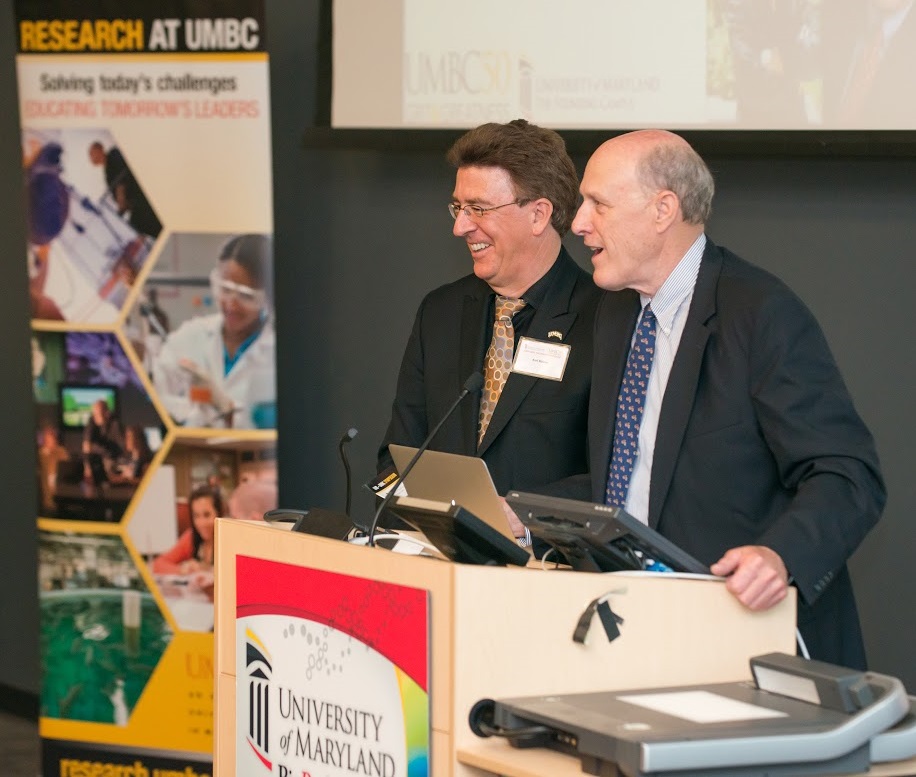
UMBC President Freeman Hrabowski and UMB Chief Academic and Research Officer Bruce Jarrell offered closing remarks focused on their shared commitment to building a close relationship between the two universities for years to come. UMB and UMBC have complementary strengths, Pres. Hrabowski explained. Programs like the UMB-UMBC Partnership Grants, he said, help both universities fulfill their potential as national leaders in innovative research and teaching.

Header image: 2016-17 UMB-UMBC Partnership Grant winners, from left to right: Amanda Lehning, Christine Mair, Chris Geddes, Colin Stine, Mary Melo, Soobum Lee, Xudong Ge. Top image: Andrew White gives his keynote address. Bottom image: Karl Steiner (left) and Bruce Jarrell introduce the program. All photos by Marlayna Demond ’11 for UMBC.