All posts by: UMBC News Staff


Manil Suri awarded prestigious residency from The Rockefeller Foundation in Bellagio, Italy

Manil Suri is one of just 15 leading experts worldwide awarded a prestigious academic residency for September 2016 at the The Rockefeller Foundation’s Bellagio Center in Italy. During the upcoming residency, Suri, a professor of mathematics, will work on his current book projectThe Godfather of Numbers.

As an arts and literary arts resident, Suri is now part of a 56-year legacy that includes Nobel laureates, Pulitzer Prize winners, artists, social entrepreneurs, and activists and the selection is recognition of his ability to promote the well-being of humanity around the world.

The residency program is made up of leading academics, artists, thought leaders, policymakers, and practitioners who have been recognized for their bold thinking and promise to further change the world for the better.

“The Foundation’s Bellagio Residency Program has a track record for supporting the generation of important new knowledge addressing some of the most complex issues facing our world, and innovative new works of art that inspire reflection and understanding of global and social issues,” according to a description about the program on the Rockefeller Foundation’s website.

In a short biography announcing September’s Bellagio residents, the foundation states: “Suri’s The Godfather of Numbers is a novel that aims to posit mathematics as the basis of all creation with The Godfather of Numbers as the narrator who initiates a mathematical big bang to create the counting numbers out of nothingness. His foremost objective for the book is to create a compelling piece of fiction and to allow readers an entry into the world of mathematics which does not assume mathematical expertise. While bringing out mathematics’ playful aspects for a wide target audience, he also wants to provide insight into how it works invisibly in so much of the universe. Mathematics is a much-maligned and poorly understood subject, and he hopes the book is a step towards reducing the anxiety surrounding it.”

Read more about residency program on The Rockefeller Foundation’s website. For more on Manil Suri’s previous books, visit his author website and to learn more about his teaching and research, visit his UMBC website.

Image: Manil Suri. Photo by Marlayna Demond ’11 for UMBC. 

Washington Post and WAMU call on Jeffrey Halverson to explain causes of devastating Ellicott City flood

The devastating flash flood that hit Ellicott City, Maryland, last Saturday night was so severe that meteorologists called it a once-in-a-thousand-years event. What conditions colluded to transform a quaint main street into a torrent of water in a matter of minutes? The Washington Post and WAMU radio both turned to Jeffrey Halverson, professor of geography and environmental systems, to explain.

Air currents from across the region converged over Ellicott City “in a manner that would literally squeeze moisture out of the atmosphere,” wrote Halverson in the Post. The extremely high humidity meant there was plenty to squeeze out. But what made it even worse was the large amount of buoyant energy feeding updraft currents. The more energy, “the more water vapor is lofted into the clouds and processed as rain,” says Halverson.

On top of that, a process called “back-building convection” resulted in several storm cells moving through the area, creating a much longer-lasting event than the traditional summer thunderstorm.

Perhaps the scariest part, though, is that even the most sophisticated computer models cannot predict the exact location of these events. “It becomes a ‘now-casting’ exercise,” says Halverson, “and there is almost never any lead time.”

But it’s not only the meteorological conditions that are to blame for the devastation Saturday night. “The flood was as much about the nature of the underlying land surface as it was about the large amount of rain falling from the sky,” Halverson told WAMU. The narrow streets, large amount of pavement, and valley geography of Old Ellicott City make it especially vulnerable to a flash flood.

“Ellicott City happened to be ground zero for a process that had very laser-like focus,” Halverson explained. “Humble rain, often gentle, is life-sustaining, nourishing, and thus benign 99 percent of the time,” he says. “But what we take for granted sometimes quickly turns deadly.”

UMBC President Freeman Hrabowski and Provost Philip Rous reached out to the UMBC community following the storm, expressing condolences to the families of two individuals who lost their lives, one of whom was an employee at University of Baltimore. Pres. Hrabowski also called on campus experts, like Halverson, to “share their knowledge and resources to help address issues to reduce future flood risk in the area.”

Recovery is a major, long-term process, but one that the area’s residents are already supporting through donations and volunteer service. As Pres. Hrabowski shared, “Ellicott City is a part of us.”

Image: Damage in Ellicott City following the July 31 flash flood; Brian Krista, Baltimore Sun Media Group.


Zero tolerance laws contribute to racial disparities in U.S. public schools, research by F. Chris Curran reveals

As students and families are preparing to start the new school year, new research demonstrates that certain school discipline laws may increase racial disparities and suspension rates for minority students and do little to improve the safety and order of schools.

The research, published in Educational Evaluation and Policy Analysis by F. Chris Curran, assistant professor of public policy at UMBC, finds that state mandatory expulsion laws—which mandate expulsion for offenses such as weapons or assault—have led to increased suspensions for all students, but at a much higher rate for Black and Hispanic students than for White students.

Curran wrote about his findings in an article published in The Conversation on July 24. He examined national data collected by the U.S. Department of Education as part of the Civil Rights Data Collection and the Schools and Staffing Survey, and through further research determined several key findings.

“First, the study showed that state laws requiring schools to have zero tolerance policies increased suspension rates for all students. Second, suspension rates increased at a higher rate for African-American students, potentially contributing to racial disparities in discipline. Finally, principals reported few decreases in problem behaviors in schools, suggesting that the laws did not improve the safety and order of schools,” Curran explains in his article.

The research is timely, as states like Michigan are considering passing legislation to curtail zero tolerance discipline policies in public schools. Curran anticipates that states beginning to move away from zero tolerance policies will have an overall positive impact on the education environment.

“Clearly, such zero tolerance laws were meant to improve the safety and order of the school environment,” Curran writes in The Conversation. “However, in recent years, they have been seen as being overly prescriptive and as contributing to racial disparities in school discipline.”

Through his research, Curran also found that zero tolerance laws can have a significant negative impact on the learning environment for all students.

“Principals report few decreases in problem behaviors such as fighting, drug use, or disrespect as a result of these laws,” says Curran.

This suggests that state zero tolerance laws may be resulting in more students, particularly students of color, being excluded from the learning environment while failing to improve the school setting for those students who remain.

More on this research can be found in Curran’s recently published article “Estimating the Effect of State Zero Tolerance Laws on Exclusionary Discipline, Racial Discipline Gaps, and Student Behavior.” Read “Zero tolerance laws increase suspension rates for black students,” in The Conversation.

Professor Curran joined UMBC’s School of Public Policy in August 2015. His research focuses on education policy, early childhood education, school discipline and safety, teacher labor markets, and the politics of education. Last year, he published a Baltimore Sun op-ed about educational opportunity in Baltimore and a column about teacher overtime policy in Education Week. He also recently launched a website with Ann Kellogg, a Ph.D. student in public policy, to track public sentiment on the Every Student Succeeds Act (ESSA).

Image: Chris Curran presents talk at UMBC about his research. Photo by Marlayna Demond ’11 for UMBC. 

Pining for the Past

When he was 30 years old, Neil Beller ’83, interdisciplinary studies, decided to make his mother a special gift for Mother’s Day: an aerial map of the Carney neighborhood where he had grown up, annotated with his favorite memories.  Over time, Beller fleshed out those annotations – and a map grew into a memory quest.

In 2015, Beller published Missing Pine Park – a book based on the project. The book is named after a small public space in Carney that lost its one remaining pine tree during Beller’s youth. Someone cut it down, decorations and all, on Christmas Eve.

These sorts of stories are at the heart of an unabashedly nostalgic memoir of a childhood in Baltimore County in the 1960s and 1970s – an era when, as Beller relates in the book, “you played with whomever was around… I used to get up at 7am on a Saturday and say, ‘See you at dinner,’ as I blew out the front door.”

One of Missing Pine Park’s most poignant themes in the book is another absence – Beller’s memories of a father who died of cancer in 1980, when the author was only 18 years old. Neil Beller, Sr., was a strict disciplinarian who’d stare down his children and breathe deep before meting out a punishment. But Beller also recalls a man who loved to watch thunderstorms on the front porch together with young Neil, and once even flew a kite with him at 7 a.m. on a weekday morning, dressed in his work clothes.

Sports are at the center of Beller’s freewheeling account of his childhood.  “We had softball games with twenty-six players on a side, and everybody batted.” he writes.  “We played in the woods, in backyards, in streets, in streams, and…. strangers’ basements were somewhat allowed.”

Beller carried that love of sports with him to UMBC, where he was the starting catcher and captain of the men’s baseball team in his senior year. He was also sports director for WUMD – the university’s campus radio station. UMBC’s interdisciplinary studies program allowed him to design a major – television production/audio media – that combined his twin passions.

“I thought I was going to be a professional baseball player since I was a kid,” says Beller, “and after you get out of professional sports, some people go into broadcasting – so that’s why I started taking TV and radio.”

Beller did play semi-professional baseball after graduation, but it was his TV and radio career that took off. After a stint editing television commercials and corporate videos for a Baltimore production company, he landed an editor job at WJZ-TV in Baltimore, where he won a local Emmy Award in 1990.

In 1991, Beller tried his luck in Hollywood. His first job was as an extra grip – building and maintaining the equipment that supports cameras – on the military justice thriller, A Few Good Men.  He also worked as an editor on Nickelodeon’s cult classic cartoon series Ren & Stimpy.

Beller returned to Baltimore in 1993, working as a senior editor and post production supervisor on a variety of projects. He was also a co-host on a radio show hosted by UMBC alumna Shari Elliker ’83, interdisciplinary studies on WBAL-AM for three years, winning two Associated Press awards along the way. (Elliker and Beller met when she was WUMD’s station manager, and they have been friends ever since.)

 Eventually Beller founded his own video production companies: Kit+Kaboodle Productions and The Beller Group. He says the preparation required for success in UMBC’s interdisciplinary studies degree – which requires careful advance planning of course requirements – helped him learn to lay firm foundations for his work.

“As someone in TV, that was the perfect training,” says Beller. “You have to be very prepared way ahead of time. If I had just stood in line and grabbed whatever was available, I don’t think I would have had that fortitude.”

Beller’s latest project? Since 1983, he has been answering letters that children write to Santa, and he is now compiling the letters into a book. Every December, he writes the letters from Santa with candles burning and cookies baking. “I got that from my father,” he says. “He loved Christmas… and I wanted to continue that.”

—Caitlin James ’01

Microscope & Meter

Diana Zeiger ’01, biochemistry is an editor and writer for the National Institute of Environmental Health Sciences. She is also a published poet. UMBC Magazine asked her to reflect on the areas in which her two passions overlap.

A poet and a scientist walk into a bar. Sounds like the setup for a terrible joke, doesn’t it?

I can tell you, however, that they’d actually have a lot in common.

Exploring these commonalities has been at the center of my professional life. I took a bachelor’s degree in creative writing at Johns Hopkins University, where my main interest was poetry. After graduating, I worked as an editor at a small poetry press for a few years. I enjoyed my job but eventually began to find it increasingly unfulfilling.

As a child, I was interested in science but set that interest aside as an undergraduate. So I attended UMBC to start on the path to medical school, but the opportunity to do undergraduate research led me to switch directions and pursue a doctorate in oral and craniofacial sciences at the University of California, San Francisco. (Think of it as a Ph.D. from a dental school.)

Even though I chose to pursue a career in science, my interest in writing never disappeared. In fact, my love of research somewhat naturally led me to seek out what the two disciplines share in common.

One thing poetry and science have in common is a love of questions. Specifically, both ask small questions that explore larger, deeper issues.

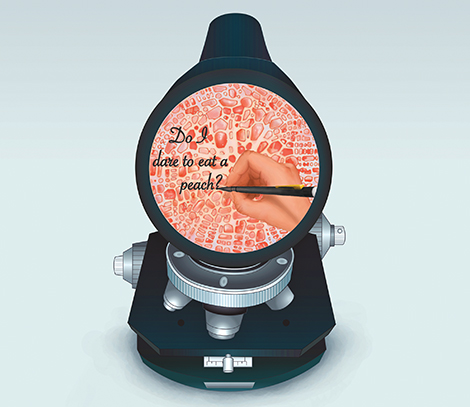
Take one of the most famous questions in modern poetry: “Do I dare to eat a peach?” The narrator of T.S. Eliot’s “The Love Song of J. Alfred Prufrock” isn’t simply pondering his choice of snack. This timid fellow is contemplating the loss of his youth and the inevitable decline of his vitality and questioning whether he is capable of expanding his ever-diminishing world. Similarly, when a biochemist asks whether a particular molecule interrupts a given signaling pathway, the impact of the answer may be as large as: “Can this drug stop the progression of cancer?” Both poetry and science embrace small questions to unlock grander concepts.

Su16-alumnistories-microscope-2Precision is another shared quality of poetry and science. Poetry is nothing if not economical; when writing poetry in forms as exacting as a sonnet or a villanelle, not a syllable can be wasted. Each word must be chosen carefully for qualities of sound and its meaning. Precision is equally essential to any scientific endeavor. Instruments must be used with meticulous care, quantities measured exactly, and actions performed and recorded in such a way that they can be perfectly duplicated. Without precision in the laboratory, science could not advance.

Once I completed my introductory science classes and began performing more advanced research, I became aware of another parallel between poetry and science less obvious to those people outside the laboratory: both disciplines require interpretation.

As early as middle school, students are taught that poems can be appreciated in multiple ways, and that the words and phrases comprising them can have layers of meaning. The language of a poem may be melodious and tell an interesting story, but there is often more to learn by digging a little deeper. Enjoyment of poems can be enhanced by knowing – or even investigating – a poet’s biography or a poem’s historical context. Efforts to identify the “Dark Lady” of Shakespeare’s sonnets has led to seemingly endless hours of debate, yet this investigation has also enriched our knowledge about – and deepened our appreciation of – these extraordinary poems.

Debate is also an important part of doing science, though this aspect is not something taught in most schools at an early stage. In primary and secondary schools, the main thrust of science education is learning facts. Even laboratory classes typically center around tried-and-true experiments where in which the aim is to achieve preordained results. However, this early education is merely intended to lay a foundation, as I found out when I embarked upon my own research career.

Professional researchers gather all the available knowledge on a topic and then interpret it to generate new hypotheses. Once tested, the new information yielded must then be interpreted again in order to evaluate the validity of the hypothesis. Facts are an indispensable part of science, but pursuing the meaning of these facts within the context of what is already known is what truly enables us to move science forward.

Neuroscience researchers have used poetry as a tool to explore how the brain processes language and sounds; the composition of poetry has also been studied in an attempt to discover the source of creativity itself. Conversely, thanks to their complex, often abstract use of words, poems about scientists and science reveal facets of their subjects that the straightforward language of essays and encyclopedias cannot do. Ultimately, it seems that science and poetry not only have a great deal in common, they also can serve to illuminate the best aspects of each other.

Hurdles & Healing

Damon Tweedy ’96, biological science, graduated from UMBC in 1996 with a 4.0 grade point average – the first participant in the Meyerhoff Scholars Program to achieve that mark. And when he entered Duke Medical School, he excelled in the classroom there as well.

But when Tweedy began his clinical rotations and his residency after taking his M.D., he faced the task of translating that knowledge into effective care for real human beings. He also found his transition carried special challenges. He was one of the few African American students in his medical-school cohort, and he was training in a state with enormous racial, class, and regional disparities in health care access. Patients turned to Tweedy with expectations – and occasional open hostility – that his non-black colleagues didn’t experience.

Tweedy’s bestselling book, Black Man in a White Coat: A Doctor’s Reflections on Race and Medicine (Picador, 2015), subtly explores several types of bias commonly experienced by both patients and health professionals.

“One of the first things I noticed in residency was the custom of naming patients’ races when they’re presented in rounds,” says Tweedy, who is now an assistant professor of psychiatry at Duke. “‘So-and-so is a 55-year-old African American male.’ I thought: Why mention race? Occasionally it’s genuinely significant, but often it seems that the patient gets typecast before you even get to the rest of the story.”

Tweedy was raised in a working-class suburb of Washington, D.C., where his father worked as a grocery-store meat cutter for many years. UMBC recruited Tweedy on two fronts. First, he was spotted by UMBC President Freeman A. Hrabowski, III in the science-and-mathematics magnet program at Eleanor Roosevelt High School in Greenbelt. But he was also on the radar of the university’s basketball coaches.

“When I visited campus,” Tweedy recalls, “I got to know other current and prospective Meyerhoff students. I just remember that for so many years I’d felt out of place – being an African-American student who was doing well in science and math – and feeling like here at UMBC there was a space where I could be myself and succeed.”

Earnestine Baker, who directed the Meyerhoff program after Hrabowski became UMBC’s president, remembers Tweedy as a compelling student in the program’s early years.

“Damon had a quiet demeanor,” Baker says. “But he had this spark about him that made you want to know him, and to know more about him.” She recalls long conversations when Tweedy made the decision to leave the basketball team after his sophomore year. He realized that he had a chance at graduating with a perfect GPA, and he didn’t want anything to distract from that goal.

“One of the great things about the Meyerhoff program,” Tweedy says, “was that they not only paid close attention to how you were doing in the classroom, but they also encouraged you to get into summer research programs, to get exposed to people in the field and to the life of the laboratory.”

One summer placement in a National Institute on Aging lab in Baltimore led Tweedy to consider medical school. “One of the researchers there was a cardiologist who had trained at Johns Hopkins,” Tweedy says. “That was one of the first times I’d met a young male African-American physician…. He kind of took me under his wing, and he introduced me to other doctors and med students. The idea of becoming a doctor was really foreign to me. In terms of knowing people in my own life who’d traveled that road, I had no frame of reference at all.”

At Duke, Tweedy gravitated toward psychiatry, a field with acute disparities in access to care. “Depending on your insurance,” he says, “you might have access to 30 days of inpatient treatment, or you might have access to two days.”

Today Tweedy divides his time between clinical practice at Durham’s Veterans Affairs hospital and training medical students and residents at Duke. He leads a course for first-year students on the doctor-patient relationship, and tries to draw students’ attention to the many kinds of conscious and unconscious bias that can complicate that relationship.

“I try not to beat them over the head with it,” Tweedy says. “But I try to show them the subtle ways in which these issues can come up in different encounters. You may have all the knowledge in the world, but if you can’t communicate with the patient and understand where they’re coming from, you really can’t deliver optimal care.”

—David Glenn

Baltimore Sun recognizes UMBC women’s basketball for commitment to community

Nine women’s basketball team members visited New Era middle school in South Baltimore to play ball with students in the Higher Achievement program. This is the second summer the Retrievers have spent time with Higher Achievement students. Andi Goodwin, a Higher Achievement mentor and academic advisor at UMBC, forged the connection, which is a powerful example of UMBC’s commitment to community partnerships.

Warren Wiggins, manager of instruction for Higher Achievement at New Era, says that when UMBC visits, the middle schoolers “get excited about college. They learn that student-athletes are students first.”

The benefits go both ways. Working with younger students encourages the athletes to “step outside of themselves for a moment,” says Goodwin. “It affords them a chance to see what doors their talent opens up for them.”

During a question and answer session after drills and a scrimmage, the youngsters quizzed the UMBC players about college life as varsity athletes. “It’s one thing to play basketball with them,” says point guard Emily Russo ’17, biology, “but we’re more than just basketball players.” She hopes she and her teammates made that clear to their new mentees.

“I feel like you build a relationship,” says power forward Pandora Wilson ’17, health administration and public policy. “If they’re listening, they’re applying what they’ve learned here and maybe they’re taking away something that’s more than just the usual words.”

The New Era principal has invited the UMBC team return this fall to meet with the school’s basketball team—a request they’ll happily oblige.


UMBC participating teammates: Laura Castaldo, Chukwuma Chiamaka, Amanda Hagaman, Kayla Hinderlie, Allison McGrath, Tyler Moore, Te’yJah Oliver, Emily Russo, Pandora Wilson

Learn more in The Baltimore Sun: UMBC women’s basketball players share more than their sport

Image: UMBC women’s basketball players practice with middle school students in the Higher Achievement program at New Era Middle School; photo UMBC Athletics.

Front Row Seat

Sitting across from Sylvia Nathanson ’71, social work, it’s hard not to see the spark that propelled her in her late forties to become one of UMBC’s first returning students – and led her to a prominent role in educating thousands of social workers as the longtime dean of admissions at the University of Maryland School of Social Work.

She is 98 years old now, but Nathanson’s memories of the university’s formative years remain vivid. “It was a time of great protests,” she says. “There were many speeches all the time. I remember my first biology class, and the head of the protestors was my lab partner.”

Nathanson began taking classes at the age of 46 at Baltimore Junior College (now Baltimore City Community College). In 1968, she was encouraged to transfer to UMBC. She found the university “a wonderful place to be. People were warm and accepting. Helpful. The older student was welcomed.”

Juggling her roles as a mother to two daughters and as a student took discipline and focus, UMBC was accommodating. “I never took a class before nine o’clock or after two o’clock,” she says.

Nathanson did participate in a formative experience for many UMBC students: study abroad. In the 1969 January session (dubbed the “minimester” in that era), Nathanson accompanied Walter Sherwin – now emeritus professor of ancient studies – and a group of her fellow students on a trip to London, Paris, and Rome.

Nathanson recalls hearing about the three-week study course a few months before the trip. “I looked over at the person sitting opposite me, and I said, ‘Golly, that’s a wonderful idea! Why don’t you do it?’ And she looked me square in the eye and said, ‘Why don’t you?’ And I did.”

The trip pushed the first-time traveler in unexpected ways. “We had a flat front bus, and we were riding down a narrow road [in Italy], and everybody took a turn riding in front to see the water below,” Nathanson remembers. “Now I was someone who didn’t like the water and didn’t like heights. But one of the students piped up and said: ‘Everyone’s had a turn. But Sylvia hasn’t had a turn.’ And they put me right up front. And I grew. It sounds ridiculous. But I grew tremendously during that experience.”

Sherwin remembers the minimester trips and their beneficial effects on students. “It expanded the horizons for a lot of people,” he says.

Nathanson soon put the growth she experienced as a student and world traveler to even more beneficial uses. She says she found her calling when Ruth Young, the legendary dean of the University of Maryland School of Social Work, came to UMBC to recruit students. “Dean Young came to campus to explain how she envisioned a bachelor’s degree in social work,” she recalls. “She was really explaining social work that day. After that, there was never a question.”

Young’s advocacy helped created a powerful new program at UMBC. “Once it got going,” says Nathanson, “the [social work] program became tremendously popular. Because there was such a need for it.”

After graduating cum laude from UMBC, Nathanson worked as a social worker at Baltimore City Hospitals (now Johns Hopkins Bayview Medical Center). “UMBC had given me a sense of community and organization,” she says. “And being older, I was able to render a social work service and pulled the community in.”

After five years, however, Nathanson went back to school again, this time to get her master’s degree in social work at the University of Maryland School of Social Work. “The master’s people had something different,” she says. “They had something I wanted. So I took a leave of absence and went to the master’s program.”

Nathanson was a fixture at the School of Social Work after obtaining her advanced degree, eventually becoming the dean of admissions. She encouraged and enrolled many graduates of UMBC in the school and helped them on in their social work careers.

“I followed the UMBC alumnae,” Nathanson recalls. “I have a particular skill. I never forget a name, and that comes in handy.”

—Richard Byrne ’86

John W. Jeffries Dean’s List Award honors high achievers

UMBC is about to celebrate its 50th anniversary, and we didn’t get this far without the dedication of some incredible people. People like Dean Emeritus John Jeffries, who joined the UMBC History Department in 1973, and spent the next 40 years helping his students and the university excel.

When Dean Jeffries retired as Dean of the College of Arts, Humanities, and Social Sciences (CAHSS) in 2013, an anonymous donor established the John W. Jeffries Dean’s List Award in his honor. The fund—which recognizes Dean Jeffries for his dedication to UMBC students and his commitment to seeing them excel—provides critical support for high-achieving students who aren’t already receiving a specialty scholarship. If they’ve demonstrated their drive by reaching the Dean’s list for three consecutive semesters, they’re eligible for the award.

This spring, Dean Jeffries had the chance to meet with some of the students who had received the award and learn a bit about their UMBC journeys.

Sunita Mengers ’16, biological sciences, had just returned from Spain when she met with Dean Jeffries. “Receiving this award helped me fully immerse myself in the local culture and allowed me to adapt to a new environment,” she explains. Hoping to continue her studies at med school, Sunita said UMBC’s close-knit and supportive environment played a big role in helping her reach her goals.

“The whole [UMBC] community helps you succeed,” she adds.

That sense of community and support is a feeling common across campus, especially among the award recipients. “I received personalized classroom instruction from quality professors who truly care about the well-being of their students,” says Ayushi Aggarwal ‘16, biochemistry and molecular biology.

The students also felt the impact of the reward well beyond their initial acceptance. Thanks in part to this scholarship, Olsi Leka ’16, computer engineering, is achieving his career goals.

“I have accepted a position [at Texas Instruments in Dallas] as a product engineer, a position that will allow me to continue my learning process beyond the doors of UMBC,” he says.

For Marianne Kirchgessner ’16, social work, the Dean John Jeffries Award is allowing her to continue her education. “[Receiving this scholarship] was a blessing because it lessened the burden for me and my parents and freed up some money to pay for grad school,” she says.

Given Dean Jeffries’ long history of helping students, it seems fitting that the fund established in his honor should do the same, as it prepares these talented Retrievers to take everything they’ve learned at UMBC into their bright futures.

“I’m both delighted and honored by the award, which helps high-achieving Dean’s List students who do not hold UMBC specialty scholarships complete their undergraduate education,” said Dean Jeffries. “I’m especially honored to have my name associated with these remarkable young men and women.”

Katharine Scrivener

Phenomenal World: Juliana and Homer Schamp Memorial Scholarship seeks to inspire the next generation of teachers

Think back to the science classes you took as a child. What do you remember about them? Did you watch a caterpillar spin a cocoon and emerge a butterfly, or a tadpole grow into a frog? Did you turn baking soda and vinegar into a fuming volcano, or set off a homemade hot air balloon from the school parking lot? Did you feel a sense of wonder as you watched the world work its unique magic?

That’s the sense of wonder the late Homer W. Schamp, Jr., UMBC’s first dean of the faculty, professor emeritus of education, and trained physicist, pursued science with, and one he sought to instill in both his students and his own children. His wife Juliana Reese Schamp, who worked on important sociological research for the state of Maryland, treated life the same way, until her passing in 2009.

With the Juliana and Homer Schamp Memorial Scholarship, their sons, Brough and David Schamp, hope to keep their parents’ legacy of intellectual curiosity alive in the next generation of K-12 science educators.

Throughout his life, Dr. Schamp, a former College Park physics professor who joined UMBC in 1965, emphasized early education as a crucial part of a child’s intellectual development. His own introduction to science began during his childhood in rural Ohio, when, according to his son David, he became fascinated with the engineering of farm equipment. It’s a curiosity he emphasized to the education classes he taught here, and something he brought up his own children with as well.

“He exposed us to all kinds of different things as we were growing up,” says Brough. “Mushroom hunting, […] botany, the stars, everything. […] His main field was physics, which is really pretty abstract, but what he really was interested in was the phenomenal, real world that we live in.” After his retirement, Brough says, Dr. Schamp built several kinetic sculptures and interactive physics-based artworks, including a large kaleidoscope on display at the American Visionary Art Museum in Baltimore.

Brough shares his father’s belief that science “should be a hands-on subject,” and says that computers and technology can create a distance between students and the physical world around them.

“The kids should be inspired by something they saw, heard, felt, experienced,” he says. “[That] inspiration is something that is often lost if you’re just looking at something on a computer and answering questions.”

In keeping with his philosophy on education, Dr. Schamp made sure to hire only the highest-quality professors, and it’s doubtful that UMBC would be the hub for innovative teaching and experiential learning it is today without the Schamps’ early influence.

“UMBC was my father’s life’s work and both of my parents conceived of it as a first rank teaching institution,” David says. While his mother, Juliana, was never a faculty member, she was “instrumental in [UMBC’s first faculty] being hired, as recruitment usually began as an evening in our home where my parents could converse [with candidates] on almost any topic.”

Giving back to UMBC seems to run in the family: Homer and Juliana Schamp established the Joseph D. Reese Memorial Prize, a biennial award given to history students, in memory of her father. “It seemed only natural to want to contribute to a place so dear to [our parents],” says David.

He agrees with his brother that their parents raised them to be thinkers, to ask questions.

“I often later felt I had learned my most important lessons at home — specifically how to learn — [and] that curiosity and thoroughness were rewarding and that it had to come from within. Knowing how to learn is the most crucial skill a teacher can pass on and my parents really encapsulated that skill. I would hope any future teachers would want to engender that in their pupils,” he says.

We don’t know exactly what science education will look like when the first Schamp scholar teaches their first class, but we do know that they’ll have the intellect, leadership, and natural curiosity to inspire a new generation of learners.

Julia Celtnieks ’13

Make a gift to UMBC today, and help inspire a new generation.


Meet SCIART: Groundbreaking fellowship opens students’ eyes to interdisciplinary careers

In early June, eight undergraduates arrived at UMBC for the first edition of SCIART. The unique summer fellowship program funded by the Andrew W. Mellon Foundation seeks to “continue to develop the students’ science expertise while also developing their appreciation for the arts and humanities,” says Zeev Rosenzweig, UMBC chemistry and biochemistry chair, who spearheaded SCIART.

Interdisciplinary programs like SCIART prepare students for a widening range of possible career paths, helping to address the challenges and opportunities presented by an evolving career landscape that emphasizes teamwork and creative problem-solving.

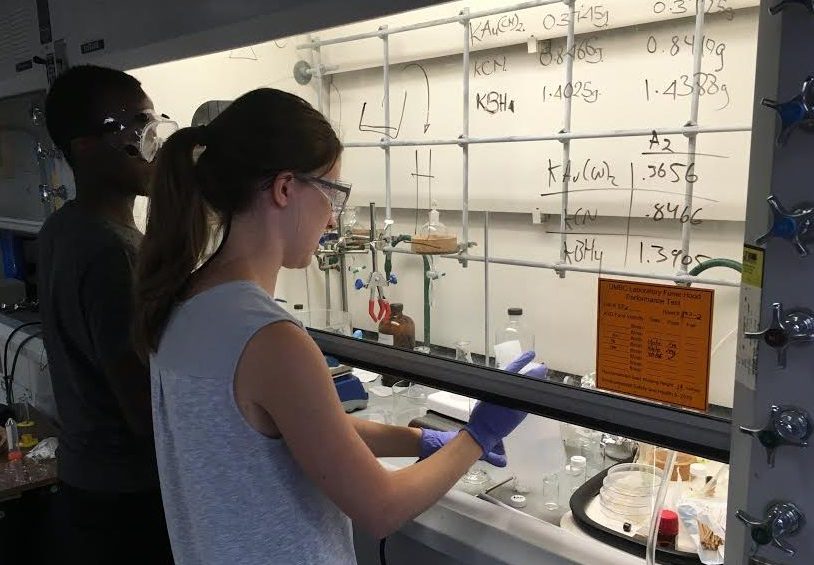
SCIART students work on scientific research projects under the guidance of faculty from UMBC and Johns Hopkins University. Each project has a specific art conservation application at the Walters Art Museum in Baltimore, and museum staff collaborate closely with UMBC to run the program. “I’m so thankful to my colleagues here at UMBC and our partners at Johns Hopkins and the Walters,” Rosenzweig says. “SCIART would not be possible without their commitment to the program, and more importantly, to the students.”

Students make frequent field trips to the Walters. The program also includes visits to the conservation science laboratories of the National Gallery of Art in Washington, DC; New York’s Metropolitan Museum of Art; the Winterthur Museum, Garden, and Library in Delaware; and the Library of Congress. The trips give students the opportunity to interact with conservators, conservation scientists, curators, and other museum professionals whose careers blur the boundaries between art and science.
sciart1

“One of the best parts has been getting to work with people in the conservation community who have so much experience,” says Marie Desrochers, an art history major with a chemistry minor at the University of Central Arkansas. Before arriving, Desrochers already planned to pursue graduate study in art conservation. “I really love art,” she says, and as a conservator, “You get to be the person that goes behind the scenes and gets the most intimate experience with the objects.”

Janaya Slaughter, a chemistry major at Stevenson University, was planning on pursuing a master’s degree in forensic science. This summer, however, opened her eyes to how much science is involved in art conservation. “Every time we go on a museum trip I get more excited,” she says.

Feddi Roth, a rising sophomore at Stanford University, is still undecided on her major, but she is interested in chemistry and loved her first art history class. She knew SCIART would be the perfect summer opportunity. Now she’s “definitely thinking of art conservation as more of a career option.”

Julie Lauffenburger, director of conservation and technical research at the Walters, discussed with the students how the path to a conservation science career is still not clear-cut. “That’s why this is such an important program,” she explains.

SCIART is also an opportunity to work in a team of peers with varied expertise. Slaughter, Roth, and Khalid Elawad, a materials science major at Johns Hopkins University, are investigating how vibrations from music during events at the museum may affect the structural integrity of art nearby. They needed an abundance of physics knowledge, learned new software programs, and even wrote their own code to analyze data. None of them had any programming experience before SCIART.

“The learning curve was the biggest challenge,” says Elawad, but the team rose to the occasion. In the end, “We all walked away with skills that we never thought we would have,” he adds.
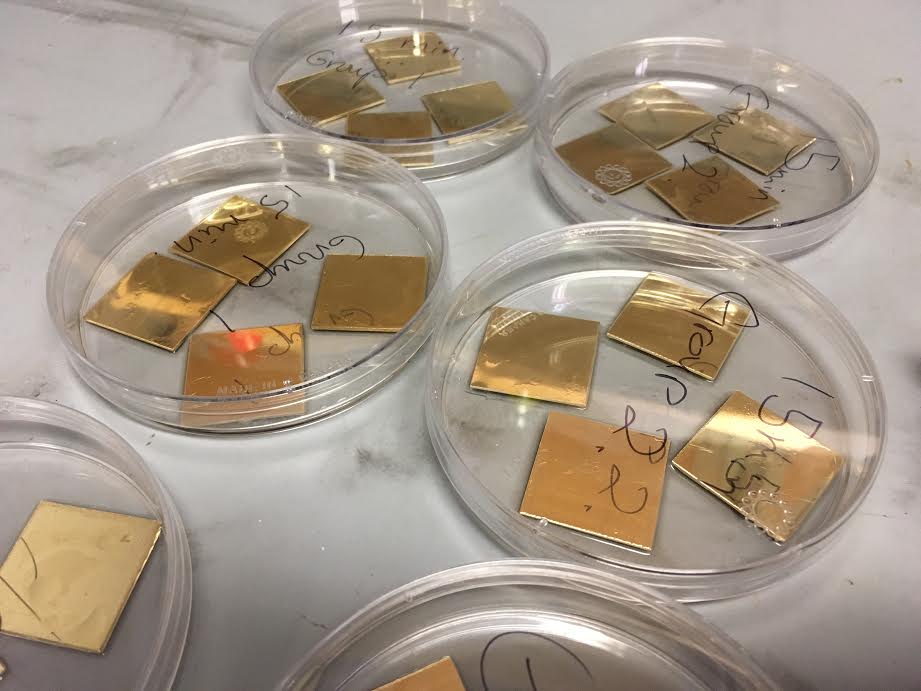
sciart2Alex Taylor, a chemistry and archaeology double major at Johns Hopkins, and Sam Maina, who studies biology at UMBC, are working with Desrochers to analyze the effects of different cleaning methods on ancient objects. This team, too, faced its challenges, but the end goal is more than answering a scientific question. “It’s about bringing together people from different disciplines to problem solve,” Desrochers says.

Part of what makes SCIART unique is that the students get to work on real problems. Terry Weisser, Lauffenberger’s predecessor at the Walters, told the students, “What you’re doing here has potential to be really important in the field.” High expectations make the experience that much richer for students. “It’s easy to stay motivated when you know you’re really going to help somebody,” shares Elawad.

A few students may be offered extended fellowships to continue work with the Walters after the summer program concludes. All students, however, will come away with their eyes open to the possibilities for interdisciplinary careers and the team-building and problem-solving experience they need to succeed.

For more information about SCIART and how to apply, click here.

Header: Students tour the conservation labs at the Walters Art Museum; photo Jason Putsché. Top image: Sam Maina (l) and Marie Desrochers (r) work in the lab. Bottom image: Gold-plated “coupons” on which Maina, Desrochers, and Taylor will test cleaning techniques. Photos by Sarah Hansen.

Hacking the Real World: Donor support gives students hands-on experience in their fields

This spring, more than 350 students joined in this year’s annual HackUMBC, a 24-hour “tech innovation marathon” where participants were challenged to come up with creative solutions to specific challenges. The slogan: “Dream big. Make it happen.”

Students worked individually and on teams to build projects, or “hacks,” which were judged on technical complexity, elegance, and creativity during an expo at the conclusion of the event.

Contrary to popular belief, not all hacks require computer coding. “We call it an idea marathon,” explains Michael Bishoff ’16, computer science, a founder of HackUMBC. “It doesn’t have to be an app or a computer program.” In the past, participants have built tangible things like pop-up showers and coffee makers. Next year, HackUMBC would even like to incorporate a social good component, challenging students to come up with solutions to societal challenges.

“I’m trying to see where tech could come into play for disadvantaged groups,” says current HackUMBC co-president Celestine Wong, a rising senior studying computer science and social work. “I find a lot of joy in doing good for someone else.”

Wong’s dual major in social work and computer science has fueled her interest in finding real-world intersections between the fields, and she’s not alone. Many hackathons focus on how hacks can make the world a better place. As both Bishoff and Wong point out, these events can be great resume builders, but they’re even better when they create an opportunity to help the community.

The event has drawn interest and sponsorship support from a variety of leading tech companies and government agencies. Dan Hood ’01, computer science, is the chief technology officer for one of those companies, ClearEdge IT Solutions, which provides provides software engineering and data solutions and services. Hood says that for ClearEdge, getting involved with UMBC and the hackathon makes sense — it gives their company a chance to see some of the brightest upcoming students, and they get to help those students by providing learning opportunities and exposure to the career options that await them.

“I think it’s important to support the next generation of the workforce,” says Hood.

The National Security Agency (NSA), a top employer for UMBC alumni, provided “technical talks, mentors, and recruitment opportunities” for students during the event, says Kathy Hutson, NSA’s associate director for human resources.

“NSA and UMBC work closely together to help build the leaders of today and tomorrow to ensure that the Agency can protect and defend the country,” Hutson explained. “UMBC graduates have contributed greatly to our mission and we are proud of all we have accomplished together.”

Tenable Network Security, a firm that provides comprehensive security technology solutions, supports the Hackathon because it values UMBC’s educational initiatives, its students, and its cyber-focused extracurricular activities.

“The platform UMBC provided, which allowed companies to help students with hacking-related questions, was very useful in creating an innovative and collaborative atmosphere,” said Tenable Network Security’s spokesperson.

That innovative atmosphere goes a long way to helping students gain the valuable real-world experience they’ll need to land a job. In fact, those extracurriculars can help students stand out amongst a crowd of applicants.

“While classroom experience is fantastic, we encourage students to engage in personal projects that help them apply the skills learned within the curriculum,” says Tenable Network Security’s spokesperson. “These are qualities of very successful employees at Tenable and something we feel is important for students to realize early on.”

Hands-on experience is one of the chief benefits of HackUMBC, says Bishoff. “It’s like a 24-hour recruiting event,” he explains. “The students who come to these events are passionate about programming. They’re the kinds of people who want to work on weekends.”

Hood adds that the Hackathon gives students the chance to work in a team environment, navigate the stress of a time crunch, and be innovative. “To see [participants] go from nothing to concept to prototype in a day is pretty remarkable,” he says.

See more news coverage: http://technical.ly/baltimore/2016/03/07/5-innovative-projects-hackumbc/ AND https://umbc.edu/students-turn-ideas-into-inventions-at-hackumbc-tech-innovation-marathon/

Learn about Hack UMBC: https://hackumbc.org/

HackUMBC was sponsored by Tenable Network Security, ClearEdge IT Solutions, the NSA, McCormick, TowerSEC, Northrop Grumman, PayPal, T. Rowe Price, VentureStorm, Namecheap, Soylent, Google, and Square.

— Meredith Purvis