All posts by: UMBC News Staff


Scholarship Q&A: Sarah Bach ’16, Biological Sciences

As the academic year draws to a close, we thought we might take the time to introduce you to some of our Alumni Association Scholarship recipients. Let’s hear from Sarah Bach ’16, biological sciences, who received an Alumni Legacy Scholarship for the 2015-16 academic year.

Name: Sarah Bach

Major: Biological Sciences

Grad Year: 2016

Extracurriculars: Global Brigades Dental Program, Pre-Dental Society

Why did you decide to attend UMBC? I chose UMBC because of its strong STEM program. I was also impressed by the amount of undergraduate opportunities in research. At many other schools that I toured, research was limited to graduate students. My dad also attended UMBC!

What’s been the most amazing discovery you’ve made so far as a student here? Joining a club or campus organization can really shape your undergrad experience and help you discover where your passion lies!

What are you most proud of accomplishing in your time at UMBC? During my time at UMBC I have changed so much as a person. The diversity at this school has allowed me to broaden my understanding of other cultures [,and the] opportunities I’ve had here have helped me grow into a more mature and well-rounded individual.

What would you say to the people who provided your scholarship? Thank you! There is so much value in education and I am so glad you have chosen to support mine!

What do you hope to do after graduation? I just got accepted at [the] University of [Maryland] dental school, so for the next four years I’ll be working towards my dream!

Help students like Sarah pursue their dreams by making a gift today.

Scholarship Q&A: Michael Wallace Karugu ’15, Information Systems, and M.S. ’17, Cybersecurity

As the academic year draws to a close, we thought we might take the time to introduce you to some of our Alumni Association Scholarship recipients. Today, we hear from Michael Wallace Karugu ’15, information systems, who is currently working toward a master’s degree in cybersecurity here at UMBC.

Name: Michael Wallace Karugu

Major: Information Systems (current master’s student in Cybersecurity)

Grad Year: 2015, 2017

Extracurriculars: Soccer and billiards

Why did you decide to attend UMBC? UMBC is a renowned institution offering recognized STEM programs. I wanted to experience the learning environment and opportunities offered by UMBC. Furthermore, since I was a transfer student, UMBC was ready to accommodate the credits that I wanted to transfer.

What’s been the most amazing discovery you’ve made so far as a student here? The faculty, staff and students at UMBC are very friendly and always willing to assist. This friendly environment promotes a healthy learning environment.

What are you most proud of accomplishing in your time at UMBC? I am currently the student manager of the Desktop Student Support section in DoIT. Having started as a regular student employee here two years ago, I feel this is my most proud accomplishment during my time at UMBC.

What would you say to the people who provided your scholarship? I would like to thank them from the bottom of my heart for supporting me financially. This assistance enabled me to focus more on my studies as compared to stressing about how I would meet my school related costs. This assistance goes a long way in nurturing deserving students.

What do you hope to do after graduation? I graduated from my undergraduate program in fall 2015 and I am now pursuing a master’s program in cybersecurity here at UMBC. I plan on graduating in the Spring of 2017. After earning my master’s degree, I will pursue employment from the private sector as a cybersecurity specialist, and in future I plan on establishing a cybersecurity consultancy firm.

Students like Michael rely on the financial support of our donors. Please consider making a contribution today.

Researchers across disciplines gather for vital conversation about academic freedom

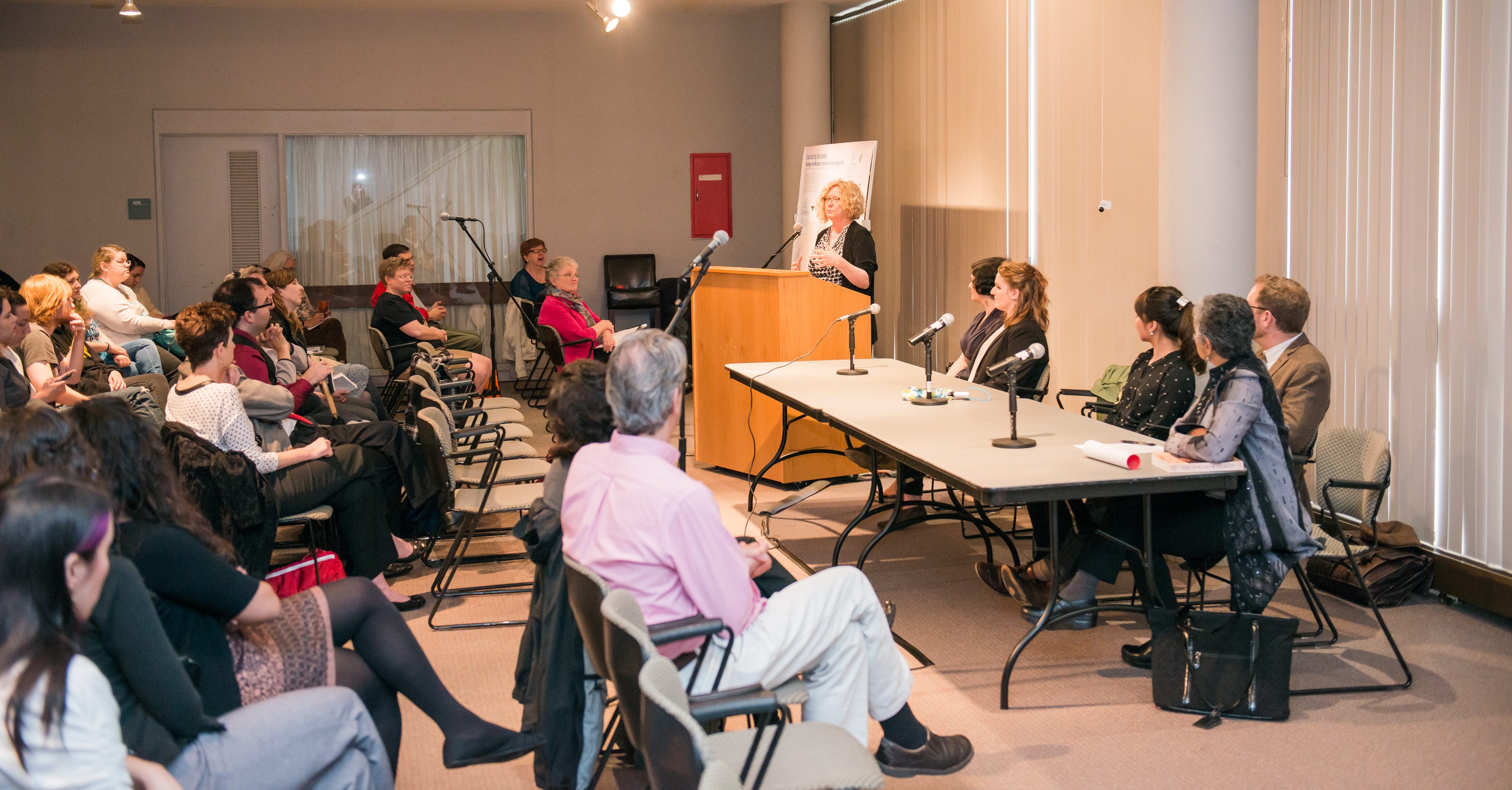
UMBC students, faculty, and staff gathered on May 12, 2016, to honor the work of two accomplished emerging scholars and to engage in a vibrant discussion on academic freedom and the display and interpretation of research.

At the discussion forum, Zoe Wang ‘16, interdisciplinary studies, and Riley Auer ‘17, ancient studies, presented their poster “Illustrating the Unseen: Analogy and Metaphor in an Ancient Gynecological Text.”

Their work became the center of a campus-wide conversation on academic freedom in late April after the poster was moved to a less prominent location shortly before Undergraduate Research and Creative Achievement Day (URCAD), with nearby signage stating, “Certain research posters may contain content that may be inappropriate for children under the age of 17.”

President Freeman Hrabowski responded to apologize to the students and affirm university support for their academic work. Scott Casper, dean of the College of Arts, Humanities, and Social Sciences, and Diane Lee, vice provost and dean of undergraduate education, then organized a special campus event to discuss “the nature of artistic, humanistic, and scientific research and representation; the presentation of research to academic and public audiences; and the meaning and centrality of academic freedom.”

Several UMBC faculty members joined the students in a panel discussion to reflect on the issues that their poster and response to it during URCAD have raised for UMBC’s research community; the context of how research on reproduction, gender, sexuality, and women’s bodies has been interpreted over time; as well as positive steps the university administration and community can take to ensure that the academic freedom of student researchers is fully supported in the future.

Wang and Auer’s research is connected with “Seeing Science,” a new initiative of the Center for Art, Design, and Visual Culture (CADVC) to reveal and advance connections between the visual arts and the sciences. Their research project examined gynecology from ancient Greek texts with a focus on Soranus’ studies about female reproductive organs. The work combined text, illustrations, and design to create an artistically interpreted visual representation to help contemporary readers understand the ancient texts without losing their original content.

“Why did we chose to hold on to medical terms that are thousands of years old?” asked Auer, during her research presentation at the forum. “I wanted to understand what terms were used…and what allowed us to develop the terms and continue their usage.”

Addressing the decision to move her poster at URCAD, Wang explained, “if we don’t treat reproductive biology with a healthy attitude, then research and education in this field will have a difficult time moving forward. I believe that we have to provide a healthy academic environment for everyone who wants to come and learn.”

post-URCAD-discussion-2699

Following the poster presentation, Molly Jones-Lewis, visiting assistant professor of ancient studies; Carole McCann, professor and chair of gender and women’s studies; Stephen Freeland, director of interdisciplinary studies; and Preminda Jacob, associate professor and chair of visual arts, presented their thoughts on the questions about scholarship and academic freedom that have been asked in the days following the URCAD incident.

Jones-Lewis, who served as a faculty mentor to Auer, commended the students on their bravery and tenacity in addressing a research topic that isn’t often discussed in the larger cultural landscape.

McCann spoke about the historical context of sexual and reproductive health and politics in the United States. She pointed to the 1870s when Comstock Laws were passed to ban representations, information, and devices related to sexual and reproductive health. She said the laws have reverberated for nearly 150 years and have made it harder to attract research scholars to address essential topics related to gender, women, reproduction, and sexual health, and to build a reputation for reproductive health sciences.

“As a university that is committed to a search for knowledge and inclusive excellence…we should be conscious of these politics, we should learn to see them when they are implied in decisions, and we should learn to discuss them quite openly,” said McCann.

Freeland commented on the power of URCAD and UMBC to “build bridges” among disciplines and to create dialogue to grapple with and address significant research questions. “This exercise was one in building bridges between images and text,” said Freeland. “In a nation and a world that is so divided between belief systems and perspectives, the university stands proud in its ability to welcome those discussions and to show and teach our students the tools of how they can navigate brave spaces,” he suggested, with a nod to the UMBC Women’s Center’s influential work promoting “brave space” discussions on campus.

As an historian of modern and contemporary art, Jacob spoke about the interpretations that images generate and the public perceptions and history of responses to those images. She explained that in today’s world, where people are constantly inundated with images, if there is one that “breaks the norm,” it can evoke a more passionate response that can bring deep-seeded emotions and assumptions to the surface.

Following the panel presentations, the audience engaged in a discussion about academic freedom, the lessons learned from the incident, and next steps in moving forward to affirm the university’s support for student research in the future.

Tim Nohe, visual arts professor and director of the Center for Innovation, Research, and Creativity in the Arts, shared that for him it was also a day to recognize the importance of each generation of scholars committing actively to support the continuity of academic freedom. He was grateful to Wang and Auer, he said, for “carrying the torch” of academic freedom for generations to come.

Images: (Top) Students Zoe Wang and Riley Auer present their research poster during a conversation about academic freedom. (Bottom) Carole McCann speaks during the panel discussion. Photos by Marlayna Demond ’11 for UMBC. 

Education department announces its second cohort of Summer Enrichment Experience Scholars

Fourteen middle and high school students from local schools have been selected to participate in an innovate summer enrichment program at UMBC to build on skills learned and tap into creative interests across disciplines.

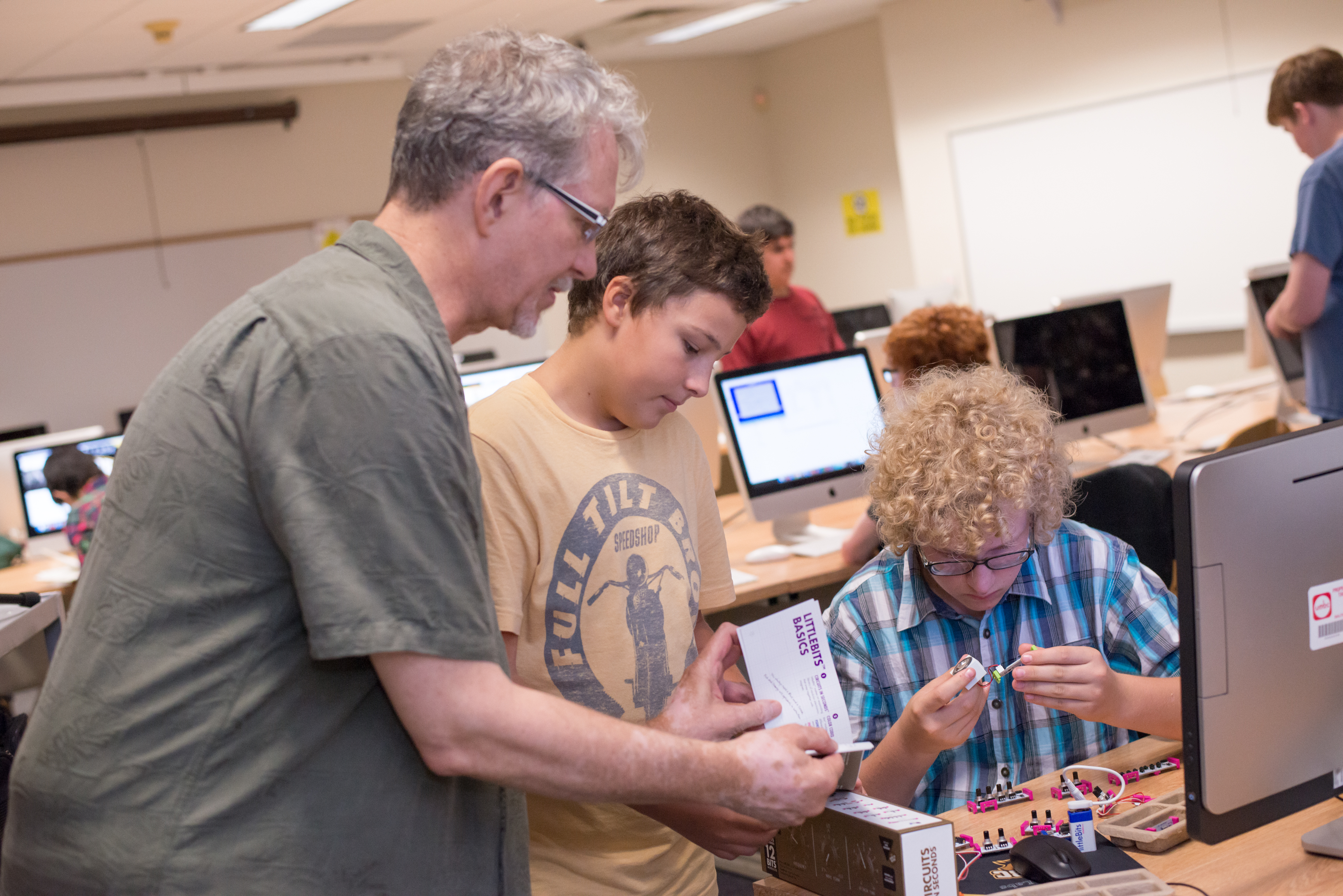
The UMBC Department of Education recently announced its second cohort of Summer Enrichment Experience Scholars (SEE Scholars). A total of fourteen rising 6th-12th grade students were nominated by UMBC teacher candidates completing their internships at UMBC Professional Development Schools (PDS) and were selected by the Education Department Scholarship Committee. Students accepted into the program will attend the campus-based summer learning camps free of charge.

SEE Scholars Program

Developed and led by UMBC faculty, students, and industry leaders, SEE experiences are designed to spark participants’ passions and interests in the fields of science, engineering, technology, the arts, and humanities; tap into their creative talents; expand technical skills; and hone their academic skills.

The 2016 SEE Scholars currently attend Windsor Middle School in Baltimore County; Talbot Springs Elementary School, Patapsco Middle School, and Mt. Hebron High School in Howard County; and City College High School and Digital Harbor High School in Baltimore City. The scholars were able to select the camp of their choice. Selected camps include The World of Cybersecurity, Music Technology Pro Tools, Sounding Off: The Art of Foley Sound in Storytelling, Science and Engineering, and The Repercussion Project: Build and Play Your Own Percussion Instrument.

Funding for the program comes from the Homer and Martha Gudelsky Foundation. Read more about the SEE Scholars Program.

Images: (Top) The 2015 SEE Scholars learn about cybersecurity at UMBC. (Bottom) Steve Bradley, associate professor of visual arts, works with SEE Scholars during last summer’s program. Photos courtesy of Carol Bateman. 

Scholarship Q&A: Grace Kim ’16, English

As the academic year draws to a close, we thought we might take the time to introduce you to some of our Alumni Association Scholarship recipients. Today, we hear from Grace Kim ’16, English.

Name: Grace Kim

Major/Minor: English/Dance

Grad Year: 2016

Extracurriculars: Member of Major Definition and Reading Tutor at Arundel Elementary/Middle School

Why did you decide to attend UMBC? I fell in love with the “homey” feel of the campus. Right away, I knew I could see myself making a second home here.

What’s been the most amazing discovery you’ve made so far as a student here? I’ve discovered that I have the ability to make goals happen if I put my mind to it.

What are you most proud of accomplishing in your time at UMBC? I am proud that I’ve made my parents proud. Their support has been a huge factor in my success at UMBC.

What would you say to the people who provided your scholarship? Simply, thank you. This scholarship has allowed me to focus on my studies and not on the financial aspect. Thank you so much for your contribution to my successful college career.

What do you hope to do after graduation? I hope to attend Towson University for their Master of Arts in Teaching program for Early Childhood Education.

Please consider making a gift today to help students like Grace pursue their goals.


NSF funds White lab to further novel microscopy project grad student built from scratch

The National Science Foundation has awarded Ryan White, assistant professor of chemistry and biochemistry, $360,000 over three years as part of the NSF’s Understanding the Brain program, supported by the White House’s BRAIN Initiative.

White’s research will build on work by graduate student Florika “Flaire” Macazo ’16 Ph.D., chemistry, to develop a technique using naturally-occurring protein channels, a kind of molecular gate, to measure concentrations of ions passing in and out of cells. Measuring the concentrations of charged molecules (ions) passing through cell membranes in the brain could increase understanding of cell-to-cell communication in healthy brains and those with neurodevelopmental disorders.

The path to this grant wasn’t easy. When Macazo first had the idea, she says, “it seemed like it wasn’t doable because I didn’t have the instrument” needed to collect data, but “one day [Dr. White] came into the lab and said, ‘Why don’t you just build one?’”

Over the next 10 months, with White’s support, Macazo built the instrument from parts, developed software for analyzing the instrument’s data (with no prior coding experience), conducted proof-of-principle experiments, and published it in a premier chemistry journal in early February 2016.

Asked what future challenges he may face with this research, White responded without hesitation: “Flaire graduating.” Macazo successfully defended her Ph.D. thesis in April after only four years at UMBC.

The positive feelings about this collaboration are mutual. At one point last summer, “I hit that moment when I wanted a different project,” Macazo says—that moment when the challenges seemed insurmountable. “But he just kept me going; he kept motivating me. He believed in my capability as a researcher.”

Macazo’s project expands the capability of an established technique, scanning ion conductance microscopy (SICM), which uses electric current to create a topographical map of a nanoscale surface. In SICM, a researcher uses an instrument comparable to a precise claw-style arcade game to scan the surface at very close range. Instead of a claw, she uses a pipet with a nanoscale tip filled with a mixture of ions. When close enough to the surface, the pipet impedes ions, and, thus, electrical current, from flowing through the tip opening. Measuring the distance at which current is blocked as the pipet is passed across the surface creates a map of the microscopic peaks and valleys on the surface.

By adding biological pores, such as naturally-occurring protein channels, SICM becomes bio-SICM (bio-inspired SICM). Protein channels are proteins embedded in cell membranes that serve as gates for the flow of ions. A channel lets some molecules through and blocks others based on characteristics such as size and charge; some channels are pickier than others.

In her novel technique, Macazo recreated a simple cell membrane at the pipet tip and embedded the protein channel in it. She has successfully tested a channel called alpha-hemolysin, which allows anything smaller than 1.4 nanometers across to pass through. One use of the grant funds will be to develop the technique with channels other than alpha-hemolysin. The ideal channel would be specific for a single molecule, such as ATP, which is central to intercellular signaling in the brain.

One advantage to bio-SICM is that it can detect precisely where on a surface ions are being released. Another is that the data output allows the researcher to detect single molecules traveling through the channel. Methods without the channels can’t approach that level of resolution.

Macazo will depart the lab at the end of the summer for a postdoc. White will continue the research she helped begin. The lab is currently writing a second paper for publication based on this work, and the technique is gaining traction in the field. The new NSF funding will allow White to further explore this project and to hire a new postdoc, whom Macazo will train before she leaves.

“Nobody’s really done this before,” White says. It wasn’t the obvious next step from the lab’s previous research, either, but the funding validates the direction the lab is heading. “It puts us in a new area, and the potential to be a pioneer in that field is really exciting.”


Image: Florika Macazo ’16 using the BioSCIM instrument she built; photo: Ryan White.

Two UMBC history professors win Berlin Prize fellowships

Rebecca Boehling and Kate Brown have won a coveted semester-long fellowship from The American Academy in Berlin. Boehling and Brown, both professors in UMBC’s history department, are two of just 23 scholars selected nationwide to receive Berlin Prize Fellowships, which are awarded annually to scholars, writers, composers, and artists from the United States who represent the “highest standards of excellence in their fields.”

Rebecca Boehling

During the fall 2016 semester, Rebecca Boehling will use the fellowship in Berlin to make a comparative assessment of how the United States, Great Britain, and France approached the process of undoing Nazi influences in post-World War II German society. She will examine the divergent theories behind denazification and how they were implemented. From 2013-2015, Boehling was director of the International Tracing Service in Bad Arolsen, Germany.

In spring 2017, Kate Brown will continue her research project by writing a history of human survival in the territories surrounding the Chernobyl nuclear power plant. She is conducting a large-scale, archival-based history of Chernobyl to explore how citizens negotiated daily life with exposures to radioactive isotopes. Last month, Brown received a prestigious research fellowship from the Carnegie Corporation of New York.

“We look forward to welcoming another group of outstanding fellows to the Academy. By working with their peers and partner institutions in Berlin and presenting their projects to the public, they will actively contribute to the exchange of ideas,” said Academy president Gerhard Casper in a news release announcing the 2016-17 awards.

The fellows were chosen by an independent selection committee and they are encouraged to work with individuals and institutions in The American Academy in Berlin’s established network to forge connections and lasting partnerships.

This is the first time that UMBC professors have received the prestigious fellowship. Read more about Rebecca Boehling and Kate Brown on the history department website. For more information about The American Academy in Berlin, visit the Academy’s website.

Top image: Kate Brown speaks at the 2015 Presidential Faculty and Staff Awards Ceremony. Photo by Marlayna Demond ’11 for UMBC. 
Scholarship Q&A: Samantha Eng ’16, Biological Sciences

As the academic year draws to a close, we thought we might take the time to introduce you to some of our Alumni Association Scholarship recipients. Today, we hear from Samantha Eng ’16, biological sciences.

Name: Samantha Eng

Major: Biological Sciences

Grad Year: 2016

Extracurriculars: Undergraduate Research Award (URA) Scholar, Biology Teaching Assistant, Meyerhoff Program Peer Advisor, UMBC Office of Undergraduate Admissions Student Assistant

Why did you decide to attend UMBC? I was part of the pre­med college program at Brooklyn Technical High School in NYC. UMBC was one of the schools we visited on our tour of the Baltimore area. I chose UMBC for the school’s dedication to research and the Meyerhoff Scholars Program. When I was applying to colleges, the program’s staff, mentorship, and record of success in encouraging students to pursue graduate studies after UMBC always stood out to me.

What’s been the most amazing discovery you’ve made so far as a student? I am amazed about how much I was able to accomplish and experience during my short time at UMBC. This was made possible by my supportive advisors, mentors, and classmates who constantly motivated me.

What are you most proud of accomplishing during your time at UMBC? I am proud to leave my comfort zone and try new things. UMBC has so many opportunities for students to get involved. I currently study darter fish in Dr. Mendelson’s lab in the Biology Department, serve as a lead teaching assistant for Biology Lab, work in the admissions office, and work closely with my scholarship program. There really is something for everyone as long as you are willing to put yourself out there and participate.

What would you say to the people who provided your scholarship? I am honored to have received the UMBC Alumni Association Scholarship. Thank you for investing in my future as I apply to medical and graduate school programs. I am thankful to those who continue to give back to UMBC and who have really shown me their support.

What do you hope to do after graduation? I hope to study developmental biology in graduate school.

Scholarships like Samantha’s rely on donations from people like you. Please consider making a gift today.

Scholarship Q&A: Amirreza Saharkiz ’16, Mechanical Engineering

As the academic year draws to a close, we thought we might take the time to introduce you to some of our Alumni Association Scholarship recipients. Today, we hear from Amirreza Saharkiz ’16, mechanical engineering.

Name: Amirreza Saharkiz

Major: Mechanical Engineering

Grad Year: 2016

Extracurriculars: President of the Persian Student Association, Member of the Honors College, Member of the Mini Baja team, Undergraduate Research Assistant

Why did you decide to attend UMBC? I considered many factors before I [chose] UMBC. First, I like small colleges and because I intended to be an engineer, the only available in-state school for me was UMBC. Also, UMBC offered me several scholarships which made me even more interested [in] attending UMBC.

What’s been the most amazing discovery you’ve made so far as a student here? The most amazing discovery that I found as a student is [that the faculty] at UMBC really care about students’ success, [especially] for undergraduate students.

What are you most proud of accomplishing in your time at UMBC? I have received an Undergraduate Research Award (URA), and [I was also] elected as the president of the Persian Student Association (PSA).

What would you say to the people who provided your scholarship? [You are] great people who care about other people’s success and [have a] great understanding of the obstacles toward higher education.

What do you hope to do after graduation? I have applied for [five Ph.D. programs] and hopefully I can get admitted.

Your gift to UMBC helps fund scholarships for students like Amirreza. Please consider donating today.


UMBC study shows positive impact of integrating quantitative reasoning into undergrad biology courses

Helping undergraduates develop stronger quantitative reasoning skills has become a major goal for many university biology faculty. A new study published in CBE—Life Sciences Education offers insights to support effective teaching of these skills.

Jeff Leips, professor of biological sciences; Sarah Leupen, senior lecturer of biological sciences; Kathleen Hoffman, professor of mathematics and statistics; and Kerrie Kephart, associate director for pedagogical innovation, research, and assessment, developed and implemented modules to improve students’ quantitative skills, and assessed the efficacy of these modules in introductory biology courses at UMBC.

Their study is one of four research projects funded through a $1.8 million grant from Howard Hughes Medical Institute’s National Experiment in Undergraduate Science Education (NEXUS) project. The universities involved in NEXUS are working to create a curriculum that integrates physics, mathematics, and chemistry into biology courses through project-based learning. Over four semesters, the UMBC faculty looked at how existing biology courses could be redesigned in this way to better prepare undergraduate students for careers in scientific research and medicine.

The faculty assessed students before and after each semester, and interviewed them to examine how students at different course levels approached quantitative problems. They also looked for variations among transfer students, who might come in with different levels of experience in quantitative reasoning. The team concluded that the biology courses they redesigned to expose students to quantitative skill development were effective in growing quantitative reasoning competency.

Read the full study, “Development and Assessment of Modules to Integrate Quantitative Skills in Introductory Biology Courses,” in CBE—Life Sciences Education.

Image: Students during a class in the CNMS Active Teaching and Learning Environment (CASTLE) at UMBC, where the newly designed biology courses are taught; photo by Marlayna Demond ’11 for UMBC.

President Hrabowski discusses the importance of connecting STEM with the arts, humanities and social sciences

On May 3, UMBC President Freeman Hrabowski joined WAMU’s The Kojo Nnamdi Show for a discussion about the state of diversity in STEM fields and the importance of connecting STEM with work in the arts, humanities, and social sciences.

Pres. Hrabowski was joined by Brian Kelly, editor of U.S. News & World Report, and James Maiden, assistant dean of student affairs at University of the District of Columbia and principal investigator of the Minority Male Makers Program. The wide-ranging discussion covered several issues, including how studying the arts, humanities, and social sciences can help students develop the skills and knowledge needed to address some of society’s most pressing challenges.

“One of the ways we can get students to appreciate what STEM can do for our country is through the humanities, not only through reading skills, but understanding many of the ethical issues involved in the achievement gap, in health disparities, and in the environmental issues that we face,” Dr. Hrabowski said.

Pres. Hrabowski highlighted UMBC’s national leadership and strengths in inclusive excellence and focus on under-representation in STEM. Mentioning centers and programs like the Center for Women in Technology (CWIT), Meyerhoff Scholars Program, Sondheim Public Affairs Scholars Program, and Humanities Scholars Program, Pres. Hrabowski shared how many students are combining majors in the arts and humanities with taking courses in STEM disciplines to pursue careers in a range of professions.

“We need many solutions that will connect disciplines that will solve the problems we find in society,” Dr. Hrabowski explained.

Later in the program, President Hrabowski also described UMBC’s partnership with Northrop Grumman and Baltimore City Public Schools to support students, teachers, and communities in science, technology, engineering, arts, and math (STEAM) education.

Listen to the full segment “Local D.C. STEM careers are soaring-but for whom?” on the WAMU website.

Image: Pres. Hrabowski speaks at Lakeland Elementary/Middle School, Jan. 2016. Photo by Marlayna Demond ’11 for UMBC.

Lipitz Professor Shari Waldstein traces complex connections between socioeconomic status and brain health

Shari Waldstein is internationally known for fundamental contributions to understanding the links among early, multi-level risk factors for cardiovascular disease, subclinical brain pathology, neurocognitive performance, and their development across the lifespan. As the 2015-2016 Lipitz Professor, Waldstein has continued her research by examining the complex associations among race, socioeconomic status and brain health, and she presented her work at the 2016 Lipitz Lecture on May 3.

The Lipitz professorship is supported by an endowment created by Roger C. Lipitz and the Lipitz Family Foundation “to recognize and support innovative and distinguished teaching and research in the Arts, Humanities, and Social Sciences” at UMBC.

Waldstein, a professor of psychology, is a clinical psychologist who specializes in cardiovascular behavioral medicine and medical neuropsychology. In recent years, she has increasingly focused on identifying the multi-level mechanisms underlying race- and socioeconomic status-related disparities in cardiovascular and brain health. Waldstein holds a secondary faculty appointment as a professor of medicine at the University of Maryland School of Medicine and has worked with numerous colleagues across disciplines and institutions throughout her career.

“Dr. Waldstein’s work in sum lies at the intersection of the natural sciences, the medical sciences, and the social sciences, and is thus an amazing and wonderful example of the interdisciplinary, collaborative endeavors that our college and UMBC prize so highly,” shares Scott Casper, dean of the College of Arts, Humanities, and Social Sciences.

During her talk, Waldstein presented a general overview of how people think about brain health, identified some of the common cardiovascular risk factors that can be early determinants of brain health, and discussed the disparities associated with socioeconomic status and race with respect to brain health outcomes.

Waldstein explained that there are many cardiovascular and metabolic risk factors that are associated with less healthy brains across the lifespan ranging from children to the elderly, and that a lot of the risk factors that impact brain and cognition aggregate among persons with lower socioeconomic status. So far, her research investigation has shown that on average, people with lower socioeconomic status are showing some signs of less healthy brains, but the associations of race and socioeconomic status to brain health are complicated and require further investigation.

“We really need continued interdisciplinary collaboration to enhance our understanding of these very complex associations,” explains Waldstein. “Ultimately this will hopefully lead to prevention and intervention efforts with the multi-level factors that impinge our brains and that allow us to maximize brain health and cognitive functioning across the lifespan.”

Since coming to UMBC, Dr. Waldstein has been awarded more than $6,000,000 in grants and contracts. Her contributions to the profession of psychology are numerous. She has served for 18 years as director of the behavioral medicine track in UMBC’s human services psychology Ph.D. program and has mentored over 30 Ph.D. students. To read more about her work, visit the UMBC psychology department website.

Image: Shari Waldstein presents the Lipitz Lecture at UMBC, May 3, 2016. Photo by Marlayna Demond ’11 for UMBC.