All posts by: UMBC News Staff


Firm Foundations

Dedicated staff members are a key element in UMBC’s rise to prominence.

Every December, the UMBC community gathers together for the university’s annual Service Awards. It’s an event so large and vibrant that the crowd spills out of the University Ballroom.

Part of why the Service Awards are a “save the date” event at UMBC is the way that the university’s staff members across departments and offices are inextricably woven into the fabric of the institution. Staff members marking anniversaries of five years, ten years, and upwards, in increments of five years, are called to stage to receive recognition. At the December 2015 awards, 58 UMBC staffers celebrated service milestones totaling 20 years or more.

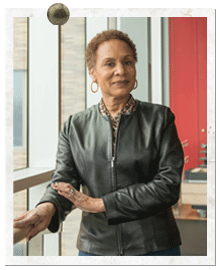
“A culture of pride is passed on from year to year,” observes Valerie A. Thomas, associate vice president of human resources at UMBC, “with long-term employees setting an example for the new employees.”

Beyond the numbers (and pervasive positive influence) of UMBC employees who make long-term careers at the university, however, are the individual stories of vision and perseverance in advancing the mission of the institution.

Rochelle Sanders, a director in UMBC’s human resources department, says that the feeling among UMBC staff members past and present that they have the power to make a difference in the lives of students has played an immense role in the university’s success over 50 years.

“In listening to employees who are initially coming on board [at UMBC],” Sanders observes, “the consistent thing that comes to mind is that they know the university cares for students, and that they want to be part of making the student experience better.”

Talk with UMBC staff members past and present as we did, and you find that the “caring” and “community” they speak of exists not just for students, but across the university community. It’s a thread that is woven through UMBC’s history. These are stories of that community.

Resident Experts —Mary K. Tilghman ’79

Books and Bytes —Jenny O’Grady

Taking Stock —Theresa Donnelly ’13

Striving for the Best —Richard Byrne ’86

Finding Paths —Richard Byrne ’86

Green and Growing —Mary K. Tilghman ’79

Unlocking Knowledge —Nichole Zang Do ’15

Biology and Family —Nichole Zang Do ’15

Working the Water

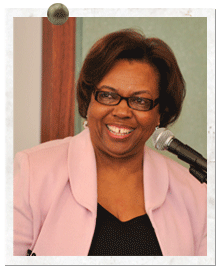
Melanie D. Harrison-Okoro ’11, Ph.D. environmental science, was raised outside Tuskegee, Alabama, where her family taught her to catch bass and catfish on Lake Martin. “My twin sister and I were out on the lake all the time with my great-grandmother,” she says. “She was the person who taught us about conservation and preservation. It just stuck.”

Twenty-five years later, Harrison-Okoro is responsible for the well-being of fish species across the Western United States. As an environmental scientist and water quality specialist for the National Oceanic and Atmospheric Administration (NOAA), Harrison- Okoro monitors the health of rivers in California, Idaho, Oregon, and Washington.

“On any given day,” she says, “I could be working on the Columbia River, the Klamath, the Feather – wherever folks need my expertise.”

Harrison-Okoro first came to Maryland for a summer internship in 2005, just after she graduated from Johnson C. Smith University, a historically black institution in North Carolina. She worked at the Baltimore outpost of the Cary Institute of Ecosystem Studies, a New York-based research center, spending long hours alongside streams and rivers in and around Baltimore, assessing the dynamics of nitrogen hot spots.

“I learned that summer about agricultural and urban nitrogen runoffs, and about algae blooms that can kill off everything in a stream,” she says.

Peter M. Groffman, a microbial ecologist at the Cary Institute and an adjunct professor at UMBC, was Harrison-Okoro’s mentor. “I could see right away that she had an aptitude for this,” Groffman says. “The trick in environmental science is to identify testable, significant questions in a complex setting with lots of uncontrolled variables, and Melanie is very good at that.”

In the spring of 2006, Harrison-Okoro was working in a lab in Winston-Salem, North Carolina. “We were studying the impact of cocaine on rhesus monkeys,” she says. “I hated it.” One evening, she got a call from Groffman. UMBC had just received a major grant from the National Science Foundation to launch an interdisciplinary doctoral program in urban ecology. Would she be interested in applying?

The decision to go to UMBC meant turning away from a long-held plan to pursue a medical degree. But Harrison-Okoro has never regretted the new path she chose. She especially appreciated the design of the degree program. “The idea was that we would have depth in a specific discipline, but also have breadth across a range of disciplines,” Harrison-Okoro says. “We studied economics, we studied ecology, we studied public policy. All of these things were interwoven.”

For her dissertation project, Harrison-Okoro continued to examine nitrification in the Baltimore region. Among other things, she found evidence that local urban wetlands absorb a significant amount of agricultural nitrate runoff, preventing it from polluting the Chesapeake. In a 2011 paper in the Journal of Environmental Quality, Harrison-Okoro and four co-authors argued that with proper management, urban wetlands might play that denitrification role even more effectively.

“At her dissertation defense, she just blew me out of the water,” says Claire Welty, a professor of chemical, biochemical, and environmental engineering, and the director of UMBC’s Center for Urban Environmental Research and Education. “She was in total command of her material.”

In 2009, Harrison-Okoro received a federal doctoral traineeship from NOAA that provided her with federal supported for her last two years of graduate school in exchange for a commitment to serve at NOAA after graduation.

The offer meant moving to northern California, far away from family and friends. It also meant turning somewhat away from a focus on the ecology of cities. “I was interested initially in urban streams and the built environment. But I’ve been able to translate the two things that I love to talk about – which are fish and water quality – into the work that I do here with NOAA, which is very, very cool.”

The bulk of Harrison-Okoro’s work today concerns preserving river populations of chinook salmon, delta smelt, and green sturgeon, all of which have come under pressure during the California drought.

Harrison-Okoro also spends a good deal of time encouraging African-American and Latino students to pursue graduate studies in science, engineering, and mathematics. “In the last year, I’ve spoken to community groups in San Francisco, in Contra Costa County, in Sacramento,” she says. “I can’t say no to these things. My passion is to see increased diversity not only in the field I work in, but all across the STEM fields. I appreciate that UMBC has that commitment, and I want to carry it forward.”

— David Glenn

Firm Foundations – Unlocking Knowledge

Wi16-FF_Slowe

“What is the main reason you are here?”

That’s the question Stephen Slowe asks at the end of every training session he holds with the UMBC students who work alongside him as maintenance assistants.

Slowe says that he often gets the same answers from his trainees. “I’m here to learn how to fix locks.” Or, “I’m here to earn money.” Each time, however, he corrects them: “Your main job here is to get an education.”

Slowe has worked at UMBC since 1984, and he received his 30th year service award at a ceremony in December. He spent his first year at the university as a contractual groundskeeper, and became a permanent employee in the carpenter shop in 1985.

In 2003, Slowe moved to the university’s lockshop, where he worked until July 1, 2012. Then he joined a new team in the facilities maintenance offices that opened in the residence halls under Chesapeake dormitory. Slowe is one of the few facilities management personnel to work on the maintenance staffs of both academic services and residential life.

Over his 31 years at UMBC, Slowe has seen the university grow and change dramatically. And his work hasn’t all been repairing locks worn out by use. In that time, campus residences have been modernized, with card readers now replacing keys on the doors of many buildings. Along the way, Slowe has enlarged his professional skills and adapted his considerable knowledge of the campus to ensure that students are safe and that everything works as it should.

But while new buildings have sprung up in nearly every part of the campus, and the diversity of UMBC’s population expands, Slowe sees cohesion and community at the heart of the UMBC experience. The university has come a long way, he explains, but he sees UMBC students, faculty, and staff as “one unified community. You have different sections within the community, but one community.”

Stephen Slowe says the UMBC students he trains as maintenance assistants are the university’s “first line of defense” in troubleshooting problems.

Slowe is especially proud of his work with UMBC students, and especially the student employees he trains in facilities management. He says the student maintenance assistants (also known as “MAs”) who provide most of the basic maintenance fixes across campus are the “first line of defense to troubleshoot problems.” They work with Slowe and the rest of the facilities management team to keep the university in proper working order.

Slowe says teaching the MAs to perform basic lock maintenance is only one part of his job. The other part of his work is anchored in that question he always asks his students. He is committed to keeping those with whom he works focused on their education and the real reason they are attending UMBC.

“Power is knowledge,” says Slowe. “When someone wants to show you or teach your something, learn it. I ain’t been around here for 52 years for nothing.”

— Nichole Zang Do ’15

Talk Up the Town

Wi16-TUTT_tom

The challenges facing Baltimore City are significant – and have garnered international headlines. But listen to Tom Sadowski ’89, political science and public administration and policy, talk about the city and region, and you’ll hear a pep rally for a great metropolis.

As president and CEO of the Economic Alliance of Greater Baltimore, Sadowski has more than words to sell the city. He likes to tell the stories of local innovators and entrepreneurs who drive the area’s economic development and commercial success and create its public-private partnerships. And there is data undergirding the anecdotes. To date, projects organized by the alliance have exceeded $10 billion in value and created 50,000 jobs.

The important work Sadowski has done has not gone unnoticed. He’s earned numerous accolades, including the Baltimore Museum of Industry’s “Industrialist of the Year” and the Maryland Daily Record’s “Influential Marylander” and “Most Admired CEO” awards.

Sadowski says his experience at UMBC stirred his passion for economic urban development. He worked his way through college selling real estate, and soaking up knowledge he’d need later in UMBC courses like “Metropolitan Baltimore” – a class that focused on how local, regional, and national economies develop. UMBC internships also played a role, including a stint with the Baltimore County Economic Development Office, which hired him after graduation as a business development director.

Sadowski says UMBC faculty members proved to be able mentors. “It was real time coaching and instruction,” Sadowski recalls. “Not just, ‘Here’s what they were trying to say in the text.’ It was more like an ongoing conversation that they encouraged.”

UMBC President Freeman A. Hrabowski, III, has also been a source of inspiration. “[Hrabowski] is the physical embodiment of what UMBC represents: The potential of the mind, but also enrichment of the soul. He has an authentic interest in bringing that out in the student body.”

Sadowski takes great pride in economic initiatives in which the alliance has been instrumental, such as the U.S. military’s 2005 Base Realignment and Closure, or BRAC. The initiative reshaped the Defense Department’s infrastructure, and involved the relocation of several thousand military and civilian workers from around the country into the Baltimore-Washington region.

“After the base realignment, we were recruited to work on behalf of the region and its military facilities,” Sadowski observes. “That process was about recognizing that we are a world-class market in which to live, work, learn, and invest.”

Sadowski believes that it is an exciting time to push forward the process of rallying economic support for the region, especially as it evolves from a focus on government activity to attract more commercial activity. “We’re helping to lead discussions about how the government, educators, and industry can work together to support the federal mission here but also to help launch and scale commercially relevant opportunities that exist,” he says.

Job growth is one area where Sadowski sees great potential. “By 2020, half of our workforce will be millennials,” he observes. “They’re some of the most educated, digitally native individuals.”

It’s an area in which he sees his alma mater as playing a key role. UMBC’s Alex. Brown Center for Entrepreneurship embeds entrepreneurship into nearly 100 courses across the university, and the university’s research and technology park – bwtech@UMBC – provides students with internships and job opportunities.

“I’ve experienced professionally things that have been very rewarding, and have reinforced my pride in this region,” Sadowski says.

Sadowski also reflects on his personal stake in seeing the Baltimore region thrive as a worldclass market. He and his wife are raising five children here. Soon enough, those children will be young adults faced with the decision of where to live and work. “Hopefully, my kids will benefit from the work we’re doing now,” he says.

For now, Sadowski is taking advantage of the livability of the region he champions. “I live in northern Harford County, and the sun sets every day in our back yard,” he says. “[But] in two hours, I can be seated at a meeting in New York. The access in this region is incredible.”

— Elizabeth Heubeck ’91

Tales of Grit & Greatness

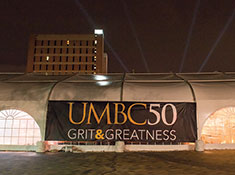
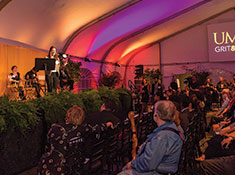
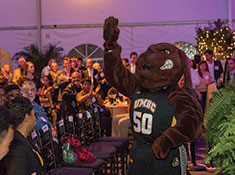
At Homecoming 2015, more than 300 members of the UMBC community (with alumni in the majority) gathered to kick off a more-than-year-long commemoration of the university’s 50th anniversary with an event that focused on alumni pride and volunteerism.

The gathering brought together committed UMBC alumni volunteers and donors to inaugurate an effort to connect almost 70,000 graduates to the celebration of UMBC’s 50 distinctive years as a public research university.

Wi16-AE_event

The motto for the 50th celebration – “Grit and Greatness” – was also unveiled at the event, and stories of UMBC alumni who embodied those qualities were a key part of the festivities hosted by Baltimore storyteller Kevin Griffin Moreno ’96, history.

As Corey Fleischer ’05, ’08 M.S. mechanical engineering, and winner of the engineering-themed TV competition Big Brain Theory: Pure Genius, told the audience: “Anything worth doing requires a significant amount of grit. And the amount of grit really helps define that total greatness.”

Wi16-AE_event-02

Some alumni touched on how their UMBC experiences helped those qualities emerge in their own lives. Amanda Rothschild ’07, English, talked about how her professors’ insistence that she give them her best work “taught me to face my fears, look on them, examine them, and work on them.” It was a foundation that helped her become a leader in Baltimore business as a founder of Charmington’s – a Baltimore restaurant that has so successfully married innovation in social issues and commerce that President Barack Obama made a visit in 2015 to see how Rothschild did it.

“I learned so much from being on the UMBC campus,” said Joseph Jones ’06, social work, founder of Baltimore’s Center for Urban Families (CFUF). Jones was encouraged by UMBC President Freeman A. Hrabowski, III, to earn his degree at the university after working past a troubled youth that included a stint in jail. He told the audience that “I learned how to be a scientist in social services by coming to this honors university.”

Sometimes it is competition that brings out grit and greatness. Morgan Taylor ’15, financial economics, was a member of the first UMBC women’s soccer team to earn a place in the NCAA tournament in 2014. She described how she and her teammates battled through two losing seasons, inspired by their coaches’ insistence that they change the culture of their sport at UMBC. “We took to heart everything our coaches had instilled in us,” Taylor said, “and the culture of the women’s soccer team did change in our time here. We went from worst to first in our conference.”

Wi16-AE_event-03
Yet UMBC grit and greatness are not just qualities that advance individual lives. They also compel alumni to take action and give back.

Winona Caesar ’09, American studies, gave the audience insight into a post-graduation journey where determination to succeed has led her to become chair of the Megaphone Project (an organization that tells the stories of underserved communities in the Baltimore region) and apply to become an officer in the Baltimore Police Department. “I love Baltimore,” Caesar said. “I love to help Baltimore. And this is just taking it to another level.”

Diane Tichnell ’70, political science, was a member of UMBC’s first graduating class. She said the watchword for her generation was “innovate, innovate, innovate” – and that UMBC was a place that allowed its students to do that even in its earliest days. She challenged her fellow alumni: “Stick close to this campus. Make sure that the students now and the students in the future have the same chance.”

Bennett Moe ’88, visual and performing arts, a past president of UMBC’s Alumni Board of Directors, spoke about how his UMBC education spurred him to propose shifting board scholarships to students in need. “At first we thought we might need to soften the criteria a little bit to expand the pool of candidates,” Moe recalled. “What we found, though, was that the applicants to our scholarships – who were now applying based on a proven and urgent need – were no less qualified, no less exemplary, than those who previously applied for the merit-based scholarships.”

The gathering’s emphasis on story was key for Adrienne Jones ’76, psychology, who serves as Speaker Pro Tem of the Maryland House of Delegates. She told the audience that the power of the UMBC story is what has allowed her to be a powerful advocate for the university and to ensure it has the resources to grow along with its achievements and ambitions. “Whatever I am able to accomplish for our alma mater is possible,” she said, “because UMBC is such a great story – your story.”

It’s not too late to get involved. Please visit 50.umbc.edu to see how you can volunteer – and to view videos of alumni stories and remarks by UMBC President Hrabowski.

— Richard Byrne ’86

Firm Foundations – Taking Stock

Even in its earliest days, UMBC had a bookstore. At the university’s founding, the bookstore was the “go-to” place for the textbooks and course materials students needed to succeed.

A university bookstore is also a hub of university life – selling everything from batteries to swag – and strategically placed to be where the students are. For many years, UMBC’s bookstore was located in the Academic Services Building and in the University Center before moving to its current two-level home in The Commons.

Robert Somers, director of the UMBC Bookstore, is known on campus as “Bookstore Bob.”

The appeal of a career in the university bookstore biz was something that Robert Somers – the longest serving director of the UMBC Bookstore – was undecided upon when he took a job there in 1990. The man now known on campus as “Bookstore Bob” recalls thinking that working in a university atmosphere would either “keep him young” or “kill him.”

There have been sweeping changes in how students obtain the materials they need for courses over UMBC’s history. But talk with Somers and Ralph Anderson, the bookstore’s manager of shipping and receiving (who arrived at UMBC in 1982) and you get a sense not only about those shifts in technology and delivery, but also their commitment to and enthusiasm for the work of learning and building community at the university.

Ralph Anderson, manager of shipping and receiving at the UMBC Bookstore.

Anderson recalls that when he joined the UMBC staff in 1982, many more people knew about the nearby Community College of Baltimore County (known back then as Catonsville Community College, or CCC). It was a time, Anderson says, when “the library only had two stories, there were only three dorms, and work on the apartment buildings was just beginning.”

Both men say that one of the hallmarks of UMBC’s bookstore through the years has been a commitment to customer service. As a veteran of larger book retailers such Follett Books and Barnes & Noble, Somers brought his knowledge of best practices to campus. Both men agree that talking to their customers, including student workers, to find out what customers need is essential. As Somers puts it, it’s important to ask, “Who are we selling to?” Part of answering that question is making a regular effort to “go straight to the horse’s mouth” and “find out what students need” by asking them directly.

Another part of customer service is getting UMBC students and other members of the university community the best possible prices, especially since much of what the bookstore sells is required reading. Doing so in the age of online discount retailers such as Staples and Amazon presents significant challenges, and in some areas (such as office supplies, including furniture and file cabinets), large retailers’ ability to offer lower prices at the click of a mouse led UMBC’s bookstore to phase out the sale of such items.

Reflecting on the ability of online retailers to provide these items quickly and cheaply, Somers says, “You can try selling these other items…but who’s going to buy them? In today’s world, students can get what they need in 24 hours and at a better price.”

The digital age does offer the UMBC bookstore new opportunities as well. Somers and Anderson are both excited about “The Course MaterialsInitiative,” a new program launching this spring, which will provide materials for 12 courses exclusively via UMBC’s Blackboard system. Though Somers readily acknowledges that students will likely “always be able to find course materials cheaper elsewhere,” he says his negotiations with the publisher of the materials means “the vast majority of UMBC students are going to benefit from the initiative’s very low pricing.”

One area in which the UMBC Bookstore has undoubtedly boomed is the increasing array of UMBC-branded items on offer, keeping pace with the university’s ever-growing alumni base. Somers reports that, “Whether it’s a UMBC mug, a notebook, or a tie, those sales are way up,” and estimates that sales of clothing emblazoned with the UMBC logo “have probably tripled” since he arrived in 1990.

Visiting alumni may also be pleased to see that the bookstore’s Yum (Your University of Maryland) Shoppe is still going strong. Somers and Anderson say that have worked hard over the years to ensure that the shop offers exactly what students want at the lowest prices possible. Anderson notes that not only is the Yum Shoppe competitively priced, but that it offers a variety of items not found anywhere else in the greater Baltimore area – from British candy bars to sodas normally sold only in the Southern United States. Even if just one student requests stocking a particular item, Anderson says, the Yum Shoppe will carry it. It’s part of a personal touch and a sense of community at UMBC that both men identify closely with the leadership of President Freeman A. Hrabowski, III. “At UMBC if you need help, all you have to do is ask for it,” says Somers.

— Theresa Donnelly ’13

Firm Foundations – Striving for the Best

UMBC is lauded for its strength in undergraduate teaching and its ability to involve undergraduates in academic research across disciplines. But how was this culture created?

Some of it was there from the beginning in the hiring of young, ambitious professors who were eager to innovate. That pioneering spirit was crucial to the creation of UMBC’s interdisciplinary studies program (first known as “Option II”) in 1969. But much of the infrastructure has been developed by staff members dedicated to student success.

UMBC’s Meyerhoff Scholars Program, created in 1988, is one of the landmark contributions to student success at the university – and has become a national and international model for creating greater diversity in STEM disciplines through concentrated cohort learning.

Ernestine Baker, former executive director of UMBC’s landmark Meyerhoff Program.

Ernestine Baker, former executive director
of UMBC’s landmark Meyerhoff Program.

Earnestine Baker, served as director and later executive director of the program before turning over the reins to her successor, the late LaMont Tolliver, who was succeeded by Keith Harmon. She recalls being in the room for the very first meeting with UMBC President Freeman A. Hrabowski, III, to create the initiative in July 1988. Tackling a problem that had bedeviled American higher education for decades might have seemed daunting, but Baker says, “I never felt that it was a risk from the first day.”

Baker says offering the students in the program challenges and support in equal measure was a key to success. “I knew having worked with [UMBC] students that we had capable students who were not working consistently at the highest levels,” she recalls.

Setting a high level of expectation was a key to the program’s success. “A student would say ‘I got a 95,’” says Baker. “But we were always asking ‘What happened to the other five?’” Yet those expectations were accompanied by a “supportive environment” that included not only formal academic advising from faculty and staff, but “social and moral support and encouragement.”

Baker says that by the third year of the Meyerhoff Program, she realized that it was going to work. “You could see the culture changing,” she says. By the fifth year, she adds, “we observed Meyerhoff students displaying the strong values and goals of the program.”

The Meyerhoff Scholars Program was aligned with UMBC’s vision of itself in that era as an “Honors University in Maryland” – and it remains a significant point of pride for the university. But perhaps the most compelling part of the Meyerhoff story is how its culture spread throughout the entire institution, spurring new projects to promote student success to a growing number of UMBC students across colleges and disciplines.

Kathy Sutphin ’95, political science, is assistant dean for academic affairs in the College of Natural and Mathematical Sciences.

As assistant dean for academic affairs in the College of Natural and Mathematical Sciences, Kathy Sutphin ’95, political science, has had a key role in creating, implementing and/or supporting a number of projects to assess and advance student outcomes, including new teaching spaces such as the CASTLE and the Science Learning Collaboratory. She has also been active in programs that support transfer student success (the CCCSTEP, and the STEM Transfer Student Success Initiative) and help provide pathways for students into research careers (the MARC U*STAR Program at UMBC). Sutphin’s most recent project – the STEM BUILD at UMBC Initiative – was recently funded by a $18 million grant from the National Science Foundation.

“I think we identify an area that we want to explore, and then we expand it.” For example, the Chemistry Discovery Center paved the way for the CASTLE, which was fun to put together with Provost Philip Rous. And then [William LaCourse, dean of CNMS, had the idea of doing the Science Learning Collaboratory, and now these projects have evolved into the Interdisciplinary Life Sciences Building. “We learn and grow, and keep trying to do a better job.”

Sutphin came to UMBC in 1995 from a career in journalism, which she says was good preparation for grant writing. She worked with the biological sciences department (including supporting the renovation of the Biological Science Building), before moving to the newly created College of Natural and Mathematical Sciences in 2005. She identifies increasing collaboration across the university as a key to success in new projects.

“It used to be UMBC had gotten as far as it had because the faculty and staff were very talented, and lots of times they could use their talents in roles and they would excel. But there were many small shops that were often dependent on one person. And now everything has grown and evolved, so you don’t just have one person. You have groups of talented people, and then they work together to make a difference.”

Jill Randles, assistant vice provost and assistant dean for undergraduate education.

Jill Randles, assistant vice provost and assistant dean for undergraduate education.

Balancing innovation in student success with strong fundamentals is just as important. One staff member who ensures that this happens is assistant vice provost and assistant dean for undergraduate education Jill Randles, who manages the university’s programs to boost undergraduate student success – including an array of first-year programs that get new students off to a flying start.

Randles arrived in 1992, working as a one-stop advising and assistance shop for evening students at UMBC. “I was the adviser,” she recalls. “I was the person who did their IDs and laminated them. I did everything for them.”

Eventually Randles moved to the College of Engineering and Information Technology, where she handled undergraduate student services for the college before moving to the provost’s office and working on undergraduate success across the entire university community.

Randles treasures her role as one-on-one adviser, and has made sure to maintain that individual contacts as she addresses broader issues. She also cherishes the diversity of the student community she serves. “When the first student I ever advised was a Russian immigrant,” she recalls, “I thought this is a place where I’m going to learn something different, and I’m going to learn more about the world community and be a part of something that’s more integrated with a global perspective.”

Preserving a balance between developing new ideas and building on successes is essential to preserving UMBC’s reputation as a model for undergraduate education. “I think we are learning how to be more strategic about the things we think are good
ideas, and I think that will serve as well,” Randles observes. “But I would not want this institution to be any less dynamic. I think that is one of the things that keeps it interesting and creative. But I do think we have to be thoughtfully dynamic…. I think we attract people who have that same sense of ideas and creativity. It’s an institution full of people who like to do things.”

— Richard Byrne ’86

Firm Foundations – Resident Experts

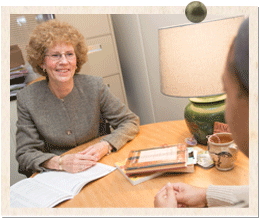
Clolita Vitale ’75, theatre, started her influential career at UMBC as a resident assistant.

The UMBC journey of Clolita Vitale ’75, theatre, eventually took her to a top leadership position at the university. But one of her first steps was moving into one of UMBC’s then-new residence halls as a student.

Vitale vividly recalls the thrill of those first days of dorm life at UMBC. When she arrived at the university, the first dormitory building had not even opened. But as soon as Dorm I (now “Susquehanna Hall”) was ready in autumn 1970, Vitale was one of the first to move in.

As a student and then as a resident assistant (RA), Vitale lived in all three dorms built during her years as a UMBC student. “There was a certain excitement about being the first ones in the dorms,” she says. “UMBC was a little ahead of the curve back then.”

UMBC’s dorm rooms were relatively modern for that era, equipped with phones, individually controlled heat and air conditioning, and bathrooms shared between two rooms instead of communal showers and toilets.

Vitale remembers UMBC’s first resident students as a close-knit group who gathered together regularly outside in the mini-quad between the buildings, in each dorm’s lobby, or in her senior year, on the patio of what was once known as Dorm III. (Now known as Patapsco Hall.)

“We used to be out there all the time,” says Vitale, who after graduation held jobs in UMBC’s purchasing department, and then as director of procurement, before eventually becoming an assistant vice president and general counsel for the university until 2007. In every case, that work kept her involved in the growth of UMBC’s resident student community.

Along with Mark Behm, who was vice president of administrative affairs from 1988 to 2005, Vitale was involved in the planning, design, and furnishing of each new residential project. She remembers choosing furniture and looking at fabric swatches. “It was kind of like designing your house,” she says. “We were pretty much involved in the whole process.”

She brought her own experiences as a resident student to the work. “I had a lot of interaction with students doing that,” recalls Vitale. “This is your university. How can we make it work for you?”

Jim Milani ’73, political science, expanded programs for UMBC’s resident students.

Jim Milani ’73, political science, expanded
programs for UMBC’s resident students.

Making UMBC resident students feel at home has also been a driving force in the careers of current UMBC staffers Jim Milani ’73, political science, and Nancy Young, the school’s current vice president of student affairs.

Milani worked in UMBC’s Office of Residential Life from 1978 to 1987, and for the last five years served as its director. A desire to enhance the experience for resident students was in his mind each time he answered an emergency call or scheduled a program.

“We stressed a community where you appreciate differences,” says Milani, who is now the director of administrative affairs in the College of Engineering and Information Technology. “We’re all different, but that’s okay. You respect one another and you take care of one another,”

Milani, who holds a master’s degree in counseling and previously worked on UMBC’s counseling staff, organized student workshops to help build community. Most notable was a student wine tasting held as part of an alcohol education program, but other workshops focused on leadership, dating, and racial sensitivity.

UMBC also expanded its housing options beyond dormitories during Milani’s tenure. Students clamored for apartments but had few options off campus. So UMBC built its own.

The first complex, West Hills, was designed as much to meet the needs of faculty or staff families, recalls Milani. The students who lived there were polled for recommendations in planning the Terrace and Hillside apartments.

“Student voices mattered,” Milani says. “We got our best ideas from students.”

UMBC’s transformation from a commuter school – once expected to have 20,000 day students – to a residential campus where 75 percent of freshmen now live on campus and students can reside in “living learning communities” has meant even more growth.

Nancy Young says residence halls are a key part of the “cultural interaction” at UMBC.

Nancy Young says residence halls are a key part of the “cultural interaction” at UMBC.

When Nancy Young joined the Office of Residential Life in 1986, UMBC offered 1,500 beds in its three 1970s-era dorms and the two apartment complexes. Now it boasts over 3,500 places in 31 buildings. She has overseen construction of virtually every residence since – first in the Office of Residential Life where she later became co-director, and since 2007 as vice president for student affairs.

Young says one of her priorities is to ensure every residence hall has “double-loaded corridors” that require students to interact with fellow residents. She cites post-graduation assessments from students that recall fond memories of interactions with students with different life experiences and cultures. “The residence hall is where most of that cultural interaction takes place,” she says.

Both Milani and Young credit previous residence life directors Dave Herman and Clarence Robinson for fostering what Young describes as “a sense of an individual caring for students” that continues to this day under Kim Leisey, associate vice president for student affairs.

“We really are a culture of care,” Young says.

Milani concurs. “Since the first students occupied the residence halls at UMBC, there has been a cadre of professional staff and student staff who focused on creating and developing environments that fostered the academic, personal, intellectual, cultural, and social development of our residents,” he observes. “In this sense, every generation has stood on the shoulders of those who came before and further developed the system that they inherited.”

Young observes that these values have endured. She recalls a retreat held before UMBC’s 40th anniversary during which students, alumni, faculty, and staff discussed what they valued about their campus experience. Students from each decade chose the same core values: family, growth and opportunity, diversity, superior academic achievement, and pioneering spirit.

“We have become the place we are, reflecting our values from the 60s that continue to weave through all 50 years of our experience,” Young says. “Students matter. I want them to have all the benefits of a large research university with all the warmth and personal care and attention of a small liberal arts college. For me that’s what UMBC is.”

— Mary K. Tilghman ’79

Power Player

Wi16-PP_Ernie

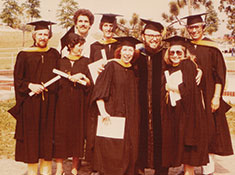
Ernie Kent ’77, M.P.P. public policy, recently returned to campus to talk about her time as one the first group of 12 students enrolled in UMBC’s public policy master’s program – a group dubbed “the Dirty Dozen.”

Many of those students – including Kent and other members of the program’s first graduating class of seven students in 1977 – went on to have distinguished careers in public service in Maryland and elsewhere.

Indeed, Kent was among the most knowledgeable and effective figures in Maryland politics from the 1960s through her retirement from state government in 2000. Her career was spent mostly behind the scenes, starting as a researcher for the Maryland Constitutional Convention in 1967–1968. Her achievements and her passion for making state government function better won her key positions under a number of Maryland administrations – starting with Governor Marvin Mandel in 1968 – and in the private sector.

In December 2000, Baltimore Sun political columnist Barry Rascovar lauded Kent’s roles in streamlining of Maryland’s governmental structure under Governor Mandel and in a number of state redistricting efforts, calling her “one of those silent heroes with an institutional memory and a grasp of government detail who makes government work.”

Kent also played a role in the founding of UMBC’s highly-regarded Public Policy program – which became the UMBC School of Public Policy in 2015. “We were asked to be part of the program,” recalls Kent, who was impressed by the wide range of governmental experience and discipline represented in the first group of graduates.

Wi16-PP_Ernie-02

A picture of the program’s first seven graduates that Kent provided to UMBC Magazine illustrates that perfectly. Along with Kent, who was still a member of Governor Mandel’s staff at that time, one sees her husband, Jack Kent ’77, M.P.P. public policy, who was then an assistant secretary in Maryland’s Department of Health and Mental Hygiene, and became a delegate in the Maryland House of Delegates and a senior executive at Sheppard Pratt Hospital. There is another future member of the Maryland House, Larry LaMotte ’71, sociology, and ’77, M.P.P. public policy, in the photo, along with Lauretta De Busk ’72, psychology, and ’77, M.P.P. public policy, who worked as a planner at Maryland’s Department of Health and Mental Hygiene and later joined the U.S. State Department. The late Ben Kleinberg, a professor of sociology who was one of the initiators of the program, is there as well, along with the late Sonia Sheinbach ’72, political science, and ’77, M.P.P. public policy, who worked for the Baltimore Social Services Administration, and her husband, Jerry Sheinbach ’77, M.P.P. public policy, who ran the Medicare Program at Social Security in Baltimore.

Kent says she “learned from the interchange of ideas with other members of the class and the teachers.” The program’s professors were drawn from disciplines including sociology, history, economics, psychology, and political science, and students even had the chance to use some of the university’s early mainframe computers. “I also acquired some computer skills,” Kent recalls, though she also remembers that results could vary “depending on which way you put the cards in.”

UMBC’s graduate programs in public policy have come a long way since that first class. The program admitted its first class of Ph.D. students in 1978 – and its doctoral program has become one of the largest in the nation, celebrating its 40th anniversary in November 2014.

“I am amazed how much the program has grown,” Kent says, “and how many tracks were now available to the students, as well as many more course offerings.”

— Richard Byrne ’86

Firm Foundations – Kathy Sutphin

Kathy Sutphin

As assistant dean for academic affairs in the College of Natural and Mathematical Sciences, Kathy Sutphin ’95, political science, has had a key role in creating, implementing and/or supporting a number of projects to assess and advance student outcomes, including new teaching spaces such as the CASTLE and the Science Learning Collaboratory. She has also been active in programs that support transfer student success (the CCCSTEP, and the STEM Transfer Student Success Initiative) and help provide pathways for students into research careers (the MARC U*STAR Program at UMBC). Sutphin’s most recent collaborative project – the STEM BUILD at UMBC Initiative – was recently funded by a $18 million grant from the National Science Foundation.

What follows are edited excerpts from a recent UMBC Magazine interview with Sutphin

Read our full story about how staff built UMBC’s infrastructure for student success.

On how UMBC works:
“It used to be UMBC had gotten as far as it had because the faculty and staff were very talented, and lots of times they could use their talents in roles and they would excel. But there were many small shops that were often dependent on one person. And now everything has grown and evolved, so you don’t just have one person. You have groups of talented people, and then they work together to make a difference.”

On what issues in student success motivate her:

I’m particularly interested in transfer success. And so one of the first projects I worked on in the college was writing a proposal targeting transfer students’ success. And it didn’t get funded, so I worked with [Dean] Geoff Summers. I said, “Well, how about we just try and pilot it, so we can understand some of the challenges that are going on with transfer students?” Because I was a transfer student, and I really understood that it’s a different world coming from there, and it’s not a question of talent, it’s just a question of knowing the right pathway, and how to be successful, and study a little differently. Because UMBC is an intense university; it’s rigorous.

So we tried a little experiment and we called it CCCSTEP, and we worked directly with the transfer students, and we really asked a lot of questions. And we learned a lot. At UMBC, “I think we identify an area that we want to explore, and then we expand it.” For example, the Chemistry Discovery Center paved the way for the CASTLE, which was fun to put together with Provost Philip Rous. And then [William LaCourse, dean of CNMS, had the idea of doing the Science Learning Collaboratory, and now these projects have evolved into the Interdisciplinary Life Sciences Building. “We learn and grow, and keep trying to do a better job.”

On what’s special about UMBC:

When I travel, I talk with people from other universities, I think what’s kind of unique about UMBC is that people stay. And I think you can get a lot done when you keep the same people. They may be in different jobs; they move around, but they stay at UMBC. Which I think is a cool thing.

Firm Foundations – John Martello

John Martello

John Martello ’76, M.S. psychology, held a number of key positions during his lengthy and influential career at the university, including vice provost for the Division of Professional Studies, chairman and CEO for UMBC Training Centers, and founder and executive director of The Shriver Center. (He will officially retire at the end of the Spring 2016 semester.)

What follows are edited excerpts from a recent UMBC Magazine interview with Martello.

Read our full story about how staff built UMBC’s infrastructure for postgraduate success.

On the path from applied learning programs at UMBC to The Shriver Center:

I got to UMBC in 1974 as a graduate student, and I did that full time for two years, at which point I took a grant-funded job, which was to establish the Cooperative Education Program.

I thought I do that for a year or two, and continue on with my doctoral studies. But I never really left UMBC, and I really enjoyed it, and proceeded to establish a number of programs and kind of get promoted along the way, and eventually finish my Ph.D.

As hard as it is to believe now, back in the 70s and 80s, the feeling of our faculty – and, at most universities, this was true – was that education is best which occurs in the classroom. Which, artfully stated, means we don’t really support internships, or co-ops, or God forbid, service learning. So we went from not having a university-centralized applied learning enterprise to having one. And it became one of the best ones in the state, if not the nation. It also formed a nucleus on which the Shriver Center was built.

The Shriver Center was a model of applied and service learning and service delivery – meaning the university would actually deliver services, not just do research or other traditional kinds of work with community-based programs. We actually developed and operated these programs, and some we kept – like the Choice program – and some we spun off.

The Choice program has certainly expanded, and it has survived Republican and Democratic administrations and budget-tightening, because its outcomes are so extraordinary, and it’s as simple as that. Even the most prudent cost-cutting analyst looks at Choice and says, “The cost not to do this would be higher than to do it.” Not only the social cost, but the economic cost.

The other great program was the Peaceworker Program, which Tim Shriver created conceptually as a gift to his father, Sargent Shriver. We became the headquarters for that initiative after a short stint at Georgetown University. The program continues to produce leadership for the city.

The majority of our Peaceworker graduates live and work here, and these are individuals from all over the country who attended wonderful undergraduate programs including UMBC, but some of the Ivy Leagues and top public universities as well. And they’ve demonstrated their commitment to work with thorny problems. What a great resource they are, intellectually, for Baltimore.

On UMBC’s innovative Training Centers:

Applied learning and service learning and professional studies and the training centers all fit under the term “engagement.” That term is bandied about, but in UMBC’s case, it’s the authentic belief that theory and knowledge creation – which is what universities have traditionally done – inform practice. But also that practice informs theory. So, for a variety of reasons, at different levels –some practical, some philosophical – UMBC has really taken the lead in engagement.

That means both the application of knowledge aimed at gaining productive work (applied learning, service learning) and our professional master’s programs and other applied and professional programs, which bring us closer to the professional community and working professionals.

UMBC Training Centers is unlike anything I’m familiar with nationally, because it is an LLC owned by a public university. There are probably other universities that control LLCs, but UMBC is unique in the Training Centers’ mission, application of knowledge, and ability to equip professionals with skills that they need today. We’ve moved non-credit training from something pedestrian to something that is popular and in demand. Three times, our LLC was identified as among the fastest-growing companies in the nation.

We serve community employers, but they help us with industrial advisory boards, and by empowering our students, supporting our students, and creating settings for interns and co-ops. We talk about multi-level partnerships. And it’s a more authentic and reciprocal engagement that’s academically based.

UMBC Training Centers became part of the institutional fiber, part of the mission and values. I think it makes us very unique. And it’s why we survived this terrible economy, because our students were having problems and challenges just like everyone else. But it’s pretty well known that UMBC graduates are quite good, and they managed to get employment because of who they were and what they had done, and the culture and programs at UMBC.

On balancing ambition and resources:

UMBC, in my experience, has always been – we call it “entrepreneurial,” but it’s probably “intrapreneurial.” Always with a huge ambition, and an outsized vision that couldn’t possibly be supported with the resources at hand. But instead of giving up or being despondent, or saying we’ll wait until the money comes in, we figure out a way to do things aimed at quality, hope, ambition, and desire to be the best. This connection to the world has served us well, because we generate resources, and we extend our reach and reputation.

How can you beat that, right? That’s my view. The theme that runs through my career – and I wish I could say I planned it this way – but it’s kind of doing God’s work at a profit. You elevate minds and spirits, but you do it in a way that manages not only to break even, but contributes resources for the important missions the university has that aren’t fully funded. So it’s perfect; it’s doing good work, and it’s revenue-positive.

Firm Foundations – John Haskell

John Haskell

John Haskell was UMBC’s first employee, hired in 1964 to build what has become the Albin O. Kuhn Library and Gallery.

What follows are edited excerpts from a recent UMBC Magazine interview with Haskell.

Read our full story about how staff built UMBC’s information infrastructure.

On how he was hired as UMBC’s first employee

In 1964, I was finishing up my Master’s in Library Science at Rutgers. and at that point, Howard Rovelstad, who was the head librarian in College Park, interviewed me. There was no such thing as a search committee. If there was somebody they wanted to hire, they would hire them. And so he said, ‘You’ll be one of a group of people who will be building the library on our new campus.’ And I said, “Well, I have to get my six months active duty with the Army Reserve behind me.’ You could go in for three, or get drafted for two, or do what I did. So I wanted to get in and get out, and I had a degree and I had a job. And he said, “Sure, we can wait till 1965.”

So February 1st of 1965, literally two days after I got out of the Army, I was on the UMBC campus. Although, actually, I was in College Park, because there was nothing there in 1965. So I had an office in the basement in McKeldin [Library].

I looked like I was about 15 years old when I was 24 years old, so people were appalled that they hired this young guy – and there was also the fact that he had never worked full-time as a professional librarian. College Park staff were sitting there waiting for UMBC to open so they could all get jobs in the library…. So I started, and one of the senior administrators in College Park called me into his office after they had decided I was going to be the librarian. And he said, “Where do they get off making you the head librarian?” I said, “Well, they must think I can do the job.” He was not happy.

On building the library.

There was a list of periodicals that the University of California was using called New Campus. It was both books and journals. These were titles that any academic library should have. So we just turned on the spigot and ordered all these periodical subscriptions. But where are you going to put them? When they first came, the mail just laid stacked up in a room on West Redwood Street for months [in downtown Baltimore] because we had no place to put them until we got shelving up at Hillcrest. So that was that.

We also had 25,000 volumes on the shelves on opening day acquired between February 1965 and September 1966 using that list. We never picked and choose any individual book. If it was on there, we just told the jobber to send it. And the book came with the cards in the back, the loose cards and the book had the call number on it, and so theoretically all you had to do was shelve it and file the card.

It wasn’t exactly quite that simple because you had to alphabetize the cards. And my wife and I kid about this, but when we were dating, sometimes we would spend our time alphabetizing cards.

I remember the campus was open in September 1966. It took us a while to get some of those books over there, and Dr. Kuhn would say, “John, when are we going to have it open?”