All posts by: UMBC News Staff


Firm Foundations – Jill Randles

Jill Randles

Assistant vice provost and assistant dean for undergraduate education Jill Randles manages the university’s programs to boost undergraduate student success – including an array of first-year programs that get new students off to a flying start.

What follows are edited excerpts from a recent UMBC Magazine interview with Randles.

Read our full story about how staff built UMBC’s infrastructure for student success.

On her early days at UMBC:

I started at UMBC in 1992, so I started the same year Freeman became president. He’s the only president I’ve known at UMBC… I came here thinking I would do a Ph.D., and become a licensed counselor – a practicing counselor. In the course of that time, I needed a job and I am still here.

The job was as an evening student services counselor, and if you think back to 1992, UMBC had Pine as our email, half of our information was not online, and we did have several programs that students could come pretty close to completing in the evening. My office was a little reconverted storage room right off the main registrar’s desk, which is still an office for someone over there.

I was the advisor. I was the person who did student IDs and laminated them, I did everything for them. We were a one stop shop for anybody at night. It was a great job; I enjoyed working with that population. It was a lot of nontraditional students, and learned a lot about the campus. I had to know a lot about the campus. I was even the person who jump started cars in the winter.

There weren’t many things open at night then. There was no place to get a drink. There was no place to get food. Nothing. It was vending machines and whatever you brought with you.

What makes UMBC special:

I have had the privilege of doing things that, at other institutions, I would have never been considered for. Yes, there is a hierarchy that you must respect, and that’s true of any institution. But we’re not so ingrained in what we do at UMBC that we don’t integrate people into new places all along the way. It’s something I just don’t think institutions that are older and more traditional do.

I do think UMBC is a community of care, and I don’t take that for granted. I think if we take it for granted, it can change.

We don’t always have a lot of funding for all of our good ideas. In my experience, UMBC has never seen a good idea it didn’t like, which is a plus and a negative. We are learning how to be more strategic about the things we think are good ideas to be funded and implemented, and I think that will serve us well. But I would not want this institution to be any less dynamic. I think that is what keeps it interesting and creative. But we have to be thoughtfully dynamic. For example, student success models. What are the things we really want to establish? How do we establish those, and then still manage experimental change, and stay a dynamic place?

Firm Foundations – Jack Suess

Jack Suess

Jack Suess ’81, mathematics, and M.S. ’95, information systems, is the director of UMBC’s Division of Information Technology (DOIT) and a witness to UMBC’s amazing growth in this key area of 21st century academia.

What follows are edited excerpts from a recent UMBC Magazine interview with Suess.

Read our full story about how staff built UMBC’s information infrastructure.

On his professional path into computer science at UMBC

In those days, computer science was under mathematics. I was majoring in math, and in my sophomore year, I was doing the applied math track. And somebody said, ‘Well, if you do the applied math track, you ought to take these programming courses, because the computer might be helpful at some day.’

So I ended up starting to take some programming classes. And from that, it was just one of those things where I was taking a couple programming classes, continuing to do the math, and I got an opportunity to be a teaching assistant for the COBOL class they wanted for economics. I really enjoyed sort of explaining to people how to solve their problems. So I got offered a job working in UMBC’s computer center it was called at that time. It was up on the third floor of what is now the Sondheim Building.

Up until then, I had been working either in retail at a small place or as a dishwasher. But it was always hard to take my programming classes because I didn’t have remote access. So you had to be here at UMBC to get access to the computer. So when the summer job came around, it really opened up the opportunity to continue taking the programming classes because now I could get access through my job….

I think I officially graduated in December. But I ended up just staying and taking classes in the spring because there were some classes I wanted to take, and they said I could continue working as a student. At the end of the spring, they had a position that came available here and they asked me if I wanted to apply for it. I did. And I was lucky enough to get it. And I started working at UMBC in June 1981 as a programmer analyst. I was actually doing administrative programming work where I designed databases and other sorts of applications for people.

On being there at the dawn of UMBC computing infrastructure

Up until 1982, all of our computing came from College Park from the academic side. There was a big mainframe at College Park and we were connected to that mainframe. And in 1982, the campus decided that it was going to go out and buy a big mainframe computer from a company called Control Data Corporation. CDC. It was a huge machine. It was housed in the basement of the library. It took up all of 2000 square feet of space for this beast of a machine.

In bringing that machine in, they needed somebody who could do what was called systems programming. Operate the machine and do upgrades to the operating system. And since I was the most recent graduate in the administrative side that actually had done the computer science – they asked me if I would do it. I ended up getting transferred over after about a year to be working on the CDC cyber system.

What’s always been amazing about UMBC is we were trying – and usually succeeding – at doing things we should never have thought we could do. The CDC machines usually had staffs of dozens of trained people to operate then. But it was myself – and then we had two or three really incredible students – who were running this sort of thing.

The CDC only lasted here a few years. Originally the funding model was that we were going to bring in this huge machine that would provide the academic computing context for UMBC, and it would also be used for instructional computing in Baltimore city schools. There was an application that Control Data had come out with called PLAY-DOH, which was the first sort of computer aided instruction.

It turned out we bought this and started heading down this path just as the first IBM PC was released. Then a year or two, it became apparent that the PC was the way to go, not using these dedicated specialized terminals that were going to be there for the PLAY-DOH system. And so they ended up deciding that they were going to get rid of the PLAY-DOH system.

One of the good things that came out of it was I got to teach for the first time. I think it was in 1983. There was a class in assembly language programming that was required in computer science, and they couldn’t find an instructor who knew the CDC assembly line language. Since I had learned it as part of my work, I got pulled into teaching the class. And that was probably a thing that really helped me. Having to get up and actually teach a class was something that gave me a lot of appreciation for how hard it is to teach and gave me more confidence to be able to go in and do these sorts of things.

Hooking up UMBC to the Internet and beyond

The turning point at UMBC was 1985. We decided to get rid of CDC and we ended up buying a large system from Digital Equipment Corporation. In buying that equipment, we ended up buying our first UNIX system that would be there, along with software that allowed you to hook that software system up to something called Bitmap. And Bitmap was really sort of the first communication system that went campus to campus. It allowed you to send email across campuses or you could transfer files from one campus to another. It was the first touch of what you think of as the Internet or networking.

In 1986, we ended up actually getting on the Internet when we got our first Internet connection on campus. That’s the time frame around the idea of Internet taking hold at UMBC. It was fun because you were starting to sort of explore the connectedness that was out there. I don’t think that at that point in time people were truly thinking how much [the Internet] was going to reshape the world. I certainly didn’t fully grasp it at that point of time.

The other thing that we ended up doing in 1985 was we set up the first Ethernet network on campus. And we started to hook other computers into that, so that you are starting to get the ability from your computer to connect in and do something. It was still minimalistic in 1985 but it was really the starting point.

The next big transition was in 1992 around the opening of the Engineering Building. What was transformative about that building was that we were able to get most of the equipment that we had requested.… We had a partnership with Silicon Graphics – now known as SGI – and we had decided to buy about 250 Silica and Graphics workstations. Most of our labs were running the Silica and Graphics workstations. We bought these big, high performance computing systems. So that’s where we started supporting that. All of our faculty in computer science ended up getting SGI workstations.

What was opportunistic about having that UNIX infrastructure is in the early 1990s was that the web is initially designed for UNIX. It didn’t work on an IBM PC. A little bit later they ended up having a sort of a Mac browser. But to really get the full browser experience, you needed a UNIX workstation. So the campus adopted the web, adopted UNIX, and leveraged the Internet in a completely different way than we would have because of the fact that we had all of these UNIX workstations that had come with the building. We could build up a much more robust environment.

Firm Foundations – Green & Growing

UMBC boasts no ivy, and no classical columns. But as a university designed as a primarily-commuter campus in the turbulent 60s, it was also born free of any traditional restraints on how a campus should look.
Joe Rexing, UMBC’s director of facilities management
The low-slung Albin O. Kuhn Library & Gallery was the only one of the first wave of campus buildings that did not incorporate brick. Designers of the initial UMBC campus created buildings that were contemporary, accessible to all, and, as Joe Rexing, director of facilities management puts it, “forward-looking.” Rexing, who came to the university in 2004, adds that “[UMBC] is not as bound or mired in tradition as some older institutions were.”
Indeed, as times have changed, the needs and the look of the UMBC campus have also shifted. The university now has 4 million square feet of office and learning space on 512 acres, with 14,000 students – 4,300 of them residents.
As director of capital planning, Nancy Quantock oversaw the construction and renovation of many new buildings in the 1990s.
As UMBC’s director of capital planning in the 90s, Nancy Quantock helped to direct a major expansion of the physical campus.
Quantock came to UMBC from the University of Maryland System, eager to work on the buildings that would define the university for a new generation of students.
“I never did it for me,” she says. “I always did it for the kids.”
Her role in supervising the distinctive tower addition to the Albin O. Kuhn Library & Gallery and the creation of the light-filled Commons rank among her favorite achievements, but Quantock also oversaw planning and design of two other new buildings (Physics and Information Technology/Engineering), an expansion for the Retriever Activities Center, and upgrades to the Biological Sciences and Meyerhoff Chemistry buildings.
Quantock relied on what she calls “very good talent” to design, build, or renovate each project, and enjoyed her role in ordering, furniture and equipment for the new spaces. She also worked behind the scenes with UMBC President Freeman A. Hrabowski, III, as he lobbied for funds in the Maryland General Assembly. “Working with Freeman was a joy,” she recalls.
While the look of UMBC’s campus changed dramatically during her tenure, Quantock always kept an eye on the original master plan for the university as she undertook two new versions of the master plan during her time at UMBC. “We tried to keep a contemporary look but added a lot of glass,” she says. “You need to keep a modern campus looking modern.”
The glass was part of Quantock’s push for light-filled spaces, which she argues makes work more enjoyable. “We talked a lot about that,” she recalls. “It’s really important for the kids.”
Rusty Postlewate, assistant vice president of facilities management at UMBC.
As the campus continues to grow in the 21st century, Rexing and Rusty Postlewate, assistant vice president of facilities management, are helping to chart UMBC’s future expansion.
Postlewate, who spent 30 years with the U.S. Army Corps of Engineers, came to UMBC in 2010 to oversee planning, design, and construction of new capital projects, as well as renovation, operation, and maintenance of existing buildings.
Rexing, an architect who has worked as a higher education consultant on more than a dozen campuses, first got to know UMBC as a consultant on the Public Policy Building.
Rexing and Postlewate both find inspiration in the 1963 master plan for UMBC, which proposed setting the first buildings into the existing hillside site to make them easily accessible on several levels, and linking buildings with bridges and housing utilities in tunnels.
“That’s pretty unusual,” Postlewate observes.
UMBC’s latest master plan looks ahead to 2019, forecasting the need for new academic and student services buildings, additions to residence facilities, as well as two new major buildings: a UMBC Events Center (which breaks ground in February 2016) and an Interdisciplinary Life Sciences Building to replace the Academic Services Building.
“It’s unlikely that we’ll quit growing,” Rexing says. And UMBC’s growing prominence and advances in innovative pedagogy mean new and different kinds of spaces are essential. In the classroom, team projects are replacing lectures and round tables are replacing desks.
“The success we have had must translate to meeting the needs that support that success,” Rexing observes. “The way we teach is even changing. Architecture has to keep up, and planning has to keep up with those kinds of changes in pedagogy.”
Planning new buildings doesn’t happen in a vacuum. UMBC’s commitment to shared governance means campus committees can express their own ideas as a new building is proposed. In that emphasis on shared governance, observes Rexing, “I’d say UMBC is unique.”
Protecting UMBC’s legacy is a critical part of Rexing and Postlewate’s mission. “It’s 50 years of investment and history that we’re building upon,” notes Rexing.
That means preserving and protecting what’s already on campus: its green spaces, the old academic buildings, and its aging dorms. “Infrastructure is more a part of the future than it has been in the past,” observes Postlewate.
Key elements of the legacy have new looks. The Library Pond, for instance, recently got a complete (and environmentally friendly) facelift, and all the university’s dorm rooms have been refurbished. In the Fine Arts Building, 30 percent of the building’s old systems and outdated spaces are undergoing a major overhaul, according to Postlewate.
The rest still needs upgrading. “I think of it as stewardship,” says Rexing. “I consider [UMBC] a valuable Maryland state asset and we’re charged with the care of it.”
— Mary K. Tilghman ’79

Firm Foundations – Green & Growing

UMBC boasts no ivy, and no classical columns. But as a university designed as a primarily-commuter campus in the turbulent 60s, it was also born free of any traditional restraints on how a campus should look.

Joe Rexing, UMBC’s director of facilities management

The low-slung Albin O. Kuhn Library & Gallery was the only one of the first wave of campus buildings that did not incorporate brick. Designers of the initial UMBC campus created buildings that were contemporary, accessible to all, and, as Joe Rexing, director of facilities management puts it, “forward-looking.” Rexing, who came to the university in 2004, adds that “[UMBC] is not as bound or mired in tradition as some older institutions were.”

Indeed, as times have changed, the needs and the look of the UMBC campus have also shifted. The university now has 4 million square feet of office and learning space on 512 acres, with 14,000 students – 4,300 of them residents.

As director of capital planning, Nancy Quantock oversaw the construction and renovation of many new buildings in the 1990s.

As UMBC’s director of capital planning in the 90s, Nancy Quantock helped to direct a major expansion of the physical campus.

Quantock came to UMBC from the University of Maryland System, eager to work on the buildings that would define the university for a new generation of students.

“I never did it for me,” she says. “I always did it for the kids.”

Her role in supervising the distinctive tower addition to the Albin O. Kuhn Library & Gallery and the creation of the light-filled Commons rank among her favorite achievements, but Quantock also oversaw planning and design of two other new buildings (Physics and Information Technology/Engineering), an expansion for the Retriever Activities Center, and upgrades to the Biological Sciences and Meyerhoff Chemistry buildings.

Quantock relied on what she calls “very good talent” to design, build, or renovate each project, and enjoyed her role in ordering, furniture and equipment for the new spaces. She also worked behind the scenes with UMBC President Freeman A. Hrabowski, III, as he lobbied for funds in the Maryland General Assembly. “Working with Freeman was a joy,” she recalls.

While the look of UMBC’s campus changed dramatically during her tenure, Quantock always kept an eye on the original master plan for the university as she undertook two new versions of the master plan during her time at UMBC. “We tried to keep a contemporary look but added a lot of glass,” she says. “You need to keep a modern campus looking modern.”

The glass was part of Quantock’s push for light-filled spaces, which she argues makes work more enjoyable. “We talked a lot about that,” she recalls. “It’s really important for the kids.”

Rusty Postlewate, assistant vice president of facilities management at UMBC.

As the campus continues to grow in the 21st century, Rexing and Rusty Postlewate, assistant vice president of facilities management, are helping to chart UMBC’s future expansion.

Postlewate, who spent 30 years with the U.S. Army Corps of Engineers, came to UMBC in 2010 to oversee planning, design, and construction of new capital projects, as well as renovation, operation, and maintenance of existing buildings.

Rexing, an architect who has worked as a higher education consultant on more than a dozen campuses, first got to know UMBC as a consultant on the Public Policy Building.

Rexing and Postlewate both find inspiration in the 1963 master plan for UMBC, which proposed setting the first buildings into the existing hillside site to make them easily accessible on several levels, and linking buildings with bridges and housing utilities in tunnels.

“That’s pretty unusual,” Postlewate observes.

UMBC’s latest master plan looks ahead to 2019, forecasting the need for new academic and student services buildings, additions to residence facilities, as well as two new major buildings: a UMBC Events Center (which breaks ground in February 2016) and an Interdisciplinary Life Sciences Building to replace the Academic Services Building.

“It’s unlikely that we’ll quit growing,” Rexing says. And UMBC’s growing prominence and advances in innovative pedagogy mean new and different kinds of spaces are essential. In the classroom, team projects are replacing lectures and round tables are replacing desks.

“The success we have had must translate to meeting the needs that support that success,” Rexing observes. “The way we teach is even changing. Architecture has to keep up, and planning has to keep up with those kinds of changes in pedagogy.”

Planning new buildings doesn’t happen in a vacuum. UMBC’s commitment to shared governance means campus committees can express their own ideas as a new building is proposed. In that emphasis on shared governance, observes Rexing, “I’d say UMBC is unique.”

Protecting UMBC’s legacy is a critical part of Rexing and Postlewate’s mission. “It’s 50 years of investment and history that we’re building upon,” notes Rexing.

That means preserving and protecting what’s already on campus: its green spaces, the old academic buildings, and its aging dorms. “Infrastructure is more a part of the future than it has been in the past,” observes Postlewate.

Key elements of the legacy have new looks. The Library Pond, for instance, recently got a complete (and environmentally friendly) facelift, and all the university’s dorm rooms have been refurbished. In the Fine Arts Building, 30 percent of the building’s old systems and outdated spaces are undergoing a major overhaul, according to Postlewate.

The rest still needs upgrading. “I think of it as stewardship,” says Rexing. “I consider [UMBC] a valuable Maryland state asset and we’re charged with the care of it.”

— Mary K. Tilghman ’79

Up on the Roof – Winter 2016

President HrabowskiUMBC President Freeman A. Hrabowski, III, takes your questions.

The role of UMBC’s staff members in the story of the university’s rise to prominence is often overlooked. What are your reflections on how UMBC’s staff members have contributed to the institution?

— Richard Byrne ’86, English

People don’t think about how important staff members are until something doesn’t go well. If things are going well, everyone’s happy, and no one even thinks about the fact that the place is operating as it should.

What people don’t know if they have not been involved in the operation of the institution is that things just don’t happen well. If something goes well, whether it is an event, or something in the everyday operation of the university, it goes well because a lot of people are working very hard to help other people succeed. That’s what staff members do. We call them the infrastructure of the place. They are the foundation. They are the people who keep the place going.

In my personal experience, you are talking about someone like Karen Wensch, former senior executive administrative assistant to the president – who for years, in a sense, ran the president’s office at UMBC (and before that ran other offices on this campus). Or you are talking about Doug Pear, a former assistant to the president who worked for years helping the provost’s office, and then helped me for so many years. These are people who gave their careers to make a difference at UMBC and support our colleagues and our students.

In fact, one of the reasons I wanted to establish the Karen L. Wensch Endowment Award for Outstanding Non-Exempt Staff was that Karen was always saying to me: “What about the staff?” She wanted to make sure, from the time when I was a young president, that I never forgot the staff. Even when I was vice provost, she would say, “Some people will say, ‘faculty and students,’ but they don’t understand nothing gets done if you don’t have staff members around.” She was absolutely right.

In writing our feature story on staff members at UMBC for this issue, many of them observed that the university is a community of caring, and, in particular, a place that looks out for students. As UMBC’s president, does that ring true to you?

It’s so true. When we had the big budget cuts back in 1992 and 1993, we said that our number one principle was to take care of people, and to make sure we supported students being able to continue their education. We were very, very determined to make cuts in such a way that people did not lose their jobs. We did everything we could to protect people. We were building our community and making it stronger than ever. We came together. We didn’t have people fighting each other. We did not have people trying to compete against each other to keep their jobs, instead we found ways to produce more revenues so everyone could keep their jobs.

That moment – and, again, when we faced similar issues in 2008 – made us stronger because people realized we told the truth. We held to honesty and transparency. We are having problems, yes, but we have got to get through this together. The idea that we may have to take furloughs, but people aren’t going to lose their jobs was very important.

The other part is that the longer people are here at UMBC, the more we go through life’s challenges together – whether it’s illness, or death, or challenges with children or with parents. When you go through life’s challenges with people, you get closer. You know them as colleagues and friends. That makes us a community of caring. When people know that you care about them as people, they care about the entire place. It has made us stronger as a community. It really has.

I can also say that shared governance is strong here at UMBC, and many staff members have been involved in that shared governance. It gives them opportunities to be a part of the leadership, to hear about the issues that the university is facing, and to help us solve problems.

We know that people feel good about this place because, when there are job openings, there are so many people trying to get to UMBC. That is the best thing you can hear.

To send a question to President Hrabowski, visit Ask the President.

To You – Winter 2016

Richard ByrneWhat’s your UMBC story? And what part does your UMBC story play in the narrative of a pioneering university that is now 50 years old?

So much of what we have learned at UMBC Magazine over the seven years that we have been publishing has come from exploring both of those questions.

Sometimes it’s a profile of an alumna or an alumnus doing amazing things in their lives. It’s also the stories about the breakthroughs that our faculty make in – and across – disciplines, or their innovations in teaching that help UMBC students succeed in learning and growing as scholars and as people. And it’s also the tales of what our students past and present are doing as they bring their talents and perspectives back to the UMBC community.

In this issue, we are telling the stories of a group that has been less often in the spotlight: dedicated staff members who have helped shape the arc of UMBC’s success over the past 50 years. (See page 14.) We also have a terrific story by UMBC alumnus Joab Jackson ’90 about one of UMBC’s most innovative researchers, Govind Rao, and his quest to expand the borders of medicine and revolutionize the pharmaceutical industry. (See page 30.)

Over the past seven years, one of the things that I’ve come to realize as the editor of UMBC Magazine is that every little bit of that UMBC story counts. Sometimes we spend hours combing through the archives to find out just how a program got started, or how “True Grit” got his name. We spend a lot of time with the university’s visual history, too. Where did that sculpture go? When did that building come down? Who’s in this photograph from our archives?

As readers, you have been a major part of that effort as well. From the Class Notes you submit to refresh and renew your connection to the university, to the feedback you send us to help make the magazine better, or fill in a gap in a story. It all counts.

Our individual stories about our UMBC experience can be woven into a powerful collective narrative. That is why one of the key elements of our celebration of UMBC’s 50th year is a new digital space called “Retriever Stories.”

Retriever Stories is a place where you can tell us your UMBC story. Share a photograph. Reconnect with classmates.

It can be a story of the past. A professor who helped shape your time at UMBC. That memorable party. Your old UMBC student ID.

But it can be a story of the present, too. Who are you now? Where are you now? How did UMBC help you get there?

See pages 6 and 47 for more details about the “Retriever Stories” site. We invite you to show up and tell us your story.

— Richard Byrne ’86

The News – Winter 2016

Story Time

UMBC celebrates its formal 50th anniversary in September. But two years ago, before the calendar turned to 2015, a small team on campus began creating a new way for UMBC alumni and others in the university community to share five decades of stories about what it means to be a Retriever. In late February, just as momentum towards the celebration of the anniversary starts to intensify, the fruits that work will be unveiled in a new website called Retriever Stories.

A New Way to Tell Our UMBC Story

Of course, Retriever Stories will celebrate the pioneering five decades that have transformed a new university on a hillside in Baltimore County. No matter when you attended UMBC, you’ll find something to explore on the new website that will speak to your time at the university.

Perhaps you have photos or a personal reminiscence you’d like to share. You can do that on Retriever Stories. We’re also digitizing photos from the archives of the Albin O. Kuhn Library and looking for help telling the stories behind those images. We’ve even digitized the entire archives of The Retriever Weekly as a searchable PDF database in case you want to revisit news from your time on campus.

But we’re not just looking for stories of UMBC’s past. We want to see where you are now. We want to know your vision for UMBC’s next 50 years.

Created at UMBC for the UMBC Community

The conception, planning, design, and execution of Retriever Stories was accomplished entirely in-house through a collaboration between UMBC’s award-winning and acclaimed Imaging Research Center (IRC), the university’s Department of Information Technology, and the Office of Institutional Advancement. UMBC students even wrote the code for Retriever Stories.

Not a Social Network but aSharing Network

From the earliest planning of the concept for Retriever Stories, we’ve been getting input from alumni and the university community. One of the things that we heard is that no one needs another social network to add to an already dizzying array of platforms and apps.

That’s why we have designed Retriever Stories to be easily accessible from a wide range of already existing and highly popular social networks. Use Facebook? You can log into Retriever Stories from there. Happily Tweeting? Use your Twitter log in. A devotee of Google? That will get you in, too. More active with your professional community via LinkedIn? That will also be a gateway to Retriever Stories. And if you’re a current member of the UMBC community, just use your myUMBC account.

Easy to Use

We’ve not only made Retriever Stories easy to access. We’ve made it easy to use. Upload a photo or a story quickly. Use hashtags to let others what your story is about and when it happened. Follow people you know. The team behind Retriever Stories will be following along to give answers to questions and help connect users.

We hope that you will visit Retriever Stories and be a part of the essential work of making your story our story.

— Richard Byrne ’86

Moving Up

Wi16_News-King_Meadows

Tyson King-Meadows, chair of Africana studies and associate professor of political science, has been appointed associate dean of UMBC’s College of Arts, Humanities, and Social Sciences (CAHSS), beginning in summer 2016.

King-Meadows joined UMBC in 2003, and he has held numerous leadership positions across campus. He co-chairs the Executive Committee for the Recruitment, Retention, and Advancement of Underrepresented Minority Faculty and has been instrumental in developing initiatives, polices, and procedures to enhance UMBC’s success in this key area of university diversity. King-Meadows also brings a wealth of experience shepherding experiential learning initiatives and programs designed to enhance college equity and access, and has made undergraduate students a vital part of his own research work.

“Tyson King-Meadows is already a leader in teaching, scholarship, and service to the university and the community. I look forward to his expanded role in supporting the missions of the college and UMBC,” says Scott Casper, dean of the College of Arts, Humanities, and Social Sciences.

As a scholar, King-Meadows has received research funding from the National Science Foundation, the Ford Foundation, the U.S. Department of Education, and the National Endowment for the Humanities. His awards and service positions include a stint as a Fulbright Scholar, research fellowships at Harvard University, Princeton University, and Johns Hopkins University, and a term as the president of the National Conference of Black Political Scientists.

In 2012, King-Meadows received the American Political Science Association Congressional Fellowship, the discipline’s most prestigious fellowship award designed to expand knowledge and awareness of Congress.

— Max Cole

Shelf Life

Wi16_News-Library

UMBC’s Albin O. Kuhn Library & Gallery is the foundation of the university’s academic life. The library’s new director, Patrick José Dawson, will guide it as the library moves forward into a time of great changes in what students, faculty, and the larger community expect of research libraries.

Chosen after a national search, Dawson joins UMBC from Northern Illinois University, where he served as dean of libraries. Prior to that position, he was associate university librarian for information and research services at the University of California, Santa Barbara.

In his previous positions, Dawson acquired a reputation as a promoter of emerging trends and technologies in information retrieval and delivery. He also has a focused area of expertise in Chicano studies, serving as head of the Colección Tloque Nahuaque – a nationally recognized resource for comprehensive Chicana/o and Latina/o information and specialized reference services – during his time in Santa Barbara.

In addition to a master of library science degree from the University of Arizona, Dawson has a master of arts in history/Latin American studies and a bachelor of arts in history from the University of New Mexico. He was a member of the Association of Research Libraries (ARL) Leadership and Career Development Program in 1998 and is a fellow in the ARL Research Library Leadership Fellows Program.

Dawson succeeds Larry Wilt, who retired as director of the library in July 2015.

— Roland King

Making Medicine Mobile

UMBC researcher Govind Rao wants to bring the bounty of the information age to a drugstore near you.

By Joab Jackson ’90

“You’re watching history being made.”

I am in the basement of UMBC’s Center for Advanced Sensor Technology (CAST), speaking with its director, Govind Rao. The “history” that Rao speaks of is a large metallic suitcase, filled with snaking tubes and strange components, being attended to by a swarm of graduate students.

Wi16-MMM_case

The suitcase is an early prototype of a device that might, one day, be able to produce many medicines the world needs. What’s happening in this basement might radically change a $300 billion health care industry.

Rao is leading 30 people to build the device, as part of a project called BioMOD, short for “biologically-derived medicines on demand.” The U.S. Defense Advanced Research Projects Agency (DARPA) has funded CAST with a $15.7 million grant over four years to make the device happen.

The heart of the unit is a “bioreactor,” which combines a dried extract of cellular machinery with specific DNA to create the medicine that is needed. The unit is also filled with other equipment to warm the resulting combination to the required temperature, as well as purify the mixture into medicine that can be placed in syringes or vials.

“The goal is to replace an acre-sized plant costing a billion dollars and taking three months to ship out medicine,” says Rao, “with a suitcase sized device” that can produce medicines where they are needed – be it a disaster zone, or a battlefield, or even a far-flung community.

USEFUL DISRUPTIONS

It might seem strange that one can make history in the Technology Research Center – a small complex of buildings at the southeast edge of UMBC’s campus with roots as a juvenile detention center. But Rao and his colleagues at CAST have a knack for creating innovation in unlikely places.

“Only the inmates have changed,” jokes Rao, who is also a professor of biochemical, chemical, and environmental engineering at the university. Rao began his career in chemical engineering, a field that remains his first love. After earning his Ph.D. at Drexel University, he arrived at UMBC in 1987 and has been here ever since. In the almost 30 years Rao has been on campus, CAST has grown from a hybrid of researchers from the University of Maryland Biotechnology Institute and the Center for Fluorescence Spectroscopy into a fully-fledged research center within UMBC that attracts affiliated faculty from numerous departments and centers on campus.

The primary focus of CAST has been the creation of novel sensor technologies, with a dizzying array of patents, publications and projects to its credit. But Rao says the center is determined to discover broader ways to help humanity with the work it accomplishes.

“I never thought I’d stay here for as long as I have,” says Rao. “But [UMBC] has everything I need nearby.”

Wi16-MMM_case-02

UMBC’s location has been a boon for Rao and his center. The headquarters for many of the agencies, companies, and fellow academic institutions he deals with are nearby, as is BWI Airport. The U.S. Food and Drug Administration and the U.S. Department of Agriculture are also nearby, as are the University of Maryland and The Johns Hopkins University. Experts in many areas relevant to the center are a short drive or flight away.

Creating a space where research and public policy come into confluence has helped CAST thrive. And the desire to make a real-world impact has also led the center to its current focus on medicines.

Rao says the center is always looking for “disruptive innovations leading to paradigm shifting practices.” He thinks the health care industry is ripe for such a shift. Reducing the skyrocketing costs of health care will not only relieve pressures on consumers in the U.S. and elsewhere, but might also make health care innovations that are currently cost-prohibitive for developing countries available to their populations as well.

Rao sees a powerful precedent in the computer industry. In the 1960s, the world’s computer power was concentrated in a handful of expensive mainframes. Today, nearly everyone holds the power of yesterday’s mainframes within their relatively low-cost smartphones, more than a billion of which are now in use.

While it might be harder to bring the same decentralization to an industry as powerful and as heavily regulated as health care, Rao sees the effort to do so as essential in a moment when the average yearly cost of health care in the United States citizen is approaching $10,000 per person – one of the highest costs of any country in the world.

“If you look at the trend lines, health care costs will continue to steeply rise,” says Rao.

Rao was first nudged to make a link between his previous research and rising pharmaceutical costs by Steve Falk, chief engineer for maternal health care technologies at General Electric’s health care division. When he toured the CAST lab a few years ago, Falk noticed a poster about a molecule that changed brightness depending on its temperature. Falk’s mind made a jump to the medical uses for such a molecule, and suggested to Rao a possible link between his technology and the ongoing problem of infant mortality. Despite many advances in prenatal and postnatal care, a baby still dies every 10 seconds around the world.

Falk says Rao ran with the idea, seeking out opportunities to build low-cost technologies to boost infant care. The team at CAST was especially eager to develop opportunities for care for those in poor or rural areas that lack doctors and high-tech facilities.

Creating a more baby-friendly way of checking blood sugar levels was among the first projects the center pursued. Checking an infant’s glucose level is done at present with a heel “stick” where a needle is used to prick the baby’s heel and collect a blood sample. But since a newborn baby has a very small blood volume, each heel stick is costly in terms of pain and risk of anemia, not to mention the risk of infection.

When considering the problem, Rao and his team focused on the fact that a baby’s skin, especially if it is premature, is much thinner than an adult’s skin. In fact, it proved to be thin enough that glucose would readily diffuse across it and allow one to measure the blood sugar level of the infant without a prick.

The CAST researchers then developed a non-invasive sensor to replace the heel stick. A chamber is placed on the skin and allows blood components, such as glucose, oxygen or carbon dioxide to diffuse into it. One could then shine a light on the chamber, and the reflected light would indicate the level of each of these substances.

This non-invasive approach could also be used for other measurements, and be adapted for use in adults. Rao envisions the eventual creation of a handheld device – not dissimilar in appearance from the “tricorder” used by medical officers in Star Trek – that might detect a wide range of medical conditions.

CAST is also working on a separate project, powered by undergraduate students, to develop a low-cost babywarmer, built from cardboard and a heater. The collapsible and disposable box addresses concerns about adequate cleaning in low-cost settings while keeping the baby warm using a minimum of technology. Students are now working to outfit the box with low-powered sensors to collect and record the infant’s vital signs.

LIGHT BULB MOMENTS

Rao calls projects such as the baby warmer “frugal innovation.” But the “suitcase” that the center is developing for BioMOD is CAST’s most ambitious and complex project yet.

Col. Geoffrey Ling, former director of the Biological Technologies Office at DARPA, came up with the idea for BioMOD, which he discussed in an agency meeting attended by Rao.

Ling, a practicing neuro-intensivist caring for severely injured military personnel, completed a total of five tours of duty in Afghanistan and Iraq. During those tours, he had found it difficult to get the medicines he needed in either combat zone. He wanted a device that could produce any medicine – on-demand and within a 24-hour period.

“He pretty much said that he wanted to put the current pharmacy business model of centralized production and distribution out to pasture,” Rao recalls.

It was a radical statement, and Rao started out by pondering the sheer impossibility of such a device. The timeline for making a medicine also did not seem feasible, at least initially. It takes a mammalian cell about 20 hours to divide, assuming those cells could be kept alive for that period of time in the first place. Currently, many biologically-based medicines are produced in cell culture by introducing DNA for a desired product into living cells or bacteria; these then make the product, which then needs to be isolated and purified. The whole process can take days to weeks.

But a short time later, Rao ran across an ad in a trade publication from a biotechnology company called Thermo Fisher Scientific. The company had technology that could strip a nucleus from a cell but preserve all the “machinery” needed to make a protein, simply by adding DNA to the extract. This “machinery” or cell-free extract was available as a freeze-dried powder and most importantly, provided a way around the problem of keeping cells alive in order to make protein.

Govind Rao in 1990

“That was sort of the light bulb moment for me,” says Rao.

Rao assembled a cross-disciplinary team, including students and faculty from most of UMBC’s engineering departments, in addition to the chemistry and biological science departments, and UMB’s pharmacy department to harness the cell-free technology and combine it with the fluidics, and control and purification systems necessary to build a device capable of producing medicines on demand. A purification expert from Ohio State University was recruited, as well as a group of system integrators from the Latham BioPharm Group to manage the complex project.

The team has built a working prototype that can be loaded with a freeze-dried cellular extract of Chinese hamster ovary (CHO) cells, which are what the pharmaceutical industry often uses to produce medicines. The idea is that the CHO cell extract, which does not contain nuclei, remains inert until the bioreactor infuses it with the necessary DNA, water, and a few chemicals. Once activated, the process should take only a few hours to produce a medicine ready to inject into a human.

“Most modern biological medicines are proteins,” Rao said. “They are either antibodies or they are enzymes that have very specific activities that modulate cellular functions.” Bio-MOD could be used to make erythropoietin, for instance, which boosts production of red blood cells.

The next major challenge for BioMOD will be to get the device to produce medicines with sufficient consistency, purity, and potency to make the Food and Drug Administration comfortable in approving the technology for public use.

“That’s a pretty high bar,” Rao admits. Rigorous clinical trials and corporate backing of some sort will likely be required to clear it.

Yet the potential is enormous. Now that medical science has arrived at the point where each individual’s genome can be sequenced, medicines could be tailor-made for each person. A patient with diabetes, for instance, could have a personalized cocktail of antibodies and proteins such as insulin that address the specific quirks of their condition and their DNA.

Rao says that CAST’s “pharmacy in a box” “is one of those enabling technologies like 3-D printing. I don’t know where it will go.”

Though the ambitions of CAST continue to grow, Rao keeps a lean outfit at the center. “My secret to making all this happen is all about getting the right people, with shared core values,” he said.

The center operates with a relatively flat management structure. Team members are encouraged to question authority, stray outside their comfort zones, and avoid what Rao calls “pride of expertise.”

Rao observes” If you’re not comfortable dealing with someone from a different discipline or with a different approach, it gets in the way of true innovation.”

Though the center has had many successes, CAST also has a high tolerance for failure. “If you do not fail, you are not trying” is another core principle in Rao’s model. “I am nothing without my team. We rise and fall together,” says Rao.

GE’s Falk says Rao “has the vision, but he also can move the team in the same direction. Everyone feels included, and all of a sudden, you have a team that is bigger than you once had, and everyone is rowing in the same direction.”

How To – Winter 2016

Create Your Own Theatre Festival
—With Zach Michel ’09, geography and environmental systems, president of the Charm City Fringe Festival

Zach Michel ’09, geography and environmental systems, arrived at UMBC not quite knowing what career he wanted to pursue, but confident that “this was the right place for me to figure it out.” Michel’s enthusiasms included the performing arts, economics, and the great outdoors. Eventually he settled on geography as a career path, and landed a job with the National Geographic Foundation after graduation.

Yet Michel never lost his passion for performing, including acting and writing short films. He became involved with the Capital Fringe Festival in Washington, performing in “a couple of really successful shows.”

When reorganization at National Geographic left him “without a job to fit into,” Michel moved back to Maryland to
regroup. He and longtime friend Michael Brush – who shared Michel’s interests in writing and performing (and an unforeseen job search) – joked about putting on a show to fill their unexpected free time, but the joke turned serious when the duo decided to create a full festival.

“We wondered why DC had a ‘fringe’ festival for alternative performance artists and adventurous audiences and Baltimore did not,” recalls Michel. “So we decided it was time to start one.”

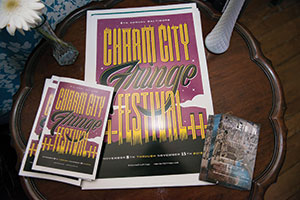
So Charm City Fringe Festival was born. Four years, and four festivals later, its president and chair shares secrets of how to create a successful arts festival from scratch.

Step 1: Just Do It

“Running a full-on festival, especially a startup, requires investing just a crazy amount of time and work,” says Michel. “You simply have to decide that it’s going to be fun and that you’re passionate about making it happen, and then just dive in and don’t look back.”

Step 2: Network, Network, Network

Wi16-HowTo_fringe

“Talk to anyone and everyone you can,” advises Michel. “A festival is essentially an umbrella organization for many different performers and groups, so you need to become familiar with all the arts going on all across the city. You also need to build support with the community at all levels – not just artists, but also your region’s municipal arts councils and offices, as well as local businesses. Michel also built out his network by asking every person he spoke with to recommend someone else for him to meet.

Step 3: Start Early, Start Small

Michel says it takes one year to put on one event. Maybe double that if you’ve never done it before. The key to success? Start small and build in plenty of lead time. When you have a “grand, impassioned vision” of the perfect event, it’s hard to hold back from doing everything all at once. “You really need to pick just one piece of that vision, and show that you can pull it off. After that, you have credibility. Which means you get to do it again, and do more.”

Step 4: Person Power

Festivals have a lot of moving parts, and need many hands to keep those parts moving smoothly. Since most festivals
are run by nonprofit organizations, this means those hands will mainly belong to volunteers. “Sometimes I feel like half my job as festival president and chair is finding and coordinating volunteers,” says Michel. “This past year we had 12 venues; each one had a box office to run, things to set up, break down…. Volunteers can be the make or break aspect of running a successful festival.” Michel recommends calling for volunteers early and often. And once people do commit their time and services, make it a fun experience, and let them know you couldn’t do it without them.

Step 5: Keep Calm and Do It Again

Wi16-HowTo_fringe-02

If preliminary research shows that the block-front corner cabinet you inherited from Great Aunt Harriet has potential value, it’s time to call a professional like Harrison.

When something goes wrong – and things will inevitably go wrong – be strong. “Staying calm, or at least being able to appear like you’re staying calm, is really important. Practice your deep breathing,” says Michel. The thought inside the head of every festival veteran, he observes, is “you wrap up the final show, and then you immediately panic that you only have 358 days until the NEXT opening night.” Tie up the loose ends of this year, take a month off, then have a post-mortem. That first night of the next festival will be here before you know it.

— Michelle Gienow

By the Numbers

Wi16-HowTo_bythenumbers

Charm City Fringe Festival 2015 featured:
86 total performances
200 artists, stage crew, directors and producers
1,200 tickets sold for 22 different productions

Firm Foundations – Finding Paths

UMBC’s reputation as a place where companies find terrific employees didn’t come out of thin air. The quality of its students and the reputation of its faculty for innovative teaching and attention to student success played a foundational role in building that pedigree.

Yet it was UMBC staff members who built on that foundation to help students succeed in an increasingly competitive job market and forge UMBC’s widely acknowledged reputation as a magnet for employers looking to make the right hire.

Betty Glascoe was there at the beginning, hired by UMBC in July 1970 to start a program (“The Placement Center”) to connect students and recent graduates to employers.

“At that time, I knew very little about the career services operation,” recalls Glascoe. “ I had read extensively, but I knew that I needed much more. To secure the position, I had to convince my VP that if given the opportunity I would do an excellent job if hired. So, I had to make certain that I didn’t disappoint. I visited colleges, universities and employing institutions up and down the East Coast as far away as New York. Everyone was so helpful. It enabled me to create meaningful relationships with employers and other educational institutions. With determination and drive, I studied their programs and services, and set in place a mission statement, objectives and goals that would enable me to successfully market the Center and provide the appropriate programs and services for our student population and the employing institutions to the advantage of UMBC.”

The challenges in the era of tie-dye and bell bottoms didn’t just include teaching skills in interviewing, resume writing and nonverbal communication.

“Many of the students didn’t have suits,” Glascoe remembers. “They didn’t have the appropriate dress clothes that the companies required….It was apparent that we really had to talk about how one dresses for success. As a result, one of the programs that staff agreed to include among the workshops offered was “Dressing For Success.” We felt that the best institutions to provide this information most effectively were the stores that specialized in clothing. Among them were Jos. A. Bank, Macy’s, and the Limited. They provided excellent information – and to encourage purchases, they provided discount coupons to the students’ delight.”

Glascoe’s savvy grew with each of the dozens of programs and initiatives she and her hard working and committed staff created to advance student success after graduation. Reflecting on her 35 years at UMBC, she remains proud of her pioneering role as an African-American woman blazing new trails for a young university – a school now seen by recruiters as a hotbed of talent for their companies and agencies.

For some people, my being an African-American woman was a little difficult to digest. At the time, (to my comprehension) I was the first African American person hired to direct a career center at a predominantly white educational institution in the country. I knew that I had to be a success. I worked very hard. In the beginning, I would come in the office on Saturdays and Sundays with my young baby just to stay ahead. But then those persons around me acknowledged that I was committed and determined, and I began to receive considerable support. My boss had described me as “a workhorse,” and the responses from those around me began to change.’”

Glascoe says that students were the driving force behind all her efforts:

“I was determined that students would have the opportunities that should be available to them. The major objective was to make certain that students were able to make a smooth transition from the academic environment to the work place and/or graduate professional educational institutions.”

She recalls a breakthrough moment at a conference in the 1980s, when an executive started singing her praises when she introduced herself.

“He was so kind. He took me around the room to introduce me to companies WHOSE representatives were not recruiting at UMBC.” says Glascoe. “He said, ‘If you are not recruiting at UMBC, you should be. You need to meet this lady. UMBC is a great university and they have excellent students. We have hired some and they are tremendous.’ It was exciting to hear that UMBC had made such an impact.”

One hire made by Glascoe and her team that had tremendous impact on UMBC’s trajectory was John Martello ’76, M.S. psychology, a then-graduate student hired to help build UMBC’s Cooperative Education Program.

It was the start of Martello’s highly influential career at UMBC, where he held a number of key positions, including vice provost for the Division of Professional Studies, chairman and CEO for UMBC Training Centers, and founder and executive director of The Shriver Center. (He will officially retire at the end of the Spring 2016 semester.)

Changing university culture to embrace relationships with employers and others was a key element in the successes Glascoe and Martello had in their efforts. “As hard as it is to believe now,” Martello recalls, “back in the 70s and 80s, the feeling of our faculty – and at most universities, was “ that education is best which occurs in the classroom.”

Martello says that the eventual embrace of this important work with employers was hastened by other qualities present in the university’s culture since its founding. “UMBC, in my experience, has always been – we call it entrepreneurial, but it’s probably intrapreneurial,” says Martello. “Always with a huge ambition, and an outsized vision, that couldn’t possibly be supported with the resources at hand. But instead of giving up or being despondent or saying we’ll wait until the money comes in, we were figuring out a way to do things aimed at quality, and hope, and ambition, and to be the best. This connection to the world has served us well, because we generate resources and we extend our reach and reputation.”

Martello cites groundbreaking programs undertaken at the Shriver Center such as the Maryland Police Corps – which offered financial support for students who made a commitment to becoming police officers – and initiatives such as the much-acclaimed Choice program and the Shriver Peaceworker Fellowships that still make a difference in communities today.

“I would say it all fits under the term engagement,” says Martello. “That term is bandied about, but in UMBC’s case, it’s the authentic belief that theory, knowledge creation – which is what universities have traditionally done – informs practice. But also that practice informs theory. So for a variety of reasons at different levels – some practical, some philosophical – UMBC has really taken the lead in engagement.”

Martello also oversaw a tremendous growth in the Division of Professional Studies and UMBC Training Centers, which enroll more than 10,000 students and professionals annually, expand educational opportunities for thousands of non-traditional students, and generate nearly $30 million in revenue for the campus.

While the professional studies programs “bring us closer to the professional community and working professionals,” Martello sees the Training Centers as “unlike anything I’m familiar with nationally, because it is an LLC owned by a public university.”

Martello says that efforts to ensure student success post-graduation and to weave professionals into the UMBC community are “part of the institutional fiber, part of the mission values. We just do that, and I think it makes us very unique. It’s why we survived this terrible economy, because our students were having problems and challenges just like everyone else. But it’s pretty well known that UMBC graduates are superb, and they managed to get employment because of who they were and what they had done, and the culture and programs at UMBC.”

— Richard Byrne ’86

Discovery – Winter 2016

Safety First

It happened at Target. It happened at JPMorgan Chase. It happened at the federal Office of Management and Budget (OMB). Hackers have relentlessly pilfered millions of social security numbers, financial records, and fingerprints, opening an abyss of anxiety about the future of privacy in a digital age.

For Richard Forno, the director of UMBC’s graduate program in cybersecurity, each new computer breach is a testament to human folly.

“The OMB hack hit close to home,” he says. “My information was there. My fingerprints were there.”

Before arriving at UMBC in 2010, Forno worked for nearly two decades as a cybersecurity consultant for private firms and government agencies. He says many organizations still ignore simple warnings laid down as long ago as the mid-1990s. (One example: If you use Social Security numbers as a primary method for identifying your employees or customers, you’re begging for trouble.)

“We’re still dealing with folks cutting corners in securing private information,” Forno says. “We see a lot of task forces and commissions – but when you look at what they actually recommend to improve federal cybersecurity, many of those recommendations are rehashes of ideas that go back into the 90s. Here we are twenty years later, still talking about basic security practices that are not being followed.”

It is alarming, Forno says, that until very recently the U.S. Department of Defense continued to use Social Security numbers to identify employees. “They’re finally moving away from that,” he says. “But with an organization of that size, it won’t be an easy process.”

Some people have hoped that IDs and passwords can be replaced with biometric systems such as fingerprints or iris scans. But those solutions have difficulties of their own. “We need to think carefully about the tradeoffs,” Forno says. “Will all of this biometric data be stored in a central database that the next generation of hackers will target?”

Forno believes that UMBC and other universities play a crucial role in strengthening cybersecurity theory and practice. He says UMBC is well positioned to bring together technically trained computer scientists with scholars from the humanities and social sciences. Only by combining those domains, he argues, will we be able to foresee emerging threats and train firms and agencies to prevent them.

“We have people who are extremely gifted technically,” Forno says. “But the skills and expertise of non-computer scientists can be just as valuable. You don’t need to be a hardcore geek.”

Forno’s graduate program awards over a hundred master’s degrees each year, mostly to midcareer professionals. And as assistant director of the UMBC Center for Cybersecurity, a campus-wide interdisciplinary project, Forno and his colleagues organize workshops, seminars, and lectures for broader audiences at UMBC. He also serves as a faculty adviser to the CyberDawgs, a student team that has been highly successful in national cyber war game events. (The 2014-2015 team made it to the national finals.)

“If you come out of UMBC,” Forno says, “I want you to know the basics. How to secure your wireless network, your cell phone, how to conduct good social media practices, so that you’re not easily becoming a victim. That’s the long-term goal.”

— David Glenn

Living (With) Wages
Wi16-Discovery_Tim_Grindling

Ever since the financial crisis of 2008 hammered the global economy, rising income inequality – and how to combat it – has been much on the mind of the world’s politicians and policymakers.

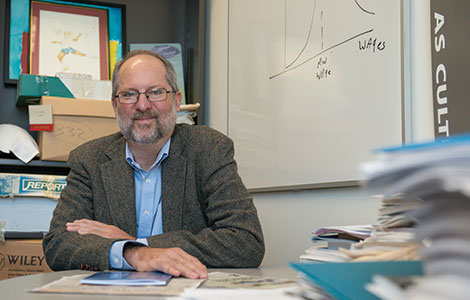
But long before 2008, those issues were already on the mind of Tim Gindling, who has spent the last fifteen years researching minimum wage policy impacts in Latin America, and he has recently expanded his research to look at policies in other developing countries such as China. In almost every case, he has found that there is not a simple one-to-one relationship that suggests raising minimum wages automatically reduces poverty.

A professor of economics at UMBC, Gindling became interested in the issue during a year spent as a researcher at the University of Costa Rica. He discovered that minimum wage policy is the most visible policy affecting the distribution of wages in countries like Costa Rica, Nicaragua, Honduras, and El Salvador. His research findings also have inspired governments in developing countries to enact changes to minimum wage regulations.
Wi16-Discovery_Tim_Grindling-02
In a May 2014 article published in the journal, IZA World of Labor, Gindling argued that in most cases, a rise in the minimum wage usually reduces poverty. But the direct positive or negative impacts are difficult to measure. A number of factors – including its effect on higher-paid workers, non-compliance, and a lack of social safety nets to protect workers who lose their jobs – can reduce its effect.

Gindling also found that when minimum wages are increased in Latin American developing countries, many workers at the bottom of the scale do not reap benefits because they are self-employed.

“One reason it’s not a simplistic issue is the fact that when you raise the minimum wage in a developing country, you aren’t raising the wage of the poorest workers because the poorest workers are in this unorganized, informal sector,” explains Gindling. “Rather, higher
minimum wages affect the wages of people who are in the formal sector who tend to be near the middle of the income distribution.”

Gindling’s work also helped affect policy in countries he has studied. Although raising minimum wages helps workers in certain sectors of the economy, Gindling and his colleagues discovered that refusal by some employers to pay minimum wage means that even formal sector workers are often not paid what they should be.

“In almost every country we’ve looked at in Latin America, there’s a high degree of non-compliance,” he says. “We’ve brought this to the attention of policymakers when we can. The work we did in Costa Rica was part of what encouraged the government to implement a comprehensive program to improve compliance, including an extensive public relations campaign, increased fines, and inspections.”

Gindling hopes his ongoing work will continue to inform policy discussions and inspire broad coalitions to address a complicated issue with global implications for growth.

— Max Cole

Let There Be Light
Wi16_AtPlay-diamonds

Illumination has always been an important part of Baltimore history. One of the city’s most famous early museums – created by Rembrandt Peale in 1814 – was lit by gas lamps. Peale’s new gas company also ensured that Baltimore was the first U.S. municipality lit by gas lamp in 1817.

That legacy of light in Baltimore is part of the inspiration for the inaugural Light City Baltimore
festival. The event – held from March 28 to April 3 – will be the first large-scale light festival in the United States and celebrate Baltimore’s status as a hub of creativity and innovation.

Light City’s centerpiece will be a 1.5-mile art walk around Baltimore’s Inner Harbor, showcasing light
displays, interactive installations, and projections – accompanied by music and dance performances at two stages.

Creative works by UMBC alumni and faculty will have a strong presence at Light City – and the university is a founding sponsor of the festival, reflecting UMBC’s strong ties to the city. At night, while the city is lit up by the festival, UMBC will host a Black and Gold Lounge inside the Columbus Center – where alumni and friends of the university can warm up with a hot beverage and reconnect with other members of the UMBC community.

The university is hosting a daytime conference associated with the festival (Light City U) that will allow participants to explore the innovations that power social change. UMBC President Freeman A. Hrabowski, III, will give a keynote address, and Light City U will also offer workshops and hackathons on sustainability, health care, education, and the city’s creative industries.

UMBC will also have a strong presence on the art walk – not surprising given the university’s strength in marrying art and new technology. Symmes Gardner, director of UMBC’s Center for Art, Design and Visual Culture, will exhibit a video installation titled “1,001 Lux.” And UMBC associate professors of visual arts Kelley Bell, M.F.A. ’06, imaging and digital arts, and Corrie Parks will display a new work, “Project Aquaculture,” at the Columbus Center.

“Baltimore is shedding light on itself through media, social action, and art,” says Colette Searls, the chair of UMBC’s theatre department and another Light City exhibitor. “The festival emphasizes Baltimore as a generator of great art and a destination for lovers of great art.”

In collaboration with Lynn Tomlinson, who teaches digital media at Towson University, Searls will be exhibiting a work that combines animation, live theater, and puppetry featuring a crab named Kendra. The crab, controlled by Searls through a computer touch screen, addresses the conflict between society’s environmental concerns and its continuing reliance on throw-away objects.

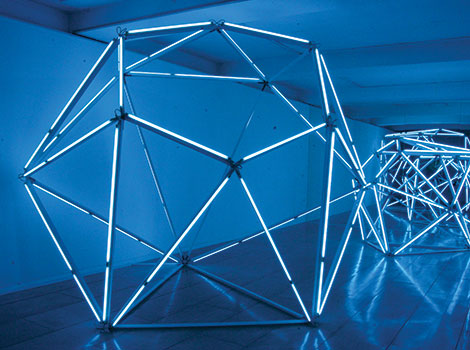
In a different part of the art walk, Mina Cheon, M.F.A. ’02, digital arts, and her architect husband, Gabriel Kroiz, have created a display of 15 giant LED diamonds that will seem to tumble toward the water.

“Artistically, innovatively, I’m just so excited to have the opportunity to do this,” says Cheon. “In terms of impact, I hope it really changes the impression of Baltimore.”

— Bess Keller

For more information on the festival go to lightcity.org.

Past Present
Wi16-Discovery_hubble

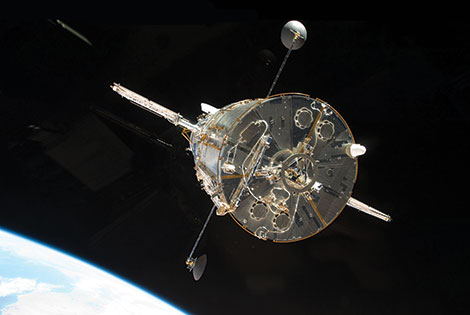
Astronomers at UMBC have seen a rare cosmic event: A gigantic stream of plasma, all lit up as it shoots from around a black hole in another galaxy at nearly the speed of light.

The work was done with the Hubble Space Telescope by Eileen Meyer, assistant professor of physics, and Markos Georganopoulos, associate professor of physics, and a team at the Space Telescope Science Institute – which is operated by the Association of Universities for Research in Astronomy for NASA.

The researchers created a time-lapse video over a 20-year period and spotted the event – an observation almost without precedent. They published their finding in Nature in the spring.

The action they saw is occurring in an elliptical galaxy, NGC 3862, which is 260 million light years from us. It is an event that actually occurred when dinosaurs roamed the earth. By astronomical terms, however, NGC 3862 is one of our neighboring galaxies and 260 million light years is the day-before-yesterday.

Most galaxies have black holes in their center – massive objects where the gravity is so strong nothing escapes, not even light. Each also has an edge, the event horizon, an area beyond which everything nearby gets sucked in.

Outside the event horizon are so-called accretion disks, collections of gas and dust that swirl around the black hole like water circling a drain. Unlike the water in the drain, however, not all the material eventually flows into the black hole. Sometimes – and astronomers still don’t know why – some of this material blasts out in the form of jets of plasma, or ionized gas.

Each of the jets has very little density, and they are being hurled at relativistic speeds, which means within a percentage or two of the speed of light.

Oddly, the images the scientists gathered make it look as if the jet was going seven times faster than the speed of light, but scientists think that’s impossible. Georganopoulos says it is likely an optical illusion called “superluminal motion,” — which happens when something is coming almost directly toward an observer at nearly the speed of light.

Wi16-Discovery_plasmaThe material in the jet is ejected at varying speeds and forms blobs that look like pearls on a string, the bright lights detected by Hubble.

The brightness is created by some of the blobs, moving faster than others, rear-ending blobs in front of them. The kinetic energy of the collision is transferred to light.

“You can see it before it slows down, but the collision seems to make the blobs brighter,” says Meyer.

The exact same thing happens on the other side of the black hole, but it can’t be seen from Earth.

“We’ve never seen two components of a jet colliding,” says Georganopoulos.

The finding is exciting for many reasons, not least of which is that it is rare to observe anything moving outside of our own Milky Way galaxy. Such jets of plasma normally only show up at radio wavelengths. The jets in NGC 3862 were observed in the visual wavelength. Moreover, using time lapse photography, they were seen moving.

— Joel N. Shurkin

Firm Foundations – Books & Bytes

The ways that universities physically store knowledge – and allow the community to access it –are at the heart of the enterprise of learning and research. What is a university without its library – and its mainframes?

John Haskell was the very first employee at UMBC, hired by Albin O. Kuhn to build the university’s library.
The UMBC story usually begins with its doors opening for classes in September 1966. But, that’s skipping ahead a chapter. Or 25,000 chapters, to be precise.
On February 1, 1965, UMBC’s very first employee arrived on campus. Fresh out of graduate school and six months of active duty in the Army Reserves, 24-year-old John Haskell was hired to build what we know today as the Albin O. Kuhn Library & Gallery.
Haskell, now 74, recalls UMBC at its beginnings: “There was literally nothing. It was just [the] Hillcrest [Building], which at that point was virtually abandoned by the state.”
Indeed, Haskell spent his first months working in the basement of McKeldin Library at the University of Maryland, College Park, tackling the daunting work of ordering thousands of books and journal subscriptions – as well as the shelves to store them.
He also met his future wife, Mary, who happened to sit a desk over in the McKeldin basement. “My wife and I kid about this,” he says, “but when we were dating, sometimes we would spend our time alphabetizing cards” in Hillcrest, where he eventually moved his office.
“One thing I remember,” he adds. “We didn’t have to worry about how much things cost, because the university’s philosophy was we’ve got to get this library going, and we’re going to do it right.”
Haskell pulled titles from a “New Campus” list created by the University of California system, and created an ordering system based on conversations with the faculty. He also decided to dispense with the standard somber black binding for the periodicals – instead opting for a “less stuffy” rainbow of colors to distinguish between subjects.
When the doors opened for class, Haskell had amassed 25,000 volumes, hired several employees – and a well-earned sense of accomplishment. He loved seeing students in the space.
He remembers vividly a moment during the Vietnam War, when a group of students who called themselves the Gorilla Band asked him if they could “march through the library with trashcan lids…and get people to come out on the front lawn for a rally? And I said sure,” he recalls. “Most librarians in that day would be horrified by that. That’s not how I approached things.”
Haskell left UMBC in 1969 to earn a doctorate and subsequently worked in special collections at the College of William and Mary. Today, the library he founded boasts more than a million bound volumes, nearly two million photographs and slides and other resources, as well as a year-round gallery.
“The best part of it all was nobody ever said ‘We’ve always done it that way,’” Haskell recalls. “Since you didn’t have anything, you could just decide how you wanted to do things,” he said. “It was fun.”
Computers and the information that pulses through their networks are just as crucial as books for a university – if not more so, since they also power the administration of the institution.
The story of how UMBC’s information systems infrastructure was built is also a story of people with the foresight to explore new territory, and the educators whose positive examples helped others blaze trails after them.
Jack Suess with UMBC campus portal architect B. Collier Jones.
That is why Jack Suess ’81, mathematics, and M.S. ’95, information systems, says that experiences from his student days still greatly influence the way he leads UMBC’s Division of Information Technology (DOIT).
Suess’ journey started in 1976, his freshman year at UMBC. He recalls that a geography professor, John Starr, sensed that he was holding back academically. “He had this booming voice and he was just an amazing teacher,” says Suess. “And one day he said, ‘Are you really giving it your best effort?’ And I said no…and he goes, ‘Well, why don’t you try giving it your best effort? I really think you could do it.’”
The conversation struck a chord with Suess, who also took a chance on a programming class because a friend told him “the computer might be helpful someday.”
Suess excelled in that class and others, and leapt into the world of information technology, later taking jobs in the computer center and as a teaching assistant. Those positions opened his eyes, brought him out of his shell, and unlocked a long career at UMBC.
Jack Suess with faculty members Bill Shewbridge ’80, history,and Peggy Southerland ’75, theatre, and Ethan Berner ’02, visual arts.
Shortly after graduating in 1981, Suess took a job as programmer analyst on UMBC’s very first mainframe computer, a 2,000-square-foot behemoth housed in the basement of the library. Until 1982, all of UMBC’s computing had come from College Park, so this was the first of many big moments in computing both for the university and for Suess.
“This was really sort of the start of UMBC building out into its computing identity,” he recalls. In the years that followed, Suess continued to help shape the university’s information structure, from the implementation of early networking and Internet in the mid-80s, to the launch of the first campus website in 1994, and the very first campus portal combining business and academic services in the late 90s.
Suess did it all while nurturing a growing team of student and alumni talent – just as he had been nurtured.
“[Suess] has always been supportive of students, giving them opportunities to explore and try new things; and offering leadership opportunities, also,” says Kevin Joseph ’87, computer science, a longtime employee of DOIT. “The culture Jack has built…provides a place that the students see themselves fitting in and being valued, [and] as a place to work after they graduate.”
That dedicated and entrepreneurial base allows DOIT to remain nimble in the face of growing demands.
“What’s always been amazing about UMBC is we were trying and usually succeeding at doing things we had no – well, things we should never have thought we could do because it’s insane,” explains Suess. “All along, we were doing stuff that very few places were doing. And it a great group of people who were really innovative and doing fun stuff.”
— Jenny O’Grady