



The ways that universities physically store knowledge – and allow the community to access it –are at the heart of the enterprise of learning and research. What is a university without its library – and its mainframes?


The UMBC story usually begins with its doors opening for classes in September 1966. But, that’s skipping ahead a chapter. Or 25,000 chapters, to be precise.
On February 1, 1965, UMBC’s very first employee arrived on campus. Fresh out of graduate school and six months of active duty in the Army Reserves, 24-year-old John Haskell was hired to build what we know today as the Albin O. Kuhn Library & Gallery.
Haskell, now 74, recalls UMBC at its beginnings: “There was literally nothing. It was just [the] Hillcrest [Building], which at that point was virtually abandoned by the state.”
Indeed, Haskell spent his first months working in the basement of McKeldin Library at the University of Maryland, College Park, tackling the daunting work of ordering thousands of books and journal subscriptions – as well as the shelves to store them.
He also met his future wife, Mary, who happened to sit a desk over in the McKeldin basement. “My wife and I kid about this,” he says, “but when we were dating, sometimes we would spend our time alphabetizing cards” in Hillcrest, where he eventually moved his office.
“One thing I remember,” he adds. “We didn’t have to worry about how much things cost, because the university’s philosophy was we’ve got to get this library going, and we’re going to do it right.”
Haskell pulled titles from a “New Campus” list created by the University of California system, and created an ordering system based on conversations with the faculty. He also decided to dispense with the standard somber black binding for the periodicals – instead opting for a “less stuffy” rainbow of colors to distinguish between subjects.
When the doors opened for class, Haskell had amassed 25,000 volumes, hired several employees – and a well-earned sense of accomplishment. He loved seeing students in the space.
He remembers vividly a moment during the Vietnam War, when a group of students who called themselves the Gorilla Band asked him if they could “march through the library with trashcan lids…and get people to come out on the front lawn for a rally? And I said sure,” he recalls. “Most librarians in that day would be horrified by that. That’s not how I approached things.”
Haskell left UMBC in 1969 to earn a doctorate and subsequently worked in special collections at the College of William and Mary. Today, the library he founded boasts more than a million bound volumes, nearly two million photographs and slides and other resources, as well as a year-round gallery.
“The best part of it all was nobody ever said ‘We’ve always done it that way,’” Haskell recalls. “Since you didn’t have anything, you could just decide how you wanted to do things,” he said. “It was fun.”
Computers and the information that pulses through their networks are just as crucial as books for a university – if not more so, since they also power the administration of the institution.
The story of how UMBC’s information systems infrastructure was built is also a story of people with the foresight to explore new territory, and the educators whose positive examples helped others blaze trails after them.

That is why Jack Suess ’81, mathematics, and M.S. ’95, information systems, says that experiences from his student days still greatly influence the way he leads UMBC’s Division of Information Technology (DOIT).
Suess’ journey started in 1976, his freshman year at UMBC. He recalls that a geography professor, John Starr, sensed that he was holding back academically. “He had this booming voice and he was just an amazing teacher,” says Suess. “And one day he said, ‘Are you really giving it your best effort?’ And I said no…and he goes, ‘Well, why don’t you try giving it your best effort? I really think you could do it.’”
The conversation struck a chord with Suess, who also took a chance on a programming class because a friend told him “the computer might be helpful someday.”
Suess excelled in that class and others, and leapt into the world of information technology, later taking jobs in the computer center and as a teaching assistant. Those positions opened his eyes, brought him out of his shell, and unlocked a long career at UMBC.

Shortly after graduating in 1981, Suess took a job as programmer analyst on UMBC’s very first mainframe computer, a 2,000-square-foot behemoth housed in the basement of the library. Until 1982, all of UMBC’s computing had come from College Park, so this was the first of many big moments in computing both for the university and for Suess.
“This was really sort of the start of UMBC building out into its computing identity,” he recalls. In the years that followed, Suess continued to help shape the university’s information structure, from the implementation of early networking and Internet in the mid-80s, to the launch of the first campus website in 1994, and the very first campus portal combining business and academic services in the late 90s.
Suess did it all while nurturing a growing team of student and alumni talent – just as he had been nurtured.
“[Suess] has always been supportive of students, giving them opportunities to explore and try new things; and offering leadership opportunities, also,” says Kevin Joseph ’87, computer science, a longtime employee of DOIT. “The culture Jack has built…provides a place that the students see themselves fitting in and being valued, [and] as a place to work after they graduate.”
That dedicated and entrepreneurial base allows DOIT to remain nimble in the face of growing demands.
“What’s always been amazing about UMBC is we were trying and usually succeeding at doing things we had no – well, things we should never have thought we could do because it’s insane,” explains Suess. “All along, we were doing stuff that very few places were doing. And it a great group of people who were really innovative and doing fun stuff.”
— Jenny O’Grady
All posts by: UMBC News Staff
Firm Foundations – Biology & Family
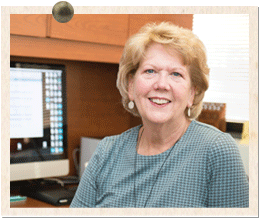
Over the past 42 years, Susan Schneider has worked at UMBC, left, and returned several times. She has witnessed the arc of the university’s growth.
In fact, Schneider knew the hillside selected as a home for UMBC before the campus was designed and built. Growing up in the Catonsville area, she remembers when the area was mostly fields. When she first started driving, Poplar Avenue was a “dark” and “spooky” route that ran directly to Walker Avenue.
Schneider took her first job at UMBC in 1974, working as a secretary for then-vice chancellor Sallie Giffen and comptroller Edward Minion. Though her work rarely took her out of UMBC’s Administration Building, the campus was small enough that everyone knew people who worked in different departments, even if they never actually saw one another.
Working at UMBC in those early years had another benefit, Schneider observes. In those days, members of the campus community did not even have to pay to park. They just pulled into a parking lot where today’s Administration Garage is located.
“Parking was awesome back then,” she says.
Schneider left UMBC in the summer of 1975, and returned to work in the biological sciences office in 1977. After that, she took an extended maternity leave and ended up staying home with her first child, until she was asked back to work part time with the department’s graduate program. In 1983, Schneider departed once again to help out with her family’s business, but returned to the biological sciences again ten years later – eventually working with the graduate program.
Between 1999 and 2002, Schneider saw a different side of UMBC when she became a program management specialist for the graduate program in computer science and electrical engineering department. During that stint, she worked at the Technology Research Center (TRC) – a building she remembered from her childhood in its previous incarnation as a juvenile detention center with tall fences. She recalls that first walking through its halls was strange with those memories in mind.
In 2002, Schneider returned to biological sciences, taking the job she still holds today as a business services specialist. She has worked under four different chairs, and watched the number of faculty double. Yet she has always made time for service, including being a member of the Non-Exempt Staff Senate and active roles in the Maryland Charity Campaign.
Schneider says it’s no surprise that she has always found a way to return to the department, even after being away for years at a time. “I was really happy to come back,” Schneider says. “[It was] meant to be. This is like my second family.”
Family is also the way that Schneider sees the larger UMBC community. (Even her son, Timothy Schneider ’06, information systems management, is a UMBC alumnus.) She says that, like any family, the UMBC community has its occasional problems and disagreements. Yet Schneider says her vision of UMBC is as a campus full of “genuinely good people, good-hearted people just doing their best.”
— Nichole Zang Do ’15
Firm Foundations – Betty Glascoe
Betty Glascoe
Hired a few weeks after UMBC’s first graduating class emerged into the working world, Betty Glascoe was the trailblazer in career services at UMBC. In her 35 years at the university, she developed the reputation of UMBC as a go-to university for businesses and government agencies.
What follows are edited excerpts from a recent UMBC Magazine interview with Glascoe.
Read our full story about how staff built UMBC’s infrastructure for postgraduate success.
On the early days of career services at UMBC:
I started at UMBC in July 1970. It was a very different place…. At the time, I didn’t know anything about a career services operation other than what I had been reading, so I decided to go to other colleges and universities on the East Coast – even as a far as New York – to see how they were functioning and serving the student population.
Also, I took the opportunity to visit employing institutions to ask them what would encourage them to come onto the college campus and hire students. Everyone was very helpful. College Park was exceptionally helpful. That gave me a beginning.
So I started programs. How to interview in an effective manner. How to dress for success. Nonverbal communication: How does one send a message that is positive or negative.
On hiring and the student culture of the 1970s:
Many of the students just didn’t have suits. Didn’t have any dress clothes or anything that would prepare them for meeting with an employer. We really had to talk about dress for success. What we did one time was we brought in Jos. A. Bank and Macy’s and some other stores to show [students] how to transition. We even had a store called The Limited for women. We showed them how to take two or three garments and move them around and make them work over a period of time. Changing blouses and shirts and sweaters and jewelry. We made sure they understood that you have to be very careful about what you wear and how you wear it and how you project. How to make sure it was the image they wanted to project.
On what motivated her:
I was determined that the students would have the opportunities that should be available to them…. I was so blessed with having the staff that I did. Everyone was extremely hard working, and always trying to develop new programs and services that were advantageous to the students and for the employing institutions. Programs and services that would enhance the image of the university. What was important to me was seeing how the contours began to change over time.
Firm Foundations – Earnestine Baker
Earnestine “Ernie” Baker
UMBC’s Meyerhoff Scholars Program, created in 1988, is one of the landmark contributions to student success at the university – and has become a national and international model for creating greater diversity in STEM disciplines through concentrated cohort learning. Earnestine Baker, served as director and later executive director of the program before turning over the reins to her successor, the late Lamont Tolliver, who was succeeded by Keith Harmon.
What follows are edited excerpts from a recent UMBC Magazine interview with Baker.
Read our full story about how staff built UMBC’s infrastructure for student success.
On transition from UMBC’s associate director for scholarships to The Meyerhoff Scholars Program:
I was working as the associate director of scholarships, and at the same time was working with [Freeman A. Hrabowski, III] and [former Meyerhoff director] Susan Boyer on the Meyerhoff concept. I was a part of that very first meeting in July in 1988 that Dr. Hrabowski had with the staff.
In the first conversation I had with Dr. Hrabowski, he mentioned that he was going to develop the Program, I don’t know why, but I never felt it was a risk. He wanted to develop a Program where our students would have the type of experience he and I had as undergraduates at Hampton Institute (now Hampton University). So, I knew immediately what he was looking for and how the Program should be modeled.
From the very beginning, I knew it would work. I can’t explain my feelings then, but I knew it would work and my duty was to help make it happen.
On the Meyerhoff Revolution:
I was aware, having worked with students in admissions, and with the scholarship program, that we had capable students who were not working consistently at their highest level. I did not have the opportunity to work with large numbers of students; but the students with whom I had close relationships, I could see that they needed to study more. They needed a more supportive environment.
I also thought of the students’ need to have an enriching experience that would better enable them to work in a diverse group and be successful. These experiences, I knew should be developed, monitored, and evaluated, to know if we were using the best academic approach. If we use these components, it would create the environment and culture that would inspire and encourage students to be successful.
Also I kept thinking about the need to create an environment on campus with a high level of student expectations. Sometimes students would come and say, “I got a 95 on an exam.” And we would say, “What happened to the other five?” And continue to say that over and over and over. We were talking about creating an environment where we expect the students to work at the highest level.
The faculty was extremely helpful in that they also had this expectation. It changed the climate in the classroom when the faculty encouraged students to work at their highest level.
On what’s special about UMBC:
Prior to coming to UMBC, I worked at two other universities and one college. In my early days at UMBC, (as you know I started in 1983), I experienced a high level of excitement that I had not witnessed before, even at the other big institutions. It was because people felt and understood the importance of our work as it pertained to establishing a new campus in the Maryland system.
The faculty and the staff, in particular, were innovative and they had a high energy level, and they seemed devoted and dedicated to the students. UMBC was young, but people were very proud. They would defend the best practices that we knew we had on campus. For me, coming into that environment was very exciting. I understood the energy and I just felt so much a part of developing new programs, having new ideas, and exploring them. And so for me that was what I felt across campus.
I hear this from students. I hear it from parents. I hear it from other universities. UMBC is a place that truly cares about its students. It’s not just publicity in our magazines and on our websites. That it is a reality. Students at UMBC feel that they can do anything they want in terms of preparing for their academic career and in their professional careers.
In terms of the Meyerhoff program, I can’t say enough about what UMBC and the Program has done, not just for the university but for a number of universities. We get about 40 universities a semester coming to visit the Meyerhoff program…I am still connected with UMBC contractually, and I collaborate with other universities who are interested in implementing that model. I’m giving talks internationally and nationally to groups of presidents and deans wanting to know more about the Meyerhoff model and its success. I think that it has to be said that the program is successful.
At Play – Winter 2016
New Tricks
The stories on the sidelines of a college basketball game aren’t just huddled strategy sessions or fevered debates with referees. Often, they involve relationships nurtured over years in play as well.
One such story is that of UMBC men’s head basketball coach Aki Thomas, and his assistant coach Frankie Allen – whose relationship spans 15 years. Thomas, 36, played for Allen, 66, at Howard University from 2001 to 2002, after transferring from the University of Colorado. After a two-year stint in professional ball in Venezuela, Thomas took his first coaching job as a member of Allen’s staff at Howard. The pair also coached together as assistants at UMBC during their run to the men’s NCAA tournament in 2007–2008.
Allen was then head coach of the University of Maryland, Eastern Shore for seven years. When his contract was not renewed after the 2014 season, Allen contemplated retirement – until his former player called.
“I thought it would be unusual, but it’s not,” Thomas says. “The dynamic of it is: he’s my coach. In the sports world, your coach is your everything, and coach Allen is that to me. It’s the same type of chemistry we had as coach/player, co-workers as assistants, and now as coworkers again.”
Allen agrees: “If I can serve him in any capacity, to take what he’s doing, tweak it and make it better, and be a fresh set of old eyes, that’s [good]. I think it’s been one of those things where I’ve just been really proud, almost like a father watching his son.”
— Jeff Seidel ’85
Wearing Well
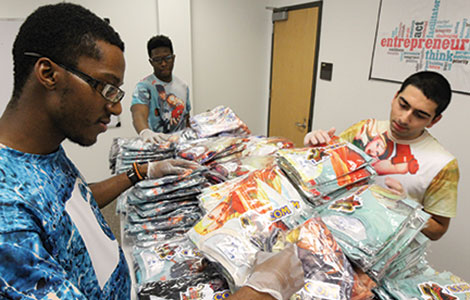
UMBC senior Turrel David cares about what you wear. His company, Blue Marble, specializes in environmentally-friendly clothing that features characters from the worlds of videos, comic books, and movies.
David is working on a double major (American studies and media and communication studies) with a minor in entrepreneurship and innovation. His studies have had a direct impact on his business.
“I came across a research study by the [Environmental Protection Agency] about the wastefulness of clothing,” David says. “I was shocked that the average American throws away 70 pounds of clothing per year, so I really wanted to look at how we can do things in a more eco-friendly way.”
Blue Marble’s clothing is made from polyester and spandex – synthetic fibers which are more durable than cotton – and use water-based ink for the art because the inks are less harmful to the environment. Blue Marble packaging is made from 100% recycled materials.
David sells his clothing line through eBay, Etsy, and the company’s website. Recently, Blue Marble partnered with Capcom, a Japanese video game company, to produce t-shirts for the Street Fighter video game franchise.
UMBC support has bolstered Blue Marble. The company receives support from the Alex. Brown Center for Entrepreneurship. Mentorship from Gib Mason ’95, economics, director of the UMBC Training Center’s Center for Leadership and Innovation, has also been a key to his success, he says. Plus, David is already hiring from UMBC, including two students and one recent alumnus.
Blue Marble seems to be wearing well already – on the climate as well as on its customers.
— Cait James ’99
Rhino View

What’s it like to see the world the way a rhinoceros might see it? Katie Feild ’05, visual arts, took up the task of imagining that view as the illustrator of Land Beast, a new book written by Kate Wyer.
Feild and Wyer met in the graduate program in creative writing and publishing arts at the University of Baltimore. They had worked together on another Wyer novel, Black Krim, but Land Beast took the collaboration to a new level.
“This was the first time I had done something that was so heavily illustrated,” she says, ruffling through a black leather case filled with drawings, storyboards, and concepts. The pictures are done entirely in grayscale gouache, pen and ink and depict the world through the eyes of Land Beast’s narrator, a female rhinoceros who’s been poached for her horn and taken from her home.
The text never explicitly reveals that its protagonist is a rhino, but Feild’s concept for the artwork helps lead the reader into the imaginative world that Wyer has created.
Rhinoceri don’t see very well, Feild explains, so the images are specific sensory details rather than lush scenescapes: a close-up of another rhino’s ear, a dark moon radiating shades of gray onto the white page.
Feild and Wyer published Land Beast themselves under the imprint Ceros Press. “Ceros” is Greek for “horn,” and their book was released on International Rhino Day in September.
— Julia Celtnieks ’13
Creating Colors

Soccer and chess aren’t the only competitions in which UMBC students have excelled. A team of Retriever developers recently took their game to San Francisco for the “final four” of game development at the Microsoft Imagine Cup – and now you can play their game online.
UMBC’s student team flew to San Francisco to compete against the Rochester Institute of Technology, University of Houston, and University of Southern California. Their game, called HueBots, features vibrant, friendly robots of different colors. Players solve a series of increasingly challenging puzzles in a maze revolving around the bots’ affinity for color-matched objects.
Visual arts students Erika Schumacher ’17 and Jasmine Martin ’15 tackled the task of designing and animating the robots. Game concept, programming, and music are the work of Tad Cordle ’16, with assistance from Michael Leung ’16, who led the team’s efforts.
“Even people who don’t like puzzle games like HueBots,” says Leung.
The teammates met through UMBC’s Game Developer’s Club, mentored by Marc Olano, a computer science professor who founded and oversees UMBC’s game development track in the computer science and electrical engineering department.
HueBots is now available on the Steam platform. Olano notes that it is the first game to go for sale to the larger public from the university’s Game Developers Club. “With this kind of a puzzle game, it’s hard to get it just right — not too easy and not too hard,” he says. “I think they did it.”
— Bess Keller
Paying It Forward: Lambda Phi Alumnae Fund a Scholarship for the Next Generation
For the past four years, alumnae of UMBC’s Lambda Phi Chapter of Alpha Kappa Alpha (AKA) Sorority, Inc. have been gathering over Homecoming weekend to reconnect and reminisce. For the past three, the event has come with a giving component to benefit the Second Generation Scholarship, which goes to two minority students a year. And in 2015, the alumnae chapter raised $1,585 through their Homecoming programming.
The amount has been steadily increasing each year, something Dr. Tamara Lewis ’92, psychology, is very pleased with. A chartering member of UMBC’s Chapter of Black and Latino Alumni, as well as an AKA alumna, she says the Second Generation Scholarship is “a minority scholarship we can all relate to.” She and two other alumnae – Crystal Watkins-Johansson ’95, biological sciences, and Anita Jackson ’80, health science and policy – decided to incorporate the giving component into the event about four years ago.
This year’s award went to three recipients: Micahyas Akama ’18, economics, Natacha Olugemo ’17, computer engineering, and Ayana Henderson ’16, biological sciences.
Henderson, a member of Alpha Kappa Alpha who plans to complete an M.D./Ph.D. program after graduation, is grateful to have received the award. She says the Second Generation Scholarship demonstrates “the high value UMBC [places] on uplifting minority students.”
Olugemo, who transferred here from Howard Community College and hopes to build a career in network or hardware engineering, says that the financial award has allowed her to focus more on her studies than how she will pay for tuition. She thanks those who gave to the scholarship fund.
“You are not just helping us stay in school, you are also helping us build a better future for ourselves and our [families],” she says.
— Julia Celtnieks ’13
Happy Retriever Love Week!
A couple of weeks ago, we put out a call on social media for couples whose love stories began at UMBC. We got so many great responses that while Valentine’s Day may have come and gone, we’ve decided to extend the holiday through Friday to share your stories on the blog. Happy Valentine’s Day the Second through Sixth!
—
In August 2000, Kenneth Knight ’03, information systems, and M.S. ’05, information systems, was a transfer student looking for advice on his classes. During a fire drill, a mutual friend led him to Angela Washington Knight ’03, information systems, and M.S. ’05, information systems, and from then on, Kenneth says, they were “inseparable.” They have been married since September 2003. (Photo courtesy of Kenneth Knight.)
—
Leah Concannon Mayer ’02, psychology, met Patrick Mayer ’02, philosophy and political science, the first month of their freshman year at UMBC, and the two were longtime friends by the time they started dating in 2003. They dated long distance while attending graduate school in separate parts of the country, and got married in 2006. They both work at Siena Heights University in Adrian, Michigan, where Patrick is an assistant professor of philosophy and Leah directs the McNair Scholars Program, and have two children. (Photo courtesy of Leah Mayer.)
—
Joe Fleshman ’14, economics, met his wife Kat Schuster Fleshman ’14, theatre, during their freshman year at UMBC. They started dating in early 2011 and “quickly became attached at the hip.”
“UMBC was so important to our relationship because we grew up here together. We have great memories of [H]omecomings, Quadmanias, and working with ResLife and the Commons to leave our marks on the campus. We gave everything we had to this school, and it gave us more than we could have ever hoped for in return. We were lucky to have many of our closest friends and UMBC family involved with our wedding in June 2015.
“I know I’m the happiest I’ve ever been because of the opportunities that UMBC gave us to allow our relationship to blossom,” Joe writes. (Photo courtesy of Joe Fleshman. And yes, that is Nick Offerman of Parks and Recreation and UMBC Homecoming 2013 fame.)
—
Stephanie Fields Lightfoot ’95, sociology, worked at the UMBC Bookstore as an undergrad, and Leon Lightfoot ’94, information systems management, was a frequent browser among the shelves. In 1993, Stephanie says, “he finally got the nerve” to approach her, and so began their courtship. A visit to the Shriver Center during her senior year led Stephanie to join the Peace Corps, a decision Leon supported “with hopes that [she] would return to him after two years.”
Indeed, when Stephanie stepped back onto U.S. soil after her service, Leon was waiting there with a ring. After 17 years of marriage and two children, Stephanie says, “If it weren’t for UMBC, there would be no Lightfoot family of [four].” (Photo courtesy of Stephanie Lightfoot.)
Read UMBC Magazine’s 2014 feature on UMBC couples here.
Back Story – Winter 2016
A university is only as good as its library, and the Albin O. Kuhn Library & Gallery is at the heart of UMBC’s intellectual enterprise. The library has been built by a dedicated staff over 50 years, so UMBC Magazine asked two of its longest-serving employees –acting director Joyce Tenney ’79, ancient studies, and chief curator Thomas Beck – for their perspectives on this essential campus institution.
UMBC’s first employee was a librarian, and the library is the place on campus where the staff members connect most directly with students and faculty. What role have staff members played in building a wonderful research library at UMBC?
Thomas Beck: One of the characteristics of the library is it’s always been like a large extended family. This was true from the beginning, I would judge, but certainly when I got here, which was 1974, it was surely that way. At that time, everybody interacted with everybody on a daily – sometimes hourly or minute-to-minute basis – and people got to know each other very well.
Unlike other libraries, our library has always had a relatively flat administrative structure. Joyce’s door is always open and all of her predecessors I think pretty much had the same feeling.
Joyce Tenney: That extends down to the student employees. I was a student assistant, and they just kind of fold you into the family. I got a phone call a couple months after I graduated and some the supervisors I had worked for said: “OK, there’s an opening. Get your application in now.” And even after I was hired, my supervisor eventually looked at me and said, “You’re not checking in standing orders forever. You’re going to library school.” And she handed me the application form to go to College Park’s library school at night and continue working. It’s a place where people try and help people move forward. It’s just a very caring and committed group and always has been.
As staff members who have seen much of the arc of UMBC’s development as a university, are there qualities that are part of the DNA of the institution?
Beck: Absolutely. The essay I’m writing for the exhibition we are putting together for UMBC’s 50th anniversary says that UMBC started as a need, became an ideal, and then became a reality. And, in fact, we are still a need, we are still a reality, and we’re still an ideal. Maybe an ideal most of all. UMBC is an ideal toward which we all are striving, and we happen to have had, over the years, good leadership in pursuing that ideal and keeping it in the forefront of the minds of people at UMBC – and also people who are outside UMBC or want to come to UMBC.
In terms of the library, that reaching for an ideal is characteristic of the library and its staff. The library staff has always been very service oriented, and it continues to be that way up to the present.
Tenney: I think one of our greatest attributes at UMBC is community. UMBC has always been a community. I looked at a number of colleges before I chose where I was going to go. I actually was offered scholarships at other places, but I’m a total introvert, a complete introvert, and I toured UMBC after touring College Park and a few other places and I just looked at my dad, and I said, “I’m comfortable there [at UMBC].” And from your first advising session, everyone was very committed to making sure that you’re in a place that you need to be. And I think that continues through today. I’ve gone out with the admissions folks in the evening to do recruitment, and I run into people that went to UMBC that now have children that are college-aged, and we start joking around about the 70s and the 80s at UMBC. It was a community then. I think it’s very much a community now.
I personally keep in touch with student assistants who have worked for me over the years. I just sent a number of Christmas messages off: “This is your surrogate mother checking in. How are you? What’s going on in your life?” I think that continues to this day and it makes UMBC unique. It makes UMBC a great place.
— Richard Byrne ’86
Marketplace radio series highlights UMBC faculty diversity initiatives
Nationwide, just 4 percent of full-time professors are black and 3 percent are Hispanic. What will it take to move the dial on the representation of diverse faculty at U.S. colleges and universities? American Public Media’s Marketplace, a leading radio program on business and the economy, tackles this question in two new stories highlighting UMBC’s work to train, recruit, hire and retain diverse faculty.
“Building a more diverse faculty” shines a spotlight on UMBC postdoctoral fellow Keisha Allen, education, and her experience transitioning from graduate student to faculty member. Allen is receiving mentorship from Mavis Sanders, professor of education, and Claudia Galindo, associate professor of language, literacy, and culture.
The story follows Sanders as she supports Allen in building the confidence to present her research to colleagues without notes, relying on her knowledge as an expert in culturally responsive pedagogy and adolescent literacy.
“You have to sort of own that identity, that now you are the expert,” Sanders explained. “It just takes practice.”
Allen is part of the newest cohort of the Postdoctoral Fellows for Faculty Diversity program, which is designed to support scholars who are emerging as cutting-edge researchers and educators in their fields and who are committed to supporting diversity in the academy.
2015-2017 Cohort of Postdoctoral Fellows for Faculty DiversityTyson King-Meadows, professor of political science, chair of Africana studies, and co-chair of the Executive Committee for the Recruitment, Retention, and Advancement of Underrepresented Minority Faculty, explains the major goals of the postdoctoral fellows program in the Marketplace story.
“The purpose of the program is to get them prepared for the professoriate and for them to understand all the nuances of being a faculty member of color or a particular gender,” King-Meadows says.
Edward Glover ’16 mathematics, a Meyerhoff Scholar and president of the Black Student Union, has worked closely with UMBC administration and faculty in addressing faculty diversity. He described in the radio story how he’d like to see UMBC faculty increasingly reflect the student body’s diversity.
The second segment, “A university confronts bias in faculty hiring,” shifts the focus to UMBC’s initiatives to address bias in the faculty hiring process, an all too common problem in higher education, across academic fields. King-Meadows describes the need for STRIDE, UMBC’s Strategies and Tactics for Recruiting to Improve Diversity and Excellence committee. This groups is developing tools to make recruitment processes more open and fair, to ensure the university hires the best candidate for each position rather than the candidate most similar to those managing the hiring process.
Susan McDonough, associate professor of history, highlights the importance of white faculty advocating for diversity in hiring and pointing out bias during the process.
“The burden has to be more on the majority culture to do it more than we do it,” she says. “I’ve seen it in my classrooms that, when students of color point out bias, there’s often a willingness to dismiss it that would not have been there if it had been a majority person who had shared that thought.”
Christopher Murphy, professor and chair of psychology, goes on to describe the work being done at UMBC to educate professors about unconscious biases that can unfairly eliminate qualified candidates during faculty searches.
Marketplace reporter Amy Scott notes that UMBC is well-known as one of the most diverse research universities in the country.
“Many people know us because we’ve had considerable success in educating students of all races in science and engineering,” President Freeman Hrabowski told Scott. “Our graduation and retention rates for African Americans and other students of color are as high as they are for any other group.”
Provost Philip Rous takes from this success inspiration to tackle the next important challenge: increasing the diversity of UMBC’s faculty. Although UMBC is ahead of the national average, Provost Rous says, “I would be the first to say that we’re not where we want to be, and this is probably the highest strategic priority I have as provost.”
“Talented minority faculty are not unicorns,” says King-Meadows. “It just depends on where you’re looking.”
Listen to the complete two-part series below:
Building a more diverse faculty
A university confronts bias in faculty hiring
Read more about faculty diversity initiatives at UMBC.
Image: Mejdulene Shomali, gender and women’s studies; Nkiru Nnawulezi, psychology; and Keisha Allen, education, meet with President Hrabowski. All images by Marlayna Demond ’11 for UMBC.
GiveCorps Spotlight: Help Model UN get to New York City!
There are so many ways to show UMBC your support, and helping out a student organization is just one of them. Today, we’re focusing on our Model United Nations team, which needs your help to get to a conference in New York next month.
Our Model UN students last fall.
At the end of March, UMBC’s Model United Nations team is headed to New York City to represent India at the national conference…and they need your help to make it happen.
Model UN provides a wonderful opportunity for students to debate global issues and develop leadership and public speaking skills. Your gift will help defray the cost of transportation, lodging, and delegate fees, making the competition more affordable and accessible for all participating students.
Our fundraising goal for the Model UN conference is $3,000. Will you help this bright bunch of students get there this year?
For even more opportunities to support UMBC, head to our GiveCorps page!
Meet the Staff: Arooj Rana ’06, 50th Anniversary Program Assistant
Here in the Office of Alumni Relations, we spend a lot of time telling stories about and talking with our wonderfully supportive alums. However, we’ve decided to turn the tables and take time to get to know the people behind the scenes – the advancement and alumni relations staff members who are hard at work on behalf of our alumni. Today we’ll be hearing from Arooj Rana ’06, psychology, who is one of the 50th anniversary program assistants in the Office of Alumni Relations. She is also working towards a master’s degree in public policy at UMBC.
Name: Arooj Rana
Job Title: 50th Anniversary Program Assistant
Focus Area: Alumni Engagement and Outreach
Years at UMBC: 8.5 total, with a break in the middle
Grad Year: 2006 and 2016 hopefully!
Where are you from originally? Maryland via Pakistan
What do you love most about UMBC? I love that it always feels like home. I had been on campus for eight years [,as both a student and an employee,] and then left for five. When I came back, the campus was just as inviting and comfortable as I left it. I was glad to see so many familiar faces that were just as welcoming now as when I started at UMBC so many years ago.
What’s your favorite thing about your job? My favorite thing about my job is hearing stories from alums about what things were like “back in the day.” It humanizes the campus in a way that makes it easier to understand and to appreciate all the great things that have happened here. Hearing those stories helps you understand the soul of the campus and why “grit” is a talent.
Who do you admire and why? I admire [UMBC’s Vice President for Student Affairs] Dr. Nancy Young because she is an excellent representation of what a strong independent woman is, [and] her story makes you appreciate her accomplishments even more. She is one of the most open-minded, intelligent, and thoughtful people on campus. Her actions and decisions show that she cares about the soul of the campus.
If you could be another staff member for a day, who would it be and why? If I could be any other staff member for a day, I’d be the Chief of Police at UMBC. I feel like this job generates good stories, and I could ride around in the UMBC police cars or segways. I’d flash my badge around a bit for that day.
Meet the Staff: Arooj Rana '06, 50th Anniversary Program Assistant
Here in the Office of Alumni Relations, we spend a lot of time telling stories about and talking with our wonderfully supportive alums. However, we’ve decided to turn the tables and take time to get to know the people behind the scenes – the advancement and alumni relations staff members who are hard at work on behalf of our alumni. Today we’ll be hearing from Arooj Rana ’06, psychology, who is one of the 50th anniversary program assistants in the Office of Alumni Relations. She is also working towards a master’s degree in public policy at UMBC.
Name: Arooj Rana
Job Title: 50th Anniversary Program Assistant
Focus Area: Alumni Engagement and Outreach
Years at UMBC: 8.5 total, with a break in the middle
Grad Year: 2006 and 2016 hopefully!
Where are you from originally? Maryland via Pakistan
What do you love most about UMBC? I love that it always feels like home. I had been on campus for eight years [,as both a student and an employee,] and then left for five. When I came back, the campus was just as inviting and comfortable as I left it. I was glad to see so many familiar faces that were just as welcoming now as when I started at UMBC so many years ago.
What’s your favorite thing about your job? My favorite thing about my job is hearing stories from alums about what things were like “back in the day.” It humanizes the campus in a way that makes it easier to understand and to appreciate all the great things that have happened here. Hearing those stories helps you understand the soul of the campus and why “grit” is a talent.
Who do you admire and why? I admire [UMBC’s Vice President for Student Affairs] Dr. Nancy Young because she is an excellent representation of what a strong independent woman is, [and] her story makes you appreciate her accomplishments even more. She is one of the most open-minded, intelligent, and thoughtful people on campus. Her actions and decisions show that she cares about the soul of the campus.
If you could be another staff member for a day, who would it be and why? If I could be any other staff member for a day, I’d be the Chief of Police at UMBC. I feel like this job generates good stories, and I could ride around in the UMBC police cars or segways. I’d flash my badge around a bit for that day.