All posts by: UMBC News Staff


UMBC expert examines urban wildlife management questions in New York Times column

Following up on recent sightings of wildlife in the New York City area, The New York Times published an opinion series exploring the question of how urban dwellers should cope with urban wildlife.

Dawn Biehler, an associate professor of geography and environmental systems, contributed to the series and wrote a column that examined the social and cultural contexts of urban wildlife arguments.

“The line between valued urban wildlife and unwanted pest is — and always has been — subjective, shaped by geography and social position,” Biehler explained. “When urban nature provokes anxiety, we would do well to take a hard look not just at the animals creeping or crashing through our backyards, but at ourselves.”

Referencing recent raccoon and bear sightings in the New York City area, Biehler said that these species often thrive on environmental conditions that humans create in those neighborhoods.

“Calling raccoons ‘invaders’ or ‘marauders’ in Brooklyn, or saying that bears have ‘overrun’ suburban New Jersey implies that these animals are out of place, but they are living in precisely the places that suit them best,” she wrote.

Read Biehler’s complete column “Pests of our own creation” in The New York Times.

Biehler researches historical geography and environmental history of public health in U.S. cities, environmental justice, urban and feminist political ecology, housing, and human-animal interactions. She is author of Pests in the City: Flies, Bedbugs, Cockroaches, and Rats, which was featured in the Summer 2013 edition of UMBC Magazine.

Image: Dawn Biehler speaks at an event at UMBC. Photo by Dinah Winnick. 

Constantine Vaporis selected for national Asian studies speaker series program

Constantine Vaporis, professor of history and director of the Asian studies program, has been selected for the ASIANetwork Speakers Bureau. The program is a new distinguished speaker series hosted by the ASIANetwork, a consortium of 160 liberal arts colleges and universities that aims to “strengthen the role of Asian Studies within the framework of liberal arts education to help prepare succeeding generations of undergraduates for a world in which Asian societies play prominent roles in an ever more interdependent world,” according to the organization’s website.

Vaporis was nominated and selected for the prestigious program from among faculty in all disciplines. The ASIANetwork Speakers Bureau is a new initiative designed to draw on Asian studies expertise within the consortium. As part of the program, speakers are invited by member schools to visit their campuses as an Asian studies guest speaker. Vaporis’ selection for the program reflects his high standing in the profession by his ASIANetwork colleauges.

Vaporis teaches Japanese and East Asian History and is an expert in Early Modern Japan, East Asia, and Asian studies. Read more about his work on the history department websiteRead more about the ASIANetwork.

Image: Constantine Vaporis. Photo by Marlayna Demond ’11 for UMBC. 


Amy Bhatt describes how Seattle’s South Asian technology workforce is changing the face of global giving

A feature published in the December 2015 edition of Seattle Magazine examines how Seattle’s South Asian population is becoming more visible in the philanthropic community. Amy Bhatt, an assistant professor of gender and women’s studies, researches South Asian migration trends in the tech industry and provided perspective on how the philanthropic community has grown over time.

“There’s a lot of wealth that has accumulated here,” Bhatt said in the article. As a result, the first generation of international tech workers in the Pacific Northwest has helped incubate a number of nonprofits and foundations.

Bhatt also observed in the article that more South Asians are emerging as leaders in the nonprofit sector: “You’re seeing more markers of South Asian leaders in general…in American organizations and institutions,” says Bhatt, citing the local examples of Microsoft CEO Satya Nadella, Seattle City Councilmember Kshama Sawant and state Senator Pramila Jayapal. Bhatt said that earlier leaders have paved the way for the new generation. “As a result of a multitiered, multigenerational community, you have much richer examples of South Asian leaders in philanthropy.”

Bhatt recently appeared in a PBS documentary about the 1965 Immigration Act and she’s author of Roots and Reflections: South Asians in the Pacific NorthwestRead more about her work on the gender and women’s studies website.

Read “South Asians are becoming more visible in the philanthropic community” in Seattle Magazine. 

Image: Amy Bhatt. Photo by Marlayna Demond ’11 for UMBC. 

UMBC partners with Baltimore City Public Schools and Northrop Grumman Foundation on $1.6M initiative to support Baltimore students, teachers, and communities

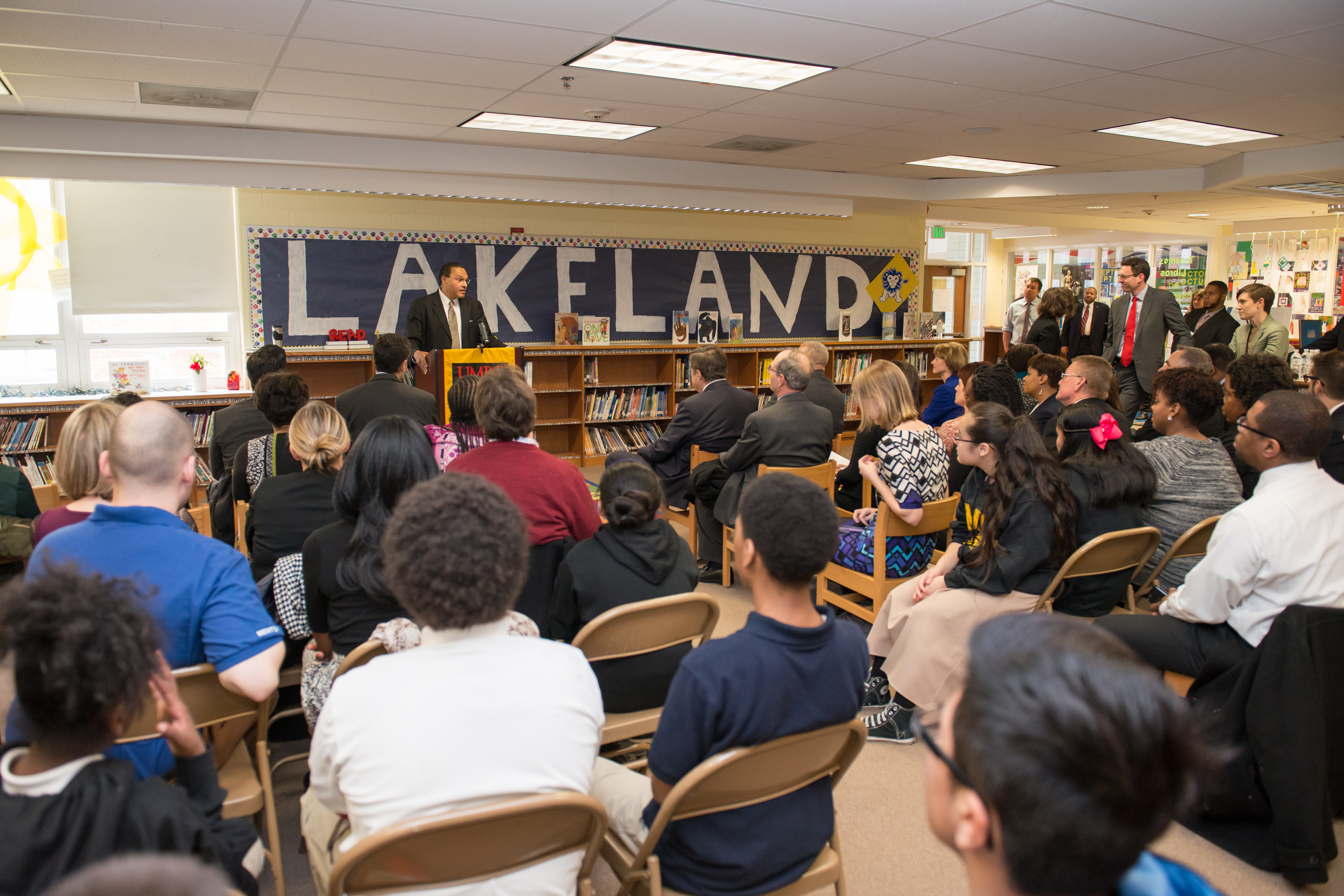
UMBC, Baltimore City Public Schools (BCPS), and the Northrop Grumman Foundation have launched a $1.6 million partnership to boost science, technology, engineering, arts, and math (STEAM) education. This news, announced on January 7, 2016 at Lakeland Elementary/Middle School in Southwest Baltimore, marks a significant milestone in UMBC’s ongoing work to support Baltimore’s K-12 students, teachers, and their communities.

Three years ago, UMBC President Freeman Hrabowski and Lakeland Principal Najib Jammal met to lay the groundwork for collaboration inspired by the vision and philanthropy of George and Betsy Sherman. The partnership that emerged brought UMBC’s Sherman STEM Teacher Scholars Program, Shriver Center Peaceworker Program, and The Choice Program to Lakeland, and it has already had a major impact.

The newly announced partnership will expand this work to support students at three city schools, while providing adult educational opportunities for local residents. Najib Jammal, Baltimore City Public Schools CEO Gregory Thornton, U.S. Congressmen Dutch Ruppersberger and John Sarbanes, Northrop Grumman Chief Operating Officer Gloria Flach, and President Hrabowski all provided remarks during the launch event to illustrate the meaningful impact the partnership will have on students’ lives and in surrounding communities.

Lakeland_Northrop_UMBC-0993

A primary focus of the program will be the development of a state-of-the-art STEAM Center at Lakeland that will have robust curriculum-based resources, professional development for teachers, and adult education and meeting resources for community members.

A second core component is an expansion of The Choice Program, a highly successful national model for community-based intervention that has served more than 20,000 youth and their families from Maryland’s highest risk communities for more than 27 years. Through the partnership, The Choice Program will expand to serve students at Benjamin Franklin High School at Masonville Cove and Excel Academy at Francis M. Wood.

“We are very excited to join forces with UMBC and Baltimore City Public Schools in the establishment of this innovative educational initiative,” said Sandra Evers-Manly, president of the Northrop Grumman Foundation and Northrop Grumman vice president, Global Corporate Responsibility. “This partnership is an outstanding opportunity to involve Northrop Grumman employee volunteers who can share their mentoring expertise with students and adults in nearby communities, reinforcing the link of academics to the wide-ranging career opportunities available in science, technology, engineering and math-related professions.”

“These are partnerships that bring a renaissance in education,” said Thornton. “I would like to thank the Northrop Grumman Foundation and UMBC for their support of these schools and the students and families they serve. This partnership provides support both inside and outside the classroom that our students need as they progress on their paths toward success in college and careers.”

The new STEAM Center, developed through a transformation of the recreation center at Lakeland Elementary/Middle School through partnership with Baltimore City’s Department of Recreation and Parks, is expected to feature science labs, a makerspace, digital video and sound studio, computer lab, parent resource room, and community meeting space.

Quality STEAM programming and professional development for teachers on topics such as project-based learning and integrating the arts and service-learning into curriculum will maximize the impact of these new resources. This work will help prepare city school students, parents, teachers, and adult education students for success in the evolving economy. It is also designed to help build strong, supportive, and engaged school communities.
Lakeland_Northrop_UMBC-0959

“The impact of this partnership goes beyond institutional philanthropy. It provides meaningful learning opportunities for all partners, from Lakeland and UMBC students, to teachers and professors, to STEAM professionals,” explained Rehana Shafi, director of the Sherman STEM Teacher Scholars Program at UMBC.

The expansion of The Choice Program to Benjamin Franklin High School and Excel Academy at Francis M. Wood will provide a continuum of services to youths facing challenges at school and at home. The program’s 24/7 wraparound services include monitoring and ensuring school attendance; providing transportation to and from school; home visits and family support services; classroom coaching, speakers, and specialists; and afterschool activities.

“We are going to work with our colleagues to prepare these children to compete against anybody, anywhere in the world,” said President Hrabowski. “We want to be saying that we can take children from any background…and make them best in the world. It takes that village, and it takes…hard work.”

A complete roundup of news coverage of the partnership launch can be found below:

UMBC, Northrop Grumman to invest $1.6 million in South Baltimore school (Baltimore Sun)
$1.6 million partnership to boost Baltimore schools, teachers and communities (WJZ)
Three Baltimore schools get boost from Northrop Grumman, UMBC (The Daily Record)
A new STEAM center is attached to a Baltimore school, but it’s not just for students (Technical.ly Baltimore)
8 things you need to know this morning (Baltimore Business Journal)
In the Media: Hogan to Propose Tax Cuts; UMBC and Northrup Grumman Invest in South Baltimore School (WEAA)
Equity in STEM: Public-private partnerships drive opportunity for all students (New America)

Images (photos by Marlayna Demond ’11 for UMBC): Lakeland Elementary/Middle School students at the partnership launch event on January 7, 2016; group photo of partners and students; and UMBC President Freeman Hrabowski speaks during the launch event. 

Link Roundup: UMBC in the News

One of the things that makes UMBC great is how wonderful our alumni, students, faculty, and staff are. Because of these amazing people, UMBC often finds itself “in the news,” so each week, we’ll be sharing with you a round-up of the most newsworthy achievements from our community.

For more UMBC community updates, head to UMBC News.

Off the Beaten Path: Creating a Legacy for Students in the Arts

DSCN0536

 Todd Carton ’77, interdisciplinary studies, has never been one to follow a conventional route. As an undergraduate, his degree program (then called Option II) combined theatre criticism, literature, and creative writing. Additionally, his experience as a tutor in the Learning Resource Center inspired him to get a master’s degree in linguistics and teach English as a foreign language.

When that market proved dry, he went on to become an accountant and work for several nonprofit organizations until his retirement. It’s certainly not what one might expect from a former theatre student!

Despite his varied career paths, Carton has remained committed to both the performing arts and UMBC.  He says his professors encouraged him to go off the beaten path and fostered “an independent and creative thinking process.”

He recalls, specifically, an American literature final he took as an undergraduate. The first question on the exam was about William Faulkner, and Carton was inspired to write his answer in that author’s distinct stream-of-consciousness style.

By the time he finished, he realized he only had a few minutes to answer the other two essay questions, but he passed the exam “despite giving [the questions] short shrift.”

“I think that built a strong attachment to UMBC for me,” he says now.

Carton has directed his philanthropy to support the arts at UMBC in significant and deeply personal ways. His initial gift, made when the first phase of the Performing Arts and Humanities Building opened in 2012, was to name the building’s box office in memory of his late brother, Steven M. Carton, whom he remembers as “the coolest guy ever.”

More recently, he has established the Carton Family Endowed Scholarship (named in honor of his parents) to support promising students in the performing arts who come from disadvantaged backgrounds. He has also included the university in his estate plan, in hopes that the scholarship fund will continue to grow and benefit more students far into UMBC’s future.

The inaugural recipient, Chandler Stafford ’19, theatre, says she is “truly honored and grateful” for the opportunity, and says that not having to worry about how she’ll pay for school has given her much more freedom to pursue her artistic and academic goals.

“With the help of this scholarship […] I can focus on furthering my knowledge and growing in my field of study,” she says.

Carton is looking forward to meeting Stafford at the Endowed Scholarship Luncheon later this semester. When asked what he might say to her, Carton says he would “…encourage [her] to make the most of [her] opportunities at UMBC, and to realize that…it’s possible to use a UMBC education and succeed in a field that may not be a direct line from your [degree].”

IMDA Alumnae in the News: Cheon, Ferrera

UMBC’s master of fine arts program in intermedia and digital arts (formerly imaging and digital arts) has stood out for over twenty years as one of the only ones like it in the country. Here’s what two of our MFA alumnae are doing now.

Mina Cheon ’02, M.F.A. imaging and digital arts, along with her husband, Gabriel Kroiz, will install 15 diamond-shaped sculptures along Pier 5 for Light City in an exhibit called “Diamonds Light Baltimore.” Cheon, who teaches at the Maryland Institute College of Art, says that she and Kroiz “wanted to participate in the healing aspect of our city [after last spring’s unrest]…There’s so many different ways that artists, architects, and culturists could be really active in participating in community development and progress.”

Christine Ferrera ’10, M.F.A. imaging and digital arts, recently talked to BmoreArt about the trajectory of her artistic career from painting and printmaking to performance art. Ferrera’s best-known performance piece, Starbux Diary, comes from of a decade’s worth of notes Ferrera wrote on Starbucks’ corporate comment cards, and the notes the coffee chain would write back. They were recently compiled into a book.

What have you been doing since graduation? Tell us in a class note!


UMBC economic policy researcher examines the impact of Puerto Rico’s debt crisis

Justin Vélez-Hagan, a Ph.D. student in UMBC’s School of Public Policy and executive director of the National Puerto Rican Chamber of Commerce, has been in the news recently after Puerto Rico defaulted on more bond payments, falling deeper into debt. Vélez-Hagan was recently a guest on Al Jazeera America, HuffPost Live, and the BBC and discussed the impact of the financial crisis and what needs to be done for the commonwealth to bounce back financially.

On HuffPost Live, Vélez-Hagan joined other economic analysts and researchers and examined how the financial crisis is affecting Puerto Rican citizens (watch the full segment).

“The average Puerto Rican is paying as much, if not more, in taxes, if they’re paying taxes. Keep in mind that a lot of the population is not paying taxes given the poverty rates. But those who are paying taxes are paying more and getting less in return. The economy continues to shrink, employment opportunities are shrinking, and it’s basically affecting everyone from the bottom to the top in Puerto Rico dramatically,” Vélez-Hagan said during the segment.

He also discussed how the increase in sales taxes and costs for electricity and water, coupled with the decrease in population and transportation investments, is having a sizable impact on Puerto Rico’s economy.

Vélez-Hagan appears frequently in the media to discuss economic policy in Puerto Rico. He’s been featured in Forbes, Fox News, Politico, The Hill, Politic365, NBC, The Huffington PostFox Business Network, Voice of America, BBC News, Al Jazeera America, Al Jazeera English, HuffPost LiveNPR Radio, SiriusXM, and Fusion.

He is the author of the new book The Common Sense behind Basic Economics (Lexington, 2015). Read more about his work.

UMBC professor’s book selected as one of six best books of poetry in 2015

Piotr GwiazdaPiotr Gwiazda, an associate professor of English, has been selected for a prestigious list “Best Books of Poetry in English 2015.” The list was compiled by Adam Zdrodowski, a poet and translator who has published three collections of poetry and translated authors such as Gertrude Stein and William S. Burroughs.

The list included six top poetry books published in 2015 from around the world, including Gwiazda’s Aspects of Strangers which received strong praise from Zdrodowski: “At first, the poems may seem simple, and yet it quickly turns out their simplicity is misleading. Simple phrases keep building up, bringing new pieces of information, sometimes corroborating and sometimes undermining what went before; phrases are sometimes repeated in different contexts, adding to the complex picture of contemporary humans struggling with the paradoxes and pleasures of contemporaneity.”

The book is Gwiazda’s third book of poetry. His areas of interest include modern and contemporary poetry and poetics, poetic theory, creative writing, literary translation and translation theory, intertextuality studies, U.S. literature and culture, and world literature. He has received grants and fellowships from the PEN American Center (The PEN/Heim Translation Fund), National Humanities Center (Summer Institute in Literary Studies), Andrew W. Mellon Foundation, and UMBC’s Dresher Center for the Humanities. He won the Washington Writers’ Publishing Poetry Contest for Gagarin Street in 2005.

Read more about Gwiazda’s work on the English department website. Read more about the six best books of poetry in 2015.

Image: UMBC’s Performing Arts and Humanities Building. Photo by Marlayna Demond ’11 for UMBC.

UMBC expert emphasizes the importance of minority voices in 2016 election

Black Girls Vote, a nonprofit organization designed to boost voter turnout in Baltimore, was recently featured in the Baltimore Sun. In the article, Kate Drabinski, a lecturer of gender and women’s studies and director of the Women Involved in Learning and Leadership (WILL) program, provided perspective on the organization’s potential far reaching impact heading into the 2016 election season.

The group was founded by a Baltimore resident with the goal of registering people to vote, especially young African-American women, and to use the nonprofit to aid public schools, the job market and access to health care. The organization is made up of 15 core members, and several pop-up events are being planned to help residents register throughout the year.

In the article, Drabinski described how involvement from minority groups in shaping public policy can help change lives.

“There are incredible efforts made to get wealthy white people to vote — whole systems to remind them how important their vote is,” Drabinski said. “You need the same kind of attention to other groups.

“Without participation, the wrong decisions will be made. It’s an old tenet: ‘Nothing about us without us.'”

Drabinski’s research interests include transgender studies, critical pedagogy, public history, and theories of activism. Each year in the spring, Drabinski leads the Elect Her! program, which is a training program that encourages college women to run for student government on their college or university campuses. Read more about Drabinski’s work and research. Read the full article “Black Girls Vote looks to get young women to the polls” in the Baltimore Sun. 

Image: Photo by Jay Baker, CC by 2.0.  

Ellen Handler Spitz explains the recent surge of interest in classic folk stories

The last five years have witnessed a wave of significant new fairy tale books. In a recent article published in the New Republic, Honors College Professor Ellen Handler Spitz explains why the fascination with classic fairy tales still exists even as the world continues to change.

“The core of fairy tales seems to reach deeper—well beyond the delights and shocks caused by improbable events…towards a species of raw, non-contingent honesty and authenticity,” Spitz wrote. “It is through the sharply-focused lenses of psychology, particularly those of child development…that we can parse some whys and wherefores of our irresistible draw into these enchanted realms.”

Using several examples, Spitz examines the ability of fairy tales to spark imagination and nostalgia, especially when looked at through the lens of a childhood development perspective.

“Fairy tale carries us back to this primordial kind of attention, the attention we gave the world when everything was ‘for the first time.’ In earliest childhood, noticing and remarking matters most…If, by the term ‘psychological,’ we mean relevance for mental life in its entwined cognitive and affective functioning, we are right to invoke it here, for fairy tales speak directly and indirectly to the psyche. They stimulate rainbows of feeling, insatiable curiosity, and inexhaustible searches for meaning.”

Read Spitz’s full article “The Irresistable Psychology of Fairy Tales” on the New Republic website. Spitz is the author of six books on the arts and psychology and her most recent research focuses on children’s aesthetic lives. Read more about her work on the Honors College website.

Image: Ellen Handler Spitz reads to children as part of the Program on Child, Family, and Community Development in Sewanee, Tennessee.

College of Arts, Humanities, and Social Sciences reflects on tremendous growth and establishes vision for future success

As UMBC is in the midst of its 50th anniversary year, the College of Arts, Humanities, and Social Sciences (CAHSS) is reaffirming its commitment to inclusive excellence, teaching and research across disciplines, and civic engagement while laying the groundwork for the future success and growth of the college.

Dean Scott Casper presented the first “State of the College” address last month to CAHSS faculty and staff to reflect on the college’s significant accomplishments over the last several years and to establish a vision for what CAHSS wants to accomplish in the years ahead.

In his presentation, Dean Casper outlined the three hallmarks that are central to the college and university’s mission of research, teaching and thinking across boundaries, and civic engagement. He explained how the college is immersed in cutting-edge research across disciplines, establishing connections in teaching and research across a range of departments and programs, and upholding the civic engagement mission through guiding students, faculty, and staff in their efforts to become better citizens of the world and local community.

As the college has grown significantly through the hiring of 50 new faculty members at all ranks over the last three years with 280 full-time faculty, 200 adjunct faculty, more than 100 staff members, 5,000 majors in the college and 1,000 graduate students, Dean Casper explained that CAHSS has been actively engaged and committed to the university’s inclusive excellence mission.

CAHSS State of the College 2016

“We are driving the university forward on creating a more inclusive faculty. If you think about the faculty who we’ve hired over the last several years, an increasing percentage of our faculty are people of color. More than sixty percent of our new faculty are women. We have taken seriously the university’s mission of having faculty that reflects in many ways our student body,” shared Casper.

College of Arts, Humanities, and Social Sciences faculty have also been moving into new leadership positions on campus. Tyson King-Meadows, associate professor of political science, is now an associate dean in CAHSS and began in that role back in July.

“I am very excited about this new opportunity to serve,” shared King-Meadows. “I look forward to working with alumni, faculty, students, staff, and our community partners on projects aligned with the strategic plan and that support the missions of the College and UMBC.”

Kimberly Moffitt, associate professor of American studies, has moved into a new leadership role as president of UMBC’s Faculty Senate. “This is a big role with very large shoes to fill because of the great work of my colleagues who have held this role previously,” she said. “But I’m indeed honored to have the opportunity to serve the university in general, but more importantly, the faculty by representing their voice in our shared governance system.”

Education Professor Sarah Shin was appointed special assistant to the provost for academic initiatives earlier this year. She will assist the provost in the design, management, and communication to campus stakeholders of special projects originating from the provost’s office working collaboratively with faculty, college deans, academic affairs support units, and shared governance bodies.

Other recent appointments include Bruce Walz, professor of emergency health services, being named special assistant to the provost for strategic initiatives and Economics Professor Robert Carpenter‘s appointment as associate provost for analytics and institutional assessment.

The new leadership positions for CAHSS faculty exemplify the growth and achievements of the college in recent years. In his State of the College address, Dean Casper said that there is still plenty of work to be done through continued recruitment of a diverse faculty, increasing the number of students in the college, building on community and extended connections, and continuing to engage CAHSS students, faculty, and staff with work in Baltimore City and the surrounding region.

“We are not just 22 departments and 13 programs and centers. We are one college, and we are working together to make each other’s worlds better as well as the world around us,” he said.

For the latest on news within the college, visit cahss.umbc.edu.

Image: Scott Casper presents the 2016 College of Arts, Humanities, and Social Sciences “State of the College” address. Photo by Marlayna Demond ’11 for UMBC.