All posts by: UMBC News Staff


Happy Holidays!

We here in Alumni Relations wish you and yours a warm, happy holiday season. (And by warm, we don’t necessarily mean the temperature, though if you’re in Maryland that definitely seems to be the case.)

If you’d like to brighten the season a little more by making a year-end gift to UMBC, you can do that here before midnight on December 31. After that, it’s a brand new year, and with that brand new year comes our 50th anniversary!

See you all in 2016!


Tyson King-Meadows appointed associate dean of College of Arts, Humanities, and Social Sciences

Tyson King-Meadows, chair of Africana studies and associate professor of political science, has been appointed associate dean of UMBC’s College of Arts, Humanities and Social Sciences (CAHSS), beginning in summer 2016.

King-Meadows joined UMBC in 2003 and has held numerous leadership positions across campus. He’s an affiliate faculty member of the School of Public Policy and the Maryland Institute for Policy Analysis and Research. Most recently, he served on the Strategic Planning Steering Committee and the Collective Impact in Research, Scholarship & Creative Achievement Strategy Group.

Prof. King-Meadows co-chairs the Executive Committee for the Recruitment, Retention and Advancement of Underrepresented Minority Faculty and has been instrumental in developing initiatives, polices, and procedures to enhance UMBC’s success at recruiting and retaining under-represented minority faculty. Among several other multi-university initiatives, he has served or currently serves as chair of the Honors College Advisory Board, chair of the CAHSS Black Faculty Committee, and member of the Shriver Center Faculty Advisory Board. King-Meadows brings a wealth of experience shepherding experiential learning initiatives and programs designed to enhance college equity and access.

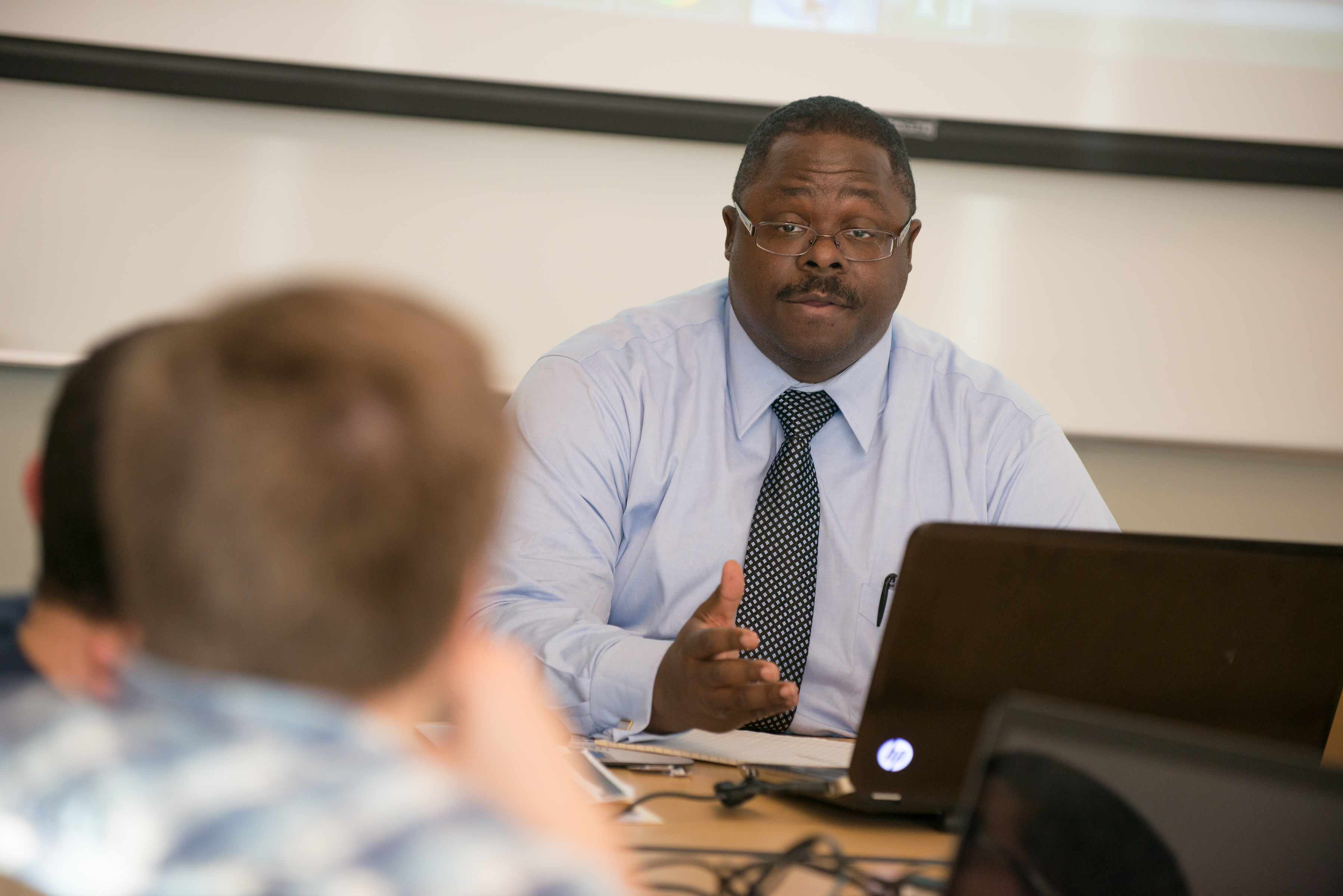
Tyson King-Meadows speaks with students.

He earned his Ph.D. from the University of North Carolina at Chapel Hill and has received external funding from various agencies and foundations, including the National Science Foundation, the Ford Foundation, the U.S. Department of Education, and the National Endowment for the Humanities. He has served as a Fulbright Scholar, as president of the National Conference of Black Political Scientists, and as a research fellow at Harvard University, Princeton University, and Johns Hopkins University.

A highly regarded teacher and scholar, King-Meadows has mentored a number of dynamic undergraduate research assistants, published innovative scholarship, and has been a research associate for the Joint Center for Economic and Political Studies and the Congressional Black Caucus Foundation.

Tyson King-Meadows

In 2012, he received the American Political Science Association Congressional Fellowship, the discipline’s most prestigious fellowship award designed to expand knowledge and awareness of Congress, and worked as a full-time staffer for the U.S. House of Representatives’ Committee on the Judiciary. His book on enforcement of the Voting Rights Act has garnered critical acclaim from journalists, activists, scholars, and legislators. His current projects examine the impact of racial imagery and racial attitudes on public support for federal policies designed to ameliorate political and economic inequality.

“Tyson King-Meadows is already a leader in teaching, scholarship, and service to the university and the community. I look forward to his expanded role in supporting the missions of the college and UMBC,” shares Scott Casper, dean of the College of Arts, Humanities, and Social Sciences.

Read more about Tyson King-Meadow’s research on the Africana studies website and a recent profile in UMBC Magazine.

Photos by Marlayna Demond ’11 for UMBC. 

Alums in the News: Eye on CompSci

Our alumni have gone on to excel in many arenas, and we couldn’t be prouder of them. Today, take a look at a couple of computer science alumni who are helping to advance the increasingly vital field of cybersecurity. 

As team technical director for the NSA’s Laboratory for Telecommunication Sciences, Josiah Dykstra ’13, Ph.D. computer science, is always coming up with new ways to combat cyber threats,
including a Google Glass-like device that alerts analysts to new threats in real time. Read more about Dykstra and his work with NSA at
Fedscoop.


Jamie Butler ’02, M.S. computer science, is now the chief technology officer of the Arlington, Va.-based cybersecurity firm Endgame. Butler’s cybersecurity career began at NSA, and he’s also worked for Mandiant and FireEye. Read more about Butler here.


Have your own news to share? Send in a class note!

UMBC’s newest Postdoctoral Fellows for Faculty Diversity pursue game-changing research

Now in its third cohort, UMBC’s Postdoctoral Fellows for Faculty Diversity program recognizes and supports talented scholars who are emerging as cutting-edge researchers and educators in their fields. UMBC’s newest group of fellows was formally introduced to the university community at a welcome reception held December 10, 2015.

Keisha Allen, education; Mejdulene Shomali; gender and women’s studies; and Nkiru Nnawulezi, psychology, represent the 2015-17 cohort of postdoctoral fellows. The fellowship is a two-year scholar-in-residence program that supports PhDs interested in academic careers who are committed to diversity in the academy. It also prepares the scholars for possible tenure-track appointments at UMBC.

“These are three talented scholars who are changing the game with their research,” shares Tyson King-Meadows, chair of Africana studies and co-chair of the Executive Committee for the Recruitment, Retention, and Advancement of Underrepresented Minority Faculty.

During the fellows’ appointments, UMBC connects them with teaching and research mentors and provides professional development opportunities across the university.

Keisha Allen researches how issues of race, culture, and intersectionality influence teaching and learning for historically marginalized youth. She is receiving mentorship from Mavis Sanders, professor of education, and Claudia Galindo, associate professor of language, literacy, and culture.

“One of the great things about the Postdoctoral Fellows Program at UMBC is the opportunity to engage with nationally- and internationally-known faculty as I carry out my research,” shares Allen. “I really get the sense that people want me to be successful and they will do whatever they can to support me.”

Mejdulene Shomali’s research focuses on gender and sexuality in Arab and Arab-American literature, art, and film. Her faculty mentors are Carole McCann, professor and chair of gender and women’s studies, and Rebecca Adelman, associate professor of media and communication studies.

“My mentors have already significantly helped my project and professional development,” explains Shomali. “I feel supported by them, and I’m additionally grateful for other spaces on campus, like the Dresher Center, that provide programming and support for humanities faculty.”

Nkiru Nnawulezi’s research uses ecological theory to understand the factors that promote or hinder the well-being of survivors of gender-based violence. She is primarily interested in exploring how social identity and culture influence African-American women survivors’ disclosure and help-seeking practices, as well as determining ways to improve support systems and communities’ response to gender-based violence. She is being mentored by Christopher Murphy, professor and chair of psychology; Shawn Bediako, associate professor of psychology; and Nicole Else-Quest, associate professor of psychology.

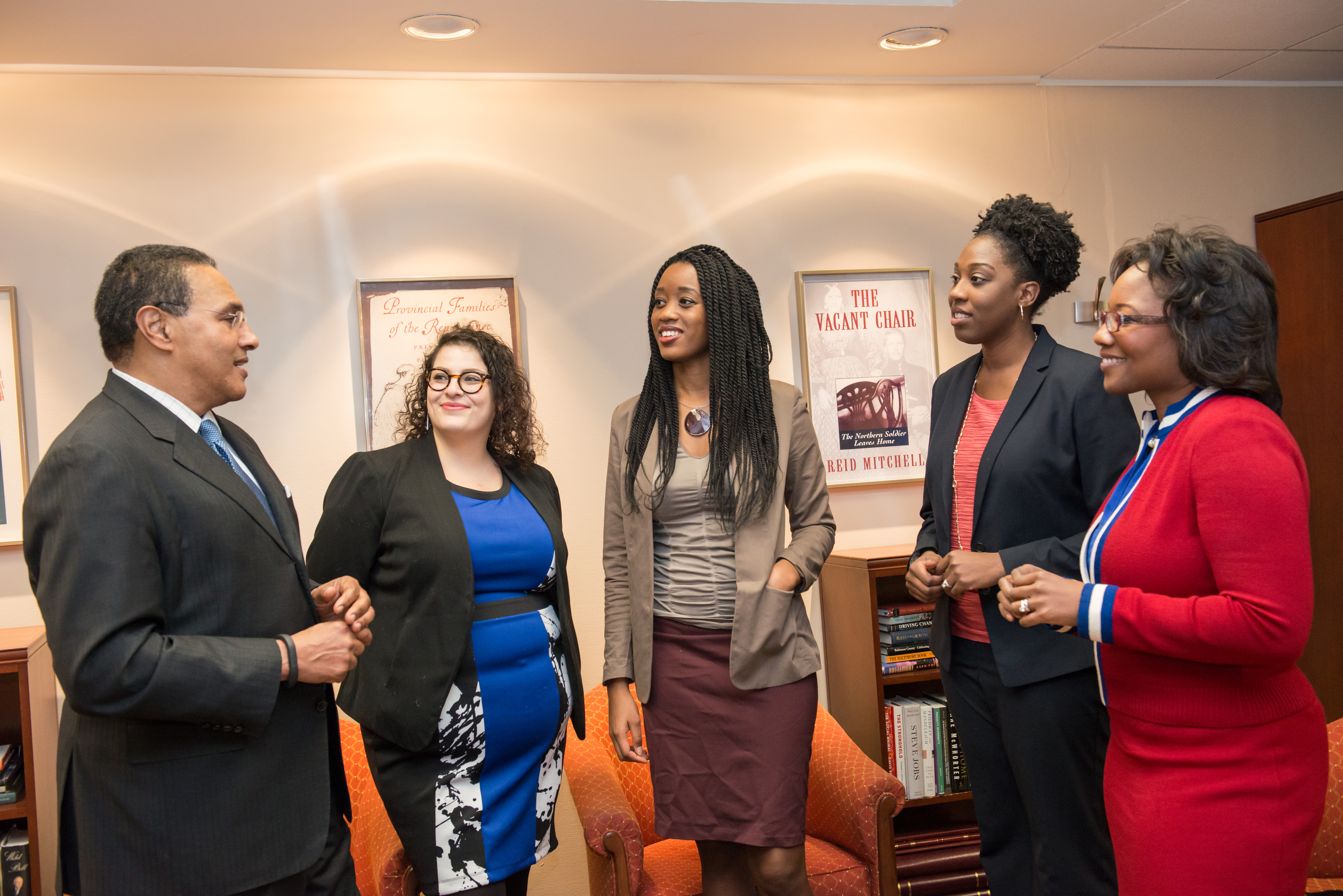
Dr. Hrabowski meets with Postdoc Fellows for Faculty Diversity

Welcoming and supporting diverse faculty members is a longstanding UMBC priority that has received renewed focus this year, as an important national conversation emerged on university diversity issues. Provost Philip Rous and Tyson King-Meadows recently wrote directly to the campus community about UMBC’s ongoing faculty diversity initiatives.

“The story and the history of UMBC is that of a community that, through the commitment and hard work of our faculty, staff and students, has dedicated itself to creating a new model of the public research university based upon the principle of inclusive excellence,” the message stated.

UMBC has established a national reputation for the diversity and academic excellence of its student body. The message from Rous and King-Meadows outlined important work that still needs to be done to better recruit and retain underrepresented minority faculty that reflect the diversity of the university’s students.

“Our collective acknowledgment of this imperative is reflected in our new strategic plan which identifies diversifying our faculty as a critical step toward advancing all aspects of our mission,” the message noted. UMBC’s new strategic plan also identifies staff diversity as an important area of future growth.

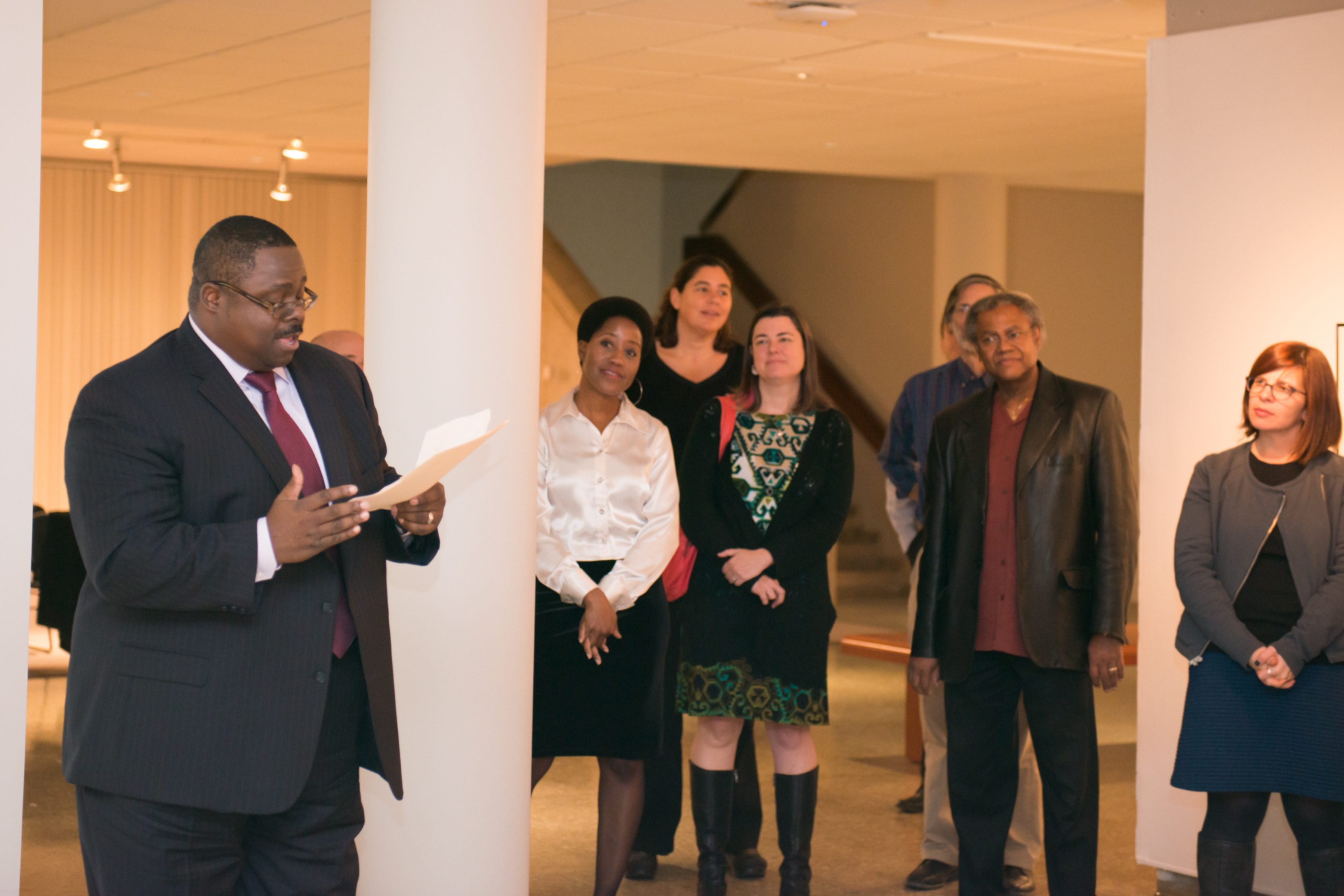
At the post-doctoral fellows welcome reception, King-Meadows and Scott Casper, dean of the College of Arts, Humanities, and Social Sciences, spoke about UMBC’s mission, and recognized the fellows program as one of many UMBC initiatives to support promising graduate students, future faculty members, and current faculty from underrepresented minorities.

The fellows explained they are eager to move forward with developing their research and teaching over next two years, and to take advantage of the many resources UMBC has to offer.

“I am amazed by the support that I’ve received from faculty, administrators, and my fellow post-docs,” said Allen. “I am blessed to be a part of this community and uphold the stellar reputation UMBC has built as an innovative and socially engaged university.”

Read more about the Postdoctoral Fellows for Faculty Diversity program, including information about previous cohorts.

Images (photos by Marlayna Demond ’11 for UMBC): Keisha Allen, Nkiru Nnawulezi, and Mejdulene Shomali; President Hrabowski meets with the current cohort of Postdoctoral Fellows for Faculty Diversity. 

F. Chris Curran selected for prestigious Emerging Education Policy Scholar Program

F. Chris Curran, an assistant professor in UMBC’s School of Public Policy, has been named an Emerging Education Policy Scholar for 2015-16 by the Thomas B. Fordham Institute and the American Enterprise Institute. The Emerging Education Policy Scholars (EEPS) program is a select group of promising, new Ph.D. scholars and candidates who present innovative research ideas and demonstrate an enthusiasm for education policy.

As part of the program, Curran will join think-tankers, academics, policymakers, and reformers in Washington, D.C. during the upcoming year to bridge connections with senior education policy experts and K-12 education practitioners. The program is designed to cultivate talent within education research, create opportunities to share research ideas, and enhance understanding of the intersections between policy and practice with education research.

“The primary purpose of my work is to produce high-quality research that contributes to the improvement of educational outcomes for students,” shares Curran. “Being selected as an Emerging Education Policy Scholar is an exciting opportunity to advance this goal as it provides the opportunity to forge relationships with other emerging researchers as well as to build connections with senior policymakers in the field.”

Professor Curran joined the School of Public Policy in August 2015. He has research interests in education policy, early childhood education, school discipline and safety, teacher labor markets, and politics of education. He has recently published a Baltimore Sun op-ed about educational opportunity in Baltimore and a column about teacher overtime policy in Education Week.

Curran is one of just 20 scholars selected for the program nationwide. Read more about this year’s EEPS cohort on the Thomas B. Fordham Institute website. Learn more about the specific goals of the program.

Image: Chris Curran presents talk at UMBC about his research. Photo by Marlayna Demond ’11 for UMBC. 

Congratulations to Our Fall 2015 Graduates!

Photo by Marlayna Demond ’11.

This week signaled the end of another semester at UMBC, and what better way to end the semester than with commencement! On December 16 and 17, our newest alumni walked across the stage into a proud legacy of grit and greatness, 50 years in the making. We’d like to congratulate all of our new graduates, and to formally welcome them as lifetime members of the UMBC Alumni Association.

To learn more about the Alumni Association and what it can do for you, click here. You can also browse photos from our undergraduate and graduate commencement ceremonies.

For a complete recap of the Fall 2015 commencement exercises, head to UMBC News! 

UMBC humanities students produce radio series exploring history and culture of Baltimore’s Bromo Arts District

Over the course of the fall semester, UMBC humanities students in an American studies course taught by Associate Professor and Chair Nicole King worked on the “Bromo Speaks” project, which examined how art and development have had an impact on the history and culture of the Bromo Tower Arts and Entertainment District in westside downtown Baltimore. The students’ efforts culminated in a five-part radio series that aired on WEAA’s The Marc Steiner Show from December 7-11, 2015.

The goal of the project was to understand the stories of the past and amplify the voices of residents, artists, workers, and business owners to develop ways to envision the city’s future. The students gathered more than 40 interviews with people living, working, and visiting the district and focused on themes related to history, neighborhood change, racism and structural inequality, displacement and development, and the potential future of the district.

“Throughout this project we have tried to give voice to the often-unheard people on the ground. We attempt to leave the listener with as many questions as answers in order to inspire people to think about how arts districts can change a city,” the class shared in a statement on the project’s website.

The radio series was part of the Baltimore Traces project, which is a collaborative teaching innovation that brings several courses together to work with the Center for Emerging Media (CEM), a Baltimore non-profit founded by radio host Marc Steiner. The series has worked with several Baltimore neighborhoods including Greektown, Highlandtown, and Station North. Read more about the project. The complete Bromo Speaks radio series can be found below.

Image: Lexington Market. Photo by Bill Shewbridge, professor of the practice of media and communication studies at UMBC.

Part 1 : History
Part 2 : Lexington Market
Part 3 : Changes
Part 4 : Tensions
Part 5 : Futures
Student Roundtable

The Science of Life: Biology Alumni Make Their Mark

We’re proud of all our alumni and love to keep up with all the amazing things they’re doing in their communities. Today, we check in on two biology alums to see what they’ve been up to since graduation.

Hetal Kathrotiya-Mago ’07, biological sciences, and ’08, psychology, now a podiatrist with Foot and Ankle Specialists of the Mid-Atlantic, recently volunteered at a D.C.-area charity health fair to educate attendees about podiatry and proper foot care.


Marquis Walker ’08, Ph.D. biological sciences,
 
has been appointed to the Morgan State University Board of Regents by Maryland Governor Larry Hogan. Dr. Walker, who received his undergraduate degree from Morgan State, has been a postdoctoral fellow at Johns Hopkins University’s School of Biological Chemistry since 2008, and has also taught biology at Howard Community College.

Keep us up to date by submitting a class note!


UMBC is a major partner in NEH grant to transform narratives on race in Baltimore

A $225,000 grant from the National Endowment for the Humanities awarded to the College of Arts and Humanities at University of Maryland (UMD) and the Maryland Humanities Council will fund a series of public programs that are designed to explore the way citizens of Baltimore are thinking about the narratives that influence the life and identity of the city. Major partners will include the University of Maryland, Baltimore County’s Dresher Center for the Humanities, the Enoch Pratt Free Library and the Greater Baltimore Cultural Alliance.

The initiative, Baltimore Stories: Narratives and the Life of an American City (Baltimore Stories), seeks to establish a model that utilizes humanities scholarship— literature, history, philosophy, communication, art and cultural studies—to produce print and digital materials that help frame and contextualize narratives of race in American cities. The project will also shine a spotlight on the ongoing, collaborative work being done in Baltimore neighborhoods by universities and non-profit organizations.

“During the uprising, Baltimore residents had lively conversations about the stories that shape our perceptions of each other,” said Sheri Parks, co-project director of the initiative and associate dean for research and interdisciplinary programming in the College of Arts and Humanities at the University of Maryland. “We are elated to use this grant as a platform to continue these conversations.”

The NEH announced yesterday $21.8 million in grants, including $3.6 million devoted to new “Humanities in the Public Square” grants that support community discussions on the relevance of the humanities to civic life.

“We are honored to answer the call that NEH Chairman Adams issued earlier this year to use the humanities to ‘take up the grand challenges of our time,’” said Phoebe Stein, co-project director of the initiative and executive director of the Maryland Humanities Council. “The equity that needs to be created here in Baltimore, and across much of the nation, can begin with the humanities as they give us contexts for understanding and addressing this inequity and the narratives that undergird it. The humanities facilitate the conversations that can ultimately contribute to solutions.”

UMBC will host three interactive public events in Baltimore and a day-long culminating session on campus. At two workshops, participants will create their own digital stories and engage in a community media project being produced by the Imaging Research Center at UMBC, intended to give voice to the stories of those living in some of Baltimore’s many communities. The events will offer community members from a variety of neighborhoods opportunities to explore how Baltimore narratives shape their lives and build on partnerships established at the Imagining America conference. A culminating event will highlight potential ways to advance our diverse communities.

“Narrative or the collectives of stories we tell ourselves and each other is also a major focus of the humanities, so we hope to help citizens investigate and contextualize the past, present and future to uncover truths and move communities toward reconciliation,” said Parks.

“This is a great opportunity to work together with UMD-College Park, the Maryland Humanities Council, and the Pratt Library, as well as our many community partners in Baltimore, on issues that affect us all,” shared Scott Casper, dean of the UMBC College of Arts, Humanities, and Social Sciences.

“This project will showcase the many ways that humanities scholarship and teaching at UMBC connect to civic life in Baltimore,” said Jessica Berman, director of the Dresher Center for the Humanities. “We look forward to working with our partners, and especially those in the community, to help explore Baltimore’s diverse stories.”

Image courtesy National Endowment for the Humanities. 

UMBC writer in residence recommends essential reading for the holidays on WYPR

Lia Purpura, writer in residence in UMBC’s English department, recently was a guest on WYPR’s “What are you reading?” segment to recommend essential reading for over the holidays and the new year. Purpura, who is an award winning poet and essayist, recommended The Essential Tales of Chekhov edited by Richard Ford and Between the World and Me by Ta-Nehisi Coates.

“Chekhov’s stories make inner lives completely bare,” Purpura shared on the program. By reading Chekhov, Purpura notes “you are shown your micro miscalculations and all those inner moral scales that you’ve got jangling around are laid bare in different characters…that sense of being seen and found out, and the almost painful little pangs of recognition are paradoxically such a joy.”

In discussing Ta-Nehisi Coates’ book, Purpura shared that his articles in The Atlantic earlier this year inspired her to read more of his work.

“I’m working myself to figure out how to live more actively in Baltimore, and more in the midst of complicated Baltimore, his work is really central to that inner journey and a full understanding of ways that I want to listen and act,” Purpura explained.

Purpura’s latest collection of poems is titled It Shouldn’t Have Been Beautiful. The book recently received a positive review in Baltimore Magazine in which reviewer Gabriella Souza stated: “Each of Lia Purpura’s versus reads like a spontaneous gem, almost as if she has been struck with a moment of inspiration during everyday life and has paused to scribble down her thoughts. But don’t think that makes her poems any less profound.”

Purpura is author of seven books of essays and poems, and her list of honors includes a Guggenheim Foundation Fellowship, National Endowment for the Arts and Fulbright Fellowships, and three Pushcart prizes. Purpura started the English Reading Series at UMBC this fall, and the next reading featuring Ocean Vuong is scheduled for April 2016. Read more about her work on the English department website. Listen to Purpura’s full segment on WYPR.

The Mathematics of Being Human receives positive review in advance of production in New Delhi

Since it debuted at UMBC in November 2014, The Mathematics of Being Human has garnered strong praise and it has traveled to San Antonio, New York City, and Baltimore. Its latest review comes in advance of an independent production of the play in New Delhi in January.

Stephen Abbott, a professor of mathematics at Middlebury College, reviewed the play for the January notice of the American Mathematical Society. Praising it for building off of real life experiences to explore studying mathematics and the humanities, Abbott gave the production a positive review.

“Witty and lighthearted, The Mathematics of Being Human is at its core a heady piece that engages its audience’s minds without making any sustained attempt to engage its hearts,” Abbott wrote in the review.” He added: “So is this play an argument for or against interdisciplinary teaching? Like a good piece of art, The Mathematics of Being Human doesn’t make this obvious or absolute for its viewers.”

The play, written by Michele Osherow, an associate professor of English, and Manil Suri, a mathematics professor, is inspired by their experiences jointly teaching a freshman seminar that bridged their two areas of expertise. The production was a natural outgrowth of a popular Chronicle of Higher Education article series and it debuted at UMBC in November 2014. It was directed by Alan Kreizenbeck, an associate professor of theatre, and Savannah Jo Chamberlain ’16, theatre, and Chaz Atkinson ’16, theatre, portrayed students in the seminar.

The Mathematics of Being Human is scheduled to be performed as an independent production with a new cast at the American Center in New Delhi on January 14 and 15, 2016. A future production will take place at the University of Pittsburgh.

Read Stephen Abbott’s full review in the January American Mathematical Society notice.

Image: Mathematics of Being Human debuts at UMBC. Photo by Marlayna Demond ’11 for UMBC. 

Alternative Spring Break: The ARC of Carroll County

As we wrap up our spotlight on Alternative Spring Break, we’d like to talk about another trip that impacts our Maryland community. The ARC of Carroll County serves people with intellectual and developmental disabilities throughout their local area, providing resources for employment, education, transportation, and community living.
On this ASB trip, students will have the chance to work directly with the people the ARC supports, building bonds and breaking down stereotypes about disability. Your gift will  go towards supplies, food, lodging, and transportation for 12 students who are bound to remember this trip for the rest of their lives.
To donate to the ARC ASB trip, click here. To hear from the student leaders themselves, click the video below: