All posts by: UMBC News Staff


Jian Chen, CSEE, Discusses New Hybrid-Reality System in The Daily Record

Jian Chen, computer science and electrical engineering, received a $360,000 grant from the National Science Foundation to build π², a hybrid-reality system that can project 3D images in order to display and interact with data. Chen and Karl Steiner, vice president of research, spoke to The Daily Record about the project.

JianChenPhotoThe π² system is to be constructed over the next year and will consist of high-resolution, floor-to-ceiling LCD panels. Chen explained that the screens can display images in 3D when used with special glasses. “That freedom of movement is part of what separates the hybrid-reality system from virtual-reality systems that use bulky headsets,” the article reported. “The headset isolates the user from the physical world; the π² display will multiple users to move more freely.”

Publicity Photo of Karl SteinerThe system seeks to make comparing and interpreting data easier and can be used in a variety of ways, including studying biological systems, data related to student success, woodland ecology, and unmanned aerial vehicle design. Steiner also shared how π² could help his own research on surgical training, saying, “The goal is what I like to call a flight simulator for the surgeon.”

Read “Immersive ‘hybrid reality’ system coming to UMBC” in The Daily Record.

Round Up: UMBC in the News

One of the things that makes UMBC great is how wonderful our alumni, students, faculty, and staff are. Because of these amazing people, UMBC often finds itself “in the news,” so each week, we’ll be sharing with you a round-up of the most newsworthy achievements from our community.

Read more at UMBC Insights!

2015 Fall Opening Meeting Celebrates UMBC Achievements, Emphasizes Commitment to Inclusion

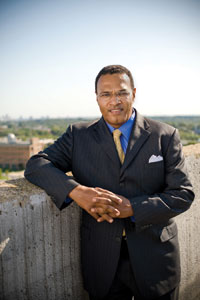
Faculty and staff gathered at the Fall Opening Meeting on August 20, 2015 to celebrate UMBC’s 2014-15 accomplishments and mark the start of a new academic year. The meeting featured remarks from incoming freshman, transfer, and graduate students, a speech by Provost Philip Rous, and the annual State of the University address by President Freeman Hrabowski.
Opening_Meeting2015-1854Maria Packard, incoming freshman in mathematics and Sherman STEM Teacher Scholarl; Sean Radaskiewicz, incoming transfer student in visual arts; and Bridget Patton, incoming master’s student in public policy and a Shriver Peaceworker Fellow, shared their personal stories, academic interests, and what attracted them to UMBC.
“Even though I have only been here for a couple of weeks, I am confident that I have made the right decision,” Patton said. “I  am eager to take advantage of all that UMBC has to offer and make my own contributions.”

In his remarks, Provost Rous welcomed faculty and staff to the new semester and gave an update on UMBC’s Strategic Planning Process. He also spoke about the need for improving faculty diversity, saying, “We cannot reach our full potential as a model public research university without the benefit of a full range of diverse perspectives and backgrounds driving our educational mission, research, scholarship, civic engagement, and educational mission.” He continued, “I know that you will join me in a renewed commitment to our most fundamental value of inclusion.”

Opening_Meeting2015-1890President Hrabowski then delivered the annual State of the University address, sharing recent faculty, student, staff and broader university achievements. He emphasized the student experience in his remarks, highlighting that UMBC’s enrollment will exceed 14,000 students for the first time in Fall 2015. “Our incoming freshmen are a remarkable group of students,” he said, calling them “the most talented group we’ve ever had.”

“Over the years, putting people first has been at the heart of our success,” President Hrabowski concluded, in his remarks to faculty and staff. “Whether you’ve been here for decades or recently arrived, you make a difference through your contributions.  As I say every year at this time, it is an honor each day to serve as president.”

Read the full 2015 State of the University address on the president’s website.

Play Hard – Alex Pyles ’09

fa15_AP-Alex_Pyles-0826_web

Alex Pyles ’09, English and media and communication studies, had loyal friends during his UMBC days.

One night, when he returned to his UMBC dorm room after covering a Baltimore Orioles player’s rehab assignment with the Frederick Keys (the Orioles’ single A minor league team), he found his roommates with their laptops open. They were clicking repeatedly on an article that he had just posted on the website of The Baltimore Sun. Thirty minutes later, Pyles’ story was atop the Sun’s “most read articles” list. And it was only his first byline.

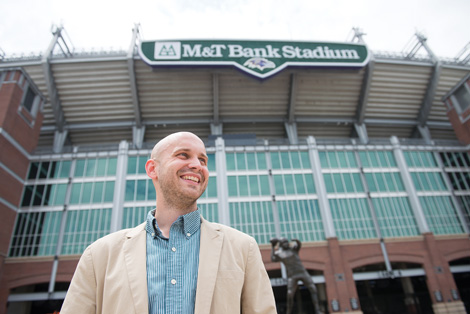
Eight years later, Pyles manages the Sun’s coverage of the Baltimore Ravens and the entire National Football League. He can be found on Sundays during the fall at M&T Bank Stadium overseeing the staff of Sun reporters who give the team’s fans an inside look at each home game. He also manages the team’s coverage from Baltimore when the Ravens are on the road.

Pyles says his focus on vivid description in reporting stories was one of the many lessons he took away from his close association at UMBC with Christopher Corbett, a professor of the practice in the university’s Department of English and the faculty advisor to The Retriever Weekly.

“Professor Corbett always talked about detail and how important it was,” Pyles says. “What somebody was wearing, what they did with their hands during the interview, and what they were looking at. You look at something and you try to describe it, but he made me pay attention to the minutiae.”

Pyles’ interest in journalism was sparked when he received a copy of The Retriever Weekly in his welcome packet from UMBC during the summer before his freshman year. He decided to stop by a staff meeting when he arrived on campus. Three weeks later, he was hired to cover the UMBC men’s soccer team.

“I was riding high. I was thinking this was what I want to do,” recalls Pyles.

Pyles quickly impressed his colleagues with his polished writing skills. Eventually he worked his way up to become the editor in chief of the newspaper.

“Alex Pyles was the best all-around editor the newspaper has had in my time at UMBC,” observes Corbett. “There have been some excellent editors who have been successful in the real world. But Alex was the editor who combined all of the skills necessary to be good at what he did.”

Prior to being named the Sun’s professional football editor in April 2015, Pyles sharpened his journalism skills through a series of successful internships, freelance gigs, and jobs at a variety of outlets, including the Wilmington News Journal, Patch.com, and The Daily Record.

Although he has been an avid sports fan from a young age, he has found it takes more than a passion for sports to become a sports journalist. “I’m fortunate in that I realized this very early,” he says. “When you are covering sports, you aren’t really a fan anymore. You stop rooting for colors and jerseys, and you start rooting for good stories.”

That constant search for good stories has lead Pyles to create a coverage strategy to increase the ways that the Sun connects its readers to news about the Ravens. It’s more than just game recaps. He’s using more video and photos to engage his audience on a broader stage online and through social media. In today’s much-diluted media landscape, Pyles recognizes that the daily newspaper isn’t dominant by default anymore in covering professional sports. His team has to tell truthful stories in consistently interesting and innovative ways to stand out.

“Everyone can see the game,” he explains. “My job is to tell them what they can’t see.”

— Max Cole

Up on the Roof – Fall 2015

President HrabowskiUMBC President Freeman A. Hrabowski, III, takes your questions.

“Was there ever a time when asking a question had a tremendous impact on your life or changed its course?

— Monica Berron ’13, media and communications studies

Yes. When, as a child, I was in a math program on a college campus and a professor asked the class a question that no one
could answer.

The rest of the class became very upset, because the professor told them: “When you can answer the question, come and see me.” The students complained: “You’re the teacher. You’re supposed to tell us the answer.”

I watched how they spent their time focusing on how angry they were because that teacher wouldn’t give them the answer. And all of a sudden, I had this magical moment. I realized that the professor didn’t give us the answer because he had confidence that we had the answer within ourselves. He wasn’t worried about our getting the answer quickly. He was much more interested in us pushing ourselves to struggle, to figure it out on our own.

So I decided to try to convince my classmates to focus our attention on the power within ourselves. It was very hard, because I didn’t have a clue about how to solve the problem and neither did they. But several things became clear in that experience. First, you don’t do your best thinking when you’re angry. Sometimes anger can motivate you. But you have to get beyond the anger to clear your head in order to do your best thinking. Number two, you have to believe you really can achieve the goal. Number three, you have to be resourceful.

What the professor was teaching us was to be resourceful. To do research, as opposed to simply writing down what’s on the board, which is what we’d done all of our lives. And so we had to ask questions. Try different approaches. Slowly, we began to see, and after a couple of days, we saw the light. That was a magical moment for me. I’ve never forgotten the lessons I learned that summer.

I see the power of questions so often with our faculty. I remember going to Mike Summers, our distinguished university professor of chemistry, when I was concerned about one of my students who had earned a B in a course. I remember saying to him that the student wouldn’t be able to get into graduate school with that level of work. And Mike said to me: “Freeman, the grade is okay. What’s important is that she’s really curious. One of the reasons she’s earning the B is that she’s working so hard in the lab, because she’s passionate about her questions. So she may not be getting an A, but that really isn’t what’s most important. What’s important is she’s really excited about the questions, and she’s persistent in seeking answers.” I’ll never forget him saying that to me.

Wendy Salkind, one of our professors of theatre, is another person who comes to mind. Often after seeing a production, I will talk to Wendy about what I liked about the show, and I ask her about parts of it that I didn’t necessarily understand. Wendy is always a teacher in the best sense of that word. Wendy always listens. And often she smiles and says: “Freeman, I’m not concerned that you didn’t understand this fully. I’m simply delighted that you’re asking a question about it.”

What Wendy is saying is that the production exists to get people to think. That’s what we’re doing here in theatre, and in many other ways, all the time. We challenge people to think about life and the challenges that we all face – challenges that inevitably raise hard questions.

As people come to our campus to visit, especially as we approach our 50th anniversary in 2016, I hope that what they see will lead them to ask questions about the importance of higher education in the development of America, and also in the development of families and individuals. That really is the whole purpose of UMBC. We exist to help people dream about the possibilities and then reach those dreams.

Just visiting our campus and understanding how we have grown and developed gives people the chance to think about the transformation of their own lives. People come back and see that this campus has changed physically. They can’t help but think about how the changes on the campus – in some way or another – are connected to the changes in their own lives.

They say, “The place doesn’t look the same. I don’t know where I am.” Then they think: “Well, when I was here, what did I look like? Who was I? Who am I now?” Pondering the evolution of this campus gives each of us a chance to put the mirror up to ourselves.

To send a question to President Hrabowski, visit Ask the President.

To You – Fall 2015

Richard ByrneEven though UMBC isn’t quite 50 years old, our university has already developed intriguing rumors and legends. One of the most persistent of these legends – submitted by Tal Levitas ’08, political science – is whether UMBC was designed to control student unrest.

This notion was part of campus folklore when I arrived at UMBC as an undergraduate in 1984.

The short and boring answer is “no.” When you plot the history of UMBC’s initial design and construction (1963-1966) against the trajectory of campus unrest that peaked after the killings at Kent State University in 1970, the timelines don’t match up.

UMBC’s original master plan focused on creating a walkable campus. UMBC was also designed to be modern. An antithesis, if you like, to the classical architectural designs usually favored by American universities. And by the time widespread student protest truly arrived at UMBC in 1970, the template for the campus and its physical design had been set.

So why has this notion persisted?

The newness of UMBC’s architectural design and the steady stream of construction occurring as student protests spread at UMBC are both undoubtedly factors. The mysterious campus tunnels may also have made an impression. (See page 20.)

The sudden intensity of the unrest at UMBC was also a factor. Particularly in the spring semester of 1970, clashes between students and administrators became more vitriolic. Students sat in at the Hillcrest administration building. Classes were disrupted. The largest campus protest on faculty hiring, firing, and tenure practices actually swamped UMBC’s celebration of the inaugural Earth Day.

Reading through the papers of UMBC’s founding Chancellor Albin O. Kuhn, I got a keen sense of how under siege administrators of that period felt. There are disciplinary committees, advisories on withdrawal of student loan eligibility for campus misconduct, and barbed correspondence.

It was a time that shaped the campus mood – and its effects lingered long after the first graduating class left. Yet there are some open questions. Little documentation exists on campus planning between 1969 and 1975. And speculation remains about the height of the Administration Building – which at its completion in 1973 literally towered over the UMBC campus.

Yet the vision of UMBC’s master plan remained largely unchanged through the 1980s with no radical shift or change in direction.

I hope you enjoy this special issue of UMBC Magazine. It has been a delight to answer questions from alumni about UMBC and its history. We also hope it stirs some wonderful memories of our campus as UMBC prepares to celebrate its 50th anniversary a year from now.

— Richard Byrne ’86

The News – Fall 2015

Anchors Aweigh

fa15_NEWS-Navy_UMBC_CRADA-7148_web

The U.S. Navy has a proud history in Maryland. And with two new agreements concluded in April, UMBC deepened its educational and research ties with the Navy in significant ways.

UMBC students are now eligible to steer a course to become commissioned officers in the Navy and Marine Corps with the establishment of a Naval ROTC (NROTC) program at the university.

The agreement with the Naval Service Training Command (NSTC) makes UMBC the first higher education institution in Maryland to be selected as an NROTC host. A professor of naval science, appointed by the NSTC in collaboration with UMBC, will lead the new program and coordinate instruction on campus.

“We are delighted to have been selected for this honor,” says UMBC President Freeman A. Hrabowski, III. “Many of our students are from military families, and many want to serve their country through the Navy. Already, hundreds of our graduates are working for the Navy. We envision many more doing so through this program.”
UMBC will join an exclusive club of 75 colleges and universities in the nation who host a NROTC program. The agreement is part of the new Maryland NROTC consortium that includes the University of Maryland, College Park. UMBC students can also participate in the Army University ROTC program through Johns Hopkins University, and also the Air Force ROTC program through the University of Maryland, College Park.

“By partnering with UMBC, we are continuing to work with elite colleges and universities committed to producing graduates with exemplary education, character, and leadership for service to our nation,” says Rear Adm. Richard A. Brown, who serves as commander of the NSTC.

“I am so pleased that the U.S. Navy is establishing an ROTC program at UMBC,” says U.S. Senator Barbara Mikulski (D-Maryland). “With the Naval Academy already in Annapolis, Maryland has a proud history of supporting those who sacrifice so much to keep us safe. Now, UMBC, a longtime leader in math and science education, will grow that historic relationship.”

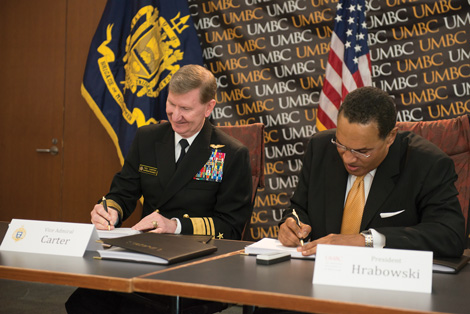
UMBC also deepened its research relationship with the Navy when Hrabowski signed a Collaborative Research and Development Agreement (CRADA) with U.S. Naval Academy (USNA) Superintendent Vice Admiral Ted Carter on April 21, 2015. The CRADA formalizes opportunities for collaboration between faculty from UMBC and the Naval Academy, and five projects have already been awarded funding from the Office of Naval Research.

One team is working to create quantum computers that could be exponentially faster than traditional computing technologies. Physics researchers are taking advantage of nanoscale defects in the structure of diamonds, and an atomic property called “spin.”

Other projects already in the pipeline focus largely on security issues. One team hopes to generate self-aware computer systems that can detect when they’re being hacked. Another group is developing computer programs to detect cyberattacks via social media posts. Projects to make cloud computing and mobile devices more secure also obtained funding.

“People have been asking us for a long time to get more connected to the Navy,” says Hrabowski. These new agreements put UMBC and the Navy on the high seas of collaboration.

— Max Cole and Sarah Hansen

Safe on Arrival
fa15_NEWS-CampusGatewayImage_web

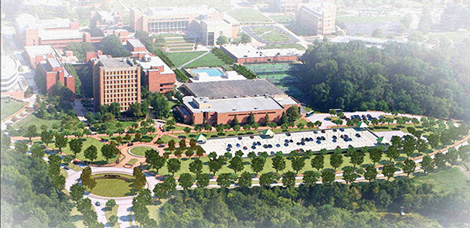
After more than a year of construction, UMBC’s campus entrance project is finally open to welcome the campus community and the many visitors to the university.

The $13.5 million renewal and renovation of the main gateway to campus – which connects UMBC to the Baltimore-Washington technology corridor via major regional highways – boasts two roundabouts, a new traffic pattern, an entrance plaza that embraces the latest concepts in shared space for vehicles and pedestrians, and much-enhanced landscaping.

Those who enter campus via UMBC Boulevard will discover that it now features two travel lanes, with a new roundabout at the entrance to the bwtech@UMBC research park. The route has been landscaped to eventually provide a canopy of towering trees and flowering understory trees.

Other improvements accompany the project as it winds into the university’s main campus. A modern sign with champagne and charcoal stone and bronze lettering graces the entrance. UMBC Boulevard now flows into a large traffic rotary at Hilltop Circle that directs motorists as they enter campus. The rotary also connects to a new and more-pedestrian friendly entrance to the main campus itself.

The new entrance was designed both to heighten safety and boost UMBC’s aesthetic beauty, says Joe Rexing, UMBC’s campus architect and director of capital planning and construction. He says that the project reflects the energy of a young and forward-looking university.

“The impetus of the project was safety,” says Rexing. Yet the chance to remedy traffic headaches and difficult pedestrian access to UMBC’s former entrance was also a chance to beautify the first impression of campus for a new generation. The old entrance “looked like an exit ramp,” he quips. “We wanted you to feel like you had arrived at a place.”

fa15_NEWS_DSC8051_webConsultations with the university community helped inform the planning. One of the chief desires was that UMBC’s new entrance should reflect a warm welcome to an inclusive campus. (The word “welcome” is even inscribed into the plaza in 80 languages, including sign language symbols and a “woof” from the campus mascot, True Grit.

Traditional iron gates and brick pillars wouldn’t do, says Rexing, who observes that “iron gates keep people out rather than welcome people in.”

Another welcoming element of the new entrance plaza is that it embraces the Dutch concept of the “living street,” or “woonerf” – a safe and shared place not only for pedestrians and bicycles to enter campus, but for cars and university shuttle buses to drop off pedestrians away from traffic and at low speeds.

Rusty Postlewate, assistant vice president for facilities management, says the new design will help direct visitors to campus. “Now it’ll be simple,” he says. “It’s going to be a lot easier for visitors, especially first time visitors.”

The campus entrance will also be greener, with landscaping that includes non-mow meadows, drought-tolerant and native plantings, and micro-bio-retention gardens that slow down runoff.

Eventually, the young trees along the entrance road will grow tall and provide a dramatic entrance to campus. “You’re going to feel like you’re driving through a forest,” says Rexing.

— Mary K. Tilghman ’79

Sound Thinking
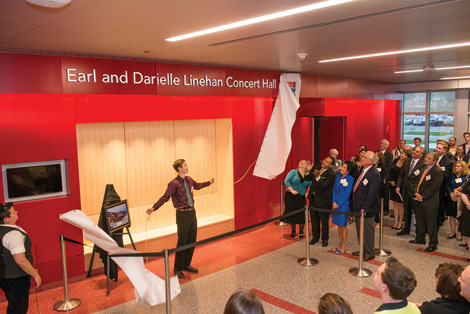
fa15_NEWS-linehan-dedication_web

The new 375-seat concert hall in UMBC’s Performing Arts and Humanities Building is already one of the premiere performing arts venues in the greater Baltimore region. Now, it has a name that acknowledges the leadership of Earl and Darielle Linehan in advancing UMBC as an institution – and especially its rising status as an artistic destination.

The Earl and Darielle Linehan Concert Hall provides an intimate experience that still allows ample room for large ensembles. The stage can accommodate a full symphony orchestra with chorus as easily as a soloist or string quartet. Materials employed to create the hall’s excellent acoustical properties – maple woodwork, birch floors and plaster walls – are supplemented by adjustable acoustic panels in the ceiling and acoustic curtains that can be lowered to adjust the sonic environment. To help ensure complete silence during performances, cool or warm air is delivered through vents under each seat from a large open chamber, or plenum, underneath the hall

“When I first walked into the hall, I was immediately struck by its visual beauty, but what was truly extraordinary was its weighty and sensual silence,” says Linda Dusman, chair of UMBC’s music department. “It’s absolutely magical, and I feel as though I am inside a beautifully tuned and crafted instrument – a Stradivarius.”

UMBC’s Department of Music will present more than 100 concerts in the hall each year, including internationally renowned soloists and chamber ensembles, the annual Livewire new music festival, emerging artists, faculty ensembles and soloists, and student ensembles and soloists.

“The Linehan Concert Hall takes us to a new level of teaching and performance opportunities, where students and faculty alike can teach, learn, and work collaboratively in a state-of-the-art environment,” says Scott E. Casper, dean of the College of Arts, Humanities and Social Sciences,

The Linehan Concert Hall (and the entire Performing Arts & Humanities Building) was created by design architects William Rawn Associates, architects of record Grimm + Parker, acousticians Kirkegaard Associates, and Theatre Project Consultants – the same team that developed the acclaimed Music Center at Strathmore in Bethesda and Seiji Ozawa Hall at Tanglewood.

Longtime residents of greater Baltimore, the Linehans have a distinguished history of involvement with UMBC. The Linehan Artist Scholars Program, launched with a generous gift in September 1997, was created through a vision that reflected the Linehans’ deeply held belief in the importance of the arts in society.

Earl Linehan chaired UMBC’s Board of Visitors from 1993 to 2005, and he was chair of the university’s first capital campaign. He also served on the committee for UMBC’s second campaign (Exceptional by Example), which surpassed its fundraising goal upon its completion in 2011. Linehan is president of Woodbrook Capital, Inc., and he serves on numerous corporate, civic, and non-profit boards.

Darielle Linehan has turned her life-long love of books and learning into a vocation, founding the highly acclaimed Ivy Bookshop in North Baltimore. She has worked with the university to create the Salons at UMBC, a series of intimate social evenings designed to explore issues in the arts and humanities.

— Thomas Moore

Gathering the Pack

fa15_NEWS-megaphone-50th-8206-nologo_web

2016 will be a memorable year for UMBC.

The university celebrates its 50th anniversary on September 19, 1966 – a golden anniversary that will be commemorated with more than a full year of events and programs and conversations with alumni, the campus community, and the general public.

Those who have studied, taught or worked at UMBC can be proud of what they have accomplished in the university’s pioneering first five decades as a public research university – and there is a palpable excitement about where the institution is heading on the way to its 100th birthday and beyond.

But UMBC’s 50th anniversary will be much more than a party. The campus-wide team organizing the celebration wants to seize the opportunity presented by the occasion to spur greater engagement with UMBC’s ever-growing number of alumni. (Almost 70,000 in 2015.)

How will that happen? From the grassroots up. In collaboration with university leaders including President Freeman A. Hrabowski, III, the UMBC campus team to guide the 50th anniversary celebrations has created a grassroots organizing effort to mobilize proud and committed UMBC alumni to celebrate the anniversary.

The message is simple but powerful: “We Need Hundreds of You to Reach Thousands of Us.”

Starting in September, members of the UMBC community will reach out to alumni to swell the ranks of those we’ve dubbed “the Hundreds.” (Starting now, with the issue of UMBC Magazine you’re reading.) They will let alumni know about the role they play as the face of UMBC – and as stewards of the university and its growing reputation.

The organizing effort will also remind alumni that as UMBC’s founding generation of faculty and staff transition to retirement, a new generation of Retrievers must pick up the torch and carry it forward – especially by staying connected with the university through continuing relationships with current students.

There are a number of exciting things in the works to make the Hundreds campaign a success. Alumni can visit a new digital space created to share UMBC stories and reconnect with fellow alumni. They can help find and organize alumni in their workplace and neighborhood, create and host events connected with the 50th anniversary, or volunteer to show up for UMBC at major regional and national events.

This groundswell of alumni engagement and pride from the organizing effort will help UMBC send a powerful message about the university’s achievements, obtained through inclusive excellence in research, teaching, and service to the community.

The 50th team has also created a video in collaboration with the university’s acclaimed Imaging Research Center (IRC) to spread the word. We’ll also be talking about the effort at UMBC’s Homecoming (October 7–10, 2015).

Be on the lookout for news about these opportunities – and ways that alumni can make UMBC’s 50th anniversary a celebration that expresses the grit and the greatness of
our community!

— Richard Byrne ’86

(Read more about why alumni leaders are excited about UMBC’s 50th anniversary and the opportunities for alumni to become part of the celebration, see Back Story.)

Discovery – Fall 2015

Nimble Fingers

Classical guitarist and UMBC affiliate artist Zane Forshee has lived a number of musical lives. First it was choosing an instrument. A well-meaning elementary school band teacher pegged the gangly, long-limbed boy as a trombone player. But borrowing an album that featured the nimble fingerpicking of Andrés Segovia from his local library soon had him considering other musical options.

“It’s kind of cliché,” Forshee recalls. “But I heard Segovia, and I was completely smitten.” The young trombonist realized he wanted to play melody. A fledgling guitarist was born.

Rock music also competed for Forshee’s heart as a teenager. But after playing in an indie rock band that toured the U.S. in a van, Forshee found himself drawn to classical performance. He quips that the lifestyle is less sweaty, with better hours, and “you only have to carry the instrument, and not all the equipment.”

Forshee is celebrating his tenth year as a member of UMBC’s faculty, where he coaches chamber music and guitar ensembles and offers private lessons in classical guitar. He is also the chair of the guitar and harp department of the Peabody Institute-Preparatory Division, and a founder of that department’s Fret Festival, which is now in its sixth year. His first album, Initial, appeared in 2008 and he is currently at work on a second album – a series of works by Valencian composers Forshee studied in Spain in 2009 as a Fulbright fellow.

The new album – which Forshee will finish in November –will center on the work of composer Vicente Asencio (1908-1979), including Forshee’s interpretation of Asencio’s Collectici Intim, or “Intimate Collection” – a series of short pieces originally written for Spanish guitarist Narciso Yepes.

While studying in the Spanish city of Alicante, Forshee examined original manuscripts and scores of Asencio’s music, which led him to the work of other Valencian composers including Eduardo López-Chávarri, Óscar Esplá, and Joaquín Rodrigo.

“I started with just investigating Asencio and sort of ended up capturing all these four composers from the same province,” explains Forshee. “What’s interesting to me is as you hear them over the course of the recording, you start to hear how there are similarities and differences in how they use rhythms and also tonalities. In the beginning they become very tonal, and then toward the end of the 20th century, they become less tonal. It’s this really unique sort of sound.”

Lauded by Fingerstyle Guitar magazine as “one of his generation’s finest guitarists,” Forshee now leads a full life as a performer and teacher of classical guitar.

“I ended up wearing a lot of different hats [in my career], and I found I really enjoy that,” says Forshee. “I get to perform. I get to think creatively about what I want to program and where I want to play. I get to teach really interesting students who are smart, fun, inspiring individuals.”

Forshee says that those students also help to shape his repertoire and performance. “They have a big impact on when I’m playing and performing and approaching pieces,” he observes, “for which I’m really thankful for because it keeps it fresh.”

— Mary Zajac

Picture Perfect

fa15_DISCOVERY-google_web

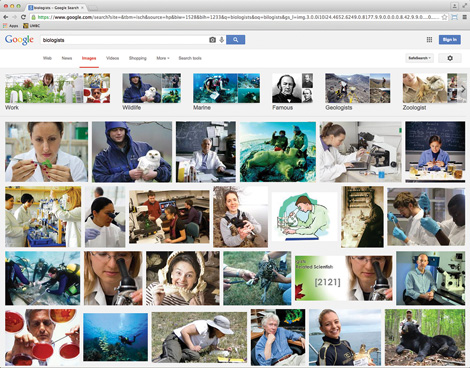
Quick: Women make up what proportion of biologists in the United States? According to federal statistics, the answer is almost exactly half: 50.1 percent. If you search for “biologist” on Google Images, however, only 35 percent of the top results are images of women.

The Google algorithm serves up similar distortions for computer programmers (23 percent in real life, but only 17 percent of top Google images) and chief executive officers (27 percent in real life, but only 11 percent of top Google results, one of which is “CEO Barbie”).

Those were among the findings of a much-discussed study released this spring by Cynthia Matuszek, assistant professor of computer science and electrical engineering at UMBC, and two colleagues from the University of Washington, where Matuszek recently completed her doctorate. Matuszek and her colleagues wanted to explore the ways in which algorithm-generated image-search results both reflect and reinforce popular stereotypes about how men and women should spend their lives.

The germ of the project, Matuszek says, came when she attended a conference presentation by a scholar working on robot caregivers for children. “He was referring to all of the grad students in his lab with male pronouns, even when he had pictures of his female grad students on the screen,” Matuszek recalls. “And when he introduced the concept of ‘caregiver,’ he used a clip-art image of a stereotypically motherly looking, smiling woman in a pink skirt suit. And I just thought to myself, ‘Really?’”

As she sat there, Matuszek started to wonder if image databases act as vectors for lazy gender stereotypes. With two University of Washington colleagues – Matthew Kay, a doctoral candidate in computer science, and Sean A. Munson, an assistant professor of human-centered design and engineering – she decided to put Google Images to some empirical tests.

The three scholars examined 45 occupations for which reliable data exist from the U.S. Bureau of Labor Statistics. They found that, on average, men were overrepresented across Google image search results relative to their actual prevalence in the work force. In highly female-dominated professions, however, Google image results tend to be even more skewed than the reality. (Ninety-five percent of image results for “librarian” are women, for example, versus 87 percent of the actual librarian work force.)

Matuszek’s team also examined gender differences in the degree of competence and professionalism portrayed in the Google search results. To explore that question, the team recruited a few dozen participants from Amazon’s Mechanical Turk system and asked them to rate workers in the images along eight different scales: “attractive,” “trustworthy,” and so on. It turned out that the workers in the images were rated as appearing more professional, competent, and trustworthy if they matched the profession’s gender stereotype. Female nurses, for example, were rated as more competent-appearing than male nurses; the opposite was true for construction workers.

In a final study, Matuszek and her colleagues examined whether image-search results could actually alter people’s perceptions of an occupation’s real-world gender balance. To test that question, they asked participants to estimate a profession’s gender balance, rate the profession’s prestige, and say whether they believe the profession is growing – all without viewing Google’s image-search results. Then, two weeks later, the same participants were shown Google’s search results and asked the same questions.

They found a small but significant effect: The image results did indeed tend to sway the participants’ estimates by at least a small degree. Here’s one example: In the real world, 55 percent of technical writers are women. But in Google’s image-search results for “technical writer,” only 35 percent of the images are of women. One of Matuszek’s participants initially estimated that 40 percent of technical writers are women – but then, two weeks later, after viewing the image search results, estimated the proportion at 35 percent, in line with what Google was showing. In this case, Google had led the participant deeper into error.

Does any of this matter? And, if so, what should be done about it? “We don’t make any recommendations in the paper,” Matuszek says. “We don’t necessarily say anything should change. We just want people who are designing these algorithms to be aware of the choices they’re making, and to know what kinds of effects these things can have.”

— David Glenn

Back Story – Fall 2015

As UMBC prepares to celebrate its 50th anniversary in 2016, the university is creating a grassroots effort to spur alumni engagement and pride. A bold motto – “We Need Hundreds of You to Reach Thousands of Us” – sums up the aims of the initiative: Recruit a dedicated band of Retrievers to spread word of the celebration to almost 70,000 fellow UMBC alumni.

UMBC Magazine asked three alumni leaders involved in the “Hundreds” campaign – UMBC Alumni Board of Directors member Zozscha Bomhardt ’93, mechanical engineering, Vice Provost for Enrollment Management and Planning Yvette Mozie-Ross ’88, health science and policy, and Vice President of Institutional Advancement Greg Simmons ’04, MPP – to talk about their commitment to the effort.

What’s got you most excited about UMBC’s 50th anniversary in 2016?

Greg Simmons: For me what’s exciting is that the anniversary represents a moment in time for us to showcase – and more fully recognize – the contributions that the UMBC community makes to Maryland and to the nation. It’s the chance to articulate not just how that community has been an important part of our past, but how it’s a part of what we are going to do next. UMBC is going to be a vital part of how we are going to solve problems, change lives, address urgent social issues, and improve our communities. We prepare people for meaningful, well-led lives. It’s a moment when we are going to be able to celebrate all that we have accomplished together in a way that we’ve not been able to do before. We’ll also help everybody look together with a common vision toward a really exciting future.

Yvette Mozie-Ross: What’s exciting me most is how we are going to be able to feature the transformation that has taken place at UMBC. It’s an opportunity to highlight the change and the progress that has happened over the years. Not so much change in terms of who we are as a university, but the changes on the campus itself. We’re still the intimate and personable campus that we’ve always been, but in terms of the infrastructure and the course offerings there has been a lot of change. We’ve done so much in such a short period of time, and when people come back they are surprised – and totally amazed.

Zozscha Bomhardt: What I’m most excited about are the events. There is a common thread of our connection to UMBC as alumni, students, faculty, and staff, and events will be the thing that takes that thread and brings us all together to celebrate. I’m especially excited that we will be celebrating the common thread of the diversity of the students who have studied on our campus. That diversity is definitely what first attracted me to the school and part of why I stay involved.

How are alumni going to make this anniversary a success?

Bomhardt: By being involved! Be involved with the events that you’re excited about. That’s really the driving force behind this. I’m also really excited by the face time I’m going to have with fellow alumni. You’ll have that time if you’re hosting an event, or even taking tickets.

Mozie-Ross: Alumni can really help us tell the story. Each one of our alumni has a unique story. Experiences they had along the way. And those stories are treasured moments. I know that others will find those stories interesting – and learn a lot from those stories.

Simmons: There are so many different ways that alumni can see themselves in this work. For some people, it will be roll up your sleeves and participate in event development or community building. Getting involved in alumni volunteer board activity. Making major substantive gifts to the campus to help us achieve our goals. For some people it will be hiring UMBC students as interns or mentoring. It can also be as easy as changing your resume so it says “UMBC” and not “University of Maryland,” or putting that UMBC mug on your desk. Showing that you’re a UMBC grad in ways large and small to let people know we’re everywhere and we’re making a difference.

(Read more about the “Hundreds” campaign and how you can get involved in Gathering the Pack)

How To – Fall 2015

Know If the Junk in Your Attic is a Valuable Antique
—With Robert Harrison ’80, history

fa15_HOWTO-Bob-Harrison-5019_web

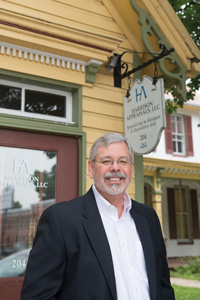
Robert Harrison ’80, history, is fascinated by material culture. He was happily pursuing an academic career in history, he recalls, until “life intervened”
and forced a change in course.

“People were so much more intrigued by the material aspect over the cultural,” he explains. “Everyone kept asking me what things were worth. So I decided I better learn how to appraise.”

Harrison studied American decorative arts at the Museum for Early Southern Decorative Arts in North Carolina, and at the Winterthur Museum in Delaware. He underwent the International Society of Appraisers’ rigorous professional certification process.

He says he became “hooked on furniture forensics” – identifying and evaluating unsigned objects to determine their financial value. For the past 20 years, he has worked from his Westminster office, appraising items, providing expert witness testimony, and even appearing on television as a professional appraiser.

In short, Harrison knows if those items in your attic are run-of-the-mill or one-in-a-million. How can you tell?

Step 1: Decide Why You Want To Know

Assessing an object’s value can be a quick, easy, and even enjoyable, bit of sleuthing. It can also be arduous and time-consuming. What you want to do with the item determines the type of evaluation required. If it’s “keep” or “toss,” Google might do the trick. If a more official value is needed for insurance purposes, or dividing an estate fairly among heirs, more legwork is usually required.

Step 2: Take a Long, Slow Look

fa15_HOWTO-Bob-Harrison-5074_webStand in front of the object. In good light, if possible. Take in its overall appearance. Note any manufacturer’s marks or stamps – usually on the back, the underside or the interior of an item. Take photos and measurements. Handle the object and observe its condition. Better condition equals higher value, but normal signs of “honest” wear are acceptable.

Careful observation also identifies reproduction pieces made new to “look” old. These objects have “manufactured” wear that is out of sync with natural functionality, sometime even down to faux wormholes drilled into wood. For instance, single-slot screws are a good sign of authentic age. Uneven dovetail joints, too. Modern manufacture will have perfect joints cut by a machine. And, finally, take a good whiff. A reproduction smells newer.

Step 3: Consider the Source

Harrison says accurately appraising an object’s value is akin to telling its story. It is the detective work of finding where and when it was made, and hopefully by whom, as well as its history of ownership.
Anecdotal information is a good place to start. How did the object come into your possession? “If a client tells me, ‘My grandmother owned this and she was 100 when she died,’ I know we are looking at a potentially authentic and valuable piece,” says Harrison.

Step 4: Research, Research, Research

Appraising is more art than science, but it does need to be based on data. Harrison says that’s true even on antiques appraisal programs on public television. “On the TV shows,” he observes, “you don’t see the part where we are backstage on the computers, feverishly pulling comparables.”

Completed auctions on eBay can reveal the value of similar items. Auction house websites, such as Sotheby’s, are places where “recent sales will be well documented.” Books like Price it Yourself by Joe Rosson and Helaine Fendelman, or the popular Kovels’ Collectors Guides can also help. And don’t forget the proprietors of local antique shops and decorative arts galleries.

Step 5: Call in the Experts

fa15_HOWTO-Bob-Harrison-5024_webIf preliminary research shows that the block-front corner cabinet you inherited from Great Aunt Harriet has potential value, it’s time to call a professional like Harrison.

Formal appraisals also are essential when making a charitable donation or insuring very valuable objects.

Professional appraisers provide a written report that includes a full description of your item and the procedure used to estimate its current value. The American Society of Appraisers has a website, searchable by both location and specialty, to find certified professionals.

“People think an object’s great age automatically confers value, but sometimes old is just old, and there isn’t much there money-wise,” Harrison explains. “But worth is relative. If a piece came down through your family and stirs memories every time you look at it, that means it is valuable – to you.”

— Michelle Gienow

By the Numbers

fa15_HOWTO-Bob-Harrison-5045_webNumber of years in business: 23
Largest number of objects appraised on a single assignment: 9,000
Largest number of hours devoted to a single appraisal: 800
Most valuable object appraised in the last 6 months:
$5 million
Number of times we’ve heard “This was owned by my grandmother who was more than 90 years old when she died”: Too many.

UMBC Faculty and Alumni Win “Innovator of the Year” Award

12662635094_f87ada2242_kUMBC alumni and faculty were featured among The Daily Record’s 2015 Innovator of the Year winners. Innovator of the Year honors men and women who have created new products, services, or programs that improve their fields.

UMBC’s winners include Chris Geddes, professor of chemistry and biochemistry, Greg Cangialosi ’96, English, and Isaac Kinde ’05, biological sciences. WeatherBugHome, an Innovator of the Year company winner, is headed by Bob Marshall ’88, mechanical engineering.

Innovator of the Year winners will be honored at an awards ceremony on Thursday, October 15. See the full list of winners on The Daily Record.

UMBC’s Y Preschool Celebrates Grand Re-Opening

Day_Care-Reopen-0431The Y Preschool at UMBC celebrated its grand re-opening on Tuesday, August 25 as the campus community gathered to reaffirm UMBC’s commitment to providing high-quality early childhood education. The event featured a tour of the new building, a visit by True Grit, and remarks by President Freeman Hrabowski, Associate Vice President of Human Resources Valerie Thomas, Y of Central Maryland CEO and President John Hoey, and parents of former UMBC preschool students. The preschool, which opens September 1, is at capacity and serves UMBC faculty, staff, students, as well as members of the local community.

President Hrabowski spoke about how the university engaged in conversations with the UMBC community to re-open the center. “This campus believes in the people here, believes in the children,” he said. “We understand how important it is for families to have safe places for their children.”
Day_Care-Reopen-0366In his remarks, Y of Central Maryland President John Hoey emphasized the importance of early childhood education and the unique experiences offered by a preschool located in an university. “We view this as a partnership with UMBC,” he said. Rebecca Zahn, executive director of early childhood development and quality at the Y of Central Maryland, praised the preschool in the Baltimore Sun. “What sets the UMBC site apart from the Y’s other sites, Zahn said, is the access the campus setting provides preschool staff and students,” the article reported.

Parents of former UMBC preschoolers also shared their experiences at the celebration. Delana Gregg, academic advisor at the Honors College, spoke about what the preschool meant to her twin daughters. “My children really found their voice at the Y,” she said. “It was the perfect way for me to be part of their education.”

Read “For the first time in two years, preschool reopens on UMBC campus Sept. 1” in the Baltimore Sun.