All posts by: Tom Moore


UMBC glows at Light City Baltimore 2018

UMBC will help illuminate the third annual Light City Baltimore festival with art, ideas, and entertainment. Running April 14 – 21 in and around the Inner Harbor, the evening celebration of light and the Labs@LightCity companion series of daytime innovation conferences prominently feature UMBC faculty, staff, students, and alumni as artists and thought leaders.

Launched by the Baltimore Office of Promotion and the Arts in 2016, Light City Baltimore is the first large-scale international light festival in the United States, and it attracts hundreds of thousands of visitors each year.

Members of the UMBC community (alumni, faculty, staff, students, and friends) are invited to an Alumni Social on Saturday, April 21, 7 – 10 p.m. at the Baltimore Visitor Center on Light Street. The space, right on the path of the BGE Light Art Walk, offers a stunning view of Light City. Attendees to this free event will enjoy complimentary food and drink, and can pick up glow-in-the-dark swag (first come, first served).

Featured Artist
UMBC artist Kelley Bell, associate professor and associate chair of visual arts, will present her installation The Herd on the BGE Light Art Walk, open nightly from 7 to 11 p.m., with extended hours until midnight on Fridays and Saturdays. Sponsored by UMBC, The Herd will be visible between Piers 5 and 6.

The Herd is a tribute to all the citizens of Baltimore City who continue to hope for a healthy city and healthy waterways,” says Bell. “It is a cluster of 400 luminous inflatable swim rings, similar in appearance to the floats used by swimmers at the seaside. The rings are laced together in a net to form a glowing multitude of creatures calmly bobbing in the shimmering ripples of the nighttime harbor. The empty ghostly rings of The Herd are a hope and a promise that someday they will be filled by happy bathers enjoying the Inner Harbor in a new, refreshing way.”

The Labs@LightCity
The daytime Labs@Light City, a series of innovation conferences dedicated to sparking social change, are organized in seven half day, topical labs: EduLab, SocialLab, GreenLab, HealthLab, ArtLab, MakerLab and FoodLab. The Labs will be held at the University System of Maryland (USM) Columbus Center on Pratt Street starting on Wednesday April 18. UMBC will be the supporting sponsor of MakerLab on Friday, April 20.

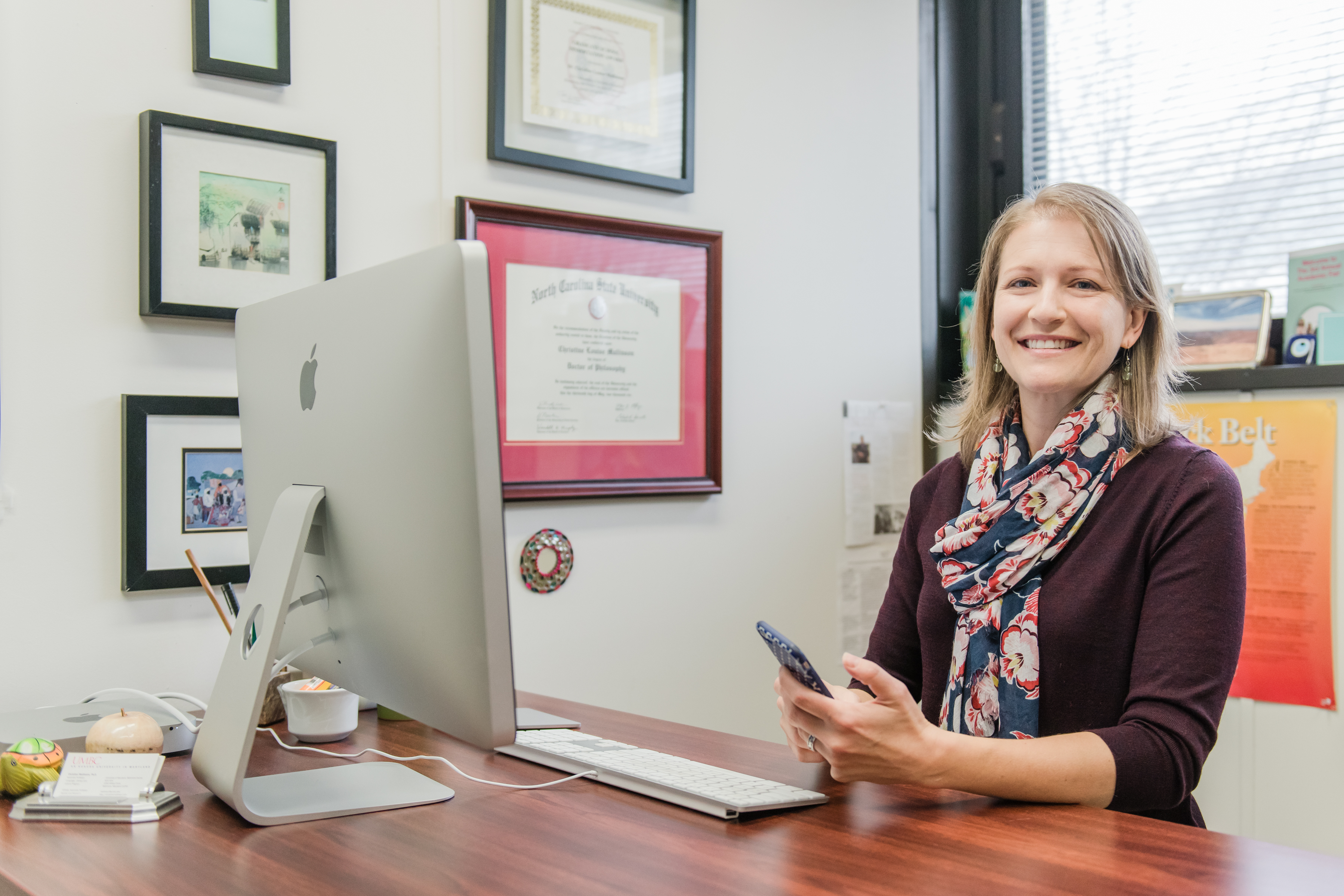
On Wednesday, April 18 at EduLab, Christine Mallinson, professor of language, literacy, and culture, and affiliate professor of gender and women studies, will take on code-switching in her talk, “Baltimore: An Incubator of Language Diversity.”
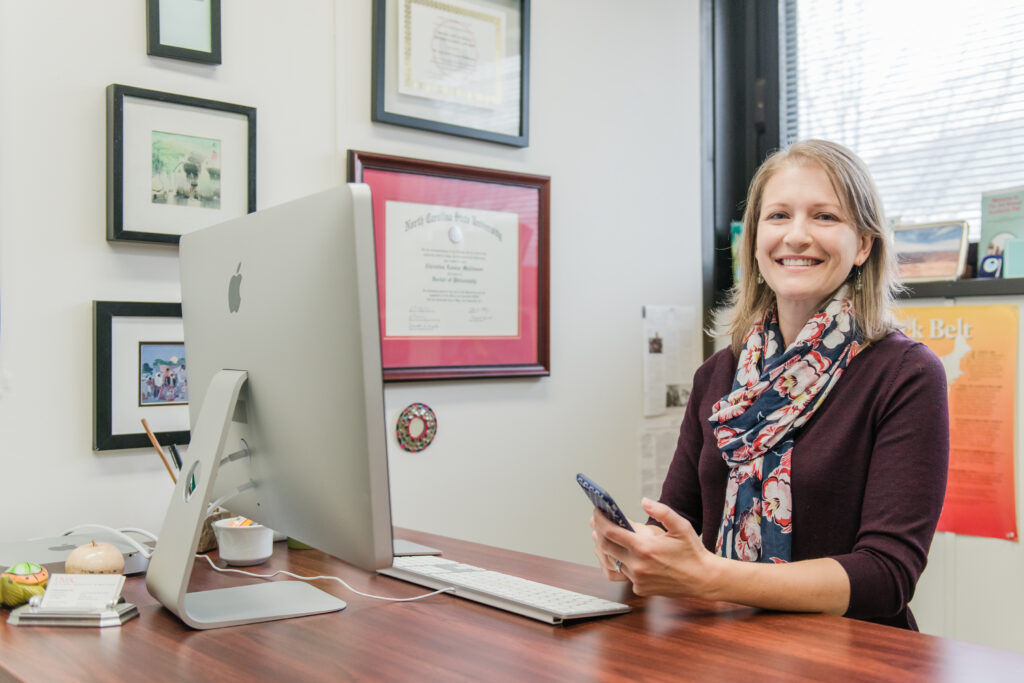
Christine Mallinson

On Friday, April 20, at MakerLab, Foad Hamidi, a post-doctoral researcher and designer in Human Computer Interaction, will share his work in the talk “Transcending Invisible Lines.” Also at MakerLab, President Freeman Hrabowski will join Kathy O’Dell, associate professor of visual arts, special assistant to the dean for education and arts partnerships, College of Arts, Humanities and Social Sciences; Richard Chisolm, ’82 interdisciplinary studies; and artist David Hess in the discussion “The Making of Gun Show.” Their conversation will reflect on the 2017 exhibition Gun Show at UMBC’s Center for Art, Design and Visual Culture. The show was created to foster dialogue about gun ownership and gun violence.

Members of the UMBC community (students, faculty, staff and alumni) are encouraged to register for the Labs@LightCity at no cost here.

Spark II
Spark II, a pop-up gallery of engaging, projection-based artworks, will be open in the Harborplace’s Pratt Street Pavilion during Baltimore’s Light City Festival, April 14 – 21. Made possible through the support of PNC and curated by Ginevra Shay, the gallery features the work of UMBC faculty and graduate students, as well as artists from Towson University. Spark II also features a schedule of performances, events, and interactive activities.

Spark II will feature works by:

  • Stephen Bradley, associate professor of visual arts, and Tagide deCarvalho, research assistant professor of biological sciences
  • Lynn Cazabon, associate professor of visual arts
  • Cathy C. Cook, associate professor of visual arts
  • Eric Dyer, associate professor of visual arts
  • Lisa Moren, professor of visual arts; Jaimes Mayhew ’10, IMDA MFA; Neja Tomšič, former UMBC artist in residence; and Martin Bricelj Baraga
  • Timothy Nohe, professor of visual arts and director of the Center for Innovation, Research and Creativity in the Arts
  • Corrie Francis Parks, assistant professor of visual arts
  • Sarah G. Sharp, assistant professor of visual arts

Special events at the Spark II gallery will include a Visual Arts Alumni Reception on Wednesday, April 18, from 5:30 to 7 p.m. to which all visual arts alumni are cordially invited. Additional events featuring UMBC faculty, students, and alumni include:

Sunday, April 15, 4:15 p.m. — Krisztina Dér ’12, music, presents Light/Flute, focused on the integration of flute music and lighting art

Monday, April 16, 8 p.m. — Lisa Cella, associate professor of music, and Stephen Bradley present SHINE. Lisa Cella performs the flute works of four contemporary composers — Christopher Adler, Adam Greene, Christopher Burns, and retired UMBC professor of music Stuart Saunders Smith — and provides a sonic framework for Stephen Bradley’s time-lapse video work that explores a meditative perspective of quotidian events.

Thursday, April 19, 7 p.m. — Shelly Purdy ’10, music, and Jason Charney ’20 IMDA MFA, perform improvised music for electronics and percussion, in an event featuring selections from Timothy Nohe‘s When People Become Verbs composed for a dance by Renée Brozic, ’99 dance.

Friday, April 20, 6:30 p.m. — The Umbilicus Percussion Ensemble will perform. Umbilicus was founded in 2012 in reaction to the generic contemporary percussion quartet, with the intention of promoting and performing a more experimental repertoire, much if it composed by its members. Umbilicus (containing the letters UMBC) consists of UMBC associate professor of music Tom Goldstein and three UMBC alumni: Paul Neidhardt, Michelle Purdy and Will Redman. Their performance will feature works by composers Will Redman, John Cage, Joseph Cello, and Brian Johnson.

Saturday, April 21, time to be announced — Puppet event by Colette Searls, associate professor and chair of theatre

On Demand
Videos by UMBC artists are featured in On Demand, a Light City curated program of time-based digital content displayed on a 12 by 20 foot LED screen. Featured are works by Vin Grabill, associate professor of visual arts; Timothy Nohe, also participating in Spark II; Jeffrey L. Gangwisch ’18, IMDA MFA; and Justyna Kurbiel ’18, visual arts.

For complete information on UMBC’s presence at the 2018 Light City Baltimore festival, visit UMBC’s Light City webpage. More information about the entire festival is available through Light City.

Header image: Visualization of Kelley Bell’s “The Herd,” courtesy of the artist.

UMBC’s Baltimore Dance Project brings premieres and revivals to the Proscenium Theatre

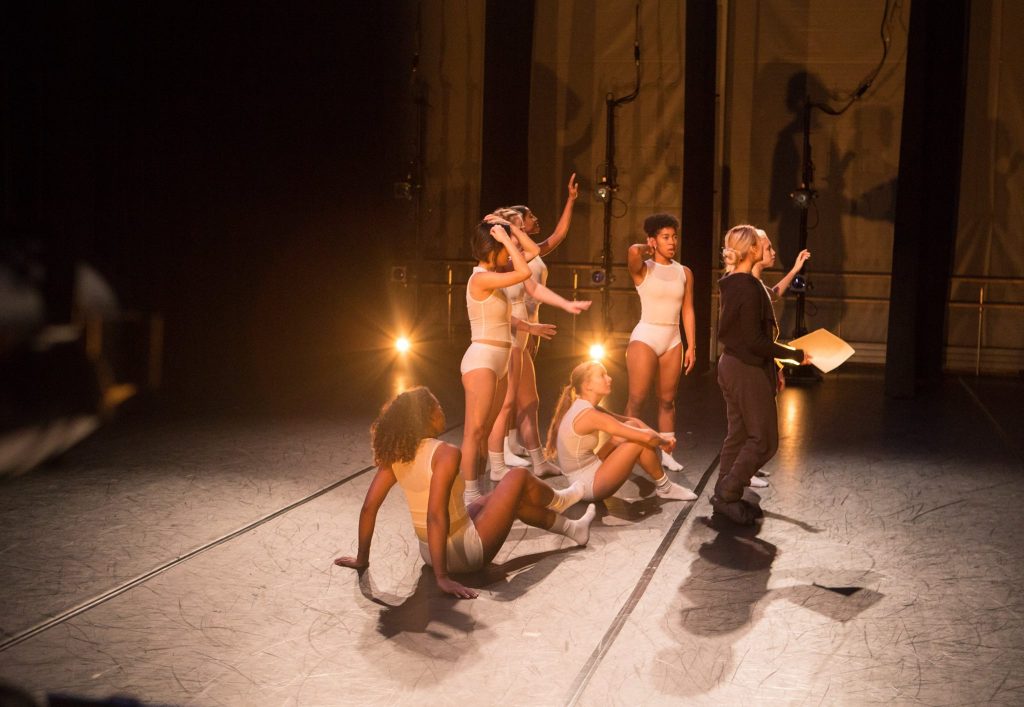
Baltimore Dance Project returns to the Proscenium Theatre for its traditional winter performances, February 8–10. Co-directed by UMBC’s Carol Hess, professor and chair of dance, and Doug Hamby, associate professor of dance, the contemporary dance company will present a blend of new, recent, and repertory works. Performances will include the premiere of Unravel, choreographed in 1995 by the late Eric Hampton and reconstructed by Alison Crosby, and an excerpt from Framework, one of the company’s earliest works, choreographed by the late Elizabeth Walton, the company’s founding artistic director, who was a member of UMBC’s dance department for more than 40 years.

Baltimore Dance Project - Square Breath

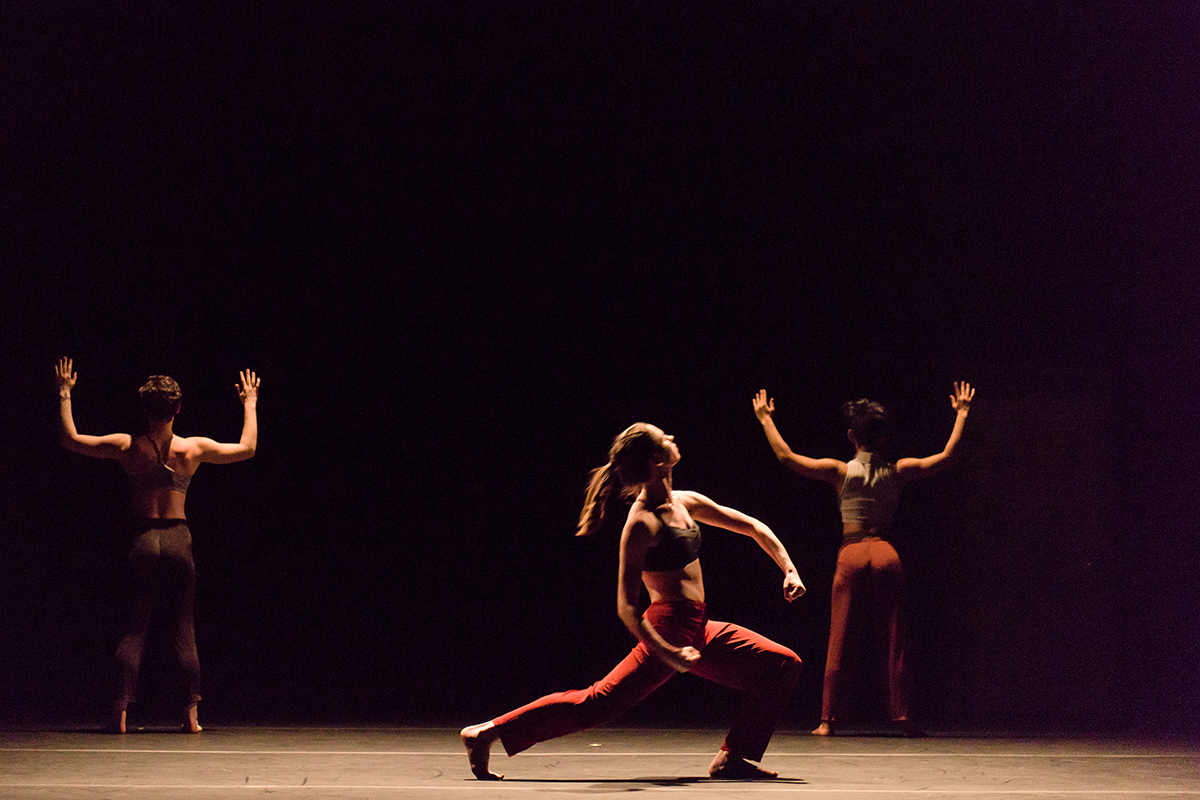
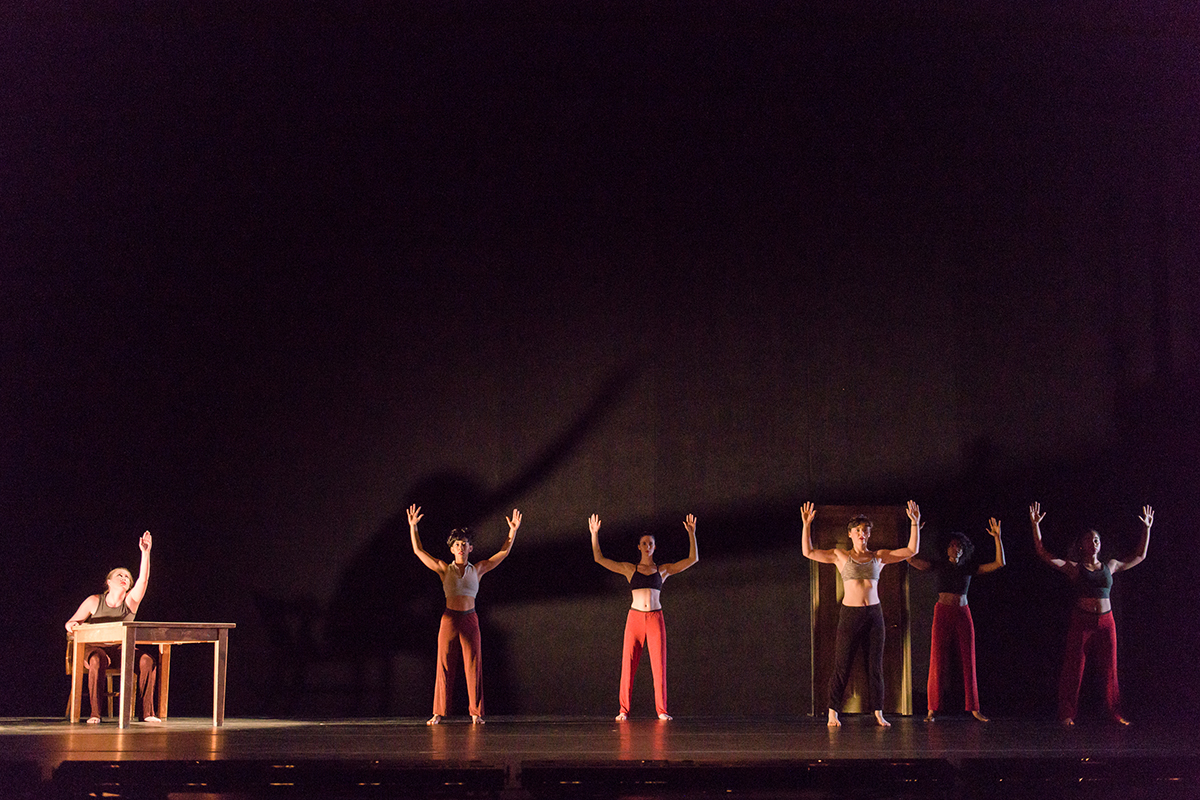
New works include a solo by Sandra Lacy, instructor of dance, and Tipping Point by Ryan Bailey ’16, dance. The program also includes encore performances of Hamby’s Square Breath, a tour de force of intensity and desperation, and Hess’ LightForest, a venture through breathtaking images of nature.

“For this concert, Baltimore Dance Project is honoring memory of Elizabeth Walton, the founding director of the company and the dance department’s first chair, by performing an excerpt from her piece Framework,” says Hess. “When I arrived at UMBC in 1982, I saw a performance of Framework in UMBC’s old theatre and loved it. In 1984, I suggested to Liz that she present the piece again. There were three dancers in the 1982 version, but Liz decided to expand the cast to six. Both Sandra Lacy and I were in that 1984 cast.”

Hess explains, “In order to re-mount the piece, I used an archival video of the piece, and my memory of Liz’s directions. I found a reel to reel master tape of the electronic score, composed by William John Tudor. The department of music’s Alan Wonneberger used his amazing expertise to process the old tape so the sound could be played and then digitized. Teaching the piece to the dancers brought back so many memories of Liz, and I am so thrilled to be able to share her work on this concert.” Walton, an associate professor emerita, passed away in November 2017.

Baltimore Dance Project - Square Breath

Hamby views the restaging of Square Breath, originally choreographed in 2007, as an opportunity for exploration. “When awakening a dance from the past, I get to rediscover it with fresh eyes, often adding to my understanding about the essence of the dance,” he explains. “A dance is a living, breathing thing, so new dancers bring new ideas and new kinetic exploration to the work. The musical score for Square Breath incorporates live sounds made by both the dancers and musicians. This allows the movement and the sound score to interact in a new and surprising way, with each restaging.”

Baltimore Dance Project infuses visual media, sound, light and technology into riveting dance performance. Known for its edgy artistic collaborations between choreographers, composers, sound artists, visual artists, engineers, and technologists, the company presents the creative work of Hamby and Hess, performer and choreographer Sandra Lacy, and guest artists.

Formed in 1982 under the name Phoenix Dance Company, BDP features outstanding performers from the Baltimore/Washington area and has been honored with numerous grants and awards. Hamby, Hess, and Lacy have received a total of sixteen individual artist awards from the Maryland State Arts Council, and their work has appeared on the streets of Baltimore and in theaters and film festivals across the United States.

More information about the upcoming performances is available on UMBC’s Arts and Culture Calendar here.

Baltimore Dance Project - Sandra Lacy

Images by Marlayna Demond ’11 for UMBC.


UMBC’s Maurice Berger launches new research projects with the CADVC

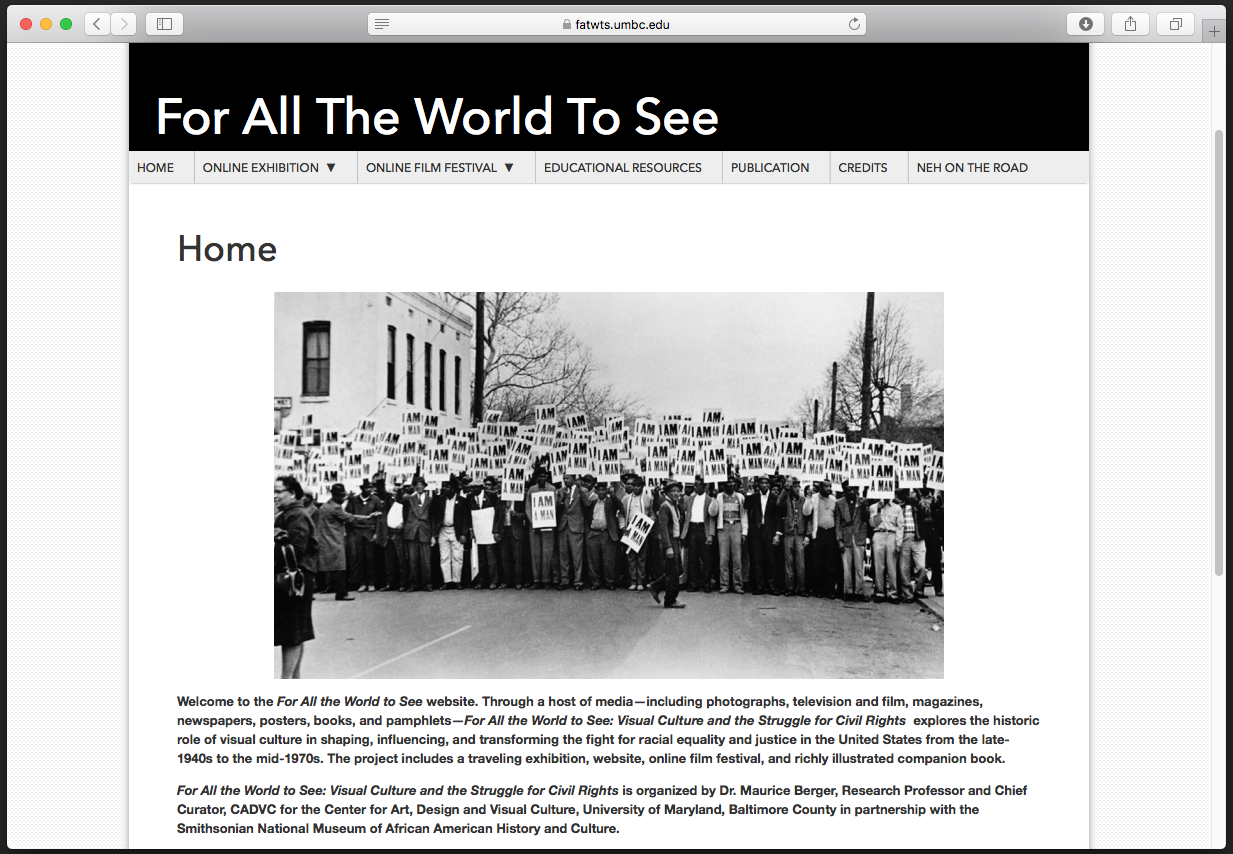
This fall, the Center for Art, Design and Visual Culture (CADVC), celebrates the launch of four significant projects by research professor Maurice Berger, who through his curatorial work frequently explores issues of race, society, and culture, examining difficult subjects through the lens of art, photography, and visual media.

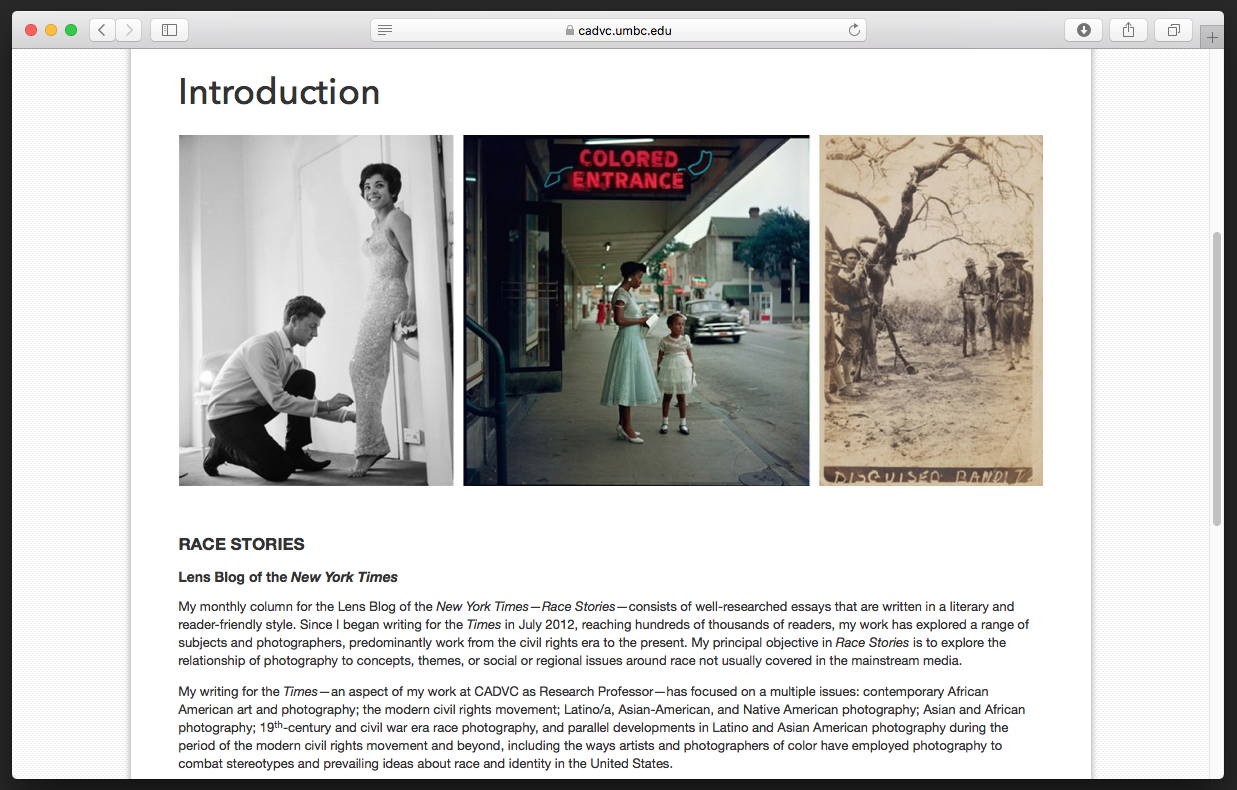
The new projects include the unveiling of exhibition websites for For All the World To See: Visual Culture and the Struggle for Civil Rights and Revolution of the Eye: Modern Art and the Birth of American Television, the creation of a online home for Berger’s “Race Stories” essays, and the extension of a national tour of For All the World To See through the National Endowment for the Humanities’ On the Road program — all of which will broaden public access to this research.

“I have a lot of faith in visual media to communicate powerful and even life-changing ideas about this country,” says Berger, whose previous work includes exhibitions such as Notes in Time: Leon Golub and Nancy Spero (1995), Adrian Piper: A Retrospective (1999); Fred Wilson: Objects and Installations 1979–2000 (2002); White: Whiteness and Race in Contemporary Art (2003); For All the World To See: Visual Culture and the Struggle for Civil Rights (2012, photo above); and Revolution of the Eye: Modern Art and the Birth of American Television (2016). Since 2012, Berger has contributed monthly “Race Stories” essays for the Lens Blog of The New York Times, exploring the relationship of race to photographic portrayals of race, and complementing many of the issues explored in his curatorial work.

Revolution of the Eye online exhibition

The online version of the exhibition Revolution of the Eye: Modern Art and the Birth of American Television, which toured nationally from 2015 to 2017 and was co-organized by CADVC and the Jewish Museum in New York, explores how modern art served as an influence and a model for shaping the new medium, from the 1940s to the 1970s. Visit the site here.

For All the World to See: Visual Culture and the Struggle for Civil Rights, co-organized by CADVC and the Smithsonian National Museum of African American History and Culture, opened in 2010 and continues to travel in a smaller, lower-security version through the NEH on the Road initiative. The exhibition was the first to comprehensively explore the historic role of visual culture in shaping, influencing, and transforming the fight for racial equality and justice in the United States from the late-1940s to the mid-1970s. Visit the new online version of the critically acclaimed exhibition here.

For All the World To See online exhibition

“Websites are incredibly valuable teaching tools,” explains Berger on the importance of these new resources. “They reach more people than come in the door of the average museum. Most exhibitions actually have a relatively small audience. For All the World to See is the exception, which has had a million visitors and counting. That’s virtually unheard of. The typical art or visual culture exhibition, no matter how many venues, will probably reach no more than 100,000 visitors. A website is not bound by geography, or the fragility of art, or the enormous cost of shipping and maintaining an actual exhibition. Visitors can pop in from all over the world. Yes, there is nothing like experiencing real works of art or important examples of visual culture. But these online exhibitions augment the original exhibition in powerful ways, disseminating its ideas far and wide.”

The launch of the Race Stories webpage brings together in one convenient place links to Berger’s monthly “Race Stories” column, which explores the relationship of photography to concepts, themes, or social or regional issues around race not usually covered in the mainstream media. Visit the site here.

Race Stories website

“I wanted to find ways to make the ‘Race Stories’ series available to as broad an audience as possible,” says Berger. “I think it’s important for college and university students to read these essays. So putting them on the CADVC website has made all of them available, in one convenient place, to our students at UMBC as well as the thousands of outside visitors to our website. I always write my essays for The New York Times and curate my exhibitions on race and visual culture with young people in mind. My ideal reader is a smart high school student — because if you can inspire a young person to see the world in new ways, then you can inspire anyone. I get a lot of emails from high school teachers and college professors, who tell me they routinely assign my ‘Race Stories’ essays to their students. I’m an educator, first and foremost. The principal purpose of my work is to teach racial literacy through visual culture.”

After a successful national tour, the exhibition For All the World To See: Visual Culture and the Struggle for Civil Rights received support from the On the Road program of the National Endowment for the Humanities, providing the opportunity for it to continue to tour the country in a reduced format. NEH on the Road is designed to create wider national access to the ideas, themes, and stories explored in major exhibitions funded by the National Endowment for the Humanities. Recently, the NEH extended its support of For All the World To See through 2023, the first time the endowment has doubled the national tour of an exhibition, allowing travel to an additional 47 geographically diverse national venues through 2023. Information on the NEH On the Road version of For All the World To See is available here.

For All the World To See On the Road


Timothy Nohe exhibits at Washington College

Timothy Nohe artwork

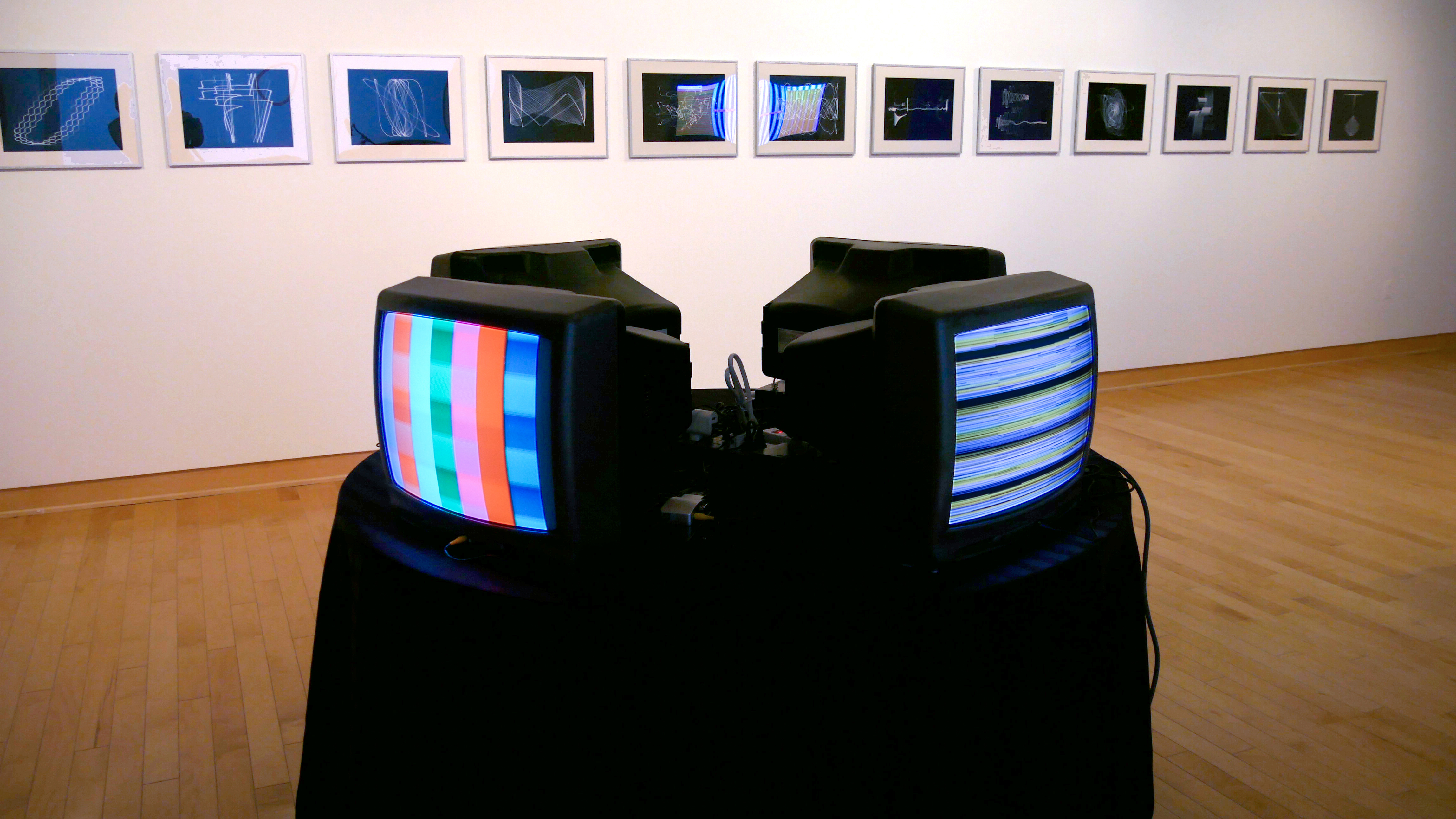
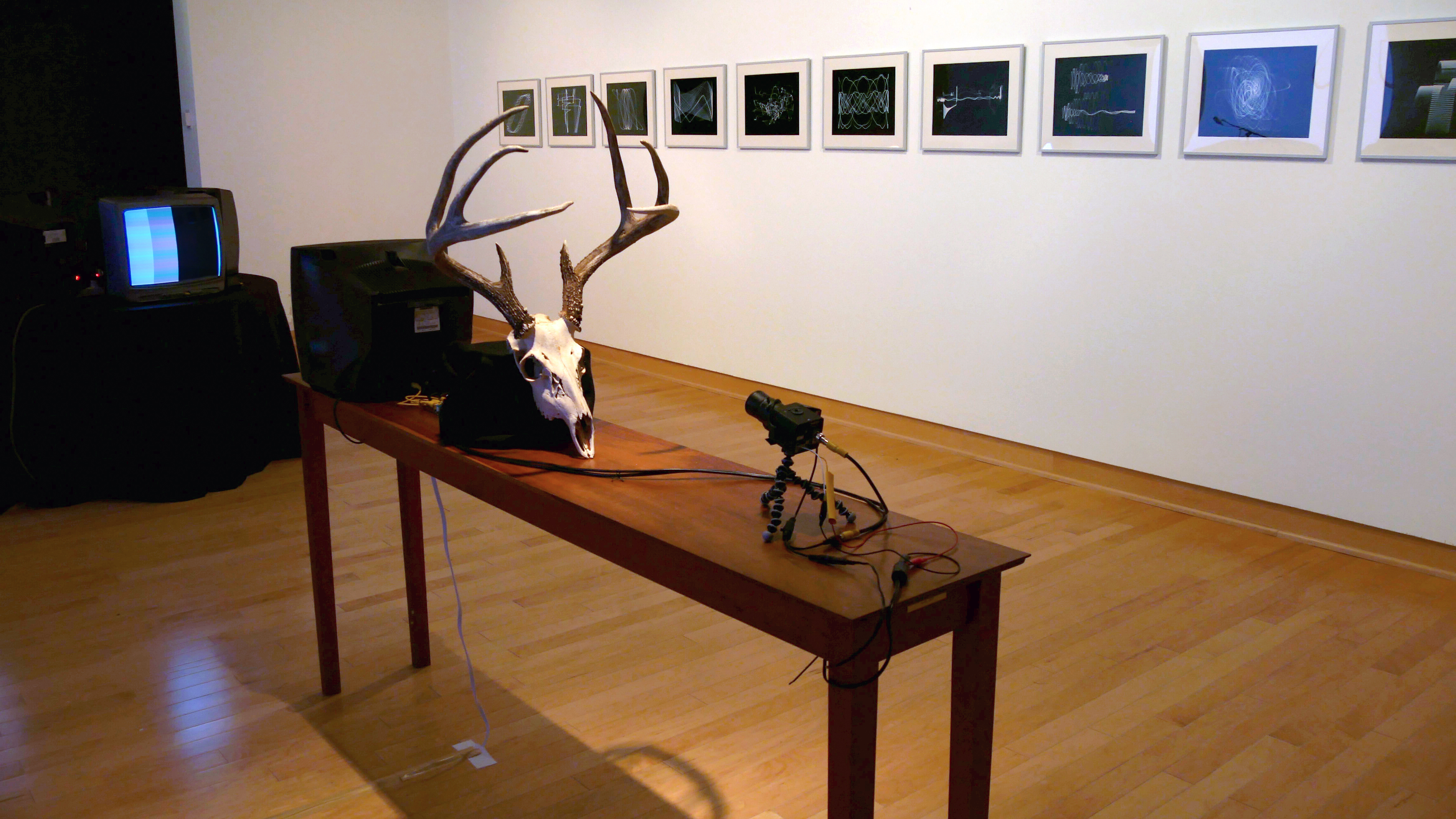
Timothy Nohe, director of the Center for Innovation, Research and Creativity in the Arts (CIRCA) and professor of visual arts, is featured in a one-person exhibition at the Kohl Gallery on the campus of Washington College in Chestertown, Maryland. The show, which opened Thursday, November 9, and continues through Friday, December 15, is entitled Voltage is Signal: Analog Video Works by Timothy Nohe and features works that explore analog video technology in innovative ways.

Timothy Nohe Cosmonaut

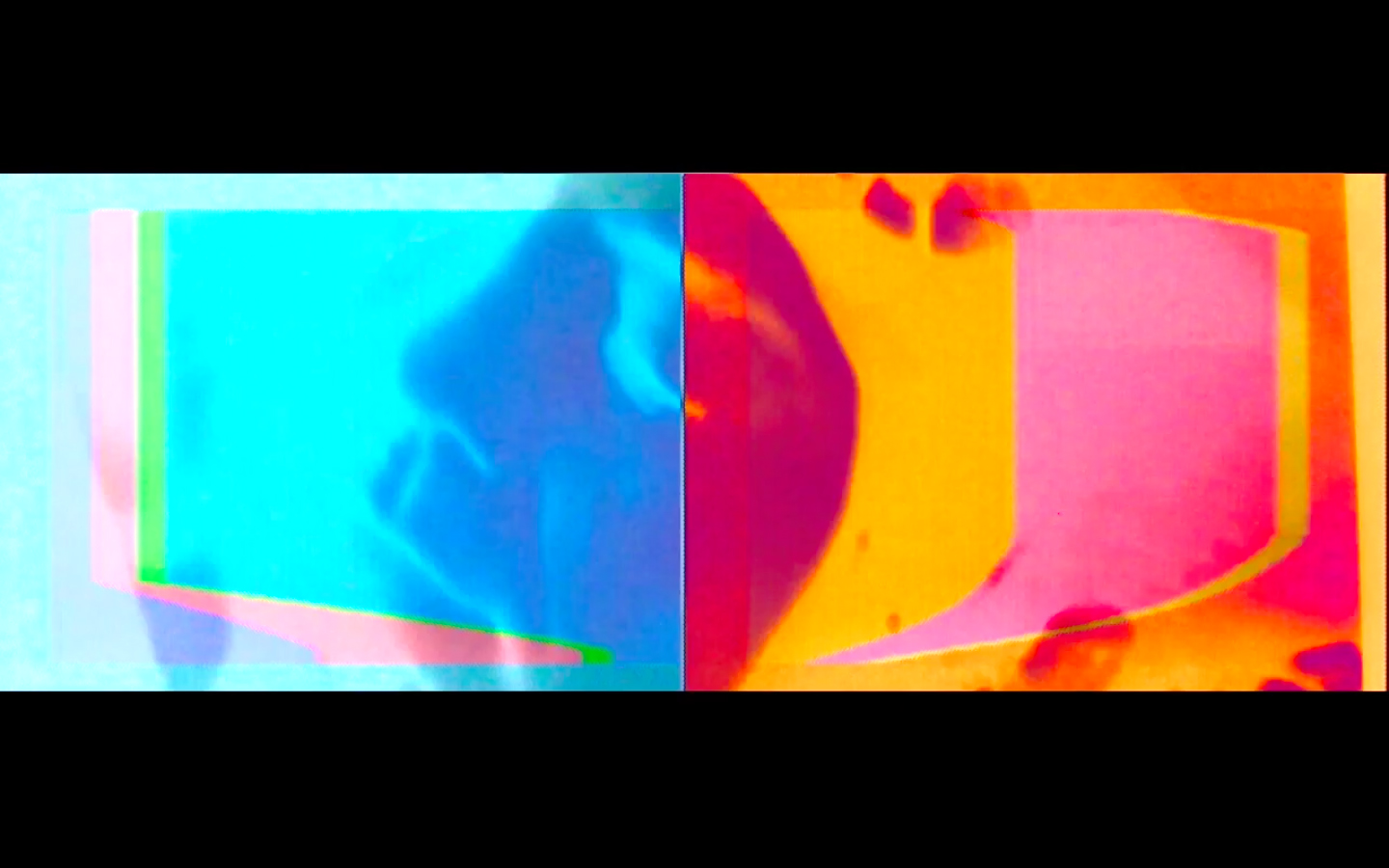
A 2015 residency at Signal Culture (Owego, New York) inspired Nohe’s work with analog modular video synthesis, and since then he has gone on to exhibit and screen video and interactive works at major public festivals such as Light City Baltimore 2017 and Artscape. His interactive exhibits, autonomous video generating circuits, installations and prints simultaneously look back and forward to technologies that slip between obsolescence and contemporary “glitch” culture. Nohe’s show at the Kohl Gallery in many ways marks a new direction, as he departs from a typically more image-based practice to consider the ways that voltages might produce abstractions. The resulting works are resonant of past traditions, from color field to Pop, even as they emerge from an interrogation of various media. A number of the works on display call for audience interaction, long a characteristic of Nohe’s work.

Timothy Nohe Artwork

Professor Nohe will return to Washington College for a public talk on his work on Thursday, November 16 at 4:30 p.m. He will also participate in a production of the modern dance LightForest by Baltimore Dance Project, directed and choreographed by Carol Hess, chair of UMBC’s department of dance, at Washington College on November 17 and 18. Nohe composed the score for LightForest for mobile devices and dancer-worn Bluetooth speakers. During the residency stay he will conduct workshops with Washington College music majors.

Timothy Nohe Artwork

Nohe was the recipient of a 2006 Fulbright Senior Scholar Award from the Australian-American Fulbright Commission and an Australian-American Fulbright Commission Fulbright Alumni Initiative Grant in 2011. Five Maryland State Arts Council awards have supported his work, and he has also been recognized with a Creative Baltimore Award. In 2015 the Warnock Foundation recognized his interdisciplinary work in urban forests with a Social Innovator award.

Additional information about Voltage is Signal is available here. Images are courtesy of the artist.

Timothy Nohe Kohl Gallery

UMBC’s Center for Art, Design and Visual Culture exhibits “Gun Show” to prompt discussion about gun violence

In 2012, following the Sandy Hook Elementary School shooting, Baltimore artist David Hess felt compelled to accelerate the construction of an unusual series of sculptures: life-size mock assault rifles fashioned from everyday ordinary objects.

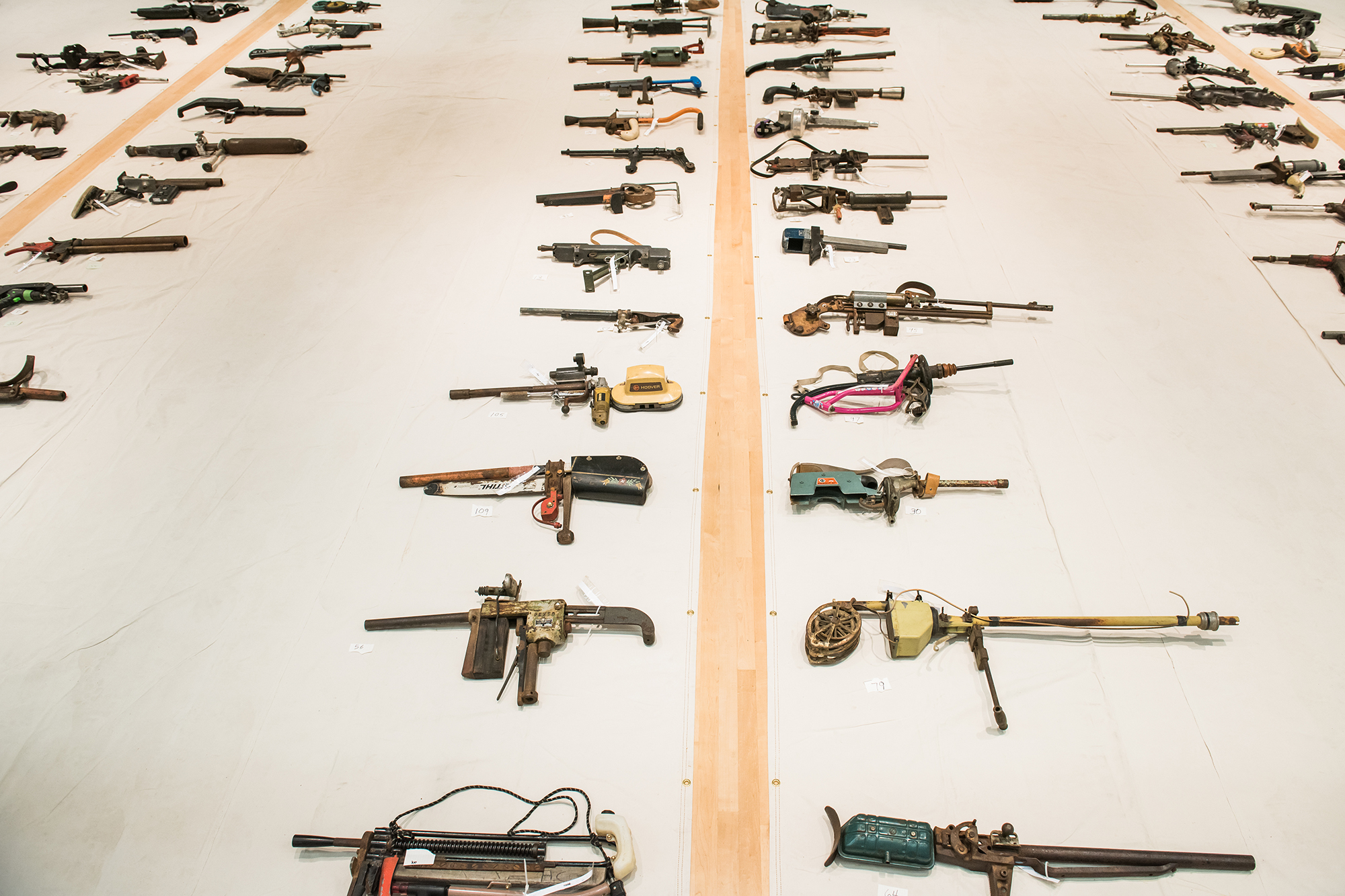
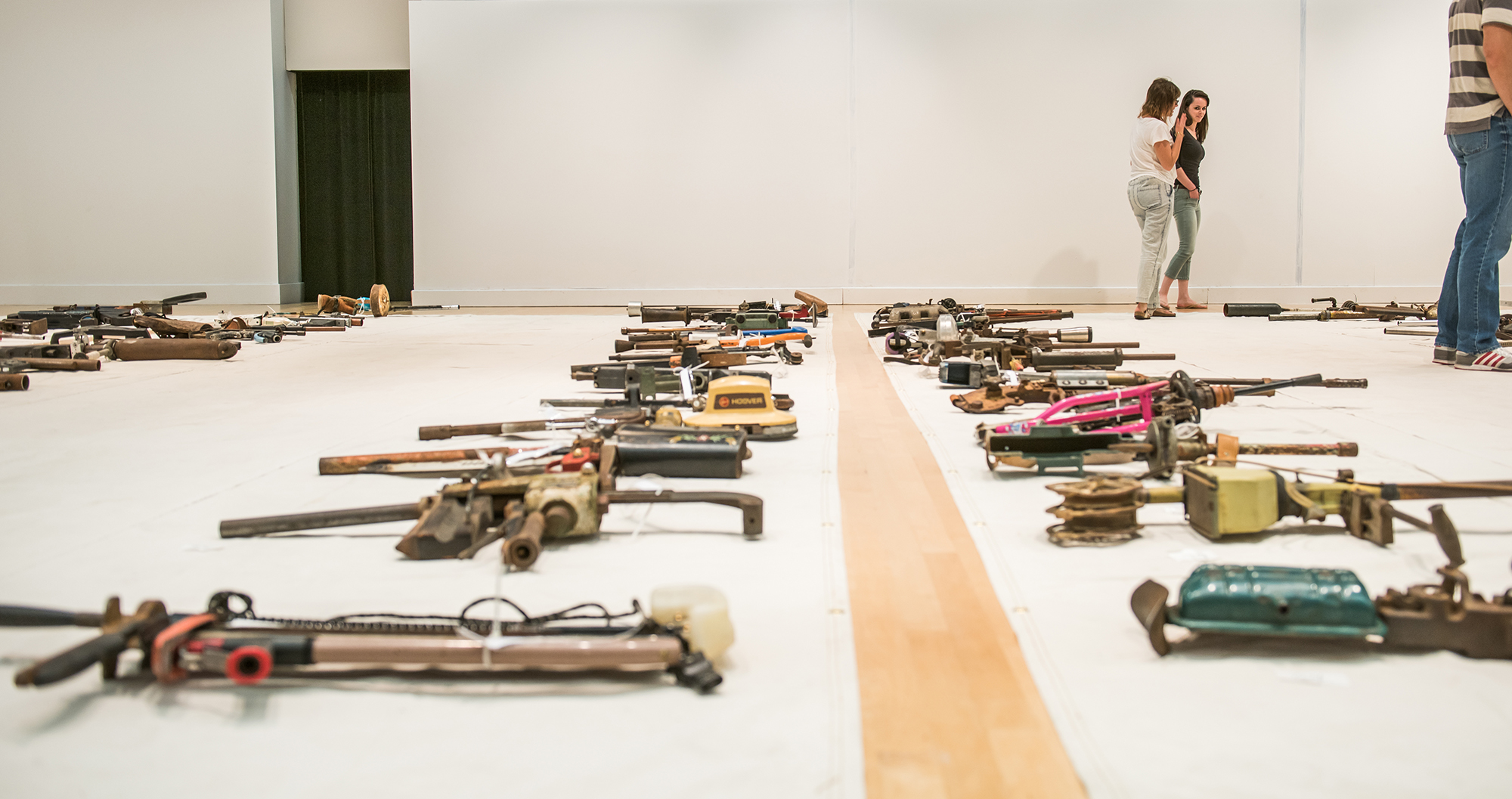
“This body of work is my personal awakening to the American obsession with weapons and the abstraction of violence,” says Hess. Taking discarded bits of things (“rescued” objects, he calls them) that most people would consider trash — a vacuum cleaner, the handle of a saw, an old black sneaker, a pink Barbie bike frame, a raggedy crutch, the body of an electric guitar, a turquoise sewing machine — Hess fashioned strikingly realistic-looking “guns” for exhibition, to prompt conversations about violence in America.

Hess’ work came to the attention of Kathy O’Dell, special assistant to the dean for education and arts partnerships, and associate professor of visual arts, art history and museum studies, who has organized an exhibition, simply titled Gun Show, of all 112 of Hess’ gun sculptures at UMBC’s Center for Art, Design and Visual Culture, opening on September 4 and continuing through October 14. An opening reception with the artist will be held on Thursday, September 7, from 5 to 7 p.m.

The exhibition displays the sculpture on the floor, laid out on tarpaulins, recalling the presentation of bodies awaiting identification following disasters, or the arrangement of confiscated weapons at police headquarters. Ranging in weight from 8 to 44 pounds, the mock guns include no shooting mechanism.

“The reason I felt strongly about convincing David Hess to hold this exhibition at UMBC is that it’s a research institution,” says O’Dell, “and research is what has driven David’s entire project, starting in the early 1990s through the present: What is a gun? What does it mean to hold one? What does it mean to make one? Who does or does not own them? Who should or should not own them? What are sensible reasons and safe ways to use them? What are the ramifications of their use or misuse? How do issues of race, class, gender identity, and age impact these questions?”

O’Dell continues, “Research is about asking questions and then attempting to answer them — as individuals and as groups working together to make sense of the world and to advance thinking.”

O’Dell notes that the power in Hess’ use of “rescued” objects is their familiarity. “Every object fits into a story with which each viewer can relate,” she says. “Yet each story is personal. A Barbie bike seat will have a different meaning to me than it will for a young man whose sister had a bike like that. Contemplating a personal story leads to contemplating one’s personal position on what the bike seat has been made to represent — a gun. The ‘rescued’ objects allow us to ‘rescue’ memories and, on the basis of memories, build thoughts and positions in the here and now.”

David Hess’ work has been exhibited at Goya Contemporary in Baltimore and the John Elder Gallery in New York. His work can be found in numerous private and public collections, including the American Visionary Art Museum, Baltimore/Washington International (BWI) Thurgood Marshall Airport, Johns Hopkins Hospital, Sinai Hospital, Montgomery College, Kaiser Permanente, and the Emerson Corporation in St. Louis, Missouri. In addition, he has completed over twenty public art commissions in and around Baltimore, Rockville, and Germantown, and Washington, D.C.

Kathy O’Dell, curator of Gun Show, teaches and writes on modern and contemporary art, with a focus on performance and global art. The author of Contract with the Skin: Masochism, Performance Art, and the 1970s (University of Minnesota Press, 1998), she has published numerous articles and reviews in Art in America, Artforum, Performance Research, TDR: The Drama Review, Women & Performance, and other journals. Currently, she is writing a book titled The Dot: A Small History of a Big Point and is co-writing, with Duke University Professor Kristine Stiles, a survey text titled World Art Since 1933. She serves on the Board of the Greater Baltimore Cultural Alliance and the Maryland State Commission on Public Art.

Read more about Gun Show on UMBC’s Arts and Culture Calendar.

All photos by Marlayna Demond ’11 for UMBC except detail of sculpture courtesy of Geoff Graham.

UMBC hosts Festival Baltimore in Linehan Concert Hall, June 16–23

From June 16 to 23, UMBC’s Earl and Darielle Linehan Concert Hall will host an ambitious new annual event, Festival Baltimore, featuring performances of major classical chamber music works by Beethoven, Brahms, Liszt, Shostakovich, Paul Creston and George Walker. Produced in partnership between UMBC’s department of music and non-profit organization Music for Minds, the festival’s concerts are unusual opportunities to hear complete cycles of works — for example, all of the Brahms piano quartets or all of the Beethoven cello sonatas — in a single evening.

“Each concert is dedicated to a composer’s complete works for a certain genre or instrumentation,” explains festival director and pianist Asiya Korepanova. “They bring back the atmosphere of the magical old times of 19th century, when two symphonies could be premiered on the same evening — after two hours of other music! — when audiences were just soaked in music, limitlessly absorbing it, when time flew by differently, and people couldn’t wait to hear premieres and then discuss their impressions.”

The festival offers “a distinctive twist on programming,” said Tim Smith of The Baltimore Sun on May 31, “in UMBC’s impressive Linehan Concert Hall.” Read his article about Festival Baltimore here.

UMBC faculty, staff and students are among the festival’s highlights. “We are thrilled to be partnering with the extraordinary musicians in Festival Baltimore to bring the joy of summer chamber music to the Baltimore region,” says Linda Dusman, chair of music. “Audiences will delight in the amazing beauty and acoustics of the Earl and Darielle Linehan Concert Hall, which brings every nuance of the performance to every seat in the house.”

Gita Ladd, cellist and UMBC affiliate artist, will perform on the festival’s finale on Friday, June 23, in a program presenting the complete Beethoven cello sonatas. Four UMBC student musicians — cellist Michael Bradshaw, violinist Morgan Dice, pianist Jackie Smedley, and pianist Junghoon Park (all class of ’18) — have received scholarships to the Festival Baltimore Academy (read more here), and with nine other academy attendees will perform the complete Brahms piano quartets on Friday, June 23.

Alan Wonneberger, director of recording for the department of music, will oversee the festival’s recording sessions, assisted by two UMBC students — Stephen Johnson and Nicholas Spears — who will intern during the festival to gain hands-on recording experience. “Festival Baltimore provides opportunities for the UMBC community and the community at large to connect with world class musicians,” he notes. “For the interns, the festival provides opportunities to record concerts with varying instrumentation performed by superb artists.”

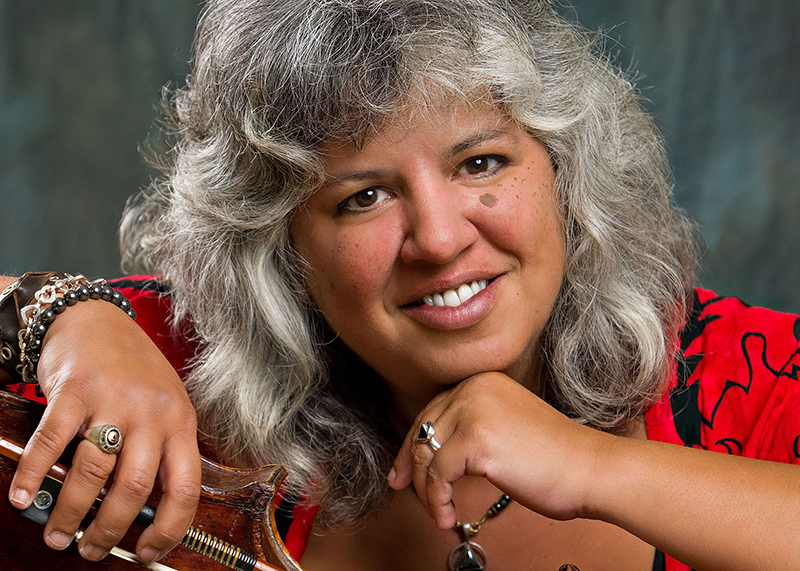
Asiya Korepenova (photo: Emil Matveev)

The festival opens on Friday, June 16, with Korepanova’s performance of Franz Liszt’s complete 24 etudes for solo piano. “I admire these etudes because they are among very few examples in the piano repertoire when a 5-minute piano piece can sound like a symphonic poem,” she says. “I’ve played the 12 transcendental etudes as a set since I was 19 and always enjoyed the challenge and grandeur of this cycle. Learning that cycle felt like taming a wild animal, and now, with another 12 etudes added, it feels that way even more.”

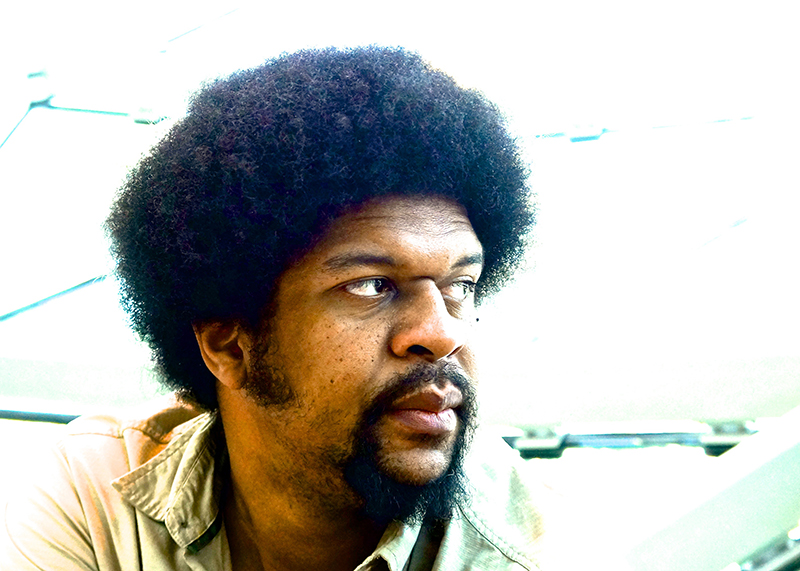
Matthew Evan Taylor (photo: Asiya Korepanova)

On Saturday, June 17, the Firebird Duo (saxophonist Matthew Evan Taylor and pianist Asiya Korepanova) performs Paul Creston’s complete works for saxophone and piano. “It has been fun to trace Paul Creston’s evolution in writing for solo alto saxophone and piano,” shares Taylor. “I’ve really enjoyed experiencing the difference between Creston’s early style, in which he is fitting his various influences together, and his mature style, which is elegant and assured.”

Milena Pajaro-van de Stadt (photo: Lisa-Marie Mazzucco)

On Sunday, June 18, violist Milena Pajaro-van de Stadt and pianist Asiya Korepanova perform the complete Brahms and Shostakovich viola sonatas, and on Wednesday, June 21, pianist Redi Llupa performs the complete piano sonatas by George Walker. Thursday, June 22, features the duo of violinist Netanel Draiblate and pianist Lura Johnson, who will perform the complete Brahms violin sonatas.

Gita Ladd (image courtesy of the artist)

Friday, June 23, hosts two concerts. First, college musicians attending the Festival Baltimore Academy will perform the complete piano quartets by Brahms. Capping off the festival in the evening, Ladd and Korepanova will perform the complete cello sonatas by Beethoven.

“Gita and I met at the Endless Mountain Music Festival in 2013 but hadn’t played as a duo until 2015, when, due to a mistake by the festival, I wasn’t told that I was to perform with her, and it was three days before the concert,” remembers Korepanova. “So, I had three days to learn the Prokofiev Cello Sonata, the Chopin Polonaise and some other challenging works, and we could rehearse only twice. The surprise was when we got together and played the entire program as if we had played with one another other for decades! It was insane, as if we didn’t need to rehearse anything — we both knew what the other was about to do.”

All Festival Baltimore performances will be held in UMBC’s Earl and Darielle Linehan Concert Hall, and master classes throughout the week are open to the public. General information about each of the concerts is available on UMBC’s Arts and Culture calendar here, and tickets are available through the Festival Baltimore website here. UMBC faculty and staff receive a 50% discount on tickets; UMBC students and attendees under the age of 18 receive free admission.

Festival Baltimore’s logo was inspired by Forum by Thomas Sayre, the public artwork situated in front of the Performing Arts and Humanities Building.

Header image: UMBC’s Linehan Concert Hall. Photo by Marlayna Demond ’11 for UMBC.

Visual artist Kelley Bell exhibits “Babel” at the David M. Brown Planetarium

Kelley Bell, associate professor and associate chair of visual arts, will display a new work, Babel, from Friday, May 19 through Sunday, May 21, at the David M. Brown Planetarium in Arlington, Virginia. The commission of the work was supported by the Friends of the David M. Brown Planetarium.

Utilizing archival imagery and animation, Babel takes advantage of the planetarium’s concave ceiling to present a projected 5-minute tour of iconic domes from around the world. Visitors find themselves beneath the oculus of Rome’s Pantheon, gaze up at the rotunda of the United States Capitol, scan the gorgeous lattices of Tilla Kari Madrasa in Uzbekistan, and take in other historic locations.

Bell ’06 M.F.A., intermedia and digital arts, stacks the different rings of these domes like children’s toys, aspiring to build a towering edifice, one atop the other. As seen in the video excerpt below, the domes spin in consecutive circles, and each level erodes and supplants the next in a futile architectural battle royale spanning centuries, geography and ideologies.

https://vimeo.com/215456230

“As the Tower of Babel presents an allegorical origin of cultural difference,” explains Bell, “Babel suggests that an ideal monument is one that brings together all ideals—faith, pleasure, beauty, industry—that the balance and tension of these paradigmatic forces allows them to coexist while supporting one another naturally, like tiers of stones stacked to form a domed ceiling.”

Admission to Babel is free, but tickets are required and can be obtained through Eventbrite here. Bell will discuss her artwork after the viewings on Friday, May 19 at 6:30 and 7:30 p.m., and on Saturday, May 20, at 7:00 p.m. She will also talk about Babel on WERA radio (96.7, Arlington, Virginia) on Thursday, May 18, at 8 a.m.

After the showing of Babel at the David M. Brown Planetarium, Bell will fly to Zagreb, Croatia, for Animafest Zagreb, which will feature her forthcoming work Carnival Love Wall.

New harpsichord graces the stage in Linehan Concert Hall

As the ensemble Musica Spira, featuring UMBC affiliate artist and keyboardist Paula Maust and soprano Grace Srinivasan, steps onto the stage in Linehan Concert Hall on Wednesday, April 5, audience members will be treated to the sounds of a new custom-built harpsichord.

A keyboard instrument most popular in the Renaissance and Baroque eras, the harpsichord superficially resembles the piano. Its sound, however, is distinctive and more delicate, produced by plectrums that pluck its strings as the keys are depressed, rather than by hammers striking strings, as with a piano. The instrument is also visually remarkable. Harpsichords were often exquisitely painted and designed with elaborate ornamentation, and UMBC’s new acquisition is no exception.

The harpsichord is one of a number of instruments obtained by the department of music through the construction of the Performing Arts and Humanities Building, and has been designed and hand-built by Owen Daly, a maker of historically-informed harpsichords and clavichords in Salem, Oregon, since the late 1970s. Daly explains:

UMBC’s new instrument is closely modeled upon a harpsichord by Pierre Donzelague, made in Lyon, France, in 1711. The 1711 Donzelague is one of the earliest known harpsichords made with the five-octave range that later became standard for large French harpsichords, rather than representing the enlargement of an earlier instrument with a smaller range.
 
The elaborate ‘wedding-cake’ rose in the soundboard, and the extravagant floral soundboard painting were both closely modeled on those elements in the original Donzelague by Berkeley artist Janine Johnson.
 
As was the case with harpsichords in their original period, the plectra are made from the shafts of feathers, in this case those of wild Canada geese, and the wire is a newly-developed material based closely upon the metallurgy of surviving samples of original wire.

Musica Spira’s program will feature music by a variety of Baroque composers, including Henry Purcell (1659–1695), George Frideric Handel (1685–1759), Élisabeth Jacquet de la Guerre (1665–1729), Peter Philips (1560/61–1628), Joseph-Nicolas-Pancrace Royer (1705–1755), and Domenico Scarlatti (1685–1757).

Harpsichord

Keyboardist Paula Maust shares:

The harpsichord is modeled on a French instrument, so a substantial portion of the music on the program is French. The Élisabeth Jacquet de la Guerre suite for solo harpsichord is from 1687, and we know that the composer was still giving recitals in Paris into the 1720s, so she may have played this music on a similar instrument. This suite is all about subtlety, nuance, and ‘good taste,’ and the new harpsichord works quite well for these pieces.
 
The Bourgeois cantata was written in 1708, so it is a close contemporary of the instrument UMBC’s new harpsichord was modeled on.
 
I’ve also chosen some later French pieces for solo harpsichord by Royer to demonstrate the instrument’s capacity for bombastic, loud, and virtuosic works (as a contrast to the Jacquet de la Guerre suite).
 
Each piece on the program was chosen to highlight the instrument’s various capabilities, for example to be loud and percussive, soft and sustained, to clearly showcase rapid passage work, and to produce and support lyric melodies.

Musica Spira performs in Earl and Darielle Linehan Concert Hall on Wednesday, April 5, at 7:30 p.m. (see additional event information).

Header image: The harpsichord’s painted soundboard and intricate woodwork. Both photos by Willie Santiago, concert coordinator.

UMBC adds spark to Light City Baltimore

With art, ideas, and entertainment, UMBC will add spark to the second annual Light City Baltimore festival, running from March 31 through April 8 in the Inner Harbor and throughout the city. The evening celebration of light and its companion series of daytime innovation conferences — the Labs@LightCity — will prominently feature UMBC faculty, staff, students and alumni as artists and thought leaders.

Launched by the Baltimore Office of Promotion and the Arts in 2016, Light City Baltimore is the first large-scale international light festival in the United States, and last year attracted more than 400,000 visitors.

Members of the UMBC community (alumni, faculty, staff, students, and friends) are invited to visit the Black and Gold Lounge on Saturday, April 1, from 8 to 11 p.m. at the Harbor Club at Pier V, right on the path of the BGE Art Walk, offering an incredible elevated 180-degree panoramic view of Light City. Attendees to this free event will enjoy complimentary food and drink, and can pick up glow-in-the-dark swag (first come, first served).

Guests in UMBC's Black and Gold alumni lounge at Light City 2017.

Featured Artists
Two visual arts faculty — associate professor Eric Dyer and professor Timothy Nohe — are among the major artists on the BGE Light Art Walk, which will feature large-scale artworks that were selected through an international competition.

DyerShabamanetica01

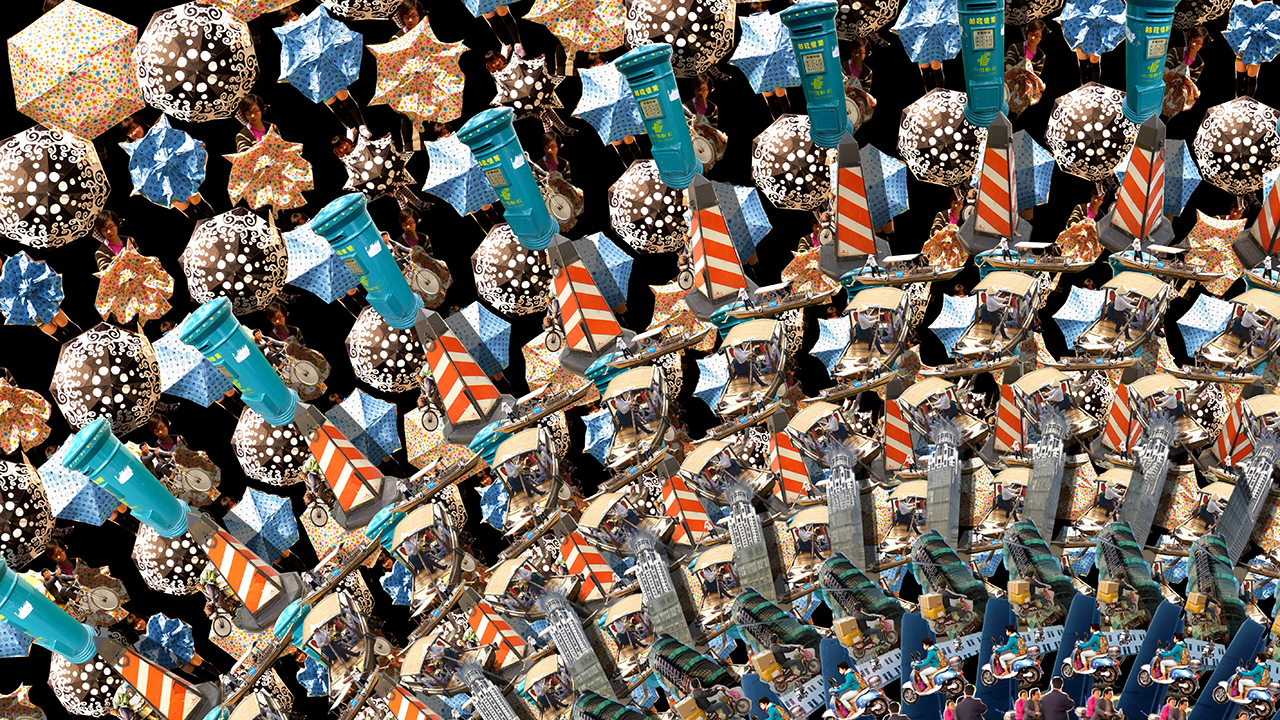
Dyer’s work, Shabamanetica (detail above), which will be located on Pier 5, “takes the form of two large spinning sculptures that evoke ships’ wheels,” explains the artist.

Spin a sculpture, and images on its face come to life with the aid of an over-arching strobe light. The animations combine imagery from Shanghai, Panama, and Baltimore: three places connected anew by the recent expansion of the Panama Canal and dredging of the Port of Baltimore in preparation for the gigantic Super Neopanamax container ships. One sculpture considers industrial heydays — Baltimore’s past versus China’s young and blossoming — with umbrellas as the common thread, set over a landscape of Panamanian highland waterfalls. The other presents the awe-inspiring ‘machine’ of canal operations and questions what it’s all for.

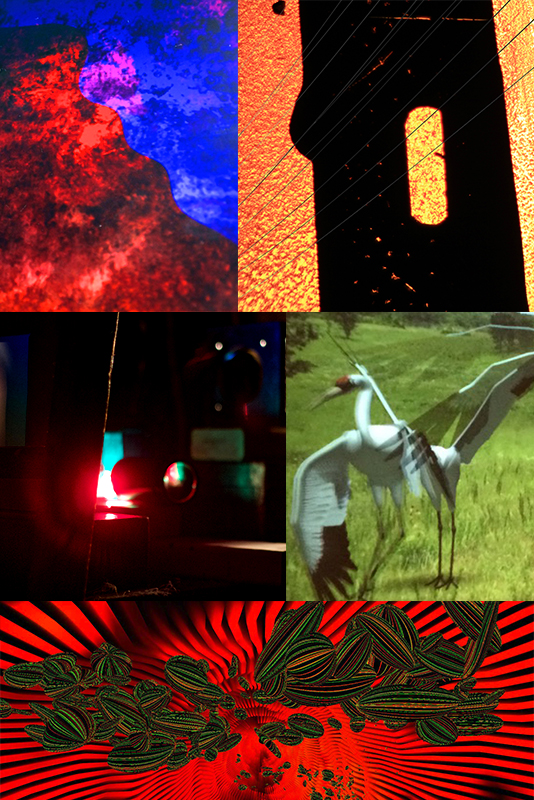
Nohe’s creation is also interactive and will be positioned near the National Aquarium. Entitled Electron Drawing — Visual Music (top image), the artwork will be “projected on a big LED screen mixes live electronic drawing with the ‘switched-on’ synthesizer music of the 1960s,” he describes. “Audiences sculpt the live ‘electron drawings’ and music with a wave of their hands.”

The Labs@LightCity
The daytime Labs@Light City, a series of six innovation conferences dedicated to sparking social change, will explore topics such as education, health, and design. The Labs will be held at the University System of Maryland (USM) Columbus Center on Pratt Street. USM will sponsor EduLab on Wednesday, April 5, at which UMBC President Freeman Hrabowski will discuss “The Path to the Future” with author Alec Ross, exploring how we look to the education system, business, and government to help cities like Baltimore tap into the promise of the industries of the future.

EduLab

At HealthLab on Monday, April 3, Gymama Slaughter, associate professor of computer science and electrical engineering, will speak on “The Body as a Battery,” in which she will discuss how the body’s chemical energy can be harnessed to power wearable and implantable sensors that diagnose and monitor diseases. Additional UMBC faculty who will speak at the Labs include Chris Swan, associate professor of geography and environmental systems; Lee Boot, director of the Imaging Research Center; and Kimberly R. Moffitt, associate professor of American studies and affiliate assistant professor of Africana studies and language, literacy, and culture. Lab attendees will also hear from UMBC alumni Maritha Gay ‘84, health science and policy; Greg Cangialosi ‘96, English; and Joseph T. Jones ‘06, social work.

UMBC SPARK Gallery
UMBCSparkVerticalPRUMBC SPARK, a pop-up gallery of engaging, projection-based artworks, will be open at Calvert and Water streets nightly, 5 – 10 p.m.

Made possible through the vision and generosity of PNC, the gallery is produced by the Downtown Partnership of Baltimore and features the work of UMBC faculty (including Kelley Bell, Cathy Cook, Symmes Gardner, Lisa Moren, Jules Rosskam and Sarah G. Sharp) and graduate students. The gallery is curated by Joe Reinsel, a Baltimore based artist who uses new media, video, and sound to explore ideas about architectural space, time, and touch.

UMBC SPARK also features a schedule of special events, including performances by UMBC’s Baltimore Dance Project and the UMBC Percussion Ensemble, a special showing of films by Stan VanDerBeek (former chair of visual arts), an animation workshop by assistant professor Corrie Parks, and a visiting artist talk by Elizabeth Daggar.

“We’re very excited that film, video, animation, and projection art works by visual arts faculty, alumni, and graduate students are prominently featured in UMBC SPARK,” says Preminda Jacob, chair of visual arts. “Some highlights include an animation workshop for the public on Wednesday, April 5, that will be conducted by our talented undergraduate students in the UMBC Visual Arts Club. On Thursday, April 6, we will welcome visual arts alumni to the exhibition with a special hospitality event.”

On Demand
Artworks by UMBC faculty, staff, and students (including Cathy Cook, associate professor of visual arts; Corrie Parks, assistant professor of visual arts; and Catherine Borg, arts publicity coordinator) will be featured in “On Demand,” a Light City celebration of digital content along the BGE Light Art Walk.

For complete information on UMBC’s presence at the 2017 Light City Baltimore festival, visit UMBC’s Light City webpage.

Images: Where not specified, images are courtesy of the artists.

Exhibition and lecture explore the artwork and changing society of Myanmar

Myanmar artwork

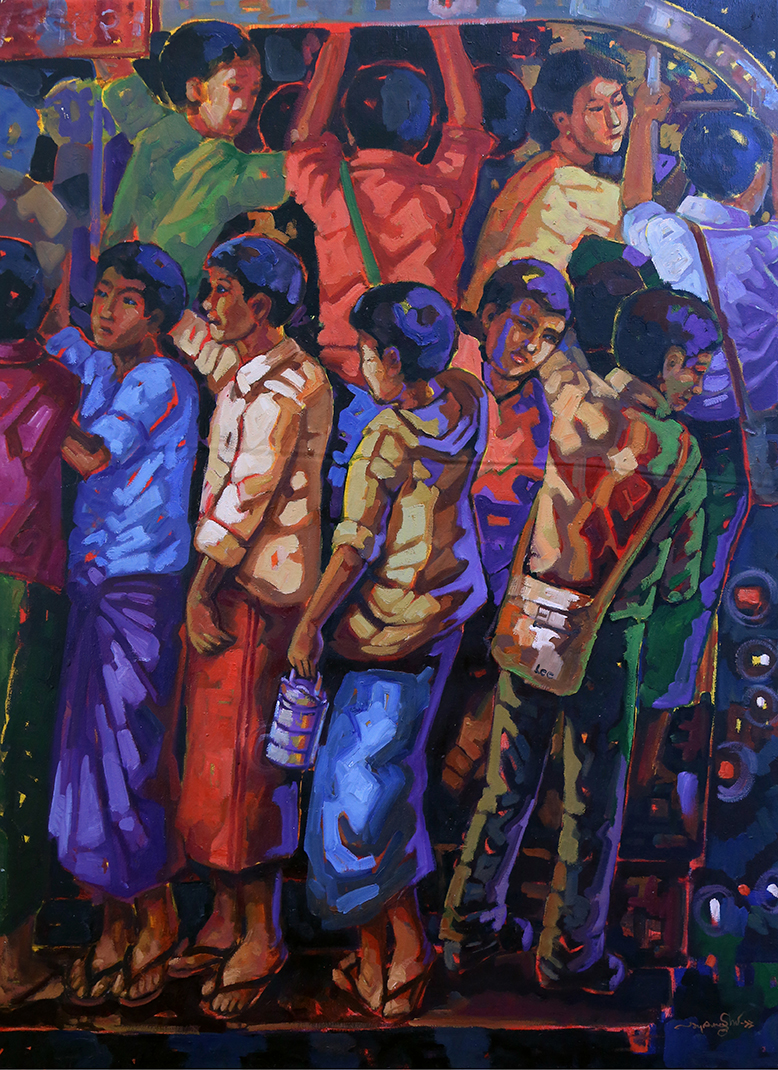
Opening on January 30 and continuing until March 26, the Albin O. Kuhn Library Gallery will present Altered State: Painting Myanmar in a Time of Transition, an exhibition of paintings by 36 contemporary artists from Myanmar, the Southeast Asian nation formerly known as Burma.

Created following the transition period of 2011, when a military-backed civilian government replaced oppressive rule by military junta and the country once famous for its seclusion re-entered the world stage, the paintings illustrate current artistic practice in Myanmar and present a series of creative viewpoints on a rapidly changing society. Paintings included in Altered State: Painting Myanmar in a Time of Transition are from the collection of contemporary Myanmar paintings of Ian Holliday, vice president and pro-vice-chancellor (teaching and learning) at the University of Hong Kong.

“The exhibition is important because it highlights the work of a large group of contemporary artists from Myanmar (Burma), many of whom experienced censorship of their work in the past. Myanmar is a country that is gradually transitioning from a long postwar history of military rule to a more democratic form of government,” says Constantine Vaporis, founding director of the Asian Studies Program and professor of history. “Barack Obama was the first U.S. president to visit the country, and his efforts to promote the peaceful democratic transformation of the country were important to the U.S.’s strategic rebalance to Asia.”

On February 1 at 4 p.m., the Humanities Forum and Social Sciences Forum will present a lecture by Christina Fink, professor of the practice in international affairs at The George Washington University, who will speak on “Myanmar: Perspectives on a Society in Transition.”

Professor Fink is a cultural anthropologist who has combined teaching, research, and development work throughout her career. Her areas of expertise are Burma/Myanmar in particular and Southeast Asia more broadly, equitable development, gender and development, civil society in ethnically diverse states. She received her B.A. in international relations from Stanford University and her M.A. and Ph.D. in social/cultural anthropology from the University of California at Berkeley. She has taught at the Elliot School for International Affairs at George Washington University since 2011. She served as a visiting lecturer at the Pacific and Asian studies department at the University of Victoria in 1995, and, from 2001 to 2010, she was a lecturer and program associate at the International Sustainable Development Studies Institute in Thailand.

Myanmar artwork

Presentation of the exhibition at UMBC is supported in part by an arts program grant from the Maryland State Arts Council, an agency funded by the State of Maryland and the National Endowment for the Arts. Additional support comes from the Friends of the Library & Gallery, the Libby Kuhn Endowment, and individual contributions. Professor Fink’s lecture is sponsored by the Asian Studies Program, the Dresher Center for the Humanities, the Albin O. Kuhn Library and Gallery, the Global Studies Program, the Department of Visual Arts, and the Social Sciences Forum.

Exhibition hours will be 10 a.m. to 4:30 p.m. Monday through Friday, with extended hours on Thursday until 8 p.m., and on Saturday and Sunday from 12 to 5 p.m. Admission to both the exhibition and lecture is free. Complete information is available on the UMBC Arts & Culture calendar here (exhibition) and here (lecture).


“Revolution of the Eye” opens at UMBC’s Center for Art, Design and Visual Culture

Hailed as “groundbreaking” by The Baltimore Sun’s David Zurawik, Revolution of the Eye: Modern Art and the Birth of American Television, the first exhibition to explore how avant-garde art influenced the look and content of network television in its formative years, is on display at the UMBC’s Center for Art, Design and Visual Culture (CADVC) through December 10.

From the late 1940s to the mid-1970s, the pioneers of American television adopted modernism as a source of inspiration. Revolution of the Eye looks at how the dynamic new medium of television, in its risk-taking and aesthetic experimentation, paralleled and embraced cutting-edge art and design.

Highlighting the visual revolution ushered in by American television and modernist art and design of the 1950s and 1960s, Revolution of the Eye features over 260 art objects, artifacts, and clips. Fine art and graphic design (including works by Saul Bass, Marcel Duchamp, Roy Lichtenstein, Man Ray, Georgia O’Keeffe, and Andy Warhol), as well as ephemera, television memorabilia, and clips from historic television programs and film (including BatmanThe Ed Sullivan ShowThe Ernie Kovacs ShowRowan and Martin’s Laugh-In, and The Twilight Zone) are on view.

Revolution-Eye-CADVC16-9642

 
Early on, television opened its doors to appearances by avant-garde artists — from John Cage performing a musical composition on I’ve Got a Secret to Salvador Dali as the mystery guest on What’s My LineRevolution of the Eye examines the diverse ways modern artists, designers, and critics used the medium as a significant vehicle for self-promotion to a broad national audience. Viewers will experience rare clips of Cage, Dali, Willem de Kooning, Marcel Duchamp, Ray Eames, Roy Lichtenstein, Ben Shahn, George Segal, and other renowned artists.

During the exhibition’s premiere in New York, The New York Times commented, “We may think of TV before All in the Family as a vast wasteland, but the more than 260 items in the exhibition — clips, advertisements, art pieces, publications, merchandise — reveal the influence and even the input of artists from Duchamp and Dali to Ben Shahn, Saul Bass, Roy Lichtenstein and Andy Warhol.”

Revolution of the Eye examines television’s promotion of avant-garde ideals and aesthetics exemplified by the integration of Dada, Surrealism, and other experimental genres into the aesthetically and conceptually rich series The Twilight Zone and The Ernie Kovacs Show by such pioneers as Rod Serling and Ernie Kovacs. Both embraced avant-garde ideas that broached broad social or cultural issues — from the politics of the Cold War to the corporate ambitions of the networks. Their work was artful and sophisticated, exemplifying the best of early television. Their influential programs reflected the medium’s potential to alter the way Americans understood the world.

The exhibition also features work by Stan VanDerBeek, a professor of art and film at UMBC from 1975 until his death in 1984, when he chaired the Department of Visual Arts. A pioneer in the development of experimental film and live-action animation techniques, VanDerBeek contributed early in his career to Winky Dink and You, an interactive Saturday morning show that aired on CBS from 1953 to 1957, clips of which are shown in the exhibition.

“Many critics speak of present-day television as kind of a new golden age in which the medium is seen to have surpassed film as a major venue for artistic experimentation and quality,” says exhibition curator Maurice Berger, CADVC research professor. “Revolution of the Eye reminds us that the desire for outstanding, artistically important programming was in television’s DNA from the beginning.”

Revolution-Eye-CADVC16-9660
 
The exhibition is organized by UMBC’s Center for Art, Design, and Visual Culture and the Jewish Museum, New York, where it was on display in 2015 prior to a national tour that included the NSU Art Museum Fort Lauderdale and the Addison Gallery of American Art.

More information Revolution of the Eye is available here. The Center for Art, Design and Visual Culture is located on the first floor of the Fine Arts Building and is open Monday through Saturday from 10 a.m. to 5 p.m., on Thursdays until 7 p.m., and on Sundays from 12 to 5 p.m. Admission is free.

Lynn Spigel, professor of screen cultures at Northwestern University, who wrote the introduction to the exhibition catalog, will speak about the exhibition on Thursday, November 17, 4 p.m. in Performing Arts and Humanities Building (room 132). Additional information about her lecture is available here.


Read the reviews:
UMBC’s ‘Revolution’ reminds us that small screen had big visual ideas (The Baltimore Sun)
‘Revolution of the Eye: Modern Art and the Birth of American Television’ Review (The Wall Street Journal)
‘Revolution of the Eye’ Examines Art’s Influence on Early TV (The New York Times)


Revolution of the Eye is made possible by the generous support of the Andy Warhol Foundation for the Visual Arts, the Skirball Fund for American Jewish Life Exhibitions, the Stern Family Philanthropic Foundation, the National Endowment for the Arts, the National Endowment for the Humanities, and other generous donors. The exhibition’s presentation at UMBC is supported in part by the Maryland State Arts Council and the Baltimore County Commission on Arts and Sciences.

Top Image: Batman and Robin, 1966. Image provided by 20th Century Fox/The Kobal Collection at Art Resource, New York.

Exhibition images by Marlayna Demond ’11 for UMBC.

UMBC Theatre performs Voracious by Susan McCully

The Department of Theatre presents Voracious by Susan McCully, directed by Nyalls Hartman, running from November 19 through 22 in the Proscenium Theatre in the Performing Arts and Humanities Building.

Obsessed with getting a 4-star review for his restaurant, Chez Rachel, Chef Jean-Jacques spies Suzanne Falmagne, the impossible-to-please restaurant critic, ordering in the dining room and snaps the staff into action. Mistakenly, the woman is actually Joanie, an amateur critic pretending to be the infamous Suzanne. Meanwhile, at the bar sits Ceely a “vegetarian” with a troubling, voracious appetite for Jean- Jacques and his blood sausage. As Joanie’s long-suffering boyfriend, Lawrence, begs for her attention, the real Suzanne storms in. Intrigue and chaos ensue while the stalwart waitress, Louise, and the rest of the quirky staff, struggle to keep the pace and the peace. All ends happily in this farce about the quest for perfection and finding one’s own pleasure as Suzanne falls for Joanie, Lawrence for Louise and Ceely joyfully discovers Jean-Jacques’ true identity.

Performances:
Thursday, November 19, 8 pm
Friday, November 20, 8 pm
Saturday, November 21, 8 pm
Sunday, November 22, 2 pm

$15 general admission, $10 students and seniors, with tickets available at Missiontix.com. Complete information is available on the Arts and Culture Calendar here.

Image: Poster for Voracious by Susan McCully.