Editor’s note: For those of you who live in cities, ask yourself: What it is about your urban lifestyle that makes it worth it despite the pollution, the noise and the traffic? Perhaps it’s the hundreds of unique restaurants that you like to dine at. Or the density that fosters a vibrant night life and cosmopolitan cultural scene. Maybe it’s the parks, the museums, the tall buildings, the mass transit.
What if much of that went away? Would you still want to live there?
Despite these challenges, two scholars who study cities explain why they think urban areas will endure – even if they don’t get the aid from Congress that now seems more likely.
The city was thought to be redundant when the telephone was introduced to the world in 1876 and then the first personal computer in 1971. What was the point of cities when people could communicate over the phone or through the internet? The future was imagined as a global village of electronic cottages.
In fact, the future was and continues to be giant metro areas and dense cities.
After 9/11, some thought that the threat of terrorism would lead to the suburbanization of financial services and a drift away from the city. In the two decades that followed, New York City continued to grow and prosper as a global financial center.
And today, many cities will survive the pandemic for the same reasons they survived the telephone, internet and terrorist attacks. That’s because there are powerful economic forces at work.
The pools of skilled labor allow the transfer of information, knowledge and skill.
The presence of so many companies generates more business for peripheral industries – such as how a big banking sector creates work for accountants and lawyers.
The proximity of people facilitates contact that leads to the maintenance of trust and the exchange of information.
These forces are even more powerful for the more dynamic sectors of the economy, particularly banking and financial services, advertising and a vast range of cultural and creative industries – all built around face-to-face contact.
I believe the cities that generate this type of “cognitive capitalism,” such as San Francisco, New York and San Jose, will bounce back. Those that have more routine industries that can be done anywhere, like Detroit, Baltimore and Buffalo, may not. This is a trend that is already occurring across the U.S. over the past 30 years as cities focused on the knowledge economy have grown faster than those that are not.
Confetti lies on the street after the Times Square New Year’s Eve ball dropped in a nearly empty Times Square early Friday, Jan. 1, 2021, as the area normally packed with revelers was closed because of the ongoing coronavirus pandemic. ( AP Photo/Craig Ruttle)
The power of cities: Sharing, matching and learning
Michael Orlando, University of Colorado Denver
Density is what makes a city special. A place can support a dizzying array of cultural delights only where significant numbers of people live in close proximity to one another.
This won’t last forever. Soon, I believe, new vaccines and improved treatments will end this pandemic. And when density is no longer cursed by contagion, cities will reassert their magic, through their ability to enhance sharing, matching and learning.
Economists refer to these three mechanisms as types of agglomeration economies because they represent benefits of concentration. They are the incentives that lead people and production to exist side by side, enduring the high cost of dense urban areas. Economies of sharing, matching and learning explain why cities form and grow.
Economies of sharing refer to economies of scale. For example, businesses that specialize in high-quality instrument repair and intellectual property law provide important services, but they are consumed only infrequently and sporadically. These businesses prefer to locate in large cities where fixed cost of operations can be spread over many customers, making it more likely their services are always in demand.
Economies of matching refer to the cost and time savings in searching for goods, services and jobs in a large city compared with a less populous area. Workers such as piano tuners and patent attorneys, for example, possess a narrow set of skills that are of great value to particular employers that regularly need these unique services. So workers with these specialized skills will prefer to locate in larger cities, where they are more likely to be matched to a job – and quickly find another if they lose it.
Economies of learning refer to the value derived from serendipitous interactions. People learn from each other, through both intentional meetings and chance encounters. Learning through intentional meetings may occur wherever people seek each other out. But learning through chance encounters will happen more frequently in dense urban areas where there are simply better odds of encountering other people. As a result, companies and workers will prefer to locate in cities where they can command higher profits and wages associated with the learning that occurs through serendipitous interactions.
Companies for whom knowledge and ideas are particularly important may engineer such chance encounters by strategically locating co-workers from different departments so that they might interact, seemingly, at random. Similarly, by locating in cities, workers and businesses engineer chance encounters with those from other companies.
In research on the economic geography of innovation, my co-authors and I have found that knowledge-intensive workers do disproportionately locate in cities. The share of workers with a bachelor’s degree is highest in the most populous county areas. And patents per capita correlate to the share of workers with a bachelor’s degree across dense urban areas.
The risks and costs of contagion will fade. And then workers and companies will be unable to resist the benefits of sharing, matching and learning that arise in densely populated areas. These are the factors that explain the lure of cities.
Of the many things that COVID-19 has made abundantly clear to us, surely one of them is a newfound realization that public health has become increasingly complex. Understanding the challenges to public health – that is, the task of guarding the well-being of the U.S. population – is essential now more than ever.
A way to accomplish this: using health care engineering, or more specifically, the application of systems engineering in health care. Systems engineering is defined as an interdisciplinary approach and means to enable the realization of successful systems. These could include such complex systems as aircraft and spacecraft systems. Already, this concept is flourishing. Research centers throughout the U.S., including those at the Mayo Clinic and Northeastern University’s Healthcare Systems Engineering, suggest challenges such as patient safety could be made better by applying systems engineering principles and techniques through more holistic and human-centered approaches to systems design.
These efforts have proven helpful to health care delivery in response to COVID-19. But more is required, particularly in the use of systems engineering in informing public health responses and interventions. A field of public health systems engineering is needed.
Its intent: to develop and apply systemic and integrated approaches to understanding and solving public health problems. Formalizing a field of public health systems engineering – focused on health care at the population level – offers the needed research and educational pathways to advance this work.
Examples of this include designing and developing personal protective equipment, repairing the vulnerabilities in the food supply chain, and grappling with vaccine logistics. COVID-19 has made clear the growing interconnected, interdisciplinary and multifaceted nature of public health’s future. In partnering with public health, systems engineering can mature mindsets (systems thinking) and practices that can aid in meeting this future.
Illustrating this notion are efforts by Pinar Keskinocak, the co-founder and director of the Center for Health and Humanitarian Systems at Georgia Institute of Technology, and her colleagues. In a recent interview, Keskinocak said: “Whenever there is a complex problem, it needs serious analysis or technology and that’s where an engineer comes in. This is exactly the situation now, very complex, dynamic and uncertain. It’s difficult to understand what’s going on or make decisions just by sitting around a table and discussing. We need expertise in engineering.”
And it’s not just technical or technological concerns. Human systems integration or human factors considerations are equally central in systems engineering approaches. For example, building trust with Black Americans is vital to the success of contact tracing. Public health systems engineering could advance efforts to develop more equitable practices that could improve Black participation. An example is works that further the development of requirements elicitation techniques such as storytelling that provide a more comprehensive understanding of users and their context of use. These more inclusive practices would consider historical context and support more community-led public health design engagements.
COVID-19 has often been called a stress test for public health. COVID-19 will not be our last or worst pandemic; our emerging understanding of the public health implications of climate change further spotlights this growing need. “What is true for COVID is true for climate change,” says a recent Scientific American opinion piece. “We’re not prepared. Part of the gap is a knowledge gap: We haven’t done the needed research, and we lack critical information.”
As the future of public health is likely to become increasingly digital, the technical understanding and holistic approach offered by systems engineering will begin to fill this critical public health knowledge gap. Fortunately, efforts are emerging in meeting these needs. Emory University’s Health DesignED, the Design Institute for Health at the Dell Medical School, Vanderbilt’s Medical Innovators Development Program and recent initiatives such as those at Johns Hopkins are examples. The time is ripe for evolving the field of public health systems engineering. It is something the U.S. public health system desperately needs.
In 1977, Ricardo Zwaig was nine credits away from completing his degree in Spanish at UMBC. Instead of working toward graduation, he had dropped out and was working at a pharmacy near campus, trying to decide what his next move would be.
That next move came in the form of Louis Kaplan, then interim Chancellor of UMBC, walking up to the counter waiting to be rung up. Zwaig couldn’t have known at that moment that the trajectory of his life was about to irrevocably shift.
“I immediately recognized who he was and asked how things were going at UMBC,” says the Honorable Zwaig, now a judge for the District Court of Maryland in Howard County. “After learning that I had been a student at UMBC, Dr. Kaplan found it inconceivable that I was so close to graduating just to throw in the towel.”
Zwaig was a 2013 UMBC Alumni Award recipient.
Economic hardships had made it nearly impossible for Zwaig to pay for his final semester. In his mind, he was already in work mode. Just one day prior he had interviewed for a job at a lumber yard, having already completed orientation there. Whatever he needed to do next, he thought to himself, it had to produce enough money to live off.
However, speaking with Kaplan about his circumstances as a former student stirred something in Zwaig. “After some more small talk about my situation, Dr. Kaplan told me to call him if I needed help finishing school,” he remembers.
By week’s end, Zwaig was face-to-face with Kaplan’s secretary asking to see him.
Good luck, good karma, whatever you want to call it, Zwaig says, he found himself on the receiving end of generosity and good faith that set him on a whirlwind path to a remarkable career. His meeting with Kaplan instantly became the cornerstone of his time at UMBC—to which he always comes back all these decades later.
Kaplan handed over a check that covered Zwaig’s last semester’s tuition and put Zwaig in touch with a scholarship service in Baltimore. In 1981, in recognition of Kaplan’s contributions to UMBC during his tenure, the Student Government Association established the Louis L. Kaplan Scholarship Fund—an endowment that offers financial support to academically gifted students close to finishing their degrees.
“He covered my tuition, my books, everything,” says Zwaig. “I don’t know why I deserved such kindness and generosity from Dr. Kaplan, but it’s something I have never forgotten and it’s something I’ve always tried to repay in some way.”
Zwaig, along with his brother Michael Zwaig ’81, history—also a lawyer—have been key donors and vocal supporters of the Esperanza Scholarship Fund, established by a group of alumni in 2010. Awarded to full-time undergraduate or graduate students of Hispanic or Latine/x/a/o descent—or those committed to the advancement of minority students—the scholarship provides students with the kind of financial support they need to continue their studies and not feel the economic pressure of having to drop out. Since its launch, the Esperanza Fund has been awarded to 15 students.
“The scholarship may not exactly level the playing field, but it sets the stage for equitable opportunities,” says Zwaig. “It was important for me to be a part of its success after experiencing firsthand the difference someone’s generosity can make.”
Kaplan’s unexpected mentorship and financial support opened doorways for Zwaig to pursue his passion for law—a passion that was admittedly tinged with a bit of romanticism.
“I wanted to practice civil rights law,” he says with a hint of a smile in his voice.
Zwaig earned his J.D. from the University of Maryland in 1982. In 1983, he was admitted to the Maryland Bar.
Civil rights law wasn’t exactly where Zwaig ended up, but he thrived in trial work. After practicing law for 27 years, he applied for judgeship and won it in August 2010, making him the first Latino male judge in the history of the state.
“UMBC has always been positioned to produce great future leaders,” says Zwaig, and the proof is in his life’s trajectory. “My ongoing contributions to the Esperanza Fund are just a small way to ensure those leadership opportunities are just as readily available for minority students.”
—Nikoletta Gjoni ’09
Esperanza Scholarship Fund Established: 2010 Scholars Served: 15 Committee Members: Jessica Contreras ’98, Roxanna Goodwin ’01, Shivonne Laird ’99, Gustavo Matheus ’90, Joseph Morales ’00, Alfredo Santiago ’08, Michael Zwaig ’81, and Ricardo Zwaig ’77
*****
Header image: Zwaig outside the Ellicott City courthouse, by Marlayna Demond ’11.
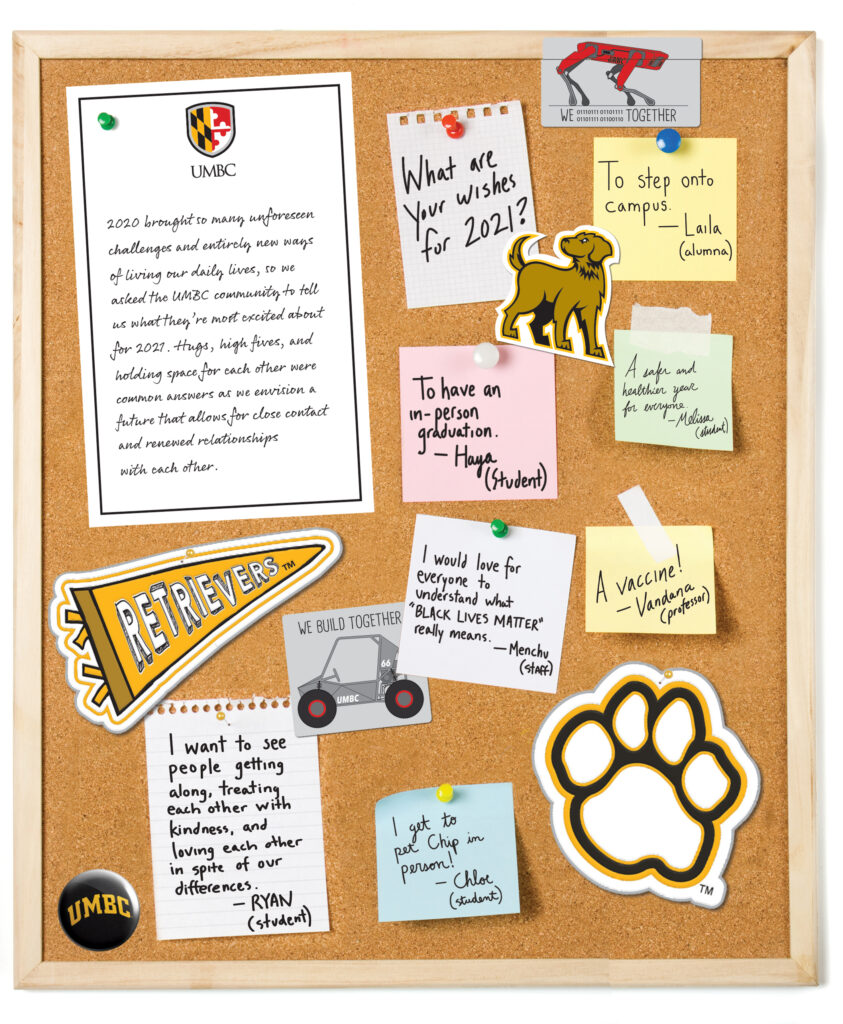
We asked the UMBC community to tell us what they wished for the coming year. We look forward to 2021 and beyond, we share a common hope, to once again be in community with one another.
Designed by Jim Lord ’99.
*****
Header image by Marlayna Demond ’11, taken in 2019.
When UMBC women’s lacrosse coach Amy Slade received a phone call several months ago but did not recognize the number, she didn’t initially answer. Slade later called back, and it proved to be a good move.
The caller told Slade she was one of eight people being inducted into the 2020 class of the National Lacrosse Hall of Fame. This ceremony was originally scheduled for October but has been postponed until mid-to-late 2021 due to COVID-19.
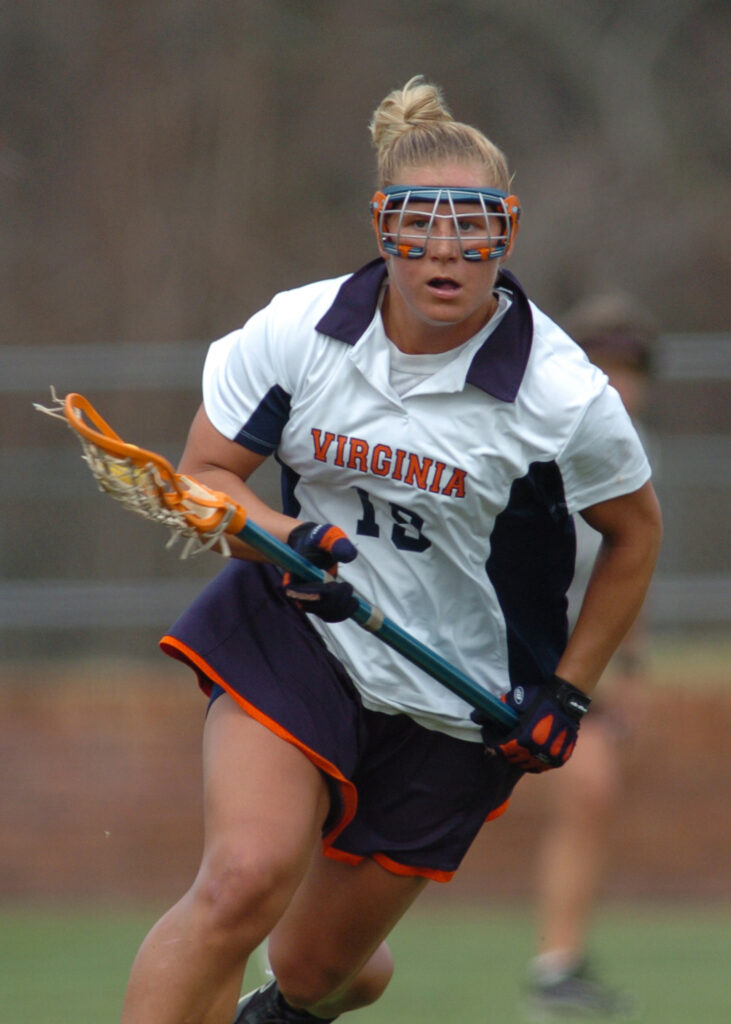
Slade during her time playing as a University of Virginia Cavalier. Photo provided by Amy Slade.
Slade is the fourth person—and the first woman—inducted into the Hall of Fame with Retriever ties. Former men’s lacrosse coach Don Zimmerman, player George McGeeney ’82 and contributor Dick Watts are the others.
Slade will start her 12th season as a coach for UMBC in 2021, including three years as assistant coach. She said this honor means a great deal to her.
“In the midst of a pandemic, it was really cool to find out,” Slade said. “The fact that the lacrosse world is recognizing me…that’s a cool feeling. It feels really special to be remembered.”
Slade was already well known in the lacrosse world due to her accomplishments while an attacker at the University of Virginia. There, she captured the prestigious Tewaaraton Award—given to the nation’s top player—in 2004. Slade (then Amy Appelt) scored a Virginia-record 90 goals and 121 points as the Cavaliers captured the Atlantic Coast Conference crown and then the national championship. The ACC also picked her as the player of the year.
Slade left Virginia with the record for goals (258), points (373) and consecutive games scored in (66).
UMBC director of athletics Brian Barrio believes that some of the success Slade found as a player has helped her as a coach because she reached such high levels.
“She knows the path up that mountain to being an elite athlete,” Barrio said. “She can show them that. I thought it’s important and that our athletes know. Not all of us have what it takes to get to the top of the mountain…Amy clearly does. She’s unbelievable in a lot of ways.”
Right now, Slade is focused on the 2021 season. She wants good players who also are good people, something she thinks will give the team a strong foundation. Slade feels the 2021 team will have just that.
The Retrievers graduated just one player from the 2020 team that played just six games before the pandemic shut down everything, but they are bringing in 10 new players that Slade is excited about having on the team. Although the schedule for the spring is still being determined, she is hoping this new team can make some noise in the America East.
UMBC women’s lacrosse coach Amy Slade received various awards, including an inductioninto the 2020 class of the National Lacrosse Hall of Fame.
“I’m thrilled with the types of kids we’re getting,” Slade said. “They’re fast. They’re coachable. From an ability point, the sky’s the limit for them.”
Now, Slade is glad she returned the phone call she didn’t answer, and is looking forward to the Hall of Fame induction.
“I would also like to thank UMBC for the amazing opportunity to continue my passion,” Slade said in a statement. “Six years ago, when the program was at a crossroads, the athletic department and deputy athletics director Jessica Hammond-Graf trusted in my leadership to get this program back on track. UMBC has allowed me to take my love of this game to the next level.”
—Jeff Seidel ’85
*****
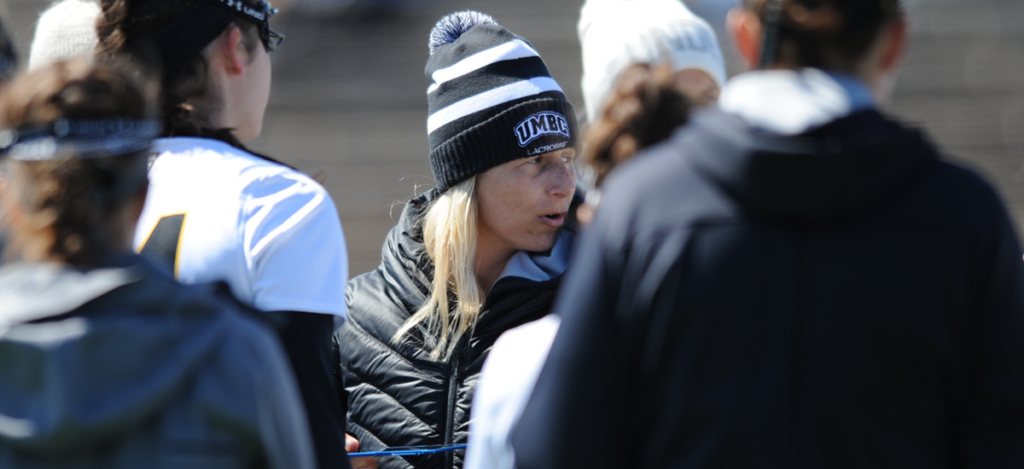
Header image: UMBC women’s lacrosse players huddle around Slade during a timeout. Photo by Jack Miller.
As travel has come to a standstill for many students worldwide, it’s never been quite so crucial to have someone like Adwoa Hanson-Hall on the job. In her work as an international student advisor for the Office of International Education Services (IES), Hanson-Hall knows first-hand how important it can be to have someone who knows the ins-and-outs of immigration and international travel on your side.
Headshot provided by Hanson-Hall.
UMBC Magazine: What is your favorite thing about the work you do at UMBC, and why?
Adwoa Hanson-Hall: Advising international students often consists of addressing non-immigration concerns like culture shock, interpersonal relationships, and more. I immigrated to the U.S. as a child and have also studied and lived outside the U.S. before my time at UMBC. I really enjoy being able to connect with students through shared experiences to help them navigate any frustrations related to adjusting to and studying in a new culture.
UMBC Magazine: Can you tell us a little bit about the work you do in the International Education Services office?
Hanson-Hall: Of course! I work mainly with new and current international students at UMBC. This includes immigration advising related to F-1 visa requirements, general support for our international student population regarding cultural adjustment, and outreach to newly admitted international students who are still abroad. I also coordinate our You Are Welcome Here (#YAWH) Scholarship program.
UMBC Magazine: Why do you feel that service is so important, especially now?
Hanson-Hall: As I mentioned above, moving to a new country can be very jarring. Additionally, adjusting to an academically rigorous university like UMBC while navigating cultural nuances has its challenges. Our work mitigates the stress related to following immigration rules and provides support services so our students can focus on thriving academically and personally while engaging meaningfully as part of the UMBC community. In the current climate, this support is even more necessary. Our students are juggling academic and personal responsibilities, COVID-19-related anxiety as well as increased unpredictability regarding the state of immigration rules.
For example, a recent proposal by the Department of Homeland Security would mean a dramatic shift in the length of time a student can remain in the U.S. to complete their academic program. This is on the heels of another proposal that was struck down in July which would have barred international students from attending classes virtually and jeopardize their immigration status if their schools decided to switch to a remote learning model during COVID-19. In addition to our day-to-day advising, the outreach and education efforts of the IES office has been instrumental in keeping our students informed of their rights and responsibilities and planning next steps that impact their academic and career goals.
UMBC Magazine: What are you missing most about the office during the pandemic?
Hanson-Hall: That’s a tough one. I usually rode UMBC Transit to and from work—it was a nice time to relax or chat with other members of the UMBC community. That was also my unofficial way of keeping up with what was happening on campus outside of my work area so I do miss that a lot.
UMBC Magazine: Who would you want to thank for making a difference in your life at UMBC?
Hanson-Hall: My team! I’m thankful to have people that share my passion and commitment to our work and who also encourage me to explore professional goals and interests without sacrificing my personal life.
UMBC Magazine: What else would you like people to know about your work?
Hanson-Hall: I mentioned earlier that over the past six months international students are facing some uncertainty. In the midst of all these changes, UMBC has really rallied to support international students in our community. From President Hrabowski and the University leadership, to colleagues at the graduate and undergraduate levels, individual professors, and student organizations like the SGA and GSA, each facet of our UMBC community has shown care and concern in some way. It’s been encouraging to see this level of support from all facets of the campus community especially considering everyone is adjusting to new work and study structures during COVID-19. Thank you everyone!
*****
Header image of The Forum in 2018 by Marlayna Demond ’11.
Soon, people in the U.S. will be able to pick up a rapid antigen test for COVID-19 from their local drugstore without a prescription, test themselves and process the results at home.
The Ellume COVID-19 Home Test that was granted an emergency use authorization from the Food and Drug Administration is expected to cost US$30, is easy to use and produces results within 20 minutes.
How does the test work?
The Ellume test is currently the most versatile rapid antigen test because it is authorized for testing anyone age 2 or over, whether they have symptoms or not. It is an antigen test that detects viral proteins, as opposed to the gold-standard PCR tests that detect viral genetic material.
The Ellume test includes a smartphone app that provides step-by-step instructions explaining how to take a nasal swab and place it into the small analyzer that processes the sample. The app connects to the analyzer via Bluetooth to display the test results on the user’s phone. It is also possible to transmit test results securely and anonymously to public health authorities via the app, which helps provide data to guide COVID-19 policy decisions.
How does the Ellume test compare to other rapid tests?
Independent testing by the National Institutes of Health confirmed that the Ellume COVID-19 Home Test successfully identified 96% of PCR-confirmed COVID-19 positive cases in people with symptoms and 91% of PCR-confirmed cases in people without symptoms. This is comparable to the Abbott BinaxNOW rapid test, another commonly used rapid antigen test, that reported agreement with PCR testing for 97.1% of COVID-19 positive cases with symptoms.
Health care providers have been using the Abbott BinaxNOW test for months, and it was also authorized for home use this week. However, it is less versatile than the Ellume test since the Abbot test requires a prescription and is currently only authorized for home use in people within seven days of the onset of COVID-19 symptoms.
How can this test be useful?
Widespread rapid antigen testing to slow COVID-19 transmission remains an important goal even though the FDA has already authorized a COVID-19 vaccine. At-home tests could boost testing rates by offering a quick and convenient alternative to testing at a doctor’s office or public testing site. Since the Ellume test is authorized for everyone, it should help identify COVID-19 cases in people without symptoms, which might otherwise go undetected.
Additionally, the $30 cost of the test poses a potential barrier to widespread and frequent use. Ideally, screening tests should cost $1-$5 to achieve the high testing rates needed to control the spread of the virus. Ultimately, the FDA may need to authorize more rapid screening tests if the U.S. is to meet the demand for testing.
Even though there aren’t enough of these tests to dramatically change the testing landscape, rapid testing can still help identify contagious cases early so infected people can avoid spreading the virus. This type of easy-to-use rapid antigen testing could also be used to screen travelers entering the U.S.
It will take months for the U.S. to reach the vaccine-driven herd immunity threshold. In the meantime, rising vaccination rates and rapid antigen testing can work together to slow transmission and suppress the virus. The Ellume test is not a game changer, but every little bit helps.
***** Header image: The new rapid test is available without a prescription, but only 20 million are set to be sold by the middle of next year. Ellume/AP
One of the undeniable benefits of UMBC’s relative youth is access to founding members of the institution and other individuals who’ve played a foundational role in shaping the University. What happens when you sit down three key players in Alumni Relations and Development who span the years of UMBC from the first day to this present moment? You learn that some things haven’t changed.
When Royce Bradshaw ’70, political science, was hired in 1969 by Chancellor Albin O. Kuhn to be the first director of the not-yet-formed alumni association, he worked as an office of one. Barbara Quinn’78, ancient studies, who took on the role of executive director of Alumni Relations in 1979, reiterates the need to wear multiple hats when working with a small staff that carries a large mandate—a mandate that grows larger with each graduating class.
Today, under the leadership of Stanyell Odom, the director of Alumni Engagement, UMBC boasts 83,000 Retriever alumni. These three sat down in October 2020 for a socially distanced discussion of how their work has shifted over the years.
Stanyell Odom: How would you both characterize UMBC alumni? What sets them apart from students at other schools?
Barbara Quinn: I would say that they’re extremely committed and they really believe in the institution. A lot of that has to do with Freeman because he has made UMBC into a family. Even though it’s continued to grow it still feels like the original institution it was back in the ’60s. And so people feel really committed to it and really want to see it continue to do well.
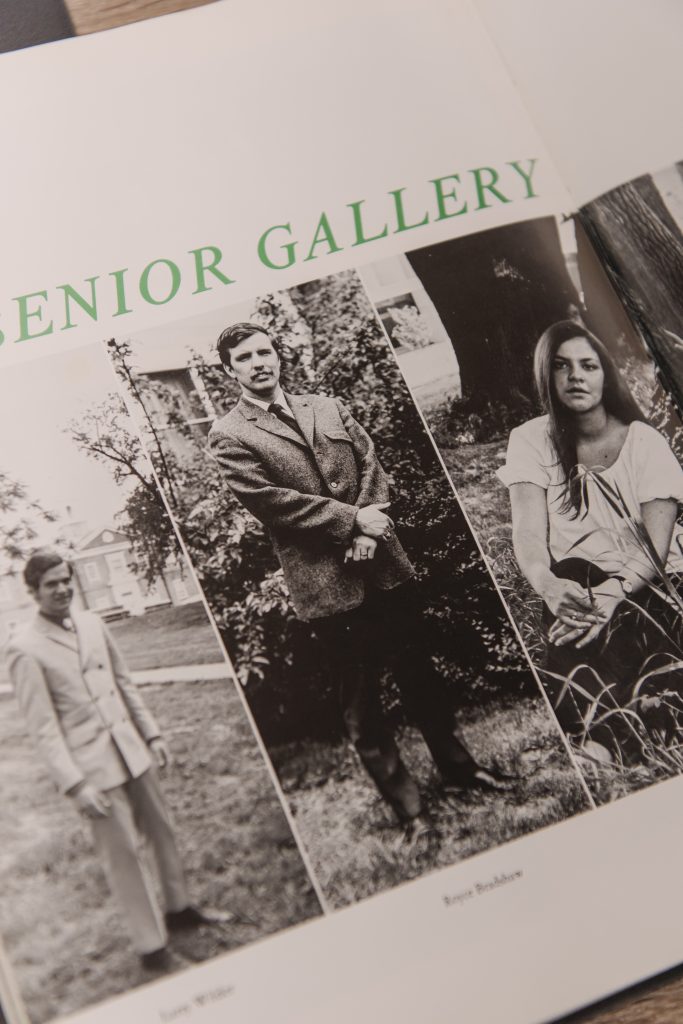
Bradshaw featured in the 1969 Skipjack, the university yearbook at the time.
Royce Bradshaw: We’re getting to be a big family. How do you make it personal at this size? To go from representing the founding class to somehow connecting with this giant population of alumni, that’s very different.
For example—Dr. Kuhn, UMBC’s chancellor at the time I graduated—he still had his farm, and during graduation, we got to nibble on strawberries from his own garden. When you have 80,000 alumni, that relationship is much different.
Odom:Barb, during your 15 years at UMBC the alumni population jumped from 5,500 to 22,000. How did you manage to keep the alumni as a whole engaged but also develop personal relationships?
Quinn: You know what, we did a lot of stuff around Athletics, because we had a good lacrosse program, a good basketball program. We also engaged the sororities and fraternities to help us. We also did special projects, like installing the statue of the Chesapeake Bay Retriever in front of the RAC.
An early project that engaged alumni is the Second Generation Scholarship, created by a committee of African American alumni to support students trying to finish their degree. We also had an alumni board that was just really devoted, really committed to the University.
Odom: Royce, from 1970 to 1972, you went from 240 graduates to 1,200 graduates. That’s a pretty substantial increase. And I know when I started at UMBC in 2006 we had 40,000 alumni, which has more than doubled now.
So to get to your question, Royce, about how to make it personal, I think anyone working with alumni now, that’s the constant struggle. I get the opportunity to work with alumni leaders and so my personal relationships are developed through the Second Generation Scholarship committee, the alumni board, working with your group, Royce, the Founding Four.
It would be really helpful to get an understanding, Royce, of how you became the first, alumni director.
Bradshaw: I came to UMBC after getting out of the army with a wife and child. The Cold War GI bill passed and I decided to use it. My second child was born 10 days before UMBC opened.
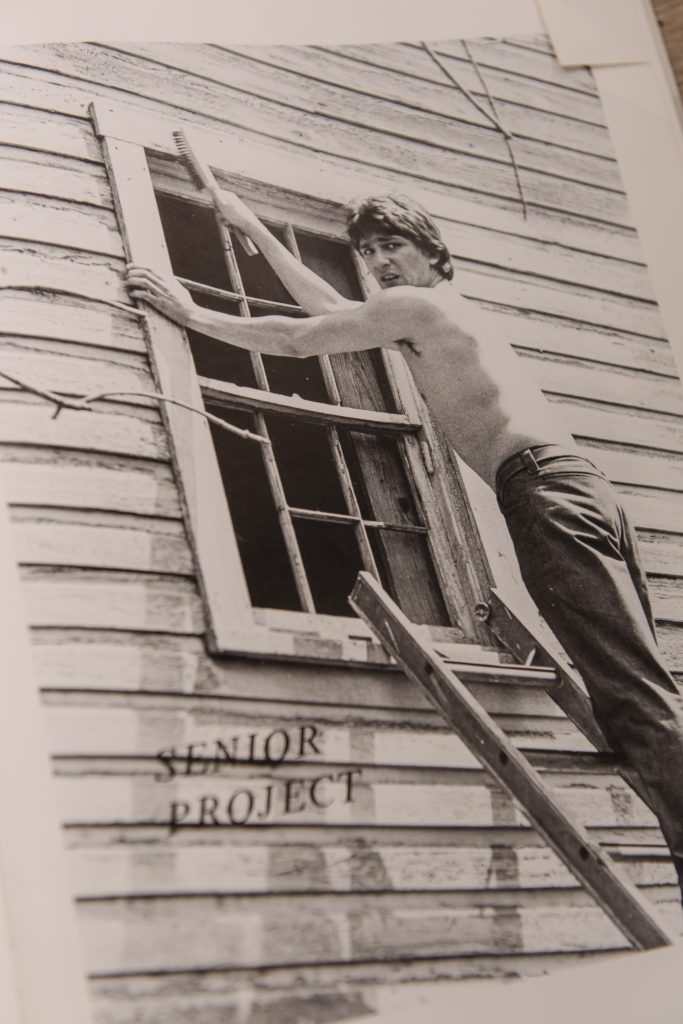
Part of the senior project included repainting local buildings.
I was very active in student government even though I was driving a taxi to support my family at the same time. I was the first student appointed to the faculty senate. I worked very closely with Dr. Kuhn. He was a guy you could call and get a meeting with the same day. I mean as a student, you know?
I was the second person to complete their degree requirements at UMBC, finishing in 1969. Chancellor Kuhn asked me to stay on at UMBC as his graduate assistant, and to begin planning for the alumni and development programs. In 1971, I became the first director of Alumni and Development, and served for one year. During my tenure I helped organize the class of 1970 gift.
Our senior class project was to write to corporations and ask them to donate to a student emergency loan fund, and in return we would do projects for them. We raised $13,000, which was no small amount of money at the time!
Odom: Barb, during your tenure as executive director of Alumni Relations what are some major ways that your office engaged alumni?
Quinn:There are actually two things. The first wasn’t a project that I particularly liked but it turned out to be a good thing—the first alumni directory. Creating something like this (and without a computer!) takes so much work. It was the first collective thing that we had with all the alumni listed in it.
The second thing, one of my favorite projects I mentioned earlier, was the Second Generation Scholarship.
Odom:Oh, wow. We still have that in place!
Quinn:The Second Generation Scholarship requires that scholarship candidates take a course in Africana studies and demonstrate a commitment to improving the lives of minorities through community service. It was started by James Wiggins ’75, political science, and other African American alumni. It was a lot of work but it was so much fun.
Odom: We actually think it’s one of the first, or possibly the first alumni-endowed scholarships at the University.
Quinn:It’s a huge source of pride for me. Because I know how much work went into it, and it was a really cool thing. I have to admit.
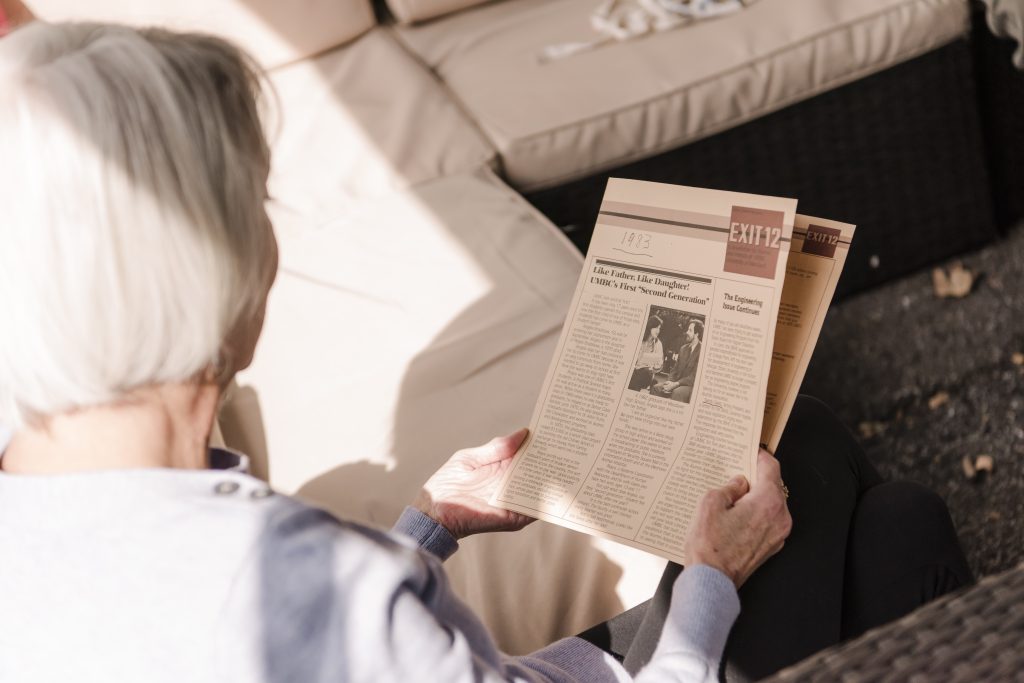
Quinn looks through documents from UMBC’s early years.
Quinn: Stanyell, while you’ve been at UMBC, what are you most proud of?
Odom:I think for me the pinnacle of my experience at UMBC was the 50th anniversary celebration. I don’t think any of us fully knew what we were in store for, but to see thousands of alumni be engaged throughout those yearlong series of events was so satisfying.
I’ll just never forget the moment when the fireworks went off and it was done and the night was over and it was like, we did this. It was such a feeling of accomplishment because I mean we put our blood, sweat, and tears into that. And through that work I got a better relationship and a strategic partnership with the alumni board and the association.
I know that when I think about how we characterize our alumni, I see their immense pride of really being part of the school’s story. I’ve been here to see the prominence and the reputation of the University continue to evolve. It’s not that we’re without our problems—we certainly have our challenges—but I think that the way we approach problem-solving as a community, it feels really good, and I think alums have become accustomed to being a part of that.
The Second Generation committee continues to illustrate this, and our Alumni Association Board of Directors is also a perfect example. They award annual scholarships to students, and they wanted to double their endowment to $200,000 by 2020. Five years ago the endowment was at $100,000. Before the campaign ended they actually had $225,000. And so I think it’s a good example of alumni also taking the lead and saying, “No, we want to help with this fundraising. It doesn’t have to all be UMBC. Here’s what we want to do.” And that’s been really great.
Barb, doesn’t it feel good to know that things that were in place when you were here that they’re still moving forward?
Quinn: It feels like it’s coming full circle.
Odom: I think that we’re ready for the next big thing.
*****
Header image: Quinn, Bradshaw, and Odom sit outside OCA Mocha in Arbutus for a socially-distant discussion. All photos by Marlayna Demond ’11.
An Asian water dragon hatched from an egg at the Smithsonian National Zoo, and her keepers were shocked. Why? Her mother had never been with a male water dragon. Through genetic testing, zoo scientists discovered the newly hatched female, born on Aug. 24, 2016, had been produced through a reproductive mode called parthenogenesis.
Parthenogenesis is a Greek word meaning “virgin creation,” but specifically refers to female asexual reproduction. While many people may assume this behavior is the domain of science fiction or religious texts, parthenogenesis is surprisingly common throughout the tree of life and is found in a variety of organisms, including plants, insects, fish, reptiles and even birds. Because mammals, including human beings, require certain genes to come from sperm, mammals are incapable of parthenogenesis.
Creating offspring without sperm
Sexual reproduction involves a female and a male, each contributing genetic material in the form of eggs or sperm, to create a unique offspring. The vast majority of animal species reproduce sexually, but females of some species are able to produce eggs containing all the genetic material required for reproduction.
Females of these species, which include some wasps, crustaceans and lizards, reproduce only through parthenogenesis and are called obligate parthenogens.
A larger number of species experience spontaneous parthenogenesis, best documented in animals kept in zoo settings, like the Asian water dragon at the National Zoo or a blacktip shark at the Virginia Aquarium. Spontaneous parthenogens typically reproduce sexually, but may have occasional cycles that produce developmentally ready eggs.
For parthenogenesis to happen, a chain of cellular events must successfully unfold. First, females must be able to create egg cells (oogenesis) without stimulation from sperm or mating. Second, the eggs produced by females need to begin to develop on their own, forming an early stage embryo. Finally, the eggs must successfully hatch.
Each step of this process can easily fail, particularly step two, which requires the chromosomes of DNA inside the egg to double, ensuring a full complement of genes for the developing offspring. Alternatively, the egg can be “faux fertilized” by leftover cells from the egg production process known as polar bodies. Whichever method kicks off the development of the embryo will ultimately determine the level of genetic similarity between the mother and her offspring.
The events that trigger parthenogenesis are not fully understood, but appear to include environmental change. In species that are capable of both sexual reproduction and parthenogenesis, such as aphids, stressors like crowding and predation may cause females to switch from parthenogenesis to sexual reproduction, but not the other way around. In at least one type of freshwater plankton, high salinity appears to cause the switch.
Advantages of self-reproduction
Though spontaneous parthenogenesis appears to be rare, it does provide some benefits to the female who can achieve it. In some cases, it can allow females to generate their own mating partners.
The sex of parthenogenetic offspring is determined by the same method sex is determined in the species itself. For organisms where sex is determined by chromosomes, like the XX female and XY male chromosomes in some insects, fish and reptiles, a parthenogenetic female can produce offspring only with the sex chromosomes she has at hand – which means she will always produce XX female offspring. But for organisms where females have ZW sex chromosomes (such as in snakes and birds), all living offspring produced will either be ZZ, and therefore male, or much more rarely, WW, and female.
Between 1997 and 1999, a checkered gartersnake kept at the Phoenix Zoo gave birth to two male offspring that ultimately survived to adulthood. If a female mated with her parthenogenetically produced son, it would constitute inbreeding. While inbreeding can result in a host of genetic problems, from an evolutionary perspective it’s better than having no offspring at all. The ability of females to produce male offspring through parthenogenesis also suggests that asexual reproduction in nature may be more common than scientists ever realized before.
Current research on parthenogenesis seeks to understand why some species are capable of both sex and parthenogenesis, and whether occasional sexual reproduction might be enough for a species to survive.
We were deeply saddened this weekend to hear of the passing of William Rothstein, a beloved founding faculty member of UMBC. He was 83. We will remember him as one of the most exemplary professors we have known—a caring colleague, teacher, social scientist, and friend.
Bill was an emeritus professor of sociology at UMBC who devoted his career to our students. After earning his Ph.D. from Cornell University in 1965, he joined the UMBC faculty in 1966, when classes first began at the university. He was promoted to associate professor in 1969 and to professor in 1988. He continued to teach as an adjunct faculty member following his retirement, and he was a strong advocate for adjunct faculty during his career.
He touched the lives of countless students through the courses he taught, as the director of the master’s program in applied sociology, and in other ways. He was known as a thoughtful and compassionate mentor, and he remained connected with many of his students for years after graduation as they progressed in their careers.
UMBC alumni have shared wonderful memories with us. Bill was a season ticket holder for men’s and women’s basketball and was often cheering in the stands or eating pizza with graduate students while watching a game. One former student shared gratitude that Bill was able to attend her wedding, and another remarked that what he learned from Bill continues to shape his own teaching today.
Service also played a large role in Bill’s work and life. In addition to serving as graduate program director and acting chair, he served on nearly every standing committee in his department. His tenure at UMBC saw astounding growth for UMBC’s Department of Sociology, Anthropology, and Public Health.
As a researcher, Bill published widely on the history of medicine in the United States from a sociological perspective, including four books. He explored topics related to medical policy and public health, and mentored student researchers in developing new scholarship on these topics. He also published several articles in the Baltimore Sun and other outlets to increase public awareness of important health-related topics.
He continued to write during his retirement, publishing a new book in 2018 on coronary heart disease in the 20th-century United States, and more recently researching the COVID-19 pandemic. He was fascinated by the role of UMBC alumni in developing a COVID vaccine and encouraged us to stay positive about the future, even in challenging times.
A virtual funeral service will be held this Thursday, December 10, at 12 p.m., available through this link, with a number of UMBC colleagues and students speaking about his life. A virtual shiva gathering at 7 p.m., through this link, is another opportunity for friends and students to remember Bill.
Honoring his commitment to students, Bill’s family asks that contributions in his memory be made to the Graduate Student Emergency Fund that he established at UMBC. Donations can be submitted online or by check (payable to the UMBC Foundation, with Graduate Student Emergency Fund in the memo line, mailed to the UMBC Foundation, 1000 Hilltop Circle, Baltimore, MD 21250) to continue Bill’s legacy.
President Freeman Hrabowski Provost Philip Rous
* * * * *
Note: This remembrance of Dr. William Rothstein, a founding faculty member of UMBC, was originally shared with the UMBC community via email on December 8, 2020.
In a recent essay, UMBC President Freeman Hrabowski notes, “In difficult times, we come to know who we are.” Never has that been more true than this year or at this point in our nation’s history.
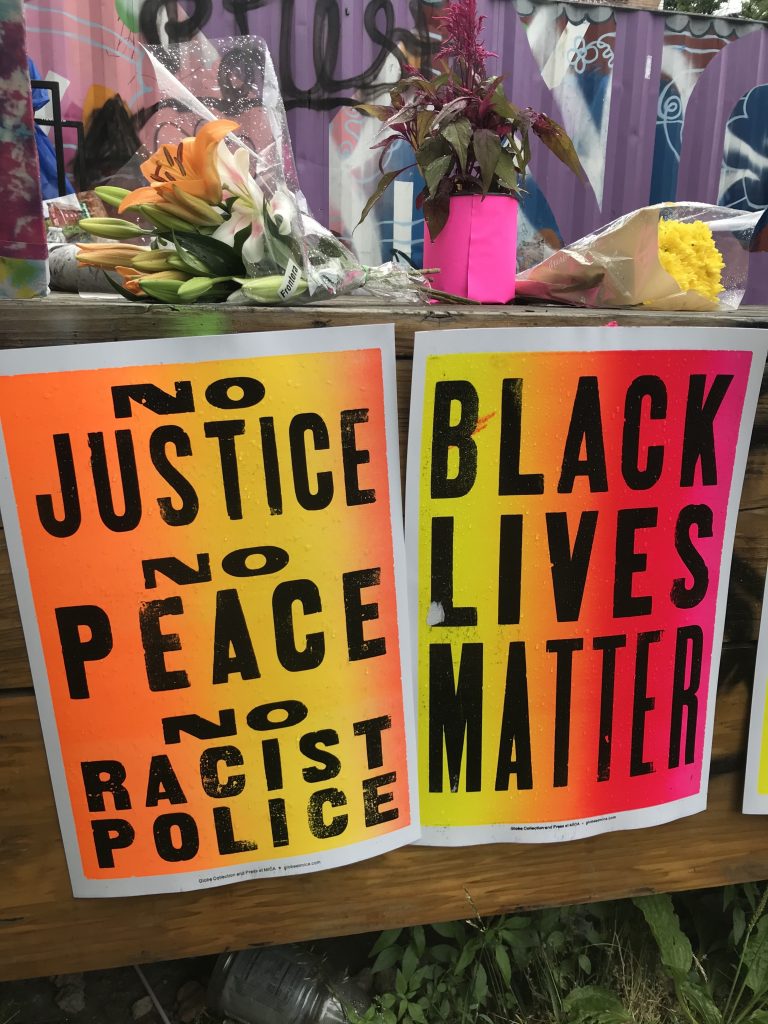
With the killing of George Floyd and other instances of police violence and the wave of protests that followed this spring and summer, many in our Retriever community are hearing the call to question what got us to this point and do everything they can to dismantle structural racism in our country.
In so many powerful ways, their voices echo those of some of our earliest Retriever alumni, who staged sit-ins on campus to protest the Vietnam war and civil rights injustices. In the spirit of this moment, many in our community are still protesting—but also taking to social media and finding new ways to make change from within their workplaces.
It’s difficult, but necessary, work. The moment is calling for an answer, and our Retrievers are responding. Because this is who we are.
THE LONG GAME
For several decades, Diane Bell-McKoy ’73, sociology and social work, has worked to make African American individuals and families in need become economically self-sufficient and to infuse philanthropic organizations with policies that create positive outcomes for people of color. UMBC Magazine talked with Bell-McKoy, CEO of Associated Black Charities and the Greater Baltimore Committee’s 2020 Regional Visionary awardee, about why making long-term change takes both patience and perseverance but is always worth it.
Diane Bell-McKoy ‘73, sociology and social work. Image courtesy of Associated Black Charities.
UMBC Magazine:What are you trying to achieve through your work with philanthropic organizations, public policy makers, employers, trainers, and educators?
Bell-McKoy: Our goal is to shift the lens to provide the facts, the history, and the current policies to let people begin to really see how we ended up where we are today. Because it was very intentional—and going forward we can make different decisions to change the outcomes and the workforce ecosystem as it relates to systemic racism as a root barrier. When Black and brown people have the opportunity to move up, the greater economic opportunity means that they can also buy a house, they can start a business, and they can contribute a great deal more to their families and to the economy.
So my days are always around educating, around influencing, around advocating, around sharing our policy….It’s about meeting with our fellow philanthropists, helping them see the world differently and then giving them the desire to go deeper into those policies, their practice, and their culture.
UMBC Magazine: Your organization’s “10 Essential Questions” guide really forces folks to look at their operations through an equity lens. Is this as eye-opening as it sounds?
Bell-McKoy: I keep thinking, is that rocket science? Doesn’t this benefit all of us? But it feels like rocket science some days in having the conversation because you’re really asking people to rethink, to relearn how they were taught in terms of that history that wasn’t given to citizens. A lot of the positive history hasn’t been available about Black and brown people. I find myself on a reading journey right now learning as much as I can more about the history of black and brown people in this country.
And it’s important…for us to do the hard work now because we’re now awake much more across the country. That’s why I’m passionate about it. It’s been my journey all of my life. It was my journey at UMBC. It’s been my journey around what can I do, how can I make a difference for Black and white people?
UMBC Magazine: You’ve been doing this work for so long. What do you tell young people who are looking to make change?
Bell-McKoy: There are many ways that you can help in the now, including doing your own reading, your own research about why this exists. There are lots of opportunities locally—particularly now that we’re in a virtual world—to join lots of webinars and conversations across the country so that you can more deeply educate yourself. And because we have the ability to touch people all across the globe through the virtual environment, there are opportunities for students to be a mentor, for them to add some value to someone’s life.
Continue to use creativity, continue to use all your genius to make a difference in people’s lives. But understand that also—as you get to the next stage in your career coming out of UMBC and you’re becoming a millionaire—you need to invest back in all those organizations trying to change the system knowing that you can become a part of the patient capital needed to achieve system changes that then benefit a greater number of persons. You do have to steel yourself for the incremental. This may mean when the big change comes, many of us may not be here to benefit from it, but…that’s a part of it. It has to be an intentional journey.
RIPPLE EFFECT
For Jason Grant ’10, M17, a defining moment happened on a bus ride to a Meyerhoff Scholars event at UMBC President Freeman Hrabowski’s house his freshman year.
A senior asked Grant about his major (computer engineering) and then proceeded to pepper him with specific questions about his classes and his plans for graduate studies. That brotherly interest, says Grant, turned out to be the norm, not the exception.
“People kept telling me,” remembers Grant, now an assistant professor of computer science at Middlebury College, “if you go to UMBC and join the Meyerhoff program, you’re going to have a community of people. I didn’t actually realize how important that was, but it turned out to be extremely critical.”
In their careers, Grant and many other Meyerhoff alumni are replicating that family atmosphere—valuing the unique contributions of each member and raising up others alongside them around the country.
Immanuel Williams ’11, M18, mathematics, grew up doing math worksheet after math worksheet, his father handing him new problems to solve and instilling a desire to understand complicated equations. So later in life, when his colleagues made assumptions about how as a Black man, his father must have been missing from his life—he stopped them short.
He and his wife Kelley Williams ’13, environmental studies, wrote a book called The Adventure of Jamear: Shapes All Around, which celebrates the relationship of a father helping his son discover math. For Williams, a lecturer at California Polytechnic State University, the book launched his work at six Boys & Girls clubs around Los Angeles and San Francisco, providing math boot camps for hundreds of elementary school students for the past three summers.
Williams taps his own college students as volunteers to help personalize all the feedback students receive. “We’re reaching marginalized communities in terms of race and economic status,” says Williams, “so that feels really good.”
Grant has carried the Meyerhoff vision to Vermont, where he’s taken on leadership roles for the small population of students of color at Middlebury to see a face that looks like them. As advisor for the Black Student Union, “it allows me to network and to get a feel for the climate of all students of color here in this predominantly white institution, and how they’re trying to navigate that space,” says Grant, current president of the Meyerhoff Alumni Advisory Board.
This year at the ACM Richard Tapia Celebration of Diversity in Computing Conference, Grant served as deputy chair for research competition and poster competition. “This made me put my money where my mouth is,” says Grant. “Telling students to go to the conference was one thing, but them seeing me on the conference program allowed me to be a vocal leader in that space as a professor.”
Nicole Parker ’11, M19, biochemistry and molecular biology, now works as a lobbyist, connecting research institutions with federal dollars. She sees her role to advance policies that broaden minority participation in STEM and increase diversity in science and engineering careers. She puts it plainly: “I’m passionate about making changes so that the entire biomedical research enterprise operates like the Meyerhoff program.”
The ripple effect of the Meyerhoff program is clear—whether in K–5 after-school programing, at rural universities where representation is crucial, or lobbying Congress to fund research programs for scientists from diverse backgrounds.
“In four years at UMBC, those Meyerhoff values are so ingrained in us every day,” says Parker. “You can’t forget it when you go on to the next place.”
— Randianne Leyshon ’09
SUPPORT SYSTEM
As protests sprung up in cities across the country this spring, alumni like public historian Allison Seyler ’10, M.A. ’12, history, and computer programmer Carlos Lalimarmo ’11, computer science, found themselves compelled to participate. Today, as the nation continues to contemplate ways of making change, they, like so many others, are thinking deeply about how to be good allies to people of color.
People march in Baltimore protesting police violence. Photo by Lalimarmo.
UMBC Magazine: What ultimately drives you to participate?
Seyler: As someone who deeply loves Baltimore City, I try to stay informed about the issues our community faces; one of those issues is police brutality. The longer I have lived here, the more I learned the necessity of making time to listen to Black leaders—women and men—who wholeheartedly devote themselves to this city; they have been calling for police reform for years. So for me, the choices I’ve made to protest this year were linked to that. I felt in order for me to show up for the Black community in Minneapolis who are mourning George Floyd, the Black community in Louisville who are mourning Breonna Taylor, and really, to show up for Black folk across the nation, I needed to show up for Baltimore.
Photo courtesy of Lalimarmo.
Photo courtesy of Seyler.
I had these eerie flashbacks to marching for Freddie Gray and felt an all too familiar sadness that families have lost their sons, daughters, fathers, sisters so unnecessarily. As I felt a sensation of “this is happening again,” my heart just dropped. How could we be at the same point we were in 2015? I think I’m driven to participate as a human being who cares intensely for others, but also because I believe that collectively, protestors can use their voices and actions in sustainable ways to force real change to happen.
UMBC Magazine: What do you see as your role as an ally and how do you hope it will be seen by others?
Lalimarmo: I think being informed is the baseline for participation, whether you agree with demonstrators’ message or not. You can’t participate responsibly without being informed. The protests themselves have become an issue, and the best way to understand them is to experience them firsthand. So I go when I can. When I think I understand and agree with the message of a particular protest, I’ll stand or march with the group to show support.
UMBC Magazine: What would you say to someone who isn’t sure of how to get involved but would like to?
Lalimarmo: I think a lot of people who would like to be more involved but aren’t sure how are probably more involved than they realize. Supporting the people close to them is important work that I’m sure they’re already doing. If not, strengthening personal relationships is a solid place to start.
Seyler: Honestly, I would remind them that there’s no better time. And I would channel two mantras that are said often, but get to the core of this work: This is a marathon, not a sprint. This is a movement, not a moment. If someone wants to get involved and is looking for a starting point, I would suggest starting with something small and human: read memoirs by Black authors like D. Watkins, Kondwani Fidel, and Chris Wilson. Pick up a copy of A Beautiful Ghetto by photographer Devin Allen and fill your mind with images that show the beauty of other peoples’ humanity. Sign up for a workshop by activist Britney Oliver to learn about being anti-racist in your actions and words. Your actions and involvement makes a difference.
ADVOCATES FOR CHANGE
Recently, there have been calls across the United States to defund the police and correctional facilities in response to the continued violence from police toward the Black community. But what exactly does defunding the police mean for youth currently in the juvenile justice system and for those most at risk of entering?
For 30 years, UMBC’s Choice Program has engaged, mentored, trained, and advocated for more than 25,000 youth in Maryland. It provides a series of programs to disentangle young people from the juvenile justice system and to strengthen youth and family ties to the community through increased educational and vocational opportunities.
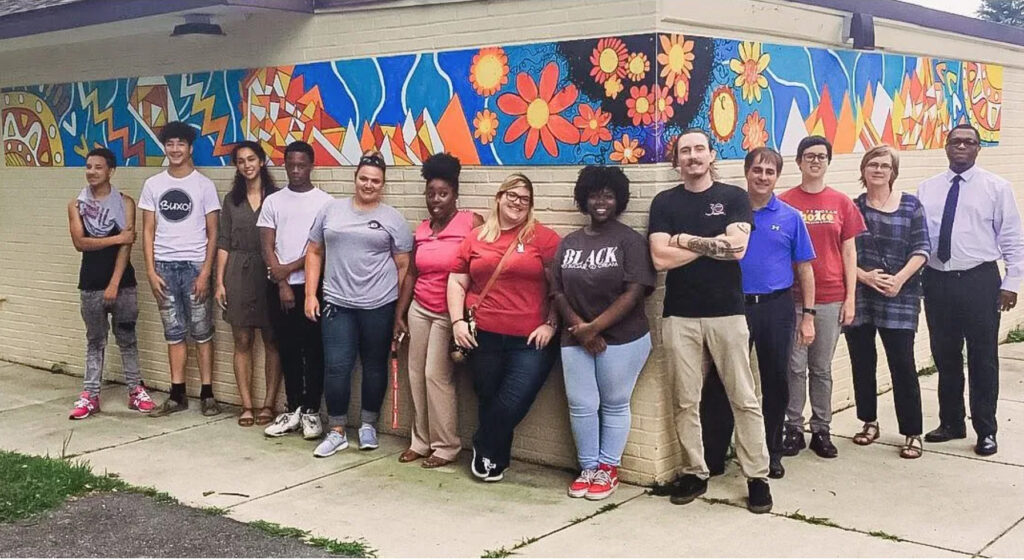
Eric Ford, first on the right, and Choice Program members unveil a mural created at Lane Manor Recreation center in partnership with Artivate Inc. Image courtesy of Ford.
UMBC’s Eric Ford, director of The Choice Program, and Frank Anderson, a doctoral student in language, literacy, and culture and the associate director of programs, talk about how the Choice model can provide a complex answer to a complex problem.
Anderson: What is defunding the police and what does that mean for Choice?
Ford: Defunding the police means reallocating funds to diversion programs so that youth will not get involved in the criminal justice system. It means investing in providing training to first responders in communities across America around restorative practices or providing additional mental health and substance abuse support for young people. Reallocating funds to these programs means communities will be able to provide the interventions and supports needed to individuals who are now being criminalized.
What do you think, Frank? What is our moral responsibility in this work?
Anderson: It’s important for me to reflect about what my moral and ethical responsibility is and whether my moral checkbook balances out at the end of each day. Am I creating more opportunities than what I’m taking? Am I working to share and distribute more resources than what I am taking? If not, then maybe it’s time for me to move to the side. I’m grateful you and peers are there to hold me accountable to keep pushing myself everyday to understand my role within the greater community.
What personal value of yours makes this work so important?
Ford: Truth. Being able to build on our Truth, Racial Healing, and Transformation (TRHT) framework has been such a rewarding experience for me. It has validated a lot of my personal beliefs, personal goals, and what I learned at Hampton University. For so long discussing the truth about what has happened in the past to marginalized people has been taboo in certain spaces. Being able to share the truth about my ancestors and people who have come before me and have it embraced has been transformational for me. This is exactly what our TRHT work aims to do. We support communities and a process to foster important difficult conversations around race equity and transformation. I am thankful for it every day.
Anderson: You are the longest-standing person of color to lead Choice. What about that makes the job difficult? What about that excites you?
Ford: My first position at Choice was as a caseworker. That experience led me to other opportunities. I returned to Choice to be assistant director and worked my way through the ranks. Ascending to the director of Choice is something I am very proud of. As a man of color, you always carry the weight of your racial or ethnic group and the weight and pressure to be successful. Coming into this position, I experienced some imposter syndrome sitting in spaces that I had not been before and wondering whether I belonged in those spaces. Over time I have gained confidence through feedback I have received from my peers, my mentors, and my family.
It has been a wonderful experience to not only represent Black men and represent all the participants of color and young men of color. I represent a possibility for them. One of my proudest moments at Choice was when an AmeriCorps member was introduced to me in my office. He was a young Black man. He looked around my office and was in awe. He said, ‘Wow, this could be me one day.’ It hit me that it’s not just about reports, proposals, and grant writing but it is also what I represent for Black men throughout the country.
INCLUSION MATTERS
Created in June, the UMBC Inclusion Council brings together faculty, staff, students, and alumni from all across campus to help address issues of equity and inclusion at UMBC. UMBC Magazine talked with the council co-chairs, Keith J. Bowman, dean of the College of Engineering and Information Technology, and Ariana Arnold, director of the Office of Equity and Inclusion about what’s ahead for this group.
UMBC Magazine:What have the first meetings of this group been like? How would you describe the energy in the (virtual) room?
Bowman: We began with several weeks wherein everyone could talk about their experiences, visible and non-visible elements of their backgrounds, and their commitment to the work. It was an incredible set of meetings where folks expressed their passion for the work of the Inclusion Council. It made me feel truly proud of our UMBC community and its commitment to social justice.
Arnold: It was extremely meaningful…because we never met until we were already virtual. So we felt like it was really important to make those personal connections. I think that really started us on a good path for people being able to be honest when having discussions about sometimes difficult topics, as well as being compassionate towards each other, which is really what we’re trying to build here.
UMBC Magazine:The Council no doubt has a lot to think about and plan (everything from curriculum, faculty and staff diversity, to intersectionality and restorative practices, etc.). What issue or project are you personally most excited to work on, and why?
Arnold: I would love to be on all of the committees…but I’m really excited about the work of the faculty and student retention and belonging groups. We had 146 people interested in being part of those working groups, which was amazing. And these are both places where we can have a significant impact on the campus.
Bowman: I am most excited about being able to provide a platform and mechanisms to elevate the work that many have been doing more towards substantive actions.
UMBC Magazine:What do you hope people will be saying about this work a year from now? Or five years down the road?
Arnold: What I’d like to be able to say a year from now is that we are doing the work and not just, you know, talking about the work. And that five years from now we’ve had a measurable impact on campus in terms of both inclusivity…meaning that people from all political, racial, ethnic, religious, cultural backgrounds, abilities, and nationalities have become engaged and that we’ve improved the sense of inclusion and belonging on campus.
Bowman: I hope they can see visible and defined changes, but I also hope they continue to have expectations since we know success is never final at UMBC.
CALL TO ACTION
In 2017, Christine Osazuwa ’11, interdisciplinary studies, left the country. She eventually settled in London—a place where she says she’s never seen quite so much natural integration of people of all races, cultures, and walks of life. Even so, when the news of the death of George Floyd reached her this spring, Osazuwa, director of data and insights for Warner Music Group, never felt quite comfortable expressing her feelings in the form of public protest.
“There’s nothing like a pandemic to remind you that you’re an immigrant…. I’m a guest in someone else’s country,” she says, noting she can’t vote, either.
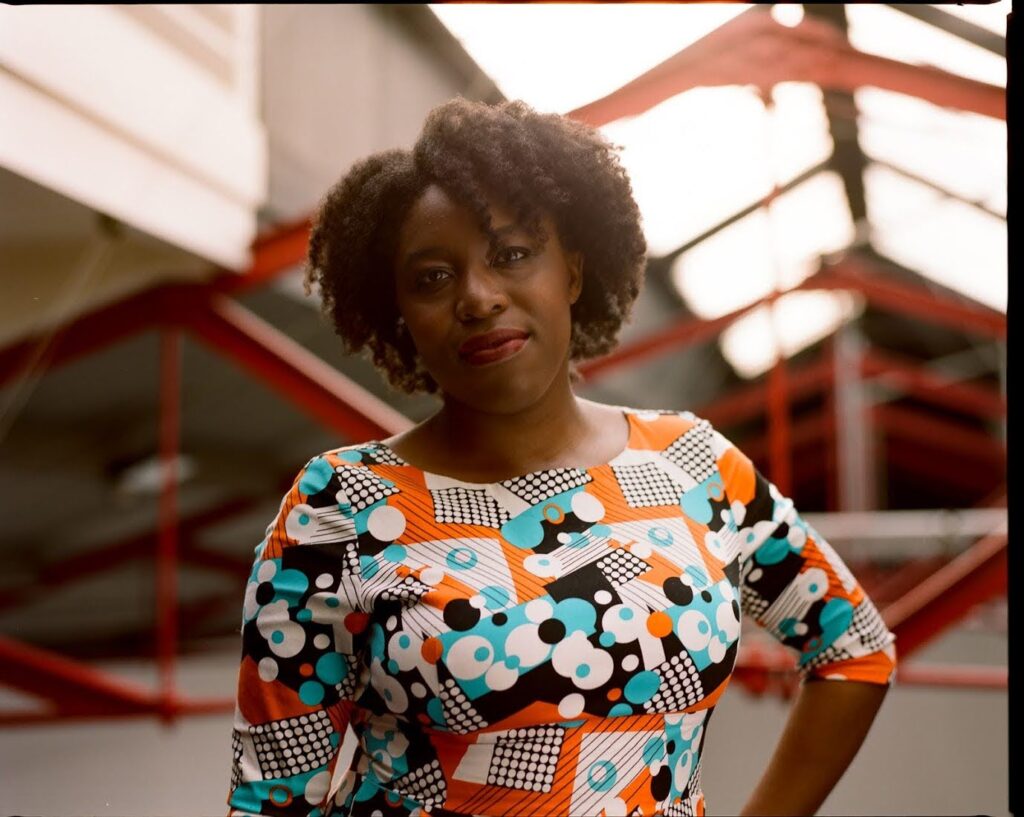
Christine Osazuwa ’11, interdisciplinary studies. Photo of Christine Osazuwa by Out Since Tuesday.
So, instead, she did what she does best—she wrote about it. What started as a short series of Facebook posts fueled by her own life and experiences eventually became a longform essay titled “How To Be a Better Ally.” In five steps—consume content and goods made by Black people, question your employers and your privilege, for instance—Osazuwa implores her white friends, ultimately, to take the time to familiarize themselves with the Black experience.
Osazuwa grew up within a first-generation Nigerian American family in a predominantly white suburb of Baltimore.
“I know all about Hanukkah, I can pronounce the last names of my Polish friends, I know basically every word to Mean Girls, I can dance to “Cotton Eyed Joe,” I can sing along to “Sweet Home Alabama,” I can name all of the Kardashians, and I’ve had my fair share of meatloaf and coleslaw…. Obviously, these are mostly trivial, stereotypical examples but the point is, I have grown up surrounded by white culture,” she writes. In creating this piece, she hopes to give readers a push to learn about Black culture without adding to the weight [Black people are] already carrying.
“As a white person, you can get through life completely fine without ever understanding another person’s culture,” she explains. “There was no expectation the other way around. I had to know your shows and mine. I had to read your books and mine. I had to know your history and my own. And now, we say it is not our job to educate you because we’ve spent our entire lives learning and doing everything twice.”
“Why are chemists so great at solving problems?” Theresa Bruce ’09, asks her eighth grade social studies class at KIPP Harmony. Her corny joke elicits no verbal responses but doesn’t go unanswered as students engage with the icebreaker online. “Because they have all the solutions!” Bruce guffaws.
In a year where teaching looks like nothing before, Bruce and other educators are grappling with how to best reach their students, academically and relationally. But the cheesy jokes are nothing new, admits Bruce. “That’s just who I am.” A Sondheim Scholar who majored in political science and social work, Bruce was runner up for the 2020 Baltimore City Teacher of the Year. It’s easy to see why, as her energetic and enthusiastic demeanor comes through clearly, even mediated through the multiple computer windows she uses to instruct her scholars from afar.
But Bruce didn’t set out to be a teacher—she had her sights set on being a hot-shot lawyer. So how to explain her past decade working as a Baltimore City school teacher? She shares this in her own words.
Putting the common good first
When I left high school, I had my mind made up that I was going to be a lawyer. I was going to be the next Johnnie Cochran. Forget if the glove didn’t fit, I was going to have my own catchphrase and it was going to blow up. I was going to be riding in limos with all of the entertainers. Then UMBC got in the way of that fantasy.
Being a part of the Sondheim Public Affairs Scholars program made me realize that I wanted to work toward something greater than myself. My celebrity ideals weren’t putting the common good first—they certainly didn’t push for society in a way that is helpful, meaningful, and beneficial for all. When that switch happened inside me, my mentors at UMBC were instrumental in helping me pursue a new goal, nurturing me, and pushing me along a path that led to public policy.
Bruce teaching virtually from her empty classroom in October 2020.Photo by Corey Jennings ’10.
So how did I end starting my 10th year teaching as a Baltimore City school teacher? After I got my master’s in public policy at the University of Chicago with a focus in K through 12 urban education reform, I realized that I needed to actually be in a teaching role before I could make policy that affected education. Additionally, I believe that every child deserves the opportunity to make choices in their lives. I feel like I got the best public education possible in Baltimore City, and I got it for free. A motivating factor for me is the belief that every child should get what I got.
Lifting up others’ dreams
I’ve always loved school, so UMBC was the perfect fit for me. It was undeniably cool to be smart. So that’s the atmosphere I try to create in my classroom. We all have favorite subjects, and I understand that for some of my students, social studies may not be their favorite. But I want these young people to find some joy when they come into my room—to feel like they can talk with me and connect. I want them to know that I support them in their goals. UMBC taught me the importance of lifting up other people’s dreams.
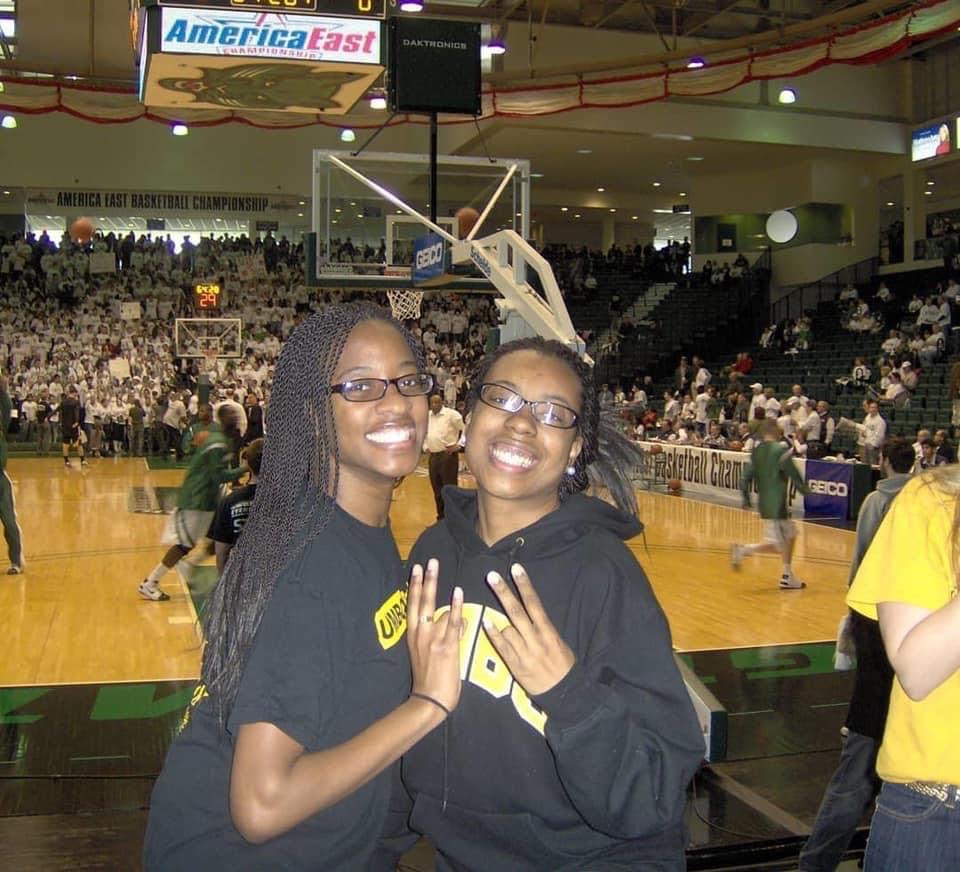
Bruce, right, with Adrienne Hawkins ’09, at a 2008 UMBC basketball game.
Looking back on my time as a student, I have so many people I’m grateful to for putting up with me, quite honestly, because I was a headache. I always had an idea. I always wanted to do something. And I wasn’t always listening. Despite that, Dr. Roy Meyers, professor of political science and affiliate professor of public policy, was my biggest champion. Dr. Cheryl Miller, associate professor emerita, public policy and political science, challenged me to think bigger than myself. Dr. Tyson King Meadows, associate professor of political science, taught my very first poli-sci class and never stopped pushing me forward. Delana Gregg, Ph.D. ’19, language, literacy, and culture, a powerhouse in the Academic Success Center, was a constant force in helping me shape my career path while being a sounding board for all of my ideals.
So now, as an educator myself, I ask how I can best push and champion my students. The biggest step I can take—and this doesn’t matter if you’re in a brick-and-mortar building or if you’re online—is to make a relationship. Yes, they’re harder to build virtually, but when young people can relate to you as a person, they’re more apt to try. When you acknowledge them and their efforts, they’re going to try even harder. There’s an old saying I think about often: People don’t care what you know, until they know you care.
Creating community in a virtual classroom
My biggest reward right now is sparking the minds of the next generation. Our young people come to us with so many gifts. They’re talented in ways that might just take a little nudging for them to realize. But I know how many people took time for me, and I want to make my students feel the same. I want them to know I care about their success, beyond their grades. How can I help them discover who they truly are, pursue what matters to them, and be an agent for change?
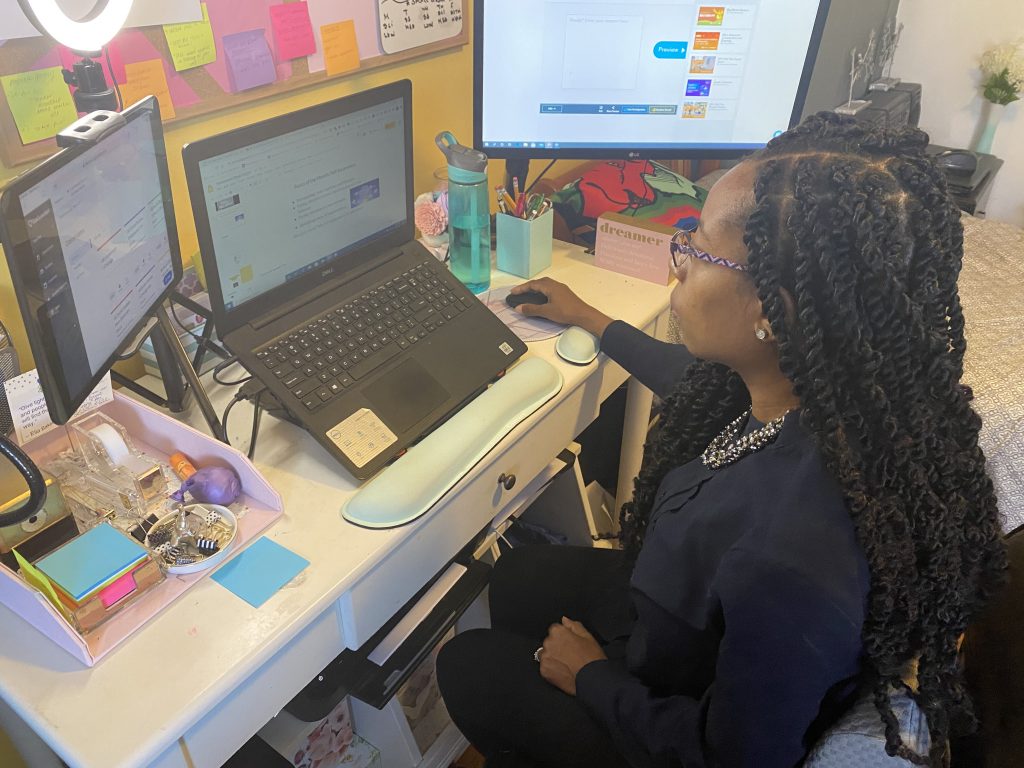
Bruce, working from her home office.
Part of the way I help them along this path is by putting books in front of them—all the time. There are over 700 books in my classroom that I’ve amassed, partly through donations via the Donors Choose platform and partly by spending my own money. Quarterly, I host a Starbooks session for my students within my classroom, usually around a theme, like non-fiction texts or graphic novels. It gives young people a chance to sample books and see what they might enjoy. Slowly but surely, I’ve been seeing an increase in my scholars’ excitement about reading books and checking them out of my classroom.
Now that we’re meeting virtually, it’s been hard to not gather in the classroom I’ve lovingly decorated and filled with books and materials. My scholars and I have created our own community in the classroom, and it’s been interesting in this pandemic to rethink the way community needs to develop. All things considered, I am thankful because even though we’re in the midst of a global virus, I’ve been pushed to rethink the way I engage the students, not only in the work, but how to grow relationships with them as well. So we’re creating a new classroom, a new virtual one. It may not be as big or as colorful, but it’s got great potential.
*****
Header image, by Corey Jennings ’10. All other photos courtesy of Theresa Bruce, unless noted.