All posts by: Magazine Editor


On Thin Ice

When the Polarstern set sail from northern Norway in September 2019, it was looking to get stuck in the ice. But this goal—a death knell for so many historic exploration ships—would be much harder for this modern research vessel to accomplish due to a shrinking ice pack.

The Polarstern was embarking on history’s largest scientific expedition to the Arctic to date. But before the first wave of scientists could start their research, they had to find a suitably robust ice pack, known as a floe, to make their home. This is harder than it sounds in the rapidly warming Arctic. An increasing amount of ice doesn’t survive the summer, which means boats have to travel further north in search of suitably thick ice. But after a nearly two-week journey from Norway, the Polarstern had found its mark. 

And this is how Nathan Kurtz, M.S. ’07, Ph.D. ’09, atmospheric physics, ended up standing guard on some floating ice 300 miles from the North Pole armed with a rifle and a mandate to keep an eye out for polar bears. 
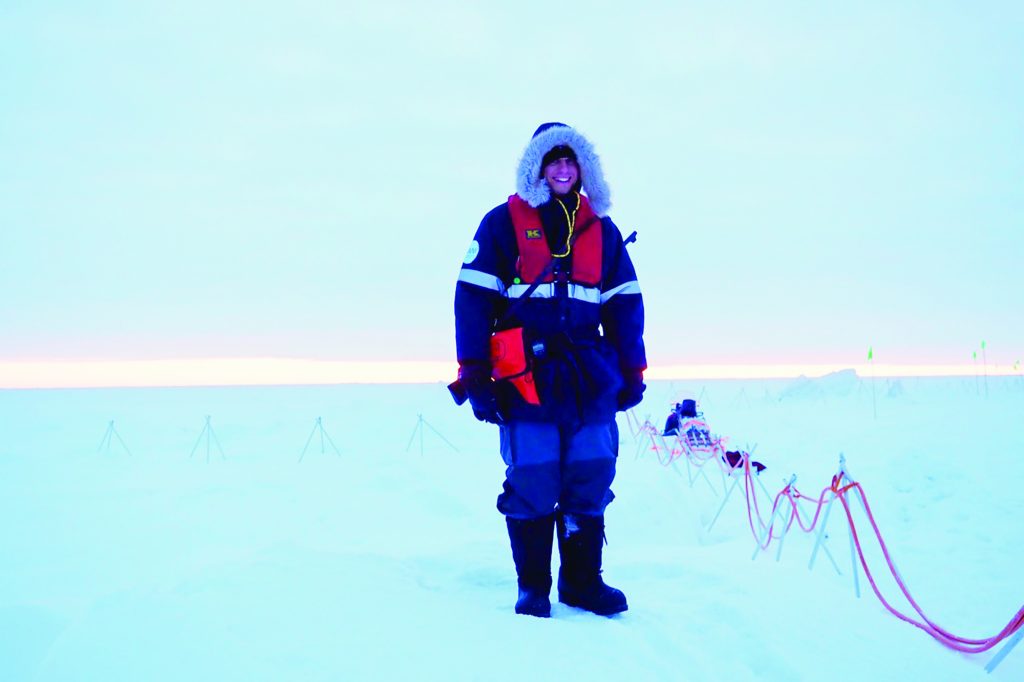
a man stands in the arctic
Kurtz, pictured on the ice next to research apparatus, courtesy of Kurtz.

Kurtz was part of the first wave of more than 600 scientists from 20 different countries who over the course of the year cycled through the ship as it drifted more than 1500 miles locked in a massive sheet of ice. The goal of the Multidisciplinary drifting Observatory for the Study of Arctic Climate (MOSAiC) expedition was to better understand the link between the Arctic environment and climate change.

Polar bear lookout was “not something I saw myself doing when I was in grad school,” says Kurtz, who didn’t see any bears that day, but by the time he returned to civilization a month later he’d had his fill. “However, UMBC really did prepare me to face challenges,” says Kurtz. “For me, grad school was hard, but it helped me with self-confidence—that this can be done and I can do this.” 

Neither Kurtz nor his shipmates had traveled all the way to the Arctic to be polar bear sentinels. It was just a necessary part of the journey that allowed them to do their real job: collecting massive amounts of data on the woefully understudied polar environment. Over the course of its Arctic sojourn, the Polarstern hosted scientists studying everything from zooplankton beneath the ice to the clouds floating above it. 

But for Kurtz, the ice itself was the main attraction. 

From Icy Moons to Polar Ice Caps

Kurtz’s arrival in the Arctic was the culmination of over a decade of research studying Arctic floes from afar. But his original focus was ice even farther away—the icy moons of Jupiter. A shift in funding from NASA had Kurtz pivot his focus from astrophysics to earth sciences. “But physics applies to the moons of Jupiter and to the Earth,” Kurtz puts it dryly, “so it wasn’t so difficult to switch my focus.”

One of Kurtz’s advisors at UMBC, Raymond Hoff, professor emeritus, says UMBC students are uniquely positioned to lead in atmospheric physics, considered a unique subset in a field that often prioritizes astronomy or astrophysics. UMBC’s relationship with the Earth Science Division of NASA Goddard Space Flight Center to form the Joint Center for Earth Systems Technology allows students to play an active role in ongoing research.

Scientific teams conduct research at a coring site on MOSAiC ice floe. Alfred-Wegener-Institute / Esther Horvath (CC-BY 4.0)

Hoff himself brought valuable Arctic experience to his classroom, and Kurtz remembers being struck by his advisor’s journeys to the Arctic in the early 1980s. “What amazed me about the Arctic was the stark and pristine beauty of the landscape,” says Hoff. “Even at -45ºF, you would find yourself outside marvelling at the ice crystals which fell out of clear blue skies as any water vapor there would freeze and fall out on your parka.” For about 20 years, Hoff measured pollution at Alert, Northwest Territories, Canada, about as far north as he could get on land. There, researchers discovered that sulfur pollution from Europe and Russia was getting into the high Arctic.

“As a result of our work,” shares Hoff, “the Arctic nations brought in scientific agreements to reduce the inputs of mid-latitudinal pollution going to the Arctic. Some of those pollutants were really surprising since they were pesticides which were used in the tropics. It brought home how small our planet is.”

Kurtz’s work four decades later would continue to rely on the cooperation of numerous stakeholders, as scientists collaborated to study—and perhaps stymie—global warming. 

Bridging the Ice Knowledge Gap

As a graduate student, Kurtz worked on methods for determining sea ice thickness based on data from NASA’s ICESat, a polar observation satellite launched in 2003. After earning his Ph.D., Kurtz has continued his work on the properties of polar ice as a scientist at NASA Goddard’s Cryospheric Sciences Branch. 

To understand how ice around the poles is changing and what this can tell us about the climate,  Kurtz and his colleagues relied heavily on laser data from ICESat, a satellite that passed over the poles bouncing laser light off the ice 40 times per second to get a high resolution map of the sea ice thickness. But when ICESat’s last laser failed in 2009, NASA was left without a dedicated satellite to study the ice caps. 

Three scientists and a bear guard land on a new floe in a transportation device called a "mummy chair" to scout its potential for setting up research stations. Alfred-Wegener Institute / Lianna Nixon (CC-BY 4.0)
Three scientists and a bear guard land on a new floe in a transportation device called a “mummy chair” to scout its potential for setting up research stations. Alfred-Wegener Institute / Lianna Nixon (CC-BY 4.0)

NASA’s solution was slightly more hands-on than a satellite—following the laser failure, NASA launched Operation IceBridge. Like ICESat, IceBridge used laser altimeters and radar to observe the Arctic ice sheet, except now they’d use a manned turboprop plane to accomplish the same thing.

Kurtz took over Operation IceBridge in 2015 and helmed the mission until 2018. Hoff shares a story of tuning in to NASA TV to see a story labeled incorrectly on the TV Guide channel as “Ice Bride.” It was really about IceBridge. “You have to laugh,” says Hoff. “I was happy to watch that story and see Nate standing on the ice in the Arctic talking about how important ice thickness is to our understanding of the progression of global warming.”

Each season, Kurtz would travel to the poles for weeks at a time to survey the ice from the air. In the Arctic, Kurtz and his team would depart from an airbase in Greenland and spend upward of eight hours per day in the fuselage of a plane as it zig-zagged back and forth across the Arctic Circle. They would pass the time monitoring the instruments, watching movies, or simply taking in the alien landscape below. 

“The scenery outside was really amazing,” Kurtz says. “I never got tired of looking out the window.”

Even if Kurtz wanted to spend more time in the IceBridge plane, the extreme polar weather limited operations to about three months out of the year, which made it difficult to comprehensively survey the polar regions. The upshot was the plane could carry far more instruments than ICESat, including ice penetrating radars that could only work at low altitudes. In this sense IceBridge drastically improved NASA’s understanding of the dynamics of polar ice—but Kurtz wanted to get closer still. 

Since 2018, Kurtz has been studying polar ice data sent back by NASA’s shiny new orbiter, ICESat-2, at Goddard Space Flight Center in Maryland. But when he heard about the MOSAiC mission, Kurtz saw a once-in-a-lifetime opportunity. “I had done the airborne work, but on the ground field work is so different,” he says. “Being there would give me a totally different view of how the ice forms and help inspire me to use airborne and satellite data in a different way.”

A New Era of Polar Exploration

One does not simply book a ticket on a month-long trip to the Arctic, of course. After securing the funding to participate in MOSAiC’s research program, Kurtz was required to participate in extensive training in New Hampshire and northern Alaska before departure. Over the course of several weeks in summer 2019, Kurtz along with fellow scientists learned how to shoot a rifle and a flare gun, escape from a sinking helicopter, orchestrate a sea rescue, and protect themselves from polar bears. They were also trained in the art of doing science in the Arctic, learning how to use a giant drill to extract an ice core and drive a snowmobile. 

The extensive training was necessary to prepare the scientists for the brutal environment. During the Arctic winter, temperatures can dip dozens of degrees below zero and starting in mid-October the Polarstern would witness five months of total darkness. 

Arctic sea ice in September 2019. Alfred-Wegener-Institute / Sebastian Grote (CC-BY 4.0)

Kurtz recalls reading novels like Endurance, which chronicles explorer Ernest Shackleton’s harrowing efforts to reach the South Pole in 1914. “This book kept sticking in my head even though I felt safe on the ship. There were all kinds of modern communication in case we needed help or ran out of something or if there was some kind of emergency—we could at least talk to someone,” says Kurtz. “Shackleton and his group had none of that. I can’t even imagine.”

In this modern journey, participants would face some of the same challenges as past expeditions—unstable ice sheets, the threat of frostbite, the prospect of hungry bears, diminishing stores of fresh produce—along with new ones: they were limited to just 50 kilobytes of email data per day—barely enough to send a photo. But aside from a brief bout of seasickness during the passage from Norway, Kurtz quickly adapted to the life of a polar seafarer. 

A Fresh Perspective on the Ice

To be sure, the days were both literally and figuratively long. When Kurtz and his crewmates arrived in the Arctic at the tail end of summer, the sun was hanging just below the horizon, casting the already alien landscape in a perpetual twilight glow. But given how much work there was to do, the extended daylight was a blessing. As the first of six expedition teams that cycled through the Polarstern that year, Kurtz and his colleagues were responsible for setting up dozens of experiments and research infrastructure that would be used by other scientists over the course of the year. 

The nature of the field experiments that surrounded the ship speaks to the diverse expertise of the crew. Some of MOSAiC’s more far flung field sites were up to 30 miles away, accessible only by helicopter. Others took place thousands of feet above and below the ship, where dirigibles or underwater robots collected data and relayed it back to the surface. 

Polar bear mother and cub on starboard side of Polarstern curiously looks at the ship. Alfred-Wegener-Institute / Lianna Nixon (CC-BY 4.0)

Kurtz’s experiments were just a few minutes’ walk from the Polarstern. They were designed to measure changes in the ice’s thickness, density, thermal conductivity, and other properties, which will serve as a ground truth for polar measurements taken from space. The dynamics of the Arctic floe have a lot to tell us about our planet; Kurtz’s experiments are helping us decipher its language. 

Being on the ice gave Kurtz a refreshed perspective of an area he could previously only appreciate from satellite data or the window of a plane, both in terms of the immense scale and barren beauty of the Arctic landscape, and what it means to study the ice. 

“Science by its nature is very dry and technical, so you’re not necessarily thinking about why something is important when you’re solving an equation, you just do it,” Kurtz says. “But going to take these measurements to make sure we understand what’s happening and what it means for the future put a very different context on the work I do.”

Kurtz says he was struck by the realization that his two elementary school-aged children—who loved to hear stories about his polar bear interactions again and again—will likely never see what he saw during his trip. The Arctic is warming much faster than the rest of the world and its ice sheet is receding at an alarming rate. Over the past few decades it has lost enough winter ice to cover Alaska, Texas, and Montana combined, and many of the regions that used to stay frozen during the summer are now ice-free. Scientists are only just beginning to understand how the Arctic affects and is affected by climate change, but the work of Kurtz and other MOSAiC scientists will fill in a crucial gap in that knowledge. 

Kurtz’s retired advisor Hoff adds, “One thing UMBC can be very proud of is the number of its graduates and alumni who are contributing to decision making and making important decisions about the most critical issues which will affect the planet.”

—By Daniel Oberhaus

*****

Learn more about other ways UMBC staff and students are using their research to study and combat the effects of climate change.

Header Image: RV Polarstern in the Arctic. During the MOSAiC expedition the German research icebreaker Polarstern, which is operated by the Alfred Weggener Institute, drifts with the sea ice for a whole year, experiencing several months of polar night. Alfred-Wegener-Institute / Markus Rex (CC-BY 4.0)
Reckoning with slavery: What a revolt’s archives tell us about who owns the past

By Marjoleine Kars, associate professor, history, UMBC

The consequences of 400 years of the Atlantic slave trade are still felt today. Untangling the power structures and systemic racism that came with slavery is ongoing, with police brutality, memorials to slave owners and reparations forming part of the discussion.

But as the United Nations marks Dec. 2 as the International Day for the Abolition of Slavery, a practice it notes “is not a merely a historic relic,” modern society also has to reckon with another question: Who has access to the records about slavery’s past?

I was struck by this question recently as I gave a Zoom talk in Guyana on my new book Blood on the River: A Chronicle of Mutiny and Freedom on the Wild Coast about a slave rebellion in Berbice, now Guyana, that took place in 1763-1764.

During the revolt, former slaves organized a government and controlled most of the colony for almost a year. The Dutch either fled altogether or holed up on a well-fortified sugar plantation near the coast. A regiment of European soldiers sent from neighboring Suriname mutinied and joined the rebels they had come to defeat. But obligated by treaties, indigenous peoples such as Carib and Arawak fought on the side of the Dutch. The revolt ended when the rebels, out of food and arms, were overpowered by enemies who had received an infusion of men and supplies from the Dutch Republic.

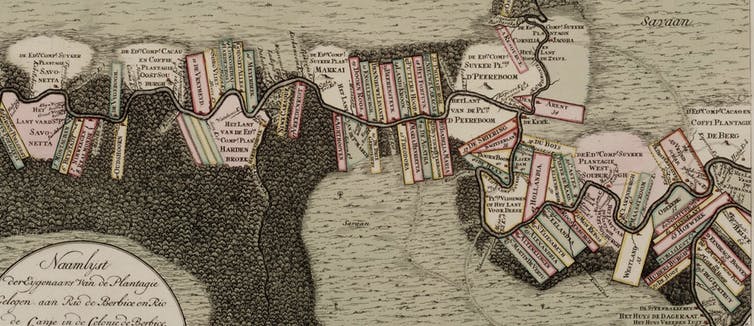
1742 map of Berbice River with plantations. Rijksmuseum, Amsterdam

The uprising, unusual among Atlantic slave rebellions for its length, size and near success, is barely known outside Guyana. But even African-descended Guyanese, it turns out, know less than they would like. Almost 13,000 people, intrigued by new information about a foundational chapter in their history, had tuned in to watch my presentation on Facebook and Zoom.

A rare cache

First colonized in 1627 to trade with Amerindians, Berbice passed into the hands of an investment company 100 years later that exploited the colony, which was growing coffee, cacao and sugar.

Berbice became British Guyana in the early 19th century and gained independence as the English-speaking Cooperative Republic of Guyana in 1966. Modern-day Guyanese view the slave rebellion as the origin of their republican inclinations.

Yet, all of the records related to the rebellion – in fact, most of the country’s historical records – are in archives in London and The Hague.

The sources for the uprising are extensive. There are the usual colonial records, such as the colonial governor’s daily journal, letters from officials and merchants and military reports. They are tainted by self-interest, Euro-centrism and racism.

More rare in the history of Atlantic slavery are letters sent by rebel leader Kofi to his Dutch counterpart. An African from the Gold Coast who had been forcibly taken to Berbice as a child, Kofi sought to end the military conflict through diplomacy.

And then there are the extraordinary testimonies of 900 suspected rebels and bystanders. They were taken as part of the Dutch kangaroo court to investigate guilt in the rebellion and condemn people to the rack, the pyre and the gallows.

These records, too, are problematic. The people on the stand feared for their lives. A Dutch clerk translated their answers from Creole into Dutch, summarized them, and put them in the third person. Using them requires, like most historical records, great care.

Still, the testimonies represent the voices of African-Guyanese ancestors. But the manuscripts have lain in the Dutch National Archives since the 19th century. They are in standard Dutch rather than the Creole language of Dutch Berbice likely more prevalent among the enslaved population at the time, and their existence was heretofore unknown in Guyana.

Dodging rebellion

Page from investigation into Berbice revolt.
National Archives of the Netherlands

The copious records reveal not only the political course of the rebellion but how people felt about it. Many young men joined enthusiastically. Older people and Creoles (people born in the colony) had more to lose in terms of family and meager possessions and were more reluctant.

To remain on the sidelines, they lived quietly on their plantations, dodging anyone, whether Europeans, rebels or Amerindians, or by hiding in the savanna or rainforest until the coast was clear. They were motivated by a desire not only to survive but also to remain masterless and ungoverned.

In his letters to the Dutch, Kofi proposed dividing the colony in two. It seems likely that he intended to keep several sugar plantations in production, perhaps with forced labor, in order to participate in the world market. Some 30 years later, Haitian revolutionary Toussaint L’Ouverture, too, would force self-emancipated Haitians to work in the cane fields for similar reasons. Many ordinary Guyanese were not up for this.

Many revolt narratives would have us believe that people are eager to rebel, sharing a common vision of freedom. This is not always the case. It was not in the American Revolution, nor was it in Berbice.

An act of emancipation

At my Zoom lecture on Nov. 24, listeners asked many questions. But they were particularly interested in the court testimonies.

Why, some asked in the chat, were these records still housed in the National Archives in The Hague? Shouldn’t they have been gifted back, or better yet, transcribed and translated? That way, African-Guyanase would be able to interpret the records for themselves and tell their own stories.

As it happens, the Dutch National Archives recently put all of Berbice’s records online – but that does not solve the language problem. I was able to put my Guyanese host in touch with a staff member at the National Archives who seemed receptive to the idea of publishing a translation of the investigations in English.

Reckoning with slavery requires having access to the records of the past. After all, writing one’s own history, too, is an act of emancipation.

*****

Marjoleine Kars, Associate Professor of History, University of Maryland, Baltimore County

This article is republished from The Conversation under a Creative Commons license. Read the original article.

Header image: Statue of the Berbice slave revolt leader Kofi in Georgetown, Guyana. David Stanley – Flickr/WikiMediaCC BY-SA

Poland’s anti-abortion push highlights pandemic risks to democracy

By Brian Grodsky, professor, Political Science, UMBC

Hundreds of thousands of Poles have taken to the streets since late October, defying bans on mass gatherings and risks from the COVID-19 pandemic to protest the government.

An immediate concern for protesters is the implementation of abortion regulations that would in effect end a woman’s choice to terminate a pregnancy in almost all cases.

But the demonstrations also, I argue, mark a concerted effort to protect Polish democracy from a deliberate attack by the ruling United Right coalition, led by the right-wing Law and Justice party known as PiS.

PiS has sought to tighten Poland’s already restrictive abortion laws since coming to power in 2015. After repeatedly failing to pass new abortion legislation, the party bypassed the democratically elected parliament and appealed to the unelected Constitutional Court to reinterpret the existing law. That court, packed with Law and Justice loyalists, criminalized abortion even in cases of severe fetal deformities on Oct. 22.

The latest move, according to members of the opposition and nonpartisan human rights observers, was an effort to push forward with a highly contentious agenda under the cover of COVID-19 restrictions. Hillary Margolis, senior women’s rights researcher at Human Rights Watch, said: “The chaos and anxiety surrounding COVID-19 shouldn’t be used as a distraction from harmful attempts to push through dangerous legislation.”

As a scholar who studies efforts to undermine democracy and has spent several years in Poland, I see echoes of PiS’s behavior elsewhere. Since the start of the COVID-19 pandemic, various authoritarian leaders, including Turkey’s President Recep Tayyip Erdogan and Cambodia’s Hun Sen, have been accused of using the global health disaster as a convenient tool to grab more power. The Poland case demonstrates how even purported democrats may be willing to use the emergency to push their agendas at a time when people’s democratic right to protest may be curtailed over concerns over the spread of disease.

Indeed, Polish Prime Minister Mateusz Morawiecki suggested that in protesting, those against the new restrictions were putting their mothers and fathers at risk from the disease.

Road to restrictions

PiS rose to power in the mid-2000s by claiming postcommunist elites had a stranglehold on the state and its various institutions. It was an anti-establishment party that promised to liberate ordinary Poles and embrace traditional Catholic values long associated with Polish identity. PiS’s decision to align itself closely with the church plays especially well in its nonurban base.

While PiS had its first taste of governing in a coalition that lasted from just 2005 to 2007, it was in 2015 that PiS won its first parliamentary majority. The party’s rise was fueled by its anti-migrant policies and promises to counter the “destructive ideology” of the LGBTQ community.

Since then, PiS also gained popularity by lavishing its constituents with generous welfare benefits, including higher pensions, tax breaks for low-income earners and a policy that pays parents to have more children. Thanks to these policies, PiS maintained its parliamentary majority in the 2019 elections, assisted by the support of the church.

Over its five years in power, PiS has been accused by critics of methodically attacking the basic liberal institutions Poland once so confidently modeled for others in the region. For example, the government has been accused of harassing nongovernmental organizations and limiting media freedoms.

It has also weakened state institutions, particularly the courts. At the start of this year, a group of Polish judges led thousands of people in a march against government efforts to undermine judicial independence. The judges were unable to stop PiS from stacking the Constitutional Tribunal with judges loyal to the party – and, it turns out, ready to implement the government’s abortion policies.

The abortion agenda

Poland’s democracy has remained vibrant enough to prevent PiS from successfully pushing through unpopular policies, including the legislation of a more restrictive abortion law. Although PiS holds a majority in the powerful lower house of parliament, for example, the opposition narrowly controls the weaker upper house.

Up until last month, Poland allowed abortions only as a result of fetal abnormalities, as well as rape, incest or a direct threat to the mother’s health. PiS attempts to tighten the laws in 2016 and 2017 failed amid public protests. Fewer than half of Poles support the draconian abortion rules pushed by PiS. This reflects the reality that while most Poles identify as Catholics, only a fraction are deeply religious.

This spring, in the run-up to presidential elections, legislators on the right acknowledged as much. Rather than fight for restrictions, they quietly sent a pending abortion bill back to committee. After President Andrzej Duda – supported by PiS – was reelected in July, lawmakers adopted a new strategy. They would skirt the democratically elected legislature and instead ask the Constitutional Tribunal they had stacked to reconsider the country’s existing 1993 abortion law.

Concerns over how PiS has changed the Polish judiciary – through measures including taking over the council that appoints judges and banning judges from criticizing the government – have grown in recent years. Earlier this year, Małgorzata Gersdorf, first president of the Supreme Court, went as far as to say that Poland is no longer “a democracy based on the rule of law.”

The Oct. 22 court decision to ban almost all abortions, even in cases of severe fetal deformities, ignited the opposition.

Democracy on the line

The timing of the decision – coming just as citizens were being advised to socially distance because of the pandemic – was, observers say, no mistake. The hundreds of thousands of Poles who took to the streets did so at great risk. With bans on public gatherings, protesters risk not only their health, but also fines of 5,000 to 30,000 złoty (nearly US$8,000). Hundreds were punished in the first days for disobeying the ban on gatherings and many more have been punished since.

The move to bypass democratic institutions amid a pandemic is eerily familiar to authoritarian watchers. Numerous authoritarian regimes have used COVID-19 to silence critics. What’s different is that Poland is still a democracy, albeit a flawed one. It is not authoritarian China, not even semi-authoritarian Hungary, where the country’s illiberal prime minister has severely undermined democracy during his decade in power.

And Poland is not the only democracy where leaders have been accused of trying to push through agendas while people may be distracted with fighting the pandemic.

In India, the ruling right-wing Bharatiya Janata Party has fueled conspiracy theories that the Muslim minority is intentionally spreading COVID-19. The United States has been accused of using the outbreak as an excuse to unlawfully expel unaccompanied migrant children. Israel has begun using data designed to track potential terrorists to track everyday citizens. And Australian police arrested Black Lives Matter participants protesting the deaths of aboriginal people in custody on the pretext that they breached coronavirus protection measures.

The risk is that as the coronavirus crisis drags on through the winter, leaders in democracies will continue to use the pandemic to take nondemocratic shortcuts to achieve their goals. They may be tempted to respond to public anger as the Polish prime minister did: “I am asking for these protests to be canceled because of the epidemic.”

The silver lining

Still, the recent Polish demonstrations – the largest since the trade union-led umbrella movement Solidarity’s showdown with Communists in the 1980s – demonstrate democracy’s potential resilience.

Indeed, democracy appears to be winning. After a week of protests President Duda suggested he might reintroduce less severe abortion legislation. A few days later, the government promised it would delay implementation of the ban. The cover of COVID-19 may not be enough for PiS to overcome democratic checks and balances in Poland, especially in the face of sustained protest and plummeting support.

*****

Brian Grodsky, Professor of Political Science, University of Maryland, Baltimore County

Header image: A protest in Poland. Photo by Michał Turkiewicz on Unsplash

This article is republished from The Conversation under a Creative Commons license. Read the original article.

It’s not just ABCs – preschool parents worry their kids are missing out on critical social skills during the pandemic

By Michele L. Stites, assistant professor, Early Childhood Education, UMBC and Susan Sonnenschein, professor, Applied Developmental Psychology, UMBC. Samantha H. Galczyk, graduate assistant, UMBC, contributed to this report.

As COVID-19 cases once again spike across the country, parents in school districts like New York City and Detroit face another weeks long stretch of remote learning. This often includes preschool parents, whose children range in age from 3 to 6 and are often too young to manage virtual learning on their own.

Many of these parents worry their children are missing out on important parts of the preschool experience – particularly opportunities to develop social, emotional and behavioral skills through interactions with teachers and other children.

As researchers who study children’s educational development, we know that preschool helps children develop important academic and social skills they will need for later school success. In April, we surveyed 166 parents of preschool children to examine what they felt was working – and not working – with distance learning. While the data haven’t been published yet, they give us important insights into virtual preschool.

Of the 166 parents who responded to our online survey, 73% said their preschool children were provided virtual learning opportunities during the COVID-19 crisis. The children were expected to devote 30 to 60 minutes a day to virtual classes. Two-thirds of parents said they supplemented the school lessons with in-home learning activities, although these primarily focused on reading, not math.


Thirty-seven percent of the parents felt children this age were too young to engage in online instruction without significant support from their caregivers. And 38% of parents reported not having the time to dedicate to distance learning while juggling the demands of work and other child care.

The parents we surveyed recognize that teachers and administrators are doing the best they can in this ever-changing and extraordinary situation. Their frustration and anxiety result from the virtual learning environment itself and the lack of resources to develop children’s social, emotional and behavioral learning along with early academic skills.

Preschool classrooms provide opportunities to build social skills like taking turns, waiting until others finish speaking and displaying empathy. These skills enable children to develop friendships, cope with challenges and have conversations with other children and adults.

Suggestions for parents

Based on the results of our survey, here are some ways parents can help make up for the shortcomings of virtual learning.

  1. Play games. Games often teach reading and math skills, but more importantly, they allow for social development. Model turn-taking for the child and how to handle losing.
  2. Take nature walks. Identifying objects and thinking about sounds, shapes and colors helps with early academics. But also take the time to have conversations. Talking about feelings is important, especially right now.
  3. Read. It’s widely accepted that reading helps children, well, learn to read. But it also gives them world knowledge and makes for enjoyable interactions with others. And, it can be used as time to work on math skills like counting and shapes. (More math suggestions are available here.) From a social aspect, it’s a good time to talk about a character’s feelings and ask the child questions like, “How would you feel?” and “What would you do if you were this character?”
  4. Make video calls. Set up virtual play dates allowing your child to talk to friends or relatives. Ask a grandparent to read a book with the child on FaceTime. Have the child play a game with a friend over Zoom.
  5. Talk about your own feelings. Model coping and dealing with challenges with your child. Don’t be afraid to tell your child when you are sad or worried. Ask the child what they would do if they were feeling sad.

Suggestions for teachers

And here are some ways that preschool teachers can support parents in their children’s learning and development during COVID-19.

  1. Help develop social skills. The parents we surveyed wanted short exercises to build social skills while students learn remotely. These activities would help students develop friendships, social norms and emotional awareness. For example, reading a book together as a class over Zoom and sharing personal experiences prompts natural conversation. Another idea is to send home stories in which a specific social dilemma like anger is discussed. Children can read and discuss the stories with a caregiver.
  2. Offer supplementary materials. Parents said they are supplementing school lessons with in-home learning activities. However, these activities typically focused on reading, with less attention devoted to math. Over half of parents said they did reading activities on a regular basis, but only 33% said they worked on math skills – which often predict later school success. By supplying the resources and materials, teachers can take out the guesswork for parents.
  3. Combine reading, math and social growth in short activities. For example, when sending home suggestions for books, point out where math opportunities – like counting certain items – and social dilemmas occur in the story. Combining lessons also makes it more efficient for parents to cover all three areas, which is important when they are balancing so many additional responsibilities.

Although academic instruction in preschool is important – and math especially should not be forgotten – teachers and parents agree that social interactions are critical at this age. And in a time of remote learning, social distancing and quarantines, keeping young children emotionally healthy, as well as physically healthy, is critical.

*****

Michele L. Stites, Assistant Professor of Early Childhood Education, University of Maryland, Baltimore County and Susan Sonnenschein, Professor, Applied Developmental Psychology, University of Maryland, Baltimore County Samantha H. Galczyk, graduate assistant, UMBC, contributed to this report.

Header image: Preschool is an opportunity to develop important social skills like taking turns, working in groups and making friends. John Tlumacki/The Boston Globe via Getty Images

This article is republished from The Conversation under a Creative Commons license. Read the original article.

No Artist Stands Alone

Lockdown, quarantine, shelter in place—a new vocabulary defines this period of our lives that requires us to maintain space to protect one another. Alone, we spend our time consuming or creating art and media, but many are also having to reinvent how we share that pleasure with others.
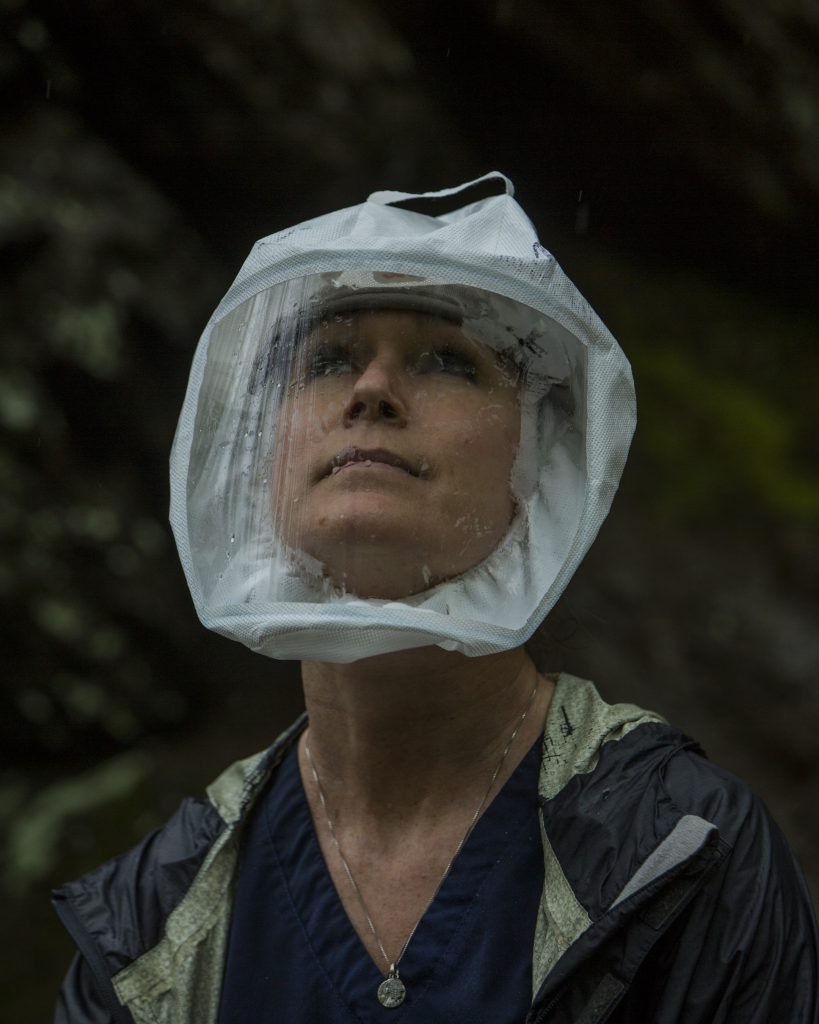
We see comedians attempting to navigate satire from living rooms; movie releases being delayed in hopeful anticipation of a less restrictive future; and book tours being curtailed for long awaited novels. For other artists, this public pause has engendered a more private creativity—a book of poems examining anti-Asian racism, lush and gentle photographs of essential medical personnel in their personal protective equipment, a step back from the stage to perform a play over Zoom.
In facing a pandemic that’s disrupted the normal rhythms of open mics and art exhibits, these Retrievers have continued their craft, carving out unique ways to then share their creations.
Can we shape and share art in community even during a global pandemic? The answer is continually a resounding yes.  

An exhibit in unusual circumstances

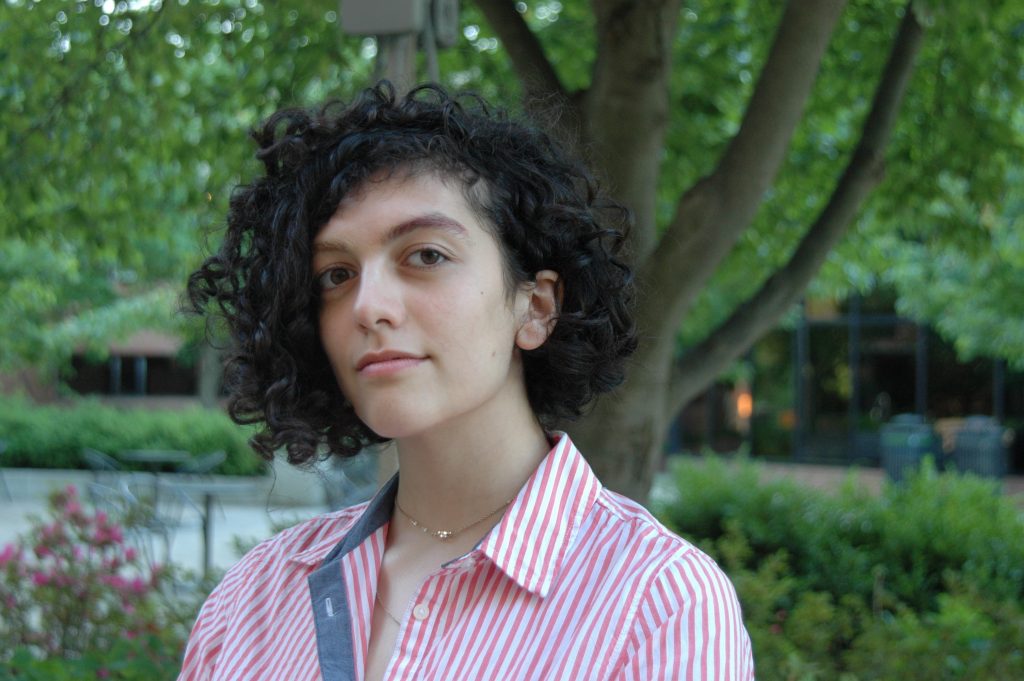
headshot of a woman in front of a tree
Headshot provided by Hannah Basher.

As Hannah Bashar ’20, art history and biology, worked to curate pieces for campus-adjacent coffee shop OCA Mocha’s Art During the Time of COVID-19 exhibit, she found herself inspired by the unique ways the contributing artists had drawn from the isolation and monotony of recent months to create impactful art.

“Some artists find inspiration in their new and changed landscapes and environments,” says Bashar, OCA Mocha’s former arts intern. She cites pieces by photographer Julie Miller, which depict the strikingly empty urban areas that the artist passed in her walks through Silver Spring.

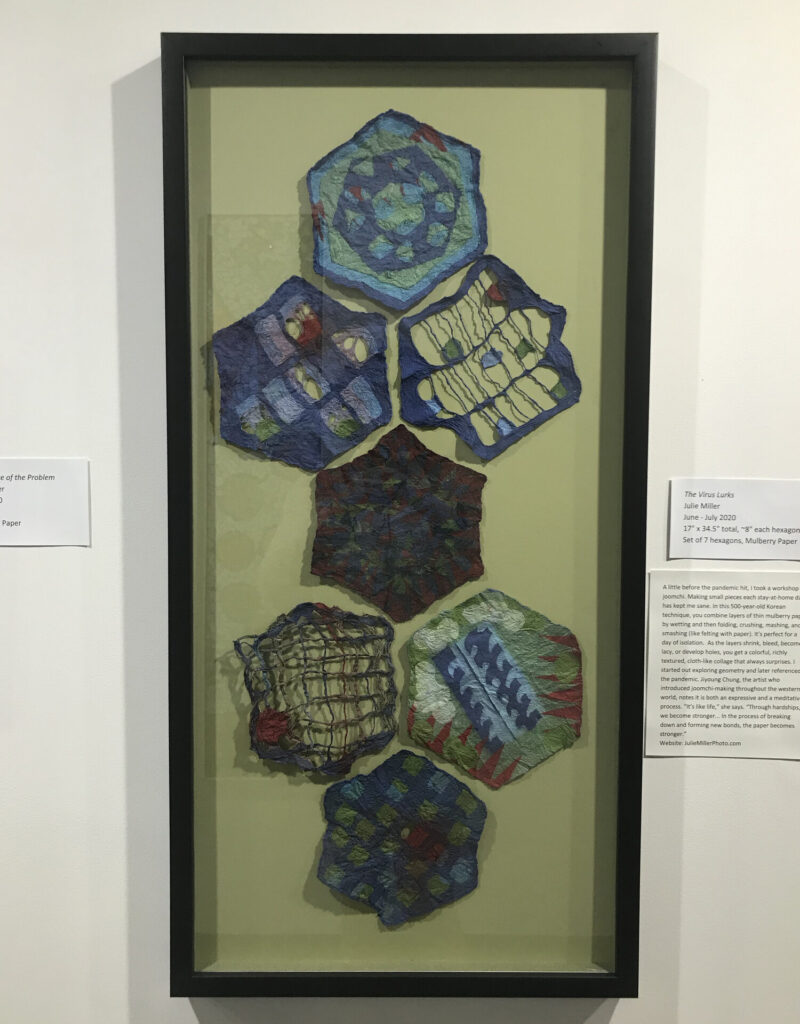
Other works featured in the exhibit were influenced by changes in routine; during the pandemic, Miller picked up the practice of joomchi, a centuries-old Korean art medium that involves layering paper in order to create unique shapes and textures. Miller’s artist statement describes the process of joomchi as meditative and “perfect for a day of isolation.”

Bashar wasn’t necessarily seeking art that made deep philosophical arguments about the pandemic. Instead, she wanted to display works that she thought viewers could relate to. “OCA Mocha stands for the community and it’s a strong force within the Arbutus community, so I want people to walk in and feel as though they can relate to what is on the walls,” she explains.

Artist Julie Miller picked up the practice of joomchi, a centuries-old Korean art medium that involves layering paper in order to create unique shapes and textures. Photo courtesy of OCA Mocha.

This means the exhibit ranges from powerful celebrations of Black women’s resiliency in textured acrylic paintings by Kathleen McPartland to playful textiles, like a diploma box filled with a yarn rug made to look like a pizza by April Berardi ’16, modern languages and linguistics.   

Bashar, who plans to pursue a career not in curation but emergency medicine, says that the unusual circumstances of this show made it an especially meaningful one to end her two-semester-long internship. “My own experience curating this show paralleled the theme of the exhibition, which is about how COVID has caused us to adapt and change with the times,” she says. “I felt like my experience curating the show was, in fact, part of the show itself.”
— Johanna Alonso ’20

Comic relief 

Umar Khan knew he had a chance with the crowd when he kicked off his stand-up comedy career a decade ago as a student—most of the faces in the audience were his friends and fellow Retrievers, gathered around the Sports Center stage on the second floor of The Commons. “I think there were like eight people there, and I remember walking away thinking it went well, although I’m sure if I watched it now…” Khan trails off. 

“All comics will tell you this, but we have to be some of the most delusional people in the world,” laughs Khan ’10, psychology. “What person in their right mind thinks they can captivate an audience of strangers for a set amount of time and on top of that make them audibly laugh?”

Armed with a notebook full of jokes he cringes at now, Khan performed at UMBC a few more times during his senior year. He kept going after that, making inroads into the DC comedy scene, maturing his content and honing his stage presence, filming his own special, performing shows almost every night while pursuing his day job as an elementary/middle school psychologist in Baltimore City. Fast forward 10 years, and COVID-19 hit comedy like so many other arts and industries. 

“Now with COVID, everyone is having to take steps back,” says Khan. “If you used to sell out theaters, well, when is anyone going to pack a theater again? So now you’re going into comedy clubs. And the people headlining comedy clubs are getting pushed down to the next level. And it just keeps going.”

“I’m so thankful I have a career—my immigrant parents were right,” Khan laughs, “dreams are stupid. You gotta get a government job with benefits and a pension.” 

In August, Khan was able to return to the stage, in a backyard show following pandemic protocols. “People are so hungry for entertainment and there’s so much going on in the world right now, says Khan. “We were pushing the line and people were loving it. It was so fun.”

“You can tell people just want to feel some sense of community and a comedy show offers you that community because you’re all laughing at the same thing. And you can leave and talk about the show—sharing the experience. It will be one of those shows we’ll look back on and be like, ‘oh remember when we had to do that during COVID?’”
— Randianne Leyshon ’09

Chocopies for world peace 

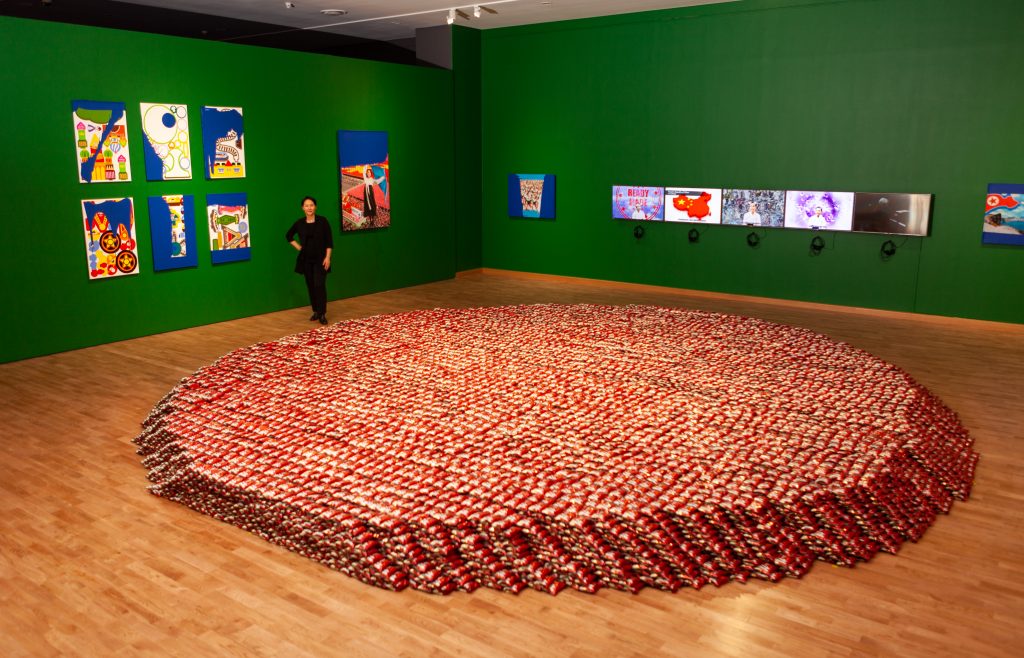
In an era where simply eating inside a restaurant is considered risky behavior, there was no way an art installation that invites thousands of guests to share in consuming a huge pile of South Korean snack cakes could go on as planned.

Thus, Mina Cheon’s Eat Chocopie Together project, which was shown physically at the Busan Biennale 2018 in South Korea and had been slated to open at the Lincoln Center in June 2020, had to be postponed. But Cheon, M.F.A. ’02, imaging and digital arts, and her collaborators knew that, as the pandemic raged on around the world, the installation’s themes of love, peace, and unity were more relevant than ever.

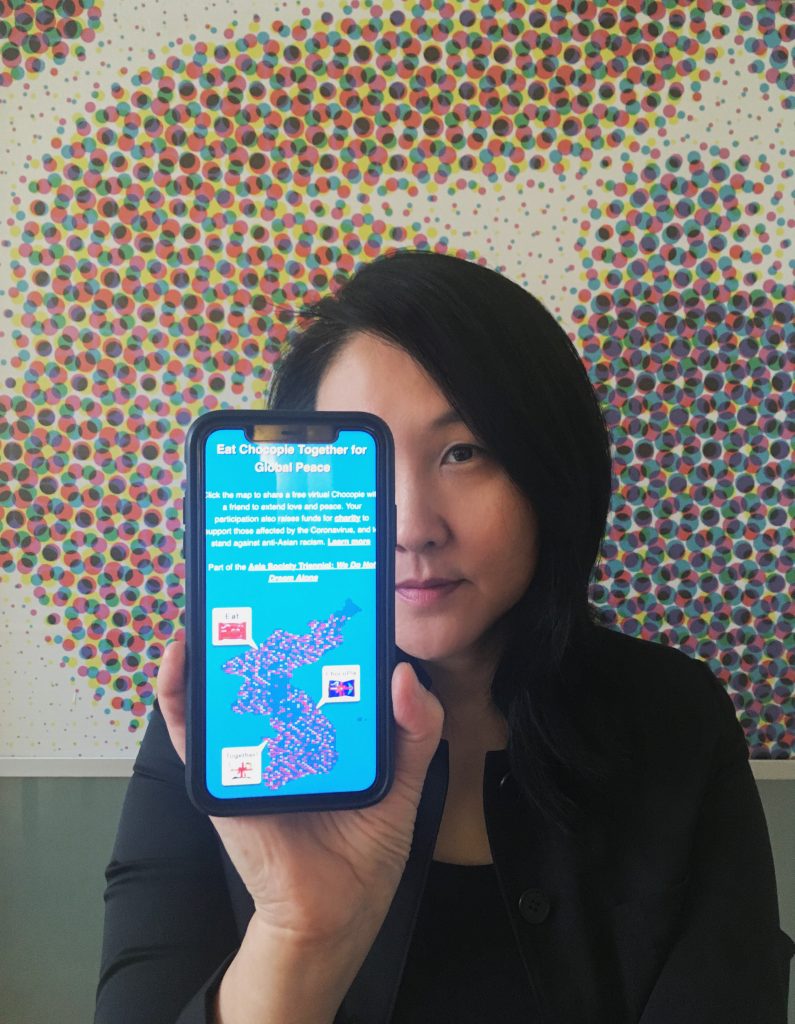
Cheon shows a map of North and South Korea, where people in both countries participated in the art project. Photo courtesy of Cheon.

To safely bring the project into the age of COVID-19, Cheon created a website, EatChocopieTogether.com, that allows friends to email one another digital versions of the marshmallow-filled treat. The chocopies are represented by graphics modeled after real chocopie wrappers but newly designed by the artist and emblazoned with one of five words: love, peace, share, eat, or unite. The recipient can “eat” the snack by clicking the graphic, and each chocopie sent and received contributes $2 to the Korean American Community Foundation COVID-19 Action Fund. 

“It’s an extended version of the original. It’s taking all the inspiration, the sentiment, the spirit of Eat Chocopie Together, but going virtual allowed us to explore the different packaging with the multiple themes” and to fundraise, Cheon says. As of September, the project reached its $5,000 goal.

The original meaning of the installation lies in the history of the chocopie; the confection is incredibly popular in both South Korea and North Korea, despite being banned in the latter country. Sharing chocopies is “meant to bring awareness of the two Koreas working towards peace and unification,” according to a press release published by Asia Society Triennal. 

Cheon stands in front of 100,000 chocopies at a 2018 exhibit in South Korea. Photo courtesy of Cheon.

The virtual version of the project emphasizes an even more global message, according to Cheon. “We are socially distanced and separated, but we can still connect,” she says. “That was such a big, empowering idea, that we could still heal through our virtual connection.”
— Johanna Alonso ’20

Art by appointment

Bonnie Crawford describes looking at art like a religious experience. So when COVID-19 interrupted her life, she realized that what she missed most was experiencing art with her friends. Over the course of a month, Crawford, M.F.A. ’08, imaging and digital arts, invited people by appointment to view her work of dental floss weavings in the shed in her backyard. 

“There’s a unique mindset when someone is looking at art,” says Crawford, who didn’t want people to lose out on that opportunity during the various stages of lockdown.

Bonnie Crawford’s dental floss weavings ranged in size from a quilt to a pocket
square. She displayed the art in her emptied out shed.
Photo courtesy of Crawford.

Crawford was worried at the beginning of the pandemic that she would possibly never make art again; she was finding it meaningless. Her weavings had usually been a way for her to channel creative energy, so she reinvisioned how to share her work with others which gave her renewed purpose.

Crawford’s dental floss weavings grew from the work she does on her Instagram feed, @brushhouse, where she shares pictures of her family brushing their teeth, sometimes including a guest appearance from a friend. The weavings extended from her desire to do more formal work. They range from small enough to fit in a wallet to a tall floss weaving that hangs like a tapestry. 

“I would go to my studio until I had to use the bathroom,” Crawford laughs. This meant driving across the city to go at home, wanting to err on the side of caution in the face of a novel virus. In this way, Crawford slowly made progress on her largest dental floss weaving. When she was finished, she asked her sons and boyfriend to clear out their things from the shed and then got to installing.

The exhibition was up for about a month, available for viewing on Thursdays, Fridays, and Saturdays. Using an app to schedule appointment slots, in total 90 people came to see her work. “I hoped that it fulfilled that spiritual need for others like it did for me,” she says. 
— Imani Spence ’16

All the world’s a digital stage

Like most things that cannot be held in person due to the coronavirus pandemic, theater has found its virtual home on Zoom.

These digital performances can be quite similar to the existing practice of staged readings, in which actors deliver their lines with little to no sets or costumes, often while sitting. But to tell some uniquely 2020 stories, some actors, playwrights, and directors have taken this medium to a new level.

Among them is Jurdan “JC” Payne ’21, theatre, who has spent the past few months performing in virtual plays featuring casts located throughout the country. Most recently, in a ten-minute play called High, Low, Uh-Oh, Payne is one of two characters on a video chat. He calls to wish a friend happy birthday, unable to celebrate in person due to COVID-19. 

Payne looks forward to the return to a real stage, but is making most of the virtual options during the pandemic. Photo courtesy of Payne.

It was the first time Payne had ever used his own house as a set and his own possessions—ketchup mixed with water to simulate blood and a sock puppet through which he sang “Happy birthday,” for example—as props. Most of the props weren’t listed in the script; instead, Payne used whatever he had laying around the house to supplement the existing material.

(And yes, that does mean he already owned a sock puppet with googly eyes).

“It was kind of new territory for me,” he says. “It’s different from being on stage, but also really different from filming a short film or a commercial.”

Pre-pandemic stage photo courtesy of Payne.

Another element of working in theater that has changed in recent months are auditions, says Payne. Whereas actors were once expected to dedicate 8- to 10-hour-long days to auditioning, the pandemic has solidified the fact that virtual auditions can be just as effective and informative as in-person ones, signaling a welcome shift from the traditional long audition days. 

“I hope that eventually theaters will adopt that practice moving forward,” Payne says. Still, he notes that a self-tape, as they’re called in the industry, can be challenging because it requires the auditioner to act as lightning designer, cinematographer, and director, all while trying to perform.

“It’s like learning a new language,” he says.
— Johanna Alonso ’20

Community of poets

Calista Ogburn ’21, health administration and policy, began writing poetry as a way to orient herself in a new environment. As a high school sophomore in Seoul, South Korea—after moving from Vietnam—Ogburn was looking for community so she joined a public speaking club that introduced her to speech tournaments and poetry readings. 

At UMBC, Ogburn has continued to use poetry as a means of making a home for herself. She credits Lia Purpura, writer in residence at UMBC, with helping her reimagine her poetry and her process as a writer. Ogburn, who is the communications director for the Student Government Association, also connected with other students in the Retriever Poets, a student group that encourages poetry through open mics and workshops. Ogburn’s first book of poetry, a splash of yellow, edited by fellow Retriever Morgan Mullings, media and communications studies, was published just for Ogburn and her friends; a project to prove to herself what she could accomplish. 

Ogburn poses with her books of poetry. Photo from calista-ogburn.com.

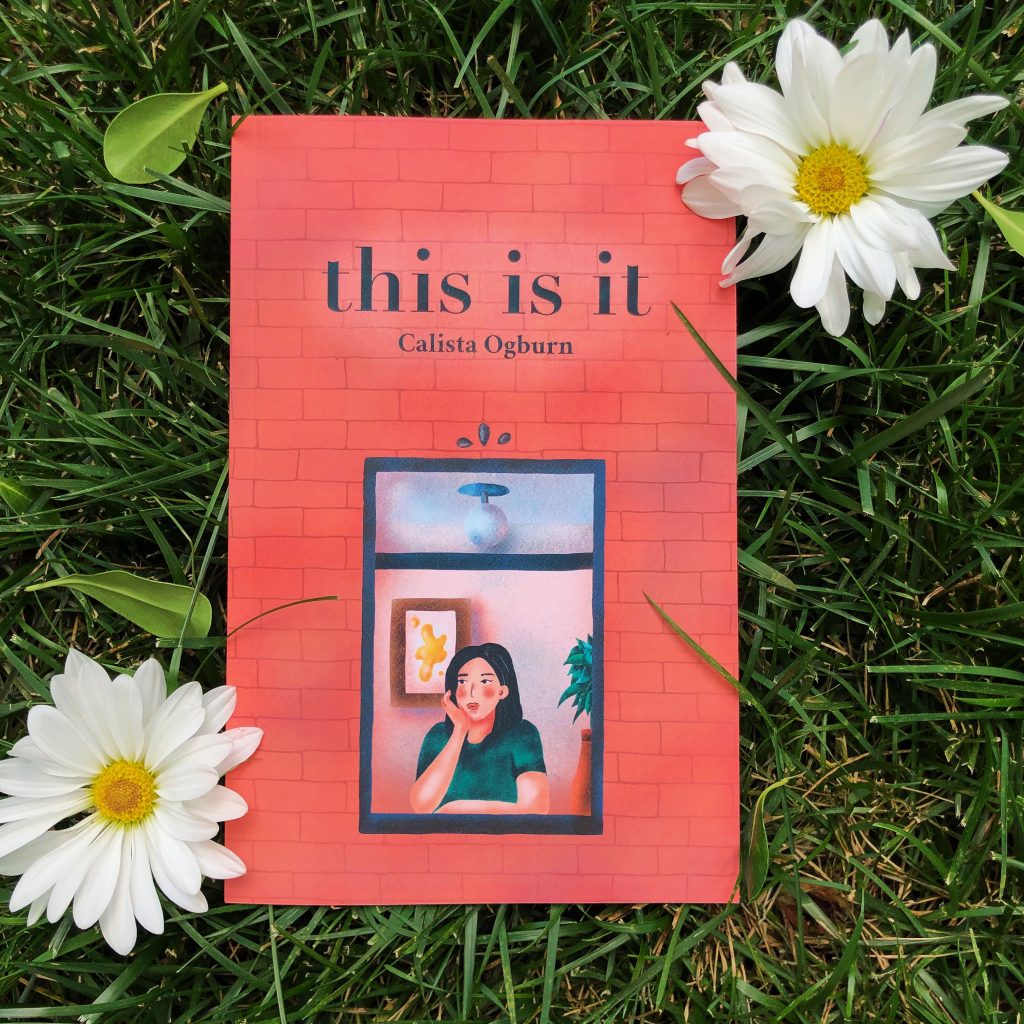
Ogburn’s second book of poetry was for a broader audience. Written in the beginning stages of COVID-19, this is it addresses racism towards Asian Americans, on personal and institutional levels as misunderstandings about the virus have influenced people. As a senior health administration and policy major watching a public health and political crisis, she felt called to action.

“My hope,” Ogburn shares, “is that these poems can touch those who are feeling loss, loneliness, or the combined grief and rage of experiencing racism.”

Promotional book photo courtesy of Ogburn.

this is it was a group effort, says Ogburn, praising Mullings, who also edited this volume. Support from other Retriever Poets helped push Ogburn to truly confront the emotions that she was feeling, and gave confidence to her voice. Since her time in South Korea, Ogburn realizes that she’s “always had a community of poets.”
— Imani Spence ’16

Meant to be connected

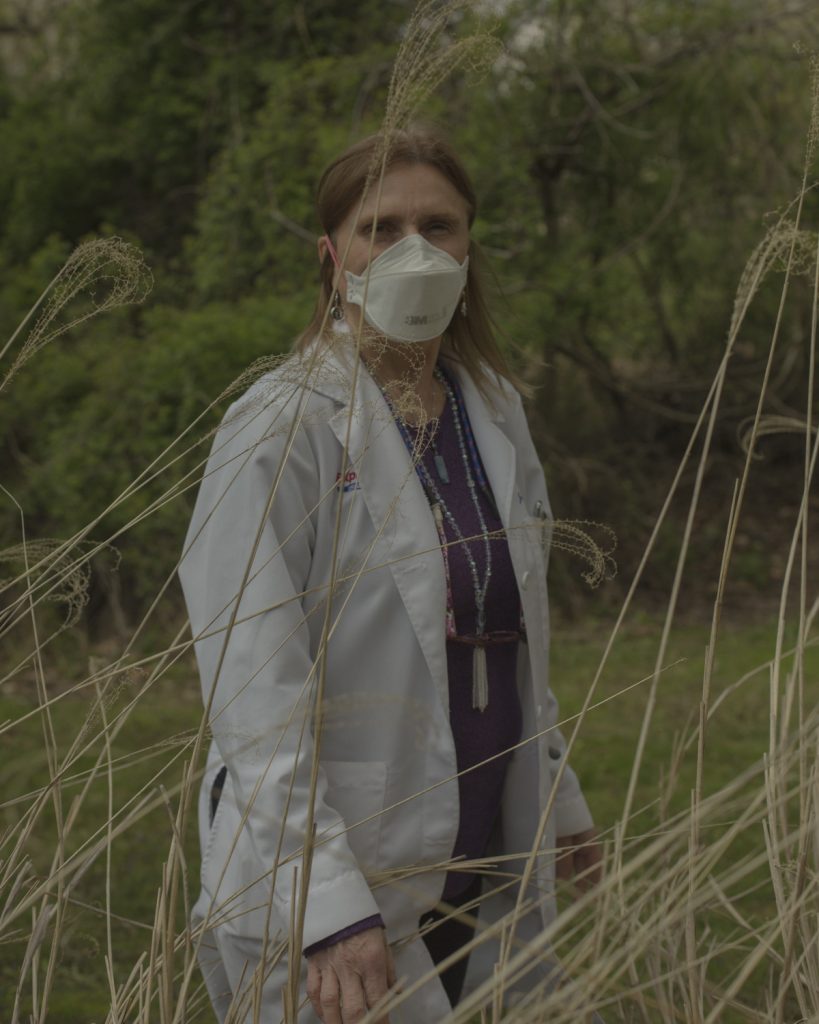
To counter her anxiety in the time of COVID, Jill Fannon, M.F.A. ’11, imaging and digital arts, decided to photograph people who are responding to the pandemic directly—healthcare workers. Her collection, Care in the Garden, features these essential workers in quiet intimate moments outside of the hospital. 

“We’re meant to be connected and we affect each other, deeply,” says Fannon, who doesn’t see this project about the art of photography as much as about capturing a moment. She has found herself asking “What will we want to know about COVID-19 50 years from now?”

When Fannon began her project in April 2020, many people didn’t expect that the country would still be facing a pandemic half a year later. Her work, Fannon says, has kept her from experiencing what many people are calling “quarantine fatigue.” 

It’s been a special experience, Fannon shares, for her to meet these medical professionals in these intimate moments. While most people are working from home, healthcare workers are forced to do everything possible to keep their work from coming home with them, mentally and physically. For these healthcare workers, concerned about transmission to their families, this has transformed their spaces drastically. One of the subjects of the photo series described to Fannon how she would take all her clothes off outside her home, throw them in the laundry, and shower before touching her family.

Photography has always been a way Fannon expresses herself and finds joy, but in this moment, she wanted to use them for the greater good—showing the humanity of essential personnel even hidden behind their PPE. The contrast between their face shields, scrubs, and the lush scenery tells a powerful story about how people are finding stillness and peace during a health crisis. 
— Imani Spence ’16

*****
Header image by Jill Fannon, M.F.A. ’11.

US colleges report a 43% decline in new international student enrollment, and not just because of the pandemic

By David L. Di Maria, associate vice provost for international education UMBC

For the fourth year in a row, the number of international students enrolled at U.S. colleges and universities has declined. This is according to data released this month by the State Department and the Institute of International Education.

The fact that the decline largely took place during Donald Trump’s presidency is no mere coincidence. The Trump administration has tightened restrictions on who can study here and has also sent signals that students from abroad are not welcome.

As the Trump administration comes to an end, the new international enrollment data serve as sort of a failing grade for an administration that claimed international education would be a top priority. The Trump administration also made commitments to increase the number of international students in the U.S. and boasted of having spent more on recruiting international students than any other administration in history.

Important as it is to have global perspectives at American colleges and universities, the steady decline in international enrollment is about more than that. As a specialist in international education, I know that the continued decrease in students from abroad will negatively affect U.S. students and the American economy.

Still over 1 million

There are currently just over one 1 million international students studying in the U.S. This has been the case since 2015. This current figure includes 851,957 students enrolled at higher education institutions and 223,539 people engaged in Optional Practical Training, a program that allows recent international graduates to remain in the U.S. temporarily to obtain work or volunteer experience related to their major, according to data I analyzed from the Institute of International Education.

The Optional Practical Training is important to consider when you examine trends in international enrollment in the era of Trump. The reason is that the true impact of the Trump administration on international enrollment is masked by Obama-era policies that permitted more international students to remain in the U.S. for longer periods through the Optional Practical Training program.

As these people complete their training programs, the total number of international students will likely once again dip below the 1 million mark.

Where they are from

While the students came from more than 220 countries and territories, China and India accounted for 53% of the total, the data show.

About one-third of international students – 34.8% – enrolled in graduate-level coursework. The next-biggest group was those enrolled in bachelor’s degree programs – 33.1%. Associate degree and non-degree studies accounted for 5.9% and 5.4%, respectively, of international student enrollment in the U.S. The remaining 20.8% were participating in Optional Practical Training.

Just over half of all students from abroad – 52% – pursued majors in science, technology, engineering and mathematics, or STEM.

How they pay for school

At the undergraduate level, 83.9% of international students rely on personal and family income to pay for their education in the U.S.

Five percent rely on a foreign government or university, and 0.4% rely on a foreign private sponsor. In all, 89.3% are pumping money from abroad into the U.S. economy, while the remaining 10.7% rely primarily on funding from a U.S. source. At the graduate level, 60.7% of international students rely primarily on international funds, since 36.5% received funding from their college in the U.S. These graduate students usually get this funding in exchange for helping faculty with grant-funded research projects or helping teach undergraduate courses in their discipline. The remaining 2.8% received funding from other U.S. sources.

Most of the money spent by international students – 55% – is spent within the higher education sector. This in turn helps colleges support high-tech academic programs. It also helps keep tuition lower for students from the U.S.

But a drop in international students doesn’t hurt just colleges’ bottom lines – it harms local economies as well.

When you subtract all funding from U.S. sources, one analysis found, international students still contributed US$38.7 billion to the U.S. economy in 2019. These dollars supported 415,996 American jobs, based on an economic analysis.

Also, consider that 18% of every dollar spent by international students goes to apartment rentals and other forms of accommodation; 11% goes to restaurants, 9% to retail and the rest to other sectors of the economy.

No matter how you slice the data, the fact remains that international students make positive contributions to the U.S. economy. In fact, 1 in 4 $1 billion startup companies in the U.S. had a founder who first arrived on a student visa.

Looking forward

Many international students have reacted positively to the victory of President-elect Joseph Biden and Vice President-elect Kamala Harris.

Nevertheless, I believe it will take years to reverse the trend of declining international enrollment that intensified under Trump.

It is true that there was a decline during the last year of the Obama administration, but that was mostly due to the fact that the Brazilian and Saudi governments curtailed major study-abroad scholarship programs for their citizens. This resulted in a drop of 10,586 in Brazilian students and 8,670 fewer Saudi students between 2014 and 2016. The situation got worse as the U.S. came to be seen by international students as an unwelcoming nation under Trump.

After the pandemic

The Institute of International Education also partnered with nine other higher education associations to assess international student enrollment amid the COVID-19 crisis. The most alarming facts from the survey are a 43% drop in new international student enrollment and a 16% reduction in total international enrollment in the fall of 2020. The study also found that 1 in 5 international students are reportedly studying online from abroad, and roughly 40,000 international students have chosen to defer their enrollment to a future term.

All said, the findings reflect a lot of uncertainty for the future of U.S. colleges, which were already – before the COVID-19 pandemic began – anticipating that overall enrollment will drop by more than 15% after the year 2025 because of record-low birthrates in the U.S. that began in 2008 and continue to this day.

Some experts attribute this decline in the birthrate to the 2008 financial crisis. People may simply have delayed having children or had fewer children because of that era’s economic hardships. And 17 years later, in 2025, there are bound to be fewer students and more empty seats in college classrooms.

The economic impact of the COVID-19 pandemic is estimated to be three times worse than the 2008 financial crisis. Consequently, colleges could experience another major decrease in overall enrollment caused by similar demographic changes by 2037. Success in recruiting students from abroad will be key to offsetting these declines.

*****

David L. Di Maria, Associate Vice Provost for International Education, University of Maryland, Baltimore County

Header image: Two students walk on campus in Fall 2020. Photo by Marlayna Demond ’11.

This article is republished from The Conversation under a Creative Commons license. Read the original article.

Leadership in Action – The Hrabowskis Participate in Vaccine Trial

UMBC President Freeman Hrabowski and his wife Jackie recently volunteered to take part in a 25-month clinical trial of the COVID-19 vaccine invented by alumna Kizzmekia Corbett ’08, M16, biological sciences, with her team at the Vaccine Research Center at the National Institute of Allergy and Infectious Diseases. We talked with the Hrabowskis to learn more about why being a part of this historic trial is so important to them both. 

UMBC Magazine: Why did you decide to volunteer for this trial?

Jackie Hrabowski: Well, it’s for a couple of reasons, starting with the fact that this pandemic has affected minorities, and African Americans specifically, more directly than most. And so, it’s important for us to be represented in the solution. If we’re looking for cures, we need to be involved and to be able to step up to that, despite all of the fears. The second reason, of course, is that the person who is developing this vaccine is a UMBC alum, and we’re very proud of her. And we always believe in supporting our students. We know that they’re the best at whatever it is that they decide to do. So those are the primary reasons…but I also think we need to be role models and walk the talk. If we say it’s important to do this, we need to be able to demonstrate it through our actions, not just with our words.

Kizzmekia Corbett ’08, M16, biological sciences, calls out UMBC as her best career decision yet.

Freeman Hrabowski:  Exactly. We’re seeing people of color and particularly African Americans dying at higher proportions, higher rates than anyone from this disease right now. And we need to help find the solutions. And right now the vaccine our alumna Kizzmekia Corbett has developed is very promising. And, as Jackie says, of those to whom much is given much should be required. And we feel very fortunate to be in that position right now. I have been the beneficiary of so much support from so many people that we want to do our part during this time.

And of course many Black people will say, yeah, but we know about these studies. I grew up with Tuskegee study. So, I recognize the prejudice that was shown and the abuse by the medical and scientific community towards Blacks in the past. But the question is, what do we do now? Right now we need this vaccine for everyone. And the encouraging news is that we can see people of all races involved in the development and the implementation of this plan for this vaccine. 

UMBC Magazine: You both clearly understand how important it is to set a good example.

Jackie Hrabowski:  It’s like the story of my dad growing up in rural Virginia. He and my mom were always out in the community helping people. We didn’t have a lot of money, but it was about giving our time and our effort…and supporting people as much as we can. And growing up, I was always there in the background, running with him, taking somebody somewhere, giving them something. And so as I got to be a little older…I asked my dad, why do we have to always be the ones going and taking people and doing things for people? And he looked at me, and he just quietly said, “Because we can.”

Freeman Hrabowski: I just love that…. It just gives me goosebumps. And you know, there are certainly a lot of limitations about things that we can’t do. We often don’t do as much as we can…but this is a time when we, as human beings, have a responsibility to step up to the plate for the public good, for the common good. This is the time when we need to be focused on people beyond ourselves.

*****

Retrievers are on the front lines of COVID-19 research.

UMBC faculty and alumni have been putting their expertise to use since the beginning of the pandemic. In addition to Kizzmekia Corbett’s vaccine work, Kaitlyn Sadtler ’11, biological sciences, is orchestrating a 10,000-participant study at the National Institutes of Health to look for antibodies to SARS-CoV-2 in volunteers’ blood, allowing the research team to estimate just how many people have been infected across the country—whether they had symptoms or not. 

Zoë McLaren, associate professor of public policy, writes about how COVID-19 cases are surging upward around the U.S. but rapid testing might allow a turnaround by a massive scale-up of testing. Katherine Seley-Radtke, professor of chemistry and biochemistry, chimes in her expertise to explain what makes some drugs work against viruses and how others aren’t effective treatment of SARS-CoV-2.

Header image and video courtesy of the University of Maryland School of Medicine. Learn more about volunteering for the clinical trial.

No, soaring COVID-19 cases are not due to more testing – they show a surging pandemic

By Zoë McLaren, associate professor, public policy, UMBC

COVID-19 cases are surging upward around the U.S., reaching 100,000 daily cases for the first time on Nov. 4 and 150,000 only eight days later. Some believe this increase in reported is a result of increases in testing, as more than 1.5 million tests are performed every day in the U.S. But the evidence is clear that these high numbers reflect a true increase in the number of COVID-19 infections.

Hospitalizations, deaths and test-positivity rates are going up. Taken together, this means that serious COVID-19 illness is on the rise and cases are being undercounted.

Steep increases in hospitalizations and deaths

Rather than being an artifact of changes in testing policy, the rise in cases reflects ongoing transmission and serious illness.

Even as COVID-19 treatments have improved and death rates have fallen, record-breaking levels of hospitalizations are already overwhelming ICUs in many parts of the country. Hospitalizations and deaths will continue to climb even if the surge in new cases abates because the majority of cases are diagnosed before serious illness develops. Today’s new infections will add to the death toll for weeks to come.

These hospitalizations and deaths represent confirmed COVID-19 infections. A COVID-19 diagnosis for hospitalized cases must be justified based on symptoms and test results. COVID-19 is simply the only plausible explanation for ongoing high hospitalization and death rates.

High and rising test positivity

High and rising test-positivity rates provide more evidence that COVID-19 is spreading uncontrollably around the country.

Test positivity is the percentage of all COVID-19 tests for active infection that come back positive. For example, Iowa’s test-positivity rate of 51.7% as of Nov. 17 means that for every 100 COVID-19 tests performed, 51 are positive.

Test positivity tells public health officials whether a testing program is casting a wide enough net to catch the majority of COVID-19 cases.

A high test-positivity rate indicates that the people getting tested are mostly those who have symptoms or think they’ve been exposed to someone with COVID-19. But people can be infected or contagious even if they aren’t showing symptoms. A low test-positivity rate means that access to testing is wide enough to reach large numbers of people who may not know they have the coronavirus. This greatly increases the chances of diagnosing people without symptoms or known exposure who may nonetheless be infected.

The World Health Organization recommends a goal of 5% test positivity or less, but test-positivity rates in many parts of the U.S. are well above that. As of Nov. 17, 44 states had test-positivity rates above 5%, meaning their testing programs were not casting a broad enough net and were likely missing many undiagnosed cases.

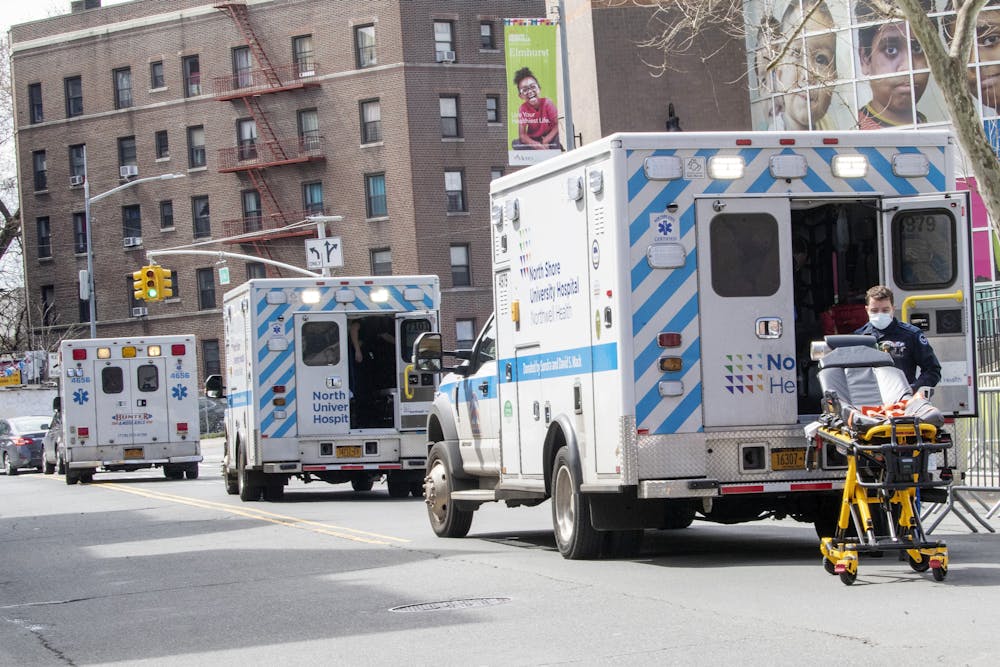
Three ambulances lined up in front of a hospital.
Hospitalizations and deaths are also rising, though they lag behind increases in diagnoses. AP Photo/Mary Altaffer

Things are worse than they seem

The data on hospitalizations, deaths and test positivity clearly show that the worst of the surge is yet to come. High test-positivity rates mean the current confirmed case numbers are undercounting total cases.

A test-positivity rate above 25%, as is the case in several states, implies there may be more than 10 times as many cases in the population as have been diagnosed. Many of these undetected cases may be contagious even though they have no symptoms, which further contributes to the spread of the virus. Considering the lag between new cases and hospitalization or death, the current surge does not bode well for the coming winter.

Overstretched testing programs

The record-breaking surge in COVID-19 cases and hospitalizations around the U.S. represents a true increase in infections and serious illness rather than an increase in testing. In fact, high test-positivity rates show that cases are undercounted because of limited access to testing. Hospitalizations and deaths will continue to rise in the weeks ahead.

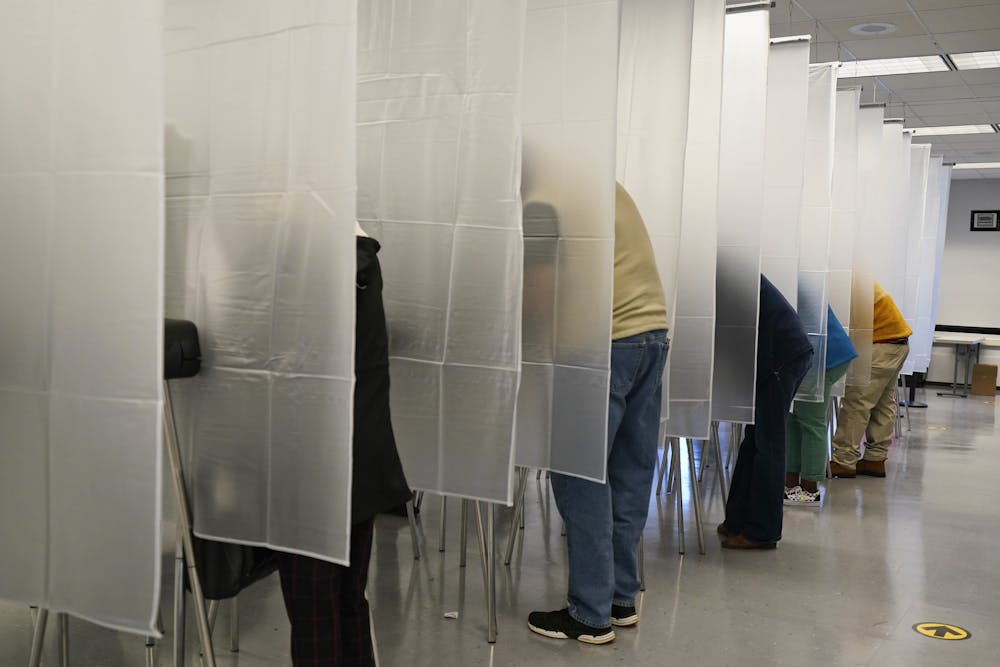
Overstretched testing programs remain a weak link in the U.S. pandemic response. Diagnosing cases – and catching them as early as possible – will help cut off transmission chains of the deadly virus. When people learn they’re infected, they’re more likely to take necessary precautions to avoid exposing family, friends and others to the virus. Contrary to what some ill-informed people may be saying, the U.S. should be expanding access to testing to curb the spread of COVID-19. More testing would actually be a crucial step toward finally getting the virus under control.

*****

Zoë McLaren, Associate Professor of Public Policy, University of Maryland, Baltimore County

This article is republished from The Conversation under a Creative Commons license. Read the original article.

Header image: Access to testing had been improving across the U.S., but as cases increase, more testing is needed. AP Photo/Bebeto Matthews

Genocide claims in Nagorno-Karabakh make peace between Armenia and Azerbaijan unlikely, despite cease-fire

By Brian Grodsky, professor, Political Science, UMBC

A Russian-brokered cease-fire between Armenia and Azerbaijan this week halted fighting over the disputed Nagorno-Karabakh territory, where long-standing hostilities reerupted on Sept. 27.

The deal leaves Azerbaijan, which was given Nagorno-Karabakh by the Soviets in 1923, largely in control of the majority-Armenian territory. Leaders in Nagorno-Karabakh, located in Western Azerbaijan close to Armenia, continue to demand independence.

Thousands have died and an estimated 100,000 have been displaced in Nagorno-Karabakh since September. As the cease-fire took effect on Nov. 10, Azerbaijanis danced in the streets. But angry Armenians stormed the Armenian parliament and office of the prime minister.

Both sides in the conflict have claimed that fighting in Nagorno-Karabakh isn’t just about territorial control – it is a fight to prevent genocide, a fight for their lives. These grave accusations, while yet unproven, may make a lasting resolution to the conflict much harder.

Freedom fighting and genocide claims

Violence first broke out in Nagorno-Karabakh in the 1980s, when the region’s ethnic Armenian leaders sought to gain independence from Azerbaijan. There has been intermittent fighting since then, including a bloody war in the 1990s that ended in another Russia-brokered cease-fire giving Azerbaijan legal control of the region.

But Armenian leaders in Nagorno-Karabakh declared themselves an independent republic, and have repeatedly tried to secede.

In my research on self-determination, I find that genocide is often invoked by secessionist regions as a last-ditch effort to secure outside intervention in their conflict.

The United Nations defines genocide as the destruction or partial destruction of a “national, ethnical, racial or religious group.” It is a war crime under international law, and countries are supposed to “prevent and punish” it under a 1948 U.N. agreement.

Secessionist leaders often try to rally foreign powers around their cause with arguments based on geopolitical strategy, economic self-interest, religious bonds or shared ideology. Those reasons broadly explain why Iran supports the Iraqi Kurds in their quest for greater autonomy, and why the Arab states back the Palestinians’ efforts at statehood.

But when all else fails, freedom fighters will highlight their own repression in the starkest of terms to gain international assistance. In war a global campaign for victimhood is the weapon of the weaker side – and genocide claims are the most powerful weapon in this arsenal.

According to my research, more than two-thirds of members in the Unrepresented Nations and Peoples Organization, a nongovernmental organization composed of autonomy-minded minority groups like the Kurds, have alleged genocide.

Genocide makes peace hard

Genocide may be, as one scholar puts it, the “embodiment of radical evil,” but as a war crime it is incredibly difficult to prove.

Under international law, accusers must show perpetrators acted with the “intent to destroy, in whole or in part,” specified groups. Demonstrating intent is a tall order.

Armenia knows this as well as any nation. The 1915 Armenian genocide by Turkey is recognized by fewer than three dozen countries. In terms of both law and politics, declaring a deadly military campaign to be genocide – versus just the atrocities of a bloody conflict – is tricky indeed.

Rubble of a cement home and photo of a boy with flowers around it
A house destroyed in an Oct. 17 rocket attack on Gyandzha, in Nagorno-Karabakh, that killed a young boy. Gavriil Grigorov\TASS via Getty Images

Genocide allegations, on the other hand, are more easily come by. But according to my research they don’t bode well for peace.

Genocide claims turn “the other side” into an enemy bent on the destruction of an entire people. Once the public sees a conflict in these terms, history shows, leaders understandably balk at the prospect of sitting down at the negotiating table with that enemy.

Genocide claims also reduce the likelihood of effective outside mediation by winnowing away the pool of “honest brokers” – that is, objective intermediaries. Opposing parties can and do reject would-be peacekeepers based on their acknowledgment of – or refusal to acknowledge – genocide accusations, my research finds.

In archived coverage of the South Ossetian region of Georgia, for example, local leaders in the 2000s insisted various European and American troops could not serve as peacekeepers since they had not defended Ossetians from an alleged 1992 genocide.

Nagorno-Karabakh and genocide

Genocide claims in the Georgia cases did eventually lead to international intervention and separation from Georgia, but not through peaceful negotiations. Instead, South Ossetia, like another breakaway Georgian state called Abkhazia, gained de facto independence after a brutal Russian military assault on Georgia in 2008.

This mirrored what occurred in Kosovo nearly a decade earlier when Serbian atrocities prompted Western intervention. Western powers recognized Kosovo’s independence in 2008, but Serbia continues to contest Kosovo’s separation.

In the case of Nagorno-Karabakh, genocide claims on both sides are nothing new. In archival research I found media reports showing that Armenian leaders have repeatedly reminded foreign powers of the 1915 Armenian genocide when pressing for outside intervention in their conflict with Azerbaijan.

Parade of cars with men waving Azerbaijani flags out the windows
Azerbaijanis celebrate the end of the military conflict over Nagorno-Karabakh on Tuesday. Gavriil Grigorov\TASS via Getty Images

Azerbaijanis, for their part, retort it is their citizens who should fear genocide. During a 1992 Armenian military campaign in Nagorno-Karabakh, Armenians committed what is now called the Khojaly massacre, when at least 613 civilians were reportedly killed. As newspapers from the era reveal, Azerbaijani leaders declared then that without international intervention, Armenians would finish the job.

It is impossible to determine whether genocide has in fact occurred in Nagorno-Karabakh without in-depth investigations. But the accusations alone may overpower any truce. And as Armenians’ angry reaction to the recent cease-fire demonstrates, peace between the two nations is fragile at best.

*****

Brian Grodsky, Professor of Political Science, University of Maryland, Baltimore County

Header image: Soldiers patrol the mountainous, disputed border between Armenia and Azerbaijan, Nagorno-Karabakh, on Nov. 8. Stanislav Krasilnikov\TASS via Getty Images

This article is republished from The Conversation under a Creative Commons license. Read the original article.

Pursuing Art and Peace Through Theater of Ideas

By Susan Thornton Hobby

The second week of March 2020, the cast and crew of Asif Majid’s original play were eagerly anticipating their Friday night community reading at a black box theater. Instead of a flood of rehearsals, the play, and the world, shut down due to COVID-19.

Majid ’13, interdisciplinary studies, seized the moment. His play, “Snapshots,” is a series of phone calls between lovers and friends talking about sexuality, Islam, and cultural appropriation. The format of the play easily translated to a pandemic platform: Zoom.

The Convergence Theatre actors learned to switch cameras, mute and unmute, and make “set” changes by changing camera angles. The actors and crew rehearsed for “an insane” two weeks, Majid says, laughing. He cobbled together a livestream with an ethernet cable and a router, then ran the program from his parents’ spare office.

The play debuted March 27 on HowlRound, a theater streaming platform, when few other theater companies were making online theater. More than 400 people in 18 countries watched. After a little tinkering with the production, they streamed the play again in June, and drew nearly as many people. Majid was thrilled by the response, and by the creativity they conjured.

“How do we continue to care, and to tell the stories that really matter?” Majid asks. “This shows the possibility of digital theater, and what it can accomplish.”

On November 8, Majid will talk about the experience at TEDx UMBC.  

Taking charge of his education

Majid devised his own education at UMBC, taking courses in history, Africana and global studies, and politics.

Steve McAlpine, assistant director of individualized studies (formerly interdisciplinary studies), says he had weekly conversations with Majid about his program, and watched it expand from a political take to sociological and psychological perspectives on conflict. “But what was extraordinary was his leap to the performing arts—especially theater—as a vehicle for building empathy for others,” McAlpine says.  

a man performs in front of a curtain
Storytelling in Baltimore, 2016. Photo by The Stoop.

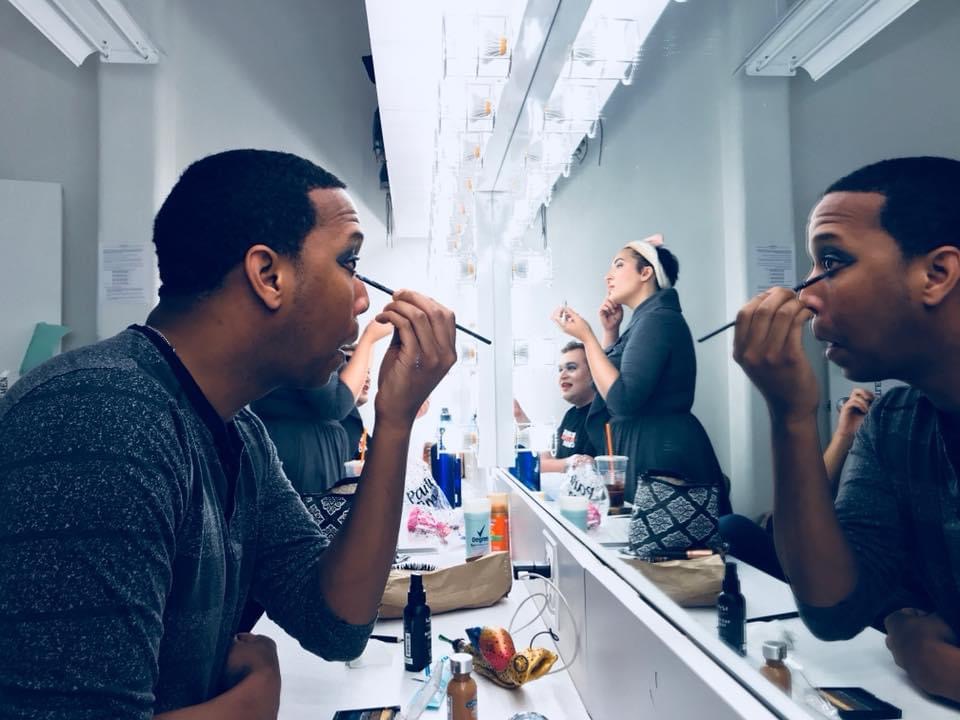
Majid played percussion with the school’s orchestra, and McAlpine sat next to him while they were beating drums outside the University Center Friday afternoons and at gigs in Maryland, D.C., and Virginia with Straight Up Tribal. At UMBC, Majid became convinced that performance and theater could bridge divisions and resolve conflicts.

“That is one of the hallmarks of the institution, how it gives the students the capacity to take charge of their education in a real way,” Majid says.

a man plays the drums
Majid drumming. Photo courtesy of Straight Up Tribal.

Joby Taylor, Ph.D. ’05, language, literacy, and culture, the director of UMBC’s Shriver Peacemakers Fellows Program, taught Majid in his seminar “Building a Culture of Peace,” later becoming Majid’s capstone co-advisor.

“From the very first classes he showed the qualities of intelligence, curiosity, creativity, and passion that have made him such a wonderful interdisciplinary and engaged scholar and social change agent today,” Taylor says. 

“His vision of transforming intercultural conflict through participation in dialogue and creative arts has remained a steady beacon leading him into deeper research and scholarship and leadership experiences of creating spaces of hope—places where theater and musical arts facilitate with reflection and dialogue on new ways of thinking and being that bridge differences and conflicts.”

A Sondheim and Boren scholar at UMBC, Majid studied abroad for two semesters in Morocco, and wrote a play about women’s sexual harassment by young Muslim men and other human rights violations. As part of his undergraduate research project, Majid later staged the play at UMBC. 

a man performs on stage with two women.
Majid performing in Edinburgh, Scotland. Photo by Derek Goldman.

Through his master’s degree in conflict resolution from Georgetown University and a doctorate in anthropology, media, and performance from the University of Manchester, Majid maintained ties to UMBC, even teaching a few classes.

“He brought so much energy to his teaching stint with the global studies program,” says Brigid Starkey, director and senior lecturer of political science. “He is a master storyteller and knows how to involve students in a process of discovery over the course of a semester. Learning is never rote as he looks for global stories in many places that others don’t even think to look.”

Seeking art as a route to equity

During his doctoral studies at University of Manchester, the city’s arena was bombed in May 2017 by a British Muslim man who was killed in the blast along with 22 others. Majid wrote a series of articles interrogating the nation’s response.

Then he jumped into making theater with young British Muslims. He faced suspicion of working with the government’s counterterrorism efforts, the difficulty of making connections in the community, and actors’ hesitancy to perform in public. But with Majid’s guidance, the group developed a radio play, “The Wedding,” about identity, interracial relationships, and sexuality in Muslim communities.

He also played Mowgli as the only person of color in a Liverpool children’s theater December 2017 production of “The Jungle Book” and is writing a book chapter on the experience, tentatively titled “The Manipulation of Mowgli,” for the Routledge Companion to Theater and Young People.

Majid applied for academic positions for a frustrating two years, then became a Mellon/American Council of Learned Societies fellow with the San Francisco Arts Commission. He’s working to ensure grants are awarded racially equitably, and absorbing the complicated dance of public art administration.

“There’s something around the intersection of racial equity plus the arts that gives me a lot of hope,” Majid says. “I have realized…this is public service, something that I’ve been missing. It dates to when I was at UMBC as a Sondheim Scholar. That’s what I got into the university to do, to engage in public service, and here it’s coming full circle.”

*****

Tune in to all the TEDxUMBC speakers on November 8, 2020.

Header image: Headshot of Asif Majid by Marlayna Demond ’11.

Ransomware can interfere with elections and fuel disinformation – basic cybersecurity precautions are key to minimizing the damage

by Richard Forno, UMBC

Government computer systems in Hall County, Georgia, including a voter signature database, were hit by a ransomware attack earlier this fall in the first known ransomware attack on election infrastructure during the 2020 presidential election. Thankfully, county officials reported that the voting process for its citizens was not disrupted.

The attack follows on the heels of a ransomware attack last month on eResearchTechnology, a company that provides software used in clinical trials, including trials for COVID-19 tests, treatments and vaccines. Less than a week after the attack in Georgia was revealed, the FBI warned that cyber criminals have unleashed a wave of ransomware attacks targeting hospital information systems.

Attacks like these underscore the challenges that cybersecurity experts face daily – and which loom over the upcoming election. As a cybersecurity professional and researcher, I can attest that there is no silver bullet for defeating cyber threats like ransomware. Rather, defending against them comes down to the actions of thousands of IT staff and millions of computer users in organizations large and small across the country by embracing and applying the basic good computing practices and IT procedures that have been promoted for years.

What is ransomware?

Ransomware is a form of malicious software, or malware, that typically encrypts a victim’s computer files, holds the files hostage and then demands a payment to send the decryption key that unlocks the files. Individual ransomware payments usually range from a few hundred to a few thousand dollars, with the expectation that a relatively low dollar amount will motivate the victim to quickly pay the attacker to end the incident.

Ransomware attacks frequently begin through email as a typical phishing message purporting to be from someone the potential victim trusts, such as a co-worker or friend. However, emerging types of ransomware exploit existing or recently discovered security vulnerabilities – in other words, they hack in – to gain system access without requiring any user interaction at all.

Once a computer system is compromised, there are many things a ransomware attack can do. But the most common outcome is encrypting a user’s data to hold it for a ransom payment. In other cases, ransomware encrypts a victim’s data and the ransomware’s creator threatens to release personal or sensitive information onto the internet unless the ransom is paid.

Computer screen showing ransomware demand
A typical ransomware attack seizes control of a victim’s computer files and holds them for ransom. So5146/Wikimedia, CC BY-SA

While ransomware attacks can affect any internet user or organization, attackers tend to target entities known for having less-robust cybersecurity defenses, including hospitals, health systems and state or local government computers. But health care remains an enticing ransomware target: In 2019, 759 health care providers in the U.S. were hit. Overall, ransomware attacks cost users and companies over US$7 billion in 2019 as a result of either ransoms paid or through costs incurred in recovering from attacks.

Ransomware’s toll

The first high-profile ransomware incident was launched by North Korea in 2017. Using malware called “Wannacry,” the attackers brought the British National Health Service to a paralyzing halt. Hospitals lost access to their computer systems and routine and emergency care was disrupted. But that was a preview of things to come: In 2020, a patient in Germany died after being diverted to another hospital due to a ransomware incident.

In 2020, during the COVID-19 pandemic, a ransomware attack crippled over 250 medical facilities run by American-based Universal Health Services. At eResearchTechnology, staff conducting COVID-19 clinical trials were locked out of their data and unable to conduct business for nearly two weeks.

And it’s not just health care organizations. The city of Atlanta was crippled by ransomware in 2018. Baltimore was similarly paralyzed in 2019. In both cases, city services – from tax collection and business licensing to real estate transactions – were unavailable to citizens. Numerous smaller cities around the world also have been affected by ransomware attacks.

However, even organizations with good IT policies and procedures find it extremely costly to investigate and recover from ransomware attacks, whether or not they pay the ransom. For example, an organization’s routine data backup can also inadvertently include ransomware code. This means victims need to ensure they are not restoring the ransomware infection when they reconstruct their systems after an attack. Depending on the victim’s backup procedures, locating a ransomware-free backup can be a very time-consuming process.

Ransomware and election 2020

The 2016 elections underscored the importance of ensuring the security and integrity of information related to government operations, including elections. Unfortunately, for many state and local governments, ransomware concerns are just another in a long line of issues that cybersecurity teams must contend with during periods of limited budgets and staffing.

Much has already been written about the vulnerable and fragile state of America’s election systems, ranging from obsolete operating systems installed on voting machines to insecure networks and systems that exchange and store vote tabulations, to ensuring the protection of voter registration databases.

Making this situation more challenging is that many local governments don’t know what’s happening on their networks. A nationwide survey conducted by University of Maryland, Baltimore County researchers in 2016 reported that nearly 30% of local government officials would not know if a cyberattack was affecting them. This lack of awareness means an attack could be well underway and causing havoc before security teams realize it – let alone respond.

voters fill out ballots during early voting in Cleveland, Ohio on October 6, 2020
Voting is vulnerable to cyberattacks at several points, from voter registration rolls to voter signature databases and computers that tabulate votes. AP Photo/Tony Dejak

Despite a growing awareness of the threat, ransomware has the potential to adversely affect the 2020 election. Unfortunately, if state and local election offices haven’t implemented strong cybersecurity protections by now, it’s probably too late to do anything meaningful given that voting is well underway. So it’s no surprise that election offices across America are considering potential nightmare scenarios that include cyberattacks that might disrupt election activities.

Fuel for disinformation

Elections are based on trust – trust in the voting mechanisms and procedures, trust in the voting data and trust in the overall electoral process. But trust in all these items is under active attack by adversaries both at home and from abroad using a variety of influence and disinformation techniques that have become more refined since 2016.

Thankfully, ransomware attacks are unlikely to cripple the entire U.S. election given the decentralized nature of voting jurisdictions and systems. However, even a few successful attacks could contribute to disinformation campaigns that erode confidence in the outcome of the election.

[Expertise in your inbox. Sign up for The Conversation’s newsletter and get expert takes on today’s news, every day.]

How to lower the risk

At this point, since the election is already happening, state and local governments should increase the monitoring of their computer systems and implement even more stringent security controls on any devices or computers that might touch election-related networks in any way. Sharing real-time information about threats and working with the DHS, FBI and Office of the Director of National Intelligence election security teams, along with other states’ election offices, also will help keep election officials informed. Additionally, major technology vendors and the U.S. military are taking active steps to disrupt cybersecurity threats, including ransomware, that may target the electoral process.

A woman walks in front of the Microsoft stand
Microsoft took legal action this month to disrupt a major botnet, a cybercrime digital network that used more than 1 million zombie computers to spread ransomware. AP Photo/Michel Spingler

As with most cybersecurity problems, the ransomware threat can be minimized by implementing common-sense best practices – many of which have been recommended for decades but often are not followed. These include keeping systems up to date, ensuring security software is installed and current, monitoring network activities and implementing appropriate IT policies and procedures to include resilient backup practices. For individual users, thinking before clicking an email link – even from people you know – is excellent self-defense to make many ransomware or phishing attacks less likely to succeed.

None of these practices is specific to the ransomware threat or election security. But for this and other cyber threats, the best thing to do is continuing to implement and enforce those common-sense, decades-old best practices of information protection that can help guard against the ever-widening range of cyberthreats – including ransomware.

Header Image: Ransomware attacks often strike local government computer systems, which poses a challenge for protecting elections. PRImageFactory/iStock via Getty Images

Richard Forno, Senior Lecturer, Cybersecurity & internet researcher, University of Maryland, Baltimore County

This article is republished from The Conversation under a Creative Commons license. Read the original article.

To Save Threatened Plants and Animals, Restore Habitat on Farms, Ranches and Other Working Lands

By Erle C. Ellis, professor, Geography and Environmental Systems, UMBC; Lucas Alejandro Garibaldi, Universidad Nacional de Rio Negro; Claire Kremen, University of British Columbia; and Sandra Díaz, Universidad de Córdoba (Argentina)

The Research Brief is a short take about interesting academic work.

The big idea

Restoring native habitats to at least 20% of the world’s land currently being used by humans for farming, ranching and forestry is necessary to protect biodiversity and slow species loss, according to a newly published study conducted by a team of environmental scientists including us. Our analysis found that this can be done in ways that minimize trade-offs and could even make farms more productive by helping to control pests, enhancing crop pollination and preventing losses of nutrients and water from soil. These working landscapes can still be grazed, mowed, harvested or burned, as long as these activities sustain or restore native species diversity.

So-called “zero-net-loss policies” would prevent any further destruction or conversion of wild lands on developed property. There are creative and experimental options for the most heavily cultivated regions, such as incorporating strips of prairie plants into crop fields across the U.S. Midwest or planting flower strips to restore pollinators in Switzerland.

Only 38% of the 82 countries we reviewed have national laws requiring native habitat on working lands. Most were in Europe and required that just 5% be kept wild. In many countries only forest habitats are regulated, while grasslands and other highly threatened landscapes are ignored. These decisions are driven by politics, economics and cultural values, but overall they lack clear scientific guidelines.

Ranch land with ponds
Through the establishment of a conservation bank on the Sparling Ranch in California, more than 2,000 acres of valuable habitat for tiger salamanders and red-legged frogs will be protected, including 14 breeding ponds, while the Sparling family continues to raise and graze cattle on their land. Steve Rottenborn, USFWS/Flickr

Why it matters

Restoring habitat creates homes for wildlife, but it also contributes to human well-being and supports all life on Earth. Native vegetation prevents erosion and purifies the water we drink and the air we breathe. It sequesters carbon, mitigating climate change, and acts as a buffer against flooding, landslides and storms. The wildlife species that move in may pollinate crops or control pests.

For more than a century, conservationists have worked to save threatened species by protecting them within large national parks and refuges. This clearly hasn’t been enough: The Earth is losing plants and animals at more than 100 times the normal rate, in what some scientists believe is the Earth’s sixth mass extinction event.

Under the 1992 Convention on Biological Diversity, an international treaty ratified by 196 nations, countries have pledged to conserve 17% of the planet’s land area in protected zones by 2020. So far, they have failed to meet that target. Now many conservationists are proposing an expanded effort that would conserve as much as 30% of land by 2030, and as much as half by 2050. Where will all this land come from?

With global land use expanding and becoming more intensive and dominated by monocultures, there is an urgent need to conserve and restore native species outside of protected areas – within landscapes managed for people.

Map of NYC water supply system
Forests in upstate New York protect and filter New York City’s drinking water supply. The forests are managed and monitored to ensure water quality; they also provide habitat for wildlife and recreation opportunities. NYDEC

What’s next

Though the benefits are many and there are numerous successful restoration models to draw upon, wild habitats continue to be degraded, razed and eliminated.

Preventing, stopping and reversing the degradation of ecosystems is also an essential strategy for meeting United Nations Sustainable Development Goals and commitments for the U.N. Decade on Ecosystem Restoration that launches next year.

Critical policy opportunities are just ahead. Europeans are now deciding how much agricultural land to devote to “landscape and habitat features.” New conservation targets will be part of the post-2020 global biodiversity framework negotiated at next spring’s 15th meeting of the Convention on Biological Diversity. Its ambitious global vision is nothing less than “living in harmony with nature” by 2050.

*****

Lucas Alejandro Garibaldi, Professor and Director, Institute for Research in Natural Resources, Agroecology and Rural Development, Universidad Nacional de Rio Negro; Claire Kremen, Professor of Resources, Environment and Sustainability and Professor of Zoology, University of British Columbia; Erle C. Ellis, Professor of Geography and Environmental Systems, University of Maryland, Baltimore County, and Sandra Díaz, Professor of Community and Ecosystem Ecology, Universidad de Córdoba (Argentina)

This article is republished from The Conversation under a Creative Commons license. Read the original article.

Header image: Planting strips of native prairie grasses on a farm in Iowa provides habitat for pollinators and protects soil and water. Omar de Kok-Mercado/Iowa State University, CC BY-ND