All posts by: Magazine Editor


3 Global Conditions⁠—and a Map⁠—for Saving Nature and Using it Wisely

By Erle C. Ellis, professor of geography and environmental systems, UMBC, and James Watson, professor, The University of Queensland

Nature urgently needs our help. Wild creatures, from songbirds to butterflies and from primates to tortoises, are disappearing so rapidly that they could be lost forever together with the wild forests, grasslands and other habitats that long sustained them. We humans already use nearly half of all Earth’s land to sustain ourselves, and the most productive parts at that. Meanwhile, the habitats remaining for the rest of life are shrinking to levels too low to sustain themselves.

To ensure a future in which humanity thrives together with the rest of nature, people around the world will need to work together like never before.

To help make this happen, our team of scientists and conservation experts have developed a new world map highlighting three conditions of landscapes across the planet that will need to be approached differently if we are to succeed in conserving biodiversity globally. These conditions are cities and farms, large wild areas and shared lands.
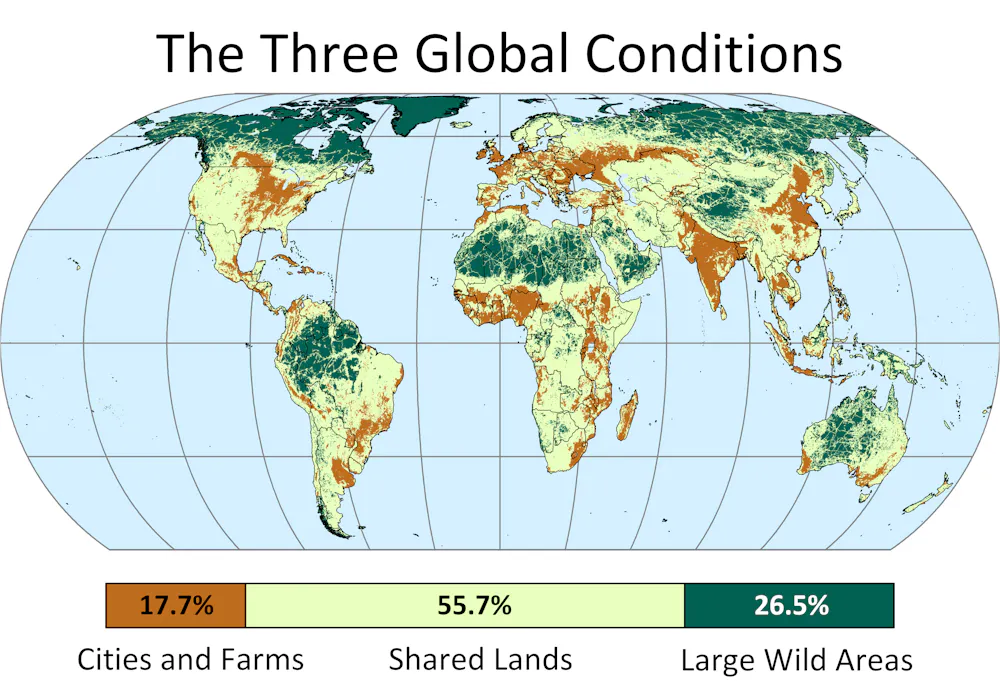
In a commentary accompanying our map, we argue that for too long, efforts to conserve nature globally have acted as if this entire planet is equally influenced by the human world. Yet different landscapes differ profoundly in how they are used and influenced by people, demanding different strategies to conserve biodiversity. Our map aims to clarify these conditions to enable people to work together to conserve biodiversity more fairly and equitably.

Biodiversity is our natural heritage

The extraordinary richness of life we’ve inherited is an irreplaceable treasure that makes the world an immeasurably better place for people. Biodiversity underpins many of the ecological functions that sustain us, from healthy soils to a stable climate, and provides a wide variety of benefits to human health – mental and physical.
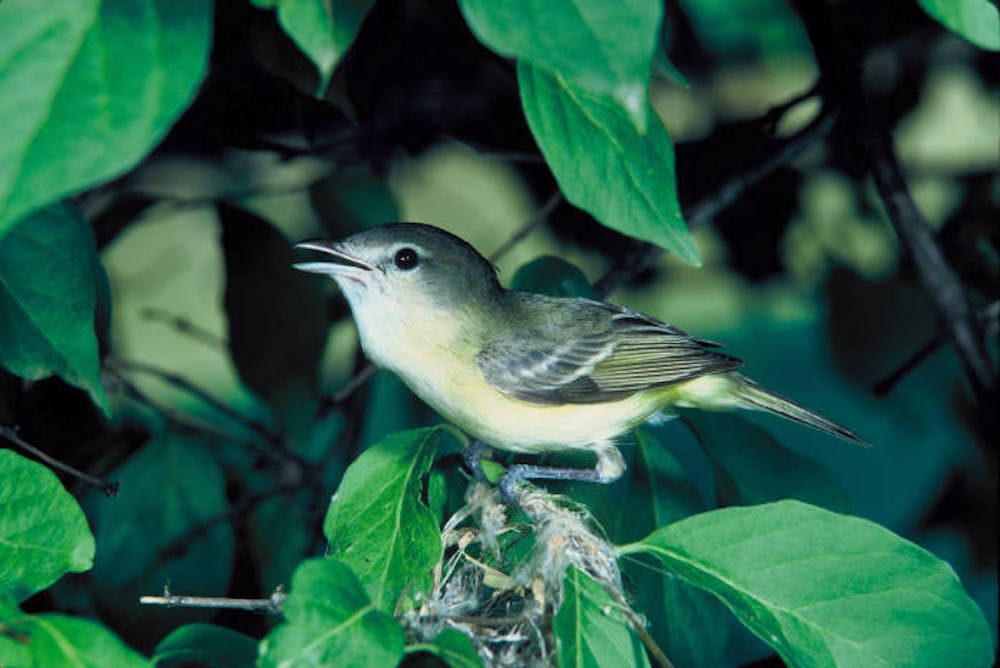
Yet the ultimate value of our biodiverse natural heritage is beyond any economic measure. Wild nature is our lifeblood and our heritage, connecting us with each other and the rest of life on this planet.

The good news is that people have already begun to rise to the challenge. For example, international commitments now aim to protect 17% of Earth’s land. But it is widely agreed that these and other existing conservation efforts are not nearly strong enough to halt nature’s decline.

In October 2020, nations working together through the global Convention on Biological Diversity will meet in Kunming, China to negotiate more ambitious international targets for conserving nature across the planet. One of the bolder proposals is to develop international commitments to officially protect 30% of Earth’s land area by 2030, and 50% by 2050.

But for any bold conservation agenda to succeed, an unprecedented level of international commitment will be needed. Perhaps the greatest obstacle is the many profound differences in social, economic and natural conditions that persist around the world. Some nations remain rich in unprotected biodiversity and wild habitats but are much less developed economically. Some are the opposite.

So how can such different nations and regions join together to make shared commitments and investments to save nature across this entire planet?

Three conditions for conserving nature

The first step is to build a basic consensus that conserving biodiversity can benefit all people, as long we share the efforts fairly at every level, from backyards to biosphere reserves, and across every social, economic and natural context, from the densest of cities to the most remote wild areas. To succeed, strategies need to be suited to the many different types of landscapes to conserve.
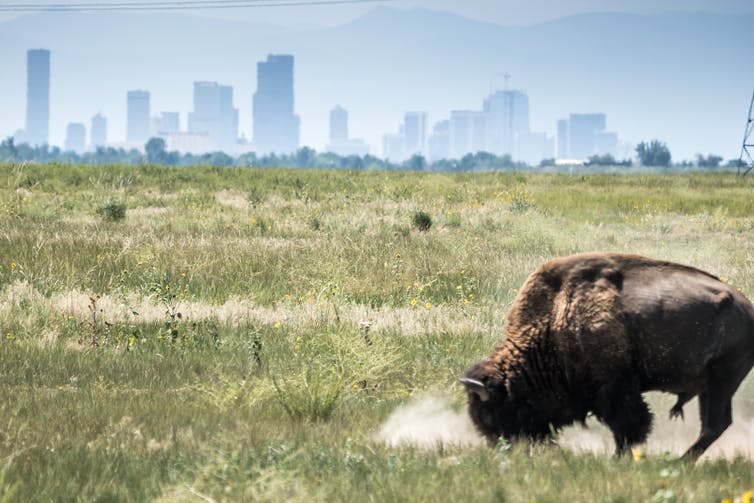
Let’s start with the parts of the world where most of us live and most of our food comes from – the cities and farmlands that take up 18% of Earth’s land surface. These are not just full of people, crops and livestock, but also include some of the densest concentrations of vertebrate diversity on Earth, including many imperiled species of mammals and birds.

In these parts of the world, there needs to be widespread adoption of wildlife-friendly farming practices. Remnant and recovering habitats must be conserved within farmlands and agrichemical production reduced, even while increasing agricultural production. And even in the densest of cities, interconnecting small areas of protected habitat, such as parks and nature reserve networks, can successfully sustain some populations of highly endangered species. In the Indian city of Mumbai, for example, a national park conserves leopards.

Large wild areas, where human influences are lowest, including large parts of Amazonia and Canadian boreal forests, still cover about a quarter of Earth’s land. Here, an emphasis on large-scale protection, such as the Five Great Forests Initiative in Central America, will be the most effective strategy. To avoid damaging the last of Earth’s unaltered ecosystems, new infrastructure and land uses, including mining, should be limited as much as possible. Recognizing indigenous people’s rights to land, so they can conserve their own lands, can also be highly effective; a large proportion of large wild areas are indigenous-owned and managed lands.

Perhaps the greatest conservation opportunities of all may reside within the most common condition of Earth’s land today – shared landscapes. Though parts of these working landscapes are still used intensively for agriculture and settlements, most of their area is composed of remnant and recovering habitats and areas lightly used for extensive grazing and forestry.
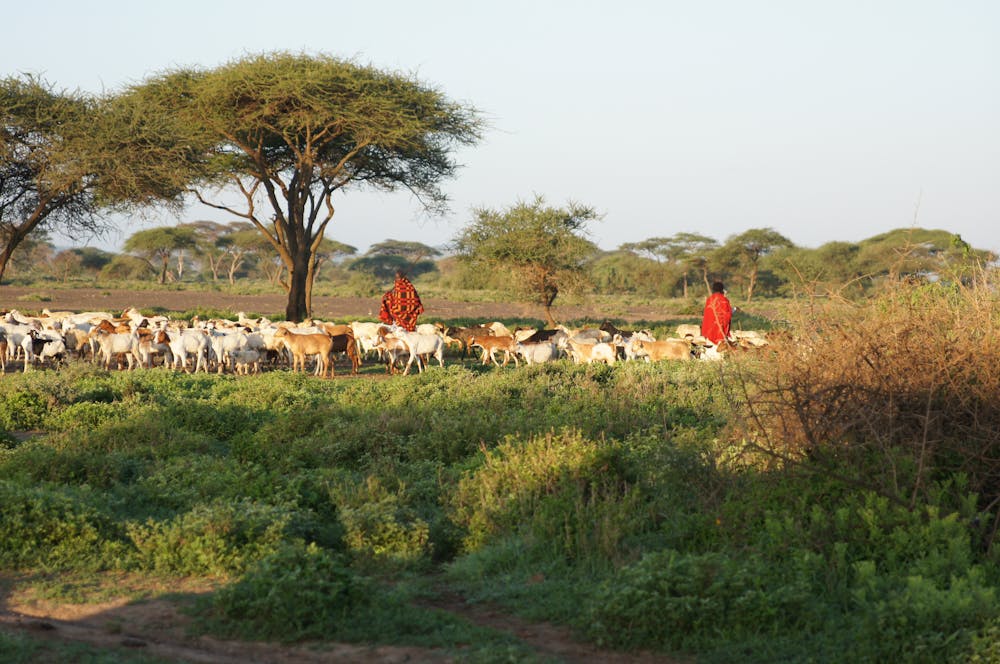
Conservation in shared lands can include regional protected area networks, such as the Yellowstone to Yukon Conservation Initiative, community conservation reserves, and conservation-friendly farms and cities that prioritize the needs of local people. For example, the Lewa community conservancy in Kenya, which protects habitat for endangered black rhinos, includes programs to assist local farmers to maximize their production while minimizing any negative impacts to protected habitats.

Shared lands are also home to almost half of Earth’s indigenous sovereign lands, another reason why expanding and empowering indigenous land sovereignty is considered essential to global efforts to expand conservation.

Doing your part to save nature

Distant wildlands are critical habitat for so many species, but effective conservation also depends on efforts in our own neighborhoods and the regions where our food comes from.

Think of nature when making new friends, caring for family, shopping, working, casting your vote, or donating your time or money to make the world a better place. The challenges ahead are not small, but working together across our farms and cities, shared landscapes, and large wild areas, we can make the nature of our planet whole and healthy again.

*****

Header image: The Snake River in Idaho is an area of ‘critical environmental concern.’ U.S. Bureau of Land Management, CC BY-SA

Contributors to the creation of the Three Conditions map include Harvey Locke of the International Union for Conservation of Nature World Commission on Protected Areas, Oscar Venter of University of Northern British Columbia, Richard Schuster of Carleton University, Keping Ma of the Chinese Academy of Sciences, Xiaoli Shen of the Chinese Academy of Sciences, Stephen Woodley, IUCN World Commission on Protected Areas, Naomi Kingston and Nina Bhola of the UN Environment Programme World Conservation Monitoring Centre, Bernardo B. N. Strassburg of the Pontifícia Universidade Católica and International Institute for Sustainability in Brazil, Axel Paulsch of the Institute for Biodiversity in Regensburg, Germany and Brooke Williams, University of Queensland.

Erle Ellis is a member of the American Association of GeographersThe Conversation. The association is a funding partner of The Conversation US.

Erle C. Ellis, Professor of Geography and Environmental Systems, University of Maryland, Baltimore County and James Watson, Professor, The University of Queensland

This article is republished from The Conversation under a Creative Commons license. Read the original article.


What Is Ashura? How this Shiite Muslim Holiday Inspires Millions

By Noorzehra Zaidi, assistant professor of history, UMBC

Tens of millions of Shiite Muslims from around the world will visit Iraq on Sept. 10 this year to see the shrines of Hussain, grandson of Prophet Mohammed, and his brother Abbas on the day of “Ashura.”

This annual pilgrimage marks the 10th day of Muharram, the first month of the Islamic new year. As the Islamic calendar is a lunar one, the day of Ashura changes from year to year.

Muslims visit the shrines to observe the martyrdom day of Hussain, who was killed in the desert of Karbala in today’s Iraq in A.D. 680. Shiite Muslims believe that Hussain was their third imam – a line of 12 divinely appointed spiritual and political successors.

Muharram may be an ancient festival, but as my research tracing the modern-day impact of Islamic pilgrimage shows, its meaning has changed over the centuries. What was once a commemoration of martyrdom today inspires much more, including social justice work around the globe.

Martyrdom of Hussain

The story of Muharram dates back 13 centuries, to events that followed the death of Prophet Mohammed.

After the prophet’s death in A.D. 632, a dispute emerged over who would inherit the leadership of the Muslim community and the title of caliph, or “deputy of God.” A majority of Muslims backed Abu Bakr, a close companion of the prophet, to become the first caliph. A minority wanted the prophet’s cousin and son-in-law, Ali. Those that supported his claim later came to be called Shiite Muslims.

Even if Ali was not made the caliph, Shiite Muslims would consider Ali their first imam – a leader divinely appointed by God. The title of imam would be passed on to his sons and his descendants.

Political leadership largely remained out of the hands of Shiite Imams. They would not be caliphs, but Shiites came to believe that their imam was the true leader to be followed.

By the time Ali’s second son, Hussain, came to be the third imam, divisions between the caliph and the imam had further deepened.

The Umayyad Mosque in Damascus. Photo by T Foz on Unsplash.

In A.D. 680, during the holy month of Muharram, a caliph of the Umayyad dynasty, Yazīd, ordered Hussain to pledge allegiance to him and his caliphate – a dynasty that ruled the Islamic world from A.D. 661 to 750.

Hussain refused because he believed Yazīd’s rule to be unjust and illegitimate.

His rejection resulted in a massive 10-day standoff at Karbala, in modern-day Iraq, between Umayyad’s large army and Hussain’s small band, which included his half-brother, wives, children, sisters and closest followers.

The Umayyad army cut off food and water for Hussain and his companions. And on the day of Ashura, Hussain was brutally killed. Among the men, only Hussain’s sick son was spared. Women were unveiled – a violation of their honor as the family members of the prophet – and paraded to Damascus, the seat of Umayyad rule.

Passion plays and performances

This history is reenacted throughout the world on the day of Ashura.

In Iraq, millions of pilgrims fill the streets to visit the shrines, chanting poems of lamentation, and witness a reenactment of violence in Karbala and the capture of the women and children.

From New York and London to Hyderabad and Melbourne, thousands take part in Ashura processions carrying replicas of Hussain’s battle standard and following a white horse. This symbolizes Hussain’s riderless horse returning to the camp after his martyrdom.

Persian passion plays known as “taziyeh,” music dramas of the many martyrs and tragedies of Karbala, are performed across Iran and many other countries. Taziyeh performances are meant to evoke deep emotions of grief in the audience.

A powerful set of themes

Numerous historians and anthropologists have explored how communities across time and space have adapted the story of Karbala or the rituals around Ashūrā.

In the 16th century, a vast majority of the population across Persia, or today’s Iran, would be converted to Shiite Muslims. In this region, the passion plays evolved into a popular form of religious and artistic expression.

The character of Zainab, the Prophet Mohammed’s granddaughter, has also come to play a central role in remembrance of the Karbala story.

Scholars have drawn attention to speeches in which Zainab denounced the violence in Karbala and lauded Hussain’s “martyrdom.”

Today, Zainab is seen as a strong female model of resistance.

In the Iranian Revolution in 1979, the story of Karbala became a rallying point for opponents of the shah, who were fighting against the shah’s brutal and oppressive regime. They compared the shah to the caliph Yazīd and argued that ordinary Iranians had to stand up to an oppressor, just like Hussain had.

Zainab’s resistance to oppression helped emphasize the role of women in Islamic society.

Anthropologist Michael Fischer calls this the “Karbala paradigm” – a story that captures a powerful set of themes, including people standing up to the state and fighting for justice and morality.

Inspiring change?

Today the story of Karbala has become a powerful tool of fight for social justice in Muslim communities.

“Who is Hussain?,” a social movement with chapters in over 60 cities worldwide, carries out charitable activities and blood donations in the name of Hussain. Volunteers are encouraged to organize around events that will be meaningful in their communities and will tie into social justice issues that Hussain is believed to have fought for.

In 2018, local volunteers donated tens of thousands of bottles of water in Flint, Michigan in remembrance of Hussain and his companions, who were denied water for three days before they were killed.

As historian Yitzhak Nakash points out, the tragedy of Karbala gives Shiite Muslims a common narrative to pass on to the next generations. And commemorating it in multiple ways is an part of their unique identity.

*****

Feature image: Ashura in Syria. Tasnim News AgencyCC BY-SA.

Noorzehra Zaidi, Assistant Professor of History, University of Maryland, Baltimore County

This article is republished from The Conversation under a Creative Commons license. Read the original article.

World View — Ryan Monroe, M.A. ’84, Ph.D. ’06

By Caitlin James ’01

When asked how the Peace Corps has changed in the past 35 years, Ryan Monroe, M.A. ’84, Ph.D. ’06, reflects thoughtfully. As the current director of programming and training for the Peace Corps in Kyrgyzstan and a returned Peace Corps volunteer who trained rural literacy volunteers in Honduras in the mid-80s, Monroe brings a unique perspective to the question.

He laughs as he recalls that when he was a volunteer in Honduras, he was told only the name of a town, and it was up to him to find a place to live.

“The training is a lot better now than when I was in it [as a volunteer]. It’s really on target and well thought out,” Monroe begins. “Once we decide which village a volunteer is going to work in, multiple people go to train the community, train the families they’ll live with. Selecting the right family, the right house—a lot of careful thought is put into it.”

In addition, Monroe had a license and rode a motorcycle while he was in Honduras—something the Peace Corps now forbids. The more cautious approach has resulted in fewer tragedies involving volunteers, according to Monroe.

Monroe comes to his new post with over 30 years of experience in immigrant education in California and the Washington, D.C., area and three degrees in the field, including two from UMBC: an MA in instructional systems development in bilingual education and a Ph.D. in language, literacy, and culture. His prior administrative posts at the Carlos Rosario International Public Charter School in Washington, D.C.—the first public charter school for adult immigrants in the United States—prepared him particularly well for the job in Kyrgyzstan.

“In Kyrgyzstan, the program is all teaching English, so as a principal at Carlos Rosario, it was all about English instruction, so it’s a very good match,” Monroe says.

When Monroe arrived in Kyrgyzstan last October, one of his first responsibilities was to play a supervisory role in the 11-week pre-service training of about 40 newly-arrived trainees. In addition to managing the logistics of the annual training in Kyrgyz language and culture and English instruction, he also gets to know the trainees, before they officially become “volunteers.” Monroe says he applies what he learned about training design at UMBC when developing training programs in Kyrgyzstan.

As a doctoral student at UMBC, Monroe did qualitative research involving 5th grade Latino students and their families in Prince George’s County, Maryland, focusing on their experiences with standardized testing. He later used his research to create workshops to explain state assessments to parents.

Although Monroe completed his Ph.D. in 2006, Sarah Shin, UMBC associate provost for academic affairs, doesn’t even stop to take a breath when asked to describe Monroe, one of her very first doctoral advisees back when she was an associate professor of education.

“Ryan really approached that whole subject (of testing) very humanistically, looking at it from where the students were,” Shin says. “I learned a lot about the families because his dissertation had to do with really meeting the needs of ESOL students in terms of accommodations and family issues, and I felt like he really brought such richness to the whole topic.”

“As a Peace Corps director you really have to be thinking creatively about a lot of things.
Ryan is perfect for that kind of position, and I think Peace Corps
lucked out in getting him.” — Sarah Shin

Monroe is one of three Americans working with 30 Kyrgyz Peace Corps staff in the capital, Bishkek. He finds the work enriching but challenging—just what he had hoped for as he prepares to retire in four years. And he’s studying Russian with a tutor so he can get around better in Bishkek.

“I live alone and work in English all day, and I think being 60, I’m more forgetful and have to practice the words a lot more than I did learning Spanish,” he explains. “I love writing in Cyrillic, but it’s a very complicated language.”

Another challenge Monroe faces is being a gay man in a post-Soviet country, where it has been like stepping back to a time in the States when the community was underground. “There’s a strong connection to Russia, and Russia is not accepting of the LGBTQ+ community legally and socially,” Monroe says.

Despite all this, Monroe says he is out to the Peace Corps staff and that they are looking forward to meeting his husband, Victor, when he visits Kyrgyzstan for the first time this fall. He also notes that the Peace Corps as an entity and the U.S. Embassy are very supportive of LGBTQ+ rights.

Shin says it’s no stretch of the imagination to envision Monroe having an impact in Kyrgyzstan.

“As a Peace Corps director you really have to be thinking creatively about a lot of things,” Shin says. “He needs to be able to navigate cross cultural global things very well, and Ryan is perfect for that kind of position, and I think Peace Corps lucked out in getting him.”

Images provided by Ryan Monroe. Header image: Monroe, center right, visits with Peace Corps volunteers at a host family’s home.

What Nigerian cities can learn from the rest of the world

By John Rennie Short, professor, School of Public Policy, UMBC

Africa is the world’s most rapidly urbanising region. By 2050 more than one billion people will live in cities across the continent.

Nigeria is Africa’s urban growth giant. In 1950, the West African nation’s urban population was under 375 000 spread across only 99 cities. Now there are close to 100 million people in over 780 cities.

Villages have mushroomed into large towns and small cities have expanded into giant metropolises. The population of Lagos, for example has swelled from under 300 000 in 1950 to over 11 million today. And that is only the official figure. Other estimates put the metro population closer to 21 million.

This rapid rate of urban population growth, fuelled by massive rural to urban migration, has overwhelmed public sector resources. It’s also hampered the private sector’s ability to provide either housing or jobs. As a result urban dwellers build their own accommodation and make their own economic fortunes. Most live in informal housing on the most marginal of lands.

They survive in poor environmental conditions and have limited access to public services like water, sewerage, police security, and fire protection. Infant mortality is high and residents battle with poor physical and mental health.

Informal employment is also precarious, subject to costs imposed by corruption and criminal gangs, often in poor working conditions and with uncertain incomes. Because the informal economy avoids taxation the government has little financial room for urban service provision.

But Nigeria is not the only country in the world that has a rapid urbanisation problem. Informal settlements house almost one billion people around the world. What can Nigeria learn from the experiments of others?

What to do

First, attempts to “eradicate slums”, dislodge communities, and “clean up” cities ultimately fail.

Sadly, these projects continue apace especially where informal communities sit on valuable land or on sites where major development are planned. In my book “The Unequal City: Urban Resurgence, Displacement and the Making of Inequality in Global Cities”, published in 2017, I discuss the negative impacts of slum eradication on cities as varied as Delhi and Manila. There “slum clearance” policies simply displaced people from central areas to distant peripheries often making the communities even more marginal in the process.

We now have better policies that focus on the improvement of existing communities rather than on their eradication.

Second, it is important to change the narrative. In reality, there is no easy distinction between the formal and informal sectors. They are inextricably linked. Describing informal communities as illegal or squatter settlements devalues them.

They are human beings just like everyone else. In fact, the makeshift urbanism of Nigeria, and the one billion people in informal cities around the world, is a testament to their resilience, innovation, sense of community, and positive outlook. They survive with little help from private markets or governments.

These communities represent huge reservoirs of hard work, self-reliance and a practice of sustainability. We need to build on their hard work. One way to do this could be by regularising the ownership of the land in informal settlements. This would provide the security people need to upgrade and improve their homes.

We could also make it easier for street vendors in the informal economy to have safe and secure places to conduct their business. The starting point is a recognition that the people in informal cities are the solution, not the problem.

Third, we should be wary of the big plans fronted by foreign aid donors, international agencies, and central governments. One study of a World Bank slum improvement project in Nigeria found that considerable funds were misdirected or wasted.

Smaller, local initiatives are better. They can involve residents in creating strategies and implementing plans. Policies need to be tailored and crafted for the needs of local communities, with ongoing and effective participation. There are numerous examples of similar schemes in Latin America, which has a longer tradition of rapid informal urbanisation.

Fourth, there is a huge infrastructure deficit in Nigeria’s informal settlements. The informal sector needs to be more effectively linked into the vital circuits of the city: fresh water supply, steady power, and the critical service provision of police, fire and medical services.

In Medellin, Colombia, for example, one strategy was to build efficient transport to link the informal settlements on the hillside to the low-lying central business district. Such schemes more tightly integrate the informal into the formal.

Finally, there is clearly a role for the private sector.

There are already private companies eager to invest in low cost housing. Improvements in technology make housing production much quicker and cheaper. We have the engineering technology to build a cheap, energy efficient, sustainable dwelling in little over two days. All low-income earners need are accessible housing finance mechanisms.

Going forward

A long-term commitment to turning informal settlements into liveable communities involves ensuring security, improving infrastructure, and creating strong links between informal and formal cities.

It also involves a commitment to participatory planning, an openness to policy experimentation, the realisation that one big plan cannot solve it all.

Informal settlements are not a temporary problem. They’re a vital part of global cities. There is no easy solution and no quick fix. We live in an urban world where turning the makeshift and the informal into the liveable and sustainable is our greatest challenge.The Conversation

*****

Header image: The infamous Makoko slum in Lagos, Nigeria. Stefan Magdalinski/Wikimedia Commons

John Rennie Short, Professor, School of Public Policy, University of Maryland, Baltimore County

This article is republished from The Conversation under a Creative Commons license. Read the original article.

Don’t ignore serious nonmilitary threats to US national security

By Richard Forno, assistant director, UMBC Center for Cybersecurity, director, Cybersecurity Graduate Program, UMBC

Almost two decades after thousands died in the attacks of 9/11, there remain many active efforts underway to protect America from international terrorism.

Since 9/11, American domestic and international security policy has been focused on individual terrorists, terrorist groups and rogue countries as the primary threats. The country’s defensive response has been focused on the military and law enforcement capabilities. That’s natural, because the military knows how to shoot, drop and launch things at threats like that. And those dangers still exist.

However, as someone who routinely analyzes threats, vulnerabilities and risks, I see the U.S. again falling prey to a decades-old problem, which the 9/11 Commission termed a “failure of imagination.” That’s when leaders miss important, relevant connections or alternatives to what they’re focused on.

Specifically, there are other, equally, if not more, dangerous risks to American national sovereignty and security, not to mention citizens’ peace of mind that they are able to live and work in a safe and secure society. The economy, climate, transportation and public utilities are all vulnerable to nonmilitary threats. Unfortunately, those weaknesses tend to receive little attention from elected officials – much less any meaningful efforts to solve them. I believe this is because dealing with such concerns isn’t immediately evident, easily profitable, politically expedient or exciting to show on TV.

Borrowing weakness

I see America’s growing indebtedness as a huge economic vulnerability.

The United States government is US$22 trillion in debt, its highest level ever, and $2 trillion more than in 2017. The national debt is expected to rise to just below the amount the entire nation’s economy produces in a single year by 2029.

If an external adversary intentionally caused or worsened U.S. economic problems, the effects in the U.S. and on the global economy could present extremely significant risks to American security, domestic stability and peace of mind.

Many countries invest some of their national treasuries in U.S. debt, such as Treasury bonds or government-backed mortgage securities, because they are viewed as low-risk. However, a country holding large amounts of American national debt might decide to suddenly sell some or all of its bonds, as Russia threatened to do in 2008. Certainly, nations like Japan hold significant amounts of debt, but presumably these countries are not likely to sell it for political leverage. By contrast, Russia or China, who also hold large quantities, may be more inclined to do so, especially during a prolonged trade war.

A bulk sale of American debt would roil U.S. and global financial markets, slow economy grown by raising the costs of borrowing and rattle global investors’ confidence in the stable value of the U.S. dollar.

Photo by Burst from Pexels.

Admittedly, if China or Russia sold significant amounts of their American debt, it would hurt them too. For example, the U.S. dollar likely would weaken, making multinational companies more competitive, and American bond prices would fall, reducing the value of those countries’ remaining holdings.

To put this in perspective, the 2008 financial crisis gave Americans a taste of economic unrest, with job losses, evictions, billions lost in retirement accounts and citizens of all ages forced to reassess their personal financial, career, family or life plans.

Climate threats

In recent years, hurricanes, blizzards, summer storms and flooding have all gotten worse both in the U.S. and around the world. The changing climate is affecting cities and nations, as well as entire industries and supply chains, like food production, transportation and the energy sector.

As climate effects worsen, both in the United States and around the world, flooding and storm damage may drive some people from their homes. Many others may suffer from poor air quality, higher commodity prices, grocery prices or even outright food shortages. Moreover, the consequences of climate incidents, such as flooding, can threaten public health with poor sanitation, diseases and epidemics, and disrupt global supply chains.

Climate change has many marching to have their voice heard. Photo by Bob Blob on Unsplash.

Climate change also affects the U.S. armed forces. Drought, heat, flooding and wildfires are all increasing global worries for the Pentagon. A 2019 Pentagon report found that climate change is affecting military operations, including threatening two-thirds of the 79 critical military bases the report’s authors surveyed.

Beyond creating problems for U.S. military operations, parts of coastal Florida are looking at multi-billion-dollar costs just to build sea walls to protect against rising ocean levels. The city of Honolulu is planning to reduce development near its coastline, in an organized retreat from rising seas. And it’s not just the United States that’s affected by climate change, either.

Deteriorating roads, bridges and buildings

According to a 2017 report from the American Society of Civil Engineers, America’s roads, bridges, railways, levees, air traffic control systems, schools, and power and water distribution networks are in significant disrepair, and have been for years.

None of this damage has been caused by an outside enemy, but rather by neglect on the home front.

Photo by Ricardo Gomez Angel on Unsplash,

It could cost trillions of dollars to fix everything that needs fixing – but money to fix these problems always is in short supply and often diverted to other priorities. Politicians can’t even agree to commit the dollars needed to fix roads and bridges – which means the repairs won’t come anytime soon, and the risks to everyday life and business will worsen.

Looking more broadly at all threats

The United States remains vulnerable not only to foreign terrorist attacks and mass shootings by domestic terrorists, but to many other problems that people may not think of as seriously as they do terrorism. Unfortunately, the “military-industrial complex” that former President Dwight Eisenhower warned about in 1961 continues to dominate U.S. security thinking.

If the United States is to remain a leading world power into the future, it must continue to be economically productive and competitive on the world stage in ways beyond military firepower. Its planning to meet the contingencies described above must embrace a wider perspective that provides citizens and companies alike peace of mind – namely, assuring them a safe, secure and stable future society.

At some crisis point, Americans will be forced to confront the effects of these other vulnerabilities within their lives, families, communities and companies. The solutions to these problems won’t come from more aircraft carriers, fighter jets, airport body scanners and upgraded nuclear weapons. Rather, they will come from objective research, evidence-based planning and investment in long-term projects at home to address these critical problems and ultimately provide lasting security in return.


*****

Header image: Ominous clouds gathering. Photo by Andree Brennan from Pexels.

Richard Forno, Senior Lecturer, Cybersecurity & Internet Researcher, University of Maryland, Baltimore County

This article is republished from The Conversation under a Creative Commons license. Read the original article.
Parents can help kids catch up in reading with a 10-minute daily routine

By Kindel Turner Nash, associate professor, early childhood education, UMBC

Because I conduct research about reading, parents often ask me the same question: “What can I do to help my child become a better reader?”

I always give them the same advice: “Read with your children. Enjoy books together, and whatever you do, don’t worry about teaching them to read. Leave the teaching to the teachers.”

This reply draws on my research regarding the literacy practices of high-performing teachers, as well as my experiences as a parent, teacher and literacy specialist. Ample evidence indicates that a solid foundation of reading, writing, talking and playing with words fosters a love for books at an early age and leads to later success as a reader.

But what happens when children do not learn to read, or when they struggle with reading? That problem is all too prevalent. Only about a third of all eighth-graders can read at or above grade level.

Successful teachers

I have studied how successful teachers at multiple high-performing urban schools in New York, Ohio, Missouri and Maryland that are helping struggling readers dramatically improve their reading fluency. Many are getting children to read passages multiple times.

Teachers and researchers have found that doing this almost always leads to improvements for struggling readers between second grade and the end of high school.

For kids, this strategy is a lot like learning a new song by reading lyrics while singing along with a music video. When children practice reading this way, they listen to and echo a more experienced reader while tracking the print with their eyes and touching the phrases of the book as they read and reread the book together.

By activating the senses of hearing, seeing and touch, this approach makes recognizing familiar words easier and faster, increasing fluency. The strategy works best when it’s repeated regularly – ideally 10-15 minutes per day. Considering the millions of children who don’t read at grade level, it’s very important.

Digging deeper

Psychologist Robert G. Heckelman first identified this method of repeated reading in the 1960s. He encountered an adolescent whose reading level increased by three grades after being tutored using this system. Heckelman repeated the method with 24 middle and high school students who were struggling with reading.

After just 7.5 hours of instruction in what he called Neurological Impress Method, students advanced by an average of two grade levels.

Those findings were later replicated with greater numbers of children, leading to a study published in 2016. In that study, the literacy researchers Chase Young, Timothy Rasinski, and Kathleen Mohr called the method “Read Two Impress.”

This new name reflected a change in the method: Kids had to read each page aloud after their tutors finished reading it to them. In addition to making kids better readers, Read Two Impress also helps them become more confident and spend more time reading.

Empowering families

Yet the Read Two Impress method, until now, has never formally involved a child’s family. Additionally, no studies of this strategy have investigated the impact of using books that reflect student culture and language.

To see if his strategy would be effective as a tool for families to use to improve their children’s reading, I partnered with co-researchers, Joshua Michael and Kris’tina Ackerman. Together, we conducted a study over 10 weeks at a school in a large Northeastern city.

There were some hurdles. For example, the grandmother of a thoughtful and inquisitive child expressed anxiety about her lack of confidence and perceived ability to read. “I’m not much of a reader myself,” she told us during the first training. “I don’t know if I can help my grandchild with reading.”

She, along with 25 second-graders and some of their relatives, participated in five training sessions.

In the final one, the adult participants described how they were teaching this strategy to others. They told us they believed similar opportunities should be broadly available. This in turn prompted us to host an open training for the whole school and a group of teachers-in-training.

This time, the grandmother, once apprehensive, helped facilitate the training. She had gained confidence in her ability to teach this learning strategy to others.

We also found that when families read books that reflected their culture and language, they enjoyed reading together more. In particular, we learned through surveys and focus groups that parents and other guardians took pride in playing a role in helping their kids become better readers.

We will publish the results of the more expansive approach to the strategy, which we call “Read Two Impress Plus,” in an academic journal.

*****

Header image: Photo by Andy Kuzma from Pexels.

UMBC doctoral students Joshua Michael and Kris’tina Ackerman contributed to the study of Read Two Impress and this article.

Kindel Turner Nash, Associate Professor of Early Childhood Education, University of Maryland, Baltimore County

This article is republished from The Conversation under a Creative Commons license. Read the original article.

Surveying archaeologists across the globe reveals deeper and more widespread roots of the human age, the Anthropocene

By Erle C. Ellis, professor of geography and environmental systems, UMBC; Ben Marwick, associate professor of archaeology, University of Washington; Lucas Stephens, research affiliate in archaeology, Max Planck Institute for the Science of Human History; and Nicole Boivin, director of the department of archaeology, Max Planck Institute for the Science of Human History

Examples of how human societies are changing the planet abound – from building roads and houses, clearing forests for agriculture and digging train tunnels, to shrinking the ozone layer, driving species extinct, changing the climate and acidifying the oceans. Human impacts are everywhere. Our societies have changed Earth so much that it’s impossible to reverse many of these effects.

Nuclear bomb testing left its mark in the geologic record.National Nuclear Security Administration/Wikimedia Commons, CC BY

Some researchers believe these changes are so big that they mark the beginning of a new “human age” of Earth history, the Anthropocene epoch. A committee of geologists has now proposed to mark the start of the Anthropocene in the mid-20th century, based on a striking indicator: the widely scattered radioactive dust from nuclear bomb tests in the early 1950s.

But this is not the final word.

Not everyone is sure that today’s industrialized, globalized societies will be around long enough to define a new geological epoch. Perhaps we are just a flash in the pan – an event – rather than a long, enduring epoch.

Others debate the utility of picking a single thin line in Earth’s geological record to mark the start of human impacts in the geological record. Maybe the Anthropocene began at different times in different parts of the world. For example, the first instances of agriculture emerged at different places at different times, and resulted in huge impacts on the environment, through land clearing, habitat losses, extinctions, erosion and carbon emissions, forever changing the global climate.

If there are multiple beginnings, scientists need to answer more complicated questions – like when did agriculture begin to transform landscapes in different parts of the world? This is a tough question because archaeologists tend to focus their research on a limited number of sites and regions and to prioritize locations where agriculture is believed to have appeared earliest. To date, it has proved nearly impossible for archaeologists to put together a global picture of land use changes throughout time.

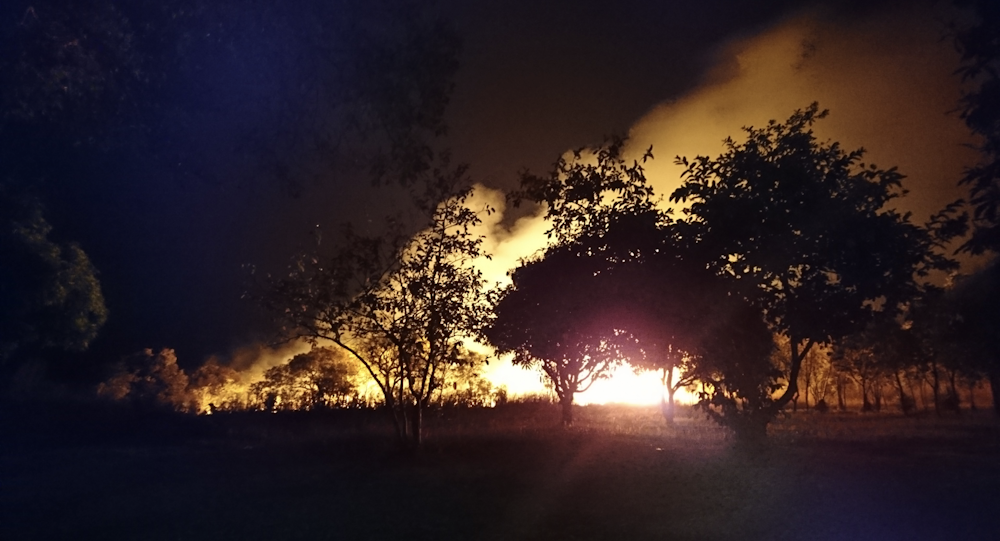
Human practices like burning the landscape – as in this night bush fire outside Kabwe, Zambia – have been affecting the Earth since long before the nuclear era.Andrea Kay, CC BY-SA

Global answers from local experts

To tackle these questions, we pulled together a research collaboration among archaeologists, anthropologists and geographers to survey archaeological knowledge on land use across the planet.

We asked over 1,300 archaeologists from around the world to contribute their knowledge on how ancient people used the land in 146 regions spanning all continents except Antarctica from 10,000 years ago right up to 1850. More than 250 responded, representing the largest expert archaeology crowdsourcing project ever undertaken, though some prior projects have worked with amateur contributions.

Our work has now mapped the current state of archaeological knowledge on land use across the planet, including parts of the world that have rarely been considered in previous studies.

We used a crowdsourcing approach because scholarly publications don’t always include the original data needed to allow global comparisons. Even when these data are shared by archaeologists, they use many different formats from one project to another, making it difficult to combine for large-scale analysis. Our goal from the beginning was to make it easy for anyone to check our work and reuse our data – we’ve put all our research materials online where they can be freely accessed by anyone.

Earlier and more widespread human impacts

Though our study acquired expert archaeological information from across the planet, data were more available in some regions – including Southwest Asia, Europe, northern China, Australia and North America – than in others. This is probably because more archaeologists have worked in these regions than elsewhere, such as parts of Africa, Southeast Asia and South America.

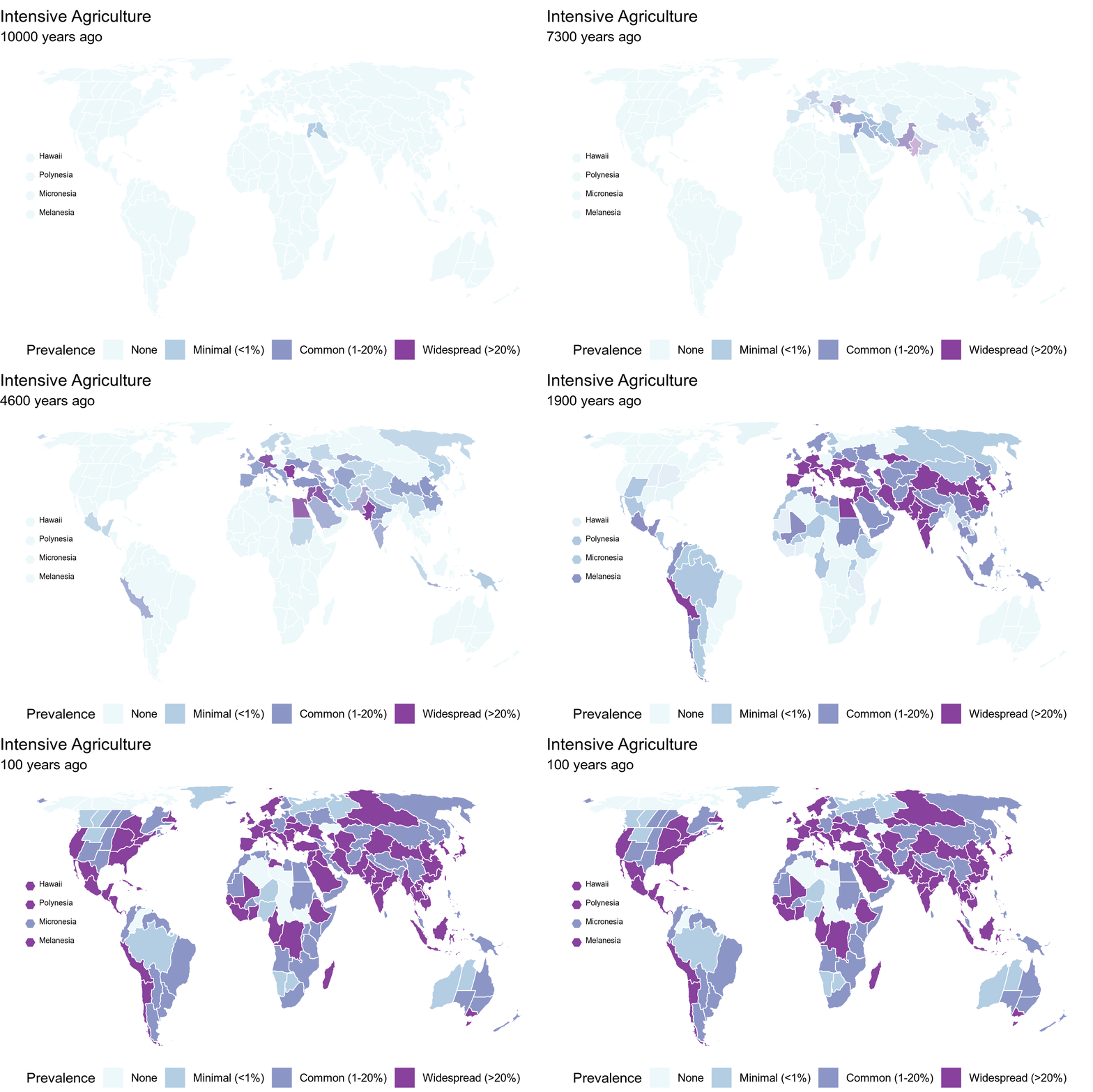
Animation showing the spread of intensive agriculture across the globe over the past 10,000 years, based on ArchaeoGLOBE Project results. (Nicolas Gauthier, 2019, CC-BY-SA)

Our archaeologists reported that nearly half (42%) of our regions had some form of agriculture by 6,000 years ago, highlighting the prevalence of agricultural economies across the globe. Moreover, these results indicate that the onset of agriculture was earlier and more widespread than suggested in the most common global reconstruction of land-use history, the History Database of the Global Environment. This is important because climate scientists often use this database of past conditions to estimate future climate change; according to our research it may be underestimating land-use-associated climate effects.

Our survey also revealed that hunting and foraging was generally replaced by pastoralism (raising animals such as cows and sheep for food and other resources) and agriculture in most places, though there were exceptions. In a few areas, reversals occurred and agriculture did not simply replace foraging but merged with it and coexisted side by side for some time.

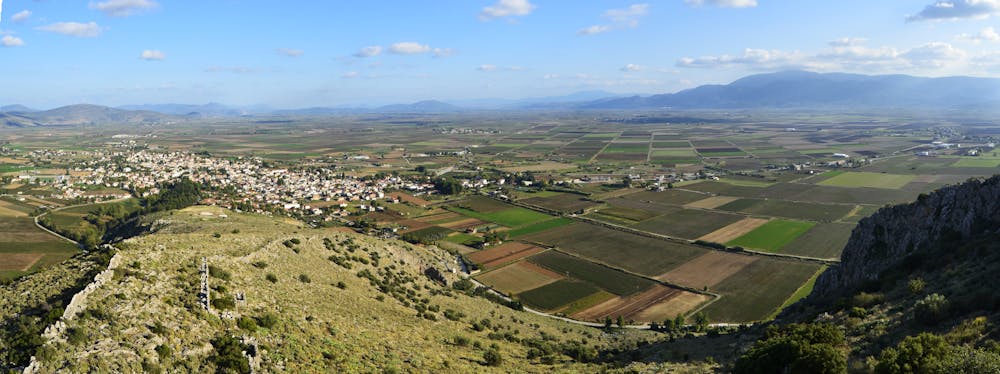
View of the Kopaic Plain in Boeotia, Greece. People first partially drained the area 3,300 years ago to claim land for agriculture and it’s still farmed today.Lucas Stephens, CC BY-SA

The deep roots of the Anthropocene

Global archaeological data show that human transformation of environments began at different times in different regions and accelerated with the emergence of agriculture. Nevertheless, by 3,000 years ago, most of the planet was already transformed by hunter-gatherers, farmers and pastoralists.

To guide this planet toward a better future, we need to understand how we got here. The message from archaeology is clear. It took thousands of years for the pristine planet of long ago to become the human planet of today.

And there is no way to fully understand this human planet without building on the expertise of archaeologists, anthropologists, sociologists and other human scientists. To build a more robust Earth science in the Anthropocene, the human sciences must play as central a role as the natural sciences do today.

*****
Header photo: People have been modifying Earth – as in these rice terraces near Pokhara, Nepal – for millennia. Erle C. EllisCC BY-ND

Erle C. Ellis is a member of the American Association of Geographers.The association is a funding partner of The Conversation US.

Ben Marwick, Associate Professor of Archaeology, University of Washington; Erle C. Ellis, Professor of Geography and Environmental Systems, University of Maryland, Baltimore County; Lucas Stephens, Research Affiliate in Archaeology, Max Planck Institute for the Science of Human History, and Nicole Boivin, Director of the Department of Archaeology, Max Planck Institute for the Science of Human History

Disclosure statement

Ben Marwick receives funding from the Australian Research Council, the Wenner-Gren Foundation, and the National Geographic Society

Erle C. Ellis received funding from the National Science Foundation for this project under grant CNS 1125210. He is a fellow of the Global Land Program, a member of the Anthropocene Working Group of the International Commission on Stratigraphy, and a senior fellow of the Breakthrough Institute. He is a member of the American Association of Geographers.

Lucas Stephens receives funding from the American Council of Learned Societies. He is a Mellon/ACLS Public Fellow and Senior Research Analyst at the Environmental Law and Policy Center and a Research Affiliate at the Max Planck Institute for the Science of Human History.

Nicole Boivin receives funding from the Max Planck Society. She is Director at the Max Planck Institute for the Science of Human History, an Honorary Professor at the University of Queensland, and a Research Affiliate at the Smithsonian Institution and University of Calgary.

This article is republished from The Conversation under a Creative Commons license. Read the original article.

UMBC Waking Up

While you were sleeping, our videographer Corey Jennings ’10 caught some quiet footage of our beautiful campus coming to life!

See more videos of campus life at UMBCtube.

Depth of Field

By Tom Moore

Close your eyes and picture, if you will, something scientific. Perhaps your mind conjures up an image of space exploration, or a melting glacier affected by climate change, or the eyes of a mosquito enlarged by an electron microscope. Whatever you imagined, it was almost certainly influenced by the field of photography, which since its invention in the early 1800s has cast its eye on the world around us, allowing us to see, share, and interpret our surroundings in new ways.

The intersection of photography and science has long intrigued UMBC visiting senior research scholar Marvin Heiferman. “I’ve been fascinated by science photography for years—pictures of microbes too small to be detected by the human eye, of stars or galaxies too distant to be directly experienced, and of processes that unfold too quickly or slowly to be easily perceived,” he says.

In 2016, Heiferman organized a multi-year project, Seeing Science, funded by the Office of Research and the Center for Art, Design, and Visual Culture. He engaged faculty, students, and alumni from across the disciplines (joined by other eminent scholars around the country) to explore how we see science via a series of public and online events, film screenings, an exhibition, and a website designed to spark interdisciplinary dialogue.

Now, Heiferman’s work has culminated in the publication of a book, Seeing Science: How Photography Reveals the Universe, released this spring as a partnership between UMBC and Aperture, a non-profit foundation and publisher dedicated to the advancement of photography. Replete with images from the dawn of photography through the present day, the handsome volume features dozens of essays—on subjects ranging from facial recognition to the discovery of x-rays to science fiction and more—and, of course, hundreds of photographs.

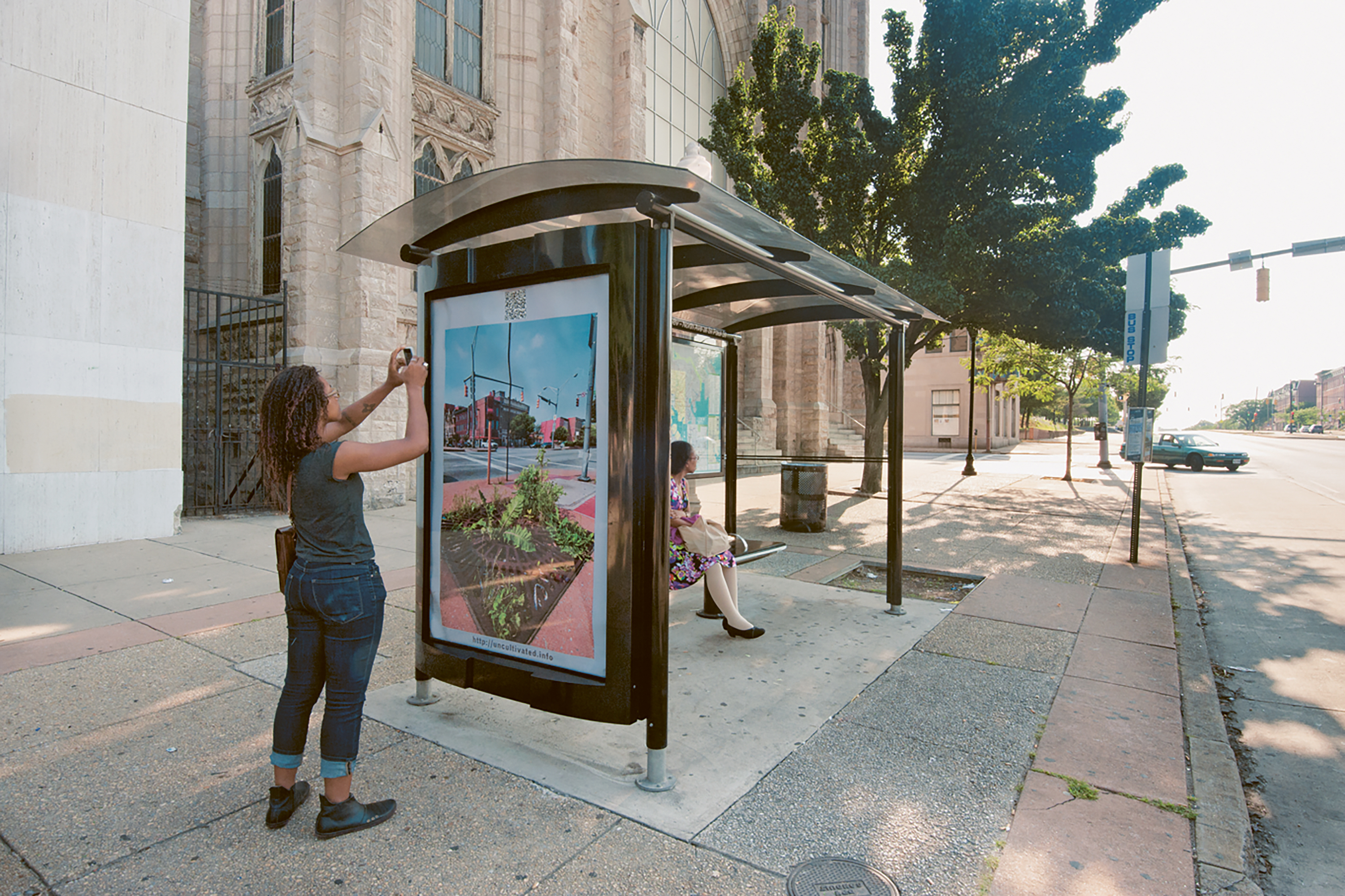
Demonstration of site specific poster for transit shelter, North Avenue, Baltimore, 2011. Art by Lynn Cazabon from the series Uncultivated.

Retired astronaut Scott Kelly, who attended UMBC in the 1980s, provided the book’s foreword, in which he describes his year on the International Space Station, taking photographs of the cosmos, of Earth’s geography, of snowstorms, and of cities illuminated at night.

Two UMBC faculty contributed essays to Seeing Science: Mark Alice Durant, professor of visual arts, writes about “The Wonder of Evidence,” tracing a dance between knowledge and wonder, documentation and astonishment, and fact and fiction; and Joseph Tatarewicz, associate professor of history and director of the human context of science and technology program, penned “Science Fiction and Moving Images,” examining film from the time of Georges Méliès’ famous Le voyage dans la lune (A Trip to the Moon, 1902) to Walt Disney’s Man in Space (1955).

Rebecca Adelman, associate professor of media and communication studies, participated in several online discussions, and her perspectives on images are found throughout the book. Heiferman also explores the photography of Lynn Cazabon, professor of visual arts, and Melissa Penley Cormier, M.F.A. ’17, visual arts, program specialist in visual arts.

“Specialized images have become so ingrained in our everyday lives that we forget how profoundly they’re helping us understand the world around us,” shares Heiferman. “An MRI on an injured knee, a sonogram displayed on a refrigerator door, the facial recognition technology that lets you unlock your smartphone: they’re all are routine examples of the ways we use science photography as an everyday tool.”

Wroclaw, Poland, 2016. From the series Uncultivated by Lynn Cazabon.


*****

Header image: Studio process of Fret & Focus project, a year of documenting worries using microscopic slides, 2016. Art by Melissa Penley Cormier.

Top 10 Reasons to Choose UMBC

So, you’re thinking about becoming a Retriever? Here are 10 reasons why we know you’ll love it here at UMBC. (Twelve, if you count the puppies and squirrels.)

TELL US ABOUT YOURSELF!

#10:  Our Community of Retriever Believers…

Retrievers stick together in and out of the classroom…and long after we graduate. We create together, we build together, and we learn together — and we have a lot of fun together, too. One afternoon you could be playing Humans vs. Zombies and the next cheering on one of UMBC’s 17 Division I sports teams — like the men’s basketball team, which made NCAA history in 2018 by becoming the first No. 16 seed to beat a No. 1 seed. Here you can help save the Earth, experience new cultures, and make discoveries together — all in the same day. And after you graduate, you’ll always be a part of #RetrieverNation.

#9:  ….Who Change the World Every Day

Want to make a lasting mark? Through classes, clubs, internships, and research opportunities, UMBC lets you follow your passion through to practice. You’re also never in it alone. Faculty mentors guide our students at every step, and also know when it’s time for students to take the lead on projects themselves, to take their work over the finish line.  And, with more than 70,000 alumni touching lives through their work every day, you’ll be part of a proud tradition of global and local impact that’s uniquely UMBC.

#8:  Professors Who Know Your Name…

U.S. News and World Report repeatedly recognizes UMBC’s professors for their incredible commitment to teaching. In fact, in 2019, UMBC ranked #8 nationally on its closely-watched list of universities with a “strong commitment to undergraduate teaching,” alongside Princeton, Dartmouth, Brown, and Rice. So, what does that mean for you? It means small classes and plenty of one-on-one time with academic all-stars whose first concern is you.

#7:  …And Take You Beyond the Classroom

Speaking of commitment, that professor-student relationship doesn’t stop when class is over. At UMBC, you’ll find opportunities not only to team up on research and creative projects, but to explore even further through amazing internships. Collaboration between people in different fields results in an experiential, interdisciplinary learning environment. UMBC students are able to be active learners prepared for a multi-dimensional workforce.

#6: A World-Class Education…

Whatever your passion, at UMBC you’ll find a prestigious academic program with a reputation to truly challenge and excite you. Don’t know what you want to study yet? We’re here to help. UMBC’s mentoring and guidance can help you figure it out. Plus, we’re always looking to the future, so you’ll be prepared for grad school or a career — or both! Check out our areas of study.

#5: …For an Amazing Value

There’s a reason UMBC has been selected by Kiplinger’s Personal Finance as a “Best Value” and the Fiske Guide to Colleges as a “Best Buy” year after year. Our students get an amazing value for their dollar, earning a top-notch education while graduating with less debt than students at other universities. Read more about our grad and undergrad rankings.

#4:  Baltimore is an Exciting College Town…

Craving a concert or an amazing meal? How about a ball game? Museums, theaters, performance halls, clubs, restaurants, hiking and biking trails, and professional sports are right around the corner to test your mind, challenge your creativity — and make sure you have plenty of good times. 

#3:  …With Easy Access to a World of Opportunity

Nestled between Baltimore and Washington, D.C., and minutes from airports, trains, and bus routes, UMBC’s beautiful campus is perfectly situated to help you explore your passions. Learn more about our city at baltimorecollegetown.org.

umbc commencement

#2:  Our Impressive Career Network

Not only does the Baltimore/Washington corridor brim with internships and job opportunities, you’ll also find tens of thousands of Retriever alums nearby to help you get a foot in the door. A little grit goes a long way at UMBC.

#1:  UMBC Believes in You

A big part of what makes UMBC different is that we’re truly a community of learners. Whoever you are, whatever your interests, you’ll find friends and professors here who will share your passions and broaden your perspective. You can be yourself — and become your best self — at UMBC. We can’t wait for you to join us!

BONUS REASONS #11 and 12: Our Amazing Wildlife

If you ever drop a French fry while walking between classes, not to worry. One of our trusty campus squirrels will gladly pick it up for you. UMBC’s squirrels are so friendly that many think of them as honorary mascots. But they just can’t compete with the best doggo mascot out there…

Our mascot, True Grit, is a Chesapeake Bay Retriever, one of the smartest, most loyal pups out there. Gritty can be seen dancing with the Pep Band at games and Homecoming, and he’ll always give you a high five when you meet him walking down the street. Need a little luck? Just rub the nose of our True Grit statue in front of the RAC for a little extra Retriever magic – and don’t forget to pose with him on graduation day.

We love you, Gritty!


After Supreme Court Decision, Gerrymandering Fix Is up to Voters

By John Rennie Short, professor, public policy, UMBC

In a 5-4 decision the Supreme Court has ruled that partisan gerrymandering is not unconstitutional.

The majority ruled that gerrymandering is outside the scope and power of the federal courts to adjudicate. The issue is a political one, according to the court, not a legal one.

“Excessive partisanship in districting leads to results that reasonably seem unjust,” wrote Chief Justice John Roberts in the majority decision. “But the fact that such gerrymandering is incompatible with democratic principles does not mean that the solution lies with the federal judiciary.”

So for now, partisan gerrymandering, in which politicians get to choose their voters rather than voters choose their representatives, will remain a fact of American political life.

What is the background to this decision? And what does the decision mean for democracy in the U.S.?

Cracking and packing

State legislatures have the constitutional responsibility to draw up the boundaries of congressional seats after the results of the census, which is conducted every 10 years.

In many states, if one party is in the majority at that time, they can use their power to manipulate the boundaries to their advantage. That’s called partisan gerrymandering, and it involves what’s referred to as “cracking and packing.”

Cracking spreads opposition voters thinly across many districts to dilute their power. Packing concentrates opposition voters in fewer districts to reduce the number of seats they can win.

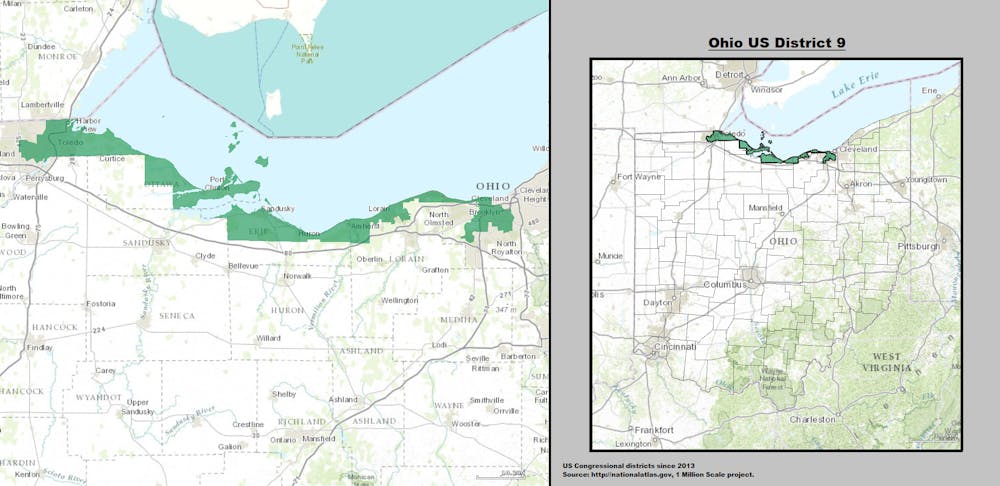
Just one example: In 2012, Republicans in Ohio drew up congressional boundaries that packed most Democratic voters into just four of the 16 congressional districts. The 9th District was referred to as the “snake on the lake” as it slithered along the edge of Lake Erie from Cleveland to Toledo to pack in as many Democratic voters as possible.

The gerrymandered 9th Ohio U.S. Congressional District, known as ‘the snake on the lake.’
US Department of the Interior via Wikipedia 

It worked. In the 2018 election, Ohio Republicans won just 52% of the votes but picked up 11 of 16 of the congressional seats.

I have researched the U.S. voting system, analyzed Supreme Court rulings and shown why gerrymandering is now more prevalent since the 1990s. Sophisticated computer programs and ever more detailed information on voters’ location and preferences now allow politicians to crack and pack with surgical precision.

In 2004, the Supreme Court effectively sanctioned gerrymandering. In Vieth v. Jubelirer, the court ruled 5-4 not to intervene in a case brought by Democrats in Pennsylvania over a redistricting plan they claimed was unconstitutionally gerrymandered.

After the ruling, partisan gerrymandering increased, especially in the redistricting round after the 2010 census.

In 2017, and again in 2018, the Supreme Court passed up opportunities to decide upon the constitutional legality of gerrymandering by effectively punting on the cases.

In other cases, the court actively intervened.

Republican-controlled Shelby County, Alabama filed a case against the constitutionality of the 1965 Voting Rights Act. The act had protected minority voters’ rights in the South from being diluted by gerrymandering and other methods. In the 2013 case Shelby v. Holder, the court overturned key elements of the act, in a 5-4 ruling. The ruling encouraged partisan gerrymandering in the states – Alabama, Georgia, Louisiana, Mississippi, South Carolina and Virginia – previously under federal scrutiny for their legacy of discriminatory voting practices.

Mounting legal challenges

There have been other legal challenges to partisan gerrymandering.

In Virginia a Republican map drawn up in 2011 that packed many African American voters into just 11 of the state’s 100 House of Delegates districts was challenged. A federal judge saw racial gerrymandering at work and ordered a new map. A Republican challenge to that ruling came before the Supreme Court. The Republican challenge was dismissed on June 17, 2019.

The court’s decision in the Virginia case was not about whether the gerrymandering was unconstitutional. Instead, a 5-4 majority of the court ruled that the Virginia Republicans had no legal standing to mount the appeal when the state senate and the state attorney general had decided against appealing. The new map stood.

In Ohio, a three-judge federal panel ruled that the Republicans attempted to cement a Republican majority of congressional seats when they drew up new districts. The state legislature was ordered by the court to draw a new map for the 2020 election.

And in Michigan a panel of federal judges ruled that many of the state’s legislature districts were unconstitutional, drawn up to ensure a partisan advantage. No more snake on the lake.

The Supreme Court set aside these last two lower court rulings on May 24, 2019 in preparation for this recent decision. The two cases are now sent back to lower courts for dismissal. The snake on the lake lives on for another election cycle.

Maryland and North Carolina

Gerrymandering is especially rampant in Maryland and North Carolina. In both states powerful politicians admitted that their plan was to solidify their party’s control.

Republicans in North Carolina drew a map in 2016 to ensure control of 10 of the state’s 13 congressional districts. Democratic voters were overwhelmingly packed into three districts with the remainder cracked across the remaining 10.

Democrats in Maryland drew a map with gyrating boundaries in order to cement their 7-1 advantage in congressional seats.

When lower federal courts struck down these gerrymandered congressional district maps, politicians in both states appealed to the Supreme Court.

Arguments were heard on these cases in March 2019.

From the questioning, it appeared that the liberal justices – Breyer, Ginsburg, Kagan and Sotomayor – would rule against gerrymandering and the more conservative justices – Roberts, Alito, Thomas and Gorsuch and Kavanaugh – were against the court getting involved.

The votes predictably split along the ideological divide.

In the majority opinion, combining the Maryland and North Carolina cases into one decision, the court’s conservative majority noted that existing measures of gerrymandering do not provide precise and judicially discernible standards. The opinion was authored by Chief Justice Roberts, who has long held the opinion that it is impossible to measure, let alone overcome, partisan gerrymandering.

Responding for the liberal minority, Justice Kagan read her dissent in open court – a sign of her intense disagreement with what she saw as the court’s unwillingness to uphold fair and free elections. She wrote that the decision “debased and dishonored our democracy.”

Now what?

Partisan gerrymandering will continue. But so will resistance against it, I believe.

There is a way for states to avoid gerrymandering. Newly formed, nonpartisan redistricting commissions, working outside the influence of the legislature to draw legislative district lines, already exist in Alaska, Arizona, California, Colorado, Idaho, Michigan, Montana and Washington.

These commissions resulted from citizen initiatives to reform the process. But most states east of the Mississippi, for instance, do not have a ballot initiative process that would allow voters to initiate reform.

Gerrymandering has a pernicious impact on the electoral system and on the wider democratic process. It encourages long-term incumbency and a consequent polarization of political discourse.

But now the Supreme Court has made it clear that the solution does not lie with federal judges.

It is up to the voters.

*****

John Rennie Short, professor, School of Public Policy, University of Maryland, Baltimore County

Header image by Claire Anderson on Unsplash.

This article is republished from The Conversation under a Creative Commons license. Read the original article.