All posts by: Magazine Editor


Here’s How to Increase Diversity in STEM at the College Level and Beyond

By Mariano R. Sto. Domingo, Department of Psychology Faculty, UMBC, and Viji Sathy, Teaching Associate Professor, University of North Carolina at Chapel Hill

Jerome Adams is the 20th surgeon general of the United States and former Indiana state health commissioner.

Angelique Johnson is a co-founder and CEO of MEMStim, a company that produces implantable electronics to treat brain disorders.

Isaac Kinde is the chief scientific officer at PapGene, Inc., a company that sells molecular tests meant to detect cancer early. He is also a recognized national expert in molecular cancer diagnostics.

All three graduated from the Meyerhoff Scholars Program. The program was co-founded by Robert Meyerhoff, a Baltimore philanthropist, and University of Maryland, Baltimore County President Freeman Hrabowski in 1988 with the goal of increasing representation of minority students in science, technology, engineering and mathematics programs at UMBC.

Since then, about 1,500 students have gone through the program and pursued careers that range from public health practitioners to entrepreneurs. Many alumni are professors.
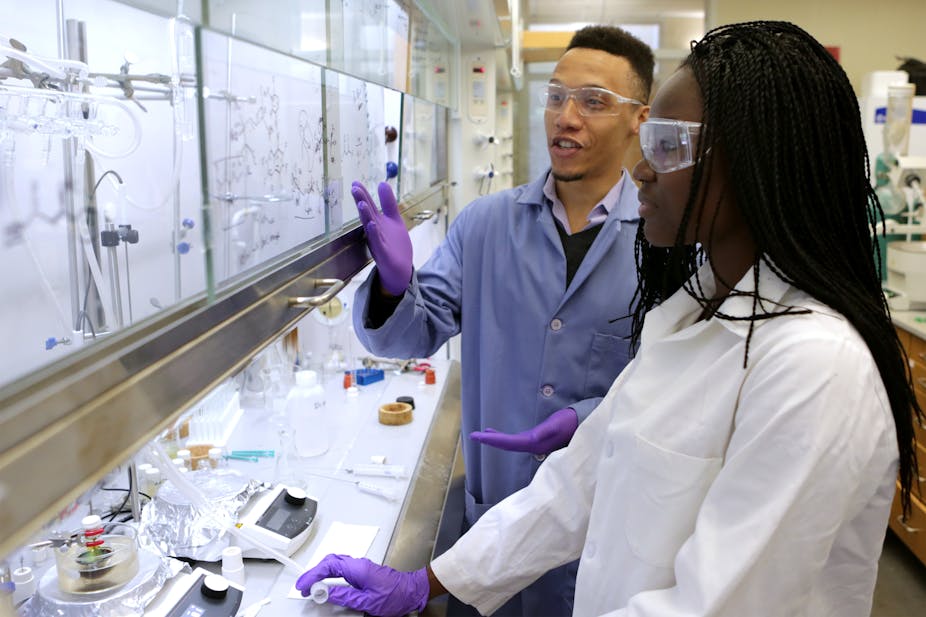
Assistant professor of chemistry Sidney Wilkerson-Hill, left, in a chemistry lab at the University of North Carolina at Chapel Hill, with Bolatito Babatunde, a student in the Chancellor’s Science Scholars program at UNC. Lars Sahl / UNC Chemistry, CC BY

What makes the Meyerhoff work?

The Meyerhoff Scholars program has been called the “gold standard” for providing a path into STEM research for African Americans, Hispanics, and economically disadvantaged white students who are underrepresented in the field. It has also been credited with changing the culture of the campus at UMBC.

Based on the success of the Meyerhoff program at UMBC, we wondered if the program could be successfully replicated on other college campuses, particularly in light of the fact that earlier attempts at other schools did not succeed.

In a study published April 26, we conclude that the answer is: yes. We conducted the study with funding and advisory support from Howard Hughes Medical Institute. We are part of the inter-institutional research team that has tracked the academic performance of the students on our campuses.

Before we get into the details of our findings, first here’s a bit of background on the Meyerhoff Scholars Program and how it works.

Practice for success

For the past 30 years, minority students who are part of the program are coached to sit in the front rows of their classes, raise their hands to ask challenging questions, and stay after class to engage their professors. These cohorts of students attend a summer bridge program before their first semester in college, live on the same residence hall and form study groups. They also volunteer in communities, work in laboratories on campus during the semesters and off-campus during summers throughout college.
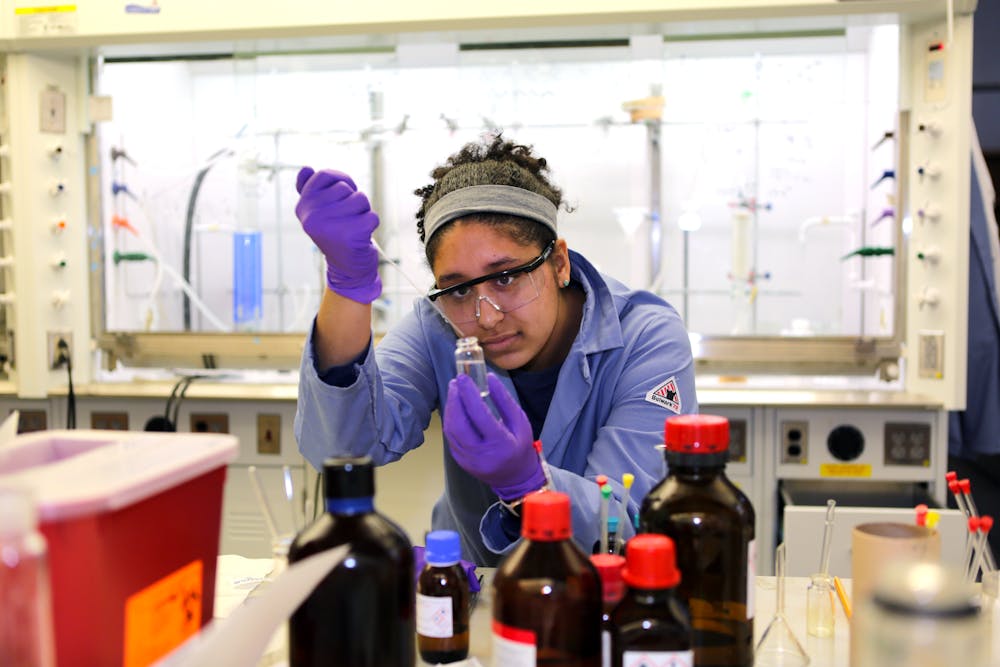
Kristen Gardner, student in the Chancellor’s Science Scholars program at the University of North Carolina at Chapel Hill.Lars Sahl / UNC Chemistry, CC BY

Faculty and campus leaders serve as champions for their success until and after they complete bachelor’s degrees.

The cohort-based program recruits high achieving high school students to work closely and excel together. Critics have said that practice of picking top students is “elitist.” But Hrabowski, the co-founder, has defended the program as being responsive to students who want to earn an advanced STEM degree.

The program includes 13 key program components designed to provide academic, social and professional support to equip students for STEM graduate programs. These components include advising and counseling, tutoring, quality research experience and mentorship.

Payoffs and benefits

Evidence shows that African American Meyerhoff scholars earn higher grades in STEM majors – 0.25 points higher on a 4.0 GPA, to be exact. Evidence also shows that African American Meyerhoff scholars are twice as likely to graduate from STEM majors than similar students. They are also 7.5 times more likely to pursue and complete advanced degrees versus those who decline the scholarship.

UMBC is now the second top producer of black STEM-Ph.D. degree recipients, second only to Howard University, and the number one producer of MD-Ph.D. degree recipients.

Brent Staples, an editorial writer for The New York Times, has noted that the Meyerhoff Scholars Program is “so well known that the university no longer needs to recruit for it.”

“Critics have sometimes accused the Meyerhoff program of cherry-picking bright students who would perform spectacularly well wherever they went to school,” Staples wrote. “But the numbers suggest that the school’s instructional strategy makes a real difference.”

Can the program be replicated?

“Some critics have argued that although the Meyerhoff program is successful at UMBC, its success could not be replicated elsewhere,” Freeman Hrabowski acknowledged in an article he co-authored for Issues in Science and Technology. “They maintain that UMBC is a unique place with a president who is African American and a program champion in a way that cannot be copied. They also claim the program is expensive.”

To put the issue of whether the program could be copied to the test, we looked at two different programs that were patterned after the Meyerhoff Scholars program – the Millennium Scholars program at Penn State University, which began in 2012, and the Chancellor’s Science Scholars program at the University of North Carolina at Chapel Hill, which began in 2013.

Prior to these programs, UNC and Penn State each had between 100 and 200 graduates who went on to earn STEM doctoral degrees but only four to six of the students were African American students. While it’s too early to tell what the outcome will be, preliminary indicators suggest that both programs are on target to surpass early Meyerhoff rates of entry into STEM Ph.D. and MD-Ph.D. programs. For instance, the rate for the first group of Meyerhoff scholars back in 1993 was 10%, whereas the rates for UNC and Penn State in 2017 were 21% and 50%, respectively. The current Meyerhoff rate of entry into STEM Ph.D. and MD-Ph.D. programs is 48% immediately after graduation.

Some may think that the programs got these results by cherry-picking exceptionally talented students. To address this question, we looked at students who were in the programs and compared them to students of similar demographics and academic strength and interest who were not in the programs. The study involved nearly 1,500 students across the three campuses.

We found that students who are part of the programs stayed in their STEM majors at a rate of between 91% and 94%, versus 78% to 80% for non-participants. And program participants earned GPAs of between 3.48 to 3.59, versus 3.15 to 3.22 for those who were not in the program.

Adopting the model

What our findings show is that in order for a Meyerhoff-type program to work, the program can’t be implemented in just any old way. Success requires a full commitment to the entire Meyerhoff model. It also takes training program staff and faculty on how to follow the model fully. Unlike earlier attempts at other schools, UNC and Penn State implemented all aspects of the program.

It also takes money. For instance, the programs at Penn State and North Carolina run off endowments of US$7.1 million and $15.5 million, respectively. Both endowments were created by dedicated fundraising campaigns, much of it going to scholarships to cover the cost of tuition, research and travel experiences for the students.

Finally, there should be a rigorous evaluation of the program that provides ongoing feedback and that tracks the academic performance of program participants.

If more colleges follow the Meyerhoff Scholars Program, it stands to reason that years from now there will be more individuals from diverse backgrounds excelling in STEM careers, much like Jerome Adams, Angelique Johnson and Isaac Kinde are now.

****

Header image: Joshua Brown, an IMSD Meyerhoff Graduate Fellows, works in the lab at UMBC. Photo courtesy of Marlayna Demond ’11.

Editor’s Note: The Conversation has received funding from the Howard Hughes Medical Institute.The Conversation

Mariano R. Sto. Domingo, Assistant Research Scientist, University of Maryland, Baltimore County and Viji Sathy, Program Evaluator, Chancellor’s Science Scholars; Teaching Associate Professor, Dept of Psychology and Neuroscience, University of North Carolina at Chapel Hill

This article is republished from The Conversation under a Creative Commons license. Read the original article.
Duke Ellington’s Melodies Carried his Message of Social Justice

by Michelle R. Scott, Associate Professor of History, UMBC and Earl Brooks, Assistant Professor of English, UMBC

At a moment when there is a longstanding heated debate over how artists and pop culture figures should engage in social activism, the life and career of musical legend Edward Kennedy “Duke” Ellington offers a model of how to do it right.

Ellington was born on April 29, 1899 in Washington, D.C. His tight-knit black middle-class family nurtured his racial pride and shielded him from many of the difficulties of segregation in the nation’s capital. Washington was home to a sizable black middle class, despite prevalent racism. That included the racial riots of 1919’s Red Summer, three months of bloody violence directed at black communities in cities from San Francisco to Chicago and Washington D.C.

Ellington’s development from a D.C. piano prodigy to the world’s elegant and sophisticated “Duke” is well documented. Yet a fusion of art and social activism also marked his more than 56-year career.

Ellington’s battle for social justice was personal. Films like the award-winning “Green Book” only hint at the costs of segregation for black performing artists during the 1950s and 60s.

Duke’s experiences reveal the reality.

Ellington and his Cotton Club Orchestra playing ‘The Mooche,’ 1928.

Cotton Club to Scottsboro Boys

Ellington first rose to fame at Harlem’s “whites only” Cotton Club in the 1920s. There, the only mingling of black and white happened on the piano keyboard itself, as black performers entered through back doors and could not interact with white customers.

Ellington quietly devoted his services to the NAACP and its racial equality activities in the 1930s. Whether it was demanding that black youth have equal entrance rights to segregated dance halls or holding benefit concerts for the Scottsboro Boys, nine black adolescents falsely imprisoned for rape in 1931, Ellington used his growing fame as a prominent band leader for a greater good.

In our literary and historical research on African American entertainment, Ellington’s ability to travel and perform across national boundaries stands out.

After success in Harlem’s night spots, Ellington composed, recorded and appeared in film shorts like 1935’s “Symphony in Black” as himself. He traveled the world with his orchestra, at first performing in the U.K. in the 1930s. Later, Ellington continued to perform on behalf of the U.S. State Department as a “jazz ambassador” in the 1960s and 70s. Audiences in such places as India, Syria, Turkey, Ethiopia and Zambia were given the opportunity to hear and dance to Ellington’s compositions.

However, not even international popularity ensured that hotels would host Ellington’s all-black ensemble during a tour in the U.K. in June 1933. Members scrambled to find boarding homes in London’s Bloomsbury neighborhood when mainstream hotels turned them away on account of their race.

Despite success, racism

Ellington’s 1932 “It Don’t Mean a Thing if It Ain’t Got That Swing” was the soundtrack for the nation’s swing era of the 1930s and 40s. The tune stayed on the Billboard charts for six weeks in 1932 and was inducted into the Grammy Hall of Fame in 2008.

But when Ellington traveled in the South, he still had to hire a private rail car to avoid crowded, poorly maintained “colored only” train seating, or hotels and restaurants that refused service to black Southerners.

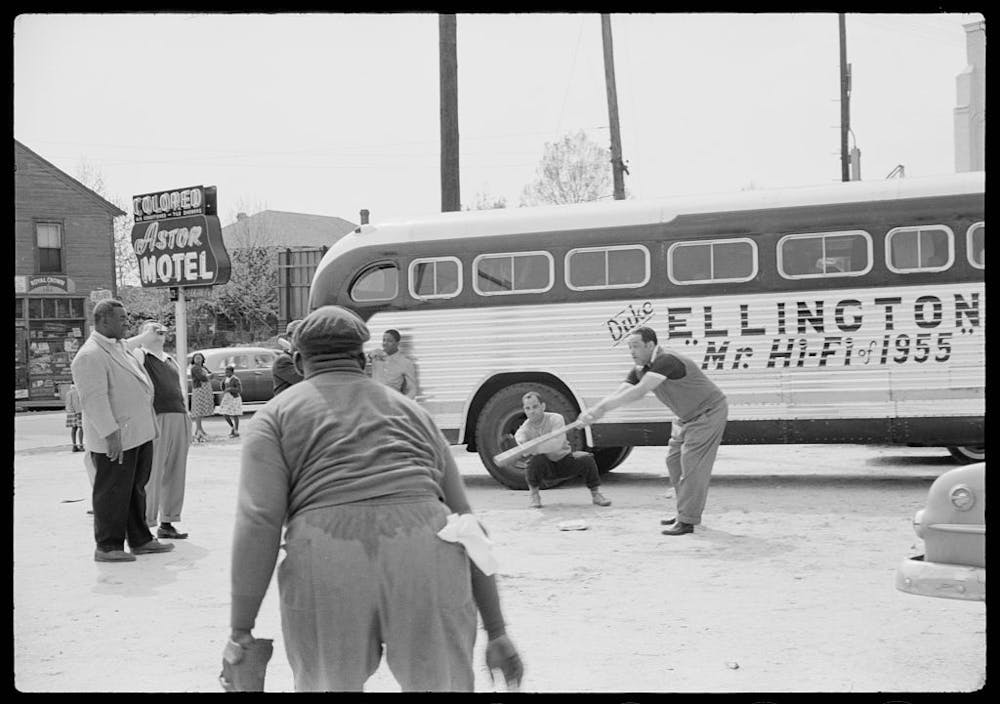
Ellington and band members playing baseball in front of the ‘colored’ only Astor Motel while touring in Florida in 1955.
Library of Congress/Charlotte Brooks photographer

Northern or western engagements in the 1930s and 1940s often proved no better. While there were no “white only” signs on the doors of these hotels or restaurants, establishments enforced segregation by telling black customers to enter through back doors or purchase their meals to go.

Bassist Milt Hinton recalled that Ellington and fellow band leader Count Basie often stayed at black-owned boarding houses rather than risk being thrown out or ignored.

White band managers attempted to protect the black bands they managed from these racist practices, but this still did not prevent Ellington from being denied service in a Salt Lake City hotel’s cafe in the 1940s.

Subtle style

Once the civil rights movement of the 1950s began to fight for racial equality through direct-action techniques like mass protests, boycotts and sit-ins, activists in the early 1950s criticized the older Ellington. His subtle activism style had focused on benefit concerts, and not “in the streets” protests.

But as the movement continued, Ellington included a non-segregation clause in his contracts and refused to play before segregated audiences by 1961. He maintained in an interview in the Baltimore Afro American newspaper that he had always been devoted to “the fight for first class citizenship.”

This was a devotion best seen in his music.

Ellington used his creative musical talents against racist beliefs that African Americans were inferior or unintelligent.

His diverse and wide-ranging catalog of music demanded the kind of serious attention and respect that had previously only been reserved for elite, white composers of classical music.

Songs such as “Black and Tan Fantasy” completely challenged what was then called “jungle music,” a negative term used to reference music inspired by the African diaspora. As a fusion of sacred and secular black culture, both the “Black and Tan Fantasy” composition and film combined the speaking traditions of black preachers with the humor and rhythms of black life.

‘Black and Tan Fantasy’ melded sacred and secular black culture.

Modern black variety shows such as “Wild ‘N Out” and “In Living Color” share a lineage with Ellington’s major stage production of 1941, “Jump for Joy.”

“Jump for Joy” combined comedy skits and music into a revue that featured African American stars of the mid-20th century, including actress, singer and dancer Dorothy Dandridge and poet Langston Hughes.

Ellington claimed that his production “would take Uncle Tom out of the theater and say things that would make the audience think.”

He used his music to showcase black excellence as a resistance tactic against the negative stereotypes of African Americans made popular in American blackface minstrelsy.

Ellington also used “Jump for Joy” to call out those who borrowed from black music without any credit or financial compensation to its creators.

Melody’s other purpose

One of Ellington’s most powerful works is the orchestral piece “Black, Brown and Beige.”

This work shows his ability to infuse the blues into classical music and his commitment to tell the history of black America through song.

From the spirituals developed through the trials of slavery to the fight for civil rights and the modern rhythms of big band swing music, Ellington sought to tell a story about black life that was both beautiful and complex.

For Ellington, melody became message.The Conversation

* * * * *

Michelle R. Scott, Associate Professor of History, University of Maryland, Baltimore County and Earl Brooks, Assistant Professor of English, University of Maryland, Baltimore County

This article is republished from The Conversation under a Creative Commons license. Read the original article.

Header image: Duke Ellington, Paramount Theater, New York, 1946. Library of Congress/William P. Gottlieb photographer

Japan’s next emperor is a modern, multilingual environmentalist

by Constantine Nomikos Vaporis, Professor of History, UMBC

For the first time in 217 years, a Japanese emperor will cede his place on the imperial throne.

On April 30, Japan’s ailing 85-year-old Emperor Akihito will abdicate and be replaced the following day by his 59-year-old son, Crown Prince Naruhito.

Naruhito and his wife, Crown Princess Masako, are a modern couple. Both have studied overseas – he at Oxford University, she in Russia, England and the United States. Born after World War II, Naruhito will be the first Japanese emperor not shaped by the upheaval that war brought to his country.

Many Japanese are hopeful that these younger royals can update Japan’s ancient “Chrysanthemum Throne.” But changing a 14-century-old monarchy to reflect the times will not be easy.

A democracy with an emperor

Japan has the oldest continuous monarchy in the world.

The current emperor, Akihito, is the 125th in a royal line of succession officially founded in the 7th century. According to Japanese legend, however, the Chrysanthemum Throne dates back 2,600 years – to the country’s founding in 660 B.C. by Emperor Jimmu, a descendant of the Shinto sun goddess, Amaterasu.

Emperor Jimmu, of Shinto legend.

Despite their sacred status, Japanese emperors have traditionally reigned but not run the country. For most of its long history, military governments or oligarchs governed Japan in a day-to-day sense.

In 1947, two years after its surrender to Allied forces, Japan became a democracy, with several political parties, parliament and a prime minister. The monarchy also changed profoundly after World War II.

Emperor Hirohito – father of Japan’s current emperor, Akihito – renounced “the false conception that the emperor is divine” in 1946 under pressure from Allied forces. The largely American-written 1947 constitution that followed officially reduced the emperor to a figurehead.

Still, the monarchy continued. And Hirohito remained on the throne until his death at age 88 in 1989.

The people’s emperor

Hirohito’s son, Emperor Akihito has, by most accounts, been a hugely popular monarch – one who put his personal stamp on this institution.

As a young crown prince in U.S.-occupied Japan, Akihito studied the English language and western culture, and his American tutor sought to encourage independence in her young student. Akihito later broke with the Japanese royal tradition of arranged marriages by wedding a commoner, Michiko Shoda, whom he met playing tennis.

Akihito has brought the monarchy closer to the people of Japan in other ways over the last 30 years, too.

He spent more time outside the confines of his palace, interacting with ordinary Japanese, than his aloof father. He and the empress also made official visits to some 35 countries.

After the 2011 earthquake and tsunami that triggered Japan’s Fukushima nuclear crisis, Emperor Akihito made a historic television appearance, urging his people not to give up hope, and visited refugees at an evacuation center.

In a 2016 speech, Akihito indirectly signaled his intention to abdicate, saying that his advanced age and declining health made it difficult for him to carry out his duties.

Resigning on April 30 will be the last modernizing act of Akhito’s 30-year reign.

The crown prince says that as emperor he hopes to emulate his father’s personal touch – to “share the joys and sorrows of the people.”

Controversy over all-male succession

The abdication of a living emperor created a legal problem for Japan, where imperial law defines imperial succession only upon death.

The last Japanese monarch to step down, Emperor Kokaku, did so in 1817 for unknown reasons, and before Japan became a democracy. There is simply no modern precedent for Akihito’s decision.

Amending Japanese imperial law to accommodate abdication would have opened it up to other changes. Specifically, many Japanese legislators and a majority of Japanese people wanted to allow women to inherit the throne.

That would be a big symbolic boost for women in a country where female executives occupy less than 1% of management positions.

Conservative forces in legislature, however, blocked calls to change Japan’s male succession tradition. Rather than amend the imperial law, they simply passed a special law allowing Akihito to step down.

That means Aiko, the daughter of Japan’s soon-to-be emperor and empress cannot succeed her father. Next in line, instead, is Naruhito’s younger brother, 53-year-old Prince Fumihito. Fumihito will be followed by his son, Hisahito.

Emperor Naruhito, the environmentalist

I had occasion to meet Prince Naruhito, Japan’s next emperor in 1990, at an academic conference in Japan.

As a scholar of Japanese history, I spoke about the travels of a prominent samurai in early modern Japan. Naruhito – long a global advocate for clean water – presented his research, conducted at Oxford University, on medieval English water transport.

Naruhito has continued to develop his environmental pursuits since. In 2007, he was appointed honorary president of the United Nations Secretary General’s Advisory Board on Water and Sanitation.

Naruhito’s global civic engagement shows how the crown prince has sought to steer his own course in life.

His wife, Masako, will also be unlike any empress in Japanese history.

The daughter of a diplomat and fluent in several languages, Masako graduated from Harvard in 1985 with a degree in economics, and later studied law at the University of Tokyo. In 1987, she was one of only three women – in a pool of 800 applicants – to pass the entrance exam for the Japanese Ministry of Foreign Affairs.

Nahurito proposed three times before Masako agreed to marry him, in 1993. That decision forced her, reluctantly, to give up her diplomatic career.

The lifestyle change appears to have been difficult for Masako.

As crown princess, she came under intense pressure to produce a male heir. Royal household officials also limited her overseas travel and closely monitored her movements.

In 2001, eight years after their marriage, Masako gave birth – but to a girl, Aiko. Shortly afterward, she vanished from public life. According to her doctors, Masako suffered an “adjustment disorder” – what outside observers might identify as depression.

Prince Naruhito has broken with a royal tradition of discretion in 2004 and spoken publicly about his wife’s struggle to adapt to her constrained new existence.

“There were moves to negate Masako’s career and her personality, which was influenced by that career,” he told reporters in 2004.

Masako began reappearing in public again only in 2014. She has expressed both anxiety and optimism about becoming empress, given the stresses and ceremonial duties of that office.

Naruhito, for his part, says he will work to change how Japan’s royal family operates, updating the imperial household to reflect changing times.

His goal for his reign, he says, is to bring “a fresh breeze” to the Chrysanthemum Throne.

* * * * *The Conversation

Constantine Nomikos Vaporis, Professor of History, University of Maryland, Baltimore County

This article is republished from The Conversation under a Creative Commons license. Read the original article.

Header Image: ID 6838463 © Norman Chan | Dreamstime.com

Notable Retrievers: Jerome Adams ’97

JEROME ADAMS ’97
Biochemistry and Molecular Biology
Notable Achievement: U.S. Surgeon General

Back in the ’90s, Jerome Adams was just a kid watching UMBC basketball games and making sure he never missed Quadmania. Now, he has a bit more on his plate—like being “Top Doctor” for the entire United States.

“UMBC as a school has constantly shown they punch above their weight. There’s nothing we can’t do.”

— Jerome Adams ’97

In 2017, Adams was named Surgeon General, tasked as the leading spokesperson on public health for the federal government and serving as the “Nation’s Doctor.”

Adams credits UMBC with helping him get to where he is today. As a student in the Meyerhoff Scholars Program, he never forgot UMBC President Freeman Hrabowski’s reminder that to whom much is given, much is required.

“UMBC and Dr. Hrabowski and the Meyerhoff Program work together
to inspire folks to be the best that they can be.”

A Quest to Reconstruct Baltimore’s American Indian ‘Reservation’

By Ashley Minner, Lecturer, UMBC

A few years ago, I invited a group of students to go on a short walking tour of the Lumbee Indian community of East Baltimore.

Lumbee are indigenous to North Carolina but have been present in Baltimore since at least as early as the 1930s. My grandparents moved here in 1963 with their three children, one of whom was my mother. I was born here, and that makes me a first-generation Baltimore Lumbee. I grew up to be a community-based visual artist and a folklorist. I’m currently a doctoral candidate at University of Maryland College Park, where I’m finishing my dissertation on the changing relationship of Lumbee people to the neighborhood in Baltimore where they settled.

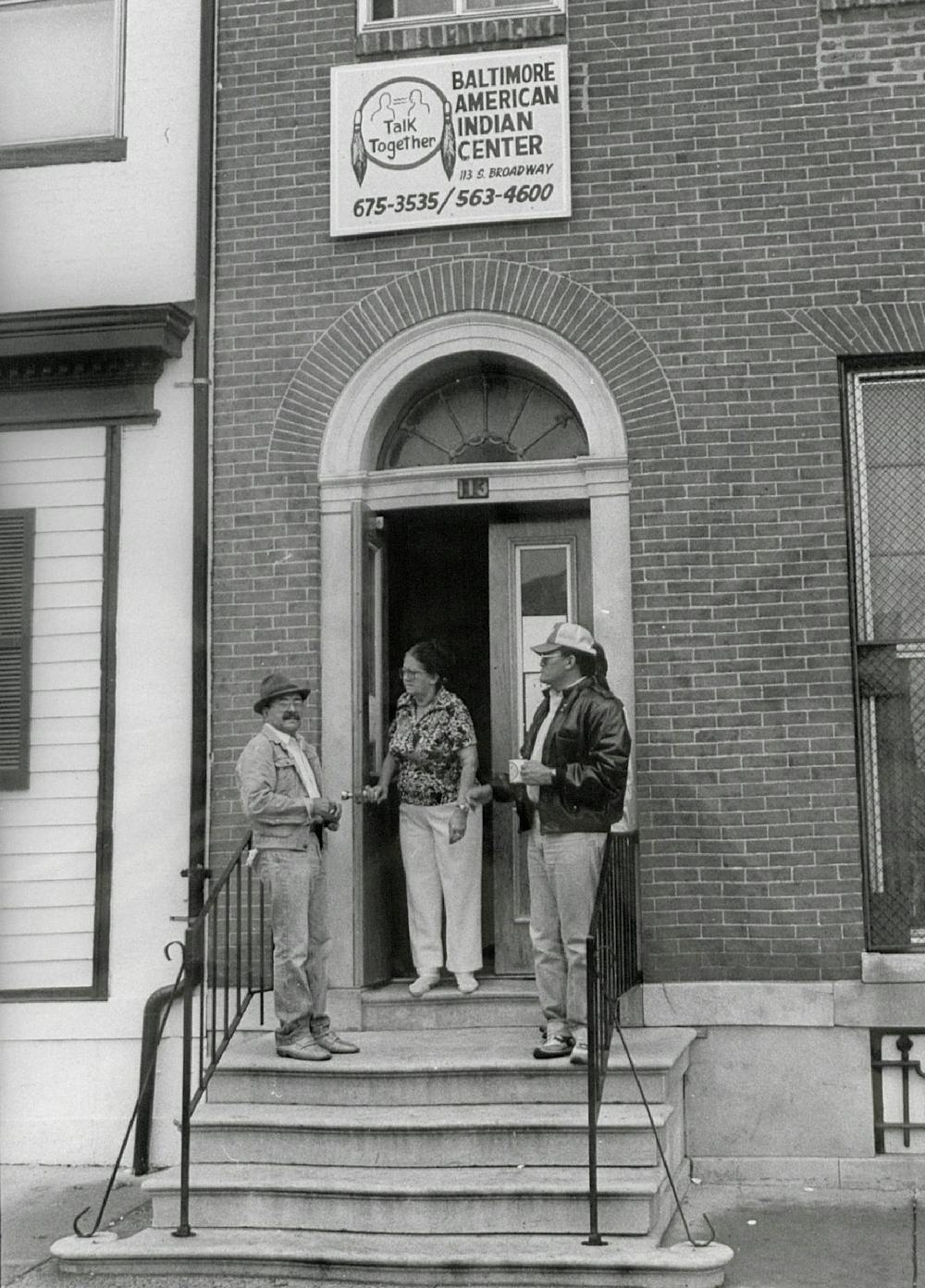
I had given such tours informally many times before, and had developed a familiar route and narrative along the way: South Broadway Baptist Church, the Baltimore American Indian Center, the Vera Shank Daycare and Native American Senior Citizens building.

This particular time, an elder of the community had come along with us. Naturally, I ceded the responsibility of leading the tour to her.

The Baltimore American Indian Center, 113 S. Broadway, is the hub of cultural activities for area Indians.Photo by John Davis, The News American, October 24, 1985. Baltimore News American Photo Archive, Special Collections and University Archives, University of Maryland College Park. Permission granted by the Hearst Corporation, Author provided

We started out on my usual route, but, to my surprise, she stopped us just outside South Broadway Baptist Church to talk about an Indian jewelry store that used to be next door. This was news to me. I didn’t remember the store because it was gone before my time.

I started to wonder: How much more don’t I know about the places and spaces Lumbee people once had here?

Drawing on the memories of our elders, the annals of local newspapers and other archival materials, I am now mapping and reconstructing East Baltimore’s historic Lumbee Indian community.

With the neighborhood being redeveloped and the Lumbee population shifting, I see this as an urgent project of reclamation – of history, of space and of belonging.

The birth of Baltimore’s ‘reservation’

The Lumbee Tribe of North Carolina is the largest tribe east of the Mississippi River, and the ninth-largest in the United States.

Our homeland is in southeastern North Carolina, with members residing primarily in Robeson, Hoke, Cumberland and Scotland counties. We take our name from the Lumbee River that winds through tribal territory, which is mostly rural and otherwise characterized by pines, farmland and swamps.

Following World War II, thousands of Lumbee Indians migrated from North Carolina to Baltimore seeking jobs and a better quality of life. They settled on the east side of town, in an area that bridges the neighborhoods of Upper Fells Point and Washington Hill, 64 blocks mostly comprising brick row houses with marble steps.

To many Lumbee newcomers, the buildings all looked identical. It was a world apart from the farm houses, tobacco barns, fields and swamps of home.

In this urban landscape, Lumbee people stood out – neither looking like the Indians on TV, nor neatly fitting into any of the races or ethnicities already living in Baltimore.

Today, most Baltimoreans would be surprised to learn that the area was once so densely populated by Indians that it was known as “the reservation.” An anthropologist who did fieldwork in the community during its heyday wrote that it was “perhaps the single largest grouping of Indians from the same tribe in an American urban area.”

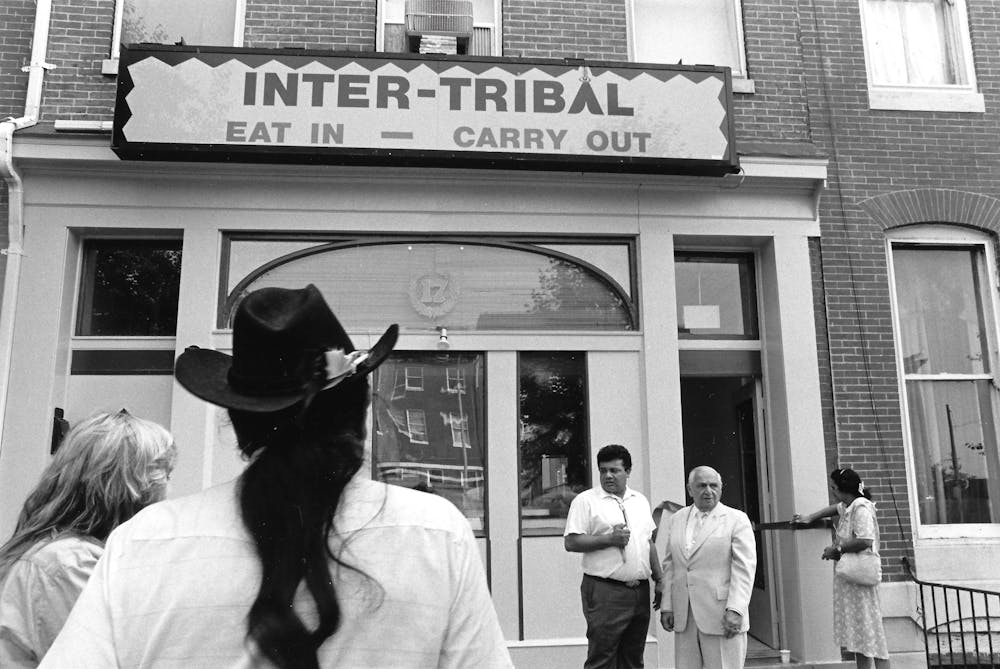
The Inter-Tribal Restaurant was owned and operated by the Baltimore American Indian Center in the unit block of South Broadway.Photo courtesy of the Baltimore American Indian Center, author provided.

The Lumbee community has gradually spread out in years since, so my own generation never experienced “the reservation” as such. But even within our own lifetimes – and especially over the last 15 years – we’ve seen the Lumbee population in the city sharply decline. The majority of our people have moved out to Baltimore County and beyond. Others have returned to North Carolina.

The old neighborhood is now being rapidly redeveloped. Historic buildings have been retrofitted. New luxury apartments abound. With the closure and sale of the former Vera Shank Daycare and Native American Senior Citizens building, the sole real estate that the Baltimore Indian Center owns is the building it occupies. The remaining elders are now in their 70s and 80s.

I know that I have arrived at this work in a crucial moment.

The neighborhood as it once was

In order to learn more about the historic community, I went to the elders first.

I was completely floored by what I learned. I had known about the places I already mentioned, along with a couple of much-fabled bars. But they talked about other restaurants, shops, more churches, more bars, investment properties and even a dance hall that were all Lumbee community-owned or frequented.

Nearly all of the sites described to me by the elders have been repurposed several times since the 1950s, if not demolished and utterly wiped from the landscape. Entire city blocks have disappeared.

How, then, could I even begin to pinpoint where things used to be?

This question prompted a spree of digging and plundering through many local institutional archives in search of clues that would help me reconstruct “the reservation.”

At the downtown branch of the Enoch Pratt Free Library, I was able to leaf through many historic newspaper clippings about the community and the early endeavors of the Baltimore American Indian Center, founded in 1968 as the “American Indian Study Center.” I even held original copies of the American Indian Study Center’s first newsletters, mailed directly from the center to the library.

I got a cartography lesson at the Johns Hopkins University’s Eisenhower Library, which led me to visit the Baltimore City Archives, where I was able to handle original Sanborn maps. These maps provide extremely detailed aerial views of the neighborhood, including footprints of buildings that no longer exist.

The Sanborn Map Company published detailed maps of U.S. cities and towns in the 19th and 20th centuries for fire insurance companies. Since they contain so much detailed information, they’re invaluable resources that show how American cities have changed over many decades.Photo by the author, Baltimore City Archives, Author provided

Later, at the Baltimore City Department of Planning’s Commission for Historical and Architectural Preservation, I was thrilled to find actual street-level photographs of many of the buildings, which, ironically, were documented as a result of urban renewal.

In the Hornbake Library at University of Maryland College Park, I was able to consult several volumes of Polk Baltimore City Directories. I had presumed these were no more than old phone books. Instead, these volumes detail the individuals and businesses that occupied every building in Baltimore, street by street, block by block, in a given year. Not only was I able to confirm addresses of the community sites the elders had described, but in many instances, I was also able to see where they, themselves, had lived.

In his youth, Clyde Oxendine was a boxer and the bouncer at The Volcano, a bar frequented by Lumbee Indians.Photo by C. Cullison, The News American, September 30, 1963. Baltimore News American Photo Archive, Special Collections and University Archives, University of Maryland College Park. Permission granted by the Hearst Corporation, Author provided

The Hornbake Library also houses the Baltimore News American photo archive, where I found portraits of community legends. There were Elizabeth Locklear, Herbert Locklear and Rosie Hunt – all founders of the Center. There was Clyde Oxendine, a boxer and the bouncer of the infamous Volcano, the meanest of mean Indian bars. And in the first folder of unprocessed photos I opened, I found, of all people, Alme Jones, the maternal grandmother of my fiance.

Preserving the past for future generations

So far, we have mapped 27 Lumbee-owned or frequented sites in and around the neighborhood.

After identifying materials from these many far-flung institutional archives, it seems imperative to establish a new collection so that these treasures can live together, alongside personal archival materials that would never have been accessible to an outside researcher. Our community needs easy access to its history.

Naturally, the Baltimore American Indian Center is the prime repository for this new collection. The Special Collections of the Albin O. Kuhn Library at UMBC is another. This amazing, publicly accessible resource already houses the Maryland Folklife Archives and the research of several Maryland folklorists. It will one day house my research as well.

Younger generations of Lumbee people should be able to see and know that our people’s history in Baltimore runs much deeper and wider than it seems.

All cities are steeped in stories. Whether we realize it or not, we are always walking in the footsteps of those who came before.

As Baltimore’s neighborhoods continue to change, its residents would do well to realize that Lumbee people have been here for a long time – and we’re still here.The Conversation

*****

Ashley Minner, Lecturer, Folklorist, University of Maryland, Baltimore County

Header Image: Members of East Baltimore Church of God, which was founded by Lumbee Indians, and was once located in the heart of ‘the reservation,’ in the 1700 block of E. Baltimore Street. Photo courtesy of Rev. Robert E. Dodson Jr., Pastor, East Baltimore Church of God, author provided.

This article is republished from The Conversation under a Creative Commons license. Read the original article.
Pitch Perfect

With five no hitters under her belt, first-year pitcher Courtney Coppersmith spent the semester picking off batters and picking up accolades—including several firsts for UMBC.

By Zach Seidel ’12, M.S. ’15

Flashback to April, and the UMBC Softball team’s bout against Norfolk State. The crowd roared and then began laughing out of astonishment: Coppersmith ’22, biochemistry and molecular biology, had just hit a tie-breaking (and eventual game-winning), two-out, two-strike grand slam in the bottom of the sixth (out of the seven innings in a collegiate softball game).

This hit was her first career home run, but more impressively, it happened just three days after she pitched the second perfect game in program history.

Her teammates and fans couldn’t stop shaking their heads and smiling because every time the lefthander from York, Pennsylvania, stepped on the field, it seemed like she was either breaking another record or coming up clutch.

Coppersmith helped lead UMBC to its first-ever America East championship and first appearance in the NCAA Tournament since 2002—despite the fact that the Retrievers were picked to finish last in the preseason coaches’ poll. In addition to being named UMBC Softball’s first-ever All-American, she was also the first person in America East history to be named both Pitcher of the Year and Rookie of the Year in the same season. And the list goes on.

Coppersmith rounds the bases. Photo courtesy of Gail Burton.

The Retrievers entered the America East tournament in Hartford, Connecticut. as the No. 4 seed, and had to face the hosts, No. 5 Hartford, in the first round of the double-elimination tournament. Coppersmith threw an 11-strikeout no-hitter, and then followed that up the following day by throwing another no-hitter, this time against the regular season champion No. 1 UMass Lowell. She then helped lead UMBC to a pair of victories over Stony Brook to clinch the championship. Coppersmith went 4 – 0 while allowing just two runs in 28 innings pitched, a 0.50 ERA on only eight hits, and 33 strikeouts en route to being named the tournament’s Most Outstanding Player.

The previous UMBC record for strikeouts in a single game was 13, set over a decade ago. Coppersmith has already reached or surpassed that total in a game seven times this season. She absolutely shattered the record in one of the best performances in the nation this season: a 17 strikeout, no walk, one-hit masterpiece in a 1 – 0 win at UNC Wilmington, in which she scored the only run of the game on offense for UMBC. She then one-upped that with a 17 strikeout no-hitter in a 7 – 0 win over conference rival Maine.

No one has more fun on the diamond than Coppersmith, who can be seen dancing to the music in between pitches. She’s top three in the country in strikeouts (a school single-season record 346) and near the top in strikeouts per game (10.16). We sat down with the thrower of a nasty “rise ball”—and aspiring future pharmacist—for a Q&A.

Zach Seidel: You were obviously recruited to play at multiple schools, so what made UMBC your top choice?

Courtney Coppersmith: They say it’s like a wedding dress, you know it when you see it and then you cry. When I visited campus I knew it was the perfect fit. (I didn’t cry, though.) Academics are very important to me, and it’s a very good academic school. UMBC offered me a sense of community. It offers a lot programs and academic opportunities on top of being an athlete.

Seidel: You want to be a pharmacist, correct? Why is that?

Coppersmith: I like helping people and pharmacists provide medicine to people to help them do that. If I don’t end up doing that, I do want to do research and help create drugs that can cure cancer and help treat various diseases.

Seidel: What feels better for you: acing a chemistry test or striking out a batter?

Coppersmith: Acing a chemistry test. A hundred percent acing a chemistry test!

Seidel: What is the coolest thing about striking someone out?

Coppersmith: The best part is when you fall behind 3-0, and then you throw two strikes that they don’t swing at and then you get them to chase the rise ball anyway. Or, I’ll throw a low rise ball right into the edge of the zone [for a called third strike] and they’ll just look at the umpire; that’s also very amusing to watch.

Seidel: Do you prefer striking batters out swinging or looking?

Coppersmith: Oh, that’s a tough one because I get a lot of my strikeouts swinging, but I guess I like them equally. It’s really funny to watch them when they think it’s not going to be a strike and it’s a strike, but also really funny to watch them swing at a ball that’s over their head, because in no way is that going to be a strike, and they still swing at it anyway!”

Seidel: What’s your walkout song and why?

Coppersmith: For my normal walkout, I use the song “Wild Thing” from the movie Major League for the simple reason that it is one of mine and my dad’s favorite movies, and it is such an important moment in that movie. For my second walkout, it is the Little Einsteins trap remix. While it may sound super childish, I really enjoy the remix and the hype that it brings my teammates, myself, and even the other team.

Seidel:  What’s the Retriever fan support like?

Coppersmith: Retriever fans are one of the major parts to the game; while we still go out and do our jobs, either way, fans only bring even more support to us as we are out there playing our game.

Seidel: If you could strike out anybody in the world, who would it be?

Coppersmith: Heck, I would love to be able to strikeout Coach [Chris] Kuhlmeyer. He always talks a lot of smack, and I know that he doesn’t think I could strike him out, so that would be a cherry on top of the ice cream!

Coppersmith mid wind-up. Photo courtesy of Ian Feldmann.

All-Star Stats

Coppersmith helped lead UMBC Softball to its first-ever America East championship. During the same season, she also became:

  • UMBC Softball’s first-ever All-American (Softball America Honorable Mention)
  • The first person in America East history to be named both Pitcher of the Year and Rookie of the Year in the same season
  • UMBC’s first Louisville Slugger/NFCA Division 1 National Pitcher of the Week
  • The first in America East Conference history to sweep the weekly awards in the same week as she was named as the Player, Pitcher, and Rookie of the Week (April 9)
  • The first member of the America East Conference to be included as a member in the 2019 Schutt Sports/NFCA Freshman of the Year Top 25, an award honoring the top freshmen in the entire nation
  • The ECAC (an organization of 87 Division 1 institutions) Rookie of the Year and made the All-ECAC First Team twice, as a pitcher and a designated player (only player to make first team at two separate positions)


****

Header image courtesy of Ian Feldmann, The Retriever.

Q&A: Grollman ’07 to Speak at 2019 URCAD

Next week, UMBC’s campus will burst with the excitement of discovery as more than 250 students from across all disciplines present their work at the annual Undergraduate Research and Creative Achievement Day (URCAD) (April 24). In addition to a day filled with performances, discussions, and poster sessions, the event will include a keynote by former undergraduate researcher Eric Grollman ’07, sociology and psychology, an associate professor of sociology at the University of Richmond. In preparation for the big day, we asked Grollman to talk about their experiences with undergraduate research at UMBC, and life beyond the loop.

We understand that you’re an assistant professor of sociology at the University of Richmond. Can you tell us a little bit about what your research and teaching entail?

I am a newly-tenured associate professor of sociology at the University of Richmond (UR), where I have worked now for six years. Though I did not know much about UR or the city of Richmond before interviewing for the position, one of the biggest draws for me was moving close to home (southern Maryland). Another was the close relationships that UR faculty develop with their students through teaching, mentorship, research, and advocacy – dynamics that I remember fondly of my own undergraduate studies at UMBC.

I have less hair on my head and more gray in my beard than I did 12 years ago as a senior completing my honors thesis in sociology at UMBC. But, my work as a scholar-activist – which first emerged at UMBC – remains consistent. I continue to use research as a vehicle for advocating for social justice. My research examines the impact of prejudice and discrimination on the health, well-being, and worldviews of oppressed groups, particularly those at the intersections of multiple systems of oppression (e.g., women of color). I continue to do work in LGBTQ studies, though now with a deeper focus on the lives of transgender and non-binary individuals – work that spurred my efforts to create Sociologists for Trans Justice to use sociological insights to advance public understanding of trans issues.

There is, however, one area of scholarship and advocacy that is new: academic justice. My latest project is an anthology entitled Counternarratives from Women of Color Academics: Bravery, Vulnerability, and Resistance, about which I and a few contributors will be speaking at UMBC on Wednesday, April 17 (5 p.m. in the Albin O. Kuhn Library). This project is a product of a blog I founded and edited for four and a half years called ConditionallyAccepted.com, now a weekly career advice column on Inside Higher Ed for marginalized academics. That is, I’ve turned my critical scholarly lens back on higher education itself to challenge the pervasive practices of sexual harassment, discrimination, microaggressions, and tokenizing that occur in academia. In related work, I examine the limits of acceptance of marginalized populations – that is, the conditions we must meet in order for the dominant group to consider us acceptable (e.g., “professionalism,” and activist approaches that effectively do nothing to challenge the status quo).

Were there any particular mentors at UMBC who helped you along the way?

Retired sociology professors Dr. Ilsa Lottes and Dr. Fred L. Pincus were two faculty mentors who were most instrumental in teaching me how to use research to make a difference in the world. Dr. Pincus and Dr. Lottes worked with me to turn my LGBTQ campus activism (i.e., the push to create the “Rainbow Center” at UMBC for LGBTQ students) into research and, in turn, to use empirical findings from my thesis research as evidence for the need for such a campus center.

Additionally, I was pleasantly surprised to find other professors who supported me in my scholar-activist pursuits. Dr. Jodi Kelber-Kaye, Dr. Carole McCann, Elizabeth M. Salisbury, and other GWST faculty provided guidance in employing feminist theories and principles in my own advocacy. Dr. Michelle Scott particularly stands out in introducing me to Black feminist thought and the history of Black women’s activism in the U.S., which laid the groundwork for my intersectional politics.

I also found mentorship and support for my scholar-activism outside of the classroom context, namely in Student Affairs and Residential Life. Jennifer Dress, Candace Martinez-Doane, Erin Hundley-Carter, David Hoffman, Lisa Gray, Darci Graves, Dr. Patty Perillo, Dr. Lee Hawthorne Calizo, Erin Stampp, and Matt Soldner were the other half of my huge team of mentors at UMBC. (You may not recognize some of these names, as amazing people are often called to share their gifts with students at other universities.) They showed me that the academic and student affairs sides of a university are most effective for a student’s development when they work together – not as independent divisions. The incredible impact they had (and still have) on my life led me to seriously consider pursuing a career in student affairs. I ultimately continued in sociology, but I am quite active in campus life now as a professor at UR.

Tell us about your URCAD experience and how it may have shaped your future research in graduate school and beyond.

I received an Undergraduate Research Award to conduct a survey on UMBC students’ attitudes toward lesbian women and gay men – the focus of my honors thesis. The following year, I presented my findings at URCAD, and subsequently published my final thesis in the UMBC Review. Shortly into graduate school, Dr. Lottes and I expanded my thesis research, subsequently publishing an article in the International Journal of Sexual Health. Altogether, these opportunities were the beginnings of my career as a researcher. I entered my Ph.D. studies with research experience already under my belt, and with my first article already published and the second shortly soon after. I humbly admit that I am very productive as a researcher, and my URCAD experiences were fundamental in propelling me into a successful research career.

Why do you believe it’s so important to celebrate and support undergraduate research?

Teaching college students how to think is a core part of the mission of any college. So, too, is knowledge-production in the form of scholarly research. For the most part, research is thought to be part of what faculty do outside of their teaching responsibilities. But, students must be involved in research activities, as well.

For students, producing – not merely consuming – academic knowledge deepens the college experience. One learns so much more by doing. Student researchers can see the full research process, from conception to publication – things they may only learn about abstractly in a methods course. Student-researchers gain so much more when they are invested in the outcomes of a given study, feeling a sense of ownership. Even if academia or other research-oriented careers are not in a student’s future, she will get more out of her undergraduate studies by experiencing research first-hand.

For science in general, we all stand to benefit when a new generation of scholars begins conducting research that challenges existing ways of doing things. Today’s college students have views on gender, race, sexuality, social justice, activism, the environment, and so forth that are uniquely expansive and fluid. We, as a society, cannot afford to wait any longer for their views on the world to change the direction of scholarship. And, we lose out when students who do not pursue research careers decide not to conduct research during college.

What advice would you give to students who are interested in being a part of URCAD?

I highly recommend URCAD, especially for students majoring in fields outside of STEM (e.g., the social sciences, humanities, arts, education). If you’re even slightly interested, go for it!

Independent research can be time-consuming, but it will be rewarding. So, I recommend pursuing a topic of study about which you are passionate. As exhausting as research is, and as long as it takes to complete, you run the risk of feeling burnt out or even bored with your topic (at least temporarily). These risks are much lower if you are actually invested in the subject. Avoid picking a topic that you feel will appease your professors, or parents, or friends, or grad school admissions committees. Studying something that reflects your passions will make it easier to articulate why others should care. Do not confuse rigorous, dare I even say “objective,” research with not caring about the subject; if you do not care about it, then it will be harder to convince others to care.

“We all stand to benefit when a new generation of scholars begins
conducting research that challenges existing ways of doing things.”

As you work, I recommend staying organized and setting firm deadlines to complete tasks. You will be shifting from hard deadlines imposed by professors in your classes to having no firm structure as an independent researcher. I recommend self-imposing a timeline so that you are not left panicked with too much to do as the year ends. That timetable should account for other personal and academic demands in your life. Talk through your proposed timeline with your research mentors, and be open to making changes as necessary. And, you might find creating an accountability group with fellow student-researchers useful – meeting weekly, biweekly, or monthly to check in on your progress and workshop through challenges that have come up during your research.

I suggest that you aim to do your research thoughtfully and carefully so that you could do further research with it in the future; don’t think of your work as a finite project that is completed within a year. Though you’re “just an undergrad,” you can get one or even multiple publications out of your research!  (I did.)

As a novice researcher, it may prove difficult channeling personal interests and passions into research. You many not feel that you know enough about the field to effectively pinpoint research that has not already been done. So, selecting an advisor who knows the field and knows you (as a student and a whole person) is crucial. Expertise is only half of what makes a great research mentor. The other half is guidance that fits with what you need and your goals.

I would suggest that it is ideal to actually start making connections with professors outside of the classroom before you begin independent research. Chat with them before or after class. Visit them during office hours. Communicate via email. Let your professors know who you are, why you are studying your major field, what your career goals are, and what you are getting out of their class(es). This will help them become invested in your undergraduate studies, or at least have more information about your aspirations. This strategy will also let you see that a given professor isn’t invested (enough) and/or isn’t available (enough) and probably is a poor fit for you.

You might also ask fellow students or even recent graduates about their experiences working with a particular faculty member. Again, brilliance does not translate into effective mentoring or even good teaching (there is actual research on this!). The mentor one student loves may not be as useful for another student; so, take others’ experiences with a grain of salt. When asking if a professor will serve as your research mentor, you might even have a frank conversation about what you need and want in a mentor and ask them what they can offer to you as a mentor.

I found it was best to have multiple mentors, even if only one or two are officially recognized as your mentors. No one person knows everything, nor can they offer you everything. Some mentors may be stronger at offering emotional support, others at teaching you a new method, and still others at writing and publishing. I recommend avoiding the common pitfall of relying on a single mentor for everything.

Without giving everything away, can you give us a taste of what you’ll be talking about as this year’s URCAD Alumni Keynote Speaker?

I’ve been advised not to give a boring speech about tips for student-researchers. So, I’ll probably talk about myself – my journey as a scholar-activist. That’s about as far as I’ve gotten in my planning!

* * * * *

UMBC’s 23rd annual Undergraduate Research and Creative Achievement Day (URCAD) will be held on Wednesday, April 24, at locations around campus. Grollman’s keynote will take place from noon to 1 p.m. in University Center 312. Visit urcad.umbc.edu for the full schedule.

Photos provided by Eric Grollman.


April 15 Is the Day Tobacco Companies Pay $9 Billion for Tobacco Illnesses, but Is It Enough?

By Charles Betley, Senior Policy Analyst, UMBC

Cigarettes have been known for years to cause many diseases. Tobacco companies now have to pay $9 billion each year to help states pay for the costs of treatment to people they sickened.

April 15 is Tax Day in the U.S., and it is a bitter pill for many.

For state Medicaid plans, though, which pay a heavy price for tobacco-related illnesses, it can be a shot in the arm of sorts. April 15 is also the day when the five largest tobacco companies pay US$9 billion dollars to state governments, each and every year, forever, because of a 1998 legal settlement meant to compensate states for the costs of tobacco-related illness such as cancer, emphysema and heart disease. Actual payments made by the tobacco companies vary year to year because of adjustment factors written into the settlement; each of the states’ payments varies as well.

Payments from tobacco companies, as well as tobacco taxes, help to support health care and other services for low-income people served by state Medicaid programs. Even though the federal government supports each state’s Medicaid program by paying at least half the costs, many states have difficulty finding revenues to pay the remaining share.

Determining how much tobacco use costs states’ Medicaid programs puts the payments from tobacco companies into perspective. One estimate found 15% of nationwide Medicaid costs were caused by tobacco use. But such estimates based on national surveys may not account for which tobacco-related diseases are most prevalent in a particular state. How many of the state’s Medicaid participants smoke, and how hospitals and doctors are paid, also affect a state’s Medicaid costs.

The Center for Mississippi Health Policy was interested in estimating the actual costs to Mississippi Medicaid for treating tobacco-related disease. The center wanted a price tag that more accurately reflected the health-related behaviors of people in Mississippi and health care services available in the state. Our team of researchers from The Hilltop Institute at the University of Maryland, Baltimore County (UMBC) conducted the study. We think our study is the first to focus on Medicaid costs using actual state Medicaid data.

Getting a truer picture

Instead of applying estimates of total costs of smoking from national surveys to individual states as previous studies have done, our research assessed how specific, individual smoking-related illnesses create costs for Mississippi. This lets the state better understand how much it differs from nationwide averages for both its total Medicaid costs and the sources of those costs.

First, we reviewed medical literature for studies that identified how tobacco use or exposure changes the risk of acquiring a particular illness. Many studies of how much smoking increases the risk of getting particular diseases have been conducted since the U.S. surgeon general first reported on the health hazards of smoking in 1964. In 2014, the surgeon general summarized many of these studies in a 50th anniversary report.

Some of the diseases we studied, such as prostate cancer, may have many causes in addition to tobacco use. Others, such as lung cancer, are almost always caused by tobacco. Once we found a number specifying how much smoking increased the risk for contracting each disease, we multiplied those risk scores by the percentage of people in Mississippi Medicaid who smoked. That enabled us to estimate what percentage of Mississippi Medicaid spending for each of these diseases was smoking-related. The Mississippi Medicaid program gave us data to determine the cost of each service paid to treat each person with the specific diagnosis.

We then adjusted this initial estimate for other factors that were not captured in the Medicaid payment data. We added adjusted costs for prescription drugs that could be used to treat smoking-related conditions. In addition, many Medicaid participants are in nursing homes because of diseases acquired from smoking. So we added the costs of nursing home stays based on residents’ diagnoses and the same risk scores.

Tobacco use can also affect the health of nonsmokers exposed to second-hand smoke. Mississippi had estimated the costs of second-hand smoke using national estimates. We updated those numbers based on relative risk of tobacco-related diseases we found in the more recent data.

An expensive set of illnesses

In total, we estimated that the cost of tobacco-related illness to Mississippi Medicaid was $388 million in 2016 and $396 million in 2017. This made up about 9% of Mississippi’s annual spending on Medicaid. Our estimates were somewhat lower than the national cost estimates of 15%. We believe this is because Mississippi Medicaid covers large numbers of children and younger adults – a tobacco-related disease may appear only after many years of smoking.

Many Mississippi Medicaid participants may still be too young to be diagnosed with tobacco-related illnesses. Furthermore, our estimates only included diseases with measures of increased risks because of smoking that are presented in the medical literature or the 2014 surgeon general’s report. So, our estimates are relatively conservative.

We believe our study results will help policymakers in Mississippi assess the benefits of policies affecting tobacco. These could include increasing tobacco cessation services, raising the minimum age for buying tobacco products, raising taxes on tobacco products and requiring smoke-free public places. Our approach to estimating costs could also be used by other states to conduct their own analyses of tobacco-related costs to Medicaid to inform their policy choices.

****

Charles Betley, Senior Policy Analyst, University of Maryland, Baltimore County

This article is republished from The Conversation under a Creative Commons license. Read the original article.
Header image courtesy of Public Domain Pictures from Pexels. 

The Conversation

New York Gets Serious about Traffic with the First Citywide US Congestion Pricing Plan

By John Rennie Short, Professor, School of Public Policy, UMBC

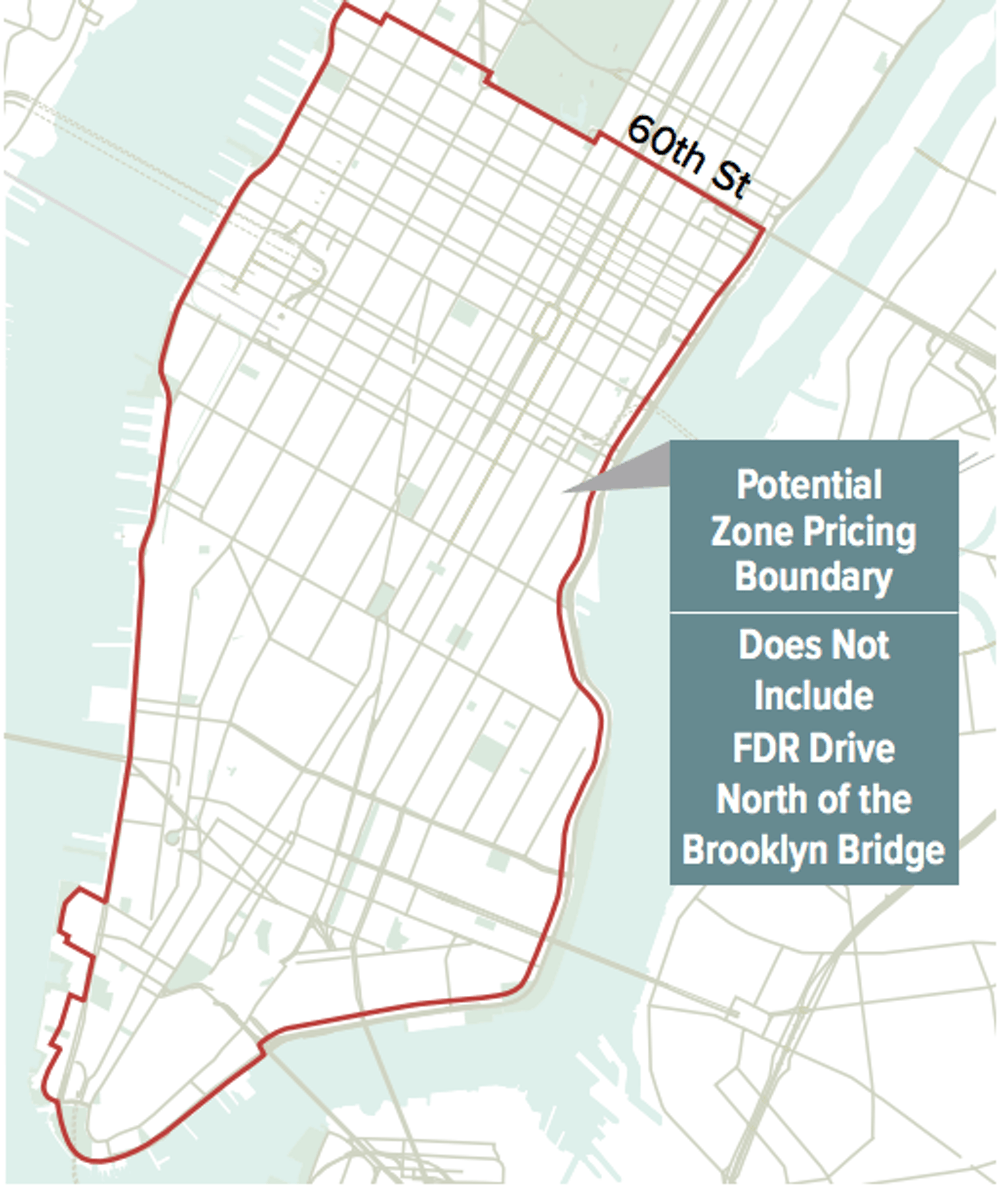
After years of debate, New York state has adopted congestion pricing to deal with traffic problems in New York City. Starting in 2021, fees will be imposed on all vehicles entering a pricing zone that covers lower Manhattan, from 60th Street at the southern edge of Central Park to the southernmost tip of the island.

This approach has succeeded in cities including London, Singapore and Stockholm. For scholars like me who focus on urban issues, New York’s decision is welcome news. Properly used, congestion pricing can make crowded cities safer, cleaner and easier for drivers, cyclists and pedestrians to navigate.

The details matter, including the size and timing of charges and the area that they cover. Congestion charges also raises equity issues, since rich people are best able to move closer to work or change their schedules to avoid the steepest costs.

The downside of density

The proposed New York City congestion pricing zone. Fix NYC via Streetsblog, CC BY-ND

But growing concentration also imposes costs, and one of the largest is traffic congestion. Drivers spend valuable time sitting idly in traffic jams, while noise, accidents and pollution impose heavy burdens on city residents.Cities concentrate people close together for good economic reasons. Clustering activities allows transfers of information, knowledge and skills. At their best, cities create deep pools of labor and large markets of consumers, and make it possible to provide public goods such as mass transit and trash collection efficiently. Planners should be encouraging cities to become bigger and more dense if we want to improve economic performance.

But growing concentration also imposes costs, and one of the largest is traffic congestion. Drivers spend valuable time sitting idly in traffic jams, while noiseaccidents and pollution impose heavy burdens on city residents.

Should road use be free?

The idea of charging for use of public roads is not new. Economist Arthur Pigou discussed the issue as early as 1920 as part of his attempt to remedy the suboptimal workings of the market system. In 1963 Canadian-born economist William Vickrey argued that roads were scarce resources that should be valued by imposing costs on users.

Consumers intuitively understand differential pricing. We expect to pay more for airline tickets at peak travel times and for hotel rooms at popular times of the year. Congestion pricing also forces users to think about the cost of making a trip, and thus to evaluate their travel patterns.

A cyclist’s perspective on traffic in lower Manhattan, filmed in 2018. 


And it can be effective. A 2008 study gave drivers in Seattle a hypothetical cash sum to spend on trips, charged them tolls linked to traffic congestion levels, and let them keep money they did not spend. Their cars were fitted with equipment to monitor driving patterns.

The results: Travelers altered their schedules, took different routes or collapsed multiple trips into single journeys. Collectively, these changes reduced congestion at peak time, lessened wait times and increased average travel speeds in the study’s regional traffic model.

Success in Europe and Asia

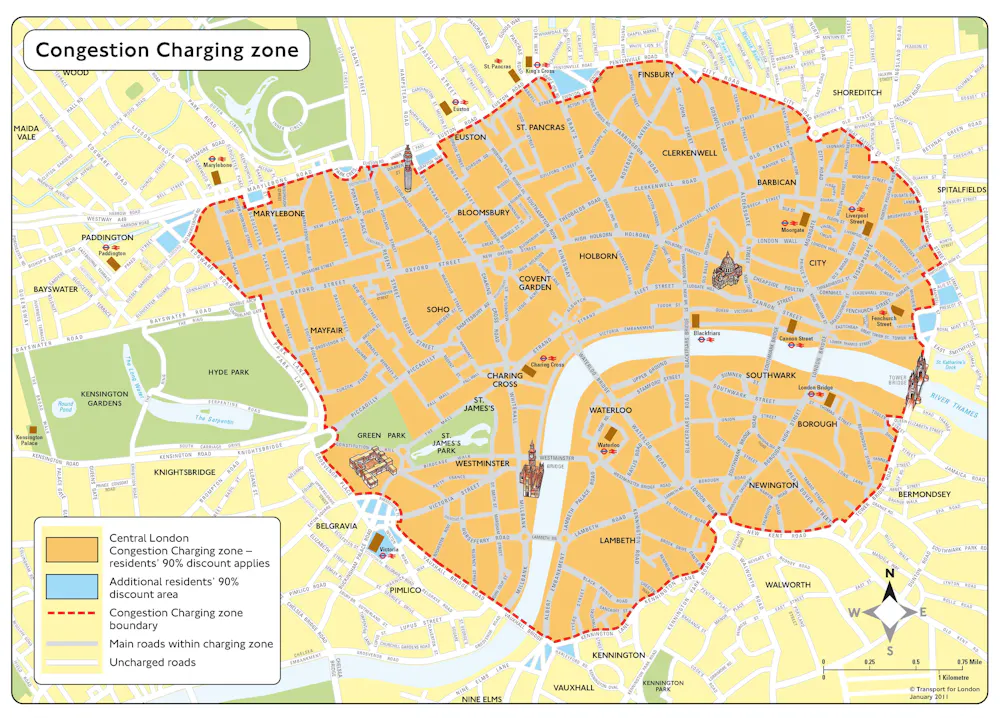
Evidence from cities around the world shows that charging motorists fees for driving into city centers during busy periods is a rarity in urban public policy: a measure that works and is cost-effective. Congestion pricing has succeeded in cities including London, Singapore and Stockholm, where it has eased traffic, sped up travel times, reduced pollution and provided funds for public transport and infrastructure investments.

It also can produce some unintended consequences. In London, house prices within the congestion charge zone increased – bid upward by consumers who were willing to pay to avoid traffic and enjoy improved environmental conditions. Over the long term, the congestion tax lubricated the gentrification of central London.

But this process is common to many other big cities, with or without congestion pricing: The rich preempt central city locations and displace the less wealthy to the suburbs.

London’s Congestion Charge zone. Transport for London

Congestion pricing in the United States

Although the United States has over 5,000 miles of toll roads, congestion pricing is uncommon. One exception is Interstate Route 66 in the Washington, D.C. metro region, where fluctuating tolls were introduced in late 2017. Pricing for express lanes changes every six minutes during rush hour eastbound in the morning and westbound in the afternoon. The toll hit US$40 for a 10-mile stretch the day after it was introduced.

So far, local officials say the policy appears to be working. Carpooling has increased, while backups and crashes have declined. The average toll is currently $8.02 during morning hours and $4.47 during afternoon hours.

But this is just one well-used road, and there are many other routes into central Washington. The I-66 tolls are more about generating revenue on one road than reducing congestion citywide.

New York City is the best U.S. candidate for congestion pricing because it is densely developed and has an extensive public transportation system. Congestion pricing is unlikely to be as feasible in lower-density cities with limited public transportation.

Some observers, such as environmental advocates, are celebrating New York’s decision. But there is pushback from others who claim that it will be regressive. Congestion charges do raise equity issues, but only 4 percent of people who commute into New York City travel by car, and of those, only 5,000 could be classified as working poor. Funding from congestion fees will increase investment in mass transit, which New York Governor Andrew Cuomo says will benefit the vast majority of New Yorkers who commute by bus or subway.

Details remain to be decided, but under a previous proposal, cars would have been charged $11.52 to enter the zone on weekdays during business hours, while trucks would have paid $25.34. Taxis and app-based rides such as Uber and Lyft would have been charged $2 to $5. Fees will be assessed by a committee of experts and collected by the Triborough Bridge and Tunnel Authority through an electronic tolling system that is already widely used for bridges, tunnels and tolled motorways across the country.

Unlike other taxes that can be easily dismissed as imposing costs and killing jobs, congestion pricing improves market efficiencies because it forces people to think about their travel and leads to a more rational use of our public roads. It is a powerful policy whose time has definitely come.

* * * * *

This is an updated version of an article originally published on Feb. 7, 2018.The Conversation

John Rennie Short, Professor, School of Public Policy, University of Maryland, Baltimore County

This article is republished from The Conversation under a Creative Commons license. Read the original article.

Header image courtesy of Life of Pix.

Want to Fix Gerrymandering? Then the Supreme Court Needs to Listen to Mathematicians

By Manil Suri, Professor of Mathematics and Statistics, UMBC, and Karen Saxe, Macalester College

“Are we in Maryland’s third congressional district?” Karen asked on a recent visit to the UMBC campus. Despite zooming into the district’s map on Wikipedia, neither of us could tell. With good reason – “the praying mantis,” as the third has been called, has one of the most flagrantly gerrymandered boundaries in the country. (The university sits just outside, as we later found.)

Welcome to Democrat-controlled Maryland. The state, along with Republican-controlled North Carolina, defended its congressional districting against the charge of unlawful partisan gerrymandering in hearings at the U.S. Supreme Court on March 26.

One might think that a map that confounds two mathematicians must be in clear violation of the law. Indeed, political scientists and mathematicians have worked together to propose several geometrical criteria for drawing voting districts of logical contiguous shapes, which are now in use in various U.S. states.

But here’s the rub: Gerrymandering in itself is not unconstitutional. For the Supreme Court to rule against a particular map, plaintiffs need to establish that the map infringes on some constitutional right, such as their right to equal protection or free expression. This creates a problem. Geometrical criteria don’t detect partisanship. Other traditional criteria, like ensuring each district has the same population, can also be easily satisfied in an otherwise unfairly designed state map.

How then to define a standard to identify partisan gerrymandering that is egregious enough to be illegal? Mathematical scientists have already come up with promising solutions, but we are concerned that the Supreme Court may not take their advice when it issues its decision in June.

Searching for answers

The Supreme Court has grappled with the question of manageable standards at least since 1986 – long enough for Justice Antonin Scalia to declare in a 2004 ruling that since one hadn’t emerged yet, the issue of partisan gerrymandering was not legally decidable, and therefore, no further appeals should be considered.

It was only Justice Anthony Kennedy’s separate concurrence that kept the door open. He cautioned against abandoning the search for a standard too soon, saying that “technology is both a threat and a promise.” In other words, technological advances would probably exacerbate the gerrymandering problem, but they could also provide a solution.

The problem has worsened, just as Kennedy predicted. Computer programs can now generate a profusion of redistricted maps, all of which satisfy traditional constraints such as contiguity and equal population across districts. Then, the majority party can just pick the map most favorable to it.

This was demonstrated in Wisconsin’s 2018 elections. Computer-boosted gerrymandered maps supersized the Republicans’ 13-seat edge to a 25-seat majority, even though Democrats won 53 percent of the total statewide vote.

We expect new congressional districts drawn countrywide after the 2020 census will be subject to even more ferocious computer-driven gerrymandering.

Math to the rescue

But the second part of Kennedy’s prediction has also come true. The same tools that produce drastically gerrymandered maps can be used to draw fair maps.

The first step is to generate – without partisan intent – a vast number of maps that adhere to traditional redistricting criteria. This creates a database against which any proposed map can be compared, by using a suitable mathematical formula that measures partisanship. Through this process, maps with extreme bias will appear as clear outliers, much like data points near the outer ends of a bell curve.

The “efficiency gap” is one such mathematical formula. It measures how efficiently one party’s votes get used and how much the other party’s votes get wasted. For example, a map might pack voters together to minimize their influence in other districts, or spread them out so they don’t form an effective bloc.

Alternative formulas exist as well. In fact, we recommend using a collection of formulas, rather than just one, to compensate for the limitations of each.

Recent conferences on redistricting have seen the mathematics and statistics communities coalesce around this “outlier approach.”

Overcoming skepticism

Getting the Supreme Court to accept this approach, however, will require overcoming the skepticism some conservative justices have expressed toward the use of mathematics and statistics in setting legal standards.

During October 2017 oral arguments for a challenge to the Wisconsin maps, for instance, Chief Justice John Roberts characterized the efficiency gap as “sociological gobbledygook,” while Justice Neil Gorsuch said that the idea of using multiple formulas for measuring gerrymandering was like adding “a pinch of this, a pinch of that” to his steak rub. Roberts also fretted that the country would dismiss statistical formulas as “a bunch of baloney” and suspect the court of political favoritism in adopting them.

At the March 26 hearings for the North Carolina challenge, conservative justices were more measured and mathematically savvy in expressing their reservations. This time, the “outlier approach” took center stage. Affirmed in the lower court decision and explained in an amicus brief, it was also endorsed in oral arguments by Justices Elena Kagan and Sonia Sotomayor. The key doubts came from Justices Samuel Alito, Gorsuch and Brett Kavanaugh, who questioned the feasibility of defining an “outlier” in practice – in particular, setting a range of numerical parameters that would demarcate permissible maps from nonpermissible ones.

The answer to such objections, adeptly addressed in an amicus brief by MIT’s Eric Lander, is twofold. First, the maps being challenged are so biased that they are extreme outliers. They would show up as anomalies under any test for partisanship. So there is no need for the Supreme Court to set a numerical cutoff level at this stage – though a threshold may, indeed, evolve in the future. Secondly, such an extreme outlier approach is already an indispensable tool in several areas of national importance. For example, it is used to test nuclear safety, predict hurricanes and assess the health of financial institutions.

Moreover, this approach has already been shown to work smoothly in gerrymandering cases as well, such as in one from Pennsylvania. Moon Duchin, a Tufts University math professor, used it to analyze – in a report requested by Governor Tom Wolf – newly proposed maps for fairness. A map drawn by the GOP state legislature clearly stood out as an extreme outlier among over a billion maps generated, both when evaluated using the efficiency gap and under another measure of partisanship called the mean-median score. Based on Duchin’s report, the governor rejected the map proposed by the GOP.

We expect that, pushed by citizen groups, an increasing number of states will incorporate math into redistricting procedures. Last year, for instance, Missouri approved Amendment 1, prescribing detailed mathematical rules that must be followed to ensure the fairness of redrawn districts. Although the rules rely heavily on just the efficiency gap – and lawmakers may try to altogether annul them – the fact that ordinary citizens voted overwhelmingly (62 percent to 38 percent) in favor of such a math-incorporating measure is truly precedent-setting.

Such developments were noted in the March 26 oral arguments, when some justices wondered whether, in light of state initiatives, the Supreme Court really had to step in. As the citizens’ attorneys pointed out, however, there are very few states east of the Mississippi where such citizen initiatives are allowed. (North Carolina is not one of them.) It behooves the court to take the lead nationally.

Enhanced by computer power, partisan gerrymandering poses a burgeoning threat to the American way of democracy. Workable standards based on sound mathematical principles may be the only tools to counter this threat. We urge the Supreme Court to be receptive to such standards, thereby enabling citizens to protect their right to fair representation.

* * * * *

Manil Suri, Professor of Mathematics and Statistics, University of Maryland, Baltimore County and Karen Saxe, Professor of Mathematics, Emerita, Macalester College

Header image: Maryland’s third congressional district. Wikimedia

This article is republished from The Conversation under a Creative Commons license. Read the original article.
The Conversation

Alumni Award Winner Crafts Sounds for the Stars

A degree from UMBC can take you anywhere even a galaxy far, far away. Kimberly Patrick ’08, recipient of UMBC’s 2019 Outstanding Alumni of the Year award for Visual and Performing Arts, has a geek’s dream job, working as a sound editor and foley artist for Lucasfilm’s Skywalker Sound.

Just reading the experience section of this alumna’s resume will make you crave popcorn. In it are Star Wars: The Force Awakens, Star Wars: The Last Jedi, and Rogue One: A Star Wars Story as well as the Marvel movies Captain Marvel and Thor: Ragnarok, all indelible parts of modern pop culture. She was nominated for a Primetime Emmy award for her sound editing for the animated series Star Wars Rebels.

Studying music technology at UMBC kick started Patrick’s interest in film sound.

“I realized how much I enjoy recording and adding sounds to moving images,” she says, and after graduation she went to film school at the University of Southern California to get her MFA in film and television production. She started as an intern at Lucasfilm in 2012 and advanced from there.

Patrick creates sounds on one of the foley stages at Skywalker with two of her coworkers.

“I was able to make some fart sounds!”

For Patrick, a typical day as a foley artist might include shaking together rollerblades and running around to make the sounds of stormtroopers on the move. As a sound editor, she might be helping to decide the exact amount of fire sound in Captain Marvel’s superpowers.

In a documentary on YouTube about the making of Star Wars: The Force Awakens, Patrick can be seen making those sounds and talking about her experience with such a seminal franchise. “It’s really exciting to be a part of that and to know that you’re part of this future generation of Star Wars movies,” which are iconic for sound and filmmaking in general, she says.

And then there is her work that slightly less auspicious like the fart noises she made for Despicable Me 2. “There’s an end credit sequence with three of the minions and you know how… they’re always doing crazy things, one of them pulled out a trumpet and they wanted the trumpet to sound like a fart.” Patrick put her musical background to work and made it happen. “It definitely makes my parents super proud,” she says, “all those trumpet lessons. I was able to make some fart sounds!”

A day in the life of a foley artist can include almost anything.

“Is it going to be lasery?”

Most of what she does, however, is edit previously-recorded sounds together to achieve the right effect. For the recent Captain Marvel, Patrick was given about a third of the movie to work with and tasked with deciding what sounds needed to go where.

“With these movies, you do get direction from the directors of what they have in mind, how they imagine it to sound, and then you have to sort of translate back.” Sometimes they might ask, “Can you do a woosh kind of thing? Or it should go like vroom pow!” Other times they use emotional direction, like “This needs to be powerful but have weight to it,” and then she might use a low-end sound.

For the superpower effects used in Captain Marvel, “You have to decide is it going to be like electrical, it is going to be fiery, is it going to be lasery? You generally give a bunch of options to the directors like, here’s this version where it’s very fiery and here’s this version where it’s a lot of electricity,” she says.

Star Wars fans will recognize her work from an eerie scene in The Last Jedi in which the main character Rey snaps her fingers in a hall of mirrors. For that effect Patrick had to use cloth and snapping sounds to create an echo. “I couldn’t just copy-paste the same sound over and over again; it would sound mechanical. There had to be a distinct rhythm, as well as a sense that her reflection repeated indefinitely away from her into the cave, so the quality of the sound would need to change as it got further and further away.  It was a bit of a painstaking process to cut each individual repeated sound and sculpt it all into a believable performance that had some nuance, but it ultimately became a pretty cool sound moment in the film,” she says.

“You have to be an experimenter.”

UMBC may seem like it’s pretty far from that world of Jedi and superheroes, but Patrick says she uses her time as a Retriever to inform her work. “Having a degree in music from UMBC has been beneficial in so many ways. The music tech program emphasizes both the creative and technical sides of music-making which prepared me for the work I now do every day,” she says.

Patrick credits Professor Alan Wonneberger with encouraging her to pursue a career in film sound and the Linehan Scholars program with giving her much needed financial help and an introduction to artistic collaboration. “It exposed me to a large group of artists that I got to work with, which ultimately is what I do every day now I get to work with a bunch of different artists from different departments and… we can just make beautiful things together.”

To give back to the school, Patrick coaches current students on how to get into the business. She has gone back to UMBC to speak to music classes and did a foley recording exercise with Professor Wonneberger’s class. She also spoke with Dr. Lisa Cella’s professional development classes about her career path. Recently, current student Jenna Polignone ’19, information systems and music technology got to pick her brain via Skype about applying for a summer internship at Skywalker.

To succeed, Patrick says, “I think you have to be an experimenter. And you have to have an ear for what things work and what things don’t and be able to describe why things work and why they don’t.” It can be rewarding artistically when it all comes together, she says, particularly when she works on a documentary with social impact like the 2016 film Looking at the Stars. But being part of blockbusters brings Patrick’s work to the hearts of geeks the world over.

“It’s really awesome that I get to work on these movies that are well known I think that’s part of what makes my job very exciting… you get to be a part of this thing that’s bigger than you and say, yeah, I contributed to that.” 

Kimberly Patrick in her office.

Karen Stysley

All photos courtesy of Kimberly Patrick. 

Restoring tropical forests isn’t meaningful if those forests only stand for 10 or 20 years

By Matthew Fagan, UMBC; Leighton Reid, University of Missouri-St. Louis, and Margaret Buck Holland, UMBC

Tropical forests globally are being lost at a rate of 61,000 square miles a year. And despite conservation efforts, the global rate of loss is accelerating. In 2016 it reached a 15-year high, with 114,000 square miles cleared.

At the same time, many countries are pledging to restore large swaths of forests. The Bonn Challenge, a global initiative launched in 2011, calls for national commitments to restore 580,000 square miles of the world’s deforested and degraded land by 2020. In 2014 the New York Declaration on Forests increased this goal to 1.35 million square miles, an area about twice the size of Alaska, by 2030.

Ecological restoration is a process of helping damaged ecosystems recover. It produces many benefits for both wildlife and people – for example, better habitat, erosion control, cleaner drinking water and jobs.

That’s why the Bonn Challenge is so exciting for geographers and ecologists like us. It brings restoration into the center of global discussions about combating climate change, preventing species extinctions and improve farmers’ lives. It connects governments, organizations, companies and communities, and is catalyzing substantial investments in forest restoration.

However, a closer look shows that a struggle remains to fully realize the Bonn Challenge vision. Some reforestation efforts provide only limited benefits, and studies have shown that maintaining these forests for decades is critical to maximize the economic and ecological benefits of establishing them.

Reforestation project in northern Costa Rica: a plantation of native trees with valuable wood.
Matthew Fagan, CC BY-ND

Putting trees back on the land

So far, 48 nations and 10 states and companies have made Bonn Challenge commitments to restore 363,000 square miles by 2020 and another 294,000 square miles by 2030. The United States and a Pakistani province have already fulfilled their commitments, restoring a total of 67,000 square miles.

Restoring forests poses political and economic challenges for national governments. Letting forests grow back inevitably means pulling land out of farming. Natural forest regeneration mainly occurs where farmers have abandoned poor quality land, or where governments discourage poor farming practices – for example, near wetlands or on steep slopes. Opportunities for natural regeneration elsewhere are limited.

As a result, much forest landscape restoration under the Bonn Challenge focuses on improving existing landscapes using trees. Restoration activities may include creating timber or fruit plantations; agroforestry, or planting rows of trees in and around agricultural fields; and silviculture, or improving the condition of degraded forests.

The U.N. Decade of Ecosystem Restoration seeks to restore some 5 billion acres of deforested and degraded landscapes and seascapes between 2021 and 2030.

One early success, the “Billion Tree Tsunami” in Pakistan’s Khyber Pakhtunkhwa province, has exceeded its 350,000-hectare pledge through a combination of protecting forest regeneration and planting trees. Similarly, Rwanda has restored 700,000 of the 2 million hectares it pledged, primarily through agroforestry and reforesting erosion-prone areas, and created thousands of green jobs.

Green deserts

However, these “restored forests” are often poor replacements for natural habitat. For animals dwelling in tropical forests, agroforestry and tree plantations can look more like green deserts than forests.

Many tropical forest wildlife species are only found in mature tropical forests and cannot survive in open agroforests, monoculture tree plantations or young natural regeneration. Truly restoring tropical forest habitat takes a diversity of forest species, and time.

Nonetheless, these working “forests” do have ecological value for some species, and can spare remaining natural forests from axes, fire and plows. In addition, scientists have estimated that restored forests could sequester up to 16 percent of the carbon needed to limit global warming to less than 2 degrees Celsius above pre-industrial levels, while generating some US$84 billion in assets such as timber and erosion control.

Logging and degradation of tropical forests is the main reason why forestry and land use account for 10–15 percent of the world’s total human-induced CO2 emissions.
GRID-Arendal, CC BY-NC-SA

Restored, but for how long?

Benefits for wildlife and Earth’s climate from forest restoration accrue over decades. However, many forests are unlikely to remain protected for this long.

In a 2018 study we showed that forests that naturally regenerated in Costa Rica between 1947 and 2014 had only a 50 percent chance of enduring for 20 years. Most places where forests regrew were subsequently re-cleared for farming. Twenty years represents about a quarter of the time needed for forest carbon stocks to fully recover, and less than one-fifth of the time required for many forest-dwelling plants and animals to return.

Unfortunately, 20 years may be more than most new forests get. Studies in Brazil and Peru show that regenerating forests there are re-cleared even faster, often after just a few years.

This problem is not limited to natural forests. Agroforests worldwide are under pressure. For example, until recent decades, coffee and cocoa farmers in the tropics raised their crops in agroforests under a shady canopy of trees, which mimicked the way these plants grow in nature and maximized their health. Today, however, many of them grow their crops in the sun. This method can improve yield, but requires pesticides and fertilizer to compensate for added stress on the plants.

Poor management of coffee and cacao farming is a leading cause of deforestation in Peru. Local and international organizations are working to conserve and restore forests through better farming practices.

And although timber plantations sequester additional carbon with every harvest and replanting, their replanting is dependent on shifting market demand for wood. Once they are harvested after six to 14 years of growth, tropical timber plantations can be abandoned as a bad investment and replaced with higher-yielding row crops or pasture.

Solid foundations for recovery

If the Bonn Challenge is to achieve its goals, nations will have to find ways of converting short-term restoration pledges into long-term ecosystem recovery. This may require tightening the rules.

Some countries have pledged to protect unrealistically large areas. For example, Rwanda committed to restore 77 percent of its national territory, and Costa Rica and Nicaragua pledged to restore 20 percent of their territories apiece. Another flaw is that the Bonn Challenge does not prevent countries from deforesting some areas even as they are restoring others.

It will be impossible to track overall progress without an international commitment to monitor and sustain restoration successes. International organizations need to invest in satellite and local monitoring networks. We also believe they should consider how large international investments in sectors such as agriculture, mining and infrastructure drive forest loss and regrowth.

Countries like Indonesia that may be considering a Bonn Challenge pledge should be encouraged to focus on long-term impacts. Instead of restoring 10,000 square miles of one-year-old forest by 2020, why not restore 5,000 square miles of 100-year-old forest by 2120? Countries like Costa Rica that have already pledged can lock in those gains by protecting regrown forests.

The U.N. General Assembly recently approved a resolution designating 2021 to 2030 as the U.N. Decade of Ecosystem Restoration. We hope this step will help motivate nations to keep their promises and invest in restoring Earth’s deforested and degraded ecosystems.The Conversation

* * * * *

Matthew Fagan, Assistant Professor of Geography and Environmental Systems, University of Maryland, Baltimore County; Leighton Reid, Faculty Associate, University of Missouri-St. Louis, and Margaret Buck Holland, Associate Professor, University of Maryland, Baltimore County

This article is republished from The Conversation under a Creative Commons license. Read the original article.

Header image: A regenerating stand of rainforest in northern Costa Rica. Matthew Fagan, CC BY-ND