All posts by: Magazine Editor


Diamonds are forever – whether made in a lab or mined from the earth

by Joshua Wilhide, M.S. ’10, and William LaCourse, UMBC

It’s diamond season. Almost 40 percent of American engagements happen between Thanksgiving and Valentine’s Day, with Christmas the most popular day to pop the question – and hand over a sparkly piece of ice. Jewelry stores do at least double their usual monthly sales in December.

Since at least the late 1800s, with the discovery of huge diamond mines in South Africa, people have treasured these dazzling gems. The beauty and splendor of diamonds goes well beyond the surface. Like a diamond hunter digging in an underground mine, one must look deeper to their atomic characteristics to understand what sets these stones apart – and what makes them valuable not just for romantics but also for scientists.

On the atomic level


When mined from the earth, diamonds look like cloudy rocks before they’re cut and polished. Their chemical nature and structure were unknown for centuries. It was Isaac Newton’s experiments in the 1600s that first suggested diamonds are made up of the fourth-most abundant element, carbon.

People doubted Newton’s discovery, which is understandable considering how different diamonds look from other common forms of carbon, like the graphite in pencils or the ash left over in a wood-burning fireplace. But in 1797, English scientist Smithson Tennant confirmed the composition of diamonds.
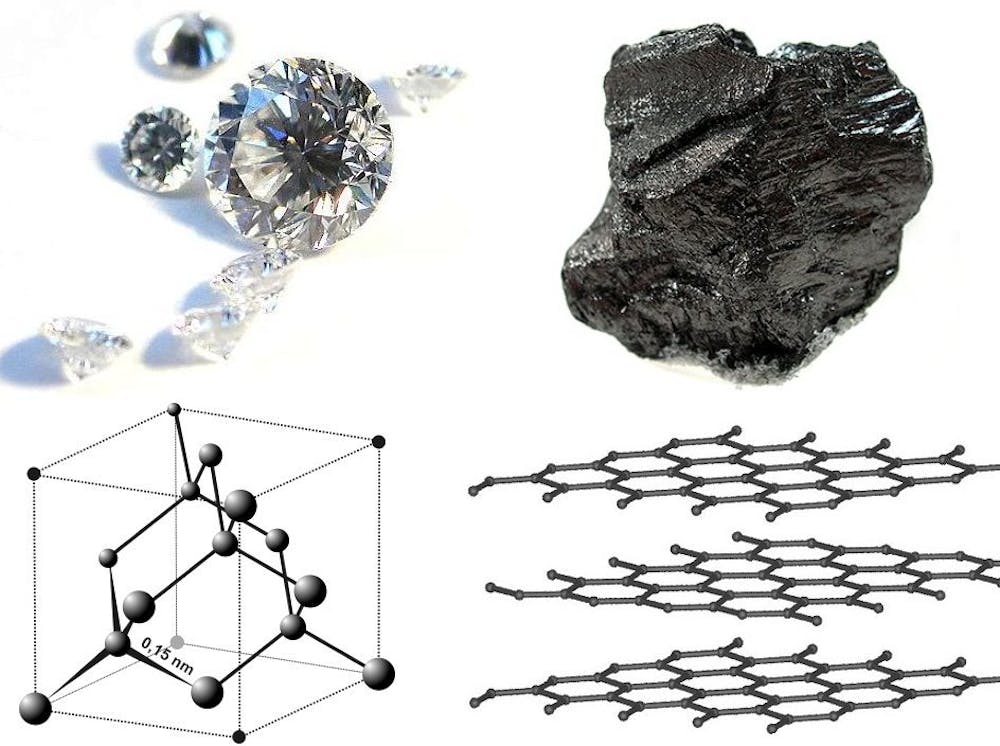
Diamond and graphite are both made of carbon atoms, but organized in different structures.
Materialscientist/Wikimedia Commons, CC BY-SA

It turns out that carbon takes two common forms that have crystalline structures on the atomic level. Graphite is a repeating two-dimensional, honeycomb-like shape, with layers stacking on top of each other. Alternatively, carbon can form a repeating three-dimensional shape, a tetrahedron – and that’s your diamond.

Where do they come from?

There are two sources of the precious gemstone: natural mining or synthesis within a laboratory.

Natural diamonds are formed under intense pressure and heat in the Earth’s crust over millions of years. Natural deposits have been found all over the world, from Northern Canada to Western Australia, even underwater in Namibia.

Mines were the only source of the gemstone until 1955, when General Electric produced the first synthetic diamond using what’s called the high-pressure, high-temperature process. This process works by applying hundreds of thousands pounds of pressure to graphite at 2,700 degrees Fahrenheit to force the carbon into the correct crystalline structure. It’s sort of like an artificial version of the extreme conditions that produce diamonds deep within the earth.

In the 1970s, labs started to use the chemical vapor deposition method to grow diamonds at lower pressures. At the time, the HPHT technique couldn’t produce a gem-quality stone. This improved method converts a hydrocarbon gas mixture by breaking it down to its components, carbon and hydrogen molecules, with an intense heated filament or plasma and deposits it onto a substrate, ultimately forming a solid diamond. Originally, this process had a very slow growth rate, but it’s now optimized to grow quality diamonds within days.

Together these techniques are largely responsible for human-made diamonds – upwards of 4 billion carats worldwide annually.

There’s a common misconception that a natural diamond must be inherently different than a synthetic diamond. To the contrary, they are chemically identical and share the same physical properties. Even the most sophisticated techniques can not detect a difference between a flawless mined diamond and a flawless human-made diamond – both are “real” diamonds. However, truly flawless diamonds of either type are extremely scarce.

Assessing a diamond

No matter its origin, a diamond can be assessed by the “four Cs” of cut, color, clarity and carat weight. Specialized laboratories grade each category, as created by the Gemological Institute of America.

The cut of a diamond is defined in two ways. There’s “the general shape of the cut stone,” with shapes including round brilliant (most common), oval, emerald, pear, princess, trilliant, triangle, heart and radiant. And there’s “the degree of perfection achieved by the cutting and polishing process” as rated on a scale ranging from excellent to poor. The type and quality of the cut ultimately determines the way light reflects in the stone, contributing to its “brilliance.”

The color of a diamond is graded on a scale from “D,” being perfectly colorless, to “Z” having the most color. Originally, the color of the stone was a huge hint about how it was formed because until 2007 about 90 percent of the high-pressure, high-temperature synthetic stones were yellow orange or yellow. Almost no stones from that process were colorless, so a colorless stone was almost certainly natural. But the HPHT growing process has greatly improved and as of 2016, 43 percent of synthetic diamonds were colorless.

Diamond clarity indicates the presence of inclusions, or tiny imperfections, in the stone. Inclusions make every diamond unique and provide strong clues to whether a diamond is natural or synthetic. The HPHT process uses metal flux, or a hot metal liquid, which acts as a solvent to dissolve the carbon source, graphite, to be rearranged and grown into a diamond. Diamonds grown this way can have inclusions of metals. The resulting stones may be magnetic – if a diamond reacts with a magnet, it is certainly synthetic. Additionally, most synthetic diamonds receive high clarity grades, while natural diamonds contain larger inclusions.

Many consumers focus on carat weight – that is, diamond size. The stone is weighed on a scale where one carat is 200 milligrams (0.007 ounces). Diamonds larger than four carats are almost guaranteed to be natural because that’s the limit for the size of the diamonds that the synthetic processes can grow.

Although the “four Cs” of diamonds ultimately define retail value, sentimental value can be even greater. Buyers must decide if a natural or synthetic stone fits the bill for them, based on factors that might include the ecological and ethical ramifications of diamond mining as well as the lower price tag for synthetic rocks.

Diamonds found beyond your ring finger

Although diamonds are well known for their place in the jewelry industry, they play other valuable roles, too.

Their physical properties, especially hardness, are ideal for abrasive applications. Small diamonds can be found coating cutting wheels, drill bits and grinding wheels, which are used for cutting concrete or brickwork.

Diamonds also have certain optical properties that make them suitable for various spectroscopy techniques, or measurements involving the electromagnetic spectrum. Scientific researchers use these tests to help identify the composition of materials they’re investigating.

A previously common place for diamonds was on record players, where to this day the needle that touches the record can be a very small diamond sliver.

Whether one appreciates the aesthetic or scientific characteristics of the gem more, diamonds can dazzle.The Conversation

* * * * *

Joshua Wilhide, M.S. ’10, chemistry, Manager of the Molecular Characterization and Analysis Complex, University of Maryland, Baltimore County and William LaCourse, Professor of Chemistry and Dean of the College of Natural and Mathematical Sciences, University of Maryland, Baltimore County

This article is republished from The Conversation under a Creative Commons license. Read the original article.

Header image  chuttersnap on Unsplash

A Matter of Trust

Driven in her work by memories of her grandmother, Dr. Tabassum Majid, M18, ’10, interdisciplinary studies, M.A. ’18, management of aging studies, has made a career of education and research related to Alzheimer’s disease and dementia. Recently, she was recognized in the Baltimore Sun’s “25 Women to Watch in 2018” list. Following her undergraduate study in neurodegenerative disorders of the aged, she earned her Ph.D. from the Baylor College of Medicine in Houston and had a fellowship at the University of Maryland, School of Pharmacy. Today, as executive director of the Integrace Institute, former Meyerhoff Scholar Majid looks ahead to ways of improving the lives of elders and their support networks, and many of the tools she uses every day come from the interdisciplinary education she received at UMBC. Here, Majid tells us how taking a chance on UMBC, and granting the trust of her most precious possession — her dreams — has made all the difference.

“Trust us with your dreams; you were meant to heal the world.”

This is one of the first things that I heard as a freshman at UMBC, the first time a mentor ever pushed me to both be vulnerable and challenge the universe at the same time.

The mantra has stayed with me throughout my personal and professional journeys since setting foot on a campus that I have come to consider a second home. The story began there.

UMBC was not my first choice until I met the people in it. I had dreams, big ones: neurosurgery at Yale, curing Alzheimer’s disease, traveling the world and making music come alive.

Yet, my heart and mind were one when I interacted with society’s most vulnerable: Older adults with dementia who reminded me of my lifelong hero — my grandmother — and children with chronic illness but sunny dispositions.

Majid cuts the ribbon at the launch of an exhibit created at Integrace Institute through collaborations with UMBC students. Image courtesy of Integrace Institute.

It took some trust to hand that over to the gentle soul who greeted me on my first day on campus. How could I refuse a place that was saying yes to my dreams, telling me that anything was possible? Freshman? Meyerhoff Scholar? Creating your own interdisciplinary studies degree focused neurodegenerative disorders of the aged? “We can figure that out,” they said. You want to be SGA Vice President? “We’ve never had a freshman do that, but why not? You were meant for greatness. Grit is in your nature.”

The opportunities kept coming, but I didn’t understand why. I kept looking for something to tell me I was in the right place doing the right thing. And then it happened. I was asked to write down the story of my grandmother. A release valve opened, passion flowed out, and I started to solidify those dreams. Before I knew it, I was graduating and off to Houston, Texas, to work with my new set of mentors, internationally renowned pioneers in Alzheimer’s and dementia research.

I finished my Ph.D. degree by focusing on all of those who came before me, who paved the path. Who I trusted with my dreams. My parents, two immigrants who came to the U.S. to give me a better life; my grandmother, who inspires me daily; my mentors, dozens of them, who encouraged, guarded, and nurtured my dreams. I defended my dissertation and got a letter from that same gentle soul at UMBC: “You’ve done what you went there to do; now you may come home.”

I came back to Maryland and decided to teach, to give back, and begin my research trajectory. I started teaching and mentoring UMBC students as an adjunct faculty member while doing my post-doctoral research. I found the most joy in seeing others be inspired to achieve their dreams, to discover their grit. I kept working with individuals with dementia and their caregivers, and got an amazing job at the Integrace Institute, a non-profit organization in Maryland that integrates research, education, and consulting together to transform the lives of those with neurocognitive changes.

I needed more knowledge on this new industry, so I came back to UMBC for my MAgS degree. Every day is different now. Whether I am teaching staff members on how to individualize care, chatting with a resident about their life, presenting at a national research conference on brain health, I’m living those dreams with my UMBC family. One of my students used her museum design background to create an exhibit space to communicate research and educational findings in an innovative way. Another is using his musical talents to help us with a meaningful music study. Faculty and staff are co-creating curriculum and collaborating on research and future intergenerational programs. We are always looking ahead for more ways to grow, expand, and change.

It has been a transformational journey for me, expanding and changing as quickly as UMBC. In times of change, however, it is comforting to know that a walk around the loop will always welcome me home.

 Majid speaks with a reporter during the production of Every 3 Seconds , a documentary produced by Alzheimer’s Disease International to help raise awareness of global impact of dementia. The documentary came out in July. Image courtesy of Alzheimer’s Disease International.

Big Screen Dreams – Erick Chavarria ’05, theatre

As a small boy, Erick Chavarria lived with his grandparents in Guatemala in the village of Loma de Chavarria (“village of Chavarria”), where everyone had the same last name. At the time, there were only dirt roads.

“Everyone — and I mean everyone — was dirt poor. My grandparents’ house was made of mud,” he recalls.

Life changed when he was six years old, and the village got running water and electricity. Sometime shortly after, his grandparents got the first television in town. Nearly the entire village would show up at his home during the day to watch Mexican soap operas. “The TV would be on from like 8 a.m. until midnight,” says Chavarria. “This was such a huge thing in the village. Everyone was so engaged with what was going on on the soaps.”

When their electric bill got too high, Chavarria’s grandmother started charging people to watch. “My job was to go around and collect five cents from everyone,” says Chavarria.

The draw of the television soaps made Chavarria think about acting. And with that thought, his whole life would change.

“It’s What I Always Wanted to Do”

When he was 15, Chavarria and some of his extended family decided to head to the United States to live. He spent 23 days walking, riding in 18-wheelers, and once in a fruit truck. His backpack with all his belongings was stolen, and the pocket of his jeans got stuck on a barbed wire fence and ripped off.

Chavarria’s plan was to work for three years in the States and then return to Guatemala for his education. Then living with family in Laurel, Maryland, he enrolled in high school and got a work permit to bus tables. After graduating, Chavarria enrolled at Howard Community College as a business administration major, but then he took an acting class. “It’s what I always wanted to do — be an actor. But my father thought it was the funniest thing ever,” he says.

After five years in the States, Chavarria became an American citizen, and once he finished his AA degree, he transferred to UMBC. He didn’t make it into the theatre program right away; so he took acting classes, worked on his craft, and was accepted the next year.

After he graduated, he didn’t go directly into acting. After a stint as a loan officer, then a real estate agent, Chavarria lost all his money in the real estate crash. With just $500 in his checking account and nothing much to lose, he decided to go head west.

“I said, ‘If I’m broke here, I might as well be broke in LA.’”

“One Day She Called Me In”

Chavarria began working as a server at a restaurant while he took acting classes. Armed with a demo reel made while at UMBC, he secured both theatrical and commercial agents and began auditioning. He began sending introduction letters to casting agents, and Gwen Hellier, who was then casting for General Hospital, stood out. Chavarria made a point of keeping in touch with her.

“I told her how I used to watch the soaps with my grandmother or that I just did a little commercial,” recalls Chavarria. “One day she called me in.”

He was given a script and told to go to the lobby and read it over, and then come back in. That’s when Chavarria realized that he was the only one auditioning for the bartender role. He got the part.

Chavarria was on six episodes of GH, played a recurring character on Eastbound and Down and Borderline, and has appeared in movies like Office Christmas Party. He has also acted at the Frida Kahlo Theatre in downtown LA and in commercials, and has a healthy IMDB profile to show for it.

The greatest reward, Chavarria said, is to be able to make a living acting. “I think a million people could’ve told me the stories of how hard it is to get into acting, and I still would have gone into acting. The most important thing is being happy.”

— Michele Wojciechowski

Image: Josue Pena

Friendly Competition

Many observers will point to March 16, 2018, as the date that UMBC Athletics came of age. But there are numerous, more subtle signals that #RetrieverNation is maturing in intercollegiate athletics.

In short order this past spring, UMBC doubled the number of former student-athletes who have risen to the pinnacle of the coaching ranks and become Division I head coaches. Temple University hired Brian Rowland ’03, economics, as its head men’s soccer coach, while America East rival Binghamton University tapped Bethann (Shapiro) Ord ’89, psychology, (pictured above) as its head women’s basketball coach.

The duo joins Michael Casper ’00, psychology, and Jen (Kasper) O’Brien ’05, psychology, who have previously directed their charges against their alma mater. (Ord will when Binghamton plays at UMBC on February 13, 2019.)

Pride and Competitive Spirit

For all of them, coming back to coach against their own team brings a mix of pride and competitive spirit.

Casper, who played for head soccer coach Pete Caringi, Jr., led his St. Francis Pennsylvania side against UMBC in September 2009, dropping a 3-1 decision to the Retrievers. O’Brien, who scored 86 goals as a four-year starter for UMBC women’s lacrosse, brought a first-year program from Virginia Commonwealth University into UMBC Stadium in February 2016, and the more experienced Retrievers prevailed, 20-5.

Rowland made his head coaching debut against his former mentors in the 2018 season opener for both squads. UMBC scored a late goal to prevail over Temple, 1-0.

“It was nice that [my debut] was here. It was familiar,” said Rowland, who starred as a goalkeeper for UMBC from 1999 to 2002, and was inducted into the UMBC Athletics Hall of Fame in 2014. “[The UMBC staff] are great coaches, great examples. Pete was always a fantastic players’ coach. I’ve always remembered that and try to emulate it as much as possible — the understanding of the player.”

Ord returns to her home state of New York after serving as head coach at Weber State for the past seven years. “I’m excited to be [coming] back and see all the changes on campus, including the new gym,” she said. “It has been a long time and I look forward to seeing a lot of my [former] teammates and people that still work at school.”

a group of men stand shoulder to shoulder in athletics gear
Brian Rowland ’03, economics (center) visits with UMBC soccer coaching staff (L-R): Sam DeBone, head men’s soccer coach Pete Caringi, Jr., Anthony Adams, Pete Caringi III.

Feeling Connected

O’Brien and Casper both vividly recall how they dealt with their emotions in those games versus UMBC.

“Every time I face UMBC, at home or away, I am filled with an immense amount of pride, appreciation, and love,” O’Brien said. “I am so proud to be a Retriever. I am grateful for the opportunity [head coach] Monica [Yeakel] gave me and I absolutely loved my time at UMBC with teammates that became family.”

Casper said he really wanted to win against UMBC — for a variety of reasons.

“I was excited to bring our team [St. Francis] to campus and compete against my alma mater,” he said. “I really wanted to show Coach Caringi, and Coach Anthony Adams [’97, history], who I have a ton of respect for, that we were a good team, and that I was a good coach.

“I was disappointed we lost, but at the same time, had we won the game, I think it would have been hard to really be excited about the win. I remember leaving [and] thinking, unless we play in the NCAA tournament, or I get a job in the same conference, I never wanted to play [UMBC] again. It is hard to compete against a school, a coaching staff, and a team that you love, that you still feel connected to, and really respect.”

— Steve Levy ’85

Image: Casey Staff, Binghamton University

Supporting Artistic Talents

The Linehan Artist Scholars Reception is an annual event students have long enjoyed.  This year, scholar alumni joined current students to meet with donors Earl and Darielle Linehan, and to thank them for their support.  Students talked about their studies and plans while alumni shared their accomplishments with the Linehans.  During the program, students and alumni displayed their talents in dance, music, theatre, and visual arts.

Learn more about the Linehan Artist Scholars Program.

See more photos from the reception. All images by Marlayna Demond ’11 for UMBC Magazine.


From Apple to Tesla to … Bumblebee

Experiences with big companies leads Sankarshan Murthy, M.S. ’06, to become an entrepreneur of more livable spaces

By Tom Kertscher

After Sankarshan Murthy got his master’s in mechanical engineering at UMBC, and then a master’s in technology management from the Wharton School at University of Pennsylvania, it was on to Apple and then Tesla and then to his current endeavor: Using technology to create more living space  — mostly by storing furnishings and belongings up near the ceiling, until you need it.

The big-company experiences helped create the entrepreneur.

Sankarshan MurthyAt Apple, where he was a product manager for the iPhone and Apple Watch from 2012 to 2016, Murthy learned the importance of thinking big  — something he eventually hopes to achieve with his new company, Bumblebee Spaces.

“The power of Apple  — everything is based to scale,” he said. “Some of the factories they work with are like cities. So, the impact you can have on Apple products, financially speaking, is so massive. Some of the people working at Apple control in their business units more money than most Fortune 500 CEOs.

“So, I learned about design thinking, but still ready-to-scale mentality. Whenever something’s designed, right from the time it’s sketched, people are thinking about how to make a million of one of these in one day.”

Then it was on to Tesla Motors, the electric car maker, and a different way of thinking.

Tesla co-founder Elon Musk “has set up the organization in such a way that there are no information blockers,” Murthy said. “So, if you find something inspirational to work on, or you find a problem that needs to be fixed, you get to jump on it and take it. That gives a certain level of empowerment to the people working there.”

Murthy said that approach caused him to think more entrepreneurially himself. And the contrasts between Apple and Tesla also led him to believe he could succeed on his own.

“The challenges that the Tesla team works on are pretty massive,” he said. “At Apple, I feel like they’re set up not to fail, because they have lots of money, they have time, there’s the power to wait and see, and then going to the market. Tesla has like 1/20th the number of engineers that Apple has and about 1/100th, or whatever the amount, of cash that Apple has. But, they are a lot more scrappy bunch and the things that they take on are much more ambitious.“

After a year as a staff product technologist at Tesla, Murthy left in 2017 to start Bumblebee Spaces. Already, his San Francisco Bay Area company was been featured in Inc. and the New York Times. Bumblebee says it is “creating a new way to live by unlocking the third dimension — using smart robots and an AI (Artificial Intelligence) stack, we increase usable space and reduce your footprint by storing, managing and retrieving objects on-demand in your ceiling.”

Imagine yourself in tiny apartment in the super-expensive Bay Area. After you wake up in the morning, you don’t really need your bed and your nightstand for awhile, right? So, after a couple of taps on a computer screen, up they go to the ceiling, freeing up space for daytime activities.

The inspiration came, in part, from Murthy’s move from Baltimore to the Bay Area. A mortgage for a three-bedroom house in Baltimore was less than rent for a one-bedroom house, less well constructed, near San Francisco.

“The only way to make housing affordable, without doing big suburban sprawl, is to make the best use of space possible,” Murthy said.

“The thing that we want to unlock is space.”

* * * * *

Tom Kertscher is a PolitiFact Wisconsin reporter for the Milwaukee Journal Sentinel. His reporting on Steven Avery was featured in Making a Murderer. He’s the author of sports books on Brett Favre and Al McGuire. Follow him at TomKertscher.com and on Twitter: @KertscherNews and @KertscherSports.

Images provided by Sankarshan Murthy.

The equivalence test: A new way for scientists to tackle so-called negative results

by Evangeline Rose, Kevin E. Omland, and Thomas Mathew, UMBC

A paleontologist returns to her lab from a summer dig and sets up a study comparing tooth length in two dinosaur species. She and her team work meticulously to avoid biasing their results. They remain blind to the species while measuring, the sample sizes are large, and the data collection and the analysis are rigorous.

The scientist is surprised to find no significant difference in canine tooth length between the two species. She realizes that these unexpected results are important and sends a paper off to the appropriate journals. But journal after journal rejects the paper, since the results aren’t significantly different. Eventually, the scientist gives up, and the paper with its so-called negative results is placed in a drawer and buried under years of other work.

This scenario and many others like it have played out across all scientific disciplines, leading to what has been dubbed “the file drawer problem.” Research journals and funding agencies are often biased toward research that shows “positive” or significantly different results. This unfortunate bias contributes to many other issues in the scientific process, such as confirmation bias, in which data are interpreted incorrectly to support a desired outcome.

A new method: Equivalence

Unfortunately, publication bias issues have been prevalent in science for a long time. Due to the structure of the scientific method, scientists often focus only on differences between groups – like the dinosaur teeth from two different species, or a public health comparison of two different neighborhoods. This leaves studies that focus on similarities completely hidden.

However, pharmaceutical trials have found a solution for this problem. In these trials, researchers sometimes use a test known as TOST, two one sided test, to look for equivalence between treatments.

For example, say a company develops a generic drug that is cheaper to produce than the name-brand drug. Researchers need to demonstrate that the new drug functions in a statistically equivalent manner to the name brand before selling it on the market. That’s where equivalence testing comes in. If the test shows equivalence between the effects of the two drugs, then the FDA can approve the new drug’s release on the market.

While traditional equivalence testing is very helpful for preplanned and controlled pharmaceutical tests, it isn’t versatile enough for other types of studies. The original TOST cannot be used to test equivalence in experiments where the same individuals are in multiple treatment groups, nor does it work if the two tests groups have different sample sizes.

Additionally, the TOST used in pharmaceutical testing does not typically address multiple variables simultaneously. For example, a traditional TOST would be able to analyze similarities in biodiversity at several river locations before and after a temperature change. However, our new TOST would allow to test for similarities in multiple variables – such as biodiversity, water pH, water depth and water clarity – at all of the river sites simultaneously.

The limitations of the traditional TOST and the pervasiveness of the “file drawer problem” led our team to develop a multivariate equivalence test, capable of addressing similarities in systems with repeated measures and unequal sample sizes.

Our new equivalence test, published in October, flips the traditional null hypothesis framework on its head. Now, rather than assuming similarity, a researcher starts with the assumption that the two groups are different. The burden of proof now lies with evaluating the degree of similarity, rather than the degree of difference.

Our test also allows researchers to set their own acceptable margin for declaring similarity. For example, if margin were set to 0.2, then the results would tell you if the means of the two groups were similar within plus or minus 2 percent.

A step in the right direction

Our modification means that equivalence testing can now be applied across a wide range of disciplines. For example, we used this test to demonstrate equivalent acoustic structure in the songs of male and female eastern bluebirds. Equivalence testing has also already been used in some areas of engineering and psychology.

The method could be applied even more broadly. Imagine a group of researchers who want to examine two different teaching methods. In one classroom there is no technology, and in another all of the students’ assignments are done online. Equivalence testing might help an school district decide if they should invest more in technology or if the two methods of teaching are equivalent.

The development of a broadly applicable equivalence test represents what we think will be a huge step forward in scientists’ long struggle to present real and unbiased results. This test provides another avenue for exploration and allows researchers to examine and publish the results from studies on similarities that have not been published or funded in the past.

The prevalence of publication bias, including the file drawer problem, confirmation bias and accidental false positives, is a major stumbling block for scientific progress. In some fields of research, up to half of results are missing from the published literature.

Equivalence testing provides another tool in the toolbox for scientists to present “positive” results. If the scientific community takes hold of this test and utilizes it to its full potential, we think it may help mitigate one of the major limitations in the way science is currently practiced.

* * * * *

Evangeline Rose, Ph.D Candidate in Biological Sciences, University of Maryland, Baltimore County; Kevin E. Omland, Professor of Biological Sciences, University of Maryland, Baltimore County, and Thomas Mathew, Professor of Mathematics and Statistics, University of Maryland, Baltimore County

Header image: © Yerbolat Shadrakhov | Dreamstime.com

This article is republished from The Conversation under a Creative Commons license. Read the original article.

4 Reasons Gerrymandering is Getting Worse

John Rennie Short, Professor, School of Public Policy, UMBC

November’s midterm elections are some of the most eagerly awaited, closely watched and hyperpartisan for many years.

But the results for many congressional House seats are already known because the election will occur at a time of rampant gerrymandering.

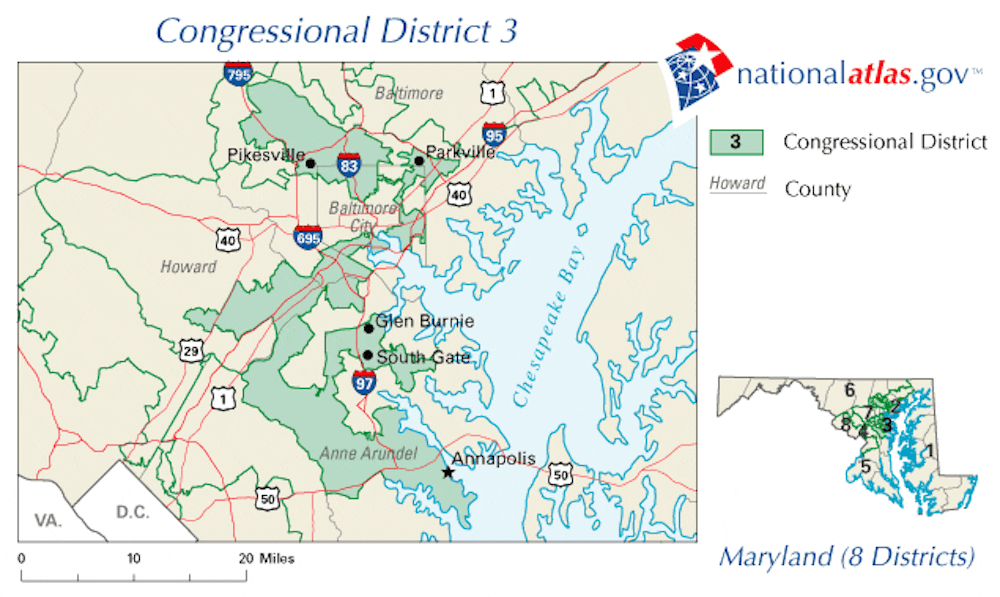
Maryland’s 3rd Congressional District.

For example, Maryland’s 3rd Congressional District is drawn up in a way that guarantees the 2018 election victory of Democratic incumbent John Sarbanes. Congressional districts in Texas are drawn up to favor Republicans, such as Mike Conway who is assured victory in the 11th District.

The mechanism is simple: The political party that controls state legislatures gets to redraw congressional boundaries every 10 years after the results of the most recent Census. Gerrymandering is the partisan redrawing of these boundaries. Basically, it allows politicians to select their voters rather than the voters to choose their representatives.

In 2012, Republicans won a majority of 33 seats in the House despite getting 1.4 million fewer votes than their Democratic opponents. In the past four congressional elections, Republicans have won a larger share of seats than their share of nationwide votes. These results are a sure sign that gerrymandering is involved.

The term “gerrymandering” originates with the activities of Elbridge Gerry, who in 1810 as governor of Massachusetts signed a bill that created legislative boundaries that favored his political party. A cartoonist of the day depicted the boundaries as a salamander. The system was so “gerrymandered” that the Democratic-Republicans won only 49 percent of the votes but picked up 72 percent of the seats.

Gerrymandering involves what’s called the “cracking and packing” of voters by moving the boundaries of voting districts. Cracking spreads opposition voters thinly across many districts to dilute their power. Packing concentrates opposition voters in fewer districts to reduce the number of seats they can win.

There are four main reasons why gerrymandering has gotten worse in the last 20 years.

1. It makes a difference

First, gerrymandering is effective in helping political parties hold power in the House.

Since 1995, after 40 years of uninterrupted Democratic dominance, the House has become more competitive because in large part the South turned Republican.

As the Dixie Democratic stronghold became a Republican bastion, the House came into play. Republicans took control from 1995 to 2007, Democrats won back the house in 2007 and Republicans regained control in 2011. Gerrymandering is now seen as a way to tip the scales in a more competitive climate.

One political consultant, Thomas Hofeller, described by many as a gerrymander genius, was particularly effective in designing redistricting strategies for Republicans between 1992 and 2017. He was one of the first to realize that redrawing boundaries was one way to elect as many Republicans as possible. In 1992 he worked for the Republican National Committee in drawing congressional maps in Arizona, Michigan, Minnesota and Ohio. He subsequently advised Republican politicians across the country on how to redraw electoral maps to their advantage.

2. More effective technology

Second, gerrymandering has become a much more effective tool in the last 20 years. With sophisticated computer programs and ever more detailed information on voters’ location and preferences, politicians can now crack and pack with surgical precision.

Maryland’s 3rd Congressional District slithers and slides across the state to pick up as many Democratic voters as possible. A Republican Texas packs Democratic voters into a few seats to ensure a Republican majority. With pinpoint accuracy afforded by these new technologies, state legislatures are able to ensure victory for their party.

3. The Supreme Court

The third reason is that the Supreme Court has effectively sanctioned gerrymandering.

In 1986, the court in Thornburg v. Gingles ruled against a Democratic legislature’s attempt to thinly spread minority voters among seven new districts in North Carolina. The case was brought by minority groups in the state who felt it impaired their ability to elect representatives of their choice in violation of the Voting Rights Act of 1965. The ruling helped create districts where minority voters were concentrated, so-called majority-minority seats, and hence encouraged the future packing of voters.

When the Republican-controlled Pennsylvania legislature proposed a partisan redistricting plan after the 2000 Census, members of the Democratic Party sued in federal court that it was unconstitutional under the one-person, one-vote principle of Article 1, Section 2 of the Constitution. In Vieth v. Jubelirer in 2004, the court ruled 5-4 not to intervene. Predictably, partisan gerrymandering then increased especially after the redistricting round after the 2010 Census.

Shelby County Alabama filed a case against the constitutionality of the 1965 Voting Rights Act that protected voters’ rights in the South. In Shelby v. Holder in 2013, the court in a 5-4 ruling overturned key elements of the act. The ruling encouraged partisan gerrymandering in areas of the country previously under federal scrutiny.

In 2017, and again in 2018, the Supreme Court passed up numerous opportunities to decide upon the constitutional legality or illegality of gerrymandering. The Supreme Court’s choice not to intervene has emboldened ever more partisan gerrymandering.

4. No likely solution

A fourth reason is that it is difficult for the courts to agree on solutions. There are numerous potential solutions.
The efficiency gap for example measures the number of “wasted” votes for a party that cannot win in a district. The difference between the wasted votes for each side, divided by the total number of votes, is the efficiency gap. It was used to assess the Republican 2011 redistricting plan in Wisconsin.

But technical problems
remain in dealing with the complexity of creating fair elections under the “winner take all” system we currently have.

So, some people argue for a major overhaul of our electoral system to overcome gerrymandering. For example, under equal weighting, voters rank candidates in order of preference rather than just choosing one. Proportional representation would involve major changes to our current electoral system and is unlikely in the near future.

Polarized politics

Gerrymandering has a pernicious impact on the electoral system and on the wider democratic process. It encourages long-term incumbency and a consequent polarization of political discourses. In gerrymandered districts, politicians only need to appeal to their base rather than to a wider electorate.

Legal challenges to gerrymandering may succeed, but until then it remains an ugly fact of the U.S. electoral system that belies our claim to be a democracy. The results of the upcoming election will reflect the redistricting designs of politicians as much as the will of the people.

* * * * *

John Rennie Short, Professor, School of Public Policy, University of Maryland, Baltimore County

This article is republished from The Conversation under a Creative Commons license. Read the original article.

Header image by Joey Csunyo on Unsplash

The Conversation

Staging Important Conversations: She Like Girls

Trying to make it through high school unscarred is difficult, but trying to balance it while discovering one’s sexuality can feel impossible. That’s the story of Kia and Marisol, who struggle to find acceptance in an intolerant community in Chisa Hutchinson’s She Like Girls – the Department of Theatre’s latest production, running now through October 28.

The department strives to produce new plays from diverse playwrights in its seasonal productions. Selecting Hutchinson’s work – she’s an acclaimed new African-American playwright – furthered that goal says director, Eve Muson, who chose the play, in part, to fit her students.

“We have a strong, talented, vibrant group of African-American actors. It felt right to give them the opportunity to play roles that they could absolutely play and audition for after graduation, as they pursue their acting careers.”

“It Makes You Think”

She Like Girls addresses sensitive themes of sexual orientation, community, domestic violence, and hate crimes. Muson relayed that the intention in staging this production on campus is to prompt discussion of these issues and give voice to students, faculty, and others to speak openly and mediate a conversation.

As a coming of age story, “this play speaks to a topic that directly interests our students. It’s also a coming out story and I felt like it was also relevant,” says Muson.

“This play offers up some very key, heartwarming moments that a variety of people can resonate with. It’s an interesting commentary on poverty, sexuality, language, misogyny and bullying,” said Majenta Thomas (Kia), a sophomore acting major. “It makes you think about being better to those around you, which has a place on a college campus, and honestly, everywhere.”

“I think the most important part about playing Marisol is that she is ferociously herself,” says Maria Marsalis, a junior acting major.

Both characters struggle to maintain their secret love to protect their safety.

Much of Muson’s research for the production focused on discovering more about the central character Kia and her world. Muson researched the life of Sakia Gunn, the teenager on whom this story is based, who was stabbed to death by a group of men after telling them that she was a lesbian in an effort to stop their harassment at the Newark train station. Her death was greatly overshadowed by Matthew Shepard’s story. Her world was the city and culture of Newark, New Jersey; Muson wanted to understand how it could impact a young woman.

Interrogating Language

Another part of discovering the “world” of the play was investigating playwright Chisa Hutchinson’s use of language. Language coaches Lynn Watson and Gerrard Taylor were brought into the rehearsals to assist with this process, training actors in the  specific dialect and accent needed to fit with the story.

Although the language of the play can be offensive to some, Muson was ready to challenge the audience: “I love that the play interrogates language.”

The actors were faced with the challenge of using racial epithets and slurs throughout the play. But through the process of working under the direction of Muson relayed that “reclaiming the hateful language is the characters’ way to strengthen bonds as community.”

– Justine Cataneo ’19

She Like Girls will run in the Black Box Theatre in UMBC’s Performing Arts and Humanities Building through October 28. Find out more about dates and ticketing here, as well as information on a panel discussion about the play on October 28.

Photos by Marlayna Demond ’11 for UMBC Magazine.

A day to celebrate chemistry’s favorite unit — the mole. But what’s a mole?

Tara S. Carpenter, Senior Lecturer and General Chemistry Coordinator, 
and Gabriella Balaa, Assistant researcher, UMBC

On Oct. 23, between 6:02 a.m. and 6:02 p.m., chemists celebrate Mole Day. Mole Day is not a day to celebrate those furry little creatures that live in the ground. Rather, it is a day to celebrate a very important idea in the sub-microscopic world.

In chemistry, the mole is a unit used to talk about atoms. It is similar to other units we use everyday. For example, you might walk into the local doughnut shop and order a dozen doughnuts. In doing so, you know that you will get 12 of these snacks and the clerk knows to give you 12. The dozen unit is simply for convenience in discussing a quantity.

We apply the same idea to discuss quantities of atoms. Why do we not simply talk about dozens of atoms? The reason is because atoms are so small that it doesn’t make sense to do so. Imagine a single grain of table salt. That tiny crystal contains over 1,000,000,000,000,000,000 (one quintillion) atoms. Rather than discussing such a large number of atoms, we can talk more conveniently through the mole unit. A mole of something contains 602,000,000,000,000,000,000,000 or 6.02 x 10²³ of that thing.

So rather than talking about over 1,000,000,000,000,000,000 atoms in the grain of salt, we can express the quantity as around 0.000002 moles of atoms, which is much more convenient.

The number 6.02 x 10²³ is also called Avogadro’s number. Amedeo Avogadro was an Italian physicist. In 1811, he proposed that equal volumes of any gas at the same temperature and pressure contain the same number of atoms (or molecules). The number is named after him to honor his work. Because Oct. 23 is abbreviated as 10/23, chemists use this date to celebrate Mole Day.

How much space does a mole occupy?

Now just how many is 6.02 x 10²³? How long do you think it would take you to count to a mole? One day? One week? One year? Go ahead, start counting. It would take you around 20,000,000,000,000,000 years. As you can see, very large quantities of atoms take up very little space which gives us an idea of just how tiny they are. Here is another example: One mole of water with all 6.02 x 10²³ molecules of H₂O occupies slightly more than a tablespoon.

So how do those tiny atoms come together to make up the stuff in the world around us? Even though atoms are so small, there is a lot of action going on. Each atom is made up of even smaller particles called electrons. The way those electrons place themselves around the atom lead to properties we can experience and observe. In a metal, the tiny atoms are swimming in a sea of electrons which gives them the ability to conduct heat and electricity.

How about water? The electrons in a molecule of water are arranged so that each water molecule is extremely attracted to the one next to it. Because of this they naturally arrange themselves at the atomic level in ways that have big consequences in the world around us. When water freezes, the molecules arrange in a way that creates a lattice that causes ice to float in liquid water. Why is that so important? Because ice floats, a pond or lake will freeze at the top, but below the entire aquatic ecosystem is able to survive. This is an amazing phenomenon of water.

Small atoms with big consequences

Many other substances adopt their own unique properties due to arrangement of electrons. The propane gas that we use to fuel a gas grill is a gas at room temperature because the molecules are weakly attracted to each other. Unlike water, they don’t really want to be next to each other at all. Consequently, the space between them results in a gaseous state.

Another important gas is oxygen. We need oxygen to live out our lives. Close your eyes and take a deep breath. As you do that, the molecules are whizzing through your nose, into your lungs where about 0.001 moles of oxygen are absorbed into your blood. Those molecules are responsible for helping each cell in your body produce energy so that your eyes can see the words on this page and your brain can think about what they mean, all while keeping your heart beating.

So, if you ever feel like you’re too insignificant to make a difference, just remember that even the smallest of things matter in the grand scheme of things.

Happy Mole Day!

* * * * *

Tara S. Carpenter, Senior Lecturer and General Chemistry Coordinator, University of Maryland, Baltimore County and Gabriella Balaa, Assistant researcher, University of Maryland, Baltimore County

This article is republished from The Conversation under a Creative Commons license. Read the original article.

The Conversation

Banksy and the Tradition of Destroying Art

by Preminda Jacob, Associate Professor, UMBC

When the British street artist Banksy shredded his “Girl With Balloon” after it was purchased for US$1.4 million at Sotheby’s, did he know how the art world would react?

Did he anticipate that the critics would claim that the work, in its partially shredded state, would climb in value to at least $2 million? That the purchaser would not object and would instead rejoice?

We have no way of really knowing, though the famously anonymous artist did suggest that the shredder malfunctioned: The painting was supposed to be fully shredded, not partially destroyed.

As an art historian, I view his act in a larger context – as the latest example of artists deploying guerrilla tactics to expose their disdain for the critics, dealers, gallery owners and museum curators whom they depend on for their livelihood.

In shredding “Girl With Balloon,” Banksy seems to be pointing to a central absurdity of his graffiti art being treated as fine art. When it appears on city streets, anyone can vandalize it; now that the same images are in galleries and auction houses, they must be handled with white gloves.

But, as he may well know, the art market is far too wealthy and adaptable to be undone by a shredder.

In fact, we’ve seen the same pattern play out, time and again: An artist will launch a withering critique and instead of taking offense, the market simply tightens its embrace.

The many versions of subversion

Some of the most well-known of Banksy’s subversive artistic predecessors were part of the early-20th century Dada movement. One of their principal strategies involved denying the market of objects that could be commodified.

French-American artist Marcel Duchamp is perhaps the most well-known Dadaist. In 1917, his “Fountain,” a urinal laid on its back and remounted on a pedestal, was his first volley against the art market’s intellectual pretenses about art.

Duchamp wanted to force the art world to acknowledge that its judgments about quality were based on media hype and money rather than artistic innovation.

However, years later Duchamp admitted to the futility of his gesture.

“I threw … the urinal into their faces as a challenge,” he lamented, “and now they admire [it] for [its] aesthetic beauty.”

In 1920, Francis Picabia, a Cuban-French Dadaist would follow Duchamp’s lead and participate in a performance purposefully designed to provoke the French art world.

Before a Parisian audience gathered at the Palais des Fêtes, Picabia unveiled a chalk drawing entitled “Riz au Nez” (“Rice on the Nose”). The artist’s friend, André Breton, one of the hosts of the event, then erased the drawing. The artwork lasted for just a of couple hours and is now lost to history. The work’s title, it’s been noted, sounds too similar to “rire au nez” (“to laugh in one’s face”) to be coincidental.

In 1953, Robert Rauschenberg, who was then an up-and-coming American artist, plucked up the courage to ask Willem de Kooning, an established abstract expressionist, for one of his drawings. Rauschenberg didn’t tell de Kooning much – just that he intended to use it for an unusual project. Although de Kooning was disapproving, he acquiesced.

After securing his gift, Rauschenberg proceeded, over the period of a month, to carefully erase all traces of the expressive pencil, charcoal and crayon drawing that de Kooning had put to paper.

Rauschenberg then re-titled the work, now preserved in the collection of the San Francisco Museum of Art, “Erased de Kooning Drawing.”

Jean Tinguely’s auto-destructing work, “Homage to New York” (1960), is probably the closest parallel to Banksy’s stunt. Made of scrap found in New Jersey junkyards, the massive work – 27 feet high and 23 feet in length – was supposed to be a mechanical display, sort of like a Rube Goldberg device.

The piece was set up the sculpture garden of New York’s Museum of Modern Art, and those attending the show included collectors Walter Arensberg and John D. Rockefeller III, and artists John Cage, Mark Rothko and Robert Rauschenberg.

Tinguely briefly set the piece in motion – and then it burst into flames.

The Museum of Modern Art described the scene:

“… a meteorological trial balloon inflated and burst, colored smoke was discharged, paintings were made and destroyed, and bottles crashed to the ground. A player piano, metal drums, a radio broadcast, a recording of the artist explaining his work, and a competing shrill voice correcting him provided the cacophonic sound track to the machine’s self-destruction – until it was stopped short by the fire department.”

Apart from a fragment from Tinguely’s “Homage” preserved in the MoMA collection, all that remains of the work is some choppy film footage.

Some black and white film footage captured ‘Homage to New York’ before it disappeared forever.

It’s difficult to imagine anyone surpassing Tinguely’s sound-and-light spectacle.

But in 2001, Michael Landy of the Young British Artists group orchestrated the most comprehensive “art as destruction” work to date.

Titled “Break Down,” Landy placed objects on a conveyor belt running into a machine that pulverized them. In the process, he destroyed all of his belongings – 7,227 pieces in all – including his own paintings and the art of his Young British Artist peers.

Guerrillas in the midst

These acts of destruction are motivated by the same impulse.

In the late 19th century, art production largely became untethered from patronage offered by the church or the state, and artists turned to powerful art dealers for their livelihood.

But many found that the radical, critical aspect of the artistic act was severely compromised – or erased altogether – when the most well-known feature of a work became the dollar sign attached to it.

To many, the market symbolized nothing more than a void.

With the urban street as his studio and insurgency as part of his artistic mission, Banksy’s graffiti often critiques institutions, such as the art museum, and authority figures like the police) and the Queen of England.

Though the market value of his work has soared in recent years, Banksy continues to paint images in public spaces that make preservation near impossible – and even invite theft or defacement.

Still, as guerrilla theater, Banksy’s recent act will be tough to beat. It’s certainly his most subversive and penetrating public foray into the elite art marketplace.

But even with all his critique, the question continues to nag: Is Banksy complicit with the art market? The very society he undermines, one that feeds on spectacle, has made him famous and his art immensely profitable.

In the wake of World War I, Dadaist artists made a practice of shocking their public audiences by wantonly destroying their own artistic creations. The public soon learned to cheer them on, and to detach themselves from the attack artists were actively waging on their sensibilities.

A century later, at Sotheby’s, the initial shock of a shredded “Girl With Balloon” dissipated quickly. The hype only grew. The market adapted.

Sotheby’s has since released a statement declaring that the piece – renamed “Love is in the Bin” – is “the first artwork in history to have been created live during an auction.”

* * * * *

Header image of Preminda Jacob by Marlayna Demond ’11 for UMBC Magazine.

Preminda Jacob, Associate Professor of Art History and Museum Studies, University of Maryland, Baltimore County

This article is republished from The Conversation under a Creative Commons license. Read the original article.

The Conversation

Best in Class — Rick Wade ’85 and Meagan Wade ’13

Neither Rick Wade ‘85, nor his daughter Meagan Wade ‘13, considered a career in teaching until they each found themselves in elementary school classrooms by happenstance.

Rick had intended to major in political science at UMBC, but began to reevaluate when he did poorly on an exam in a government class. He transferred into one of the few classes still open – an education class.  Through the required weekly practicum at Arbutus Elementary School, he discovered he really liked working with kids, and ended up majoring in education and history.

Although Meagan grew up with a teacher for a father (in fact, Rick was Meagan’s 4th grade math teacher at Hampton Elementary, the same school where he still teaches today), she had never envisioned following in her father’s footsteps.

“I saw how much work was involved, and I was like, I don’t want to have to do that,” she explains.  

Not to mention the fact that it’s not always easy being the daughter of the teacher. On having her father for 4th grade math, she says playfully, “It’s kind of like a running joke – he was the only teacher that year that gave me a B and everyone else gave me an A. I still hold it against him.”

After graduating from UMBC with a psychology major, Meagan began looking for a job in social work, but her dad suggested she apply for an opening at his school as an Additional Adult Assistant, supporting students with special learning needs. She got the job, and before long, Meagan fell in love with the classroom, much to her own and her father’s surprise.

“Then I saw the other side of it, and then I understood. I had never seen that side of teaching before. It was really nice to see the classroom side of it and how rewarding it could be,” says Meagan, who earned her master’s in teaching in 2016.  

Rick believes his influence may have been indirect. “I didn’t overtly encourage her,” he says. “What I did, I guess, was just enjoy what I was doing.”

After two years as a 4th grade teacher in Harford County, Meagan has now joined her father in Baltimore County Public Schools, where he has been teaching for more than 25 years. She is  teaching 1st grade at Norwood Elementary. Theirs is a unique father-daughter bond, enhanced by their professional relationship.  

“I definitely ask him for advice a lot – like how I can get  a student to focus more, or I may run a lesson by him,” Meagan explains, but adds that it goes both ways.  

“He’s come and helped me set up and break down my classroom the last two years, so some of the things he’s seen me do, he says, ‘that’s a good idea,’ like using fabric instead of paper on bulletin boards, things he’s done a certain way for years and has never thought of doing (differently),” she says.

Rick concurs and recalls how he consulted Meagan when Baltimore County began using a technology-based program for recording students’ reading abilities that she had been using in Harford County for two years.  He says she also offered suggestions about how to handle classroom management while administering the test to students individually.

They recollect fondly how they collaborated on a class writing project while they were both teaching 4th grade. In a previous year, Rick’s class had written to penpals in Wales, so he proposed a penpal project to his daughter as a fun vehicle for teaching writing skills.  

“Her class and my class were pen pals together,” Rick says.  “We had the kids write by hand so they could work on handwriting and practice paragraph writing skills and going through the  writing process.”

Meagan adds with a chuckle, “We talk about work a little bit too much. I know it annoys my mom when we’re at dinner.”  

— Cait James ‘01

Photos by Marlayna Demond ’11 for UMBC Magazine