All posts by: Magazine Editor


Staking our Claim

UMBC Researchers Explore the New Great Frontier – The Brain

By Megan Hanks
Illustrations by David Plunkert

In the early 1960s, the prospect of being the first nation to plant a flag on the moon stoked America’s collective imagination, leading to a national commitment from scientists, engineers, and researchers – along with their funders – to explore and understand outer space.

In similar fashion, researchers today are scrambling to explore a frontier that’s just as vast, though considerably closer to Earth – the human brain.

“In some ways, what we have right now is an inner space challenge,” explains Karl V. Steiner, vice president for research, who calls understanding how the brain functions “the holy grail” of research. UMBC is playing a major role on this front, employing technological advances – and, often, interdisciplinary approaches – to delve deeply into brain research on topics ranging from pain perception, to mental illness, to the effects of space travel.

“We have committed as a nation to really spend significant resources, money, and people’s time to reach a goal that was unreachable for us a few decades ago before we had tools like fMRI machines, modeling capabilities, and nanosensors” that allow for the measurement and quick analysis of data that previously was not possible.

“Understanding how the brain works will benefit everyone because even though everyone has a brain, no one understands exactly how it works,” he says.

Measuring Stress

One of the great mysteries of the brain is how it perceives pain and stress. By studying the brains of youth and adults enduring types of social discrimination and physical pain, UMBC researchers hope to make in-roads into early intervention practices for patients.

Raimi Quiton, an assistant professor of psychology who was trained as a neuroscientist, is interested in understanding how pain perception can be impacted by biopsychosocial factors, such as race/ethnicity, gender, age, and socioeconomic status.

“There are large disparities in social group membership or socioeconomic group membership in terms of who develops chronic pain,” says Quiton, explaining that discrimination and marginalization can affect the brain, how the brain processes pain, and how people experience pain.

While studies show that women, African-Americans, and older people experience chronic pain at higher rates, Quiton says that the underlying brain mechanisms of why the risk may be higher for those groups of people is unclear, and the impact of social disparities on the brain have not been widely studied. “The overarching goal of the research is to characterize what is happening in the brain that may predispose certain individuals to developing chronic pain later in life, and to try to identify mediating social factors so that there can be early intervention for at-risk individuals,” she explains.

Quiton also studies how people with healthy brains process pain compared to people with post-traumatic stress disorder. To study the effect of pain on the brain, Quiton uses short, harmless bursts of heat pain and pressure pain on human subjects, evoking a response in the brain that can be observed by Quiton on the screens outside of the fMRI machine. (These types of pain stimuli do not harm the human subject or damage the tissue where the pain stimulus is applied.)

“Lived experience really impacts how the brain functions and how pain is processed,” Quiton said.

Tinoosh Mohsenin, assistant professor of computer science and electrical engineering and director of Energy Efficient High Performance Computing (EEHPC) Lab, recently received a CAREER Award from the National Science Foundation for her work developing deep-learning technology and machine-learning algorithms that can be used in medical and non-medical applications. Deep-learning algorithms are modeled and developed to potentially function like the brain.

Mohsenin is also developing battery powered and cost-effective computing techniques that can monitor brain signals and recognize patterns in brain function. These wearable devices can monitor stress, detect seizures, and possibly identify cancer by analyzing brain waves and image data. “The deep-learning technology can potentially help detect cancer with greater accuracy by providing more information than is found in standard imaging,” she says.

Mohsenin hopes deep-learning technologies will help physicians and medical professionals detect seizures and cancer more quickly and accurately by improving the analysis of highly complex brain signals and data images, beyond what can be gleaned from today’s standard brain monitoring and analysis techniques.

“Current deep-learning models have not been explored for power-constrained smart devices, and this research can potentially revolutionize several fields, including health care, transportation, ecology, surveillance, and public utilities,” she explains.

Mohsenin hopes her work will also help people with significant mobility limitations who use small multi-modal sensors on their tongues as well as other methods to maneuver wheelchairs or command other technologies. More complex algorithms and their efficient hardware implementation can notably improve the responsiveness of such tools for users.

Preventing Mental Illness
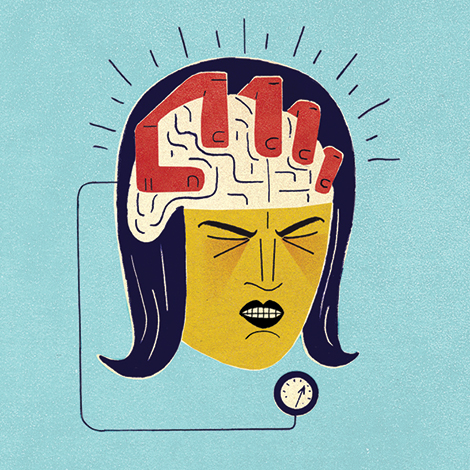
The early identification of mental disorders and illnesses can lead to early intervention and treatment, and help medical professionals provide better treatment and care to patients. Researchers in UMBC’s psychology, computer science, and electrical engineering departments are working to break ground in these emerging areas of work.

Jason Schiffman, professor of psychology, and psychology Ph.D. candidate Caroline Demro are studying the early identification of psychosis among youth ages 12 to 21, who are at risk for the mental disorder in which a person’s thoughts and emotions lose contact with reality. Diagnosing mental illness in individuals early and tailoring treatment plans to individual patients may help prevent mental illness in people who have risk factors that have been identified at an early age.

For people with indicators of psychosis and other mental illnesses – such as the tendency to mistake sounds for voices or objects – the chemical balance within the brain can differ, including levels of dopamine, which helps control the parts of the brain that indicate reward and pleasure. Schiffman and Demro focus on Baltimore city youth who visit the fMRI facility at Spring Grove for mental health evaluations. They use various techniques to determine how the partners’ brains function at a resting state, including what parts of the brain are receiving oxygen, and then ask subjects to answer questions and complete certain tasks while in the fMRI machine to glean insight into how their brains function and what experiences they have had in the past that may signal potential mental illness in the future. Their findings are consistent with research findings from studying adult brains.

“The implications of the illness are pretty pronounced; the human suffering associated with it are hard to overemphasize for many people,” Schiffman says. “That has implications for their ability to work, their ability to find happiness, and it also has implications for our society in terms of people contributing to society through their gainful employment.”

Fow-Sen Choa, professor of computer science and electrical engineering, is one of three faculty who recently received grant funding from the National Science Foundation under the Neural and Cognitive Systems (NCS) program for his work with faculty at the University of Maryland School of Medicine (UMSM) to develop technology that can deliver stimulation to specific parts of the brain. Deep-brain stimulation is an invasive treatment that is sometimes used to help people with neural diseases, such as Parkinson’s, essential tremor, dystonia, and obsessive compulsive disorder. Choa is working to develop a stimulation and monitoring device that will be tested by UMSM researchers on mice – a technology thought to be less invasive than other alternatives.

Choa explains that deep-brain stimulation is typically used as a last-resort treatment when drugs have not been shown to impact the person. The technology he is developing could serve as a tool to help researchers and physicians understand what parts of the brain should be stimulated in individual patients’ brains, and to make modifications and changes to location, frequency, and strength as the operation is in progress.

“If we can find a way to stimulate the brain noninvasively, that is the key,” Choa says.

Crunching the Data

As Steiner alluded to earlier, a researcher can collect all the raw data in the world – but without the means of analyzing it quickly and accurately, the race to understand the brain could be lost. Tulay Adali, distinguished university professor and professor of computer science and electrical engineering, and Seung-Jun Kim, assistant professor of computer science and electrical engineering, are the two UMBC faculty in addition to Choa who received grant funding from the National Science Foundation under the NCS program. They are analyzing data from a control group of people with healthy brains and patients who have been diagnosed with schizophrenia. Kim and Adali have developed an algorithm that can discern how individual brains function, with particular attention to how differences in the brain can impact treatment plans from person to person. The large datasets that Kim and Adali are studying will help physicians make treatment decisions based on the data, when symptoms first appear.

“There is a great need to effectively capture subject-specific traits,” says Adali, who stresses the importance of balancing prediction accuracy and reproducibility. “This is the key step for developing strategies for individualized therapy, intervention and forecasting – of disease and addiction.”

Adali and Kim are collaborating with Vince Calhoun Ph.D. ’02, electrical engineering, a professor of electrical and computer engineering at the University of New Mexico, and executive science officer at The Mind Research Network in Albuquerque, New Mexico. Adali advised Calhoun while he was completing his Ph.D. at UMBC.

Calhoun explains that brain data is stored around the world and is used for many types of research. Typically, for large sets of data to be analyzed, the data has to be compiled in one central location, a challenge for researchers. The method that Adali, Kim and Calhoun are working on will allow brain imaging data to be processed where it is by sending data summaries and decentralizing the data processing.

“There is so much data available today that new approaches that can leverage advanced multivariate algorithms to extract and draw information from brain networks without actually moving data from its various locations are greatly needed,” says Calhoun. “The ability to capture brain networks that show common characteristics across individuals while also fully leveraging the individual aspect of each brain will advance the field considerably.”

And Now, Back to Outer Space

Traveling and spending time in outer space can have long-lasting effects on the human body, due to lack of gravity and other factors, but the brain can be especially impacted by exposure to radiation – especially over time. That’s where Bernard Rabin, professor of psychology, comes in.

NASA has funded some of Rabin’s research to explore the lifetime limits of exposure to radiation in the atmosphere and the ways the human brain is impacted by this radiation. Astronauts who travel to the International Space Station are exposed to a limited amount of radiation; however, exploratory missions that take astronauts beyond that expose them to higher levels of cosmic rays and high-energy radiation that can cause damage to their brains and even accelerate aging in the body and the brain, Rabin explains.

“The changes we see in neuronal function and cognitive performance [after space travel] are characteristic of those changes that we see in older organisms,” says Rabin, whose work focuses on rats. He explains that when astronauts are being selected for space missions, it is important to tell them about the possible consequences of radiation exposure so they can make informed decisions.

“Informed consent is one of the key issues that astronauts need to be told,” Rabin says. The major effect of exposure to space radiation during exploratory class missions lasting up to three years may be an accelerate of the aging process, which may affect the quality of life after the conclusion of the mission.

Looking Forward

Steiner says that the new Interdisciplinary Life Sciences Building scheduled to open in summer 2019 will give faculty and students new tools and collaborative space to continue studying the brain. Set to begin construction this year, the 130,000 gross square foot building will support course redesign with dynamic high-technology classrooms, seminar rooms, and teaching labs; and support interdisciplinary research with twelve shared labs and other support labs to provide unique opportunities for new study.

“There are tremendous opportunities but also very big challenges to overcome [in brain research],” says Steiner. “These are not easy questions, and because they are not easy questions, you have to draw on groups of experts that focus on the particular question you are trying to study, understand, and solve.”

Related: Creating a “Pacemaker” for the Brain: Dr. Kaf Dzirasa ’01, chemical engineering

Sidebar: Next-Level Tools

Down the road from UMBC, in an unassuming gray building on the Spring Grove Hospital campus, lives a technology integral to much of UMBC’s brain research — a functional magnetic resonance imaging (fMRI) machine. Shared by UMBC, the University of Maryland, Baltimore, and the University of Maryland School of Medicine and its department of psychiatry, the fMRI tracks how water moves in the brain, indicating the flow of blood and activity happening within the brain as subjects complete tasks within the machine’s scanning chamber.

Peter Kochunov, research associate professor of physics and deputy director of the Center for Brain Imaging Research, runs the fMRI technology at the Maryland Psychiatric Research Center. He explains that fMRI is used for a wide range of research focuses, often collaborative, including obtaining quantitative information that can shed light on psychiatric illnesses and genetic risk factors that may predispose someone to these illnesses. Without it, many UMBC projects would not be possible. “Having an fMRI machine within walking distance is a really added benefit to us and our campus,” says Steiner.
Save

Save

How to Make a Viral Music Video

With Lisa Soumphontphakdy ’14, Visual Arts

Lisa SoumphontphakdyBack in 2012, Lisa Soumphontphakdy ’14, visual arts, was a recent transfer student looking for a home at UMBC. She loved music, she loved to sing, and she especially loved the idea of making more female friends, so the Stilettos, UMBC’s only all-female a cappella group, seemed like a natural fit.

After auditioning, she quickly bonded with the group and became as involved as possible, arranging music, designing T-shirts, acting as president, and shooting and editing the group’s first video – Meghan Trainor’s hit “All About That Bass,” complete with sassy choreography, which she uploaded to YouTube. “I fell in love with it a lot more than I expected,” she says.

“[Lisa] definitely was a maternal figure in Stilettos,” says fellow Stiletto senior Valerie Pasquale, health administration and policy, who was pleased to work with Soumphontphakdy again last fall. “[She] always was pushing the envelope, trying to get us to be the best that we could be.”

The video she made – a cover of “Boy,” originally performed by the British girl group Little Mix, and arranged by junior Becca Nolder, social work – now has more than 11,000 views. So, what exactly does it take to make a video go viral?

STEP 1: GET A DEGREE IN… DESIGN?

While Soumphontphakdy started off at UMBC as a film major, she switched her focus to graphic design to broaden her post-graduation career options: “Every single business needs a graphic designer,” she says. However, she’s kept her video muscle strong in her current job at Educational Funding Company, a Bethesda-based software firm, since video has proven so effective in online marketing in recent years. It would also provide her a golden opportunity off the clock.

STEP 2: GET YOUR GIRLS TOGETHER

Last fall, when Pasquale asked Soumphontphakdy if she wanted to shoot a music video for “Boy,” with its intricately structured harmonies and, as Nolder says, its “empowerment, Cheetah Girls kind of vibe,” Soumphontphakdy jumped at the chance. A cappella was such an integral part of her college career, she says, that she wanted to maintain the connection.

“This was an organization that I loved and was passionate about… I didn’t want it to be a thing where once I left school, I just forgot all about my a cappella life,” she says.

The group laid down the track in the studios at UMBC’s Performing Arts and Humanities Building (PAHB), assisted by fellow Stiletto Jenna Polignone, music and computer science, and Matthew Neary, computer science. After Polignone mixed and mastered the song, the group was ready to shoot. The production ended up spanning locations across the entire PAHB, from the Linehan Auditorium stairwell to the Forum sculpture outdoors.

STEP 3: GET GOOFY!


While a cappella will get you used to being on stage, performing for a camera isn’t always as familiar – or comfortable – an experience. Luckily, Soumphontphakdy had a strategy there, too: during filming, “we had some of us standing behind the camera, dancing and singing, so that they didn’t feel too intimidated by the camera. [We were trying] to get everyone to loosen up and be more comfortable with the video.”

STEP 4: GET TO THE EDITING SUITE

Filming a cappella groups, Soumphontphakdy says, is a multi-step endeavor: with everyone lip-synching in tune with the audio track, it requires multiple takes of each voice part, the soloists, and the group as a whole. “We managed to knock this down in about two to three hours,” she says, with one to two takes of each group. (“I’m a big advocate for being efficient with time,” she adds.)

Lisa shot the video on DSLR and edited it in Adobe Premiere. “It probably took me four or five hours [to edit] because […] I had to watch through each [clip] individually, to make sure I’m grabbing the good bits. I put markers on the parts where I felt like they were particularly good with the energy, or [with] their expressions, or… just in their overall performance.” In splicing together the video, she wanted to gather “the best of everybody.”

STEP 5: GET ONLINE

The video was released on Facebook on November 28, one week ahead of the Stiletto’s 2016 winter concert, and has since garnered more than 11,000 views. Comments poured in from both inside and outside the UMBC a cappella community, including from Soumphontphakdy herself:

On December 4, the Stilettos played to a full house… or, more accurately, a full lecture hall.

Says Pasquale: “We had [our concert] in the afternoon on a Sunday. Usually you wouldn’t think there would be a lot of people that came, but because of the video, everyone was like ‘Oh, we’ve got to see this group!’ So the auditorium was packed. That just tells you how useful the digital marketing was, and how grateful we are for Lisa’s help.”

As of this writing, another Stilettos music video is in the works.

— Julia Celtnieks ’13

https://www.facebook.com/umbcstilettos/videos/10154688410664882/?hc_ref=PAGES_TIMELINE

Watch “Boy” by the Stilettos at bit.ly/umbcstilettosboy.

Legend of Excellence

During her years as an undergrad at UMBC, Karen Sutton ’97, history, would constantly see Simmona Simmons ’74, American studies, working quietly in the library. Even today, when she stops in the Albin O. Kuhn Library, she sees Simmons and smiles, for even the sight of the librarian still inspires Sutton to pursue her goals.

“I (wanted to) become a librarian vicariously through her,” says Sutton, a lecturer at UMBC. “I plan to use the skills Simmona taught me to inspire others.”

Despite the major impact she tends to have on the lives of others, Simmons has always kept a low profile. Described as modest, quiet, and unassuming, Simmons maintains that people should be measured by their actions. And after more than fifty years of service at UMBC, she certainly has a lot to be measured by, quietly inspiring others – sometimes without even knowing it.

This year, Simmons, along with three other UMBC faculty members will be honored with the Legends of Excellence Award – a tribute that acknowledges faculty members and staff who have made an impact on UMBC’s African and Latino students. Serving on the library staff since the school opened in 1966, and through her role as library liaison, Simmons has had the opportunity to work with countless staff and students.

“My tenure at the Albin O. Kuhn Library & Gallery has been rewarding because I have had the opportunity to work with students, faculty, and staff, answering interesting queries and assisting with their research needs,” she says. “I have always loved working with the students; as they discover new information and as they mature, it is exciting to contribute a small part to their success.”

Simmons is also one of the founders of the UMBC Women’s Center which first opened in 1991, serving on its advisory board. Along with other founders, she pressed for the Center to be on the “footpath” of campus, ensuring that it be, as it is now, centrally located in The Commons for students to easily access.

“What I have learned from Simmona,” says Jess Myers, Director of the Women’s Center, “is that the work and its impact is most important and getting credit is less important.” Though she keeps out of the spotlight, Simmons is hardly inaccessible.

Through these various roles on campus she has made herself available to the student body, and she thrives on the role of mentorship in bettering one’s career. She often encourages students to seek out community and role models.

“Coming from a background where your parents aren’t educated,” says Simmons, referring to her own childhood, students need to find people who can help them make their way through academia.

“Identify a person that is doing what (you) want to do and hitch (your) wagon to that person,” she says. “Just go for coffee with them and ask them five questions.”

Simmons cites Dr. Gloria Oden, poet and former professor in the English department, as her professional inspiration even across the disciplines, recalling Oden’s constant encouragement to strategize and read better sources, and even to pursue writing for various publications and encyclopedias as a means to continue on in her professional development.

Everyone relies on the same tools to pursue their goals, regardless of family background or academic interests. And anyone can encourage others to use these tools: a poet from the English Department inspires a librarian in the American Studies department who inspires an instructor in the African American studies department.

Simmons has made sure that she can be a resource for students and even for other faculty, learning from those who have helped her in her career how to best help others.

— Kristen Russell

Savvy Entrepreneur

Danielle Burnett ’00, M.S. ’05, information systems management, wasted no time putting her UMBC degrees to work. In 2001, a newly-minted college graduate, she founded Applied Technology Services (APS), a technology services company serving commercial and government clients throughout Maryland. Since Burnett launched the company, it’s grown exponentially, recently exceeding 10 million dollars in revenue, and earning her a spotlight in the Baltimore Business Journal. Natural business acumen accounts for much of Burnett’s success, as does the preparation she received at UMBC, she says.

“The information systems program I was in at UMBC was very project-management oriented. And those process-driven skills really did help me in dealing with [business] challenges. That’s where I was able to focus to gain my credibility – my ability to execute,” Burnett says. She also credits the availability of certificate programs at UMBC, such as the one she earned in Electronic Government (she was the first student at UMBC to receive it) as useful to honing the skills she’d eventually apply to her company.

Burnett started out small, with one employee and one consultant. In fact, she remains surprised at the rapid-fire pace growth of ATS. She didn’t always see herself heading up a traditional company with on-site employees. But the contracts were coming so quickly that the accompanying paperwork required to complete them drove ATS from a virtual company to a brick-and-mortar one in 2010.

“All these deals we were working, we needed the paper to move through the organization, from the quote to the order to the invoice,” says Burnett, who took advantage of special programs for minority and small business owners to boost her client base. As a woman-owned company with under 50 employees, ATS qualifies for both. So while most of the country was reeling from the effects of the recession, ATS continued to thrive. Between 2006 and 2011, ATS doubled in size every year.

Burnett is proud not just of her business’ growth, but of the measured way she’s nurtured it. “I’ve never had to let a single employee go,” she says.

For now, the company remains small. She has 12 employees and is contemplating hiring two or three more in the near future. While some employees are family members – including her husband, father and sister-in-law – Burnett says she works to extend the feeling of a family business throughout the company.

Of all of her employees, Burnett says, “I make sure they’re treated fairly, and that they know their importance in the business. And I give them the flexibility to do different things.”

One of the benefits of working for a small business such as ATS, notes Burnett, is that employees can acquaint themselves with various aspects of the organization fairly easily. In fact, it’s an element of the business she conscientiously promotes. “Particularly for younger employees, during performance review, more than anything else, it’s about: ‘What else would you like to be doing?’”

While Burnett feels content about the progress she’s made as a businesswoman, she acknowledges that it hasn’t always been easy. Being a female executive in the IT industry, says Burnett, is challenging. “It’s difficult to earn credibility,” she says, as the field is upwards of 80 percent male.

But she’s plugged on, undeterred. Neither her style nor her company is particularly flashy or trendy, and that’s a point she tries to drive home to young college students whom she mentors through UMBC’s Alex.Brown Entrepreneurship program.

“I try to explain to them that you don’t have to come up with the next Angry Birds to find success as an entrepreneur,” Burnett says.

— Elizabeth Heubeck ’91

Our Best Defense

Bill Ermatinger ’86, political science, grew up in rural Baltimore County, in the (then) small town of Reisterstown. Decades later this small town background comes in handy when Ermatinger describes his work at Huntington Ingalls Industries, the largest military shipbuilding company in the U.S. and our nation’s sole builder of nuclear aircraft carriers.

Aircraft carriers, those behemoths of the ocean, are the most complicated piece of machinery in the world, says Ermatinger. “Imagine you’re creating an entire small town. You have to have clean water and a way to feed all your citizens. You need sanitation and waste disposal, a hospital, a school. Put an airport in there. Now put a nuclear reactor in your town. Once all that is built, you have to be able to move that town anywhere on the planet. Now you have an aircraft carrier.”

As executive vice president and chief human resources officer for Huntington Ingalls, Ermatinger oversees employee health and welfare at the company’s Newport News, Virginia, headquarters as well as other domestic and international subsidiary shipyards. “I get to represent 40,000 shipbuilders of this nation – the men and women building things for our commander in chief,” he says. “They don’t decide where or when these assets are employed, but in the event, they are going to make darned sure they are in a fair fight. I get to represent them and that is simply the coolest thing on the planet.”

When Ermatinger graduated from high school during the Reagan era, he says, his friends all headed to Towson State or Salisbury. However, he says, “I was not looking for a social school. In the early ’80s, if you wanted to be challenged academically, UMBC was your choice.”

Above and beyond stellar academics, Ermatinger says he enjoyed the school’s inclusive environment. “Everybody was treated the same, whether it was race or gender or academic ability, the professors and fellow students made a truly welcoming environment that embraced all students,” recalls Ermatinger. “I visited my friends at other schools and it did not feel the same on their campuses – there were cliques, exclusive sub-groups. At UMBC, I never felt that.”

Upon graduating from UMBC, Ermatinger landed a job at Westinghouse Defense – “right next door to campus,” he laughs – working in human resources. Northrop Grumman bought out Westinghouse in 1996, and Ermatinger worked his way up through the administrative ranks there. “Northrop Grumman went on a buying rampage, like many other defense companies, and bought Newport News Shipbuilding in 2005 along with some other ship makers. They asked me to move down to Virginia to become human resources vice president there, and then when Northrop spun off all their shipbuilding assets into a new company, Huntington Ingalls, I became chief human resources officer for the whole new entity,” he explains.

Indeed, Ermatinger is almost uniquely positioned to weigh and compare the outcomes of various institutes of higher learning. He oversees hiring for his company, which is the largest industrial employer in Virginia (as well the largest private employer in Mississippi, where Huntington Ingalls builds non-nuclear military ships). At the same time, he is also looking at schools as a parent. By both standards, he says, “UMBC is a first-choice school, not a school of option.”

Ermatinger has reached this conclusion after hiring “tens of thousands of kids” over a 30-year career in HR. “I’ve seen a wide range of the skills and qualities needed to be successful, and UMBC excels at instilling the soft skills,” he says. According to Ermatinger, these essential, yet too often un-nurtured, skills include the ability to work with others and to be a good listener. The willingness to persist. To be comfortable in charge: those are skills and attributes that employers are ultimately trying to hire. “The GPA is important, the program they graduated from is important, but in an interview we are also looking at intangibles. The whole person, not just their transcript,” says Ermatinger.

(In fact, Ermatinger credits this “whole person” recruitment approach as one reason Huntington Ingalls’ employee attrition rate is below 3% when the manufacturing industry as a whole averages 13.3% attrition annually).

“That is what my professors at UMBC taught me. It’s part of the culture. And I am very proud of that, as an alumnus.”

— Michelle Gienow

Back Story – Spring 2017

For 25 years, the Women’s Center has provided co-curricular programming, support services, and advocacy for marginalized individuals and communities, along with campus-wide activities such as Take Back the Night, Sexual Assault Awareness Month, Critical Social Justice, and more. UMBC Magazine talked with center director Jess Myers, Vice Provost of Faculty Affairs Patrice McDermott, and special projects coordinator Amelia Meman ’15, GWST, for their thoughts about the center’s mission.

What do you see as the role of a women’s center on a university campus in today’s environment?

Jess Myers: There are so many women in higher education. But just because there are more women, doesn’t mean that there is the quality of experience. There’s still sexism. There’s still racism. There’s still able-ism. I think what women’s centers have been doing is really expanding that notion of which women, and really thinking about all the different kinds of women and their experiences in higher education and what can we do to expand the net in regards to reaching them and supporting their experience here at UMBC, but also in higher education as a whole.

Amelia Meman: It’s also about sort of empowering many different sorts of women. So you talk a little bit about gender equity on campus. But that looks like many different things. So supporting survivors of sexual assault because their stories don’t often get told and also supporting women of color, which has been a renewed focus of the Women’s Center in these past years. Critical Social Justice is also important because it is a way of expanding the notion of what activism can look like, and expands the notion of what women can do and what anybody can do really. The Women’s Center tackles all of these things in the broadest way, but also in the most grounded and people-centered way, which is really special to me. We not only do feminism, we not only do stuff for women, but we try to make social justice a priority. It’s something that we take very seriously.

The Women’s Center, in its early years, didn’t always have an office. As an early advocate of the center, Dr. McDermott, how has the place changed since taking up permanent residence in The Commons?

Patrice McDermott: When [The Commons] was created, a lot of the academic student and staff community around these issues fought to get this location and to get a full-time director. And then, we had this space…and what was done with this space, it’s amazing. We never imagined that this is what this would be, physically as well as it’s the hub of not just those sort of traditional issues that you would associate with women – the sort of expansion into a more nuanced understanding of gender rather than just in the body. It’s not a surprise that the Critical Social Justice work is – that this is one of the anchors on campus for that, because even before we used the word in academia – intersectional – that was the ethos of this space.

Myers: When we’re talking about who we are, what we do, we say we’re a place and we’re a space: a space for people to come out and take a deep breath to feel like their home away from home, but also a place of learning and activism and support. So we really do mean it as an active place that is doing things, but also a space to just take a deep breath and be a community and reconnect and be with people.

McDermott: It has a presence that you feel when you walk in the door, but it also has a presence on the campus for people and it’s a very dynamic space. I would be remiss if I didn’t mention that we saw a parallel, but quite different sort of explosion, in the gender and women’s studies department. These are the pillars if you will, on the campus. It’s one of the reasons I’m at UMBC.

See a collection of historic items from the Women’s Center’s history at bit.ly/womenscentercollection.

Practicing What They Preach

Students come to UMBC’s Emergency Health Services program for many reasons. Some already work as EMTs or as physicians, while others hope to get into health policy or disaster relief. What brings them together, says program chair and professor J. Lee Jenkins ’97, biological sciences and EHS, M.S. ’99, EHS, is a shared desire to help people in need.

“The students here are very altruistic, and they are the classic ‘Wanna change the world, wanna make it a better place,’ people with big ideas,” she said. “Being able to help people immediately and make a difference at a very stressful moment in their lives is really meaningful for us.”

Founded in 1980 at the request of Dr. R. Adams Cowley, a pioneer in the development of the trauma center concept and the namesake of Baltimore’s main shock trauma center, the EHS program at UMBC is one of the oldest emergency medical baccalaureate programs in the nation. Alumni of the program can be found all over the world, providing leadership in clinical and disaster settings, determining policy at all levels of government, and teaching the emergency health professionals of the future.

With an aging population and increasingly complicated primary care options, the emergency medical services community has diversified over the years to meet changing demands, Jenkins said. Partnerships with local rescue outfits allow EHS researchers and workers to integrate health units through better use of data and communication between parties, making service more efficient and targeted by client.

Looking ahead, the EHS department is also embarking on more interdisciplinary research, and recently launched a joint Ph.D. program with the department of public policy, which offers the choice of a concentration in emergency health services. With nearly a thousand EHS alumni currently in the field, Jenkins knows the department is making an impact across the globe.

“We really do have leaders and policy makers all over the world at this point. We have physicians. We have state EMS medical directors. We have people working in ASPR,” or assistant secretary for preparedness and response, at the federal level, she said. “It’s pretty incredible.”

Read about the EHS Search and Rescue excursion.

Up on the Roof – Spring 2017

UMBC President Freeman A. Hrabowski, III, takes your questions.

Q: With the success and momentum from events around the 50th celebration, what are the best lessons learned in how to engage and develop new generations of UMBC alumni for the next 50 years?

— Nate Dissmeyer ’07, information systems management

A: The number one lesson comes from the faces of the alumni who came back. So many were surprised to see how UMBC has developed and evolved over the years. The lesson was that we have to find ways of getting graduates back to campus—not simply to see the growing beauty of the physical setting, but, even more important, to talk with students and faculty and staff; to see other alumni; and to see how much this setting represents community and family in the best senses of those words.

During the celebration, alumni remembered when they were younger. Whatever the age, there’s that sense of nostalgia, and it’s also satisfying to connect to one’s alma mater. Some people were surprised to hear us saying anybody who graduated in the first 50 years would be considered a part of the founding group. Well, whether one graduated in the ’70s or the ’90s or in 2010, all are part of that founding group because we forget how short a period 50 years really is.

The fact is that years from now, when we are 150 years old, people will look back at that first 50 years and say, “Those people helped to found that place.” They had faith that the place was going to be better and better and better. And so there’s a sense of pride people can take in being a part of the foundation of the university. It’s not every university that can talk about its founding graduates or founding alumni and founding faculty and staff, but we are fortunate in that way.

So our graduates have helped to create the institution. The university is only as impressive as its alumni. Universities are fortunate to have superb faculty and staff, but the fact is alumni are always part of the university. That’s the most important message from them—that this is always their university, and will always be their alma mater.

Q: Knowing your intense schedule and commitment to our university, when do you get the time to just be Freeman Hrabowski? How do you kick back and relax?

— Ron Pettie ’82, English

A: This is going to sound really nerdy: Studying French. Literally reading French literature and philosophy, talking with students on campus in French, and having them correct my pronunciation is as relaxing as anything I could possibly do because I’m learning. I’m always learning new vocabulary and new structures of sentences and new ideas. I’ll give you just one idea that will give you the point. I’m studying the differences between American culture and French culture. One of the differences is the French understand that you will cut them off before you finish a sentence. There’s a rhythm to it, where having an exciting conversation means you never finish your sentence. Somebody gets the point, and they just cut you off, and it goes back and forth.

In America, we think it’s disrespectful to cut someone off, and the French would use the word “boredom.” They think it’s rather boring that we wait until one person finishes talking. These are things that we would not think about without having a chance to study those differences. The  reason I enjoy relaxing that way is that I enjoy learning new things, and I enjoy students seeing that there’s so much I don’t know—and that they can correct me! I think that’s a lot of fun. It really is.

The other thing I would say is I enjoy reading in different centuries. I particularly like the pace of the 19th century, whether it’s British or French literature. I love studying different centuries, getting away from the fast pace, being able to slow down and think about an envelope and the smell of a letter. I need that. I need the slowing down process. I also meditate. I both pray and meditate. Very different things, but people don’t know it and I’m not ashamed to say it. I pray all day for all of us. I think we need it.

And finally, I will tell you the most fun thing I’ve done is working with children. I love going to third or fourth grade and sitting on the floor working on math problems with children. I really enjoy that. I enjoy kids because they will always say, “Please don’t go.” You go to leave, and they take your heart. I love it. I’m still thinking about Lakeland Elementary when the little girl said, “Please don’t go.” I told Greg [Simmons ’04, vice president of institutional advancement], “I just may stay.” It’s that innocence of a child that gives me such hope. It really does.

To send a question to President Hrabowski, visit umbc.edu.

To You – Spring 2017

Dear Retrievers,

There’s nothing quite like snow seeping through your boots to wake up the brain and tune you into what’s really important. This happened for me in April, when staff photographer Marlayna Demond ’11 and I traveled to western Maryland to witness UMBC’s 33rd annual weekend-long Emergency Health Services (EHS) “Search and Rescue” wilderness training workshop.

We arrived to find ourselves in less-than-spring-like conditions. As I stood freezing my toes off on a snowy hillside of trees, waiting for a group of students to appear over the ridge where they were conducting a practice grid search, I realized three major things:

  1. My sad, leaky boots were not made for anything other than Baltimore weather. More importantly, though…
  2. Despite the bone-chilling wind, these students were smiling, seemingly oblivious to the cold. They were doing their work with the gusto of people who know how important it is and would continue to do so again and again all weekend, without complaint, long after Marlayna and I had departed for the warmth of our beds, because – quite honestly – they love helping people.
  3. That love extends past their work and into the EHS community. More than twenty former search and rescue alumni from the program’s nearly 40-year history stood in the woods and the cabin as volunteer trainers beside them, many of them coming back for the second or tenth or twentieth year in a row because they share that same guiding desire to help people.

This is not just an EHS attribute, of course, but one that runs through UMBC. During my twelve years working in the loop, I’ve been knocked over time after time by the sheer selflessness that drives our community to learn, perform, and make positive change. In this issue of UMBC Magazine, you’ll see numerous examples. Researchers working to understand the brain in ways that will help Alzheimer’s patients and astronauts and children. People from all disciplines at UMBC working to connect with our neighbors in Baltimore. You’ll meet this year’s winners of the Legends of Excellence award – including one staff member and alumna who has served UMBC’s students since 1966. And this is just the tip of the iceberg of our Retriever community near and far.

In my new role as editor of UMBC Magazine, I look forward to continuing the work of capturing and sharing the best of these stories with you. Standing on that snowy hill in western Maryland reminded me yet again of just how lucky I am to get to see it all up close.

— Jenny O’Grady
Editor, UMBC Magazine

P.S. Thank you to the hundreds of you who shared your thoughts about UMBC Magazine via our web survey this spring. Your voices will help us continue to share the types of stories you love best.

The News – Spring 2017

Cyber Winners

UMBC’s Cyber Defense Team took first place at the 2017 National Collegiate Cyber Defense Competition held in San Antonio, Texas in April, defeating nine other regional winners from across the country in a contest to protect their networks from cyber attacks and threats efficiently and effectively.

“We are as excited about the national cyber defense competition as we are about an NCAA athletic competition,” says UMBC President Freeman Hrabowski. “UMBC is developing brainpower to protect our nation and build the economy in the Baltimore region… Our campus is an ecosystem for cybersecurity talent development.”

Cyber Dawgs’ faculty advisor Charles Nicholas, professor of computer science and electrical engineering, explains that the competition puts the team in a realistic attack scenario, requiring them to use resources and work together to keep their network accessible and make sure systems are not brought down by hacks or cyber attacks.

“We are absolutely ecstatic with our win at Nationals. We have worked very hard to be the first team from the Mid-Atlantic region to win nationals,” said Christian Beam ’18, computer science.

In early April, the Cyber Dawgs beat teams from Towson University, the University of Maryland, College Park, and Drexel University to place first in the Mid-Atlantic Collegiate Cyber Defense Competition, solidifying their spot in nationals.

— Megan Hanks

Read more at UMBC News.


Celebrating UMBC Legends

In May, the UMBC Chapter of Black and Latino Alumni (CBLA) gathered for what has become a highly anticipated event – the Legends of Excellence Award Brunch. Held once every five years, the event acknowledges the extraordinary contributions of faculty and staff who have made an impact in the lives of UMBC’s African American and Latino students during their tenure at the university.

The 2017 awardees are:

  • Earnestine Baker, Former Executive Director, Meyerhoff Scholars Program
  • Willie Lamousé-Smith, Professor Emeritus and Former Department Chair, Africana Studies
  • Simmona Simmons ’74, American studies, Service and Special Projects Librarian
  • Jamie Washington, Former Assistant Vice President, Student Affairs

“This was an outstanding slate of award winners, and it is fitting that they are being honored during UMBC’s 50th anniversary year,” said Stanyell Odom, director of alumni relations, who  helped CBLA with planning the event. “They represent grit and greatness, and it was wonderful to have so many alumni come back to campus to recognize the extraordinary impact they’ve made in the lives of hundreds and thousands of fellow Retrievers.”

Through this event and others, the CBLA supports the Second Generation Scholarship and the Esperanza Scholarship. Both scholarships provide support to students who meet minimum GPA standards, are involved in community service, and have demonstrated a commitment to the advancement of minorities.

Read more about Simmons in this issue of UMBC Magazine.

50th Anniversary and Beyond

As the 50th anniversary year comes to a close, UMBC continues to have much to celebrate – including record numbers of alumni and campus community participation in events and giving all year long.

During last fall’s 50th Anniversary Celebration Weekend, September 16-19, more than 3,300 people attended a range of special events on campus, including a Roots of Greatness Luncheon, GRIT-X talks, Stoop Stories featuring our earliest graduates, a fireworks show with the UMBC Symphony, a celebration of Founders Day, and more. In the months preceding that, hundreds of alumni also attended special events at Light City Baltimore, a Fab Four Reunion, and elsewhere, a dramatic increase over past years.

Linda Dunn ’71, history, who travelled from Delaware to take part, said she enjoyed a number of events throughout the weekend, including the Fab Four dinner.

“At the end of the dinner, they had various people give little vignettes about what they remembered about UMBC, and it was very touching and well-thought-out,” she said. “It served as a wonderful memory to hear all about the things you hadn’t thought about in a long time. It made me smile.”

The “Grit & Greatness” of the 50th also sparked an increase in giving, with a 40% increase in alumni giving at the end of calendar year 2016 over the previous year. Longtime donor and former Alumni Association board of directors member Brian Cuthie ’84, M.S. ’94, computer science, says it just makes sense to support his alma mater.

“I really feel like I owe UMBC a lot. Whenever I’ve been involved in the campus, I’ve felt like everybody is so generous. That, to me, is a sense of obligation,” he said.

In a video released after the Celebration Weekend, President Freeman A. Hrabowski thanked the entire UMBC community for its support and participation, saying, “We’ve laid the foundation… and now we’re ready to begin the next 50 years.”

— Jenny O’Grady

Serving Her Country

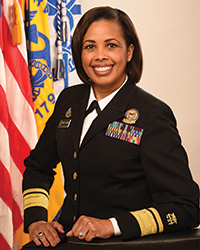
Sylvia-Trent-AdamsRear Admiral Sylvia Trent-Adams, Ph.D. ’06, public policy, has been named acting Surgeon General following the resignation of former Surgeon General Vivek Murthy. The April appointment is the latest step in a career focused on improving access to care for poor and underserved communities. Prior to her role as Deputy Surgeon General, she served as Chief Nurse Officer of the U.S. Public Health Service (2013-2016), and before that held positions in the Department of Health and Human Services, the HIV/AIDS Bureau, and the Commissioned Corps of the USPHS. She also served as a nurse officer in the U.S. Army.

— Jenny O’Grady

Photo courtesy of the U.S. Department of Health and Human Services.


Wish You Were Here!

postcards

Admitted Postcard lunch

Admitted Postcard lunch

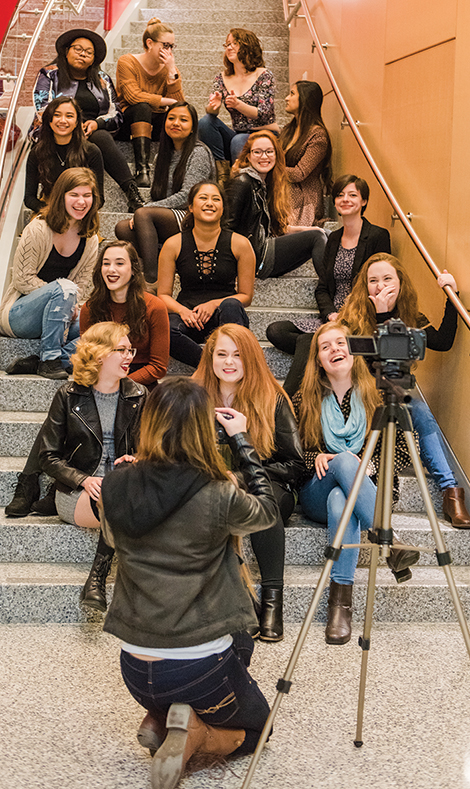
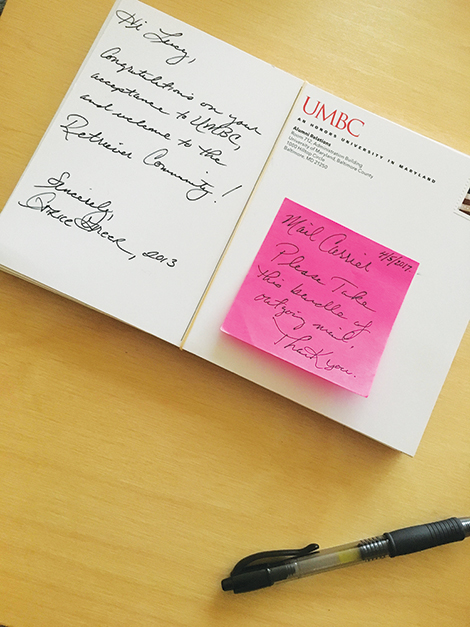
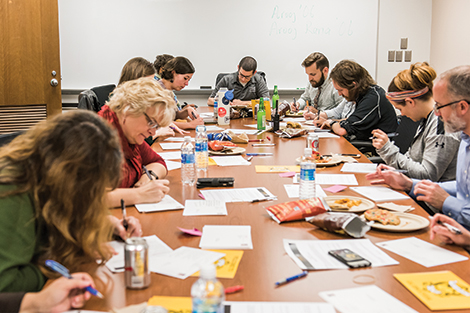
More than 60 alumni wrote 1,400 personalized notes to admitted students in April, giving a new crop of potential first-year students a true Retriever welcome. Top: On-campus alumni gathered to write postcards together. Middle: “As an alumna, I was overjoyed to participate in such a warm and welcoming endeavor,” said volunteer postcard writer Catrice Greer ’13, English. Bottom: Current students from the Center for Women in Technology also mailed notes to potential CWIT Scholars.

The UMBC Experience: Inspired Growth and Success Worth Celebrating

Tom SadowskiThomas Sadowski ’89, political science and public administration and policy, is all about turning opportunity into reality. A first-generation college graduate who until recently headed up the Economic Alliance of Greater Baltimore, Sadowski last year was appointed vice chancellor for economic development for the University System of Maryland. In this role, he is uniquely positioned to see and nurture the possibilities ahead for Maryland’s universities – including his alma mater, UMBC.
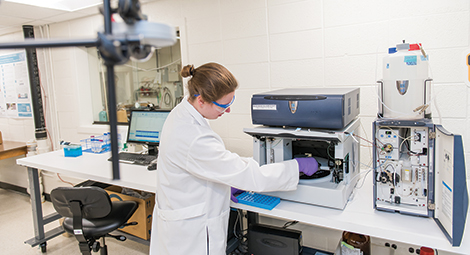
Twenty-five years in economic development have afforded me the opportunity to work with leaders from industry, government, education, and civic organizations from all over the world. There are many leadership styles and approaches to fostering growth, investment, and economic opportunity. One of the things I have enjoyed the most is traveling to other markets to learn and share best practices in how to build an ecosystem, encourage community reinvestment, grow and retain jobs, and attract new business and investment. From Austin, Texas, to Boston, Massachusetts. Silicon Valley to Silicon Alley. Detroit to Dallas. The UK to Japan. Every experience offers things to emulate and avoid.

What were some of the big takeaways? Have a bold vision; build on your history, assets, and strengths; have a plan and commit to execution but be willing to be flexible; don’t fight the market; foster deep and authentic relationships amongst industry, government, education, and civic leaders; collaboration trumps control; celebrate your rock stars and champions; tell your story; and most importantly – celebrate success.

Which of these comes first or second depends on the market, available resources, and specific circumstances. Ultimately the combination of all these, once achieved, creates a sustained sense of buy-in and pride that can make a market more resilient, dynamic, able to attract attention, and seize new economic opportunity. You have heard the term “it’s better to be lucky than good.” Well, in short, there are markets that have been so good at organizing themselves in such a way that they make their own luck and inspire new opportunities that were never considered possible at the start.

What I have just described can easily be applied to the evolution and growth that we have proudly witnessed at UMBC. It has, in turn, inspired new opportunities for students, faculty, alumni, and the institution that were never considered 50 years ago.

It was for this reason I was so honored when asked to contribute this piece to UMBC Magazine. There was no shortage of material to draw from, particularly after UMBC commissioned an economic impact study by Sage Policy Group entitled “The Power of 50: Tracing the Impact of UMBC and its Alumni After Five Decades”. But the more I thought about the piece and studied the numbers, the more I wanted to go beyond the data. I wanted to get to the heart of what the data were saying.

Among the many findings included in the “Power of 50” study was the fact that UMBC has become “an engine of economic opportunity.” It was determined that a key reason UMBC has reached the level of excellence and diversity that it has is due to its ability to foster “academic prowess among students with humble financial backgrounds”. I was one of those students – a first-generation college student, paying my own way. I can’t say I achieved a level of “academic prowess,” but I can say the knowledge I gained and belief I developed in myself was tied to my UMBC experience. It inspired me to try and do the same for others. This same experience has been replicated many times over as the “Power of 50” data suggest to the betterment of communities, organizations, research partnerships, the state’s economy, and beyond.

Best-selling author, three-time Pulitzer Prize winner, and New York Times columnist Tom Friedman (a Marylander) once said, “It is not what you know, but what you do with what you know.” It is that act of “inspired doing” that differentiates UMBC and its alumni. It is part of the culture. This has in turn translated UMBC into a magnet for new students of all means, races, religions, cultures and/or ethnic backgrounds from throughout Maryland and beyond. It is a vital intangible that sustains the momentum UMBC has established and will continue to drive its future. Equally important is the fact that major employers, research laboratories, venture capital investors, government agencies, civic foundations, and others, have taken notice and want to get in on the UMBC experience.

I believe UMBC has arrived at that moment in time, like Austin or Silicon Valley, where its reputation is known and there is a buzz about the institution, its people, and the work that is done there. As members of the UMBC community, it’s important we keep up the good work, continue to “make our own luck,” and celebrate our collective success.

Good Neighbors

Anyone who has had the pleasure of a rooftop visit with Freeman A. Hrabowski knows the joy UMBC’s president takes in pointing out the Baltimore skyline from the top of the Administration Building. That’s because Baltimore — to him, and to UMBC — is not just a nearby spot on a map or a place to watch a baseball game. It’s a life source for the university, providing internships for our students, jobs for our graduates, and culture for all who may choose to take advantage of it.

As much as UMBC receives from the city, however, it also gives back in immeasurable ways, in service and partnership. Every day, members of the UMBC community — faculty, students, staff, and alumni — collaborate with neighbors across the city through art, civic and social service, environmental activism, storytelling, and education projects. The stories that follow highlight just a few of the many, many ways UMBC is making an impact in its beloved Baltimore.

Full STEAM Ahead

A UMBC STUDENT TEACHER READS TO LAKELAND ELEMENTARY SCHOOL STUDENTS.

It has been a year since UMBC and Northrop Grumman launched a partnership in three Baltimore City schools, sparked by a $1.6 million commitment from the Northrop Grumman Foundation. The partnership, which includes Baltimore City Public Schools and the Department of Recreation and Parks, boosts science, technology, engineering, arts, and math (STEAM) education both in and out of school. The work is centered at Lakeland Elementary/Middle School in Southwest Baltimore and is changing how these students, and their families, see science in their futures.

A primary focus of the program will be the development of a state-of-the-art STEAM Center at Lakeland that will feature science labs, a makerspace, digital video and sound studio, computer lab, parent resource room, and community meeting space. The recreation center attached to the school is in the process of getting a complete makeover, but even during construction planning, the new STEAM programs are already happening. After school, girls are learning to design and build apps in the Technovation club, and students are working on robots for Vex Robotics.

Students showed off the work in the first ever STEAM family night, bringing almost 70 students and community members to the school to learn about science together. With more than just financial support, volunteers from Northrop Grumman are now a constant presence in the school, serving as coaches, mentors, and even celebrity readers.

Four years ago, UMBC President Freeman Hrabowski and Lakeland Principal Najib Jammal met to lay the groundwork for collaboration inspired by the vision and philanthropy of George and Betsy Sherman. The partnership that emerged brought UMBC’s Sherman STEM Teacher Scholars Program, Shriver Center Peaceworker Program, and The Choice Program to Lakeland.

“The impact of this partnership goes beyond institutional philanthropy. It provides meaningful learning opportunities for all partners, from Lakeland and UMBC students, to teachers and professors, to STEAM professionals,” explains Rehana Shafi, director of the Sherman STEM Teacher Scholars Program at UMBC.

Beyond STEAM, the partnership also helps Lakeland and other schools build stronger communities. Northrop has supported the expansion of The Choice Program, a highly successful national model for community-based intervention that has served more than 20,000 youth and their families from Maryland’s highest risk communities for almost 30 years. Through the partnership, The Choice Program has expanded to serve students and their families, including former Lakeland students, at Benjamin Franklin High School at Masonville Cove and Excel Academy at Francis M. Wood. At Lakeland, STEAM center staff plan activities for parents, including a food pantry, community Zumba, and free tax preparation. Once the new computer lab is complete, the center will also start offering job training classes.

“We are going to work with our colleagues to prepare these children to compete against anybody, anywhere in the world,” said President Hrabowski. “We want to be saying that we can take children from any background…and make them best in the world. It takes that village, and it takes…hard work.”

— Max Cole and Marie Lilly

Hands-On Science

What exactly is in our water? Through a partnership between UMBC and area schools, students can explore worlds beyond what’s visible by the naked eye.

“Science is premised on asking questions about our world and seeking answers through the scientific method. Students learn best through doing,” says Dean Bill LaCourse of the College of Natural and Mathematical Sciences. Unfortunately, many schools have limited resources to practice science using advanced instrumentation, he explains, but UMBC’s RAIL, or Remote Access Instrumentation Laboratory, can help close that gap.

Through the generous support of Battelle, UMBC is using RAIL to leverage technology to bring high-end analytical instrumentation to elementary, middle, and high school students across Maryland. Housed in UMBC’s Molecular Characterization and Analysis Complex, RAIL aims to increase teacher content knowledge while inspiring the next generation of scientists and researchers in STEM.

Teachers receive training at UMBC to use remote-access software to connect computers in their classrooms to the instrumentation in the RAIL studio. They also learn procedures for collecting water samples RAIL can test – from the Patapsco River to a playground puddle – which they send to UMBC for analysis on RAIL. When the teacher and class make contact with RAIL, a UMBC scientist is available to answer questions via the lab’s two-way video capability. Then the class can remotely operate the instrument as it analyzes their samples and view the data it produces in real time – from pollutant content to salinity. Over the last year, the system has been implemented in schools in Baltimore City and Harford County, and the goal is to greatly increase the reach of the program.

“RAIL will be the basis of a new model for outreach by UMBC,” LaCourse shares, “to provide opportunity and inspiration to students from every corner of the state, including Baltimore City.”

— Sarah Hansen M.S. ’15

Making the JUMP to College

UMBC Seniors

Nepal is a world away from Baltimore in miles of land and ocean. But for those who find they must leave their home there, making that trip is only the beginning of their journey.

“I cannot speak what’s on my mind. I stop because of my language barrier,” said Sushmita Thapa, a Western High senior who had to leave Nepal with her family in 2015 because of the political unrest. Despite the difficulties, she says, “I want to be a doctor. I want to be an independent woman, and I want to help others.”

Thankfully, she has an ally in that process – Hannah Sadollah, UMBC sophomore and mentor in College JUMP (Journey Upward Mentoring Program). Since September, Sadollah has met with Thapa weekly, giving her tips on how to take the next steps to getting into college – from crafting essays to navigating financial aid.

“It hurts my soul that she has the potential to get into college but she wouldn’t have been able to get in because she doesn’t know how to apply,” said Sadollah, who is studying to become a psychiatrist.

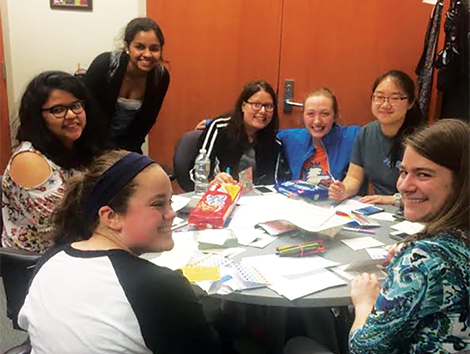
Sadollah and other college students acting as mentors in College JUMP aim to enable high school juniors and seniors who are refugees (or asylees, seeking asylum) with crucial college application and life skills. The program came about two years ago through a partnership between UMBC and the Baltimore City Community College Refugee Youth Project.

Christie Smith ’15, global studies, coordinates the program through AmeriCorps. She says partnerships like Thapa and Sadollah’s work well because “they build off each other’s energy” and are both so motivated. It also helps that, like most of the mentors, Sadollah’s family has an immigrant background. She came here from Iran when she was a baby.

“This gives me an awesome opportunity to give back,” said Sadollah, who learned these skills in high school. She said Thapa is “soaking it up,” to the point where four of her college applications have been accepted, including one to UMBC. Now, like all college-bound seniors in the U.S., she has to figure out what will work for her in her ongoing education.

“I’m learning every day,” said Thapa, “I’m trying to fit into this society every day.”

— Karen Stysley

Charm City Connections

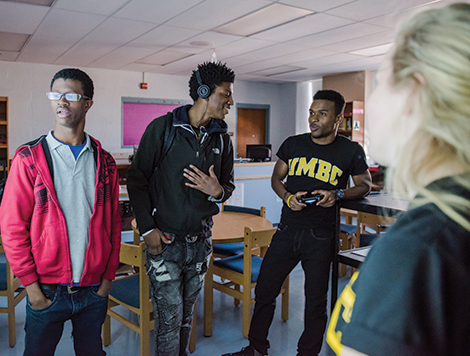
It’s a little chaotic during closing bell at Excel Academy, located on Baltimore’s west side. Teenage students, giddy with the excitement of an unseasonably warm March day, flow in and out of the library — drawn equally to the PlayStation that has been set up and two young men just a few years older than the high school students themselves.

UMBC students Ramses Long ’17, biology, and Jabari McLain ’19, financial economics, are visiting the library to tutor, mentor, and connect. They are members of Charm City Connection, an organization of UMBC students, most of whom also went to school in the city and who want to build relationships as role models and mentors with Baltimore City students.

These after-school sessions are only one of the club’s endeavors, but it’s unique in simplicity and impact. Long, McClain, and the other members are not trying to change policy or act as saviors. They have partnered with UMBC’s Shriver Center to help students with homework, studying, writing a paper – or maybe just getting them into class – on a weekly basis. Excel Academy is an alternative high school for students at least two years behind grade level – usually over-aged, under-credited, and facing a plethora of problems in their homes and neighborhoods.

“We’ve gotten students to commit to their goals. One student didn’t come to school on a regular basis and never came on Fridays. We got him to start coming to school on Fridays,” says Long about the basic nature of their approach. “Another student needed help writing a paper and was behind. We worked on the paper during the after-school session, and she got it in on time.”

Understanding the small steps to achievement like attending class, completing homework, and a few hours of studying, make the Charm City Connection mission humble and effective. Showing how accomplishments like passing a class and moving to the next grade level put goals like graduation, college enrollment, and job placement within reach.

The PlayStation might be a trick to get students into the library after the closing bell rings, but it works. Charm City Connection members have built an honest relationship with Excel Academy students, beyond just tutoring.

“We engage students in conversation to help them contextualize their experiences, so they aren’t as confused by the obstacles they are facing,” says Long. “We want to empower these students to do something for themselves and communities.”

— Alice Crogan

Proof of Life

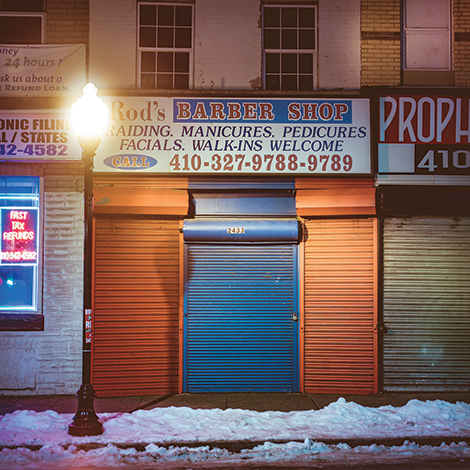
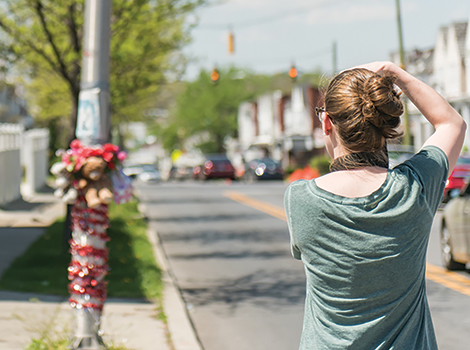
UMBC student Amy Berbert ’17, visual arts, is in the midst of an ambitious yet somber project: using photography to memorialize each of the 318 victims of homicide in Baltimore in 2016.

Berbert began taking photographs at crime scenes in the city last year with the goal of bringing visibility to the traumatic impacts of violence on people and communities. Her year-long senior thesis project, which she posts on the Instagram feed @stainsonthesidewalk, is described as, “An Exploration of Homicide in Baltimore City. Same Day. Same Time. Same Place. One Year Later.” Each death is memorialized with a picture taken precisely one year later at the location of the homicide.

The photographs “are respectful of the people involved,” she told Mary Carole McCauley in the Baltimore Sun. “They don’t judge anyone. It’s just a moment of silence to remember these people, and the fact that they lived and died in that place.”

Though Berbert’s senior exhibit concluded her college career, she is dedicated to continuing the rigorous project through the end of the year, planning her life in 2017 around the lives that were lost in Baltimore in 2016.

By focusing on increasing awareness of lives lost through violence, Berbert hopes to encourage others to engage with and support communities facing challenges. She shares, “As a community we need to educate ourselves and others about the root causes of violence…step out of the bubble of campus and immerse ourselves in understanding the issues that people right down the road from us face every day.”

The broader impacts of Berbert’s work aren’t yet fully realized, but she’s already felt the project’s effects on herself. As she told the Baltimore Sun, “Before I started working on this project, I knew I had stereotypes. But, every time I go out I’m faced with them. I don’t know if this project is going to change anyone else. But, I think it’s changing me.”

Berbert notes the similarity in age of herself and many of the victims as well as perpetrators. “It has inspired me to learn how differences in circumstances and environment can lead two equally human people down two very different life paths. We all want to feel safe, provided for, accepted, and sometimes noticed. As I have read about the victims and the perpetrators of these homicides as well as spend time in the neighborhoods and talk with people who experience the struggles of these neighborhoods, I have learned that we really are not so different.”

— Catherine Borg

Walking the Walk

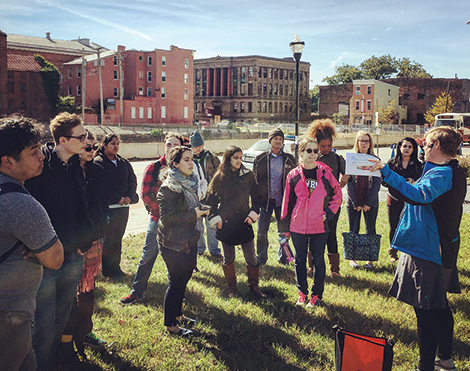
When the students disembark the UMBC Shuttle at MLK Boulevard, their tour guide Kate Drabinski, lecturer in gender and women’s studies, turns the group to face the subject of the day: a part of downtown Baltimore they have likely not explored before this day.

They start walking, stopping to discuss the B&O Railroad Museum, the Bromo Seltzer Arts tower, and other landmarks. With each of these points of interest, however, there is a division as tangible as the short brick wall dividing one side of MLK from the other. The rise and fall of industrialization, the spread of the arts community, and the building of new neighborhoods comes at the expense of demolishing others.

The group goes quiet at the University of Maryland Biopark, a physical reflection of what comes down when something new is built. Boarded-up houses still surround vacant lots reserved for development.

“When we cut those people off from our imagination, then it makes it easier to destroy them,” says Drabinski, who offers the walking tour in conjunction with the Women’s Center Critical Social Justice Week. “From talking to students, their parents say ‘Don’t go to Baltimore. Baltimore is so dangerous.’ But that kind of rhetoric is dishonest … and it justifies the civic abandonment of these places and that is not ok.’”

At the end of the tour, Drabinski leaves the students with a final lesson. They must find lunch and figure out their own way back to campus so they can learn not only about the layers of history within the different places, but also the logistical barriers of getting there and back.

“Stuff that is a little bit scary,… part of the struggle is having someone give you permission to go into that space,” says Drabinski. “As a tour guide or as a teacher I can say, ‘I invite you;’ that is the first step. Just like in class, if I call on you on the first day and you hear your voice, you are more likely to talk through the rest of the semester. With the walking tour, if someone takes you somewhere and shows you how to do it … someone shows you the first steps they are more likely to do it again.”

— Kristen Russell

Making Good CHOICEs

At the dinner table, J’Monnie Walker and his four high school clients act like a family. Their plates piled high with the abundance only a college all-you-can-eat buffet can provide, they joke over ice cream, mac and cheese, pizza, and smiley face french fries, with day glo green soda to wash it all down. They ham it up for a group photo like siblings.

Then Walker, a fellow with the Choice Intensive Advocacy program, which is run by UMBC’s Shriver Center, gets serious.

“Tell me what this program is about,” he says, directing the question to 15-year-old Ja’Bria, a city high school junior who wears a cat ear headband and a welcoming smile.

“When I started the program, I was not a happy person,” explains Ja’Bria, who has missed more than her fair share of school days over the last semester for reasons we don’t discuss tonight. “But now … I’m a happier person. I try to be warmer.”

“Do you feel better?” he asks her. She nods. And her attendance record reflects it.

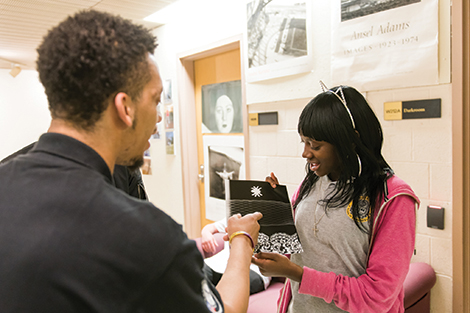
Students who are referred by a state agency into the six-month program find themselves paired with a fellow, like Walker, who visits the school at least twice a week, and the home once a day. Walker is like an extended member of the family, he says, even teaching the students how to cook. Tonight, they’re at Loyola University for a “College Night,” which he hopes will help them see opportunities beyond the challenges of their lives.

“I just want people to see them the way that I do,” and not judge them by their transcripts, he says. “The best part is the progression you see, the window that opens.”

— Jenny O’Grady

Calm in a Storm

Intimate partner violence (IPV) can happen anywhere, and it largely goes unreported and untended. For veterans in the Baltimore area, however, a pilot program created and staffed by UMBC alumni and faculty is setting new standards for care and prevention of this particular type of violence. The Baltimore Veterans Administration Medical Center is among the first of 17 national pilot sites for Strength at Home, a 12-week group-based program developed by Casey Taft Ph.D. ’01, clinical psychology.

“Our programs focus on preventing violence from occurring in the first place, or else ending that violence once it begins,” says Taft, who originated the program at his home base of Boston, and whose recently published trials prove the program to be a bona fide success.

Over the course of three months, small groups of veterans who have been referred to the program meet for two hours at a time to discuss in depth the best ways of responding to stressful situations, the difference between assertive communication and aggressive or passive communication, and other related topics.

“We have been amazed at the receptiveness that we have received at the Baltimore VA, and how invested folks there have been in working to end violence in military and veteran families,” says Taft. “We expect to see the program continue to grow and to be considered the place to refer veterans and service members who are experiencing difficulties with anger and aggression in their relationships.”

IPV Assistance Program Coordinator Julia Caplan ’07, modern languages and linguistics, notes an added benefit is having Taft’s mentor Chris Murphy, professor and chair of the psychology department, just a short drive away. An expert in abuse and violence in intimate adult relationships, Murphy also serves as a trainer for the program.

“We are lucky that we have Chris down the road because they’re training people all over the entire United States. So Casey is in Boston, his co-coordinator is in Texas, and Chris is here,” she said, and Taft agrees.

“His presence there ensures that there will always be incredible local expertise in partner violence intervention and a steady stream of highly competent providers and trainees who will carry on this effort.”

— Jenny O’Grady