All posts by: Magazine Editor


The Power of 50

Tracing the Impact of UMBC – and its Alumni – After Five Decades

In his Founders Day address, UMBC President Freeman A. Hrabowski, III, made the case for UMBC’s vitality and influence as a public research institution. But how do you quantify the university’s success and impact over its existence?
The university asked Sage Policy Group, a prominent economic analysis firm, to assess UMBC’s impact as a university and as an engine of fiscal growth in Maryland.
The group’s report – UMBC at 50: Momentum and Impact – makes a clear and compelling case for the university’s dynamic intellectual, social, and economic influence in its first five decades.

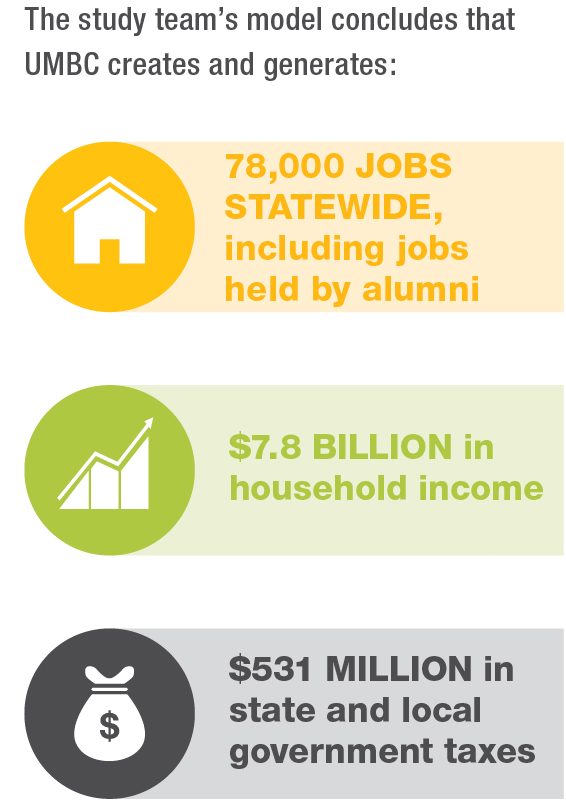
UMBC and Its Alumni Fuel Maryland’s Economy

The earning power and contributions of UMBC’s graduates and employees to the state economy are a key element of the report.
The report pegs the total economic impact created in Maryland each year by UMBC in the billions – a figure derived from the employment produced by the university, its bwtech@UMBC research park, current students and alumni combined with the budgetary spending from those same sources.
Dig deeper – as the analysts did – and you will see that the more than 70,000 alumni who have graduated from UMBC since its doors opened in 1966 are the motor of that powerful impact. The positive economic benefits of obtaining an undergraduate degree are well documented. Sage analysts generated a range of annual household income for UMBC alumni with an undergraduate degree between $84,628 and $131,835. Those who held a graduate degree from UMBC saw even more benefits, with annual household income between $123,654 and $192,630.
And since many UMBC alumni stay in the region, these dollars are at work in the local and state economy. The Sage analysts found that, using mid-point annual income as a foundation, “UMBC alumni spend an estimated $1.2 billion in the regional economy and $1.9 billion in the state’s economy.”

How Did It Happen?

The Sage Policy Group analysts tracked a number of key factors in UMBC’s rise as a public research university that produces graduates with such immense impact.
ENROLLING AND RETAINING STUDENTS
UMBC’s student population had grown strongly over the past 50 years. The analysts observe that “the pace of UMBC’s enrollment growth was particularly rapid between the 10th anniversary [in 1976] and the 25th anniversary [in 1991],” and the university currently boasts almost 14,000 students.
Student Population
Over the past 40 years, UMBC has made substantive progress in retaining students. The university’s progress has been more remarkable still in its support for student completion of undergraduate degrees. Since the university’s 10th anniversary, first-year retention rates for all students have climbed from 76 percent to 87 percent. By comparison, the recent national retention rate for four-year public universities and colleges was 78 percent, and Maryland’s rate was 81 percent. And 67 percent of first-time, full-time UMBC freshmen graduate from the university within six years, while 76 percent complete a postsecondary degree (associate or bachelor’s) at UMBC or some other institution. Including those enrolled now, 90 percent of the men and women who start their college careers at UMBC have either earned a postsecondary degree or are pursuing a degree six years after matriculation.
Retention and Graduation
 
“In building [its] multifaceted student population,” the report concludes, “the university has also lifted its academic caliber while generating a rapidly expanding pool of financial support. This financial support has helped UMBC welcome an increasing number of students from low-income families for whom the education and experience the university offers is likely to fundamentally alter economic prospects.”
[view larger]
AN ENGINE OF ECONOMIC INCLUSION
UMBC is an engine of economic opportunity for its students. This fact underpins the university’s growing excellence and diversity. The SAGE analysts observe that “[t]his is one of those areas in which UMBC really shines – generating remarkable academic prowess among students with humble financial backgrounds.”
UMBC has made startling leaps in the value and scope of its financial aid over the past 25 years. And while the growth in the amount of need-based aid and merit awards at UMBC are eye-catching, the university has also vastly increased the number of Pell grant recipients who attend the school. This is an important metric because most students who receive Pell grants have household incomes of less than $20,000 a year.
Awards
RESEARCH AND CAPITAL INVESTMENTS
Sage Policy Group noted that “UMBC has had remarkable success in capturing funds for research over the decades.” In 1976, the earliest year for which data are available, funds for research at the university totaled less than $1 million. This total grew to $6.8 million by 1991 and then to more than $68 million in 2015, the most recent year for which data are available.
power-of-50-research-funding
The university has also made significant strides in attracting funding for capital growth that is necessary to consolidate its successes and grow along with its expanding mission. The analysts observe that support from the State of Maryland and steady increase in enrollment “have provided nearly $700 million towards the development and construction of state-of-the-art research, instruction, and student life facilities.” There has been an investment of more than $553 million in capital projects on the UMBC campus since 2000, with an additional sum of $110 million to develop the bwtech@UMBC Research and Technology Park. UMBC has budgeted an additional $144 million for facilities over the next four years – budgetary expenditures which will support nearly 4,400 jobs in the Baltimore region.
DOLLARS AND SENSE
The Sage Policy Group report also delves deeply into the economic impact of UMBC in terms of employment, income, taxation base, and overall effects on the state’s economy.
“Reflecting its growth in enrollment, faculty, and staff, UMBC has become an increasingly important economic presence in the Baltimore region and in Maryland,” the analysts write. “From a relatively modest $19 million operating budget in the 1976-1977 academic year, the university’s operating budget grew to $107 million by its 25th anniversary and then to $420 million at its 50th anniversary.” At its current budget levels, UMBC is “one of central Maryland’s economic anchors.”
INNOVATION CREATION
Sage’s analysts specifically mentioned bwtech@UMBC as a key to this impact. UMBC’s research park – established in 1989 – was the first university-based research park in Maryland, and the study’s authors conclude that it is “the most visible manifestation of UMBC’s commitment to translating intellectual capital into more broadly shared regional prosperity.” They add that bwtech@UMBC’s “total economic contribution to Maryland’s economy totals $340 million per annum,” and that it is “home to 1,450 jobs.”

Fab (Four) Storytellers

A collection of vivid vignettes from UMBC’s founding.

The Stoop Storytelling Series – created by Laura Wexler and Jessica Henkin – has become a fixture in Baltimore arts community, encouraging “ordinary” people to tell the extraordinary stories of their lives. So it was a natural for the Stoop Stories team to organize “Retrieve Your Memories: Stoop Stories with the ab Four and Friends” to tell stories of UMBC’s first students and faculty, with a special guest appearance by UMBC President Freeman A, Hrabowski, III. Each speaker stepped into the spotlight for a few moments and brought the early days of the university to life for a packed audience in the Linehan Concert Hall.

What follows are edited excerpts from the event.

Laura Lefavor ’13

Mimi Dietrich ’70: On September 19, 1966, I came to UMBC as a student. I am a member of the Fab Four, which is the first four graduating classes. I want to set the stage a little bit by telling you a little bit about what it was like in 1966. Imagine. There were 750 freshman commuter students. There were no upperclassmen. There were three buildings. Everything that we did was in those three buildings.

We had professors that we had never heard of before. We had no idea what they were like, and we had no idea that they were really as new as we were to this whole thing. It was amazing. It was exciting. We came with notebooks. We did not have any computers. And the best thing of all is that everybody left their phone home, because it was hooked to the kitchen wall with a curly little line. So tonight we’re going to tell you some stories about those days, and take you back a little bit.

Louie (Linda) Sowers ’70: I came to UMBC in 1966, not really knowing what to expect, but I was hoping to play sports here. I had played volleyball in high school. I loved volleyball, so I was really hoping to play volleyball in college. But unfortunately, freshman year we didn’t have any intercollegiate women’s sports. There were men’s sports, but there were no women’s sports. So when sophomore year rolled around, there were still no women’s sports. And I was getting a little nervous, because I really wanted to play volleyball.

So I thought: “Well, I probably need to get a little proactive.” So I decided that I would go speak to Dick Watts, who was the Director of Athletics here. And he was a little bit gruff around the edges, and very intimidating to me anyway, a little shy sophomore. I had no idea what his reaction was going to be, but I went up into his office and I said to him, “What are the chances that we could have a volleyball team this year?” And he never smiled at me. He was very serious. Just stared at me, which seemed like forever.

And then finally he said, “I’ll tell you what. If you bring me a piece of paper with the signatures of the girls who are interested, and if there’s enough interest, I’ll hire you a coach.” So I said, “Okay, fair enough.” So I went out and I did my little recruiting thing, and evidently I was pretty good at begging people, because I came back with 66 names, and he hired us a coach. So this was about four years before Title IX, so we had no money. There was no budget….

We had no uniforms. We wore our gym uniforms that first year. And we had no away games because we didn’t have money for transportation…. [In] junior year, things got a lot better. He hired a woman named Joan Chenoweth, who was the Women’s Athletic Director, and she coached field hockey, basketball, and volleyball. Now, I played on all three of those sports, but please don’t be impressed by that. If you showed up the first day of practice, you were on the team….

By the time I was a senior, our basketball team had a nine and two record. We were invited to the State Championships. We were seeded second in that tournament, and I’m really proud of that. And I’m really proud to have been a part of women’s sports and the starting of it, and I loved every second of going to school here.

Ed Berlin ’70: We all showed up in tribes. There was the Calvert Hall tribe, and there was the Parkville High tribe. And even though we went to different classes, we all found each other back in the cafeteria – our tribe. I happen to be a member of the Jewish City College tribe. And there wasn’t a lot to do. There were some sports, but someone had this great idea that it’s fall, “Why not have a Halloween party?” And for some reason – I can’t remember how – I got to be the facilitator, or the student activity person putting it together.

The very first party in the history of UMBC: October, 1966. And I wanted to make it special, so I scrounged around. I found some pumpkins. I thought that would be great. It’s pumpkin time. And then I realized the pumpkins were rolling around in the cafeteria, and you couldn’t dance or anything like that with these pumpkins rolling around. So if we were going to have a party, we needed to do something about the pumpkins.

It was a facilities gentleman who offered me some old picket fences that looked like they had been here since the beginning of time, and he found me some whitewash to dress them up. And I put the fences around (if you remember) the columns in the old cafeteria, so there were these nice pumpkin patches. And I was feeling pretty darn good about myself.

So people start to show up, and they have amazing costumes. The music was terrible. I think someone had some 45s or something like that. The sound system in the cafeteria was, as you could expect, pretty awful. But I felt pretty good about it. It was packed. It was hot. People were dancing.

And then all of a sudden, I started to hear this shrieking, and people were turning around and pointing at each other’s costume, and there were white streaks all up and down everyone’s costume, right? And people were angry. Who was crazy enough to paint those picket fences, and they were still wet, right? So I didn’t really know what to say. In fact, I think I left early.

Simmona Simmons ’74: I came to UMBC in 1966 as a staff person. I was really, really young, and so was everybody else. I came from Bowie. I had been at Bowie for about two years. I worked there, and then I also was a student. I wasn’t able to finish my education, so I withdrew from school and decided to take the state test so that I could get a state job to fund my education. When I took the state test, the first job that came up was UMBC. I came for the interview with Mr. John Haskell, who was their librarian at that time.

I had just gotten married, so when he interviewed me, he said, “Just got married – you probably won’t be here very long.” So I got the job, and believe it or not, the library was at Hillcrest. Many of you probably don’t even know about that building. Hillcrest was a leftover from Spring Grove, and in the basement, I understand, there were bars. But I never went down there, because it was too spooky. I stayed on the main floor and did what I was supposed to do.

Later on, the library moved to the Biology building. We stayed there a few years. In 1968, the first phase was completed of the library, and I helped move into that phase. Then later on, Phase II was completed. We moved into Phase II, so I helped move that library. Then in 1994, we moved into the Tower, as we know it now, and I think that’s the last move for me.

During that whole time, as UMBC was growing, I decided I would start taking classes. I loved going to school, and I loved learning. I decided: “I will complete my education.” So I started to take classes. Early on, I was an English major. Then I decided I would switch over to American studies. I completed my B.A. in 1974. Then I went on to get my master’s in Library Science, so I’d be a certified librarian. And then I went on and got a second master’s in American studies.

The whole experience here at UMBC was gratifying, and I learned a lot. There weren’t that many people around early on that looked like me, so I was very shy…. Sometimes I felt a little invisible, but I hung in here, and I’m glad I stayed, because as UMBC grew, I grew with UMBC. This has been a wonderful experience. I’ve grown up with the university, and I have to say, some of my best experiences, some of my growth experiences, happened here.

Diane Tichnell ’70: On September 19, 1966, I came with a mission, and I came with an attitude. Now, my mission was I was going to get a cheap education, and I was going to hang around this little rinky-dink place for like two years, and go to the real University of Maryland at College Park. So that was my mission. Now, my attitude was that I was going to wow this campus and everybody else with my journalism
prowess. So the first year, as you’ve heard from our speakers, was kind of kludgy. We were freshmen. There were no upperclassmen…. But there was a newspaper, and second year,
I made my way into the newspaper office….

My first assignment, I was told to go out and count the parking spaces on campus, and then go to Facilities and find out how many more we would have that year. So that got about two inches published in the newspaper. My second assignment was to go and seek out a commissioned sculpture that had been placed on the campus (it was called Entropy Machine No. 7 and Micro Mantis) and find out about it. Well, this gentleman, this sculptor, had been paid $40,000 for this and yet another sculpture.

So I found it, and apparently it was all made out of big iron pipes, and there was a praying mantis for one end, and there was this big machine at the other end. It was to show that when UMBC was developed, we displaced thousands, apparently, of praying mantis colonies…. I actually had a picture put in the paper with that, and maybe four inches of copy that time. So I was so excited.

Finally, [the editor] called me in, and he said…. “There is a group coming on campus, and I would like you to go and interview their leader prior to a seminar they’re going give this afternoon…. It’s in the Student Union….”

So I walked through those doors, and two guys were standing in front of me in guerilla-style warfare outfits. They had boots. They had fatigues. They had berets, and they had bullets across their chest. And they just looked at me. So I [said], “I’d like to speak to the leader of your group….”

That moment was a life-changing experience for me, when Bobby Seale, the co-founder of the Black Panthers for Self-Defense, started talking to me. He was so articulate. He was so committed. He was bang, bang. I couldn’t write fast enough to get down everything he said….

After talking with him, I realized I got nothing. This man put his life on hold, put his family on hold, put everything on hold to walk out there, to come across-country, and to do a big sweep of the East Coast. He could’ve walked out of UMBC and been shot. He could’ve been arrested, as his co-founder was, on trumped-up charges, Huey Newton. It changed my life. Not only the way that I approached journalism, but it changed the way I thought about causes.

They are not abstract. They are people, putting themselves out there for the rest of us. When I finished my interview, I thought to myself – obviously, I didn’t make it to College Park. I changed my major to political science and stayed here. Where can you go and get an experience up-close and personal with the movers and shakers in the country at that time but here? Dr. Albin Kuhn must’ve had some kind of
vision of what was going to happen here, in this microcosm of America that we had. He must’ve known….

John Titchener, emeritus professor, philosophy: My name is John Titchener. I came in June of 1967, one of the hottest summers on record, and taught in the library, first floor, in the classroom facing the pond. The average temperature was between 100 and 110 [degrees].

The ’60s, late ’60s, these people have been saying, were the times of the troubles. Campus was in turmoil. We had all kinds of furor about censorship…. A threat to The Retriever, and the question of prior restraint, all that kind of stuff. I had the misfortune, I think – or fortune, I’m not sure which – to be the President of the UMBC Assembly, which was alleged to be a governing body composed of students, staff, and faculty, and to represent the interests of the entire community.

It fell to me to go to the Board of Regents and complain bitterly about this prior restraint and censorship. So I said to [founding chancellor] Albin O. Kuhn: “I have to go to the Board of Regents meeting, and I have to tell them how much we dislike what you’re doing.”

Now, this was not a very comfortable position to be in. But Albin Kuhn took me aside, and said: “Now look, I understand what you have to do, and I respect you for doing it. But you should know some things about these Regents. One of them is tone-deaf. Not tone deaf, totally deaf, so make sure you face him. He’s important. He’s the one you need to impress.”

He wanted to take me down in a limousine, and coach me, and I said, “I can’t do that.” I was too proud. I mean I represented the faculty; I couldn’t be seen with the administration. But he helped me there, and I did my testimonial. I can’t say it was because of me – I think it was Dr. Kuhn – but the cause was resolved.

I just want to join all the other people who thought about him, because he was an extraordinary person, and an extraordinary first president.

Allen Holtzman ’70: I was in the first UMBC class, 1966, and the first class that graduated, in 1970. I was on the lacrosse team….We went down to the University of Virginia, and we had some fairly good players. But the University of Virginia was a top-rate school, and my friend was the goalie. And he had just told me, when I told him we were going to come down and play (after he stopped laughing), “Oh, that’ll be an easy game for us.” And he predicted a shut-out, which is very unusual in lacrosse. And I said, “Well, we’ll see.”

[At] UMBC, there were no scholarships, so in order to go down, I had to get an okay from [a professor] to take a test before I left, so I did that. And we got on a bus on a Saturday morning really early, like about must’ve been 6 [a.m.], and we drove down there. It seemed like we were in the bus forever, and I remember getting a lot of homework done on the way down…. But we got out there, and we started playing. And it was an unusual game because it was very low-scoring, and we found ourselves playing just as well as they were.

All of a sudden, we were close. I didn’t play that much, but I was a midfielder, so I got in there ccasionally. And lo and behold, the game was over and we won four to two. So every time I see this guy, I don’t say anything. I just mouth the numbers: “Four to two.”

William Rothstein, emeritus professor of sociology: In the spring of 1966, I drove to Baltimore to find housing and visit the campus. I drove down Wilkens Avenue past the dairy farm and the cows, which made me wonder if this was really an urban university. I drove past the Beltway, took a right, and entered Spring Grove State Mental Hospital and saw the bars on the windows, raising more doubts about this new urban university. I eventually located the campus, got out of my car at the top of the hill above the campus, and looked down at UMBC.

The land had been dug up everywhere. None of the three buildings was finished and there were no roads. I had taken a job at a university and there was no university. Could they start classes in the fall? And more important, if not, would I have a job? The first years at UMBC were notable because practically all of the faculty were new Ph.D.s like myself, and not much older than the students, who were mostly freshmen. There were faculty-student basketball games and faculty-student softball games. A faculty colleague was playing basketball in the gym, and saw a student playing basketball who had told him earlier that he had missed class because he was sick….

So many things had to be decided in the early days that we were creating the university as well as teaching and doing research. I found it very exhilarating and collegial, not bureaucratic. At the end of my second year at UMBC, I was walking across the campus and thought to myself, “I think I’ll be a college professor.”
Donna Hekler ’70: I was another one of those commuter students. We all were. There wasn’t a dorm…. So the cafeteria was really a melting pot, as you’ve heard. And I was sitting there one day with my tray and it’s full, ’cause everybody ate lunch in the cafeteria because that was the only place to eat.

So I’m standing there with my tray, looking around, going, “Oh, geez, it’s full. Where am I going to eat?” And I saw my girlfriend, Maria Adams, and she was eating with this sort of nice, distinguished-looking man. And I figured since she was in American Studies, and I was in English, he was probably one of her professors that I hadn’t met yet. And that was normal for the professors to come down and eat
with the students.

So I’m standing there with my tray. I walk over and look at Maria and this gentleman, and said, “Can I sit here?” So I put my tray down, you know, I’m eating lunch. And this gentleman looks at Maria, and says, “Maria, I don’t believe I’ve met this young lady yet.” She said, “Donna, this is Dr. Kuhn.” I went, “Oh my God – I’m eating lunch with the Chancellor of the University.” And I kind of checked myself, and I thought, “Oh, please manners, don’t fail me now.”

Dr. Kuhn wanted to know what these two freshmen, who had only been at the school for a few weeks, thought of our experience. And he wasn’t asking for us to say things he wanted to hear; he really wanted to know what was working, and more importantly, what wasn’t working. What needed to be changed? What did we think really needed more oomph? And as I look back on it, I realize that this is probably the first person of stature that ever listened to me. Really listened, truly wanted my opinion, and heard everything we said, and was willing to act on it. It was quite an amazing luncheon…. It took some grit to open this school, and if the faculty and the students and the staff were the grit, my friend, Dr. Albin O. Kuhn, was the greatness.

Freeman A. Hrabowski, III, UMBC President: In 1992, Michael Hooker accepted a job in Massachusetts, and invited me to go with him. But somehow, UMBC was in my blood, and I knew I wanted to stay here in my role. And yet several faculty members came and said, “We’d like you to think about being our interim president.” I’ll never forget it. Came to my office and said, “You can do this.”

So I became the interim president, and it was a new role, and I felt very humble, but I was so excited. The economy, unfortunately, was in really bad shape. The resources got to the point where the regents decided they had to cut all budgets by millions and millions of dollars. And I’m thinking, “Oh my God, here I am president; what do I do?” Immediately, the regents had a major discussion about the future of each university. And what came through was that they decided which programs would be cut.

We, the presidents, had said, “Please let us make those decisions.” They said, “No.” They decided that a number of programs would be cut, including our fabulous theater program, our ancient studies program, our social work program….

What happened was this: the campus came together. They could’ve said, faculty against administrators, students against everybody else. Instead, when times are tough, and it’s about character, people come together. All of a sudden, social workers from all over the state were saying, “You cannot cut this program….” The faculty in ancient studies were able to get the head of the Greek Church of North
America to write a letter. And so when I went to talk to the regents, I was with God on my side. I want you to know that it was really powerful.

And I’ll never forget being fortified, because I kept thinking, “I wonder if what I say will determine whether I will keep this job?” Because I was so angry that we were treated that way. And I did say to the regents, some of whom I knew had children in very wealthy institutions. And I said to them, “Is it your thought that only rich kids should be exposed to Greek and Latin?” And faces turned red. You know, a lot of people turn red. I don’t, but a lot of people do, right? I said, “I am a strong believer that working-class people, middle-class people, should be exposed to the best, because they’re going to be the leaders, whether you like it or not.”

Amazingly, they listened to me. But then the most exciting part of all came. The [theatre] students took their creativity and decided to come before the Board of Regents. The students came in. All of a sudden it was quiet. They were all in black, and there was a coffin with Theater written on the side, and they put it down in front of the Board of Regents. And they just stood there in silence. It was the most powerful moment. But it said, “This is who we are. We come together as a community.”

The liberal arts are important. If it were not for what they did, we would not be sitting here today. Thank you.

Watch the entire “Retrieve Your Memories: Stoop Stories with the Fab Four and Friends” at 50.umbc.edu/weekendroundup.

Deep Roots

A gathering to honor UMBC founders provides insights in university history.

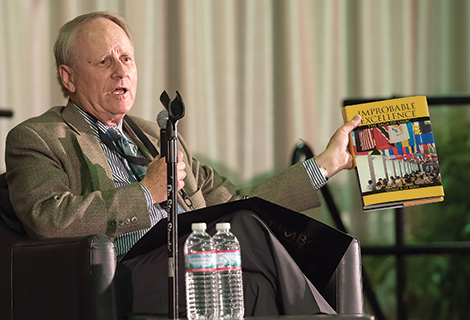
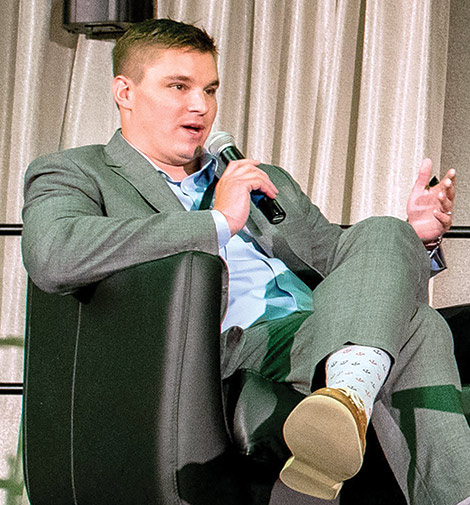
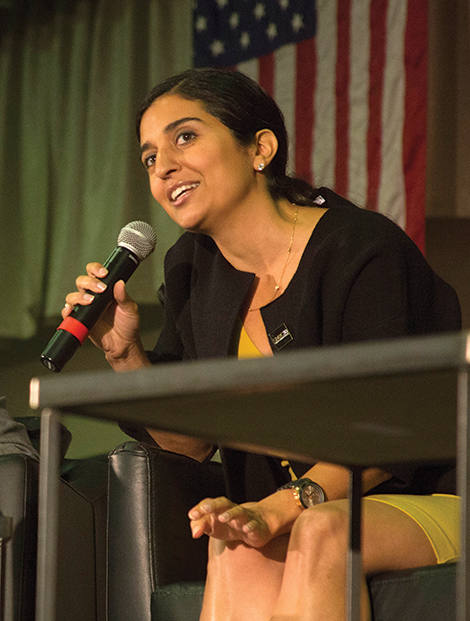
The Roots of Greatness Luncheon, held September 17, celebrated the founding generation of students, faculty, and staff. Among the highlights of the program was a portrait of founding chancellor Albin O. Kuhn, delivered by Wendy Salkind, professor emeritus of theatre, and a discussion of a new history of the university – Improbable Excellence: The Saga of UMBC – written by George La Noue, professor emeritus of public policy and political science. The discussion was moderated by John Jeffries, dean emeritus of the College of Arts, Humanities and Social Sciences, and included two alumni – David Bennett ’11 and Yasmin Karimian ’11 – who worked on the book. What follows are edited excerpts of the program.
Laura Lefavor ’13

Wendy Salkind on Albin O. Kuhn

Albin O. Kuhn – the founding chancellor of UMBC – wasn’t much on speeches and statements. His first letter to students, printed in the very first edition of what would eventually become The Retriever Weekly, observed drily that:

“We do not expect UMBC to be quite like any other campus….”

In one interview, Kuhn spoke about the sales pitch he used to recruit the founding faculty of UMBC:

“That was the thing we talked about a lot when we were trying to attract original faculty and staff. ‘Want to be a pioneer? Come join us. You can develop it and help to make it what it will be…’ It wasn’t a
bad thing to get that kind of person.”

Kuhn began his career in agronomy. He was a grower. And he brought that background along with him to
grow UMBC. Agronomy is a highly interdisciplinary field. Agronomists had to work across boundaries with biologists, botanists, and entomologists. Kuhn [once observed] that interdisciplinary was a concept he also saw as vital to UMBC:

“At the time we came to being developed, universities were undergoing an evolution…toward, as Clark Kerr said in some of his speeches, ‘a prime instrument of national purpose.’ You can’t do that with just science. You have to do that with understanding people. You have to do that with understanding the real drive that’s involved in the humanities and arts. When you put it all together, it can be very forceful. Without all of it together, you won’t get there….”

Kuhn also provided the words that our current president, Freeman A. Hrabowski, III, continues to say to our graduates as they leave the university community to find their own paths. They are special words and still ring true for successive generations:

“If you bring to the future the same personal qualities and personal commitment you have brought to this campus as students, good and important things will happen to each of you, as well as to those around you … and the university community will be proud to have played a part in your life.”

Discussion of George La Noue’s Improbable Excellence

George La Noue, professor emeritus, of public policy and political science

John Jeffries: What contributions did you think [Improbable Excellence] was going to make as you set out on the journey [to write it]?

George La Noue: UMBC has dramatically expanded in almost every way you can think of in 50 years, but there’s always an enriching new flow of students, faculty, and administrators who would have no way of knowing its history. And if you don’t understand institutional history, you may have an incomplete view of institutional values….

Jeffries: Once folks actually get their hands on the book and go through it, they’ll see [it has] a focus and framework around the politics and policy of higher education.

La Noue: Well, guilty as charged…. That’s something I really never regretted. The most common format is administration by administration chronology kind of an encyclopedic view of university history. They are dull, dull, dull, and they don’t exactly work for UMBC because of the extraordinary achievements and tenure of [UMBC President] Freeman Hrabowski….

Furthermore, I think a top-down view of the university really misunderstands the successes and failures that happen on a daily basis in a university. Administrators are enormously important both system-wide and on this campus, but they don’t teach classes, they don’t get the research grants, they don’t direct plays and musical performances, and they don’t win games….

Jeffries: What did you find in your research that was surprising or unexpected?

La Noue: The first thing I found that was surprising was the history of the campus lands. You know we all work here, but we don’t most of us think much about that. There is actually archeological evidence [of human habitation] dating back to 8000-3500 B.C.E…. In the 17th century, the Piscataway tribe occupied the lands and they would kill wolves, and then the white settlers would claim the bounty for the wolves. That was probably not politically correct, but it was done. In the 18th century, Daniel Webster and Henry Clay would take waters at the Sulphur Spring Inn, and the remnants of that [spa] are barely still in the campus….

Jeffries: To what degree do you find UMBC to be sui generis?

La Noue: UMBC was one of the several dozen new-wave urban universities created in the ’50s and ’60s as the demand for higher education expanded. The traditional flagship campuses were not well located to handle an influx of new students – or did not want to. From the beginning, it was like the other new-wave campuses designed to be a research institution. That’s very important. In other respects, UMBC was very different. It was so close to the downtown UM campuses that it could never have the traditional array of professional schools. Further, there were so many other public and private universities in Baltimore and the Baltimore metropolitan area – nine to be exact – that we did not have the built-in political and business support that say a University of California, San Diego or a University of North Carolina, Charlotte had immediately. That made fundraising and program approval very difficult.

Jeffries: What particular challenges did you experience in the research and writing?

La Noue: How do you create records in a situation where the archives are being formed? Where contemporary newspaper documents are really very sparse? Then I got lucky. Serendipity. It came in the form of the UMBC undergraduate research tradition. I was lecturing on higher education desegregation in my Constitutional Law class one day and I mentioned a few things about UMBC’s history, [for instance, UMBC was] the only non-segregated public university in the state. And students were very interested. It’s one of those moments when you’re teaching and they get engaged. So I came up with the idea of forming the UMBC history team of nine undergraduates who wrote extensive original research papers on various topics in the book. Some of their work was so good I had difficulty avoiding plagiarism, because their research and articulation was so impressive….

We’re fortunate to have two of their representatives with us today: Yasmin Karimian and David Bennett.

David Bennett, '11

David Bennett: I heard about the independent study opportunity of working a semester-long on a specific paper…I looked at the Social Sciences here at UMBC, so I had the opportunity… to sit down with the various chairs of those departments… some of them who have been here for many, many years to discuss what that department looked like back then and what it looks like now. It’s really quite astounding to see the determination of folks who were in their early thirties to form these departments to [become] what they are today…. Now I’m a health policy advisor for Senator John McCain in Washington, D.C.

Yasmin Karimian '11

Yasmin Karimian: I got connected to Dr. La Noue through Dr. Hrabowski. I visited Dr. Hrabowski one day and I said, “I think I want to go to law school.” He looked at me, and he said, “Go take Dr. La Noue’s class, and if you get an A we’ll talk about it.” I loved his classes and continued taking them and ended up on the UMBC History team. I did go to law school. I graduated two years ago from Georgetown Law. I now work at Amazon in contracts, but I actually got reconnected to Dr. La Noue this past year. I ended up indexing the book….

Jeffries: What would you say are the principal conclusions that you drew from your study?

La Noue: One is that UMBC’s location turned out to be a great plus…. We were placed as far south in Baltimore County as you could possibly be placed because Towson State is in the county seat, but we are, in fact, in the center of the state and increasingly transportation has gotten easier. We are also located in one of the greatest centers in the world of talented professionals of all sorts…. Maryland has high quality public education and so produces many good students who formerly had to go out of state to get the kind of research undergraduate experience that they needed. UMBC has developed a national reputation of excellence in many areas in part because of the unflagging efforts of Dr. Hrabowski, but also because of the work of faculty and staff that made those claims of excellence credible. Given our ambitions, UMBC is still inadequately supported by state funding and private giving, as demonstrated in the book. It still faces hurdles in program approval. And should the plaintiffs prevail in a case now in the federal courts… then UMBC might lose some of its key programs. Then there is the problem of the ambitions of state flagship campuses for global eminence may end up trampling the welfare of other public institutions.

Finally, in the last several decades, the economic enterprise nationally has become less collegial and more corporate in its character. There is more emphasis on institutional branding, an insatiable seeking for status, and a trend toward using faculty as income producers rather than its truth seekers…. At this moment in our history, universities might well ask if they’ve done enough to raise the deep and unsettling
questions necessary to any society. Historians are not good prophets and so Improbable Excellence concludes this way: “For UMBC with uncertain political support and awkward name surrounded by well established public and private competitors and unable to launch its own professional schools, seeking excellence at its founding by following the traditional route seemed almost most improbable. Instead, UMBC has developed a new model and perhaps the quest for excellence may be a permanent part of UMBC culture. The only thing that can be known for sure is that the past cannot be changed but the future depends on those who care for it.”

You can watch the entire Roots of Greatness event at 50.umbc.edu/weekendroundup.

You can buy George La Noue’s Improbable Excellence at the UMBC Bookstore (bookstore.umbc.edu).

Windows On Today — Emily Russo

EMILY RUSSOSenior and student athlete Emily Russo is majoring in biology and minoring in psychology. A guard and three-year captain on the women’s basketball team, Emily serves as president of UMBC’s Student Athlete Advisory Committee and as a member of the Athletics Policy Committee. She also works part time in Dr. Michael Summers’ HIV-1 Lab on campus.

>> Back to Windows On Today

Sharing the Past, Building the Future

The Albin O. Kuhn Library & Gallery Tells the UMBC Story in Artifacts and Images

— Richard Byrne ’86 

In assembling its exhibit to celebrate the founding decades of UMBC, the team in UMBC’s Special Collections who put together “Sharing the Past, Building the Future: UMBC at 50” – chief curator Tom Beck, archivist Lindsey Loeper ’04, exhibition curator Emily Hauver ’05, and librarian Susan Graham ’98 – have given the university community a chance to glimpse essential objects and images that may have escaped easy notice.

As Beck and Loeper write at the conclusion of their introductory essay:

The ideal as seen by [founding chancellor] Albin O. Kuhn in 1966 has grown greater than anyone could have imagined then. The future as contemplated by [chancellor] Calvin B.T. Lee in 1972, has arrived, and perhaps because Lee was thinking about education in the future, UMBC is prepared for the changes that have continued to propel the university forward. Along the way, the individual identity of the campus has been forged, the seeds of excellence have been sown and reaped and sown again, and a feeling of community has taken root. Research at all levels is routine at “Our UMBC” (the affectionate title of the school alma mater). Those who have been a part of the saga of UMBC will most appreciate and understand our pursuit of dreams while looking toward bigger purposes.

What follows are some of the images and artifacts contained in the exhibit. See the full exhibit online here.

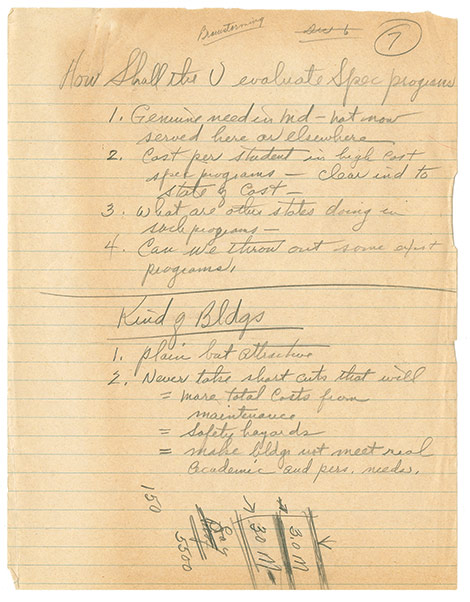
“Brainstorming” by Albin O. Kuhn, 1963
(Albin O. Kuhn papers)

“BRAINSTORMING” BY ALBIN O. KUHN, 1963

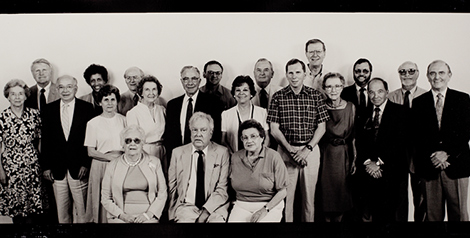
Group portrait of founding faculty and staff by Tim Ford, 1991
(University Photographs)

GROUP PORTRAIT OF FOUNDING FACULTY AND STAFF BY TIM FORD, 1991

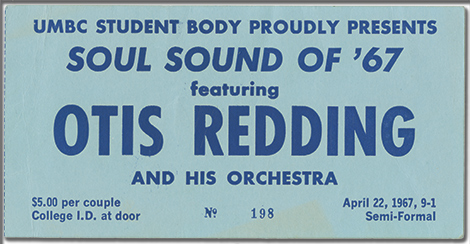
Ticket to Otis Redding show, April 22, 1967
(Robert Dietrich Collection)

Otis Redding Ticket

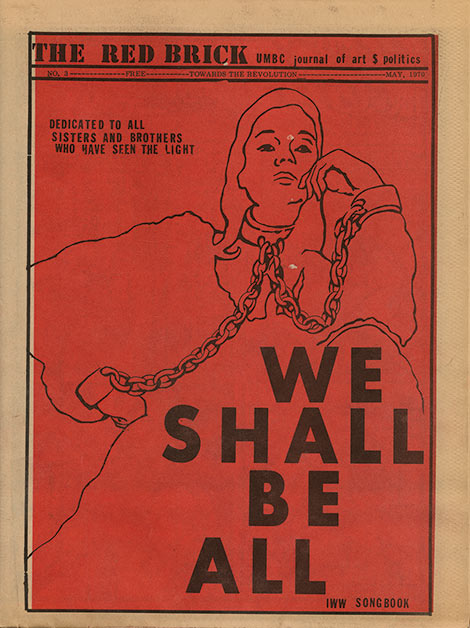
The Red Brick, No.3 (May 1970)
(University Publications)

The Red Brick

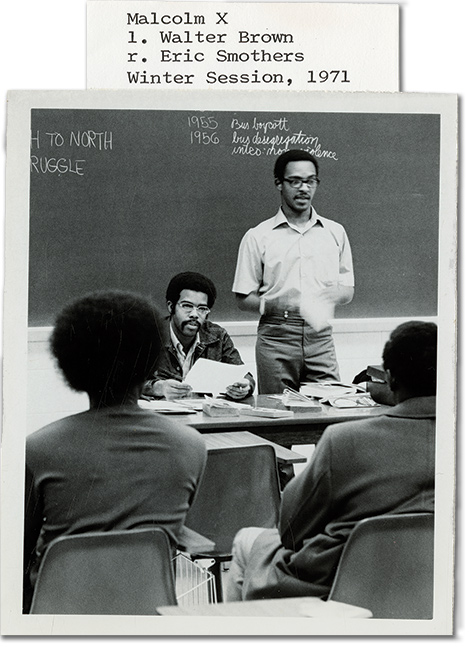
Winter Session Class discussion of Malcolm X by William Morgenstern (Winter 1971)
(University Photographs)

sharing-MX-b

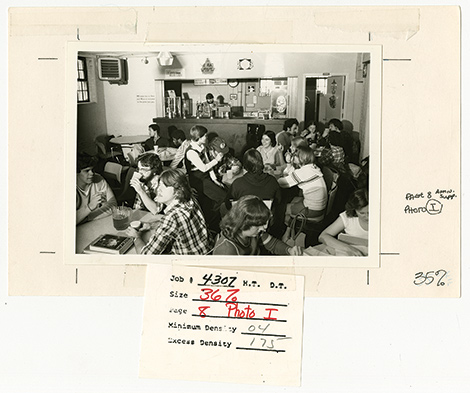
“UMBC Rathskeller” by Photo Service UMCP, 1971
(University Photographs)

The Ratt

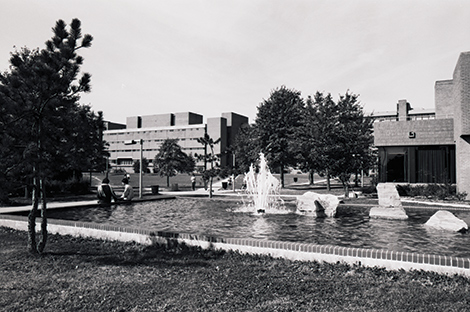
View of campus (Negative #18), 1976
(University Photographs)

UMBC Campus, 1976

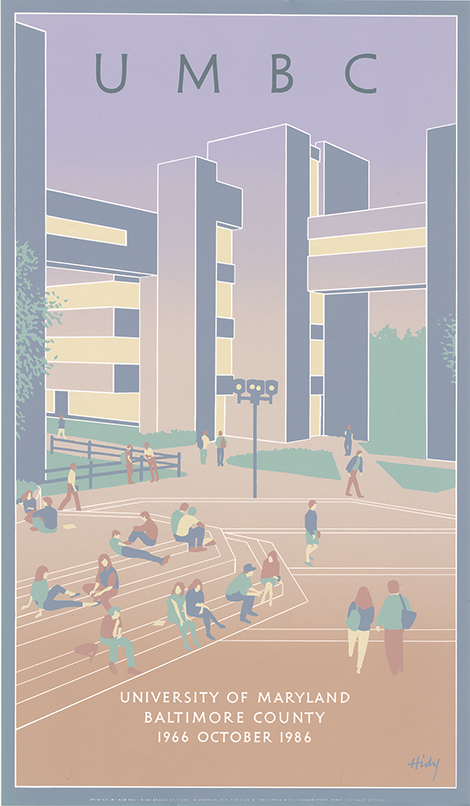
Lance Hidy 20th anniversary commemorative poster, 1986
(Albin O. Kuhn Library & Gallery)

Nationally-known illustrator Lance Hidy designed the poster commemorating the 20th anniversary of the university. His work is known for its minimal detail and flat, solid colors.

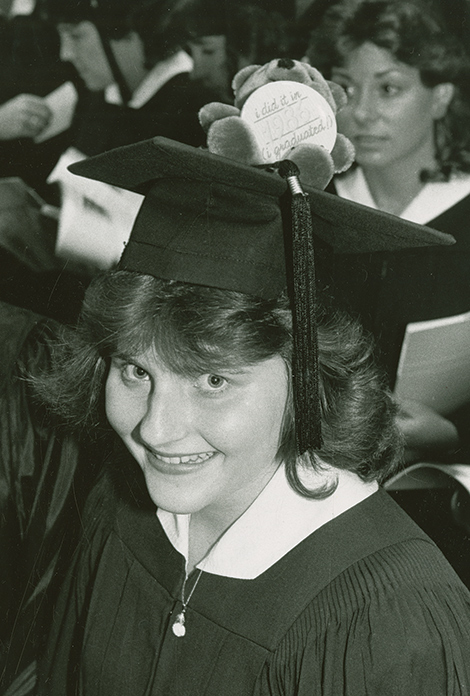
Graduate with a pin on mortarboard that reads “I did it in 1986 (I graduated),” 1986
(University Photographs)

Graduation, 1986

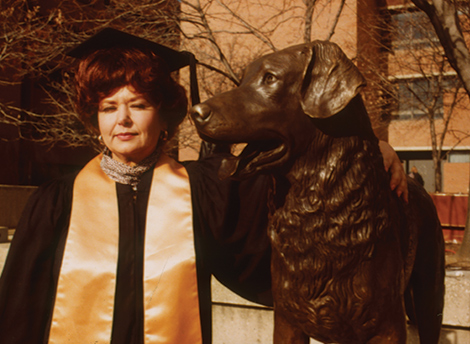
Sculptor Paulette Raye, ’87 with the True Grit statue, December 1987
(University Photographs)

Paulette Raye and True Grit

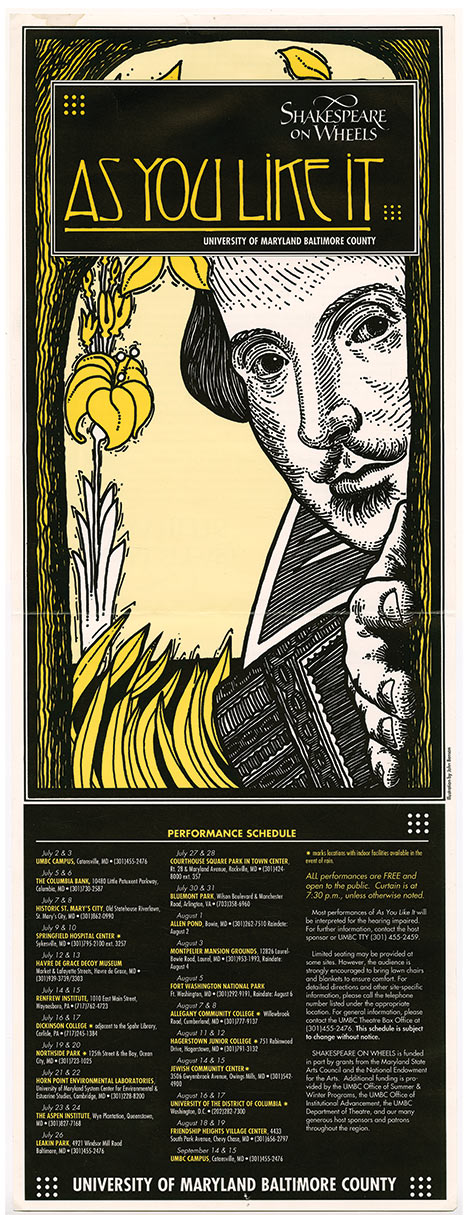
Shakespeare on Wheels, As You Like It, 1990
(Theatre Records)

Shakespeare on Wheels was created by UMBC Theatre professor William Brown. While teaching at the University of Ibadan in Nigeria, his mobile Elizabethan stage traveled more than 4,000 miles throughout the country, and in 1985, the UMBC Theatre Department adopted the idea to bring Shakespeare to Baltimore. The department funded A Midsummer Night’s Dream as an academic summer session class, with a stage set mounted on a rented flatbed travel trailer. The department continued the project every summer through 1994. The goal of Shakespeare on Wheels was to “provide free, high caliber and accessible theatre for the people regardless of their race, age, abilities, religion, or economic status.”

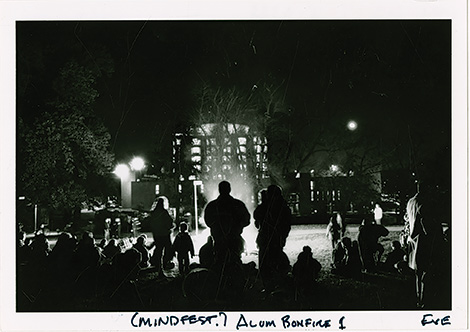
Alumni bonfire with the newly constructed library tower in the background, 1995
(University Photographs)

Library in the distance, Alumni bonfire

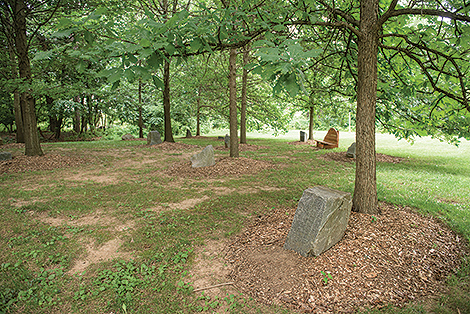
Joseph Beuys Sculpture Park by Marlayna Demond ’11, Visual Arts 2016
(UMBC Creative Services)

Sculpture Park 

Windows On Today — Navaal Mahdi


Senior Navaal Mahdi, media and communications studies, is an Undergraduate Research Award (URA) Scholar, and is completing three internships this fall: social media intern for the Career Center; digital marketing intern for the Division of Professional Studies; and producer of the Compact Nation Podcast for Campus Compact. She’s also planning her wedding in December.
>> Back to Windows On Today

Windows On Today – David Atlas

DAVID ATLAS

Junior mathematics major David Atlas, who is also minoring in computer science and statistics, is an intern working on projects like data visualization and prediction models for T. Rowe Price. He is also an active member of UMBC Hillel.

>> Back to Windows On Today

Windows On Today — Andrea Davis

ANDREA DAVIS

Junior Andrea Davis is majoring in sociology with a minor in Africana Studies, as well as a Sondheim Public Affairs Scholar. She serves as executive aide of the president for the Student Government Association and vice president for involvement for the Student Events Board (seb), as well as civic engagement and leadership intern for the Office of Student Life, and an Orientation Peer Advisor for the Office of Undergraduate Admissions and Orientation.

>> Back to Windows On Today

Windows On Today – Ashton Greenwood

ASHTON GREENWOODMedia and communications major Ashton Greenwood has spent much of her senior year gaining experience in the field as a sports production intern for WBAL-TV, and with the New Media Lab, which produces campus television programming. She also holds down a part-time off-campus job, is a member of Bartleby, UMBC’s literary magazine, and hosts an NFL podcast for WMBC, UMBC’s student radio station.

>> Back to Windows on Today