UMBC’s growing reputation as a hub for research with powerful impact isn’t founded on the achievements of renowned scholars who have created laboratories or explored the limits of the arts, humanities and social sciences at the university alone. It is also built on a growing number of impressive younger scholars who have found a home for their work at UMBC.
The pedigree of the scholars who will propel research and teaching at the university in its next 50 years can be measured in part by the number of early career teaching and research awards these up-and-coming faculty members have received.
One of the most prestigious of these honors is the National Science Foundation’s Early Career Development (CAREER) award, which was created to support “junior faculty who exemplify the role of teacher-scholar through outstanding research, excellent education, and the integration of education and research within the context of the mission of their organizations.” UMBC faculty members have received 29 NSF CAREER awards over the last two decades.
UMBC Magazine would like to introduce you to some of the faculty who represent the bright future for research and teaching at UMBC – and how they are already making their mark on academia and the world.
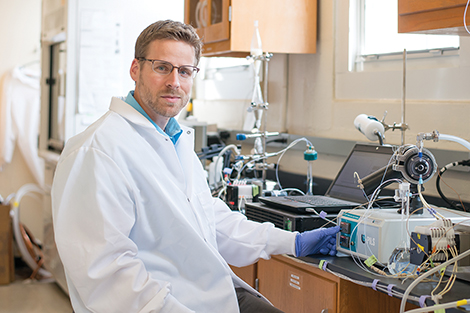
Christopher Hennigan
Everyone dreads a bad air day when it pops up on a weather forecast, but knowing how those conditions are created is essential to finding ways to ameliorate or prevent the damage to health and climate.
Christopher Hennigan, assistant professor of chemical, biochemical, and environmental engineering, is at the forefront of analyzing these issues. His work focuses on pollutants known as particulate matter or aerosols—small particles in the air that have detrimental effects on human health and important implications for climate change.
This work has come to the attention of the National Science Foundation (NSF), which gave Hennigan a CAREER award of $524,606 to characterize the effects of acid-catalyzed reactions on the atmospheric transformation of volatile organic compounds into secondary organic aerosol (SOA).
SOA is an ubiquitous component in the atmosphere that contributes to aerosol effects on human health and climate, but there has been disagreement between laboratory studies and ambient readings on the role of particle acidity in its formation. So Hennigan and his team are developing new methods to rapidly measure particle acidity through automated system that provides the best combination of high time resolution and accuracy.
When Hennigan’s new technique is deployed, it will provide more accurate models representing SOA formation, thus improving scientists’ ability to make predictions related to ambient aerosol events.
“The five-year duration of the CAREER award is especially advantageous, as it will allow us to push the work forward in a highly significant way,” says Hennigan.
–Dinah Winnick
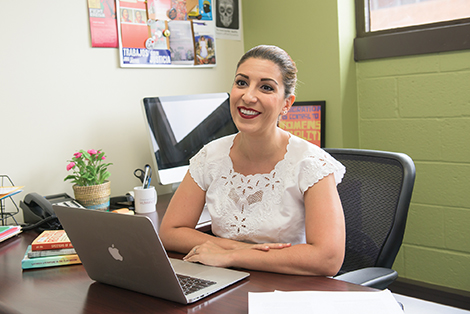
Danielle Beatty Moody
Can poverty and discrimination lead to accelerated diseases and disorders related to the brain including stroke, dementia, and cognitive decline? Pronounced racial disparities have been observed in studies of brain health and pathology, but little is known about how social disadvantages over a lifespan may contribute to those outcomes.
Danielle L. Beatty Moody, an assistant professor of psychology, won a $600,000 Career Development Award from the National Institutes of Health (NIH) in 2014 to investigate these disparities in brain health for African Americans, taking into account many of the possible causal complexities.
As primary investigator of the project, Beatty Moody works with nearly 300 Baltimore residents to determine if there is a relationship between social disadvantages early in life and MRI-indicators of brain pathology that predict future strokes and overall cognitive decline. Her work also examines if these combined factors are more pronounced in African American adults than they are in white adults.
“This type of study has really not been done before,” explains Beatty Moody. “We have a diverse sample in our study, considering race, ethnicity, and a range of socioeconomic statuses.”
Beatty Moody will also investigate associations these data might have with risk factors for cardiovascular disease. The goal of her research is to develop appropriate prevention and intervention strategies that can reduce – and ultimately eliminate – race-related health disparities.
“The key is to understand how early life adversity and race and ethnicity interact to form the health disparities we see in adulthood with African Americans,” Beatty Moody says. “A lot of what happens in childhood can be hard to undo.”
–Max Cole
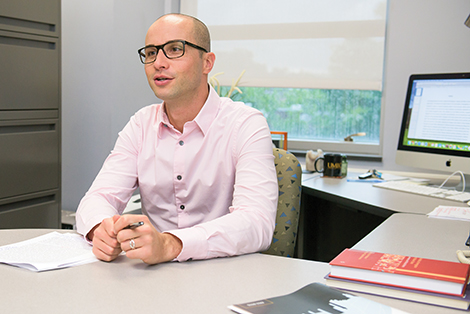
Felipe Filomeno
Why have some countries taken relatively corporate-friendly approaches to intellectual property rules, while others have been more resistant to corporations’ desires? Felipe Filomeno, an assistant professor of political science, spent half a decade studying those questions in South America. Last year, his research led to an Early Career Prize from the Latin American Studies Association.
As a student, Filomeno became intrigued by the disputes surrounding Roundup Ready soybean seeds, a genetically-engineered product introduced by the Monsanto Company in 1996. The seeds generate easy-to-grow crops that are resistant to herbicides, but Monsanto has fought for widely-disliked laws that forbid farmers from saving, trading, or cross-breeding patented seeds.
In some countries — notably Brazil — Monsanto has won almost all the legal protections it has sought. In Argentina, for example, farmers have maintained the right to save and recultivate seeds from their own soybean crops, including seeds that have inherited Monsanto’s engineered traits.
“I thought [these differences were] an interesting and understudied issue,” says Filomeno, who spent several years doing field work, archival research, and interviews while he was earning a doctorate in sociology at Johns Hopkins University.
In Monsanto and Intellectual Property in South America (Palgrave Macmillan, 2014), he argued that Argentine farmer-activists’ success derives largely from the fact that the nation’s major farmers’ organizations were given formal roles in regulating agricultural biotechnology as early as the 1970s.
Since arriving at UMBC in 2014, Filomeno has researched how cities make conscious efforts to welcome immigrants. He has spent the past two years studying ostensibly pro-immigrant municipal policies in Baltimore and other U.S. cities, and is now examining immigration policies in Buenos Aires, Mexico City, and Sao Paolo.
–David Glenn
Jeffrey Gardner
Simple biological processes can have great impacts. They may even be the future of fuel.
Jeffrey Gardner, an assistant professor of biological sciences, investigates the soil bacterium Cellvibrio japonicas and how it finds and breaks down complex sugars for energy. He received the Department of Energy’s Early Career Award in 2015 to advance work that adds to foundational knowledge and may have practical uses in renewable fuel.
Gardner is especially interested in how C. japonicas may prioritize one energy source over another. “If you’re a bacterium in soil, your senses are not as sophisticated as ours,” observes Gardner. Yet the microbe at the center of his research is able to regulate production of enzymes that break down nutrient sources depending on which are present and “move toward things they like and away from things they don’t.”
Part of Gardner’s work focuses on engineering C. japonicas to produce bio-ethanol as a source of renewable fuel. He recently submitted his first patent application. “It’s exciting to translate the research into a product,” he says.
While the applications are exciting, Gardner says the foundational knowledge his research provides is crucial. “Getting people to find value in fundamental science is incredibly important,” he says.
Gardner adds that UMBC’s biological sciences department “really wanted to make sure my research program took off. A lab is like a spaceship: It takes a really long time to get to the launch pad, and a whole lot of fuel to lift off, but once you’re in orbit, things get a little easier.”
–Sarah Hansen
Viviana MacManus
The human cost of conflicts in Latin America in the latter half of the 20th Century was immense – so much so that the political violence in places including Mexico and Argentina became fixed in the public imagination as so-called “dirty wars.”
Viviana MacManus, assistant professor of gender and women’s studies, has focused much of her research on uncovering the legacy of those conflicts. It is research that has been recognized by the Woodrow Wilson National Fellowship Foundation with a Career Enhancement Fellowship for Junior Faculty award.
Funded by the Andrew W. Mellon Foundation, the award provides support to junior faculty to pursue scholarly research and writing essential to attaining tenure. MacManus will use the sixth-month fellowship to work on her book manuscript We Are Protagonists of This History: Gender, Political Violence, and Testimonies of Resistance in Latin America’s Dirty Wars.
MacManus cites the “support network and sense of camaraderie” at the university as a key to “helping junior faculty thrive and succeed in their careers at UMBC.”
Her book is largely based on research she conducted in Argentina and centers on gender and state violence during the violent political tumult in the region in the two decades after 1960. MacManus is compiling extensive interviews she conducted into oral histories that examine the gender politics involved in guerrilla movements and unarmed political organizations in Mexico and Argentina.
“I am pleased that there is investment in supporting academic work on social justice scholarship and feminist theory,” says MacManus, “as my research focuses on critical human rights and gender violence in Latin America.”
–Max Cole
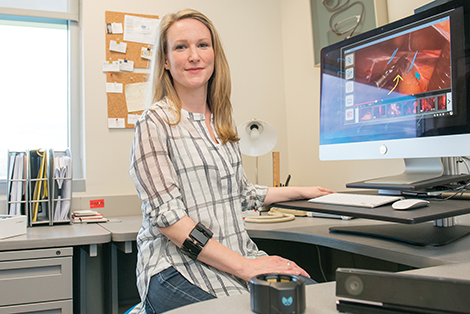
Helena Mentis
Physicians, and specifically surgeons, have a wide array of new technologies to help them perform faster, safer procedures. But how can they be utilized while maintaining core principles of surgery – especially ensuring sterility?
Helena Mentis, assistant professor of information systems, is pushing that careful balance of innovation and tradition with work that focuses on “touchless interaction” interfaces. The technologies that Mentis uses in her lab are commercially available, she explains, and surgeons can wear the devices under their scrubs. She began her research using Xbox Kinect, then eventually moving to Leap Motion. Most recently, she has worked with the Myo armband and Google Glass.
The National Science Foundation (NSF) saw the potential in Mentis’ research on surgical telemedicine and gave her a $518,121 CAREER award to explore the benefits of collaborative image interaction through gesture-based tools. Such tools will allow remote surgeons, for instance, to share their expert knowledge in the operating room.
Finding the right tools and best practices to most effectively facilitate telemedicine, teleconsulting, and telementoring will be at the center of Mentis’ research. She will also investigate verbal and nonverbal mechanisms that medical professionals use to share knowledge and images quickly, while avoiding contamination in the operating room.
Mentis observes that telemedicine is often considered the future of medicine. But though there are many promising technologies now available, she adds, “there are no clear directions yet about the best ways to do telemedicine.”
Over the course of the grant, Mentis hopes to incorporate new emerging technologies into her research and help shape the direction telemedicine will take as it becomes a common tool in medical practice.
–Megan Hanks
Corrie Parks
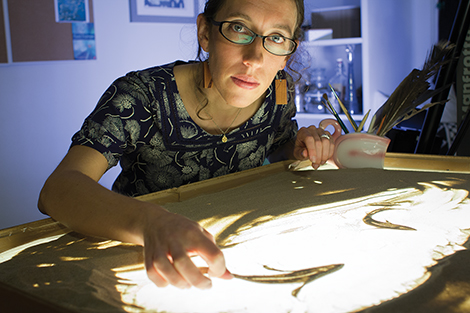
Most animation is created digitally, but Corrie Francis Parks – an assistant professor of visual arts – prefers to handcraft colorful work such as her short animated film, “A Tangled Tale,” using materials including sand.
“We’ve been through the digital revolution,” says Parks. “We’ve achieved photo realism. What comes next? What comes next is artistry.”
“A Tangled Tale” has been shown at film festivals around the world – one of a series of projects that is bringing Parks international acclaim. Her new book, Fluid Frames, was published in April, and features some 30 pioneers in experimental animation, and her tour for the book included a stop in Vienna, Austria.
In March, Parks and UMBC associate professor of visual arts Kelley Bell ’06, imaging and digital arts created “Projected Aquaculture” – a whimsical look at the Chesapeake Bay – for the Light City Baltimore festival. This summer, the project will be screened on the facade of the Museum of Contemporary Art in Zagreb, Croatia.
Parks was a freelance animator and photographer in Montana before joining UMBC’s faculty to teach stop motion and character animation two years ago. “It’s a really fabulous place to be a faculty member,” she says.
She appreciates that UMBC’s approach to research explicitly embraces the arts. “That’s the kind of environment you want to work in,” Parks says.
The students in UMBC’s broad liberal arts program have also proved to be an attraction to Parks ”They come up with things I couldn’t teach them,” she observes. “They just figure it out.”
Nanoparticles are a key element of product design, so foundational research in understanding how they interact with the environment is crucial. Scientists understand how conventional liquids, like water, behave on ordinary time and length scales, and how individual molecules make up liquids, but there is less understanding about liquids on intermediate scales.
Matt Pelton, assistant professor of physics, is exploring liquids’ behavior at that scale. He has developed a method based on ultrafast laser spectroscopy of vibrating metal nanoparticles suspended in liquids to understand the complex properties and molecular interactions of ordinary liquids. It is work that not only has technological potential, but also advances our understanding of the function of biological molecules, which live in a liquid environment.
“It’s like ringing a bell, but on a much smaller scale,” says Pelton. The nanoparticles in liquids that Pelton studies vibrate a few billion times per second, and can be manipulated with laser pulses. These pulses cause the nanoparticles to expand and vibrate, but like a bell, they react differently depending on the liquid that they are in. Pelton is working to understand how long the nanoparticles vibrate when hit with laser pulses, and where the energy goes as the particle moves.
The National Science Foundation (NSF) recently gave Pelton a CAREER award of approximately $650,000 to advance his work on how mechanical energy flows at the nanometer scale. Pelton has also created a research group on campus, and says that he is committed to training the “next generation of scientists in an environment that emphasizes inclusive excellence.”
When UMBC Magazine put a call out for questions about our institution’s history and mysteries, alumni from across our 50+ years of graduating classes responded. Accessing our campus experts, we compiled and addressed the top nine questions below.
Why was the Hillcrest Building torn down? What was the history behind this structure?
Perry Alexander ’91
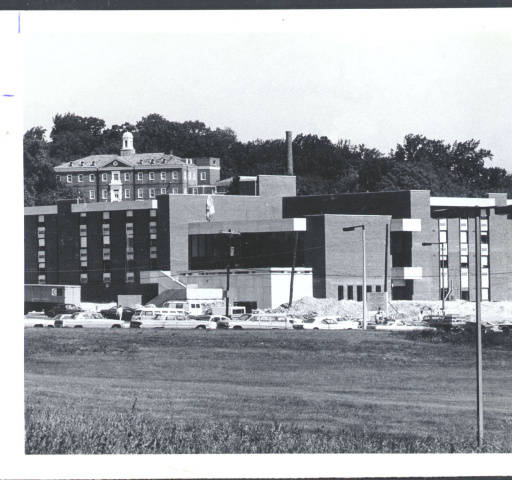
What remains of the Hillcrest Building today is a conspicuously vacant stretch of grass nestled among UMBC’s West Hill and Terrace Apartments. Yet Hillcrest occupies a very important place not only within UMBC’s history, but also in the history of mental health treatment in the United States.
Hillcrest served as the site of the university’s first administration building in 1966. It hosted a variety of university functions, including the housing of student organizations and the operation of the popular basement social club known as The Rattskeller (or “Ratt”) for 34 additional years until its closure in 2000. The building also inspired a great deal of curiosity in the time between its phasing out of campus use and its eventual demolition in 2007.
As curious as many students and faculty and staff may be about Hillcrest as a significant campus site, the building’s history before it was acquired by the University System of Maryland is perhaps even more significant, intriguing, and problematic—and also a probable source of campus fascination with the building.
Hillcrest was the first structure in the history of the United States to be designed and erected specifically for the containment and rehabilitation of “criminally insane” patients. It opened in March 1922 as an extension of Spring Grove State Hospital, and remained in operation until its closure in 1965.
Indeed, the Hillcrest Building’s roots as a locus of pioneering psychiatric care and as the cradle of the planning and early administration of UMBC represent two contrasting historical identities that, when recalled simultaneously, ultimately made preserving the building (and it baggage) an impractical task.
The first facility dedicated to the treatment of the criminally insane in America was founded in 1859 at the Auburn State Penitentiary in Auburn, New York. Similar facilities appeared across the country in the years that followed, and all of them were created as subsidiary components of their respective state penitentiaries rather than as independent medical institutions poised to handle the unique challenges of treating individuals who were then-labeled as “criminally insane.”
J. Percy Wade, the superintendent of Spring Grove State Hospital from 1896 – 1927, pursued the creation of a special building for the criminally insane in 1917, after noticing the inadequate treatment options available, especially for shell-shocked soldiers returning from World War I. Wade sought to both alleviate the burden placed on state penal institutions that were ill-equipped to deal with such patients, and renew the role of the hospital environment as a place of refuge.
In 1921, the Maryland legislature voted $135,500 in funds to construct Hillcrest. The building stood approximately 40 feet by 120 feet (23,349 sq. ft.), and its brick and sandstone exterior emulated Georgian architectural motifs. Hillcrest was located approximately one mile from the main Spring Grove campus, in an area surrounded mostly by farmland and steep topography. Its location was chosen in an effort to hinder escape attempts (and to ease in the recapturing process should an escape be successful) and to maximize community security while minimizing disruption to the main campus. The quiet surroundings also were thought to be therapeutic to patients.
Unlike patients on the main hospital campus, Hillcrest patients were not allowed to watch motion pictures, dances, or theatrical shows for fear of inciting violence or escape attempts. The prospect of escape was particularly feared by hospital administrators because of the safety risk for patients and potential embarrassment to the hospital.
These fears, along with advances in psychiatric techniques, led to the construction of isolation rooms in 1927 for unruly patients. The carefully selected patients admitted to Hillcrest also engaged in occupational rehabilitation, often sewing their own clothes, growing crops, and tilling the surrounding farmland.
By the mid-1950s, Hillcrest not only faced overcrowding, but also it had declined as the leading facility for the care of criminally insane patients in Maryland after the opening of the new Clifton T. Perkins Hospital in Jessup. Interest by Spring Grove administrators in selling the property coincided with the University System of Maryland’s choice of site to create UMBC, and Hillcrest was part of the 435-acre tract upon which the university was founded.
Hillcrest’s key role as the university’s first administration building, Residential Life headquarters, and hub for campus Greek organization and social life faded as UMBC developed newer and more functional spaces, including University Center and The Commons. But even after its closure in 2000, Hillcrest retained an outsized place in campus folklore and legend.
Campus tales about the building drew upon from Hillcrest’s psychiatric roots, positing that a patient who served as a model for the character of Hannibal Lector in the novel (and the film) The Silence of the Lambs was once treated within its walls. Others reported seeing ghostly figures in windows or hearing strange sounds emanating from inside. And, of course, Hillcrest’s actual history as a former institution for the most violent and volatile mental health patients of its time certainly stood in stark contrast to its aspirations as an honors university.
In its final years, Hillcrest stood out distinctly from the neo-contemporary architecture of of the rest of the university. Yet the building’s lack of “unique” exterior architectural features (considering the era of its construction) also meant that it had difficulty being placed on state and national historic registers. Local preservationists came to the building’s defense when UMBC announced plans in 2004 to raze Hillcrest to create additional parking and living space on campus. One group—a newly-formed Hillcrest Historical Society—successfully lobbied the Baltimore County Historical Trust to survey the building and resulted in its placement on the trust’s preservation watch list.
Despite the publicized involvement of community watchdog groups, UMBC eventually obtained clearance to demolish Hillcrest in 2006 and did so in July 2007. Yet Hillcrest and its elusive past have not been forgotten, and the building represents a bygone era that remains impressive both for its contributions to medical history and the foundation of the university itself. – Trevor J. Blank ’05
The Silo
“
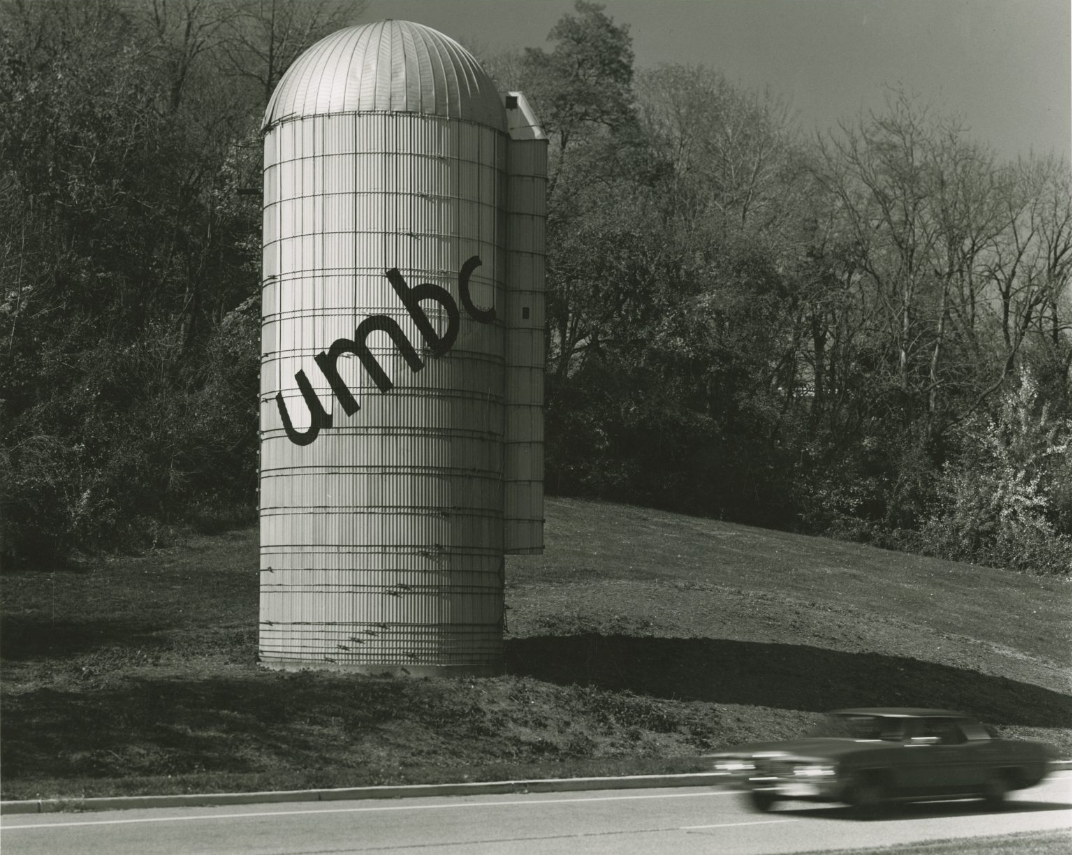
The silo on UMBC Boulevard suggests a connection between the university and farming. What was that property before it became UMBC?
Mary Slicher ’73
Former Maryland Comptroller Louis Goldstein’s brainstorm to found the university on land owned by Spring Grove Hospital between Catonsville and Arbutus placed the campus on farmland once worked by students at the Baltimore Manual Labor School—an institution that used agricultural labor as a means to improve and reform impoverished boys.
So why wasn’t the silo demolished when construction on UMBC began in the 1960s? One theory was that the old structure was kept as a remembrance of the site’s history as a farm. Founding chancellor Albin O. Kuhn addressed this very question in 2006, suggesting a more practical reason at the bottom of the question: The silo was too large and heavy to move or demolish. Kuhn reasoned that the old silo “wouldn’t bother anybody.”
The Tunnels
“
Does UMBC have secret underground tunnels? Why?
Bennett Moe ’88
Mention the word “tunnels” to many UMBC alums, and you’re bound to get a story.
Often it’s a second- or third-hand tale. A friend of a friend, who may (or may not) have actually been there. Very often, shenanigans will be involved in the story. There are even conspiracy theories.
Yes, the tunnels do exist. Actually, they are quite extensive. It is a 6,000 foot long system of utility passageways humming beneath the campus. Yet, very few people have actually entered the tunnels.
“Everybody knows they’re there, but they can’t get in, so it’s very easy for stories to get started,” says Rusty Postlewate, assistant vice president for facilities management, one of the few to hold the key that unlocks this campus mystery.
As envisioned in the original blueprints for the UMBC campus, the service tunnels house what can be described as the central nervous system of the university, with large aluminum tubes encasing all of the main utility lines, including hot and cold water, electrical, phone, and fiber optics, for easy maintenance access by facilities workers.
Running directly beneath Academic Row (also known to Facilities Management staff as “196,” or the height above sea level), the tunnels reach from the Administration Building all the way to the Albin O. Kuhn Library & Gallery. Offshoots connect The Commons, the Public Policy and Physics Buildings, as well as the Central Plant. As the campus has grown, the UMBC tunnels have expanded along with it, most recently to the new Performing Arts & Humanities Building.
Walking beneath the campus feels a bit like entering another world, with concrete and tubing as far as the eye can see. But touches of UMBC filter through. Near an entrance point in The Commons, a hand-painted tag reads “John ’87.” In another section, a “You Are Here” map puts the twists and turns into perspective.
At a lanky 6 foot 4 inches tall, Postlewate ducks his head to avoid metal tubing hanging from the ceiling of one of the connecting passageways—a reminder of one of the main reasons why most people aren’t allowed down here. With pressurized water of 350 degrees and 13,200 volts of electricity running end to end, it’s just not safe for visitors.
That hasn’t kept generations of alumni from speculating about the tunnels, though. Take a spin through the online archives of The Retriever Weekly, and you’ll find a broad history of student perception of the tunnels—both true and imagined.
An article from the September 25, 1972 issue of the newspaper stated that a “very select group of handicapped students” was allowed to use the tunnel system to travel between buildings located along Academic Row. (This is not currently allowed.) Former UMBC Physical Plant director Guy Chisolm observes that other students were barred from the tunnel area for a rather mundane reason (insurance consideration), but then adds that “we don’t want to give anybody the opportunity to commit any acts of sabotage.”
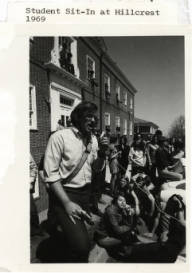
Why might this have been on Chisolm’s mind in 1972? The interview was conducted a few months after the end of the spring 1972 trial of Catholic anti-war activists (known as the “Harrisburg Seven”) ended with a hung jury that freed the defendants. Among the charges leveled was that the activists wanted to set explosives in steam tunnels under government buildings, and one of the seven defendants was Philip Berrigan, a Catholic priest and the primary organizer of the landmark “Catonsville Nine” action in 1968 where draft files were burned at a Knights of Columbus hall near campus (which also housed the Selective Service).
More often, however, UMBC’s tunnel system has been the object of playful speculation, particularly in several issues of The Retriever Weekly’s annual April Fool’s Day edition. The April 1st issue from 1973 spends the good part of a page mashing up two bits of campus folklore by describing a “Man Discovered in Tunnel” who turns out to be an escapee from the Spring Grove State Mental Hospital. Another parody—in the March 29, 2005, issue of “TEH DECEIVAR” – features the front page headline “Bodies Found In Mysterious Labs Under Hillcrest,” and spins a funny and complicated story involving the police, zombies, and an unidentified man in a tweed jacket.
Otherworldly creatures aside, campus maintenance workers are the primary visitors to the campus tunnels these days. Even UMBC President Freeman A. Hrabowski, III doesn’t have a key, says Postlewate.
Greg Stryker ’97, psychology, recalls his own memories of the tunnels from when he worked as a maintenance assistant for the Office of Residential Life. “We found all sorts of cool stuff on that job. I don’t remember doing anything out of the ordinary… just walking around the tunnels to see where they led,” he said. “Stories were that (the tunnels) were put in so the faculty could escape during a campus riot. [A] funny thought that gained some traction, but they were obviously service tunnels.”
Jay Lagorio ’08, computer science, snuck into the tunnels a few times. And he has the pictures to prove it. “At one point, myself and another student made it our mission to map out everything that was down there and be experts on how the whole university connected together,” he recalls. “We had a variety of ways to get in but the one thing we never found, though not for lack of looking, was an outdoor entrance. The best memory I have was hearing maintenance people walking towards us very, very late at night. We were pretty sure they didn’t know we were there, but I don’t think I’ve ever had to run so quickly or quietly before or since. The next day we heard there had been an electrical problem over the previous night so we didn’t think they were looking for us.”
Several years ago, Postlewate’s crew had to stake out a section of the system near The Commons after food started disappearing in the middle of the night. That free meal ticket didn’t last long, he says with a laugh. “Ah, that’s just students being students.” – Jenny O’Grady
The Shape of the Loop
“
Is it true that you have to run around the Loop Road to get rid of the calories in one donut? I heard this when I was a freshman 20 years ago.
Renate Smith '98
The caloric reduction in running the 2.2 miles of Loop Road (officially known as Hilltop Circle) likely depends on your metabolism. But we do know that the road itself was the result of careful planning by Albin O. Kuhn and the team that designed the university before it opened in September 1966.
Kuhn visited many universities before proposing a design for UMBC. “In essence, UMBC became a compilation of the positives and negatives that Kuhn experienced,” says Nichole Zang, a master’s student in UMBC’s historical studies program who also works in the Special Collections department in the university library named after Kuhn.
Kuhn observed in a 1994 interview that his plan for UMBC aimed to compensate for “the mistakes of a campus like College Park.” He believed the circular design, with most of its academic buildings located in the center, and utility wires buried underground, would keep traffic running smoothly, and allow students to walk to classes rather than drive across a sprawling campus or cross busy roads. The loop would also connect seamlessly to major routes near UMBC, including I-95, the Baltimore Beltway, and Wilkens Avenue.
That vision and the loop road have sustained UMBC through its first 50 years—as well as giving members of the university community and neighboring residents a circle to jog or pedal off those donuts. – Julia Celtnieks ’13
Why the Chesapeake Bay Retrievers?
“
What’s the real story behind True Grit? Why was a Chesapeake Bay retriever chosen as the school’s mascot?
Zozscha Bomhardt ’93
In the fall of 1966, a piece in the inaugural issue of UMBC News (later dubbed The Retriever Weekly) announced a contest to choose a mascot for the brand new university. Entreating readers to choose a mascot “that will become the loveable pet of students for years to come,” the article garnered dozens of entries, ranging from whimsical fancies (unicorn, angel) to prosaic suggestions (muskrat, crab).
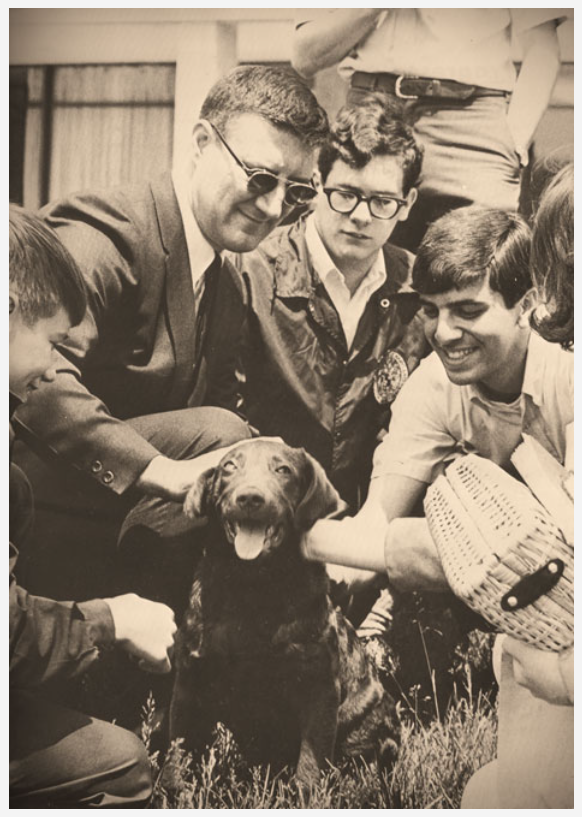
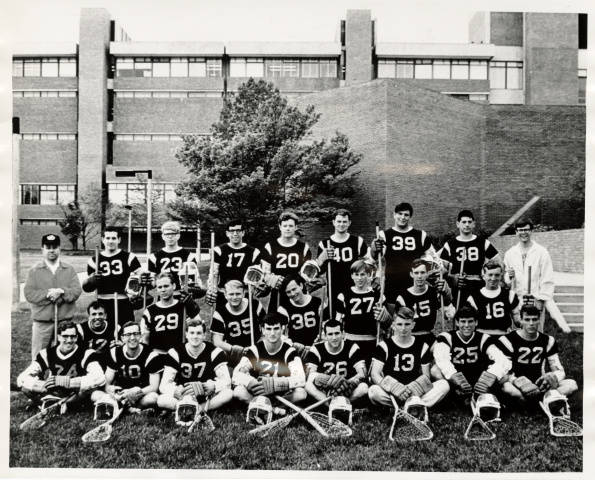
On October 30, 1966, the university announced that student Tom Berlin had won the contest with his nomination of the Chesapeake Bay Retriever. And soon after, UMBC received its first live mascot in the form of a spirited Chesapeake Bay Retriever pup with curly brown fur. Dog breeder Claude L. Callegary—whose son attended UMBC and played lacrosse for the Retrievers—donated the dog to the school in the spring of 1967. Another contest failed to yield a name for the puppy, which eventually became known as “Campus Sam.” In the absence of any formal arrangements to care for the dog, Guy Chisolm, UMBC’s first director of physical plant, volunteered to take the retriever to live with his family in their Catonsville home, which was adjacent to the campus.
Richard Chisolm ’82, interdisciplinary studies, who has made a notable career as a documentary filmmaker, recalls that “Sammy” (as he and his siblings Mac and Susie called the puppy that their father brought home) grew into a large dog with a fierce bark who loved to swim in the family’s swimming pool. He and his siblings were responsible for training and walking Sammy. From time to time, coaches or faculty members from UMBC would borrow Sammy for games or campus events, where he would be adorned for the occasion with a black and gold UMBC scarf.
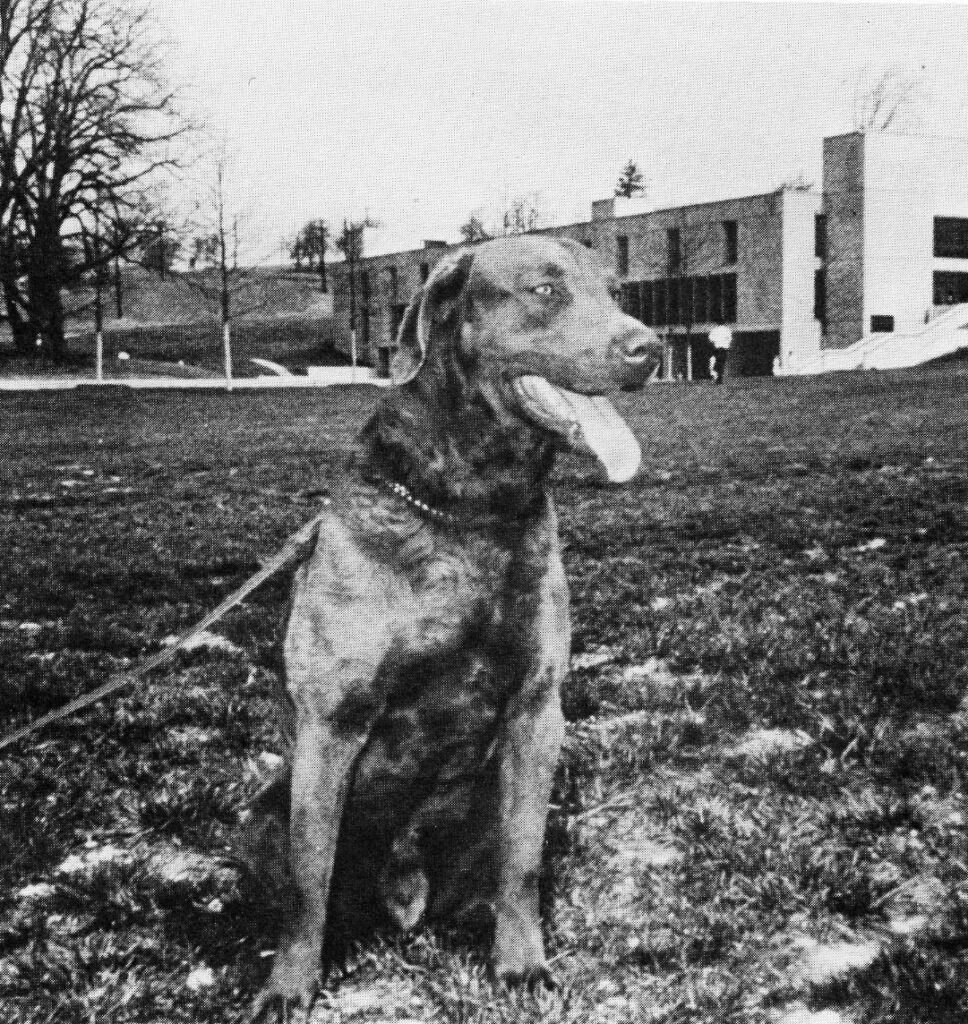
Campus Sam was UMBC’s first live mascot.
Richard Chisholm adds that Campus Sam’s life, though largely peaceful, was nearly cut short one day when he escaped the family’s fenced yard to chase after a deer. Leash in hand, Richard ran after Sammy and witnessed the determined dog crash headfirst into a moving car. Thankfully, Sammy survived with little more than a permanent bump on his head.
UMBC has had a number of subsequent live Chesapeake Bay Retriever mascots—as well as mascot images to represent the university. (Two of these images, including the most recent, have been created by Jim Lord ’99, design director of UMBC’s Creative Services.)
But perhaps the most prominent symbol of the university is a 500 pound bronze cast sculpture of the mascot, dubbed “True Grit,” which graces the plaza between the Administration Building and the Retriever Athletic Center (RAC).
A 1966 contest for resulted in UMBC’s mascot being a Chesapeake Bay Retriever.
UMBC commissioned artist and alumna Paulette Raye ’87, who had graduated summa cum laude from the university with a degree in philosophy, to create the sculpture. Raye created the work in a studio at Towson University, using “Nitty Gritty”—a champion Chesapeake Bay Retriever owned by Howard County residents and veterinarians James and Brenda Stewart—as her model.
In an email to UMBC Magazine, Raye recalls that “the mascot was the first dog I had ever sculpted—of any size. It was the only large size sculpture that I had ever done.”
Raye relates that a number of setback delayed the completion of the project. In fact, she writes, the project almost literally melted down.
“The wax casting was made and then sat in the foundry—very warm in there—for a full year before [UMBC President Michael] Hooker released the funds to complete the casting in bronze,” she recalls. “In the meantime, the wax casting had distorted—not terribly, but it did not cast nearly as detailed and beautiful as it had been sculpted because of some warping from the heat that it had sat in for a year.”
Raye also helped UMBC Magazine solve on enduring mystery about UMBC’s mascot that an extensive search for details about the project in the university archives did not reveal: The model’s name was “Nitty Gritty,” so what was the origin of the name “True Grit?”
“‘True Grit’ was the name of the Nitty Gritty’s father,” writes Raye. “Exactly why the mascot received that name, I am not sure, other than it sounded bold and strong—like the team.”
Hooker and UMBC director of athletics Rick Hartzell oversaw an unveiling of the statue—with a tug from model Nitty Gritty himself—at a ceremony on December 7, 1987. In a a letter to Hoke Smith, then president of Towson University, Hooker lauded the statue’s creation at Towson’s art studios as an historic truce in the “traditional Retriever-Tiger” rivalry, and graciously invited Towson’s president to stop by and “see us, and True Grit, when you can.”
True Grit remains a steadfast and enduring campus presence—greeting new students and visitors on their arrival to campus, and bidding a fond farewell to UMBC’s proud new alumni with cap on his head and diploma in his teeth as they graduate. And that shine on his nose? UMBC students have developed a tradition of rubbing True Grit’s nose for luck in their exams. – Theresa Donnelley ’13 and Richard Byrne ’86
Performances for the History Books
“
Who was the most famous performer or group to play a concert at UMBC?
Eric Messner '01
UMBC has had many amazing musical acts play at various venues on campus, including the now-vanished Gym I, the University Ballroom, the Quad, and the Retriever Activities Center.
But if we had to narrow it down to five performers or groups that have achieved worldwide fame, cultural influence, and super-sized records (in some cases, all three), and played on our campus during their respective heydays, here are our answers to this question:
1. Otis Redding: The legendary soul singer, who died so tragically at the height of his fame in December 1967, played UMBC’s Gym I during the university’s inaugural “Spring Week” in April of that same year. Redding’s UMBC show was less than two months before his electrifying performance at the Monterey Pop Festival in June 1967—a concert that made him a crossover superstar in the few months before he died.
The Retriever Weekly enthused that the performance by Redding “was without a doubt the highlight of the social year at UMBC,” though strangely took more note of the decorations for the occasion than the music itself.
2. Quadmania 2004: A double bonus for UMBC students. Kanye West may be a globe- trotting, always in the news, stadium-headliner now, but back in 2004 when he played at UMBC’s Quadmania, Kanye was still an up-and-coming rapper who’d literally just rocketed to stardom (and the top of the Billboard charts) with his first record The College Dropout and its breakout hits “Through the Wire” and “Slow Jamz.” John Ellis ’06, history, who reviewed the show for The Retriever Weekly, wondered if West could reproduce his layered and sophisticated sound in concert, but concluded that “all in all, Kanye put on the best hip hop show I’ve seen in a long time…”
Ellis also caught another performer at the same Quadmania who has had just as much subsequent musical and cultural acclaim (but perhaps not the notoriety of marrying a Kardashian), writing that renowned hit maker Pharell Williams (“Happy”) – along with his crew N.E.R.D.—“making the RAC glow with the neon greens and blues of hundreds of cell phones (the poor man’s lighter”).
3. The Velvet Underground: The musical and cultural influence of the Velvet Underground is immense. Not only were they the first rock band to truly immerse themselves—via the interventions of Andy Warhol and actor/singer Nico—in the world of avant garde graphic art, performance and filmmaking, but their impact on dissident writers and politicians (most notably Vaclav Havel) continues to this day.
The version of the band that played at UMBC on September 20, 1969 was without Nico and co- founder John Cale, but main songwriter Lou Reed was playing new songs from the band’s eponymous third record, The Velvet Underground—an LP that features classics including “Pale Blue Eyes,” “Beginning to See the Light,” and “I’m Set Free.”
4. Snoop Dogg: Since his debut on Dr. Dre’s The Chronic in 1992, few American hip hop artists have exerted the gravitational force of Snoop Dogg. So his April 29, 2011 show at UMBC ranks as one of the biggest shows in university history. Snoop sported a Washington Capitals jersey at the show.
The Snoop Dogg was also a special event for UMBC students because of a campus-wide step show competition that offered a chance to open the show as a prize. UMBC’s Kappa Alpha Psi walked away with the honors and had a chance to perform on the same stage as one of the godfathers of rap.
5. Chicago Transit Authority (later “Chicago”): Long before their jazzy and slow dance radio hits of the 1970s (“Saturday in the Park,” “Colour My World”) and later easy listening earworms of the 1980s (“You’re the Inspiration”), Chicago was a rock band that went by the name Chicago Transit Authority—and they played two shows at UMBC behind their million-selling debut album of that name on October 19, 1969.
Chicago Transit Authority already had a smoother and more melodic sound than other jazz-inflected rock bands of that era (such as Traffic), but they also had strong countercultural bona fides. That may be a reason why a full page ad for the show appeared not in The Retriever Weekly (which did not review the show) but in the radical campus newspaper The Red Brick. – Richard Byrne ’86
UMBC Football: Undefeated
“
Why does UMBC not have a football team? Did the university ever consider having one?
Lisa Price ’87
The fact that UMBC does not have an intercollegiate football team is one of the defining elements for the university (and, perhaps, its social life) since its founding in 1966. The UMBC Bookstore even sells t-shirts with a Retriever paw inside a football that proudly proclaims “UMBC FOOTBALL: UNDEFEATED.” Records of various discussions of a possible intercollegiate football program are scattered throughout the university archives. While there has always been an undercurrent of interest, funding is the number one reason football never found a foothold at UMBC.
UMBC’s First Computer
“
What was the first computer on campus? How did UMBC create a nationally-known reputation in the field?
Matt Basch '08, ’10
Remember punch cards? Room-sized computers? Computing centers where students would input data and wait—up to a full day—for the results? Even a university with a widely-acclaimed reputation in computer science and information technology had to get its start somewhere.
At UMBC, that beginning had roots across the university in departments including mathematics psychology, biology, and also in the business operations of the school.
In the early years of UMBC, students didn’t major in computer science. Instead, students who pushed the boundaries of computer science were biology majors using technology to study fruit flies, psychology majors crunching numbers from their experiments, and budding mathematicians working out complex equations.
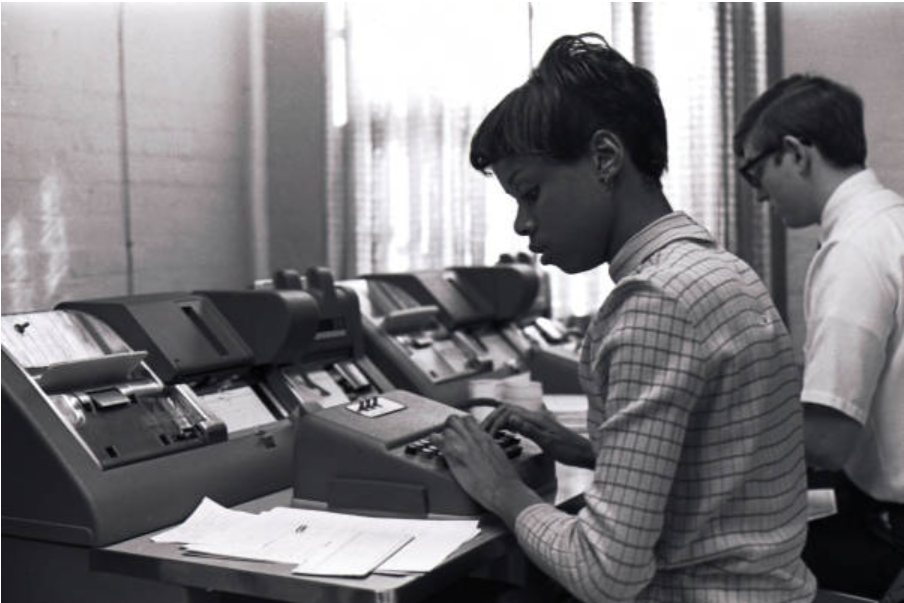
Students work on a Univac 1004 II, a punch card computer system.
It’s also important to note that some of the roots of UMBC’s reputation as a place that encourages undergraduate research are also located in those early years of information technology at the university. Students were doing a lot of computing tasks in UMBC’s early years—keeping key elements of UMBC’s administration up to date, as well as running student projects on the first mainframe computers.
“We were all students,” says Mike Petry ’78, mathematics. “It was all students doing the computing.”
Frank Elmore ’73, biological sciences, remembers vividly the arrival on campus of a room-sized Univac 9400 computer in 1972. “The computer ran one job at a time,” Elmore recalls, adding that it could take a day to get the data processed.
As a biology major, Elmore took UMBC’s first programming class, in Fortran, that same year. He also took all the new programming courses on offer at UMBC as they were introduced during his years as an undergraduate, and then later as a graduate student and a university employee.
It was an era before students could harness individual computing power via their own personal computers and laptops, says Jack Suess ’81, mathematics, and M.S. ’85, operations analysis, who is now UMBC’s vice president of information technology.
The same big campus computers served the needs of every student, whether they were science students running experiments, or economics and accounting students studying Cobol. And everyone counted on a computer operator who would run the programs punched on stacks of cards, recalls Petry, who is now assistant director of network infrastructure at the University of Maryland, College Park.
“Students would show up with decks of these things,” observes Brian Cuthie ’84, M.S. ’94, computer science, who was one of UMBC’s earliest computer science graduates. Far from the isolation that being locked into one’s screen can bring today, the UMBC computing lab was a busy place, in that era, filled with students who had to bring their work in person.
“It had the effect of making the computer center a very social place,” says Cuthie.
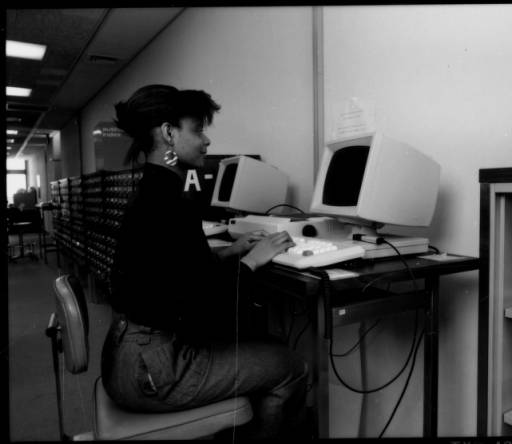
Progress came at leaps and bounds. Between 1974 and 1984, computers got smaller and faster. Punch cards gave way to CRT screens. Apple computers appeared in the mid-1980s. “That’s the point where you hoped to own your own computer,” says Charles Nicholas, a professor of computer science since 1988.
Networking became more than standing around waiting for your turn. A comprehensive system called “Control Data Cyber” was installed in the library’s lower level in 1982. With 60 terminals around campus, it was the first computer generally available for use by all faculty and staff.
“That computer also had the first email system, though it could only send to people who had accounts on that system. It was the first use of email on the campus,” Suess recalls. (UMBC joined a pre-internet National Science Foundation network connecting campuses in late 1985.)
The growth also meant that the university was ready for a computer science department. Professor of mathematics A. Brooke Stephens noticed many young faculty members in other disciplines who were really computer scientists. “I could tell that they weren’t happy and they were likely to move on,” Stephens recalls.
Richard Neville, who was the dean of UMBC’s College of Arts and Sciences, was convinced, and a department formed in August 1985. Samuel Lomonaco, who was engaged in a career with the U.S. army performing lab work, arrived at UMBC and became the department’s founding chairman for its first six years.
“I looked at UMBC and I saw the tremendous potential of the institution.” Lomanoco says. “It was the wild west. The first year we were frantically trying to hire people.”
The growth of UMBC’s programs in these disciplines was cemented by the opening of a dedicated Electrical Engineering and Computer Science Building in 1992. Tim Finan, who succeeded Lomonaco as chair in 1991, called the building a “milestone” in the program’s history.
By the 1990s, Finan adds, “UMBC had more computer science graduates than any other research university in the country.”
UMBC also led in finding ways to increase diversity in an increasingly male-dominated field. Joan Korenman, a professor of English and the director of UMBC’s women’s program, was instrumental in establishing the Center for Women and Information Technology (CWIT) in 1998.
“I was very excited with the internet and what it was about. It was clear this was going to be a tremendous resource,” recalls Korenman. The center, now the Center for Women in Technology, continues to offer support and scholarships for women in these disciplines.
Today, the department of computer science and electrical engineering has grown to 1,100 undergraduate and 600 graduate students with 72 full-time and part-time faculty.
“There’s always been an incentive to hire the very best people we could,” Stephens said. “That’s one of the reasons we’re strong today. It is a good department, well balanced in various departments—artificial intelligence, cyber security, software development—and that’s another strength. No area has been overlooked or neglected.”
The growth, however, had firm roots in the earliest days of the university. “I think we were very good,” Lomanaco says. “We were teaching the real thing.” – Mary K. Tilghman ‘79
The Founding Class
“
Who was the first student to register for classes at UMBC? How many students were in the first graduating class in 1970?
Felice Pinckney ’92, information systems management
The first students at UMBC were 750 pioneers who arrived on September 19, 1966, and found three academic buildings, a campus still under construction, and a lot of mud. Some of the pathways they found were wooden boards. The Loop Road that would eventually encircle campus was years from completion yet. Who knew they would lay a foundation of hard work and determination that continues almost 50 years later?
According to the second issue of UMBC News (the student newspaper that was later renamed The Retriever Weekly), Gabija Brasauskas Blotzer ’70, English was the first student to register for classes and obtain her student identification card.
Blotzer told the newspaper that she liked the “smaller campus,” and quipped: “And to think I wanted to go to College Park.”
The first UMBC graduate was Robin Keller Mayne ’69, American studies. She received her degree one year earlier than the 239 UMBC students who graduated on June 7, 1970.
UMBC alumna Mary Slicher founded one of Baltimore’s leading advocacy groups for the homeless forty years ago. Now her organization is finding a new home of its own.
By Elizabeth Heubeck ’91
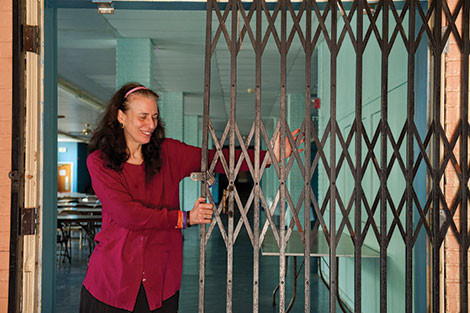
With a discernible bounce in her loping gait, Mary Slicher ’73, sociology approaches the double doors of a formidable stone building that dates back to the 1950’s. A stubborn folding metal gate renders the building’s inside areas off-limits to intruders, and as Slicher pushes her weight against the gate and it finally slides to the side, she flashes a ready smile and tosses her long wavy black hair away from her shoulders.
It’s easy to imagine Slicher, 60, flashing that same quick smile on a night some 40 years ago as she stood outside the UMBC library at closing time with some of her fellow students. Back then, Slicher and her classmates talked excitedly about starting an organization that might help end homelessness in Baltimore.
Almost four decades after founding that group, which she and three fellow UMBC students called Project PLASE (People Lacking Ample Shelter and Employment), Slicher has kept both her youthful energy and her long-cherished ideals.
“You’re not whole without a home,” says Slicher.
Since its founding in 1974, Project PLASE has grown from a walk-in center for homeless citizens on the second floor of a St. Paul Street row house in Baltimore’s Charles North neighborhood into a nonprofit organization with 55 employees and an operating budget of around $3.5 million that provides housing and a host of related support services to 450 Baltimore residents annually.
Slicher’s belief in Baltimore’s homeless residents – even when they themselves, or the community at large, seem to have stopped believing – has endured and grown over time. And now Project PLASE is also on the cusp of an expansion into a new space in Southwest Baltimore that will increase the number of homeless residents it serves.
With Project PLASE’s growing waiting list of 338 people and a startling 19 percent increase in homelessness in Baltimore between 2009 and 2012, Slicher recognizes the city’s dire need to provide housing and related services.
“Baltimore is in a unique position,” Slicher says. “We’re on some lists you wouldn’t want to be on: We have the second-highest rate of HIV in the country, and we lead the country in heroin incidents related to ER hospital visits. But all these things can be addressed with the right resources.”
Homelessness in Baltimore is a problem that has grown immensely in both size and complexity since Slicher first started Project PLASE.
Slicher says the seeds of her own pursuit of justice and social equality were planted in childhood. As a young girl, she would take the bus with her mother from their suburban home in West Baltimore to a downtown Baltimore that was still home to legendary high-end department stores like Hutzler’s and Stewart’s. En route, they would pass by public housing projects and her mother would become reflective, telling her daughter: “I would love to know their stories. Everybody’s got a story.”
As an advocate for the homeless, Slicher hasn’t simply yearned to know the stories of people living in challenging situations. She’s listened carefully, and, in many instances, she has made it possible for the homeless to change the arc of their own stories dramatically.
Slicher explains that trust is the key – and gaining the trust of someone who’s been living on the streets typically requires a lot of patience. “You might have to meet someone at McDonald’s for coffee ten times,” she says.
The complexity and interrelation of factors that force people into homelessness make the need for such patience understandable. Addiction, poverty, mental and physical illness, and isolation can all play a role in why someone ends up without permanent shelter. Project PLASE works to address these problems that lead to, or co-mingle with, homelessness.
Up front, the nonprofit provides the basics: transitional housing and food in a setting with around-the-clock support. Project PLASE also offers tailored services (all of which are voluntary) including case management, access to an on-site nurse and a mental health therapist, medication monitoring, HIV education, daily living skills, transportation, and referrals to medical and other services.
Those who know Slicher and her work well remark on her patience and her energy in attacking the problems faced by the homeless head-on.
“She’s one of the most incredible people I have known. The Baltimore community is so absolutely lucky to have someone that diligent, that driven, with the kind of tenacity and ability to understand and work with this group of folks,” says Gregory Hunter, a social worker and co-founder of Project PLASE who served as its first director before handing the reins to Slicher.
Hunter recalls that in its early days, when Project PLASE was located in a little room above the Manna House food pantry on St. Paul Street, which has since become a private home, they had little more to offer than a sympathetic ear.
Slicher, too, says the organization’s earliest days were filled with compassionate conversation to get to the root of a client’s problems. “We would just sit down and talk with people until they started to trust us, and themselves,” she recalls.
Envisioning clients’ potential for growth and change is the foundation of Slicher’s approach. Sometimes that means looking beyond alcohol on the breath, or the acute symptoms of mental illness that a homeless person is battling, or even a general brokenness of spirit, to grasp who a person once was and what he or she can become.
“Part of our job is to see someone broken and to imagine them whole,” she explains.
More importantly, the fact that Slicher and her colleagues at Project PLASE can see the potential in someone grappling with homelessness eventually helps the client see a path forward too – in his or her own time.
“Miss Mary’s always willing to stop, talk, listen to you, ask how things can get even better.”
– Pete Boney
“At Project PLASE, I haven’t had no kind of pressure, like you have to have something done by this certain time,” says a client named BoneyBoney. “They meet you where your needs are,” he adds.
When Boney came to Project PLASE, he was fresh out of a months-long drug rehabilitation program. Saddled not only with a drug addiction that he was working hard to control, he also suffers from bipolar disorder, HIV and Hepatitis C.
“I was scared that when I left [rehab], I had nowhere to go,” Boney says. After working hard to get clean, he didn’t want to return to living in abandoned buildings in Baltimore City, where he squatted for five years before entering drug treatment.
Boney has been a client of Project PLASE for 15 months. In that time, he’s stayed clean. He lives in temporary housing provided by Project PLASE, and has immersed himself in the community life the nonprofit offers. (He has even served as chairman for events put on by the consumer advisory board, including holiday gatherings for the residents.)
As Boney waits f
or an opening in permanent housing, he busies himself by working on obtaining his general equivalency diploma, or GED. “I’ve been in and out of drug programs, rehab centers, psych wards. I never been anywhere that helped me like here,” Boney says. “Miss Mary’s always willing to stop, talk, listen to you, ask how things can get even better.”
“The people at Project PLASE, they were like a real good doctor. They asked me: How do I feel? What do I want? They renewed my hunger to satisfy my mother.”
– Jerry Morris
Jerry Morris echoes Boney’s sentiments. He’s been a client of Project PLASE for almost 13 years, having heard about it from neighboring nonprofit Healthcare for the Homeless. When Morris approached Project PLASE, the words of his mother filled his head.
“I could hear her voice saying that she didn’t raise me to be a drug addict,” recalls Morris, who’s been clean since he’s been with Project PLASE.
Reflecting on why he’s been able to achieve long-term sobriety and stability, and thus make good on his mother’s words, Morris explains: “The people at Project PLASE, they were like a real good doctor. They asked me: How do I feel? What do I want?” He pauses before adding, “They renewed my hunger to satisfy my mother.”
Seeing a happier and healthier future for those served by Project PLASE is important. But over the past few years, Slicher has also been envisioning the possibilities for Project PLASE itself – and making them a reality.
Take, for instance, three empty buildings in Southwest Baltimore – one dating back to the 1890s and all sorely in need of repair and renovation – that will soon provide an expanded base of operations for the organization. Shuttered in 2010, these buildings on Old Frederick Road were owned by St. Joseph’s Monastery Parish, with one of the buildings used as a parochial school.
The prospect of restoring these buildings to their former glory or repurposing them into something entirely different would be daunting to many people. Not Slicher. During a tour of one of the buildings, Slicher points out its copious interior and the large windows that bring in lots of light. She can already see how these run-down and outmoded buildings could make the perfect home for those without one.
Slicher’s identification of the parish’s buildings as a new headquarters for Project PLASE – and the site of more transitional and permanent housing for the homeless – was only the first step. She needed the community surrounding the buildings to envision it as the ideal location, too.
That’s why Slicher led a year-long educational campaign in the residential communities surrounding the property. Without backing from local residents, the re-zoning that was required for Project PLASE to pursue its purchase simply wouldn’t have happened.
It was no small feat. Slicher knocked on doors in the Irvington and St. Joseph’s neighborhoods, working to win over residents who initially opposed welcoming formerly homeless people to their neighborhoods. She also enlisted some of the 80-plus members of St. Joseph’s Parish, which continues its mission in the neighborhood, to help her spread the word, and spoke at area community association meetings.
“Until you really dialogue with individuals, and let them know what your group is and what you can do, sometimes there are a lot of fears – some they can name and some they can’t,” says Slicher. “If you can dialogue with people, it really makes a difference.”
That dialogue eventually met with success. Once members of the surrounding communities were assured that the acquisition would provide a much-needed service to homeless residents—and also that the new residents would make good neighbors—the community got behind the purchase. With the support of Baltimore City Councilwoman Helen Holton and a host of community and civic leaders, the re-zoning was issued and Project PLASE had a new home.
Harry T. Spikes II backed the project from the start. A special assistant to Congressman Elijah E. Cummings, Spikes had a personal reason to support the expansion of services to Baltimore’s homeless population: His father experienced homelessness as a young boy. Spikes, as chairman of the Shelter Committee, part of the local nonprofit Community Assistance Network Inc., spoke before Irvington community members to ensure them of Project PLASE’s good intentions. “I shared with them my passion for helping people who just need a shot, like my dad did,” he says.
Spikes also stood before that audience because he believes in Slicher. “There’s not a lot of Marys out there. She’s walking the walk,” he says. “I’m so happy she’s doing what she’s doing.”
When renovations at the Old Frederick Road site are complete, Project PLASE will consolidate some of its existing housing units and offer new, improved ones. Forty housing units will remain in the current headquarters, at 1814 Maryland Avenue, but existing buildings on St. Paul Street and North Avenue will be sold to focus on the renovations at the new site, which will boast 62 one-bedroom transitional housing units, 36 permanent one-bedroom apartments, and even space for a health suite, computer lab, commercial kitchen and dining area, plus counseling and meeting rooms.
The relocation of Project PLASE is envisioning writ large. But Slicher also revels in important details, like the private rooms that will enhance clients’ sense of personal dignity. “Clients will have private rooms. That will be so nice for them,” she observes.
Part of Project PLASE’s success can be found in not allowing a failure to permanently damage a future. Unlike many other agencies that aim to help homeless people in need, especially individuals who suffer from problems of addiction (an estimated 64 percent of all homeless people have alcohol or substance abuse problems, according to the National Coalition for the Homeless), Project PLASE gives its clients a second chance.
“If I went into a treatment program for substance abuse, relapsed, and tried to come back, I couldn’t,” Slicher says. Most drug treatment programs operate with a zero-tolerance policy.
Slicher points out that this is not the case at Project PLASE. While it is imperative that clients in its transitional and permanent housing programs stay clean, those who fail to maintain sobriety are not permanently banned from the program. In fact, if clients are asked to leave because they’ve begun using drugs or alcohol again, they actually rise to the top of the waiting list when they return to Project PLASE at a later time.
“It’s 100 percent love in Mary’s heart. All she do is help,” says Carlton Gross, a trim man with a twinkle in his eyes and an irrepressible smile who understands the need for second chances.
“They help you with small-time goals so you can move on to big-time goals.”
– Carlton Gross
In his twenties, Gross, a single father, owned his own house and also a cafe. Then he got hooked on cocaine and heroin and lost it all. He lived on the streets for six years. After completing an in-patient, six-month drug program, he knew he wasn’t ready to stay straight on his own. “I was going to get high if I went back on the street,” Gross says.
Fortunately, a social worker referred Gross to Project PLASE. He’s been a client for the past six years. “They help you with small-time goals so you can move on to big-time goals,” says Gross, who started his ow
n landscaping business last year. “I see where I’m going. I had my own house. I want to get that back.”
Slicher is quick to defend her clients and underscore the incredible obstacles they have overcome to get to where they are. She doesn’t dwell on the low points in her clients’ lives. She’s focused on the whole person.
It’s a quality that shows itself even in small moments, such as a conversation with Mike Coram, a counselor at Project PLASE. When Coram mentions the trajectory of clients such as Carlton, he observes that they are “getting up from a fall” on their way to discovering greatness.
It helps that Slicher has had the opportunity to see clients not only at their most fragile, when they come to Project PLASE, but also when they’ve gotten back on their feet. “I see people all over the place – when I go to the Enoch Pratt, the Giant – who were homeless and no longer are. That’s the untold story of homelessness,” Slicher says.
It’s a story embodied in people like Boney, Gross, Morris, and the countless other clients who have arrived on the doorstep of Project PLASE seeking shelter after confronting the darkness of homelessness.
“Many in the community only see homeless persons in a negative light,” Slicher says. “Here at PLASE we are lucky enough to see the person, and their humanity, in its entirety—strengths and struggles all together—as any of us would want to be seen.”
SIDE BAR: FACTS AND FACTORS
When Mary Slicher co-founded Project PLASE (People Lacking Ample Shelter and Employment) in 1974, she had a good idea at just the right time.
Scholars who study homelessness and poverty note that average wages have fallen 16 percent – after adjusting for inflation – since 1973. And the mid-1970s also marked the onset of increasing scarcity in affordable housing.
While statistics on homelessness in the 1970s are difficult to come by, it is likely that far fewer people in Baltimore were without homes in that decade. Conservative estimates place 4,088 men, women, and children on the streets of Baltimore on any given night in 2013. Some say that number may be eight to ten times higher, as those who conduct census counts rarely enter the 40,000-plus vacant homes in Baltimore which people without homes are known to occupy.
The following timeline offers a glimpse of the societal factors that have fueled homelessness since Project PLASE opened its doors.
Late 1970s: A trend to de-institutionalize mentally ill patients formerly residing in psychiatric hospitals without adequate plans for transitional housing leads to a large increase in the homeless, mentally ill population.
1980s: Cuts to housing and social service programs push the homeless population upward. Homeless rates in American cities triple between 1981 and 1989, from 5 to 15 people per 10,000 residents. The arrival of crack cocaine in the mid-1980s also contributes to the soaring homeless rates.
1990s: Scores of public housing units, having fallen into disrepair and becoming dilapidated, are abandoned, leaving many without affordable housing options.
Early 2000s: Federal public housing funding drops significantly, putting affordable housing out of reach for even more city residents. And a report on Baltimore’s homeless population, published in 2005, notes that almost 30 percent of the city’s homeless are veterans.
Late 2000s: In 2008 and beyond, many people report being homeless for the first time, as unemployment due to the recession forces many out of their homes.
Sources: Mayor’s Office of Human Services; Health Care of the Homeless; Over the Edge: The Growth of Homelessness in the 1980s, by Martha R. Burt (Russell Sage Foundation and Urban Institute Press, 1991);Baltimore Homeless Services, Inc.; James T. Patterson, America’s Struggle Against Poverty: 1900-1994 (Cambridge: Harvard University Press, 1994).
UMBC professor of psychology Robert Provine’s “small science” makes big strides in explaining human behavior.
By Chelsea Haddaway
Twenty five right-handed UMBC students sit cross-legged in their chairs in a classroom, shoes and socks removed, with the ankle of one leg resting on the knee of the other. Slowly, they stroke the soles of each foot with their fingertips, recording what they feel using first one hand, then the other.
The students are testing an idea that professor of psychology Robert Provine stumbled on as he soaped his own foot in the shower one day. It tickled more than he thought it should, especially given the widespread popular belief that one cannot tickle oneself.
The students performing this experiment eventually helped confirm Provine’s hypothesis, getting the strongest urge to giggle when tickling their left foot with their right hand.
Self-tickling might not seem the stuff of serious research. But discovering that one half of our body treats the other half as relatively alien is definitely surprising. And it is exactly the kind of discovery that has propelled Provine to prominence as a scientist and an author.
Provine has also proved that “small science” – or “sidewalk neuroscience,” as he sometimes calls it – is an ideal way to do research at a primarily undergraduate university like UMBC. His investigations are based largely on observations of everyday human behavior – and they can be conceived and executed quickly and with relatively untrained research assistants. No large grants or pricey equipment required.
“If you insist on more equipment,” Provine quips, “buy a stopwatch.”
Small science doesn’t mean small discoveries, however. In a steady flood of scholarly papers and well-received books for general audiences such as Curious Behavior: Yawning, Laughing, Hiccupping and Beyond(2012) and Laughter: A Scientific Investigation (2001), Provine challenges (and sometimes confirms) things we think we know about everyday behavior.
TheNew York Times observed that Curious Behavior “begs you to continue where curiosity leads you, down both the boulevards and the back alleys of science” and The Wall Street Journal declared it “charmingly written and profoundly informative.” Library Journal even named Curious Behavior one of the best books of 2012.
His successful books have also made Provine – who will become an emeritus professor this month – a sought-after public speaker and public intellectual, turning up in roles ranging from a keynote speaker at the International Brain Bee (a high school neuroscience competition) to a consultant for an exhibit on “What Makes Us Smile?” at the American Visionary Art Museum.
In particular, the publication of Laughter also made Provine a leading authority on what tickles our funny bones. One important thing he’s discovered is that humor has its foundations in our relationships. Stand-up comedy might be hard to master, for instance, because a speaker tends to laugh about 46 percent more than his or her audience does. And gender matters, too. Women laugh more than men in conversation.
“Opportunities [for research] lie in these behaviors that have always been in front of us but have never received the examination that they should. What we’re doing is taking these behaviors seriously,” Provine says.
Provine has also spoken four times at one of America’s bastions of big science – the Goddard Space Flight Center – in the center’s Scientific Colloquium series. Dave Thompson, an astrophysicist at Goddard who chairs the colloquium committee, says that the UMBC professor’s small science approach (and impressive results) have a lot to teach those who work on a grander operational scale.
“There are things you can do with the human brain that are better than what can be done with a machine,” saysThompson. “People like Provine have helped to stimulate this idea that you do not have to be a specialist who has built a multimillion dollar piece of hardware to do good science.”
Robert Provine was a neuroscientist even before various branches of research on the brain and its development coalesced under that name.
As a graduate student pursuing a Ph.D. in psychology at Washington University in St. Louis in the 1960s, he also took classes in biology, physiology, anatomy, and even electrical engineering to satisfy his growing interest in the field. He developed a subspecialty of neuroembryology on the way to his doctorate, and several of his advisors were biologists.
When Provine joined UMBC’s faculty in 1974, he was using chick embryos in most of his experiments on the development and evolution of the nervous system. He wanted to give his undergraduate students opportunities to participate in that research, but the work was technologically advanced and it took a year of preparation for them to contribute in a meaningful way.
So Provine began thinking about how to enlist students in research on the brain in other ways. It was a quest that led Provine to the “small science” on which he’s made his name.
“I came to the conclusion that if you looked at the right behavior in the right way, you don’t have to use animal models,” Provine recalls. “You can get the same kind of rigor and insights by looking at the ongoing behavior of normal people.”
Take yawning, for example, an everyday event that Provine tackles in Curious Behavior. We yawn when we’re tired, right? Yawns are triggered by a lack of oxygen in the air, yes? And everyone knows that yawns are contagious.
Actually our yawns can be a bit more complicated than these common assumptions. “Folklore is a good place to start our research because it’s based on age-old observations about behavior,” Provine observes. “Sometimes it’s right and sometimes it’s wrong.”
Some of Provine’s research confirms that folk wisdom. We do yawn when we’re about to fall asleep. But we also yawn immediately upon waking. The bookend nature of yawns makes Provine wonder: Do yawns mark a transition state between waking and sleep in both directions?
That second assumption about yawning is completely false, he continues. Yawns have no relationship to the air around you. But contagious yawning is definitely a reality. Provine’s experiments indicate that if you see someone yawn, or even read about yawning, you’re more likely to yawn as well. (Are you yawning yet?)
“If we look back and examine this closely, something really important is going on,” Provine observes. “This means that we imitate other kinds of things that we see.”
Provine speculates that the development of contagious behavior (we also are likelier to laugh, cough and itch when we see others do so) could be part of what helped us develop one of our most deeply human traits: empathy. He even muses that deficits in these mechanisms may be involved in the social pathologies of autism, pointing to other recent studies showing that autistic children tend to be less likely to “catch” yawns.
The discoveries that Provine has made through observation have not gone unnoticed by prominent colleagues. “We are surrounded by evidence about human behavior, and should put it to use,” says Steven Pinker, who studies and writes about language as a professor of psychology at Harvard University – and like Provine is the author of books for general audiences. “He is the only scientist I know of who is studying many aspects of human behavior that fascinate most laypeople but which are not standard topics in the field.”
“There’s been an age-old interest in some of these behaviors, but they never prompted serious science,” agrees Provine. “My undergraduate research students and I have been able to take advantage of this neglect. Some of the seminal work on yawning, laughing and other behaviors was done right here in Math/Psych Room 507b.”
Indeed, those undergraduate research students are the engine behind Provine’s uncommonly productive lab. The UMBC professor publishes papers in scientific journals nearly as quickly as he can write them, and often these undergraduates are listed as co-authors.
Kurt Krosnowski ’08, psychology, a graduate student in biological sciences at UMBC studying how animal noses sniff out pheromones, was one of those undergraduate researchers. He traces his interest in the nostrils directly back to the first class he took with Provine: “Sensation and Perception.”
Krosnowski says Provine’s lectures were no mere elaborations on the textbook, but were always weaving in anecdotes about his years working in research, consulting for major corporations, and fervent dabbling in music, art, and astrology. Though he had started out as an engineering major, Krosnowski was so inspired by the course that he approached Provine about joining his lab team.
At first, Provine said no.
“Five or ten times more people indicate an interest in joining my team than are invited,” explains Provine. In order to ensure that his lab is staffed with students who can contribute and work independently, Provine is extremely selective, tapping only students who excel in his class or possess a research skill that is urgently needed in the lab.
Marcello Cabrera’12, psychology, got his chance by knowing the right software. “He made an announcement one class and asked if anyone knew how to use Photoshop,” Cabrera says. “I began informally working on one of his projects that involved using Photoshop to add artificial tears to images. At the same time, I was doing very well in his class, and, before the semester was over, he asked me to join his lab team.”
Krosnowski persisted and eventually won a place on Provine’s team, studying reaction times for common behaviors: If you ask someone to cry, can they do it on command? How long does it take? What about sneezing, coughing, laughing, yawning? He also worked with Provine on a study of how seeing someone’s tears affects our perception of their sadness.
“That was the most fulfilling for me because I had a very direct hand in getting it up and running. [Provine] wasn’t like ‘here, do this for me.’ We had a very sincere conversation about how we think this should work,” he says.
Now that Krosnowski is working towards a Ph.D., those conversations with Provine are paying off. “He was my first experience having a peer relationship with a professor,” he observes. “Now that I’m in graduate school, they’re training you to have peer relationships with all of your professors,” he says.
Cabrera has also found his time in Provine’s lab a boon, despite the fact that his career has taken him away from psychology and into the nonprofit world. “I took lots of great classes at UMBC,” he recalls, “but I don’t think I learned as much in the classroom as I did in the lab. Working on these projects with the team taught me about how to solve problems that don’t have easy or straightforward solutions.”
Both Krosnowski and Cabrera are also among the select group of student researchers who have co-authored papers with Provine in a range of publications, including Human Nature, Ethology, and Evolutionary Psychology. Krosnowski is a co-author on two of Provine’s publications, and Cabrera’s name is on a series of papers, some still awaiting publication, on the whites of the eyes.
Provine says that students who reach that level of collaboration are intricately involved in not only the execution, but the design and analysis of an experiment. “Co-authoring a paper is an a-ha moment, because that’s a gold standard for having done something,” Provine says.
Provine takes an effusive, almost fatherly, pride in his undergraduate researchers. Many of them have moved on to careers in psychology and other professions. “I thank a generation of mostly undergraduate students who contributed to this work,” he wrote in the acknowledgements of Curious Behavior. “All are exceptional in their own ways.”
He isn’t surprised that so many of his students achieve success after graduating. Provine believes that UMBC is the ideal place for budding undergraduate scientists to get the experience they’ll need to move to the next level.
“You can get a good undergraduate education a lot of places, but what you can do uniquely well at UMBC is not only learn about science, but actually do science,” he says. “Studying science without doing science is like going to the conservatory and studying the flute from someone who doesn’t play it. They can talk about the history of the flute and the theory of the flute, but if you want to study the flute, you need to study with someone who actually plays the damn flute.”
And speaking of musical instruments, Provine decided that he’d be devoting a bit more time to the saxophone (and to his other hobby, painting) starting in June, when he will retire from full-time teaching and writing at UMBC.
“I’ll have a work schedule more like that of my Ivy League colleagues,” he quips.
While his own paintings of neurons adorn the walls of his lab, Provine says he hasn’t held a paintbrush in years. And the saxophonist who fondly recalls playing in a jazz quartet has barely had time to practice his instrument as he’s labored over his busy schedule of research and writing.
“It’s a sad business,” Provine says. “I’m a musician that doesn’t play and a painter that doesn’t paint.”
Provine will continue to follow his small science research wherever new discoveries lead him, however. As an emeritus professor, he will teach seminar-style courses at UMBC on neuroanatomy and on the topics tackled in Curious Behavior, and continue to recruit students for research.
Indeed, his next project is a new vein of research based on his discoveries concerning the whites of the eye and emotional tearing. In addition to his undergraduate collaborators, Provine will also recruit engineering students into the lab to help him develop instrumentation to look at the associated physiological changes in the eyes.
Provine believes there are no end of curious human behaviors to observe, and he wants to be part of that process of discovery for as long as he can.
“My mentors set a high standard for longevity in science, working to the end,” he wrote in a letter to his colleagues announcing his retirement. “Viktor Hamburger lived to 100 and Rita Levi-Montalcini, the oldest Nobel Laureate, made it to 103. Jerry Lettvin only made it to 91, but left an admonition that guides my thinking: ‘If your research does not change everything, why bother doing it?’”
America’s urban landscapes have long been a battleground in wars against bedbugs, roaches, rats and flies. In a new book, UMBC professor Dawn Biehler traces that conflict’s history across boundaries of class and race.
By Richard Byrne ’86
Illustrations by Joanna Barnum
Most city dwellers feel nothing but loathing and fear when they see the rats and roaches that often plague their neighborhoods. And even visitors to the big city can panic when bedbugs infest their hotel beds.
So what sort of researcher likes to dig into the vexed dynamics of our interactions with such pests? Dawn Biehler, an assistant professor of geography and environmental systems at UMBC, says it helps to have strong (and early) curiosity about things that might turn a normal person’s stomach.
“I’ve always really liked disgusting things,” says Biehler. “Going back to age eight or so, I was interested in outbreaks of bubonic plague. The Black Death in Europe and Asia.”
After college, Biehler’s participation in Volunteers in Service to America (VISTA) led her to take a strong interest in housing issues. “I was interested not just in whether people had housing,” she recalls. “But also what was the quality of the housing that they lived in.”
Those overlapping interests in creatures, health and social justice laid the foundation for her current academic research and a new book, Pests in the City: Flies, Bedbugs, Cockroaches, and Rats, which will be published by the University of Washington Press this autumn.
Using sources that range from old public health records to yellowing housekeeping manuals to episodes of the NBC sitcom 30 Rock, Pests in the City is a history of 20th century efforts to eradicate these bugs and rodents in American cities (including Baltimore) that takes in culture, biology and ecology. Biehler not only traces how these campaigns were often hampered or thwarted by societal divisions of class and race, but also how the battle to rid urban landscapes of pests blurs the traditional (and often divisive) boundaries of public and private space.
“Pests are both public and private,” Biehler explains. “They upset this very neat dividing line between our homes and the rest of the world.”
Biehler also demonstrates how the battles to eliminate rats and roaches became focal points for political organizing in the 1960s and 1970s, including tenants in public housing (where neglect and proximity of residences often led to the proliferation of pests) who united behind demands for cleaner and safer environments in which to live.
“Dawn’s research offers compelling insights into the construction of urban ecologies,” observes Sandy Parker, chair of the geography and environmental systems department. “Her use of political ecology, environmental history, and health geography opens up new ways of thinking about urban health and urban environments.”
THE POWER OF PERSISTENCE
Pests in the City deftly sketches a century of America’s urban combat with pests. But one of Biehler’s most interesting gambits in the book is to occasionally step out of human history and view the urban landscape as the pests saw it before and after public campaigns launched to eradicate them.
Biehler begins the chapter on attempts to eliminate German cockroaches, for instance, with a vivid roach’s eye view circa 1946, before powerful pesticides to attempt to control them were in wide use:
On the dry-good shelf at the market, a Blattella germanica left a sticky ootheca, one of eight she would lay in her lifetime, clinging to a sack of rice. The shopper did not see the purse-shaped egg-case, smaller than a pea, as she lifted the sack from the shelf, nor did she see it later while packing her groceries. German cockroaches already infested her New York apartment building so thoroughly that she would never notice the new brood she brought home.
“People don’t do that in history books very much,” Biehler says of these vignettes, which she developed after consultations with editors at University of Washington Press.
Writing the book also forced Biehler to get to grips with the biology of the pests that she was writing about. “I was pretty naïve about all of these pests going in,” she says. But trips to the field with exterminators and delving into current research helped fill in the gaps and understand how German cockroaches not only modify their behavior to adapt to changes in home environments, but also develop biological resistance to certain pesticides.
“Cockroaches’ behavior is very plastic,” Biehler says. “And their genetics are very plastic. These cockroaches are changing themselves in two different ways to adapt.”
Biehler’s adoption of the pests’ eye view underscores the persistence of these creatures despite immense efforts to eradicate them. (Indeed, in the cases of rats and roaches, some efforts have had unintended consequences that enhance their survival.)
Yet public campaigns to eradicate pests did help change perceptions. Flies, for instance, once were thought to be more or less harmless. But more importantly, technology and social engineering were also changing the environment in which pests bred – for better and for worse.
The radical shift in the early 20th century from horses to the motor engine as a primary means of transportation virtually eliminated the stables in urban centers where flies found their best environment for breeding.
Other pests, however, proved more difficult to control, let alone eradicate. Biehler observes that bedbugs were such a problem in the early 20th century that those afflicted were willing to eradicate them with deadly prussic acid (HCN), which triggered numerous sudden accidental deaths when applied in homes under less than optimal conditions.
“Part of the strangeness of that risk is the suddenness of it,” Biehler says. “HCN was so quick and so absolute. That’s what makes it distinct from the risks we assume today, which tend to be long term and cumulative.”
Biehler also closely examines the mixed success of large-scale campaigns (centered at The Johns Hopkins University) to help Baltimore better control its rat population in the 1940s.
Curt Richter, a physiologist at the university’s medical school, developed a new chemical (ANTU) that would escape detection by the rats and also kill them. But the attempts to implement its widespread use in the city created health, environmental, and political concerns. A separate effort by ecologists to tackle the rat problem soon after via intensive block-by-block eradication a few years later eventually flagged after an auspicious start – and the ecologists also failed to adequately address rats’ penetration into neighborhood homes and public spaces.
Baltimore’s efforts “didn’t include the community that well,” Biehler observes. “African-American communities in Baltimore had been doing all these cleanup activities for decades. It was really a lost opportunity to take advantage of that sustained community effort for ecological rat control.”
BITES AND RIGHTS
Biehler doesn’t ignore the cultural implications of pestilence. From Richard Wright’s Native Son to public information campaigns by the Black Panther Party, she observes that writers and artists have used images of urban residents battling infestation to express wider political and cultural dissent.
And the persistence of urban infestation became an even more powerful image when contrasted against the progress made elsewhere in society, notes Biehler, who quotes a biting passage from Gil Scott-Heron’s 1970 song “Whitey on the Moon”: “Rat done bit my sister Nell/ (with Whitey on the moon)/ Her face and arms began to swell/ (and Whitey’s on the moon).”
“Not many historians have focused on the fact that [Rachel Carson’s ecological classic] Silent Spring and the Civil Rights era overlapped with one another,” she says. “Both point to problems of modernity, and how the promises of modernity have failed… and especially, with the Civil Rights movements, that modernity has not worked for us in particular ways.”
Pests in the City also traces how communities organized not only to rid themselves of pests but also to put pressure on politicians. Biehler traces this struggle through the pages of African-American newspapers, excavating the work of activists such as Jesse Gray, who successfully organized city residents around pest control issues in New York City in the 1970s. The tide was shifting, Biehler finds, and the shame associated with infestation was being transformed into rage and fueling attempts to reclaim both private property held by slumlords and public housing from squalor.
Not that it was easy. At times, efforts to pressure the government for help in resolving these problems ran aground on rural and urban divides. Biehler recalls that rural members of the U.S. Congress not only killed legislation to fund rat control in afflicted areas, but openly mocked it – in essence blaming city residents for their own infestations. One legislator, she writes, stated on the floor of the House of Representatives that “the rat smart thing to do is to vote down this civil rats bill, rat now.”
What brings Biehler’s history into sharp contemporary focus is the realization that infestations can and do cross lines of race and class to unite all citizens in the suffering and shame – as has happened more than once since 2000 when new epidemics of bedbugs spread quickly in urban areas. These outbreaks infested fancy hotels as well as city homes, and served as a reminder of how pests can alter our reality.
TAKING IT TO THE STREETS
Biehler’s research and teaching also track more contemporary ripples from this ongoing conflict between pests and humans. She is also examining an urban nuisance not tackled in her book: mosquitoes.
As part of an ongoing research project started in Washington, D.C., and now working in Baltimore neighborhoods, Biehler is assessing the attitudes and knowledge of city residents about mosquito infestation in Baltimore. (The project is a collaboration with researchers at the Baltimore Ecosystem Study, Rutgers University, the Parks and People Foundation, and the University of Maryland, College Park and it has received multiyear funding from the National Science Foundation.)
Because effective mosquito prevention requires an understanding of how and where the insects breed, informed and proactive residents can play a key role in efforts to control them. Biehler is also trying to understand how mosquitoes change people’s environments as well. “I’m asking about how mosquitoes are changing people’s use of space,” she says. “Indoor and outdoor space. How can mosquitoes be unifiers or dividers in a neighborhood?”
The same questions of public and private space that Biehler tackles in Pests in the City also crop up in the mosquito research. “On the one hand, people agree that we need to work together to control mosquitoes when there is something in the landscape that supports breeding,” she observes. “On the other hand, sometimes neighbors get mad when they feel that one neighbor isn’t doing enough, which places a stigma or an ongoing grudge. And then [we ask] how that affects mosquito management.”
Sandy Parker says that Biehler’s research “will become even more important in the context of climate change, changing urban ecologies, and the spread of pathogens and insect-borne diseases.” He adds that the outreach to citizens at the heart of the effort “provides a voice to the experiences of those living within these communities,” and that Biehler herself “offers valuable historical information that community-based organizations can use in constructing their own strategic initiatives.”
Indeed, with help from other scholars in science education and environmental justice, Biehler is expanding the study into a “citizen science project” that will encourage residents not only to help eliminate harbors in which mosquitoes can breed, but to become part of the process of discovery.
Biehler also brings her research into the classroom at UMBC, enlisting students in a new class that she has developed on environmental justice as part of the citizen science effort. The students have partnered with a youth group at St. Luke’s Episcopal Church in Baltimore’s Franklin Square neighborhood.
“I want the students to develop an understanding of what it’s like living in an environment where there has been disinvestment for a significant period of time,” she says.
Ultimately, Biehler’s research aims to transform the pests that infest our homes and environments into teachers, casting new light on the world around us. “These animals have learned much from humans, our cities and our homes” she writes in Pests in the City. “The persistence of unjust urban environments raises the question of whether we have learned from them.”
Yesterday, Maryland State Senator Allan Kittleman ’81, political science, launched his campaign for Howard County Executive. He is the first to announce his candidacy for county executive, a position that has been left vacant by term limits.
According to the Baltimore Sun:
During a 15-minute address to his supporters, Kittleman, 54, said his priorities for the county are education, solving transportation issues, fostering economic development, and assisting county residents who are suffering.
If he is elected, Kittleman would be the first Republican to hold county executive office in Howard County since 1998.
In his junior year at UMBC, Collin Wojciechowski ’13, political science, represented nearly 180,000 students within the University System of Maryland (USM) as their sole student representative on the Board of Regents. Wojciechowski advocated against “doomsday” budget cuts and tuition increases and successfully lobbied to overhaul the USM policy for assessing student fees, making students an active part of the discussion.
Without the aid of scholarships, he would never have been able to serve his fellow students in this way. We sat down with the newly graduated Sondheim Scholar to talk a little bit about the part scholarships have played in his life.
Q:How important was it to your college career to have the support of scholarships?
A: Being the son of a firemen and a public school teacher and the oldest of three brothers who all aspire to seek higher education, having the support of a scholarship was extremely important to my college career.
Q:Can you tell us a little about what it meant to you to be able to serve as the student regent, and then to continue working with legislators?
A: If I did not have a scholarship, I would not have been able to be the USM Student Regent; it’s as simple as that. I only had the time and ability to serve at that post because I did not have to work a side job to pay for college.
Being the Student Regent was one of the most meaningful experiences of my life. Representing students through such trying times as merger debate and the doomsday budget was the thrill of a lifetime. To then be able to take what I had learned on the Board and use it to represent Dr. Hrabowski in Annapolis was a dream. I have never had more fun then the Session I spent advocating for UMBC before legislators.
Q: Has that work given you added insight into education funding, and if so, can you talk a little about the significance of alumni support of education in Maryland?
A: Having been a member of the Advancement Committee of the USM Board of Regents, which oversees alumni giving, I feel I have a unique perspective on the significance that alumni support plays in higher education in Maryland. While our state, specifically Governor Martin O’Malley, has done tremendous things for public universities in terms of funding, student support and financial aid always need assistance. As students and their families continue to face economic difficulty it is up to the alumni base to ensure UMBC is a place welcoming to everyone.
FROM: Freeman Hrabowski, President, and Philip Rous, Provost TO: The UMBC Community RE: New Grants from the Hrabowski Fund for Innovation
We are delighted to announce the second set of projects to receive grants from the Hrabowski Fund for Innovation. These projects build on the strong commitment of our faculty to continually reimagine our students’ learning experiences.
The selection committee received a number of outstanding applications. The grant recipients were chosen by a committee comprised of faculty from each college, teaching award winners, and representatives from the Provost’s Office, Graduate School, and Office of Undergraduate Education. In selecting projects to fund, the committee sought initiatives that would address multiple courses or disciplines, respond broadly to student needs, affect student success or retention, and be sustainable.
Implementation and research grants
Modeling as a Pedagogical Tool for the Life Sciences Curriculum– Led by Mauricio Bustos, associate professor of biological sciences, the team will use computer simulations of lab experiments to allow students in the biological sciences to focus on critical biology concepts rather than rote lab procedures. By removing the beakers, pipettes, and other distractions of the lab, the team hopes to enhance student focus on experiment design, observation, and interpretation.
Enhancing Hands-On Problem-Solving across the Chemical Engineering Curriculum – A team led by Joshua Enszer, lecturer in chemical and biochemical engineering, will create a series of hands-on activities to connect a five-semester sequence of required courses in chemical engineering. The goal of the project is to show students how these separate courses are related, and enable them to see how the concepts they are learning in the classroom relate to the laboratory.
Seed grants
Metacognitive Activity Promotions (MAPs) in Chemical Engineering Thinking – A team led by Mariajose Castellanos, assistant professor of chemical and biochemical engineering, will use sociological principles to examine the effect of written reflection exercises on students’ understanding of their chemical engineering coursework.
These projects join our first round of grant recipients in building on our strong history of finding novel approaches to teaching and scholarship. Established with major grants from the Carnegie Corporation of New York and the Heinz Awards, the Innovation Fund has also benefited from substantial support from alumni and friends, the local community and businesses, and state and national leaders. This support is a testament to the work we’ve already done and a vote of confidence for the national model we’re continuing to build.
The competition for the next round of Innovation Fund grants will be announced later this summer with a due date in fall. We want to thank everyone who has submitted a proposal, and encourage those whose proposals could not be funded in this round to apply again.
We are truly inspired by the creative ideas we hear each day and are delighted to be able to support more of them through this fund.
Greg Cangialosi ’96 (far right) talks with students about careers in the startup industry at the Betamore Startup Crawl, which he hosted in May.
As a master of marketing tech and entrepreneurship, UMBC alumnus Greg Cangialosi ’96, English, always seems to be two – or ten – steps ahead of pretty much everyone else. He has to be.
When many of us were still figuring out listservs, his vision for power e-marketing was already permanently changing the communications scene. When we finally started to grasp the concept of “the cloud,” he had already measured potential and created a community for big thinkers and even bigger collaboration. Follow him on Twitter, and it sometimes feels like time travel.
And yet, in the best of ways, Cangialosi is an old-fashioned guy with a timeless sense of what really matters. A generous volunteer, he embraces the three pillars of philanthropy – time, talent and treasure – and UMBC is all the better for it.
Last month month, Cangialosi made a five-year commitment to UMBC totaling $100,000 to support the creation of a business innovation competition and an endowment that will support student entrepreneurship initiatives, including everything from new courses, guest speakers and potential seed money for budding student start-ups.
“I have had wonderful experiences in all three realms of giving back and I think they are all important as they all make an impact,” said Cangialosi, who sold his start-up email marketing firm Blue Sky Factory in 2011 and recently co-founded Betamore, an 8,000 square foot “urban campus for entrepreneurship and technology, focused on three main areas, education, community and incubation” in Federal Hill.
“My recent experience, teaching, has given me the closest connection to the students, student life, and how many amazing things are happening on campus and around the university,” he said. “UMBC is moving forward, making things happen, and it’s great to be part of that momentum.”
Since his graduation in 1996, Cangialosi has played many roles as an alumnus and donor. He has judged UMBC’s annual Idea Competition, and served as a speaker for the Alex.Brown Center for Entrepreneurship and Career Week. A former member of the Alumni Association’s Board of Directors, he was named an Outstanding Alumnus of the Year in the Humanities in 2012. And last year, he taught “Entrepreneurial Marketing” at UMBC for the first time – an experience he found “challenging yet rewarding.”
“Greg’s relationship with campus has so many dimensions,” said Greg Simmons ’04, Vice President of Institutional Advancement.
“From his early days an entrepreneur – when he let us use his e-mail marketing platform to publicize university events like the IT Visionaries programs – to his work on the alumni board, he has always demonstrated great commitment and energy to finding ways to be supportive of UMBC. Seeing him enjoy teaching has been great. And this recent demonstration of his commitment – via philanthropy – shows a great alignment of UMBC’s efforts and his own value system.”
Cangialosi’s gift will further solidify UMBC’s entrepreneurship program, said Vivian Armor ’73, director of UMBC’s Alex.Brown Center for Entrepreneurship. She expects the Cangialosi Business Innovation Competition to become a major source of support and inspiration for students looking to become successful entrepreneuers.
“We’ll be able to create a very immersive experience for students,” including potential cash prizes for winning ideas, as well as structured mentorship opportunities, she said.
Through his teaching and connections to UMBC, Cangialosi has been able to further provide opportunities for students. Recently, Betamore hosted a “Startup Crawl” for more than 80 students from around Baltimore (including a couple dozen from UMBC) as a way of “getting students exposed to the startup scene here in Baltimore, and at the same time exposing new emerging companies to the amazing talent pool here in Baltimore,” Cangialosi said.
Twenty companies participated, all of whom were hiring either full time positions or internships. Students mixed and mingled, getting a taste for employment options they might not otherwise have considered.
“What I got out of it was great networking,” said newly-minted alumna Monica Berron ’13. “I had no idea we had a burgeoning entrepreneur community in Baltimore. I met a great group of women, for example, who have business called Drio who create website for bloggers and businesswomen, which is something I’m really interested in.”
“Aside from networking and meeting a lot of the founders, a portion of the Startup Crawl also included a session in which each company presented to all the attendees,” said senior Andrew Mavronicolas, who recently took Cangialosi’s class, and who is majoring in information systems with a minor in entrepreneurship. “From this, we not only learned about their companies, but some of the struggles they went through along the way.
Always looking ahead, Cangialosi is already hoping to host another Startup Crawl for the fall. And UMBC students will definitely be a part of it.
“I love UMBC first and foremost,” he said. “I am also a big believer in giving back and helping to make the places and the institutions that support you better and better. That happens by giving back.”
UMBC Rugby players past and present joined together for the first UMBC Rugby Day of Service, partnering with Habitat for Humanity of the Chesapeake and Habitat for Humanity Sandtown to demolish and clean up one site, and to build a new home on another. Close to 30 players from the men’s and women’s club participated.
“As an organization, we were looking for an event that would allow us to bring all of the teams together, past and present, to do something positive in the greater Baltimore community,” said Tracy Williams, Jr. ’06, who helped organize the event and who hopes to make this an annual event. “We were able to leverage our extensive alumni and current player network to make a long lasting difference in the lives of families in need.”
Sandtown Habitat: Back Row L-R: Tyler Tippett, Colin McGrath, Jeremy Boyer ’07, Karl Shuey, Robert Duvall ’06, Richie Campbell, Brendan McQueeny, Amha Sertsu. Front Row: Joe Letts, Hieu Truong ’05, Candice Simmons, Jasmine Cashin, Allie Alton, Soheyl Soltani-Nia, Matt Zvitkovitz, Jackson Sparrow Drury
Habitat Chesapeake: Back Row L-R: Mikhail Hershfield, Joe Bieberich ’12, James Park, Arya Koolaee, Tracy Williams ’06, Phillip Zwaig. Front Row: Andrew Gaither ’94, James Nardei, Josh Herring ’08,’11, Ricky Raccoon, Erik Anderson
UMBC Rugby players past and present joined together for the first UMBC Rugby Day of Service, partnering with Habitat for Humanity of the Chesapeake and Habitat for Humanity Sandtown to demolish and clean up one site, and to build a new home on another. Close to 30 players from the men’s and women’s club participated.
“As an organization, we were looking for an event that would allow us to bring all of the teams together, past and present, to do something positive in the greater Baltimore community,” said Tracy Williams, Jr. ’06, who helped organize the event and who hopes to make this an annual event. “We were able to leverage our extensive alumni and current player network to make a long lasting difference in the lives of families in need.”