UMBC Top Stories News, research, and discoveries from our community

UMBC Magazine

Spring 2026

Published: June 22, 2026

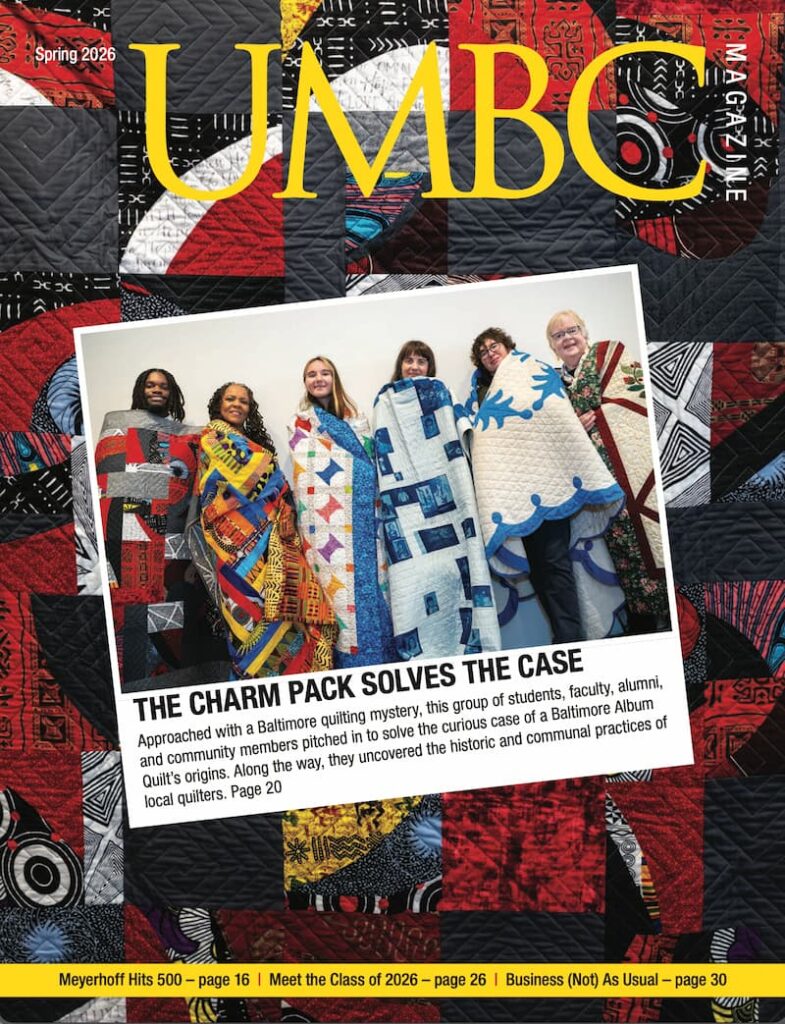
UMBC Magazine Spring 2026 Cover

On the Cover

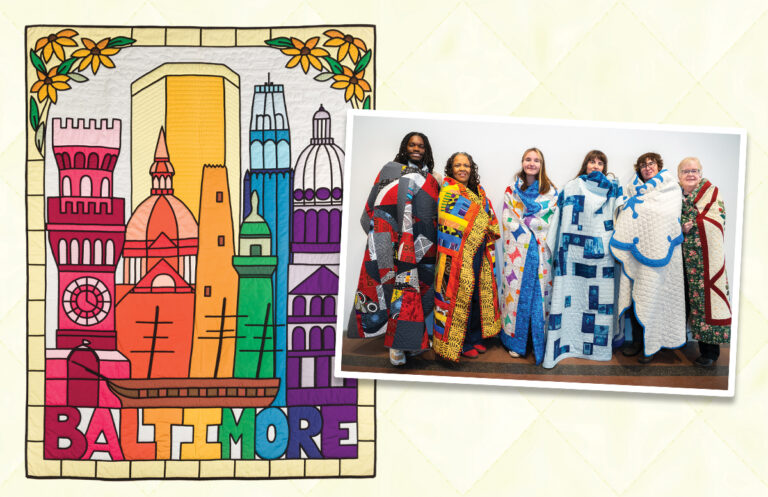
Quilting is an entry point to storytelling, as UMBC CoLab students discovered. The artistic practice can make time stand still, be a window into the past, and inspire future quilters with possibilities.

View Online Request a Copy

In This Issue

To you—Letter from the editor

Dear Fellow Retrievers,

I have a confession to make—it’s not always easy to tell the UMBC story. But the difficulty stems from a very good reason: Rarely is there just one person or one organization doing meaningful work alone. You interview one person, and they introduce you to three more, and before you know it, the story has grown exponentially! This interconnectedness isn’t accidental—it’s baked into our UMBC make up. Retrievers approach the world with intentional interdisciplinarity and genuine community engagement that makes it impossible to give a complex question a surface-level treatment.

You’ll see this clearly in “Business (Not) As Usual” (p. 30). At UMBC, students and faculty find that entrepreneurial pathways abound and that by eschewing a conventional business school setup, Retrievers are set to be nimbler in the world of innovation. It should surprise no one that one area where UMBC students especially excel is “socialpreneurship,” or the desire to drive positive social change rather than profit.

The Class of 2026 is ready to lead the charge on positive social change. Want to feel hopeful about the future? I welcome you to chat with any number of our graduating class (or read about them on p. 26) and you’ll walk away with a sense that Retrievers are asking big questions and not satisfied with superficial answers. These new alumni are approaching the world through a community-engaged lens that’s grown out of layers of mentorship, campus leadership opportunities, supportive friendships, and relevant applied-learning and education-abroad experiences.

Speaking of layers, consider the mystery presented to Sarah Fouts, an American studies professor who was approached with a a quilt with an interwoven set of names. Fouts turned the original question of the quilt’s origin into a summer CoLab research experience that eventually included students, alumni, community members, and the Baltimore Mayor’s Office. The group uncovered historic quilting practices and also reprised a 30-plus-year-old quilting competition that celebrates Baltimore (p. 20).

I enjoy following the rabbit (Retriever?) trail of interviews—it’s a fun challenge to try to get the most complete view of a story while staying in tune to the details that matter. Throughout this issue, Retrievers are connecting the dots across disciplines and across the state to create positive change— and they’re not doing it alone.

— Randianne Leyshon ’09
Editor, UMBC Magazine

OUR STAFF

Editor
Randianne Leyshon ’09

Design Director
Jim Lord ’99

Photographer
Brad Ziegler

Video Producer
Elijah Davis, M.F.A. ’21

Production Coordinator
Tima Aflitunov

Designer
Jim Lord ’99

Section Editors
Catalina Sofia Dansberger Duque
Sarah L. Hansen, M.S. ’15
Catherine Meyers

Contributors
Catalina Sofia Dansberger Duque
Marlayna Demond ’11
Sarah L. Hansen, M.S. ’15
Michael Joseph
Kayla Logue ’27
Bobby Lubaszewski ’10, M.P.S. ’23
Kait McCaffrey
Catherine Meyers
Zachary Seidel 12


Editorial Intern
Kayla Logue ’27

Editor Emerita
Jenny O’Grady

Administration
Lisa Van Riper
Vice President, University Communications and Marketing

Patrick Roche
Vice President, Institutional Advancement


UMBC Magazine is produced by University Communications and Marketing staff along with partners throughout UMBC. To read our content all year long, please visit our Stories homepage.

For more information on the Alumni Association, visit the alumni website. To learn about giving, visit our giving website.

Office Hours

Office Hours—President Sheares Ashby talks with a graduating senior about rootedness and change

Manav Narendra’s story has been shaped by constant motion. A math and computer science double major, who graduated from UMBC this spring, Narendra grew up moving frequently between India and the United States, adapting to new schools, cultures, and environments every few years. Raised by a single mother who was always striving to create a better life for them, Narendra grew accustomed to change—but also to the challenges that come with it.

Coming to UMBC marked a turning point. Narendra sought out a smaller, close-knit academic environment where he could build community, form lasting friendships, and explore what it means to belong somewhere. In this Office Hour, President Valerie Sheares Ashby—who has also been at UMBC for four years—and Narendra reflect on growing rooted to a place and what effect those lasting connections can have.

UMBC Magazine: Manav, tell us about your background and what brought you to UMBC. 

Manav Narendra: I’m originally from India, and I’ve spent about half my life there and half in the U.S. Growing up, I moved a lot because my mom would switch jobs for better opportunities. By my senior year of high school, we had just moved to Maryland. I applied to a vast array of colleges, but I ultimately chose UMBC because I wanted a smaller, more personal environment where I wouldn’t feel lost.

And here, I’ve met people in so many different ways—through classes, the Honors College, tutoring, tennis, even the Career Fair. It’s been really meaningful.
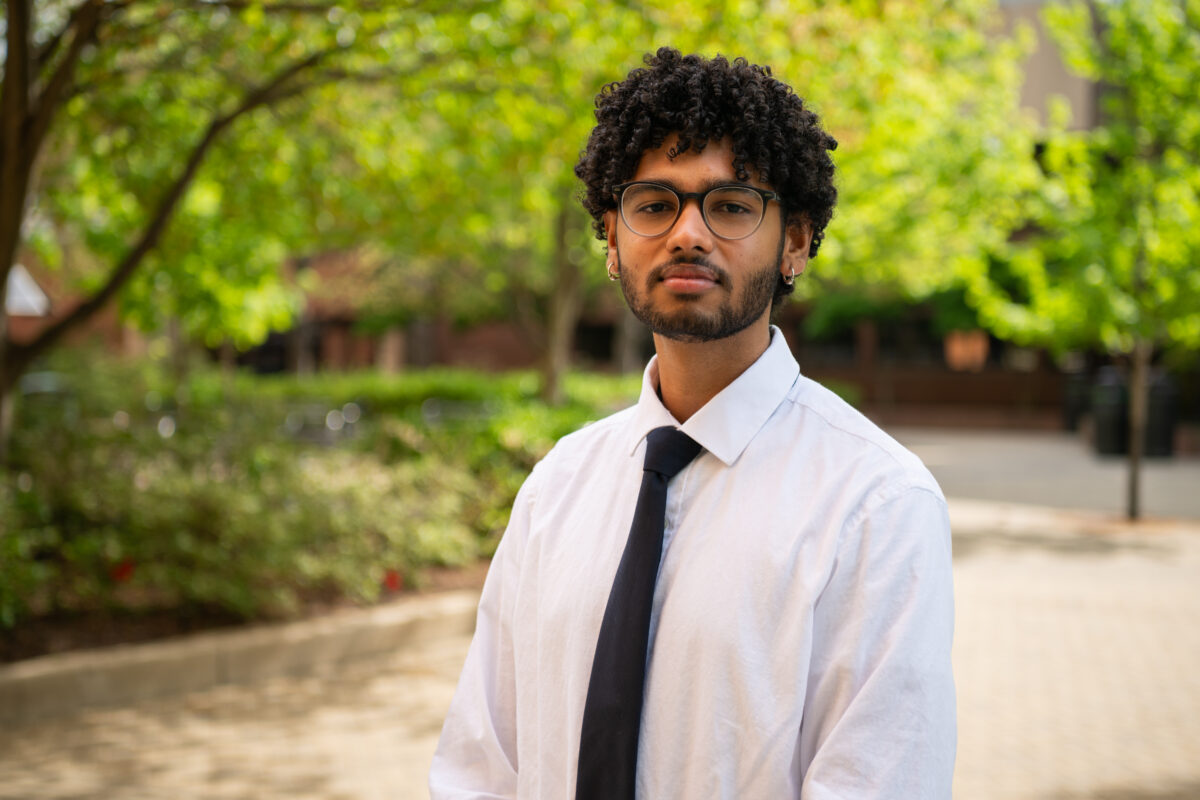
a headshot of a manav narendra, a college senior wearing a white collared shirt with a black tie
Narendra on campus in spring 2026.

President Valerie Sheares Ashby: You wanted a place where you could feel seen—that is powerful. And these smaller communities within UMBC can really shape your experience.

UMBC Magazine: How did moving so often affect your ability to build relationships?

Narendra: It was difficult. I became more introverted over time because you don’t really get the chance to build lasting friendships when you’re always leaving. I just didn’t realize how much I was missing in terms of long-term connections until I got here. Nevertheless, I’m forever grateful to have met so many incredible people from such beautifully different walks of life—they’ve all shaped who I am today.

President Sheares Ashby: I understand that. I am an introvert, too, and I think those kinds of experiences can really shape how you connect with people. It is not always easy to keep starting over. When I moved to Baltimore, I did not know anyone here, but from experience, I knew what I needed to put in place in order to feel like I am grounded and rooted in community. I learned how to do that when I was your age. In college and in graduate school, I started to ask myself: “What is it that I need to feel grounded?” And then I would go get it—I do not wait for it to happen.

UMBC Magazine: How has UMBC shaped your conception of community?

Narendra: I’ve made friendships that have lasted all four years, which still surprises me. I’ll see someone on campus and think, “Wow, I’ve known you for so long.”

President Sheares Ashby: That is such a special realization. I always tell students that those relationships are one of the most important parts of college. You learn so much in the classroom, but those connections—those are what stay with you.

UMBC Magazine: What does “home” mean to you now, after having moved so much?

Narendra: Growing up, home was my mom. Wherever she was, that’s where home was. She was the only constant in my life. I was diagnosed with cancer when I was 13, and my mom and I went through it together. I dealt with the physical pain, but she carried the brunt of the emotional and mental burden. She quit her job to take care of me. I couldn’t have done it without her. Now, I feel like I have another home here. I have a place where I belong, where I feel valued. It’s comforting to be in one place and not have everything constantly changing.

UMBC Magazine: How did that experience influence your future goals?

Narendra: It’s made me want to give back. I’m looking at various roles, ranging from data and actuarial science to software and astrophysics—seeing where I can best utilize my skills to make a difference: something that helps people and advances our collective understanding of the world. I feel like I’ve been given a second chance at life, and I want to use it well.

President Sheares Ashby: Often, our experiences guide us toward that sense of purpose. There is this idea of finding where your talents meet the greatest need—that is where meaningful work happens.
Dawg's Eye View

The News

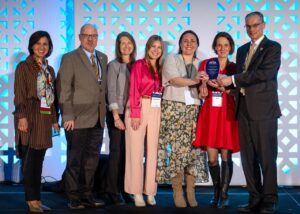
A group of seven people in business attire gather together with two of them holding an award made of glass

UMBC's Global Learning Lab receives Innovative Excellence in Internationalization Award

The Association of International Education Administrators (AIEA) has awarded UMBC's Global Learning Lab one of two Innovative Excellence in Internationalization Awards. This award honors creative, replicable, and innovative initiatives that are critical to internationalization and require strong leadership to achieve. The AIEA commends the Global Learning Lab for reflecting UMBC’s commitment to justice, equity, diversity, and inclusion by fostering inclusive, cost-effective models that integrate global perspectives into the curriculum. 
two men in conversation walk alongside the UMBC Library Pond, which serves to help prevent flooding on campus

Boosting resilience: UMBC secures $1M+ congressional funding to launch lab addressing flood risks in vulnerable Maryland communities

The new UMBC Laboratory for Flood Risk Impact Assessment and Adaptation in Impoverished Maryland Communities. will serve as a hub for analyzing and tracking the impacts of rising flood risks on low-income populations in both urban and rural areas across the state and engage directly with affected communities to collaboratively address shifting environmental challenges.
Four students in business dress stand in front of pond.

Four UMBC student researchers receive prestigious Goldwater Scholarships

Four UMBC students have been named Barry Goldwater Scholars this year. The Barry Goldwater Scholarship and Excellence in Education Foundation supports talented college sophomores and juniors who aspire to become leading researchers in science, engineering, and mathematics in the U.S. The award is one of the most prestigious for undergraduates in STEM. 

At Play

Kaleb Cave and two teammates in white UMBC t-shirts, Cave holds up a bronze medal that is around his neck

Diving into a new sport

From USA Gymnastics national team to UMBC diving record-breaker, Kaleb Cave's athletic journey defies expectations. After discovering diving through Instagram DMs, this mechanical engineering major overcame a devastating Achilles rupture to break a 14-year-old school record and help lead his team to a championship title.
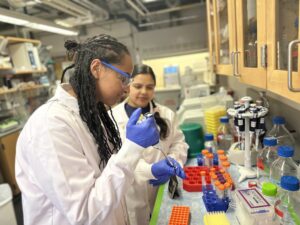
student in lab coat, gloves, and glasses pipets at a lab bench while another student supervises

Sisters in science: How one UMBC lab kindled a family tradition of discovery

On the fourth floor of UMBC’s Meyerhoff Chemistry Building, where students are hard at work exploring the intricacies of RNA molecules that may hold the key to combating viral diseases, a unique family tradition has taken root. Three sisters—Huda, Reem, and Rowah Abdelghani—have each stepped into the same research space and found the thrill of discovery, the warmth of community, and a mentor who welcomes eager learners at all levels.

Discovery

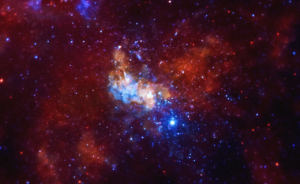
A Chandra X-ray Observatory image around the Sagittarius A* supermassive black hole, located in the center of the Milky Way galaxy, is shown. The image is dominated by vibrant red and blue hues, with a large amount of celestial objects visible. At the center of the image, there is a bright, lumpy object showing the intense X-ray radiation emanating from the Sgr A* black hole. In the surrounding area, there are a couple smaller lumps layered throughout the image, feathering out to a large almost butterfly shape filling much of the screen. The image appears textured, like dozens of blue and orange glow worms are paused in their wriggling. The image offers an unprecedented view of lobes of hot gas extending for a dozen light years on either side of the black hole. These lobes provide evidence for powerful eruptions occurring several times over the last ten thousand years. The image also contains several mysterious X-ray filaments, some of which may be huge magnetic structures interacting with streams of energetic electrons produced by rapidly spinning neutron stars. Such features are known as pulsar wind nebulas.

Revealing galactic history with cosmic rays

Unlocking the Milky Way’s history through cosmic rays: UMBC nuclear physicist Priyashini Ghosh is leading a first-of-its-kind experiment at the Facility for Rare Isotope Beams (FRIB), measuring how chromium-52 breaks apart as it travels through space. Her work fills critical data gaps, sharpening models of galactic chemical evolution and supporting NASA's upcoming TIGERISS mission.
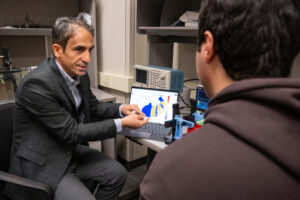
Kiani sits in front of a computer that shows a picture of a virtual stomach and talks with a student.

Electrical, biomedical, and computer science researchers team up to develop a ‘cybergut’

UMBC researchers led by Mehdi Kiani, a professor in the Department of Computer Science and Electrical Engineering, are at the frontiers of these changes. They recently teamed up with colleagues at New York Institute of Technology and Pennsylvania State University to develop a system that combines state-of-the-art, millimeter-sized medical implants, computational models, and machine learning to better monitor and treat stomach disorders.
A digital collage of an orange book co-authored by Kristina Gaddy with a headshot of the author on the right, and the words humanities books in the margins with an image of the United States in a circle

Author Kristina Gaddy ’09, collaborates with Rhiannon Giddens, Grammy Award-winning musician, on the history of Black American music

Rhiannon Giddens, a MacArthur recipient and Pulitzer Prize winner, is grateful for Kristina Gaddy's dedication to digitizing and broadening access to historical material culture. While working on pieces of music highlighting 18th-century North American, Scottish, and Irish traditions for Ken Burns’s 2025 PBS documentary The American Revolution, Giddens was looking for samples of Black music from the Revolutionary War. She wasn't having much luck until she explored Gaddy's website, where she not only found what she was looking for but also the inspiration for their co-authored book, Go Back and Fetch It.

Impact

Group of people, mostly in black and gold dress, pose for a picture

Meet a Retriever—Hailey Turney, M.A. ’21, a COEIT academic advisor who’s found a trusted team to rely on

Hailey Turney, M.A. ’21, first came to UMBC as a student pursuing an academic passion in the text, technologies, and literature program. She connected right away with faculty and other community members. Now, as an undergraduate academic advisor in the College of Engineering and Information Technology and an instructor teaching introductory English and university orientation classes, she helps current UMBC connect and find their own path, too. 
Seven people pose for photo in conference room

Baltimore City hometown recruits shine bright

The Best of Baltimore Grant, a UMBC initiative started in fall 2025, is changing how students from Baltimore City imagine college: not as a distant possibility overshadowed by debt, but as a tangible, financially supported path forward, and right in their backyard.
Three adults stands inside a large room filled with metal shelves and canned goods one person is pushing a grocery cart filled with groceries

A place where kindness grows

The Southwest Emergency Services has been in close proximity to UMBC for decades, it’s relatively new that an intentional cohort of Retrievers regularly volunteers there. This shift was led by a UMBC Peaceworker Fellow, Megan Hamilton, who began working with SWES for 20 hours a week in fall 2025. The Peaceworker Fellows Program, based in UMBC’s Shriver Center, offers a master's degree in social change leadership for returning Peace Corps Volunteers. Fellows are required to complete 20 hours a week of service with community partner non-profits, government agencies, or campus-based service-learning

How To

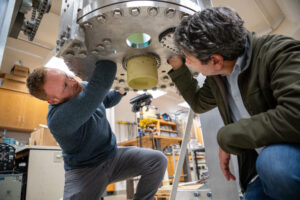
Two men look work under a large metal cylinder housing the magnet.

How to make a (really) strong magnet

Ethan Bowers, a Ph.D. student in mechanical engineering at UMBC, is building a massive, one-of-a-kind research magnet. It weighs more than 2,300 pounds and will be capable of generating a magnetic field of 7 teslas (roughly 140,000 times stronger than the Earth’s magnetic field and more than twice as strong as the field in most MRI machines.)

Wild Card

In This Issue