All posts by: Catherine Borg


DeeAnn Spicer, outstanding philosophy major, serves as an ambassador for her field

DeeAnn Spicer
B.A., Philosophy
Magna Cum Laude
Hometown: Baltimore, Maryland
Plans: Associate Program at the Institute for Recruitment of Teachers (IRT)

The professors at UMBC, specifically in the philosophy department, have been very encouraging and supportive of my goals. They have brought many opportunities to my attention and have provided the resources I needed along the way. Because of my professors, I was able to attend two summer institutes at UCSD and MIT for philosophy majors who plan on going to grad school. These institutes were invaluable.

As an exceptional philosophy student, DeeAnn Spicer has won several prizes in her field, including both recognition from UMBC and nationally competitive honors. Spicer received the Mary Akaras Book Scholarship Award in 2015 and the Evelyn Barker Book Prize from the philosophy department in 2015 and 2016. She won full admission and full funding to the UC San Diego Women in Philosophy Summer Program in 2014 and to the Philosophy in an Inclusive Key Summer Institute (PIKSI) at MIT in 2015. She has also served as a PIKSI Ambassador since 2015, speaking to philosophy majors, undeclared students interested in the major, and philosophy clubs about the summer institute experience.

Spicer has achieved all of these honors, and maintained an impressive academic record, all while working full-time throughout her undergraduate years. Spicer grew up in Trinidad with her family from 1993 through 2001, and moved to Maryland as a high school student. After graduation she will participate in the Institute for Recruitment of Teachers (IRT) Associate Program. IRT was designed to increase the number of minority students “pursuing advanced degrees for teaching, counseling and administrative careers so the pool of potential faculty members at both the K-12 and university levels will become more diverse.” Associates are selected through a rigorous application process and are offered extensive counseling and assistance in negotiating the graduate school application process. Spicer will apply for PhD programs in philosophy this fall.

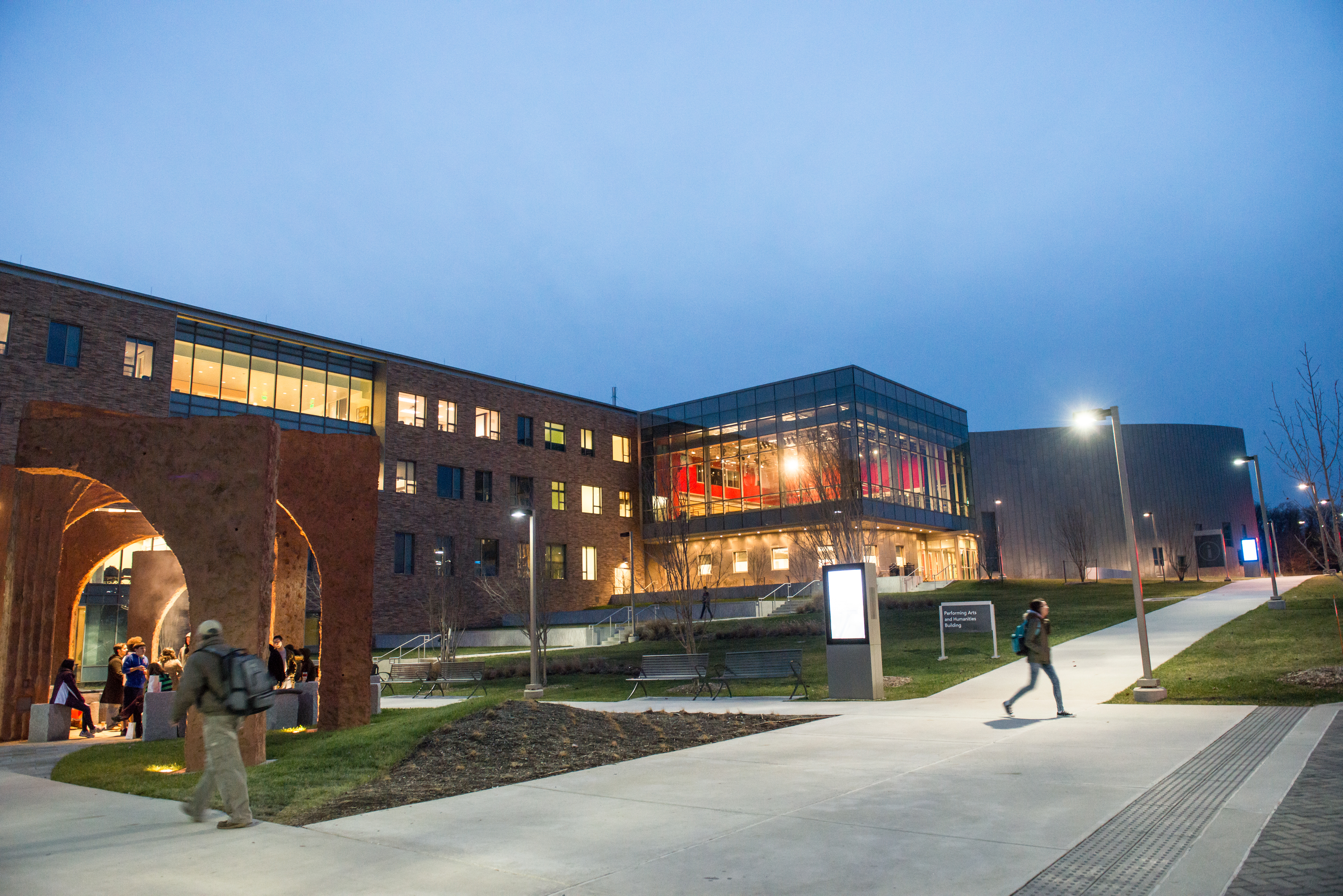
PAHB_night-3366

Image: The Performing Arts and Humanities Building at night, where Spicer spent many late nights studying. Photos by Marlayna Demond ‘11 for UMBC.

Alexis Kocerhan, Linehan Artist Scholar, to continue exploring intersection of art and politics at CalArts

Alexis “Ally” Kocerhan
B.A., Theatre; B.A., Gender and Women’s Studies
Cum Laude
Hometown: Pasadena, Maryland
Plans: M.A. in Aesthetics & Politics at California Institute of the Arts (CalArts)

UMBC has provided me with the opportunity to discover passions that will carry through my personal, professional, and academic careers…Being a double major has helped me focus on the intersections of race, class, gender, ability, and sexuality in all of my artistic and scholarly work. Through my experiences in the Theatre Department and the Gender and Women’s Studies department, I’ve focused on using my work to show how art is inherently valuable, and how social justice issues are important to every aspect of our lives.

Ally Kocerhan is a Linehan Artist Scholar who served as director of Christopher Durang’s challenging one-act play “Sister Mary Ignatius Explains It All For You” as part of the theatre department’s Studio 3 production in 2016.

She commented on the too classes that especially influenced her career at UMBC: “Gender, Sexuality, and Theatrical performance taught by Dr. Susan McCully and Feminist Perspectives in Transnational Cinema taught by Dr. Viviana MacManus opened my eyes to the deep connections between social justice, identity, and art.”

Kocerhan is particularly interested in the intersection of politics and the arts. “(At Cal Arts) I will be studying subjects such as Arts Activism, Critical Theory, Critical Discourse in the Arts, Feminist and Queer perspectives in Art and Politics, and Contemporary Political Thought.”

Image: Portrait by Marlayna Demond ‘11 for UMBC.

UMBC artists recognized for excellence through highly competitive awards

Funding for individual artists is often scarce and always highly competitive, but the Baltimore-Washington region is fortunate to have both state and private organizations awarding funds directly to individual artists. Award announcements this spring include many UMBC students, alumni and faculty, whose recognition speaks to ongoing artistic excellence at UMBC.

The Maryland State Arts Council’s annual Individual Artist Award (IAA) “recognizes the importance of artists and their works of excellence to the cultural vibrancy of Maryland.” The award categories cycle every three years and this year awards were given within the disciplines of Creative Non-Fiction/Fiction, Media/Digital/Electronic Arts, Theater Solo Performance, Painting, and Works on Paper. Selected from more than 585 applicants, the 2016 awardees receive grants for $1,000, $3,000 or $6,000 to honor their achievement and to support further advancement of their career.

This year’s recipients, announced March 30, 2016, include Lynn Cazabon, associate professor visual arts; Dominique Zeltzman, M.F.A. ’14, imaging & digital arts; Mina Cheon, M.F.A. ’02, imaging & digital arts; and David Anthony Brown ’99, visual and performing arts. Lynn Cazabon, whose project Portrait Garden includes photographic images of plants selected to represent eleven women incarcerated at Maryland Correctional Institution for Women and audio statements, received the highest award level in Digital Medi. She commented: “This is my 4th MSAC grant since 2003 and the first time winning it in the Digital Media category. The recognition and validation of the award is valuable in and of itself but also the merit basis means the funds can support any aspect of my work, not just a specific project.”

Finalists for the 11th Annual Janet and Walter Sondheim Artscape Prize were also recently announced and include Christos Palios ’02, visual and performing arts, a fine art photographer “whose work probes ideas and aspects of identity, memory, and isolation within urban, industrial, and natural spaces.” Palios’ work can be found in public and private collections all over the country, and has appeared in such online publications as F-Stop Magazine and Dotphotozine. The award is designed to support artists working in the Greater Baltimore area, and the winner, to be announced July 9 at the Baltimore Museum of Art, will receive a $25,000 fellowship to further their career. The work of the seven finalists will be presented in the Thalheimer Galleries at the Baltimore Museum of Art from Wednesday, June 22 through Sunday, July 31, 2016.

UMBC community members who were semifinalists for the prize include Marian Glebes, M.F.A. ’09, intermedia and digital arts; Jason Hughes, M.F.A. ’15, intermedia and digital arts; Vincent Carney ’06, visual arts; Ben Marcin ’80, economics; and Lynn Cazabon, associate professor of visual arts. An exhibition of the semifinalists’ work is shown in the Decker and Meyerhoff galleries of MICA on Friday, July 15 through Sunday, July 31, 2016. An opening reception for the semifinalist exhibition takes place July 14, 2016, 6-9 p.m. at MICA, located at 1303 W. Mount Royal Avenue.

Finalists for the 2016 Baker Artist Award were also recently announced and include Vin Grabill, associate professor of visual art; Richard Chisolm ’82, interdisciplinary studies; Stephanie Schafer ’00, visual and performing arts; and current Intermedia and Digital Arts (IMDA) students Jeffrey Gangwisch, M.F.A. ‘18 and Christopher Kojzar M.F.A. ’18. This year, five artists will be selected to win $85,000 in prizes: the $50,000 Mary Sawyers Imboden Prize, the $20,000 Mary Sawyers Baker Prize, and three $5,000 prizes (the Semmes G. Walsh, Nancy Haragan, and Board of Governors Awards). These prizes will be awarded “to artists who exemplify a mastery of craft, commitment to excellence, and a unique and compelling vision.” Awardees will be announced on May 12 on a special episode of Maryland Public Television’s “Artworks” program.

Images by Lynn Cazabon: Above left, installation of Portrait Garden interactive poster in Baltimore Light Rail car; above right, Portrait Garden (C, Echinacea purpurea), 22″ x 23″, 2014

CADVC’s touring exhibits connect with audiences across the nation

The Center for Art, Design and Visual Culture (CADVC) reaches audiences far beyond UMBC with dynamic touring exhibitions that explore the social and aesthetic issues of our times and inspire viewers to rethink how art institutions relate the public. The Center offers extensive educational outreach initiatives and publication programs, often in partnership with a leading educational and cultural institutions.

Four CADVC exhibitions currently traveling serve as excellent examples of this work:

For All the World to See: Visual Culture and the Struggle for Civil Rights was organized by the CADVC in partnership with the Smithsonian National Museum of African American History and Culture. Through a host of media—including photographs, television and film, magazines, newspapers, posters, books, and pamphlets—the project explores the historic role of visual culture in shaping, influencing, and transforming the fight for racial equality and justice in the United States from the late-1940s to the mid-1970s. For All the World to See includes a traveling exhibition, website, online film festival, and richly illustrated companion book. The exhibition originated on the UMBC campus and since then toured extensively; prominent exhibition venues include the International Center for Photography, the National Civil Rights Museum, the National Museum of African American History and Culture, and the DuSable Museum of African American History.

In addition to the partnership with the Smithsonian, the extension of the exhibition through digital and printed efforts, and the initial exhibition tour, a subsequent tour in partnership with the National Endowment for the Humanities’ On the Road program has been traveling since 2012, reaching cities from Portland to San Antonio. The 20th installation of the exhibition through the NEH partnership will open in April at Kean University in Union, New Jersey and then continue to tour at least through the spring of 2017 with additional upcoming exhibitions in Connecticut, Illinois, Louisiana and Texas. The NEH is an integral partnership, supplying the resources and communications to reach diverse audiences and tailor the exhibition for a wide variety of venues.

Revolution of the Eye: Modern Art and the Birth of American Television, organized jointly by the CADVC and the Jewish Museum in New York, is the first exhibition to explore how avant-garde art influenced and shaped the look and content of network television in its formative years, from the late 1940s to the mid-1970s. During this period, the pioneers of American television—many of them young, Jewish, and aesthetically adventurous—had adopted modernism as a source of inspiration. Revolution of the Eye looks at how the dynamic new medium, in its risk-taking and aesthetic experimentation, paralleled and embraced cutting-edge art and design. The exhibition premiered at the Jewish Museum, and then travelled to the Fort Lauderdale Museum of Art where it was on view recently. The exhibition will open next at the Addison Gallery of American Art in Andover, Massachusetts next month before returning to UMBC in the CADVC gallery October 6, 2016 through January 7, 2017.

Visibility Machines: Harun Farocki and Trevor Paglen, which opened at UMBC in October 2013, explores the unique roles Harun Farocki and Trevor Paglen have played as meticulous observers of the global military industrial complex. Investigating forms of military surveillance, espionage, war-making, and weaponry, Farocki and Paglen each examine the deceptive and clandestine ways in which military projects have deeply transformed, and politicized, our relationship to images and the realities they seem to represent. The exhibition initiates critical questions about the crucial part images play in revealing essential but largely concealed information, and places the oeuvres of Harun Farocki and Trevor Paglen within the broader cultural and historical developments of the media they are creatively working with, namely photography, film, and new media. The exhibition marks the first time the work of these two internationally recognized artists has been shown together as well as significantly evaluated in respect to one another. After the exhibition premiered at UMBC an international tour included exhibitions at Die Akademie der Künst, in Berlin, Germany; Gallery 400 at the University of Illinois, Chicago; and the Gund Gallery, Kenyon College, in Gambier, Ohio.

The exhibition Where Do We Migrate To? features the work of nineteen internationally recognized artists and collectives, including Acconci Studio, Svetlana Boym, Blane De St. Croix, Lara Dhondt, Brendan Fernandes, Claire Fontaine, Nicole Franchy, Andrea Geyer, Isola and Norzi, Kimsooja, Pedro Lasch, Adrian Piper, Raqs Media Collective, Société Réaliste, Julika Rudelius, Xaviera Simmons, Fereshteh Toosi, Philippe Vandenberg, and Eric Van Hove. The exhibition explores contemporary issues of migration as well as experiences of displacement and exile. Situating the contemporary individual in a world of advanced globalization, the artworks address how a multiplicity of migratory encounters demand an increasingly complex understanding of the human condition. After its presentation at UMBC in 2011, the exhibition has toured both nationally and internationally, most recently exhibited at the Värmlands Museum in Karlstad, Sweden (view here). It will be on view at DePauw University’s Richard E. Peeler in the fall of 2016.

Symmes Gardner, executive director of the CADVC, says he is “very excited to be working on the Center’s next project on the near horizon, SEEING SCIENCE, a new initiative that engages a wide variety of research happening at UMBC.” The year-long campus-wide interdisciplinary project will bring together UMBC’s science, humanities, and art communities to explore the central and evolving role that photographic images play in defining, shaping, promoting, and furthering science. The project asks how photographic images made in and about the sciences impact public opinion, policy, science education, visual and popular culture, and trigger awareness of and discussion about pressing issues. Seeing Science was initiated by the Office of the Vice President of Research, in collaboration with the CADVC. More information regarding the web-based projects, exhibitions, film series and publications can be found on UMBC’s Arts & Culture calendar.

Image: Installation view of the exhibition Revolution of the Eye: Modern Art and the Birth of American Television. The Jewish Museum, NY. Photo by David Heald.

Nohe exhibit presents shifting Australian landscape that illustrates humanity’s global impact

Timothy Nohe, director of the Center for Innovation, Research and Creativity in the Arts (CIRCA) and visual arts professor, will introduce American audiences to the deeply woven human narrative of Botany Bay in his exhibition Sounding Botany Bay opening February 12 in the Albin O. Kuhn Library Gallery.

The exhibition, which runs through March 31, is the culmination of ten years of research beginning in 2006 while Nohe was an Australian-American Fulbright Commission Senior Scholar fellow. Nohe returned for intensive research residencies in subsequent years, during which time change inexorably swept the bay.

Nohe will also present a lecture about his work in the exhibition, part of the Humanities Forum series from UMBC’s Dresher Center for the Humanities, on Tuesday, February 16 at 4:00 p.m. Nohe shares:

For many thousands of years the land adjacent to Kamay was an important source of food, place of trade, and site of spiritual importance to a number of Aboriginal clans. Botany Bay/Kamay is one of Australia’s most significant cultural and natural sites. This location was a significant point of both physical and cultural conflict: HMS Endeavour, the first ship carrying British explorers and colonists, landed on the southern shores of Kamay — renamed, at this time, Botany Bay — in 1770.

Today, Botany Bay is an unusual clash of pristine national park land home to a diverse but delicate marine ecosystem, and heavily industrialized areas including Sydney’s main cargo seaport and the desalinization plant, oil refinery, sewer treatment facility, and miles of industrial pipelines that line the shores.

By walking through bush and dunes, suburban streets and industrial estates, Nohe was able to directly observe the Bay with contemplative discipline. The artist was ready to document discoveries with digital audio recorders and cameras, and comprehensive database searches in state and national libraries and the online market eBay.

Over time he became aware of seasonal and long-term rhythms accented by notes of discordant change. A world of inaudible sound was sampled via a radio frequency scanner, allowing Nohe to intercept air traffic at Sydney Airport; hydrophones captured otherwise inaudible underwater sounds in mangroves, docks and tide pools.

His extended time and methods of observation revealed truths about a complex place told with documentary mural prints, sound compositions, video, archival documents, and ephemeral materials. In many ways this story mirrors our American experience of human stewardship, the colonization and the decimation of indigenous peoples, industrialization, national narratives, globalization and climate change.

“In the years that I worked on this project, I witnessed and recorded change that astounded me,” Nohe says. “One must contrast the epoch of Aboriginal stewardship of the Bay, with the radical reshaping of the environment after the founding of Modern Australia.”

Timothy Nohe is an artist and educator engaging traditional and electronic media in daily life and public places. His artwork has focused on sustainability and place, intermedia works, and sound scores for dance and video. He received a 2006 Fulbright Senior Scholar Award from the Australian–American Fulbright Commission and an Australian–American Fulbright Commission Fulbright Alumni Initiative Grant in 2011.

Nohe has forged strong ties to Australia, serving on the editorial board of the peer-reviewed journal Unlikely, as an adjunct professor at La Trobe University, Faculty of Humanities and Social Sciences, and as an artist-in-residence at the Centre for Creative Arts at La Trobe University.

Four Maryland State Arts Council awards have supported his work in the areas of music composition, non-classical; media; new genre; and installation/sculpture. Nohe has also been recognized with a Creative Baltimore Award and in 2015 the Warnock Foundation supported his interdisciplinary work in urban forests with a Social Innovator award.

Complete performance information and tickets are available through the UMBC Arts & Culture Calendar.

Timothy Nohe will be on WYPR’s Humanities Connection live at 4:44 p.m. on February 11, 2016. An archive of the broadcast will be available at Humanities Connection.

Image: Botany Bay, Australia. Photo by Timothy Nohe.

Groundbreaking Exhibition Revolution of the Eye Opens at the Center for Art, Design and Visual Culture

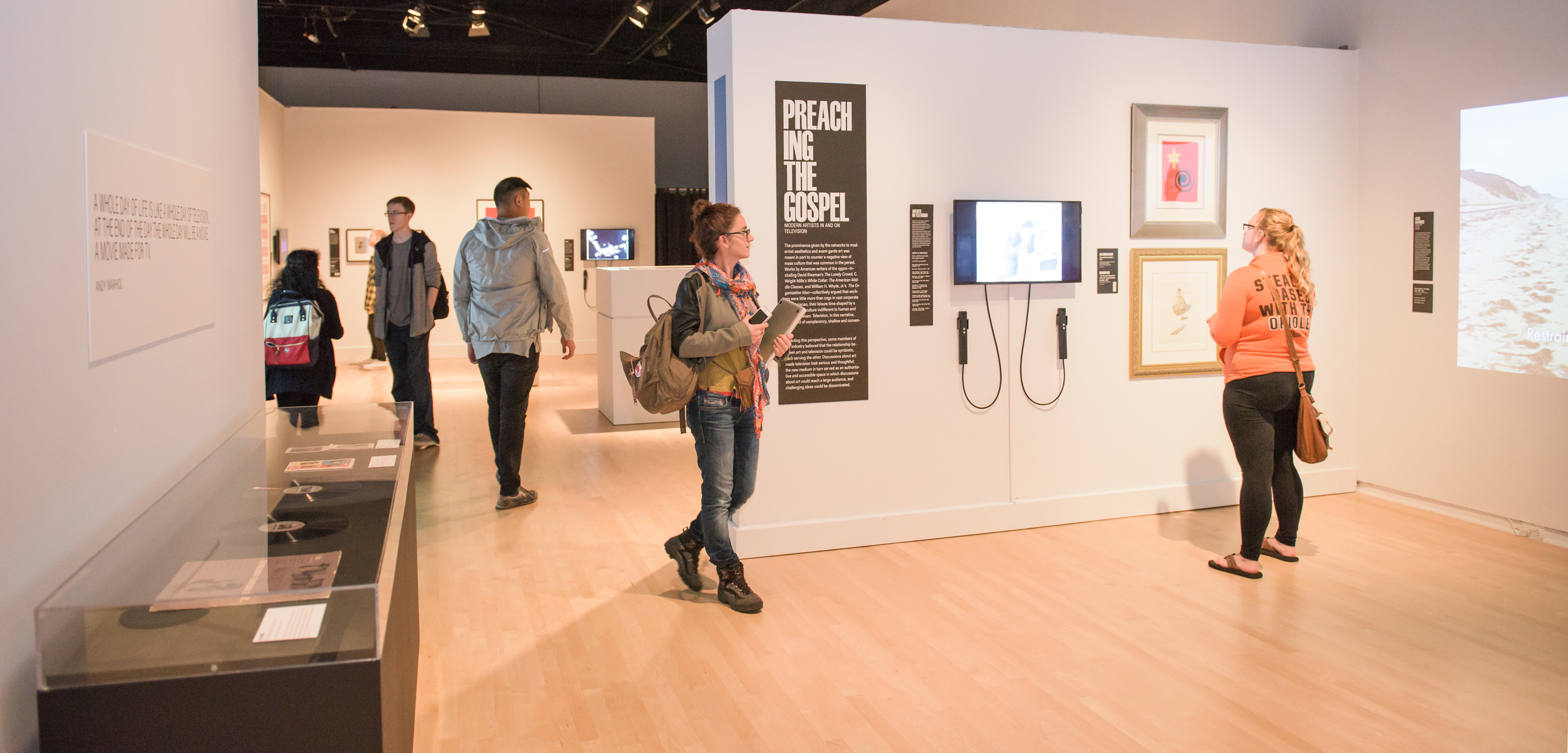
Hailed as “groundbreaking” by The Baltimore Sun’s David Zurawik, Revolution of the Eye: Modern Art and the Birth of American Television, the first exhibition to explore how avant-garde art influenced the look and content of network television in its formative years, is on view at the UMBC’s Center for Art, Design and Visual Culture (CADVC) through December 10.

From the late 1940s to the mid-1970s, the pioneers of American television adopted modernism as a source of inspiration. Revolution of the Eye looks at how the dynamic new medium of television, in its risk-taking and aesthetic experimentation, paralleled and embraced cutting-edge art and design.

Highlighting the visual revolution ushered in by American television and modernist art and design of the 1950s and 1960s, Revolution of the Eye features over 260 art objects, artifacts, and clips. Fine art and graphic design, including works by Saul Bass, Marcel Duchamp, Roy Lichtenstein, Man Ray, Georgia O’Keeffe, and Andy Warhol, as well as ephemera, television memorabilia, and clips from historic television programs and film, including Batman, The Ed Sullivan Show, The Ernie Kovacs Show, Rowan and Martin’s Laugh-In, and The Twilight Zone will be on view.
Revolution-Eye-CADVC16-9642Early on, television opened its doors to appearances by avant-garde artists — from John Cage performing a musical composition on I’ve Got a Secret to Salvador Dali as the mystery guest on What’s My Line. Revolution of the Eye examines the diverse ways modern artists, designers, and critics used the medium as a significant vehicle for self-promotion to a broad national audience. Viewers will experience rare clips of Cage, Dali, Willem de Kooning, Marcel Duchamp, Ray Eames, Roy Lichtenstein, Ben Shahn, George Segal, and other renowned artists.

During the exhibition’s premiere in New York, The New York Times commented, “We may think of TV before All in the Family as a vast wasteland, but the more than 260 items in the exhibition — clips, advertisements, art pieces, publications, merchandise — reveal the influence and even the input of artists from Duchamp and Dali to Ben Shahn, Saul Bass, Roy Lichtenstein and Andy Warhol.”

Revolution of the Eye examines television’s promotion of avant-garde ideals and aesthetics exemplified by the integration of Dada, Surrealism, and other experimental genres into the aesthetically and conceptually rich series The Twilight Zone and The Ernie Kovacs Show by such pioneers as Rod Serling and Ernie Kovacs. Both embraced avant-garde ideas that broached broad social or cultural issues — from the politics of the Cold War to the corporate ambitions of the networks. Their work was artful and sophisticated, exemplifying the best of early television. Their influential programs reflected the medium’s potential to alter the way Americans understood the world.

The exhibition also features work by Stan VanDerBeek, a professor of art and film at UMBC from 1975 until his death in 1984, when he chaired the Department of Visual Arts. A pioneer in the development of experimental film and live-action animation techniques, VanDerBeek contributed early in his career to Winky Dink and You, an ingenious interactive Saturday morning show that aired on CBS from 1953 to 1957, clips of which are shown in the exhibition.

“Many critics speak of present-day television as kind of a new golden age in which the medium is seen to have surpassed film as a major venue for artistic experimentation and quality,” says exhibition curator and UMBC research professor Maurice Berger. “Revolution of the Eye reminds us that the desire for outstanding, artistically important programming was in television’s DNA from the beginning.”
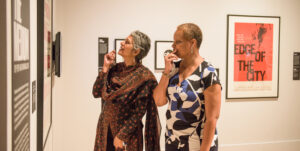
Revolution-Eye-CADVC16-9660The exhibition is organized by UMBC’s Center for Art, Design, and Visual Culture and the Jewish Museum, New York, where it was on display in 2015 prior to a national tour that included the NSU Art Museum Fort Lauderdale and the Addison Gallery of American Art.

The Center for Art, Design and Visual Culture is located on the first floor of the Fine Arts Building and is open Monday through Saturday from 10 a.m. to 5 p.m., on Thursdays until 7 p.m., and on Sundays from 12 to 5 p.m. Admission is free.

Lynn Spigel, Professor of Screen Cultures at the School of Communication at Northwestern University, who wrote the introduction to the exhibition catalog, will speak about the exhibition on Thursday, November 17, 4 p.m. in 132 Performing Arts and Humanities Building.


Read more:
UMBC’s ‘Revolution’ reminds us that small screen had big visual ideas (The Baltimore Sun)
‘Revolution of the Eye: Modern Art and the Birth of American Television’ Review (The Wall Street Journal)
‘Revolution of the Eye’ Examines Art’s Influence on Early TV (The New York Times)


Revolution of the Eye is made possible by the generous support of the Andy Warhol Foundation for the Visual Arts, the Skirball Fund for American Jewish Life Exhibitions, the Stern Family Philanthropic Foundation, the National Endowment for the Arts, the National Endowment for the Humanities, and other generous donors. The exhibition’s presentation at UMBC is supported in part by the Maryland State Arts Council and the Baltimore County Commission on Arts and Sciences.

Top Image: Batman and Robin, 1966. Image provided by 20th Century Fox/The Kobal Collection at Art Resource, New York.
Exhibition images by Marlayna Demond ’11 for UMBC.