Over 10 years ago, Tania Lizarazo met with Justa Mena Córdoba in Chocó, Colombia. Before Mena Córdoba passed away, Lizarazo promised to tell her story as one of the founding commissioners of the Gender Commission of COCOMACIA, Colombia’s largest Afro-Colombian peasants’ association.
With her new book, Postconflict Utopias: Everyday Survival in Chocó, Colombia (University of Illinois Press, 2024), Lizarazo fulfills that promise. “It means a lot to me to publish this book as this was my first collaborative research project,” says Lizarazo, associate professor of modern languages, linguistics, and intercultural communication and global studies. “I promised Justa that I would do my best to share her story and legacy of peace-building amidst decades of ongoing violence by supporting women’s daily work.”
Lizarazo (red shirt) with members of the Gender Commission COCOMACIA. (Image courtesy of Lizarazo)
Lizarazo’s interest in Latin American cultural studies and transnational feminist research led her to explore the Gender Commission of COCOMACIA. Curious to learn more, Lizarazo reached out to Mena Córdoba. She invited Lizarazo to her home and the headquarters of the commission, both in Chocó, located in the northwest, bordering Panama and the Atlantic and Pacific Oceans, and where the largest Afro-Colombian community in the country lives. For over a decade, Mena Córdoba served as Lizarazo’s friend, mentor, and fellow researcher.
Many scholars, says Lizarazo, both Colombian like herself, and foreign, research the Colombian Pacific and use ethnography as their main research approach. She notes that while she uses ethnography, her work also places the community on equal footing with researchers. The book documents the collaboration between Lizarazo and the Afro-Colombian women of the Gender Commission. The team used digital storytelling tools to document the commission’s daily efforts to build networks and share resources that strengthen their families, schools, jobs, and communities.
Tania Lizarazo (l) with a member of the Gender Commission of COCOMACIA at the community radio station. (Image courtesy of Lizarazo)
“Sometimes we highlight protests but ignore the daily mundane actions that build over time and make collective survival possible. This is the case for Black women in the Colombian Pacific,” explains Lizarazo for The Conversation. “Their solidarity is a reminder that peace and justice are a collaborative, everyday effort. As Justa told me in 2012: “One cannot change the world by herself.”
Learn more about Lizarazo’s collaboration with fellow UMBC faculty María Célleri, Yolanda Valencia, and Thania Muñoz to document the experiences of Latinx communities with Latinx communities in D.C., Maryland, and Virginia.
Ever wonder what dinosaur poets would write about if they knew their moment of extinction was near? That’s one of the questions poet Tanya Olson, associate teaching professor of English, considered while writing her latest book, Born Backwards (YesYes Books, 2024). As she worked on the collection, Olson reflected on extinction and preservation—of food, objects, experiences, relationships, places, and people, especially butch life in the American South during the 1980s and ’90s.
“The poems of Born Backwards remember anyone who feels out of place—in a body, a hometown, or a century,” says Olson. “In a time when such histories are again a threat, remembering becomes urgent.”
One of Oslon’s favorite parts of teaching is guiding students through the research process for their writing. Some of Olson’s research for the 20 poems in Born Backwards draws on her life growing up in the South. She shares episodes of her time on her grandmother’s farm doing chores, learning to drive from her father—starting with a push mower—and helping her mom tend a large vegetable garden. Alongside these experiences are reflections on questions of being queer and the decision to leave in search of a more queer-friendly place.
Olson also draws inspiration from the MTV revolution of the 1980s and the country music she heard growing up—artists like Johnny Cash, Patsy Cline, and Loretta Lynn—as well as the trailblazing career of k.d. lang, a pioneer for lesbian country music artists. Reflecting on extinction and preservation, Olson contemplates what could be lost if she is the last butch to remember smoky lesbian bars and to witness the decline of butch culture, wondering who will preserve these histories in the future.
“
Butches are not being erased
Butches are not being replaced
It is simply our time to go
Extinction happens to everyone
Tanya Olson
“Let Me Not Forget Me Not,” one of the poems in Born Backwards, was featured in the DC 2025 Pride Poem-A-Day Series.
If you could develop a treatment to improve the care of millions of people with opioid use disorder (OUD) and post-traumatic stress disorder (PTSD), where would you start? For doctoral students like Laurel Meyer, with a passion for serving this community, the answer begins with funded clinical research opportunities and faculty mentorship.
In 2020, Rebecca Schacht, clinical psychologist and associate professor of psychology, and Kevin R. Wenzel, a clinical psychologist and director of research at Baltimore-based Maryland Treatment Centers, welcomed Meyer into the human services psychology doctoral program as a research coordinator in their study. Schacht and Wenzel were conducting a randomized trial of written exposure therapy (WET) for people with PTSD in residential OUD and substance use disorder (SUD) treatment settings. WET is an evidence-based treatment for PTSD in which patients process their trauma by writing an in-depth narrative about a specific traumatic event in five sessions.
(l-r): Rebecca Schacht and Kevin R. Wenzel. (Image courtesy of Schacht)
“At the start of the project, I contributed to research design and protocol development. I then collaborated with clinical staff at the treatment facility to identify and recruit eligible patients,” says Meyer, who, along with fellow research assistant Samantha Berg, a fifth-year human services psychology doctoral student, had the opportunity to share the findings as co-authors on the article “A pilot test of Written Exposure Therapy for PTSD in residential substance use treatment” in the American Journal on Addictions.
“Throughout the trial, I worked directly with participants in several capacities, including assessing eligibility for the study, providing Written Exposure Therapy as a study therapist, and conducting follow-up interviews to understand participants’ experiences,” says Meyer.
Thanks to the team’s rigorous research, Schacht and Wenzel, the co-principal investigator, are scaling up their research with a grant of over $3 million from the National Institute on Drug Abuse to develop and test Written Exposure in Substance Treatment (WEST), an adapted version of WET for use with people with OUD in residential SUD treatment.
“One of the most exciting aspects of grants like this one is that they include funding for Ph.D. students. This project will support at least two doctoral students throughout the six years of the project, including summer funding,” says Schacht, the director of the UMBC Psychology Training Clinic. “Most doctoral students serve as either research assistants or teaching assistants. These positions provide students with mentored professional development and include tuition, health insurance, and stipends to support living expenses.”
The research cycle
Now a sixth-year doctoral student, Meyer is passing the baton to the next generation of researchers in the human services psychology doctoral program, one of whom is second-year doctoral student Alexis Alfano. This summer, Alfano has been preparing assessments by programming measures in Qualtrics, an online survey tool to build and distribute surveys, collect responses, and analyze response data. Because the research involves human participants, Alfano is assisting in developing a detailed plan for participant involvement to submit to the Institutional Review Board for review and approval. She also contributed to the development of the procedure manual and materials used during interviews and focus groups, and assisted with programming forms, transcribing qualitative data, and data entry.
“I had the opportunity to become involved in Project WEST by being a student in Dr. Schacht’s lab and receiving her mentorship,” says Alfano. “For the last two years, I have participated in a variety of tasks, including recruiting and interviewing both patients and staff at the Maryland Treatment Centers to gather feedback on Written Exposure Therapy.”
(l-r): Julia Thomas and Morgan Dease, research coordinators at Maryland Treatment Centers, demonstrate what a WEST session looks like. (Image courtesy of Schacht)
Maryland Treatment Centers have a longstanding history of conducting clinical research trials to improve patient care and treatment delivery, with the support of patients and staff, as well as researchers and universities. The seven-year partnership between Schacht and Wenzel offers students a real-world clinical setting to develop hands-on clinical skills essential for treating patients, collaborating with center staff and fellow researchers, and gaining the experience needed to become clinical psychologists and conduct clinical research.
“Patients are at the center of the research. Their experiences, insights, and feedback help us identify which aspects of the treatment are most effective and which need to be adjusted for maximum impact,” says Schacht. “We consider people to be the experts of their own experience, and their perspectives are essential to designing an intervention that’s aligned with their needs.” Schacht hopes that, by the end of the project, the team will have an effective intervention that can be widely implemented, making WEST the gold-standard treatment for PTSD available in residential and other SUD treatment contexts.
The long game
Doctoral training is a years-long process. In the coming year, Meyer is completing her predoctoral internship in an integrated healthcare setting where she is receiving further clinical training in evidence-based treatment for PTSD. She is excited to move closer to her career goal to combine both clinical practice and clinically focused research.
“My role as research coordinator in Dr. Schacht’s research on Written Exposure Therapy has deepened my passion for clinical research and has been instrumental in shaping my long-term career goals,” says Meyer. “Being part of research that has such a direct impact on clinical care has inspired me to pursue a career in which I can use science and clinical practice to enhance treatment outcomes and quality of life for individuals who have experienced trauma and substance use.”
Imagine a world where, instead of pointing out everything nations are doing wrong to the living world based on how they create, improve, and sustain a thriving environment, we measure what they are doing right. By focusing on the good, people worldwide might be empowered to learn from success, instead of feeling more powerless in the face of all the messages of environmental harm and damage. For nearly three years, Erle Ellis, professor of geography and environmental systems, has collaborated with a team of researchers across six continents, led by the United Nations Development Program’s Human Development Report Office (UNDP-HDRO) to make that vision a reality by developing the Nature Relationship Index (NRI).
The NRI will be the first standardized global metric that measures the quality of a nation’s relationships with nature, including plants and animals, land, rivers, oceans, mountains, forests, deserts, and grasslands. Progress will be measured in terms of each nation’s contributions to the living world, based on three dimensions: the management of landscapes to enable people and nature to connect and thrive together, the use of nature to sustain human development without harming, diminishing, or degrading it, and financial, legal, and institutional support for environmental protections.
Towards a balanced living world
Nature, the world’s leading multidisciplinary science journal, has published this groundbreaking framework by conservation, environment, and human development experts and practitioners. The NRI is now being developed with the aim of a public release as part of the 2026 Human Development Report, with the goal of updating the NRI for all countries of the world annually.
“By focusing on human agency—people’s ability to hold values and make commitments and choices beyond their own individual well-being,” writes Ellis, the lead author, “the human development approach treats people as agents of change, rather than passive recipients of policy interventions, foregrounding people’s values, aspirations and struggles to achieve a better future.”
UMBC’s College of Arts, Humanities, and Social Sciences has named Ellis the 2025 – 2026 Lipitz Professor. The Roger C. Lipitz and the Lipitz Family Foundation endowed professorship that celebrates and sponsors cutting-edge research and teaching. This honor recognizes Ellis’s international leadership in research that supports the health of human-managed ecosystems at both local and global levels, aiming to guide sustainable and responsible stewardship. Ellis served as the 2021 – 2024 UMBC Presidential Research Professor for his contributions to ecology and geography, including landscape ecology and human-environmental interactions.
Ayra Sangi, an Asian studies senior, has received the 2025 Freeman-ASIA Award. The semester-long education abroad award funds U.S.-based undergraduates up to $5,000 to study abroad in East or Southeast Asia for one semester. Sangi will spend the fall semester of her senior year at the National Taiwan University in Taipei City in their intensive Mandarin Chinese language program to prepare her for a career in Chinese linguistics.
Sangi’s love of Mandarin began in high school, when she started learning it through English translations of Chinese web novels. This hobby inspired her to explore Asia’s cultures and languages, and it was the deciding factor in choosing UMBC.
“It was important for me to find a university with a strong education abroad program and a comprehensive Asian studies major rather than one centered solely on learning Chinese,” said Sangi, who pursued her degree while working every other semester in the federal civil service. “While I did want to learn the language, I also wanted to learn about the history, culture, and politics. UMBC offered both.”
Sangi is in good company. Despite the unexpected challenges of international travel, UMBC’s 2025 – 2026 academic year marks the largest cohort of Retrievers participating in education abroad programs. “As more and more UMBC undergraduate and graduate students participate in global education opportunities, they are applying for more nationally competitive awards,” says Brian Souders, Ph.D. ’09, language, literacy, and culture, M.A. ’19, TESOL, the associate director of global learning at UMBC’s Center for Global Engagement. “Looking at the past decade, Ms. Sangi is the first Retriever recipient of the Freeman-ASIA scholarship.”
Planning a career in linguistics
Sangi comes from a globetrotting bilingual family that speaks English and Sindhi, a Pakistani language. They have traveled to 14 countries across Europe, Asia, and Africa, which planted the seed for an international career. To go from international vacation mode to international career mode, Sangi intentionally pursued faculty-led education abroad opportunities to develop the professional, social, and cultural skills needed to work and live in Asia. She first explored options within her second major, modern languages, linguistics, and intercultural communication, by enrolling in the Intercultural Communication in Morocco and Spain class in summer 2024.
“I don’t speak any Arabic at all, but having Samir El Omari, a teaching professor of Arabic and French, who is Moroccan, lead the trip made a huge difference,” said Sangi. “He helped me understand how to navigate the culture in a way I couldn’t have on my own,” said Sangi.
The success of that trip led her to enroll in the political science class, Comparative Politics and the Italian Political System in Rome, Italy, during the 2025 winter break, led by Carolyn Forestiere, professor of political science, who has spent several years studying and working in Italy. “I feel more prepared to travel solo now,” said Sangi. “I’ve learned that I first need to acclimate to my surroundings, not get overwhelmed with the new language right away, and give myself grace because the jet lag and managing all the logistics take time.”
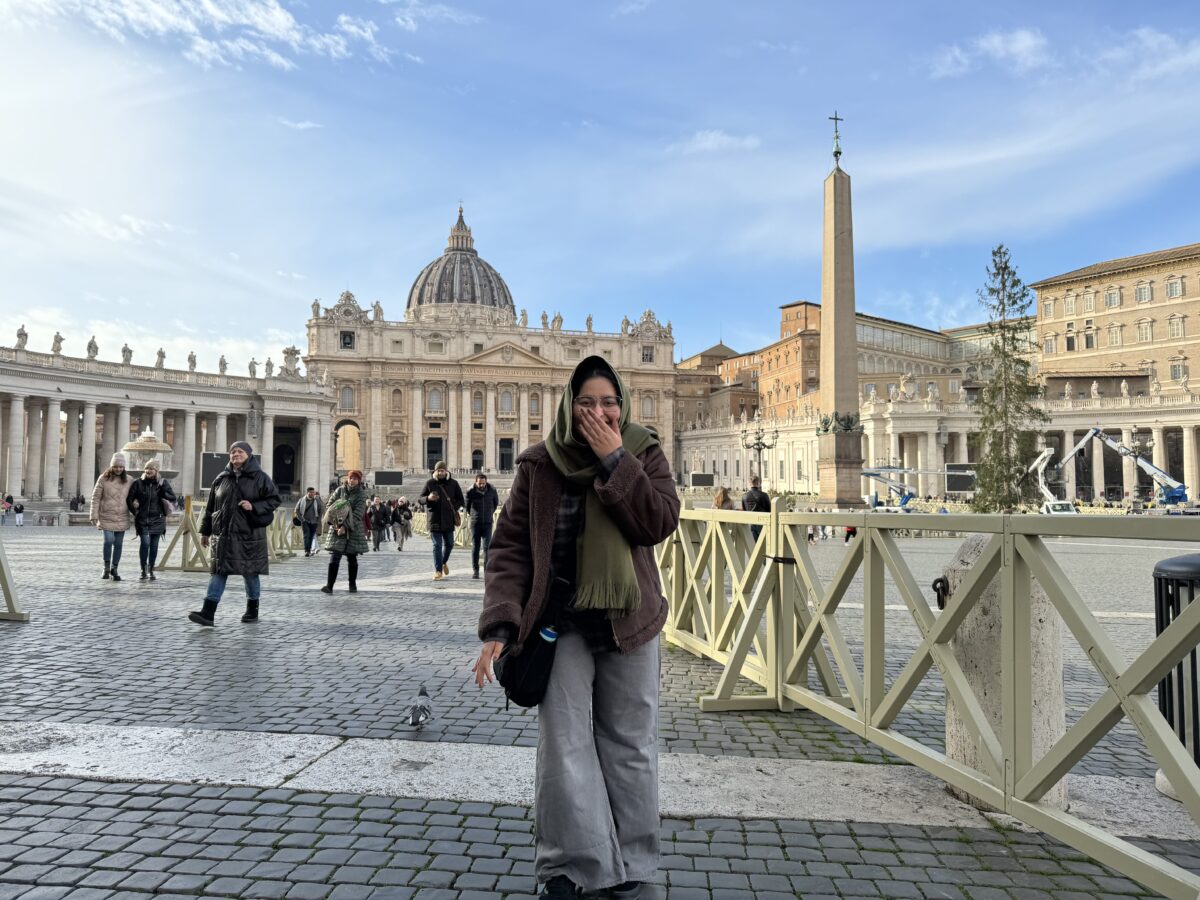
Ayra Sangi at Saint Peter’s Basilica in Rome, Italy. (Image courtesy of Sangi.)
From campus to Taiwan
Throughout her journey, Sangi benefited from the guidance and support of faculty members who brought both global experience and personal insight to the classroom, in particular her academic advisor, Meredith Oyen, associate professor of history, specializing in the history of U.S.-China relations and migration
UMBC’s 2025 – 2026 academic year marks the largest cohort of Retrievers participating in education abroad programs.
Sangi has excelled in her Chinese coursework with Oyen and left a lasting impression. “Ayra is diligent, thoughtful, and creative. In my classes, she was as good at traditional research and analysis as she was at reimagining engaging ways to present information visually,” said Oyen. “Add her outstanding record in Chinese coursework, and you have someone with endless potential to make her mark. I’m excited to see where she goes next.”
“Professor Oyen was a huge help when I started thinking about studying in Taiwan because she lived in Taiwan while conducting research,” said Sangi. “She helped me find education abroad programs and scholarships and encouraged me to apply for the Fulbright Program. Professor Oyen opened the path for me to study in Taiwan.”
Growing up in Bronx, New York, almost a century ago, Bernard “Bernie” L. Berkowitz, a first-generation son of Hungarian immigrants, may not have realized then that his life would take him beyond the bounds of New York City to Baltimore City and eventually to UMBC. In 1995, Berkowitz completed seven years of service to UMBC as the special assistant to the president for economic development efforts, which included planning for the bwtech@UMBC Research and Technology Park.
Thirty years later, Magaly Lizama Hernandez, a first-generation daughter of Salvadoran immigrants, is the recipient of the inaugural award bearing his name for her vision to develop a higher education pathway for Baltimore City students—a similar program to the one that led her to the psychology program at UMBC at the Universities at Shady Grove.
“Receiving the Bernard L. Berkowitz Memorial Award is not only an incredible and personal honor, but a reflection of a mission I’m deeply passionate about, making higher education more accessible for young people in Baltimore City,” said senior Lizama Hernandez at the awards ceremony this past May. “I’ve seen many talented and hardworking students feel that college was out of reach, not because of ability, but because they lacked access, support, and sometimes simply someone who believed in them. I know, because I was that student.”
As an alumna of the Achieving Collegiate Excellence and Success (ACES) program, a partnership between Montgomery County Public Schools, Montgomery College, and the Universities at Shady Grove, Lizama Hernandez knows firsthand the profound impact of mentorship. Beginning in her sophomore year at Gaithersburg High School in Montgomery County, Lizama Hernandez received one-on-one coaching to develop college-level skills and guidance on college and scholarship applications, which made her transition from high school to Montgomery College—and eventually to UMBC-Shady Grove—a success. Now, she wants to adapt the program for Baltimore City Public Schools.
The next generation of public servants
“The goal of the endowment is to inspire the next generation of committed Baltimore public servants,” said Rachel Edds, former deputy director of Baltimore City’s planning department, principal at Edds Consulting, and one of 10 founding donors. After Berkowitz passed in 2023, the group—composed of family, friends, and colleagues—established the award to commemorate his more than 40-year legacy of planning and economic development in Baltimore City.
Berkowitz began his service to Baltimore City in 1961 at the Baltimore City Department of Planning, becoming the director in 1968. He held various positions across the city, including on Mayor William Donald Schaefer’s economic development team (1974 – 1980), and more recently as the president of the Black/Jewish Forum of Baltimore (1997 – 1999) and as president of the Lexington Market Board (1990s – 2000s).
“We hope the example of Bernie Berkowitz’s exemplary public service in Baltimore will inspire the Fund’s recipients to work toward assuring a sound future for Baltimore and its economy,” said Edds. She was joined in the audience by three other founding members: David Berkowitz, his son, Chris Ryer, director of planning for Baltimore City Mayor Brandon Scott, and David Hash, senior director of facilities planning at Johns Hopkins Bayview Medical Center, who worked with Berkowitz for over 20 years.
(l-r): Eli Edds, Dave Hash, Rachel Edds, Lizama Hernandez, Erick Stokan, and Chris Ryer. (Image courtesy of Stokan)
“Bernie was a true professional whose work ethic was exemplary. He cared very much about serving the business community, calling upon companies who he thought might benefit from the numerous economic development programs available for their retention and expansion”, said David Hash, former executive vice president of the Baltimore Economic Development Corporation.
The fund marks the first student-centered endowment award administered by UMBC’s Center for Social Science Scholarship (CS3). Eric Stokan, director of CS3 and associate professor of political science, noted that Lizama Hernandez’s application stood out among the 16 submitted. “Magaly’s efforts to empower low-income students throughout their educational journey, providing them with tools, support, and confidence to thrive professionally and personally, align well with the spirit and purpose of the award,” said Stokan.
Stokan is grateful that the founding funders will ensure that CS3 can offer this award on an annual basis to students who embody the spirit of “Bernie” Berkowitz with a focus on local public service in the Baltimore area.
Investing in Baltimore City Public Schools
Impressed by Lizama Hernandez’s entrepreneurial spirit, the counseling staff at Gaithersburg High School hired her as a student worker to guide students like herself through the college application process. Thanks to the Bernard L. Berkowitz Memorial Fund Award, Lizama Hernandez can now apply the knowledge she acquired as an ACES student and staff member to begin the planning process for establishing the program in Baltimore City
“Bernie believed in transcending divisions—bringing together people of different social and economic backgrounds,” said Edds. “He is fondly remembered for his clear thinking, always with a sense of humor and kindness.”
His example has motivated Lizama Hernandez to take the next step in her academic and professional journey. “Through my studies in psychology and social work at UMBC and my work supporting students and families, I’ve seen firsthand the transformative power of education,” said Lizama Hernandez, who plans on earning a master’s in social work. “My goal as a future counselor is to help students know why their dreams are valid and achievable. Baltimore’s young people deserve every chance to thrive.”
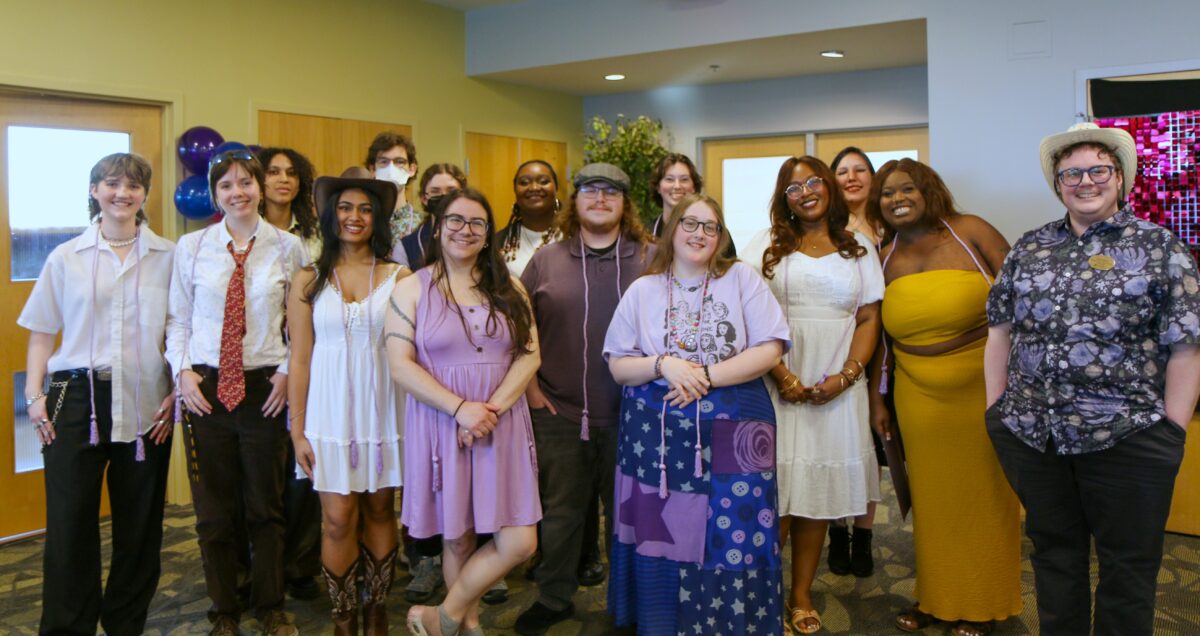
Ramping up to the end of the Retriever 2024 – 2025 academic year, UMBC’s Office of Student Engagement and Belonging gathered students, faculty, and staff to celebrate their accomplishments and invaluable contributions with the communities closest to them. Angelina Jenkins, assistant director of UMBC’s Mosaic Center, which provides the campus community with resources and community building, was at the helm of the three Cultural and Affinity Celebrations and Awards, with a cadre of co-chairs making the Asian, Lavender, and Black/Latine/x events a reality.
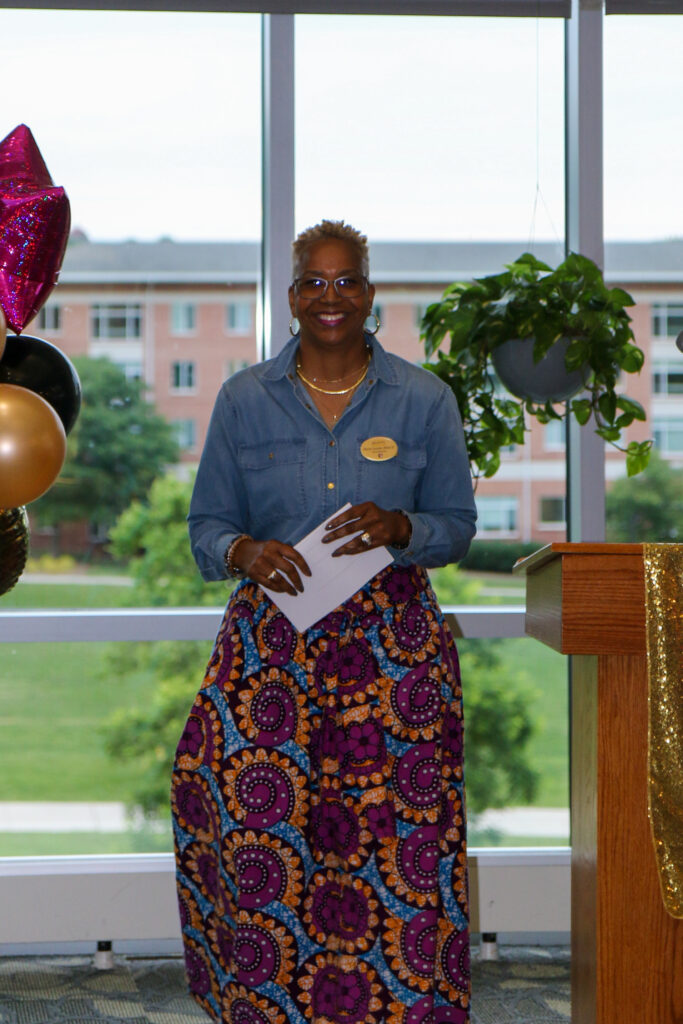
Thania Muñoz, associate professor of modern languages, linguistics, and intercultural communication, served as the co-chair for the 5th Black and Latine/x celebration. Priya Bhayana, project manager for UMBC’s Global Asias Initiative, served as the co-chair for the inaugural Asian Cultural Celebration and Awards gathering. Zoe Brown, program coordinator for the Women’s Center and current M.P.P. student, co-chaired the Lavender event with Darcie Adams, graduate assistant for UMBC’s Gathering Space for Spiritual Well-Being, who supported all three events.
“The Office of Student Engagement and Belonging strives to collaborate with a team of interdisciplinary partners across campus to create a true emphasis on our narrative that inclusive excellence and belonging are a reality for everyone at UMBC,” said Jenkins. “Your stories belong here. Our collective UMBC story and community are made better by them.”
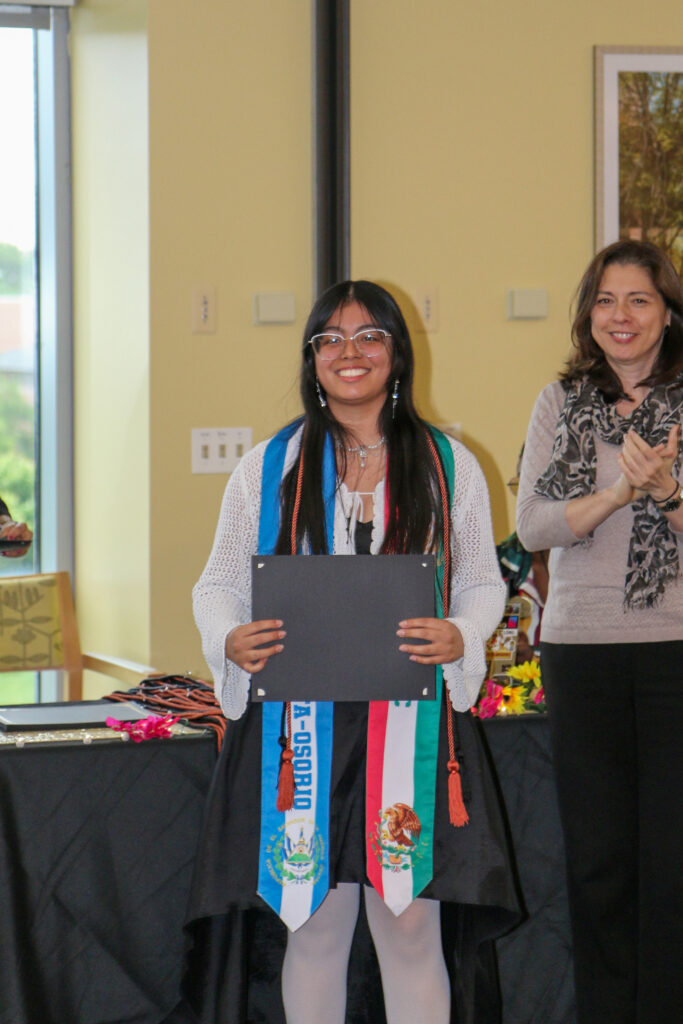
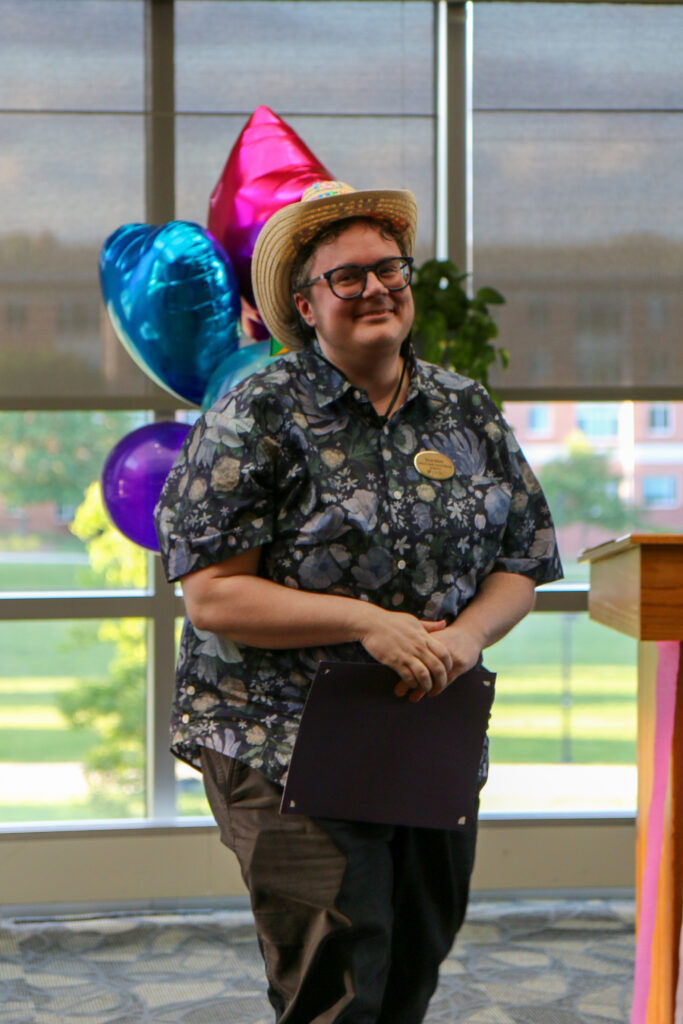
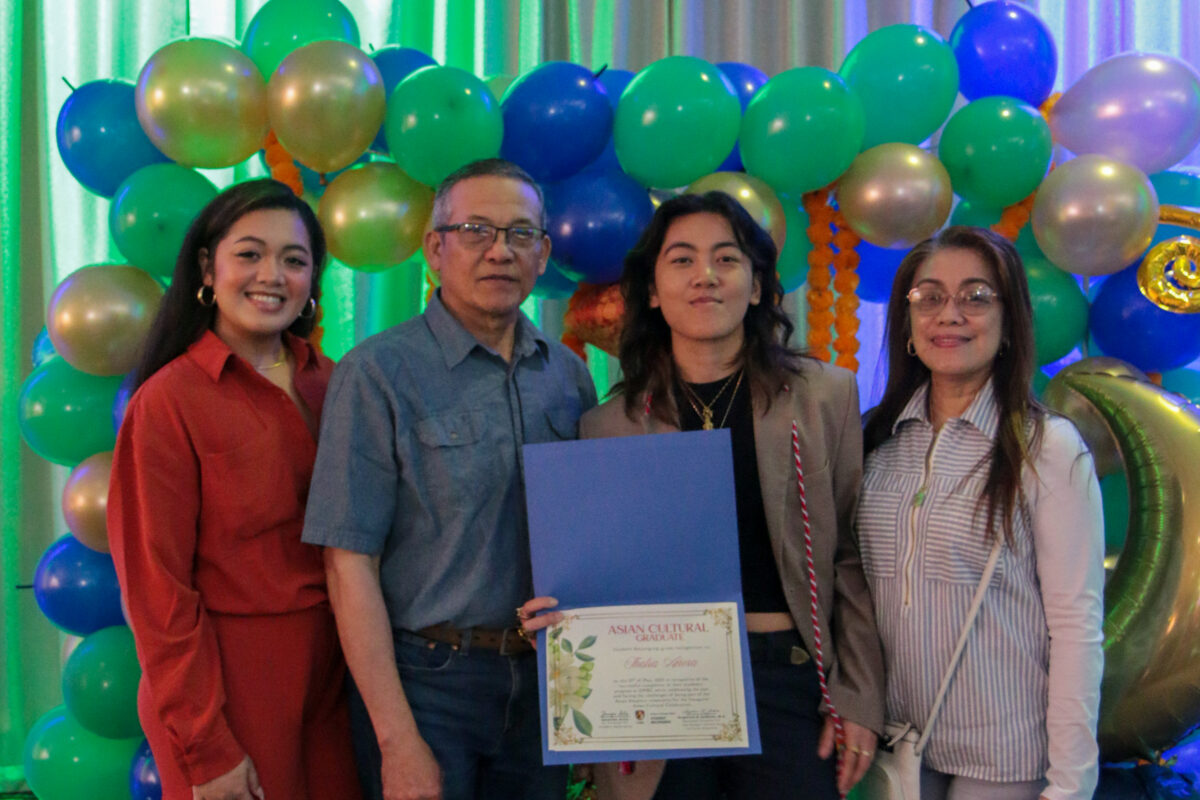
(l-r): Jenkins (first on left)with Mary Rose Khamfong ’25, psychology, a McNair Scholars Program Teaching Fellow, and recipient of the Love Today and Tomorrow Award at the Asian Cultural Celebration and Awards. Marilin Argueta-Osorio ’25, media and communication studies, receives black and brown honor cords and a certificate of recognition at the Black and Latine/x Celebration and Awards. Director of the McNair Scholars Program, Reverand Michael Hunt ’06, computer science, and Ph.D. ’25, language, literacy, and culture (LLC), with his family. Darcie Adams ’23, gender, women’s, and sexuality studies (GWST), political science, and M.P.S. ‘25, receives the Legacy Award, which honors those who have made an unforgettable, lasting impact on the UMBC queer community. (All images by Tanzila Malik ’26, GWST, except the Hunt family by Bradley Ziegler/UMBC)
Inaugural Asian Cultural Celebration and Awards
Gathering Retrievers from all corners of the world is something that Meghna Chandrasekaran ’25, political science and biological sciences, is skilled at as the president of the Student Government Association and vice president of undergraduate affairs on the University System Student Council. She hosts “Chai Chats with Meghna!” where she serves piping hot tea and fosters camaraderie throughout the year. “Because of my role as the associate director of the Center for Democracy and Civic Life, as well as my lived experience as both Chinese and Jamaican, I’m honored to have been asked to participate in this inaugural event to present the Another World Is Possible Award to Meghna Chandrasekaran,” said Ricky Blissett ’11, bioinformatics and computational biology. He was proud to add to Chandrasekaran’s long list of accomplishments include her workshops on intersectional leadership and Tamil-language teaching. “She doesn’t just imagine a better world—she builds it, step by step, with humility and resolve.”
(l-r): Meghna Chandrasekaran with Ricky Blissett. (Bradley Ziegler/UMBC). Chandrasekaran receives her red honor cord. (Tanzila Malik)
“
In our Tamil literature, we have a book of universal truths, called the Tirukkuṟaḷ, and I am beyond proud to share this one with you in Tamil.rnஉள்ளத்தாற் பொய்யா தொழுகின் உலகத்தார் உள்ளத்து எல்லாம் உளன்rnIt says, “What is truth? It is speaking words that do not betray one’s inner self.” To me, this is the heart of authenticity. It’s not just about being honest with others; it’s about refusing to forget who you are, even when the world tries to define you otherwise.
Meghna Chandrasekaran ’25
political science and biological sciences
Students and their families celebrate their accolades. Party time! (Top row by Bradley Ziegler/UMBC. Bottom row by Tanzila Malik)
“UMBC was my first experience stepping out of India without anyone to look after me,” said graduate keynote speaker, Sairam Bokka, M.A. ’25, cybersecurity, a leader in UMBC’s Retriever Essentials addressing food insecurity on campus. “I arrived here unsure, quiet, and content with staying in the background. But thanks to the people I met, the support I received, and the opportunities I embraced, I’m walking away from UMBC more open, confident, and purpose-driven. May we all continue to grow, serve, and seek out new paths, even when we feel uncertain. That’s where the real magic happens.” (Bradley Ziegler/UMBC)
12th Annual Lavender Celebration and Awards
(l-r): Master of ceremonies, Jacob Leizear ’16, geography and environmental systems; Lorae Bonamy-Lohve, the new assistant director of UMBC’s Pride Center; Darcie Adams; Joseph Vann-Jones, program coordinator for UMBC’s Gathering Space; and Maya Jones ’25, psychology. (Bradley Ziegler/UMBC)
As Lorae Bonamy-Lohve, the new assistant director of UMBC’s Pride Center, made the opening remarks for the Lavender Celebration and Awards, she had a clear message for her new Retriever community. “Lavender is a color long tied to liberation, strength, and the beauty of our community,” said Bonamy-Lohve. “Today’s ceremony is about how you made it easier for the next generation of students like you to imagine themselves here, thriving, loved, and affirmed. Let this celebration not only be a moment of joy, but also one of remembrance and responsibility, a reminder that liberation is collective, and that we carry many histories as we move forward.”
Love and history are two intrinsically intertwined concepts for Sanai Eaton-Martinez ’25, a political science pre-law track transfer student and Grit Guide. “My first words were ‘Te quiero mucho.’ [I love you] Love is what we give, but respect is what we’re owed. UMBC allowed me to keep my path forward, and it soon became my home,” said Eaton-Martinez, the Lavender Celebration and Awards undergraduate keynote speaker and founder of UMBC’s Sisterhood: A Women of Color Coalition. “We have raised thousands of dollars to better our community and now have 200 members. Sisterhood is a labor of love. It has taught me so much more than I could have imagined. Not only did I gain a community, but I gained a family.”
(l-r): Amariana Crawley, a psychology sophomore, and award presenter; Dasani Mia-Sheree Mann, a media and communication studies sophomore; Carrington Cline ’25, media and communication studies; and Eaton-Martinez. (Tanzila Malik)
When Adams was designing the student art gallery for the Lavender Celebration and Awards, he reached out to Key Gallagher, an English junior, sophomores Jamar James, a computer engineering major, and Qaiyah Dawson, a biological sciences major with a photography minor, to display their crocheting, robotics, and photography skills, respectively. This is Dawson’s first photography exhibit, but James is an avid robotics competitor, and Gallagher’s whimsically crocheted stuffed and wearables sell quickly at campus events.
(l-r): Gallagher with his latest designs, James with the Retriever Robotics Team VEX Robot, and Qaiyah Dawson explains her first series of photographs exploring different phases of mental health. (Bradley Ziegler/UMBC)
“I’ve been crocheting for two years now. I have ADHD and need to work with my hands, or else I can’t focus. I finished this piece today. It is a piece of advice that my therapist gave me about not letting fear stop me from experiencing life. It’s a way to express myself,” said Gallagher, a critical disabilities minor, of his ‘Do It Scared’ banner, which took 16 hours and 7,500 stitches to make. “It is amazing when someone comes to my table and sees their flag. Their eyes light up. It’s a great way to connect with people and say, ‘I see you. You are safe here.’”
(l-r): Graduate student keynote speaker, Riley Donahue ’24, political science and current M.P.P. student, receiving the Lavender Activism and Inclusive Excellence Award. She serves on the America East Conference Student-Athlete Advisory Committee (SACC), as co-president of UMBC SAAC and Division I NCAA SAAC, and is a representative for the America East and the NCAA Mental Health Advisory Group. Candace Hill, head coach for the UMBC women’s basketball team. (Bradley Ziegler/UMBC)
“
Before coming to UMBC, there were times when I didn’t quite fit in. Being a Division I women’s basketball athlete was also another world where fitting into a certain mold often appears to be the only way to stay in the game. When I transferred to UMBC, I brought all of it with me. Here, I found something I never knew was missing. The ability to just be. Not just in class or on the court, but in ordinary moments, walking around campus, sitting in meetings, smiling at friends, all of me without apology. Let’s keep the door open for others. Let’s keep showing up, imperfectly, authentically, and powerfully.”
Riley Donahue ’24
political science, current M.P.P. student
Sealed with Lavender honor cords and ready for the next adventure. (Tanzila Malik)Jacob Leizear. (Tanzila Malik)
“I was here for the first Lavender Celebration back in 2014. I received the 2016 Student Leader of the Year Award,” said Leizear, a geography and information systems specialist for The Nature Conservancy. “I think it’s amazing that this is still happening. The people I met here became my friends and are now friends for life. It’s great to be back and see everything happening—bigger and better than ever.”
5th Annual Black and Latine/x Celebration and Awards
“This moment is a combination of dreams, both spoken and unspoken,” said Marian Saunder White ’87, information systems, a member of UMBC’s Alumni Association Awards Committee, at the 5th Annual Black & Latine/x Celebration and Awards. “It is the legacy of your ancestors who survived the unimaginable so that you can imagine freely.”
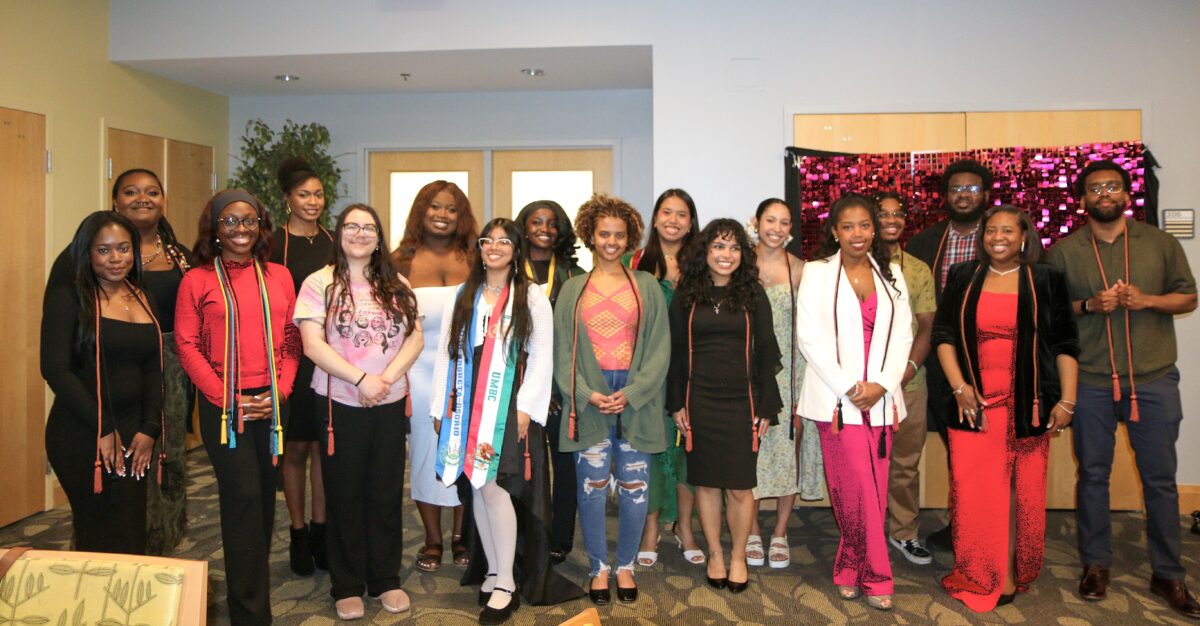
(l-r): Saunders. Michael Hunt with his child receiving the black and brown honor cords from Maria Sanchez, director of the Engineering and Computing Education Program, interim director and director of education and outreach of the Individualized Study Program, and committee member for all three cultural and identity celebrations.Black and Latine/x students stand tall and proud wearing their black and brown honor cords. (Tanzila Malik)
Legacy is something Janerra Allen, Ph.D. ’25, electrical engineering, (above second from the right), has had on her mind, as a first-generation college student, more so now that she will begin her postdoctoral research at the Johns Hopkins University Applied Physics Laboratory this summer. “When I told my grandmother, she cried. She didn’t know what a postdoc was, but she knew her granddaughter had made it,” said Allen, the Graduate School keynote speaker. During her time at UMBC, she served as a graduate senator for the College of Engineering and Information Technology, secretary of the Graduate Student Association, and president of the Black Graduate Student Organization. “Wherever you go next, know this: You carry the power of every obstacle you’ve overcome and every hand that helped lift you. You are not alone. You are part of a legacy that is unshakable. So take pride. Take your rest. And take up space—because you deserve it.”
(l-r): Camila Chombo Sam ’25, computer science, receives her black and brown honor cord from Sanchez; Black/Latine/x Student Leader of the Year, T’ana Joseph ’25, mechanical engineering; and Scholar of the Year, Gabrielle Ware ’25, individualized study, with a friend. (Bradley Ziegler/UMBC)
Hunt, the 2024 Black/Latine/x Excellence Award, was excited to surprise this year’s recipient. Bosola Jerry-Asooto ’25, biological sciences, (left) was shocked when he announced she is the recipient of the 2025 Black/Latine/x Excellence Award.”From student government to residence life, health advocacy to academic mentorship, they’ve consistently stepped up—not for recognition, but to ensure others are seen, heard, and supported,” said Hunt. (Bradley Ziegler/UMBC)
Lesley Hernandez ’25, biochemistry and molecular biology, the undergraduate keynote speaker. (Brad Ziegler/UMBC)
“
When I was in fourth grade, I invited my mom to school for career day. My classmates asked her who her role model was, and she said herself. I was so embarrassed. Other parents were saying Nelson Mandela or Einstein. Now, I get it. I can also say my role model is myself. I know how hard I work. I know how much I’ve grown. I push myself to do the uncomfortable things because I believe growth lies on the other side of discomfort. Do not lose sight of your visions. Believe in yourself. Be your greatest motivator and be your own role model.
Lesley Hernandez ’25
biochemistry and molecular biology
As the curtains close on another year, the Office of Student Engagement and Belonging is already thinking ahead on how to top these years’ ceremonies. The Cultural and Affinity Celebrations and Awards ceremonies aren’t just about recognizing achievements. They are about praising the journey, the effort, the laughs, and speed bumps along the way, and the promise of what’s still to come.
One way to describe Dave Anguish’s journey with UMBC is as a trip around the world and back again. Anguish came to UMBC in 2008 to study political science as well as modern languages, linguistics, and intercultural communication. After graduating in 2012, he hopped on a plane to Mexico City to conduct political science research thanks to a research grant from the Fulbright U.S. Student Program. He later returned to UMBC to earn an M.P.P. in public management in 2019 while working in UMBC’s International Education Services (IES)—an opportunity that allowed him to travel the world and inspired his first career in international education leadership. Now, it is leading to his second career as he prepares to graduate from the University of Maryland Francis King Carey School of Law. Take it away, Dave!
Q: Tell us about your primary WHY, and how it led you to UMBC.
A: In 2008, I came to UMBC as an undergraduate student because it offered something different, something I didn’t see at other schools. I liked that it was “medium-sized” and that the buildings were arranged in a grid, almost like a small city. It was so easy to meet new people, whether they were classmates, staff, or faculty. Everyone was open to making connections. At the time, I was surprised that an undergraduate student had so much access to people of greater stature. I came to understand that reducing the power differential was a deliberate choice and part of the university’s culture. It’s something I’m so glad still lives on today.
Q: What’s one essential thing you’d want another Retriever to know about you?
A: After graduation, I moved abroad for a year and then came back to work at UMBC. When I returned, it took a few years to find my passion. An urgent need for an advisor in IES ended up being my big break. I discovered that it wasn’t simply getting to meet and work with people from all over the world that appealed to me; it was also learning and explaining to others the complexity of immigration law. That seed of an idea blossomed into the (eventual) decision to attend law school and become an immigration lawyer focused on deportation defense and justice for immigrant communities. I could never have foreseen how far a frontline advisor position in the “visa office” would take me, or how it would reveal my professional path.
A: I’ve been part of CGE since it was called International Education Services. Back then, we were a small but mighty team of five or so people. Today, CGE has nearly thirty staff, and while our teams focus on different areas, we all seek to forge connections between UMBC and the world.
Anguish (last row, third from the left) with colleagues from UMBC’s Center for Global Engagement. (Image courtesy of Anguish)
I’m so inspired by the work CGE does. My team handles immigration services for the thousands of international students coming to UMBC to study, as well as those who have graduated and are working around the country in exciting fields, getting practical training.
My colleagues in Education Abroad enable students to break through the confines of campus and explore new lands, gaining crucial intercultural skills, learning languages, and learning more about themselves and their role in the world. Other CGE teams coordinate English language training and design special programs for groups to visit UMBC over the summer for intercultural experiences and training.
Anguish (center) with UMBC alumni panelists at UMBC’s International Student Career Conference. (Image courtesy of Anguish)
Q: Tell us about someone in the community who has inspired you or supported you, and how they did it.
Massey (l) with Anguish. (Image courtesy of Anguish)
A: For several years, I was on a two-person team serving all of UMBC’s international students. My co-worker, supervisor, and friend, Michelle Massey ’10, intercultural communications, taught me so much about how to be the best version of myself for those I serve. She is the reason why my emails are littered with happy exclamation points, and why I try to communicate in the most positive and friendly way with people who may not be as familiar with U.S. culture, and why I keep in mind that the work we do matters, because it has such an impact on every student’s life, career, and dreams. Michelle left UMBC to join the foreign service several years ago, but her example of servant leadership has stuck with me and set a standard that I try to live up to in my work.
Q:What’s the one thing you’d want someone who hasn’t joined the UMBC community to know about the support you find here?
A: It’s clichéd to say “it’s the people” that make UMBC what it is, but it’s true. I’ve had the pleasure of working with so many people who work hard every day to make the place run. Maybe it’s our relative youth as an institution, but there is a sense that even a university of our size can be nimble and adjust to new realities. We’re writing the story of UMBC every day. It’s been fascinating to see how much UMBC has changed since I was an undergraduate, but how the ethos has remained constant. We’ve had many changes in leadership over the past few years, and this new era at UMBC is an exciting one to watch and even more exciting to participate in.
Although I returned to UMBC shortly after I graduated, really, I’ve been all over the place: through my work at UMBC I’ve been able to travel the world, meet so many wonderful people, and learn new skills. Two graduate degrees later, my time at UMBC is coming to a close as I transition into an attorney role in another organization. But UMBC has been such a significant part of my life for so long that I know this isn’t truly the end.
* * * * *
UMBC’s greatest strength is its people. When people meet Retrievers and hear about the passion they bring, the relationships they create, the ways they support each other, and the commitment they have to inclusive excellence, they truly get a sense of our community. That’s what “Meet a Retriever” is all about. Learn more about UMBC’s Center for Global Engagement.
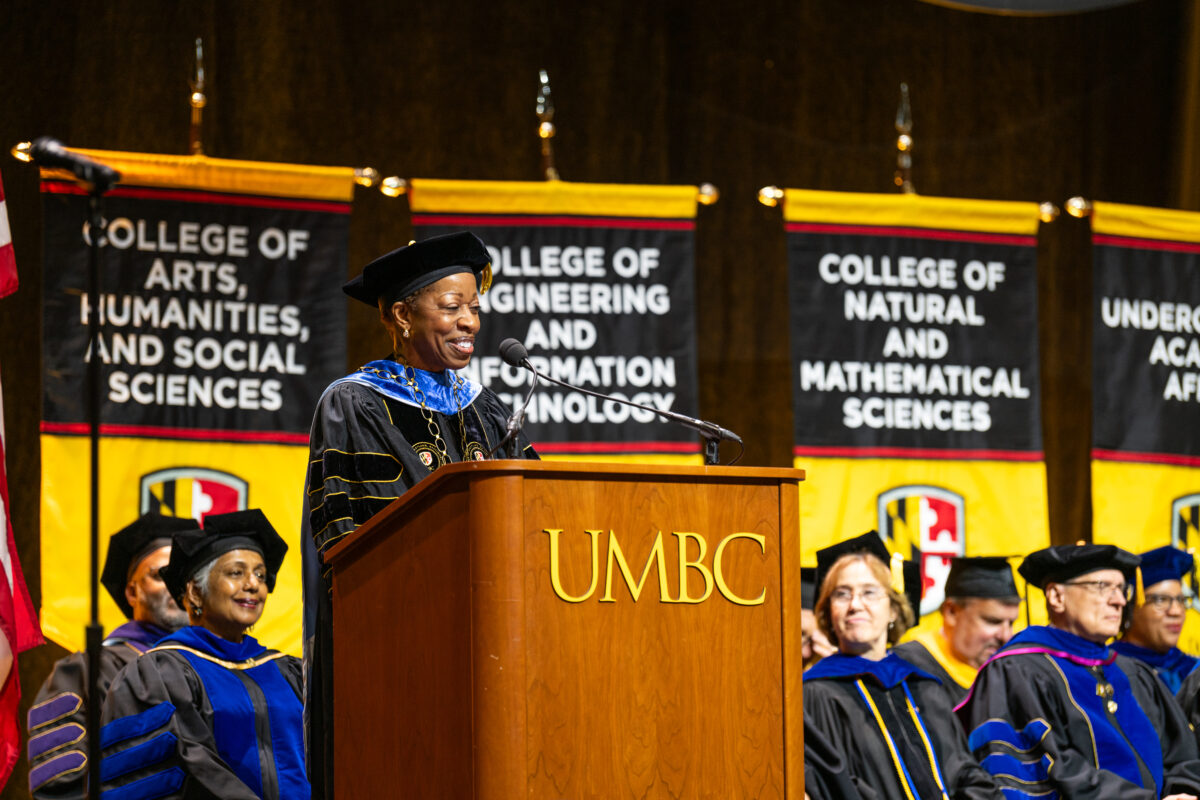
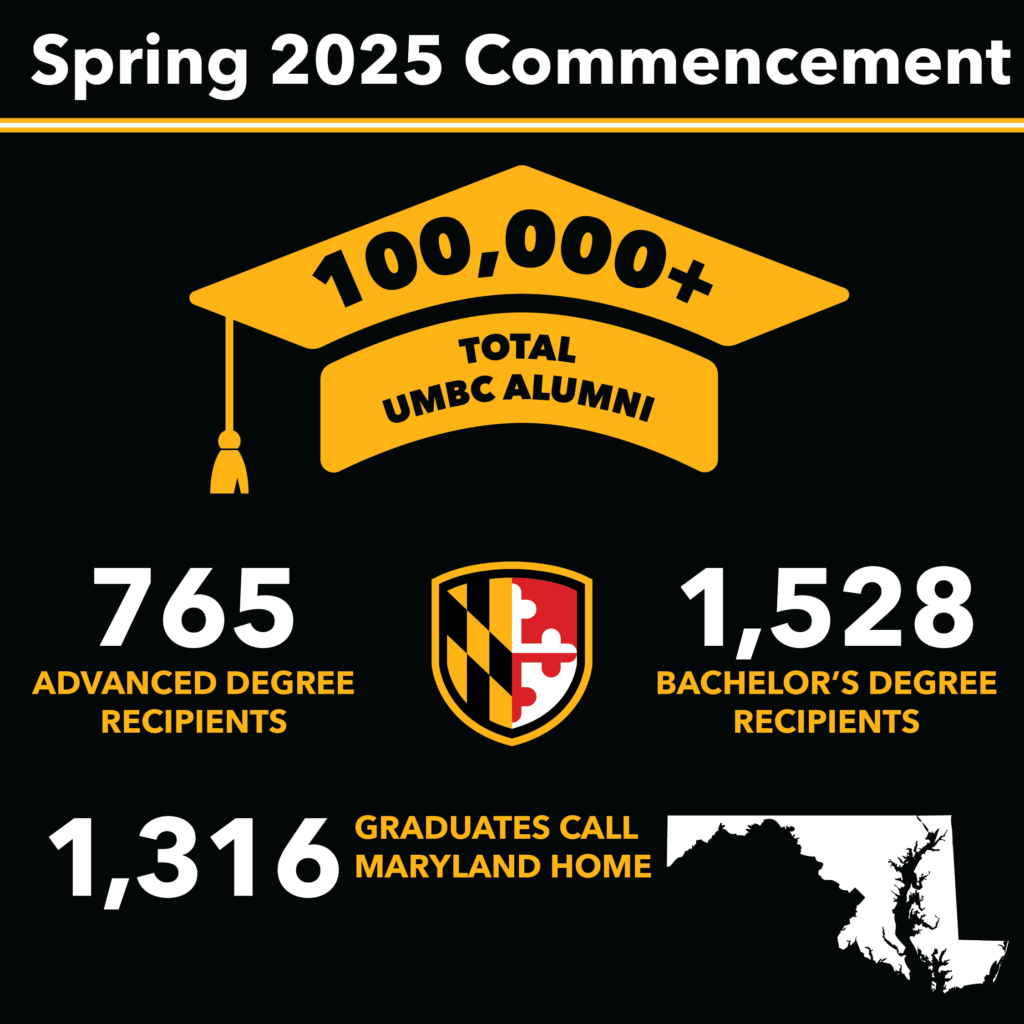
Before Joy Gabrielle Ware walked off the Commencement stage, she stopped mid-stage to face her peers and shouted, “UM!” prompting a booming “BC!” response from the undergraduates and their families who packed the arena last week at UMBC’s 84th Undergraduate Commencement Ceremony. Ware, an individualized study major, was awarded the historic 100,000th degree since UMBC’s first Commencement class in 1970, which had 241 students—a stark contrast to the 1,528 undergraduate and over 700 graduate degrees awarded to the Class of 2025.
(l) President Valerie Sheares Ashby addressing UMBC’s Class of 2025. (Brad Ziegler/UMBC) (r) Diane Tichnell ’70 (third from left) celebrates the publication of This Belongs To Us with fellow book editors Mimi Dietrich, Bob Dietrich, and Dale Gough. (Marlayna Demond ’11/UMBC).
To celebrate this historic moment, President Valerie Sheares Ashby paid tribute to the alumni known as the Founding Four, who represented graduates of the first four undergraduate classes from 1970 to 1973.
“What a profound impact UMBC has had on the state of Maryland and the world,” said Sheares Ashby. “Each one of our alumni has made a difference in some way, many of them as leaders and pathbreakers—in the public and private sectors, in the arts, in education, in research, in public service, and in their communities.”
Gratitude
The Class of 2025 celebrated and cheered for each other. However, thunderous applause rippled across UMBC’s Chesapeake Employers Insurance Arena every time a speaker asked the students to thank those who made their dreams come true. The stands were filled with roommates, classmates, mentors, and families who kept pointing the way when graduation seemed out of reach.
Celebrating graduation day! (Brad Ziegler/UMBC)
“You took risks when you chose to pursue this graduate degree. You stumbled and struggled and faced down your fears and insecurities,” said Graduate Student Association President Jessica Burstrem, Ph.D. ’25, language, literacy, and culture, in her address to her peers at the Graduate School Commencement ceremony.
(l) Jessica Burstrem addressing the Graduate School Class of 2025. (Brad Ziegler/UMBC)
“That bravery is why you celebrate today. Those are the kinds of people the world always needs—people who do the right thing even if they are afraid. People of integrity and bravery. People who stand together,” said Burstrem.
(l) Sonja Brookins Santelises, chief executive officer of Baltimore City Public Schools, Thursday morning’s undergraduate commencement speaker and honorary degree recipient. (r) Anwesha Day, Ph.D. ’04, biochemistry and molecular biology, executive director in the Discovery Oncology Department of Genentech, spoke to Thursday afternoon’s graduates. (Brad Ziegler/UMBC)
The path of service
College wasn’t Tina Garcia’s first path, even after becoming the first in her family to graduate from high school. She served nearly a decade in the United States Air Force, rising to the rank of staff sergeant, before continuing her service within the government. After serving her country, Garcia chose to honor her family once again—this time by becoming the first to earn a college degree. She drew on her experience as a veteran and her majors in social work and psychology to co-found and serve as vice president of UMBC’s Student Service Members, Veterans, and Families organization.
(l) Valedictorian Tina Garcia shares her journey to UMBC. (r) UMBC’s Color Guard opening the 2025 commencement ceremonies. (Brad Ziegler/UMBC)
“UMBC is where I found my community, and with it, a renewed sense of purpose to continue serving Veterans. I’m so grateful to everyone who continues this work, who shows up for veterans every day, and who refuses to let that momentum fade,” said Garcia, as one of two undergraduate valedictorians. “When we find belonging, we thrive. When we thrive, we create space for others to do the same. May you always find places where you belong and never let anyone convince you that you don’t.”
UMBC welcomes all
For international students, the meaning of community transcended physical boundaries, cultures, and languages, with graduate students representing 27 nations across five continents and Central America, and undergraduates representing 35 countries across six continents and the Caribbean, including Jamaican native, Akellia Bernard, a music performance major with a concentration in voice. Bernard, a member of UMBC’s Choir and Camerata, performed the national anthem for the three commencement ceremonies. This summer, Bernard plans to join the Choir and Camerata in Paris and Prague, where they have been invited to perform with the Czech National Symphony Orchestra.
Akellia Bernardsings the Star-Spangled Banner at her undergraduate commencement ceremony. (Brad Ziegler/UMBC)
Praise Lasekan, a biological science major, whose family watched his valedictorian speech virtually back home in Ondo, Nigeria, was adamant about how the Retriever community became the vessel for his growth, acceptance, and joy.
UMBC faculty and alumni give Praise Lasekan a standing ovation for his inspiring words. (Brad Ziegler/UMBC)
“The person you see standing in front of you today was once called a failure. People made fun of me. There were times I almost quit. But mentors, community, and the grace of God reminded me: Dreams don’t die, they just need to be stirred again,” said Lasekan. This fall, he will begin his Ph.D. at Brown University in the Department of Molecular Biology, Cell Biology, and Biochemistry. “UMBC showed me that community isn’t just who you’re around, it’s who holds you up when life feels heavy.” His journey resonated with the celebratory crowd and earned a standing ovation from the full house.
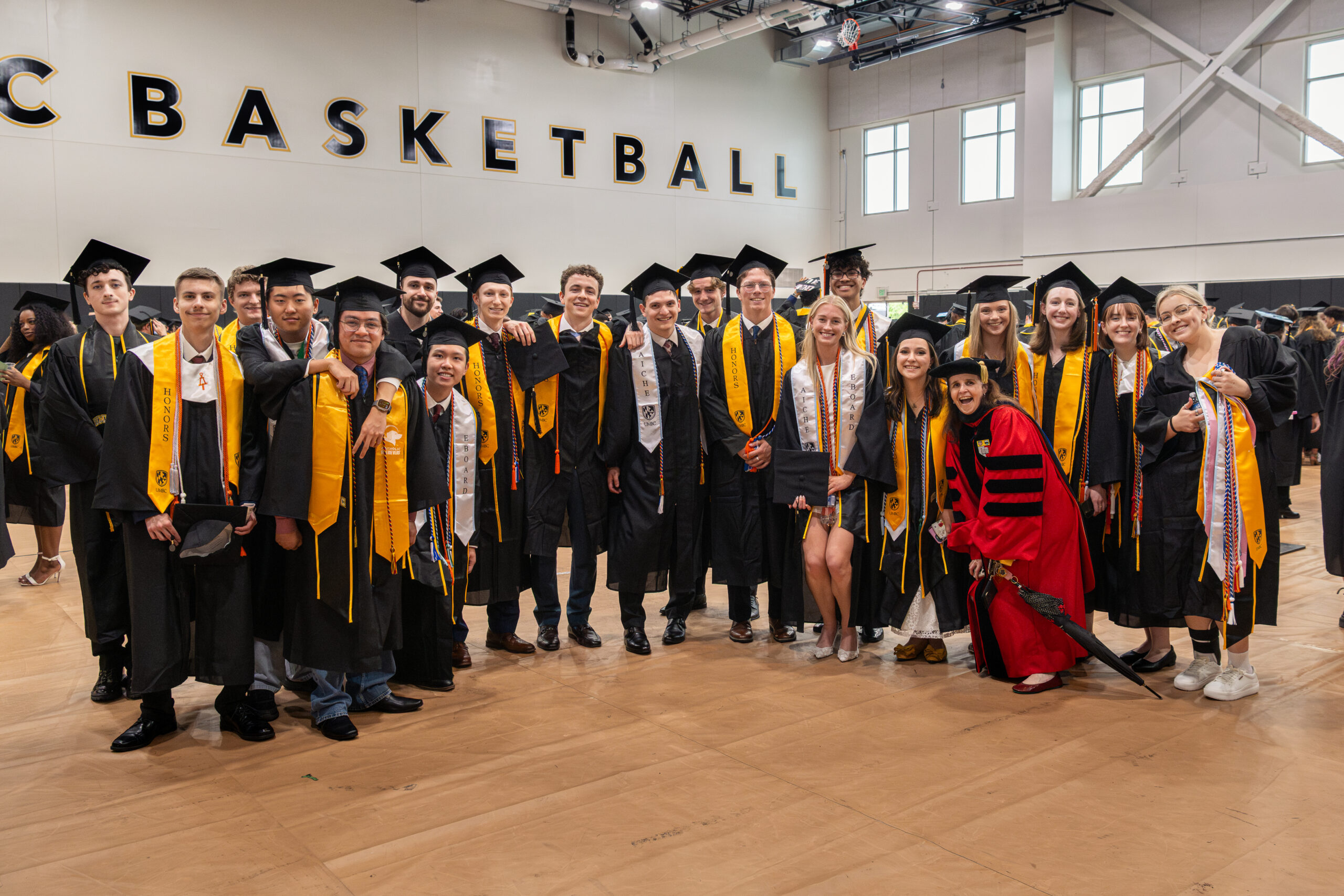
And with the turn of the tassel, these students are officially UMBC Alumni. (Brad Ziegler/UMBC)
As Retrievers crossed their tassels from right to left, President Sheares Ashby reminded them that while the pursuit of their dreams might have had similar zig zags, they, “will be the ones who will listen to all the voices, fight for the needs of others, not just yourself, unite, not divide, bring calm to chaos, open doors, and see new ways forward.”
Listen to Akellia Bernard sing the Star-Spangled Banner, Governor Wes Moore’s message to the Class of 2025, and watch all three ceremonies at commencement.umbc.edu.
Art historian James Smalls, a professor of visual arts, researches the intersections of race, gender, and queer sexuality in both 19th-century art and the broader visual culture of the Black diaspora. Smalls is on a thrilling adventure to uncover the life and legacy of Senegalese performer known as Féral Benga and restore him to his rightful place in art history, and in a twist of timing fate, his research might also protect Benga’s final resting place. Smalls spent nine months in 2024 at the Getty Research Institute in California as part of their Getty Scholars Program, which gave him time to work on his next book, Féral Benga: African Muse of Modernism, and continue connecting the dots of Benga’s artistic impact.
Q: What led you to research Féral Benga?
A: I found a black and white photo of a sculpture by Richmond Barthé, an African American sculptor of the Harlem Renaissance. It’s a beautiful sculpture of a Black man holding aloft a kind of saber, doing this hypnotic dance. It was titled Féral Benga, and I thought, ‘Well, what’s that? Is that a type of dance that I’m looking at or something else?’ Eventually, I found out that this is the stage name of François Benga, who adopted the name when he began performing at the Folies Bergère [a famous cabaret music hall in Paris]. Benga was a very statuesque sort of dancer. His dance technique combined African dance with classical ballet and acrobatics. I wanted to learn more, which led to years of research trying to create an archive of his life and art.
Féral Benga, La danse du sabre, c. 1934, by Lucien Waléry. (Courtesy Bibliothèque de France)
Q: How did Féral Benga‘s statue inspire the next step of your research journey?
A: I discovered that Benga became a muse for visual artists during the early part of the 20th century and that he had a very interesting personality.
He was a very magnetic sort of person and had many amorous affairs. Benga was gay and belonged to a gay circle of avant-garde artists. Jean Cocteau was one of those people and included him in his first avant-garde film, The Blood of a Poet, in 1932.
Postcard of Féral Benga at the Folies-Bergère, about 1930, by Lucien Waléry. (Images courtesy of the Getty)
Q: What were some of Féral Benga’s contributions before and after World War II?
A: Before WWII, Benga owned a cabaret and a Senegalese restaurant in Paris where he performed. After WWII, he again established a nightclub, a cabaret called La Rose Rouge, where young African artists and students gathered and created works, leading to the beginning of the Négritude movement within the performing arts. [The Négritude movement was an anti-colonial cultural and political movement founded by a group of African and Caribbean students in Paris in the 1930s who sought to reclaim the value of blackness and African culture.]
I want to dispel the notion that women and people of color did not contribute to modernism and the avant-garde movement. They are sort of written out of art history. I’ve learned Benga contributed greatly to these two movements. Through my research, I want to bring that to the surface so that people are aware of that, that they’re just not on the side.
Q: Did your research bring any unexpected finds?
A: I put an alert out on eBay for any imagery of Féral Benga. For a while, I didn’t hear anything. Then, suddenly, something came up. A woman in France started selling photographs of him without knowing who he was. She had this huge box of images and wanted to sell them piecemeal to make money. Each time she sent me a photo, she added some candid shots of the dancer. One shows him smoking a cigarette at a party, and another in a park. Suddenly, Swiss art dealers bought the rest of the collection. They have agreed to let me use the photos for my book.
It turned out the woman’s father was an estate dealer. He found this box of photos in a house in Châteauroux, in central France, that I later discovered was Féral Benga’s house.
Q: Did you find additional traces of Benga’s life during your trip to France?
A: I went to the Saint-Denis cemetery in Châteauroux and found the family tomb where he is buried. I’m still researching the family, which is difficult because there are no records. It’s interesting work because I’m trying to piece together this life that was very popular and well-known at the time but then suddenly sort of disappeared from history.
The concession [rights to the plot of land] on the family tomb is set to run out in 2028—the French government will disinter the remains and put them in different ossuaries. I’m petitioning the French government to preserve Féral Benga’s grave because he is an important icon of Black diasporic modernism.
Q: Are there connections between this research and the research for your first book, The Homoerotic Photography of Carl Van Vechten: Public Face, Private Thoughts?
A: Carl Van Vechten was a great patron of the Harlem Renaissance, a writer, and a photographer. If you see old photographs of African Americans from the Harlem Renaissance, portraits of people in music, dance, theater, and cultural people, those images are by Carl Van Vechten. He was very well known during the period. He also did a lot of private erotic photography, which is what my book was about.
Benga with his troupe, La Magie Noire in Harlem, 1936. (Image courtesy of Smalls)
The connection to my new book is that Féral Benga arrived in New York City in 1937, and Carl Van Vechten invited Féral Benga over into his studio apartment and took many interesting photographs of him.
It’s been a great journey piecing all this research together. Now, I must finish the book.
For Oyinlola Oluka, political science and philosophy, doing the right thing is not just a mantra but a career path. A law school hopeful since middle school, Oluka, a first-generation Nigerian American, has a keen interest in the efforts of African countries to move from political instability toward accountability for human rights violations. She knows that holding governments accountable is a lofty task, but fear is not in her vocabulary—justice is. At UMBC, she found a kindred spirit in Jeffrey Davis, a political science professor whose passion for human rights and politics began at 12 years old after joining Amnesty International. Oluka delved deeply into the complexities of international law in Davis’s classes, inspiring her to shift her ambitions toward becoming an international human rights judge—someone committed to upholding human rights at the highest level.
Q: What motivated you to come to UMBC?
Oyinlola Oluka carrying her sister Atinuke Oluka at her graduation. (Image courtesy of Oluka)
A: My sister, Atinuke Oluka, is a Retriever. She graduated in 2022 with degrees in psychology and biological sciences. I saw how many opportunities UMBC gave her—how she felt like she belonged and how smoothly she transitioned from high school to college. I don’t see limits for myself either, so I decided to follow in her footsteps. The opportunities I’ve had at UMBC have changed the way I approach life.
Q: In what ways do you live out your ‘no limits’ philosophy?
A:I am a first-generation Nigerian American.My family inspires me. They experienced Nigeria’s instability, but did not let it limit their future. I knew I wanted to be a lawyer in middle school. So, once I came to UMBC, I took advantage of opportunities to help me learn more about being a lawyer and due process, such as civil rights, criminal justice, and international law classes. As part of UMBC’s Legal Internship Program, I worked at the Baltimore City Juvenile Justice Center under the mentorship of the Honorable Judge Nicole K. Barmore, an associate judge in Baltimore City’s Circuit Court.
I chose philosophy as my second major and completed a certificate in philosophy, law, and politics, another in French, a minor in law and justice, and participated in Philosophers Anonymous, which serves as a council of majors. My hard work earned me memberships in Pi Sigma Alpha, the National Political Science Honor Society, and Phi Beta Kappa Society, an academic honor society.
Oyinlola Oluka assists with a client intake at UMBC’s first Expungement Clinic in partnership with Maryland Legal Aid. (Image courtesy of Molly Timko, UMBC’s pre-law academic advisor)
Simply put, I don’t limit myself—not to one field, skill, or experience. I always make sure that what I’m doing now aligns with my long-term goals. If I can see myself succeeding where I am, then I know I can succeed elsewhere, too. I will be the first person in my family to pursue a career in law.
Q: How did you choose to add a philosophy major?
A: When I applied to UMBC while I was at Towson High School, the application asked what other major I might consider, which I interpreted as a backup in case my first choice didn’t work out. I chose philosophy because of my passion for the law. It offered a safe, inquisitive space to explore and understand fundamental questions about the world around us. To my surprise, I was admitted as a dual major. I decided to keep it, and it turned out to be one of the best decisions of my life.
In 2024, the Department of Philosophy nominated and voted to award me the Evelyn Barker Book Prize for superior academic performance by a senior. I am proud to receive this award because it demonstrates that my contributions to the department and the discipline, as a whole, made an impact. Even though picking this major was initially unintentional, it proved to be a discipline that fit perfectly with the person I strive to be. This award shows me that I am taking the necessary steps to actualize my dreams and aspirations. My experience in the department has been phenomenal, and I would absolutely make the same choice again.
Q: Is there someone who has served as a mentor for you?
A: My favorite classes were taught by Jeffrey Davis, professor of political science, because they deepened my interest in criminal justice and international human rights law. His teaching style left a lasting impression on me. He influenced my time at UMBC not only through what he taught, but also how he taught. He was always encouraging, never condescending, precise, yet never rigid.
“
Jeffrey Davis’s classroom was a space where ideas could be explored freely, and where every student’s voice was heard. He helped shape not only my academic path but also my sense of purpose as a future legal scholar and advocate. I will always be grateful for his mentorship.
A: In the American voting behavior class, led by Ian Anson, the associate director of UMBC’s Institute of Politics, I learned how voting behavior reflects public opinion and policy. We gauged the attitudes of 1,119 Baltimore County voters who cast their ballots in person during early voting and on Election Day. The poll asked voters about their views on the presidential and congressional races, state constitutional amendments like “The Right to Reproductive Freedom,” and broader issues like the economy.
Oyinlola Oluka at UMBC’s 14th annual Pi Sigma Alpha Research Conference. (Image courtesy of Oluka)
This hands-on project taught me so much about public opinion research, voter behavior, and the challenges of conducting fieldwork in real time. I used the information from this course to create a final paper, which I presented at UMBC’s 14th annual Pi Sigma Alpha Research Conference. I was honored with the award for best presentation and speech, a validating milestone in my academic journey.
Q: Where do you see yourself in a decade?
A: My ultimate goal is to become a judge because it is one of the most direct ways to improve the lives of people charged with a crime. A judge has the responsibility and the power to decide what happens next for that individual. My internship at the Baltimore City Juvenile Justice Center immersed me in the complexities of juvenile justice. I engaged in legal research, drafted memos on post-conviction issues and child welfare cases, and presented my findings directly to Judge Barmore. Through this experience, I developed my research, analytical, and oral communication skills, particularly in breaking down legal arguments clearly and persuasively. It also strengthened my professional network, as I interacted with judges, administrative staff, and law clerks.
By observing Judge Barmore, I also saw how a judge can be nurturing and compassionate toward defendants while also holding them accountable for their actions. She was efficient and effective in addressing the needs of the children in the system, their parents, and their unique family circumstances. These processes helped me understand how crucial it is for a judge to manage their emotions so they can remain clear, consistent, and fair under pressure.
This opportunity was especially valuable because I’m still exploring whether I want to practice law in government, at a firm, or within a nonprofit organization. With the help of UMBC’s Pre-Law Society, I met law school admissions counselors, reviewed mock applications, and connected with lawyers—all of which are helping me prepare for the Law School Admission Test and narrow down the law schools I want to apply to.
Q: Now that you are the second Retriever in your family, how do you reflect on your UMBC journey?
A: The classes at UMBC taught me how to think, how to ask the right questions, and how to engage with the world around me. Whether it was a lively debate in a politics class or a professor’s encouragement after a class, every moment shaped my understanding of what it truly means to learn. I carry that with me, not just the knowledge I’ve gained at UMBC, but also the curiosity and courage to keep learning wherever I go.
On a fall Saturday morning, Mohammad Arshad, an information systems senior, greeted clients arriving at the Erickson School of Aging Studies looking for a fresh start with the help of UMBC’s first Expungement Clinic. After completing the intake forms, Arshad passed the files to pro bono lawyers and staff from Maryland Legal Aid and pro bono lawyers from the Baltimore County Bar Association. They carefully reviewed each client’s criminal records to determine eligibility for clearing or sealing certain charges or offenses that can create barriers to jobs, housing, and education
When Jessica Cook, associate director of the Sondheim Public Affairs Scholar Program, noticed that Loyola University has this program, she connected with Molly Timko, UMBC’s pre-law academic advisor, and discussed bringing the program to UMBC. They established the clinic with funding from UMBC’s Center for Democracy and Civic Life. As soon as a call was made for 20 student volunteers, the response was overwhelming.
Expungement clinic volunteers (l-r): Damilola Khadijat Yusuf, a philosophy sophomore; Oyinlola Oluka, a political science and philosophy senior; Desta’nae Nicole Wilson ’24, psychology; Jessica Cook, associate director of the Sondheim Public Affairs Scholar Program. (center); Jean Kim, a global studies junior; Thara Pillai, a political science sophomore; Samantha Kennedy ’25, a social work senior; Cooper; Garret Miller, a financial economics sophomore; and Arshad. (Image courtesy of Timko)
Sometimes it’s hard to get internships as an undergraduate student, notes Timko. “The exposure to public interest law—doing law for the greater good—and to network with lawyers in various fields broadens students’ understanding of what being a lawyer can look like beyond arguing in a courtroom,” says Timko, a licensed attorney in Maryland, Washington, D.C., and New York. In her role at UMBC, Timko provides career pathway counseling and law school application support for UMBC students of all majors, as well as alumni.
“It was the first time I saw a law-related volunteer opportunity on campus,” said Arshad. He serves as the senate president of the Maryland Student Legislation (MSL), a model Maryland General Assembly. Currently, there are 15 college delegations, governed by the Council of States, a group of six college students elected by MSL members. Arshad serves as the lieutenant governor.
Mohammad Arshad (l) with Maryland State Delegate, Christopher Michael Griffith. (Image courtesy of Arshad)
This experiential learning experience teaches students how to draft original legislation and debate bills, navigate parliamentary procedures, and understand the legislative process. At the end of the year, all of the legislation adopted by the students is shared with members of the Maryland General Assembly for their review. “As someone interested in the legal field, I saw the Expungement Clinic as a meaningful way to deepen my understanding of the legal process.”
Oyinlola Oluka assists with a client intake at the Expungement Clinic. (Image courtesy of Timko)
The expungement clinic was streamlined to assist as many clients as possible. No appointment was needed. Lawyers arrived equipped with laptops and printers, prepared to complete and file paperwork. Angus Derbyshire, director for Pro Bono at Maryland Legal Aid, who spearheads expungement clinics across Maryland, reported that 14 clients were served at the UMBC Expungement Clinic, and 10 of them had cases that were deemed potentially eligible for expungement. “This resulted in the preparation of 24 expungement petitions, which is a meaningful outcome for both the clients and the community,” said Derbyshire.
As a first-generation college student, Arshad had never seen the legal process in action firsthand, let alone been part of it. What surprised him most was the collaboration and community focus. “I had always assumed legal work was mostly done behind the scenes. This clinic showed me how much personal interaction and empathy are involved,” said Arshad. He plans to practice intellectual property law defending the rights of inventors, entrepreneurs, and developers. “It also gave me a better understanding of expungement and how access to legal resources can significantly improve someone’s future opportunities.”
All majors to the legal field
Despite the overwhelming response from volunteers for the expungement clinic, Timko has noticed that many students still assume a political science major is required to pursue a career in law. Like Arshad, Timko is a first-generation law student with a major outside of political science. She majored in anthropology and art history, with a minor in Italian, but wasn’t sure if she wanted to pursue a Ph.D. in either field. “During my master’s program in higher education and student affairs administration, I studied abroad in South Africa and took a course on social reform in post-apartheid South Africa. It sparked my interest in education and advocacy law,” says Timko.
One of Timko’s bigger goals is to help students discover their spark. “It’s important for students to know you can major in anything. There are so many ways to be a lawyer. There’s the stereotypical trial lawyer, but there are also lawyers focused on research and writing that never set foot in a courtroom,” says Timko who is also the advisor for UMBC’s Pre-Law Society that helps student prepare for the Law School Admissions Test (LSAT) and network with area schools. “You don’t have to be super extroverted or argumentative to be a really good lawyer.” There is also no expiration date on when you can decide to pursue a legal career.
Timko (right with gold jacket) and UMBC’s Pre-Law Society students visit nearby law schools. (Images courtesy of Timko)
This is why she was excited when Shannon Ziegler ’14, fine arts, and Alexander Langsam ’22, biology, reached out to her for guidance on applying to law school. Both had initially worked in their respective fields, which unexpectedly led them in new directions—Ziegler in the financial technology industry and Langsam in civil service, which then spurred in them an interest in law.
After completing the pre-med track at UMBC, Langsam dove into studying for the Medical College Admission Test and worked as a medical assistant. When he saw firsthand the challenges faced by providers and patients, he pivoted and decided to pursue a master’s in public health policy instead, while continuing to work in civil service. There, he spent time learning about the work of the general counsel, which confirmed for him the impact lawyers can have at the federal level.
“I had never considered law school before, so when I began to think of it as a possible career, I looked up UMBC pre-law advising and emailed Molly out of the blue. She guided me through the law school application process,” said Langsam. “If you can, expand your career options beyond your degree because there are so many things you can do in this world that may not be obvious in undergrad.” He will complete his masters in May and continue to the University of Baltimore Law School in the fall.
Ziegler is about to finish her first year of law school at the University of Maryland Francis King Carey School of Law. In the decade before law school, she balanced being a business manager for Baltimore’s Center Stage by day and acting by night. She then checked off living in Chicago from her bucket list, where she worked at Venmo, launching a career at the crossroads of financial regulation and technology, the topic of her law school admissions essay.
Timko is on the Law School Admission Council directory as an undergraduate pre-law school advisor and receives an alert when an alum takes the LSAT. As soon as she was sent Ziegler’s results, she touched base with her. “It had been so long since I left UMBC that I didn’t think of reaching out. Molly gave me great advice on how to focus my application better and what to prioritize in my search,” said Ziegler. “She helped me slow down to think about what my goals are. I found that reframing really helpful.”
Making the LSAT accessible
Megumi Fukuzawa. (Image courtesy of Fukuzawa)
The mission of the pre-law advising programming is to create a supportive community. One where UMBC’s law school hopefuls can develop the skills, strategies, and confidence to navigate the various steps between studying for the LSAT and the first year of law school. This spring, Megumi Fukuzawa ’23, political science, who is currently studying for the LSAT, understands the need for support. Like many undergraduate students, Fukuzawa’s schedule was jam-packed. Whenever she carved out time to study for the LSAT, she felt lost and discouraged. “I needed help understanding the materials and advice about how to study effectively,” said Fukuzawa, a research assistant at the Howard County Historical Society’s Archives and Historical Center. “The only flyer I saw on campus was during my junior year, advertising a $1,000 introductory LSAT course. At that point, the LSAT felt like a massive wall I couldn’t break through.”
Thanks to a professional development grant from the American Studies Department, she was able to access study materials during her senior year. This spring, Fukuzawa asked Timko if she could lead an LSAT preparation information session. “I want to offer an LSAT prep information session, free tutoring, and an online study community for UMBC LSAT students. I hope this will make LSAT prep, and by extension, a legal education, more accessible to UMBC students and alumni,” said Fukuzawa. Arshad is also championing the need to help fund LSAT preparation materials for Fukuwaza, himself, and other pre-law students who can’t afford expensive study aids. Arshad is collaborating with peers and community members on a long-term solution to establish a UMBC partnership with an LSAT coaching provider to offset LSAT preparation costs.
Advocacy and fairness are Arshad’s core values. They have defined his student work as well as his career plans to practice intellectual property law. “My background in systems and data gives me a unique perspective on how legal services, like the Expungement Clinic, can be streamlined and made more accessible through innovation,” said Arshad. “Volunteering at the expungement clinic made me think about how I can apply my tech skills to create more efficient and equitable legal solutions.”