Social, cultural, and scientific advancements have helped people live longer. Not only are people living longer, but they also have fewer children than at any previous time in human history. This shift will present a unique situation where there will be more older adults outnumbering infants and teenagers in about four decades. How will the world take care of this burgeoning population?
Christine A. Mair, associate professor of sociology and gerontology and director of UMBC’s Center for Health, Equity, and Agingin the department of sociology, anthropology, and public health, examines the presence or absence of family and non-family ties. Mair seeks to document how social integration and support (or lack thereof; e.g., “kinlessness”) shape mental health, physical health, end-of-life experiences, and other aspects of well-being especially cross-nationally.
“Many of these older adults will also be unpartnered due to never marrying, divorce, or their eventual widowhood. These three intersecting trends of high longevity, low fertility, and low partnership will culminate to produce a growing population of people who are both unpartnered and childless. This group is sometimes referred to as ‘kinless,’” Mair explains to Lynn Pasquerella, president of the American Association of Colleges and Universities and host of The Academic Minute, a daily show featuring faculty from colleges and universities worldwide speaking about their cutting-edge research.
For centuries, media has portrayed Arab culture as misogynistic and homophobic, leaving little room for the possibility that queer Arab communities exist and thrive. Adding to this sense of erasure is the belief some Arab communities have in thinking that homosexuality is not inherently Arab but something the Western world brought to the Arab world. However, the reality queer Arabs and those in the diaspora live is much more positive and complex.
“My research looks at how Arab people experience and narrate their queerness in unexpected ways. For example, Arabs may be in same-sex relationships but might not claim gay or lesbian identities,” Shomali explains to Lynn Pasquerella, president of the American Association of Colleges and Universities and host of The Academic Minute, a daily show featuring faculty from colleges and universities worldwide speaking about their cutting-edge research. “Many queer Arabs might not check off Western benchmarks of LGBT identity, like being ‘out.’ Some of the existing Arabic terms for queer people have negative connotations and are also not popular.”
Learn more about Mejdulene Bernard Shomali’s research:
She is currently a 2023-24 Society for the Humanities fellow at Cornell University, where she is working on a project called Palestine Matters: Aesthetics, Embodiment, and Pleasure in Palestine and also teaching a seminar called “Feeling Free: Radical Aesthetics and Political Affects.”
Her essays on gender and sexuality in transnational Arab culture include:
For centuries, books have been the primary method of documenting spoken and written languages. This method has given us insights into the formal and informal uses of language within communities and those outside the community. However, books and even tape recordings haven’t always captured the intricacies and uniqueness of a language. Advances in technology have broadened the scope and quality of language documentation and preservation, but these digital tools have also created a skills gap between researchers and communities.
UMBC’s Renée Lambert-Brétière, associate professor of modern languages, linguistics, and intercultural communication, is working on bridging this gap through a collaborative and community-engaged research project with Innu-speaking communities in Quebec, Canada, that seeks to democratize access to digital tools involved in the documentation of their language.
“Mobilizing methodologies of linguistics, digital and public humanities, this research makes an important contribution to current developments in language documentation research and constitutes a major step in broadening the tools for language preservation within the Innu speech communities,” Lambert-Brétière explains to Lynn Pasquerella, president of the American Association of Colleges and Universities and host of The Academic Minute, a daily show featuring faculty from colleges and universities worldwide speaking about their cutting-edge research.
Lambert-Brétière’s book, À la recherche d’un signe perdu: Jean-Baptiste de La Brosse, S.J., Éléments de languemontagnaise (1768) (Chemins de tr@verse, 2018), is the first edition of the grammar of the Innu language written in Latin in 1768 by the Jesuit Jean-Baptiste de La Brosse. It offers a unique testimony on the state of this nomadic language in the middle of the eighteenth century. Her research has appeared in peer-reviewed outlets that include the Journal of Language Diversity, Anthropological Linguistics, Journal de la société des océanistes, and Annual Review of Cognitive Linguistics.
Banks, large corporations, small businesses, non-profit organizations, and individuals alike lend and loan money to make more money, spur corporate growth, buy property, start a business, and help those in need. Funding prosperity and goodwill can be one outcome of financial investments. However, it’s not all good news. Today, we often hear about financial mismanagement, embezzlement, and money laundering, sometimes leading to bankruptcy and/or government bailouts—But financial fraud is not a modern story.
UMBC’s Amy Froide, professor of history, teaches courses in British history and European women’s history between 1500-1800 and researches social, economic, and gender history. During a research trip to the U.K., Froide found documents about the Charitable Corporation’s financial disaster of 1732, which she wrote about inThe Conversation.
“The Charitable Corporation was notable in having a high proportion of female investors—35 percent of the funders in the 1700s were women,” Froide explains to Lynn Pasquerella, president of the American Association of Colleges and Universities and host of The Academic Minute, a daily show featuring faculty from colleges and universities worldwide speaking about their cutting-edge research. “When the financial scandal came to light, it was these women who led activist shareholders to call for government compensation.”
UMBC’s Academic Minute takeover week
Froide joined five UMBC scholars this fall in UMBC’s firstAcademic Minute Takeover Week, featuring the latest research in media and communication studies; modern languages, linguistics, and intercultural communication; language, literacy, and culture; and history. This series is republished on NPRpodcasts and Inside Higher Ed.
The goal of the rule was to create greater transparency in the prices that hospitals charge to patients and payers. In theory, this data should help the public make the most informed decisions about where to receive their care, as reported by The New York Times with data support from Morgan Henderson, principal data scientist, and Morgane Mouslim, advanced policy analyst, at The Hilltop Institute at UMBC.
“Hospitals have been required to post this data for almost three years, and most hospitals are posting something,” says Henderson, a co-author of the paper along with colleagues from the University of Texas Medical Branch (UTMB) at Galveston, Rice University, and business entrepreneur Mark Cuban. “However, very little attention has been paid to the extent to which the prices appear to be accurate.”
Secret shoppers, different prices
The new cross-sectional study compares 60 U.S. hospitals’ online cash prices with their over-the-phone cash prices for vaginal childbirth and brain magnetic resonance imaging (MRI). The data was collected between August and October 2022 from “secret shopper” phone calls to 20 top-ranked hospitals as well as 20 safety-net hospitals (which accept patients who cannot pay) and 20 non-top-ranked, non-safety-net hospitals.
The study found that the online prices hospitals are required to post were missing for 47 percent of hospitals for childbirth and 10 percent for MRIs, said Merina Thomas, a doctoral student at UTMB at Galveston, who was the lead author of the paper.
“Among those hospitals where prices were available online, the online price often did not match the prices provided over the phone,” Thomas said toutmb Health. “For example, a hospital might have an online price for an MRI of $2,000 but give a phone price of $5,000, or an online childbirth price of $20,000 but a phone price of $10,000.”
This research is among the first to attempt to investigate the validity of hospitals’ pricing transparency data relative to other pricing benchmarks. “While this study doesn’t explicitly assess the accuracy of these price transparency data files,” says Henderson, “by comparing them to telephone-based price estimates, we demonstrate that something (either the accuracy of the price transparency data, or the accuracy of telephone estimates, or both) isn’t working.”
The paper was authored by Thomas; Peter Cram, professor of internal medicine at UTMB; Cuban; James Flaherty, UTMB medical student; Jiefei Wang, assistant professor of biostatistics and data sciences at UTMB; Henderson; and Vivian Ho, professor of economics at The Baker Institute of Public Policy at Rice University.
Doctoral students diligently work through coursework to become doctoral candidates. But, the process of writing a dissertation sometimes overshadows the joy of moving closer to earning a Ph.D. Family and work responsibilities can pose additional barriers to completing a dissertation.
Ramon Goings, associate professor of language, literacy, and culture, notes that over 40 percent of doctoral students who enter a program and do not finish recognize the dissertation process as a major contributing factor.
His research found that once students finished their classes, projects, and presentations, the structure that had scaffolded their progress throughout the program did not continue during the dissertation process. “In my research, I sought to unpack the beliefs and skills that propel doctoral students to finish their dissertation in one year or less. What I found can be broken down into what I call the 3P Formula. People + Process = Product,” Goings explains to Lynn Pasquerella, president of the American Association of Colleges and Universities and host of The Academic Minute, a daily show featuring faculty from colleges and universities worldwide speaking about their cutting-edge research.
UMBC’s Academic Minute takeover week
Goings joined five UMBC scholars this fall in UMBC’s first Academic Minute Takeover Week, featuring the latest research in media and communication studies; philosophy; modern languages, linguistics, and intercultural communication; and history. This series is republished on NPRpodcasts and Inside Higher Ed.
Revolution. Is it a right or a duty? The answer is more of a grey area. Those for and against a revolution have complex reasons for holding their ground. Some point to defending structural systems thought to be the reason for progress and prosperity. Others fight against laws that have legalized inequality and injustice. Centuries of revolution have not clarified this question.
UMBC’s Mike Nance, associate professor of philosophy, studies Johann Benjamin Erhard’s understanding of the right to revolution, which the German philosopher wrote about during the height of the French Revolution (1789 – 1799). Nance, along with James A. Clarke, senior lecturer at York University in England, is translating a volume of Erhard’s Writings on Revolution for Oxford University Press.
“Erhard argues that the right to revolution can be sustained, but only under conditions of what we would call structural injustice,” Nance explains to Lynn Pasquerella, president of the American Association of Colleges and Universities and host of The Academic Minute, a daily show featuring faculty from colleges and universities worldwide speaking about their cutting-edge research.
Nance joined five UMBC scholars this fall in UMBC’s first Academic Minute Takeover Week, featuring the latest research in media and communication studies; modern languages, linguistics, and intercultural communication; language, literacy, and culture; and history. This series is republished on NPRpodcasts and Inside Higher Ed.
COVID forced employees away from traditional offices to home offices, making working from home no longer the exception. Before the pandemic, work-from-home proponents advocated a more flexible work week/space to give employees a better work-life balance. Has this proven to be true? As some employers try to find incentives to bring their teams back to cubicles and open-plan workspaces, the argument about which setup gives a better work-life balance continues.
UMBC’s Elizabeth Patton, associateprofessor of media and communication studies and author of Easy Living: The Rise of the Home Office (Rutgers University Press, 2020), is very familiar with this argument. “Through my research, it has become evident that the issue of balancing work and life, and the integration of work into the home, has a deep-rooted history and continues to be a challenge we face today,” Patton explains to Lynn Pasquerella, president of the American Association of Colleges and Universities and host of The Academic Minute, a daily show featuring faculty from colleges and universities worldwide speaking about their cutting-edge research.
UMBC’s Academic Minute takeover week
Patton joined five UMBC scholars this fall in UMBC’s first Academic Minute Takeover Week, featuring the latest research in philosophy; modern languages, linguistics, and intercultural communication; language, literacy, and culture; and history. The episode was republished by NPR podcasts and Inside Higher Ed.
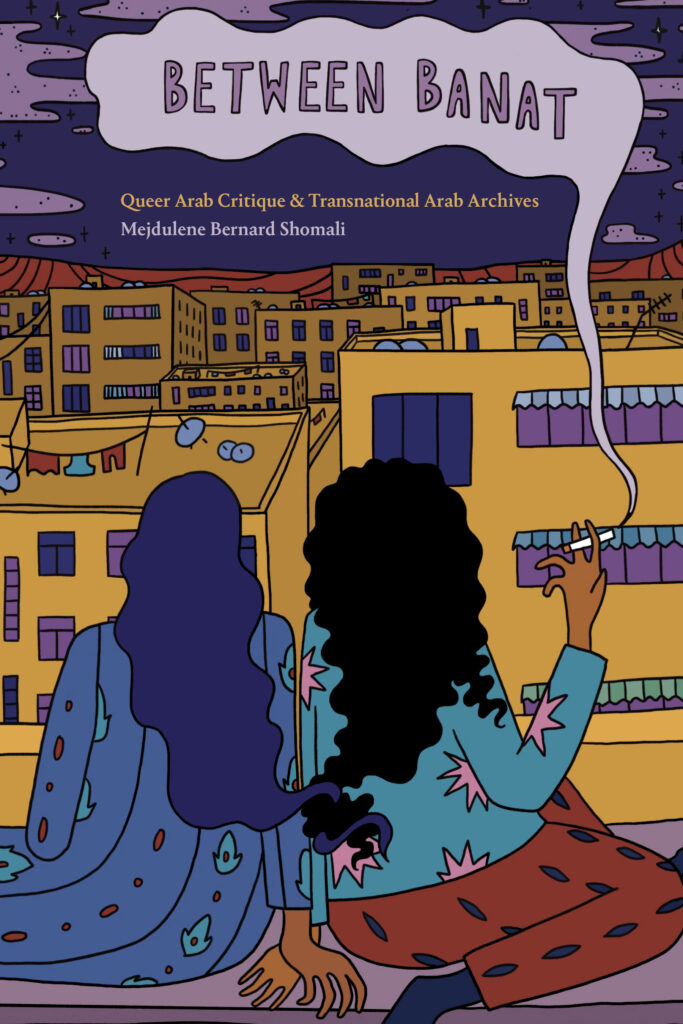
Seven years ago, Mejdulene Bernard Shomali began a search for her queer Arab women “banat” ancestors. Shomali, a queer Palestinian poet, was looking for mirrors and searching for hope in other queer Arab women, queer Arab banat. Their lives and names were unknown to her, blurred as they were by Western, Orientalism, and Arab hetero-patriarchal representations of Arab femininity.
Shomali came to UMBC in 2015 as a member of the third cohort of UMBC’s Postdoctoral Fellows which recognizes and supports talented scholars who are emerging as cutting-edge researchers and educators in their fields. In 2016, Shomali joined the faculty as an assistant professor of gender, women’s, and sexuality studies.
Shomali wondered if one could be queer and Arab and okay all at the same time especially if representation of queer banat desire was missing from popular cultural texts and films. In the darkest of times, during a global pandemic shutdown, she found her answer— it was a resounding, YES. Not only can one be queer and Arab and okay, you can also create queer Arab joy.
In 2019, Shomali received The Woodrow Wilson National Fellowship Foundation Career Enhancement Fellowship to continue research for her manuscript. After seven years of research throughout the Arab diaspora, Shomali published her first book, Between Banat: Queer Arab Critique and Transnational Arab Archives. It is the first study of desire that addresses the contemporary cultures and lives of queer Arab women.
“This book is my love letter to my unnamed queer Palestinian ancestors. It is the knowing glance, playful wink, and double entendre between us,” Shomali writes in her book. “It is the ways we call one another, not only for recognition and community but to action and movement toward a joyful and pleasurable queer Arab future.”
Shomali, who has developed university-wide programming around Arab and Muslim identity, discussed her book at the Dresher Center for the Humanities 2023 Spring Humanities Forum. “It is not easy to work at the intersection of several disciplines and build both sophisticated and intelligible arguments for all audiences,” said Carole McCann, professor and chair of gender, women’s, and sexuality studies, who introduced Shomali. “However, Dr. Shomali deploys the conceptual tools of critical cultural studies, literary theory, transnational feminist theory, and queer of color critique with great dexterity demonstrating both a sharp intellect and immense writerly talent.”
UMBC Dresher Center for the Humanities 2023 Spring Humanities Forum.
Queer Arab Critique
Moving between Arabic, English, and Arabish (Arab+English), Shomali takes us as far back as the 10th century to analyze the famed Persian, Arab, Indian, and Asian tale of The Thousand and One Nights where Scheherazade saves herself, other women, and the nation by telling the king—who killed his virgin wives each morning—stories over 1001 nights. “As a storyteller and state queen, she evades the three typical representations of Arab femininity: silent veiled Muslima, hypersexual dancer or harem girl, and female terrorist,” notes Shomali. “She is hailed as an ancestor, muse, and icon for many Arab and Arab American writers.”
Shomali analyzes an 1855 and 1995 translation and three modern versions. “Scheherazade has also been used as a key figure in the portrayal of Arab women’s femininity, elitism, heteronormative sexuality, and anti-Blackness and has served to perpetuate colonial and Orientalist beliefs of the Arab world,” explains Shomali. Orientalism defines the West as civilized colonizers with progressive ideas and the East as foreign, uncivilized, primitive, and “other” that must be tamed through colonization. “Studying Scheherazade can reveal how representations of Arab women and femininity change given the cultural and political context in which they emerge,” says Shomali.
Where would one find queer Arab representation in a text that defines heterosexuality as the norm of Arab femininity? Like many queer people and people of color who do not see themselves represented in literature, art, business, or academia Shomali had to design her own solution—what she calls a Queer Arab Critique.
Queer Arab Critique is about finding the unseen, “the what ifs,” reading critically and between the lines. Using this lens, Shomali reexamines Scheherazade’s story and two films from the Golden Era of Egyptian Cinema (1940s – 70s). It is as much a mirror for queer Arab women of queer Arab women’s desires, sexuality, space, and time. It is also evidence that Western colonization and Western queer thought do not define nor erase mainstream queer Arab culture.
“Queer Arab Critique allows us to see the traces of queer desire in mainstream Arab cultures and undermines the erasure of queer people from Arab histories,” Shomali explains, “and reveals how queerness and Arabness are constructed relationally, between many locations, texts, and times.”
For and by queer Arab women
Between Banat is equally about undoing the archives of the past as it is about creating a new queer Arab archive. One that centers on literature, arts, film, and activism by and for trans and cis Arab women, femmes, and those Arabs who identify with femininity.
Searching for these vibrant communities pre-pandemic would have taken multiple trips to several countries, scouring state and local archives, and finding the hidden and active network of queer Arab communities. A global pandemic meant shifting gears. Shomali took to digital sleuthing in English and Arabic. Posting questions, following helpers, and clicking through online bootleg archives in Lebanon, Syria, Saudi Arabia, and Palestine.
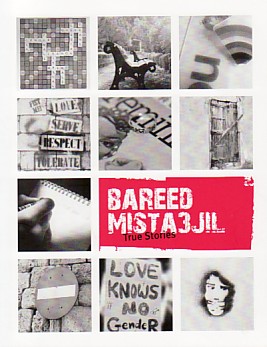
“Bareed Mista3ji” by Meem.
One find includes three biographical essay collections: “Haqi: An A’ish, An Akhtar, An Akoon” (My Right: To Live, To Choose, To Be) and “Waqfet Banat” (Women’s Stand) by Astwa in Palestine, and “Bareed Mista3ji” (Priority Mail) by Meem in Lebanon. Through anonymous and first-name authorship, banat write about their experiences, identities, and communities and publish their work via queer feminist organizations that advocate for LGBTI+ communities like Astwa and Meem.
In her search, Shomali also found three novels: Elham Mansour’s Ana Hiya Inti (I Am You), Seba al-Herz’s Al Akharuun (The Others), and Samar Yazbek’s Ra’ihat il Kirfathree (The Scent of Cinnamon). Once more written by, for, and about queer Arab women. These rich narratives take place in Lebanon, Saudi Arabia, and Syria respectively, giving readers a complex, close, and varied experience of same-sex desires and practices within Arab communities, families, spaces, and politics.
“It often comes as a surprise to Western and some Arab audiences that the majority of works about same-sex desires and practices between Arab women are not, as Orientalism would have us believe, originating in the West or in English,” says Shomali, who was named the 2017 Outstanding Faculty Ally at the Lavender Celebration, UMBC’s yearly event honoring LGBTQIA+ students, faculty, and staff. “They are works by Arab authors and artists, produced in Arabic, in Arab nations.”
A free and joyful queer future
In addition to texts, Shomali connected with filmmakers, artists, and designers currently advancing perceptions and practices of gender, sexuality, and liberation from oppressive systems within Arab culture creating a joyful and thriving present and future in film, fashion, and illustration.
Maysaloun Hamoud’s 2016 narrative film Bar Bahar (In Between) tells the friendship of three Palestinian roommates living in occupied Palestine working through issues of cultural expectations, identity, desire, and freedom. Nöl Collective is a clothing production company and intersectional feminist and political fashion collective based in Ramallah, Palestine. It works with Palestinian women artisans to create clothes based on traditional methods as a platform to bring awareness to political, environmental, and intersectionality issues as shared on their website.
“
The political reality for Palestinians is shaped by the military occupation which touches and shapes every element of our lives, including creativity. Isolated from one another geographically most of the artisans we are working with have never met and even need to work together digitally to bring garments to life, representing a creative endeavor which has u003ca href=u0022http://The political reality for Palestinians is shaped by the military occupation which touches and shapes every element of our lives, including creativity. Isolated from one another geographically most of the artisans we are working with have never met and even need to work together digitally to bring garments to life, representing a creative endeavor which has triumphed over imposed borders.u0022u003etriumphed over imposed bordersu003c/au003e.
Nöl Collective
Detroit’s own Maamoul Press is a small multidisciplinary art collective that supports the production and circulation of creative works in the genres of comics, printmaking, and book arts in the Arab diaspora.
“Ultimately, Bar Bahar, Nöl Collective, and Maamoul Press are geared toward a queer Arab future whose ethnic, sexual, and gender politics point toward collective liberation rather than community gatekeeping and social erasure,” says Shomali. “They do so by centering diverse voices, substantiating a future in which queer Arabs not only exist and experience pleasure, but whose existence, pleasures, and activists are essential to a sexually free future.”
“
By positioning the work of diaspora artists alongside the work of artists living in our home countries, we seek to u003ca href=u0022https://maamoulpress.com/Aboutu0022u003ebreak down barriers that fragment our communitiesu003c/au003e.
Maamoul Press
Shomali chose the word banat because it is void of the western, Orientalist, and hetero-patriarchal gaze that has defined queer Arab women into three stereotypes of Arab women’s religion, sexuality, and political beliefs. Between Banat is about all the spaces in between queer Arab women’s loving and living. Their past and future, visibility and invisibility, heterosexuality and queerness, empires and colonies, western and Arab.
“When I felt like it was impossible to write this book, I thought about my Palestinian ancestors and how I was bringing to bear a future we couldn’t have imagined,” says Shomali. “I believe in our joy and I believe our freedom is coming. I am grateful to them for teaching me that I am not alone.”
This year, the U.S. Fulbright Student Program, the U.S. government’s flagship international exchange program, has awarded nine UMBC students and alumni top research and teaching placements in countries such as Japan, Taiwan, and North Macedonia.
Each year, more than 10,000 students apply with just over 2,000 selected from hundreds of colleges and universities across the U.S. In the last decade, UMBC students and alumni have received more than 85 Fulbright U.S. Student Program awards for research and teaching placements in Africa, Asia and the Pacific, the Middle East, South America, and Europe. UMBC was named a Fulbright Top Producing Institution in 2019 – 2020.
This year’s class includes research award recipient Paul Ocone ’22, individualized study, who will be conducting research at Meiji University School of Global Japanese Studies in Japan. Fulbright research awards provide funding for research and training efforts overseas with a focus on non-Western foreign languages and area studies. Additionally, there are eight UMBC recipients of the English Teaching Assistant (ETA) award. ETA’s develop their own language skills and knowledge of their host country while working with student in elementary through college to strengthen their English-language abilities and knowledge of the U.S.
Three alumni will be headed to Taiwan to further their passion for global languages and communities: Nailah-Benā Chambers ’23, global studies, Kara Gavin ’20, English, and Milan Richardson ’23, bioinformatics.
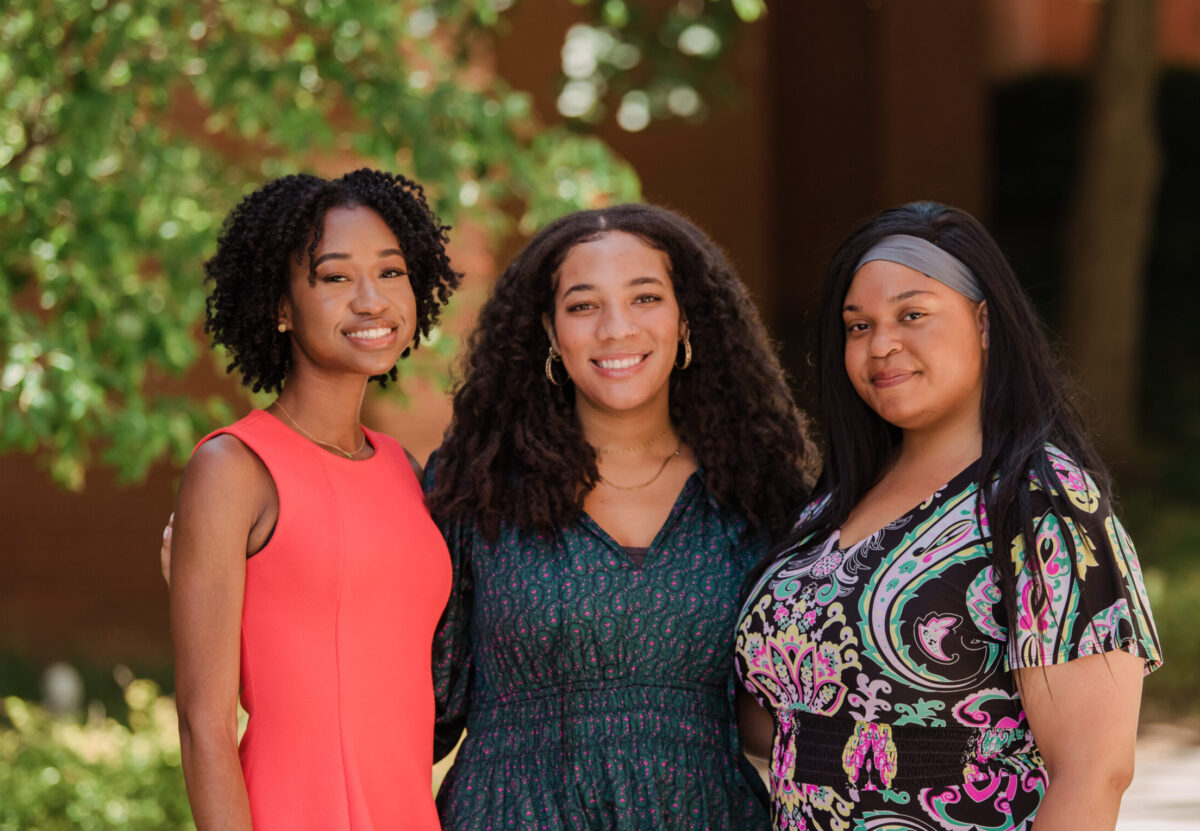
Kara Gavin, Nailah-Benā Chambers, and Milan Richardson. (Marlayna Demond ’11/UMBC)
Gavin brings experience as a Teaching of English as a Second Language (TESOL) volunteer which she completed during her study abroad program at the University of Brighton in the U.K. Chambers began learning how to move between different languages early in life as a student in a Chinese-language skills course. She later became a tutor, a skill she continued at UMBC’s English Language Institute (ELI). Teaching Baltimore City Public Schools’ diverse student population inspired Richardson to apply to the Fulbright program, where she will continue working with students from all backgrounds.
David Bullman ’22, ancient studies, served in the U.S. Army as a musician and public diplomat. He will be returning to North Macedonia, one of the countries he previously served in.
David Bullman. (Marlayna Demond ’11/UMBC)
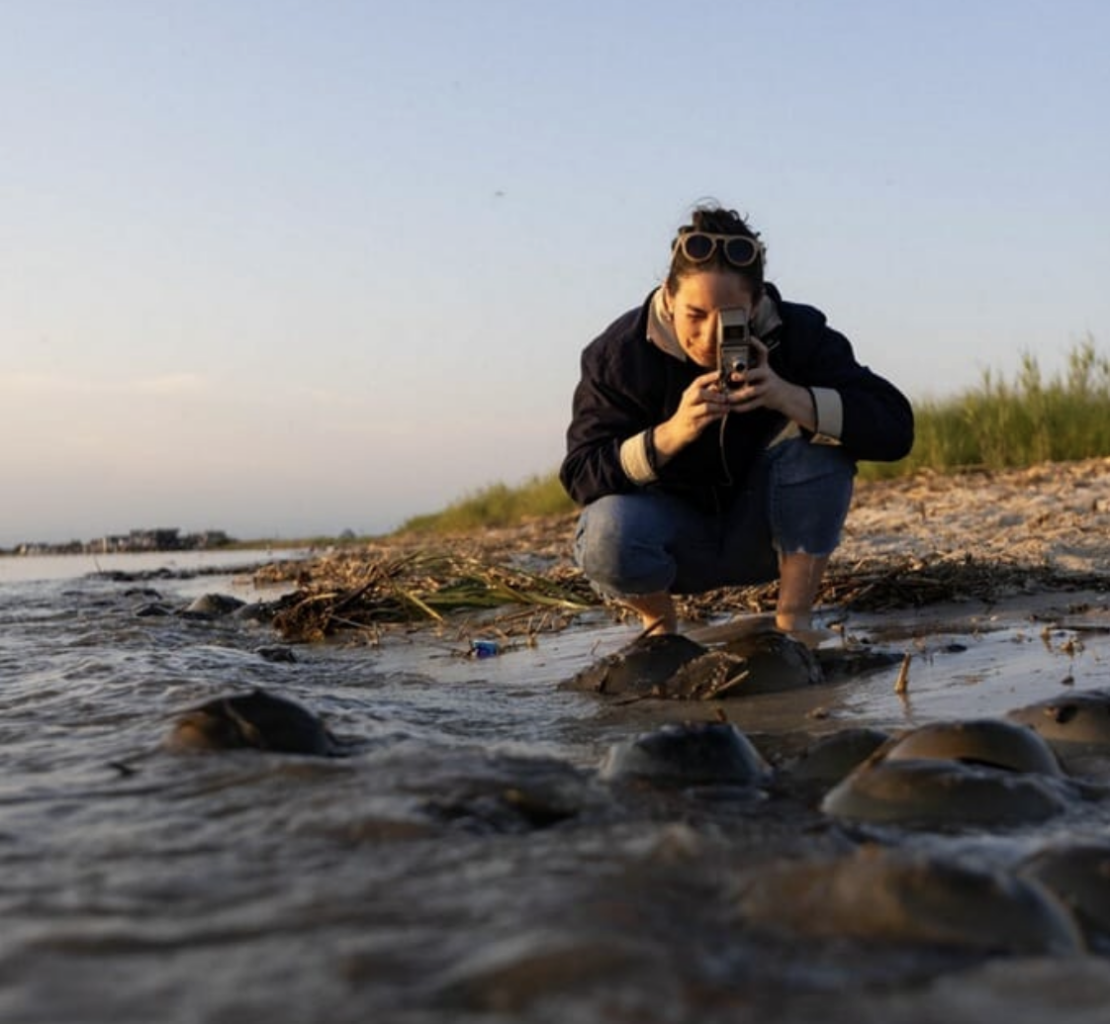
In addition to teaching English, Leah Michaels, M.F.A ’19, intermedia and digital arts, will be conducting research for two films and teaching film workshops for the community in Piła, Poland.
Leah Michaels in Cape May shooting the horseshoe crab mating period for a film she’s working on. (Image courtesy of Leah Michaels)
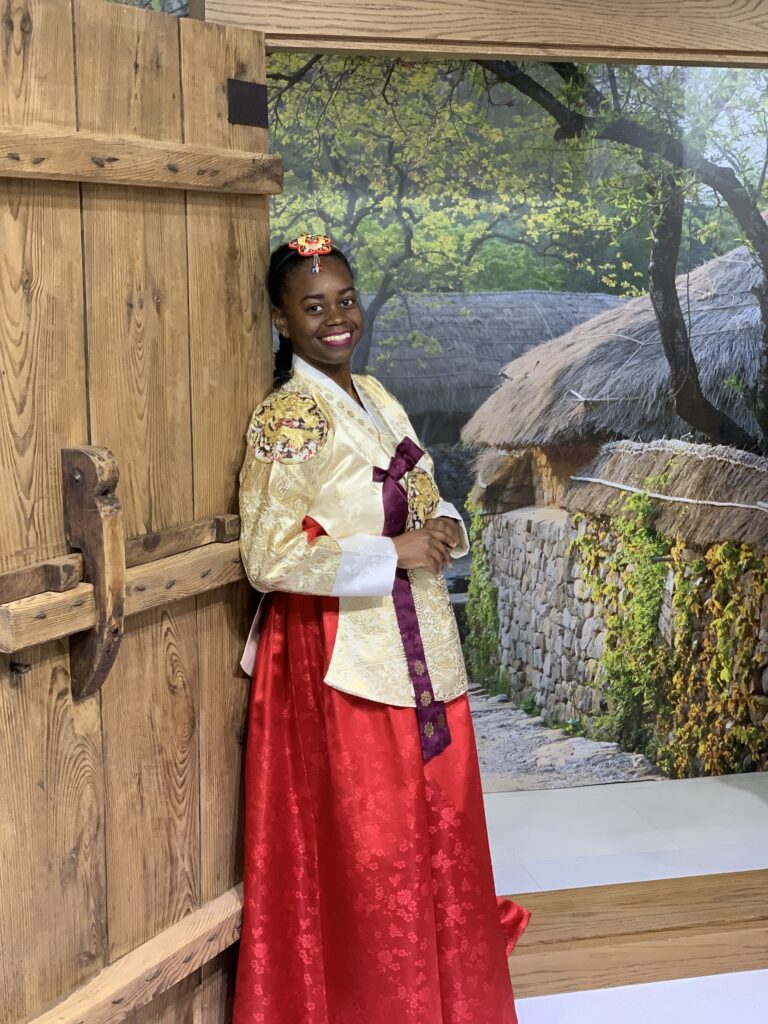
Tiffany Powell ’23, TESOL, spent three years teaching English in Seoul, Korea and will continue teaching in Romania after she graduates in December.
Tiffany Powell in Seoul wearing a hanbok, South Korean traditional clothing. (Image courtesy of Tiffany Powell)
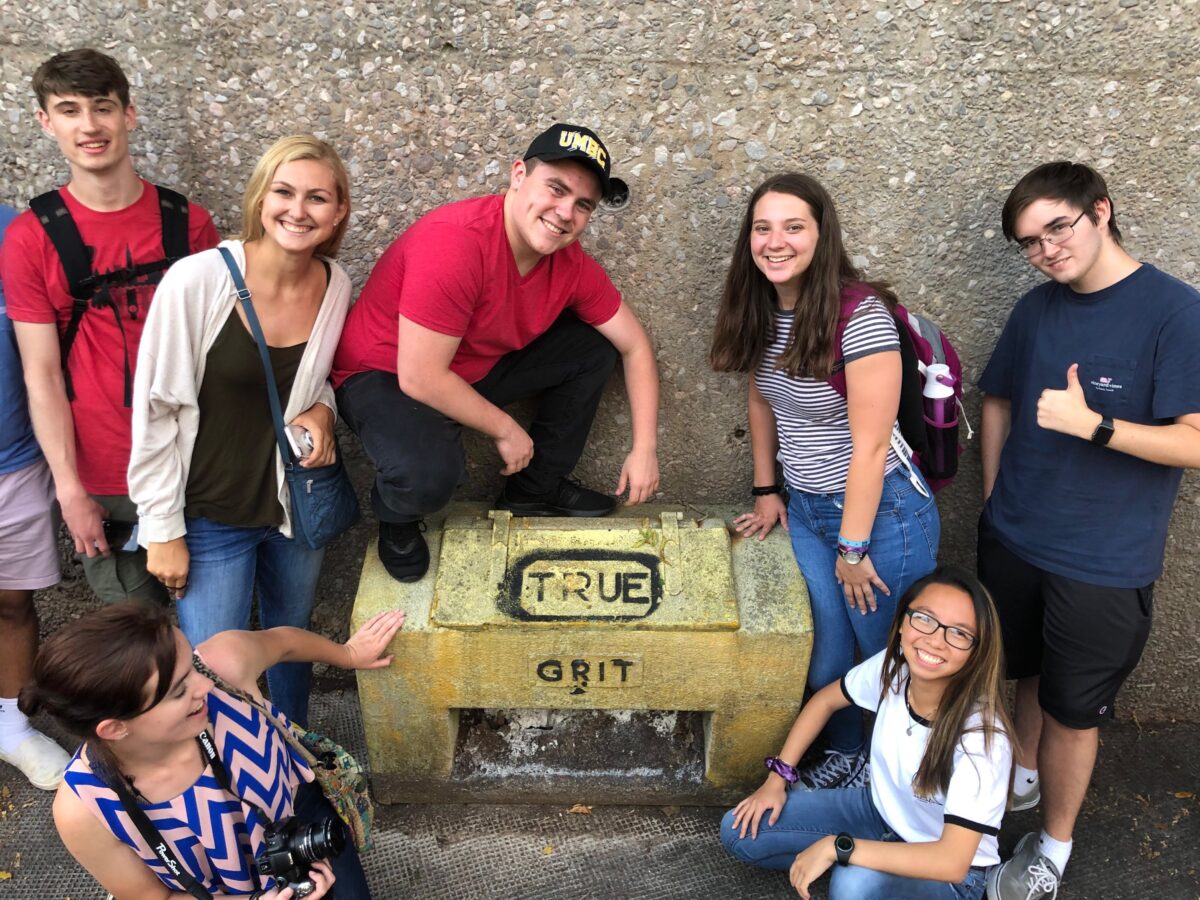
Sianna Serio ’23, computer science, who studied abroad in France, Spain, and the U.K., will head to the Slovak Republic to teach high school students.
Sianna Serio, kneeling on right, in Bristol, U.K. (Image courtesy of Sianna Serios)
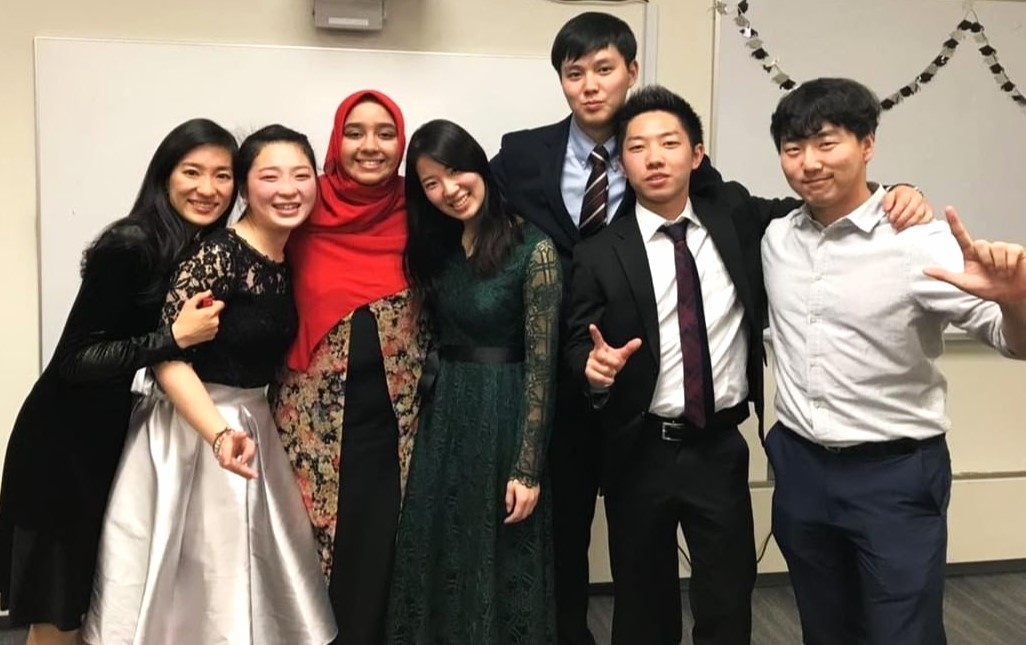
As a former marketing assistant at the ELI, Tasneem Mansour ’20, modern languages, linguistics and intercultural communication, supported visiting students from Peru, Nagoya and Tokyo, Japan. Mansour will head to South Korea.
Tasneem Mansour, third from the left, with students from Nippon Sport-Science University in Tokyo, Japan. (Image courtesy of Tasneem Mansour)
UMBC’s global outlook
UMBC’s commitment to international collaboration and research begins at the Center for Global Engagement, which connects students and faculty from the U.S. with students and distinguished faculty from more than 100 countries with unique international academic opportunities. Together, they further the research and skills needed to address long-standing and new global challenges.
Brian Souders, M.A.’19, TESOL and Ph.D. ’09, language, literacy and culture, the associate director of global learning of the Center for Global Engagement, has led students through the Fulbright application process, as UMBC’s Fulbright Program advisor, for the last decade. “Our students are high achievers, the application process is a place for them to share their story,” says Souders. “Faculty and staff are there to ensure each student’s application reflects their years of hard work and the skills they have developed to collaborate with partners across the world.”
With the vast network of Fulbright alumni at UMBC and across the U.S., it’s always helpful to get tips on how to conduct research in a new country and in a new language. Fulbright recipient Ocone, a long time fan of all things anime, began developing his ethnographic research skills with the support of Bambi Chapin, associate professor of anthropology. Chapin, a 1999 – 2000 Fulbright recipient, taught Ocone the theoretical and practical aspects of ethnographic research which he will now use to research the politics of inclusion and exclusion in otaku (anime/manga fan) spaces.
Chapin, along with Julie Christ Oakes, the assistant director of curriculum and retention of the Honors College and a 2001 – 2002 Fulbright research award recipient to Japan, also workshopped Ocone’s research proposal and Fulbright application. Oakes also shared her insights on the Fulbright experience.
“I went to Japan to do research for my dissertation research,” says Oakes. “I have a good idea of what [Ocone] will face as a relative “newbie” abroad and a non-native Japanese speaker and reader.”
The Fulbright experience is also about nurturing relationships with faculty abroad. Ocone said he feels honored for the opportunity to further his research with Kaichiro Morikawa, an associate professor at Meiji University and author of one of the foundational books on otaku spaces. Morikawa will help Ocone navigate the various resources on otaku culture. He wrote in Ocone’s recommendation letter that his “research is highly original as well as effectively focused,” and says he looks forward to supporting Ocone during his time at the university and in Japan.
Paul Ocone. (Marlayna Demond ’11/UMBC)
“I am immensely grateful to all of my mentors for guiding me on my journey through my undergraduate degree—from my earliest fuzzy and broad ideas of what I wanted to do, to the more specific research plans, and to the rewarding thesis that eventually emerged,” says Ocone. “I’ll be continuing research on topics that I care deeply about, research that I will likely build upon in graduate school and beyond.”
Fulbright support network
The road to being a Fulbright recipient begins day one students’ UMBC experience as they explore majors, create a network of mentors, and hone their research skills. At the end of their junior year, students develop their initial application at the Fulbright Base Camp led by Souders, who is a 2023 – 2024 Fulbright International Education Administrator award recipient. “The camp helps elevate and support students to reach their Fulbright goals,” says Souders. “Students share drafts of their essays with me for feedback prior to the campus deadline, the first day of the fall semester. They participate in a campus evaluation process with UMBC faculty and staff to receive feedback on their applications.”
“The panel gives students advice about how to craft a project, like how to take it apart and re-put it back together, what we see as strengths,” says Chapin. “We support them and encourage them as they go through that really difficult intellectual work, emotional work of figuring out how to make their strong projects even stronger.”
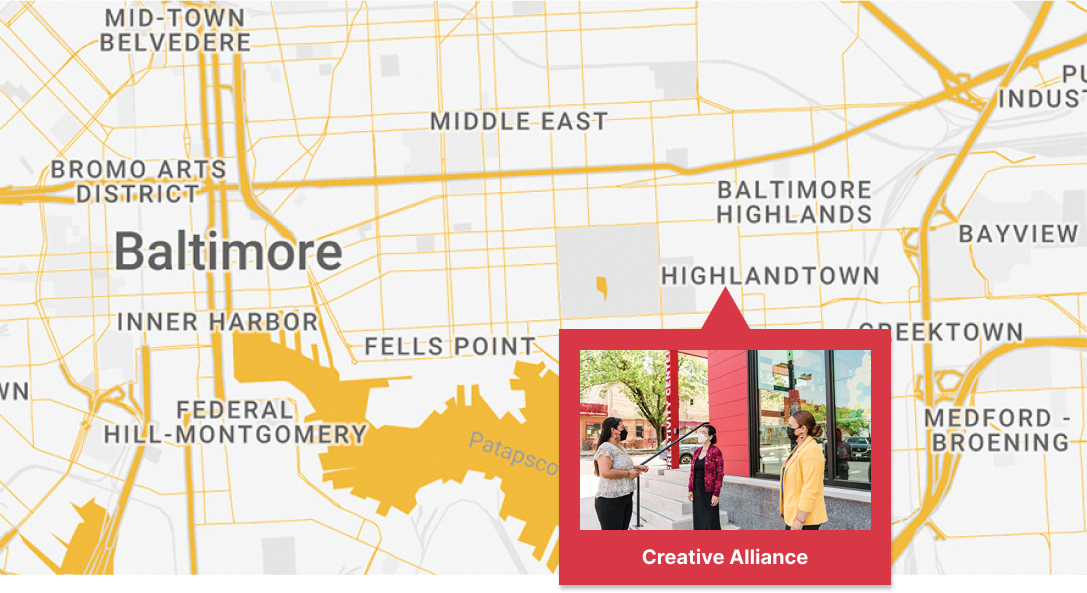
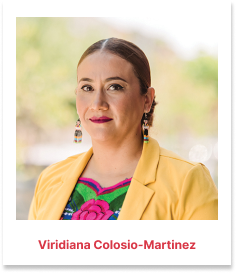
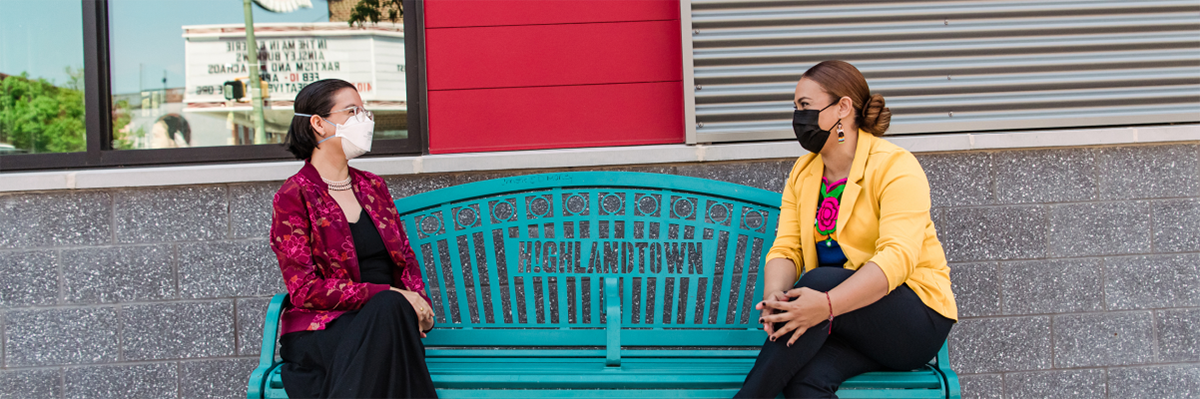
On a warm and bright sunny day in April when the trees in Baltimore City’s Patterson Park are changing from bright green buds to full leaf and the birds are competing with the car horns, Viridiana Colosio-Martinez ’22, modern languages, linguistics, and intercultural communication, and M.A. ’24, intercultural communication, waits in front of the Creative Alliance, a community and performance space a few blocks away from the park. After three years of undergraduate and graduate classes with her professor Tania Lizarazo, Colosio-Martinez is finally meeting her in person.
“I’m nervous and excited,” she says, waving to Lizarazo, associate professor of modern languages, linguistics and intercultural communication and global studies, as Lizarazo crosses the street to meet her and collaborator Yesenia Mejia, director of Creative Immigrant Educators of Latin American Origin (CIELO) and the Artesanas Latin American cultural enrichment program coordinator at the Creative Alliance.
“I can’t believe it’s the first time I’m seeing them outside of Webex,” says Colosio-Martinez.
There was a lot of hugging—the kind of hugging that is reserved for a friend you haven’t seen in years. Together, the group is gathering to review digital storytelling projects they’ve been working on virtually for the past year. They will present the story at the International Digital Storytelling Conference in Baltimore this summer.
Led by Lizarazo and in collaboration with local Latin American communities, they are collecting and sharing a range of unrecognized immigrant journeys.
“Lived experience is knowledge and should be part of knowledge production. A lot of our students are immigrants or their parents are immigrants and seeing experiences of migration beyond academic writing motivates them to explore their own personal and family stories,” says Lizarazo.
Tania Lizarazo, Viridiana Colosio-Martinez ’22, M.A. ’24, and Yesenia Mejia have been working together to tell the immigration stories of Baltimore’s Latin American communities.
Making teaching and research accessible
When Lizarazo moved from the University of California, Davis (UC Davis) to teach at UMBC in 2015, she felt an urgent need to create community. It had been easy to find a Latinx community in Davis but less so in Maryland.
“I arrived in Baltimore and suddenly I’m walking into places where I’m the only Latina. I don’t think that it’s healthy for anyone,” says Lizarazo. She began volunteering at the Creative Alliance, where she met Mejia and started Latinas in Baltimore.
During the pandemic, Lizarazo, who is chronically ill and immunocompromised, has found that virtual classes and tools allow her to continue teaching and engaging in research with the community. In fact, the pandemic made accessibility that had previously been considered impossible the norm.
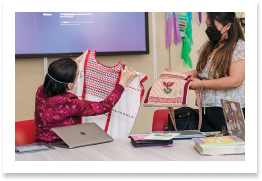
Mejia shares pieces of her family history, including a cotton huipil (tunic) hand embroidered with red and orange nahuales, and a family picture with her mother wearing it.
“We were so close to reimagining what community care could look like in 2020. We should not leave anyone behind or require people to choose between showing up or protecting themselves, their families, and their communities,” says Lizarazo.
“I am also committed to showing that we don’t have to choose between presence and safety. We can imagine collaborations that do not require additional exposures during an ongoing pandemic. We can acknowledge that we have different access to resources, such as healthcare, and that we value interdependence and community care. Not only do I want to collaborate in producing knowledge, but I want to be mindful of the context of these collaborations and not pick and choose what justice is when marginalized people keep being the most affected by the pandemic.”
Together with the Baltimore Field School, a part of UMBC’s overarching public humanities programming, and her partner researchers, Lizarazo has spent numerous hours building the relationships needed to help community members tell their stories.
“In the same way, community members rarely feel included in academia in different ways than research subjects. Creating opportunities for dialogues opens up opportunities to imagine new interactions and collaborations where not only the researcher’s knowledge is valued. Researchers would not be able to do anything without relationships and collaborations with students and community members.”
Slow research
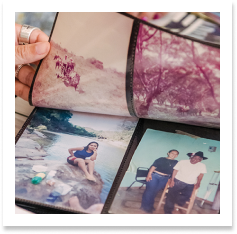
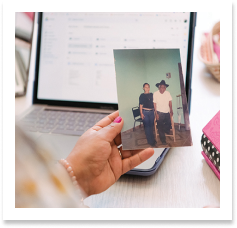
The researchers sit around a table and listen to Mejia describe photos of her family back in Santa María Zacatepec, Oaxaca, Mexico, during the 1990s. A faded photo shows her and her sister riding horses at a ranch. She picks up a picture of her father and pauses. “I didn’t get to see him.” Mejia has not been able to return to Mexico for almost 20 years, during which her father died. Colosio-Martinez and Lizarazo nod, understanding the pain and joy in between Baltimore and Oaxaca.
Mejia, a Baltimore Field School fellow, is working on a digital story, a story map, and website for her project on Representations of Indigenous Traditions from Latin America in Baltimore. She unfolds a calf-length, white cotton huipil (tunic) hand embroidered with red and orange nahuales and proudly shows a family picture with her mom wearing the same huipil.
“My mom always wears her huipil,” says Mejia. “Nahuales are spirit animals that are assigned to a baby according to the day they were born.” This spurs a lot of questions about the nahuales while she shows another hand-embroidered item, a bag with nahuales made by a fellow Indigenous Tacuate artist from Zacatepec.
This community-centered approach to research where students and community members are the knowledge creators is a key approach to Lizarazo’s community-engaged research on Latin American studies, transnational feminism using collaborative methods. It’s a shift away from the colonial-minded ethnography methods created by academics in the global north to research communities in the global south.
“We need to recognize that trust-building is a slow process,” says Lizarazo. “It’s based on reciprocity and it’s essential to meaningful communication and collaboration with communities.”
“Academia has historically excluded marginalized groups while extracting their knowledge. This extraction translates into personal gain for researchers but rarely benefits the communities that have been researched. As universities are not always reflections of the local communities where they are located, I have always been interested in learning from community members,” says Lizarazo. “I enjoy creating, collaborating on, and supporting projects that would not have an exclusively academic audience and won’t exist (only) behind paywalls. This is particularly important in public universities.”
Lizarazo calls this “slow research.” She had been practicing it in her home country of Colombia and at UC Davis as a doctoral student.
“Tania was an early proponent of experimenting with digital storytelling as a research method. She was uncomfortable with academic ‘interventions’ into communities. Tania liked the idea of putting digital communication tools in the hands of vulnerable groups, like migrants, who might not otherwise have access to share their experiences with the public,” shares Lizarazo’s mentor, Robert Irwin, director of the UC Davis Global Migration Center.
“She was an advocate for listening to and learning from migrants. Hers was an important voice in the research group that designed our first strategies for deploying this methodology.”
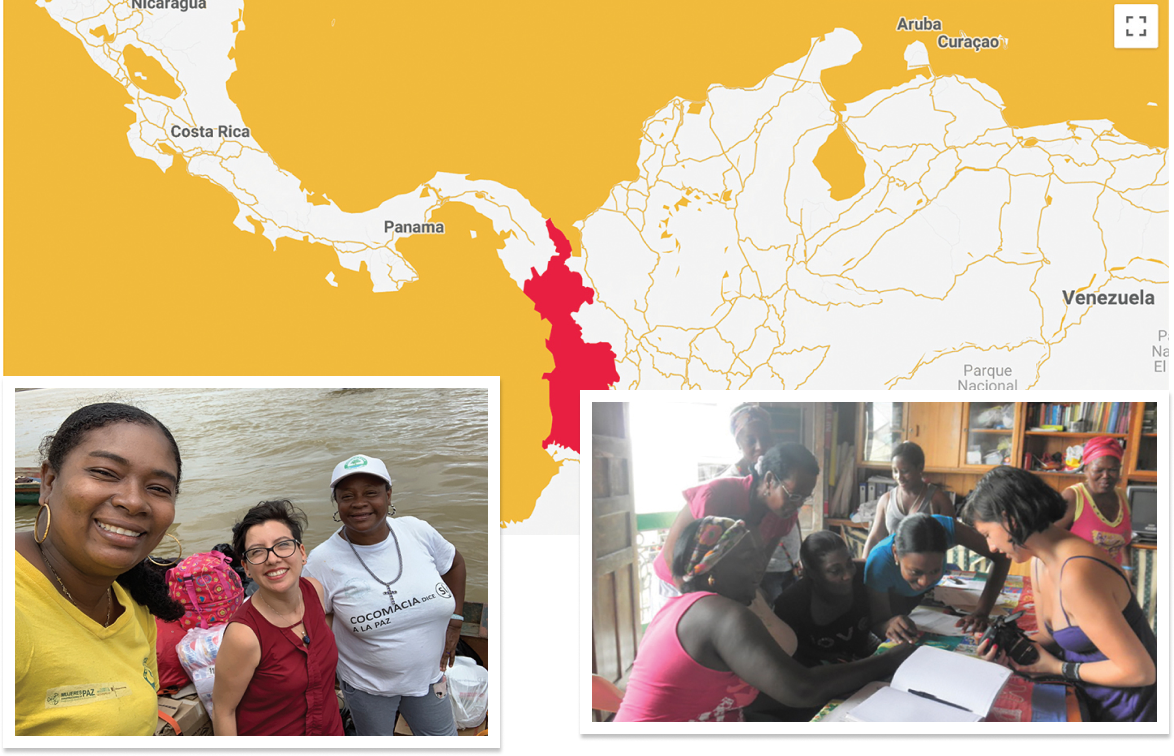
At left: Lizarazo (center) meets with community journalist Lucely Rivas (left) and Gender Commissioner Julia Susana Mena Becerra at the Atrato River. At right: Working with partners on the Mujeres Pacíficas project at the Gender Commission’s office in downtown Quibdó in 2013. Pictured (l-r): Rubiela Cuesta Córdoba, María del Socorro Mosquera Pérez, Yenny Palacios Romaña, Carmen Aides Navia Mena, Banessa Rivas López (in blue), Luz Adonis Mena Becerra and Ana Rosa Heredia Cuesta. Photos courtesy of Lizarazo.
Listening and learning
“Mujeres Pacíficas” was Lizarazo’s first digital storytelling project in collaboration with Afro-Colombian women activists in the department of Chocó, in Western Colombia. They were also advocates for land rights and women’s rights. She met the group in 2008. “Women were doing the work alongside men for years, but their work had gone unrecognized,” says Lizarazo.
One of the first shared stories, recorded after five years of community building, was created in collaboration with Luz Adonis Mena Becerra. She was a member of the Main Community Council of the Integral Peasant Association of the Atrato River. It is a Black farmers’ association in the Colombian Pacific, where Black communities were officially granted territorial rights in 1993.
“In the process of creating Luz Adonis’s story, I found out she had faced forced displacement and had lost everything she owned in a fire years later,” says Lizarazo. “Despite this, she reconstructed her memories through community photographs for her story.”
The project inspired Lizarazo’s forthcoming book from the University of Illinois Press, Postconflict Utopias: Performing Everyday Survival in the Colombian Pacific, a part of the “Dissident Feminisms” series. “The willingness to imagine these stories before they had audiences, and in spite of the absence of personal archives, is utopian,” says Lizarazo. “Not because these stories are ideal or unrealistic but because they invite the audience to imagine what seems impossible: the end of decades of violent conflict into a material reality.”
Student-teacher and the teacher-student
Parting with colonial-minded immigration research means developing new frameworks that humanize data. It requires a shift in the process of gathering and disseminating information from one person to a community with a diverse and evolving set of skills and expertise.
“Equipping immigrants with the tools and methods to co-create personal stories can help us understand migration as a hemispheric experience. It can help us understand the context of globalization, colonialism, neoliberalism, genocide, and marginalization, especially in Black and Indigenous communities in Latin America,” says Lizarazo.
These voices highlight the multitude of paths immigrants take that are equally stories of joy, success, family, and community love as they are stories of survival, sacrifice, separation, and pain. There isn’t one Central American experience, Mexican American life, or Latin American journey. Before immigrants became people of color, Latinos, or minorities, they were Aymara, Taino, Mayan, Colombian, Mexican.
“It’s important to critically study the connections between local and global contexts of production and consumption of these stories,” says Lizarazo.
“It’s a more horizontal teaching-learning experience, where students, community members, and instructors are teaching and learning. The world is messy; when we listen to each other, we can do things that we didn’t know were possible before.”
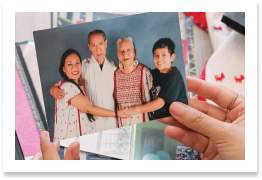
Colosio-Martinez shares photos and stories of her family’s journey with Mejia and Lizarazo.
One penny
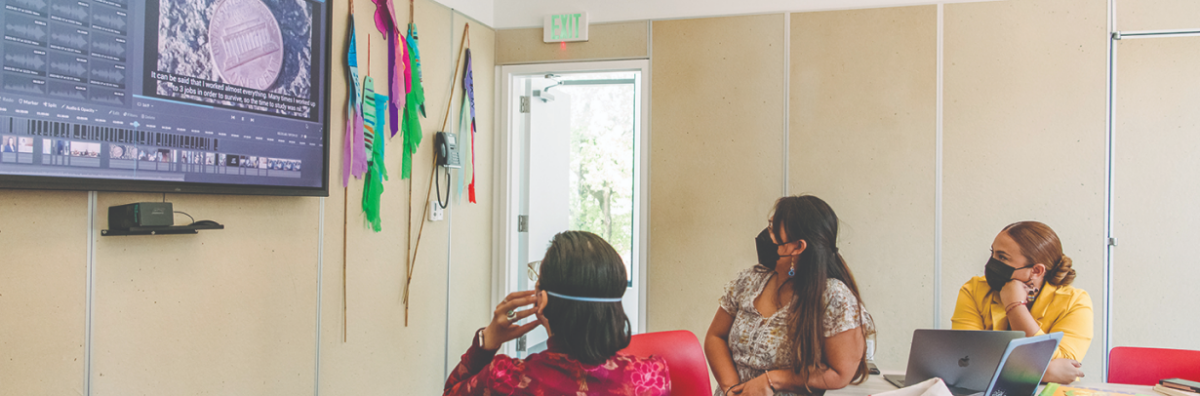
After Mejia places her photos and huipil on the table, Colosio-Martinez, research assistant for the Moving Stories: Latinas In Baltimore digital storytelling project led by Lizarazo, takes a deep breath. She preempts the debut of her digital story draft by apologizing for the tears to come. A clip of a map shows a blue line tracing the miles of her life from Caborca, Sonora, Mexico, three hours from Phoenix, Arizona, to New Haven, Connecticut, to Baltimore.
A small picture of a penny appears on the screen.
“I’ll never forget when me and my mom tried to register for community college,” she begins, “but we were short one penny.” With each description, the penny gets bigger. “The registrar said she didn’t have a penny and shut the window in our faces.” The penny fills the screen. “My mom and I went outside and searched the floor until we found a penny.”
The pursuit of education is the connecting thread throughout the narrative. A photo of Colosio-Martinez wearing her cap and gown and celebrating with her husband after earning her associate’s degree is followed later by a screenshot of an email welcoming her to UMBC.
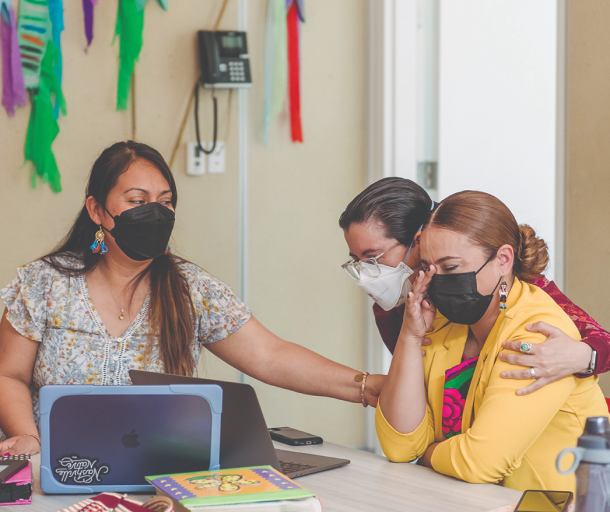
Colosio-Martinez covered her eyes to hide her tears. Lizarazo hugged her. Mejia touched her shoulder. They suggest she not cut her story.
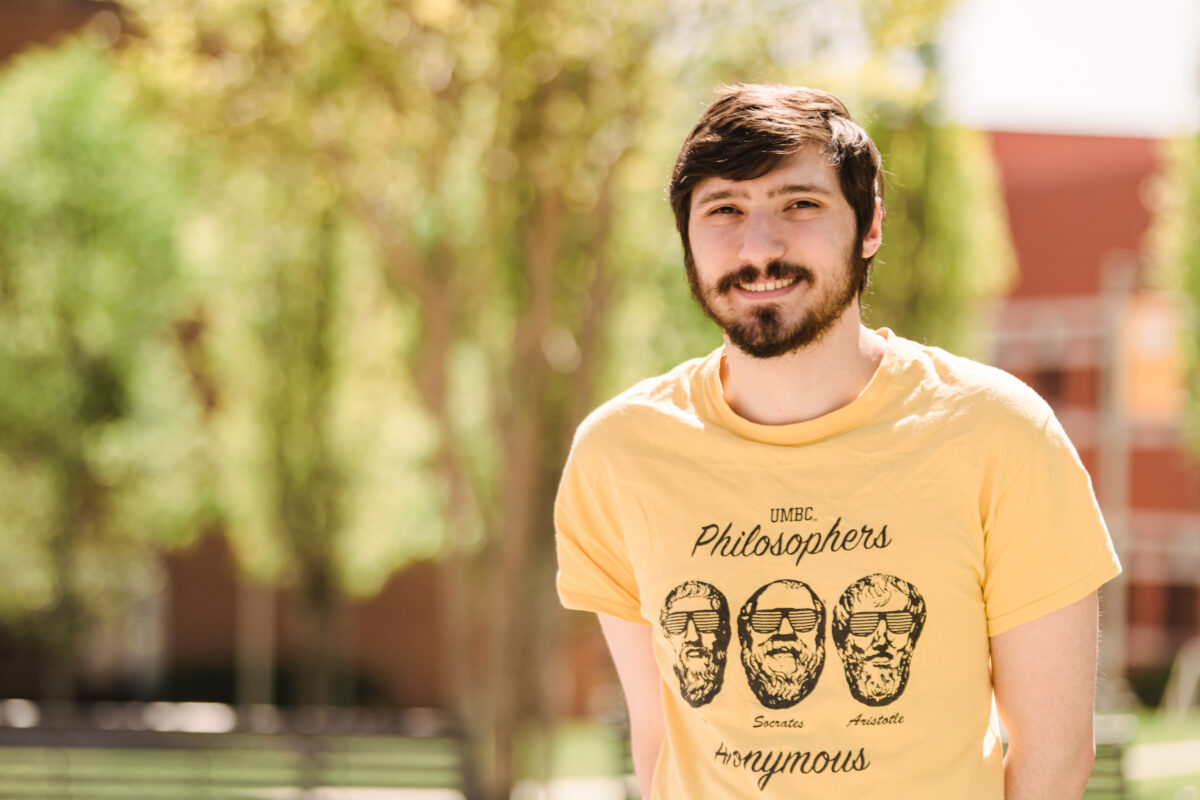
Avi Newman, who is graduating from UMBC this spring, knows all too well about learning to navigate unexpected detours beyond his control. Managing the compounding effects of COVID-19, meant letting go of his original college plan and embracing much-needed time for self-care and reflection. It also meant asking for and accepting help from a network of faculty who were ready to listen, offer guidance and encouragement, and help him pursue his interests in new ways.
Avi Newman. (Marlayna Demond ’11/UMBC)
Newman originally envisioned himself walking a straight line from College Signing Day to Commencement. Instead, he found that a zig-zagging seven-year path took him where he needed to go, and that his success was a collaborative process. One of his greatest sources of support was Songon An, associate professor of chemistry and biochemistry.
“Avi came to my lab with great potential to become a biochemist. However, the COVID pandemic changed everything about his course of life,” says An. “I remember telling him that it’s OK to pause his undergraduate life and take advantage of such time to try out many different things, beyond academics, that he may find himself enjoying and feel rewarding.”
Newman began taking courses in a broader range of fields and is graduating with majors in biochemistry and molecular biology, biological sciences, and philosophy, plus minors. He has worked as a tutor, volunteered with a public health organization, and practices meditation to keep himself grounded. Accessing support gave Newman the confidence to rethink his assumptions about who he is now and who he wants to be.
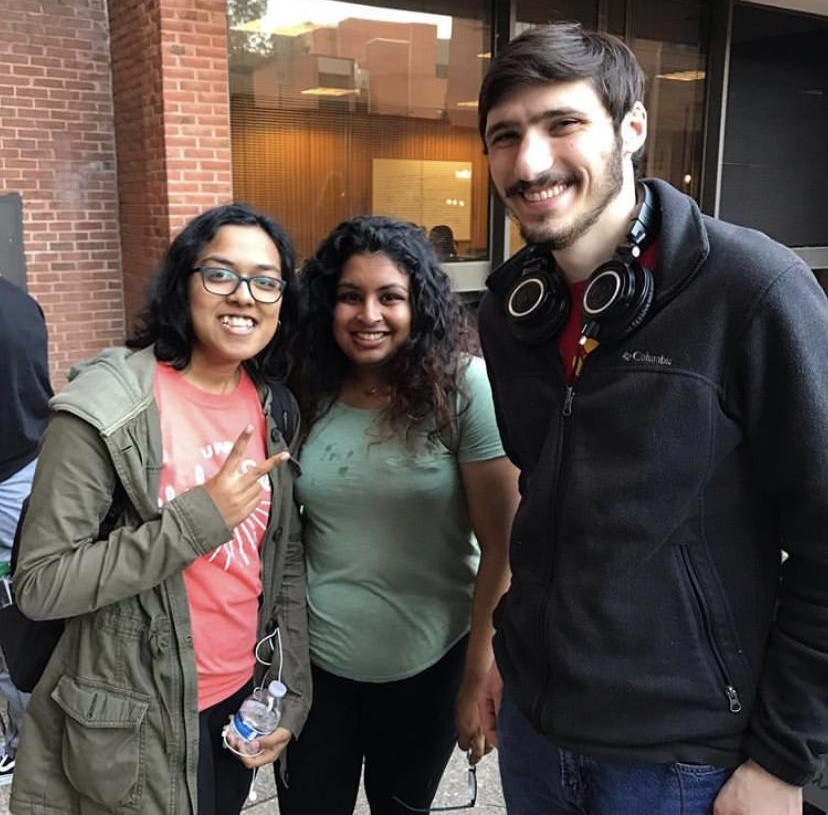
Avi (at right) with friends at the UMBC Chapter of the American Chemical Society Saccharide Social. (Image courtesy of Newman.)
“I think initially it was hard to come to terms with not graduating ‘on time,’ but after a while I realized that there’s no rush to life and that it was better for me to take my time and learn as much as I could,” says Newman. “I wanted to enjoy my time and take care of my mental, emotional, and physical health, which ultimately is much more important than rushing through things being excessively stressed.”
Maneuvering daily challenges
Like Newman, Jennifer Boateng will soon cross the stage to accept her degree seven years after she enrolled at UMBC. Throughout her journey, she has kept a clear goal in mind: finding the best way to use her creative talent to support people who, like her, live with sickle cell disease, and similar challenges.
Boateng found a perfect match in global studies, with a focus on creating multimedia content for humanitarian groups with a global audience. Pursuing this dream has meant adeptly maneuvering the complexity of living with sickle cell disease. Boateng completed research, taught herself her Final Cut Pro, wrote papers and lab reports, and attended classes both in person and at the hospital, virtually, as she received necessary care.
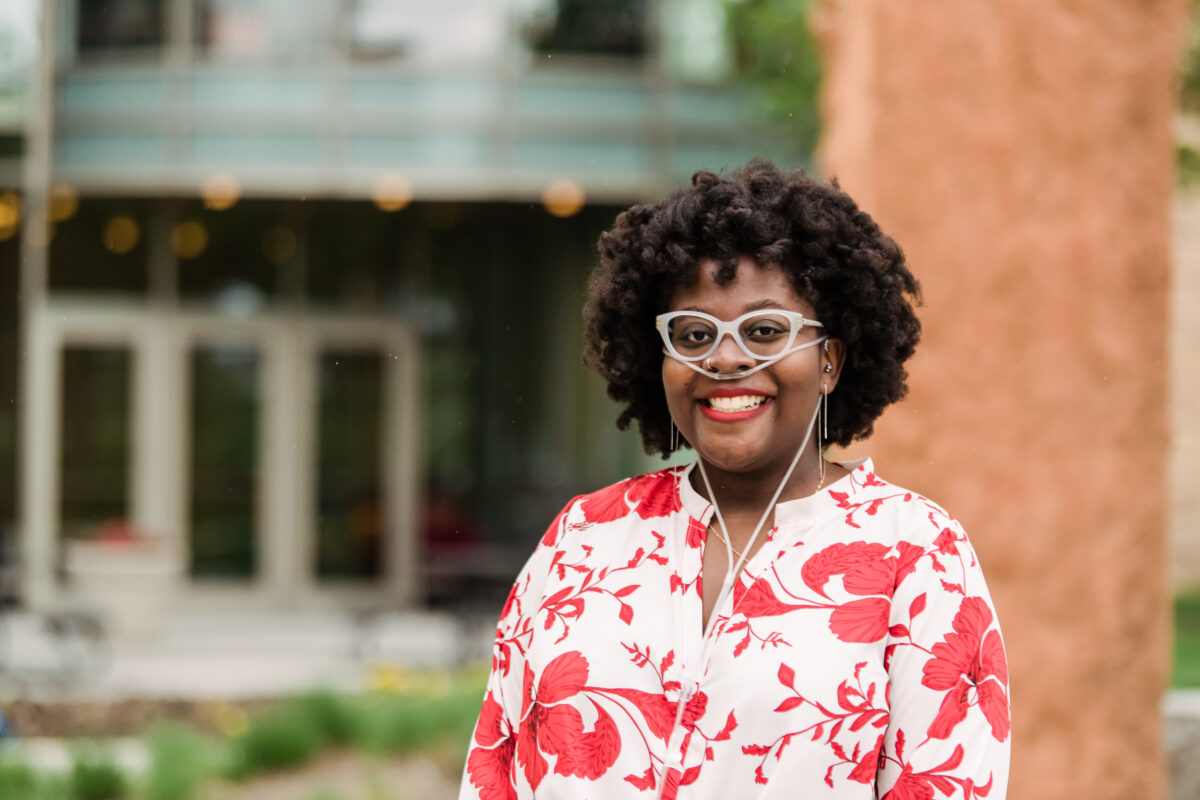
Jennifer Boateng. (Marlayna Demond ’11/UMBC)
Boateng credits her positive and successful college experience to the long-term support of her friends and family as well as kindness and flexibility from UMBC faculty, staff, and peers. Her mentor Brigid Starkey, principal lecturer of political science and director of global studies, notes that the program worked closely with Boateng, especially over the last year, to strategize on how to finish her degree.
“We worked on course selection and navigating academic appeals processes, and her disability rights,” says Starkey.
With the moment she will turn her tassel in sight, Boateng and her mentors are looking toward what’s ahead. “Lately, my mentorship has involved talking to her about the future and where she may want to focus her efforts in the job market,” says Starkey. Boateng’s mentor is leveraging the department’s alumni network to connect her with career possibilities that will help her fulfill her vision.
Community support leads to success
Finding success through community support is familiar to many UMBC graduates. UMBC was the second university Victoria Joya Euceda attended, searching for a mentor who understood her story as a first-generation college student whose parents immigrated from Central America. At UMBC, she connected with Yolanda Valencia, assistant professor of geography and environmental studies, and other supporters. Now, Joya Euceda ’23, geography and environmental systems, is heading to a Ph.D. in geography at the University of Illinois at Urbana-Champaign.
Victoria Joya Euceda ’23, geography and environmental studies. (Marlayna Demond ’11/UMBC)
Beatriz Soriano Luna’23, social work, transferred from Montgomery College to UMBC at the Universities at Shady Grove, where she became an integral member of a close-knit community. Valuing the mentorship of M. Nicole Belfiore, clinical instructor of social work, Soriano Luna herself mentored more than two dozen students as a peer advisor. She’ll next pursue a master’s degree through the University of Maryland School of Social Work.
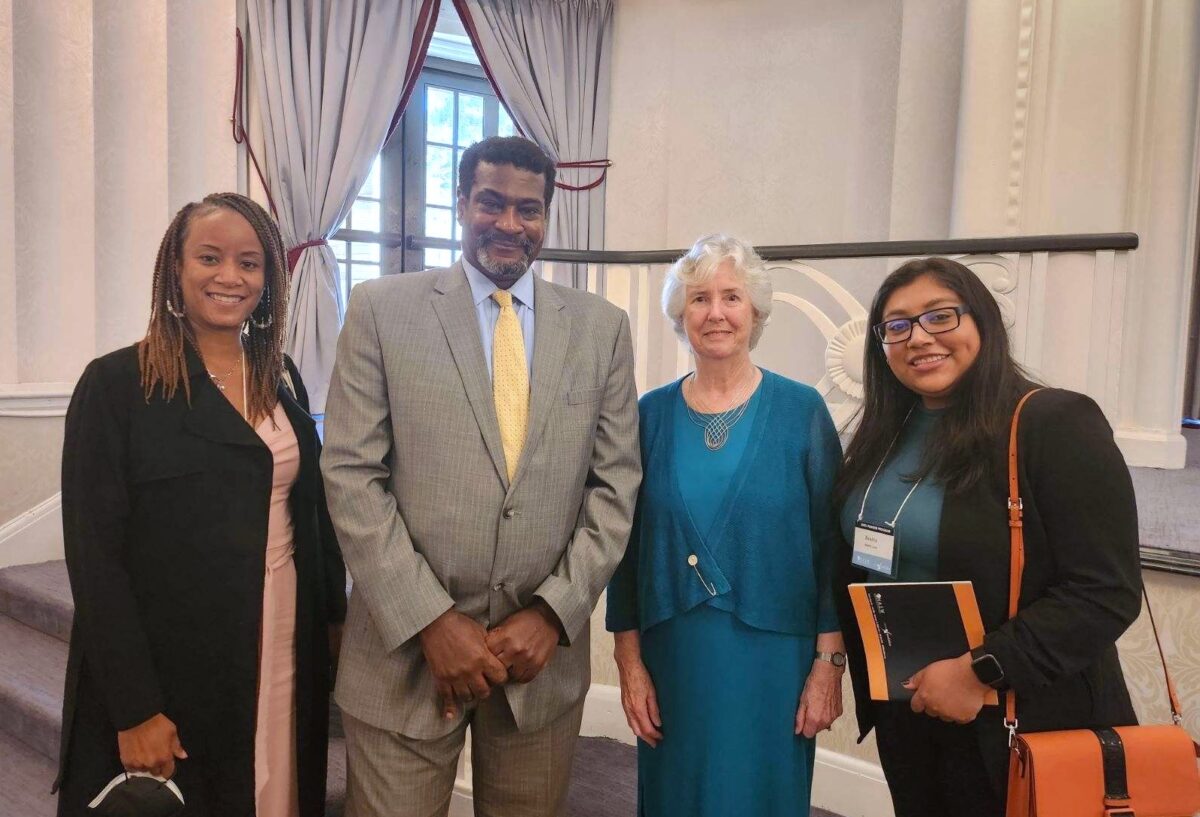
Beatriz Soriano Luna (right) with (left to right): Dominique Culley ’23, social work; Angelo McClain, former chief executive officer of the National Association of Social Workers (NASW); and Betsy Vourlekis, professor emeritus of social work and chair of the NASW Social Work Pioneer Committee. (Image courtesy of Soriano Luna.)
This May, on College Signing Day (which celebrates students’ college decisions), Joel DeWyer, director of campus life operations, welcomed UMBC’s next incoming class in a video on Twitter, reminding them of the excitement that lies ahead and the support they can access along the way.
“College can be a nerve-wracking and anxious experience, right? So when you have a question, or when you are feeling uncertain, when you are feeling overwhelmed, do me one favor,” said DeWyer. “Find someone around you in your community and ask for help.”
He shared a message that Newman, Boateng, Joya Euceda, and Soriano Luna have worked to pass along to others: that support can be found everywhere at UMBC. “There’s people all around you who care about your success and we are here to help you,” said DeWyer. “So never, ever, be afraid to ask for help.”