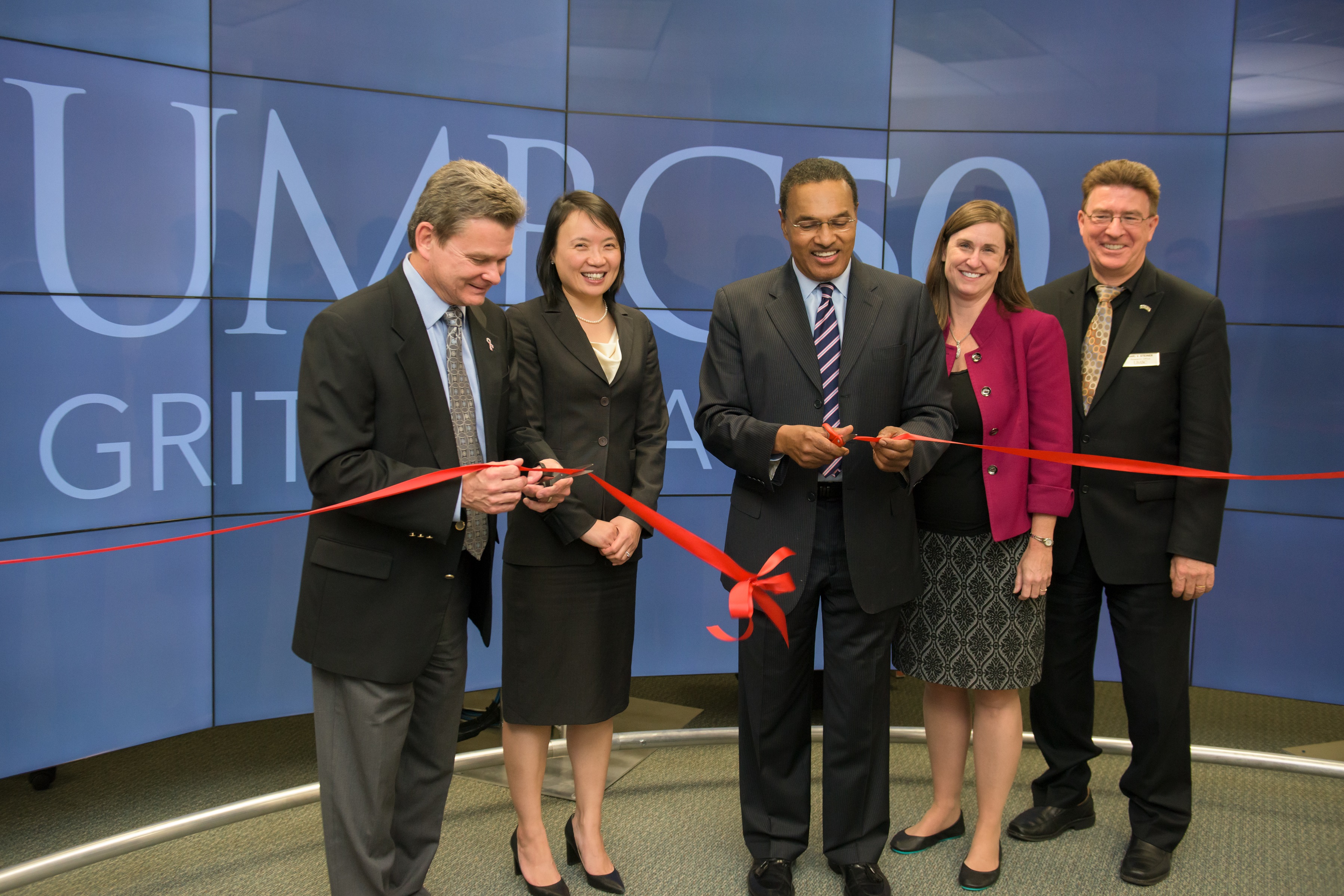
UMBC’s new PI^2 Immersive Hybrid Reality Lab will allow faculty and students to interact with data in different, more visual ways than they have before, reducing the distance between the information and the researchers, said Jian Chen, assistant professor of computer science and electrical engineering, at a ribbon cutting for the space.
Chen led a group of faculty from all three UMBC colleges who together submitted a proposal to the National Science Foundation (NSF) Major Instrumentation Program to make the new lab a reality. During the ribbon cutting event on Friday, October 14, she demonstrated how virtual reality research allows people across campus to collaborate with each other and to approach questions from a range of disciplines in novel ways.
“It’s about research, it’s about education, it’s about everything that we do here,” said Julie Ross, dean of the College of Engineering and Information Technology, about the new space.
The PI^2 Immersive Hybrid Reality Lab is funded by a $360,000 NSF award, with additional support from Next Century Corporation. In the lab, users wear 3D glasses with sensors attached to them and operate handheld controls that allow them to sensorially immerse themselves in data, which appears on dozens of high-resolution screens that are precisely aligned to work together. Users control the data by manipulating it in the space around them. The user’s body is fairly stationary, but the brain thinks the body is moving within the virtual world.
The lab brings together tools “that will allow humans and the computer to augment each other,” said Chen.
Virtual reality and augmented reality are already well known and generating notable excitement in the entertainment industry, demonstrated through the recent launch of a Sony Playstation virtual reality system. But John McBeth, president, CEO and founder of Next Century, remarked at the ribbon cutting, “We’re at the beginning of a shift. This isn’t just about games anymore.”
As Karl Steiner, vice president for research, shared in a recent WMAR segment highlighted PI^2 and other virtual reality work being done at UMBC, there are endless for the kinds of systems that could be examined through hybrid-reality based research, including “a wind farm for instance, or how blood flows through a human body…or how car traffic might be on I-95.”
Simply put, says Dean Ross this hybrid reality research space will “allow us to do things we’ve never been able to do,” to develop new, illuminating research across all disciplines.
The PI^2 Immersive Hybrid Reality Lab is featured in the Technical.ly Baltimore article “Check out UMBC’s VR cave.”
Image: A user tests out the new hybrid reality lab at its ribbon cutting. Photo by Marlayna Demond ’10 for UMBC.
Five Linehan Artist Scholars from UMBC visited the White House last week to participate in a workshop led by William Allman, chief White House curator. Adan Rodriguez ‘17, film; Justyna Kurbiel ‘18, animation; Megan Clelan ‘19, graphic design; Sarah Miller ‘17, photography and interdisciplinary studies; and Emily Eaglin ‘17, video, attended the special event, accompanied by Doug Hamby, associate professor of dance and director of the Linehan Artist Scholars program.
The workshop was centered around a recently acquired painting by Alma Woodsey Thomas, an African American Expressionist painter and art educator from Washington D.C. (1891-1978). The students learned about Thomas’s painting, now on display in the White House’s Old Family Dining Room, and heard remarks from First Lady Michelle Obama on the significance of Thomas’s work. They also learned from Allman about the broader history of the White House art collection, how the pieces of art were selected and acquired, and how the president and first lady select art to display in the living area of the White House. Following the official remarks, the Linehan Scholars were invited to view and discuss the artwork with art experts on the second floor of the White House.
During another White House event in the same week, Kafui Dzirasa ‘01, chemical engineering, served on a neuroscience panel alongside President Barack Obama. The White House Frontiers Conference was held at Carnegie Mellon University and focused on advances in neuroscience and progress made by the Brain Research through Advancing Innovative Neurotechnologies (BRAIN) and Precision Medicine Initiatives.
The BRAIN Initiative supports research to advance the understanding of the human brain by developing technologies that show how individual cells and intricate circuits interact.
“I think the big opportunity is for us to begin to think of the brain as an engineered system,” said Dzirasa, now a prominent researcher at Duke University, sitting beside President Obama. He went on to describe the incredible number of steps that take place within fractions of a millisecond every time the brain receives, processes, and responds to input, which can easily be interrupted in conditions from Alzheimer’s to autism.
Even when discussing doctors’ and researchers’ “common enemy” of disease, Dzirasa focused on the positive. “The reason I’m optimistic is because I fundamentally believe that there is a seven year old sitting in a classroom somewhere that will take all of the investments and all of the work that we’ve made and will transform things for my family,” he said.
Dzirasa added that he hopes students in classrooms across the country will have “the opportunity for their ideas to bubble up and be nurtured, because at the end of the day, the solution to that common enemy that we all face [disease] might be sitting in that classroom right now.”
Watch the full video of the White House Frontiers Conference panel on the White House website.
Images: (1) A view from the White House, photo by Adan Rodriguez; (2) Linehan Artist Scholars in front of the White House, photo courtesy Doug Hamby.
Nearly 500 students from UMBC and colleges across the region gathered on campus for HackUMBC 2016, a 24-hour hackathon for students to develop technological solutions (“hacks”) to problems that matter to them. The event enables students, both with and without coding experience, to work on innovative projects independently and collaboratively, to network and expand their skills, and to learn directly from leaders in the industry.
“I was completely blown away by how many people came out not only from UMBC but schools from across the East Coast. Seeing how much HackUMBC has grown and is continuing to grow is an overwhelming feeling that continues to leave me in awe year after year,” said Celeste Wong ‘18, computer science and social work, a HackUMBC co-organizer. Participating student teams submitted 71 hacks at the end of the event. Twelve hacks received awards from the HackUMBC organization and from sponsors.
The award-winning app Parking Pronto was designed to help users find parking spots on campus through crowdsourcing, showing available spots based on permit type. Another app, Beige, won the award for the “Best Hack Against Online Harassment.” This app automatically blocks from a Twitter user’s view those accounts that post a certain number of “user-defined trigger words.”
Katherine Gibson ’08, computer science, and John Park, both lecturers of CSEE, and Rick Forno, assistant director of the UMBC Center for Cybersecurity, director of the Cybersecurity Graduate Program at UMBC, and faculty advisor to HackUMBC student organization, served as judges.
“Now in its fourth year, HackUMBC continues to grow in standing and regional attraction,” said Forno. “It’s always an awesome feeling to see the amazing intellectual energy and technical results these students—novices and experts alike—generate at this prominent, intense, around-the-clock campus event.”
In addition to becoming a very popular regional event, HackUMBC is gaining steam on a larger scale. The official student hackathon league Major League Hacking recently released standings for the North American Spring 2016 season, listing UMBC as eighth out of 47 schools. Wong explained that while the ranking shows HackUMBC has become a popular event with students, it also shows that the university’s “hackathon community is representing UMBC well across North America.”
For more information about the entries and winners of HackUMBC 2016, visit the HackUMBC website.
ABC News in Baltimore took an in-depth look at virtual and augmented reality this week, ahead of Sony’s planned launch of a Playstation virtual reality system. The segment, “Virtual reality opening entertainment, research possibilities,” featured interviews with UMBC faculty on new technologies, the opportunities those technologies create, and issues for users and developers to consider as the field expands.
For viewers unfamiliar with virtual reality, Karl V. Steiner, vice president for research, explained how these technologies allow people to experience the world in a different way. “You put your headset on, you’re in the forest. You could be on a foreign planet or you could be in a battlefield,” he said.
In UMBC’s new PI2 Immersive Hybrid Reality Lab, Jian Chen, assistant professor of computer science and electrical engineering, demonstrated how ultra-high-resolution screens can help researchers visualize complicated data. To experience this technology, users wear 3D glasses with small sensors to enter a world that they can manipulate using handheld controls.
“In this type of environment, your brain thinks your body is moving but your body is not actually moving,” she explained.
The new lab will enable faculty and students in various departments to simulate data in uniquely immersive ways, whether a researcher is exploring wind farms, how blood flows through the human body, or highway traffic, said Steiner.
Ryan Robucci ‘02, computer engineering, and Nilanjan Banerjee, both associate professors of computer science and electrical engineering, are already using HTC Vive headsets in their labs to understand how people make decisions and react when when they are on a battlefield.
Banerjee says that augmented reality technology may be more useful and user friendly than virtual reality systems. Augmented reality allows people to see their surroundings, but alters the world through a device or glasses. Smartphone users are already playing Pokémon GO in huge numbers. In the near future, it could be common to have a technology that, for example, overlays directions and controls onto home appliances.
Dean Julie Ross of UMBC’s College of Engineering and Information Technology, has been named to the Executive Committee of the Global Engineering Dean’s Council. She will serve a three-year term on the committee, and will work closely with engineering deans from around the world to advance engineering education, research, and service globally.
In her role on the council, Dean Ross will attend the annual conference of the GEDC in Seoul, Korea in early November.
UMBC’s engineering and IT programs and leaders have increasingly received national and international recognition, and become major players when it comes to innovating engineering and IT education, both in universities and in K-12.
In 2015, Renetta Tull, associate vice provost for graduate student development and postdoctoral affairs, was named one of just three global finalists for the prestigious GEDC Airbus Diversity Award, in recognition of her work to promote inclusion and diversity in STEM fields. The honor focused on her leadership in the PROMISE Alliance for Graduate Education and the Professoriate (AGEP) program, which works to increase the number of future engineering faculty from underrepresented groups.
Dean Ross and Associate Dean Marie desJardins, professor of computer science and electrical engineering, have recently participated in multiple White House events examining the future of computer science education, particularly how giving more kids exposure to computer science early on could diversify the tech workforce of the future.
Image: Julie Ross. Photo by Marlayna Demond ’11 for UMBC.
In the past year, dozens of companies have faced cyber attacks and hacks, with the most recently announced attack affecting half a billion Yahoo accounts.
Rick Forno, assistant director of the UMBC Center for Cybersecurity and director of the Cybersecurity Graduate Program at UMBC, joined Nicole Perlroth, technology reporter for The New York Times, on WHYY to discuss this recent breach with Mary Cummings-Jordan, host of Radio Talk.
Although the Yahoo cyber attack happened two years ago, users are just learning about this breach now. These hacks can expose important identifying information.. Despite the level of sensitive information personal accounts can include, they often do not have the same types of security that employers typically ensure for work email accounts.
“The email address disclosures is bad enough, but if you have little bits of information like zip codes and birthdates, you can use these little tidbits to try to reset an account password and try to get in that way,” Forno explains. He adds that once a hacker enters an account they can access substantially more personal details and potentially hack into the user’s accounts on other sites.
Hacks of this nature should encourage people to use good cybersecurity practices, Forno suggests. “This that we’ve been preaching…[that] basic practices are just as valuable today as they were 20 years ago,” he says.”
To protect their email accounts, people should be vigilant when it comes account activity, change passwords regularly, and not share passwords between websites. Both Forno and Perlroth agree that enabling dual authentication, if available, is another way to protect accounts from being hacked. Writing out passwords and keeping them somewhere at home is one way to have different passwords for each account and not have to store them electronically, reducing the risk that a hacker may obtain the login information, says Forno.
Even with these preventative actions in place, cyber hacks will continue to be issues, he says. “The minute you learn of a problem, you’re already behind the curve in responding to it.”
UMBC and Tel Aviv University signed a memorandum of understanding on Wednesday, September 21, 2016, to formalize an academic collaboration between the two institutions. The agreement establishes a framework for joint research as well as academic exchange opportunities for students, faculty, and staff.
Antonio Moreira, vice provost for academic affairs, signed the agreement during a trip to Israel, as did Raanan Rein, vice president at Tel Aviv University. Maryland Governor Larry Hogan attended the signing of the document.
“The signing of this memorandum of understanding with Tel Aviv University opens up exciting opportunities for important academic collaborations involving faculty, students and staff from UMBC and TAU,” says Moreira. “Visiting TAU was very informative and allowed existing ties between the two institutions to be strengthened. We are delighted to have TAU as one of our partners.”
UMBC is the leader of the collaborative Center for Hybrid Multicore Productivity Research (CHMPR), which has historically included five other U.S. universities working to address computational challenges. Recently, the National Science Foundation approved Tel Aviv University as the first international research partner site for the Center, setting the stage for additional collaborative activities.
Stu Schwartz, senior research scientist for the Center for Urban Environmental Research and Education (CUERE) at UMBC, has long looked with concern at the issue of soil compaction and its effect on stormwater runoff and infiltration. Impervious surfaces, such as roofs, roads, and parking lots, increase stormwater runoff and pollutants in streams and rivers. Schwartz and his students found that standard construction practices can routinely result in green permeable landscapes with compacted soil profiles that produce almost as much runoff as an impervious road or parking lot.
Looking for a better way to create sustainable, attractive landscaping, he dug into the problem of compacted soil and began collaborating with various government agencies to address these issues.
Schwartz and his students worked with the Maryland Department of Transportation State Highway Administration’s Office of Environmental Design to demonstrate and refine an alternative to standard topsoiling practices that are commonly used by contractors. The technique—suburban subsoiling—makes the soil less compact and incorporates rich, organic compost into the soil to restore infiltration and water-holding capacity.
This practice needs little to no ongoing irrigation and fertilizer input, functions well technically, and has the markers of commercial success. It can be implemented with relatively minor changes to standard land development practices, and holds great promise as a win-win technology to reduce stormwater runoff while delivering superior sustainable landscaping.
The American Association of State Highway and Transportation Officials (AASHTO) recently identified this innovation as one of 2016’s “Sweet 16” projects. AASHTO’s “Sweet 16” distinction annually recognizes four high value projects from each geographic region of the United States.
In applying the suburban subsoiling technique, Schwartz and his students have worked with the City of Baltimore and Yorkwood Elementary School. The collaboration aims to reduce the amount of asphalt covering the ground and create construction that can allow the ground to absorb more water. Schwartz’s team developed an alternative way to restore the sustainability profile of the soil after the asphalt was removed and replaced with grass.
Photo by U.S. Department of Agriculture. CC by 2.0.
In a half-century, UMBC has graduated more than 70,000 people, and the university’s alumni have gone on to rewarding and impactful careers in the arts, humanities, social sciences, and STEM. “That has been the story of UMBC,” said President Freeman A. Hrabowski in an interview on Maryland Public Television, just ahead of UMBC’s 50th anniversary. During the network’s Education Spotlight week, Hrabowski discussed with Jeff Salkin UMBC’s success since it opened its doors in 1966, as well as important national education issues, including diversity and paying for college.
“People marvel at the quality of education here,” Hrabowski told Salkin. “We are one of the top institutions in innovation, and we have redesigned courses,” he said. “We give students chances to work in labs, but also in companies and school systems, and people get great jobs.”
Many students at UMBC today are the children of people who attended institutions in the University System of Maryland and found successful careers, he noted, sharing, “What American families see when they come to college is that people who complete those experiences are able to get better jobs and are able to take care of their families.”
President Hrabowski also offered advice for students on how to make the most of their college experience, particularly visiting the “Career Center and attending career fairs beginning in the first semester of freshman year.” Emphasizing the importance of internship opportunities, he said, “There are wonderful experiences and opportunities in the Baltimore-Washington corridor, we just have to expose the students to them and they will do well. The challenge is to make sure they take advantage of the opportunities.”
The lessons students learn at UMBC prepare them to contribute to society in meaningful and significant ways, Hrabowski continued, describing that it is important for students to go outside of their comfort zones and learn how to work with people different from themselves, to become “people who can serve as a bridge in explaining the problems.”
“What we need in America is the opportunity to talk to people different from ourselves, to remember to listen, to open our ears and our minds and our hearts, and to solve the problems,” Hrabowski said.
UMBC’s 50th anniversary was featured in several news outlets, including:
In recent months, as the U.S. presidential election has approached, concerns over email hacks and the security of voting systems have frequently appeared in the news. Rick Forno, assistant director of the UMBC Center for Cybersecurity and director of the Cybersecurity Graduate Program at UMBC, recently described to WYPR’s Sheilah Kast that voting machines are just one part of a system that has concerning vulnerabilities. “I think we have to separate the issue between voting machines and the overall voting process, because the two are related but have very different threat and vulnerability characteristics,” said Forno, who is particularly interested in the voting process and technologies used to collect data, as well as how that data is collected, counted, and reported.
A voting machine might report votes to a laptop across the room at a polling location, and that computer might then share data from the single polling place with a computer in a regional or state hub to be aggregated. In this scenario, Forno wonders how the laptop—as one small but crucial piece in the full chain of data transfer—is protected.
Data can be corrupted at moments when it is moving, and also when it is stationary, he says. “You’re looking at a range of security concerns that start with the individual voting machine in the voting booth, all the way up through the systems that officially record and report out the outcomes of an election.”
Voting machines include computers and other hardware that need to be maintained on a regular basis, much like computers that people use at work or at home. Forno warns that not regularly updating the technologies used in voting systems, can give hackers and researchers the opportunity to identify weaknesses and potential vulnerabilities in those systems.
On September 19, 1966, 750 freshmen arrived at UMBC and began taking classes in one of three building that made up the campus. Fifty years later, community members gathered together to share their memories of UMBC’s early days in the gleaming, new Linehan Concert Hall. The event was a special UMBC 50th anniversary edition of Baltimore’s popular Stoop Storytelling Series, which features “‘ordinary’ people telling the extraordinary, true tales of their lives.”
Mimi Detreich ‘70, American studies, set the stage by helping the audience imagine what it was like to be a student at UMBC during the first years. “We had professors who we had never heard of before, we had no idea what they were like, and we had no idea that they were really as new as we were to this whole thing,” she said.
When Louie Sowers ‘70, American studies, arrived at UMBC in 1966, she knew that she wanted to play sports in college because she loved playing volleyball during her high school years. At that time, UMBC only offered intercollegiate sports for men. “My sophomore year rolled around, and there were still no women’s sports. I was getting a little nervous because I really wanted to play volleyball, so I decided that I needed to be a little proactive,” she said. Sowers met with the athletic director who told her that if she could collect enough signatures of women interested in playing volleyball, he would hire a coach. “Evidently, I was pretty good at begging people,” she recalled, “because I came back with 66 names, and he hired us a coach.”
Ed Berlin ‘70, history, owner of The Ivy Bookshop in Baltimore, also arrived at UMBC in 1966 and recalls that the UMBC social scene was fairly quiet at first, before the campus began inviting top musicians like Otis Redding and Lou Reed to perform on campus. In those early days, he helped throw a Halloween party, and painted some wooden fences white as part of the decorations. After the party began he heard shrieks from people as they realized there were white stripes on their costumes from leaning against party decor. Being at UMBC was rewarding, he said, “I appreciate every second that I was here.”
In 1966, Simmona Simmons ‘74, American studies, now UMBC’s outreach and special projects librarian, started her first staff position at the library. After taking the state test, she applied to the first job opening that she saw, which happened to be at UMBC. During her time at UMBC, Simmons has seen the library move and expand, and she has continued her education, completing her bachelor’s degree and two master’s degrees. “The whole experience at UMBC was gratifying,” she said. “As UMBC grew, I grew with UMBC.”
Diane Tichnell ‘70, political science, says she arrived at UMBC ready to “wow” the community with her journalism skills. She began working on the school newspaper during her sophomore year, and at first was given small assignments, until her editor asked her to interview the leader of a group coming to campus to give a seminar. “That moment was a life-changing experience for me, when Bobby Seale, the co-founder of the Black Panthers for Self-Defense, started talking to me,” she recalls. “I couldn’t write fast enough to get down everything he said.” Tichnell’s experience at UMBC was one that changed the way she thought about causes. “They are not abstract, they are people who are putting themselves out there for the rest of us.”
When William Rothstein, faculty emeritus of the department sociology and anthropology, was interviewing for the job opening at UMBC, he was told that there was no campus for him to visit, so the interview was conducted in New York City. He was offered the job and began working at UMBC in the fall of 1966, where he continued to teach until he retired in 2013. “The first years at UMBC were notable because most of the faculty were new PhDs, like myself, and not much older than the students,” Rothstein said, adding that there were even faculty-student basketball and softball games. “So many things had to be decided in the early days when you were creating the university, as well as teaching and doing research.”
Donna Banks Hekler ‘70, English, recalled meeting Albin O. Kuhn, the first chancellor of UMBC, in the cafeteria while she was eating lunch with a friend in UMBC’s early days. She spoke about how Kuhn was always interested in hearing about students’ experiences. “He really wanted to know what was working and more importantly, what wasn’t working, what needed to be changed. What did we think?” she said. Heckler shared that Kuhn’s true love was farming, and that when he retired he moved back to his farm. “He planted crops, and he nurtured those and tilled the soil and did the harvest. And he did the same thing here. He planted a university, and he grew it and he nurtured it and he loved it.”
When audience members were offered the chance to come to the stage, John Titchener, emeritus associate professor of philosophy, and Allan Holtzman ‘70, history, also told short stories about their time at UMBC.
The final Stoop Story presenter was President Freeman A. Hrabowski, who jumped forward a few decades to tell a story about the early 1990s, a challenging time for university budgets in Maryland. President Hrabowski shared how, at a moment when arts and humanities programs were at risk, the UMBC campus showed up to support students’ access to a broad liberal arts education. “When times are tough, and it’s about character, people come together,” Hrabowski said. “I’m a strong believer that working class people, middle class people, should be exposed to the best, because they’re going to be the leaders one day.”
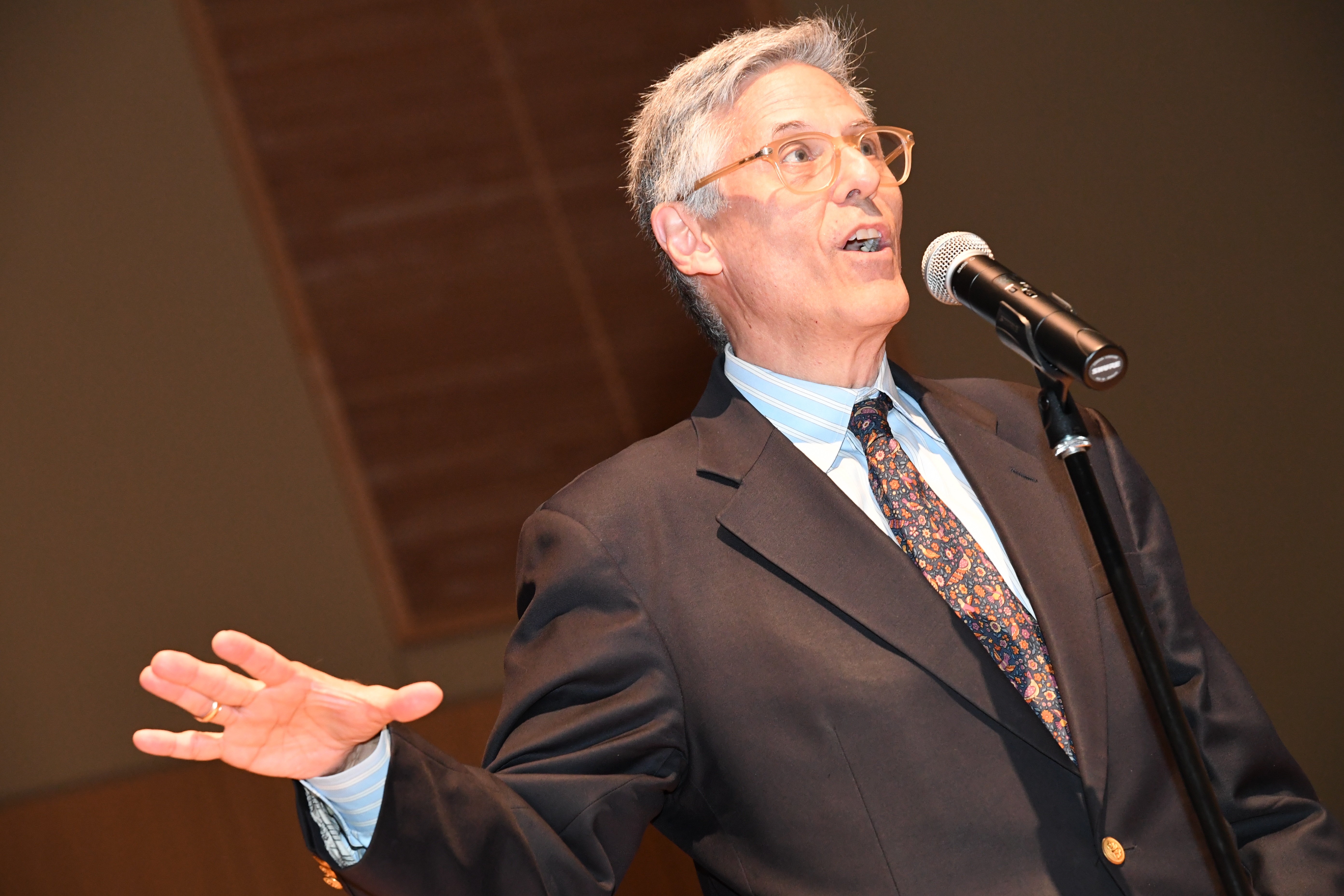
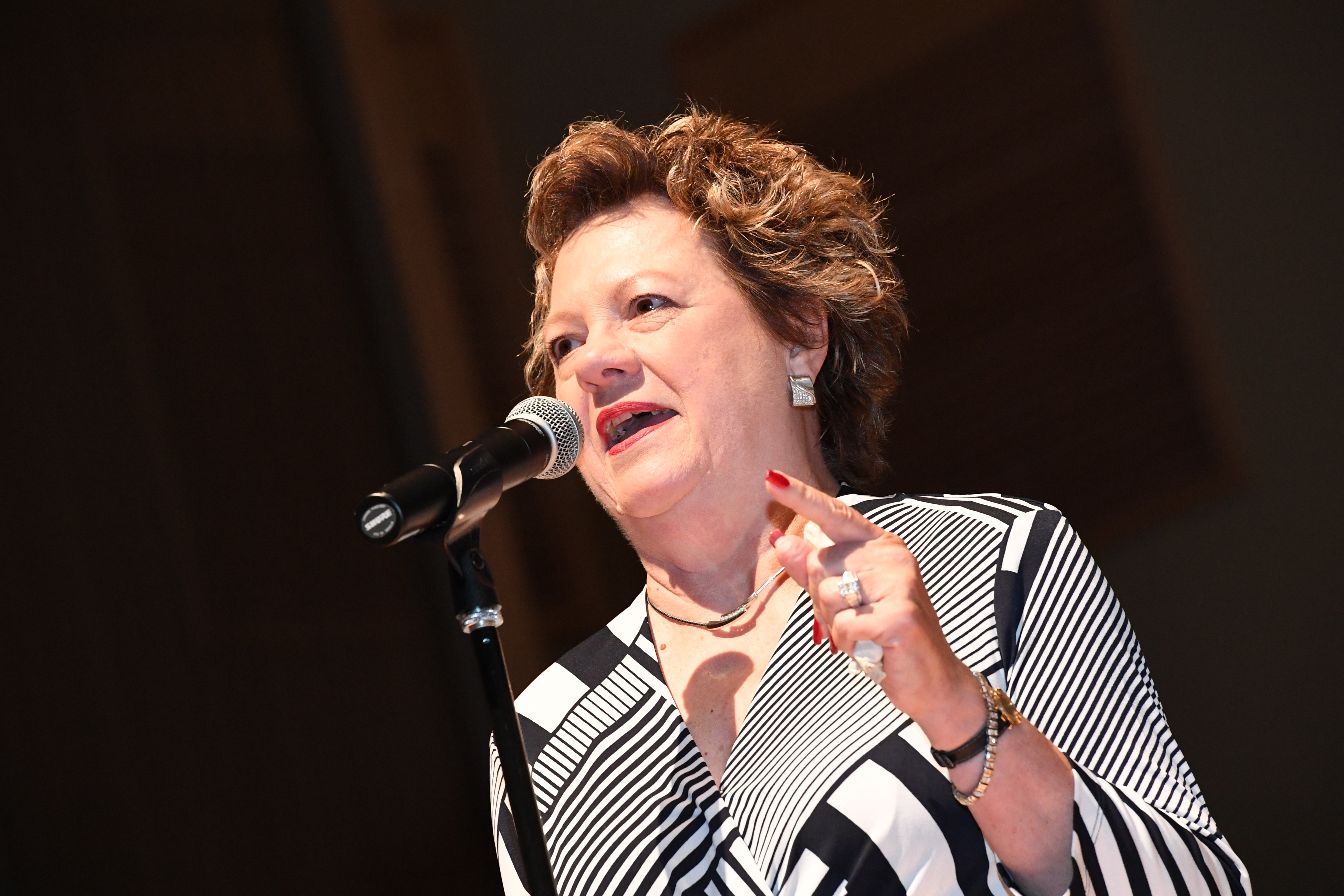
Header image: Simmona Simmons speaks at UMBC Stoop Stories event, September 17, 2016. All images by Jim Burger.
Through the collaboration, UMBC faculty and staff will serve as guest speakers in HCPSS high school classes and attend HCPSS professional development programs for computer science and technology educators. UMBC representatives will also inform Howard County students about engineering and information technology programs UMBC offers for both high school and college students. UMBC’s Center for Women in Technology, for example, offers programs for high school girls who are interested in pursuing engineering and information technology majors and careers.
Anupam Joshi, chair and professor of computer science and electrical engineering, hopes to engage more HCPSS students in the field of computing through the collaboration. “Nationwide, high schools have not traditionally thought of computing as a core STEM area, so many students have not had a chance to explore it as a potential STEM career path,” he explained. “Our partnership with HCPSS will help change that perception.”
One focus of the partnership is promoting STEM education and careers to students in underrepresented groups. “We’ll work together with HCPSS to expand and diversify the pipeline of students going into the computing discipline,” said Joshi.
The collaboration will also strengthen initiatives at both UMBC and HCPSS that work to eliminate achievement gaps among students, providing equal access to quality STEM educational opportunities for all students.
UMBC’s Antonio Moreira, vice provost for academic affairs, and Julie Ross, dean of the College of Engineering and Information Technology, joined Joshi in signing the partnership agreement on September 1. HCPSS representatives included Howard County Board of Education Vice Chairman Ellen Flynn Giles, board member Sandra French, HCPSS Executive Director of School Improvement and Administration Frank Eastham, and Career and Technology Education Coordinator Sharon Kramer.
Image: UMBC and HCPSS faculty and staff at the signing of the UMBC-HCPSS partnership agreement. Photo courtesy of HCPSS Partnerships Office.