
All posts by: Megan Hanks Mastrola


Changing role of IT impacts predictive analytics in higher ed

Over the past two decades, the rapid evolution and integration of technology in higher education has changed the work that information technology leaders do on campus. More than ever before, IT professionals can now collect and analyze data to develop new insights on educational approaches, tools, and programs, to track and improve them over time.

Jack Suess, vice president for information technology, has observed the roles and goals of IT shift notably over the  course of his career. In an essay on the higher ed news site The EvoLLLution, he writes, “during the 1995-2005 period, our information technology organization went from being focused on making certain basic technology functions work acceptably to one that required that we use IT as a strategic enabler.”

Suess suggests that IT officers at universities must work closely with current and emerging leaders on campus to support the broader goals of the institution. In this way, IT leaders serve as trusted advisors and relationship builders, and help articulate how the specific needs of departments align with larger strategic goals. “The IT leader then can translate how technology creates options and possibilities for the institution and how it can be utilized to maximum benefit,” Suess said.

A recent article in The Baltimore Sun describes how universities analyze data, such as grades, demographics, and swipe card use, to identify students who are at risk for dropping out, and to predict success and failures rates.

John Fritz, assistant vice president of instructional technology, found that students with A, B and C averages used Blackboard (an online assignment, discussion and grading platform) 40 percent more than students with D and F averages. He worked with Blackboard to develop the “Check My Activity” tool, which allows students to compare their Blackboard use and activity with their peers, anonymously. Students who utilized the tool are 1.5 to nearly 3 times more likely to earn at least a C, Fritz found through the research.

Read the full stories in The EvoLLLution and The Baltimore Sun.

Image: John Fritz. Photo by Marlayna Demond ‘11 for UMBC.
Maryland Dept. of Commerce recognizes Dean Julie Ross for advancing STEM education

In Baltimore, women hold approximately 31% of the positions in computer and mathematical fields, compared with the national average of 26.5% of women who hold positions in these areas. On MDBiz News, the Maryland Department of Commerce features a list of 20 leading women who are driving Maryland’s leadership in tech, including Julie Ross, UMBC’s dean of the College of Engineering and Information Technology (COEIT).

Through her work in at UMBC, Ross has helped advance UMBC’s reputation as a powerhouse in STEM fields. Before being named dean of COEIT, she was the chair of the department of chemical, biochemical and environmental engineering at UMBC. She has received external grants totaling nearly $13 million to advance her research and engineering education.

Two UMBC alumna were also included in the blog post. Linda Burger ‘86, information systems management, is the director of Technology Transfer Programs at the National Security Agency (NSA). Stephanie Hill ‘86, economics, is the vice president and general manager of Lockheed Martin’s Mission Systems & Training, Ship & Aviation Systems. Additionally, the piece features Zuly Gonzalez, CEO of Light Point Security, located at the bwtech@UMBC research park.

See the full list of featured leaders in the article “In Maryland, Women in Technology Thrive,” on the MD Biz News blog.

Image: Julie Ross. Photo by Marlayna Demond ’11 for UMBC.

UMBC Career Center director offers job search tips for new grads nationwide

According to the National Association of Colleges and Employers, the jobs outlook is improving for recent college graduates. In a new WalletHub feature, UMBC Career Center Director Christine Routzahn and fellow career experts around the country offer tips on the best next steps for these job seekers. Like her colleagues, Routzahn recommends that graduates pragmatically make sure that the work they plan to pursue is in demand in the location where they want to live. She also encourages job-seekers to broaden their perspectives and their searches, and to go in prepared but also know how to move forward after a setback.

Routzahn recommends that job seekers go outside of their comfort zone, and use their networks as they job search and more broadly explore career possibilities. “Identify alumni from your institution who currently reside in the area for informational interviews along with conducting your job search,” she says, adding that “face to face opportunities are ideal in making the best connections.”

She also encourages current students as well as alumni to contact their university career centers, which can offer advice related to job searches, resumes, and the interview process, as well as practice interviews and connections with employers who are actively hiring. For those who have not yet earned their degree, Routzahn strongly recommends internships, research, co-ops, service, and student leadership opportunities. “These opportunities develop your skills, confidence, network, and many times lead to full-time employment,” she says.

And what if, even with all that planning and preparation, a young job seeker makes a  mistake on their path to a dream career? Mistakes happen, Routzahn says. “It is important to own your mistakes and grow from them. Take initiative, listen and learn from others, understand the importance of a team, build your network and never stop learning.”

Read the full article on WalletHub, including Routzahn’s advice.

Image: Christine Routzahn, left, and Sue Plitt during the 2016 Presidential Faculty and Staff Awards Ceremony. Photo by Marlayna Demond ’11 for UMBC.

U.S. News STEM Solutions panels highlight UMBC’s focus on inclusive excellence, supporting students

UMBC President Freeman Hrabowski and Dean Julie Ross, of the College of Engineering and Information Technology, shared powerful insights on how to support student success during the U.S. News STEM Solutions Conference, held in Baltimore, May 18-20, 2016. The conference brought business, education, and government experts together to discuss the future of science, technology, engineering, and math (STEM) in society.

Michael Crow, president of Arizona State University, joined Hrabowski for the keynote panel focused on effectively supporting and retaining diverse students in STEM fields.  Changes to the nation’s education system are necessary to increase the diversity and graduation rates in STEM fields, and to show students that they can succeed in challenging areas, both leaders argued.

“The culture of our country is not one that teaches children…‘you can do this and it’s going to be hard’,” said Hrabowski.“The challenge we face in this country is to rethink culture, not just of science but of our nation, and who can succeed in these disciplines,” he noted, emphasizing the need to provide a combination of support and high standards that encourage children to learn through persistence.


Ross joined Kevin Moore, dean of the college of engineering and computational sciences at the Colorado Schools of Mines, and Karl Reid, executive director of the National Society of Black Engineers on the panelPriming the Pipeline: The Push for Diversity at Engineering Schools.” Their discussion focused on ways that schools can help students of all backgrounds succeed in engineering.

For UMBC, Ross explained, the goal is “inclusive excellence,” which goes beyond a commitment to “diversity” alone.

“Diversity is, ‘Who comes in our door, who do we enroll; who’s here?’,” said Ross. In contrast, “inclusiveness” prompts the questions, “‘What experience are those people having when they’re here? What is our climate?’…and the excellence piece is, ‘What are our outcomes?’”

Ross continued, “We have very high standards. It includes diversity, but it’s more than that. … Are our students from all different backgrounds being successful at equal rates?” Thanks to asking tough but essential questions like this, Ross explained, there is no gap in graduation rates between black and white students at UMBC.

Prior to taking the stage in the U.S. News STEM Solutions Conference, Ross provided details on UMBC’s approach to inclusive excellence, and efforts to increase faculty diversity to match the diversity of the student body, in the U.S. News article “Diversity Your Workforce: Leveraging the Employer-College Connection.

That article also explores the value of university partnerships with top employers, and the particular appeal that UMBC’s focus on inclusive excellence has for companies seeking academically exceptional students from diverse backgrounds. “We have a longstanding partnership with UMBC because it is a top engineering school that attracts many people of color and women as engineering majors,” Jennifer Boyd, vice president of talent management at Exelon Corporation, told U.S. News. The investment of time and effort in partnering with UMBC has paid off, she said, in the enthusiasm of students in response to recruiters.

Image: President Hrabowski. Photo by Marlayna Demond ’11 for UMBC.

Julie Ross explains how UMBC is preparing students for jobs of the future at Washington Post “Transformers” event

How do you prepare students for jobs that don’t exist yet? UMBC’s Julie Ross, dean of the College of Engineering and Information Technology, tackled this question alongside David Kenny, general manager of IBM Watson, during a panel conversation at the Washington Post’s “Transformers” event on May 18, 2016.

The conference brought together leaders in science, business and technology who are “pushing the boundaries of knowledge.” In addition to touching on the recent announcement of a new collaboration between UMBC and IBM, Ross and Kenny explored the future of artificial intelligence (AI) and how to effectively train students to work in AI and similarly fluid, quickly evolving fields.

“There’s only so much as humans that we can take in and process, in terms of information, and make sense of,” said Ross. She suggested that artificial intelligence can help people sift through massive amounts of information to find the patterns that can enable them to keep up with the rapid rate of change in today’s world.

Discussing the need for greater numbers of talented engineers and computer programmers, Ross explains how she particularly enjoys showing students the possibilities for STEM careers and encouraging them to persist in completing STEM degrees. “I get to talk to young people about all of the opportunities that are out there in engineering and the IT world, and try to help them understand what they can do in that space,” she said. “The opportunity right now is limitless.”

Colleges are now working  to give students the knowledge they need to be successful in today’s workforce, and also the tools to continue to learn and grow so they can tackle projects that have yet to be imagined, Ross explains. “The challenge for colleges and universities is to really step up and say ‘How do we train students today for those jobs that don’t exist yet, for those areas that we don’t know about yet? How do we get them ready for the thing that’s going to happen in 10 years or 20 years?’”

For Ross, it comes down to problem-solving skills and the ability to work on a team with people of diverse backgrounds. “Those types of skills,” she says, “are always going to be important.”


Read a recap of the event and watch the full panel discussion on The Washington Post (“UMBC Dean: Critical Thinking Never Goes Out of Vogue”). Ross’ remarks are referenced in a recent article in The Washington Post about artificial intelligence.

Image: Julie Ross. Photo by Marlayna Demond ’11 for UMBC.

Erin Lavik’s dynamic TEDxBroadway talk connects theatre and engineering

When Erin Lavik, professor of chemical, biochemical and environmental engineering, was pursuing her graduate degree, she was required to pursue a minor outside of her discipline, and she selected playwriting. Lavik found that teamwork was crucial to the success of theatre, and that it also translated well into the scientific field she was pursuing, she explained in her recent TEDx Broadway talk “Genius Is Created Through Collaboration.

“Theatre is the greatest gift you can give an aspiring scientist because theatre is dreaming realized,” Lavik said. She shared that she watched people come together with big ideas about stories, lights, and sound, only to surpass their dreams and the dreams of others around them as they moved forward with the creative process.

Lavik discussed how collaboration is crucial in the scientific discovery process, just as it is essential to a successful production in theatre, and she described how teamwork has impacted her research. She also addressed common stereotypes about the personalities and tendencies of scientists, including that they are male, work in isolation late into the night, and are odd or strange, and said that these stereotypes need to be broken. 

She points out that as young children we are all scientists, and, as we grow into adulthood and pursue careers, there is great value in continuing to support the intense curiosity and willingness to experiment and learn that children often demonstrate.

As a student interested in pursuing engineering, Lavik said, “Knowing that I could work with other people”that science didn’t need to be a solitary enterprise“made it a little less scary. And I went to college of be an engineer so that I could learn about science and apply it to big problems.”

The big problem that Lavik and her team are working on now is determining how to protect and repair the brain and spinal cord after injury, with a focus on stopping internal bleeding.

“I don’t know if our material will ultimately work in humans,” she said. “But I am absolutely and utterly sure that we wouldn’t have gotten to this point if it wasn’t for the fact that we have a whole team.”


A brief recap about Lavik’s talk is included on Broadway World.

Image: Erin Lavik presenting during TEDxBroadway. Photo by TEDxBroadway, CC BY-NC-ND 2.0

What’s a “cyberbomb?” UMBC cybersecurity experts explain in Scientific American

U.S. Deputy Defense Secretary Robert Work recently spoke about cyberwarfare and U.S. efforts to fight online security threats, leaving analysts wondering about the nature of today’s battles in cyberspace. UMBC’s Anupam Joshi and Rick Forno  shed light on this world in a new Scientific American article that explains how online tactics known as “cyberbombs” work to prevent potential attacks, or could potentially be directed at U.S. targets.

Joshi is director of UMBC’s Center for Cybersecurity and professor and chair of the department of computer science and electrical engineering, and Forno serves as assistant director of the UMBC Center for Cybersecurity and director of UMBC’s graduate program in cybersecurity.

Cyberattacks can disrupt essential components of infrastructure people use every day, from cell phone networks to electric network generators, Joshi and Forno explain. They point out that “a ‘cyberbomb’ is not a single weapon,” but rather a collection of computer hardware and software that can be used to protect against cyber threats. This work might involve a broad range of professionals, including technological experts, military strategists, researchers, policy analysts, and lawyers, and as technology changes so do cyber weapons and tactics.

“We can analyze the underlying technologies and look at the global strategic considerations of those of those seeking to wage cyber warfare,” Joshi and Forno write. “That work allows us to offer ideas about cyber weapons and how they might be used.”

Read the full article, “America is ‘dropping cyberbombs’but how do they work?” originally published in The Conversation. The original article was also mentioned in Tech Republic.

Images: Anupam Joshi presenting during cybersecurity forum hosted by the School of Public Policy. Photo by Marlayna Demond ’11 for UMBC. 

Marc Olano explains how technology changes the way that we think about reality at TEDx event

Marc Olano, associate professor of computer science and electrical engineering, offered attendees of TEDxTowson 2016 a look into how technology has changed the way we perceive reality. “New technology has started blurring the lines between the real and the virtual,” he said at the May 5 event.

Olano walked his audience through the adoption of new technologies, from the “experimental stage” of their development, to being increasingly available but still very expensive and largely inaccessible, to becoming commonly available.

3D printers took center stage in Olano’s talk, and he began by showing the audience an item made by a 3D printer in the late 1980s, when the end product was much less important than the basic achievement of printing in 3D. “I have absolutely no idea what this thing is, but hey, it was made by a 3D printer,” he shared. “It is something that did not exist before, was a virtual object, and was 3D printed.”

The 3D printers available now are more durable and precise than those that existed a few decades ago, and much more common. Today, the fact that someone makes a 3D print is not tremendously exciting, Olano suggested, it’s all about what materials they are using, what they are making, and how that item can be used.

A tactile graph, developed at UMBC by Amy Hurst, assistant professor of information systems, is one example of a 3D-printed item that serves a interesting and important purpose, Olano explained, showing the graph to the audience. The object allows people without sight to understand how graphs are used to communicate information, as well as conveying the data in the graph itself.

In addition to exploring how 3D printers turn virtual objects into real, tangible objects, Olano discussed advances in virtual reality (VR) technologies. VR, he explained, allows a person to become immersed in a new world. VR goggles are a common way to create this experience and are becoming increasingly sophisticated and accessible. “It can give you that convincing sense of presence,” he said.

Watch Olano’s full TEDxTowson talk. (His talk begins around 44:30.)

Images: Marc Olano during the opening of the 3D Scanning Room at UMBC. Photo by Marlayna Demond ’11 for UMBC. 

Baltimore Sun highlights UMBC in special section on education, focusing on career preparation and accessible technologies

With intense competition in today’s workforce for entry-level professional positions, internships are a popular way for students to get experience and contribute to companies and government agencies during their undergrad years, and to make the connections that can help them secure a job that matches their skills and interests. Caroline Baker, assistant vice president of careers and corporate partnerships, recently told The Baltimore Sun that employers are also competing with each other to hire top students, particularly in fields such as computer science, information systems, and cybersecurity.

“Because of the demand in hiring, we know that there are great jobs for these students,” she says, noting that UMBC is working to generate more student interest in these fields, especially among women. “We’re trying to break down the perception that cybersecurity professionals work alone in a dark room looking for hackers.”

Employers are hiring students as interns earlier in their college careers to provide them with more in-depth experience in core areas and entice them to consider full-time positions post-graduation. Baker says that previously internships were offered to juniors and seniors only, but recently she has seen sophomores and even some freshmen who have been offered competitive internships.

“It used to be unusual, but now companies are offering jobs at the end of internships,” Baker says. “The competition for talent is high.”

The special Baltimore Sun issue on education that highlighted UMBC’s Career Center also included articles focusing on UMBC’s robust teacher training program and 3D printing.

For future teachers, training to engage with and support diverse student populations is essential. UMBC’s Sherman STEM Teacher Scholars Program addresses the need for highly qualified math and science teachers who also understand the diverse populations that they serve, explains Rehana Shafi, director of the program.

“We support science and math majors who want to be K-12 teachers with professional development in culturally competent practices and offer applied learning in local urban settings,” Shafi says.

The Sherman STEM Teachers Scholars Program also offers support to alumni of the program when they enter the teaching workforce. “We help them see what they’re doing well, and talk about what’s going on in the schools,” she explains.

After Sherman alumnus Corey Carter ’08, biological sciences, ’10 M.A.T., was selected as 2016 Baltimore County Public Schools (BCPS) Teacher of the Year in April, Shafi noted, “Corey’s journey is a wonderful example of why the support provided by the Sherman Scholars Program, both during a student’s time at UMBC and during their first few years teaching, is so important.”

The Sun highlighted the assistive technology work of Amy Hurst, assistant professor of information systems, and her students, in the article “Humanizing Technology.” Hurst’s Prototyping and Design (PAD) lab at UMBC focuses on creating tools to help people with disabilities engineer technologies to fit their needs. William Easley ‘13, information systems, ‘15 ‘M.S. and ‘22 Ph.D., human centered computing; and Erin Buehler ‘14, M.S. and ‘18 Ph.D., human centered computing, taught a class in the Students United for Campus-Community Engagement for Post-Secondary Success (SUCCESS) program, which enabled students with disabilities to design 3D models and learn to operate a 3D printer.

The team is now looking at ways users with different cognitive abilities can use create 3D models as a drawing, mold or form.

“There’s a lot of misconceptions about the level of ability needed to use 3D printersthat you need an engineering background,” says Easley. “But we taught them the basics of 3D printing and the class created their own 3D print shop on campus. In the end, nobody became an expert, but everyone had designed their own model and [participants] were able to print with minimal assistance.”

Read the full education section in The Baltimore Sun.

Sarah Leupen receives Fulbright award to teach evidence-based science pedagogy at Czech medical school

Sarah Leupen, senior lecturer in biological sciences, has received a Fulbright award as part of the Core Fulbright U.S. Scholar Program. She will teach and facilitate faculty development at Charles University Medical School in the Czech Republic for the 2016-17 academic year. While in the Czech Republic, she will teach courses in physiology, nutrition, and reproduction at the Charles University Medical School, and will train faculty in the use of evidence-based teaching practices in medical school science courses on topics including nutrition, reproduction, and neurobiology.

Leupen will focus on transitioning medical school courses from traditional lecture-focused methods to more learner-centered, evidence-based pedagogical approaches. She explains that faculty can be hesitant to integrate teaching methods beyond the lecture formats they were exposed to as students, often due to lack of experience with alternative approaches or knowledge of current research on how people learn best.

Leupen will lead monthly discussions for faculty at the medical school based on articles about university science pedagogy. “Exposing faculty to that evidence is often the key component to increasing their willingness to try new approaches to teaching,” she explains.

This Fulbright opportunity will also enable Leupen to learn more about the history and tradition of teaching methods used in the Czech Republic, and how they relate to teaching approaches from elsewhere in the world. She looks forward to connecting with “faculty whose style, approach, goals, level, or topic is different” from her own.

Image: Sarah Leupen. Photo by Marlayna Demond ’11 for UMBC.

UMBC and IBM Research launch Accelerated Cognitive Cybersecurity Lab

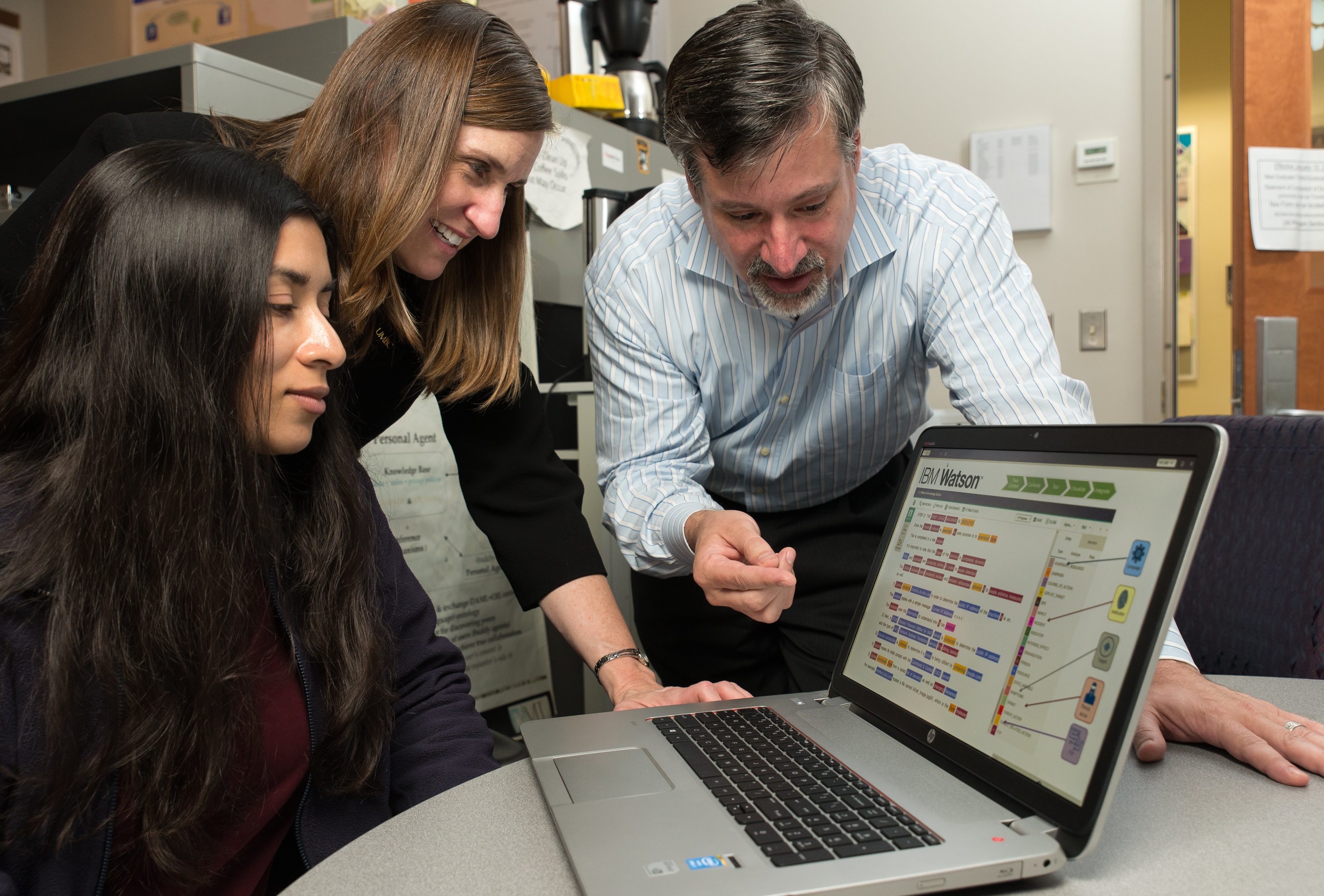
UMBC and IBM Research have announced an exciting new collaboration to create the Accelerated Cognitive Cybersecurity Lab (ACCL), opening at UMBC in fall 2016. Housed within the College of Engineering and Information Technology, the ACCL will advance scientific frontiers in cybersecurity and machine learning. The new lab is supported by a multi-year commitment from IBM.

“UMBC faculty and students in the College of Engineering and Information Technology are excited to expand our work on global scientific and cybersecurity challenges in collaboration with world class partners like IBM,” says Julie Ross, dean of the UMBC’s College of Engineering and Information Technology.

Anupam Joshi, director of UMBC’s Center for Cybersecurity and chair of computer science and electrical engineering, will lead the ACCL. Building on prior research, faculty and students working in the ACCL will apply cognitive computing to complex challenges in the rapidly expanding field of cybersecurity. They will collaborate with IBM scientists and leverage IBM’s advanced computing systems to add speed and scale to the cybersecurity solutions they develop.

UMBC is also one of eight universities working to train IBM’s Watson computer system, internationally famous for its capacity to answer questions delivered in natural language, for application in the cybersecurity sphere. This work seeks to increase the capacity of cybersecurity professionals to quickly detect and respond to emerging threats. The other universities involved with training Watson include California State Polytechnic University, Pomona; Pennsylvania State University; Massachusetts Institute of Technology; New York University; the University of New Brunswick; the University of Ottawa, and the University of Waterloo.

Beyond moving forward a research mission with great public impact, the ACCL collaboration will also help IBM establish itself as an employer of choice for UMBC graduate and undergraduate students.

Joshi shares, “This collaboration will allow our students and faculty to work with IBM to advance the state-of-the-art in cognitive computing and cybersecurity.”

Update: UMBC is one of six institutions working with IBM as part of the Cognitive Horizons Network.

Media coverage:
The Washington Post: IBM is training Watson to hunt hackers
Fortune: IBM Watson brings AI wonders to cybersecurity
Baltimore Business Journal: UMBC partners with IBM Research for cybersecurity lab
The Daily Record: UMBC to help IBM’s Watson fight cybercrime
Tech Times: IBM Research And UMBC Team Up To Create Cognitive Computing Cybersecurity Lab
International Business Times: IBM Watson supercomputer teams up with top universities to fight cybercriminals
Christian Science Monitor: Can IBM’s Watson fight cybercrime?

Image: Anupam Joshi and Yelena Yesha working with several UMBC students, top; Ph.D. student Lisa Mathews, Dean Julie Ross, and IBM’s Jeb Linton (l-r) view a Watson interface, second photo. Photos by Mitro Hood/Feature Photo Service.

Device to prevent head trauma in baseball wins 2016 Cangialosi Business Innovation Competition

Mechanical engineering majors Andrew Wallace ‘16, Michael Torres ‘16, Stefan Wroblewski ‘16, Jezron Basbas ‘16, and Baruch Weiner ‘16 have won top prize in the 2016 Cangialosi Business Innovation Competition (CBIC) for Preventing Injuries, Trauma and Cracks to the Head (PITCH), a lightweight protective device designed to reduce head trauma and skull fractures in baseball players.

The competition, hosted by the Alex. Brown Center for Entrepreneurship, is supported by Greg Cangialosi ‘96, English, a leading Baltimore entrepreneur. “My goal in creating this competition was to connect our students with mentors who are off campus, actively running companies, or investing in startups,” he says. “It is important for them to know, while they are still in school, that the Baltimore region is thriving as an innovation ecosystem and here to develop and support the next generation of entrepreneurs.”Vivian Armor

The CBIC allows students to experience and plan a start-up company, explains Vivian Armor ‘73, American studies, director of the Alex. Brown Center for Entrepreneurship. “The CBIC targets students who are serious about starting a business in the near future, and the goal is to provide them with mentors, potential seed funding and networking opportunities to help them take their idea to the next level,” she says.

This year, 30 ideas were submitted, and seven of those ideas were selected for the final competition by a panel of judges from various Baltimore-area employers. Business mentors worked with each team to help develop and refine their idea before the final competition was held.

Second place went to an app called SupplySense, which uses sensors to track product inventory in a way that can help business function more strategically and efficiently. The idea was created by Filip Dabek ‘13, ‘14 M.S., and ‘21 Ph.D., computer science.

Third place was awarded to Aerwell, a device that extracts clean, pure water from humidity in the air to provide fresh water and sustainable energy. The Aerwell team includes Alexis Walmsley ‘16, music; Marios Levi ‘19, mechanical engineering; Bedford Boylston ‘16, interdisciplinary studies; Terry Wasserleben ‘17, computer engineering; and Arthur Schorr ‘17, media and communications studies and visual arts.

The top three teams were given cash awards, and membership in Betamore, a Baltimore-based incubator and educational facility, which Cangialosi cofounded.

The prizes themselves are designed to help students explore what it would mean to take their business ideas to the next level. Armor explains that the competition is “meant to be a real world experience to get them thinking about what is involved in planning and launching a business.”

Greg Cangialosi“The CBIC was designed for those students who are truly going to go after the dream of entrepreneurship,” says Cangialosi. “Now, in its third year, it’s exciting to see how alive and vibrant entrepreneurship is at UMBC.”

Image: The PITCH team with Greg Cangialosi, left to right: Michael Torres, Jezron Basbas, Greg Cangialosi, Stefan Wroblewski and Andrew Wallace; missing Baruch Weiner; top. Vivian Armor, director of the Alex. Brown Center of Entrepreneurship; middle. Greg Cangialosi at a UMBC event, bottom. Photos courtesy of the Alex. Brown Center for Entrepreneurship (top), and Marlayna Demond ’11 for UMBC (middle and bottom).